Riding Coach Through Atlas Shrugged. Chapter 1: The Calendar Hung Itself.

50th Anniversary Edition pages 11-20*

*Note: The actual chapter ends on page 33 but I am splitting these up based on POV changes for easier digestibility.

Chapter Summary: White-collar worker Eddie Willars runs into a peculiar homeless man, reflects on a decaying city, and attempts to convince his boss of an urgent matter in Colorado.

My initial impressions are all pretty positive. The opening line: “Who is John Galt?” accomplishes everything an opening should and most importantly sets up a mystery to pique the reader’s interest.

Even with my limited knowledge of small parts of this book I was still immediately hooked by the questions presented on the first page: “Who is John Galt?”, “Why does it [the above question] bother you?”, and without missing a beat (or answering those questions) Rand describes the world that frames these questions quite beautifully with several potent, if a bit obvious, metaphors.

The bum as the faceless masses, intelligent but wearied and cynical without the energy to change their station but able to if inspired. “The face was wind-browned, cut by lines of weariness and cynical resignation; the eyes were intelligent.”

It also seems to be relevant that the bum is our introduction to the character of John Galt. The nameless, faceless masses knowing about the coming change almost instinctively and long before the more comfortable and well off middle class.

The city, in my estimation, represents society as a whole. Once beautiful but now decaying and, like the old tree on the Taggart estate, hollow and rotting from within. “…the shafts of skyscrapers against them were turning brown, like an old painting in oil, the color of a fading masterpiece.” The seed of beauty and triumph is there but it has rotted from within.

Eddie is who really intrigued me though; he reminded me a lot of Tolstoy’s Ivan Ilyich. A middle man in society who knows something is wrong but doesn’t have the skills to do anything about it. While he cannot identify the sinking feeling that permeates every fiber of his being he does have a stable foundation to latch onto.

“When he was asked what he wanted to do [in life], he answered at once, “whatever is right”…”twenty two years ago. He had kept that statement unchallenged ever since; the other questions had faded in his mind…[B]ut he still thought it self evident that one had to do what was right; he had never learned how people could want to do otherwise.”

As a natural-rights libertarian I believe that there are absolute moral and ethical truths and Eddie’s commitment to a similar personal philosophy deepened my ability to relate to the character. It also stands in stark contrast to more modern interpretations of ethics such as “rule utilitarianism” which will always decay to subjective act-utilitarianism.

“David Lyons argued that collapse occurs because for any given rule, in the case where breaking the rule produces more utility, the rule can be sophisticated by the addition of a sub-rule that handles cases like the exception. This process holds for all cases of exceptions, and so the ‘rules’ will have as many ‘sub-rules’ as there are exceptional cases, which, in the end, makes an agent seek out whatever outcome produces the maximum utility.”

In short, any attempt to prevent the “ends justify the means” outcome of utilitarian ethics, without some sort of higher moral authority, inevitably fails and the system is reduced to one of pure utilitarianism. I was actually under the impression that Rand was a bit of a utilitarian herself so I will be interested to see if this commitment to the universal “right” turns out to be a character flaw in Eddie or whether it remains an ideal to be upheld.

Eddie’s confrontation with James Taggart was also quite inspiring. A man who knows he is stepping out of line but is willing to do so for the sake of his personal convictions is an ideal that many of us could due to imitate. I will save my examination of James until the next installment but the important thing I took from this interaction between James and Eddie was how uncomfortable James grew when Eddie looked into his eyes.

“What Taggart disliked about Eddie Willars was this habit of looking straight into people’s eyes. Eddie’s eyes were blue, wide and questioning; he had blond hair and a square face, unremarkable except for that look of scrupulous attentiveness and open, puzzled wonder.”

If, as I suspect, Eddie is the everyman (or reader avatar) in this story and James is an (the?) antagonist then what I am supposed to take from this is that the villains in this world, and in ours, cannot stand up to scrutiny. They are filled with uneasiness when we examine their actions and question their motivations. If Eddie is an ideal, then his attentiveness is an ideal as well.

Eddie’s relationship with the Taggarts as a whole is something I hope is explored more. It is obvious he admires and respects Dagny since they grew up together and the fact that he still has some sort of respect for James leads me to believe that the latter wasn’t always so insufferable. What made Eddie so devoted to this family? Was it simply their entrepreneurial spirit or was there something more?

I had a few small criticisms but I am going to have to wait to see how they play out. As I mentioned briefly at the start of this entry Rand’s metaphors were really straight forward which isn’t bad in and of itself but simply something I am taking note of and will look for as the chapters go by.

I cringed a bit when Eddie admitted that he was simply a serf pledged to the Taggart lands. The whole feudalism angle is one that I am going to keep an eye on since one of the most common attacks on libertarianism is that it would descend into a neo-feudal corporatist society.

Of course I may be taking the line a bit too seriously since Eddie was simply trying to get James to agree to his requests to support the Rio Norte line. In fact it could very well turn out to be a rebuke of that attack once all is said and done.

Finally I have no idea what the giant calendar is supposed to represent or foreshadow. Perhaps it is simply a literal translation of the city’s days being numbered which would both be very clever and kind of groan-worthy at the same time. Hopefully Eddie shows up again soon to let us know but I have a sneaking suspicion that our protagonist isn’t Mr. Willars despite my initial preoccupation with his character.

Check in next time for first impressions of Dagny, a word of support for monopolies, and our first real look at James Taggart. I wish this was a George R.R. Martin novel so maybe he would be dead before the book was over. Hey, I never said I would be impartial.


Part 2

Into the ear of every anarchist that sleeps but doesn’t dream…

We must sing, We must sing,We must sing…


There is no libertarian art.

Well, that is a slight exaggeration, but not much of one. Art is a vital part to any social movement and it is one area where libertarians suffer immensely. Sure there are libertarian leaning authors such as Robert Heinlein and modern Austrian economic art like the guys over at www.econstories.tv but for the most part there are few non-academic ways to inspire potential libertarians.

This is a problem I lament when I am feeling negative about the prospects for a free society which, to be fair, is usually the case. Sometimes reading an article about Intellectual Property just isn’t enough to get the passion flowing.

“But Wait!” You say, “you failed to mention the author who brought tens of thousands of people into the libertarian fold. The late, the great, the Ayn Rand!”


….yea about that.


I don’t like Ayn Rand. There, I said it. Bring out the pitchforks and tie me to a Rearden Steel railroad track if you must but I stand by my statement. Now I know what you are all thinking: “But her works exemplify the individual freedoms that a libertarian society should strive for!” or “Dagny is a strong independent woman who don’t need no government!”

Yes, I am aware, but it isn’t Ayn Rand the author I dislike. Actually it isn’t even Ayn Rand the person that I dislike. I don’t like the idea of Ayn Rand. The metaphysical zeitgeist that surrounds and worships her throughout every circle of the libertarian movement from Walter Block to Milton Friedman to every other subscriber on www.reddit.com/r/libertarian.

All too often I have had to argue about libertarianism through the lens of someone whose only exposure to the philosophy is Ayn Rand and the objectivist selfishness that nearly everyone associates with capitalism. In short, I think she is bad for libertarianism and provides no end of ammunition that can be used against those of us with a more nuanced moral/ethical position.

Here is the kicker though. I have not read a single Ayn Rand novel. Not Anthem, not the Fountainhead, and especially not her magnum opus Atlas Shrugged. My knowledge of her works (outside of objectivist philosophy) comes mostly through a bit of osmosis during many diatribes in my conversion to libertarian thought and the first few chapters of Anthem I read in high school before being bored to tears.

I feel that my lack of personal experience with the work of Ayn Rand is a great injustice to someone so influential to many (but certainly not all) of the ideals that I hold so dear and maybe, just maybe, I can siphon off some of the passion that so many others feel when reading her novels.

So it is my objective to spend the next several weeks (months perhaps) reading Atlas Shrugged along with you, the faithful readers here at www.notesonliberty.com, and recording chapter based summaries of my thoughts, opinions, and analysis from a literary, ethical, and philosophical standpoint. These will be full of personal anecdotes and armchair analysis so be prepared for a tumultuous ride through one of the “great?” works of the 20th century.

Part one of many comes tomorrow morning.

The Origin of Expression “Nazi” and How it was Introduced into English Usage

My hearty greetings to the Notes on Liberty “tribe” and special thanks to Brandon for inviting me to become part of this forum. I would like to share with you my side project that recently mutated into an article submitted to Independent Review. Last June, I was doing research in Vienna, Austria, working on a totally different topic (Mongol-Tibetan religious prophecies (Shambhala and the like) and their perceptions by Westerners). Taking advantage of my stay in that gorgeous city, in my spare time, I visited local museums and various prominent landmarks.

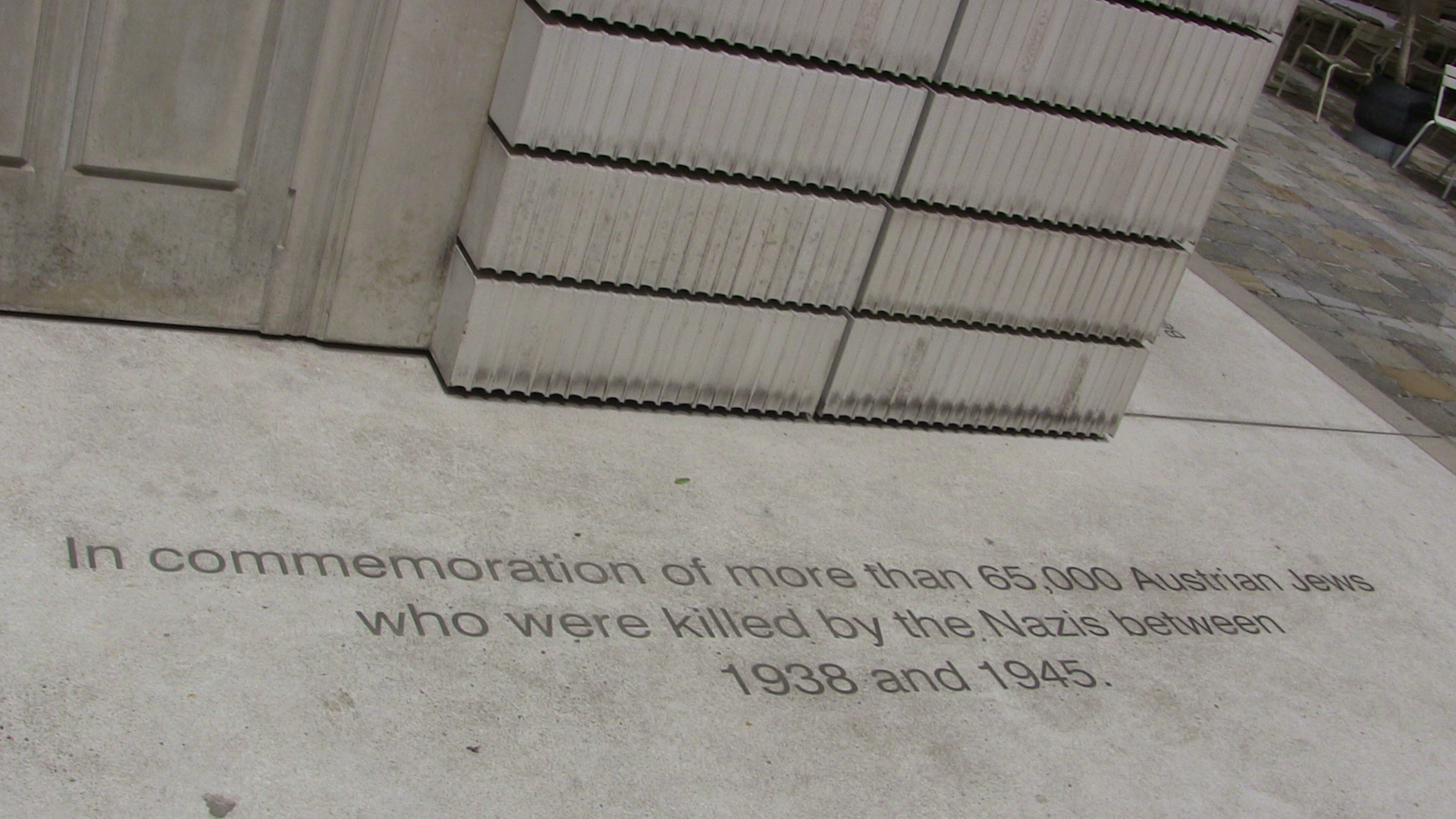
Thus, I strolled into so-called Jewish Plaza in downtown Vienna. The place has a monument that commemorates the memory of 65,000 Austrian Jews murdered by Hitler’s regime during World War II. In fact, I briefly visited this place earlier during one of my previous trips to Vienna. Yet, now looking at three identical inscriptions in three languages at the foundation of the monument I noticed something that earlier had not caught my attention. The inscription on the left is in German, the one on the right is in English, and the one in the middle is in Hebrew. The German one says, “In commemoration of more than 65,000 Austrian Jews who were killed by the National Socialists between 1938 and 1945.” So does the Hebrew one in the middle. Yet, the English version reads: “In commemoration of more than 65,000 Austrian Jews who were killed by the Nazis between 1938 and 1945.”

IMG_0687

IMG_0694

IMG_0698

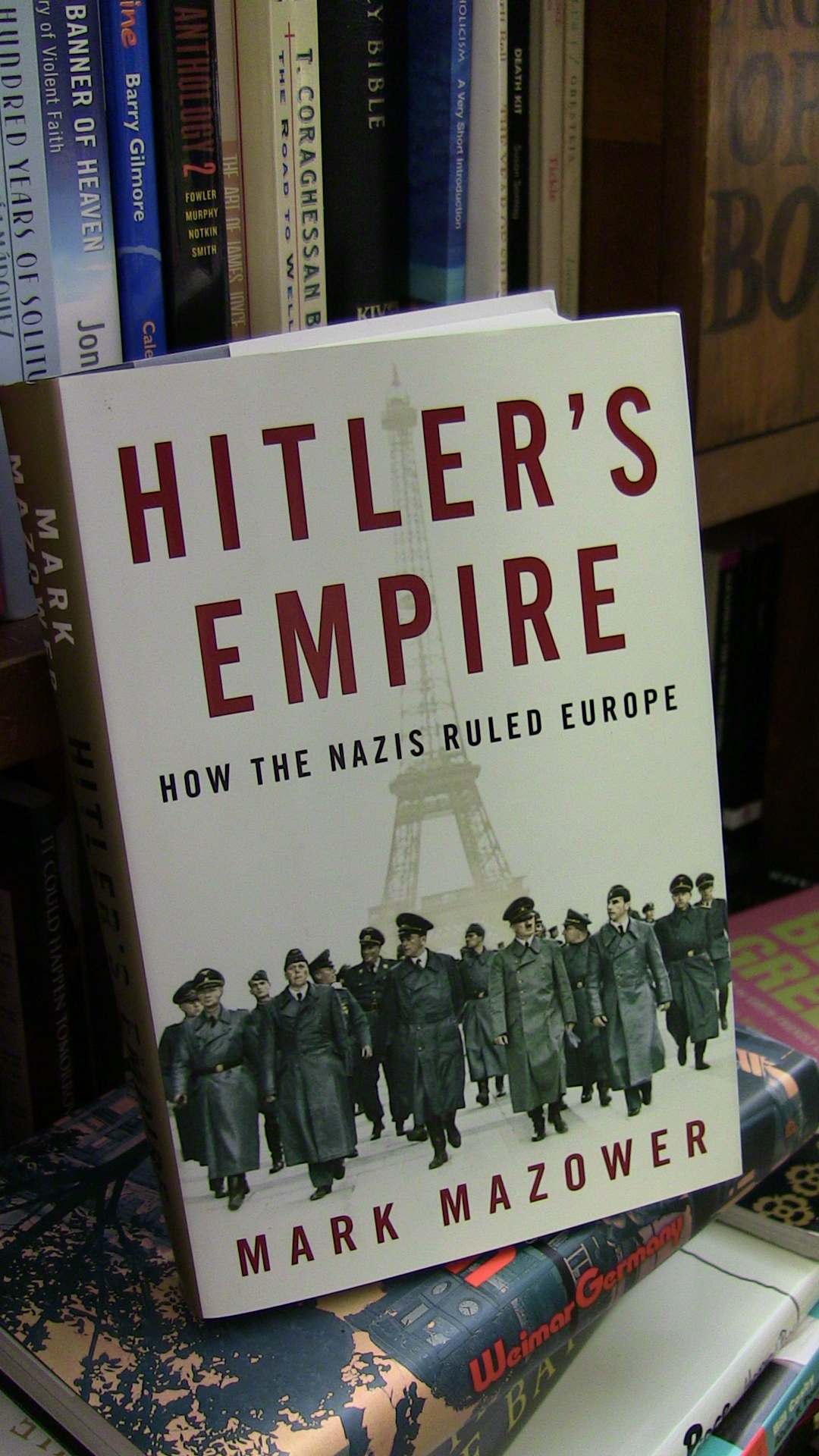
The same day I happened to go to Thalia, the biggest bookstore in Vienna. There, browsing shelves with social science and humanities literature that I stumbled upon a German translation of Hitler’s Empire: How the Nazis Ruled Europe, a 2009 book by the noted American historian Mark Mazower. The German edition of that book, which has the same cover picture, reads Hitlers Imperium: Europa unter der Herrschaft des Nationalsozialismus [Hitler’s Empire: Europe under the National Socialism Rule.]

IMG_0951IMG_0855

So I became curious about this linguistic discrepancy. Eventually, my curiosity took me further and further. The first thing one notices is that when English-speaking people write and talk about the 1930s-1940s’ Germany, more often than not they routinely use the word “Nazi.” Thus, in English we have books and articles about Nazi economy, Nazi labor policy, Nazi geopolitics, Nazi genetics, and so forth. In contrast, when Germans refer to the same turbulent years, they usually say “National Socialism” (Nazionalsozialismus).

So here is the result of my quest – an attempt to answer why in English we use “Nazi” and also who and why introduced this expression in English. The article has not been published yet. At first, I decided to prepare a brief digest of that paper and post it on this forum. Then I changed my mind. To make things more interesting, I decided to prepare a small multimedia audio presentation about why, how, and when the expression “Nazi” emerged in the first place and how it was introduced in English language and post it as a 20-minute video clip on my YouTube channel maguswest. Here it is:

National Socialists into Nazi: Politics and the English Language

A good friend of mine, who is an excellent narrator, assisted me in this. Click this link to see/listen to this talk and, if you wish, give me your critical feedback: Do not skip the ending of the clip, for it features a music tune (so-called Aviation march) that was shared by both Soviet Stalinist and National Socialist marching bands in the 1930s (words are different but music is the same).

Entendiendo la inmigración a los Estados Unidos

El día de hoy murieron una o dos personas intentando cruzar la frontera entre México y Estados Unidos. El número de fallecidos es, sin embargo, ignorado pues la mayoría de la información existente sobre la situación migratoria en el sur de Estados Unidos se encuentra oculta por un manto de ignorancia y desinterés político crónico que ha desgastado los incentivos para discutir y explorar el tema migratorio.

Los datos provistos por el gobierno de los Estados Unidos de América son, sin embargo, alarmantes. Desde octubre, 2013 hasta junio de este año más de 52,000 niños sin acompañantes alcanzaron la fronteras superando en un 200% la cantidad reportada por el gobierno el año anterior.  Se espera que en el año 2014 más de 70,000 niños intentaran cruzar la frontera.

Tres niñas en vestido de quinceañeras juegan en Tijuana al lado del muro de la frontera México-USA. Fotografía: Romel Jacinto. Flickr. CC.
Tres niñas en vestido de quinceañeras juegan en Tijuana al lado del muro de la frontera México-USA.
Fotografía: Romel Jacinto. Flickr. CC.

La crisis aumentó cuando las imágenes de niños en campos de deportación empezaron a ser compartidas en las redes noticiosas y redes sociales. El gobierno de Barack Obama (quien ganó el premio Nobel de la Paz en el año 2009) reaccionó solicitando al Congreso de los Estados Unidos la cantidad de US$3,700 millones para empezar a responder a la emergencia humanitaria. El plan, en general, es una campaña cortoplacista que busca apaciguar las aguas en espera de que los medios de comunicación se interesen por otros temas.

En los países centroamericanos (la región de donde provienen la mayoría de estos niños) los gobiernos también reaccionaron rápidamente solicitando recursos económicos para financiar campañas de ‘educación’ y ‘concientización’ sobre las amenazas que representa realizar el viaje de alrededor de 2,000 millas. Estos gobiernos también reaccionan en espera de que la atención de este urgente problema se desvíe hacia los otros problemas cotidianos de seguridad, hambre, corrupción, insalubridad y pobreza que afectan la región.

La única solución para frenar esta crisis humanitaria, sin embargo, está muy lejos o es prácticamente imposible de conseguir si las condiciones globales actuales no cambian. Además, la solución a la situación migratoria requerirá que acciones legales, económicas y sociales sean tomadas en los países de Estados Unidos, México y Centro América para encontrar respuestas a largo plazo en estos países. De no hacerse nada, la actual situación migratoria continuará sin solucionarse de la misma manera en que la Guerra contra las Drogas continúa año con año aumentando.

Actualmente, la reforma migratoria no será discutida en el Congreso de los Estados Unidos de América y las acciones necesarias para atacar el flujo originario de inmigrantes indocumentados en los países de origen implican un reto dantesco. Los migrantes centroamericanos viajan al norte en busca de empleos y escapando de la violencia en la que fue inmersa el Istmo Centroamericano desde finales del siglo XX por el crecimiento del crimen organizado, las mafias del narcotráfico y la incapacidad de los gobiernos por afrontar los cambios globales fomentando un desarrollo económico sostenible para responder a las demandas de la economía mundial.

A pesar de la firma de un tratado de comercio regulado entre Estados Unidos y Centroamérica en el año 2005 conocido como DR-CAFTA, los países centroamericanos han sido incapaces de aprovechar las ventajas competitivas del tratado y los beneficios han sido para tan solo algunos sectores económicos.

Inmigrantes hondureños y salvadoreños que cruzaron la frontera entre Mexico-USA detenidos en Tejas.  Fotografía: Eric Gay/AP
Inmigrantes hondureños y salvadoreños que cruzaron la frontera entre Mexico-USA detenidos en Tejas.
Fotografía: Eric Gay/AP

Pero no crea estimado lector que la batalla está totalmente perdida para las miles de personas que buscan mejorar sus condiciones de vida mediante la migración forzosa de la que son víctimas. A continuación les comparto algunos estudios y ensayos que analizan el tema y profundizan en la compleja situación migratoria que enfrenta el continente americano. Al final del día, es solo educándonos y compartiendo el conocimiento adquirido que podremos contribuir a la búsqueda de soluciones a este tema migratorio que hasta el día de hoy ha sido detenido por una filosofía política inmoral y inhumana.

Ensayos:

Libros:

My REASON review on the Panic of 1837

My review of Jessica Lepler’s The Many Panics of 1837: People, Politics, and the Creation of a Transatlantic Financial Crisis appears in the July issue of Reason. It has now been posted online.

Only after agreeing to review the book and receiving my copy, did I realize that Lepler’s study was far too academic and specialized for the typical Reason reader. But previously, when they had asked me to review Thomas Fleming’s Civil War book (A Disease of the Public Mind) and I had agreed, it turned out to be an awful example of cliche-ridden, superficial pop history at its worst. So I told them it wasn’t worth reviewing, and I didn’t consider it wise to do that again with the Lepler book, even though it would have been for the exact opposite reason.

A much better, recent book on the panic of 1837, despite my disagreeing with most of its interpretations, is Alasdair Roberts’s America’s First Great Depression: Economic Crisis and Political Disorder after the Panic of 1837 (2013). I mentioned it in the first draft of my Lepler review, but it was in a section that Reason edited out.

Bear With Me

I am neglecting this blog a little because I am putting together a new thin book of stories in French. It’s going to be called: “Les pumas de grande banlieue.” It means the “Suburban Mountain Lions.” At this point, it’s only for electronic publication.

Please, bear with me. I will be back. You might want to forage through my archives in the meantime. They are worth it. (My best blog work is probably behind me.)  I recommend especially my series of 8 or 9 essays on protectionism. They have lost no validity and they are especially intended  for the intelligent ignorant. They require no knowledge of economics or of economics jargon. I am also pleased with my few essays on fascism, a topical subject right now. They are addressed to the same kind of readers.

The hard, print version of my book in English: I Used to Be French: an Immature Autobiography, is still not ready. It’s frustrating as well as embarrassing. (I won’t say why to protect the guilty.) It’s happening though. When I finally hold it in my hands, it will be a little bit like having a hot date at the tenth-year reunion with the girl you were lusting for in high school: Nice but not what it could have been.

Anyway, it will be for sale on Amazon and also available directly from me through my email when it’s ready ($17 plus $4 for posting).

The electronic version is on Amazon, Kindle only. It will be available for all reading devices July 30th.

http://www.amazon.com/dp/B00JY0G3SA

Economists and Environmentalists: Divergent Values?

Following Simon, the author of The Bet suggests that the disagreement between environmentalists and economists may be due to a divergence in values. People in Ehrlich’s camp believe that values can exist outside human minds and claim priority over human values. Although Sabin does not go there, the practical implication is that people in Ehrlich’s camp feel justified in imposing their ideal society on those who don’t share their values, which they disguise under the mantle of science. Hence the environmentalists’ inclination to boss people around.

This is from Pierre Lemieux’s new review of The Bet, a book on an infamous bet between an economist and a biologist in 1980 (the economist won).

One could easily replace ‘economist’ with ‘libertarian’ and ‘environmentalist’ with anything and could find the same debate being played out. This observation of mine, if correct, prompts a number of questions (such as “why aren’t all economists libertarians?” or “why are libertarians so pugnacious?”), but so does the loser of the bet’s reaction to his loss (you’ll have to read the review to find out!).

The Bet is by Yale historian Paul Sabin. Here is the link to his book.

A Renegade History of the United States: a brief response

A while ago I finished reading (by audiobook) A Renegade History of the United States. The overarching theme of this entertaining and interesting book often seems to be: “look at these fucking squares!”

And that’s important, because the author points out their illiberal, short sighted, and irrational views, the reactionary nature of those views. But the author turns it into yet another A vs. B situation; a linear spectrum. There’s the “renegades” and the “squares.” I’m absolutely on board with the idea that there are establishment squares to be derided. But just because The Man is stupid, doesn’t mean he’s got a monopoly on it.

The positive message is that “renegades” are exemplars of freedom, and especially the freedom to be wrong. If you aren’t free to make mistakes, you aren’t free. And the point of freedom (besides the fact that freedom is excellent) is that it allows a dispersed approach to figuring out the good life. I’m increasingly doubtful that The Hitchhikers’ Guide was anything but correct when it posited that Earth is a computer set in motion to determine the question that matches the answer to “Life, The Universe, and Everything” (the answer is 42, the question is something besides “What is 6×7?”). This history shows a number of instances that show how breaking from the status quo, actively doing what everyone else is convinced is wrong, contributes to the overall flourishing and success of later generations.

All told, I’m happy giving it 4 stars.

Eduardo Galeano Disavows ‘Open Veins of Latin America’

I read this book a long time ago (it wasn’t required reading for any of my undergraduate courses) and found it to be much too hyperbolic and unsubstantiated, so I’m very pleased and surprised to see Galeano disavow it.

From the New York Times:

For more than 40 years, Eduardo Galeano’s “The Open Veins of Latin America” has been the canonical anti-colonialist, anti-capitalist and anti-American text in that region. Hugo Chávez, Venezuela’s populist president, even put a copy of the book, which he had called “a monument in our Latin American history,” in President Obama’s hands the first time they met. But now Mr. Galeano, a 73-year-old Uruguayan writer, has disavowed the book, saying that he was not qualified to tackle the subject and that it was badly written.

The reactions of factions, something I have become increasingly interested in, are predictable but maybe that’s why I am so interested in them. For example:

Michael Yates, the editorial director of Monthly Review Press [a socialist publishing outlet – bc], Mr. Galeano’s American publisher, dismissed the entire discussion as “nothing but a tempest in a teapot.” “Open Veins” is Monthly Review’s best-selling book — it surged, if briefly, into Amazon’s Top 10 list within hours of Mr. Obama’s receiving a copy — and Mr. Yates said he saw no reason to make any changes: “Please! The book is an entity independent of the writer and anything he might think now.”

Consider not only the reaction of a long-time socialist to the disavowal of one of his intellectual and – dare I say – spiritual bedrocks, but also the fact that a socialist is scrambling to keep his best-selling product from losing its quite subjective value. Read the whole report.

Piketty’s numbers on inequality don’t add up

The Financial Times, a center-Left British publication, has the story here.

Piketty, an economist at France’s most prestigious business school, recently wrote an almost 600-page treatise on the growth of economic inequality in the West. The book has earned him lots of fame and has been discussed ad nauseum for about a month now.

Here is what I have found most interesting up to this point on the debate about inequality: The factions and their strategies regarding data and how it is interpreted. I think Dr Delacroix’s approach to the way data is interpreted is best, namely that the study design itself should be analyzed first and foremost.

Regarding factions, remember when that graduate student from the heavily neo-Keynesian UMass-Amherst found discrepancies in the work of Kenneth Rogoff and Carmen Reinhart on austerity in the West? The Left attacked savagely. The Right came up with excuses that would have earned an ‘F’ on most undergraduate tests.

Now that the Left’s own preferred conclusions have been borne out by bad data, what do you think is going to happen? Who wants to bet that the roles of Left and Right will be reversed? When Rogoff’s and Reinhart’s mistakes went public, the graduate student was invited to speak on televised talk and radio shows around the world. His work was (justifiably) hailed in the national and international press, and also (much less justifiably) as an answer to the deplorable state of the discipline of economics. What do you think the odds will be that the researchers responsible for finding flaws in Piketty’s data will get the same reception?

My money is on the answer “not good.”

All of this discussion about austerity and inequality is great, of course. The fact that researchers are expanding their findings to include more than just the data within their own countries is perhaps the most satisfying development in regards to epistemological human progress. I will await further developments to lay down my own verdict on the matter of inequality in the West. With the mistake of Rogoff and Reinhart, I decided, after carefully reading the merits and weaknesses of both sides of the debate, that their mistake was small enough to overlook and that austerity generally leads to better economic outcomes in the near- and long-term and that public debt is a drag on economic growth.

Depending on how the Left responds to its critics, I will see if economic inequality is indeed growing in the West.

New Book

The electronic version of my book is up on Amazon.com. (The print version will soon follow.)

I Used to Be French: an Immature Autobiography

is live in the Kindle Store at: http://www.amazon.com/dp/B00JY0G3SA

Share it with your friends. Fling it at your enemies!

Delacroix’s Autobiography is now out on Kindle

After fat far too long, Dr Delacroix’s memoirs I Used to Be French: an Immature Autobiography are finally out. You can find it on amazon.com for $7. The print version should be available shortly.

You can find a short excerpt of his memoirs here.

Congrats Dr J!

PS: Dr J is turning 72 sometime this week. Be sure to wish the young man a happy birthday.

Polystate – book 3

This is my nth response to Polystate and covers the third and final portion of the book (for the 1st through n-1th responses see here, here, and here).

As a quick reminder, the purpose of this book is to consider a possible political structure where individuals choose their own government (“anthrostate”) and these governments operate in the same geographic area (under a “polystate”). This is in contrast to the current system of geographical monopolies on coercion (“geostates”).

Book three attempts to identify insoluble problems with the idea of a polystate. The first problem is the potential for bureaucracy explosion (no, not that kind). A greater (which is to say any) degree of customized service in our current government would surely come with increased costs. There may be technological solutions to this problem, and competition between anthrostates would surely add pressure to get around these costs. In any event, the administrative questions are actually quite interesting. I suspect that many government services would end up moving back into civil society and private markets and the result would be lower monitoring costs in the case of civil society (e.g. for social security through mutual aid societies), and greater use of specialization and innovation in the case of market goods (e.g. for safety standards).

Another big one is the importance of “sacred locations.” If we had always lived in a polystate, Jerusalem might be considered a state of mind. But in the world we live in, it’s a geographical location, and different groups want it for themselves. A market with private property allows these groups to express the importance of this location by outbidding others for its purchase, but such a system is likely not good enough for some members of the relevant groups, and it’s plausible that violence could be resorted to. At the risk of sounding like an insensitive social Darwinist… maybe that’s not the worst possible outcome?… But certainly still a bad, though the root problem is the beliefs of those people; determining which political structure (all of which have costs and benefits) is “best” is an interesting question.

I think the biggest area of potential contention (by non-libertarians) is demonstrated by the issue of gun control. One anthrostate’s gun control is meaningless if it coexists with another that doesn’t have gun control. In other words, a polystate is less polycentric confederacy and more anarchist default plus an odd contract structure for particular firms. This leads to the final problem: transition.

The epilogue discusses the “issue” that the proposal is for a minimal polystate. We can think of this as a contemplation of federalism. This is a thought experiment in radical federalism that is so far down the spectrum of possibilities that it puts the onus of governance on the individual. In many ways, discussions by libertarian political economists can be thought of more as discussions of federalism than discussions of liberty; I think it’s worth thinking about the connection between federalism and freedom, as well as different potential forms of federalism.

Here are my overall thoughts: The book presents an interesting thought experiment and the author does an excellent job of providing well thought out analysis without going overboard. There is plenty to think about, and plenty more discussion to be had (note: read this book with friends and discuss it over beers). ZW had a choice of going into more detail and making a stronger case, or going into less detail and leaving more of the thought experiment to the reader. I think he perfectly balanced these two goals.

Note: an ungated version of that last link is available here. The article is “Afraid to be free: Dependency as desideratum” by James Buchanan.

Polystate: Book 2

This is my third entry on Polystate and will cover book 2 (entries one and two covered book 1). This section covers a thought experiment in polystates and begins immediately with the flattering implication that macroeconomists can make speculative predictions about complex systems. This is typically where an Austrian would say “the world is too complex to make speculative predictions which is why  we need a flexible system.”

Quick reminder: a polystate is a state that contains non-geographical anthrostates. Anthrostates have rules relevant to their members, while polystates have rules relevant to the interaction of anthrostates and their members.

My first qualm with ZW’s conception of anthrostates is that there are local spillovers in governance, culture, etc. that would likely lead to enclaves. ZW addresses this now with rule number one of polystates being that no anthrostate may claim territory. My general feeling on federalism is that the higher units will have rules that are more universally accepted, so that a nation will have prohibitions on murder, while regions of states/provinces may have fairly uniform rules on abortion, drug use, etc., individual states have their own traffic laws, and cities have their own rules on neighborly conduct. Polystates are a radical form of federalism, but in order for them to work adequately, they must start with fairly uniform basic rules on property rights over land.

Rule two is that individuals choose their anthrostate annually (by birthday). The specific interval is fairly arbitrary but it seems obvious that it should be neither too long (in which case anthrostates gain monopoly power) or too short (in which case they can’t credibly commit to govern in difficult situations such as collecting taxes or enforcing punishments). The alternative to a time-based restriction would be a social-stigma based restriction which has pros and cons of its own but I’m tempted to think would be more effective (though with some very important caveats that warrant further discussion!). The birthday rule is interesting as it staggers political change leading to greater stability than having “global revolution” at each shift; we face a similar problem in today’s world of election days.

Rule three is where things get tricky: anthrostates that take territory lose their government status under the polystate order. This creates a collective action problem among other anthrostates as enforcing this rule won’t be free and won’t have uniform benefits to others. ZW recognizes this, but the problem still stands. This is essentially the same as the national defense problem. This is really the big one: are geostates unnecessary but inevitable? Essentially this book is considering a special form of anarchy and so belongs in the same category of other classic thought experiments.

It obviously isn’t statelessness, and so it isn’t quite anarchy, but I’m not so sure anarchy is quite anarchy either. Even the sort of state imagined by David Friedman has coercion, it’s just decentralized. Likewise, polystates specifically allow anthrostates to act coercively, but it subjects them to competition. In essence, the polystate proposal is to increase competition among governance structures by allowing them to be geographically diffuse.

An interesting institutional feature of polystates is that anthrostates are no longer bound to seek something like an end state. Where as the USA tries to set up a system for the median voter who is expected to be there for life, an anthrostate could specialize in particular stages of individuals’ lives. There could be a state for students and one for seniors (… I wonder what a world with AARP running an anthrostate would look like…).

ZW doesn’t mention this, but if individuals can be members of more than one anthrostate (of course, based on the rules and enforcement of those rules by the relevant anthrostates) then it is conceivable that government services not be so horizontally integrated. This raises an interesting line of inquiry: is a polycentric polystate possible?

A big problem is the “inherent goodness” of imposing rules on people who don’t want them. It’s easy for libertarians to say that drug laws are dumb (because they are), but as Ryan Murphy surely writes somewhere, where people see value/justification in imposing their views on others we run into problems. We’re pretty much all cool with prohibiting murder, but what about less clear cut issues? If I saw veganism as having the same moral weight as murder (“I don’t think humans should be treated like that.”) then I would be morally justified in striking down with great vengeance and furious anger those who attempt to poison and destroy my brothers with icky lentils. The best solution would be for me to stay the hell away from Berkeley. Again, we’ve got local spillovers in governance. We also have tribalistic barriers to the sort of integration economists want to see for the good of everyone.

In the final section on war ZW raises an interesting point regarding the possibility of war-mongers self-selecting into aggressive anthrostates. This is a troubling notion, but such behavior is expensive. North Korea is aggressive, but manageable because Kim Jong Un isn’t wealthy enough to pose a more drastic threat to NATO. With self-sorting, a North Korean anthrostate would lose many of its productive people and be even less of a threat. But ZW doesn’t raise the question of nuclear weapons…

The example of Kidnappocracy drives home the point that ultimately coercion underlies any system of governance. Rights are as rights are enforced. Political structures are created to resolve rights disputes in an amicable (sort of) fashion, and polystates will still need means of resolving these disputes. Even in a geostate, some people are willing to fight and die for their views, but the institutional change to a polystate seems somewhat orthogonal to such issues. Anthrostates will serve as focal points, and having more disparate focal points may increase the possibility for conflict. But mostly it would just be a different sort of federalism; if we don’t see violence between people from different states, and if effective institutions emerge quickly enough, this problem may be small and quickly swamped by other benefits.

Ultimately the resolution of problems between members of different anthrostates would require that 1) their disputes are matters of honest disagreement that can be resolved with arbitration, 2) interactions that may lead to such disputes are minimized by a general refusal to interact, or 3) there is a strong and near universal support for (this sort of) federalism such that people are willing to resolve differences to support the overarching system. The second seems most likely, supporting the hypothesis that geostates will typically be more successful even if they will be less prosperous.

I come away increasingly convinced that perhaps the most fundamental aspect of governance is geographical sorting. I don’t like geostates (I don’t think many people truly do), but I think geographically localized governance is effective because it reduces interaction by people with contradictory conceptions about good behavior and so reduces conflict while supporting order. I think ZW’s ideas are largely influenced by a sort of a sci-fi view (that I’m highly sympathetic to) which reflects the sort of governance we see on the Internet. 4chan is a very different place from Facebook and every subreddit has it’s own unique culture. In such a world, “geography” is a different matter; it takes a different form, but it’s still there.

Recension: The Problem of Political Authority, av Michael Huemer

Michael Huemer, The Problem of Political Authority,  Palgrave Macmillan (2013)

Michael Huemer är professor i filosofi vid University of Colorado och jobbar mest med epistemologi, etik och metaetik. Huemer har sedan sin disputation 1998 skrivit tre böcker och över 40 artiklar, och en sökning på hans namn i Philosopher’s Index ger 75 träffar (som referens ger giganten John Rawls 1863) Han är alltså ingen nybörjare, men heller ingen filosofisk tungviktare (ännu).

Huemers bok The Problem of Political Authority: An Examination of the Right to Coerce and the Duty to Obey är ett lättläst, underhållande och välkommet bidrag till den politisk-filosofiska libertarianismen.* Boken riktar sig till en bred krets och är absolut inte för svårläst för den intresserade lekmannen. Tvärtom. Några grundläggande moralfilosofiska doktriner avhandlas enkelt och lättsamt utan att argumenten förlorar så mycket styrka att yrkesfilosofen lägger boken åt sidan.

Michael Huemer kallar sig själv anarkist, men skriver också att ”although I am an extremist, I have always striven to be a reasonable one.” I sin bok gör han inga omotiverade starka antaganden som motsäger detta. Huemer tillerkänner sig inte den fanatiska libertarianska tradition som hävdar att individens exklusiva självägandeskap trumfar alla moraliska skyldigheter. I stället skriver han ibland, nästan som i förbifarten, att det ena eller det andra säkerligen är moraliskt påbjudet eller förbjudet. Det är just Huemers avslappande stil som gör boken läsvärd. Genom att hänvisa till ”vanligt sunt förnuft” (fritt översatt) menar Huemer att han kan visa hur anarki är ett önskvärt samhällsskick. Och vanligt sunt förnuft kräver inte det tyngsta filosofiska artilleriet.

I det inledande kapitlet skriver Huemer följande:

In my experience, most people appear to be convinced that anarchism is obvious nonsense, an idea that can be refuted within 30 seconds with minimal reflection. This was roughly my attitude before I knew anything about the theory. It is also my experience that those who harbor this attitude have no idea what anarchists actually think – how anarchists think society should function or how they respond to the 30-second objections. Anarchists face a catch-22: most people will not give anarchism a serious hearing because they are convinced that the position is crazy; they are convinced that the position is crazy because they do not understand it; and they do not understand it because they will not give it a serious hearing. I therefore ask the reader not to give up reading this book merely because of its conclusion. The author is neither stupid nor crazy nor evil; he has a reasoned account of how a stateless society might function. Whether or not you ultimately accept the account, it is very likely that you will find it to have been worth considering.

I de efterföljande kapitlen visar Huemer att det finns tyngd bakom dessa ord. Den anarkism som Huemer förespråkar är väl genomtänkt och hans resonemang slår inte dubbla volter för att hantera de moraliska positioner som är vanliga att inta gällande politisk filosofi.

The Problem of Political Authority består av två delar. I den första delen, ”The Illusion of Authority”, går Huemer igenom vanliga strategier för att filosofiskt motivera politisk auktoritet. Den andra delen, ”Society without Authority”, är mer normativ. I denna del blandas empiri med ekonomisk teori medan det rent filosofiska snarare är en underliggande ton. Det är också i denna andra del som boken är som svagast eftersom Huemer i stor utsträckning förlitar sig på tidigare teoretiker. Här finns väldigt lite ”nytt” för den som redan är insatt i libertariansk teori, medan den som inte är insatt säkerligen har följdfrågor på argumenten. Bokens allra sista kapitel, ”From Democracy to Anarchy”, är dock intressant inte bara ur ett filosofiskt perspektiv utan även ur ett realpolitiskt. Huemer visar hur många av de samhälleliga förändringar han själv förespråkar redan har påbörjats, vilket förstås också hans kritiker kan ha nytta av att uppmärksamma.

Det är i bokens första del som politisk auktoritet som sådan ligger under den filosofiska luppen. Både historiska och nutida teorier granskas och förkastas med hänvisning till ”sunt förnuft”. Den klassiska idén om att auktoritet legitimeras genom ett ”socialt kontrakt” avvisas just eftersom det inte finns något faktiskt sådant kontrakt. Något starkare bäring har den hypotetiska kontraktsteorin, och Huemer gör upp med såväl John Rawls som T.M. Scanlon. Ett hypotetiskt kontrakt, menar Huemer, är etiskt irrelevant – oavsett hur rättvist, skäligt eller opartiskt ett sådant kontrakt skulle vara medför det inte rätten att tvinga andra att acceptera det. Inte heller följer en sådan rätt av att beslutet är demokratiskt fattat. Huemer tar också den teoretiska modellen om deliberativ demokrati i beaktande och pekar bland annat på dess praktiska orimlighet som skäl att avfärda påståendet att modellen legitimerar auktoritet.

Idén att jämlikhet med rätta motiverar politisk auktoritet sägs inte kunna trumfa individens självägandeskap, och jämlikhet självt sägs strida med idén om politisk legitimitet. I detta kapitel ligger Huemer närmre den klassiska högerlibertarianismen än vad han gör i andra, men hans argument kan inte helt lätt avvisas. Huemer går vidare till konsekventialismen och ifrågasätter statens förmåga att generera faktiska förmåner, och varför en sådan förmåga skulle påverka individens skyldigheter att erkänna politisk auktoritet. Slutligen görs en psykologisk och historisk analys av attityder gentemot auktoritet, vilket Huemer sammanfattar som följer:

A review of psychological and historical evidence concerning human attitudes to authority suggests two important lessons: first, most individuals have strong pro-authority biases that render their intuitions about authority untrustworthy. Second, institutions of authority are extremely dangerous, and the undermining of trust in authority is therefore highly socially beneficial.

The Problem of Political Authority gräver inte djupare i idéerna om individens exklusiva självägandeskap, och inte heller ligger dess styrka i hur Huemer balanserar olika moraliska värderingar mot varandra. Det är tanken att de så väl underbyggda teorierna om politisk auktoritet är oförenliga med vanligt sunt förnuft som gör Michael Huemers bok intressant.

Den som är intresserad av politik borde lägga Michael Huemers bok till sin läslista. Huemer har en förmåga att få de mest extrema ståndpunkterna att låta förnuftiga, faktiskt helt vardagliga. Anarkism är helt enkelt den simpla idén om att folk inte har moralisk rätt att bestämma över varandra. Kanske borde anarki vara ett samtalsämne vid köksbordet, om så bara för att ge perspektiv på realpolitiken – om anarki är ett samhällsskick vi kan enkelt kan föreställa oss blir tanken på hur stort inflytande politiken idag har över vår vardag absurd. Eller åtminstone någonting som är värt att låta det sunda förnuftet fundera på.

* Jag använder begreppet libertarianism i dess bredaste bemärkelse som omfattar alla slags idéer om en liten eller ingen stat.