I just found this video about some people’s initial responses to the coronavirus in China. The idolatry for the Chinese government, within China, is very remarkable: “Not afraid! We have our government, government can protect us!”
Current Events
Supreme Court hears vital freedom-of-religion case
Today, the Supreme Court heard the most important case on the intersection of religion and education to arise in decades–Espinoza v. Montana Department of Revenue. A few years back, Montana had passed its first school-choice program, a tax-credit scheme that allowed a small tax credit for donations to scholarship programs that helped kids afford private school.
As in any state, many of Montana’s private schools are religious. Right after the state legislature passed the tax-credit statute, the Montana Department of Revenue promulgated a rule that immediately gutted the program by forbidding students attending religious schools from receiving scholarship money.
The Department based its rule on Montana’s Constitution, which says the legislature can’t “make any direct or indirect appropriation or payment from any public fund or monies . . . for any sectarian purpose or to aid any church, school,” etc. Plenty of states have very similar “no-aid” clauses. Revenue claimed that scholarships for religious students under the tax-credit scheme violated the “no-aid” clause.
It’s worth taking a moment to consider how bizarre this argument is. These scholarships are funded by private donations–the money never enters a public coffer. Yet Revenue thinks such donations would constitute state aid to religion because the donor gets a tiny tax credit (up to $150) for the donation. Underlying this argument is the strange notion that any money the government declines to collect from you is still the government’s money. This would mean, for instance, that every charitable donation eligible for a tax deduction would likewise constitute a government appropriation. Revenue’s argument has always looked to me like an extremely weak pretext for blatant discrimination against religious students.
So Kendra Espinoza and a few other parents with kids at religious schools sued the Department of Revenue, claiming, among other things, that Revenue’s rule violated their free exercise of religion under the First Amendment. Kendra won at trial, and then lost spectacularly at the Montana Supreme Court. In fact, the Montana Supreme Court did something even worse than the Department of Revenue–it invalidated the entire tax-credit program, such that even students at secular private schools could no longer receive scholarship assistance.
Thankfully, the Supreme Court took up the case, and they heard oral argument today. (My colleagues and I filed an amicus brief with the Court in support of Kendra).
The oral argument transcript shows a Court divided along the typical ideological lines. The liberal justices seemed preoccupied with standing–whether the petitioners had the right to sue. One justice implied that only taxpayers (who have a financial interest because of the tax credit) and schools (who receive the scholarship money) should have the right to sue. This is a weird take, given that families and students are obviously the intended beneficiaries of the scholarship program.
A number of the justices discussed a odd quirk about the Montana Supreme Court’s decision. The basic question they raised is this: since the Montana Supreme Court took the scholarship program away from everyone, are petitioners now being treated equally? But the sole reason the Montana Supreme Court struck down the program was to prevent religious students from receiving scholarship. A government action taken for a discriminatory reason is, well, discriminatory. If the legislature had excluded religious students when it enacted the program, the program would still stand. And if the legislature tried to enact the same program, providing equal treatment to religious and secular students alike, the Court would strike it down. That’s discrimination based on religious status–pretty straightforward.
One justice cited to James Madison’s famous Memorial and Remonstrance Against Religious Assessments, arguing that the founders wouldn’t have wanted public funds flowing to religious schools like this (again no public funds were flowing to Montana religious schools under this program, but why let accuracy get in the way of a good narrative). That’s a terrible misreading of Madison. The Memorial and Remonstrance was an attack on preferential aid to religion, not to a program that provided public benefits to all groups, including religious ones. The difference is vital. Can the government deny churches police protection, fire protection, sewer connections, electrical service, or any other public benefit on the grounds that the government would be providing indirect public funding to religious institutions? Surely not. In fact, that’s exactly what the Supreme Court said in a recent case called Trinity Lutheran, where Missouri denied a church daycare access to a government program that helped renovate playgrounds.
There is a difference between Trinity Lutheran and this case, arguably, which is that here the money goes more directly to religious indoctrination, not something secular like playground materials. But at bottom, public funding is fungible. Providing police protection and other general public benefits obviously makes it easier for a religious institution to fulfill its religious mission.
This case should be an easy one. The government offered a benefit to all private schools. To include religious schools doesn’t “establish” religion. It just treats religious groups equally, as the Constitution requires.
“A classical liberal view of the Iran crisis?”
Classical liberals will not be surprised by the repeated occurrence of violence and war in the Middle East and will understand the realities of the unstable region where Iran is an important player. Their analysis will view the regional balance of power in the context of the global balance of power. They will also take account of the history of US-Iranian relations […]
This is from fellow Notewriter Edwin, writing for the Institute for Economic Affairs in London. It was part of a nightcap a few days ago, but I thought I’d give it some more love with a post of its own.
Edwin likes to use the “balance of power” strategy to explain the classical liberal position (check out his now classic article in the Independent Review), but I don’t know how true this is. Traditionally, hasn’t the balance of power method been favored by conservatives like Metternich and Kissinger?
I know he’ll respond by telling me that I have a socially liberal view of IR because I favor more federation, but I don’t know how true this is either. Shouldn’t trade-offs and cooperation in the context of power take precedence in classical liberal theories of IR? What sounds more liberal to you, then: a strategy of balancing power between separate actors, or a strategy of finding trade-offs and binding actors together in a manner (federal) that maximizes those trade-offs?
New thorns in the Special Relationship: Persian, Chinese, and populist
The past few days have been witness to some important statements made in the context of the Joint Comprehensive Program for Action (JCPOA) — also referred to as the Iran Nuclear deal. US allies, including the UK and some EU member states, do not seem to be in agreement with the US President’s Iran policy in general, and especially his inclination towards scrapping entirely the JCPOA.
Boris Johnson’s interviews and his comments on the JCPOA
In an interview to the BBC on January 14, 2020, British Prime Minister Boris Johnson stated that the JCPOA could be renegotiated, and seemed to be accommodative towards Trump. Said Johnson: ‘Let’s work together to replace the JCPOA and get the Trump deal instead.’ Johnson’s remarks came a day after the UK, Germany, and France had issued a joint statement announcing that all three countries were totally in favor of keeping the JCPOA alive. The UK, Germany, and France had also said that they were keen to ensure that the nuclear non-proliferation regime is kept intact, and that Iran is prevented from developing nuclear weapons.
Earlier, in a telephonic conversation last week with Johnson, US President Donald Trump told him that the deal was ‘foolish‘ and that the other signatories should also walk out of it.
During the course of his interview with the BBC, which happened to be Johnson’s first interview with the media after the victory of the Conservative Party in the UK’s recent general election. Johnson, while having a dig at Trump, said that the US President thought himself of as a good negotiator, as did many others. Johnson also made the point that the current deal had been negotiated by Trump’s predecessor, Barack Obama, and alluded that this was one of the key reasons why Trump wanted to renegotiate the JCPOA.
Members of Johnson’s cabinet and their comments on the Iran deal
UK Foreign Secretary Dominic Raab, while criticizing Iran for failing to meet with the compliances related to the JCPOA, also stated that the UK is keen to keep the deal intact. Before Raab, another member of Johnson’s cabinet, British Defence Secretary Ben Wallace, had also indulged in some straight talk, lambasting the Trump administration for its increasingly isolationist approach towards global issues, and Trump’s tendency of taking Washington’s allies for granted. Wallace had also stated that US support for the UK’s coalition should not be taken for granted.
Responses of Trump and Rouhani to Johnson’s remarks
Trump’s response to Johnson’s suggestion regarding a fresh JCPOA was predictable: he welcomed it. Meanwhile, Iranian President Hassan Rouhani, in an aggressive address on January 15, 2020, lashed out at the EU and UK, saying that all Trump knew was violation of contracts, so there was no question of a new Iran deal.
UK-US relations
Interestingly, Johnson in his interview to the BBC, had also said that there was no real need for the UK to have been informed in advance by the US with regard to the killing of Iranian General Qasem Soleimani. It would be pertinent to point out that not just members of the Labor Party, but even a senior Tory MP, Tom Tugendhat, who is also a former chairman of the Commons Foreign Affairs Committee, criticized the US for not consulting the UK.
This brings us to another important point. While Johnson’s main challenge is perceived to be the withdrawal of the UK from the EU by January 31, 2020, there are likely to be important differences between Washington and London over dealing with Iran. A close advisor of Trump, Richard Goldberg, who until recently was a member of the White House national security council (NSC), has already stated, for example, that if Johnson wants a UK-US Free Trade deal, the UK should immediately pull out of the Iran deal.
US-UK FTA and Trump’s support for the same
Trump has been in favor of a Free Trade Agreement (FTA) with the UK (which happens to be the 5th largest trading partner of the US) for some time. In fact, in his congratulatory tweet to Johnson after his victory in December 2019, Trump had said that Britain and the U.S. will now be able to forge a significant new trade deal after Brexit. At the G7 Summit in 2019, Trump had spoken about how the US would sign a pathbreaking trade deal with the UK, post Brexit.
It has been argued that while the conservative lobby in both the US and UK has been in favor of bilateral FTA, there are lobbies in both countries which are fervently opposed to such an idea. It also remains to be seen whether the Trump Administration is serious about imposing conditionalities on the UK regarding the FTA — such as, supporting the US stance vis-à-vis Iran. Given the reactions by some members of Johnson’s cabinet (to Trump’s handling of the Iran issue), it is tough to really predict the UK’s reaction.
Not just Iran, US-UK also differ over Huawei
Another issue that could be an impediment to the further consolidation of economic and strategic relations between the US and the UK is the British use of Huawei’s hardware for the development of next-generation 5G wireless networks. Johnson’s predecessor, Theresa May, had stated that non-core technologies of 5G were acceptable while core parts would be banned. At a meeting of the National Security Council (NSC) in 2019, some of May’s colleagues, including Jeremy Hunt (then Foreign Secretary), Sajid Javid (then Home Secretary and now treasury secretary), Gavin Williamson (then Defence Secretary), and Penny Mordaunt (then international development secretary), had opposed May’s decision. Interestingly, Williamson had been sacked for allegedly leaking the proceedings of the meeting.
Johnson’s approach towards Huawei
In the interview to BBC, Johnson stated that he did not want to jeopardize cooperation with any of the other “5 Eyes Intelligence alliance partners” (Australia, Canada, New Zealand, and the US are the other members of this network). While hinting at the US stand on Huawei, Johnson said that those criticizing one technology also needed to provide an alternative.
Differences between US and other allies over other crucial economic and strategic issues
It is not just the UK but other allies, like India, who will be closely watching Trump’s approach on crucial geopolitical issues. For instance, the US had earlier stated that India would get a waiver from CAATSA (Countering America’s Adversaries Through Sanctions Act) even if it went ahead with the purchase of S400 missiles from Russia, but a State Department spokesperson recently commented on the waiver to India and stated that there was no blanket waiver. Of course later, the State Department spokesperson did clarify that the US views these issues on a case by case basis.
Conclusion
If one were to look at the scenario for bilateral relations between the UK and the US (defined as a ‘special relationship’ first by Winston Churchill in 1946), there are numerous challenges. There is a tendency to oversimplify bilateral relationships by looking to the personal chemistry of leaders or to leaders’ ideological inclinations, as in the case of Johnson and Trump. There are likely to be a number of obstacles which may come in the way of the bilateral relationship (discussed above).
In addition to this, there is a note of caution for other allies like EU member states (especially Germany and France), Canada, and Japan, which have already borne the brunt of Trump’s insular economic policies, and his myopic and transactional approach towards complex geopolitical issues.
Be Our Guest: “Suing Juul Won’t Solve Anything”
NOL‘s “Be Our Guest” feature is as popular as ever this year. Here’s John Lancaster with the latest:
Peer driven rumors, videos of experimentation, forums, news, and entertainment sources provide nigh infinite opportunities for young ones to pick up on vices. The appeal of vaping would’ve caused widespread exposure through said channels anyway. The most marketing does at that point is convince the willing participants to choose a particular brand rather than take on the act itself.
Juul is a company that sells vapes, which are those cigarette replacements that have been so popular lately. Please, read the rest, and shoot us an email if you want your voice heard!
Be Our Guest: “The U.S. Economy: A Fading Illusion?”
This essay, by longtime NOL reader and CPA Jack Curtis, is the first essay of 2020’s “Be Our Guest” feature. Here is a snippet:
This widespread financial vulnerability seems a natural result of government policies that minimize interest rates and support monetary inflation as the Federal Reserve and other central banks have continued to do in recent decades. There is little incentive to save money when it offers no significant return and its value is inflated away. Governments that cling to such policies are imposing dependence upon their citizens, forcing them in essence to live hand to mouth, deprived of the ability to provide for their own futures.
Jack paints a pretty gloom picture of the U.S. economy. Does this square with what economists have been telling us about the state of the world? Please, read the whole essay, and if you have been thinking about writing for the public in 2020, give us a holler. We’d be happy to put your thoughts up for the whole world to read.
Protecting your privacy: symmetric cryptography (part 1)
In my previous post, I discussed the decline of internet freedoms around the world. While writing the post, I realized that I should follow-up on the topic and discuss how we can use cryptography to protect our communication from surveillance by governments and corporations.
This is the first of four posts in which I discuss cryptography. If you read all four posts, you will understand the differences between symmetric and asymmetric cryptography, why the US government were against the spread of modern cryptography, how it has resulted in the first crypto war between code rebels (techno-libertarians) and the US government, and how you can easily protect your privacy using Pretty Good Privacy (PGP).
The topics of the four posts are:
- What is symmetric cryptography;
- What is asymmetric (public key) cryptography;
- The first crypto war between code rebels and the government;
- How to easily use PGP to protect your e-mail communication.
What is symmetric cryptography
The use of cryptography is more than 4,000 years old. A classic example of symmetric cryptography is the Caesar cipher. It was used by Julius Caesar for his private correspondence with his generals.
The principle of the Caesar cipher is simple. The receiver of the message has to replace each letter with another letter, some number of fixed positions down the alphabet. If a Caesar cipher, for example, makes use of a rotation of three to the left,
- A in the encrypted text becomes X
- C becomes Z
- E becomes B
- etc…

A Caesar cipher, compared to modern encryption methods, can be easily deciphered. You can for example make a frequency analysis of letters and see whether the letters in the encrypted text resemble typically Dutch or English writing. Also, each letter in the encrypted text only has 26 possibilities in the decrypted text, including itself. You can also make a table in which you write down the text and let a computer replace each letter with all 26 possibilities.
Up until the 1970s, cryptographers made use of this type of cryptography – also known as symmetric cryptography.
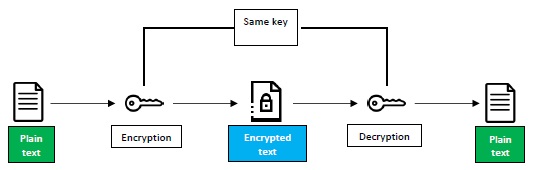
With symmetric cryptography, there is one key (the secret key) that is used for encrypting and decrypting the message. It’s therefore necessary for the sender of the message to share the secret key with the party he would like to correspond with.
The Caesar cipher is considered to be symmetric cryptography, because knowing the exact rotation (secret key) that is used to encrypt the message, you do also know how to decrypt the message.

Disadvantages of symmetric cryptography
There are several disadvantages to symmetric cryptography.
The first disadvantage is that the secret key has to be shared between the sender and receiver for messages to be exchanged privately. Sending the secret key over an unprotected communication channel is not recommended. In the next post, we will see how asymmetric (public key) cryptography allows us to send the encryption key safely over unprotected communication channels, while keeping the decryption key safely in our own possession.
The second disadvantage is that the secret key is now on two different locations. Thus, there are now two points of attack.
The third disadvantage is that the sender has to trust the receiver that he will not steal or copy the key or give it to someone else. It’s comparable to sharing the keys to your apartment: you also have to trust the other person not to steal your key, or copy your key, or give the key to another person.
The fourth disadvantage is limited scalability. Assuming that we’d like to communicate with a great number of parties, and that we’d like to provide each party with a different secret key for security reasons, we’d need to maintain a database of secret keys. For this setup to be user friendly in an environment like the internet, it would probably require an infrastructure of specialized distribution centers that generate secret keys each time two parties would like to initiate a private conversation. As these distribution centers would hold many secret keys, it would be a honey pot for hackers.
An example of symmetric cryptography is the Data Encryption Standard (DES), which was released on the market in 1975. It was developed by IBM, and was primarily meant to protect electronic communication between large financial organizations. Up until DES, cryptography was mainly a field for governments’ secret intelligence agencies to protect state communication. When the DES was released, it was received very well by cryptographers, until people found out that the National Security Agency (NSA) was involved with the development of the encryption key and purposefully influenced IBM to limit the key sizes from 64 bits to 56 bits. With 56 bits, there are 2^56 possible key combinations. This is considerably less than 64 bits keys. It is therefore much easier to break the encryption. Cryptographers believed that it would just be a matter of time before someone would find the right keys through a brute force search – meaning that you are trying all possible key combinations to find the right one.
Symmetric cryptography was the way cryptography was done until 1976 when two young researchers from Stanford University, Whitfield Diffie and Martin Hellman, invented asymmetric or public key cryptography.
Both researchers were discontent with DES, and Hellman even addressed a letter to the Secretary of Commerce, Elliot Richardson, saying:
I am writing to you because I am very worried that the National Security Agency has surreptitiously influenced the National Bureau of Standards [NBS] in a way which seriously limit the value of a proposed standard, and which may pose a threat to individual privacy. I refer to the proposed Data Encryption Standard. … I am convinced that NSA in its role of helping NBS design and evaluate possible standards has ensured that the proposed standard is breakable by NSA.
In my next post, I will discuss how public key cryptography works. Eventually, at the end of the post series, you will be able to encrypt your e-mails using public key cryptography.
Small thought on calls for societal discussions on the ethics of cryptosystems
When people say that we should involve society in discussing the ethics of cryptosystems and blockchain, we should ask ourselves why society is suddenly paying attention to the strides we’re making in the cryptospace. Where does this attention come from?
Back in 2011, society was considering us weird and misinformed. Encryption, digital money, anonymous networks, digital pseudonyms, zero knowledge, reputations, information markets, black markets, collapse of governments were spoken about openly in the cryptospace and no one paid much attention.
6-7 years later, after Bitcoin has shown it’s not just a fad, some groups within society have particularly paid close attention to cryptosystems and are now leading the discourse of what they call “discussions for society’s sake”. Who are they and what are their interests? Banks, central banks and national governments. They’re trying to shape the discourse around cryptosystems, because (a) banks are afraid of becoming obsolete by cryptosystems, (b) central banks are afraid of losing control over monetary policy, and (c) governments are afraid that their national currencies will be outcompeted by cryptocurrencies and their inability to tax and trace crypto payments. When they call for societal discussions about the ethics and consequences of cryptosystems, they thus enter the discussions from a position of fear. Can we then really have substantial discussions with them?
Or will they enter the discussions already motivated to overregulate cryptosystems – spoiling everything beautiful about cryptosystems so that their operations are not threatened?
My main point: be careful of those who say we need more public discussions on cryptosystems. Their calls sound noble, but they may have hidden agendas and don’t enter discussions with an open mind to learn about the beauty of cryptosystems.
Example case of this: Benjamin Lawsky and BitLicense.
2019: Year in Review
It’s been a heck of a year. Thanks for plugging along with Notes On Liberty. Like the world around me, NOL keeps getting better and better. Traffic in 2019 came from all over the place, but the usual suspects didn’t disappoint: the United States, United Kingdom, Canada, India, and Australia (in that order) supplied the most readers, again.
As far as most popular posts, I’ll list the top 10 below, but such a list doesn’t do justice to NOL and the Notewriters’ contribution to the Great Conversation, nor will the list reflect the fact that some of NOL‘s classic pieces from years ago were also popular again.
Nick’s “One weird old tax could slash wealth inequality (NIMBYs, don’t click!)” was in the top ten for most of this year, and his posts on John Rawls, The Joker film, Dominic Cummings, and the UK’s pornographer & puritan coalition are all worth reading again (and again). The Financial Times, RealClearPolicy, 3 Quarks Daily, and RealClearWorld all featured Nick’s stuff throughout 2019.
Joakim had a banner year at NOL, and four of his posts made the top 10. He got love from the left, right, and everything in between this year. “Elite Anxiety: Paul Collier’s ‘Future of Capitalism’” (#9), “In Defense of Not Having a Clue” (#8), and “You’re Not Worth My Time” (#7) all caused havoc on the internet and in coffee shops around the world. Joakim’s piece on Mr Darcy from Pride and Prejudice (#2) broke – no shattered – NOL‘s records. Aside from shattering NOL‘s records, Joakim also had excellent stuff on financial history, Richard Davies, and Nassim Taleb. He is also beginning to bud as a cultural commentator, too, as you can probably tell from his sporadic notes on opinions. Joakim wants a more rational, more internationalist, and more skeptical world to live in. He’s doing everything he can to make that happen. And don’t forget this one: “Economists, Economic History, and Theory.”
Tridivesh had an excellent third year at NOL. His most popular piece was “Italy and the Belt and Road Initiative,” and most of his other notes have been featured on RealClearWorld‘s front page. Tridivesh has also been working with me behind the scenes to unveil a new feature at NOL in 2020, and I couldn’t be more humbled about working with him.
Bill had a slower year here at NOL, as he’s been working in the real world, but he still managed to put out some bangers. “Epistemological anarchism to anarchism” kicked off a Feyerabendian buzz at NOL, and he put together well-argued pieces on psychedelics, abortion, and the alt-right. His short 2017 note on left-libertarianism has quietly become a NOL classic.
Mary had a phenomenal year at NOL, which was capped off with some love from RealClearPolicy for her “Contempt for Capitalism” piece. She kicked off the year with a sharp piece on semiotics in national dialogue, before then producing a four-part essay on bourgeois culture. Mary also savaged privileged hypocrisy and took a cultural tour through the early 20th century. Oh, and she did all this while doing doctoral work at Oxford. I can’t wait to see what she comes up with in 2020.
Aris’ debut year at NOL was phenomenal. Reread “Rawls, Antigone and the tragic irony of norms” and you’ll know what I’m talking about. I am looking forward to Dr Trantidis’ first full year at NOL in 2020.
Rick continues to be my favorite blogger. His pieces on pollution taxes (here and here) stirred up the libertarian faithful, and he is at his Niskanenian best on bullshit jobs and property rights. His notes on Paul Feyerabend, which I hope he’ll continue throughout 2020, were the centerpiece of NOL‘s spontaneity this year.
Vincent only had two posts at NOL in 2019, but boy were they good: “Interwar US inequality data are deeply flawed” and “Not all GDP measurement errors are greater than zero!” Dr Geloso focused most of his time on publishing academic work.
Alexander instituted the “Sunday Poetry” series at NOL this year and I couldn’t be happier about it. I look forward to reading NOL every day, but especially on Sundays now thanks to his new series. Alex also put out the popular essay “Libertarianism and Neoliberalism – A difference that matters?” (#10), which I suspect will one day grow to be a classic. That wasn’t all. Alex was the author of a number of my personal faves at NOL this year, including pieces about the Austro-Hungarian Empire, constructivism in international relations (part 1 and part 2), and some of the more difficult challenges facing diplomacy today.
Edwin ground out a number of posts in 2019 and, true to character, they challenged orthodoxy and widely-held (by libertarians) opinions. He said “no” to military intervention in Venezuela, though not for the reasons you may think, and that free immigration cannot be classified as a right under classical liberalism. He also poured cold water on Hong Kong’s protests and recommended some good reads on various topics (namely, Robert Nozick and The Troubles). Edwin has several essays on liberalism at NOL that are now bona fide classics.
Federico produced a number of longform essays this year, including “Institutions, Machines, and Complex Orders” and “Three Lessons on Institutions and Incentives” (the latter went on to be featured in the Financial Times and led to at least one formal talk on the subject in Buenos Aires). He also contributed to NOL‘s longstanding position as a bulwark against libertarian dogma with “There is no such thing as a sunk cost fallacy.”
Jacques had a number of hits this year, including “Poverty Under Democratic Socialism” and “Mass shootings in perspective.” His notes on the problems with higher education, aka the university system, also garnered plenty of eyeballs.
Michelangelo, Lode, Zak, and Shree were all working on their PhDs this year, so we didn’t hear from them much, if at all. Hopefully, 2020 will give them a bit more freedom to expand their thoughts. Lucas was not able to contribute anything this year either, but I am confident that 2020 will be the year he reenters the public fray.
Mark spent the year promoting his new book (co-authored by Noel Johnson) Persecution & Toleration. Out of this work arose one of the more popular posts at NOL earlier in the year: “The Institutional Foundations of Antisemitism.” Hopefully Mark will have a little less on his plate in 2020, so he can hang out at NOL more often.
Derrill’s “Romance Econometrics” generated buzz in the left-wing econ blogosphere, and his “Watson my mind today” series began to take flight in 2019. Dr Watson is a true teacher, and I am hoping 2020 is the year he can start dedicating more time to the NOL project, first with his “Watson my mind today” series and second with more insights into thinking like an economist.
Kevin’s “Hyperinflation and trust in ancient Rome” (#6) took the internet by storm, and his 2017 posts on paradoxical geniuses and the deleted slavery clause in the US constitution both received renewed and much deserved interest. But it was his “The Myth of the Nazi War Machine” (#1) that catapulted NOL into its best year yet. I have no idea what Kevin will write about in 2020, but I do know that it’ll be great stuff.
Bruno, one of NOL’s most consistent bloggers and one of its two representatives from Brazil, did not disappoint. His “Liberalism in International Relations” did exceptionally well, as did his post on the differences between conservatives, liberals, and libertarians. Bruno also pitched in on Brazilian politics and Christianity as a global and political phenomenon. His postmodernism posts from years past continue to do well.
Andrei, after several years of gentle prodding, finally got on the board at NOL and his thoughts on Foucault and his libertarian temptation late in life (#5) did much better than predicted. I am hoping to get him more involved in 2020. You can do your part by engaging him in the ‘comments’ threads.
Chhay Lin kept us all abreast of the situation in Hong Kong this year. Ash honed in on housing economics, Barry chimed in on EU elections, and Adrián teased us all in January with his “Selective Moral Argumentation.” Hopefully these four can find a way to fire on all cylinders at NOL in 2020, because they have a lot of cool stuff on their minds (including, but not limited to, bitcoin, language, elections in dictatorships, literature, and YIMBYism).
Ethan crushed it this year, with most of his posts ending up on the front page of RealClearPolicy. More importantly, though, was his commitment to the Tocquevillian idea that lawyers are responsible for education in democratic societies. For that, I am grateful, and I hope he can continue the pace he set during the first half of the year. His most popular piece, by the way, was “Spaghetti Monsters and Free Exercise.” Read it again!
I had a good year here, too. My pieces on federation (#3) and American literature (#4) did waaaaaay better than expected, and my nightcaps continue to pick up readers and push the conversation. I launched the “Be Our Guest” feature here at NOL, too, and it has been a mild success.
Thank you, readers, for a great 2019 and I hope you stick around for what’s in store during 2020. It might be good, it might be bad, and it might be ugly, but isn’t that what spontaneous thoughts on a humble creed are all about? Keep leaving comments, too. The conversation can’t move (forward or backward) without your voice.
The Real Meaning of Christmas
…Jesus Christ matters a great deal for this atheist. For Christians, Easter, the Resurrection, is the big date. For us it’s Christmas. When someone wishes me “Good Holidays” in my simplistically minded libprog town, I respond with a cheery, “Merry Christmas.” I don’t do it just to be churlish (though I wouldn’t put this beyond me). No, I mean it.
What happened in Bethlehem is that God became a human, completely, with a conventional birth and all, and a regular upbringing.* This is not another small unimportant religious tale. In time, it’s a world-changing myth.
When God is man, we are only one step removed from Man becoming God. In the long run, it’s the beginning of the end of our collective submission to an often savage Bronze Age divinity. It took about 1500 years but it did happen and only in the parts of the world that had been Christian (plus, maybe, in Japan. Why in Japan? Beats me!).
* By the way, the doctrine of the Immaculate Conception is not what many people think it is. I keep hearing the mistake on the radio. (It takes an atheist to help with Christian theology, N.S.!)
Entangling alliances, Donald Trump, and a new libertarian alternative
Some say that Donald Trump’s transactionalism in the realm of geopolitics has gotten out of hand. Tridivesh has actually been saying this for awhile now. Jacques is not pleased with the president’s decision to withdraw American troops from Syria. Of the other Notewriters, only Andre has spoken up for Trump’s withdrawal from Syria.
There are libertarians and leftists who have applauded Trump’s move, but for the most part people are dissatisfied with the way the president of the United States conducts foreign policy. There’s no logic. There’s no strategy. And the incentives don’t quite line up, either: is Trump out for the republic or himself?
This is unfair. Trump’s transactionalism comes with more press, but Obama and the guy before him were transactionalist presidents, too. Just think about Syria to begin with. Getting involved in the butchery there had no logic to it and actually went against the strategy of Obama’s “Pivot to Asia.” Still, Obama mired the republic in another brutal regional scuffle. GWB did the same thing in Iraq, too. Osama bin Laden was hiding out in Afghanistan, so Bush invaded Iraq, a country that had nothing to do with 9/11. Makes sense, right?
Maybe we’re looking at this all wrong. Maybe we should be looking at the incentives and trade-offs available to the executive branch of the American government instead of single individuals.
My contribution to reassessing American foreign policy is to look at the role that formal alliances play in chaining down the executive branch in the American system. Libertarians loathe both alliances and the executive branch, but what if one is useful for off-setting the other? Which one would you rather have? (Trade-offs are more realistic than utopias, my fellow libertarians.)
There are two general types of alliances in the world: formal and informal. Alliances have been with us since the dawn of time, too. Think of the alliances our Stone Age ancestors made, one individual at a time. Elected politicians make alliances and call them political parties. Dictators make alliances and call them bargains. You get the picture. The United States has traditionally made use of informal alliances, so Trump’s abandonment of the Kurds in Syria is really a continuation of American foreign policy and not an aberration as some hawks claim.
In fact, prior to World War II, the United States had signed just one official alliance with another polity: the Treaty of Alliance with France that lasted from 1778-80. So from the start of the Revolutionary War (which was really a secession from the British Empire rather than an actual revolution) in 1776 to America’s entrance into World War II in late 1941, the United States had joined only one alliance, and it was a short-lived alliance that would make or break the existence of the republic. (During World War I, the United States was an “affiliated partner” rather than an official ally.)
This doesn’t mean that the United States was isolationist, or non-interventionist, during this time frame. In fact, it highlights well the fact that the United States has a long history of entering into alliances of convenience, and a short history of building and then leading stable coalitions of military partners around the world. Alliances have shaped the destiny of the republic since its founding. And, more importantly, these alliances of convenience have their intellectual roots in George Washington’s foreign policy. Washington’s foreign policy even has its own name: the Washington Doctrine of Unstable Alliances. According to Washington and other elites of the founding era, the United States should freely enter into, and exit, alliances as necessary (Jefferson was a big fan of this Doctrine, too). This stands in stark contrast to the idea that the United States only soiled its virginal unilateralism once, when it was in dire peril and needed a helping hand from France to fend off an evil empire.
Washingtonian alliances throughout American history
Aside from fighting alongside the Oneida and Tuscarora during its secession from the British Empire, the United States forged alliances with Sweden, in 1801 to fight the Barbary states, and with the Choctaw, Cherokee, and some of the Creek during the ill-fated War of 1812. In fact, one of the reasons the United States got pummeled in the War of 1812 was the lack of Native allies relative to the British, who had secured alliances with at least 10 Native American polities.
The American push westward saw a plethora of shifting alliances with Native peoples, all of which tilted in eventual favor of the United States (and to the detriment of their allies).
The American foray into imperialism in the late 19th century saw alliances with several factions in Cuba and the Philippines that were more interested in extirpating Spain than thinking through an alliance with an expansion-minded United States.
In 1832 the United States entered into a Washingtonian alliance with the Dutch in order to crush some Barbary-esque states along the Sumatran coast. The alliance led to the eventual, brutal conquest of Aceh by the Dutch and a long-lasting mutual friendship between the Americans and the Dutch.
From 1886-94 the United States and its ally in the South Pacific, the Mata’afa clan of Samoa, fought Germany and its Samoan allies for control over the Samoan islands. The Boxer Rebellion in China saw the United States ally with six European states (including Austria-Hungary) and Japan, and affiliate with three more European states and several Qing dynasty governors who refused to follow their emperor’s orders.
NATO’s continued importance
Clearly, the United States has followed its first president’s foreign policy doctrine for centuries. Washington warned that his doctrine was not to be an eternal guideline, though. Indeed, the most-cited case study of the Washington Doctrine of Unstable Alliances is not the American experience in the 19th century, but the Nazi-Soviet one of the 20th, when the Germans turned on the Soviets as soon as it became expedient to do so.
The establishment of NATO has forced the United States to become reciprocal in its alliances with other countries. The republic can no longer take, take, and take some more without giving something in return. This situation of mutually beneficial exchange has tempered not only the United States but everybody else in the world, too (especially in the industrialized part of the world; the part with the deadliest weapons). Free riding will most likely continue to be a problem within NATO. The United States will continue to pay more than its share to keep the alliance afloat. And that’s perfectly okay considering most of the alternatives: imperialism (far more expensive than free riding allies), ethnic cleansing, or oscillating blocs of states looking out for their own interests in a power vacuum, like the situation Europe found itself in during the bloody 20th century.
The forgotten alternative
Unstable alliances lead to an unstable world. The rise of NATO has been a boon to the world, despite its costs. If libertarians want to be taken seriously in the realm of foreign affairs, they would do well to shake off the Rothbardian shackles of isolationism/non-interventionism and embrace Madisonian federalism with a Christensenian twist. The 13 North American colonies that broke away from the British Empire were sovereign states when they banded together. The 29 members of NATO are sovereign states, too, and there’s no reason to believe that Madison’s federal blueprint can’t band them together as well.
If libertarians are comfortable embracing non-interventionism as a foreign policy doctrine, even though it has never been tried and even though it’s based on a shoddy interpretation of history, there’s no reason why they can’t instead embrace federation as their go-to alternative. Federation at least has history on its side, and it’s also got the obscure appeal that libertarians so love to ooze at public gatherings. Will 2020 be the year that libertarians shift from non-interventionism to federation?
Despite pressure from Trump, Iran’s world role will continue to be important
Introduction
Ever since taking over as President, Donald Trump’s approach towards Iran has been excessively rash and lacking in nuance. The US withdrawal from JCPOA (Joint Comprehension for Plan of Action), the imposition of sanctions, and brash statements by Trump have heightened tensions between both countries. Allies of the US, including EU member states (especially Germany and France), have expressed their disapproval of Trump’s Iran policy on numerous occasions.
In August 2019, during the G7 Summit at Biarritz (France), it seemed that Trump might have changed his approach towards Iran. The US President expressed his openness to engaging with Iran and dubbed it as a country of immense potential. After the attack on Saudi Oil facilities, there has been a visible shift in the approach of Germany, France, and the UK towards Iran. All three countries blamed Iran for the attacks. In a meeting on the sidelines of the United Nations General Assembly (UNGA) these three countries issued a statement condemning the attack. They also held Iran squarely responsible for the attack. Said the joint statement:
It is clear to us that Iran bears responsibility for this attack
Why China is giving importance to Iran Continue reading
Changing the way doctors see data
Over the past four years, my brother and I have grown a business that helps doctors publish data-driven articles from the two of us to over 30 experienced researchers. However, along the way, we noticed that data management in medical publication was decades behind other fields–in fact, the vital clinical outcomes from major trials are generally published as singular PDFs with no structured data, and are analyzed in comparison to existing studies only in nonsystematic, nonupdatable publications. Effectively, medicine has no central method for sharing or comparing patient outcomes across therapies, and I think that it is our responsibility as researchers to present these data to the medical community.
Based on our internal estimates, there are >3 million published clinical outcomes studies (with over 200 million individual datapoints) that need to be abstracted, structured, and compared through a central database. We recognized that this is a monumental task, and we therefore have focused on automating and scaling research processes that have been, through today, entirely manual. Only after a year of intensive work have we found a path toward creating a central database for all published patient outcomes, and we are excited to debut our technology publicly!
Keith recently presented our venture at a Mayo Clinic-hosted event, Walleye Tank (a Shark Tank-style competition of medical ventures), and I think that it is an excellent fast-paced introduction to a complex issue. Thanks also to the Mayo Clinic researchers for their interesting questions! You can see his two-minute presentation and the Q&A here. We would love to get more questions from the economic/data science/medical communities, and will continue putting our ideas out there for feedback!
Follow Hong Kong’s district election
Today is a big day for Hong Kong, as the people are voting for their district representatives. Never before has there been such a high voter turnout: 71.2%. I haven’t found any English website that allows you to follow the results live, so here is a Chinese website: https://dce2019.thestandnews.com/
Yellow is the pro-democracy camp and red is the pro-establishment (pro-Beijing) camp. As of this writing, some results have come in already and the pro-democracy camp is far ahead having occupied more than 90% of the seats (45 against 4).
This is the first stage of the 2019-2020 election cycle. The election will fill 452 seats on Hong Kong’s 18 District Councils. Next year, there will be elections for the territory-wide Legislative Council.

Hong Kong Police storm Polytechnic University of Hong Kong: a selection of news articles
《BBC》
//Those who remain seem determined to fight to the end, no matter the risk.//
https://www.bbc.co.uk/news/world-asia-china-50452277
《Financial Times》
//“Everyone is exhausted and [when] someone wants to leave, they can’t. There are even kids that are 11, 12 years old,” said a social worker trapped in the campus//
《The Guardian》
//“Those people on the front, they are putting their lives on the line to fight for what they believe … they are doing it for all of us.” – Calvin See, 27//
《The New York Times》
//“They were all in good spirits,” he said. “They were not being deterred. They were ready to be arrested. They said, ‘We stand for freedom, dignity, democracy, human rights.’ They said they were staying.” – The pastor, William Devlin//
《Washington Post》
//“Carrie Lam’s murderous regime has resorted to brutality, which makes Hong Kong become a state of savage existence and astonishes the international communities,” he said in a statement early Monday.//
《The Times》
//“We’re fighting for our rights: we’re fighting for freedom of expression,” said a woman aged 25 who identified herself only as Mary-Jane. //
《Al Jazeera》
//”The Hong Kong government has all along decided to treat this as a law-and-order matter and has had no willingness to negotiate or talk or listen in any serious way to the demands of the protesters. At the end of the day, there has to be some kind of political solution,” Roderic Wye told Al Jazeera.//
《CNN》
//”If we don’t come out, no one will come out and protect our freedoms. Polytechnic University is my home,” – A 23-year-old protester and Polytechnic University alumnus//
https://edition.cnn.com/2019/11/17/asia/hong-kong-protests-november-17-intl-hnk/index.html