A History of Plagues

As COVID-19 continues to spread, fears and extraordinary predictions have also gone viral. While facing a new infectious threat, the unknowns of how new traits of our societies worldwide or of this novel coronavirus impact its spread. Though no two pandemics are equivalent, I thought it best to face this new threat armed with knowledge from past infectious episodes. The best inoculation against a plague of panic is to use evidence gained through billions of deaths, thousands of years, and a few vital breakthroughs to prepare our knowledge of today’s biological crises, social prognosis, and choices.

Below, I address three key questions: First, what precedents do we have for infections with catastrophic potential across societies? Second, what are the greatest killers and how do pandemics compare? Lastly, what are our greatest accomplishments in fighting infectious diseases?

As foundation for understanding how threats like COVID-19 come about and how their hosts fight back, I recommend reading The Red Queen concerning the evolutionary impact and mechanisms of host-disease competition and listening to Sam Harris’ “The Plague Years” podcast with Matt McCarthy from August 2019, which predated COVID-19 but had a strangely prophetic discussion of in-hospital strategies to mitigate drug resistance and their direct relation to evolutionary competition.

  • The Biggest Killers:

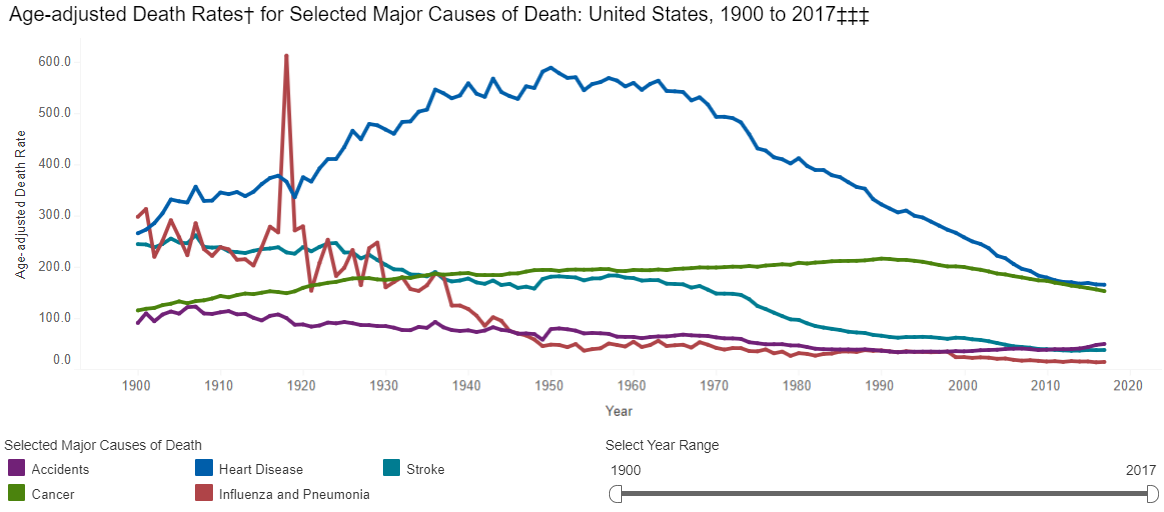
Infectious diseases plagued humanity throughout prehistory and history, with a dramatic decrease in the number of infectious disease deaths coming in the past 200 years. In 1900, the leading killers of people were (1) Influenza, (2) Tuberculosis, and (3) Intestinal diseases, whereas now we die from (1) Heart disease, (2) Cancer, and (3) Stroke, all chronic conditions. This graph shows not that humans have vanquished infectious disease as a threat, but that in the never-ending war of evolutionary one-upmanship, we have won battles consistently since 1920 forward. When paired with Jonathan Haidt’s Most Important Graph in the World, this vindicates humanity’s methods of scientific and economic progress toward human flourishing.Death rates

However, if the CDC had earlier data, it would show a huge range of diseases that dwarf wars and famines and dictators as causes of death in the premodern world. If we look to the history of plagues, we are really looking at the history of humanity’s greatest killers.

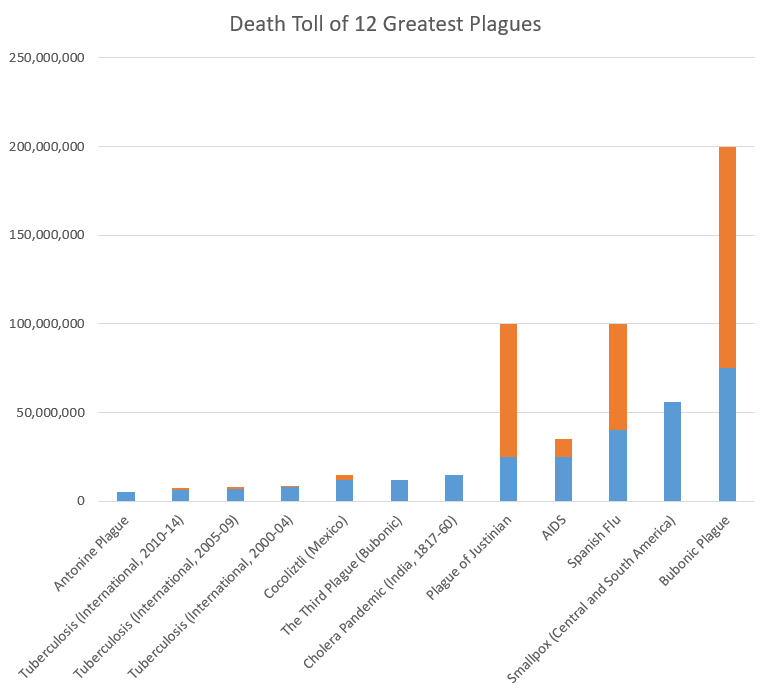
The sources on the history of pandemics are astonishingly sparse/non-comprehensive. I created the following graphs only by combining evidence and estimates from the WHO, CDC, Wikipedia, Our World in Data, VisualCapitalist, and others (lowest estimates shown where ranges were presented) for both major historic pandemics and for ongoing communicable disease threats. This is not a complete dataset, and I will continue to add to it, but it shows representative death counts from across major infectious disease episodes, as well as the death rate per year based on world population estimates. See the end of this post for the full underlying data. First, the top 12 “plagues” in history:

Capture disease top 12


Note: blue=min, orange=max across the sources I examined. For ongoing diseases with year-by-year WHO evidence, like tuberculosis, measles, and cholera, I grouped mortality in 5-year spans (except AIDS, which does not have good estimates from the 1980s-90s, so I reported based on total estimated deaths).

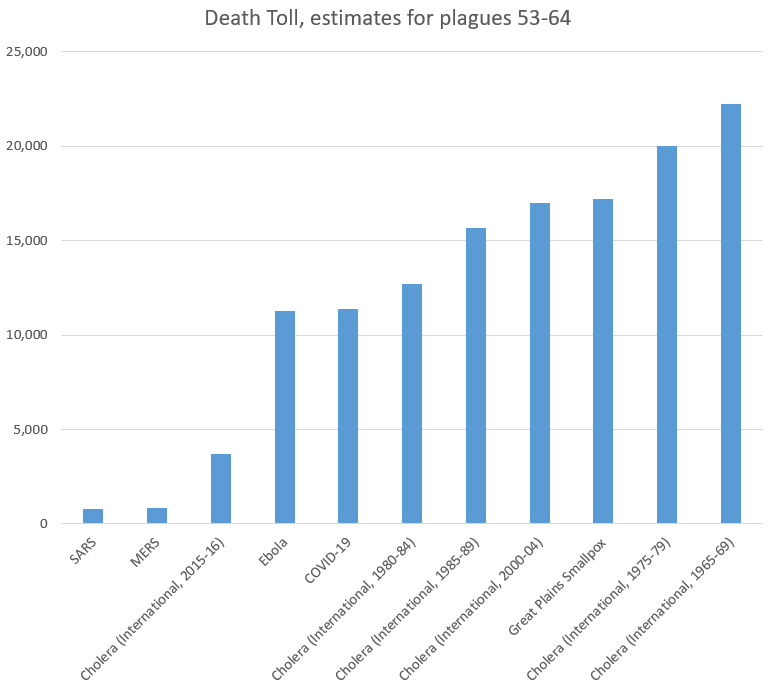
Now, let’s look at the plagues that were lowest on my list (number 55-66). Again, my list was not comprehensive, but this should provide context for COVID-19:

Capture covid

As we can see, the 11,400 people who have died from COVID-19 recently passed Ebola to take the 61st (out of 66) place on our list of plagues. Note again that several ongoing diseases were recorded in 5-year increments, and COVID-19 still comes in under the death rates for cholera. Even more notably, it has 0.015% as many victims as the plague in the 14th Century,

  • In Context of Current Infectious Diseases:

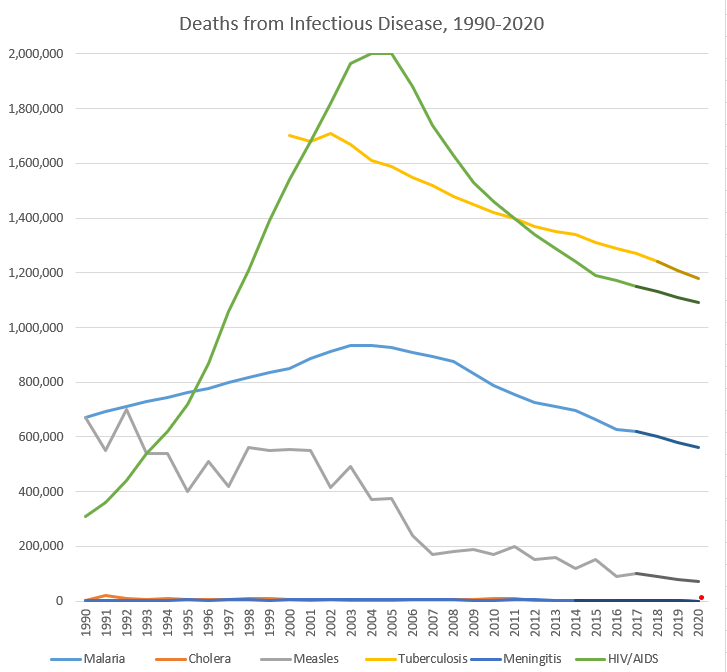
For recent/ongoing diseases, it is easier to compare year-by-year data. Adding UNAIDS to our sources, we found the following rates of death across some of the leading infectious causes of death. Again, this is not comprehensive, but helps put COVID-19 (the small red dot, so far in the first 3 months of 2020) in context:

Capture diseases by year

Note: darker segments of lines are my own estimates; full data at bottom of the post. I did not include influenza due to the lack of good sources on a year-by-year basis, but a Lancet article found that 291,000-645,000 deaths from influenza in a year is predictable based on data from 1999-2015.

None of this is to say that COVID-19 is not a major threat to human health globally–it is, and precautions could save lives. However, it should show us that there are major threats to human health globally all the time, that we must continue to fight. These trendlines tend to be going the right direction, but our war for survival has many foes, and will have more emerge in the future, and we should expend our resources in fighting them rationally based on the benefits to human health, not panic or headlines.

  • The Eradication List:

As we think about the way to address COVID-19, we should keep in mind that this fight against infectious disease builds upon work so amazing that most internet junkies approach new infectious diseases with fear of the unknown, rather than tired acceptance that most humans succumb to them. That is a recent innovation in the human experience, and the strategies used to fight other diseases can inform our work now to reduce human suffering.

While influenzas may be impossible to eradicate (in part due to an evolved strategy of constantly changing antigens), I wanted to direct everyone to an ever-growing monument to human achievement, the Eradication List. While humans have eradicated only a few infectious diseases, the amazing thing is that we can discuss which diseases may in fact disappear as threats through the work of scientists.

On that happy note, I leave you here. More History of Plagues to come, in Volume 2: Vectors, Vaccines, and Virulence!

Disease Start Year End Year Death Toll (low) Death Toll (high) Deaths per 100,000 people per year (global)
Antonine Plague 165 180 5,000,000 5,000,000 164.5
Plague of Justinian 541 542 25,000,000 100,000,000 6,250.0
Japanese Smallpox Epidemic 735 737 1,000,000 1,000,000 158.7
Bubonic Plague 1347 1351 75,000,000 200,000,000 4,166.7
Smallpox (Central and South America) 1520 1591 56,000,000 56,000,000 172.8
Cocoliztli (Mexico) 1545 1545 12,000,000 15,000,000 2,666.7
Cocoliztli resurgence (Mexico) 1576 1576 2,000,000 2,000,000 444.4
17th Century Plagues 1600 1699 3,000,000 3,000,000 6.0
18th Century Plagues 1700 1799 600,000 600,000 1.0
New World Measles 1700 1799 2,000,000 2,000,000 3.3
Smallpox (North America) 1763 1782 400,000 500,000 2.6
Cholera Pandemic (India, 1817-60) 1817 1860 15,000,000 15,000,000 34.1
Cholera Pandemic (International, 1824-37) 1824 1837 305,000 305,000 2.2
Great Plains Smallpox 1837 1837 17,200 17,200 1.7
Cholera Pandemic (International, 1846-60) 1846 1860 1,488,000 1,488,000 8.3
Hawaiian Plagues 1848 1849 40,000 40,000 1.7
Yellow Fever 1850 1899 100,000 150,000 0.2
The Third Plague (Bubonic) 1855 1855 12,000,000 12,000,000 1,000.0
Cholera Pandemic (International, 1863-75) 1863 1875 170,000 170,000 1.1
Indian Smallpox 1868 1907 4,700,000 4,700,000 9.8
Franco-Prussian Smallpox 1870 1875 500,000 500,000 6.9
Cholera Pandemic (International, 1881-96) 1881 1896 846,000 846,000 4.4
Russian Flu 1889 1890 1,000,000 1,000,000 41.7
Cholera Pandemic (India and Russia) 1899 1923 1,300,000 1,300,000 3.3
Cholera Pandemic (Philippenes) 1902 1904 200,000 200,000 4.2
Spanish Flu 1918 1919 40,000,000 100,000,000 1,250.0
Cholera (International, 1950-54) 1950 1954 316,201 316,201 2.4
Cholera (International, 1955-59) 1955 1959 186,055 186,055 1.3
Asian Flu 1957 1958 1,100,000 1,100,000 19.1
Cholera (International, 1960-64) 1960 1964 110,449 110,449 0.7
Cholera (International, 1965-69) 1965 1969 22,244 22,244 0.1
Hong Kong Flu 1968 1970 1,000,000 1,000,000 9.4
Cholera (International, 1970-75) 1970 1974 62,053 62,053 0.3
Cholera (International, 1975-79) 1975 1979 20,038 20,038 0.1
Cholera (International, 1980-84) 1980 1984 12,714 12,714 0.1
AIDS 1981 2020 25,000,000 35,000,000 13.8
Measles (International, 1985) 1985 1989 4,800,000 4,800,000 19.7
Cholera (International, 1985-89) 1985 1989 15,655 15,655 0.1
Measles (International, 1990-94) 1990 1994 2,900,000 2,900,000 10.9
Cholera (International, 1990-94) 1990 1994 47,829 47,829 0.2
Malaria (International, 1990-94) 1990 1994 3,549,921 3,549,921 13.3
Measles (International, 1995-99) 1995 1999 2,400,000 2,400,000 8.4
Cholera (International, 1995-99) 1995 1999 37,887 37,887 0.1
Malaria (International, 1995-99) 1995 1999 3,987,145 3,987,145 13.9
Measles (International, 2000-04) 2000 2004 2,300,000 2,300,000 7.5
Malaria (International, 2000-04) 2000 2004 4,516,664 4,516,664 14.7
Tuberculosis (International, 2000-04) 2000 2004 7,890,000 8,890,000 25.7
Cholera (International, 2000-04) 2000 2004 16,969 16,969 0.1
SARS 2002 2003 770 770 0.0
Measles (International, 2005-09) 2005 2009 1,300,000 1,300,000 4.0
Malaria (International, 2005-09) 2005 2009 4,438,106 4,438,106 13.6
Tuberculosis (International, 2005-09) 2005 2009 7,210,000 8,010,000 22.0
Cholera (International, 2005-09) 2005 2009 22,694 22,694 0.1
Swine Flu 2009 2010 200,000 500,000 1.5
Measles (International, 2010-14) 2010 2014 700,000 700,000 2.0
Malaria (International, 2010-14) 2010 2014 3,674,781 3,674,781 10.6
Tuberculosis (International, 2010-14) 2010 2014 6,480,000 7,250,000 18.6
Cholera (International, 2010-14) 2010 2014 22,691 22,691 0.1
MERS 2012 2020 850 850 0.0
Ebola 2014 2016 11,300 11,300 0.1
Malaria (International, 2015-17) 2015 2017 1,907,872 1,907,872 8.6
Tuberculosis (International, 2015-18) 2015 2018 4,800,000 5,440,000 16.3
Cholera (International, 2015-16) 2015 2016 3,724 3,724 0.0
Measles (International, 2019) 2019 2019 140,000 140,000 1.8
COVID-19 2019 2020 11,400 11,400 0.1


Year Malaria Cholera Measles Tuberculosis Meningitis HIV/AIDS COVID-19
1990 672,518 2,487 670,000 1,903 310,000
1991 692,990 19,302 550,000 1,777 360,000
1992 711,535 8,214 700,000 2,482 440,000
1993 729,735 6,761 540,000 1,986 540,000
1994 743,143 10,750 540,000 3,335 620,000
1995 761,617 5,045 400,000 4,787 720,000
1996 777,012 6,418 510,000 3,325 870,000
1997 797,091 6,371 420,000 5,254 1,060,000
1998 816,733 10,832 560,000 4,929 1,210,000
1999 834,692 9,221 550,000 2,705 1,390,000
2000 851,785 5,269 555,000 1,700,000 4,298 1,540,000
2001 885,057 2,897 550,000 1,680,000 6,398 1,680,000
2002 911,230 4,564 415,000 1,710,000 6,122 1,820,000
2003 934,048 1,894 490,000 1,670,000 7,441 1,965,000
2004 934,544 2,345 370,000 1,610,000 6,428 2,003,000
2005 927,109 2,272 375,000 1,590,000 6,671 2,000,000
2006 909,899 6,300 240,000 1,550,000 4,720 1,880,000
2007 895,528 4,033 170,000 1,520,000 7,028 1,740,000
2008 874,087 5,143 180,000 1,480,000 4,363 1,630,000
2009 831,483 4,946 190,000 1,450,000 3,187 1,530,000
2010 788,442 7,543 170,000 1,420,000 2,198 1,460,000
2011 755,544 7,781 200,000 1,400,000 3,726 1,400,000
2012 725,676 3,034 150,000 1,370,000 3,926 1,340,000
2013 710,114 2,102 160,000 1,350,000 3,453 1,290,000
2014 695,005 2,231 120,000 1,340,000 2,992 1,240,000
2015 662,164 1,304 150,000 1,310,000 1,190,000
2016 625,883 2,420 90,000 1,290,000 1,170,000
2017 619,825 100,000 1,270,000 1,150,000
2018 1,240,000
2019
2020 16,514

Pandemic responses are beyond Evidence-based Medicine

critical-appraisal-of-randomized-clinical-trials-14-638

John Ioannidis, a professor of medicine at Stanford University, fears that the draconian measures to enforce social distancing across Europe and United States could end up causing more harm than the pandemic itself. He believes that governments are acting on exaggerated claims and incomplete data and that a priority must be getting a more representative sample of populations currently suffering corona infections. I agree additional data would be enormously valuable but, following Saloni Dattani, I think we have more warrant for strong measures than Ioannidis implies.

Like Ioannidis’ Stanford colleague Richard Epstein, I agree that estimates of a relatively small overall fatality rate are plausible projections for most of the developed world and especially the United States. Unlike Epstein, I think those estimates are conditional on the radical social distancing (and self-isolation) measures that are currently being pushed rather than something that can be assumed. I am not in a position to challenge Ioannidis’ understanding of epidemiology. Others have used his piece as an opportunity to test and defend the assumptions of the worst-case scenarios.

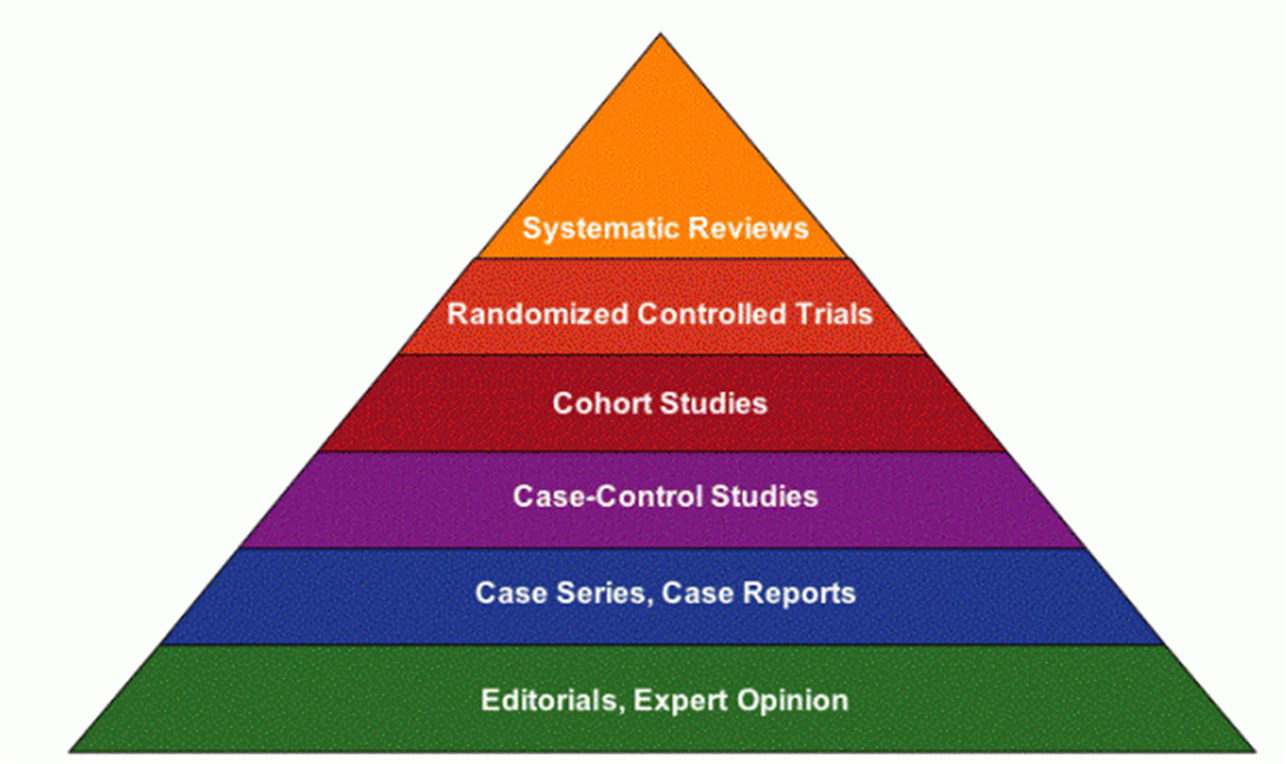
Nevertheless, I can highlight the epistemic assumptions underlying Ioannidis’ pessimism about social distancing interventions. Ioannidis is a famous proponent (occasionally critic) of Evidence-based Medicine (EBM). Although open to refinement, at its core EBM argues that strict experimental methods (especially randomized controlled trials) and systematic reviews of published experimental studies with sound protocols are required to provide firm evidence for the success of a medical intervention.

The EBM movement was born out of a deep concern of its founder, Archie Cochrane, that clinicians wasted scarce resources on treatments that were often actively harmful for patients. Cochrane was particularly concerned that doctors could be dazzled or manipulated into using a treatment based on some theorized mechanism that had not been subject to rigorous testing. Only randomized controlled trials supposedly prove that an intervention works because only they minimize the possibility of a biased result (where characteristics of a patient or treatment path other than the intervention itself have influenced the result).

Picture4

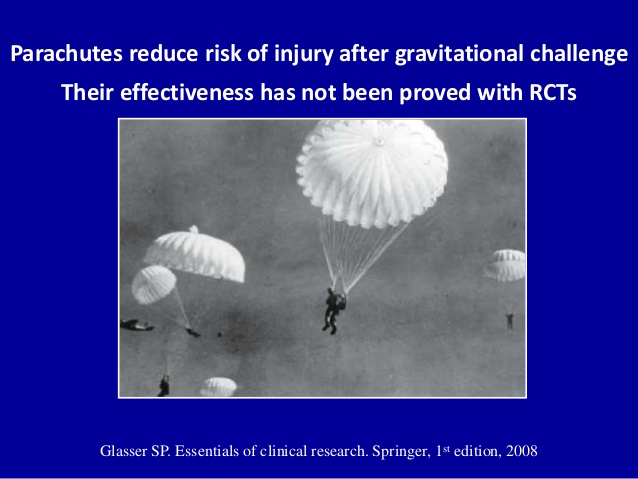
So when Ioannidis looks for evidence that social distancing interventions work, he reaches for a Cochrane Review that emphasizes experimental studies over other research designs. As is often the case for a Cochrane review, many of the results point to uncertainty or relatively small effects from the existing literature. But is this because social distancing doesn’t work, or because RCTs are bad at measuring their effectiveness under pandemic circumstances (the circumstances where they might actually count)? The classic rejoinder to EBM proponents is that we know that parachutes can save lives but we can never subject them to RCT. Effective pandemic interventions could suffer similar problems.

Nancy Cartwright and I have argued that there are flaws in the methodology underlying EBM. A positive result for treatment against control in a randomized controlled trial shows you that an intervention worked in one place, at one time for one set of patients but not why and whether to expect it to work again in a different context. EBM proponents try to solve this problem by synthesizing the results of RCTs from many different contexts, often to derive some average effect size that makes a treatment expected to work overall or typically. The problem is that, without background knowledge of what determined the effect of an intervention, there is little warrant to be confident that this average effect will apply in new circumstances. Without understanding the mechanism of action, or what we call a theory of change, such inferences rely purely on induction.

The opposite problem is also present. An intervention that works for some specific people or in some specific circumstances might look unpromising when it is tested in a variety of cases where it does not work. It might not work ‘on average’. But that does not mean it is ineffective when the mechanism is fit to solve a particular problem such as a pandemic situation. Insistence on a narrow notion of evidence will mean missing these interventions in favor of ones that work marginally in a broad range of cases where the answer is not as important or relevant.

Thus even high-quality experimental evidence needs to be combined with strong background scientific and social scientific knowledge established using a variety of research approaches. Sometimes an RCT is useful to clinch the case for a particular intervention. But sometimes, other sources of information (especially when time is of the essence), can make the case more strongly than a putative RCT can.

In the case of pandemics, there are several reasons to hold back from making RCTs (and study designs that try to imitate them) decisive or required for testing social policy:

  1. There is no clear boundary between treatment and control groups since, by definition, an infectious disease can spread between and influence groups unless they are artificially segregated (rendering the experiment less useful for making broader inferences).
  2. The outcome of interest is not for an individual patient but the communal spread of a disease that is fatal to some. The worst-case outcome is not one death, but potentially very many deaths caused by the chain of infection. A marginal intervention at the individual level might be dramatically effective in terms of community outcomes.
  3. At least some people will behave differently, and be more willing to alter their conduct, during a widely publicized pandemic compared to hygienic interventions during ordinary times. Although this principle might be testable in different circumstances, the actual intervention won’t be known until it is tried in the reality of pandemic.

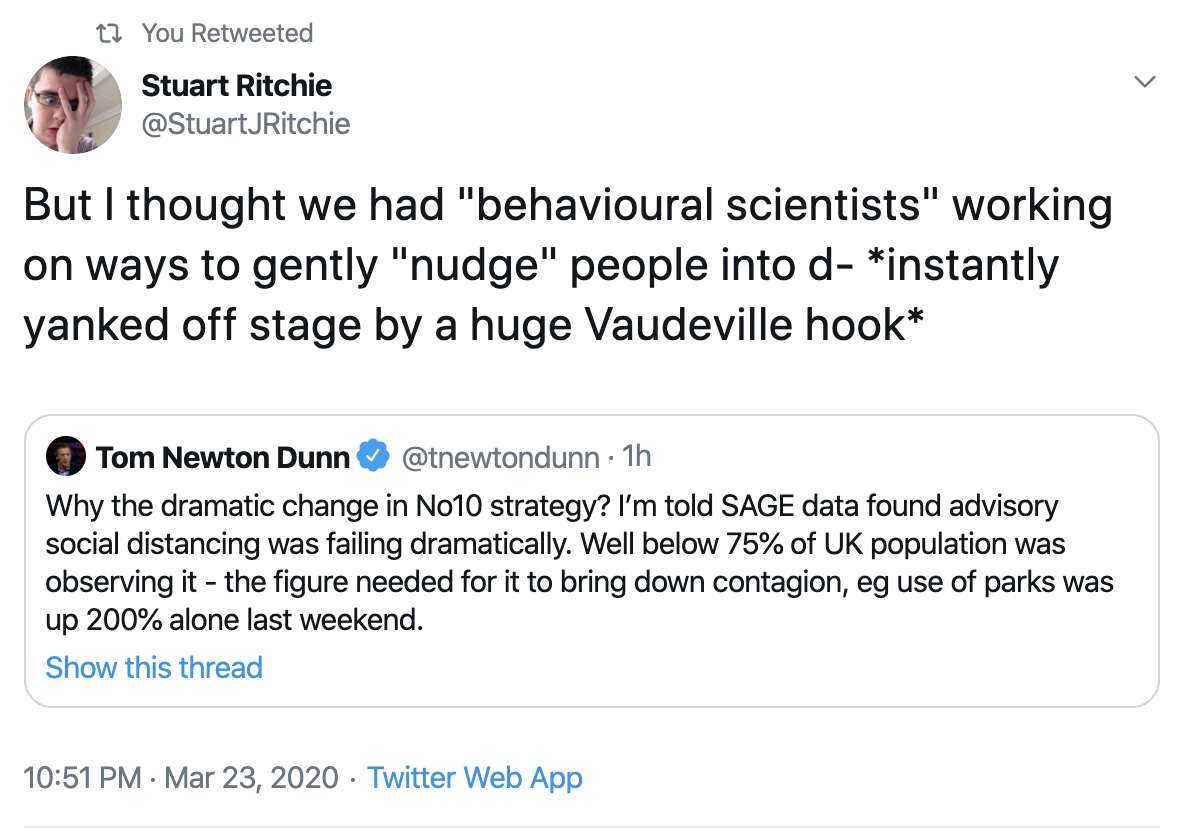
This means that rather than narrowly focusing on evidence from EBM and behavioral psychologists (or ‘nudge’), policymakers responding to pandemics must look to insights from political economy and social psychology, especially how to shift norms towards greater hygiene and social distancing. Without any bright ideas, traditional public health methods of clear guidance and occasionally enforced sanctions are having some effect.

Screenshot 2020-03-23 at 23.57.13

What evidence do we have at the moment? Right now, there is an increasing body of defeasible knowledge of the mechanisms with which the Coronavirus spreads. Our knowledge of existing viruses with comparable characteristics indicates that effectively implemented social distancing is expected to slow its spread and that things like face masks might slow the spread when physical distancing isn’t possible.

We also have some country and city-level policy studies. We saw an exponential growth of cases in China before extreme measures brought the virus under control. We saw immediate quarantine and contact tracing of cases in Singapore and South Korea that was effective without further draconian measures but required excellent public health infrastructure.

We have now also seen what looks like exponential growth in Italy, followed by a lockdown that appears to have slowed the growth of cases though not yet deaths. Some commentators do not believe that Italy is a relevant case for forecasting other countries. Was exponential growth a normal feature of the virus, or something specific to Italy and its aging population that might not be repeated in other parts of Europe? This seems like an odd claim at this stage given China’s similar experience. The nature of case studies is that we do not know with certainty what all the factors are while they are in progress. We are about to learn more as some countries have chosen a more relaxed policy.

Is there an ‘evidence-based’ approach to fighting the Coronavirus? As it is so new: no. This means policymakers must rely on epistemic practices that are more defeasible than the scientific evidence that we are used to hearing. But that does not mean a default to light-touch intervention is prudent during a pandemic response. Instead, the approaches that use models with reasonable assumptions based on evidence from unfolding case-studies are the best we can do. Right now, I think, given my moral commitments, this suggests policymakers should err on the side of caution, physical distancing, and isolation while medical treatments are tested.

[slightly edited to distinguish my personal position from my epistemic standpoint]

Coronavirus and the BRI

The Corona Virus epidemic has shaken the world in numerous ways. The virus, which first emerged in the Chinese city of Wuhan (Hubei province), has led to the loss of over 12,000 lives globally. The three countries most impacted so far have been Italy (4,825 lives lost), China (3,287 lives lost), and Iran (1,500 lives lost) as of Saturday, March 21, 2020.

While there are reports that China is limping back to normalcy, the overall outlook for the economy is grim, to say the least, with some forecasts clearly predicting that even with aggressive stimulus measures China may not be able to attain 3% growth this year.

The Chinese slow down could have an impact on the country’s ambitious Belt and Road Initiative (BRI). While China has been trying to send out a message that BRI will not be impacted excessively, the ground realities could be different given a number of factors.

One of the important, and more controversial, components of the BRI has been the $62 billion China Pakistan Economic Corridor (CPEC), which has often been cited as a clear indicator of ‘Debt Trap Diplomacy’ (this, some analysts argue, is China’s way of increasing other country’s dependency on it, by providing loans for big ticket infrastructural projects, which ultimately lead to a rise in debts).

The US and multilateral organizations like the International Monetary Fund (IMF) have predictably questioned the project, but even in Pakistan many have questioned CPEC, including politicians, with most concerns revolving around its transparency and long-term economic implications. Yet the Imran Khan-led Pakistan Tehreek-E-Insaaf (PTI) government, and the previous Pakistan Muslim League (Nawaz) (PML-N) government, have given the project immense importance, arguing that it would be a game changer for the South Asian nation.

On more than one occasion, Beijing has assured Pakistan that CPEC will go ahead as planned with China’s Ambassador to Pakistan, Yao Jing, stating on numerous occasions that the project will not be hit in spite of the Corona Virus. Senior officials in the Imran Khan government, including the Railway Minister Sheikh Rashid Ahmed and Foreign Minister Shah Mehmood Qureshi, in an interview with the Global Times, stated that while in the short run Corona may have an impact on CPEC, in the long run there would be no significant impact.

Analysts in Pakistan however, doubt that there will be no impact, given the fact that a large number of Chinese workers who had left Pakistan are unlikely to return. Since February 2020, a number of reports have been predicting that the CPEC project is likely to be impacted significantly.

Similarly, in the cases of other countries too, there are likely to be significant problems with regard to the resource crunch in China as well as the fact that Chinese workers cannot travel. Not only is Beijing not in a position to send workers, but countries hit by COVID-19 themselves will not be in a position to get the project back on track immediately, as they will first have to deal with the consequences of the outbreak.

Some BRI projects which had begun to slow down even before the outbreak spread globally were in Indonesia and Bangladesh. In Indonesia, a high speed rail project connecting Jakarta with Bandung (estimated at $6 billion) has slowed down since the beginning of the year, and ever since the onset of the Corona Virus, skilled Chinese personnel have been prevented from going back to Indonesia. Bangladesh too has announced delays on the Payra Coal power plant in February 2020. As casualties arising out of the virus increase in Indonesia and other parts of Asia and Africa, the first priority for countries is to prevent the spread of the virus.

While it is true that Beijing would want to send a clear message of keeping its commitments, matching up to its earlier targets is not likely to be a mean task. Even before the outbreak, there were issues due to the terms and conditions of the project and a number of projects had to be renegotiated due to pressure from local populations.

What China has managed to do successfully is provide assistance for dealing with COVID-19. In response to a request for assistance from the Italian government, China has sent a group of 300 doctors and corona virus testing kits and ventilators. The founder of Ali Baba and one of Asia’s richest men, Jack Ma, has also taken the lead in providing assistance to countries in need. After announcing that he will send 500,000 coronavirus testing kits and 1 million masks to the United States, Ma pledged to donate more than 1 million kits to Africa on Monday March 17, 2020, and on March 21, 2020, in a tweet, the Chinese billionaire said that he would be donating emergency supplies to a number of South Asian and South East Asian countries — Afghanistan, Bangladesh, Cambodia, Laos, Maldives, Mongolia, Myanmar, Nepal, Pakistan, and Sri Lanka. The emergency supplies include 1.8 million masks, 210,000 test kits, 36,000 protective suits and ventilators, and thermometers.

China is bothered not just about it’s own economic gains from the BRI, but is also concerned about the long term interests of countries which have signed up for BRI.

The Corona Virus has shaken the whole world, not just China, and the immediate priority of most countries is to control the spread of the pandemic and minimize the number of casualties. Countries dependent upon China, especially those which have joined the BRI, are likely to be impacted. What remains to be seen is the degree to which BRI is affected, and how developing countries which have put high stakes on BRI related projects respond.

Never reason from a fatality rate


Richard Epstein has produced several posts and a video interview arguing that the mainstream media is overreacting to the Coronavirus pandemic. Richard understands the potential seriousness of this situation and the proper role of government. He recognises the value of the Roman maxim Salus populi suprema lex esto – let the health of the people be the highest law. In public health emergencies, many moral and legal claims resulting from individual rights and contracts are vitiated, and some civil liberties suspended.

Nevertheless, along with Cass Sunstein, Richard claims that this particular emergency is likely to be overblown. His justification for this is based on data for infection and fatality rates emerging from South Korea and Singapore that appear (currently) under control with only a relatively small proportion of their population infected. This was achieved without the country-wide lockdowns now being rolled out across Europe. Extrapolating from this experience, Richard suggests that the Coronavirus is not too contagious outside particular clusters of vulnerable individuals in situations like cruise ships and nursing homes.

The line of argument is vulnerable to the same criticism that one should never reason from a price change. The classic case of reasoning from a price change is reading oil prices as a measure of economic health. When oil prices drop, it could herald an economic boom or, paradoxically, a recession. If the price dropped because supply increased, when OPEC fails to enforce a price floor, then that lower price should stimulate the rest of the economy as transport and travel become cheaper. But if the price drops because economic activity is already dropping, and oil suppliers are struggling to sell at high prices, then the economy is heading towards a recession. The same measure can mean the opposite depending on the underlying mechanism.

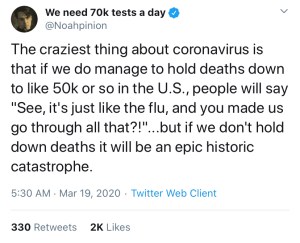
The same logic applies to epidemics. The transmission rate is a combination of the (potentially changing) qualities of the virus and the social environment in which it spreads. The social environment is determined, among other things, by social distancing and tracking. Substantial changes in lifestyle can have initially marginal, but day after day very large, impacts on the infection rate. When combined with the medium-term fixed capacity of existing health systems, those rates translate into the difference between 50,000 and 500,000 deaths. You can’t look at relatively low fatality rates in some specific cases to project rates elsewhere without understanding what caused them to be the rate they are.

Right now, we don’t know for sure if the infection is controllable in the long run. However, we now know that South Korea and Singapore controlled the spread so far and also had systems in place to test, track and quarantine carriers of the virus. We also now know that Italy, without such a system, has been overrun with serious cases and a tragic increase in deaths. We know that China, having suppressed knowledge and interventions to contain the virus for several months, got the virus under control only through aggressive lockdowns.

So the case studies, for the moment, suggest social distancing and contact tracing can reduce cases if applied very early on. But more draconian measures are the only response if testing isn’t immediately available and contact tracing fails. Now is sadly not the time for half-measures or complacency.

I believe that Richard’s estimated fatality rates (less than 50,000 fatalities in the US) are ultimately plausible, but optimistic at this stage. Perversely, they are only plausible at all insofar as people project a much higher future fatality rate now. People must act with counter-intuitively strong measures before there is clear and obvious evidence it is needed. Like steering a large ship, temporally distant sources of danger must prompt radical action now. We will be lucky if we feel like we did too much in a few months’ time. Richard believes people are more worried than warranted right now. I think that’s exactly how worried people need to be to adopt the kind of adaptive behaviors that Richard relies on to explain how the spread of infection will stabilise.

Human Capital Diversification vs Pancake Mix

I went to the grocery store yesterday (late morning) expecting either business-as-usual or empty shelves. I was surprised to see both. I’m currently regretting not taking photos because it probably will be business-as-usual by the time I go back.

Some shelves were empty, and others were full. What I saw was a direct visualization of what my neighbors don’t know how to cook.

Going through my store I could see that my neighbors know how to put jarred sauce on pasta. But I saw the opportunity to blend some canned whole tomatoes and make my own sauce. “International” foods were largely untouched, but anything in the local culinary lexicon was sparse.

The whole Baking Needs aisle was basically fine, except for the pancake mix which was all gone. This is really the whole story. Who buys pancake mix? Culinary illiterates.

(Disclaimer: I’m a biased source when it comes to pancakes. I take pancakes as seriously as 75th percentile Bostonian takes the fact that the Yankees suck.)

It takes a modest amount of skill to make pancakes, but the ingredients are cheap and YouTube wants to help you. Now is a great time to up your pancake game. But even if you just follow the directions on any random pancake recipe you’re stirring together flour, salt, baking powder, sugar, eggs, oil, and milk.

The mix will either give you a crappy shelf-stable replacement for the eggs and/or milk (yuck!) or hold your hand as you stir together some powder with eggs, oil, and milk.

Thinking back to my career as an omnivore, I can recall a time when I’ve bought ingredients I really should have made. I’m not judging people who don’t know how to cook, because I’ve been there.

What I’m pointing out is that those people are always going to have the hardest time when it comes to food shortages. I’d be in the same boat if I was shopping at a store that didn’t sell the limited set of ingredients I know how to use.

There’s a tension in economics that we don’t pay enough attention to: gains from specialization vs. gains from diversification. At a system level (and in a Principles class) the two go together. But at the level of individual there is a lot to be said for diversification–you’re more robust to change, resilient in the face of problems, and perspectives gained in one domain may have lessons to apply to others.

I’m grateful I haven’t taken my own human capital specialization so far that I can’t make my own pancakes.

Coronavirus and the spirit of internationalism

Introduction

Iran has asked the International Monetary Fund (IMF) for emergency funding (it is for the first time since 1962 that Iran has sought IMF assistance) to fight the deadly Corona Virus outbreak (COVID19).

As of Saturday, March 14, 2020, Iran reported over 600 deaths (611) and over 12,000 cases arising out of the deadly virus. That makes Iran the third most affected country in the world after China and Italy. A number of prominent personalities, including the country’s Vice President (Eshaq Jahangari) and two other senior cabinet members, have contracted the virus.

On Wednesday, March 4, 2020, the IMF’s managing director, Kristilina Georgieva, stated that developing countries will be supported in their efforts to take on the Corona Virus through the Fund’s Rapid Financial Instrument. The IMF announced a $50 billion aid package with the aim of specifically assisting ‘low income’ and ‘emerging market’ economies. (On Monday, the World Bank had announced a $12 billion package to deal with the epidemic.)

Iran’s Central Bank chief, Abdolnaser Hemmati, said on Thursday that he had written to the IMF requesting $5 billion in emergency funding via the latter’s Rapid Financing Instrument. In a tweet on Thursday, the Iran’s Foreign Minister, Javad Zarif, urged the IMF to release this amount immediately. The Iranian Foreign Minister also said that Iran was facing a severe shortage of medicines and equipment. US sanctions on Iran, which have prevented it from selling oil or participating fully in the world’s financial ecosystem, have had a detrimental impact on the country’s economy. Iran, in a letter to the UN Secretary General Antonio Guerres, stated that US sanctions should be suspended keeping in mind the current crisis.

Iran’s apprehensions

Even if the IMF were to agree to releasing $5 billion for Iran, there are a number of obstacles that may result in Iran not being able to get the money from the IMF. First, the US is part of the IMF’s decision-making board (interestingly, in his tweet Zarif had stated that the IMF/IMF board should act responsibly) and even if the IMF agrees to disburse the amount, given the strains between Washington and Tehran it is quite possible that the US will veto such a move by the IMF. If Trump is willing to annoy US allies like the EU (on Wednesday, Trump took a decision to suspend flights from 26 Schengen countries to US, for a period of 30 days without consulting the EU), there is no reason why he will adopt a nuanced approach towards Iran.

Second, the Financial Action Task Force (FATF) has blacklisted Iran, which means that even if IMF agrees to provide the loan, banks and financial institutions can block such transactions.

Corona Virus is an opportunity for the US to exhibit statesmanship and maturity, and also lower tensions with Iran. While Trump has claimed to being open towards engaging with the Iranians, and seems to have changed his approach towards Tehran, he has not really exhibited much statesmanship in dealing with Tehran. Ever since the killing of Iranian General Qasem Soleiman (a major general in the Islamic Revolutionary Guard Corps) in a drone attack, in January 2020, ties went further downhill.

Opportunity for the US

This is an opportunity for the US to send a positive message to the international community, and to also distinguish between the Iranian public and its political class. China’s messaging with regard to helping the international community has been far better. On March 12, 2020, a team of Chinese doctors reached Italy (Italy, which is the most worst hit nation after China, had requested assistance from the latter). A number of Italian leaders have also criticised EU countries for being slow in reacting to Italy’s call for assistance.

Positive steps taken by China

What is also significant is that at a time when Washington and Beijing have been engaged in unnecessary mud-slinging with regard to the virus, with the US Secretary of State Mike Pompeo dubbing the Corona Virus as ‘Wuhan Virus’, and a senior Chinese diplomat responding by calling it a ‘conspiracy’ by the US army, on Friday March 13, 2020, Chinese billionaire Jack Ma stated in a tweet that he would donate one million face masks and 500,000 corona virus testing kits to the US. Earlier, Jack Ma’s charitable foundation, and his China-based company’s foundation, the Alibaba Foundation, had already donated supplies to a number of countries including  Japan, Korea, Italy, Iran, and Spain.

Conclusion

In case, the US does not agree to provide immediate assistance to Iran, other countries should step in including US allies like the UK, EU member states, and Japan. It is also important for multilateral organizations to show their teeth and not allow petty politics to come in the way of the fight against COVID 19. The Corona Virus is a clear reiteration of the point that while there may be numerous problems with economic globalization, we live in a truly interconnected world however much we may try to obliterate this fact. Humanity should trump petty politics and bickering, and this is an opportunity to revive the true spirit of internationalism.

I stopped French kissing. (Coronavirus alert!)

About 40 US deaths so far. The French have double that with 1/5 the population. My skeptical fiber is on full. Still I am washing my hands. When I run out of rubbing alcohol, I will use cheap brandy – of which I have plenty, of course. Oh, I almost forgot: I have decided to stop French kissing completely if the occasion arises! Extraordinary times require extraordinary measures! Count on me. I am wondering what the libertarian response should be to this public crises (plural).

My best to all.

Prediction: Online Adjuncting is About to Boom

SUNY has been pushing for more online for some time. It means an increased ability to sell credentials to a broader market with lower real estate costs.

As far as I can tell, the primary constraint has red tape. I don’t know who put it there (unions? accreditors? governments?), but getting a class certified to go online on my campus has meant going through a steep enough up front cost that few people bother. Combine that with the fact that an online class is simply less fun and you’ve got a recipe for a mercifully slow expansion of online teaching.

That changed this week. Now almost all of SUNY is online, like it or not. The red tape might be there when we get back to normal, but the up front cost to getting a class online will fall enough that many adjuncts will get in on the action next fall.

About 15% of summer 2020 classes are slated to be led by adjuncts. I predict that by summer 2021 that will increase to 25% and that will just be the start of a much larger trend of adjunctification of online classes.

Coronavirus and takings

City governments are flirting with a ban on evictions during the coronavirus pandemic. I doubt, however, that doing so comports with the Constitution’s takings clause or, perhaps, the contracts clause.

San Jose has introduced legislation that will ban evictions due to un/underemployment resulting from coronavirus. Seattle’s socialist firebrand, Kshama Sawant, calls for similar action. Her letter, though, betrays the truth behind many proposed emergency measures–she’s leveraging the crisis to further her political agenda, particularly her hatred of capitalism. In the letter, she froths: “The status quo under capitalism is deeply hostile to the majority of working people, and it would be unconscionable to place the further burden of the Coronavirus crisis on those who are already the most economically stressed.” Never mind that the status quo in the absence of capitalism would be grinding poverty.

But, in any case, the proposal to ban evictions and force landlords to renew leases as the pandemic sweeps across the states raises serious constitutional concerns. Even in times of crisis, observance of constitutional norms remains essential. In part, this is because laws passed as emergency measures tend to hang about long after the emergency subsides. New York rent control began as a wartime measure, for instance, and that curse still plagues the New York rental market. The other reason, of course, is that the Constitution is built for just these moments. The pressure to invade rights, after all, comes when things are not going well. As Justice Sutherland once put it, “If the provisions of the Constitution be not upheld when they pinch, as well as when they comfort, they may as well be abandoned.”

Forcing landlords to either renew leases or forego eviction for lease violations likely raises at least two constitutional problems: takings and impairment of contractual obligations. While such laws don’t literally seize property, they effectively impose a servitude on landlords’ property, stripping them of control over the disposition and occupation of their land. When an essential attribute of property ownership is destroyed by regulation in this manner, the government must offer compensation. We already know this compensation requirement applies during national emergencies. During World War II, for instance, the Supreme Court held that the United States had to compensate property owners and leaseholders when it temporarily seized factories for wartime production.

The contract clause problem is also straightforward: barring landlords from enforcing lease terms impairs obligations under pre-existing contracts. The contracts clause, though, has been severely undermined in recent decades, such that a showing of a compelling interest like mitigating the impact of the pandemic may well satisfy the flaccid demands of the modern contracts clause.

It may seem profoundly harsh to impose constitutional constraints on governments trying to resolve a crisis. But three things ought to be kept in mind.

First, an emergency certainly means that some will face a heavy burden, but that fact tells us nothing about how that burden should be allocated. Why should landlords bear the costs? Indeed, As the Supreme Court said in Armstrong v. United States, the takings clause exists to avoid imposing societal burdens on specific individuals: “The Fifth Amendment’s guarantee that private property shall not be taken for a public use without just compensation was designed to bar Government from forcing some people alone to bear public burdens which, in all fairness and justice, should be borne by the public as a whole.”

Second, we should keep in mind that lease agreements already account for risk. That’s baked into the price and terms that give rise to a mutually agreeable arrangement between parties. To simply allow one party to slip out of the terms of the lease distorts that arrangement.

Third, the takings clause does not bar emergency measures, including the seizure of property, but only upon just compensation. No exigency should excuse cities like San Jose or Seattle from compensating for the costs they’re hoisting upon landlords. And in the case of the contracts clause, the government could still honor existing leases by acting as a guarantor for tenants who can’t pay the rent.

All of these points apply to a world in which landlords do not voluntarily exercise leniency. But I think we’ll find that most landlords are forgiving during a temporary crisis. Most landlords have an extreme aversion to evicting tenants–it’s the nightmare, last-ditch option that they try hard to avoid. That, plus the simple dose of compassion that many landlords will feel inspired to offer, may do more toward helping see us through than any emergency measures.

Biden vs. Sanders: The view from New Delhi

After Joe Biden’s remarkable performance on Tuesday, March 3, 2020, where he won 10 states, Wall Street surged on Wednesday. Many argue that the former Vice President, with his centrist economic views as compared to Senator Bernie Sanders, would be more acceptable not just to centrist supporters of the Democrats, as well as US corporates, but interestingly even some Republicans who are not comfortable with Trump’s economic policies. Donors of the Democratic Party are also rallying behind Biden, and Sanders is trying to use this point in his favor, saying that the ‘political establishment’ is not happy with his rise. The Vermont Senator, with his radical economic policies, has based his campaign on challenging the current status quo (where a section of the elite have disproportionate influence).

If one were to look at Biden’s key stand on foreign policy issues, his remarks on Afghanistan were criticised not just by Afghan leaders but also strategic analysts. Biden stated that US should not be concerned with ‘nation building’ in Afghanistan, but rather with countering terrorism. Reacting to his remarks, spokesman for Afghan President Ashraf Ghani stated:

Afghanistan fought and stood as a whole nation to the face of tyrants such as the Soviet Invasion, Terrorism invasion and now, it is in the front lines so that the other nations are safer. ISIS [Daesh] & the Taliban, the major terror networks and the enemies of the world are defeated here.

Former Afghan President Hamid Karzai stated that Biden’s remarks were ‘unrealistic and immature’ and sent a message that US was not really concerned about nation building in Afghanistan. Other observers of Afghanistan were also surprised by Biden’s remarks (as number 2 in the Obama Administration, he played a key role in the formation of the Unity government in 2014).

On China, Biden’s approach seems to be more nuanced than Trump’s. In May 2019, he stated that while US needed to watch its own interests, excessive paranoia vis-à-vis China was uncalled for. A month later (in June 2019) he stated that “China poses a serious challenge to us, and in some areas are a real threat.”

At the same time, like the Republicans and Democrats, Biden has opposed the entry of Huawei into the United States’ 5G network, arguing that this would be a security threat (in a presidential primary debate, Biden alluded to this point along with other candidates). Interestingly, an article in China’s main English-language daily, Global Times, argues that Biden would be a better bet for China than Bernie Sanders given that he is more predictable and has experience in dealing with China.

One issue on which Biden has drawn flak from Bernie Sanders is the Trans Pacific Partnership (TPP), a brain child of former President Barack Obama (TPP was an important component of Obama’s ‘Pivot to Asia’ policy which sought to counter China’s economic and strategic influence in the Asia-Pacific region – now referred to as Indo-Pacific).

Sanders’ approach to TPP is identical to that of Trump (whose first decision was to pull out of the TPP). Sanders had praised Trump’s decision saying that this decision was in the interest of American workers.

The Vermont Senator has argued that Biden supported the TPP, which would be damaging to American workers. While seeing the popular mood, Biden has revised his stand and stated that he would go ahead with the deal but will renegotiate it (interestingly, Trump’s 2016 opponent Hillary Clinton also turned against the TPP even though as Secretary of State she had fervently backed the deal).

When in power, the approach to crucial policy issues changes and that could be the case as far as Joe Biden is concerned. On issues like China and TPP it is highly unlikely that Biden will take a fundamentally different position from the Republican Party given the current narrative prevalent in the US. Having been an insider, it is likely though that he will follow a more cautious approach and not upset the apple cart too much.

My Political Paranoia on Speed

I gave myself a little time to react to the Super Tuesday Democratic Party primary results (in the US). I wanted to examine my own head and my own heart first. Incidentally, I don’t feel shy about spouting off today. The professional pundits have proven again that they don’t know much of anything.

V.P. Joe Biden came up from behind in an astonishing sweep of several states. First, I don’t know how it happened. It’s credible that the heart of the Dem. Party was always sort of moderate although we were misled by the hype about socialist Sen. Sanders. Second, it’s possible that the Dem leadership, national and local, worked double time toward an unlikely Biden victory. All the same, it remains hard to believe.

I have two fears, a little one and a big one. The little one first: Should VP Biden actually get the nomination and should Pres. Trump agree to debate him, I am afraid he, Mr Trump, will not be able to restrain himself, that he will bully Mr Biden on stage, even make him cry. That would be a disaster big enough to guide tender-hearted undecided voters away from the president. In a close election it might just make the difference.

Now, about my second fear, but let me start with a reminder. Those who know me a little are aware of the fact that I don’t readily adopt conspiracy explanations (of anything). I also have a record of keeping paranoia at bay. Ordinary human folly and bad luck explain almost everything I don’t like. This time is different.

It’s almost impossible to not see what I see: Mr Biden is not capable of being president. He is too old to sustain the stress. He is too mentally fragile. The fact that he gave a decently coherent victory speech Tuesday night does not modify much my opinion. Mr Biden and I are the same age and I am well aware of the short term miracles that pharmacology can produce. (And by the way, I don’t make much of the fact that he briefly confused his wife for his sister. That may just have been a shout out to Rep. Ilhan Omar.) Moreover, Mr Biden is corrupt if not directly, for his relatives. Corruption and senility make an explosive mixture.

So, if the Dem apparat is aware, it may never have to worry about Mr Biden’s ability to govern, or not for long. If he obtains the nomination, the Dem elite will produce yet another Clinton miracle. Hillary Clinton will become the VP nominee. If they win, soon after President Biden’s inauguration, he will retire informally, or even formally. Ms. Clinton will then at last have the presidency that is owed to her.

Alternatively, the Dem elite is not cured of its identity obsession and confusion and it will choose as a V.P candidate, the low-achieving, snobbish, and anti-American Michelle Obama. Same scenario except that the occult Dems will exercise even more power.

Tell me I am crazy. Please.

One good thing has come out of this 2020 Dem. primary: The myth has been put away for a while that one can buy an election, at least as directly as Mr Bloomberg tried to do. He may yet try to buy if for Mr Biden, of course.

“Medicare For All” will never work: a Brazilian view

Even though I don’t follow the news, it’s somewhat impossible not to know that Bernie Sanders is making a lot of buzz as the possible Democrat candidate for the coming presidential elections. I know: he presents himself as a democratic socialist; he says that some European countries are good examples for the US. I believe that as a Brazilian I have something to say about that.

Bernie Sanders often compares the US with countries like Denmark or Sweeden. I believe there is a fundamental problem with that: the US is a gigantic country with a gigantic population. And a very diverse population at that! Nordic countries are tiny, with a tiny and homogenous population. How about comparing the US and Brazil? The two countries have about the same size and the population is not too different. Besides, Brazil is as culturally diverse as the US. Maybe more!

So here are some things about Brazil that I think people should know. Brazil is by definition a social democracy. That is not written anywhere, but one has only to read our constitution to be aware of that. Brazil’s constitution is very young: it was promulgated in 1988. As so, it reflects more recent political ideas. For example, it basically puts healthcare as a human right that the government has to provide for the population. So, Brazil has (in theory) a free universal healthcare system.

How is healthcare in Brazil in reality? Horrible. Inhumane. Media news are basically the same every week: long waiting lines for the most basic treatments. People dying without care. Few doctors. Overprice. Medication and equipment rooting without use. I don’t think that people in Brazil are different from people in the US. We have the same chromosomes. The difference is in how we deal with the issue. Brazil decided that healthcare is a right and that it should be provided by the government. The result is that we don’t have healthcare.

I believe I know why things are the way they are in Brazil: healthcare is a need. No doubt about that! But there is something really bad when a need is turned into a right. A right means that you have to get it, no matter what. But, really? No matter what? Second, there is something very deceiving when one talks about “free” healthcare. Really? Free?! Doctors have to get paid. Medicine costs money. One can’t possibly be serious when they say “free healthcare”. Finally, I suspect that the Austrian School of economics has something very important to say about the government running the healthcare system. More than anyone else, Friedrich Hayek pointed to how free prices are important for the economy. In a truly free economy, supply and demand interact with prices: high prices mean low supply; low prices mean high supply. This simple mechanism functions as a compass for everyone. However, when the government interferes, the result is inefficiency.  Too much medicine is bought and just rots. Or too little, and people die.

I’m not sure how many Bernie supporters read Notes on Liberty. But I really wish some of them would check what happens in Brazil. We tried to have a free universal healthcare system. We tried to have free college. We tried all these things. It didn’t work. I believe that the Austrian School can explain why. I know, it’s a bummer. There is nothing nice about people dying for lack of treatment. However, if you agree with me that this is a problem, I believe I’m in the right position to say that socialism – democratic or not – is not the solution.

Bernie fans should want Bernie to lose the primary

In politics, sometimes it’s best to play the long game.
 
Pro-liberty people, and everyone else, will have two options in November. They will have Donald Trump, of farm subsidies, bump stock bans, and tariffs fame, who has overseen us first run a trillion-dollar federal deficit, and they will have Democratic Candidate-Chemical X, who is probably going to be mostly for free college, radically centralized health care, injected with nuclear levels of woke ideological steroids, and will have a “B” somewhere in their name.
 
Of Buttigieg, Beth, Biden and Bernie, only one has a grassroots, large-scale, young-and-old movement behind them, and far more meaningful for the long game of politics is going to be this movement, not the person with their name on the campaign. Leftists are fighting to capture the eternal soul of the States, and therefore the effective ones will use weapons that puncture more than flesh, build infrastructure that survives short-term failure, and mobilize voters past one election cycle.
 
The 2016 Bernie primary voters came back to Bernie at a remarkable rate. This animation is the sign of a movement, and it rings a bell for libertarians from 2008 and 2012. Now, the best case scenario for a Bernie voter is for Bernie to win the nomination. But the best case scenario for a Bernie revolutionary is for Bernie to lose the primary, far before the election.
 
If Bernie wins the nomination, he will certainly lose to Trump in the election. When he loses to Trump in the election, the Democrats will slide more toward centrism, having seen populist leftism crash and burn when it’s on the big stage. There’ll be a bifurcation of the socialists and moderates, with the socialists losing all their Sisyphean-gained infrastructure, and the establishment Democrats disavowing the radicals just like the conservatives disavowed the ethnonationalists last season (notice how right now, Bernie is the most untouchable candidate in the debates — the DNC is seeing how it goes). The momentum of the socialists’ movement will take a huge hit; it almost certainly won’t last four years later. This way, their ideas simply lose. They get close, then they give up.
 
However, if Bernie loses the nomination, another candidate will move forward and take the beating. And no one else pulls off Bernie’s brand and essentializes American socialism like he does. Bernie losing is American socialism losing, just like Labour and Corbyn’s defeat is British socialism losing; Warren or Buttigieg or Biden losing is respectively less and less symbolic. Inversely, Klobuchar, Buttigieg, and Biden taking the punch in November would seem to be a dramatic indictment of the moderate Democrats.
 
Sanders is very popular with a very young crowd. This group has the stamina for a grassroots movement that lasts. And that’s the long game. The American government-electing machine is a gigantic servo, absorbing constituent stress in armored heat baths, depressurizing with fluctuations between Democrat and GOP success, pulling in billions of minute feedback points and stabilizing itself against any revolutionary change. What happens if Sanders does get elected President this year? Four years max — there’s no way he runs at 82. And then another Republican, much, much more conservative than Trump, to undo the welfare additions. The movement dies either way if Bernie proceeds.
 
Bernie fans should want their candidate to lose the primary, so that the base feels cheated by their own, so that another candidate takes the fall against the Emperor, so that the young people voting in their first election get disillusioned with the polls — so that they decide there’s more to instituting reform than checking a box for one person every four years. The Presidency is not necessary to the movement. The influx of successful hard-leftists in lower and federal office came from Bernie’s defeat and the anger thereof — Ocasio-Cortez might never have made it to office without the group Justice Democrats, half of which the founders came directly from the 2016 Bernie Sanders for President campaign.
 
It’s obvious the analogy here. Ron Paul lost painfully twice in a row; if he had beat McCain or Romney, we probably would have had President Obama either way. But him losing to McCain — getting his voice to the millions, with coerced delegates exposing the party corruption, legions of supporters birthed out of thin air, committed to a vast litany of pro-liberty pursuits that exist to this day — was the real victory. President Paul lasts eight years maximum, and might have the prestige of Reagan today (how many Reagan-esque Presidents have we had since?). Failed candidate Paul, on the other hand, is a God.
 
I think some of Sanders’ staff, especially Briahna Joy Gray, know this on an intuitive level. They’re committed to the movement after the man, not the man. But we’ll see where it goes.
 
The most important thing this time, though, will be Bernie not making the mistake of endorsing the DNC candidate, as he did with Clinton. 

That day when the communists tried to seize power in Brazil

On March 31, 1964, the military seized power in Brazil. Between 1964 and 1985, five generals assumed the presidency of the country. The period is generally called the Military Dictatorship. Although it ended more than 30 years ago, this period is still influential in Brazil’s political environment. A part of the Brazilian right still praises the military regime as a golden period in Brazilian history. A part of the left still condemns the regime as the darkest period in our history. Jair Messias Bolsonaro, the current president of the republic, is an admirer of the military regime and considers that not only was this necessary but also beneficial for the country. Dilma Rousseff, the former president impeached in 2016, was an urban guerrilla during the military regime and as far as I know, she has never publicly regretted this episode of her biography. Hardly a week goes by without the mainstream media and left-wing observers warning that Bolsonaro intends to strike a blow and reinstitute the dictatorship. Although the military regime was undoubtedly striking in the Brazilian reality, I would like to remind you today that Brazilian history did not begin in 1964.

1935. Brazil is governed by President Getúlio Vargas. Vargas came to power in 1930 through a coup. Defeated candidate for the presidency that year, he did not accept the result of the elections and with the support of the army, he took the power. Vargas was provisional president until 1934 when he was indirectly elected by Congress to remain in office. Vargas is pressured on the one hand by Integralistas, a group with fascist characteristics, and on the other by the Communist Party of Brazil. Faced with this scenario, with support from the USSR, the communists led by Luiz Carlos Prestes decided to take power by force.

The attempted coup took place between November 23 and 27, 1935. Low-ranking leftist militaries revolted in barracks in several cities in the country, including the capital Rio de Janeiro. The military who participated in the coup attempt believed that the working class would support them. The Communist International, in particular, saw Brazil as a “semi-colonial” society, in which a revolt against the government would be enough to lead the population to a spontaneous upheaval. That’s not what happened. The coup d’état had no expressive support from the population and the revolutionaries were soon defeated by legalistic forces.

The consequences of the coup attempt were dire. Luiz Carlos Prestes could not accept that his movement had simply been poorly organized and that the population did not support communism. There had to be a culprit. Prestes decided that it was the fault of Elza Fernandes, code-named Elvira Cupello Colonio, then about 16 years old. Elvira joined the group of communists of the 1930s under the influence of her boyfriend, Antonio Maciel Bonfim, code-named Miranda, general secretary of the Brazilian Communist Party. Prestes suspected that she was a police informant and decided that she should be killed. Elvira was murdered by strangulation on March 2, 1936.

In response to the coup attempt, Vargas hardened his regime, effectively becoming a dictator in 1937. The entire period from 1930 to 1964 would be deeply influenced by him.

After 1935, the Brazilian army became progressively more anti-communist, culminating in the 1964 coup.

There is no doubt that the leaders of the movement were paid (and very well paid) by the Comintern. There is no doubt that they were aided by foreign spies, mostly Europeans.

I don’t want to fall into the Tu quoque fallacy here, but my experience is that Brazilian leftists hardly remember the country’s history before 1964. Many criticize the anti-democratic character of the regime that was established in the country that year. Many denounce that the 1964 coup was carried out with US support. But I don’t remember many leftists making similar criticisms to the 1935 coup attempt.

I don’t want to be unfair. I have friends who identify themselves as leftists and who value democracy. But I must say: socialism can start democratic, but it inevitably leads to dictatorship. This is the only way to have their plans realized. People don’t seem to have learned that in Brazil. Or in other parts of the world.

Brazil, the country of Carnival (?)

Maybe for most English speakers it isn’t even known, but we are in the Carnival week. Carnival is a festive season that occurs before the liturgical season of Lent. The main events typically occur during February or early March. It typically involves public celebrations, including events such as parades, public street parties and other entertainments. I’m unashamedly taking some elements from Wikipedia here to try to explain it. It is basically equivalent to Mardi Gras. Carnival (or Carnaval, as we say it in Portuguese) is a big thing in Brazil. Or maybe not. That’s what this post is about.

Carnival is a Christian feast, at least in its origin. It occurs right before lent. Lent is the forty days that antecede the Passover. The idea was that people would fast (at least to some degree) during the forty days of lent. Therefore, Carnival was the last opportunity for forty days to indulge in some pleasures of the flesh. Carnival literally means “remove meat”, from the Late Latin expression carne levare. “Farewell to meat” is another possible translation. However, carne is not solely meat in Latin; it also refers to the flesh, especially in the Christian association between sin and flesh. Carnaval, therefore, is the feast of the flesh – taken literally or not. At least in Brazil, to my knowledge, the relationship between Carnival, Lent and Passover is little known. I believe that most people just take it to be a major party that happens sometime between February and March.

Brazil is popularly known as the country of Carnival, Samba and Soccer. Of these three, I kind of like the last one. Not so much the first two. To my knowledge, Carnival has always been very popular in Rio de Janeiro, at least since the early 19th century. At that time, it was known as Entrudo, a celebration in which mostly people throw water on one another, like in a water balloon fight. However, there were some improvements: people started throwing some liquids other than water if you know what I mean and that even at strangers. The party was also an opportunity for slaves to poke on their masters. Carnaval eventually became associated with the slaves’ African culture, and I suppose that’s how the Christian origins were somewhat lost. Today, Carnaval in Rio is strongly associated with Samba music.

I haven’t done a very scientific research for this, but to my knowledge, most people in Rio actually don’t like Carnaval. Carnaval is a street party, with all that comes with it: people leave tons of trash behind; people get drunk, and often violent; the music can get really loud and sometimes going on for hours, even into the night. Given the specific nature of the festival, there are people having sex on the street and other things happening as well. It is hard to say this without sounding moralistic, but the thing is that Carnaval ends up being the most anti-libertarian thing one can imagine. If “don’t do onto others what you don’t want to be done onto you” is the golden rule we’re trying to put into practice, Carnaval is the undoing of this.

In the late 19th century, some authorities already realized that the festival was getting out of control and tried to organize it somehow, mostly to no avail. But things really got out of control in the early 20th century. Coming out of the monarchy, Brazilian intellectuals were dedicated to the task of identifying the Brazilian identity. Sérgio Buarque de Holanda made a huge contribution to this with is Roots of Brazil (Raízes do Brasil), in which he said that Brazilians had a hard time understanding and applying the impersonal relationships necessary for a modern capitalistic society. Another major contribution in this conversation was done in 1933 by anthropologist/sociologist Gilberto Freyre in his book Casa-Grande e Senzala (English: The Masters and the Slaves). In this book, Freyre argued that the Brazilian national identity was the result of miscegenation (both biological and cultural) between masters and slaves.

On the one hand, I want to say that Freyre’s argument was revolutionary because he was saying that Brazilians were not an “inferior race” because of race-mixing. Just the opposite: Brazilian culture was permeated by highly positive elements exactly because of miscegenation. Consider that Freyre was saying that in the 1930s, when race-mixing was still a major taboo in the US, not to mention Nazi Germany. But on the other hand, I believe that Freyre contributed to a movement that gave up trying to “civilize” Brazil.

The topic of civilization is always a polemic one because it implies that some cultures are superior to others. I don’t want to go that way. But I also don’t want to be a cultural relativistic. Some cultures are superior to others in some aspects. There is nothing culturally superior in leaving tons of trash in the streets after a street party. There is nothing culturally superior in imposing your music taste on others. There is nothing superior in imposing your take on sexuality on others.

In the late 19th century, some authorities were trying to organize Carnaval in Rio de Janeiro because things were getting out of control. In the early 20th century, most authorities gave up that enterprise because they decided that Rio de Janeiro (and Brazil) is that “mess”. Instead of trying to correct the bad aspects of Carnaval, they decided to celebrate it as the very essence of Brazilian culture. Eventually, into the 20th century, Carnaval became a great example of panem et circenses policy.

I understand that in the early 21st century more and more people in Brazil are getting sick and tired of Carnaval, and that has some connections with politics. Typically (though definitely not always) people on the left want to celebrate Carnaval. People on the right typically (though definitely not always) don’t want to. Some people on the left are already saying that Bolsonaro’s government represents the taking over of government by Christian fundamentalists. I doubt. They may be right at a very low degree. But for the most part, what is happening is that Brazil is too diverse for a single project of nation to work for everybody. Ironically Gilberto Freyre was right: we are the result of this mixture, and this is not a bad thing. People only need to learn to respect the opinions, tastes and preferences of the other elements in this mix.