On Robert Allen’s defense of the High-Wage Economy hypothesis

The high-wage economy thesis is a topic I have blogged about many times before as I think it is an important debate among economists and economic historians (see notably here and here, see also this contribution of mine to the Journal of Interdisciplinary History). For those unfamiliar with this thesis, here is a simple summary of the idea advanced by Robert Allen: high wages relative to capital units was a key force in the industrialization of Britain and thus it explains why the Industrial Revolution was British before if was anything else.

As I have explained in the aforementioned blog posts, I am unsure of where I stand regarding this idea. I tend to be skeptical, but I have stated the evidence needed to convince me of the opposite. In the past year or so, there has been an avalanche of articles on the topic including this article by Humphries and Weisdorf, a follow-up working paper by the same authors, another paper by Judy Stephenson and a working paper by Stephenson (bis). Today, Robert Allen replies to his critics in this working paper.

I find that some of the points are convincing, however I must take issue with a particular point that falls into my ballpark as Allen mentions my work on wages in France (the aforementioned article in Journal of Interdisciplinary History). In my research, I pointed out that Allen’s computations underestimated wages outside Paris. With the correct computations, the rest of France does not appear as poor relative to England as Allen suggests. Allen concedes this point but then goes to state the following:

Geloso (2018) has pointed out that the Strasbourg unskilled wage series for 1702-64 is low in comparison to that of comparable towns, and workers may have received food, which has not been taken into account.  This is a perceptive point, but its implications are limited. The most important use I make of the Strasbourg evidence is in calculating the ratio of the wage to the user cost of capital. If the Strasbourg wage in this calculation is raised to that of neighbouring towns, the wage-capital cost ratio does rise but only by a small degree. The reason for this somewhat surprising result is that the wage is also an argument in the formula for the user cost of capital–building workers have to build the machines and the mills that house them–so the denominator of the ratio increases as well as the numerator, although to a lesser extend.

This is a incorrect characterization of my argument. First, I did not state that wages in Strasbourg did not account for in-kind payment. I stated that in-kind payment was evidence that the wages did not pertain to Strasbourg! The wages from the primary sources were for a city some 70 km away from Strasbourg, they did not concern unskilled workers and they included large in-kind compensation. To correct for this problem, I compared agricultural wages in England with those around Strasbourg that had been collected by Auguste Hanauer. What I found was the the lowest wages in farming were equal to 74% of farm wages in Southern England (as opposed to 64% with Allen’s stated wages). While I did not report this in the article because I had doubts, it is worth pointing out that the high bound of farm wages in Strasbourg is above the level reported for Southern England (which acts a proxy for England – see table 2 in my paper). As Strasbourg is a proxy for living standards outside Paris, my finding suggests a much smaller gap in living standards. It also entails a much more important change in the cost of capital to labor (wages are in the range of 50% above those suggested by Allen and sometimes they are higher by more than 100% which would mean a halving of the relative cost of capital! These are not peanuts to be thrown on the sidewalk!

Second, I ought to point out the nature of my argument. I was not trying to prove/disprove the high-wage hypothesis. My point was much more modest. The mirror of the question as to why the industrial revolution was British is why it was not French. France had a large population offering large returns to scale (in both economic and political organizations) and an array of navigable rivers that facilitated internal trade. It also key pockets of Lancashire-like industrialization such as Normandy (for textile) and Mulhouse (the French Manchester). As such, it is an entirely reasonable endeavor to try to situate living standards in France relative to Britain. If France was massively poorer than England, then Allen has a greater likelihood of being correct. If it was closer to an equal footing (I do not believe that anyone places France above England in circa 1750), then Allen’s critics have a greater likelihood of being correct.* However, regardless of the answer, the data does not infirm/confirm the high-wage hypothesis. It merely situates relative likelihood. As I point out that wages were quite above those postulated by Allen, I am merely stating the extent of the reasonableness of being skeptical of the high-wage hypothesis.

Finally, it is worth pointing out that the work of Leonardo Ridolfi is absent from Allen’s reply. The latter’s work is very important as it echoes (in a much richer manner) my point that wages outside Paris were not as low as cited by Allen.**
*As I assume a greater equality of capital returns across both countries, the smaller the wage gap, the smaller the relative differences in capital/labor costs ratios.
** Ridolfi shows France had incomes equal to 64% of English incomes circa 1700. However, I am skeptical of this figure. This is because, while I trust the index produced by Ridolfi, I am unconvinced about the benchmark year to convert the index into international dollars.

Nightcap

  1. How conservatives won the law Steven Teles (interview), Wall Street Journal
  2. Libertarians in the Age of Trump Ross Douthat, NY Times
  3. Political theory for an age of climate change Alyssa Battistoni, the Nation
  4. Nationalists versus empire: A brief history of the African university Mahmood Mamdani, London Review of Books

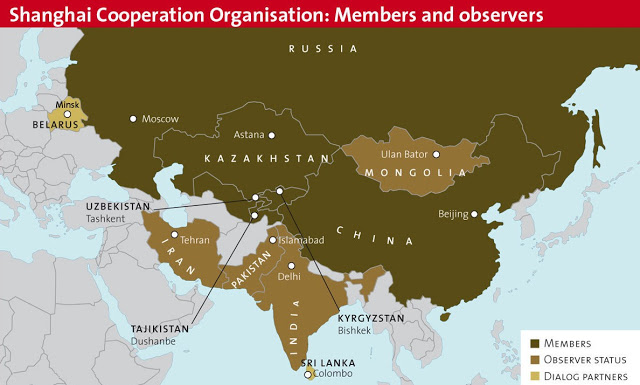
Eye Candy: Shanghai Cooperation Organization

NOL map SCO 2018
Source

First off, Shanghai and Warsaw are two very different cities, and because of that I think the SCO is a different animal than the Warsaw Pact. For one thing (aside from the difference in the two cities, one being selected for its geographical prominence, the other for its commercial acumen), the Warsaw Pact was a military alliance led by the Soviet Union, while the SCO is dedicated to political and economic cooperation as well as military security. Notably, the security aspect of the SCO is dedicated to coordinating state-led efforts against terrorism and separatism rather than against a rival alliance.

I don’t see anything wrong with multilateral efforts undertaken by states other than the US. I don’t see any need to worry, fret, or otherwise suspect the SCO of undermining world peace and prosperity. The fact that the SCO is made up of cooperating autocratic regimes rather than democratic ones does not faze me. The SCO has been making overtures to the democracies of India, Iran, and Sri Lanka (be sure to check out Tridivesh’s excellent take on India and the SCO), and multilateral cooperation among states is in itself an exercise in political participation among equals, albeit not at an individual level.

There is also cause to be happy that China and Russia have bound themselves up in such a prominent cooperative venture, too, given the two powers’ history of fighting each other. The SCO is contributing to peace and prosperity, and while it appears on the surface that the venture is designed to be a rival of the Western-built world order, the Shanghai Cooperation Organization actually contributes to it.

(h/t Nick)

Nightcap

  1. Turkish underworld joins war on journalists Amberin Zaman, Al-Monitor
  2. Turkish underworld has long history of working for Ankara Barry Stocker, NOL
  3. Russia meddles in Greece-Macedonia name bargain Kerin Hope, Financial Times
  4. The ugly plight of Turkey’s hidden Armenians Kapil Komireddi, the National

Nightcap

  1. Before Indiana Jones came Abraham Hyacinthe Anquetil-Duperron Blake Smith, Aeon
  2. Can economists and humanists ever be friends? John Lanchester, New Yorker
  3. A Guaranteed Income would undermine the social virtues of work John McGinnis, Law & Liberty
  4. On Alexandria Ocasio-Cortez, Palestine, and the Left Corey Robin, Crooked Timber

Animation Review #1: Burn the Witch

I am a big fan of animation, but I often have to ‘turn my brain off’ to enjoy a comic trying to make political commentary. With rare exceptions, like the Incredibles series, the industry has a strong statist bent. The industry is so statist that Superman: Red Son, a story line with the premise that Superman landed in the Soviet Union instead of the United States, ends with the message that communism would work if only it were a bit more democratic. Note that I say statist bent, as opposed to leftist bent. They are smaller in number, but there are several conservative comics (e.g. the Kingsman) that leave a statist aftertaste.

I can’t do much on the supply side of liberty-friendly comics, but I can at least highlight those comics that I think fellow libertarians might enjoy via blog posts.

First off is Burn the Witch, a new comic series published by Shonen Jump. I was pleasantly surprised when I read through Tite Kubo’s Burn the Witch. Tite Kubo is best known for authoring Bleach, a comic about Japanese school children fighting demons in fantasy Mexico.

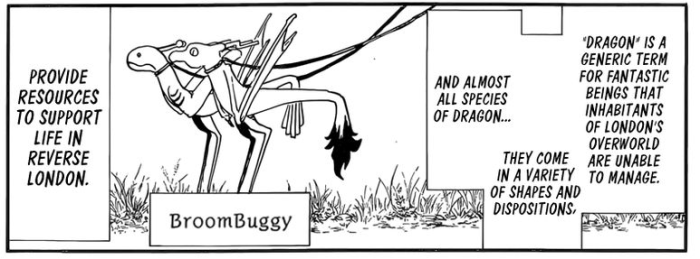
Dragons.png

Burn the Witch is about Anglo-Japanese school children fighting demons in fantasy Britain. The twist? Unlike their counterparts in fantasy Mexico, the British demons (referred to as ‘Dragons’ in-series) aren’t killed outright. Instead they are raised for the resources they provide. Only ‘bad’ demons who are killing humans or otherwise causing destruction are killed. It is noteworthy that the protagonists refer to themselves as ‘conservationists’. They kill the occasional demon, providing the story with action scenes when doing so, but their primary purpose is to conserve them. In an off hand comment the protagonists note that their fantasy Mexican counterparts are barbaric and indiscriminately kill their demons.

Contrary to the protagonist’s comments, it isn’t that individual fantasy Mexicans are barbaric so much that fantasy Mexico doesn’t recognize property rights in demons. Since no one has a property right in demons, no one has an incentive to conserve, much less domesticate, them in fantasy Mexico. Fantasy Britain enjoys strong property rights and consequently has minimal problems associated with its demons. One of the protagonists is ethnically from fantasy Mexico, but seems to be thriving under fantasy Britain’s rules. The story’s lesson? Property rights matter.

Only one chapter of Burn the Witch has been published thus far, and it’s unclear if it’ll become a recurring series, but I like what I’ve seen so far.

Thoughts? Comments? As always, write in the comments below. If you’re a fan of animation and a fellow libertarian, consider joining the anime libertarian alliance facebook group.

Nightcap

  1. Brexit as neoliberal politics Chris Dillow, Stumbling and Mumbling
  2. Russia and “dark globalization” John Connelly, Public Books
  3. Rand Paul finds lots to like in Trump’s presser with Putin Elana Schor, Politico
  4. Did Trump just help stop Brexit? Andrew Sullivan, Daily Intelligencer

The Helsinki Follies

Myself, my wife, Rush Limbaugh, and a couple of others on FB, alone of those who express themselves publicly, have taken leave of their senses. The obvious has stopped waiving at the American intelligentsia (Russian word, on purpose).

Mr Mueller, in charge of demonstrating that Russia gave Mr Trump the election, announces three days before a president’s meeting with Mr Putin that he has charged 12 Russian military intelligence officers with crimes (presumably, violations of American law).

Several things are wrong with this picture.

First, is it a surprise that Russian military intelligence is trying to mess with us? Is this new? Did they used not to? Why make a major announcement of it? It’s routine stuff. Catch them; slap them! Is it the case that US intelligence agencies never tried to mess with Mr Putin’s endless re-elections? What’s their excuse if they did not? Is it the case that our intelligence agencies are not interfering with, say, Venezuela’s political processes today? Really? I liked better the days when our CIA had balls and was the scourge of everything and everyone progressive and socialist.

Second, ignoring the futility of the charges, what’s the chance any of the twelve is going to show up to be tried in America? Not great? Reminder, tentative reminder: Kidnapping them on foreign soil to bring them to American justice would probably violate someone’s law. So, why bother; why indict them? What was the purpose? What was the purpose, a couple of days before President Trump was to meet Mr Putin publicly? Was the purpose other than satisfying justice? Was the purpose to cover up and distract from something more important? Did it have to do with Mrs William Clinton?

Mr Putin offered – short of extraditing the twelve – several compromise solutions so that Mr Mueller could interrogate the Russian intelligence officers named. Will Mr Mueller accept any of those offers? Why not? Give a good reason why he should not.

Reminder: Extradition treaties between countries are always reciprocal: I send you the people you charge; you send me the people I charge. There are really good reasons the US should not want to have such a treaty with Russia.

Does Mueller really want to interrogate the Russian intelligence officers he charged, really? Does he want the truth? (Isn’t it already known?)

How was Mr Trump supposed to respond to such a brutal and vicious attack on his honesty, proffered by Mr Mueller while he was going to be on foreign soil? Was he supposed to lower his eyes, smile sweetly and keep mute? I would not have! He should not have! Should he not have allowed doubt about our intelligence agencies pass his lips, after what the FBI, for example, did? Is he crazy; is he stupid?

Putin is a brutal dictator, a meddler, and probably a murderer. With its nuclear arsenal, his country is the only one really capable of hurting us irreversibly. Good reason to talk to him. We don’t have to be friends but some formal courtesy is required.

The collective reactions of the American political class to the Helsinki meeting tells me that it has lost touch with elementary reality. It’s folly; it’s in a state of collective hysteria. I remember being there before. That was in the eighties.

Warning: If you are sensitive, please, don’t read the next sentences.

In the 80s, the media were awash with denunciations of brutal sex abuse of small children by Satanic cults. People were charged, convicted and sentenced on the testimony of four-year-old coached by eager, man-hating social workers. I remember well, especially, a story in The Atlantic. A father of two confessed to nailing his small daughters to the floor of his living room so his buddies could rape them. The next day, the girls would go to school as usual. No problem! I believe no apologies were ever issued. The justice system was very reluctant to let go of the imprisoned.

A senior Wall Street Journal journalist, Dorothy Rabinowitz, had a solitary struggle of several years to get the wrongs righted.

Wake up, America; get a grip! Those are wooden nickels you are taking!

Nightcap

  1. How sanctions feed authoritarianism Peter Beinart, the Atlantic
  2. Four ways of looking at a constitution Stephen Cox, Liberty Unbound
  3. Mining minerals in outer space: Luxembourg leads the way Justin Calderon, BBC
  4. Europe’s dependence on the US was all part of the plan Claire Berlinski, Politico

Nightcap

  1. Cambodia and the academic Left Matthew Blackwell, Quillette
  2. Lewis Carroll’s adventures in Russia Mark Davies, Times Literary Supplement
  3. Does ‘Melanesia’ exist? Rhys Griffiths, History Today
  4. KFC: Kentucky Fried Camel Sarah Osman, Coldnoon

Nightcap

  1. Belgium struggles to manage its burgeoning Islamic scene Bruce Clark, Erasmus
  2. Juul Madness John Tierney, City Journal
  3. Citizenship is the new caste system Rachel Lu, the Week
  4. Hope and fear in a world of uncertainty Kenan Malik, Guardian

Ottomanism, Nationalism, Republicanism VI

The end of World War Two placed Turkey between the Soviet Communist world and the western democracies. It’s Middle Eastern neighbours consisted of one outright colony (thinly disguised as a League of Nations mandate), French Syria; one de facto colony of Britain, Iraq (formally independent after a mandate period); one country whose sovereignty was highly compromised by United States and British ‘interests’, that is Iran. After decades of rule by the secularist-nationalist Republican People’s Party (CHP is the Turkish acronym), the idea of a Middle Eastern orientation was not a major one at any kind of obvious level, and had limited practical applicability even for those oriented towards the kind of traditionalist Islam which inevitably looks for some kind of connection with the original Muslim heartland.

The Muslim Brotherhood was formed in (British dominated) Egypt in 1928 and that becomes more important in Turkey over time. A Turkish version, National View, was founded by Necmettin Erbakan in 1969, and forms the core of the AKP today, led by Recep Tayyıp Erdoğan. Turkish history from the 1940s to the AKP coming to power in 2002 can look like an inevitable process, and with some qualifications that is probably a reasonable one-sentence way of thinking. Qualifications include the dangers of seeing history as the inevitable unfolding of a single unified process, and the constant possibility that better decisions by secular leaders at various time could have prevented this outcome. The decisions of the small numbers of self-defined liberals in Turkey were not really any better, sad to say.

İnönü’s response to the post-war world was to adopt multi-partyism. The Democrat Party was allowed to form under Adnan Menderes, who had been a member of the short-lived Free Republican Party and then a CHP deputy, and former prime minister Celâl Bayar. The DP contested the 1946 election, which was not all fully free and fair, but came to power in a more properly conducted election in 1950. Bayâr became President and Menderes became Prime Minister. This worked more as the Turkish constitution suggested than when the CHP was the only party in the national assembly. The result was that Menderes was the decision making person.

This political opening up helped Turkey into the Council of Europe (the grouping of European democracies) in 1949 and made it eligible for Marshall Aid under İnönü. Under Menderes, Turkey joined NATO in 1952. Acceptance into NATO was helped by substantial Turkish participation in the Korean War. The participation of conscript peasant soliders from Anatolia is still remembered in folk songs.

All these ways in which Turkey was acknowledged as part of the community of European democracies took place simultaneously for Greece, so the countries were taken as a pair during this period. The peaceful transfer of power through election from İnönü and the CHP to Menderes and the DP was the first such occasion in Turkish and Ottoman history. Some have seen İnönü as ‘only’ responding to US pressure and therefore denied him credit. This has, in the past, been the default position of most Turkish liberals though I believe that the latest historical work shows that İnönü was much more of an active enthusiast for the transition to genuine elections. On this matter, and others, it looks like time for the default ‘liberal’ position to change.

In any case, the whole idea that İnönü only responded to pressure is unsatisfactory. Of course he made his decision in a context of international balances of power of the time. Others made different decisions. In Spain, for instance, Francisco Franco stuck to ultra-conservative, Fascist-influenced dictatorship, accepting US military bases and continuing previous valuable trading relations. In Portugal, the corporatist dictatorship of António de Oliveira Salazar joined NATO after the adoption of an absurd imitation of party pluralism, with a purely token licensed opposition. Spain and Portugal were not aid recipients, but were able to get considerable trade advantages from the differing deals they made to associate with North Atlantic democracies. İnönü could have found ways to stay in power for ever, but did not.

There were limits to İnönü’s moves towards political pluralism and it was certainly not the ideal process. To some degree, it was one part of the CHP agreeing to the demands of the other part (which left to form DP) to have its turn in power after the current, most favourable to state-led joint secularism and modernity had been in power for so long. More on the DP in the next post.

Returning to İnönü’s rule after the war, the left became victims after a period relative tolerance in the latter years of World War Two, when it looked like the western allies would win in alliance with the US, so the Turkish state showed more tolerance of leftists and less of pan-Turkish nationalists who had the most tolerance of Fascism and Nazism (there has never been a self-identified fascist or national socialist political movement in Turkey).

Not only did İnönü oppress leftist groups outside the CHP as he moved towards genuinely contested elections, he identified left-Kemalist loyalists to the regime as communists who needed to be purged. This was at least in part to gain favour in the US by presenting himself as the main enemy of a real communist threat. Left-Kemalist academics who lost their university jobs at the time included Neyazi Berkes, the most notable Kemalist intellectual of any kind, who went onto an academic career in the west. Measures against left groups outside the CHP included using a religious conservative gang to smash the printing presses of a left newspaper. The willingness of the state to tolerate, and even promote, illegal violence by far right groups supposed threats to the regime and has been a frequent occurrence ever since.

To be continued

Nightcap

  1. The lesser of two evils, Brazilian style Dom Phillips, Guardian
  2. Why We Need a New Transatlantic Alliance Bruno Maçães, National Review
  3. The Atlantic Charter, Atlanticism, and Western Civilization Nick Nielsen, The View from Oregon
  4. The Rich Tapestry of Jewish Life Colin Shindler, History Today

Nightcap

  1. You’ll Hate This Post On Brett Kavanaugh And Free Speech Ken White, Popehat
  2. Kavanaugh and Executive Power – the Good, the Bad, and the Overblown Ilya Somin, Volokh Conspiracy
  3. Judge Kavanaugh and Justice Kennedy’s Free Speech Legacy Jonathan Adler, Volokh Conspiracy
  4. How the Kavanaugh Nomination Reveals a Deep Challenge to Our Democracy David French, National Review

RCH: Terrorism, libertarianism in the mountain west, global gold rushes, and more!

Woah, I’ve been busy.

Somehow, they haven’t canned me over at RealClearHistory yet, so I’mma keep going. Here’s the latest:

Two of those gold rushes are happening right now. Why aren’t they famous in the same way that 19th century gold rushes are? You’ll have to check out the link to find out!