Against Ideology

Since first dipping my feet (brain?) into philosophical waters I’ve realized that the world has more dimensions than my mind. Many more. Which means insisting on a consistent philosophy is, in all likelihood, a recipe for disaster.

This isn’t to say I’ve got an inconsistent philosophy, or that I’m ready to throw up my hands and say “anything goes!“. But like a good bridge, my philosophy is full of tensions.

I can’t derive everything back to the Harm Principle (a principle I like), recognition of subjective values (which I’m on board with), or some notion of a social utility function (which I do like as a rhetorical crutch or skyhook, but am unwilling to take with me more than arm’s length from the whiteboard).

Instead, I’ve got a smorgasbord of mental tools–ethical notions (“don’t kill people!”), social science models (prisoners’ dilemma, comparative advantage)–that I try to match appropriately to the situation.

This puts me in the unfortunate position of requiring a great deal of humility. But as it will say on my tombstone: worse things have happened to better people…

I approach the world with libertarian priors. At the end of the day, I’m a left-libertarian anarchist. But Jonathan Haidt’s work has convinced me that my priors say more about me than the world. To be sure, libertarianism brings something important to the table, but so do other views.

Recognizing the importance of ideological pluralism lets me use my ideology like a lever instead of a bat–a tool instead of a weapon. And hey, what’s more libertarian than pluralism?!

As a centuries-long-run prospect for a meta-utopia I’m still staunchly libertarian. Go back in time 500 years and you’ll be told democracy is a pipe dream. I think we’re in a similar moment for the ideas of radical freedom, self-determination, and decentralization of power I’d really like to see put into practice. But imagine going back in 500 years, convincing everyone you’re a powerful wizard, then implementing democracy all at once. I don’t think it’d work out very well. Hell, I’m not even sure about going back in time 3 years to run that experiment! Similarly, flipping the An-Cap switch tomorrow would probably be 100 steps forward, 1000 steps back. Without the appropriate culture in place, good ideas are likely to backfire.

Still, I’m a libertarian anarchist by default and want to see the world move in that direction. But in the short-medium run I refuse to be dogmatic.

I get a lot out of my ideological priors, but I get more by refusing to slavishly follow them at all costs. Yes, the greatest good will be served in an anarcho-capitalist world (I think). But it’s a long trip from here to there. Sustaining that equilibrium will require a cultural shift that hasn’t happened yet–and ignoring those informal institutions is likely to lead to something more like feudalism than utopia. In the mean time, I say move towards greater freedom and avoid getting bogged down in partisanship.


So I’ve got a long-run goal: radical federalism and maximal freedom. But how do we get there? What are the short- and medium-run goals?

Simply to make things better while encouraging people to engage in voluntary interactions that create value, especially by building up social capital networks.

My Austrian-subjectivist priors are in tension with my rationalist-utilitarian instinct. But I think we find a way out by considering policy effects on future generations. Tyler Cowen suggests pursuing policy that promotes long run economic growth.

The big caveat is that although GDP is the best available metric to pursue, GDP is an imperfect measure. Figuring out “GDP, properly understood” adds a layer of complexity that makes policy evaluation all the more difficult. Which is part of the controversy with my recent posts on pollution taxes.

For example, after the end of slavery, total leisure time increased which would decrease measured GDP. But clearly a proper accounting of productivity would discount the initially higher GDP by the cost of forced labor. Similarly, we have to refine our notion of measured* economic well-being to account for things left out of the old methods–like household consumption, leisure, black markets (side note: the war on drugs is a waste!), human capital**, and ecological assets that fall outside the private property system.

Addendum for the left: what’s best for the world’s poorest people is a worthy addition to Cowen’s policy. And it’s an addition that also tends to push us towards libertarian arguments (like liberalization of immigration policy).


Unfortunately, I’m a rationalist by default which means I have to work at my epistemic humility. I’m constantly tempted to see the world as more legible than it really is. I have to keep reminding myself that I don’t know could fill a library. But the world is much more complex than any functional team of smart people could handle, let alone a lone economist–even if he happens to be one of few who really do get it.

One of my favorite arguments is the Austrian-libertarian point that “if we knew what people would do with their freedom, we wouldn’t need it.” For example, the reason to allow someone to start new businesses isn’t because we know that it’s going to make things better. Instead, it’s because market innovation depends on decentralized, crowd-sourced experimentation. We don’t say “oh, this Steve Jobs guy is about to improve our lives,” because if we could do that (we can’t) then we could instead find a less costly way to get the same outcome (we can’t do that either). 

This line of reasoning also applies to policy. There are some easy cases–there’s plenty of low-hanging fruit in occupational licensing. But society is a complex system, so you can’t do just one thing. Any one policy change ripples through the system and creates unintended consequences. 

Don’t get me wrong, I’m not saying we should do nothing. But my conservative friends are right that we shouldn’t go too fast. In any case, we’ve got more tensions that require me to listen to a wider range of ideological voices due to my cognitive limits.


A particularly interesting policy question is to what extent we should (not) take account of the impacts of American (Canadian, European, Chinese, etc., etc.) policy on non-Americans.

Here we find another tension. On the one hand, surely being accidentally born into a particular geography doesn’t give you greater moral weight than others. On the other, even if we want American policy to help Haitians, there’s a knowledge problem exacerbated by distance.

I think the appropriate response is a friendly and open federalism. Local issues should be handled locally. We should be neighborly. We should resist the temptation to centralize power. 

But we should also take advantage of large-scale governance structures (private or public) to deal with large-scale issues. Match the scale of governance to the scale of the relevant externalities.

The downside of this approach is that some locales will do terrible things. “States’ rights” is a bad argument for slavery (or for anything else). But stepping in to make things better isn’t an unambiguous improvement. If there’s one thing to learn from America’s adventures in statecraft*** it’s that you can’t just force a country to be free.

Given that, we should be more open to accept the world’s huddled masses yearning to breathe free. Historically, our record is far from spotless. But there have also been humanitarian successes in moving people away from tyranny. 

We have a moral obligation to at least consider the well-being of everyone around the globe. And the lowest hanging fruit for actually making a positive difference is opening up our borders. Not to say there’s a simple answer, but the answer lies in the direction of freedom of movement.


How should we (according to me) go about deciding questions of public policy? We should opt to encourage the creation of value and reduction of costs (i.e. economic growth). But we should do so carefully and with open minds.

GDP growth is a worthy goal, but not for it’s own sake. John Stuart Mill wrote: 

“How many of the so-called luxuries, conveniences, refinements, and ornaments of life, are worth the labour which must be undergone as the condition of producing them?… In opposition to the ‘gospel of work,’ I would assert the gospel of leisure, and maintain that human beings cannot rise to the finer attributes of their nature compatibly with a life filled with labour.”

Mindless insistence on measurable output overlooks important things like going to your kid’s little league game, grabbing a beer with friends, or quiet contemplation. And even if the people arguing for protecting the environment seem a bit silly, we’re wrong to ignore the importance of environmental externalities in affecting our standard of living. All of which is to say, Cowen is right that we need to carefully consider the shortfalls of how we measure economic growth, all while encouraging it.

Perhaps most importantly, we should relish a tension between consequentialism and principles. There are plenty of low-hanging fruits for libertarianism, but if we want to get the most out of this metaphorical tree we need to let a fear of bad outcomes encourage us to invest in civil society, informal institutions, and rich social networks so that freedom can expand without costing us inhumanity. I want to see the welfare state ended, but I’m willing to wait while we start by reducing barriers to entrepreneurship. I want to see taxes go away, but I’m willing to see a less-bad tax replace an egregious one.

We should reject the dogmatism that too often leads us to over-prioritize ideological purity. First, such purity can trap us in local optima (metaphor: a self-driving car programmed to never go east sounds like a good way to get from NYC to LA… till it gets stuck in a cul de sac somewhere). Second, that purity is an illusion. God’s true ethical system simply isn’t available to us–it’s more complex than our brains are–so why worry?


Post script: don’t take this to be an argument against libertarianism. Or a call to prioritize “pragmatism” over ideology or any other political values. I’m not trying to make a definitive argument abolishing ideology, I’m just gently pushing back. The key word here is tension. We can’t have tension between A and B if we get rid of A.


*Here’s another tension: I don’t believe we can actually measure economic well-being. I think we can make educated guesses based on well-thought out studies of observable proxy variables, but I believe in the impossibility of interpersonal utility comparison.

**A major pet peeve of mine is the conflation of education and schooling. Education, properly understood, is simply not measurable. We might find some clever proxy variables (for example, the Economic Complexity Index is my current favorite metric for productive capability–which overlaps capital and human capital accumulation).

***That’d be a good title for a comic book! If you know the right historian and/or international relations scholar, put them in touch with Zach Weinersmith!

Nightcap

  1. How things fell apart in 20th century Germany Adam Tooze, Financial Times
  2. “The world was just an aggregation of nation-states” Branko Milanovic, globalinequality
  3. Godspeed Justin Raimondo, You Brilliant Son of a Bitch Nicky Reid, Counterpunch
  4. “The problem is that our own agency is so precious to us” Caleb Scharf, Life Unbounded

FURTHER CRACKS IN THE GLOBAL WARMING PROPHECY

Although global warming zealots continue their religious crusade, more research reveals skepticism toward the doomsday prophecies. Recently Finnish scientists published research that further debunks claims about the role of humans in generating global warming. Their thesis is that global temperatures are controlled primarily by cloud cover, which is a natural occurance that is beyond human control:

https://www.ecology.news/2019-07-12-climate-change-hoax-collapses-new-science-cloud-cover.html

The opponents immediately denounced this as a junk science:

It is OK and normal to have debates within scientific community. We, regular lay tax paying people are understandably not shrewd in all intricacies of scientific debates around so-called climate change. Yet, I am sure many of us want to make sure that no financially ruinous global or nationwide social engineering scheme would be enforced on all of us by social activists who decided to side with a group of aggressive academic zealots claiming scientific consensus and squashing dissenting views.

In his Counterrevolution of Science (1955), F. A. Hayek wrote about the dangerous hubris of “science worshippers” who wanted to extend their theories, which at best had narrow application and limited experimental database, to reshape the life of entire humankind. The first aggressive spearheads of this hubris were “generation X” socialists, acolytes of Henri St. Simone, who congregated in and around Paris Ecole Politechnique from the 1810s to 1860s. They dreamed about New Christianity – a creed based on the religion of science. With its “Council of Newton,” it was to regulate entire life of society. In the past century, we already lived through projects designated to reshape the life of humanity through “scientific” societal laws peddled by Marxism. We also lived through national socialist attempts to breed the better race of human beings based on “scientific” laws. More recently, in the 1970s, driven by the same scientific hubris backed by moral considerations, we resorted to global ban of “evil” DDT.  This led to the outbursts of yellow fever and mass deaths in the Third World.

During a brief period of soul searching and self-scrutinizing among the left in the wake of communism collapse in the 1990s, in his Seeing Like a State (1998), James Scott, a leftist academic, gave a severe critique of that hubris that he called high modernism arrogance. Not naming socialism directly and sparing the ideological feelings of his fellow comrades, who have been dominating humanities and social sciences, he subtitled his book as follows How Certain Schemes to Improve the Human Condition Have Failed. Still, it was a devastating accusation of the “science”-based social engineering, from German attempts to breed perfect healthy forests in the 18th century to the “scientific socialism” of the Soviets  who methodically ruined Russian agriculture by their aggreesive collectivization. The current left are not as modest as Scott’s generation. They quickly moved on, sweeping their own history under the rug. Being emboldened by the crisis of 2008 (a new “sign” of capitalism end of times), the left are now ecstatic about the Green New Deal and its Stalinist global warming regulations that are peddled by the big-eyed “democratic” socialist of “color” from Congress. It seems we are invited again to step on the same rake in order to smash our forehead once again by adopting another scientific Utopia.

Nightcap

  1. Buddhist terrorists and the Zen way of war Brian Victoria, Aeon
  2. Faith and empire: a realistic view of Tibetan Buddhism Ian Johnson, New York Review of Books
  3. A history of Soviet Atheism Elena Leontjeva, Law & Liberty
  4. “It’s now Raimondo’s world, and he’s not living in it” Curt Mills, Spectator USA

Tone deaf Leftists: A Chilean tale

Check out this beautiful block of text from the Poetry Foundation, an educational website ostensibly dedicated to the subject it has named itself after:

[Pablo] Neruda had gone into hiding in his native Chile more than a year before. After he helped elect Gabriel González Videla as president on a radical left platform, González Videla launched a campaign of repression that included roundups of leftists and labor leaders, and violent repression of workers’ strikes. As copper prices plummeted after World War II, the Truman administration convinced González Videla that he would need the United States’ economic help and that war between the US and Russia was looming. This convinced González Videla to ban communism in Chile.

There are two things to think about here. One is the fact that the poetry website is only superficially about poetry, even though it proudly claims the mantle of all things belonging to the realm of the poet. In reality, the Poetry Foundation is one of the many well-funded arms of the political left.

Here’s the thing, though. The folks at the Poetry Foundation don’t think they’re engaged in leftist political activism. They think they’re doing the work of a poetry foundation. To them, there is no distinction between poetry and left-wing politics. It’s like the partisan who claims to be a political moderate while calling for the wholesale nationalization of medical and financial markets. We’re not dealing with a vicious, concerted effort to uproot the liberal order. We’re dealing with obstinate people in cliques who believe they have more knowledge than everybody else. (By the way, the excerpt above was what the well-respected leftist website 3 Quarks Daily, which shows NOL some love from time to time, used to promote the article.)

The second thing I’d like to focus on is the narrative itself. A radical left-wing government was elected and, once in power, immediately began repressing other rivals factions. (Do you think labor groups and other leftist organizations were the only ones repressed by González Videla?) This is not a new phenomenon. This is what radicals, on both the left and the right, do. Just ask the Russians. Or the Venezuelans.

Yet look at how this well-documented repression – by a left-wing, democratically-elected Chilean government – is portrayed by the Poetry Foundation. Instead of owning up to the fact that radical governments, even democratically-elected ones, tend to resort to violence when their unfeasible ideas are finally put into place and inevitably, predictably fail, Harry Truman gets blamed.

So a radical leftist government gets elected and starts repressing its former allies (and, it is assumed, its enemies) because Harry Truman told this radical, democratically-elected leftist that the Soviet Union and the United States were going to fight in a war and the Americans were the side Chile should ally with? Obstinate ignorance!

Before I sign off, it’s worth noting that González Videla was elected in 1946. Allende was elected in 1973. In the nearly 40 years between them lots of people on both sides of the aisle died for political reasons. People didn’t stop dying until well into the 1980s. Yet, somehow, Milton Friedman and F.A. Hayek (and Harry Truman) are to blame for all of Chile’s Cold War woes.

Nightcap

  1. Murray Rothbard on reparations for slavery Jeff Deist, Power & Market
  2. Outstanding analysis of Israeli politics Michael Koplow, Ottomans & Zionists
  3. “My book was arrested but I am free” Victor Sebestyen, New Statesman
  4. Breakfast has resisted globalization, until now Josie Delap, 1843

Nightcap

  1. “Buddhists have entered the era of militant tribalism” Hannah Beech, New York Times
  2. The German problem Samuel Goldman, Modern Age
  3. The Soviet century Aaron Smith, Harper’s
  4. Fully automated luxury communism Kristian Niemietz, Quillette

Nightcap

  1. Liberalism misunderstood Peter Boettke, Coordination Problem
  2. The way of the gun John Lott, Claremont Review of Books
  3. Homo Appiens and free speech Arnold Kling, askblog
  4. David Remnick interviews AOC for the New Yorker

Nightcap

  1. The future of God in 1943 Tim Stanley, History Today
  2. Against the old clichés, Anne Applebaum, New Criterion
  3. French colonialism lives on in Africa Thomas Fazi, spiked
  4. A free-market gold standard? George Selgin, Alt-M

Introducing: the Federation of Free States, an ongoing thought experiment

The most popular article I have ever written, in terms of views, has been, by far, “10 Places that Should Join the U.S.,” a short piece at RealClearHistory pining for an enlarged geographic area under the American constitution.

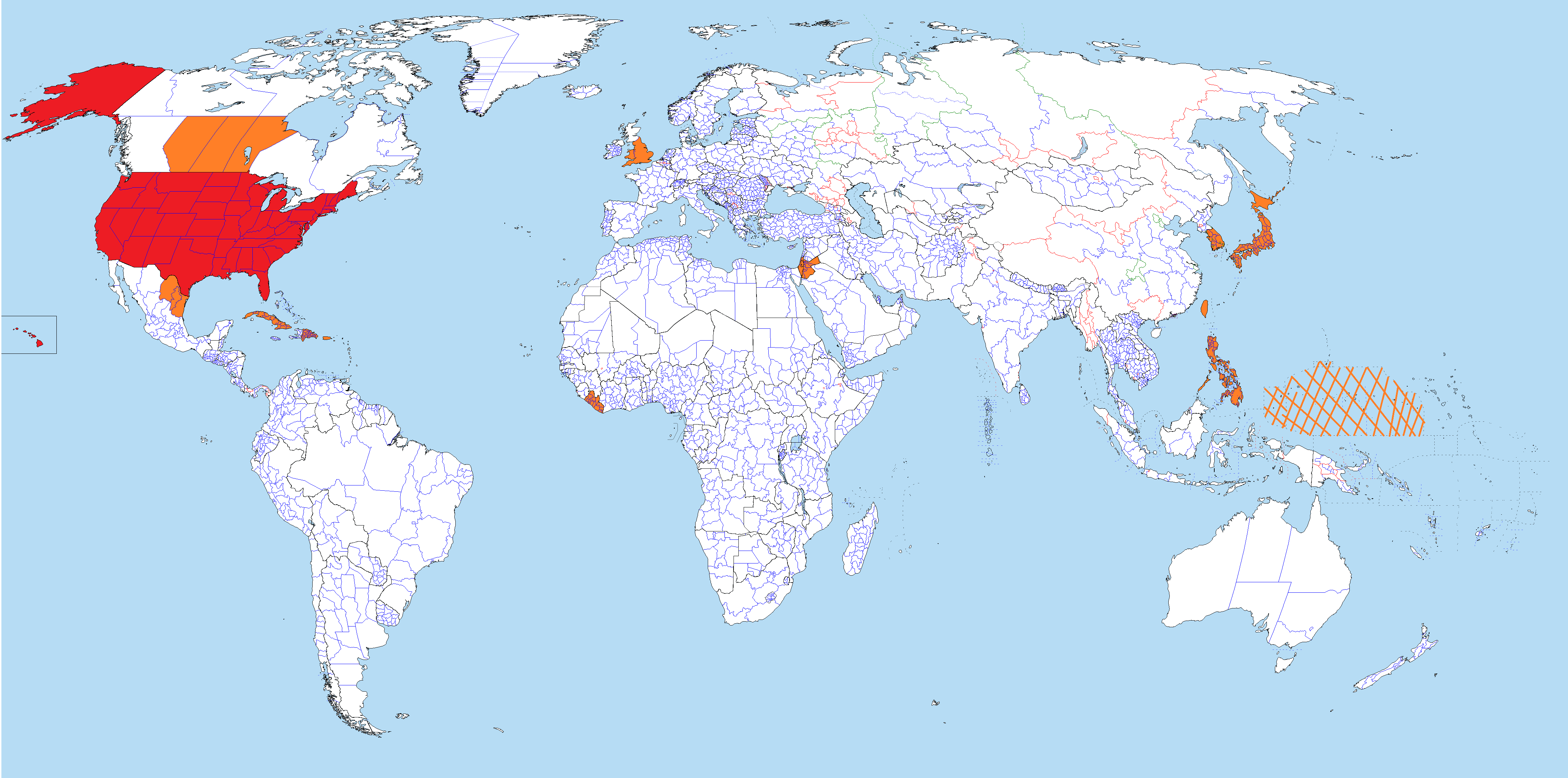
This is not a strange concept for longtime NOL readers. I’ve been pleading for stronger political ties between the U.S. and its allies for quite some time. There has been lots of push back to this argument, from everywhere. So I’m going to spend some more time explaining why I think it’d be a great idea for the American constitutional regime to expand geographically and incorporate more political units into its realm. Here is what an initial “federation of free states” would look like in, say, 2025:

NOL map United States in 2020 with 79 states

I’ve incorporated two of the strongest voices against such a federation, NOL‘s very own Michelangelo and Edwin. Michelangelo’s Pacific and Caribbean bias is somewhat acknowledged, and Edwin’s pessimistic socio-linguistic argument against adding continental European states to the federation has also been incorporated.

I’ve also tweaked the “10 places” that I originally saw fit to join the US.

In the map above I’ve got parts of Canada (the 3 “prairie provinces”) and Mexico (3 “ranching states”) joining the American federation. The prairie provinces of Canada – Alberta, Saskatchewan, and Manitoba – would be admitted as separate “states,” and would thus get to send 2 senators each to Washington. According to my napkin calculations, Alberta would only be sending 3 representatives to DC while Saskatchewan and Manitoba would only get 1 representative each in the House. The ranching states of Mexico – Coahuila, Tamaulipas, and Nuevo León – wold likewise be admitted as separate “states,” and would also get to send 2 senators each to Washington. These three states, which have plenty of experience with federalism already, are a bit more populated than the prairie provinces, but not by much. Nuevo León would send 4 representatives to DC, while Tamaulipas would send 3 and Coahuila, 2. Why be so generous to these polities? Why not lump them together into one unit each – a Mexican one and a Canadian one? Mostly because these new states would be giving up a lot to leave their respective polities. Military protection and the rule of law wouldn’t be enough, on their own, to persuade these states into joining the Federation of Free States. They’d need disproportionate representation in Washington, via their Senate seats, in order to leave Canada and Mexico and join the republic.

Antilles (Cuba, Dominican Republic, US Virgin islands, and Puerto Rico). This is a random collection of polities, I admit, and lumping them together into one “state” is even more random. But lump them together I would. On their own I don’t think these polities would do well in a federated system, even with their own Senate seats. There’s just not enough historical parliamentary experience in these Caribbean states. If they were lumped together, though, they’d be a formidable presence in Washington. While Antilles would only get 2 Senators, its combined population would be enough to send 19 representatives to the House, more than Florida, New York, and a gang of other influential states in the current union. At the heart of Antilles joining the US as a “state” in its union is a great trade off: sovereignty in exchange for the rule of law and democratic self-governance.

IsPaJo. Israel, Palestine, and Jordan would also be incorporated into 1 voting state, though I don’t have a good name for this state yet. This isn’t nearly as crazy as it sounds. The populations of these 3 polities would benefit immensely from living under the US constitution. Questions of property would be handled fairly and vigorously by the US court system, which is still widely recognized as one of the best in the world when it comes to property rights. Concerns about ethnic cleansing or another genocide would be wiped away by the fact that this new state is now part of the most powerful military in world history. Sure, this state would only get to send 2 Senators to Washington, but its representation in the House would be sizable: 18 representatives.

England and Wales (but not Scotland or Northern Ireland). England would be the crown jewel of the federation free states. The United Kingdom is dying. Scotland wants out. Northern Ireland wants to rejoin Ireland. In England, London is thriving but the rest of the country is suffering from the effects of de-industrialization. The kingdom’s once-vaunted military depends on the United States for nearly everything. Adam Smith put forth a proposal in his 1776 treatise on the wealth of nations that’s worth re-discussing here. Smith argued that the best way to avoid a costly war with the 13 American colonies was to give them representation to go along with taxation. He proposed that the U.K.’s parliament should add some seats and give them to North American representatives. This way both sides could avoid the whole “no taxation without representation” dispute. Smith further opined that, were this federation to happen, the center of the British empire would inexorably move in the direction of the North American colonies. England and Wales would both get to send 2 Senators to Washington, giving the Isle of Liberty 4 Senators in the upper house. Wales wouldn’t get much in the way of the lower house (only 2 representatives according to my napkin calculations), but England, in exchange for its sovereignty, would become the republic’s most populated “state” and would therefore get to dictate the terms of discourse within the republic in much the same way that California and Texas have been doing for the past 3 or 4 decades. That’s not a bad trade-off, especially if you consider how awful life has become in once-proud England.

Liberia. In 1821-22, the American Colonization Society founded a colony on the Pepper Coast of West Africa and called it Liberia. The aim of the colony was to provide freed slaves in the Americas a place to enjoy their freedom, since racism was still rampant in the Americas. The freedman quickly came into conflict with the locals (a clash of cultures that has continued into the present day). Liberia, governed by its New World migrants, declared its independence in 1847 but it wasn’t until 1862, in the early stages of the American Civil War, that the US recognized Liberia’s declaration. The African continent’s first and oldest republic, predating Ghana by over one hundred years, survived, as an independent entity, the Scramble for Africa in the late 19th century and has been at the forefront of regional coalition-building in Africa since the end of World War II (when the British and French empires collapsed). Liberia, like almost all republics, has decayed politically and socially, especially over the last few decades. Federating with the United States would do wonders for Liberians, and give the federation of free states a legitimate stamp on the African continent (and breath new life into America’s own republican decay). The West Africans would send 2 Senators to Washington, and about as many representatives as Louisiana or Kentucky.

Japan (8 “states”). With nearly 127 million people, Japan’s presence in the American federation would alter the latter’s composition fundamentally. Federating the United States with Japan also presents some logistical problems. As it stands today, Japan has 47+ prefectures, which are roughly the equivalent of US states. If we added them all as they are, the Japanese would get over 100 senate seats, which is far too many for a country with so few people. So, instead, I would bring Japan on board via its cultural regions, of which there are 8: Kantō, Kansai, Chūbu, Kyushu, Tōhoku, Chūgoku, Hokkaidō, and Shikoku. The country formerly known as Japan would get 16 Senate seats (which would be roughly divided between left and right) and the new “states” would be able to send a plethora of representatives, ranging from 32 for Kantō to 3 for Shikoku. In exchange for its sovereignty Japan would get the military protection from China it wants. The US would no longer have to worry about a free-rider problem with Japan, as its inhabitants would be citizens under the Madisonian constitution. It is true that a federation would lead to more non-Japanese people being able to migrate and take root in Japan, but this is a feature of federation, not a bug. (A federation of free states would devastate ethno-conservatism in several societies around the world.)

“Micronesia.” Made up of 8 current countries and territories in the Pacific Ocean, Micronesia is also a cultural territory that encompasses a huge swath of the Pacific. While it doesn’t have a whole lot of people, Micronesia has been important to US military efforts in the Pacific for centuries. Federating with the area is the least we could do for the inhabitants of the Northern Marianas, Guam, the Federated States of Micronesia, the Marshall Islands, Palau, Nauru, Kiribati, and Wake Island. Micronesia would only get 1 seat in the lower house, but with 2 sitting Senators in DC the area would finally get a say in how the United States conducts its business in the region.

Visayas, Mindinao, and Luzon. These 3 regions in the Philippines would do much to enrich the federation of free states. Like Japan above (and South Korea below), the Philippines has a complicated representative system that would need to be simplified in order to better fit the Madisionian constitutional system. Through this cultural-geographic compromise, the Philippines would be able to send 6 senators to Washington, but these three “states” would also get to send more representatives to Washington than New York, Pennsylvania, and a bunch of other current heavyweights. There is already a long history between Filipinos and Americans, and while the first half century was a rough one for both peoples, today Filipinos hold some of the most pro-American views in the world. Of course, Americans who live near Filipino communities in the United States know just how awesome Filipinos are.

Taiwan. Even though Washington doesn’t officially recognize Taiwan as a country (a deal Washington made with post-Mao reformers on the Chinese mainland, in exchange for peace and trade), the two polities are deeply intertwined. Taiwan spends billions of dollars on American military equipment, and the U.S. spends significant political capital protecting Taiwan from China’s bellicosity. Taiwanese statehood would not only bring two close societies even closer together, it would force China to either fight the United States or reveal itself to be a paper tiger. That’s a gamble I’m willing to take, since China is a paper tiger.

South Korea (5 “states”). Another wealthy free-riding ally of the United States, South Korea has 5 cultural regions that could easily become “states” in a trans-oceanic federation: Gangwon, Jeolla, Chungcheong, Gyeongsang, and Gyeonggi. This would give South Korea 10 senators and 50 representatives (spread out according to population size, just like all the other states in the union).

Altogether we’re looking at adding 29 states to the union. That’s a lot, but I think you’ll find that not only would we be expanding liberty but also limiting the size and scope of the federal government, and forcing it to do more of what it is supposed to do: provide a standardized legal system with plenty of checks & balances and maintain a deadly, defensive military.

Ending Empire

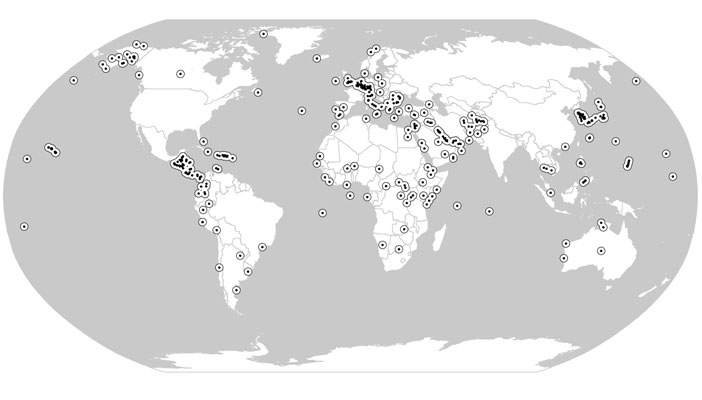
Check out this map of known American military bases in the world today:

NOL known US bases
h/t Dissent Magazine

Expanding liberty and the division of labor are not the only positive side-effects of an enlarged federation under the Madisonian constitutional system. Ending empire – which is expensive and coercive, and gives the United States a bad name abroad – would also be a key benefit of expanding the republic’s territory.

Most American libertarians are isolationists/non-interventionists. Most European libertarians are wishy-washy hawks. Neither position is all that libertarian, which is why I keep keep arguing that “a libertarian position in foreign affairs should emphasize cooperation, choice, and trade-offs above all else.” Non-interventionism is uncooperative, to say the least, but you could argue that it’s at least a position; the Europeans seem to take things on a case-by-case basis, which is what you’d expect from a people who haven’t had to make hard foreign policy decisions since 1945. Open borders is a cool slogan, but that’s just a hip way of arguing for labor market liberalization.

It’s time to open up our doors and start talking to polities about going all the way.

Nightcap

  1. One multi-ethnic state on the ruins of another Branko Milanovic, globalinequality
  2. Class politics has given way to identity politics Fraser Myers, spiked
  3. What a conservative learns in college these days Kathryn Hinderaker, Power Line
  4. “You can only hold down a good city for so long” Scott Sumner, MoneyIllusion

“Ethnic Violence in Africa: Destructive Legacies of Pre-Colonial States”

Note: I’ve gotten through the first three chapters of Paul Feyerabend’s Against Method. (Rick’s initial thoughts are here, and Bill has been doing Feyerabend for awhile. These are the two you should probably follow a bit more closely throughout the summer.)

My own thoughts on Against Method are coming, but I keep getting distracted. Check out this beast of an article on how pre-colonial states in Africa continue to influence current affairs today, even though these have been absorbed into the post-colonial states we are all familiar with in Africa today. (h/t Kevin Lewis)

Nightcap

  1. What is a “national interest”? (Why not federalism?) NOL
  2. Libertarians and world government NOL
  3. Sovereignty, the commons, and international relations NOL
  4. Why not world government? NOL

Don’t forget to read through the ‘comments’ dialogues…

Nightcap

  1. David Bergland, R.I.P.
  2. The case against the case against the American Revolution Ilya Somin, Volokh Conspiracy
  3. One of the most peculiar aspects of the history of democracy Salih Emre Gercek, Age of Revolutions
  4. Reason, naturalism, and free will David Potts, Policy of Truth

Nightcap

  1. If the United States leaves NATO: a thought experiment Economist
  2. The cries of populism have always been hollow Bryan Caplan, EconLog
  3. A new two-party system in the democratic West John Quiggin, Crooked Timber
  4. The student takeover at Cornell, 50 years on Tony Fels, Quillette