- Europe’s Ancien Régime returns Jäger and David Adler, London Review of Books
- Monetary imperialism in French West Africa Ndongo Samba Sylla, Africa is a Country
- In defense of George W Bush Feaver & Inboden, War on the Rocks
- Justice Ginsburg on Justices Gorsuch and Kavanaugh Jonathan Adler, Volokh Conspiracy
Nightcap
- What it’s like to be black in Europe Christopher Kissane, Financial Times
- America’s other rebellious border Maxime Dagenais, Age of Revolutions
- Capitalism in America: Up, up, and away Deirdre McCloskey, Claremont Review of Books
- How Italy made me think about America Addison Del Mastro, American Conservative
From the Comments: Dual loyalties and American hypocrisy
I am on the road. I’m in Utah, actually, for a wedding. I drove here with my little family. From Texas. It’s a beautiful drive. But long. I’ll have more American pop-sociology soon enough. In the mean time, here’s Irfan on an important topic, and one that’s gone almost cold in libertarian circles:
Thanks for mentioning this post of mine. I hope people will take a look at the comments as well as the post itself. One hears so much loose talk about “anti-Semitism,” and the insult implied by talk of “dual loyalties.” But it’s not a criminal offense in the United States to believe or assert that Muslims celebrated the 9/11 attacks, or imply that Muslims side with Al Qaeda or ISIS. The President encourages people to believe and say such things, and they do, from the federal executive down to the local level.
https://thehill.com/blogs/blog-briefing-room/news/454555-new-jersey-school-board-member-says-his-life-will-be-complete
Meanwhile, the State of New Jersey is seeking to make it a criminal offense to assert that Palestinians have a right of self-defense against attackers who happen to be Jewish: $250 fine, six months in the county lock up. In this universe, either there is no such thing as a Jew who aggresses against a non-Jew, or if it happens, non-Jews are not to resist in such a way as to “harm” their attackers.
As for “dual loyalties,” here is an undeniable, demonstrable fact that no one engaged in the “dual loyalties” debate has managed to address: American Jews have the right to maintain dual citizenship, US and Israeli, to enter the Israeli military, and to serve under Israeli commanders. Those commanders have the authority to order those under their command (including American “Lone Soldiers,” as they’re called) to shoot at anyone deemed a threat under rules of engagement that cannot be questioned by anyone outside of the chain of command. The potential targets include Americans like me (or Rachel Corrie, or Tariq Abu Khdeir). No soldier has the right to refuse such an order. You get the order? You fire at will–to kill.
If an American serving under foreign command faces the prospect of shooting an American in a foreign country, exactly what description are we to give that situation but precisely one of dual loyalties? The soldier holding the weapon has one loyalty to a foreign commander, and one to the United States (or else to the principle of rights), which proscribes shooting a fellow citizen under questionable circumstances. How he resolves the dilemma is up to him, but you’d be out of touch with reality to deny that he’s in one. Is it really “racist” or “anti-Semitic” to identify this blatantly obvious fact? Apparently so.
If the New Jersey bill passes, my merely raising the preceding issue out loud, even as a question–iin the presence of someone who might report me to the police–makes me a criminal suspect, subject to arrest and prosecution. Though I teach at a private university, and the bill seems to apply only to public universities, the wording is extremely vague and ambiguous, and in case, even on the narrow interpretation of its scope, it implies that I lose my rights of free speech if I move to a public university or (perhaps) if I engage in a speech act while being present at a public university.
As someone who’s already been arrested on campus for “saying the wrong thing” (where the offended parties weren’t the usual left-wing snowflakes) this whole censorship thing is starting to get old pretty fast. If the passage of this bill wouldn’t mark a descent into fascism, with a rather large assist from the pro-Israel lobby, what would? If a constituency threatens to imprison you for exercises of free speech and academic freedom in the name of a sectarian state, are you really obliged to pretend that it’s not doing what it practically admits to be doing?
Dr Khawaja blogs at the always-excellent Policy of Truth.
Here is stuff on antisemitism at NOL. And on Palestine. And on free speech.
Nightcap
- Paying special attention to Israel’s recent home demolitions Michael Koplow, Ottomans & Zionists
- The political foundations of the German Federal Republic Jacob Van de Beeten, JHIBlog
- Taking a new, leftist look at Christianity in America Marilynne Robinson, New York Review of Books
- The best piece on Boris Johnson’s win I’ve yet read Alberto Mingardi, EconLog
Nightcap
- The divine right of the majority Pierre Lemieux, EconLog
- Overcoming the Mormon legacy on race Bruce Clark, Erasmus
- A sympathetic liberty Brent Orrell, Law & Liberty
- Free speech on the shoals of ideology Irfan Khawaja, Policy of Truth
Nightcap
- India blasts off for the moon Jen Kirby, Vox
- South Korea’s first strongman Rob York, War on the Rocks
- The fourth state of water Marc Henry, Inference
- New left economics and the capitalist system Andy Beckett, Guardian
Nightcap
- Less visible systems of murder Robin Hanson, Overcoming Bias
- No. Belle Warring, Crooked Timber
- Finally, air is for sale Oliver Wainwright, Guardian
- Martian civilization Nick Nielsen, Centauri Dreams
Nightcap
- Goldbugs for Trump Paul Krugman, New York Times
- The day the Swedes forget individualism Derrier & Savage, BBC
- Arnold Kling is correct about Will Wilkinson askblog
- A history of the German people William Hay, Law & Liberty
Nightcap
- A German history of the Balkans Tony Barber, Financial Times
- A Brazilian history of the Atlantic slave trade Jorge Cañizares-Esguerra, Not Even Past
- A conservative history of America at its peak Ross Douthat, New York Times
- The emotional lives of others Andrew Beatty, Aeon
Nightcap
- Movers and stayers (immigration) John Quiggin, Crooked Timber
- Bryan Caplan steps out of his bubble (and away from libertarian philistinism) EconLog
- Edmund Burke and the idea of national conservatism Yuval Levin, Law & Liberty
- “Never give a cunt a chance to be a cunt.” (Labour’s antisemitism) Chris Dillow, Stumbling & Mumbling
Nightcap
- Can Ottoman nostalgia be a good thing? Peter Gordon, Asian Review of Books
- Ottomanism, Nationalism, Republicanism Barry Stocker, NOL
- What is global history? One good answer (and one not so good answer) Krishan Kumar, Times Literary Supplement
- The world without the moon Caleb Scharf, Life, Unbounded
Nightcap
- Poetic justice with Donald Trump Irfan Khawaja, Policy of Truth
- Love it or leave it: exceptionalism for dummies Ross Douthat, New York Times
- How not to be an arrogant prat Chris Dillow, Stumbling & Mumbling
- Rent-seeking during the slave trade Jose Corpuz, The Long Run
Nightcap
- On gratitude and immigration Charles Cooke, National Review
- The myth of the welfare queen Bryce Covert, New Republic
- “Why did the Department of Justice cut such a deal?” Ken White, the Atlantic
- When the sun never set Michael Auslin, Claremont Review of Books
Nightcap
- The Dutch-Norwegian oil boom town nobody has heard of Matthew Birkhold, Public Domain Review
- A 19th century “ice map” from the American northeast Rebecca Onion, the Vault
- 20th century Soviet hipsters still went to Siberia James Womack, Los Angeles Review of Books
- “In reaction to the neoliberal turn of the Red-Green government…” Adam Tooze, London Review of Books
The long-run risks of Trump’s racism
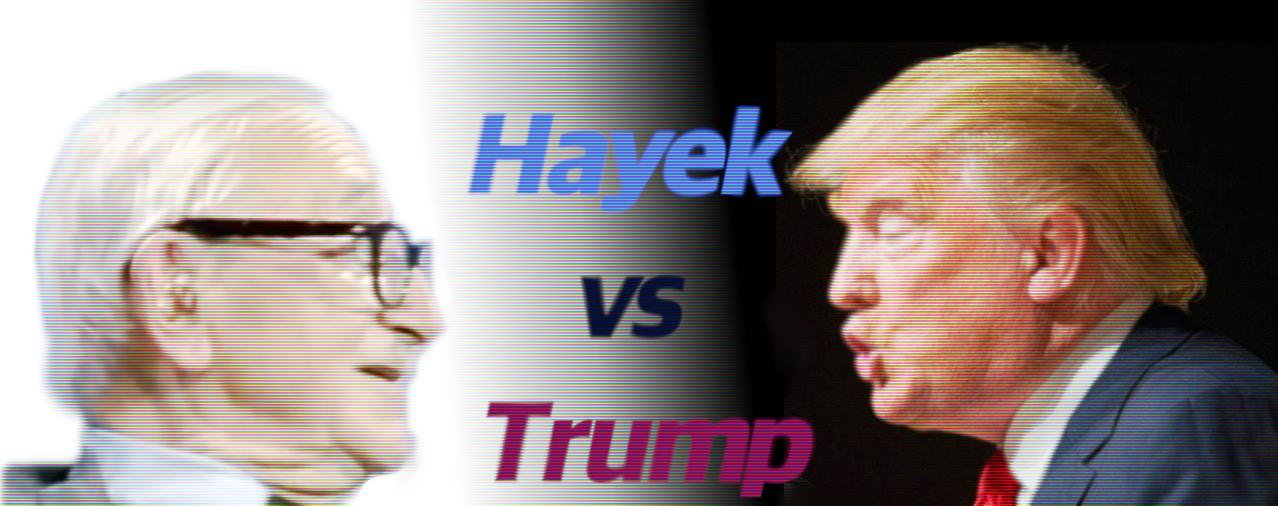
This week, the United States and much of the world has been reeling from Trump’s xenophobic statements aimed at four of his Democratic opponents in Congress. But the U.S. economy continues to perform remarkably well for the time being and despite his protectionist spasms, Trump is widely considered a pro-growth, pro-business President.
This has led some classical liberals to consider Trump’s populist rhetoric and flirtations with the far right to be a price worth paying for what they see as the safest path to keeping the administrative state at bay. Many classical liberals believe the greater risk to liberty in the U.S. is inevitably on the left with its commitment to expanding welfare-state entitlements in ways that will shrink the economy and politicize commercial businesses.
In ‘Hayek vs Trump: The Radical Right’s Road to Serfdom’, Aris Trantidis and I dispute this complacency about authoritarianism on the right. In the article, now forthcoming in Polity, we re-interpret Hayek’s famous The Road to Serfdom in light of his later work on coercion in The Constitution of Liberty.
We find that only certain forms of state intervention, those that diminish the rule of law and allow for arbitrary and discriminatory administrative oversight and sanction, pose a credible risk of turning a democratic polity authoritarian. A bigger state, without more discretionary power, does not threaten political liberty. Although leftwing radicals have in the past shown disdain for the rule of law, today in the U.S. and Europe it is the ideology of economic nationalism (not socialism) that presently ignores democratic norms. While growth continues, this ideology may appear to be compatible with support for business. But whenever the music stops, the logic of the rhetoric will lead to a search for scapegoats with individual businesses in the firing line.
Several countries in Europe are much further down the 21st road to serfdom than the U.S., and America still has an expansive civil society and federal structures that we expect to resist the authoritarian trend. Nevertheless, as it stands, the greatest threat to the free society right now does not carry a red flag but wears a red cap.
Here is an extract from the penultimate section:
The economic agenda of the Radical Right is an extension of political nationalism in the sphere of economic policy. While most Radical Right parties rhetorically acknowledge what can be broadly described as a “neoliberal” ethos – supporting fiscal stability, currency stability, and a reduction of government regulation – they put forward a prominent agenda for economic protectionism. This is again justified as a question of serving the “national interest” which takes precedence over any other set of values and considerations that may equally drive economic policy in other political parties, such as individual freedom, social justice, gender equality, class solidarity, or environmental protection. Rather than a principled stance on government intervention along the traditional left-right spectrum, the Radical Right’s economic agenda can be described as mixing nativist, populist and authoritarian features. It seemingly respects property and professes a commitment to economic liberty, but it subordinates economic policy to the ideal of national sovereignty.
In the United States, President Trump has emerged to lead a radical faction from inside the traditional right-wing Republican Party on a strident platform opposing immigration, global institutions, and current international trade arrangements that he portrayed as antagonistic to American economic interests. Is economic nationalism likely to include the type of command-and-control economic policies that we fear as coercive? Economic nationalism can be applied through a series of policies such as tariffs and import quotas, as well as immigration quotas with an appeal to the “national interest.”
This approach to economic management allows authorities to treat property as an object of administration in a way similar to the directions of private activity which Hayek feared can take place in the pursuit of “social justice.” It can take the form of discriminatory decisions and commands with a coercive capacity even though their authorization may come from generally worded rules. Protectionism can be effectuated by expedient decisions and flexible discretion in the selection of beneficiaries and the exclusion of others (and thereby entails strong potential for discrimination). The government will enjoy wide discretion in identifying the sectors of the economy or even particular companies that enjoy such a protection, often national champions that need to be strengthened and weaker industries that need to be protected. The Radical Right can exploit protectionism’s highest capacity for partial discriminatory applications.
The Radical Right has employed tactics of attacking, scapegoating, and ostracizing opponents as unpatriotic. This attitude suggests that its policy preference for economic nationalism and protectionism can have a higher propensity to be arbitrary, ad hoc and applied to manipulate economic and political behavior. This is perhaps most tragically demonstrated in the case of immigration restrictions and deportation practices. These may appear to coerce exclusively foreign residents but ultimately harm citizens who are unable to prove their status, and citizens who choose to associate with foreign nationals.

