Normas, decisiones y complejidad

Hace pocos días, se publicó en el sitio americanscientist.org un ambicioso artículo sobre el concepto de lo aleatorio. El autor, Scott Aaronson, trataba de elucidar bajo qué criterio podíamos distinguir una serie aleatoria de números de otra serie de números ordenados conforme cierto patrón, difícil de determinar, pero estructurante al fin de un orden en la serie. En otras palabras, si una computadora arrojaba “aleatoriamente” un número “9” y luego otro número “9” y luego otro y otro, ¿estábamos ante el resultado del azar, que se juega en cada nueva jugada, o ante un patrón que podía expresarse en una fórmula? ¿Si de repente apareciera en la serie un número 4, eso confirmaría el azar, o nos indicaría que nos encontramos ante un patrón más complejo?

Aaronson propone en el referido artículo, como criterio identificatorio de un número aleatorio, la característica de no ser susceptible de reducción a un algoritmo más simple. La explicación aparece como plausible y tiene un gran poder de seducción. Sin embargo, desde nuestro punto de vista, tal conceptualización no permite distinguir azar de complejidad. Friedrich A. Hayek se inspiró en Kurt Gödel para proponer, como caracterización de un fenómeno complejo, aquél sobre el que, en atención a la heterogeneidad de sus elementos, ninguna teoría puede ofrecer su descripción completa, es decir, que no puede expresarse en un algoritmo más simple.

La noción de fenómeno complejo tiene sus raíces en el empirismo de David Hume: las relaciones entre los términos (una serie de números, por ejemplo) no se encuentran en los términos mismos, si no que son atribuidas por el sujeto (en nuestro ejemplo, le adjudicamos un patrón a aquella serie de números.) Desde el momento en el que el conocimiento general no proviene de los hechos si no que es atribuido a los mismos, tal conocimiento general no nos permitirá agotar el conocimiento de lo particular. En otras palabras, siempre habrá un elemento empírico en toda teoría.

Para continuar con nuestro ejemplo: podemos enunciar un patrón que explique la sucesión de una serie de números, pero estamos expuestos a que aparezca un nuevo número en la serie que nos obligue a revisar nuestra teoría. Cuando aparece un nuevo acontecimiento que se escapa a nuestras expectativas, lo que hacemos es reajustar la noción de orden que le atribuimos a la realidad. Lo que hace que una serie de acontecimientos configure un orden o estructura, y no sea caótica o aleatoria no es, por consiguiente, que las expectativas en torno a los acontecimientos siempre se cumplan, si no que exista un rango de acontecimientos que nunca se verifique, en otras palabras: que determinadas expectativas sean sistemáticamente frustradas.

Igualmente, la confusión entre azar y complejidad puede ser fecunda y arrojar más luz sobre la naturaleza de la segunda. Por ejemplo, Nicolás Maquiavelo culminaba “El Príncipe” con la afirmación de que la iniciativa era la virtud fundamental del político, ya que la fortuna tendía a favorecer más al arriesgado que al cauto. En términos poblacionales, vemos más hombres de éxito con iniciativa que sin ella ya que, para resultar exitosos, se tuvieron que conyugar dos situaciones: la decisión de asumir riesgos y que la oportunidad favorable efectivamente se haya presentado. En el conjunto de políticos sin éxito encontraremos a los cautos y también a los arriesgados (que no tuvieron suerte). Va de suyo que podemos sustituir “fortuna” por “complejidad” sin perder mucho del sentido de la idea.

Asimismo, The Economist publicó la semana pasada un interesante artículo sobre la relación entre la estructura del azar y laestructura de las decisiones. Todo parece indicar que efectivamente existen buenas y malas rachas, pero ello no se debe al azar si no a la estructura de decisiones que se toman frente a una situación difícil o imposible de comprender. Un jugador tiene a la suerte de su lado cuando, luego de ganar la primera apuesta, en las sucesivas va reduciendo su exposición al riesgo. Correlativamente en este caso, a menores riegos, menores ganancias pero también menores pérdidas, con lo que el resultado neto de todo el conjunto de jugadas es positivo. Paralelamente, si un jugador pierde en su primera apuesta, incrementar el riesgo de las sucesivas con la idea de compensar la primera pérdida sólo lo llevará a la ruina. En síntesis, una muy buena estrategia para lidiar con el riesgo es actuar como un sistema de retroalimentación negativa: a cada desvío del promedio estándar, responder con mayor moderación. Después de todo, la comparación con un sistema de retroalimentación negativa era la caracterización que F. A. Hayek hacía de la función del derecho y de todo sistema normativo en general, aportando mayor estabilidad y mejores resultados netos.

Publicado originariamente en http://www.ihumeblog.blogspot.com.ar , el blog institucional de la Fundación Instituto David Hume (www.ihume.org), de Buenos Aires, Argentina.

The concept of “dispersed knowledge” should be a commonplace!

I dare to state that the world would be a better place to live in if the concept of “dispersed knowledge” were a commonplace. Perhaps it is an elusive idea and that is why every now and then political intervention regards itself as the saviour from the “chaos of the market”.

But what most people are used to call “chaos” is, in fact, “complexity”. Every single rational agent is an administrator of the bits of information gathered by him from the limited range of his experience, using devices of perception, such as senses, social values, norms, and technologies. The said devices are mostly common to other agents and thus contribute to make the compatibility of several individual plans, the most of them unknown to each other, possible –and the stability of the social order rests on the degree of such compatibility.

As we said, social spontaneous conventions as language, monetary economy, trade, morals, and law systems –along with many others- are devices used by the these agents to cope with the complexity of an order of things built on a framework of plans of multiple individuals, most of them yet undiscovered. It is a complex order of facts, but it is an order still: spontaneous conventions make of the multiple bits of information from the different individual plans a coordinated set of resources applied to carry out the most of them. It is a complex system of coordination of knowledge, with gaps and perturbations, but it is a system that can deal with a higher amount of information than any individual or committee would be able to do.

Since our concept of rationality is mostly instrumental, regarding as “rational” a set of resources deliberately applied to attain a known aim, it is easy to consider the complex order resulting from spontaneous coordination of individual plans as “irrational” -and this charaterisation gains strength with every new crisis. At this point, what we have to notice is that the net benefits rendered by the extended society –i.e.: the spontaneous coordination of the dispersed knowledge from multiple individual plans and institutions- are higher than what any other alternative system of organization of human beings could bring about. The consequence of the argument is that dispersed knowledge is both a burden to central planning and lever to the open society.

We know that almost the whole work of F. A. Hayek is devoted to this quest, but if I had to choose a single paper that keeps the kernel of this philosophy I would choose “The Use of Knowledge in Society”. This would be a good starting point to make the idea of “dispersed knowledge” part of our cultural background, like heliocentrism or Gödel’s theorem.

Originally published on http://www.fgmsosavalle.blogspot.com

Neoliberalism: When French philosophy thinks about American economics

From an economic perspective, the vision of man becomes very, very poor. Man is a being who responds to stimuli from the environment, and we can modify his behavior with a choice of stimuli. And what government is, what power is, is the use of different kinds of stimuli. The economic theory gives a set of tools, a “good manner” to use stimuli to obtain the right comportment. In this respect, the result of the theory, perhaps, is to produce a vision of man that is very impoverished.

This is French philosopher François Ewald taking a moment away from his task of explaining Foucault’s thoughts on Gary Becker’s work to elaborate his own thoughts on the discipline of economics. Read the whole thing (pdf). It’s a short paper on Michel Foucault’s thoughts about American liberalism (or neoliberalism) and particularly Gary Becker’s work.

Dragging the Poor Slobs Into War

Hermann Goering, speaking at the Nuremberg trials following World War II:

Why of course the people don’t want war. Why should some poor slob on a farm want to risk his life in a war when the best he can get out of it is to come back to his farm in one piece? Naturally, the common people don’t want war; neither in Russia, nor in England, nor for that matter in Germany. That is understood. But, after all, it is the leaders of the country who determine the policy and it is always a simple matter to drag the people along, whether it is a democracy, or a fascist dictatorship, or a parliament, or a communist dictatorship. Voice or no voice, the people can always be brought to the bidding of the leaders. All you have to do is tell them they are being attacked, and denounce the peacemakers for lack of patriotism and exposing the country to danger. It works the same in any country.

Quoted in Ron Paul’s A Foreign Policy of Freedom

Change is on the way in India, but is this a good thing?

From Niharika Mandhana in the Wall Street Journal:

India’s voters chose a Hindu-nationalist, pro-business politician to be their next prime minister—tossing out the party that has led the country for most of the past 67 years in a historic political realignment.

Riding a wave of voter discontent with the incumbent [and hard Left-wing] Congress party and a sharply slowing economy, the Bharatiya Janata Party [BJP], led by Narendra Modi, was on track Friday evening to win 282 of the 545 seats in the lower house of Parliament[…]

If so, it would be the first time in three decades that a single party has won so decisively and captured an outright legislative majority, something that would give the BJP a strong position from which to push its governing agenda.

And what, exactly, is the Hindu nationalist and pro-business BJP’s governing agenda?

Mr. Modi hasn’t detailed his economic plan, but in a country with a strong legacy of state economic control, his slogans for small government, private enterprise and reduced bureaucracy have excited pro-market economists and given Mr. Modi a right-of-center image.

Still, Mr. Modi and his party’s economic agenda is far from clear. The BJP, for instance, is unlikely to roll back expensive food subsidies and opposed foreign investment in the retail industry […] But economists and analysts expect Mr. Modi will try to rein in India’s famed bureaucracy, and stimulate international trade and investment in other areas. On the campaign trail he has talked about rolling out a “red carpet” for business rather than “red tape.”

I think Prime Minister Modi will probably not be able to get through India’s massive  parliament as easily as his supporters hope. On foreign policy Mandhana reports:

On the world stage, Indians have also grown frustrated with a foreign policy that some saw as too soft on rival neighbors Pakistan and China. Mr. Modi is expected to build a more robust one based on trade, particularly with countries in South and Southeast Asia.

Analysts generally view Mr. Modi as more hawkish than his predecessors from Congress, a reputation some say gives Mr. Modi a better shot at making peace with Pakistan.

This, I think, is the most troubling aspect of Modi’s election victory. The BJP is, as the article states, a Hindu nationalist party (nevermind for the moment that Hinduism is a religion, not a nation) and its nuclear-armed neighbor (Pakistan) is basically a “Muslim nationalist” (again, bear with me in the horrible terminology) state.

If Modi lets the radicals in his party take the lead on foreign policy, and Mamnoon Hussain (a member of the center-right – for Pakistan – Pakistan Muslim League)  in Pakistan lets the radicals dictate foreign policy in Islamabad, the world could suddenly get a lot hotter in South Asia.

Still, I think Modi’s election is a good thing overall for India (and South Asia). The Left-wing Congress Party has been impoverishing India for half a century now, so even if the BJP is pro-business rather than pro-market I think prosperity will increase slightly and the potential for better foreign policy decisions is definitely there.

Addendum 5/17: Here is Geeta Anand and Gordon Fairclough with more on India (also in the Wall Street Journal).

Around the Web

  1. A Riddle Wrapped in a Mystery Inside of an Enigma
  2. Gary Becker on François Ewold on Michel Foucault on Gary Becker (pdf)
  3. Check Your Obedient Privilege
  4. Political scientist Jason Sorens on the difference between states and governments
  5. Rational expectations don’t require smart people
  6. The State as a Metanarrative (when post-modernism meets libertarianism; h/t Mark Brady)
  7. Twisting Libertarianism (a great debunking of the most recent prominent straw man attack on libertarianism)
  8. A Liberty Society versus a Status Society

Are libertarians more intelligent than conservatives and liberals?

The short answer is “yes.”

Jonathan Haidt, a moral psychologist at NYU’s Stern School of Business, published a paper in 2012 with three colleagues exploring libertarian morality. Dr Haidt is well-known for his work on studying morality among conservatives and liberals in the US, but has become increasingly interested in libertarians (or, at least, he can no longer ignore us).

Among the factors that Haidt and his colleagues explore and compare with liberals and conservatives is intelligence, or at least one common measure of it:

The Cognitive Reflection Task is a set of 3 logic questions that have correct and intuitive answers. Correct answers on these questions is said not just to measure intelligence, but also to measure a person’s ability to suppress an intuitive response in service of the cognitive reasoning required to solve these problems.

[…]

Results.

Table 3 shows that libertarians find the correct answers to these questions at a slightly higher rate than liberals and moderately higher rate compared to conservatives (also see Figure 4).

Interpretation.

The cognitive reflection task provides a behavioral validation of the hypothesis that libertarians have a more reasoned cognitive style. In our dataset, this measure inter-correlates with both Need for Cognition […] and Baron-Cohen Systemizer […] scores, with libertarians scoring higher than both liberals and conservatives on all three measures. Taken together, a convergent picture of the rational cognitive style of libertarians emerges.

Although the Cognitive Reflection Task is just one test among many that attempts to measure intelligence, and although I am not a big believer that intelligence tests are any good at detecting intelligence (they are, however, great for analyzing structural issues within a society or across different societies), it’s hard to argue with the results: Libertarians score higher on intelligence tests than either liberals or conservatives. Here is the paper. I’d be very interested in reading through more literature that deals with this, but libertarians are new to a lot of scholars (which is why Haidt’s “common-sense” approach is being considered groundbreaking for including libertarians).

You don’t really need to read the paper though. Dr Amburgey, the house liberal of this blog, explains well why liberals tend to score slightly lower on intelligence tests than libertarians. Here, for example, is Dr Amburgey trying to tell me that the CIA is not really arming rebels in Syria if it goes through proxies like Qatar and Saudi Arabia. It’s an intelligent response, to be sure, but a libertarian – slightly more superior in his cognitive abilities, according to science – knows better.

Notes  On Liberty‘s house conservative*, Dr Delacroix, amply demonstrates why conservatives are not in the same league as liberals or libertarians.

With the fact that libertarians are more intelligent than liberals and conservatives in mind, I’d like to take a moment to a) bask in the glory of it all, and b) go back to Rick’s question about the One Big Change that I’d like to make.

I think that there is a way to incorporate open borders into a One Big Change-style reform while also leaving room for other improvements such as financial competition in the markets (rather than between governments) and competing tax regimes. I’d dig deeper and go a little more structural. I’d federate the entire world, and I wouldn’t make the federation out of the current agglomeration of nation-states, either. I would destroy the states currently in place and federate the administrative units that currently operate underneath the nation-state.

This, I think, would do a great job of incorporating open borders (everyone is part of the same federal union now), financial competition (no more national banks), tax regimes (you can more easily vote with your feet), and a common legal system that protects individual rights such as private property and freedom of religion.

*Dr Delacroix is, of course, a libertarian. He just calls himself a conservative out of spite for liberals, and because he mistakenly thinks of himself as a paternalistic defender of the common man from Leftist condescension and aggression.

Kidnapped Girls: a Victory for Twitters and for Ms Obama!

The Twitters campaign and Mrs Michele Obama won a huge victory in the matter of the 300 Nigerian girls kidnapped by Islamist terrorists that the Obama administration does not want to call “Islamist” or “terrorists.”

No, none of the school girls has been returned to her family. In fact, it looks today like some or many of the girls will never be returned to their Kaffir (infidel) families because they have converted to Islam. There is an impious part of me that thinks that it would not take two weeks to convert me to anything if I had a gun pointed at my head. I would even convert to global warmism.

Some other girls, Christian girls, will be “married” by force to good Muslims. That’s rape, in my book. I keep asking Muslims and people who are better informed than I to contradict me and to affirm that the rape of non-Muslims girls is haram under Islam. Still waiting.

The Twitter campaign and the First Lady’s speech have succeeded in enlarging beyond their wildest dreams the reputation of the religious Nazis that is Boko Haram. Its leaders are now in a good position to negotiate anything they want with a Nigerian government softened by an indignant world public opinion. They will ask for the release of their fellow criminals and for money to buy even more and better weapons to kidnap even more school girls, to massacre even more civilians.

“We can’t be the policemen of the world” is a favorite of cliché today. I hear it from all sides. Nobody is stepping in to replace the US as sheriff yet. Perhaps Putin’s Russia or the People ‘s Republic of China will make a move soon. In the meantime, looking forward to that day, terrorism is spreading.

I keep wondering where are Reverend Jesse Jackson and President Carter, our normal hostage negotiators. Are they secretly afraid that Boko Haram would cut off their heads at the earliest opportunity if they meddled ? I wonder why.

Changing the subject, here is a quiz:

There is a largish country where more than thirty people are currently either on death row or serving a life sentence for blasphemy. The country is:

a Pakistan;

b Brazil;

c Russia;

d South Africa.

(The correct answer is in the Wall Street Journal 5/9/14 but don’t cheat.)

Radiations: Report is in!

The report of a serious scientific study aimed at detecting radiation from the Fukushima nuclear accident on the California coast is in. The study examined kelp (a kind of giant seaweed) because its tissues easily absorb and retain radiations.

The main finding is: _____________________________________

Precios inflacionarios en la industria farmacéutica global

20140513-075345.jpg

En Guatemala se impuso la insignificante multa de US$.20,000 a la industria multimillonaria de farmacias que venden medicamentos con altos porcentajes de descuentos. Este caso es uno más de cientos que tienen lugar en los países en vías de desarrollo.  Estudios que explican las razones por las cuales se paga más por medicamentos en países en vías de desarrollo han sido publicados y luego, ignorados por el Establishment.  Al centro de la discusión deberían de estar los criterios utilizados por la industria farmacéutica para establecer los precios de sus productos.  Empezando por acá se podría corregir errores elementales como los que pueden leer en la imagen de esta noticia publicada el día de hoy en el diario Prensa Libre titulado “Descuentos en medicinas no son reales“.

Los burócratas en esta nota aducen que “los descuentos no son reales” y por lo tanto piden al gobierno que legislé sobre los precios a los medicamentos con el establecimiento de controles.

Desafortunadamente, una legislación de control de precios no funcionará. Los descuentos son reales, existen, se aplican sobre un precio establecido según las reglas del mercado estipuladas por lo que existe en el mercado (oferta controlada por la industria farmacéutica global + oferta regulada por una grupos de lobby locales) y por lo que están dispuestos a pagar los consumidores (demanda) por estos productos que de “precios de libre mercado” tienen solamente el nombre.

Se puede hacer algo acaso para (rescatar) esta industria de las garras de las grandes corporaciones y permitir que los precios sean establecidos según las reglas del libre mercado?

Sí, la solución es sencilla pero relativamente imposible. El establecimiento de precios inflacionarios sobre industrias controladas por una pequeña elite capitalista en el pseudo “libre mercado global” es el resultado de que estas industrias estén protegidas por privilegios en los países desarrollados. Es allá, en el norte global donde los primeros pasos de nuestra solución se hayan. Destruye la raíz de los problemas y es muy difícil que la mala hierba vuelva a crecer.  Para esto es necesario comprender las razones por las cuales la postura neoclasica de considerar este tipo de problemas desde el punto de vista de “fluctuaciones en las reglas de la oferta y la demanda” es incompleto y no integra la complejidad de las sociedades de economías corporativistas y patrimonialistas en ausencia del de estado de derecho y/o en la existencia de economías mixtas que favorecen a grupos de interés.

Lo que la nota de este periódico muestra es lamentablemente el final de la cadena de malas decisiones económicas que existen en todas las industrias de nuestros estados naciones hoy en día.  Lo que hacen las empresas de venta minorista es una copia en pequeño de lo que acostumbran hacer las industrias farmacéuticas globales.

La estrategia de imponer precios artificiales a través de acuerdos corporativos globales que fueron inspirados en los precios de monopolio a la antigua usanza del estado-nación continúan y solamente se transforman en nuevas estrategias comerciales conforme la economía se ha ido integrando cada vez más.  Se ha incrementado controlando monopólicamente el mercado global y  distorsionando ‘efectivamente’ los precios para inducir precios inflacionarios.

La crítica y solución debe dirigirse a cuestionar el actual modelo de  economía política que rige y en cuestionar las condiciones del actual dominio del capital financiero corporativista, la  crisis estructural del capitalismo corporativista y la crisis ‘artificial con los controles de oferta y aumento de precios que continúan imponiendo las industrias globales de la provisión de energía y alimentos.

Ya ven como la única solución de este problema es sencilla pero casi imposible? O quizás se pueda solucionar más fácil de lo que pensábamos?

The Problem with Modern Monetary Theory

“Modern Monetary Theory,” a doctrine about fiat money, has captured the attention of some reformers and progressives. This doctrine – a set of propositions contrary to logic and evidence – purports to explain why the US and other economies are ailing, but is beset by contradictions with the historic facts and within the doctrine.

For example, The New Inquiry on 11 April 2014 featured an article by Rebecca Rojer on “The World According to Modern Monetary Theory.” The author regards it as a revelation of MMT that the “rules of money are not immutable laws of nature.” Since the science of economics explains the effects of incentives and decisions, evidently these money “rules” are the outcomes of private and governmental decisions, and since the effects are not immutable laws, people can arbitrarily create whatever outcomes they wish. That would indeed be wonderful, to just print money are thereby eliminate unemployment, depressions, and poverty, all without creating price inflation, because the rules of money creation are not immutable, so we can have whatever outcome we wish!

Science is based on logic and evidence rather than “revelations.” It is possible that there have been revelations, but these create religion rather than science, since if an experience or experiment cannot be duplicated, the revelations are not sufficient for scientific warrants. Various religions have had different revelations, and the members do not believe the revelations of the others.

The author provides an example of the MMT doctrine. Suppose there is an island that has minerals. The owner of the mines hires workers and pays them with fiat money, like the paper and bank-account money we have today, i.e. money created out of nothing. But the owner also imposes a tax on the wages of the miners. So evidently this mine owner is a government, and we are not dealing with private enterprise, but a coercive socialist state. The miners work enough to both pay the wage tax and be able to survive.

But a premise of this MMT island example is that prior to the mining, the people were able to hunt and farm without working too hard. So why would anyone work in the mines? The historical explanation is the “enclosures” movement, in which land that was held by small-scale farmers or by villages was forcibly taken by the aristocracy or by the state or by foreign invaders. This is not a money story, but a land-grab story. Another way to get forced labor, other than chattel slavery, is to require the payment of taxes in money, which forces subsistence farmers to work on plantations at least long enough to pay the taxes. That is more a tax story than a money story, since if the government insists on being paid in coconuts, and a farmer does not grow coconuts, he must work on the coconut plantation, get paid in coconuts, and then pay the tax. Therefore the forced labor is based on the government’s restrictions on alternative employment opportunities.

MMT is correct in stating that one way that the government gets people to accept its fiat money is what economists call the “fiscal theory of money,” that the government reinforces its money as a medium of exchange by requiring the use of that money for paying taxes. However, if the government currency is being hyper-inflated, taxpayers would keep their savings in, say, gold, or a stable foreign currency, and then convert it to the fiat money only when a tax payment is due. The fiscal effect only works if the government is not creating too much inflation.

Therefore MMT is incorrect as stating, as a “core building block,” that forcing people to pay taxes with fiat money “gives it its value.” That was not the case, for example, in Zimbabwe, which suffered hyperinflation. One “immutable” economic law of money is that the creation of money, beyond what is needed for transactions, results in price inflation, and the payment of taxes becomes tied to that inflation, via the nominal rise of prices and wages, rather than preventing inflation.

A related fallacy of MMT is that “sovereigns” in general create money by “spending it into existence.” That can indeed happen, as for example in the Zimbabwe hyperinflation, but in the US and most countries today, government spending comes from taxes and borrowing, not money creation. The central bank, such as the Federal Reserve, does not create money by spending it for goods, but rather by buying bonds and then increasing the banks’ reserves or funds to pay for the bonds.

Since the “core” proposition of MMT, that price inflation can be controlled by government’s taxing and spending, is incorrect, the whole superstructure of the MMT doctrine built on it collapses. Actually, MMT does accept the proposition that monetary inflation creates price inflation, but that true proposition contradicts the core MMT premise that tax-paying gives money its value.

A worse MMT fallacy is that the taxes paid to the government destroys money. MMT tells us that governments create money when they spend, and then the money disappears when taxes are paid. But a tax no more destroys money than the dollars used to buy bread. The seller of bread now has the money, and the government now has the dollars paid in taxes, and they then spend that money.

There have been various theories and doctrines on money and banking in the history of economic thought, and in my judgment, the explanations that best fit the facts are a combination of the monetarist and the Austrian schools of thought. The monetarist core is the equation MV=PT, which explains that the quantity of money (M) multiplied by its annual velocity or turnover (V) equals the price level (P) multiplied by the amount of transactions (T) measured in money. Thus high price inflation, a rise in P, is usually caused by monetary inflation, an on-going increase in M.

The Austrian school explains how excessive monetary inflation not only cause price inflation, but distorts relative prices, such as when house purchase prices rise faster than rentals. Austrian theory shows how governmental central planning fails because the knowledge to do so well is always lacking, and that applies to money as well. Hence the Austrians propose free-market money and banking, so that the market sets interest rates and the money supply.

Indeed the Fed failed to prevent the Great Depression of the 1930s and the Great Recession of 2008, and its policies generated high inflation during the 1970s and the cheap credit that has fueled land-value bubbles. MMT cannot do any better, because, as the Austrian theory explains, the optimal money supply is not only not known, but not knowable. The pure free market provides the optimal money supply just as it provides the optimal amount of bread and the optimal amount of shoes.

Useful neoconservative insights

It is not common for liberals to praise neoconservative thinkers. Regardless if this concerns domestic politics or international affairs.  While this normally makes a lot of sense, sometimes the liberals are clearly at fault. I recently re-read two of Robert Kagan’s most famous books: Paradise and Power: America and Europe in the New World Order (2003) and The Return of History and the End of Dreams (2008). The power of Kagan’s analysis struck me again in these two concise books, predominantly his balanced treatment of the enduring and dominant role of power in world politics. This is something not many liberals are keen to accept, the classical liberals excepted, most notably Hume, Smith and the certainly the hawkish Hayek.

In the light of the topical situation in Eastern Europe, let me quote a few lines from The Return of History.

  • ‘One of the geopolitical fault lines runs along the western frontier of Russia, [Ukraine included] with Russia on one side, and the European Union and the United States on the other. Instead of an anticipated zone of peace, western Eurasia has once again become a zone of competition.’
  • ‘If Russia was where history most dramatically ended two decades ago, today it is where history has most dramatically returned. Russia’s turn toward liberalism at home stalled and then reversed, and so has its foreign policy […….] Great power nationalism has returned to Russia and with it traditional great power calculations and ambitions.’
  • ‘Contrary to the dismissive views of many in the West, Russia is a great power, and it takes pride in being a force to be reckoned with on the world stage.’
  • ‘its oil and gas wealth has allowed Moscow to increase defense spending by more than 20 percent annually over the past three years’.
  • ‘This new sense of power today fuels Russian nationalism. It also stirs up deep resentment and feelings of humiliation […] such as acceptance of NATO enlargement, the withdrawal of troops from former Soviet republics and the ceding of independence to Ukraine, Georgia and the Baltic states.’

Recall this was in 2008 and it just a very brief selection. There was not much the liberals (of all persuasions) could have added to this. Liberals generally lack realistic let alone original views on world politics. That is simply not good enough, if they have intentions to widens the appeal of liberal thought. An embrace of neoconservative insights such as Kagan’s would be a good start.

Choques reais e choques monetários…juntos – observações aleatória sobre bitcoin, Lucas, Marschak e, claro, política monetária

One source of difficulty in formal empirical studies of monetary policy effects on real variables has been the common practice of focusing attention on real responses to policy innovations—i.e., unexpected components —in vector autoregression (VAR) studies. [McCallum, B.T., here]

O que dizer da distinção entre choques reais e monetários quando o governo norte-americano, de forma inteligente, aceita a inovação do bitcoin?

Pois é. A criação do bitcoin e similares é um choque tecnológico, mas é também um choque monetário. Digo, você injetou mais moeda de forma descentralizada e temporalmente aleatória na economia. A princípio, isto tornaria a oferta de moeda mais instável do que a demanda, penso.

Bem, como seria de se esperar, políticos, que são tão racionais quanto nós, facilitaram o fluxo de bitcoins…para eles.Seria legal agora que pudéssemos investigar uma galera da Papuda. Será que eles têm bitcoins também?

Old bottles…

Suspeitas à parte, a questão sobre como medir o choque monetário do bitcoin é algo a ser pensado, não? McCallum já chamava a atenção para a dificuldade, em termos do debate acerca da demanda de moeda (a equação (4) do texto, reproduzida a seguir) e dos choques tecnológicos já em 2002.

mt −pt = γ0 +γ1γt +γ2Rt +εt

Agora que você se lembrou da famosa equação, eis o trecho interessante:

Indeed, it would seem almost to suggest the opposite—for the theoretical rationale for (4) is built upon the transaction-facilitating function of money, but the technology for effecting transactions is constantly evolving. And since technical progress cannot be directly measured by available variables, the effects of technical change (not captured by a deterministic trend) show up in the disturbance term, εt. But the nature of technological progress is such that changes (shocks) are typically not reversed. Thus one would expect a priori there to be an important permanent component to the εt process, making it one of the integrated type— and thereby making mt −pt not cointegrated with yt and Rt.

Podemos ver que McCallum, ao discutir a questão do progresso tecnológico, deu-nos uma pista para como poderíamos começar a entender o problema. Temos que estudar mais séries de tempo, cointegração e pensar melhor no sistema de equações que usamos. Ok, não é um conselho fácil, mas nem inventar o bitcoin foi fácil, não é?

Fica esta dica para o debate sobre o choque que é (ou os choques que são) a introdução do bitcoin no modelo.

Mas vamos aproveitar que o autor é bom e citar outro trecho!

“Eu já sabia. Pelo menos o Lucas deve ter lido meu artigo…”

Ah sim, em um outro excelente momento do texto, ele mostra seu conhecimento da evolução histórica do pensamento econômico. Vejam que trecho ótimo:

Now clearly the switch from the fixed-lag to the rational expectations hypothesis was the consequence primarily of theoretical, rather than empirical, analysis. At the time it seemed a rather drastic step, but after the fact it has come to be recognized as an entirely natural extension of the usual approach of neoclassical economic analysis to an area of economic activity (expectation formation) that had previously been treated in a non-standard manner. Today, many economists trained after 1980 appear, empirically, to have difficulty in even contemplating any other expectational hypothesis. Also, it should be remembered that Lucas’s critique itself was not new, but merely a (brilliantly persuasive) application of Marschak’s (1953) fundamental insight that policy analysis requires a structural (as opposed to reduced-form) model.

Marschak é um autor bem mais antigo, nascido em Kiev (Ucrânia, Putin, Ucrânia…) e, como você pode ver, não era um sujeito qualquer. Não digo para sair por aí correndo para ler artigos dele, mas pense na questão que sempre destaco aqui: a importância do capital humano na formulação e condução da política monetária. De certa forma, o genial Bryan Caplan já pensou em algo assim quando publicou aquele artigo que sempre cito aqui sobre a idea trap (versão para iniciantes aqui, para alunos que já fizeram pelo menos um ano de curso e não temem as letras do alfabeto em combinações algébricas aqui).

Só para você ter um gostinho do que Caplan intuiu:

The current paper presents a simple political– economic model of the interaction of growth, policy, and ideas to explain this puzzle. Growth, policy, and ideas are mutually reinforcing, given a key assumption about the impact of growth on ideas. Countries tend to have either all ‘‘good’’, all ‘‘mediocre’’, or all ‘‘bad’’ values. An important implication is that social forces do notinexorably drive economically unsuccessful countries to reform. In my model, policy ‘‘turn-arounds’’ instead arise due to large random disturbances that shock economies into better equilibria. While this conclusion is somewhat counterintuitive, it is much more consistent with the empirical failure of the convergence hypothesis than the optimistic ‘‘learning’’ model (Williamson, 1994a).

Pense nisto um pouco. Não é o que ocorre no Brasil? Sai uma equipe econômica que coloca a economia no lugar, entra outra que parece não ter lido nem um livro-texto básico. Não há porque a política econômica ser sempre melhor do que a anterior porque ela é feita por seres humanos. Logo, diria o leitor de Buchanan, precisamos de amarras constitucionais para não dependermos de anjos, né?

Eu adoraria falar mais disto, mas notei que isto está se transformando em outro post. (a ser publicado em De Gustibus Non Est Disputandum)

Energy Primer for Libertarians (or anyone else)

One of these days Brandon’s going to kick me off this blog for posting notes that aren’t “on liberty.” But maybe he’s not looking. I’ll take a chance.

This piece is about energy and on second thought, it is relevant to libertarians. We need to know what we’re talking about when we enter into controversies on current topics like energy. Insights into how markets work are crucial, of course, but not sufficient. We should arm ourselves with a few facts and Lord knows, maybe even a little understanding of basic physics.

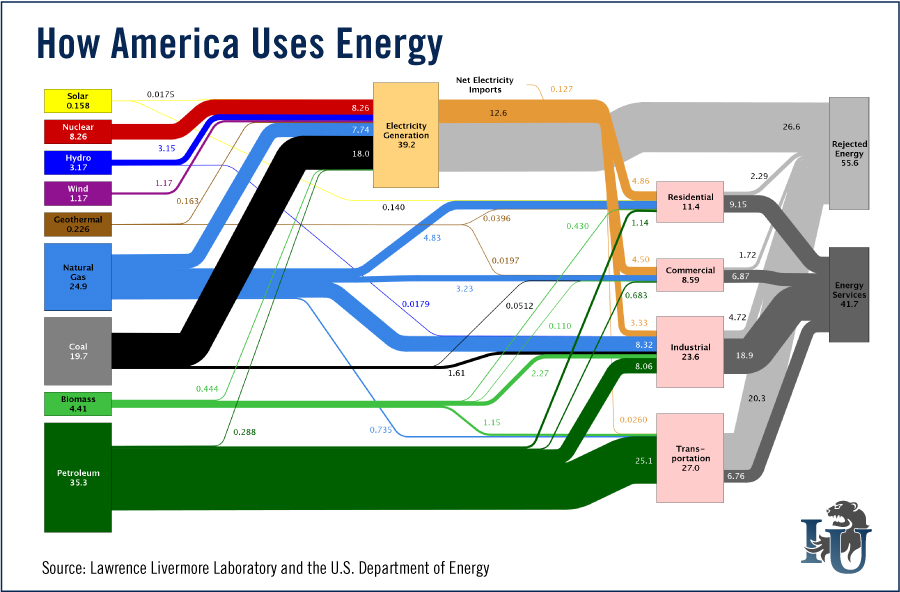
I base my remarks on an excellent chart produced by (gasp!) a government agency, Lawrence Livermore National Laboratory. It appears here but if it’s illegible please find a better copy here.  Blame Brandon for squeezing our posts into a narrow column!Image

We see energy sources on the left. A couple of facts stand out. At the top, notice that solar and wind are negligible. The yellow line representing solar may be thinner than a single pixel on your monitor and therefore invisible. Geothermal is on the radar, but barely; same for biomass (wood chips, organic leftovers, corn used for ethanol instead of feeding people) that can either be burned or processed into methane or ethanol. Our three main sources are, and will be for the foreseeable future, petroleum, coal and natural gas.

At the top center we see electricity generation. We don’t consume electricity directly except maybe for executing criminals. We use it to power devices in the four broad categories shown on the right: residential, commercial, industrial, transportation.

Notice the fat grey line coming out of the electricity generation box called “rejected energy.” It tells us that about two thirds of the energy coming into power plants goes up in smoke or steam or other waste heat rather than electricity. That sounds like a terrible loss and indeed, there is always room for efficiency improvements at the margin. But, boys and girls, there’s something called the Second Law of Thermodynamics which puts an iron limit on how much energy in a particular situation is available to do useful work. In other words, a certain amount of the “waste” represented by that fat gray line is inevitable. It would be great if the good people at LLL could supply that calculation, but I suspect that reliable estimates of the necessary data would be difficult to come by.

Look at the residential box on the right. It only represents 11% of energy consumption meaning that relative to the big picture, home energy efficiency measures like insulation, solar panels, etc. can never do much for the big picture. I say this too keep things in perspective, not to deny the possibilities for cost-effective marginal improvements in many homes.

If your monitor resolution allows it, you’ll see a tiny orange line running from electricity generation to transportation. That means electric vehicles are, and for some time will be, utterly insignificant, though again, marginally beneficial in very special situations.

Another fat gray line comes out of transportation. When you burn gasoline, most of the energy goes out the tailpipe or the radiator; only a little ends up as kinetic energy and even that ends up as waste heat when you apply the brakes. (In the long run, it all ends up as waste heat. Look up “heat death” on Wikipedia.)

The overall message of this chart is: if we want to maintain anything like our present industrial civilization with its abundant heat/cooling, light, transportation, etc., we’d better keep the present main sources going – petroleum, coal, natural gas, nuclear because renewable energy sources are advancing only slowly and in many cases (wind and ethanol, especially), uneconomically. The stakes couldn’t be higher – significant losses of energy, more than anything short of nuclear war, will make life nastier, more brutish, and shorter.

How to decide which energy R&D projects deserve scarce resources? Solyndra, anyone? No, central planning of energy is just as much a disaster as any other form of central planning or maybe more so. Energy is a highly specialized field. A biomass expert, for example, may be ignorant of nuclear fusion. A transformer guy may know nothing of transmission line losses. I suspect there are dozens or hundreds of subspecialties within the biomass field. Knowledge, as Hayek taught us, is dispersed and often tacit. We need to let all these specialists use their particular knowledge and facilities to experiment around the edges, comparing present or expected future marginal costs and benefits. Other than an occasional nice chart like you see here, the Energy Department just gets in the way. (To see a boondoggle that dwarfs Solydra, google “national ignition facility.”)

Speaking of costs and benefits, one of these days I’ll comment on the strange notion that energy accounting – a perfectly legitimate engineering practice – should be used to judge the economic value of energy projects. Tallies of income/expenses and assets/liabilities, should, say proponents, be carried out not in dollars but in energy units (joules or BTUs.) Why is this wrong? Because the economic value of a joule depends on time and place and most critically, people’s ability to make good use of it. In fact, natural resources aren’t resources at all until and unless someone figures out how to make good use of them.  More generally, value never inheres in physical objects and materials but only in the minds of people who believe those objects and materials can help satisfy wants, theirs or others’.

Postscript: The oceans store unimaginable amounts of thermal energy. You can calculate this yourself: using your favorite system of units, just multiply the volume of water by its mass density by its specific heat at constant pressure. You’ll discover that if we were willing to lower the ocean temperature by a thousandth of a degree per year, we would have abundant energy from now till Kingdom Come. Try this idea on a “progressive” friend sometime, keeping the answer momentarily in your back pocket: the Second Law forbids it. Stated differently, even with perfect technology, you would have to put more energy into the conversion process than the usable energy end product.

Abstract Ideas Don’t Deserve Patents [NY Times]

In preparation for something special that I will finally complete this week (Rothbard willing) lets talk about this editorial from the New York Times.


The article starts accurately enough explaining the US government’s monopoly power of ideas saying:

The Constitution gives Congress the power to grant inventors a temporary monopoly over their creations to “promote the progress of science and useful arts.”


I am actually shocked at the strong language used here, the four letter word “monopoly” is rarely used in reference to any government service.  At least in polite company.  I would also like to point out the subjective language quoted from the constitution.  “Useful arts”.  Useful to whom?  To the inventor?  To consumers?  To the government?  To humanity?  Like most state activities the ability to decide what is “useful” is left to bureaucrats in service to the government rather than in the free market where useful services will generate profits and those that generate disuse (or disutility) are met with losses.  Back to the article though:

“But in recent years, the government has too often given patent protection to inventions that do not represent real scientific advances.”


No argument there.  The “copyright troll” phenomenon is more than enough to make this libertarian squeamish.  Where is this editorial going I wonder?

  “The issue in this case, Alice Corporation Pty. v. CLS Bank International, is whether using a computer to implement a well-established economic concept can be patented. The court should rule that such ideas are not eligible for patent protection.


Alice Corporation obtained four American patents that cover a method of settling trades between investors in currency and other financial markets. The approach depends on a neutral middleman to make sure traders complete the transactions they have agreed to. The corporation, which is based in Australia, has accused CLS Bank, a London-based company that settles foreign exchange trades for investors around the world, of infringing its patents.”  

To make a long story short the US patent office granted the Alice Corporation a copyright on a form of interaction between a buyer, a middleman and a seller.  An absurd concept to be sure.  Now the question is what does the editorial suggest?

“The Supreme Court should make clear that nobody should be allowed to claim a monopoly over an abstract idea simply by tying it to a computer.”

I agree; but why stop there?  Why the artificial endpoint of “abstract ideas tied to a computer”?  If we shouldn’t allow patents on abstract ideas what would the author suggest if we proved that all ideas are necessarily abstract and therefore not able to be owned, sold, or monopolized?  Would he follow his logic to the conclusion that perhaps all patents are invalid?