More Arabs in the US? Yes, please!

I hope y’all had a chance to check out Ussama Makdisi’s essay on Ottoman cosmopolitanism from one of the nightcaps a few days back. It was excellent, and serves as good complement to Barry’s work on the Ottoman Empire here at NOL.

It’s especially good for a few reasons. First, it has a useful explanation of the mandate system that London and Paris experimented with. Second, it’s comparative and brings in lots of different modes of governance. Third, there is an interesting discussing about citizenship (consult NOL for more on citizenship, too). Lastly, it explains well why the Arab world continues to wallow in extreme inequality and authoritarianism.

Makdisi represents a shift in thinking in Arab circles away from victimization and towards self-determination and responsibility: no longer are the French and British (and Jews) to be reviled and blamed for everything that’s wrong with the Middle East. There is a shift towards internationalist thinking. The Americans now play a positive role in what could have been (and still might be) a freer Middle East. The British and French have factions now and some of them were supportive of Arab voices, some of them not. Arab scholars are finally benefiting from the American university educational system, probably because there are so many Arabs studying in the US now.

Makdisi’s piece is not a libertarian interpretation, but it’s a start.

Rethinking the Yellowbelt: Report Release

After a full year of research, the largest, most comprehensive report on the economics, politics, history, and policies of zoning in Toronto is available for download.

The full report is available both on the Housing Matters website, and quickly downloadable here: Rethinking the Yellowbelt

The “Yellowbelt” refers to the portion of the city that’s zoned exclusively for detached homes. The report goes into detail explaining when and why such a zone came into existence, where it spreads in the city, who is hurt by the existence of this zone and how; and what it will take to change the system.

A summary of the report follows. Of course, the report itself goes into much more detail.

Continue reading

Thoughts on Time from a College Library

Note: This was written by my brother Keith, and he did not originally post it online but sent it to our family members. For being a younger brother, he brings a hell of a lot of wisdom to the table, and I think this thought-provoking epistle deserves to be shared more widely. I am publishing it here, with permission:

From Keith:

I learn a great deal from my family.  The facts, figures, and articles that commonly result from discussing and arguing with each other are a reward in and of themselves.  As might be expected, many of these experiences and facts are soon forgotten, making way for new debates.  Once in a while, however, when discussing a topic, we–or I–stumble upon an insight which radically changes, clarifies, or re-enforces my understanding.

In recent months, I had two routine, incidental, and unrelated conversations, one with my brother, and the other with my sister.  The conversation with my sister did not start during some contentious economic debate, but when we were eating dinner together.  Offhand, my sister said to me:  “Keith, I have really come to appreciate the ideas from your econ classes you told me about, like opportunity cost, especially the opportunity cost of time spent on one task being a loss of all other possible actions.  When I applied those ideas to my everyday life, I saw a marked improvement, because I had become more efficient, simply from valuing my time appropriately.”  We often complain that few people these days recognize how econ is not a theory of how society works but of how math can represent human reality at any level. This is one case where there are real, personal benefits from understanding the math of limited lifespan.

My second recent conversation of note did not concern this day and age, in fact, it concerned the ideas of a wealthy 2000-year-old Roman by the name of Seneca.  My brother had recently been translating his Epistulae morales ad Lucilium (literally “Moral letters to Lucilius” in Latin, courtesy of Wikipedia), and had stumbled upon Roman intellectual gold.  Any attempt of mine to summarize the ideas in the letter would be less than adequate, so I shall copy it here.  I know that it is long, and rather Latin-ish, but I would encourage anyone to take the time to read it, if only because reading it will pay your time back, with interest:

Greetings from Seneca to his friend Lucilius.

Continue to act in the way you described, my dear Lucilius: set yourself free for your own sake; gather and save your time, which till lately has been forced from you, or stolen away, or has merely slipped from your hands. Make yourself believe the truth of my words, that certain moments are torn from us, that some are gently removed, and that others glide beyond our reach. The most disgraceful kind of loss, however, is that due to carelessness. Furthermore, if you will pay close heed to the problem of lost time, you will find that the largest portion of our life passes while we are doing ill, a goodly share while we are doing nothing, and the whole while we are doing that which is not to the purpose. What man can you show me who places any value on his time, who reckons the worth of each day, who understands that he is dying daily? For we are mistaken when we look forward to death; the major portion of death has already passed, Whatever years be behind us are in death’s hands.

Therefore, Lucilius, do as you write me that you are doing: hold every hour in your grasp. Lay hold of today’s task, and you will not need to depend so much upon to-morrow’s. While we are postponing, life speeds by. Nothing, Lucilius, is ours, except time. We were entrusted by nature with the ownership of this single thing, so fleeting and slippery that anyone who will can oust us from possession. What fools these mortals be! They allow the cheapest and most useless things, which can easily be replaced, to be charged in the reckoning, after they have acquired them; but they never regard themselves as in debt when they have received some of that precious commodity: time! And yet time is the one loan that even a grateful recipient cannot repay.

You may desire to know how I, who preach to you so freely, am practising. I confess frankly: my time account balances, as you would expect from one who is free-handed but careful. I cannot boast that I waste nothing, but I can at least tell you what I am wasting, and the cause and manner of the loss; I can give you the reasons why I am a poor man. My situation, however, is the same as that of many who are reduced to slender means through no fault of their own: everyone forgives them, but no one comes to their rescue.

What is the state of things, then? It is this: I do not regard a man as poor, if the little which remains is enough for him. I advise you, however, to keep what is really yours; and you cannot begin too early.  For, as our ancestors believed, it is too late to spare when you reach the dregs of the cask. Of that which remains at the bottom, the amount is slight, and the quality is vile.  

Farewell

After listening to my brother dictate the whole of this letter, I felt genuine chills.  The truth it contains is so blatant, a simple calculation could yield the same result:  life is made up of a limited number of hours, therefore life is time.  Whenever you work, you are giving up your time for money (hence the old adage that time is money).  This means that whenever you waste time, or money, you are wasting your life, and wasted life is death.  This single fact horrifies me every day, because like most every other human, I waste an obscene amount of time.  Time watching a movie I have already seen, trolling through Facebook without really reading any of the posts, or having the same argument all over again:  rarely, when I am doing these things do I think about what else I could be doing.

Therein lies the link, which most will have already seen, between my two conversations.  Our time is not free.  Every moment we spend sleeping, eating, studying, etc., has a cost–an opportunity cost–and once it has been spent, if it was not truly the best way to spend it, then some small part of your life has been lost without reward.

I see this nearly everywhere:  students doze off in class or idly check their email or texts, they, when “studying” in the library, will spend a majority of the time effectively idle.  Writing this, I am in a college library, and with sample size n=11, I may, without prying too much, say that ~7/11ths  of my fellow computer users are not doing what they came intending to do.  They are wasting time they will not get back.

And so I say to you, whoever you may be reading this (perhaps idly), much the same as what Seneca might say to you, only I will say it less eloquently, and more directly:  value your time.  Do not waste it.  Work on being efficient not for the sake of productivity, but for the sake of leisure, for we all have our jobs to do, and if we get them done faster then there is more time for enjoyment.  If you spent less time complaining, you might spend that time actively addressing your problems, solving them rationally and thus eliminating your cause for complaint.

Vale.

Hyperinflation and trust in Ancient Rome

Since it hit 1,000,000% in 2018, Venezuelan hyperinflation has actually been not only continuing but accelerating. Recently, Venezuela’s annual inflation hit 10 million percent, as predicted by the IMF; the inflation jumped so quickly that the Venezuelan government actually struggled to print its constantly-inflated money fast enough. This may seem unbelievable, but peak rates of monthly inflation were actually higher than this in Zimbabwe (80 billion percent/month) in 2008, Yugoslavia (313 million percent/month) in 1994, and in Hungary, where inflation reached an astonishing 41.9 quadrillion percent per month in 1946.

The continued struggles to reverse hyperinflation in Venezuela are following a trend that has been played out dozens of times, mostly in the 20th century, including trying to “reset” the currency with fewer zeroes, return to barter, and turning to other countries’ currencies for transactions and storing value. Hyperinflation’s consistent characteristics, including its roots in discretionary/fiat money, large fiscal deficits, and imminent solvency crises are outlined in an excellent in-depth book covering 30 episodes of hyperinflation by Peter Bernholz. I recommend the book (and the Wikipedia page on hyperinflations) to anyone interested in this recurrent phenomenon.

However, I want to focus on one particular inflationary episode that I think receives too little attention as a case study in how value can be robbed from a currency: the 3rd Century AD Roman debasement and inflation. This involved an iterative experiment by Roman emperors in reducing the valuable metal content in their coins, largely driven by the financial needs of the army and countless usurpers, and has some very interesting lessons for leaders facing uncontrollable inflation.

The Ancient Roman Currency

The Romans encountered a system with many currencies, largely based on Greek precedents in weights and measures, and iteratively increased imperial power over hundreds of years by taking over municipal mints and having them create the gold (aureus) and silver (denarius) coins of the emperor (copper/bronze coins were also circulated but had negligible value and less centralization of minting). Minting was intimately related to army leadership, as mints tended to follow armies to the front and the major method of distributing new currency was through payment of the Roman army. Under Nero, the aureus was 99% gold and the denarius was 97% silver, matching the low debasement of eastern/Greek currencies and holding a commodity value roughly commensurate with its value as a currency.

The Crisis of the Third Century

However, a major plague in 160 AD followed by auctions of the imperial seat, major military setbacks, usurpations, loss of gold from mines in Dacia and silver from conquest, and high bread-dole costs drove emperors from 160-274 AD to iterative debase their coinage (by reducing the size and purity of gold coins and by reducing the silver content of coins from 97% to <2%). A major bullion shortage (of both gold and silver) and the demands of the army and imperial maintenance created a situation where a major government with fiscal deficits, huge costs of appeasing the army and urban populace, and diminishing faith in leaders’ abilities drove the governing body to vastly increase the monetary volume. This not only reflects Bernholz’ theories of the causes of hyperinflations but also parallels the high deficits and diminishing public credit of the Maduro regime.

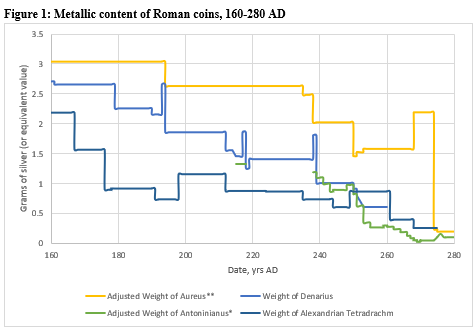
Inflation and debasementFigure 1 for Fiat paper

Unlike modern economies, the Romans did not have paper money, and that meant that to “print” money they had to debase their coins. The question of whether the emperor or his subjects understood the way that coins represented value went beyond the commodity value of the coins has been hotly debated in academic circles, and the debasement of the 3rd century may be the best “test” of whether they understood value as commodity-based or as a representation of social trust in the issuing body and other users of the currency.

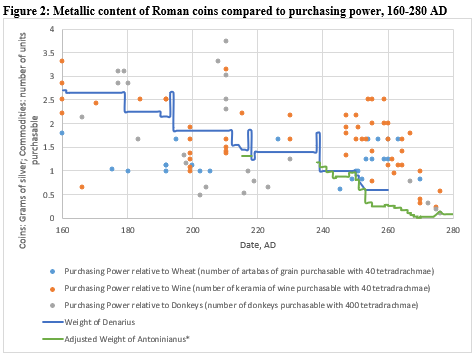
Figure 2 for Fiat paper

Given that the silver content of coins decreased by over 95% (gold content decreased slower, at an exchange-adjusted rate shown in Figure 1) from 160-274 AD but inflation over this period was only slightly over 100% (see Figure 2, which shows the prices of wine, wheat, and donkeys in Roman Egypt over that period as attested by papyri). If inflation had followed the commodity value of the coins, it would have been roughly 2,000%, as the coins in 274 had 1/20th of the commodity value of coins in 160 AD. This is a major gap that can only be filled in by some other method of maintaining currency value, namely fiat.

Effectively, a gradual debasement was not followed by insipid ignorance of the reduced silver content (Gresham’s Law continued to influence hoards into the early 3rd Century), but the inflation of prices also did not match the change in commodity value, and in fact lagged behind it for over a century. This shows the influence of market forces (as monetary volume increased, so did prices), but soundly punctures the idea that coins at the time were simply a convenient way to store silver–the value of the coins was in the trust of the emperor and of the community recognition of value in imperial currency. Especially as non-imperial silver and gold currencies disappeared, the emperor no longer had to maintain an equivalence with eastern currencies, and despite enormous military and prestige-related setbacks (including an emperor being captured by the Persians and a single year in which 6 emperors were recognized, sometimes for less than a month), trade within the empire continued without major price shocks following any specific event. This shows that trust in the solvency and currency management by emperors, and trust in merchants and other members of the market to recognize coin values during exchanges, was maintained throughout the Crisis of the Third Century.

Imperial communication through coinage

This idea that fiat and social trust maintained higher-than-commodity-values of coins is bolstered by the fact that coins were a major method of communicating imperial will, trust, and power to subjects. Even as Roman coins began to be rejected in trade with outsiders, legal records from Egypt show that the official values of coins was accepted within the army and bureaucracy (including a 1:25 ratio of aureus-to-denarius value) so long as they depicted an emperor who was not considered a usurper. Amazingly, even after two major portions of the empire split off–the Gallic Empire and the Palmyrene Empire–continued to represent their affiliation with the Roman emperor, including leaders minting coins with their face on one side and the Roman emperor (their foe but the trusted face behind Roman currency) on the other and imitating the symbols and imperial language of Roman coins, through their coins. Despite this, and despite the fact that the Roman coins were more debased (lower commodity value) compared to Gallic ones, the Roman coins tended to be accepted in Gaul but the reverse was not always true.

Interestingly, the aureus, which was used primarily by upper social strata and to pay soldiers, saw far less debasement than the more “common” silver coins (which were so heavily debased that the denarius was replaced with the antoninianus, a coin with barely more silver but that was supposed to be twice as valuable, to maintain the nominal 1:25 gold-to-silver rate). This may show that the army and upper social strata were either suspicious enough of emperors or powerful enough to appease with more “commodity backing.” This differential bimetallist debasing is possibly a singular event in history in the magnitude of difference in nominal vs. commodity value between two interchangeable coins, and it may show that trust in imperial fiat was incomplete and may even have been different across social hierarchies.

Collapse following Reform

In 274 AD, after reconquering both the Gallic and Palmyrene Empire, with an excellent reputation across the empire and in the fourth year of his reign (which was long by 3rd Century standards), the emperor Aurelian recognized that the debasement of his currency was against imperial interests. He decided to double the amount of silver in a new coin to replace the antoninianus, and bumped up the gold content of the aureus. Also, because of the demands of ever-larger bread doles to the urban poor and alongside this reform, Aurelian took far more taxes in kind and far fewer in money. Given that this represented an imperial reform to increase the value of the currency (at least concerning its silver/gold content), shouldn’t it logically lead to a deflation or at least cease the measured inflation over the previous century?

In fact, the opposite occurred. It appears that between 274 AD and 275 AD, under a stable emperor who had brought unity and peace and who had restored some commodity value to the imperial coinage, with a collapse in purchasing power of the currency of over 90% (equivalent to 1,000% inflation) in several months. After a century in which inflation was roughly 3% per year despite debasement (a rate that was unprecedentedly high at the time), the currency simply collapsed in value. How could a currency reform that restricted the monetary volume have such a paradoxical reaction?

Explanation: Social trust and feedback loops

In a paper I published earlier this summer, I argue that this paradoxical collapse is because Aurelian’s reform was a blaring signal from the emperor that he did not trust the fiat value of his own currency. Though he was promising to increase the commodity value of coins, he was also implicitly stating (and explicitly stating by not accepting taxes in coin) that the fiat value that had been maintained throughout the 3rd Century by his predecessors would not be recognized going forward by the imperial bureaucracy in its transactions, thus signalling that for all army payment and other transactions, the social trust in the emperor and in other market members that had undergirded the value of money would now be ignored by the issuing body itself. Once the issuer (and a major market actor) abandoned fiat currency and stated that newly minted coins would have better commodity value than previous coins, the market–rationally–answered by moving quickly toward commodity value of the coins and abandoned the idea of fiat.

Furthermore, not only were taxes taken in kind rather than coin, but there was widespread return to barter as those transacting tried to avoid holding coins as a store of value. This pushed up the velocity of money (as people abandoned it as a store of value and paid higher and higher amounts for commodities to get rid of their currency). The demonetization/return to barter reduced the market size that was transacted in currency, meaning that there were even more coins (mostly aureliani, the new coin, and antoniniani) chasing fewer goods. The high velocity of money, under Quantity Theory of Money, would also contribute to inflation, and the unholy feedback loop of decreasing value causing distrust, which caused demonetization and higher velocity, which led to decreasing value and more distrust in coins as stores of value kept this cycle going until all fiat value was driven out of Roman coinage.

Aftermath

This was followed by Aurelian’s assassination, and there were several monetary collapses from 275 AD forward as successive emperors attempted to recreate the debased/fiat system of their predecessors without success. This continued through the reign of Diocletian, whose major reforms got rid of the previous coinage and included the famous (and famously failed) Edict on Maximum Prices. Inflation continued to be a problem through 312 AD, when Constantine re-instituted commodity-based currencies, largely by seizing the assets of rich competitors and liquidating them to fund his army and public donations. The impact of that sort of private seizure is a topic for another time, but the major lesson of the aftermath is that fiat, once abandoned, is difficult to restore because the very trust on which it was based has been undermined. While later 4th Century emperors managed to again debase without major inflationary consequences, and Byzantine emperors did the same to some extent, the Roman currency was never again divorced from its commodity value and fiat currency would have to wait centuries before the next major experiment.

Lessons for Today?

While this all makes for interesting history, is it relevant to today’s monetary systems? The sophistication of modern markets and communication render some of the signalling discussed above rather archaic and quaint, but the core principles stand:

  1. Fiat currencies are based on social trust in other market actors, but also on the solvency and rule-based systems of the issuing body.
  2. Expansions in monetary volume can lead to inflation, but slow transitions away from commodity value are possible even for a distressed government.
  3. Undermining a currency can have different impacts across social strata and certainly across national borders.
  4. Central abandonment of past promises by an issuer can cause inflationary collapse of their currency through demonetization, increased velocity, and distrust, regardless of intention.
  5. Once rapid inflation begins, it has feedback loops that increase inflation that are hard to stop.

The situation in Venezuela continues to give more lessons to issuing bodies about how to manage hyperinflations, but the major lesson is that those sorts of cycles should be avoided at all costs because of the difficulty in reversing them. Modern governments and independent currency issuers (cryptocurrencies, stablecoins, etc.) should take lessons from the early stages of previous currency trends toward trust and recognition of value, and then how these can be destroyed in a single action against the promised and perceived value of a currency.

Be Our Guest: “Of Monies and Juries and Freedoms”

Be Our Guest is a new, experimental series at NOL. Basically, NOL is invite-only but you can, and should, submit your thoughts to us. The latest piece is by Michalis Trepas, a Greek national working in the financial sector. An excerpt:

The judicial system was reluctant to intervene, out of respect of the separation of powers (according the Weimar Constitution, currency matters were reserved for the parliament). So, at first, the courts upheld the nominalistic principle and refused to accept a revalorisation of debts. But then, something began to change in the courts’ reasoning. The currency’s slide prior to 1921 could be attributed to the conditions of the “war economy”, whose burden was to be shared by everyone in the country. The unrestrained fall thereafter, the courts said, was a monetary phenomenon, punishing “blindly and unpredictably” only the creditor class.

If you cannot guess by now what Michalis is writing about, read on! If you have figured out what the subject of his piece is about, read on, as it only gets more interesting.

There are cultural and geopolitical considerations to think about here, too, in regards to Greece and Germany and financial markets and constitutionalism.

Financial History to the Rescue: The Harder Money Wins Out

This article is part of a series on bitcoin (and bitcoiners’) arguments about money and particularly financial history. See also:

(1) ‘On Bitcoiners’ Many Troubles’, Joakim Book, NotesOnLiberty (2019-08-13)
(2): ‘Rothbard’s First Impressions on Free Banking in Scotland Were Correct’, Joakim Book,
AIER (2019-08-18)

(4): ‘Bitcoin’s Fixed Money Supply Is a Weakness’, Joakim Book, AIER (2019-08-28)

The great monetary economist and early Nobel Laureate John Hicks used to say that monetary theory “belongs to monetary history, in a way that economic theory does not always belong to economic history.”

Today I’m going to illustrate exactly that with respect to the Bitcoiner’s (mistaken) progressivism in another episode of Financial History to the Rescue.

In the game of monetary competition, the Bitcoin maximalists posit, the “harder” money always wins out. I’ve been uneasy with the statement as it (1) isn’t clear to me what “harder” money (or money’s “hardness”) really means, and (2) probably isn’t historically true. So we end up with something that’s false, or vague – or both! Clearly unsatisfactory. As I pointed out in my overview post to this series, financial and monetary history is almost always more nuanced than what such simple generalizations allow.

Luckily enough, Saifedean Ammous at the Soho Forum debate last week, did inadvertently provide me with a useable definition – and I intend to use it to debunk the idea that money’s history is one of increased hardness. Repeatedly Saif claimed that monetary history, before the advent of central banking, showed us that the harder money always won out: whenever two monetary networks clashed (shells and silver; wampum and gold) the “harder” money won. The obvious implication is that Bitcoin, being the “hardest” money, will similarly win out. Right off the bat, there’s some serious problems here.

First, it’s not altogether clear that such “This time is not different” arguments apply. Yes, economic history teaches us not to discount what seems to be long-standing or universally applicable phenomena – but also to take notice of the institutional setting in which they happen. Outcomes specific to, say, the Classical Gold Standard, rarely generalize into our hyper-modern financial markets with inflation targeting central banks.

Second, over the twentieth century we literally went from the hardest money (gold) to the “softest” money (central bank-created fiat paper money). Sure, you can argue that this was unfair or imposed upon us from above by wars and welfare states, but discounting it as irrelevant strikes me as overly cherry-picking. If the hardest money “lost” before, what makes you think that your new fancy money will win out this time around?

Then Saif returned to the topic of hardness and defined it as a money whose supply is “the hardest to increase.” The hardness of Cowrie shells or Wampum or gold or Whale’s teeth or Rai stones or the other early money that Jevons listed and discussed in 1875, all rely on a difficult, costly and inconvenient process of extraction and/or production. Getting Rai stones from far-away islands, stringing beads together into extended strips of Wampum, or digging up gold from inaccessible patches of the earth were all cumbersome and expensive processes. In Saif’s mind, this contributed to their hardness. Their money stock were simply difficult to expand – in jargon: their money supplies were inelastic.

The early 1600s Dutch Republic struggled with another problem. As the main financial centre of the time, countless hard money (coins) from all over the world were used in Amsterdam. Estimates say over a thousand legally recognized kinds of coins – and presumably even more unrecognized coins. A prime setting for monetary competition: they were all pretty hard (Saif’s definition: difficult and costly to expand) commodity moneys, of various quality, origin, and recognition in trade.

Another feature of 17th century Amsterdam was the international environment of Bills of Exchange (circulating private credit notes). Briefly summarized, merchants across the world traded debts on Amsterdam bankers or traders, and rather than holding and transporting bullion across the world, they transported the debt of the most trustworthy and reliable Dutch financiers. As all such bills required a settlement medium in Amsterdam, trade on thin margins was very sensitive to fluctuations in prices between the commodity moneys in which their bills were denominated – and very sensitive to debasements and re-defined values by various European proto-governments.

In 1609, the City of Amsterdam created the Wisselbank (initially a 100% reserve exchange bank) specifically tasked with standardizing the coinage and to insulate the bill market from currency fluctuations (through providing a ‘neutral’ unit of account for bills settlement). The Bank accepted deposit of whatever coin at the legally recognized rate (unrecognized at metal content) and delivered ”high-quality Dutch trade coins” upon withdrawal. To fund itself, it added a withdrawal fee of 1.5%, but no internal transfer fee, which made holding currency at the Bank very expensive in the short-term, but very cheap in the long-term. Merchants also avoided much of the withdrawal fee by simply trading balances with one another rather than depositing and withdrawing trade coins. In return for this cost-saving, sellers of bank balances would share a portion of the funds saved with the buyer in what’s known as the “Agio”: the price of Bank money in terms of current money outside the Bank’s accounts. This price would fluctuate like any other price on the market and would indicate the stance of liquidity demands.

In a classic example of Alchian’s monetary competition by transaction costs, Dutch merchants and financiers “outsourced” the screening and assaying of unfamiliar coins. They preferred settling their transactions through the (cheaper) medium that was deposits in the Bank.

And it gets worse for the bitcoiner’s story. In 1683, the Bank coupled its deposits with specific receipts for withdrawal; to gain access to coins, one was required both to hold balances and to purchase a receipt issued by the Bank (they also changed the pricing). Roughly speaking, the Bank became a fractional reserved bank (with capped withdrawals) overnight – and contrary to what the hardness argument would imply, the agio on Bank money rose to above par!

Two monetary historians, Stephen Quinn and William Roberds, summarize one of their many writings on the Wisselbank as follows:

“imaginary money on the Bank’s ledgers succeeded because it was more reliable than the real stuff. […] The most liquid asset in the economy was no longer coin, but a sort of ‘virtual banknote’ residing in Bank of Amsterdam accounts.”

Further,

“the evolution of the agio shows that the market valued irredeemable balances as if they were closely tied to backing trade coins” (my emphasis)

The story of the Amsterdam Wisselbank’s monetary experiments and innovations show us that monetary adaption relies on many more dimensions than “hardness.” Sometimes “hard” money is defeated by “soft” money, since the softer money brought other benefits to its users – in this case a cheap and reliable settling medium.

The lesson for bitcoin-vs-fiat-vs-FinTech is pretty clear: hard money doesn’t always “win”; and sometimes “soft” money can better serve the needs of consumers in a free market.

Financial History to the Rescue: On Bitcoiners’ Many Troubles

This article is part of a series on bitcoin (and bitcoiners’) arguments about money and particularly financial history. See also:

(2): ‘Rothbard’s First Impressions on Free Banking in Scotland Were Correct’, Joakim Book, AIER (2019-08-18)
(3): ‘The Harder Money Wins Out’, Joakim Book, NotesOnLiberty (2019-08-19)
(4): ‘Bitcoin’s Fixed Money Supply Is a Weakness’, Joakim Book, AIER (2019-08-28)

It is unfair to expect technologically savvy bitcoiners to also be apt and well-read monetary economists. By no means do the skills and experiences of either have to overlap. Through the rise of Bitcoin with its explicit central banking challenge and attempt to become a worldwide currency, the subject matter of the two groups has unexpectedly clashed. All arguments that support or attack bitcoin is a head-first dive into monetary economics – sometimes exhuming centuries-long disputes among monetary economists and often blatantly distorts and overlooks money and banking arrangements of the past.

We can’t have that, can we.

One of the most delightful events in the libertarian world is the monthly Soho Forum debate run by Gene Epstein. Yesterday’s splendid showdown between Profs. George Selgin and Saifedean Ammous on the suitability of Bitcoin as a Medium of Exchange is bound to get some serious traction once the recording is on available only – look out for that!

A great debate for anyone interesting in monetary system and monetary economics more generally, this was probably the best and most entertaining of many Soho Forum debates I’ve watched. It’s a good format that forces speakers to engage and respond to one another’s arguments, which makes a two-hour conversation on something as technical and intricate as Bitcoin’s monetary role an absolute delight; even those of us deep into this nerdy rabbit hole can learn a lot and walk away with a trove of inspiration.

Channeling that inspiration into long-form, multi-part reviews of the relevant financial and monetary history is exactly what I’m going to do!

One question I often get regarding my research interests (banks, money and financial markets in the past) is the mildly offensive but absolutely correct question to ask: who the f— cares?! Bitcoin and the question of monetary regimes are perfect examples that make financial history relevant: the rise of crypto questions the fundamentals of monetary systems, systems that very rarely change. Naturally, the financial historian has an edge here, having a lot more nuanced knowledge about past monetary and financial arrangements and their operations. History becomes our (only) laboratory, to which the financial historian typically has a lot to contribute.

Moreso than other topics, fundamental questions of monetary regimes are explicitly pitted against other possible regimes – by their nature comparative and always informed by historical experience. It takes about two-and-a-half sentences before debates over money invoke some reference to financial and monetary history – as they should, since they illustrate how some (aspect of) a different monetary regime worked. Frustratingly enough, there’s a good chance that the speaker has mindboggingly little idea of what s/he’s talking about!

That’s where I like to come in. To a roomful of aspiring monetary economists at Cato’s Alternative Money University in July this year, Randall Wright‘s response to why he does monetary economics at all (“to debunk all this B-S!”) generalizes pretty well.

I’m gonna use this post to review some of the mistakes Saifedean made yesterday – and use it going forward as an updated collection of future posts on the topic, especially as I go through Saif’s promising book, The Bitcoin Standard: The Decentralized Alternative to Central Banking. The aim here is to respectfully clarify the parts of the Bitcoin arguments where I’d like to think that I have a comparative advantage – financial and monetary history – and to better develop my understanding of the monetary theory involved.

Here are some points that came up yesterday:

  • The Monetary Progression of ‘Harder Money’: the brilliance of the past is that almost any account, no matter how persuasive and compelling, is bound to run into inconvenient historical facts. The world is more nuanced than can be reasonably captured by pithy generalization (yes, I realize the irony here). In a piece attacking this bitcoiner’s creation myth earlier this year, I wrote:

This progressively upward story is pretty compelling: better money overtake worse money until one major player unfairly took over gold – the then-best money – replacing it with something inferior that the Davids of the crypto world now intents to reverse. […] Too bad that it’s not true. Virtually every step of this monetary account is mistaken.

  • The Lender-of-Last-Resort role privately provided: Many Austrians and opponents to fractional reserve banking routinely believe that banks holding less-than-100% reserve against their deposits must have a government backing them, providing emergency liquidity when such banks are inevitably run upon. This is completely false. I can point to many different historical instances that privately accounted for such risks, from private clearinghouses to insurance, to the option-clause debate in Scottish Free Banking and contingent/unlimited liability institutions.
  • …which leads us to Scottish Free Banking. There’s a famous quip by Rothbard (“Rothbard’s Law“) that describes the tendency for economists to specialize in the fields they’re worst at: Henry George specialized in land, where his writing is appalling; Milton Friedman on Money, where he’s awful etc. I usually say that the same thing applies for Rothbard whenever he writes on Financial History. Very bad. And yes, I will go through his article ‘Myth of Free Banking in Scotland’
  • Saif made a distinction yesterday between the “Medium of Exchange” and the “Payment Mechanism” involved that struck me as misleading, and I didn’t get a chance to finish my reasoning with him in person – so I’ll flush it out in a piece later on. Happily for all you Free Banking fans, it involves note-issuing Scottish banks and the bigger questions of redeemability and outside/inside money.

Some additional housekeeping from yesterday:

  • Saif: “There was no real estate bubble on the Gold Standard”.
    • Yes, Selgin said, the Florida 1920s housing bubble leading up to the Great Depression. No, Saif correctly objected, that wasn’t a real gold standard, but a central bank-planned Gold Exchange Standard.
      Ok, fine – I’d agree with Saif here. How about the 1893 Australian banking crisis? Classical Gold Standard, no central bank, but a property boom and bubble-like collapse nonetheless.
    • A response might be “but fractional reserve banking!” but a) that’s a topic I’ll delve into much more, and b) this is started to sound like a No True Scotsman fallacy…
  • Saif: “Central banks hold gold – they don’t trust each other enough to hold currency”
    • Saif probably misspoke here, since he couldn’t possibly believe this; looking at any central bank’s balance sheet would instantly dispell such beliefs. Central banks generally hold no more than 5-8% of their assets in gold, and often a lot more than that in foreign currency-denominated asset. The ECB holds about equal parts (7-8% of assets) in gold and foreign currency. I routinely follow the weekly changes in the Riksbank’s balance sheet and even after a more extreme QE programe than the Fed’s (as % of GDP), it holds more FX than it does SEK-denominated assets (and no more than 5% in gold). The Bank of England technically doesn’t actually have any gold at all on its balance sheet, but holds gold in storage at its vaults (on behalf of other countries and the UK Treasury).

Bear with me over the next few months, as I make my way through Saif’s book and engage with these thrilling debates. Feel free to interrupt/comment on Twitter at any point if you think I’ve made a factual/empirical error, error in reasoning or in relevance to Bitcoin.

And yes, keep in mind that this is a respectful inquiry into fascinating topics with people who agree on like 92% of everything. Feel free to call me out for unnecessarily snarky and offensive thing as we go along – and welcome to the party!

On Translating Earnings From The Past

A few days ago, John Avery Jones published a great piece on the Bank of England blog (“Bank Underground”), investigating how much Jane Austen earned from her novels in the early 1800s. By using the Bank’s own archives and tracking down Austen’s purchases of “Navy Fives” (Bank of England annuities, earning 5%), Avery Jones backed out that Austen’s lifetime earnings as a writer was probably something like £631 – assuming, of course, that the funds for this investment came straight from the profits of her novels.

Being a great fan of using literature to illustrate and investigate financial markets of the past, I obviously jumped on this. I also recently looked at the American novelist Edith Wharton’s financial affairs and got very frustrated with the way commentators, museums, and scholars try to express incomes of the past in “today’s terms”, ostensibly vivifying their meaning.

For the Austen case, both Avery Jones and the Financial Times article that followed it, felt the need to “translate” those earnings via a price index, describing them as “equivalent to just over £45,000 at today’s prices”.

Hang on a minute. Only “£45,000”? For the lifetime earnings of one of the most cherished writers in the English language? That sounds bizarrely small. That figure wouldn’t even pay for the bathroom in most London apartments – and barely get you a town-house in Newcastle. The FT specifically makes a comparison with contemporary fiction writers:

“[Austen’s] finances compare badly even with those of impoverished novelists today: research last year by the Authors’ Licensing and Collecting Society found that writers whose main earnings came from adult fiction earned around £37,000 a year on average”

Running £631 through MeasuringWorth’s calculator yields real-price estimates of £45,910 (using 1815 as a starting year) – pretty close. But what I think Avery Jones did was adjusting £631 with the Bank’s CPI index in Millenium of Macroeconomic Data dataset (A.47:D), which returns a modern-day price of £45,047 – but that series ends in 2016 and so should ideally be another 7% or so from 2016 until May 2019.

 “This may not be the best answer”

Where did Avery Jones go wrong in his translation? After all, updating prices through standard price indices (CPI/RPI/PCE etc) is standard practice in economics. Here’s where:

untitled-1

The third line on MeasuringWorth’s result page literally tells researchers that the pure price number may not reflect the question one is asking. The preface to the main site includes a nuanced discussion about prices in the past:

“There is no single ‘correct’ measure, and economic historians use one or more different indices depending on the context of the question.”

When I first estimated Mr. Darcy’s income, this was precisely the problem I grappled with; simply translating wealth or incomes from the past to the present using a price index severely understates the meaning we’re trying to convey – i.e., how unfathomably rich this guy was. There is no doubt that Mr. Darcy was among the richest people in England at the time (his annual income some 400 times a normal worker’s salary), a well-respected and wealthy man of elevated rank. However, translating his wealth using a price index doesn’t even put him on the Times’ Rich List over the thousand wealthiest Britons today. Clearly, that won’t do.

Because we are much richer today in real terms, price indices alone do not capture the meaning we’re trying to communicate here. Higher real income – by definition – is a growth in incomes above the rise in prices. We therefore ought to use a more tangible comparison, for instance with contemporary prices of food or mansions or trips abroad; or else, using real income adjustments, such as GDP/capita or average earnings.

MeasuringWorth provides us with three other metrics over and above the misleading price-index adjustment:

Labour Earnings = £487,000
using growth in wages for the average worker, it reports how large your wage would have to be today to afford what Austen could afford on £631 in 1815. Obviously, quality adjustments and technological improvements make these comparisons somewhat silly (how many smartphones, air fares and microwaves could Austen buy?), but the figure at least takes real earnings into account.

Relative Income = £591,300
Like ‘Labour Earnings’, this adjustment builds on the insight above, but uses growth in real GDP/capita rather than wages. It more closely captures the “relative ‘prestige value’” that we’re getting at.

Both these attempt are what I tried to do for Mr. Darcy (Attempt #2 and #3) a few years ago.

Relative Output = £2,767,000
This one is more exciting because it captures the relationship to the overall economy. If I understand MeasuringWorth’s explanation correctly, this is the number that equates the share of British GDP today with what Austen’s wealth – £631 – would have represented in 1815.

Another metric I have been experimenting with is reporting the wealth number that would put somebody in the same position in the wealth distribution of our time. For example, it takes about £2,5m to qualify for the top-1% of British wealth (~$10m in the United States) distribution today. What amount of wealth did somebody need to join the top 1% in, say, 1815? If we could find out where Austen’s wealth of £631 (provided her annuities were her only assets) rank in the distribution of 1815, we can back out a modern-day equivalent. This measure avoids many of the technical problems above for how to properly adjust for a growing economy, and how to capture inventions in a price index – and it gets to what we’re really trying to convey: how wealthy was Austen in her time?

Alas, we really don’t have those numbers. We have to dive deep into the wealth inequality rabbit hole to even get estimates (through imputed earnings, capital stocks or probate records) – and even then the assumptions we need to make are as tricky and inexact as the ones we employ for wage series or prices above.

The bottom line is pretty boring: we don’t have a panacea. There is no “single correct measure”, and the right figure depends on the question you’re asking. A reasonable approach is to provide ranges, such as MeasuringWorth does.

But it’s hard to imagine the Financial Times writing “equivalent of between £45,000 and £2,767,000 at today’s prices”…

“Ethnic Violence in Africa: Destructive Legacies of Pre-Colonial States”

Note: I’ve gotten through the first three chapters of Paul Feyerabend’s Against Method. (Rick’s initial thoughts are here, and Bill has been doing Feyerabend for awhile. These are the two you should probably follow a bit more closely throughout the summer.)

My own thoughts on Against Method are coming, but I keep getting distracted. Check out this beast of an article on how pre-colonial states in Africa continue to influence current affairs today, even though these have been absorbed into the post-colonial states we are all familiar with in Africa today. (h/t Kevin Lewis)

Snatching you up (mendicants and Gulags)

I’ll get to Feyerabend, but first Solzhenitsyn:

However, the root destruction  of religion in the country, which throughout the twenties and thirties was one of the most important goals of the GPU-NKVD, could be realized only by mass arrests of Orthodox believers. Monks and nuns, whose black habits had been a distinctive feature of Old Russian life, were intensively rounded up on every hand, placed under arrest, and sent into exile. They arrested and sentenced active laymen. The circles kept getting bigger, as they raked in ordinary believers as well, old people, and particularly women, who were the most stubborn believers of all and who, for many long years to come, would be called “nuns” in transit prisons and in camps (37).

It’s true that Christians were viciously persecuted by socialists in the USSR, and what makes matters worse is that few historians, and fewer journalists, point this out. Bishops and patriarchs living in mansions were the official targets of socialist purges, mind you, but mendicants, village priests, and old church ladies were the ones who actually got dragged away and put to work for The Cause. Why? Because they actually believed. They already had a moral compass, so there was no need for a strong state. In socialist countries, alternatives ruin plans. So in socialist countries, alternatives get snuffed out.

As I read through the Gulag Archipelago I can’t help but think of the Russia I hear about on NPR and read about online. Russia is the left’s new boogieman, for obvious reasons. But I wonder, with Solzhenitsyn in mind, just how close the Orthodox Church actually is to Putin and his henchmen. I’m sure the top brass are close to Putin, but what about the village priests and the others? Did socialism wipe out the old, more mystical Christianity that was prevalent in the Russian countryside before the Revolution? Are there any mendicants left in post-socialist Russia? All those decades of violent repression, starvation, ethnic cleansing, and forced labor, and the hierarchy of the Russian Orthodox Church hums along as if nothing ever happened. The actual believers, on the other hand, are gone, along with the unique culture they spread throughout the Russian Empire and, via the mediums of literature and art, the world.

Federation, not unilateralism, ought to be the American Libertarian’s foreign policy

This is an expanded post that stems from a conversation I have been having with Bruno and Jacques in the ‘comments’ threads. The conversation is more about the nation-state than the unilateralism/federation non-debate, but I thought that’s why it’d make a good post.

The Nation-State

Nation-states are often considered to be sacred territory to conservative libertarians (see Jacques or Edwin, for example), even if they don’t use the word “sacred.” A nation-state is a geographic territory that is supposed to be made up of a single nation. Thus the French live in France, the Germans in Germany, the Greeks in Greece, etc. You can see the problem with this logic right away: what about the people who don’t fit into the idea of what a nation should be? How do religious minorities, for example, or your neighbor who speaks only Romanian, fit in? How are they a part of the nation? (Ludwig von Mises wrote one of the better critiques of the nation-state way back in 1919, using the Austro-Hungarian Empire as an example.)

Nation-states arose in Europe after centuries of horrific warfare and genocidal campaigns, such as the Holocaust, and only came into being elsewhere in the world with the fall of the European empires after World War II. These empires, which never had a good grasp on the territories they claimed as their own to begin with, rebuilt the international order around the ideas of state sovereignty and the nation-state. Part of this had to do with the fact that their own empires had reverted to a form of nation-state (the UK, France, etc., instead of the British, or French, Empire), and part of it had to do with the idea that Asians and Africans deserved a stage on the international scene. (This latter idea was pushed by left-wing Europeans and Asians and Africans who believed their colonies could easily make the transition from colony to nation-state.) The colonies of the European empires, which had been patched together slowly over hundreds of years, did not take nationality into consideration in matters of governance, unless it was to explicitly crush any notions of nationhood among the colonized.

So, the nation-states of Europe and, to a much lesser extent, North and Latin America, have a long history of violence, politics, law, and trade (among other factors) that bolster their legitimacy as organizational entities and their place in the world. The states that formed in the ashes of the European empires had no nations to speak of and entered a world order that wanted to treat these new states as if they did have such a nation.

Nation-building

Since there were suddenly a bunch of new states in the world without nations in them, elites in these new, post-imperial states had to begin nation-building. Barry has a great series, soon to be enshrined as a Longform essay, on Turkish nationalism here at NOL. James Gelvin, a historian at UCLA, has done some good work on nationalism in the Middle East (here is a review of one such work). Eugen Weber (UCLA) and David Bell (Princeton), both historians, have written excellent examples of how Paris went about molding people within France’s territory into French citizens.

In most of the post-imperial cases, elites were proponents of secularism and inclusivity. Elites in Iraq, Syria, and Iran, for example, made a concerted effort to protect the rights of minorities and women, even going so far as to include them in key aspects of governing these new states. Indeed, when the dictator of Iraq, Saddam Hussein, was chased from power by the Americans in 2003, Iraq’s Christians, women, and other minorities suffered most because the Hussein regime protected them from the (conservative and religious) majority. The same thing happened when the American-backed Shah of Iran was overthrown by Islamists in 1979. Elites in the post-imperial world wanted their societies to be nation-states (in fact, they needed them to be, so that they could get the attention of Western allies), but they thought they could get there through the prism of nationalism.

Minorities, rights, and nations

Nation-building in the post-imperial world has gone about as smoothly as it went in Europe. War has been an ongoing problem (most of it has been intrastate instead of interstate), and genocides have occurred. The intrastate wars are easiest to understand. Elites are trying to build a nation to populate a state (which is just a former colony of a European empire). Those that don’t fit in to the idea of what it means to be a part of X nation, perish, or are harshly oppressed (such as the Kurds in Iraq, Iran, and Syria, or the Balochs in Iran and Pakistan).

Religion has also been a problem. Most leaders in these new nation-states tried to establish secular regimes, but were also believers in democracy. Unfortunately, secularism and democracy are incompatible without liberty. If Saddam Hussein or Shah Pahlavi had tried to hold elections, Islamists would have been voted into office, just as they routinely are in Egypt and Palestine. India, a former British colony that was perhaps the most intimately connected to its imperial overlord, is sliding back into Hindu theocracy as well. Without robust protections for property rights (or “bundles of rights“), elections will continue to be oppressive for minorities thanks to religious conservatives.

This does not mean that Muslims are incapable of secular self-governance, either, as some libertarians are wont to argue. In fact, the first nation-states of Europe were governed by religious conservatives. The struggle between religious conservatives and liberals was a slow, violent evolution that eventually turned in favor of the liberals, especially after they began to secure their property rights more effectively.

Federation, status quo, imperialism

My argument is that it would better – i.e. more libertarian – to make citizens out of these post-imperial states, rather than members of a nation, by incorporating them into federal or confederal systems that have experience with large, disparate, democratically-governed populations. The United States should just start inviting people from all over the world to petition for statehood within its federation. The elites trying to govern the failed nation-states of the post-imperial world would not appreciate this, of course, but who cares? They would be better off as citizens, too.

Imperialism is still a bad idea. It was bad when Adam Smith railed against it in 1776. It was bad when F.A. Hayek pointed out its moral failings in 1960. It is still bad today, in 2019.

The status quo is somewhere in between imperialism and federation. In my view, the status quo leans toward the latter, at least when it comes to the United States (the polity where I am a citizen). The invasion and occupation of Iraq wasn’t quite old-style imperialism, but neither was it an attempt at federation between at least two separate polities. One good thing that I thought was a lesson learned from the Iraqi disaster is that invading and occupying a foreign country is a bad idea. It’s an even worse idea when you declare that your enemy is the regime of a failed nation-state rather than the people living in it. That’s no way to fight a war. (This is a brutal notion, but a realistic one. If you’re going to invade and occupy a foreign country, and impose your will upon its inhabitants, and consider yourself a free and open society, you’re going to need a population that hates everything about that foreign country. If your population does not hate everything, or even just a few things, about said foreign country, why on earth would you invade and occupy it?)

Post script

I got my copy of Paul Feyerabend‘s Against Method in the mail last week. I’ll be blogging my thoughts as I read through it. Rick has already started in. Federico has some excellent stuff on the philosophy of science coming up, too. And, of course, Bill has already been blogging about Feyerabend. You’ll be hearing more from him, too. Andrei also has some thoughts on Feyerabend. Hopefully, some of the other Notewriters will chime in as well!

Back in Brazil: more impressions

Another thing that calls my attention in Brazil (or rather, in Rio de Janeiro) are the crazy traffic jams. All day long, traffic moves painfully slowly. Really. There is no rush hour. Every hour is rush. The reason is not hard to understand: there are way too many buildings for too few streets and poor options in mass transportation.

Thinking about this, I came across this excellent text. It is in Portuguese, so for those who can’t read it, I’ll summarize. Basically, zoning laws in Rio de Janeiro through the 20th century were completely crazy, following a very nasty relationship between politicians and real state companies. A company wanted to build taller buildings and profit, the city hall would not oppose, especially when a luxurious apartment was waiting for the mayor. The result is that old neighborhoods like Tijuca and Botafogo simply have no space on the streets for so many cars.

But what is the problem with many tall buildings? That’s what New York is all about, and I simply love the Big Apple! Well, that’s true, but NY has something that Rio doesn’t: a great mass transit system. Rio has four subway lines. Or three. Wait, maybe it’s just one. Here is the thing: on paper, Rio has four subway lines, which already makes no sense, since it only has lines 1, 2 and 4. Line 3 was planned but never built. Line 4 is just an extension of line 1, and line 2 trains enter line 1 (!). Although the system was privatized in the 1990s, it is very clear that it maintains a very suspicious connection with the state government. Sergio Cabral, Rio’s former governor, and presently in jail, was married to a lawyer who defended the Metro company. It is also clear that bus companies subsidize politicians who maintain their interests. In sum, Cariocas are hostages to a terrible public transport system that favors a criminous relationship between big companies and politicians.

Rio ends up representing very well a problem we see all over Brazil: people believe this is capitalism. Because of that, they vote for socialist parties. It should be painfully obvious from the examples of USSR, Cuba, Venezuela, Nicaragua, North Korea, China, Vietnam, Eastern Europe, and so many others that socialism simply doesn’t work. But here is the thing: people in Rio (and actually in Brazil and Latin America in general) suffered and suffer so much under crony capitalists that they can’t help but thinking that socialism might be the answer.

Hear, World! Socialism failed, just like Mises predicted. But as long as people suffer under crony capitalists, it will still be appealing, be it in a poor neighborhood or a college campus in the US, be it in a poor country in Latin America. The job is not done. Freedom isn’t free. We still have a long way to go freeing people from evil.

Economists, Economic History, and Theory

We can all come up with cringeworthy clichés for why history matters to society at large – as well as policy-makers and perhaps more infuriatingly, to hubris-prone economists:

And we could add the opposite position, where historical analysis is altogether irrelevant for our current ills, where This Time Is completely Different and where we naively disregard all that came before us.

My pushback to these positions is taken right out of Cameron & Neal’s A Concise Economic History of The World and is one of my most cherished intellectual guidelines. The warning appears early (p. 4) and mercilessly:

those who are ignorant of the past are not qualified to generalize about it.

We can also point to some more substantive reasons for why history matters to the present:

  • Discontinuities: by studying longer time period, in many different settings, we get more used to – and more comfortable with – the fact that institutions, routines, traditions and technologies that we take for granted may change. And do change. Sometimes slowly, sometimes frequently.
  • Selection: in combination with emphasizing history to understand the path dependence of development, delving down into economic history ought to strengthen our appreciation for chance and randomness. The history we observed was but one outcome of many that could have happened. The point is neatly captured in an obscure article of one of last year’s Nobel Prize laureates, Paul Romer: “the world as we know it is the result of a long string of chance outcomes.” Appropriately limiting this appreciation for randomness is Matt Ridley’s rejection of the Great Man Theory: a lot of historical innovations seems to have been inevitable (When Edison invented light bulbs, he had some two dozen rivals doing so independently).
  • Check On Hubris: history gives us ample examples of similar events to what we’re experiencing or contemplating in the present. As my Glasgow and Oxford professor Catherine Schenk once remarked in a conference I organized: “if this policy didn’t work in the past, what makes you think it’ll work this time?”

History isn’t only a check on policy-makers, but on ivory-tower economists as well. Browsing through Mattias Blum & Chris Colvin’s An Economist’s Guide to Economic Historypublished last year and has been making some waves since – I’m starting to see why this book is quickly becoming compulsory reading for economists. Describing the book, Colvin writes:

Economics is only as good as its ability to explain the economy. And the economy can only be understood by using economic theory to think about causal connections and underlying social processes. But theory that is untested is bunk. Economic history provides one way to test theory; it forms essential material to making good economic theory.

Fellow Notewriter Vincent Geloso, who has contributed a chapter to the book, described the task of the economic historian in similar terms:

Once the question is asked, the economic historian tries to answer which theory is relevant to the question asked; essentially, the economic historian is secular with respect to theory. The purpose of economic history is thus to find which theories matter the most to a question.

[and which theory] square[s] better with the observed facts.

Using history to debunk commonly held beliefs is a wonderful check on all kinds of hubris and one of my favorite pastimes. Its purpose is not merely to treat history as a laboratory for hypothesis testing, but to illustrate that multitudes of institutional settings may render moot certain relationships that we otherwise take for granted.

Delving down into the world of money and central banks, let me add two more observations supporting my Econ History case.

One chapter in Blum & Colvin’s book, ‘Money And Central Banking’ is written by Prof. John Turner at Queen’s in Belfast (whose writings – full disclosure – has had great influence on my own thinking). Focusing on past monetary disasters and the relationship between the sovereign and the banking system is crucial for economists, Turner writes:

We therefore have a responsibility to ensure that the next generation of economists has a “lest we forget” mentality towards the carnage that can be afflicted upon an economy as a result of monetary disorder.” (p. 69)

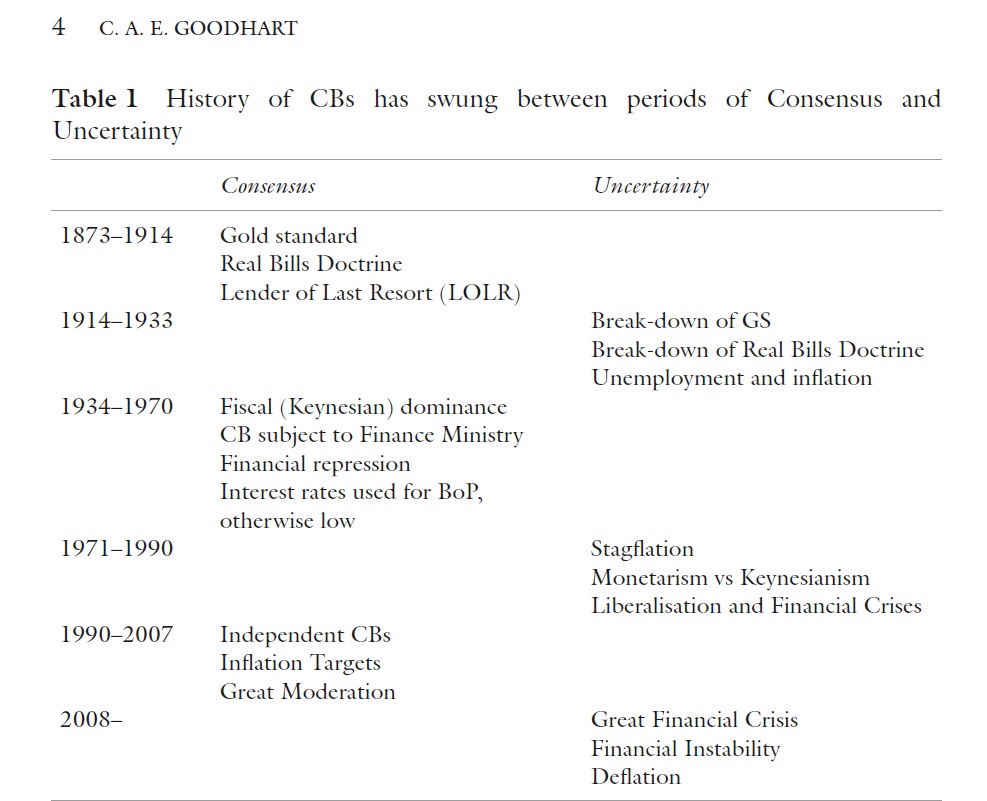
This squares off nicely with another brief article that I stumbled across today, by banking historian and LSE Emeritus Professor Charles Goodhart. Lamentably – or perhaps it ought to have been celebratory – Goodhart notes that no monetary regime lasts forever as central banks have for centuries, almost haphazardly, developed their various functions. The history of central banking, Goodhart notes,

can be divided into periods of consensus about the roles and functions of Central Banks, interspersed with periods of uncertainty, often following a crisis, during which Central Banks (CBs) are searching for a new consensus.”

He sketches the pendulum between consensus and uncertainty…goodhart monetary regime changes

…and suddenly the Great Monetary Experiment of today’s central banks seem much less novel!

Whatever happens to follow our current monetary regimes (and Inflation Targeting is due for an update), the student of economic history is superbly situated to make sense of it.

Those revenue-raising early central banks

In a piece on a rather different topic, George Selgin, director for the Center for Monetary and Financial Alternatives and editor-in-chief of the monetary blog Alt-M, gave a somewhat offhand comment about the origins of central banks:

For revenue-hungry governments to get central banks to fund their debts is itself nothing new, of course. The first central banks were set up with little else in mind. (emphasis added)

Writing about little else than (central) banks in history, you can imagine my surprise:

Reasoned response: Selgin ought to know better than buying into this simplified argument.

Less reasoned response, paraphrasing one of recent year’s most epic tweets: you come into MY house?! 

Alright, let’s make a quick run-through, then. Clearly, some simplification and lack of attention to nuances is permissible under the punchy poetic licenses of the economic blogosphere – especially so when the core of an argument lies elsewhere. But the conviction that early central banks

(a) were created as revenue-raising devices for their governments, or
(b) all central banks provided their governments with direct fiscal benefits,

is a gross simplification of a much broader and much more diverse history of early public banks. Additionally, the misconception entails what Italian banking scholar Curzio Giannini derisively referred to as overly-narrow “fiscal theor[ies] of central banks”. Since too many people believe some version of the argument, let’s showcase the plethora of early central banks and illustrate their diverse experiences.

Initially, the banks-as-fund-raisers argument may seem reasonable; a few proto-central banks definitely were set up with this purpose in mind, with the Bank of England’s series of monopoly charters beginning in 1694 as the prime example. David Kynaston, the great historian of the Bank, eloquently characterized the relation between the government and the Bank as a ‘ritualistic dance’ in light of the periodic renewals of its monopoly charter; the Bank provided the government with funds and in return received some new privilege in addition to lucrative interest payments.

Among the dozen or so other candidates reasonably fitting the description “first central banks”, we see a wide variety of purposes, not all of which were principally – or even at all – concerned with funding their governments.

Banco di San Giorgio (Genoa, 1407), was essentially a precursor of money market funds with investors holding the City state’s debt and receiving taxing rights. Here, as in many of the northern Italian city-state banks of the 14th and 15th century, the banks-as-fund-raisers argument seems applicable (we might mention others here too, like the Catalonian Taula de Canvi, 1401, that is often considered the first public bank). Whether or not these first generation banks may be counted as  “central banks” is much less doubtful, but a topic for another day.

Amsterdam Wisselbank (1609), a much-studied institution and a trailblazer in the history of central banking, was primarily set  up to facilitate payments, specifically to simplify the chaotic muddle of coins and payment methods that abounded in the Low Countries during the 1500s and 1600s. The Bank’s lending was circumscribed, and the lending that did take place often went to the Dutch East India Company – of course, we might argue that the Dutch East India Company, with its directors appointed by the Dutch provinces, actually constituted an arm of the government and so counting this lending as government financing. Besides, the City only began using the Wisselbank for financing purposes firstly through a loan in the 1650s and then more frequently towards the end of the 17th century. Regardless, those are (decades removed) outcomes – not initial purposes.

Hamburger Bank (1619) was similarly set up with monetary stabilization in mind and adopted many of the features of the Wisselbank. Contrary to the Wisselbank, it had a credit department that right away engaged in lending to private parties on collateral. However, it seems that most of its funds were lent to the Kämmerei (municipality treasury). In economists William Roberds and Francois Velde’s account, the

problems with circulating coinage in early seventeenth-century Hamburg were, if anything, worse than in Amsterdam.

A partial vindication, at best, for the banks-as-fund-raisers argument since the Hamburger Bank was clearly set up with monetary stabilization in mind rather than government financing. In practice, however, it did finance the city.

The Riksbank: (Stockholm, 1668). Picking up from its failed predecessor ‘Stockholms Banco’, what later became known as Sveriges Riksbank (frequently credited with being the first – surviving – central bank) was tasked with facilitating trade and upholding the value of the domestic currency. In practice, this meant influencing the foreign exchanges as they stood in Hamburg or Amsterdam. Initially, the bank was explicitly prohibited from extending funds to the crown (in early 2019 there has emerged a dispute over this point among some Swedish financial historians). What is clear is that for the first fifty years or so of the bank’s existence, the rule seems to have mostly held up; not until the Great Northern Wars in the early 1700s did the Riksbank to any meaningful extent advance funds to the government.

Bank of Scotland (1695) and the Royal Bank of Scotland (1727), were both – a bit like the Riksbank – chartered to advance and improve the functioning of the domestic economy, and they were prohibited from lending to the crown. Despite the well-known political conflicts leading to the chartering of the Royal Bank, the Scottish case of rivaling banks were clearly created to advance the North Sea trade, not to finance the government or manage its debt. The third chartered Scottish bank, the British Linen Company (1745) was formed in order “to carry on the linen manufactory”. As is often the case in banking history, the Scottish case might thus be the clearest counterpoint to an argument. Further, the Scottish banking historian Sydney Checkland pointed out that the Bank of Scotland was “solely dependent on private capital, and […] wholly unconnected with the state.”. Again, the No True Central Bank objection might be raised, but it would send us tumbling into a dark definitional hole that has to wait for another time.

Banco del Giro/Wiener Stadtbank (Vienna, 1703 and 1705) were both established as a result of “the poor state of Austrian public finance” Like in Venice and Genoa, the banks were meant to enhance the liquidity of the government’s debt, actively contributing to reducing the State’s and the City’s interest rates respectively – and then gradually pay back their debt. While both banks did accept private deposits, and like its Hamburg and Dutch predecessors facilitated payments through their ledgers, these operations were clearly not their prime purposes. Money-raising argument vindicated.

This brief overview of some early central banks illustrate the point: banking history contains much wider experiences than a simplified money-raising argument implies. Indeed, even the First Bank of the United States – clearly an aspiring candidate to the title of ‘first’ central banks’ – seems to primarily have had trade-enhancing and economic development purposes in mind. This I say much hesitantly, since early American banking is definitely not my forte and I fully expect Selgin (and others) to correct me here.

Regardless, to claim that early (central) banks were set up with government finance in mind, is clearly an overstatement.

___

The title is a play on my favorite of George Selgin’s many brilliant articles, ‘Those dishonest goldsmiths’.

For the record, George Selgin is well-versed in this literature, and I’m merely using his quote as a stand-in for a common conviction among the not-so-well informed academic crowd.

How US foreign policy hurts Christians worldwide

Christians are the most persecuted religious group worldwide. The 20th century produced more Christian martyrs than any other period in history. During a great part of that century, Christians were mostly persecuted by totalitarian regimes in communist countries like the USSR and China. Today persecution still comes from communist governments, such as the ones in China, Cuba and North Korea, but mostly Christians are persecuted in countries where Muslims control the government. With that in mind, I would like to answer two questions: Why is that and can Christians in the West do something about it?

Typically, Christians (and other religious groups) are persecuted by totalitarian governments. The definition of a totalitarian regime is that it can comport no opposition or dissidence. A totalitarian regime is characterized by the attempt to control your whole life, including your religious life. Totalitarian regimes fear losing control over their population. Christians gathering for worship are mistaken for a seditious group. This is the reason why these governments persecute Christians.

Until World War I, US foreign policy was mostly characterized by what is typically defined as isolationism. US presidents since the Founding Fathers understood that Europe was a mess and that the US would do well to keep away from political entanglements with it. This changed with Woodrow Wilson. Wilson understood that it was the US’ mission to rebuild the World after its own image. With that in mind, he struggled, against the US population, to get the country into World War I.

US involvement in World War I proved to be essential for that war and for all US foreign policy since then. The tendency in Europe, since the 17th century, was for major wars to end with a new power equilibrium. This is not hard science, but pretty much every hundred years Europeans would fight a major war and then rest for another hundred. That was so with the 30 Years War, the War of Spanish Succession, and the Napoleonic Wars. All these conflicts had one thing in common: the emergence of a new great power in Europe moved other countries to balance that power. The tendency, in the end, was equilibrium. That was the case with World War I: the European system was balanced after the Napoleonic Wars. However, towards the end of the 19th century, Germany emerged as a new great power. Other countries allied against it. This scenario was delayed by Otto von Bismarck’s brilliant foreign policy but proved ultimately inevitable.

World War I should end like any other European War since the 17th century: that generation realizes that it is impossible for a single country to dominate the entire continent, diplomats accept the status quo and anyway, everybody becomes war-weary and more inclined to peace. But US intervention prevented that from happening. My hypothesis (that I have no idea how to test) is this: without US intervention, World War I would finish with peace without winners. It would be considered a draw. With US intervention, however, France managed to punish Germany for the War. Germany, on its part, became vengeful against France. England understood that it was better to stay on the other side of the channel. World War I became only the first half of a major conflict that continued some twenty years later with World War II. If in World War I US involvement was optional, in World War II it became inevitable. And after World War II came the Cold War, and the US hasn’t stop ever since.

US involvement in World War I had a number of consequences. German revanchism against France gave way to the rise of Nazism. In Russia, the Bolsheviks rose to power as well. Another effect of World War I was the end of the Turco-Ottoman Empire. Following Woodrow Wilson’s vision, that empire was to be divided into several countries, according to several ethnic groups identified by westerners. In actuality, England and France took the chance to divide the Middle East into several colonies. Christians were persecuted in Nazi-Germany and the USSR. The Middle East is a mess to this day. Before World War I, American missionaries were welcomed in the Turco-Ottoman Empire.

British ones were not, because that empire understood (I suppose correctly) that they would be hard to separate from the imperialist interests of Great Britain. The US mostly took England’s place in this regard. To make matters worse, oil was the fuel of the second industrial revolution that began at the end of the 19th century. Soon after, it was discovered that the Middle East had some of the greatest deposits on the planet. The US became the first world superpower, and to maintain that it needed oil. Lots of oil. It is a vicious cycle.

In sum, I am blaming Woodrow Wilson and his foreign policy for everything bad that happened ever since. The Founding Fathers had a very good foreign policy, that made the US and US citizens welcomed worldwide. Woodrow Wilson broke that pattern, much because he was a liberal Christian who thought that the US role was to make the world democratic by force.

I don’t think it’s too late to change. It might be unthinkable to just withdraw from every international commitment the US has today, but it is definitely time for a gradual change. A world without major US military intervention may be – counterintuitively – a world safer for Christians.