Brazil, the country of Carnival (?)

Maybe for most English speakers it isn’t even known, but we are in the Carnival week. Carnival is a festive season that occurs before the liturgical season of Lent. The main events typically occur during February or early March. It typically involves public celebrations, including events such as parades, public street parties and other entertainments. I’m unashamedly taking some elements from Wikipedia here to try to explain it. It is basically equivalent to Mardi Gras. Carnival (or Carnaval, as we say it in Portuguese) is a big thing in Brazil. Or maybe not. That’s what this post is about.

Carnival is a Christian feast, at least in its origin. It occurs right before lent. Lent is the forty days that antecede the Passover. The idea was that people would fast (at least to some degree) during the forty days of lent. Therefore, Carnival was the last opportunity for forty days to indulge in some pleasures of the flesh. Carnival literally means “remove meat”, from the Late Latin expression carne levare. “Farewell to meat” is another possible translation. However, carne is not solely meat in Latin; it also refers to the flesh, especially in the Christian association between sin and flesh. Carnaval, therefore, is the feast of the flesh – taken literally or not. At least in Brazil, to my knowledge, the relationship between Carnival, Lent and Passover is little known. I believe that most people just take it to be a major party that happens sometime between February and March.

Brazil is popularly known as the country of Carnival, Samba and Soccer. Of these three, I kind of like the last one. Not so much the first two. To my knowledge, Carnival has always been very popular in Rio de Janeiro, at least since the early 19th century. At that time, it was known as Entrudo, a celebration in which mostly people throw water on one another, like in a water balloon fight. However, there were some improvements: people started throwing some liquids other than water if you know what I mean and that even at strangers. The party was also an opportunity for slaves to poke on their masters. Carnaval eventually became associated with the slaves’ African culture, and I suppose that’s how the Christian origins were somewhat lost. Today, Carnaval in Rio is strongly associated with Samba music.

I haven’t done a very scientific research for this, but to my knowledge, most people in Rio actually don’t like Carnaval. Carnaval is a street party, with all that comes with it: people leave tons of trash behind; people get drunk, and often violent; the music can get really loud and sometimes going on for hours, even into the night. Given the specific nature of the festival, there are people having sex on the street and other things happening as well. It is hard to say this without sounding moralistic, but the thing is that Carnaval ends up being the most anti-libertarian thing one can imagine. If “don’t do onto others what you don’t want to be done onto you” is the golden rule we’re trying to put into practice, Carnaval is the undoing of this.

In the late 19th century, some authorities already realized that the festival was getting out of control and tried to organize it somehow, mostly to no avail. But things really got out of control in the early 20th century. Coming out of the monarchy, Brazilian intellectuals were dedicated to the task of identifying the Brazilian identity. Sérgio Buarque de Holanda made a huge contribution to this with is Roots of Brazil (Raízes do Brasil), in which he said that Brazilians had a hard time understanding and applying the impersonal relationships necessary for a modern capitalistic society. Another major contribution in this conversation was done in 1933 by anthropologist/sociologist Gilberto Freyre in his book Casa-Grande e Senzala (English: The Masters and the Slaves). In this book, Freyre argued that the Brazilian national identity was the result of miscegenation (both biological and cultural) between masters and slaves.

On the one hand, I want to say that Freyre’s argument was revolutionary because he was saying that Brazilians were not an “inferior race” because of race-mixing. Just the opposite: Brazilian culture was permeated by highly positive elements exactly because of miscegenation. Consider that Freyre was saying that in the 1930s, when race-mixing was still a major taboo in the US, not to mention Nazi Germany. But on the other hand, I believe that Freyre contributed to a movement that gave up trying to “civilize” Brazil.

The topic of civilization is always a polemic one because it implies that some cultures are superior to others. I don’t want to go that way. But I also don’t want to be a cultural relativistic. Some cultures are superior to others in some aspects. There is nothing culturally superior in leaving tons of trash in the streets after a street party. There is nothing culturally superior in imposing your music taste on others. There is nothing superior in imposing your take on sexuality on others.

In the late 19th century, some authorities were trying to organize Carnaval in Rio de Janeiro because things were getting out of control. In the early 20th century, most authorities gave up that enterprise because they decided that Rio de Janeiro (and Brazil) is that “mess”. Instead of trying to correct the bad aspects of Carnaval, they decided to celebrate it as the very essence of Brazilian culture. Eventually, into the 20th century, Carnaval became a great example of panem et circenses policy.

I understand that in the early 21st century more and more people in Brazil are getting sick and tired of Carnaval, and that has some connections with politics. Typically (though definitely not always) people on the left want to celebrate Carnaval. People on the right typically (though definitely not always) don’t want to. Some people on the left are already saying that Bolsonaro’s government represents the taking over of government by Christian fundamentalists. I doubt. They may be right at a very low degree. But for the most part, what is happening is that Brazil is too diverse for a single project of nation to work for everybody. Ironically Gilberto Freyre was right: we are the result of this mixture, and this is not a bad thing. People only need to learn to respect the opinions, tastes and preferences of the other elements in this mix.

Edge of Democracy in Brazil?

The past few days Brazilian internet was packed with commentaries about The Edge of Democracy (Portuguese: Democracia em Vertigem), a 2019 Brazilian documentary film directed by Petra Costa that was nominated for Best Documentary Feature at the 92nd Academy Awards (and lost). To be honest, I didn’t watch this movie and I’m not planning to. My life is already quite busy as it is. However, judging by the trailer and by what people were saying, “The film follows the political past of the filmmaker in a personal and intimate way, in context with the first term of President Lula until the events leading to the impeachment of Dilma Rousseff, analyzing the rise and fall of both presidents and the consequent sociopolitical crisis that swept the country. The arrest of Lula paved the way for the rise of Jair Bolsonaro and his eventual presidency” (from Wikipedia). Vox says this: “Filmmaker Petra Costa grew up in a politically involved family in Brazil, and that’s her starting point for The Edge of Democracy, in which she traces recent developments in Brazilian politics and shows how the country moved so quickly from a fledgling democracy toward far-right authoritarianism”. So, it seems to me that the movie is about how Brazil was becoming a vibrant democracy under the rule of the Workers’ Party and now it’s becoming a far-right autocracy. Judging by that, these are some thoughts on how I see democracy in recent and past Brazilian history.

Brazil was a Portuguese colony, but this was different from America being an English colony. There were not thirteen colonies in Brazil. Portugal’s oversight of Brazil was stronger than England’s over America. There was basically no space for local rule in Brazil. Therefore, Brazil came from its colonial days with basically no self-government experience.

Brazil became independent from Portugal in 1822. But again, this was different from America’s independence. In 1808 the Portuguese royal family came to Brazil, running away from Napoleon. Brazil became a United Kingdom with Portugal in 1815. Dom João VI, the Portuguese king, gave in to the court’s pressure and went back to Portugal in the early 1820s. However, he left his son Dom Pedro I as prince regent in Brazil. And at this Pedro declared Brazil’s independence in 1822.

Dom Pedro I was crowned as Emperor of Brazil and ruled until 1831. Suffering multiple pressures, he went back to Portugal like his father before him. From 1831 to 1840 Brazil was ruled by several regents. In 1840 Dom Pedro I’s son, Dom Pedro II, became emperor. He ruled until 1889, when he was deposed by a military coup.

Brazil has been a republic ever since, but not like America. We didn’t simply have presidential elections every four years. The first two Brazilian presidents were virtually military dictators. Civilians came to power in 1894 and ruled until 1930, but these were not exactly democratic times. Mostly the country was ruled by coffee oligarchs.

The last of these coffee planter presidents ruled until 1930. Then Getúlio Vargas came to power in a coup. He ruled until 1945. Vargas was deposed but continued to be a major political player. So much so, that he came to the presidency in the 1950s. He committed suicide in 1954, while still in office. Basically, the country was still under Vargas’ shadow from 1945 to 1964. And that’s when the military came to power.

Brazil was under military governments from 1964 to 1985. This is the historical period that people tend to remember and refer to the most. The military came to power because the population asked them to. There was a great fear of communism, and the army would theoretically defend Brazil against this. I am not saying that this fear was justified or that military governments was the right solution, but this is how most people thought at that time.

The last military president surrendered power in 1985. Since then, Brazil has been ruled by civilians. The Workers’ Party (or Partido dos Trabalhadores, PT, in Portuguese) became one of the most competitive political forces in Brazil in this period. Officially founded in 1980, it always had Luiz Inácio Lula da Silva as one of its main leaders. The Workers’ Party always presented itself as broadly leftist, without further specification. Among its founders were sympathizers of Roman Catholic Liberation Theology, radical socialists who defended armed opposition to the dictatorship, and union workers (Lula among them).

Lula was presidential candidate in 1989, 1994 and 1998, always coming in second place with about 30% of the votes. During those years Lula and the Workers’ Party were radically opposed to the economic reforms Brazil was going through. Like in other countries, Brazil was suffering from the crumbling of years of populism. The Washington Consensus was the order of the day, but the Workers’ Party was against everything it called “neoliberalism”. “Out with FHC (Fernando Henrique Cardoso, Brazil’s president from 1995 to 2002) and the IMF” was their usual chant. The party even defended not paying Brazil’s staggering international debts. Lula still hung out with socialist leaders, mostly Fidel Castro. However, in 2002 he presented a different platform. Advised by advertising professional and political strategist Duda Mendonça, he announced that, if elected president, he wouldn’t undo FHC’s economic reforms. Plagued by several international economic crises (Mexico, Asia, Russia, Argentina), Brazil was having a hard time entering the free-market world. The once highly popular FHC came out from office with low popularity. The combination of these factors (FHC’s low popularity at the time and Lula’s promise to pursue a less radical path) opened the way for the Workers’ Party to come to Brazil’s presidency.

In the first years of his government Lula was true to his promise. He not only maintained but deepened FHC’s economic reforms. After the initial shocks, Brazil slowly reacted to the free-market medicine and the economy started to grow. This guaranteed Lula’s reelection in 2006, although by then major corruption scandals already surrounded his presidency, centrally the Mensalão scandal. This scandal broke in 2005 when it was discovered that the Workers’ Party gave monthly payments to several deputies from other parties to vote for legislation that was favored by the ruling party. Although the investigations implicated some of Lula’s closest allies, the president himself managed to get off scot-free.

Lula’s second term in office marked a change from the first and even from his party’s historical stand up until then. The Workers’ Party since its inception always posed as a firm adversary to corruption. Political corruption is hardly something new in Brazil. Going back to the beginning of this text, one of Brazil’s historical problems has always been the difficulty of separating public and private. This was ironically famously observed by Raymundo Faoro, one of the Workers’ Party initial supporters. In Donos do Poder (Owners of the Power) Faoro observed that Brazil has always been led by ruling elites who saw public property as their property. In this scenario the very idea of corruption becomes fuzzy since ruling elites believe they are not stealing – they are simply using what is rightly theirs! It is against this scenario that Faoro and others proposed a technocrat professional bureaucracy. After the Mensalão scandal, however, the Workers’ Party became cynical towards corruption. Their usual response to it became to say that previous governments also did it, that they didn’t invent corruption or simply to say that Lula was an innocent man being politically persecuted by the elites. In sum, Workers’ Party officials and supporters were divided between those who, while not denying the veracity of the corruption scandals, tried to minimize it, and those who completely denied it.

Lula left his second term in office still high on popularity. So much so that he was able to elect his successor, Dilma Rousseff. Dilma, however, would face several difficulties in her presidency. Number one, although somewhat forgotten by the general public, the corruption scandals were still a reality that would surface every now and then. Second, Brazil was suffering the effects of the 2008 world economic crisis. Finally, Dilma was herself a shamefully inept leader.

As I mentioned before, Lula came to power in 2003 mainly because he and others in the Workers’ Party were able to (partially) come to terms with the fact that the Washington Consensus is called a consensus for a reason: as much as some things in political economy are debatable, some are not – centrally, you can’t spend money that you don’t have forever. Dilma would have none of that. Although she is famously very confused in the way she speaks, all things point to the fact that Dilma is trapped in a painfully outdated Keynesian mentality. Trapped in this mentality, she overspent – against Brazilian law. For this reason, she was impeached.

Dilma’s impeachment was followed by a short government of her vice-president, Michel Temer, and now the country is governed by Jair Messias Bolsonaro. Bolsonaro was for many years an obscure politician from Rio de Janeiro, elected mostly to corporately defend the military as workmen. Almost an unofficial union leader for soldiers. Bolsonaro, however, is also an admirer of the Brazilian army in general. He graduated from Academia Militar das Agulhas Negras, something akin to West Point. As a reformed army captain, he fiercely believes that the military did save Brazil from communism in the 1960s. As I mentioned before, that’s exactly what people in the 1960s believed. I’m not saying that they were right.

Ironically, leftists greatly benefited from the military governments of the 1960s-1980s. The guerrilla in Brazil’s countryside was crushed by the armed forces and the urban armed resistance was mostly weak and disorganized. Some important leaders in the Workers’ Party came precisely from these two. But Brazilian armed forces were shamefully unprepared to fight a cultural war. While some sectors of the left were still following Mao Zedong or Che Guevara, trying to reach power by force, others were reading Gramsci and the Frankfurt School, following a more cultural path to power.

In any case, the left was very good at posing as victims. In the years that followed the military governments, there was a tendency to romanticize the resistance. Some people, artists and politicians, made whole careers on that. To be “persecuted by the dictatorship” became a major asset.

But the truth is that Brazilian left never fought for democracy. This isn’t meant to depreciate them. It’s just a statement of fact. Actually, what I meant in the first paragraphs was to show that Brazil has a very weak democratic tradition. Beginning very early in the 20th century, shortly after the Russian Revolution, communists tried to take power in Brazil by force. Again, this is just a statement of fact. This continued up to the early 1960s when, fueled by Cold War fear (some might say paranoia, I don’t really mind), people begged the armed forces to take power. Has it not lasted for so long, the military governments would probably have been long forgotten or taken as something positive. But because they lasted for so long, the left was able to play its cards and pose as democratic victims of an authoritarian regime.

And this is, I believe, how we come to 2020. Bolsonaro has, I believe, a wrong idea about the military governments. Even if they were truly necessary to avoid a communist coup, they shouldn’t have lasted for so long. Besides that, the military presidents had their ups and downs in how they governed the country. Bolsonaro mostly can’t see that. The left, on the other hand, romanticizes the dictatorship. Some of them seem to actually believe in the lie that they were fighting for democracy. They were not. Had they won the war against the military forces, Brazil would have become something akin to Castro’s Cuba or Mao’s China. Had the military not won against the guerrillas, Brazil would have something akin to Colombia’s FARCs.

In sum, Brazil is still trapped in things that happened in the 1960s. Socialists, of course, wanted a big state. That’s basically their ideology. Ironically, in order to fight that, the military built an equally gigantic state. Petra Costa’s family got rich, fabulously rich, during the military governments. Today her family has contracts with the Workers’ Party. Some things change, but others remain the same: some people don’t care if governments are red or blue. All they care about is the green of the dollars. And a smaller state would be bad business for this kind of people.
Sunday Poetry: Halal Cookery by the SS

First of all: Happy New Year Peeps!

I am trying my best to get some routine in blogging by sticking to this series. However, I do not know if I can still pull it off during the upcoming finals. We will see.

This week’s Poetry is less poetic yet very much informative (at least to me). David Motadel in his book “Islam and Nazi Germany’s War” reconstructs the bizarre relationship between Nazi Germany and Islam (and thus sheds light on another Myth of the Nazi Regime). What sounded completely counterintuitive to me, was this short passage on the halal cookery courses organized by the SS:

“In the end, both the Wehrmacht and the SS also took Islamic food regulations into consideration. In his instructions of 1942, Niedermayer ordered to ensure that the dietary requirements of Muslim soldiers, especially the ban on pork, were respected. Similar instructions were issued for Arab Wehrmacht soldiers. The SS went even further here. In July 1943, Himmler personally instructed Berger to find out “what Islam prescribes to its soldiers with regard to food” and added that he wanted to ensure that religious rules were observed. Shortly afterwards, Berger informed Himmler that the soldiers were not allowed to eat pork or drink alcohol. The Reichsführer-SS reacted promptly and ordered: “All Islamic members of the Waffen-SS and the police are granted as an unbreakable special right that, in accordance with their religious rules, they are never given pork as well as sausage containing pork and never alcohol to drink. An equally valuable diet is guaranteed in any case.” The SS even organized halal cookery courses near Graz.”

I wish you all a pleasant Sunday.

Entangling alliances, Donald Trump, and a new libertarian alternative

Some say that Donald Trump’s transactionalism in the realm of geopolitics has gotten out of hand. Tridivesh has actually been saying this for awhile now. Jacques is not pleased with the president’s decision to withdraw American troops from Syria. Of the other Notewriters, only Andre has spoken up for Trump’s withdrawal from Syria.

There are libertarians and leftists who have applauded Trump’s move, but for the most part people are dissatisfied with the way the president of the United States conducts foreign policy. There’s no logic. There’s no strategy. And the incentives don’t quite line up, either: is Trump out for the republic or himself?

This is unfair. Trump’s transactionalism comes with more press, but Obama and the guy before him were transactionalist presidents, too. Just think about Syria to begin with. Getting involved in the butchery there had no logic to it and actually went against the strategy of Obama’s “Pivot to Asia.” Still, Obama mired the republic in another brutal regional scuffle. GWB did the same thing in Iraq, too. Osama bin Laden was hiding out in Afghanistan, so Bush invaded Iraq, a country that had nothing to do with 9/11. Makes sense, right?

Maybe we’re looking at this all wrong. Maybe we should be looking at the incentives and trade-offs available to the executive branch of the American government instead of single individuals.

My contribution to reassessing American foreign policy is to look at the role that formal alliances play in chaining down the executive branch in the American system. Libertarians loathe both alliances and the executive branch, but what if one is useful for off-setting the other? Which one would you rather have? (Trade-offs are more realistic than utopias, my fellow libertarians.)

There are two general types of alliances in the world: formal and informal. Alliances have been with us since the dawn of time, too. Think of the alliances our Stone Age ancestors made, one individual at a time. Elected politicians make alliances and call them political parties. Dictators make alliances and call them bargains. You get the picture. The United States has traditionally made use of informal alliances, so Trump’s abandonment of the Kurds in Syria is really a continuation of American foreign policy and not an aberration as some hawks claim.

In fact, prior to World War II, the United States had signed just one official alliance with another polity: the Treaty of Alliance with France that lasted from 1778-80. So from the start of the Revolutionary War (which was really a secession from the British Empire rather than an actual revolution) in 1776 to America’s entrance into World War II in late 1941, the United States had joined only one alliance, and it was a short-lived alliance that would make or break the existence of the republic. (During World War I, the United States was an “affiliated partner” rather than an official ally.)

This doesn’t mean that the United States was isolationist, or non-interventionist, during this time frame. In fact, it highlights well the fact that the United States has a long history of entering into alliances of convenience, and a short history of building and then leading stable coalitions of military partners around the world. Alliances have shaped the destiny of the republic since its founding. And, more importantly, these alliances of convenience have their intellectual roots in George Washington’s foreign policy. Washington’s foreign policy even has its own name: the Washington Doctrine of Unstable Alliances. According to Washington and other elites of the founding era, the United States should freely enter into, and exit, alliances as necessary (Jefferson was a big fan of this Doctrine, too). This stands in stark contrast to the idea that the United States only soiled its virginal unilateralism once, when it was in dire peril and needed a helping hand from France to fend off an evil empire.

Washingtonian alliances throughout American history

Aside from fighting alongside the Oneida and Tuscarora during its secession from the British Empire, the United States forged alliances with Sweden, in 1801 to fight the Barbary states, and with the Choctaw, Cherokee, and some of the Creek during the ill-fated War of 1812. In fact, one of the reasons the United States got pummeled in the War of 1812 was the lack of Native allies relative to the British, who had secured alliances with at least 10 Native American polities.

The American push westward saw a plethora of shifting alliances with Native peoples, all of which tilted in eventual favor of the United States (and to the detriment of their allies).

The American foray into imperialism in the late 19th century saw alliances with several factions in Cuba and the Philippines that were more interested in extirpating Spain than thinking through an alliance with an expansion-minded United States.

In 1832 the United States entered into a Washingtonian alliance with the Dutch in order to crush some Barbary-esque states along the Sumatran coast. The alliance led to the eventual, brutal conquest of Aceh by the Dutch and a long-lasting mutual friendship between the Americans and the Dutch.

From 1886-94 the United States and its ally in the South Pacific, the Mata’afa clan of Samoa, fought Germany and its Samoan allies for control over the Samoan islands. The Boxer Rebellion in China saw the United States ally with six European states (including Austria-Hungary) and Japan, and affiliate with three more European states and several Qing dynasty governors who refused to follow their emperor’s orders.

NATO’s continued importance

Clearly, the United States has followed its first president’s foreign policy doctrine for centuries. Washington warned that his doctrine was not to be an eternal guideline, though. Indeed, the most-cited case study of the Washington Doctrine of Unstable Alliances is not the American experience in the 19th century, but the Nazi-Soviet one of the 20th, when the Germans turned on the Soviets as soon as it became expedient to do so.

The establishment of NATO has forced the United States to become reciprocal in its alliances with other countries. The republic can no longer take, take, and take some more without giving something in return. This situation of mutually beneficial exchange has tempered not only the United States but everybody else in the world, too (especially in the industrialized part of the world; the part with the deadliest weapons). Free riding will most likely continue to be a problem within NATO. The United States will continue to pay more than its share to keep the alliance afloat. And that’s perfectly okay considering most of the alternatives: imperialism (far more expensive than free riding allies), ethnic cleansing, or oscillating blocs of states looking out for their own interests in a power vacuum, like the situation Europe found itself in during the bloody 20th century.

The forgotten alternative

Unstable alliances lead to an unstable world. The rise of NATO has been a boon to the world, despite its costs. If libertarians want to be taken seriously in the realm of foreign affairs, they would do well to shake off the Rothbardian shackles of isolationism/non-interventionism and embrace Madisonian federalism with a Christensenian twist. The 13 North American colonies that broke away from the British Empire were sovereign states when they banded together. The 29 members of NATO are sovereign states, too, and there’s no reason to believe that Madison’s federal blueprint can’t band them together as well.

If libertarians are comfortable embracing non-interventionism as a foreign policy doctrine, even though it has never been tried and even though it’s based on a shoddy interpretation of history, there’s no reason why they can’t instead embrace federation as their go-to alternative. Federation at least has history on its side, and it’s also got the obscure appeal that libertarians so love to ooze at public gatherings. Will 2020 be the year that libertarians shift from non-interventionism to federation?

Sunday Poetry: Rüstow vs. Mises

One of the bests books I’ve read this year was Serge Audier’s & Jurgen Reinhoudt’s relatively unknown (unfortunately!) translation of the protocols of the Walter-Lippmann-Colloquium. The NOUS-Network organized a wonderful seminar in which we thoroughly discussed the book and the emergence of Neoliberalism. For the preparation of this weekend’s Hayek-Kreis seminar, I reread the book and stood once again in awe of the magnificence of the discussion during the Colloquium.

By the way: If you are an undergraduate, graduate, or PhD scholar, please consider joining the NOUS-Network for Constitutional Economics and Social Philosophy as a Young Affiliate! NOUS is an information platform and a community for interdisciplinary research. The network links all academic fields relevant for thinking about social order and liberty. It spans philosophy, politics, economics and fosters scholarly research, contact and exchange.

In the following excerpt, it becomes clear, that the participant’s opinion on the psychological and sociological causes of the decline of Liberalism differed significantly. Mr Rüstow eloquently captures the standpoints of the two opposing groups (not without bias to be fair) and even cheekily disses Ludwig von Mises.

“Mr Rüstow: ‘All things considered, it is undeniable that here, in our circle, two different points of view are represented. One group does not find anything essential to criticize or to change in traditional liberalism, such as it was and such as it is, apart from, naturally, the adjustments and the current developments that are self-evident.

In their view, the responsibility for all the misfortune falls exclusively on the opposite side, on those who, out of stupidity or out of malice, or through a mixture of both, cannot or do not want to discern and observe the salutary truths of liberalism. 

We, on the other hand, we seek the responsibility for the decline of liberalism in liberalism itself; and, therefore, we seek the solution in a fundamental renewal of liberalism. In order to justify in a positive manner this second point of view, I have to refer to what I have said and, especially, to the excellent arguments of Mr Lippmann.

Here, I would only like to draw attention to the fact that if the unwavering representatives of old liberalism were right, the practical prospects [for liberalism] would be almost hopeless. Because it does not really seem that old liberalism has gained in persuasive and in seductive force or that the arguments, no matter how shrewd they may be, of these representatives have the least possibility of bringing about a conversion movement within the realm of Bolshevism, Fascism, or of National Socialism. If they did not listen to Moses and the prophets—Adam Smith and Ricardo—how will they believe Mr. von Mises?'”

As always, I wish you all pleasant Sunday.


Sunday Poetry: Junger’s War Observations

Without noticing it, I heavily built my reading schedule this year around of what one might call a “post-liberal reading list”. The idea, that the demise of social institutions might be the inevitable consequence of an ongoing individualization of society struck me as initially convincing. I am currently in search of good examinations on the ultimate effect Liberalism has on the development of social institutions. Hopefully, Steven Horwitz’ “Hayek’s Modern Family” will provide me with some compelling arguments to refute the post-liberal agenda.

Not directly being post-liberal, but pointing towards the importance of “homecoming and belonging”, Sebastian Junger’s book “Tribe” has had a lasting influence on me. I found the following observations of a war refugee voluntary reentering Sarajevo during its siege both fascinating and devastating.

“What catastrophes seem to do – sometimes in the span of a few minutes – is to turn back the clock on ten thousand years of social evolution. […]

“‘I missed being that close to people. I missed being loved in that way’, she told me. ‘In Bosnia – as it is now – we don’t trust each other anymore; we became really bad people. We didn’t learn the lesson of the war, which is how important it is to share everything you have with humans being close to you. The best way to explain it is that the war makes you an animal. We were animals. It’s insane – but that’s the basic human instinct, to help another human being who is sitting or standing or lying close to you.’

I asked Ahmetašević if people had ultimately been happier during the war. 
‘We were the happiest,’ Ahmetašević said. Then she added: “And we laughed more.'”

I wish you all a pleasant Sunday.

Sunday Poetry: Camus about Europe

Albert Camus is the most influential writers to me (See here why). This passage is from his third “Letter to a German Friend” (1944), depicting his unbroken love for European culture in the dark times of the second world war.

“Sometimes on a street corner, in the brief intervals of the long struggle that involves us all, I happen to think of all those places in Europe I know well. It is a magnificent land moulded by suffering and history. I relive those pilgrimages I once made with all the men of the West: the roses in the cloisters of Florence, the gilded bulbous domes of Krakow, the Hradschin and its dead palaces, the contorted statues of the Charles Bridge over the Vltava, the delicate gardens of Salzburg. All those flowers and stones, those hills and those landscapes where men’s time and the world’s time have mingled old trees and monuments! My memories have fused together such superimposed images to make a single face, which is the face of my true native land. … It never occurred to me that someday we should have to liberate them from you. And even now, at certain moments of rage and despair, I am occasionally sorry that the roses continue to grow in the cloister of San Marco and the pigeons drop clusters from the Cathedral of Salzburg, and the red geraniums grow tirelessly in the little cemeteries of Silesia.”

I wish you all a pleasant Sunday.

Why some countries are stuck in poverty

It is fairly common for young children in Brazil (or at least in Rio de Janeiro, the part of the country I know better) to call adults “uncle” or “aunt”. My closest friends’ children call me uncle and I’m totally ok with that. I do see them as my nephews and nieces. That also happens in schools: children up to 11 or 12 call the teachers “aunt”. Some people think that this is normal or even cute. However, I studied in a school that strictly forbid children to call the teachers aunt. The teachers were supposed to be called simply “teacher”. One interchange became folkloric in my house: “Am I your father’s sister? Am I your mother’s sister? Am I married to your uncle? Then I’m not your aunt.” Ouch! As gruff as it might sound, that’s the mentality I grew up with. My mother was also never totally comfortable with some of my friends calling her “aunt”.

One of my favorite interpretations of Brazil came from Sérgio Buarque de Holanda (1902-1982). In his book Raízes do Brasil (Brazil roots, 1936) he made an analysis of the country, saying that the problem with Brazilians is that they are cordial. Using Max Weber’s categories, Holanda said that Brazilians don’t know how to conduct formal, impersonal relationships. It is really hard for them (or I should say, for us) to understand that the guy in office is the guy in office and not our friend.

I would say that many times I saw Holanda’s interpretation in action. Students who thought they were my friends and that because of that I would go easy on their exams. Colleagues who thought I wouldn’t fine them when I was working in the library. People I barely knew, who were friends of my friends, who thought I would give them answers for the exams. I managed to be friends of some students, but that was the exception. Most students had a hard time distinguishing between “Bruno, my friend” and “Bruno, my professor”. Worse, some, I don’t know how, came to the conclusion that I was their friend.

Lula da Silva, Brazil’s former president, presented himself as a father. He introduced Dilma Rousseff, his successor, as a mother. Getúlio Vargas, the horrendous dictator from the 1930s was widely known as “the father of the poor”. I’m sad to say that Jair Bolsonaro, Brazil’s current and supposedly right-wing president, doesn’t really scape this logic. It may be nice and cute when little children call adults aunt or uncle, but it sickens me when grownups use this language. Even more so, when they use it to people they don’t even know!

Sergio Buarque de Holanda is one of the few things from college I profited from reading. It helped me to escape the Marxist bog that is much of Brazilian humanities academia. Years later I read Good Capitalism, Bad Capitalism and I discovered that Brazil was not alone. That is the problem with many so-called capitalist countries that still lag behind. They are not really capitalist in the sense that the US, much of Western Europe or Japan and other Asian countries are, and one of the main reasons for that is that people don’t know how to conduct impersonal, formal relationships. The teacher is not your aunt, and the country is not a big family.

Intellectuals You Should Know About

I read a lot. Wide, deep and across quite a number of different fields. As a self-proscribed ‘writer’ and ‘editor’, reading much is both satisfying an intellectual desire and a professionally useful practice in familiarize myself with various styles, voices and topics. A common tip for aspiring writers is to read someone they admire and try to imitate their style; at this, at least, I am somewhat successful, as a friend recently told me that my style reminded him of Deirdre McCloskey. Full of idolized admiration for Deirdre’s work, I couldn’t imagine a higher praise.

As readers, the eternal curse of modernity is our laughable inability to keep up with the couple of millions of books that are published every year. Not to mention written materials on blog or respectable outlets or in magazines and journals. As consumers of the written word, we are completely outstripped, utterly defenseless and overwhelmingly inundated.

When in September I published my discussion of geographer and anthropologist Jared Diamond’s impressive work, I got a lot of feedback of astonishment from friends and family – including the friend that praised me for occasionally (accidentally…?) write like McCloskey: “Wow,” he said, “I’ve never heard of him before!”

Huh, I thought. I wonder what other household names of public intellectuals are not read as much as they deserve.

My exact reaction of astonishment was more like a gaping “What?!”, betraying my wanna-know-everything attitude, slight elitism and writer lifestyle. Contrary to the belief that our times is one of all talking and no listening (well, writing and no reading), it takes a vast amount of reading before you can produce anything that others want to read. Sure, anybody with a laptop and an internet connection can start a blog and flush out their thoughts (I did so for years) but it takes knowledge to say something intelligent and interesting – knowledge acquired by extensive reading.

It also takes a lot of practice to develop a voice of one’s own. Authors with astonishing and recognizable writing styles are made, not born.

What, then, should you read?

In light of this surprise, I decided to make a list of intellectuals I would advise anybody to read. Note that this is not a list of the most important thinkers ever, nor is it a collection of the most profound academic contribution to various disciplines. Instead it’s a gathering of writers whose popular writing (often in addition to their rigorous academic work) is exactly that – popular. That means that a lot of others liked them (and if you’re anything like others, you might too) and more importantly: a lot of smart people you meet are rather likely refer to these authors or to the ideas contained in their work. Here are 11 authors I would consider to be household names and whose writing will make you a much smarter and interesting person.

Jared Diamond

Let’s begin our list with aforementioned Jared Diamond, whose trilogy on humanity is compulsory reading for pretty-much everyone. This year he released Upheaval, which received very mixed responses and that I decided to skip after hearing his pitch on Sam Harris’ Making Sense podcast. Diamond’s publisher maintains that this is the third installment of his “monumental trilogy” of how civilizations rise and fall, but to me that was The World Until Yesterday: 

  • Guns, Germs and Steel is the book that definitely made Diamond a well-known name, the kind of Big Picture civilizational economic history we have recently seen in Yuval Harari’s work – the author of Sapiens: A Brief History of Humankind, that strangely boring book that everyone seems to be reading these days – or the less well-known but more captivating Columbia professor Ruth DeFries’ The Big Ratchet. If you like, you could describe this Pulitzer prize-winning book as well-written geographical reasons for why the West is rich and the Rest isn’t. If that’s your thing, read away.
  • Collapse: How Societies Choose to Fail or Succeed, the book that my September piece was mostly concerned with, is a dense story of many different human civilizations falling apart: Easter Islanders, Native Americans in the dry southwest or central America and my favourite chapter: The Greenland Norse. Complemented with the Fall of Civilizations podcast and Dan Carlin’s recent book The End is Always Near would make you ridiculously interesting to talk to in these hyper-catastrophist times. Upheaval is a natural extension of Collapse so if you crave more, that one is for you.
  • I would rather point to The World Until Yesterday for Diamond’s third gem as it is a deep dive into the lives of traditional societies in general, but in practice mostly New Guinean societies. Somehow, Diamond made anthropology exciting!

Paul Collier

Rapidly moving up in controversy, Paul Collier is an Oxford development economist whose work most intellectuals have a distinctly firm opinion about. His popular claim to fame rests on:

  • Exodus, a very cool (and prescient!) take on global migration. Highly recommended.
  • The Bottom Billion, for a plunge into global poverty and development economics. It might be slightly outdated (published in 2007) as many of the 60 failing countries he identifies have seem quite some growth in the last decade.

I should also recommend his latest book, Future of Capitalism, but I wasn’t very impressed with it. In these times of political polarization, populist uprisings, urban-rural divides and worries about AI, it is still a relevant read.

Whenever Collier speaks, you want to listen.

The Four Horsemen of Atheism (or “New Atheism”):
Christopher Hitchens, Sam Harris, Richard Dawkins, and Daniel Dennett

to which we should add the “one Horse-woman“, Ayaan Hirsi Ali, whom I’m ashamed to only know as “the wife of Niall Ferguson” (yes, my background is money and history, OK, not politics or religion…).

Together, these 5 brilliant minds may have helped many out of their religiosity, but their contributions loom much larger than that. As most of the Western world has gradually abandoned faith, their religious inclinations have turned to other areas: environmentalism (Mike Munger’s take on recycling never gets old!), invented hierarchies or social justice. The writings of these five horsemen can be hugely beneficial here too. Some recommended reading includes:

Speaking of Ferguson, as I’m a big financial history guy, I am shamelessly squeezing in this prolific writer, professor (well, Senior Fellow at Hoover institution nowadays) and public intellectual:

I should also mention his two-volume biography of Henry Kissinger (first volume 2015, next probably finished next year), which I ignored (politics is boring) and his recent book The Square and the Tower, which I heard very bad things about – and so downgraded for now.

Steven Pinker

Ah, this Harvard cognitive scientist and linguist-turned-public-intellectual is a must-read. His top trilogy, which I voraciously consumed last fall, includes:

  • The Blank Slate, the best description of this book that I ever heard came from Charlotta Stern, sociologist at Stockholm University: every sound argument against the “Nurture Only”-idea that biology doesn’t matter compiled into a single book. Yes, you want to read it.
  • The Better Angels of Our Nature, a Big Picture humanity-scale look at violence, resurrecting Norbert Elias’ Civilizing Process theory to explain why we hurt and kill each other less than at probably any point in human history. Nassim Nicholas Taleb (see below) is decidedly not convinced
  • Enlightenment Now! The Case for Reason, Science, Humanism, and Progress, as if Better Angels wasn’t Big Picture enough, here’s the ultimate case for why humanity is doing pretty well, why doomsday sayers are wrong on every count and why we shouldn’t despair. Many of the topics of Better Angels re-occur in Enlightenment Now!, but I don’t regret reading both as Pinker’s prose is easy to follow and his content well-sourced should you require more convincing. Originally a cognitive scientist, he has a ton of more books you might wanna check out – The Language Instinct, for instance, ranks pretty high on my Next Up list:
  • The Language Instinct
  • How the Mind Works
  • The Stuff of Thought

Matt Ridley

Speaking of optimistic people taking a Big Picture view of humanity, zoologist and science writer Matt Ridley is a must. Tall (like me!), Oxford-educated (like me!) and techno-optimist (like me!), no wonder I like him.

At last, How Innovation Works is schedule for May 2020. 

Nassim Nicholas Taleb

Oh, boy – here’s a controversial one. Frequently does he get into loud and hostile arguments with other high-profile intellectuals, and rarely does he pull any punches. His popular writing is found in the “Incerto” serie – the Latin term for ‘doubt’ or ‘uncertainty’ that capture Taleb’s core work. The set of books are together described as “an investigation of luck, uncertainty, probability, opacity, human error, risk, disorder, and decision-making in a world we don’t understand:”

They are intended to push One Big Idea: that we frequently overlook how random the world is, ascribing causality where none belongs and overestimate what we can know from (relatively recent) past events. Black Swans, the proverbial unpredictable event, dominates the social sciences in Taleb’s view. While the 2000-odd pages worth of the Incerto series may seem daunting, the books (and even the individual chapters) are designed not to fall very far from each other. The interested reader can, in other words, pick any one of them and work backwards in accordance with whatever is of interest. You wanna read all – or any – of them.

Having read Fooled by Randomness first, I’ve always held that highest. Be ready for a lot of sarcastic and frequently hostile (but thoughtful) objections of things you took for granted.

In sum: just bloody read more

Any selection of important contemporary intellectuals is arbitrary, highly skewed and super-unfair. There are more, many more, whose fantastic writings deserve attention. As I said, the eternal curse of modernity is our laughable inability to keep up with avalanche of cool stuff written every year.

As readers, we are overrun – and the only thing you can do to keep is is to read more. Read widely.

Above are some amazing thinkers. Drop me a line or tweet me with readings you would add to a list like this.

The Myth of the Nazi War Machine

Nazism and fascism, in the popular imagination, are associated with evil, immoral, inhumane treatment across conquered groups and their own subjects alike. These evil actions loom even larger because the thought of an entire society dedicated to military industry, extending its reach across and beyond Europe, inspires ghastly fears not only of evil intent but also astonishing military might that could overwhelm the Allies with the technological wonder of the V2 rocket, the deadly and ever-present U-boat threat, and the German “Royal Tiger” tank that was so well armored that Sherman-fired shells literally bounced off of it. This vision of the Nazis as conquering through technological and industrial superiority is not just a mistake of modern historians, but is actually based on the overestimation of their foes by the Allies and on the disastrously misplaced overconfident messaging of the Germans, Italians, and Japanese that their technology, industrial power, and elan gave them even a chance of victory. The miscalculation of the Hitler in extrapolating his successes in Poland and France to assuming his alliance could overwhelm the combined defenses of over 1.5 billion people represents the most astonishing delusion in military history.

The inspiration for this comes from Victor Davis Hanson’s fascinating economic and industrial history, The Second World Wars. One of his major arguments is that the Axis leaders lost because their commitment to their ideology became a fantasy that they had abilities that directly contradicted the reality of their actual abilities and those of their opponents. I heartily recommend the book and this shorter interview where he lays out the book’s central concepts. My major takeaway was that this fantasy has gone beyond the minds of Hitler, Tojo, and Mussolini, and the vision of a vast industrial empire looming over the world is now imprinted on our memory of World War II. I think it is past time that we recognize Nazism as not only immoral but also incompetent. Below, I hope to share some astonishing statistics that show beyond a shadow of a doubt that the modern concept of Nazi military might is a myth.

  1. The Allies rode in cars, the Germans rode horses. In 1939, the only transportation available to 85% of German infantry other than walking was horses. By 1945…it was still 85%. In total, the US and UK produced almost 4 million general-use vehicles, compared to 160,000 German vehicles. That is a 25-fold advantage. The Allies also had 1 million infantry-supporting artillery compared to less than 100,000 for all of the Axis.
  2. Where were the supplies? The Allies had 46 million tonnes of merchant shipping vessels to the Axis’ 5 million, five times as much aluminum (key for engines and planes), and by 1943 had cut off all German access to rare metals such as tungsten, one of the key metals used in munitions, manufacturing, and electronics. The US supplied Britain and the USSR through the Lend-Lease Act with almost $700 billion (inflation-adjusted 2019 dollars) in supplies throughout the war, which is roughly double the entire German annual GDP in 1939.
  3. The Allies swam to victory on a sea of oil. Though Rommel came within a battle of accessing the British Middle-Eastern oil fields, the Axis still had astonishingly little fuel (which they needed to power their King Tiger, which drank a gallon of gas every 700 yards, the vast Luftwaffe that put over 130,000 planes into action, and their gigantic battleship Bismark). The Axis as a whole used 66 million metric tonnes of oil, while the Allies used a billion. A 15X advantage.
  4. The panzers were neither numerous nor superior technologically. The Mark 1 and 2 panzers that conquered France were actually less numerous and less technologically advanced than France’s. While blitzkrieg and elan overwhelmed the French, even the Mark 4–the most commonly used panzer in the late war–underperformed Shermans in infantry support and reliability and were even considered inferior to the Soviet T34 by Hitler himself. Even including the outmoded Czech tanks repurposed by the Germans, they fielded only 67,000 tanks on all fronts to face 270,000 Allied tanks (with no help from Italy, with a pitiful 3,300 tanks, and Japan largely ignored mobile land armor and created only 4,500 tanks). The environment of idealogical zeal in Germany prevented a military researcher from telling Hitler about the true tank numbers of the Soviets, as Hitler himself recognized later in the war by repeating that if he had known the true number of T34’s he faced, he would never have invaded. The US and USSR deployed massive numbers of upgraded Shermans and the workhorse T34s, while Germany sank huge investments into specialized and scary duds the Royal Tiger–300,000 man-hours and ten times as much as a Sherman. Only 1,300 Royal Tigers were ever produced, and their 70 tonnes of weight, constant mechanical issues, and cost undercut their supremacy in tank-on-tank duels. The US and Britain used precision bombing to inflict major tank losses on Germany, and while German tanks outfought Soviet tanks roughly 4:1, by 1945 the Soviets still had 25,000 tanks against the Germans’ 6,000.
  5. Collaboration helps both tech and strategy. The Allies worked together–the Sherman’s underpowered 75mm (corrected) could be upgraded with a British gun because of interoperability of parts, and the US and Brits delivered over 12,000 tanks and 18,000 planes to the Soviets under Lend-Lease; the Germans did not even have replaceable parts for their own tanks, and the Germans never helped their Italian allies (who had lost a land invasion even to the collapsing French) develop industrial capabilities. Bletchley Park gave advance warning to US merchant convoys, but the Italians and Japanese found out that Hitler had invaded the USSR only after troops had crossed into Ukraine.
  6. Fascism is not industrially sound. Even though the Nazis put an astonishing 75% of their GDP toward the military by 1944 and despite taking on unsustainable debt to sustain their production, their GDP in 1939 was $384 billion, roughly equal to the Soviets and $100 billion less than the UK and France combined. By the end of the war, this fell to $310 billion, compared to a whopping $1.4 trillion US GDP. However, even these numbers do not fully represent how non-mechanized, non-scalable, and non-industrial Germany was even under military dictatorship. While German science and engineering had been pre-eminent pre-WW I, the central control and obsession with infeasible, custom projects before and during the war meant that the Germans had a lower percentage of their population that could be mobilized for wartime production than their opponents, not to mention that their GDP per capita was half of that of the US, and yet the Axis still took on opponents that had productive populations five times their size.
  7. The V2 was a terrible investment. After losing the Battle of Britain (largely because of inferior training, radar, and plane production), the Nazis tried to use ballistic missiles to bomb the Brits into submission. The less technologically sophisticated V1 delivered a respectable 1,000 kg of explosives, but despite launching over 10,000, by mid-1944 the British countermeasures stopped 80% of these, and many misfired, failed to explode, or had guidance system malfunctions. The V2 was more sophisticated, but was never mass produced: only 3,000 were launched, and more Nazis were killed as part of the development of the rocket than Brits by their launch. The V1 and V2 programs combined cost 50% more than the Manhattan project, and even compared to the US’s most expensive bombing program (developing the B29), the cost-per-explosives-delivered was thirty times higher for the V2.
  8. The Luftwaffe was completely overmatched even by the RAF alone. Before the Battle of Britain, the Luftwaffe (2,500 planes) outnumbered the RAF (about 1,500), and the RAF was using more outdated Hurricanes than they were the newer Spitfire; however, the Brits scaled up training and production and even put novel innovations into their manufacturing within the 3 months of battle.
  9. The Germans underestimated the scalability of their opponent’s production. By the end of the war, the Brits manufactured 177,000 planes, 44,000 more than Germany. Crucially, though they started the war with far fewer experienced pilots, the Brits used this production advantage to train their pilots far better (in fact, the Brits had over 40,000 training aircraft). The US was similarly underprepared in terms of both aircraft production and training, but within a year had increased production from one B-24 every two weeks in 1940 to one every two hours in 1942. The US manufactured almost 300,000 planes by the end of the war, with far superior bombers (the figher-resistant B-17 and the giant, sophisticated Super Fortress B-29). However, the German air force personnel still needed to be more numerous than either the US or Britain because of the lack of mechanization.
  10. The Germans could not replace their pilots. By early 1945, the Germans were losing 30% of their pilots every month, even after giving up on bombing campaigns because of high pilot and plane attrition. They never scaled training and were sending completely green pilots against well-trained Allied opponents who had numerical, technological, and experience superiority by 1943 and air supremacy by 1944.
  11. The Germans did not deploy new air technologies to their advantage. While the jet engine and V2 rockets would revolutionize air power after the war, they did not impact the outcome of the war except to drain German R&D. Germany also failed to develop a functional heavy bomber, did not update their fighters’ technology during the war, never fully or effectively deployed radar, and never matched the Allies’ anti-aircraft defenses.
  12. The Allies could win through strategic bombing, but the reverse was not true. Both sides targeted industry and killed civilians en masse in strategic campaigns, but Germany never had the ability to strategically reduce their enemies’ production. Though Germany dropped 760,000 tonnes of ordnance on the Soviets and systematically destroyed production west of the Urals, the Soviets moved their industry to the East and continued outproducing their opponents with respect to tanks, vehicles, artillery, machine guns, and munitions. The Germans never produced a functional 4-engine bomber, so they could not use strategic bombing to undercut industry beyond this; the Blitz killed 40,000 civilians and destroyed over a million homes, but never developed into a threat against British military production. This also cost the Luftwaffe over 2,200 planes and 3,500 of their best pilots. However, nearly every major German and Japanese city was reduced by an unbelievable 3.5 million tonnes of ordnance dropped by the Allies, which killed over 700,000 German and Japanese civilians and destroyed the majority of both empires’ military production.
  13. The U-boat campaign became a colossal failure by 1943. Though the unrestricted submarine warfare of 1940-41 was sinking enough merchant vessels to truly threaten British supplies, Allied countermeasures–code-cracking, sonar, depth charges, Hedgehogs, Squids, and the use of surface aircraft to screen fleets–systematically destroyed the U-boats, which had losses of over 80% by the end of the war. In fact, the Germans barely managed to exceed the total merchant losses inflicted in World War I, and in May-June 1943 only sank two ships for every U-boat lost, ending the Battle of the Atlantic in just two disastrous months. The US was producing ships and supplies so quickly and in such vast quantities that the U-boats needed to sink 700,000 tonnes of shipping every month just to keep up with this production, which they did in only one month (November 1942); this number sank to less than a tenth of that by early 1943.
  14. The US actually waged a successful submarine campaign. Unlike the Germans, the US completely neutered the Japanese merchant fleet using submarines, which also inflicted over 55% of total Japanese fleet losses during the war, with minimal losses of submarine crews. Using just 235 submarines, the US sank 1,000 ships, compared to roughly 2,000 sunk by Germany (which cost almost 800 U-boat losses).
  15. Naval war had changed, and only the US responded. After the sinking of the HMS Prince of Wales near Singapore, all nations should have recognized that naval air forces were the new way to rule the waves. And yet, the Germans only ever built a single aircraft carrier despite their need to support operations in North Africa, and built the Tirpitz, a gigantic Bismarck-class battleship (that cost as much as 20 submarines), which barely participated in any offensive action before being destroyed by successive air raids. Germany never assembled a fleet capable of actually invading Britain, so even if they had won the Battle of Britain, there were no serious plans to actually conquer the island. Japan recognized the importance of aircraft carriers, and built 18, but the US vastly overmatched them with at least 100 (many of them more efficient light carriers), and Japan failed to predict how naval air supremacy would effectively cut them off from their empire and enable systematic destruction of their homeland without a single US landing on Japanese home soil.
  16. The Nazis forgot blitzkrieg. The rapid advances of Germany in 1939 is largely attributable to the decentralized command structure that enabled leaders on the front to respond flexibly based on mission-driven instructions rather than bureaucracy. However, as early as Dunkirk (when Hitler himself held back his tank forces out of fear), the command structure had already shifted toward top-down bureaucracy that drummed out gifted commanders and made disastrous blunders through plodding focuses on besieging Sevastopol and Stalingrad rather than chasing the reeling Soviets. Later, the inflexibility of defenses and “no-retreat” commands that allowed encirclement of key German forces replayed in reverse the inflexibility of the Maginot line and Stalin’s early mistakes, showing that the fascist system prevented learning from one’s enemy and even robbed the Germans of their own institutional advantages over the course of the war.
  17. Even the elan was illusory. Both Germany and Japan knew they were numerically inferior and depended on military tradition and zeal to overcome this. While German armies generally went 1:1 or better (especially in 1941 against the Soviets, when they killed or captured 4 million badly-led, outdated Soviet infantry), even the US–fighting across an ocean, with green infantry and on the offensive against the dug-in Germans–matched the Germans in commitment to war and inflicted casualties at 1:1. At the darkest hour, alone against the entire continent and while losing their important Pacific bases one by one, the Brits threw themselves into saving themselves and the world from fascists; only secret police and brute force kept the Nazis afloat once the tide had turned. The German high command was neutered by the need for secrecy and the systematic replacement of talented generals with loyal idiots, and the many mutinies, surrenders, and assassination attempts by Nazi leaders show that the illusory unity of fascism was in fact weaker under pressure than the commitment and cooperation of democratic systems.
  18. The Nazis never actually had plans that could win an existential war. Blitzkrieg scored some successes against the underprepared Poles and demoralized French, but these major regional victories were fundamentally of a different character than the conflicts the Nazis proceeded to start. While the Germans did take over a million square miles from the Soviets while destroying a 4-million-strong army, the industry was eventually transferred beyond the Urals and the Soviets replenished their army with, over 4 years, a further 30 million men. But most of all, even if Hitler somehow achieved what Napoleon himself could not, neither he nor Tojo had any ability to attack Detroit, so an implacable, distant foe was able to rain down destruction without ever facing a threat on home soil. The Nazis simply did not have the technology, money, or even the plans to conquer their most industrially powerful opponent, and perhaps the greatest tragedy of the entire war is that 60 million people died to prove something that was obvious from the start.

Overall, the Nazis failed to recognize how air and naval air superiority would impact the war effort, still believed that infantry zeal could overcome technological superiority, could not keep pace with the scale of the Allies’ industry or speed of their technological advances, spent inefficiently on R&D duds, never solved crucial resource issues, and sacrificed millions of their own subjects in no-retreat disasters. Fooled by their early success, delusions of grandeur, and belief in their own propaganda, Hitler and his collaborators not only instituted a morally repugnant regime but destroyed themselves. Fascism a scary ideology that promises great power for great personal sacrifice, but while the sacrifice was real, the power was illusory: as a system, it actually underperformed democracy technologically, strategically, industrially, and militarily in nearly every important category. Hopefully, this diametrical failure is evidence enough for even those who are morally open to fascism to discard it as simply unworkable. And maybe, if we dispel the myth of Nazi industry, we can head off any future experiments in fascism and give due recognition to the awe-inspiring productivity of systems that recognize the value of liberty.

This is in no way exhaustive, and in the interest of space I have not included the analogous Italian and Japanese military delusions and industrial shortcomings in World War II. I hope that this shortlist of facts inspires you to learn more and tell posterity that fascism is not only evil but delusional and incompetent.

All facts taken from The Second World Wars, Wikipedia, or general internet trawling.

More Arabs in the US? Yes, please!

I hope y’all had a chance to check out Ussama Makdisi’s essay on Ottoman cosmopolitanism from one of the nightcaps a few days back. It was excellent, and serves as good complement to Barry’s work on the Ottoman Empire here at NOL.

It’s especially good for a few reasons. First, it has a useful explanation of the mandate system that London and Paris experimented with. Second, it’s comparative and brings in lots of different modes of governance. Third, there is an interesting discussing about citizenship (consult NOL for more on citizenship, too). Lastly, it explains well why the Arab world continues to wallow in extreme inequality and authoritarianism.

Makdisi represents a shift in thinking in Arab circles away from victimization and towards self-determination and responsibility: no longer are the French and British (and Jews) to be reviled and blamed for everything that’s wrong with the Middle East. There is a shift towards internationalist thinking. The Americans now play a positive role in what could have been (and still might be) a freer Middle East. The British and French have factions now and some of them were supportive of Arab voices, some of them not. Arab scholars are finally benefiting from the American university educational system, probably because there are so many Arabs studying in the US now.

Makdisi’s piece is not a libertarian interpretation, but it’s a start.

Rethinking the Yellowbelt: Report Release

After a full year of research, the largest, most comprehensive report on the economics, politics, history, and policies of zoning in Toronto is available for download.

The full report is available both on the Housing Matters website, and quickly downloadable here: Rethinking the Yellowbelt

The “Yellowbelt” refers to the portion of the city that’s zoned exclusively for detached homes. The report goes into detail explaining when and why such a zone came into existence, where it spreads in the city, who is hurt by the existence of this zone and how; and what it will take to change the system.

A summary of the report follows. Of course, the report itself goes into much more detail.

Continue reading

Thoughts on Time from a College Library

Note: This was written by my brother Keith, and he did not originally post it online but sent it to our family members. For being a younger brother, he brings a hell of a lot of wisdom to the table, and I think this thought-provoking epistle deserves to be shared more widely. I am publishing it here, with permission:

From Keith:

I learn a great deal from my family.  The facts, figures, and articles that commonly result from discussing and arguing with each other are a reward in and of themselves.  As might be expected, many of these experiences and facts are soon forgotten, making way for new debates.  Once in a while, however, when discussing a topic, we–or I–stumble upon an insight which radically changes, clarifies, or re-enforces my understanding.

In recent months, I had two routine, incidental, and unrelated conversations, one with my brother, and the other with my sister.  The conversation with my sister did not start during some contentious economic debate, but when we were eating dinner together.  Offhand, my sister said to me:  “Keith, I have really come to appreciate the ideas from your econ classes you told me about, like opportunity cost, especially the opportunity cost of time spent on one task being a loss of all other possible actions.  When I applied those ideas to my everyday life, I saw a marked improvement, because I had become more efficient, simply from valuing my time appropriately.”  We often complain that few people these days recognize how econ is not a theory of how society works but of how math can represent human reality at any level. This is one case where there are real, personal benefits from understanding the math of limited lifespan.

My second recent conversation of note did not concern this day and age, in fact, it concerned the ideas of a wealthy 2000-year-old Roman by the name of Seneca.  My brother had recently been translating his Epistulae morales ad Lucilium (literally “Moral letters to Lucilius” in Latin, courtesy of Wikipedia), and had stumbled upon Roman intellectual gold.  Any attempt of mine to summarize the ideas in the letter would be less than adequate, so I shall copy it here.  I know that it is long, and rather Latin-ish, but I would encourage anyone to take the time to read it, if only because reading it will pay your time back, with interest:

Greetings from Seneca to his friend Lucilius.

Continue to act in the way you described, my dear Lucilius: set yourself free for your own sake; gather and save your time, which till lately has been forced from you, or stolen away, or has merely slipped from your hands. Make yourself believe the truth of my words, that certain moments are torn from us, that some are gently removed, and that others glide beyond our reach. The most disgraceful kind of loss, however, is that due to carelessness. Furthermore, if you will pay close heed to the problem of lost time, you will find that the largest portion of our life passes while we are doing ill, a goodly share while we are doing nothing, and the whole while we are doing that which is not to the purpose. What man can you show me who places any value on his time, who reckons the worth of each day, who understands that he is dying daily? For we are mistaken when we look forward to death; the major portion of death has already passed, Whatever years be behind us are in death’s hands.

Therefore, Lucilius, do as you write me that you are doing: hold every hour in your grasp. Lay hold of today’s task, and you will not need to depend so much upon to-morrow’s. While we are postponing, life speeds by. Nothing, Lucilius, is ours, except time. We were entrusted by nature with the ownership of this single thing, so fleeting and slippery that anyone who will can oust us from possession. What fools these mortals be! They allow the cheapest and most useless things, which can easily be replaced, to be charged in the reckoning, after they have acquired them; but they never regard themselves as in debt when they have received some of that precious commodity: time! And yet time is the one loan that even a grateful recipient cannot repay.

You may desire to know how I, who preach to you so freely, am practising. I confess frankly: my time account balances, as you would expect from one who is free-handed but careful. I cannot boast that I waste nothing, but I can at least tell you what I am wasting, and the cause and manner of the loss; I can give you the reasons why I am a poor man. My situation, however, is the same as that of many who are reduced to slender means through no fault of their own: everyone forgives them, but no one comes to their rescue.

What is the state of things, then? It is this: I do not regard a man as poor, if the little which remains is enough for him. I advise you, however, to keep what is really yours; and you cannot begin too early.  For, as our ancestors believed, it is too late to spare when you reach the dregs of the cask. Of that which remains at the bottom, the amount is slight, and the quality is vile.  

Farewell

After listening to my brother dictate the whole of this letter, I felt genuine chills.  The truth it contains is so blatant, a simple calculation could yield the same result:  life is made up of a limited number of hours, therefore life is time.  Whenever you work, you are giving up your time for money (hence the old adage that time is money).  This means that whenever you waste time, or money, you are wasting your life, and wasted life is death.  This single fact horrifies me every day, because like most every other human, I waste an obscene amount of time.  Time watching a movie I have already seen, trolling through Facebook without really reading any of the posts, or having the same argument all over again:  rarely, when I am doing these things do I think about what else I could be doing.

Therein lies the link, which most will have already seen, between my two conversations.  Our time is not free.  Every moment we spend sleeping, eating, studying, etc., has a cost–an opportunity cost–and once it has been spent, if it was not truly the best way to spend it, then some small part of your life has been lost without reward.

I see this nearly everywhere:  students doze off in class or idly check their email or texts, they, when “studying” in the library, will spend a majority of the time effectively idle.  Writing this, I am in a college library, and with sample size n=11, I may, without prying too much, say that ~7/11ths  of my fellow computer users are not doing what they came intending to do.  They are wasting time they will not get back.

And so I say to you, whoever you may be reading this (perhaps idly), much the same as what Seneca might say to you, only I will say it less eloquently, and more directly:  value your time.  Do not waste it.  Work on being efficient not for the sake of productivity, but for the sake of leisure, for we all have our jobs to do, and if we get them done faster then there is more time for enjoyment.  If you spent less time complaining, you might spend that time actively addressing your problems, solving them rationally and thus eliminating your cause for complaint.

Vale.

Hyperinflation and trust in Ancient Rome

Since it hit 1,000,000% in 2018, Venezuelan hyperinflation has actually been not only continuing but accelerating. Recently, Venezuela’s annual inflation hit 10 million percent, as predicted by the IMF; the inflation jumped so quickly that the Venezuelan government actually struggled to print its constantly-inflated money fast enough. This may seem unbelievable, but peak rates of monthly inflation were actually higher than this in Zimbabwe (80 billion percent/month) in 2008, Yugoslavia (313 million percent/month) in 1994, and in Hungary, where inflation reached an astonishing 41.9 quadrillion percent per month in 1946.

The continued struggles to reverse hyperinflation in Venezuela are following a trend that has been played out dozens of times, mostly in the 20th century, including trying to “reset” the currency with fewer zeroes, return to barter, and turning to other countries’ currencies for transactions and storing value. Hyperinflation’s consistent characteristics, including its roots in discretionary/fiat money, large fiscal deficits, and imminent solvency crises are outlined in an excellent in-depth book covering 30 episodes of hyperinflation by Peter Bernholz. I recommend the book (and the Wikipedia page on hyperinflations) to anyone interested in this recurrent phenomenon.

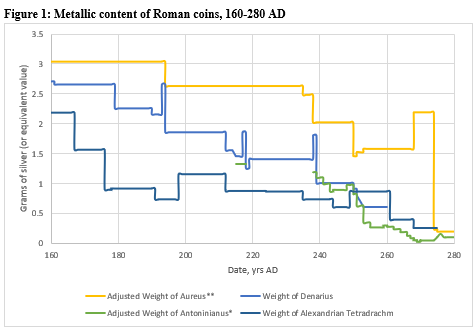
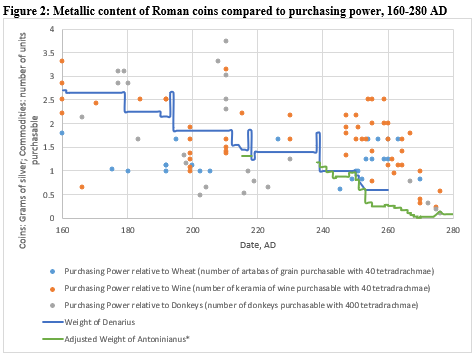
However, I want to focus on one particular inflationary episode that I think receives too little attention as a case study in how value can be robbed from a currency: the 3rd Century AD Roman debasement and inflation. This involved an iterative experiment by Roman emperors in reducing the valuable metal content in their coins, largely driven by the financial needs of the army and countless usurpers, and has some very interesting lessons for leaders facing uncontrollable inflation.

The Ancient Roman Currency

The Romans encountered a system with many currencies, largely based on Greek precedents in weights and measures, and iteratively increased imperial power over hundreds of years by taking over municipal mints and having them create the gold (aureus) and silver (denarius) coins of the emperor (copper/bronze coins were also circulated but had negligible value and less centralization of minting). Minting was intimately related to army leadership, as mints tended to follow armies to the front and the major method of distributing new currency was through payment of the Roman army. Under Nero, the aureus was 99% gold and the denarius was 97% silver, matching the low debasement of eastern/Greek currencies and holding a commodity value roughly commensurate with its value as a currency.

The Crisis of the Third Century

However, a major plague in 160 AD followed by auctions of the imperial seat, major military setbacks, usurpations, loss of gold from mines in Dacia and silver from conquest, and high bread-dole costs drove emperors from 160-274 AD to iterative debase their coinage (by reducing the size and purity of gold coins and by reducing the silver content of coins from 97% to <2%). A major bullion shortage (of both gold and silver) and the demands of the army and imperial maintenance created a situation where a major government with fiscal deficits, huge costs of appeasing the army and urban populace, and diminishing faith in leaders’ abilities drove the governing body to vastly increase the monetary volume. This not only reflects Bernholz’ theories of the causes of hyperinflations but also parallels the high deficits and diminishing public credit of the Maduro regime.

Inflation and debasementFigure 1 for Fiat paper

Unlike modern economies, the Romans did not have paper money, and that meant that to “print” money they had to debase their coins. The question of whether the emperor or his subjects understood the way that coins represented value went beyond the commodity value of the coins has been hotly debated in academic circles, and the debasement of the 3rd century may be the best “test” of whether they understood value as commodity-based or as a representation of social trust in the issuing body and other users of the currency.

Figure 2 for Fiat paper

Given that the silver content of coins decreased by over 95% (gold content decreased slower, at an exchange-adjusted rate shown in Figure 1) from 160-274 AD but inflation over this period was only slightly over 100% (see Figure 2, which shows the prices of wine, wheat, and donkeys in Roman Egypt over that period as attested by papyri). If inflation had followed the commodity value of the coins, it would have been roughly 2,000%, as the coins in 274 had 1/20th of the commodity value of coins in 160 AD. This is a major gap that can only be filled in by some other method of maintaining currency value, namely fiat.

Effectively, a gradual debasement was not followed by insipid ignorance of the reduced silver content (Gresham’s Law continued to influence hoards into the early 3rd Century), but the inflation of prices also did not match the change in commodity value, and in fact lagged behind it for over a century. This shows the influence of market forces (as monetary volume increased, so did prices), but soundly punctures the idea that coins at the time were simply a convenient way to store silver–the value of the coins was in the trust of the emperor and of the community recognition of value in imperial currency. Especially as non-imperial silver and gold currencies disappeared, the emperor no longer had to maintain an equivalence with eastern currencies, and despite enormous military and prestige-related setbacks (including an emperor being captured by the Persians and a single year in which 6 emperors were recognized, sometimes for less than a month), trade within the empire continued without major price shocks following any specific event. This shows that trust in the solvency and currency management by emperors, and trust in merchants and other members of the market to recognize coin values during exchanges, was maintained throughout the Crisis of the Third Century.

Imperial communication through coinage

This idea that fiat and social trust maintained higher-than-commodity-values of coins is bolstered by the fact that coins were a major method of communicating imperial will, trust, and power to subjects. Even as Roman coins began to be rejected in trade with outsiders, legal records from Egypt show that the official values of coins was accepted within the army and bureaucracy (including a 1:25 ratio of aureus-to-denarius value) so long as they depicted an emperor who was not considered a usurper. Amazingly, even after two major portions of the empire split off–the Gallic Empire and the Palmyrene Empire–continued to represent their affiliation with the Roman emperor, including leaders minting coins with their face on one side and the Roman emperor (their foe but the trusted face behind Roman currency) on the other and imitating the symbols and imperial language of Roman coins, through their coins. Despite this, and despite the fact that the Roman coins were more debased (lower commodity value) compared to Gallic ones, the Roman coins tended to be accepted in Gaul but the reverse was not always true.

Interestingly, the aureus, which was used primarily by upper social strata and to pay soldiers, saw far less debasement than the more “common” silver coins (which were so heavily debased that the denarius was replaced with the antoninianus, a coin with barely more silver but that was supposed to be twice as valuable, to maintain the nominal 1:25 gold-to-silver rate). This may show that the army and upper social strata were either suspicious enough of emperors or powerful enough to appease with more “commodity backing.” This differential bimetallist debasing is possibly a singular event in history in the magnitude of difference in nominal vs. commodity value between two interchangeable coins, and it may show that trust in imperial fiat was incomplete and may even have been different across social hierarchies.

Collapse following Reform

In 274 AD, after reconquering both the Gallic and Palmyrene Empire, with an excellent reputation across the empire and in the fourth year of his reign (which was long by 3rd Century standards), the emperor Aurelian recognized that the debasement of his currency was against imperial interests. He decided to double the amount of silver in a new coin to replace the antoninianus, and bumped up the gold content of the aureus. Also, because of the demands of ever-larger bread doles to the urban poor and alongside this reform, Aurelian took far more taxes in kind and far fewer in money. Given that this represented an imperial reform to increase the value of the currency (at least concerning its silver/gold content), shouldn’t it logically lead to a deflation or at least cease the measured inflation over the previous century?

In fact, the opposite occurred. It appears that between 274 AD and 275 AD, under a stable emperor who had brought unity and peace and who had restored some commodity value to the imperial coinage, with a collapse in purchasing power of the currency of over 90% (equivalent to 1,000% inflation) in several months. After a century in which inflation was roughly 3% per year despite debasement (a rate that was unprecedentedly high at the time), the currency simply collapsed in value. How could a currency reform that restricted the monetary volume have such a paradoxical reaction?

Explanation: Social trust and feedback loops

In a paper I published earlier this summer, I argue that this paradoxical collapse is because Aurelian’s reform was a blaring signal from the emperor that he did not trust the fiat value of his own currency. Though he was promising to increase the commodity value of coins, he was also implicitly stating (and explicitly stating by not accepting taxes in coin) that the fiat value that had been maintained throughout the 3rd Century by his predecessors would not be recognized going forward by the imperial bureaucracy in its transactions, thus signalling that for all army payment and other transactions, the social trust in the emperor and in other market members that had undergirded the value of money would now be ignored by the issuing body itself. Once the issuer (and a major market actor) abandoned fiat currency and stated that newly minted coins would have better commodity value than previous coins, the market–rationally–answered by moving quickly toward commodity value of the coins and abandoned the idea of fiat.

Furthermore, not only were taxes taken in kind rather than coin, but there was widespread return to barter as those transacting tried to avoid holding coins as a store of value. This pushed up the velocity of money (as people abandoned it as a store of value and paid higher and higher amounts for commodities to get rid of their currency). The demonetization/return to barter reduced the market size that was transacted in currency, meaning that there were even more coins (mostly aureliani, the new coin, and antoniniani) chasing fewer goods. The high velocity of money, under Quantity Theory of Money, would also contribute to inflation, and the unholy feedback loop of decreasing value causing distrust, which caused demonetization and higher velocity, which led to decreasing value and more distrust in coins as stores of value kept this cycle going until all fiat value was driven out of Roman coinage.

Aftermath

This was followed by Aurelian’s assassination, and there were several monetary collapses from 275 AD forward as successive emperors attempted to recreate the debased/fiat system of their predecessors without success. This continued through the reign of Diocletian, whose major reforms got rid of the previous coinage and included the famous (and famously failed) Edict on Maximum Prices. Inflation continued to be a problem through 312 AD, when Constantine re-instituted commodity-based currencies, largely by seizing the assets of rich competitors and liquidating them to fund his army and public donations. The impact of that sort of private seizure is a topic for another time, but the major lesson of the aftermath is that fiat, once abandoned, is difficult to restore because the very trust on which it was based has been undermined. While later 4th Century emperors managed to again debase without major inflationary consequences, and Byzantine emperors did the same to some extent, the Roman currency was never again divorced from its commodity value and fiat currency would have to wait centuries before the next major experiment.

Lessons for Today?

While this all makes for interesting history, is it relevant to today’s monetary systems? The sophistication of modern markets and communication render some of the signalling discussed above rather archaic and quaint, but the core principles stand:

  1. Fiat currencies are based on social trust in other market actors, but also on the solvency and rule-based systems of the issuing body.
  2. Expansions in monetary volume can lead to inflation, but slow transitions away from commodity value are possible even for a distressed government.
  3. Undermining a currency can have different impacts across social strata and certainly across national borders.
  4. Central abandonment of past promises by an issuer can cause inflationary collapse of their currency through demonetization, increased velocity, and distrust, regardless of intention.
  5. Once rapid inflation begins, it has feedback loops that increase inflation that are hard to stop.

The situation in Venezuela continues to give more lessons to issuing bodies about how to manage hyperinflations, but the major lesson is that those sorts of cycles should be avoided at all costs because of the difficulty in reversing them. Modern governments and independent currency issuers (cryptocurrencies, stablecoins, etc.) should take lessons from the early stages of previous currency trends toward trust and recognition of value, and then how these can be destroyed in a single action against the promised and perceived value of a currency.

Be Our Guest: “Of Monies and Juries and Freedoms”

Be Our Guest is a new, experimental series at NOL. Basically, NOL is invite-only but you can, and should, submit your thoughts to us. The latest piece is by Michalis Trepas, a Greek national working in the financial sector. An excerpt:

The judicial system was reluctant to intervene, out of respect of the separation of powers (according the Weimar Constitution, currency matters were reserved for the parliament). So, at first, the courts upheld the nominalistic principle and refused to accept a revalorisation of debts. But then, something began to change in the courts’ reasoning. The currency’s slide prior to 1921 could be attributed to the conditions of the “war economy”, whose burden was to be shared by everyone in the country. The unrestrained fall thereafter, the courts said, was a monetary phenomenon, punishing “blindly and unpredictably” only the creditor class.

If you cannot guess by now what Michalis is writing about, read on! If you have figured out what the subject of his piece is about, read on, as it only gets more interesting.

There are cultural and geopolitical considerations to think about here, too, in regards to Greece and Germany and financial markets and constitutionalism.