Were Confucians the first internationalists?

Sheng [Hong] uses the term in this broader sense, so that we can say that tianxia zhuyi is the idea of a global civilization that encompasses a diversity of cultures. In fact, this interpretation matches with the historical evolution of the Chinese empire, which was a multiethnic body politic based on certain universal civilizational principles and artifacts such as the Chinese script.

It is essential why Sheng makes that distinction. He claims that globalism, which he considers to be a Western term, is actually violating basic principles of economic liberalism in opting for trade liberalization but containing international migration.

That is from Carsten Herrmann-Pillath, a Professor of Business Economics at the Frankfurt School of Finance and Management, in a chapter titled “Smith, Confucius and the Rise of China.” The chapter is in Volume 8 of The Adam Smith Review, edited by Fonna Forman, which in turn was a gift from Edwin to me. There is no mention of Mises or Hayek (or NOL!) in the bibliography. Herrmann-Pillath continues:

So, globalism is a conceptual framework which still builds on the conception of the nation state and hence economic nationalism […] Ideas about the transition from the ‘nation state’ to a new political order based on culture and civilization continue to flourish among Chinese intellectuals until today. (88)

Unlike Chhay Lin and Matthew, I don’t know very much about ancient or medieval Chinese political thought,  but I can buy Sheng’s argument. In fact, I’m surprised it has taken this long for scholars anywhere in the world to realize that certain schools of thought in an empire would be internationalist. What is more curious to me, though, is this “new political order based on culture and civilization.” Why not base it on the individual? It seems to me that basing political orders on hard-to-define terms like “culture” and “civilization” will only lead to major problems, such as cultural chauvinism, down the road.

An overview of India-China boundary disputes

I have a new paper that has just been published in Asian Affairs. Here is an excerpt:

Questions over the India-China border are not a new phenomenon. They are asked whenever there is a Sino-Indian state visit. Despite having close to $100 billion of trade between them, China and India have failed to bring their frontier disputes to an end. In the 1980s and 1990s it was thought that the increasing economic cooperation between the two countries would act as a prompt to resolve their political disputes, but it has not. Military stand-offs and confrontations between border guards from India and China occur at regular intervals. To address their boundary disputes, they have engaged in frequent dialogues (17 rounds of focused dialogues can be counted between 1988 and 2015), but nothing substantive has yet been yielded through such engagements.

The boundary disputes between India and China have their ultimate origin in the ‘Great Game’ played during the British Empire. At present, the two main areas of dispute along the Himalayan frontier are the western sector (Aksai Chin around 37,250 sq km/14,380 square miles) and the eastern sector (Arunachal Pradesh, around 83,740 sq km/32,330 sq mile). This article traces the roots of the boundary disputes between India and China and attempts to discuss sources of tensions and probable solutions.

The link to the whole paper can be found here [pdf].

“Landscapes of Nationalism” interview

Here is an interview a colleague of mine did with me last month regarding my summer trips, which somewhat are connected by a same thematic thread – on how I stumbled upon incidents of big and small nationalisms. It appeared in our obscure university newsletter with an open access. An excerpt:

When I left Estonia and arrived in St. Petersburg, which is in northern Russia, the first thing I saw, when coming out of the airport, was a large posh car that was passing me. Its windshield was decorated with an orange and black “St. George ribbon”; this ribbon (a symbol of the patron saint of the Russian military) is currently a badge of patriotism for millions of my former compatriots. The back of the car sported big letters in blue: “Onward to Berlin! I honor WWII vets.” The irony of the situation was that the car driven by that well-to-do patriot was a German Mercedes! By the way, the topic of World War II is a “sacred cow” in Russia. From the Soviet times to the present, the government and conservative elements have been constantly bombarding people with two pieces of propaganda. First, they have being arguing that the Soviet Union/Russia had singlehandedly saved the world from fascism. For this reason, the whole world owes them everything. Second, since the country lost in that war more people than any other country, Russians suffered more than anybody else and, again, for this reason, the world owes them. Many people internalized this mythology.

Jews in the West and Jews in the Middle East

Has there ever been a Holocaust in the Middle East?

Pogroms were an annual affair in Russia, and we all know how much Christian Spain loved its Jews. The Holocaust was horrific.

I also realize that anti-Semitism is rampant in the Middle East. Some of this is because of Israel, and some may be because some imams interpret the Koran to be anti-Semitic, but there’s never been any kind of mass murder committed by Muslims against Jews in the Middle East on the scale that has occurred in the West.

Is this because the West was industrialized and therefore had better access to technology with which to kill large amounts of people? Is it because the structure of states in the West made it easier to run roughshod over the liberties of minorities? These are the only two explanations that I can think of that make any sense. The second of the two possibilities seems like an especially weak option, given the amount of carnage post-colonial states have managed to produce (though, in a paradox, it is often minorities that do the killing and oppressing in these post-colonial states, rather than majorities; maybe this helps to explain why there has never been a Holocaust in the Middle East…).

The first possibility is reasonable enough, but since most of the states in the Middle East that are rich enough to “test” this hypothesis have expelled the Jews from their territories, it’s virtually impossible to know.

I am simplifying things here, I realize. I want to give this much more thought (and I have been), but I think that, given the toxic climate in the public sphere concerning Islam, it’s important to point out the obvious.

“Conflicts in South Asia Will Go On and On”

That is the title of my recent article (pdf) on the long-term effects that the British partition of its Indian colony has had on South Asia. Here is the abstract:

This brief article, an extended review of two recent important publications, problematises the continuity of inter-state and intra-state conflicts since the partition of British India in 1947. Territory and identity are the main triggers of those conflicts, many of which will remain, while others will take on new forms relating to resource scarcity, mainly water. Conflicts are unlikely to be settled fully through various interventions, as sub-dimensions will linger on, develop new roots and new issues will constantly crop up. The article argues that past, present and future are visibly and invisibly connected through the fallout of patterns of myth and memory, dissatisfaction with the status quo and present conditions and often completely unrealistic expectations of a better future. Identifying elements of interconnectedness as central, the review assesses the contributions these two new studies make for a deeper understanding of the scenario of continuing conflict within the context of South Asian Studies.

It’s been published by South Asia Research, and is pessimistic throughout…

“We’re all nothing but bags of stories”: Carlos Castaneda as a Countercultural Icon and Budding Post-Modernist

Exploring the countercultural 1960s and the origin of Western New Age, one cannot bypass Carlos Castaneda. He became a celebrity writer because of his bestselling book The Teachings of Don Juan: A Yaqui Way of Knowledge that was published by the University of California Press in 1968. The book was written in a genre of free-style dialogues between a Native American shaman named Don Juan Matus and Castaneda himself, who claimed that he worked with Don Juan for many years. The Teachings describes how Castaneda learned to use three hallucinogenic plants: peyote, jimson weed, and psychedelic mushrooms. After ingesting these substances, Castaneda went through mind transformations and learned that there were other realities besides the ordinary one. Later, it was revealed that he made up the whole experience, but this never affected his popularity.

Carlos-Castaneda-The-Teachings-of-Don-Juan

Of course, a book like this was well-tuned to the then-popular hallucinogenic subculture, and the link between Castaneda’s text and the psychedelic ‘60s is the most common explanation of his popularity. Yet I want to argue that this is a very narrow view, which does not explain why Castaneda’s follow up books, which had nothing to do with psychedelics, continued to enjoy popularity well into the 1990s. In fact, by the early 1980s, Castaneda became so paranoid about hallucinogens that he forced his girlfriend to undergo drug tests before allowing her to sleep with him. I also argue that viewing Castaneda exclusively as one of the spearheads of the New Age does not explain much either. The appeal of his texts went far beyond the New Age. In the 1970s and the 1980s, for example, his books were frequently assigned as conventional course readings in anthropology, philosophy, sociology, religious studies, and humanities classes.

Let me start with some biographical details. Castaneda was born Carlos Arana in Peru to a middle class family and moved to the United States in 1951. He tried to enter the world of art but failed. Then, for a while, he worked as a salesman while simultaneously taking classes in creative writing before eventually enrolling in the anthropology graduate program at UCLA.

Originally Castaneda did not care about hallucinogens and the emerging hippie culture, but eventually UCLA (and the broader California environment), which was saturated at that time with various counterculture and unchurched spirituality projects, made him choose a sexy topic: the use of psychedelics in a tribal setting. The book which made him famous, The Teachings of Don Juan, originated from a course paper on “power plants” and from his follow-up Master’s thesis. I want to stress that both papers were essentially attempts to find a short-cut to satisfy the requirements of his professors. His first professor, an anthropologist, invited those students who wanted to get an automatic “A” to find and interview an authentic Indian. Despite a few random contacts, Castaneda could not produce any consistent narrative, and had to invent his interview. This was the origin of his Don Juan character. Then he followed requirements of his advisor, Harold Garfinkel, a big name in sociology at that time and one of the forerunners of postmodernism. Garfinkel made it explicitly clear to Castaneda that he did not want him to classify and analyze his experiences with Don Juan scientifically.

What Garfinkel wanted was a free-style and detailed description of his work with the indigenous shaman as it was and without any interpretation. Thus it was through collective efforts that Castaneda produced a text that by chance caught the attention of the university press as a potential bestseller. Essentially, Castaneda took to the extreme incentives provided to him by his professors and by the surrounding subculture. He internalized these incentives by composing a fictional text, which he peddled as authentic anthropological research. It is interesting to note that in 1998, just before he died, Castaneda made the following mischievous remark in his introduction to the last anniversary edition of The Teachings of Don Juan: “I dove into my field work so deeply that I am sure that in the end, I disappointed the very people who were sponsoring me.”

The popularity of the first book gave rise to the whole Don Juan sequel, which made Castaneda an anthropology and counterculture star. The combined print run of his books translated in 17 languages reached 28 million copies. And, as I mentioned above, despite the revelations that his Don Juan was a completely fabricated character, the popularity of his books was increasing throughout the 1970s. In fact, to this present day, libraries frequently catalogue his books as non-fiction.

It seems that Castaneda’s appeal had something to do with overall trends in Western culture, which made his text resonate so well with millions of his readers. For this reason, I want to highlight the general ideological relevance of Castaneda’s books for the Western zeitgeist (spirit of the time) at its critical juncture in the 1960s and the 1970s. Various authors who wrote about Castaneda never mentioned this obvious fact, including his most complete biography by French writer Christophe Bourseiller, Carlos Castaneda: La vérité du mensonge (2005). So exploring the ideological relevance of the Don Juan books will be my small contribution to Castanediana.

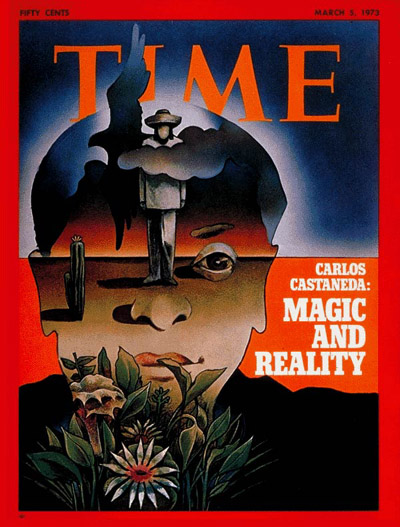
To be specific, I want to point to two themes that go through all his books. First, he hammered in the minds of his readers the message of radical subjectivism, which in our day it is considered by some a conventional wisdom: What we call truth is always socially constructed. Don Juan, who in later books began speaking as a philosophy professor, repeatedly instructed Carlos that so-called reality was a fiction and a projection of our own cultural and individual experiences, and instead of so-called objective reality, we need to talk about multiple realities. In an interview for Time magazine, Castaneda stressed that the key lesson Don Juan taught him was “to understand that the world of common-sense reality is a product of social consensus.” Castaneda also stressed the role of an observer in shaping his or her reality and the significance of text in Western culture. In other words, he was promoting what later became the hallmark of so-called postmodern mindset.

Second, fictional dialogues between the “indigenous man” Don Juan, whom Castaneda portrayed as the vessel of wisdom, and Castaneda, a “stupid Western man,” contained another message: remove your Western blinders and learn from the non-Western ones. Such privileging of non-Western “wisdom” resonated very well with Western intellectuals who felt justified frustration about the hegemony of positivism and Western knowledge in general and who looked for an intellectual antidote to that dominance. By the 1990s, this attitude mutated into what Slavoj Zizek neatly labelled the “multiculturalist’s basic ideological operation,” which now represents one of the ideological pillars of Western welfare-warfare capitalism.

At the end of the 1970s, several critics tried to debunk Castaneda. They were able to prove that his books were the product of creative imagination and intensive readings of anthropological and travel literature. These critics correctly pointed out that Castaneda misrepresented particular indigenous cultures and landscapes. Besides, they stressed that his books were not written in a scientific manner. Ironically, this latter criticism did not find any responsive audiences precisely because social scholarship was moving away from positivism. Moreover, one of these critics, anthropologist Jay Fikes, who wrote a special book exposing Castaneda’s hoax, became a persona non grata in the anthropology field within the United States. Nobody wanted to write a reference for him, and he had to move to Turkey to find an academic position.

What critics like Fikes could not grasp was the fact that the Castaneda texts perfectly fit the emerging post-modernist thinking that was winning over the minds of many Western intellectuals who sought to break away from dominant positivism, rationalism, and grand all-explaining paradigms. To them, an antidote to this was a shift toward the subjective, individual, and spontaneous. The idealization and celebration of non-Western knowledge and non-Western cultures in general, which currently represents a powerful ideological trend in Western Europe and North America, became an important part of this intellectual revolt against the modern world. I am sure all of you know that anthropology authorities such as Clifford Geertz (until recently one of the major gurus of Western humanities), Victor Turner, and Claude Lévi-Strauss were inviting others to view any cultural knowledge as valid and eventually erased the border between literature and science. They also showed that scholarship can be constructed as art. Castaneda critics could not see that his texts only reflected what was already in the air.

Castaneda_Time magazine

The person who heavily affected the “production” of the first Don Juan book, which was Castaneda’s revised Master’s thesis, was the above-mentioned sociologist Garfinkel. As early as the 1950s, Garfinkel came up with ideas that contributed to the formation of the post-modern mind. I am talking here about his ethnomethodology. This school of thought did not see the social world as an objective reality but as something that individuals build and rebuild in their thoughts and actions. Garfinkel argued that what we call truth was individually constructed. Sometimes, he also called this approach “people’s sociology.” He stressed that a scholar should set aside traditional scientific tools and should simply narrate human experiences as they were in all details and spontaneity. Again, today, for many, this line of thinking is conventional wisdom, but in the 1950s and the 1960s it was revolutionary. Incidentally, for Castaneda it took time to figure out what Garfinkel needed from him before he rid his text of the vestiges of “positive science.” To be exact, Castaneda could not completely get rid of this “science” in his first bestselling book. In addition to the free-flowing and easy-to-read spontaneous dialogues with Don Juan, Castaneda attached to the text an appendix; a boring meaningless read that he titled “Structural Analysis.” In his later books, such rudiments of positivism totally disappeared.

When Castaneda was writing his Master’s thesis, Garfinkel made him revise the text three times. The advisor wanted to make sure that Castaneda would relate his spiritual experiences instead of explaining them. Originally, when Castaneda presented to Garfinkel his paper about a peyote session with Don Juan, the text was formatted as a scientific analysis of his own visions. The professor, as Castaneda remembered, rebuked him, “Don’t explain to me. You are nobody. Just give it to me straight and in detail, the way it happened. The richness of detail is the whole story of membership.” Castaneda spent several years revising his thesis and then had to revise it again because Garfinkel did not like that the student slipped into explaining Don Juan psychologically. Trying to be a good student, Castaneda embraced the advice of his senior colleague. So the final product was a beautiful text that was full of dialogues, rich in detail, and, most importantly, came straight from the “field.”

I interviewed some of Castaneda’s classmates and other scholars who became fascinated with his books at the turn of the 1970s. Many of them had no illusions about the authenticity of Don Juan. Still, they argued that the whole message was very much needed at that time. A quote from Douglas Sharon, one of Castaneda’s acquaintance, is illustrative in this regard. In his conversation with me, Sharon stressed:

“In spite of the fact that his work might be a fiction, the approach he was taking—validating the native point of view—was badly needed in anthropology, and, as a matter of fact, I felt it was a helping corrective for the so-called scientific objectivity that we were taking into the field with us.”

I want to mention in conclusion that Castaneda not only promoted the postmodern approach in his novels but also tried to live it. Before the age of Facebook and online forums, Castaneda, with a group of his followers, became involved in an exciting game of identity change. They came to enjoy confusing those around them by blurring and constantly changing their names and life stories. For example, people in his circle shredded their birth certificates and made new ones. They also performed mock wedding ceremonies to make fun of conventional reality. To those who might have had questions about this “post-modernist” game, Castaneda reminded: “We’re all nothing but bags of stories.”

Malthusian pressures (as outcome of rent-seeking)

Nearly a week ago, I intervened in a debate between Anton Howes of King’s College London whose work I have been secretly following  (I say “secretly” because as an alumnus of the London School of Economics, I am not allowed to show respect for someone of King’s College) and Pseudoerasmus (whose identity is unknown but whose posts are always very erudite and of high quality – let’s hope I did not just write that about an alumnus of King’s College). Both bloggers are heavily involved in my first field of interest – economic history.

The debate concerned the “Smithian” counter-effect to “Malthusian pressures”. The latter concept refers to the idea that, absent technological innovation,  population growth will lead to declining per capita as a result of marginally declining returns. The former refers to the advantages of larger populations: economies of scale, more scope for specialization and market integration thanks to density. Now, let me state outright that I think people misunderstand Malthusian pressures and the Smithian counter-effect.

My point of is that both the “Smithian counter-effect” and “Malthusian pressures” are merely symptoms of rent-seeking or coordination failures. In the presence of strong rent-seeking by actors seeking to reduce competition, the Smithian counter-effect wavers and Malthus has the upper hand. Either through de-specialization, thinner of markets, shifting to labor-intensive technologies, market disintegration and lower economies of scale, rent-seeking diminishes the A in a classical Cobb-Douglas function of Total Factor Productivity (Y=AKL). This insight is derived from my reading of the article by Lewis Davis in the Journal of Economic Behavior and Organization which contends that “scale effects” (another name for a slight variant of the “Smithian counter-effect) are determined by transaction costs which are in turn determined by institutions. If institutions tend to favor rent-seeking, they will increase the likelihood of coordination failure. It is only then that coordination failures will lead to “Malthusian pressures” with little “Smithian counter-effect”. Institutions whose rules discourage rent-seeking will allow markets to better coordinate resource use so as to maximize the strength of the “Smithian counter-effect” while minimizing the dismal Malthusian pressures.

In essence, I don’t see the issue as one of demography, but as one of institutions, public choice and governance. I am not alone in seeing it this way (Julian Simon, Jane Jacobs and Ester Boserup have documented this well before I did). Why the divergence?

This is because many individuals misunderstand what “Malthusian pressures” are. In an article I published in the Journal of Population Research, me and Vadim Kufenko summarize the Malthusian model as a “general equilibrium model”. In the long run, there is an equilibrium level of population with a given technological setting. In short-run, however, population responds to variation in real wages. Higher real wages from a “temporary” positive real shock will lead to more babies. However, once the shock fades, population will adapt through two checks: the preventive check and the positive check. The preventive check refers to households delaying family formation. This may be expressed through later marriage ages, planned sexual activities, contraception, longer stays in the parental household and greater spacing between births. The positive check refers to the impact of mortality increasing to force the population back to equilibrium level. These checks return to the long-term equilibrium. Hence, when people think of “Malthusian pressures”, they think of population growth continuing unchecked with scarce ressources. But the “Malthusian model” is basically a general equilibrium model of population under fixed technology. In that model, there are no pressures since the equilibrium rates of births and deaths are constant (at equilibrium).

However, with my viewpoint, the equilibrium levels move frequently as a result of institutional regimes. They determine the level of deaths and births. “Poor” institutions will lead to more frequent coordination failures which may cause, for a time, population to be above equilibrium – forcing an adjustment. “Poor” institutions would also lead to an inability to respond to a change in constraints (i.e. the immediate environment) by being rigid or stuck with path-depedency problems which would also imply the need for an adjustment.  “Good” institutions will allow “the Smithian counter-effect” to intervene through arbitrage across markets to smooth the effect of local shocks, a greater scope for specialization etc.

My best case for illustration is a working paper I have with Vadim Kufenko (University of Hohenheim) and Alex Arsenault Morin (HEC Montréal) where we argue that population pressures as exhibited by the very high levels of infant mortality rates in mid-19th century Quebec were the result of institutional regimes. The system of land tenure for the vast majority of the population of Quebec was “seigneurial” and implied numerous regressive transfers and monopoly rights for landlords. This system was also associated with numerous restrictions on mobility which limited the ability of peasants to defect and move. However, a minority of the population (but a growing one) lived under a different institution which did not impose such restrictions, duties and monopolies. In these areas, infant mortality was considerably lower. We find that, adjusting for land quality and other factors, infant mortality was lower in these areas for most age groups. Hence, we argued that what was long considered as “Malthusian pressures” were in fact “institutional pressures”.

Hence, when I hear people saying that there are problems linked to “growing population”, I hear “because institutions make this a problem” (i.e. rent seeking).

Cave Paintings and Elementary Science

This is a travel story of sorts, of travel through time, to an extent. Be patient.

Directly to the west of Marseille, the second largest city in France are a series of beautiful, narrow coves, like fjords, situated in a sort of desert. They are called “calanques” in French. They are accessible only by sea or through a long walk on hot rocky ground. Although they constitute a separate world, the calanques are close to Marseille, as the crow flies. They used to be a major fishing resource for the city. You can be sure they were never forgotten during the 2600 years of the city’s existence. Also, the city was founded by Greeks and thus, it always had a literate population, one that kept records.

Marseille and its environs are where SCUBA was invented, the first practical solution to the problem of men breathing underwater. Accordingly, the calanques were always and thoroughly explored after 1950. In 1985, one of the co-inventors of SCUBA discovered a deep cave in one of the calanques. He couldn’t resist temptation and swam into it until he reached a large emerging room. I mean a cave where he could stand and breathe regular air. His name was Cosquer.

Cosquer visited there several times without saying a word about his discovery. Soon, he observed dozens of beautiful paintings belonging to two distinct periods on the upper walls of his cave. The art of the first period was mostly hand imprints or stencils. The art of the second, distinct period, comprised 170-plus beautiful animals including many horses, ibex and others mammals, also fish, seals and other sea creatures. Archaeologists think the painting of the first period were done about in about 25 000 BC, those of the latter period date back to about 18 000 BC, they believe.

Today, the entrance to the cave is about 125 feet below sea level. We know that paleolithic men did not have SCUBA. They simply walked into the cave for their own reasons, with their own purposes in mind. Thus, the sea level was at least 125 feet lower then than it is today. The people of Marseille never saw the cave. They would have written about it. There would be records. They would not have forgotten it. They simply did not know of its existence during the past 2600 years.

Sometimes in the past 20 000 years, the sea rose 125 feet or more. That’s an amplitude several times greater than any of the direst predictions of the official United Nations Intergovernmental Panel on Climate Change for the next century. The IPCC squarely blames a future ocean rise (one that has not been observed at all, yet) on abnormal emission of several gases, especially CO2 . These abnormal emissions in turn, the IPCC affirms are traceable to human activities such as driving cars and producing many useful things by burning fossil fuels.

It seems to me that basic good science requires that causal analysis begin with a baseline. In this case, it would mean something like this: In the absence of any burning of fossil fuels, the ocean rose 125 feet sometimes during the past 20,000 years. Let’s see if we can find evidence of the ocean rising above and beyond this order of magnitude since humanity began burning fossil fuels in large quantities, about 150 years ago.

The conclusion will likely be that nothing out of the ordinary happened. Hence, fossil fuel emissions are probably irrelevant to this particular issue. (This leaves open the possibility that such emissions are odious for some other reason. I mean that CO2 is plant food. Too much CO2 may promote weed growth in our fields and gardens. )

The ocean is not currently rising and if it is, the existence of the Cosquer cave suggests that it’s rising to a tiny degree. Let’s keep things in perspective. Let’s discard openly and loudly every part of the building of a complex hypothesis that does not work. Those who don’t take these obvious cleansing measures simply have a lot of explaining to do. They should not be allowed to wrap themselves in the mantle of science while violating Science 101 principles.

One of the conceits of the Warmist movement is that you don’t have a right to an opinion unless you possess a doctorate in Atmospheric science. By this dictate, anybody who has to keep a job, raise children, or pay a mortgage is out of the discussion. This is the typical posturing of intellectual totalitarianism. Note what’s missing in the story above: It says nothing about what did cause the ocean to rise between 18 000 B. C. and today. It’s enough to know that whatever it was, it was not the massive burning of fossil fuels. The story is complete as is. Don’t quit your job and apply to graduate school!

An update from Memphis (Russo-Baltic edition)

Dr Znamenski (bio, posts) sent me an email updating me on his recent shenanigans:

I also appreciate your remark that we need to reach out to other libertarian-leaning people rather than singing to only a libertarian chorus. Even though I am notorious for not contributing to NOL, I devoted this summer to reach out to liberty-minded people in Europe by going to St. Petersburg, Russia, and delivering there a public talk (in Russian) on “Heroics of the New Deal and Its Critics” at a downtown hotel and afterwards I met with the audience for a free-style interactive talk on current challenges to individual liberty. Then I proceeded to Tallinn, Estonia, where I met a group of Estonian libertarians and delivered a talk (in English) on geopolitical imagination of Russian nationalism (used current Alaska-related Russian patriotic rhetoric as an example). Then proceeded back to Russia, where at Samara University again I gave a talk on the mythology of FDR and New Deal Keynesianism and how it was appropriated in 2003-2008 by the Putin regime that was building the “vertical” of its power. My argument was that politico-economic regime whose “validity” was “scientifically” proven by Keynes in 1936 by now became a kind of a fetish that is associated with a good government. Hence, the “Heroics of the New Deal” title. The Estonian visit was especially pleasant and inspiring.

I also met an informal leader of Estonian libertarians […] Very productive and charismatic guy. I need to navigate him to you and to NOL, which will greatly benefit from his contributions (if any). His English is impeccable too. See his picture attached to this letter (they have Mises Institute of Estonia) in addition to a few other images from Estonia (the country where all paper work exists only in electronic form and a flat tax return occupies only one page!). The country [Estonia] was the first in Europe to introduce universal flat tax (1994), which replaced three tax rates on personal income and one on corporate profits. The flat tax rate was on 26%, which later was reduced to 20%. Several countries of Europe followed the suit and benefited from this. Very simple system, which helped this tiny backwater country of 1 million plus something people to dramatically raise its well-being. To their frustration, even Russian nationalists, who remain quite influential in Estonia due to the presence of a large Russian minority, have little economic discontent among Russians to chew on. The latter simply compare their economic situation in their historical homeland where average salary is $500 and Estonia where this salary is $1150.

Dr Znamenski has some excellent ideas brewing (on US-Russian relations in the Arctic, Crimean secession, and Foucault), and hopefully he can find the time to post them in the very near future. Notice, too, that Dr Znamenski refers to Russians as Europeans (or, at least, considers St Petersburg to be European). A small observation, I know, but one that I suspect has big sociological implications. Check out these pictures he sent me:

This is the Estonian libertarian Dr Znamenski mentions above. I hope to someday meet him.
This is a photo from the Museum of the 20th century in Tallinn (the capital city of Estonia).
This is my favorite picture. It’s a view of Tallinn with a curious visitor, and highlights Dr Znamenski’s sense of humor, which I greatly appreciate.

Myths of Sovereignty and British Isolation, 20. Concluding Remarks

This series (1, 2, 3, 4, 5, 6, 7, 8, 9, 10, 11, 12, 13, 14, 15, 16i, 16.ii17, 18, 19) has explored a number of ways in which those who support a very sovereign United Kingdom completely separate from the European Union, and even other European institutions like the European Court for Human Rights, which is attached to the Council of Europe rather than the European Union, are attached to unsupportable ideas about the separateness and superiority of England, Britain or the UK.

What Britain’s past was does not prove anything about where it should be now with regard to European institutions, but it is at least possible to say that claims according to which Britain has always stood apart from Europe are false, and so is any connected claim that Britain is somehow fated by history, geography and national character to stand aside from arrangements made by European nations to share sovereignty.

Britain was connected to the rest of Europe through Celtic culture and language, then through the Roman Empire, then through the Saxon conquest, then partial Viking conquest, then Norman-French conquest, then ties with the Netherlands, then a union in the person of the joint monarch with the Netherlands, then a union in the person of a series of kings with Hanover in Germany, then through constant British intervention in European affairs, land holdings which go back to the Channel Islands (originally French), the remains of which still exist in Gibraltar and sovereign military bases in Cyprus, then through postwar European institutions like the Council of Europe (which loosely groups all democracies, broadly defined) and then the European Union.

The peoples of the United Kingdom of Great Britain are rather less firmly committed to maintaining the existing state than the peoples of France and Germany are, the two European nations usually taken by British Eurosceptics as the negative opposite of Britain in all its glory. There is a distinct possibility that Scotland will leave, with strong separatist tendencies in Northern Ireland and to a lesser but real extent in Wales. So Britain is not uniquely well formed and self-confident as a nation.

As with all other nations, Britain was built through war, state appropriation and the enforcement of a national state system. It is not a country of unique liberty, neither does the Anglosphere of UK, USA, Canada, Australia and New Zealand exist as a uniquely coherent transnational grouping based on medieval and early modern English institutions. The Anglosphere countries are diverse, with different historical experiences, with Britain as the odd one out in the sense that all the other Anglosphere countries are still dealing with the status of indigenous peoples who lived there before the relatively recent history of the Anglosphere states.

Other European states have links with ex-colonies, where the language of the colonial power is still widely spoken. More French people live in Britain than those from the Anglosphere (300 000 versus 191 000). Links with the Anglosphere are certainly quite real and exist quite happily alongside EU membership, so the whole idea of making the Anglosphere something that excludes a European path is misleading in any case.

The historical interpretations referred to in this and previous posts are not contentious. No educated and fastidious sovereigntist-Eurosceptic is going to deny them, the trouble is that a lot of less fastidious sovereigntist-Eurosceptic assumptions about history are not in happy accord with these historical realities, and even the more fastidious are trying to emphasise an unrealistic counter-narrative of British distinctness that goes beyond the normal level of distinctness between major nations. Britain has certainly made its contribution to the history of liberty, civil and commercial society, but is not obviously more blessed in these respects than the other most advanced European nations.

The case against the United Kingdom’s participation in the European Union can only be the case against the existence of a transnational political union for any large grouping of European nations. There are problems with the EU and I can agree with many sovereigntist-Eurosceptics on many of these problems, but if we reject the more myth making kinds of nationalism these are problems I suggest that can be addressed with better, more decentralised and flexible institutional arrangements. India, which has a greater population than the EU, and at least as much diversity of language and other aspects of human life survives.

It is of course difficult to know what Europe would look like without the EU and what good things in Europe are due to the EU, but I suggest that it is not a complete coincidence that the period of the EU has been a time of growing democracy and peace, with many countries taking EU membership as part of the path from dictatorship to democracy. The Euro crisis and the more recent Mediterranean refugee crisis are bringing strain to the EU, but that is what happens to political communities, they encounter problems and survive them if they have robust institutions. The economic problems of southern Europe precede the EU and tensions round migration exist in other parts of the world. Britain has anyway remained aside from the Euro, as have Sweden and Denmark, suggesting that the EU can accommodate flexibility and allow member states with doubts about the most ambitious schemes to stand aside from them. This is certainly the path to go down if the EU is to be a robust political community.

The basic point in this series has been that nothing makes British history separate from European history, so that questions about membership of a European political community which pools sovereignty are not answered by looking to a supposed distinct and superior history. Britain is part of Europe and always has been and has frequently shared sovereignty in some way with some mainland European state. Past history does not exclude Britain from Europe and trans-national European institutions, which may or may not be appropriate for Britain and other countries, for reasons in the here and now. As far as history determines Britain’s place, the appropriate place is Europe.

Myths of Sovereignty and British Isolation XIX, Charters and Constitutions

The last post discussed the historical role of law. This post finally delivers the promise to discuss constitutions and charters. The sovereigntist Eurosceptic position in Britain standardly includes an elevation of Magna Carta into the greatest document ever in human liberty or, in more moderate versions of this position, certainly the greatest since it was issued in 1215 and the fount of all worthwhile liberties ever since: blessing Britain and countries which might be considered off shoots, like the USA, Canada, Australia and New Zealand (the ‘Anglosphere’), with a unique appreciation of liberty and parliamentary democracy.

While Magna Carta is of course a remarkable document and the moment it was issued was a remarkable historical moment, these claims are a distortion. It was a Latin document issued under duress during civil war conditions, the duress applied to the king by barons, at a time when the the English aristocracy and monarchy was distinguished from the great body of English by use of the French language and holdings in France.

Magna Carta has nothing to do with parliamentary democracy, it refers to a council of 25 which barons might form if they found the king to be misbehaving, and does not refer to a standing representative body but rather something more like a right of insurrection against a ‘tyrannical’ monarch. This has no more to do with parliamentary democracy than a variety of councils and assemblies existing across Europe at this time, and rather less than some.

Though Magna Carta is dressed up in the language of reasserting traditional rights, this does not make it the expression of a distinctly English or British love of rights based in tradition rather than innovation as the sovereigntists standardly claim. All demands for rights across Europe were expressed in that way at that time, and for centuries before and centuries after. The French Revolution itself started as a demand for ‘restoration’ of rights. The language of restoration is of course frequently a cover for innovation, an attempt to justify innovation by denying what it is.

Magna Carta was the innovatory product of political struggle, not the writing down of the unchanging liberties of old England. The same goes for the struggles for parliamentary power in the seventeenth century which frequently took on the deceptive form of ‘restoration’ of a Magna Carta which was already supposedly a restoration. It is even more fantastical to see the US Constitution as the outcome of Magna Carta, which does not stop many Anglosphere sovereigntist Eurosceptics doing so.

The history, or histories of liberty, is the accumulation of many interacting events, charters and theories in many countries. The growth of British parliamentary power took place in that context as did the US constitution and the Declarations of the Rights of Man and Citizen, which took place during the French Revolution. Like the French Declarations, Magna Carta exists in different versions so there is no pure origin text of liberty in either place. Rival French and Anglosphere attempts to proclaim the priority of either are particularly absurd. These are documents separated by hundreds of years and many other factors.

We cannot imagine modern liberty without either source, though both sources are flawed and open to challenge. The last thing thought and politics based on liberty needs is some sacred unchallengeable text as foundation, inevitably distorting understanding of the varied contexts and sources of liberty, and inevitably distorting our understanding of how ‘sacred’ documents had a source in power politics and political economy. There is no immaculate liberty born outside of struggles over power and appropriation of wealth.

The writing down of liberties in a legal document itself, particularly one that has a special, difficult-to-overturn foundational status, places some constraint on liberty, on how some people now and even more in the future might have some different ideas about liberty and see the earlier document as constraining.

It is certainly the case that a strongly entrenched document like the US Constitution deprives later generations of the liberty to re-imagine liberty and it is certainly the case that such a Constitution conflicts with the common law tradition exalted by British sovereigntist-Eurosceptics, according to which law progresses through the way judges build gradually on earlier cases to interpret statutes and formulate principles of justice.

Clearly a strongly entrenched Constitution with a Bill of Rights added does not come from common law, though it may try to capture some of the principles supposed to be widespread in common law, and must heavily constrain common law judges. The idea of a Constitution standing above politics, constraining it according to pure justice, has at least in the United States made the membership of the Supreme Court and its decisions a matter of constant political contention.

No attempt at a system of liberty can avoid tensions between different sources and understanding of liberty. Unfortunately the Eurosceptic-sovereigntist position largely tends to overlook this, or like someone looking at the Sun, cannot have it directly in its gaze without serious damage. The elevation of common law tradition, Magna Carta, and parliamentary democracy is the elevation of different things which in some sense must always be part of liberty, thinking of the general principles of judicial independence, institutional harmony, and representative government. However, as they conflict there can be no perfect version and no reason to think English, British or Anglosphere solutions can be regarded as above all others and with nothing to learn from the law-governed democracies of mainland Europe.

Next week, the end, a final summary.

Myths of Sovereignty and British Isolation XVIII: Laws, Juridification and the Administrative State

The last post focused on the distinction between civil and common law, with regard to Britain’s position as a common law country in contrast with the civil law tradition of the rest of Europe. The promise at the end was to move onto laws, charters, and constitutions in this post. However, I have found it necessary to discuss the idealisation of common law further and look at how a large part of this looks back to a world which is lost, regardless of predominant legal system as societies have roughly speaking moved from customary law to ‘juridification’ (state centred comprehensive law penetrating all social relations), and then the world we live in now of the administrative state.

The British sovereigntist and Eurosceptic position tends to emphasise a supposed unique British exception from the statist rationalism of civil law, in the ‘common sense’ of the accumulation of law arising from judicial precedent in the decisions of judges in previous cases. This supposedly British exception looks rather challenged when we consider the thoughts of the influential German philosopher Hans-Georg Gadamer in his 1960 book Truth and Method. Gadamer refers to French rationalist Enlightenment in contrast with a German form of Enlightenment based on the original understanding of ‘prejudice’.

Prejudice, in Gadamer’s account, did not begin as a negative term for the constraints of false assumptions, but in a legal process in which the court forms a preliminary opinion in an early stage of proceedings. For Gadamer this represents the continuity of custom and the communal sense of justice in contrast to abstract rationalism. What he describes is not the same as the common law tradition, but represents another way in which the apparent underlying advantages of common law can appear in another system.

The idealisation of common law is really a claim to prolong the role of custom in law into the age of state statutes and deliberately constructed legal codes. Not that an age can be identified in which pure custom operated and no state created laws existed. It can be said that laws used to be less in number and articulated in terms of defending the wisdom of ancestors as part of a generally shared sense of justice.

However, the destruction of such a world, which depends on accepting fictions about the harmonious origin of laws outside the interests of power, was not from the triumph of civil law. The heroic moments of civil law in the process that leads from 1789 French Revolution through constitutional monarchy, republic, and Bonapartist autocracy, are the product of the decay of traditional societies in which localised and regionalised kinds of authority operated in ways which mixed statute and customary law, and where even in conditions of political autocracy the state ruled over either a very small community unified by common experience, or larger units which aggregated such communities rather than enforcing a very uniform and unitary form of sovereignty back by a hierarchical bureaucratic-military state machine.

There were of course elements of the latter, as in the eleventh century Norman Conquest of England, but even this established only a minute state machine by modern standards, which recognised the ‘privileges’ and ‘liberties’ of the City of London, the church, the barons, and so on. The idea of civil law is generally traced back to Rome, bracketed by the Twelve Tables of fifth century BCE Rome and the Corpus Juris of Civilis (often identified with the Institutes which form just one part of it) Justinian promulgated in the New Rome of Constantinople in the sixth century CE.

This civil law prevailed in Roman Britain for four centuries as it did from the Rhine to the Euphrates. The Roman world, including the Greek empire governed from Constantinople, that emerged in the sixth century, was nevertheless a world of localised traditional authority in which central state institutions were more like connecting threads rather than an all inclusive structure.

The Middle Ages saw a process of juridification, as Roman law continued in the church and was revived for the state, in which the uniform administration of justice became strong enough for a system of dominating unifying state military-bureaucratic power to emerge underneath sovereignty that was beginning to become more distinct from the person of a king (or occasionally the persons of an aristocratic assembly).

All European states went through a process, which has been implemented elsewhere, leading to what is now known as an administered society, administrative state, biopower, and all the other terms referring to the inclusive, comprehensive and unifying power of state law and state bureaucracy in relation to society. This was simultaneous with the development of capitalism as a dominant economic system working through unified national markets and trade between states.

A lot of what is said about the difference between common law and civil law represents a wish to return as far as possible to go back to a time before administered societies and even before juridification. There is no time at which law was purely traditional and consensual and no current possibility of even approaching that ideal. Concerns about the administered-juridified society have to be addressed with that world.

The common law tradition might or might not on average be better than the civil law tradition from that point of view, but common law is not what its strongest defenders wish it was and it is not obvious that civil law states in northern Europe including Switzerland, the Netherlands and Denmark, and in a slightly more qualified but real way, Germany are doing worse for liberty and prosperity than the English speaking common law countries. France, the homeland of modern civil law, is itself not doing at all badly compared with most countries in the world as it is and certainly in terms of human history.

For the next post the intention is to finally get onto charters and constitutions.

Myths of Sovereignty and British Isolation XVII: Common and Civil Law

The last post referred to the need to investigate ideas about law and related ideas in discussing Britain’s relation both with the Anglosphere (USA, Canada, Australia, New Zealand) and with the rest of Europe. The big issue here is Anglosphere common law tradition versus Roman or civil law tradition in the European mainland and indeed most of the world outside the Anglosphere. Common law in this context refers to judge-made law based on precedent versus civil law referring to statute laws based on the will of the sovereign. Statute laws are laws instituted by the state, in writing, in public explicit acts of law making.

Judge-made laws based on precedent refers to the ways in which judges, using a general sense of justice, make judgements according to that sense of justice with the precedents of previous relevant judgements shaping the sense of justice along with the whole set of laws and their general principles. Civil law judges look at the text of statutes, as do common law judges, but apparently the latter category of judges are also concerned with the mixture of precedents and general spirit of the laws.

There are certainly some real differences between common law and civil law traditions, but how straight forward are these difference? The phrase ‘common law’ itself comes from the codification and national harmonisation of laws undertaken by French-speaking kings of England, after William, Duke of Normandy, conquered England. So the phrase ‘common law’ itself refers to the opposite of what common law has come to mean: the English legal tradition since the High Middle Ages has come out of conquest by an external power. We can argue about how far Anglo-Saxon laws and judicial formalities survived the Norman and Angevin re-codification, but there is no denying that the re-codification happened and that nothing now survives from the Anglo-Saxon era.

England started off in the earlier Middle Ages where all of post-Roman Europe stood, that is Roman law had collapsed and Germanic tribes introduced their own laws in conquered territories, where some elements of Roman law survived in the canon law of the church. The Roman law system itself reached a peak with the final codification undertaken under the Emperor Justinian in Constantinople during the sixth century. The transformation of the eastern part of the Roman Empire into a Greek empire included a decline in knowledge of Latin so understanding of the definitive law text was limited, but survived in the Empire including the last Roman-‘Byzantine’ holdings in Italy.

Knowledge of Roman law increased in the thirteenth century, in association with the growth of new universities where legal education played a very large role. England was not outside this process, but it is fair to say that it was less influenced by it than some continental powers, particularly France. The process of Revolution and Bonapartist rule, from 1789, produced a large scale deliberate construction of law as a unified system based on the will of the sovereign (whether elected assembly or absolute monarch) with regard to the laws, which was exported to other parts of Europe in the Revolutionary and Napoleonic wars.

The British commitment to common law was not entirely consistent since Scotland has always retained some differences from England in its legal system, which place it closer to the civil law tradition, at least compared with England. In the United States, there was a parallel to the French republican and Bonapartist experience of redesigned institutions in the process of adopting first the Articles of Confederation and then the Constitution of the United States, which unified the thirteen British colonies in a common structure.

The difference between French and American constitution making is often held to be that the French constitutions claimed that laws are the will of the people and the product of nature, while the American constitution is designed to disperse any idea of a single political law-making will between the different branches of federal government and the ‘several states’. However, the preamble to the US Constitution refers to ‘we the people’ and therefore asserts that it is the product of a single political will of the people in the union.

While the US Constitution does not refer directly to good laws as the work of nature, there were shared underlying assumptions in France and the US concerning the ‘natural’ status of good laws, good political institutions, and justice. It is at least true that the US constitution federalises rather than centralises, while the French process of about the same time ended in a very centralised state. This cannot be the difference between common and civil law systems though, since there are federal civil law states like Germany and Switzerland and unitary common law states like the UK and New Zealand, though the UK has been evolving in a more federal direction, if in a rather ad hoc and limited way, since the turn of the century.

Next, laws, charters and constitutions

Myths of Sovereignty and British Isolation XVI, Britain’s Significant Others: France and Germany (2)

Continuing from here.

The French, or at least the dominant part of its elites, together with a more ambiguous but largely assenting public opinion, sees the chance to maintain a large European role and an accompanying global role through the EU, using the EU to maintain the importance of French as an administrative language and the influence of France on European affairs without war, and ideally without aggressive winner-takes-all attitudes to diplomacy. It is a matter of reasonable debate whether this has worked well, it is not reasonable to think that France has given up on being France.

There is a strong steak of grandiose French ambition and memories of the more universal moments of the French state, under Bourbon monarchs who tried to dominate Europe, the French Revolution, and the Bonapartist Empire. Despite what some sovereigntist-Euroseptics claim, France is not obviously less global than Britain in its history or current attitudes. France had the second biggest overseas empire after Britain, there are many French speakers outside France, even though some parts of what was the empire have lost the Francophone legacy. France is just as much of a country of immigration as Britain.

The residual overseas territories from the empire are more integrated into the French state then the British equivalents are integrated into the British state. Of course Britain had the bigger empire, English is the more global language, and a global financial role lacking for France, but none of this makes France less of a country to some degree tied to its non-European legacies, or that France is less integrated and less nationally-oriented than Britain. In fact France looks a lot less likely to break up between component parts than Britain. The devolution of power to Scotland, Wales, and Northern Ireland is not matched in even the most distinct French regions and there seems little chance of any part of France matching Scotland in the success of a separatist party and near success of a separatist referendum.

The same applies to Germany. Germany has a briefer history as an important country of self-image construction for Britain than France, but the sense that Britain is more liberal than the Prussian-German state tradition and more patriotic than current federal Germany is a major factor in Britain. The sense that Germany has a less strong sense of national identity combines for British Eurosceptics, or alternates, with the sense that it is trying to dominate Europe.

There is no doubt that Germany has a more traumatic relation with its recent history than Britain, and that it is the leading country in the EU. Nevertheless, there is no sign at all of bits of Germany seceding, while there is every sign that German state rebirth through democracy and European identity has been a great success. The relations of Germany with the rest of the EU is a rather large question, but it is worth remarking here that most of the supposed German dominance and domineering attitudes in the EU is a mask for the hopes of other EU countries, on the French model, to improve themselves through:

  • institutional influence on Germany;
  • importing German fiscal discipline and associated economic successes through a common currency;
  • a willingness to put the burden of blame on Germany for tough policies resulting from the imbalances that emerged as a result of excessively low interest rates in the less robust Eurozone economies;
  • a preference for related ‘externally imposed’ German influenced reforms over exit from the EU and a reassertion of strong national sovereignty.

At the heart of these choices is the belief that Germany is too big to ignore and that where states have had difficulty in economic reform, institutional constraints designed in the hope of importing German economic success, within a system of pooled sovereignty, offer more hope of economic success than supposedly pure national sovereignty. This may or may not work for the best in the long term, but it is not an example of German aggression; and given that no one state has genuinely pure and absolute sovereignty, no one state can exist unrestrained by the attitudes of other nations and the international consequences of its own policies, so pooling of sovereignty with Germany should not be seen as unpatriotic countries surrendering an unvalued national existence.

Anyway, the sovereigntist-Eurosceptics who put forward, or rely on, the dangerous German domination claim, are themselves generally oriented towards an Anglosphere conception of an alliance between the UK, the USA, Canada, New Zealand, and Australia. This can draw on the enhanced levels of intelligence and security co-operation between these countries, along with the ‘Special Relationship’ between the UK and the USA that developed during the Second World War. The obvious issue here from a sovereigntist point of view is that the USA is very dominant in this relationship, whether that of the Anglosphere or of the ‘special relationship’. The language of the ‘special relationship’ has declined anyway in the UK, particularly since the invasion and occupation of Iraq. The reality has always been in any case that the USA has pursued close relationships with countries outside the Anglosphere with little if any common decision making in the ‘Anglosphere’. The Anglsophere idea also refers to ideas about law, which will be discussed in the next post.

Myths of Sovereignty and British Isolation XVI, Britain’s Significant Others: France and Germany (1)

Moving on from the narrative of British history concluded in the last post, some thoughts about the way that Britain has existed as a European nation in comparison with other nations, mostly Germany and France. Britain has been defining itself in comparison with these two, in more or less friendly ways since Germany emerged as a modern unified state in 1871. The comparisons with France go back further, as has been partly explored in the narrative posts from Æthelred II’s (the Unready) marriage to a French princess to the Tudor loss of Calais.

The attitude to Germany has been coloured by the pre-1870 Prussian monarchy which became the imperial family of Germany, while retaining the Prussian royal title, in 1871. Even the Prussian monarchy, though, is new compared with the French state. The Prussian kingdom only goes back to 1701, as an elevated form of the Margravate of Brandenburg in which the Hohenzollern family had been the Margraves since 1415, and even that is rather recent compared with the beginning of the history of France. Anyway, we cannot think of Brandenburg-Prussia as a pre-formation of the German state until the early nineteenth century when it took lands on the Rhineland and emerged as the joint leading power in Germany, along, with Austria, after the European  settlement at the end of the Napoleonic wars.

It is not entirely clear when we can date the beginning of the French state, since the earliest form, or preformation, of it was the Frankish kings who became rulers of some part of what is now France in the fifth century with the collapse of Roman rule in what had been Gaul. The Franks were German and the sense that the aristocracy of France had a different national origin from the common people lingered into the nineteenth century. It is only in the ninth century that Old French emerges as a written language of state business while the title of King of the Franks was separated from that of the dominant ruler of Germany, holding the title of Emperor of the Romans since the Frankish king Charlemagne was crowned by the Pope in 800.

The official title King of France only stated to replace King of the Franks in the late twelfth century, but it is safe to say that something like a swell defined the French state with a very broadly defined sense of shared culture between king and French speaking subjects goes back to the ninth century, after a preformation going back to the fifth century. Of course it should be remembered in relation to that it was only in the nineteenth century that a shared mass competence in the French of Paris prevailed across France including communities which were historically Basque, Flemish, Breton, German, Italian and Occitan (southern versions of French including Povençal), though a linguistic unity of the educated goes back much further.

One aspect of the sketches of French and German history above, is that the history of the dominant power in western Europe is often the history of France and Germany in various sometimes overlapping forms. This continues into the European Union which is at its heart a Franco-German union and that can be seen in the Euro which comes out of the French belief that it could import German economic success and discipline through a common currency, as well as the belief that it could mitigate German influence in Europe after post-Cold War unification though a shared monetary mechanism. One problem with British membership, maybe the most important, is a lack of interest in the French and German belief in a shared destiny best managed by some pooled sovereignty in a unified Europe, largely if not entirely consisting of countries strongly influenced in their history by contacts with France and Germany.

The most important issue in this post, though, is that France has a history as old and as grandiose as that of Britain, in fact preceding the unified British state history of England and Scotland only going back to 1603. The reason for emphasising this is the British sovereigntist-Eurosceptic tendency to regard France, like all European nations other than Britain in their view, as somehow less proud of their nationality, less patriotic, and less real as nations than Britain.

Really this is preposterous nonsense, and it should not be said that all British eurosceptics hold to this view, but it is hard to imagine the Eurosceptic current existing in Britain without this aspect of its culture, and hard to imagine even many of the more fastidious Eurosceptics do not believe this in their guts. The apparent willingness of France to share sovereignty with Germany in the EU even when Germany has become clearly the dominant EU country may to some degree explain this, but does not justify it.

More on this in the next post