England circa 1700: low-wage or high-wage

A few months ago, I discussed the work of my friend (and fellow LSE graduate) Judy Stephenson on the “high-wage economy” of England during the 18th century. The high-wage argument basically states that high wages relative to capital incite management to find new techniques of production and that, as a result, the industrial revolution could be initiated. Its a crude summary (I am not doing it justice here), but its roughly accurate.

In her work, Judy basically indicated that the “high-wage economy” observed in the data was a statistical artifact. The wage rates historians have been using are not wage rates, they’re contract rates that include an overhead for contractors who hired the works. The wage rates were below the contract rates in an amplitude sufficient to damage the high-wage narrative.

A few days ago, Jane Humphries (who has been a great inspiration for Judy and whose work I have been discretely following for years) and Jacob Weisdorf came out with a new working paper on the issue that have reinforced my skepticism of the wages regarding England. A crude summary of Humphries and Weisdorf’s paper goes as such: preindustrial labor markets had search costs, workers were willing to sacrifice on the daily wage rate (lower w) in order to obtain steady employment (greater L) and thus the proper variable of interest is the wage paid on annual contracts.

While their results do not affect England’s relative position (it only affects the trend of living standards in England), it shows that there are flaws in the data. These flaws should give us pause before proposing a strong theory like the “high-wage economy” argument. Taken together, the work of Stephenson (whom I am told is officially forthcoming), Humphries and Weisdorf show the importance of doing data work as the new data may overturn some key pieces of research (maybe, I am not sure, there is some stuff worth testing).

Adios a Fidel

It was so romantic when those truckfuls of young men with beards took over the cesspool of Havana on New Year’s Eve (a scene immortalized in The Godfather Two). They were bringing freedom and relief from poverty to the beleaguered people of Cuba who had suffered under American imperialism for more than sixty years.

When his main acolyte was through shooting a few hundred political opponents – which took weeks – the business of revolutionary construction began in earnest. Soon, the Revolution had to face an invasion from disgruntled sons of the exiled Cuban upper-class. The invasion was roundly betrayed by the fabled Pres. John F. Kennedy. After that, the Revolution found extravagant financial support from the Soviet Union, a poor country itself but a large one.

Later, the leader of the Cuban Revolution tried to get the US nuked by his big Russian brother. That cool leader must have had his reasons, I am sure.

The stubbornness of opponents (“worms”) was so great that the Revolution was forced to jail a few thousand of them, including poets (along with thousands of men whose crime was homosexuality). Other obdurate traitors to the Revolution left Cuba on balsa rafts and on rafts made with old barrels. Many drowned at sea. Their choice! After a while, one Cuban in five was living abroad, away from the workers’ paradise.

The Revolution triumphed in the fields of education and public health. Nowadays, Cubans’ level of literacy is a high as that of other Latin American countries. Although it’s not really free, the Cuban public health service is pretty good, what with its separate public-public sector and its sector for Communist Party members only, the two equal to each other, of course.

When the first leader became too old, somehow, the best revolutionary found to succeed him was his little brother, as happened in other people’s democracies such as North Korea.

In the meantime, there had been several military adventures, all in tropical countries where even ordinary Cuban privates could afford bananas for once. That they did not win anywhere was not their fault. One prominent general even had to be shot by the leadership because he was dealing drugs. His trial lasted a whole week.

Today, after fifty years, progress is so great that ordinary Cubans easily earn forty or fifty dollars a month. Many earn three times more by renting their bedroom to foreign visitors. Take university professors and medical doctors. They can always make much more than fifty a month by driving a taxi. And meat is now available six days a month instead of the customary four. You can’t argue with this!

As Westerners, we must be especially grateful that the Cuban Revolution has made the island into one of the best destinations for sex tourism in the world.

Yes, Fidel was really, really cool and we will all miss him. He was our youth. He embarked on a great experiment in human happiness. That it failed is not his fault at all. Nobody is perfect. At least, his long life of power and influence has had the great merit of showing what happens to Communist take-overs in the long run, when no external factor puts a precocious end to them.

PS To this day, many Cubans and an embarrassing number of western leftists believe that the Cubans’ poverty is mainly due to the US BLOCKADE of the island. Well folks, there was a blockade, in the early sixties. It lasted two weeks (fourteen or fifteen days). Since then, there has been an American economic embargo on Cuba. It means that Americans cannot buy from or sell most items to Cuban economic actors. Cubans could always buy anything from and sell anything to anyone else in the whole wide world, including our Canadian cousins who have everything we have. We are talking here of a fifty year-old grand lie. You had to be cool, like Fidel and his little brother to pull it off!

From the Comments: Lenin knew what he was doing when he picked Stalin

Barry and William had an interesting discussion in the ‘comments’ threads of Dr Rosi‘s post about Lenin. At the heart of the dialogue is whether or not Lenin thought Stalin was an incompetent fool. Here is Dr Stocker’s final response:

This all depends on accepting that a text written by Krupskaya was Lenin’s own view. Leaving that aside, Kotkin is very against the idea that Stalin was stupid and I don’t think we should equate Stalin’s crassness with stupidity. Even leaving aside Kotkin, it is clear that Stalin did intellectually demanding things over many years, with regard to political organisation, political journalism and writing on Marxist doctrine (particularly the national question and this was before the Revolution long before issues of Stalin getting people to write things for him).

General Secretary of the Party was a very influential job, which meant selecting the people to run the party and therefore the country along with a complex range of other tasks which require some intellectual capacity. If Lenin appointed Stalin believing that Stalin was not very bright and could therefore be given an unimportant job, he was bizarrely mistaken about the demands and influence of the party secretary, the head of the Party in a party-state. Lenin did not need this title as he was the undoubted leader and instigator of the October Revolution. After he was off the scene, the party secretary would inevitably be the most powerful person in Russia. Stalin was at all times crude, brutal, cunning, calculating and dishonest in his behaviour, but this is not same as intellectual lack.

As Robert Service, amongst others, have pointed out Trotsky portrayed himself as the great intellectual with the right to inherit Lenin’s mantle and needed to portray Stalin as stupid and maybe needed to believe that someone lacking in his formal education, knowledge of foreign languages and manners associated with intelligentsia culture really was stupid. Well Stalin won the power struggle and I think it had something to do with intelligence behind the crassness.

Lenin and Trotsky themselves have been exaggerated as Great Thinkers by their followers. Clearly they had some scholarship and intellectual capacity, but what did they write which anyone would care about if they hadn’t come to power in 1917? Interest in Lenin’s writings has dropped off in a quite extreme way since Leninism stopped being the official ideology of what used to be the USSR, allied regimes and some large allied political parties outside the socialist bloc. Sort of equalises the intellectual legacy of Lenin, Trotsky and Stalin.

Read the whole thing.

Explicando a eleição de Trump para brasileiros

Para qualquer um que acompanhou as notícias pela grande mídia brasileira (leia-se especialmente Globo e Globonews) a eleição de Donald Trump para a presidência dos EUA parece ter sido em primeiro lugar uma surpresa imprevisível e em segundo lugar a maior desgraça que poderia se abater sobre aquele país e o mundo, quando ao mesmo tempo estes perderam a chance de serem agraciados com a primeira mulher presidente dos EUA, a imaculável Hillary Clinton. Para responder a esta avaliação, faço aqui algumas observações a respeito do sistema político e eleitoral dos EUA.

Há basicamente dois partidos políticos nos EUA: Democratas e Republicanos. Diferente de algumas bobagens que vi nos principais canais de notícias, o Partido Democrata não remonta a Thomas Jefferson. Remonta sim a Andrew Jackson, primeiro presidente populista dos EUA e notório assassino de índios. Ao longo do século 19 o Partido Democrata foi o grande defensor da escravidão, e com a abolição desta nefasta instituição tornou-se o grande defensor da segregação. Woodrow Wilson e Franklin Delano Roosevelt, famigerados presidentes democratas, muitas vezes tratados como grandes heróis da democracia, foram grandes expansores do governo federal e enfraquecedores da economia americana. Na década de 1960 o Partido Democrata criou uma versão norte-americana de Welfare State que desde então mais prejudica do que ajuda os mais pobres. Do século 19 ao 21, o Partido Democrata está sempre ao lado dos mais poderosos e contra os mais pobres, não importa se dizem o contrário.

A origem do Partido Republicano é menos antiga. O GOP (grand old party), como é chamado, foi formado pela união de vários movimentos abolicionistas, e seu primeiro presidente foi Abraham Lincoln. Em resposta à eleição de Lincoln, estados escravistas do sul dos EUA romperam com a União, dando início à Guerra Civil. Embora a história do GOP esteja cheia de controvérsias, o fato é que ao longo do tempo este partido foi mais inclinado ao livre mercado, defensor mais forte dos direitos individuais e menos populista do que seu adversário Democrata.

Para além dos partidos, a população dos EUA se divide basicamente em duas correntes políticas: liberais e conservadores. Diferente do que ocorre no Brasil ou na Europa, o termo liberal é utilizado nos EUA para indivíduos de esquerda. O termo liberal passou por uma mudança na virada do século 19 para o 20, sendo adotado por indivíduos do movimento progressivista (notoriamente o já citado presidente Woodrow Wilson), que defendia a expansão dos poderes do estado e menor liberdade de mercado. Eventualmente o termo liberal tornou-se associado aos Democratas.

Conservadores nos EUA são as pessoas que querem conservar o país como este foi fundado no final do século 18. Conservadores são mais constitucionalistas do que os liberais, defendem um governo mais limitado e maior liberdade de mercado. Em outras palavras, conservadores são liberais clássicos, enquanto que liberais deturparam este termo, quando deveriam se chamar de progressivistas (embora seja altamente questionável se sua posição promove algum progresso). Eventualmente conservadores também se tornou um termo ligado a cristãos, embora esta ligação seja menos necessária do que possa parecer. Conservadores estão particularmente ligados ao Partido Republicano.

Evidentemente é impossível que a população de um país grande como os EUA se encaixe perfeitamente em somente dois partidos políticos ou duas tendências ideológicas. Os liberais em geral defendem liberdades sociais (como legalização das drogas e união civil de homossexuais), mas são contra liberdades econômicas (como contratos livres entre trabalhadores e empregados). Conservadores são contra liberdades sociais e favoráveis a liberdades econômicas. Pessoas favoráveis aos dois tipos de liberdade sentem-se pouco representadas nos dois principais partidos, e, embora em geral optem pelo GOP, também tem como opção o Partido Libertário ou o movimento Tea Party (não um partido político formal, mas sim um movimento de protesto contra o crescimento do estado, em favor do retorno aos parâmetros constitucionais). Há também socialistas, ambientalistas, comunistas, e todo o tipo de tendência política nos EUA. O fato é apenas que somente dois partidos possuem uma representatividade nacional.

O fato de que os EUA possuiriam somente dois partidos políticos expressivos foi previsto bastante cedo por James Madison, um dos Pais Fundadores e principal autor da Constituição. No final do século 18, Madison previu que devido ao tamanho do país (ainda pequeno se comparado com as dimensões atuais) e sua diversidade, um partido de projeção nacional precisaria evitar extremismos e se focar em posições moderadas, que pudessem atender à população como um todo. Foi o que aconteceu. Ao longo de toda a sua história os EUA tiveram um sistema bipartidário, variando apenas os partidos que compõem este sistema. Republicanos e Democratas tem sido estes dois partidos desde meados do século 19.

Na primeira metade do século 19 outros partidos compuseram o sistema bipartidário previsto por Madison. Mudanças variadas levaram partidos antigos a perder relevância e serem substituídos por novos. É possível que o mesmo fosse ocorrer com Democratas e Republicanos, mas mudanças na lei eleitoral realizadas especialmente na década de 1970 tornaram mais difícil a entrada de competidores nas eleições. Estas mudanças são em parte responsáveis pela animosidade de grande parte do eleitorado, que não se sente representado por nenhum dos partidos, e consequentemente não se importa em votar. Este quadro é um alerta para pessoas que defendem uma genérica reforma política no Brasil, particularmente uma que limite a entrada de novos partidos.

Há em geral uma grande distância entre o que políticos falam em uma campanha e o que fazem uma vez nos cargos. Isto é particularmente verdade a respeito de Hillary Clinton. Graças à sua vasta experiência em cargos públicos, podemos dizer com segurança que Clinton é uma política profissional que busca angariar votos com argumentos que não necessariamente irão guiar suas ações uma vez no cargo. Trump é um político novato, e assim esta mesma avaliação torna-se impossível de fazer, mas há a impressão de que sua campanha foi conduzida como um dos reality shows de que ele fazia parte anos atrás: trata-se de uma realidade produzida com o objetivo de alcançar audiência, não de realidade real. É bastante provável que Trump presidente seja bem mais moderado do que Trump candidato, para o bem ou para o mal. Simpatizantes de Hillary podem se impressionar, assim como eleitores de Trump podem se sentir traídos.


Early childhood memories of a Cambodian refugee camp

In 1991, sixteen Khmer families from Cambodian refugee camps (mostly from Khao I Dang) received asylum in the Netherlands. This Saturday, November 5, we will celebrate the 25th anniversary. To commemorate our stay in the Netherlands, I would like to share some of my early childhood memories about being born in a Cambodian refugee camp in 1986.

I understand that my story is just one small, but essential part of my family’s overall journey for safety from the civil war (1967-1975), Khmer Rouge (1975-1979) regime, and the subsequent Vietnamese occupation. According to some estimates, 2 million out of 8 million people died during this long period. This figure has been contested many times. I don’t think anyone knows how many people have actually died, but if I look at the family members of my parents’ households: 40% from my mum’s side died and 25% from my dad’s side.

Khao I Dang, the refugee camp where I was born

My parents were forced to work in labour camps in the countryside in Battambang by the Khmer Rouge. They eventually met each other while fleeing from Battambang to the Thai border when the Vietnamese invaded Cambodia. As with most fleeing Cambodians, my parents decided to get together – not out of love, but more out of the need and desire to share their hardships. This was after all, a months-long journey through the heart of the Cambodian jungle in which my father lost his father, the granddad I never came to know. My mother lost her brother and her father. As my mother was separated from her brother early on during the Khmer Rouge regime and never witnessed his death, she had always held hope that one day she would find him again.

My parents’ long journey towards Thailand brought them to the Sa Kaeo camp which was the first organized refugee camp that opened in 1979. Within just 8 days, the refugee population grew to 30,000. The camp eventually closed down half a year later, because of unfavorable conditions. The drainage in the campsite was for example so poor that several refugees, too weak to lift their heads, drowned from a flood as they laid on the floor in tents made of plastic sheets.

One month after the opening of Sa Kaeo, the Khao I Dang camp was opened and many people were repatriated into Khao I Dang. My parents eventually ended up there as well.

Khao I Dang camp

Khao I Dang was a refugee camp on the Thai-Cambodian border where I was born. It was a bamboo village with dirt roads, barbed wire, and armed guards. Within just 5 months, the camp’s population reached 160,000. Population wise, this would make the camp the 11th largest municipality in the Netherlands.

Although the camp gave us more safety, violence and theft ran rampant.

Religion and death

People continued their religious activities and some houses were transformed into places for Buddhist ceremonies. In this picture you see my two brothers, my father, and I wearing our best clothes. We just came back from a visit to a local ‘temple’. The husband of my aunty, who had just been allowed to find refuge in Australia, had recently died in the camp.

My two brothers, me, and my father

Behind me is a grave of him. My father hired a photographer to take this picture so that he could send it to my aunty. I am the one barefooted.

Hospital

My father worked at the hospital. The hospital was a large hall with beds placed next to each other. I remember that I visited the hospital where I was given a doctor’s gloves to play with. I would blow it and enjoy a child’s kick out of it.

Hospital in Khao I Dang

Night raids

I remember that during some nights, rebels with guns would raid people’s houses to steal their belongings. Often, the word about night raids spread faster than the rebels themselves, and so most of the times we were warned before the rebels reached us. I remember very well one incident when we did not flee early enough.

My brothers and I ran after my father, while my mother took my baby sister in her arms to flee in separate directions. My father brought us into a nearby canal to hide there. When the Thai patrolling soldiers within the camp arrived at the scene, shooting between the two groups erupted. When I think back to this moment, I can still clearly feel the fear I had. I wanted to cry, but my father put his hands tightly on my mouth so that I would not make any sound. We then fled to the hospital where my father was working, and stayed there during the night. We were too afraid to go back home, and waited until the next morning.

In another incident, our neighbors were too late to flee and somehow for reasons unknown, a rebel threw a hand grenade inside their little home that killed the whole family.

Kindergarten

Despite the violence and misery, people tried to rebuild their normal lives. I went to kindergarten and remember so well one incident that I played hooky.

I was 4 years old and walking to school by myself, I stopped and decided to return home to my mother’s small shop. This is an incident that I am personally extremely proud of. As long as I can remember, I have always detested school. I hated to sit still and to be told what to do and what not to do. I took this attitude with me to the Netherlands, and still today I am very critical of schooling. My mother, a soft young woman, let me stay with her at the shop. But then my father came by, got angry with me, and spanked me for not going to school. Until this day I still don’t think that I did anything wrong.

Our little shop

Trade went on. Although it was illegal, industrious people were trying to make money by starting small businesses. This shows to me that entrepreneurship is natural to us human beings, and that economics and trade are naturally emerging processes as people are always looking for ways to improve their lot and to fulfill their needs.

Thai merchants would come to the fences, away from the Thai soldiers who were patrolling, in order to sell food to the refugees inside. Such activities occurred during night-time. When Thai soldiers would find out that we were trading with outsiders, they would beat us and take away our belongings. We, refugees, were also not allowed to get outside of the camp or we would risk being shot dead by Thai soldiers.

My mother, my brothers and I at our little shop. I am the one in the blue jersey

During day-time, people inside the camp would expose their new belongings and small shops would emerge. My mother sold small products of convenience. Some of it was smuggled by Thai people into the camps that we, Cambodians, were selling to other Cambodians. Other things like oil and sugar were given to us as part of a food relief program that we used sparingly so that we could sell it further. With the money we earned, we could then buy other goods that we needed more.

Other ways through which we made money was by brewing alcohol made from rice and apples. Although alcohol was illegal, it did not stop my parents from brewing it. Whenever a Thai soldier would come to our house for inspection – I don’t think you can really hide the alcoholic odor that was surrounding our little house when we were brewing alcohol – my parents would bribe him with money so that he would leave us alone.

Continuing story

These are some of my childhood memories of our lives in Khao I Dang. Maybe next time I can tell more about our life in the camp, share some of my older brothers’ memories, our cat that was lost, killed and eaten by someone or my first encounter with inspiring Superman and Spider-Man comic books. Maybe, I will also write about our continuing journey to the Netherlands and the psychological impact my experiences in Khao I Dang had on me. I can tell about the nightmares that haunted me until my teenage years, how I always felt alienated from the people here and the inferiority complex towards Dutch people that I developed as a little child for feeling different. Feeling different made me feel insecure. Every time I met someone, and I think it lasted until my later teenage years, I would always ponder whether the person would kill me if he would be put in similar circumstances as those many killers from the Khmer Rouge period. In other words: as a child, I already wondered excessively about the “banality of evil”. These thoughts were of course extremely unhealthy, especially when you are as young as 4 or 5 years old.

The biggest lesson I have learned from my childhood is that both good and bad experiences are important in our lives. Happiness, in my opinion, is very much overrated and hardship is at least as valuable.

I have not written this so that people pity me. Pity, and in particular self-pity, is an extremely damaging emotion. It multiplies our suffering and reveals an extremely pathological egoism. When I look back at the hardships my family has overcome, I like to remind myself of Haruki Murakami’s saying that “only assholes feel sorry for themselves”.

The legacy of autocratic rule in China

What is the long-term legacy of political persecutions? Here I want to present the main findings of my recent research with Melanie Meng Xue (UCLA Anderson). Our research is an attempt to undercover how a legacy of political persecution can shape social capital and civil society by studying imperial China. The full version of the paper is available here.

We know from other research that particular institutions, policies, and events can have a detrimental and long-lasting impact on economic and political outcomes (e.g. Nunn 2011, Voigtländer and Voth, 2012). But it is hard to find a setting where we can study the long-run impact of autocratic institutions. A key feature of autocracy is the use of persecutions to intimidate potential opponents. In our paper, Melanie and I argue that the intensification of imperial autocracy that took place in the High Qing period (1680-1794) provides an ideal setting to study the impact of such persecutions.

Qing China

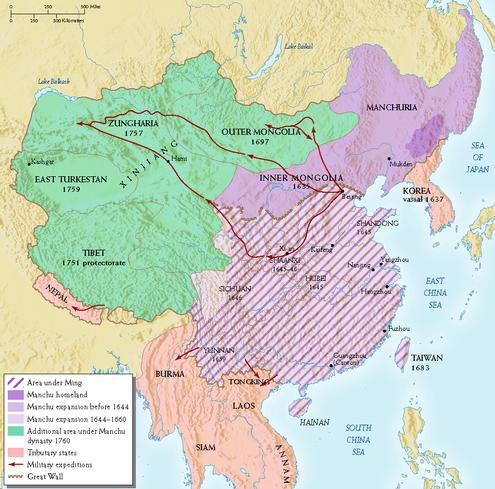
The High Qing period was one of great political stability, imperial expansion, and internal peace. Economic historians like Bin Wong and Ken Pomeranz have shown that China possessed a flourishing market economy during this period; it experienced Smithian economic growth and a massive demographic expansion. Rulers such as the Kangxi (1661-1722) and Qianlong Emperors (1735-1794) are seen as among the most successful in Chinese history. Nevertheless, as ethnic Manchus, these rulers were extremely sensitive to possible opposition from the Han Chinese. And during this period Qing tightened control over the gentry and implemented a policy of the systematic persecution of dissent. (Figure 1 depicts the Manchu conquest of China.)

chinamingqing
The Qing conquest of China

The Literary Inquisitions

The focus of our paper is on the impact of persecutions conducted by Qing China against individuals suspected of expressing disloyalty. We study the impact of these state-orchestrated persecutions on the social fabric of society. This allows us to speak to the kinds of concerns that authors like Hannah Arendt and George Orwell expressed about the long-run impact of totalitarianism in the 20th century.

These persecutions are referred to by historians as ‘literary inquisitions’. Existing scholarship suggests that the resulting fear of persecution elevated the risks facing writers and scholars, and created an atmosphere of oppression and a culture of distrust which deterred intellectuals from playing an active role in society. But these claims have never been systematically investigated. Putting together several unique datasets for historical and modern China, we explore the impact of literary inquisitions on social capital in Qing China and trace its long-run impact on modern China through its effect on cultural values.

spence
Jonathan Spence provides an excellent account of one of the most famous and unusual inquisition cases in his book Treason by the Book

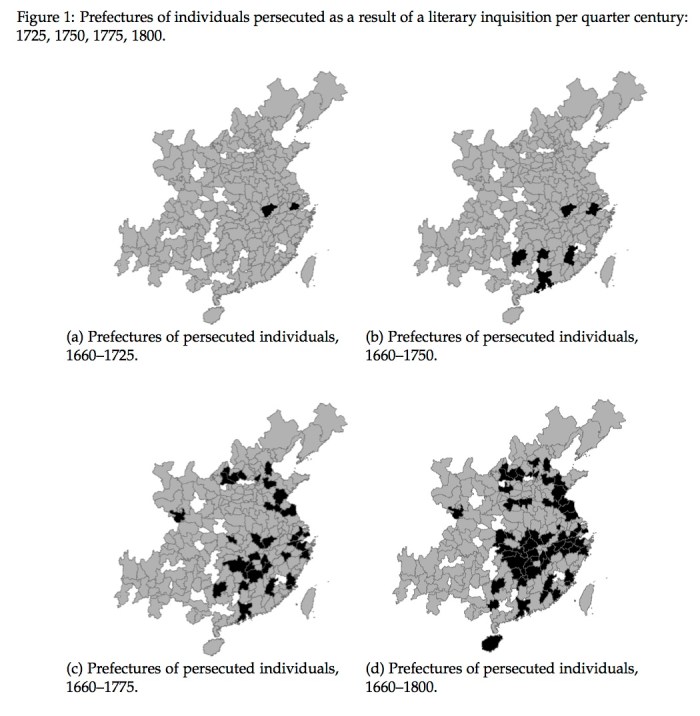
To conduct our analysis, we use data on 88 inquisition cases. We match the victims of each case (there are often multiple victims per case) to their home prefecture. This data is depicted in Figure 1. Since prefectures varied greatly in their economic, social, and political characteristics we conduct our analysis on a matched sample. This ensures that the prefectures “treated” by a literary inquisition are similar in terms of their observables to those we code as “untreated”. As our data is a panel, we are able to exploit variation across time as well as variation in space.

While individuals could be persecuted for a host of reasons, these were all but impossible to anticipate ex ante. Cases were referred to the emperor himself. Frederic Wakeman called this “the institutionalization of Imperial subjectivity.” The standard punishment in such cases was death by Lingchi or (slow slicing) and the enslavement of all one’s immediate relatives. In some cases, however, the guilty party would be executed by beheading. These persecutions aimed to deter opposition to Qing rule by signaling the ability of the Emperor to hunt down all potential critics or opponents of the regime.

Map.jpg

The Impact of Literary Inquisitions on Social Capital

We initially focus on the impact of persecution on the short and medium-run using our historical panel. We first examine the effects on the number of notable scholars.  In our preferred specification we find that a literary inquisition reduced the number of notable scholars in a prefecture by 33 percent relative to the sample mean.

We go on to show the effect of persecutions on collective participation among the gentry in China. Our measure of collective participation in civil society is the number of charitable organizations. Charitable organizations played an important role in premodern China providing disaster relief and local public goods such as repairing local roads. They were non-governmental organizations and played an important role alongside the government provision of disaster relief. In our preferred empirical specification, we find that a persecution number of charitable organizations by 38 percent relative to the sample mean.

These results are in keeping with the argument that literary inquisition had a major psychological impact on Chinese society. They are consistent with the rise of “inoffensive” literary subjects during the Qing period that have documented by historians. To reduce the risk of persecution, intellectuals scrupulously avoided activities that could be interpreted as constituting an undermining of Qing rule. Instead they “immersed themselves in the non-subversive “sound learning” and engaged in textual criticism, bibliography, epigraphy, and other innocuous, purely scholarly pursuits” (Wiens, 1969, 16).

The Impact of Literary Inquisitions on 20th Century Outcomes

We go on to examine how the effects of these persecutions can be traced into the 20th century. In particular, we focus on the provision of basic education at the end of Qing dynasty. In late 19th and early 20th century China, there was no centralized governmental provision of primary schools.  Basic education remained the responsibility of the local gentry who ran local schools.

Thus the provision of education at a local level was dependent on the ability of educated individuals to coordinate in the mobilization of resources; this required both cooperation and trust. We therefore hypothesize that if the persecution of intellectuals had a detrimental impact on social capital, it should also have negatively affected the provision of basic education.

We find that among individuals aged over 70 in the 1982 census – hence individuals who were born in the late Qing period – a legacy of a literary inquisition is associated with lower levels of literacy. This reflects the impact of literary inquisition on the voluntary schools provided by the gentry and is not associated with lower enrollment at middle school or high school. We show that result is robust to controlling for selective migration and for the number of death caused by the Cultural Revolution.

Finally, we show that literary inquisitions generated a cultural of political non-participation. Drawing on two datasets of political attitudes – the Chinese General Social Survey (CGSS) and the Chinese Political Compass (CPoC) – we show that individuals in areas in which individuals were targeted during literary inquisitions are both less trusting of government and less interested in political participation.

Finally, we find that individuals in prefectures with a legacy of literary inquisitions are less likely to agree that: “Western-style multi-party systems are not suitable for China” (Q 43.). This suggests that in areas affected by literary inquisitions individuals are also more skeptical of the claims of the Chinese government and more open to considering alternative political systems. Similarly, individuals in affected prefectures are more likely to disagree with the statement that: “Modern China needs to be guided by wisdom of Confucius/Confucian thinking.”

In summary, our analysis suggests that autocratic rule reduced social capital and helped to produce a culture of political quietism in pre-modern China. This has left a legacy that persisted into the 20th century. These findings have implications for China’s current political trajectory. Some scholars anticipate China undergoing a democratic transition as it’s economy develops (Acemoglu and Robinson, 2012). Others point to China as an example of “authoritarian resilience.” By showing that a long-history of autocratic rule and political persecutions can produce a culture of political apathy, our results shed light on a further and previously under-explored source of authoritarian resilience.

Taxes, Free-riding, and Federation

Check out Adam Smith complaining about the rent-seeking that the UK’s North American colonies were practicing back in 1776:

The expence of the ordinary peace establishment of the colonies amounted, before the commencement of the present disturbances, to the pay of twenty regiments of foot; to the expence of the artillery, stores, and extraordinary provisions with which it was necessary to supply them; and to the expence of a very considerable naval force which was constantly kept up, in order to guard, from the smuggling vessels of other nations, the immense coast of North America, and that of our West Indian islands. The whole expence of this peace establishment was a charge upon the revenue of Great Britain, and was, at the same time, the smallest part of what the dominion of the colonies has cost the mother country. If we would know the amount of the whole, we must add to the annual expence of this peace establishment the interest of the sums which, in consequence of her considering her colonies as provinces subject to her dominion, Great Britain has upon different occasions laid out upon their defence. We must add to it, in particular, the whole expence of the late war, and a great part of that of the war which preceded it. The late war was altogether a colony quarrel, and the whole expence of it, in whatever part of the world it may have been laid out, whether in Germany or the East Indies, ought justly to be stated to the account of the colonies. It amounted to more than ninety millions sterling, including not only the new debt which was contracted, but the two shillings in the pound additional land tax, and the sums which were every year borrowed from the sinking fund.

This comes from Book 4, the third (and last) part (“Part Third”) of Chapter 7 in Smith’s famous book The Wealth of Nations (TWON). (Here is a great link to the whole chapter, courtesy of the Library of Economics and Liberty. I read the Bantam Classics version for my Honors seminar on Liberty in Western Political Thought, led by Andrew Sabl, who is currently a Visiting Professor at Yale, though I don’t have it with me so I can’t cite, let alone remember, the page numbers.)

Let me throw a little bit of historical context for this excerpt at you. Smith wrote TWON before the onset of the first Anglo-American war (TWON was published in 1776, which means it did not influence the American colonists in any way, shape, or form; think about the way information spread back in those days), and the war was largely the result of a quarrel between the UK and its North American colonies over taxation. The taxation, though, was needed in order to pay for a war (the Seven Years’ War) that the colonies had initially lobbied the British government to fight for them. The British colonies in North America had much more leeway than their French, Spanish, Portuguese, and Dutch counterparts, and a number of these colonies wanted to expand westward, into the Ohio Valley, where the French state had made claims that were recognized under international treaties.

To make a long story short: Several colonial factions picked a fight with the French and their Native American allies, and this little schoolyard brawl turned into a global war (with fighting in North America, India, Africa, South America, and East Asia) that saw the United Kingdom become the world’s preeminent imperial power and France lose almost all of its North American colonial possessions.* When the war was over, the British parliament wanted to tax the colonies to pay for their fair share of the war, and the colonists said “No taxation without representation!” Smith summed up the situation as thus:

In order to put Great Britain upon a footing of equality with her own colonies […] it seems necessary, upon the scheme of taxing them by parliamentary requisition, that parliament should have some means of rendering its requisitions immediately effectual, in case the colony assemblies should attempt to evade or reject them […] The parliament of Great Britain insists upon taxing the colonies; and they refuse to be taxed by a Parliament in which they are not represented.

This is quite the conundrum, and Smith put forth a proposal that I found quite novel when I first read it as an undergraduate. But before I get to his proposal, I want to make sure that everyone understands the situation here. The UK fought an expensive war at the behest of its colonies, and the colonies, once the war was over, refused to pay for it. Sound familiar? It should. Today the United States finds itself in this situation often (just replace the word “colonies” with “allies”).

Smith proposed the following deal instead of war or civil oppression (such as economic sanctions):

If to each colony […] Great Britain should allow such a number of representatives as suited the proportion of what is contributed to the public revenue of the empire, in consequence of its being subjected to the same taxes, and in compensation admitted to the same freedom of trade with its fellow-subjects at home. [Were British America] to send fifty or sixty new representatives to parliament, […] there is not the least probability that the British constitution would be hurt by the union of Great Britain with her colonies. That constitution, on the contrary, would be completed by it, and seems to be imperfect without it. The assembly which deliberates and decides concerning the affairs of every part of the empire, in order to be properly informed, ought certainly to have representatives from every part of it. That this union, however, could be easily effectuated, or that difficulties and great difficulties might not occur in the execution, I do not pretend. I have yet heard of none, however, which appear insurmountable. The principal perhaps arise, not from the nature of things, but from the prejudices and opinions of the people both on this and on the other side of the Atlantic. […]

Why didn’t the UK just federate with its North American colonies? Smith cited British fears of an unbalanced political constitution that the North American colonies might bring to such a union, and North American fears of being completely dominated by a faraway parliament were they to join such a federation. He countered both fears well, but check out what he predicted would happen if such a federation were to actually take place:

The distance of America from the seat of government […] would not be of very long continuance. Such has hitherto been the rapid progress of that country in wealth, population, and improvement, that in the course of little more than a century, perhaps, the produce of American [taxation] might exceed that of British taxation. The seat of the empire would then naturally remove itself to that part of the empire which contributed most to the general defence and support of the whole.

Interesting, right? Smith argued that the American colonies would become so rich and so populous that the capital of his proposed British federation would “naturally” move from London to somewhere in North America.

Smith was wrong in a general way, but correct in an even more general way. Let me explain.

Smith was wrong because the United States – once separated from the United Kingdom – evolved into the wealthiest, most innovative society the world has ever known. The reason for this is the aristocratic upper house of a legislative institution (“Senate”) that the 13 states had to create in order for all of them to join a federation. If Smith had had his way, the world would have never known the American Senate, and I doubt very much that the 13 colonies would have grown to become as innovative and wealthy as they are today without this vital institution of governance.

Smith was also wrong to make his argument for such a federation to be based on tax revenue rather than principled representation (though see Warren’s infamous post arguing for just such a proposal). The tax revenue argument might be more economically efficient, but it would not give polities seeking federal bonds the guarantee of some sort of equality (two representatives in the aristocratic chamber of the legislative assembly) that they would need to join such a federation. On these two points Smith’s argument was wrong, but what did he and other republicans and federalists get right?

To answer that I think it’s best to ask another question: What would happen if the UK and the US were to federate today?

The UK would be the poorest state in the union (as measured by GDP PPP per capita), if it were admitted as one state.

The stark difference in living standards doesn’t stop there, though. Suppose the SNP finally gets its way and Scotland leaves the UK. Even if England (intl$ 32,669), Wales (intl$ 25,947), and Northern Ireland (intl$ 27,573) were admitted into the US as three separate states, they would all be at the bottom of the living standards barrel. Were Scotland to go along with the other polities in the UK and federate with the US as a separate state, she would rank second-to-last (intl$ 33,791), just in front of Mississippi but behind Idaho. The rankings would look like this:

49. Idaho

50. Scotland

51. Mississippi

52. England

53. Northern Ireland

54. Wales

Smith’s argument suddenly looks a whole lot better, right? At least if you think living standards as they are measured by economists are a good way to gauge the overall health and wealth of a given society.

A federation is basically a huge, actual free trade zone (both capital and labor can move freely) coupled with a binding military pact and some institutions that allow factions to openly argue and contest for spoils that end up in a state’s treasury, but that’s not what the US has with any of its military allies or trading partners. What I find interesting is that the objections to federation between the UK and its North American colonies that Smith listed are essentially the same ones that crop up when such a federation is proposed between the US and its various allies and partners. The difference between now and then, though, is the Senate. Sending representatives based purely on population or tax revenue would most likely contribute to an unbalanced political constitution, but having two guaranteed representatives in a political body that’s heavily aristocratic and lightly democratic would surely guarantee an equality that all sides could eventually agree upon.

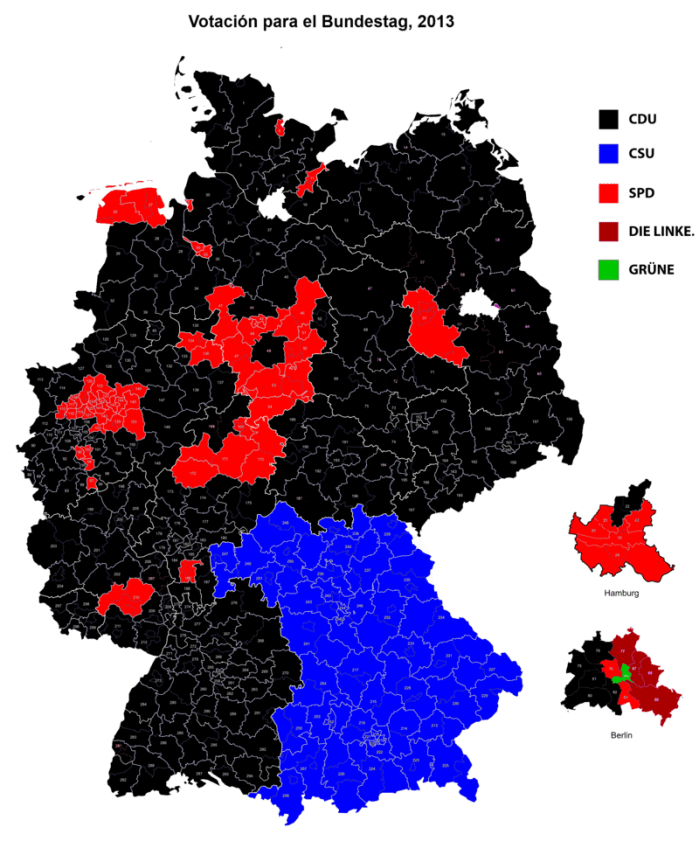
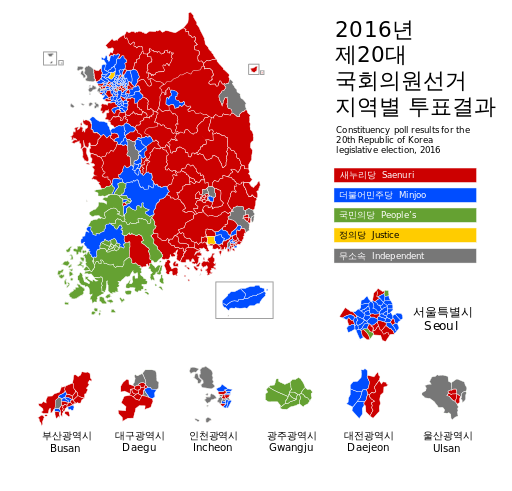
There is also an interesting cultural development to think about as well. The states in Western Europe and East Asia sans China have helped to develop a political culture that is more closely aligned with the one found in the US, Canada, and Australia/New Zealand, one where citizenship trumps ethnic identity. Identity based on citizenship is not as strong as the one found in the Anglo-Saxon world, and ethnic differences do pop up from time to time (largely due to linguistic differences), but the states of Western Europe and East Asia have taken many steps in the right direction to help eradicate the parochial tribalism that has long plagued European and Asian societies and replace it with citizenship. Take a look at the political constituencies of the following three countries:

blog-2013-elections-germany
Germany’s 2013 federal elections (source)
blog-2016-elections-south-korea
South Korea’s 2016 legislative election (source)
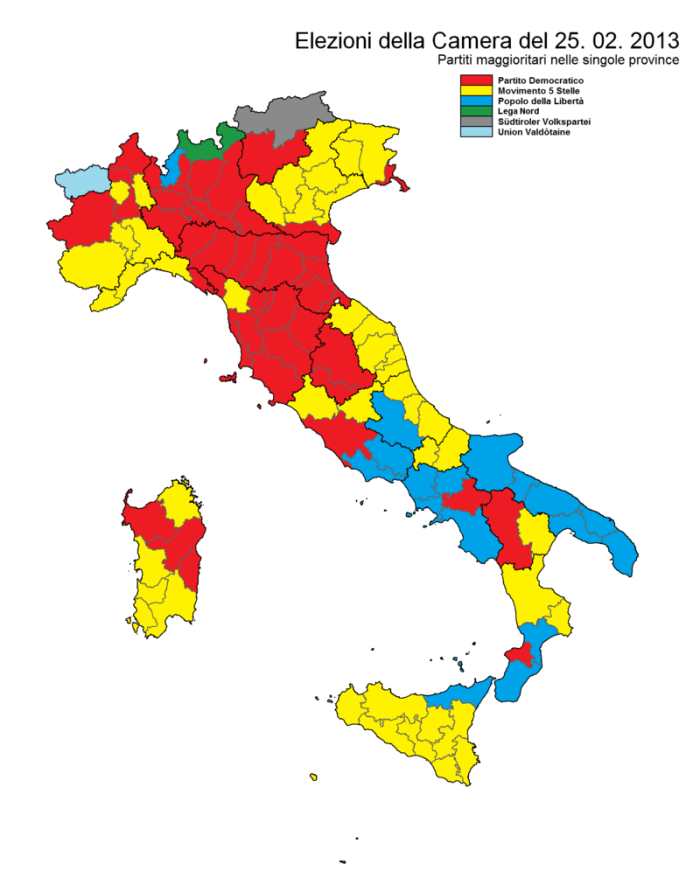
blog-2013-elections-italy
Italy’s 2013 legislative election (source)

They are largely based on a Left-Right divide rather than the ethnic ones we find in less economically-developed, less politically-integrated, post-colonial states. This Left-Right divide would fit in perfectly with the Madisonian constitution, as administrative units (i.e. Northern Ireland, Gangwon, Bavaria, or Trentino instead of the UK, South Korea, Germany, or Italy) could be added in a manner so as not to upset the balance between Left and Right currently found in the US. Political coalitions would wax and wane with time, of course, but if we want a world where the East Asians and Western Europeans pay their fair share, and where they are protected from Moscow and Beijing, then federation is as moderately radical as you can get.

Just ask Adam Smith.

Minorities and Economic Growth: Evidence from Jewish Communities in Premodern Europe

Urban theorist Richard Florida is celebrated for arguing that cities today succeed by attracting members of the “creative class.”  In a similar spirit I have a recent paper with Noel D. Johnson where we investigated whether or not cities in medieval and early modern Europe grew faster if they possessed a Jewish community.

Scholars have long noted the role of minority groups in economic development. This is particularly true for the the premodern period. The great scholar of long-run historical development in Europe, Fernand Braudel, observed that “successful merchants who controlled trade circuits and networks often belonged to foreign minorities.” These minorities could be other nationalities or religious minorities, for example, “the Jews, the Armenians, the Banyans, the Parsees, the Raskolniki (Old Believers) in Russia or the Christian Copts in Muslim Egypt” (Braudel, 1979, 1982, 165).

Hornung (2014) studies the impact of the Huguenot migration to Prussia. Since the nineteenth century, scholars like Friedrich List linked the presence of Huguenots with the transmission of human capital, skills, and innovation. Hornung (2014) is able to test this hypothesis using Prussian immigration lists from 1700 that document the location of Huguenot settlements and firm-level data on input and output for all 750 textile manufactories in Prussia in the year 1802. Approximately 16,000 to 20,000 Huguenots fled France to Prussia at the end of the seventeenth century.  Hornung finds that the presence of Huguenots significantly increased firm productivity. Specifically, a 1 percentage point increase in the share of Huguenots was associated with 1.5 percentage points higher productivity in 1802.

Jewish Communities and City Growth

In our paper we take a broad sweep of European history from 1400 to 1850.  We have a total of 1,792 cities in our panel data from the Bairoch (1988) dataset and 1,069 Jewish communities that appear in the Encyclopedia Judaica. The figure below shows both the cities in the Bairoch dataset and the Jewish communities mentioned in the Encyclopedia Judaica.


bairochandjewishcitiesgreyscale

To understand the relationship between the presence of a Jewish community and subsequent city growth we conduct a difference-in-differences style regression analysis.

The fact that we have data on city populations every century means we can hold constant the identity of a city using city fixed effects and see whether or not it grew faster in the centuries when it had a Jewish community in comparison to those centuries when it did not. We can also control for the possibility that overall city growth was faster in some centuries in comparison to others using century fixed effects.

We are also able to hold constant other factors that could plausibly have affected city growth. We control for local geography including cereal suitability, proximity to rivers, and proximity to coast, as these factors likely affected city growth in different ways over time. We also control for local infrastructure including presence of university and distance to a medieval trade route.

Our  analysis suggests that, indeed, cities with Jewish communities grew faster on average between 1400 and 1850. The effect we find suggests that cities with Jewish communities grew about one third faster than those that did not have Jewish communities. This analysis remains a correlation, however. We do not know if the presence of a Jewish community brought with it economic benefits or if Jews merely choose to settle in faster growing cities.

Instrumenting the Presence of a Jewish Community

We model the network of Jewish communities as one way to see whether the effect of Jews on city growth was indeed casual. By examining how Jewish communities expanded we hope to isolate a source of exogenous variation in the presence of a Jewish community.

We assume that a Jewish community is more likely to be established close to another Jewish community because of trade networks, financial relationships, or cultural linkages. We then calculate the closest travel path between Jewish communities using our information about the location of roads and river networks and estimates of premodern transport costs. The important assumption we make is that if cities with Jewish communities share certain “unobservable” characteristics that might make them more likely to grow rapidly, these characteristics become less correlated with distance.

We then divide Europe into 5km x 5km grids and assign the lowest travel cost to each grid. We apply Djikstra’s algorithm to determine the lowest cost of travel between all 3,211,264 city pairs (van Etten, 2012). This allows us to create a measure of ‘Jewish network access’ for each city.

Jewish network access itself is, of course, correlated with the unobservable characteristics of the city for which it is calculated. To overcome this we adopt two strategies to create valid instruments out of the network access measures. First, we calculate Jewish network access for cities that are only more than a certain distance away from each other. Second, we use information on expulsions to weight our measure of Jewish network access. The intuition behind this is that Jewish expulsions consist of an exogenous “push” factor leading to Jews settling in new cities close to the existing network of Jewish communities. Using these two strategies we obtain similar (though larger in magnitude) effects from the presence of a Jewish community on city growth. This provides further suggestive evidence that the correlation we found in our baseline analysis was indeed causal.

The Relationship Between Urban Growth and the Presence of a Jewish Community Over time

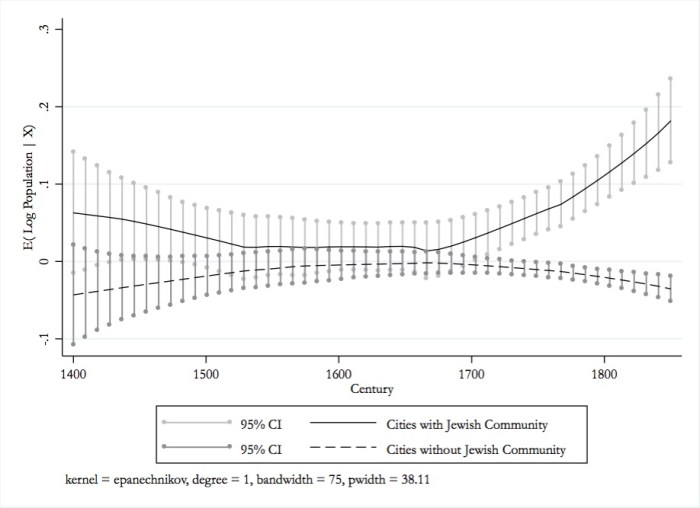
Across specifications, we find that cities with Jewish communities experienced no growth advantage in the 15th and 16th centuries. After 1600, however, they began to grow significantly faster.

motivationlpoly

The relationship we observe in the Figure does not appear to be inline with a pure human capital story. Jews had higher human capital than Christians throughout the medieval and early modern period. But the growth advantage of cities that had Jewish communities only became evident after 1600. This raises the possibility that something else changed around  17th century that made the human capital and skills of Jews more complementary to economic growth.

Two Mechanisms: Jewish Emancipation and Market Access

The two factors that stand out in explaining the emergence of a growth advantage for cities with Jewish communities after 1600 but not before are: (1) Jewish Emancipation after 1750; and (2) a complementarity between the presence of a Jewish community and market access.

The process of Jewish emancipation began in continental Europe after 1780. It was a major institutional break that signified a major change in the economic, social, and political status of the Jews in Europe. In work with Jean-Paul Carvalho, I’ve shown that Jewish emancipation lead to a religious schism and the emergence of both Reform and Ultra-Orthodox Judaism.

In the period before Jewish emancipation, legal barriers limited the ability of Jews to put their labor to its highest value use. Jewish businesses were prevented from hiring non-Jewish workers. Jews could not attend universities. Moreover, Jews and Christians were culturally isolated. This changed with emancipation, and we expect to see it reflected in the contribution of Jewish communities to city growth in the post-1750 period.

The second factor we study is the complementarity between the presence of a Jewish community and the development of markets. The historical literature points to the importance of Jewish trading and financial networks. But, while economic historians have conducted numerous studies of market integration during the early modern period, with a few exceptions these have focused on the grain trade with little systematic study of other markets due to data limitations. Jewish merchants in medieval and early modern Europe, however, did not play a prominent role in the grain trade but, rather, were involved in the transport of diamonds, sugar, silks, tobacco, and other luxury products in addition to playing a large role in banking and finance. Therefore, rather than looking at grain markets, we explore a more general measure of market integration based on market access.

Market access depends on the population size of nearby cities weighted by the cost associated with the least cost travel path. We show that market access was increasing for all cities after 1700. We find evidence that cities with Jewish communities were better able to take advantage of this increase in market access. As we detail in the paper, our findings are consistent with the argument made by numerous historians that Jewish trading and finance networks help to knit together the European economy, particularly in the period 1650 to 1800 (Israel, 1985).


Our analysis provides support for the accounts of historians who have emphasized the important role played by Jewish traders in 17th and 18th century Europe (such as Fortune, 1984; Israel, 1985; Trivellato, 2009). Furthermore, our story is in line with institutional arguments such as those developed by Douglass North, John Wallis and Barry Weingast, and Daron Acemoglu and James Robinson.  In the Middle Ages, the presence of Jewish communities was part of an institutional arrangement that extracted rents from society and distributed them among members of the ruling elite. The eradication of these rent-seeking arrangements and the liberalization of Jewish economic activity, first in the Netherlands and England and then in the rest of Europe following Jewish Emancipation, was of critical importance as it is in those cities that possessed emancipated Jewish communities that we observe the strongest relationship between the presence of Jews and economic growth.

Pornography, virtual reality and censorship [I]: presidents and feminism

Oculus Rift, recently purchased by Facebook and partnered with Samsung, and HTC Vive, manufactured by HTC with Valve technology, have lead the 2010 wave in developing virtual reality headsets. These technologies, innovative by today’s standards but primitive by science fiction’s, mark the beginning of a differently structured society. They also mark a starting point for a new debate about privacy, the social affects of videogames, and especially censorship in media.

Virtual reality (in its not-too-distant actuality) offers an opportunity to behave outside of social norms in an environment that is phenomenologically the real world. The only comparable experience for humankind thus far is lucid dreaming, for which the rewards are less intense and the journey less traversible than the quick promises of virtual reality machines. One inevitable development for these machines is violent, sexually explicit experiences, available for cheap and accessible 24/7. To see how VR might be received, the closest industries to analyze are the videogame and pornography industries.

Interestingly, pornography has a very liberal history, in comparison to other “societal ills,” like drugs. Erotica dates back to ancient cultures — notably, the Kama Sutra, hardcore by today’s standards, is still a staple of contemporary sexual experimentation — and today’s perversions were common themes: bestiality, pedophilia, etc., although pornography with an emphasis on violence might be a more modern trend. This isn’t to ignore, however, the roles typically played by women in ancient Western folklore and mythology, which are degrading by today’s feminist standards.

The case could be made that today’s censorial views on pornography come from a far more malevolent or oppressive stance toward women than two millennia ago. The free expression that pornographic media once enjoyed was severely deflated over the 20th century. Only two years ago, a plethora of activities were banned from pornography in the United Kingdom. Reacting to the legislation, commentators were quick to criticize what was seen as policy that was specifically anti-female pleasure. Female ejaculation, fisting, face-sitting, and many forms of spanking or role-play were among the restrictions. There are puritanical, “moral outrage” elements to the restriction, but many noticed the absurdity of banning face-sitting: said one producer, “Why ban face-sitting? What’s so dangerous about it? … Its power is symbolic: woman on top, unattainable.” (There has been well-intended censorship as well. Los Angeles county passed Measure B in 2012 to require condom use during any pornographic scene with anal or vaginal contact, to combat the spread of venereal disease.)

Nowadays, there are plenty of porn directors that have learned to focus on both male and female pleasure, and reintroduced artistic merit to their directions. With the equalizing force gaining momentum in porn, it’s curious what the vehement, persistent condemnation springs from, when not focused exclusively on abusive sex scenes. In addition, the negative effects of pornography’s presence in society are still being debated. Just the other day, a study which led to headlines like “Porn doubles the risk of divorce” and “porn signifies a death knell for marriage” was criticized by Reason magazine for failing to address important underlying factors that more plausibly contribute to both pornography consumption and an unhappy marriage leading to divorce. There seems to be an obsession on behalf of the great majority of the public in assigning pornography to some sort of social harm.

Research on photographic pornography’s effect on society began early and aggressively. The Meese Report (1986), commissioned by Reagan and still frequently cited by anti-pornography advocates, determined pornography to be detrimental to society and family relations, and especially for women and children. Arguments built on similar reports attempt to connect sexually explicit material with rapes and domestic violence, alleging that the desensitization to rough sex carries over from the depictional world into the real one. Henry E. Hudson, the Chairman of the Meese Commission, alleged that pornography “appears to impact adversely on the family concept and its value to society.” The Meese Report, however, has been challenged extensively for bias, and is not taken seriously as a body of research any longer. One criticism by writer Pat Califia, concluding a traditionalist narrative embedded in the research, states that the report “holds out the hope that by using draconian measures against pornography we can turn America into a rerun of Leave It to Beaver.”

The United States’ Commission on Obscenity and Pornography, preceding the Meese Report and commissioned by Lyndon B. Johnson and Nixon, was unable to find evidence of any direct harm caused by pornography. (Although Nixon, despite the evidence under his administration, believed porn corrupted civilization.) It is curious that a new federal study was requested only sixteen years after the first extensive one, but maybe not too unusual given the growth of porn with technology (from adult stores and newsstands to unlimited free online access; the internet just celebrated its quarter-centennial birthday); also not too unusual given the absurd and expensive studies already undertaken by the federal government. It is also worth pointing out that pornography, though often connected to feminism, is a divisive issue within 20th century and contemporary feminism: some thinkers, like Andrea Dworkin, condemned it as intrinsically anti-women; others feminists like Ellen Willis argued for pornography as liberating and its suppression as moral authoritarianism. The debate along lines of sexuality, online or otherwise, culminated in the feminist “sex wars,” with groups like Feminists Against Censorship and Women Against Pornography popping up. Thus, the debate is open across every ideological camp, and support of pornography is neither necessarily liberal nor necessarily feminist.

[In the next post, I discuss violent pornography’s cross-media transformation into videogames, more sociological research and the general point, and insecurity, of prohibitory measures.]

The Coup in Turkey

I am based in Turkey and have been at the edge of some dramatic events. Before I was in Turkey, I was in the Turkish sector of Cyprus (officially designating itself the Turkish Republic of Northern Cyprus, but only recognised as such by Turkey), where I followed the Postmodern or Indirect Coup of 28th February 1997 when military representatives on the National Security Council were able to force the collapse of a coalition government under an Islamist Prime Minister. Later that year I relocated to Istanbul where I experienced sporadic terrorism from Kurdish separatists and Jihadists. In June of this year I landed at the Atatürk airport just after an ISIS suicide attack. In a more gradual way I saw the disappearance of a Turkish political system under the guardianship of Jacobin laicist army generals, known as Kemalists after the first President of the Republic of Turkey, Kemal Atatürk.

The changes in Turkey came about through a de facto alliance between a party with Islamist roots, the AKP (JDP, Justice and Development Party) and the followers of Fetullah Gülen. Gülen was himself a product of Nurcu Islam, which developed in the early years of the Republic before World War Two as a reaction against the state-led secularisation of Turkey. Gülen was a not very well educated preacher who operated in the context of a fragment of the Nurcu movement, which is not as a whole connected with him. Given the enormous tension between laic Kemalists and the religiously observant population, there was room for a movement devoted to developing conservative Muslim power in civil society and the state.

The Gülenists were preceded in this by the Nakşibendi community, which targeted the state bureaucracy and had followers in politics, notably Türgüt Özal, Prime Minister and then President in the 1980s. Secretive and manipulative politics has been a feature of Turkish and Ottoman politics for a long time. The power of the Janissary elite military and bureacratic corps during the Ottoman period was tied to a religious community, the Bektaşis, creating a parallel system to the legal power of the Sultan until they were violently crushed in the late eighteenth century.

The Committee of Union and Progress, which came to power with military support in the last phase of Ottoman history, developed into a conspiratorial organisation rather than a parliamentary political parry, and a secret arm of it was at the centre of the destruction of Anatolian Armenians in 1915. Secretive groups of Unionists provided a power base for Kemal Atatürk when he revolted against the restored power of the Sultanate and its subservience to the partition/occupation of what is now Turkey after World War One.

The idea of a secret part of the state was maybe not so strong during the early years of the Republic when a one-party system (though in principle the republic was under popular sovereignty) under the dominance of Kemal Atatürk and then İsmet İnönü maybe made it less necessary. Nevertheless, the conditions were established for a revived politics of manipulation behind the scenes. Unfortunately, İnönü’s decision to join the west after World War Two played a part in this. The reorientation resulted in free elections in 1950, with a change in government, and Turkish membership of NATO in 1952.

As in some other countries, the Gladio units played a role in dark political activities. These were the units established to engage in resistance in the event of a Soviet invasion. They had a secretive army within an army aspect and were inevitably a magnet for the most fiercely anti-communist officers, including Alparslan Türkeş, who played an important role in the 1960 Coup. Türkeş was expelled from the coup government, which found him too radical, but he founded the extreme right party in Turkey, Nationalist Action, which is comparatively moderate now, but was heavily involved in political destabilisation and terrorism along with the most anti-communist parts of the state.

What came later was infiltration of the state by Nakşibendis and then Gülenists. Their activity was rather overshadowed by the darker activities of the army and its extreme right allies, often also connected with the Mafia. This network is often known in Turkey as the Deep State. It tended to favour a secular democratic system in terms of formalities, but with concessions to religious conservatism along with an anything goes attitude to covert war against communists and then more importantly Marxist Kurdish autonomists, as well as very limited tolerance for the Left. The hard right element of the army with a base in Gladio was not the whole story. There were far left army officers, particularly up to 1971 and a general staff that tended to be in the middle, though the middle tended to move further right from 1960 to 1980, and then became unwilling to launch anymore violent coups after the 1980 military council stepped down in 198. The general staff itself became increasingly concerned about infiltration by Islamists, including Gülenists.

As it turns out the army’s fear was more than justified. The country liberalised, from a very illiberal base, in the late 1990s, and while the army to some degree went along with that, it launched a peaceful ‘post-modern’ coup in 1997 against the Islamists and was left with the image of the pillar of anti-democracy and anti-liberalism in Turkey. This is an important part of the background to the AKP ‘moderate’ Islamist/conservative democrat electoral victory of 2002 along with the economic crisis of 2001, which along with the 1997 coup left the secular parties very fragmented. The AKP gained a lot of liberal and libertarian support (a very small proportion of Turkey though) and more general reformist support from those who believed it would be a vehicle for reducing the military role in politics and for generally less nationalist-statist politics.

The AKP had very few supporters in place in the military, in the state bureaucracy, or in senior positions in education. The Fetullah Gülen campaign to turn his supporters into the dominant force in Turkey meant they had people in these positions, partly through infiltration of state institutions and partly through founding private educational institutions. This was just one part of the Gülen empire, which include major media groups, banks, and industrial companies in Turkey, and in many countries outside Turkey including the USA. Gülen himself moved to the USA to avoid prosecution by the Kemalist old guard before AKP came to power, claiming to have no links with the economic and educational empire of his supporters which is clearly less than honest of him.

The Gülenists expected a large role in the AKP government and served them most spectacularly in purging the armed forces after an attempted website coup in 2007. In that year the armed forces, unwilling to launch an outright coup, hoped to influence public opinion and the political process by placing a message on its website proclaiming the army’s guardian role in relation to secularism. This turned into the final political defeat of the army’s Kemalist guardian-tutelary role. The AKP won a general election and a referendum to change the method of electing the President. This triumph of civil electoral politics was, however, undermined by the trials of supposed armed coup plotters in the armed forces. Such trials gave the impression of completing the civilian dominance over the army, but were themselves rigged using weak and outright faked evidence. The judges and prosecutors were from the Gülen movement and were creating space for their own people to take the high offices in the armed forces.

The AKP began a campaign against the Gülenists after making its own illiberal core attitude very clear in 2013 in its highly intolerant and authoritarian reaction to the Gezi protest movement. It was increasingly clear to the (even then) most enthusiastic of liberal fellow travellers with the AKP that it was Islamo-nationalist and statist at its core, reducing democracy to the unlimited will of the party elected to government. The Gülenists and the AKP now found the state was not big enough for both of them and the Gülenists decided to use conspiratorial methods against the AKP. Audio files and video tapes of AKP figures and associates, which had evidently been kept in reserve and which suggested widespread corruption were released. Recep Tayyıp Erdoğan (then Prime Minister and now President) and the AKP government succeeded in sacking, retiring and transferring  enough Gülenist police officers, prosecutors and judges to stop this evidence coming to court. They then declared the Gülenists to be a parallel state and a terrorist group, entering into a process of purging the state of Gülenists and seizing their assets in the media, educational and other sectors. The coup conspiracy convictions against army officers, and others, were overturned and it became widely accepted that Gülenists had rigged the trials.

On 15th July this year, I was at a small party on a terrace in the Üsküdar district of Istanbul, overlooking one of the Bosphorus bridges, though by quite a large distance. We could see traffic interrupted on the bridge and news began filtering through of a confrontation between police and army units in what was described as an anti-terrorist operation gone wrong, but was beginning to sound like the beginning of a coup. It turned out that a coup had started and for a brief part of the night it appeared that the old Kemalist-Guardian army had come back to dispose of a government that was elected but increasingly authoritarian. Any welcome in the party where I was, of secular anti-AKP Turks and foreigners was strongly outweighed by a fear that a coup regime would be authoritarian, would create new problems, and the AKP or something like it, if not worse, would be in power for ten or twenty years by way of reaction. This turned out to be the mood of anti-AKP and anti-Erdoğan Turkey. It also became increasingly reported and accepted across the political spectrum that though the putschists had adopted Kemalist language, they were for the most part Gülenists rising up before a purge of the army in a last grasp at domination of the Turkish state.

Since then a purge has unfolded against the Gülenists in state and society, covering the universities (the sector where I work), which has already led to the sacking and arrests of about 60 ooo, including constitutional court judges, army generals and university rectors. The number will certainly at least double before the purge and the current state of emergency is over. Such sweeping action is understandable up to a point given the violent actions of 15th July, and the accumulating evidence over the years of Gülenist infiltration to create a Gülenist-controlled state and society, but clearly the potential exists for massive and systematic individual injustice with abuses of state power affecting over enemies of the state, real and imagined. Some of the language President Erdoğan has used since the coup has been highly polarising and vengeful, demanding submission to state power; some of his rhetoric has been more conciliatory, recognising that all political parties opposed the coup and that deputies across the spectrum sheltered together in the basement of the National Assembly fearing for their lives. I cannot say I am hopeful that the post-coup atmosphere will be beneficial to liberty, but we should hope for and work for the best in Turkey, while being vigilant in working against further declines of liberty.

One thing is for sure: republican politics will not come from the army now and Turkish republicanism must renew itself through engagement and re-engagement with the whole history of republican thought, which is at the origin of classical liberal and libertarian thought. In theoretical and philosophical terms, which is where I work, the discussions of republicanism and liberty going back to Hannah Arendt in the last century, along with the revived study of Machiavellian–Renaissance–Early Modern Republicanism and the way the classical liberals were dealing with the republican legacy of ancient Greece, ancient Rome and medieval city-states are particularly apposite given that Turkish politics, avowedly Kemalist or not, deals so much in a republican language of shared sovereignty and popular mastery.

McCloskey, Western equality, and Europe’s Jews

Warren shot me the following email a few days ago:

Brandon, do you know the name Deirdre McCloskey?

She is a first-rate economist with extensive expertise in history, literature and anthropology.  She recently finished a trilogy, the third volume of which is “Bourgeois Equality.” It’s a fat book but you would be well rewarded for time invested.  You don’t have to read the first two volumes to benefit from the third.

The purpose of the trilogy is to explain why we’re 30 times richer than our forebears of 250 years ago, as best that can be estimated.  Conventional answers like the industrial revolution and rule of law don’t go far enough.  The answer lies in attitudes toward commerce.

I haven’t read McCloskey’s book yet, but it’s been on my amazon wishlist for awhile and thanks to Warren’s prodding it’ll be my next purchase. (Here is all of NOL‘s stuff on McCloskey so far, by the way.)

My first instinct on this topic is to think about Europe’s Jews. Bear with me as I lay out my thoughts.

McCloskey’s book, which as far as I can tell takes readers to the Netherlands and the United Kingdom from the 17th to 19th centuries, is about how Europeans began to reconceptualize equality in a way that was very different from notions of equality in the past.

A very basic summary is that notions of equality in Europe prior to the modern era largely aligned with notions of equality elsewhere in the world. Basically, an established hierarchy based on either inherited land ownership or clerical ranking was justified in all cultures by a religious appeal: “we’re all Christians or Buddhists or Muslims or fill-in-the-blank, so don’t even worry about what we have and you don’t have.” This way of thinking was irrevocably altered in 17th century northwestern Europe. Once I actually read McCloskey’s book, I can give you more details (or, of course, you can just read it yourself).

This argument, that northwestern Europe became free and prosperous because of a change in ideas about equality, is of course very broad and qualitative, but I buy it. The big “however” in this line of reasoning is Europe’s treatment of its Jews.

I forget where I heard the argument before, but somebody or some school of thought has argued that because Europe’s Jews were forced by legislation to go into “dirty trades” like commerce, they became more broadly open-minded than other ethnic groups in Europe and therefore more prosperous. Dutch and British bourgeois culture no doubt had a Jewish influence, and because bourgeois culture is internationalist in scope this Jewish influence must have penetrated other European societies, but anti-Semitism in these other bourgeois centers was more rampant than than it was in the UK and the Netherlands. Why was this?

My main guesses would be “Protestantism” (because Protestants at the time were more open-minded due to being at odds with the Catholic Church), or “the seafaring character of British and Dutch societies.” These are just guesses though. Help me out!

Classical Liberalism and the Nation State

Barry’s response to my earlier post is another interesting read, yet it is also rather broad brush historical. I think he is erroneous if he claims that ‘it did not occur to classical liberals, on the whole, to question the state system as they knew it’. In fact the founding fathers of classical liberalism, David Hume and Adam Smith, were very much aware of other, often cosmopolitan ideals of world order. Yet they argued that the nation was attached to individual emotion, which could not be the case for entities beyond the nation state. This was also the position of later classical liberals such as Von Mises and Hayek, as I show in Classical Liberalism and International Relations Theory (Palgrave, 2009).  Let me elaborate a little, also in the wider context of international political theory.

Liberalism is the political expression of individualism, yet cooperation of individuals in groups is valued positively. For classical liberals the nation, or the country, is the largest group in society which is the object of human passion, both positive in the sense of national pride and negative in the sense of shame and humiliation. Hume noted that there are few men entirely indifferent to their country, and both he and Adam Smith underlined that humans sympathise more with people to whom they are close than with strangers or foreigners. Feelings for the nation are strong, natural motivational forces for individuals.[i]

This also applies in the age of modern states and nationalism. Despite the atrocities committed in the name of national glory throughout the twentieth century, Mises and Hayek never predicted nor called for the end of the nation state. Mises thought that language was the essence of nationality, and with the fragmentation of the polyglot Austro-Hungarian Empire in mind he argued that multi-language countries were doomed to failure. His solution was an increase in possibilities for individual self-determination and group secession, but not in the expectation that this would lead to a world without sovereign states.[ii] Hayek saw the nation as a prime source of human bonding and individual loyalty, but recognised the negative aspects of nationalism. He valued the nation, but nationalism was a poison,[iii] not least because he saw a strong relation between nationalism and imperialism. After all, it is a small step from thinking good about one’s country to trying to rule and civilise allegedly inferior others. Often, although certainly not in all cases, the nation as a group is politically organised as a sovereign state. In the classical liberal view, states are the most important actors in international relations.

To maximise individual freedom the state should only have a limited number of tasks. The state is an important protector of natural rights, but history has shown that it is also the biggest abuser of these rights. The principle of the rule of law intends to protect the negative liberty of individuals. Classical liberals think the state can best be bound by a combination of constitutions; separation of the legislative, executive and judicial powers; and the limitation of positive law.

In international affairs this means that states should be cautious about concluding and ratifying treaties and other forms of positive law. These are often binding commitments that are very hard to change or to get rid of, with a large possible negative impact on individual freedom. Some international agreements may be useful to smooth the working of the international society of states, or to settle practical matters. But the dangers of overregulation are just as real in world politics as they are in national politics. Besides some specific cross-border issues, the classical liberal rule of thumb is that there is no need for international state action if there is no domestic state task.

Consequently, attempts to build a better world by establishing international organisations and regimes are rejected. Mises and Hayek were strong critics of the League of Nations and its successor the United Nations, and Hayek was a fierce critic of the International Labour Organization. Their main concern was that these and other organisations were taking up tasks they should not perform, just like overactive states in national circumstances. Social constructivism is bad, no matter at what level it is performed.[iv]

In Degrees of Freedom (Transaction, 2015)  I have tried to illuiminate the differences between the different forms of liberalism (and conservatism, also see my earlier post on the differences between them entitled “Let’s clear up the liberal mess”), including their views in international relations. In summary it looks like this:

Liberalism, Conservatism and International Relations

Classical liberalism Social liberalism Libertarianism Conserva

tism.

Nation as limit of individual sympathy Yes No No Yes
State as prime actor in world politics Yes No No Yes
International governmental

institutions/regimes

No Yes No No
Can war be eliminated No Yes Yes No
Does trade foster peace? No Yes Yes No

Source: Edwin van de Haar, Degrees of Freedom. Liberal Political Philosophy and Ideology (Transaction Publishers, 2015).

That also explain partly why Barrry can rightly argue that the ideas of Kant, Mill and to a lesser extent Montesquieu differ from those of Hume, Smith, Mises and Hayek: they are not classical liberals but social liberals.

Notes:

[i] Hume, Treatise,79, 317; Adam Smith, The Theory of Moral Sentiments (Indianapolis: Liberty Fund, 1982), 299; also Edwin van de Haar, ‘David Hume and International Political Theory: A Reappraisal,’ Review of International Studies, 34:2 (April 2008), 225–242.

[ii] Ludwig von Mises, Nation, State, and Economy. Contributions to the Politics and History of Our Time (New York and London: Institute for Humane Studies & New York University Press, 1983), 39–40, 82.

[iii] Friedrich Hayek, Studies in Philosophy, Politics and Economics (New York: Simon and Schuster, 1967), 143.

[iv] Mises, Nation, State and Economy, 90–91; Ludwig von Mises, Omnipotent Government. The Rise of the Total State and Total War (Grove City: Libertarian Pres, 1985), 292–294; Friedrich Hayek, The Road to Serfdom (London: Routledge, 1997), 176.

Reply to ‘Classical Liberalism, Cosmopolitanism and Nationalism’

I write in reply to Edwin van de Haar’s post ‘Classical Liberalism, Cosmopolitanism and Nationalism’, which contains some generous remarks about my social media posts while putting forward a view different from my own about the role of the nation state. Edwin argues that the nation state is foundational to classical liberalism in that post. I have previously argued for the benefits of the United Kingdom staying in the European Union, just before the referendum which has put the UK on the path to leaving.

I will start with the doctrinal issues of how far classical liberalism might be considered as something that is embedded in the emergence of the nation state as we know it. It is true that classical liberalism arose as the nation state emerged and consolidated and it did not occur to classical liberals, on the whole, to question the state system as they knew it. That is a system defined in early modern natural law and contractual theory about law and state as one of a very unified system of sovereignty in a world of ‘a state of nature’, anarchy, or lawlessness between states.

We have to note at least one major deviation in the familiar list of classical liberal authors, which is Immanuel Kant, thinking of his essays ‘Idea for a Universal History with a Cosmopolitan Purpose’ (1784) and ‘Perpetual Peace: a philosophical sketch’ (1795), which do not question the internal  sovereignty of states, but does argue for a law governed set of relations between states with a global institution of some sort to prevent republics going to war with each other.

We should consider John Stuart Mill’s thoughts on federal states in Considerations on Representative Government (1861), particularly chapter XVII, ‘Or Federal Representative Governments’ which looks at the possibility of a state with decentralised decision making functions. A nation state can be federalised, at least in principle, but what are the components of the federation other then sub-nations, where the population may even regard them as nations within the state. Mill was building on the experience of the United States since the constitution of 1787, and Switzerland, particularly since the federal constitution of 1848.

The United States and Switzerland did not come out of nowhere. The US consolidated the links between thirteen colonies of Great Britain while federal Switzerland built on the Swiss Confederation and its links with places like Geneva which were associated with the confederation, but were not part of it until the restructuring of European states in the Napoleonic period. The point here is that modern states may be federal as well as unitary states and that includes continuity with pre-modern links between at last partly self-governing regions-nations. We could even say that kind of state of associated states was the Medieval norm.

The example, and even idealisation, of this Medieval structure enters classical liberalism via Montesquieu’s The Spirit of the Laws (1748), along with the work of Swiss jurists of the time, particularly in Berne. Montesquieu was building on the experience of the kind of medieval and early modern monarchy where he thought there was liberty, moderation in government, distinguishing it from tyranny. In such situations different laws and assemblies for towns and for historic regions was quite normal under the monarchy. In so far as such states, like France, were tending to evolve in states based on the absolute sovereignty of the centre, in the formation of what we call a nation state, Montesquieu saw the danger of despotism.

The historical experience that Montesquieu was drawing on was the way that Medieval monarchies were constructed through assembling  patch work of  the monarch’s personal domains, regions with their own lords and institutions, and church domains, along with increasingly self-governing towns. He also looked at the antique experiences of allying republics in a federation, which he thought was preserved in the Netherlands and Switzerland of his time. Germany, which at that time was a kind of federal/confederal empire of very varied forms of sub-imperial sovereign units including princes with lands outside the Empire, was also a form of federation for Montesquieu.

If we go back to the German history of the century before Montesquieu, the idea of the modern nation state is strongly associated with the Treaty of Westphalia (1648), which ended the Thirty Years war, focused on Germany, but drawing in most of Europe. ‘Westphalian state system’ has become a label for an internal system of states which are completely sovereign internally and face each other as equal legal personalities with no higher instance of sovereignty or collective instrument for enforcing the laws of nations, which do have some basis in the natural law doctrines of the time, and earlier.

The trouble with this understanding of Westphalia is that though it has some truth for Europe outside the German Empire (officially known as the Holy Roman Empire), it is very misleading for the Empire, and therefore for those European powers, including Sweden and Denmark, which had land within the Empire. The princes, cities and other territorial units within the Empire were under the legal authority of the Emperor, who largely served as a judge of interstate disputes though with far greater powers in the lands of the Habsburg family (consolidated as the Austrian Empire in the Napoleonic era) which always had the Emperor, though the Emperor was legally an elective office. The Habsburgs land extended outside the Empire into central Europe so the Westphalian system of Imperial authority brought in other European nations and extended outside the Empire strictly speaking.

Westphalia modified a system rooted in the Middle Ages of Germany as a middle European federation or confederation, drawing in other parts of Europe and therefore anchoring a European system of some kind. Periods of dominance by France or Spain complicate this story, but French claims always overlapped with Imperial claims and the peak of Spanish power was when the Spanish monarchy was from the same family as the German Emperors.

The Napoleonic era disrupted these arrangements severely, but we can see Napoleon as trying to revive the original Empire of the Romans under Charlemagne in the ninth century, which united France, Germany and neighbouring territories under a Frankish over-king. Charlemagne was know as ‘father of Europe’ in his time, perhaps more in connection with Europe as Christendom and his wars against Muslims in Spain, then with Europe as we might think of it now, but this is part of the story of what it is for there to be a Europe and a European system. Coronation by the Pope and recognition of the Frankish kingdom as heir to ancient Rome connects the medieval German Empire with the first great European political system, the Roman Empire.

The aftermath of the Napoleonic period in Germany was a confederation, which again included those European powers (the United Kingdom was one) which had lands in Germany. This evolved into the German Empire founded in 1871, which was itself an extraordinary mixture of Greater Prussia, federation, democracy, aristocracy, monarchy, and so on. It was more of a nation state than German predecessor systems in that it was a sovereign unified part of the international state system. The size and growing economic power of the Kaiserreich, incorporating Polish, French and Danish speaking areas, made it a destabilising force in Europe. Too big for the security of other European states, too small to anchor a European system.

The First World War and the Second World War were both consequences of this unstable system. The European Union is in large part an attempt to solve the problem by creating a European system which Germany anchors, though since unification the dominance of Germany has become an issue again. Whatever the problems, the EU provides a better framework for structuring a European system in which Germany is both contained and can exert influence in a consensual manner.

Returning to the issue of the nation state, Germany was never a nation state in the strictest sense of a very unitary state with a single language and ethnicity. France has usually been taken as the model of the nation state ‘strictly speaking’, but even so it has only been a country of speakers of standard French since the late nineteenth century. As it is now, it includes speakers of Breton, Basque, Occitan and Alsace German. Corsica has special status and Alsace-Lorraine also has some special arrangements in recognition of its specificities.

The European world before the First World War was more of a Europe of multi-national Empires than nations, with four Empires (German Hohenzollern, Austrian Habsburg, Turkish Ottoman, Russian Romanov) dominating the centre and east. Spain in practice has always been an extended Castille in which other regions-nations have played variable distinct roles. The United Kingdom never completely integrated as a nation state; even at the peak of integration in the nineteenth century, Scotland kept its own legal, state church and educational system and since then in a rather complicated way the UK has become more loosely integrated and may lose Scotland in a few years.

Even with the imminent departure of the UK from the EU, Europe continues to be a political system, not just an aggregate of nation states. The larger European states are not nation states in the strictest sense. Even without the EU, European states accept various kinds of obligation with regard to north Atlantic security and global trade which limit sovereignty. The UK will negotiate some kind of membership of the internal market of the EU and its passport union aspect, as well as participation in various EU schemes. It will therefore continue to be part of a European system anchored by Germany.

Ever since the Romans, Europe has needed a European system of some kind, and the German anchor schemes going back to 800 have recognised the Roman precedent. In reality there has never been a Europe of nation states and the periods closest to that model ended in catastrophic wars. Disaggregation of the European system as it is now may not result in war, but it has the potential to unleash trade wars, protectionism, competitive currency devaluation, erosion of chances to live, work, and study abroad, associated labour market sclerosis, destabilising struggles for political-diplomatic dominance, and an incapacity to ally in order to deal with global and strategic issues affecting Europe, including migration flows, Russian expansionism, and Middle Eastern conflict and terror.

(more on the consequences of the UK leave referendum soon)

Narratives, Impacts and the Actors: Bangladesh’s 1971 Liberation War

That’s the subject of my newest paper, which was just published by India Quarterly. Here is the abstract:

Both the Bangladesh state and society are yet to settle the questions over and narratives related to the Liberation War of 1971. Broadly, there are two groups with contradictory and conflicting interpretations of the events related to that war. This has also led to the mushrooming of militant groups in the country. The beginning of trial of perpetrators of Liberation War crimes since 2010 and the execution of a few of the leaders has further polarised the society and politics of Bangladesh. The existing debates over the Bangladesh Liberation War cannot be studied without looking into the roles of India and Pakistan. The two countries have their own interpretations and political fallout of the 1971 liberation war.

Here is the full paper (pdf).

A short note on two types of political structures

I just came across an excellent review by Herman Belz of a book on American history recently published by Nicolas Barreyre, a French history professor. The main thrust of the book Belz is reviewing has to do with American Reconstruction, but the theoretical thrust of the book is all about state-building and political economy. The whole article is worth your time, but I wanted to hone in on a particular paragraph that caught my attention:

In the 20th century, Progressive “living-Constitutionalism” dedicated to constructing a centralized administrative state […] undermined the Founders’ establishment of a territorial federal republic as the constitutional ground of American liberty. Americans were the territorial people of the United States. Sovereignty resided in the people of the state in which they lived as well as in the states united as a national whole. In the 21st century, the aspirations of Progressive statism reach beyond national borders to the conceit of transnational global authority.

In this paragraph Dr Belz draws a distinction between two political structures:

  1. a centralized administrative state
  2. and a territorial federal republic

The centralized administrative state is a much worse option than a territorial federal republic in Belz’ view (and my own), mostly because in the federal republic sovereignty resides in both “the people” and in the various “states” that have federated to form a republic (Belz suggests this made the United states “a national whole,” but I don’t think that’s true, largely because of Belz’ own description of what Barreyre calls “sectional” politics at the time, but I digress; see Michelangelo for conceptions about “the nation”).

The territorial federal republic is thus a bottom-up approach to a more inclusive, more open society, whereas the centralized administrative state relies on experts, many of whom are unelected and unknown, to govern public affairs.

Belz is largely correct in his summaries of these two political structures, but I think his conclusion (“the aspirations of Progressive statism reach beyond national borders to the conceit of transnational global authority”) misses the mark. This is not because he is right to suspect the Left of wanting to create and sustain a centralized administrative state with a global reach (i.e. the UN), but because he leaves out the possibility that a territorial federal republic can also have a global reach while still avoiding the pitfalls of morphing into a centralized administrative state. Belz is probably more conservative than I am, and hence more pessimistic about the chances of a “transnational global authority” being republican in nature rather than administrative, but I still think my argument is better…