Malthusian pressures (as outcome of rent-seeking)

Nearly a week ago, I intervened in a debate between Anton Howes of King’s College London whose work I have been secretly following  (I say “secretly” because as an alumnus of the London School of Economics, I am not allowed to show respect for someone of King’s College) and Pseudoerasmus (whose identity is unknown but whose posts are always very erudite and of high quality – let’s hope I did not just write that about an alumnus of King’s College). Both bloggers are heavily involved in my first field of interest – economic history.

The debate concerned the “Smithian” counter-effect to “Malthusian pressures”. The latter concept refers to the idea that, absent technological innovation,  population growth will lead to declining per capita as a result of marginally declining returns. The former refers to the advantages of larger populations: economies of scale, more scope for specialization and market integration thanks to density. Now, let me state outright that I think people misunderstand Malthusian pressures and the Smithian counter-effect.

My point of is that both the “Smithian counter-effect” and “Malthusian pressures” are merely symptoms of rent-seeking or coordination failures. In the presence of strong rent-seeking by actors seeking to reduce competition, the Smithian counter-effect wavers and Malthus has the upper hand. Either through de-specialization, thinner of markets, shifting to labor-intensive technologies, market disintegration and lower economies of scale, rent-seeking diminishes the A in a classical Cobb-Douglas function of Total Factor Productivity (Y=AKL). This insight is derived from my reading of the article by Lewis Davis in the Journal of Economic Behavior and Organization which contends that “scale effects” (another name for a slight variant of the “Smithian counter-effect) are determined by transaction costs which are in turn determined by institutions. If institutions tend to favor rent-seeking, they will increase the likelihood of coordination failure. It is only then that coordination failures will lead to “Malthusian pressures” with little “Smithian counter-effect”. Institutions whose rules discourage rent-seeking will allow markets to better coordinate resource use so as to maximize the strength of the “Smithian counter-effect” while minimizing the dismal Malthusian pressures.

In essence, I don’t see the issue as one of demography, but as one of institutions, public choice and governance. I am not alone in seeing it this way (Julian Simon, Jane Jacobs and Ester Boserup have documented this well before I did). Why the divergence?

This is because many individuals misunderstand what “Malthusian pressures” are. In an article I published in the Journal of Population Research, me and Vadim Kufenko summarize the Malthusian model as a “general equilibrium model”. In the long run, there is an equilibrium level of population with a given technological setting. In short-run, however, population responds to variation in real wages. Higher real wages from a “temporary” positive real shock will lead to more babies. However, once the shock fades, population will adapt through two checks: the preventive check and the positive check. The preventive check refers to households delaying family formation. This may be expressed through later marriage ages, planned sexual activities, contraception, longer stays in the parental household and greater spacing between births. The positive check refers to the impact of mortality increasing to force the population back to equilibrium level. These checks return to the long-term equilibrium. Hence, when people think of “Malthusian pressures”, they think of population growth continuing unchecked with scarce ressources. But the “Malthusian model” is basically a general equilibrium model of population under fixed technology. In that model, there are no pressures since the equilibrium rates of births and deaths are constant (at equilibrium).

However, with my viewpoint, the equilibrium levels move frequently as a result of institutional regimes. They determine the level of deaths and births. “Poor” institutions will lead to more frequent coordination failures which may cause, for a time, population to be above equilibrium – forcing an adjustment. “Poor” institutions would also lead to an inability to respond to a change in constraints (i.e. the immediate environment) by being rigid or stuck with path-depedency problems which would also imply the need for an adjustment.  “Good” institutions will allow “the Smithian counter-effect” to intervene through arbitrage across markets to smooth the effect of local shocks, a greater scope for specialization etc.

My best case for illustration is a working paper I have with Vadim Kufenko (University of Hohenheim) and Alex Arsenault Morin (HEC Montréal) where we argue that population pressures as exhibited by the very high levels of infant mortality rates in mid-19th century Quebec were the result of institutional regimes. The system of land tenure for the vast majority of the population of Quebec was “seigneurial” and implied numerous regressive transfers and monopoly rights for landlords. This system was also associated with numerous restrictions on mobility which limited the ability of peasants to defect and move. However, a minority of the population (but a growing one) lived under a different institution which did not impose such restrictions, duties and monopolies. In these areas, infant mortality was considerably lower. We find that, adjusting for land quality and other factors, infant mortality was lower in these areas for most age groups. Hence, we argued that what was long considered as “Malthusian pressures” were in fact “institutional pressures”.

Hence, when I hear people saying that there are problems linked to “growing population”, I hear “because institutions make this a problem” (i.e. rent seeking).


Cave Paintings and Elementary Science

This is a travel story of sorts, of travel through time, to an extent. Be patient.

Directly to the west of Marseille, the second largest city in France are a series of beautiful, narrow coves, like fjords, situated in a sort of desert. They are called “calanques” in French. They are accessible only by sea or through a long walk on hot rocky ground. Although they constitute a separate world, the calanques are close to Marseille, as the crow flies. They used to be a major fishing resource for the city. You can be sure they were never forgotten during the 2600 years of the city’s existence. Also, the city was founded by Greeks and thus, it always had a literate population, one that kept records.

Marseille and its environs are where SCUBA was invented, the first practical solution to the problem of men breathing underwater. Accordingly, the calanques were always and thoroughly explored after 1950. In 1985, one of the co-inventors of SCUBA discovered a deep cave in one of the calanques. He couldn’t resist temptation and swam into it until he reached a large emerging room. I mean a cave where he could stand and breathe regular air. His name was Cosquer.

Cosquer visited there several times without saying a word about his discovery. Soon, he observed dozens of beautiful paintings belonging to two distinct periods on the upper walls of his cave. The art of the first period was mostly hand imprints or stencils. The art of the second, distinct period, comprised 170-plus beautiful animals including many horses, ibex and others mammals, also fish, seals and other sea creatures. Archaeologists think the painting of the first period were done about in about 25 000 BC, those of the latter period date back to about 18 000 BC, they believe.

Today, the entrance to the cave is about 125 feet below sea level. We know that paleolithic men did not have SCUBA. They simply walked into the cave for their own reasons, with their own purposes in mind. Thus, the sea level was at least 125 feet lower then than it is today. The people of Marseille never saw the cave. They would have written about it. There would be records. They would not have forgotten it. They simply did not know of its existence during the past 2600 years.

Sometimes in the past 20 000 years, the sea rose 125 feet or more. That’s an amplitude several times greater than any of the direst predictions of the official United Nations Intergovernmental Panel on Climate Change for the next century. The IPCC squarely blames a future ocean rise (one that has not been observed at all, yet) on abnormal emission of several gases, especially CO2 . These abnormal emissions in turn, the IPCC affirms are traceable to human activities such as driving cars and producing many useful things by burning fossil fuels.

It seems to me that basic good science requires that causal analysis begin with a baseline. In this case, it would mean something like this: In the absence of any burning of fossil fuels, the ocean rose 125 feet sometimes during the past 20,000 years. Let’s see if we can find evidence of the ocean rising above and beyond this order of magnitude since humanity began burning fossil fuels in large quantities, about 150 years ago.

The conclusion will likely be that nothing out of the ordinary happened. Hence, fossil fuel emissions are probably irrelevant to this particular issue. (This leaves open the possibility that such emissions are odious for some other reason. I mean that CO2 is plant food. Too much CO2 may promote weed growth in our fields and gardens. )

The ocean is not currently rising and if it is, the existence of the Cosquer cave suggests that it’s rising to a tiny degree. Let’s keep things in perspective. Let’s discard openly and loudly every part of the building of a complex hypothesis that does not work. Those who don’t take these obvious cleansing measures simply have a lot of explaining to do. They should not be allowed to wrap themselves in the mantle of science while violating Science 101 principles.

One of the conceits of the Warmist movement is that you don’t have a right to an opinion unless you possess a doctorate in Atmospheric science. By this dictate, anybody who has to keep a job, raise children, or pay a mortgage is out of the discussion. This is the typical posturing of intellectual totalitarianism. Note what’s missing in the story above: It says nothing about what did cause the ocean to rise between 18 000 B. C. and today. It’s enough to know that whatever it was, it was not the massive burning of fossil fuels. The story is complete as is. Don’t quit your job and apply to graduate school!

An update from Memphis (Russo-Baltic edition)

Dr Znamenski (bio, posts) sent me an email updating me on his recent shenanigans:

I also appreciate your remark that we need to reach out to other libertarian-leaning people rather than singing to only a libertarian chorus. Even though I am notorious for not contributing to NOL, I devoted this summer to reach out to liberty-minded people in Europe by going to St. Petersburg, Russia, and delivering there a public talk (in Russian) on “Heroics of the New Deal and Its Critics” at a downtown hotel and afterwards I met with the audience for a free-style interactive talk on current challenges to individual liberty. Then I proceeded to Tallinn, Estonia, where I met a group of Estonian libertarians and delivered a talk (in English) on geopolitical imagination of Russian nationalism (used current Alaska-related Russian patriotic rhetoric as an example). Then proceeded back to Russia, where at Samara University again I gave a talk on the mythology of FDR and New Deal Keynesianism and how it was appropriated in 2003-2008 by the Putin regime that was building the “vertical” of its power. My argument was that politico-economic regime whose “validity” was “scientifically” proven by Keynes in 1936 by now became a kind of a fetish that is associated with a good government. Hence, the “Heroics of the New Deal” title. The Estonian visit was especially pleasant and inspiring.

I also met an informal leader of Estonian libertarians […] Very productive and charismatic guy. I need to navigate him to you and to NOL, which will greatly benefit from his contributions (if any). His English is impeccable too. See his picture attached to this letter (they have Mises Institute of Estonia) in addition to a few other images from Estonia (the country where all paper work exists only in electronic form and a flat tax return occupies only one page!). The country [Estonia] was the first in Europe to introduce universal flat tax (1994), which replaced three tax rates on personal income and one on corporate profits. The flat tax rate was on 26%, which later was reduced to 20%. Several countries of Europe followed the suit and benefited from this. Very simple system, which helped this tiny backwater country of 1 million plus something people to dramatically raise its well-being. To their frustration, even Russian nationalists, who remain quite influential in Estonia due to the presence of a large Russian minority, have little economic discontent among Russians to chew on. The latter simply compare their economic situation in their historical homeland where average salary is $500 and Estonia where this salary is $1150.

Dr Znamenski has some excellent ideas brewing (on US-Russian relations in the Arctic, Crimean secession, and Foucault), and hopefully he can find the time to post them in the very near future. Notice, too, that Dr Znamenski refers to Russians as Europeans (or, at least, considers St Petersburg to be European). A small observation, I know, but one that I suspect has big sociological implications. Check out these pictures he sent me:

This is the Estonian libertarian Dr Znamenski mentions above. I hope to someday meet him.
This is a photo from the Museum of the 20th century in Tallinn (the capital city of Estonia).
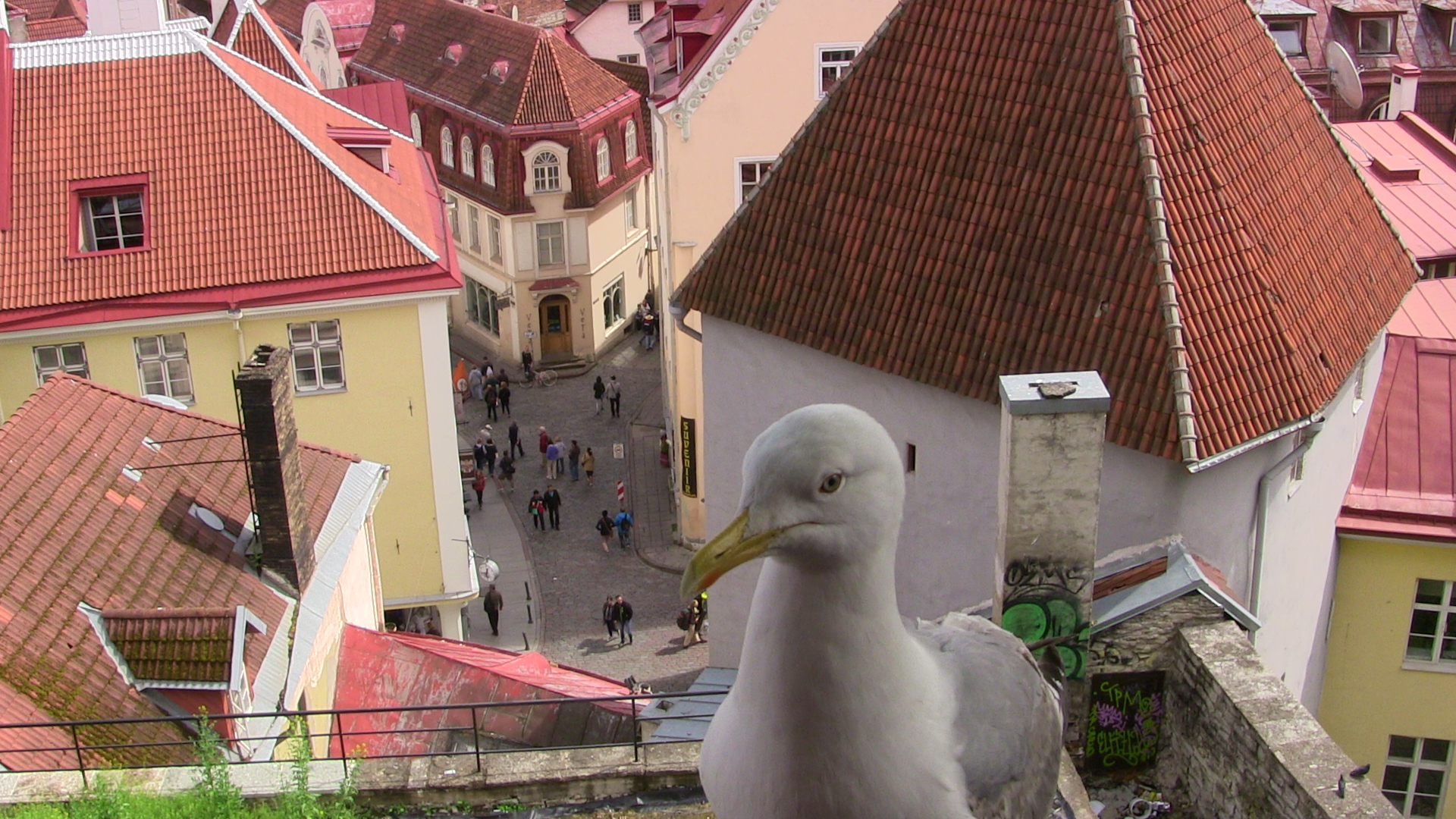
This is my favorite picture. It’s a view of Tallinn with a curious visitor, and highlights Dr Znamenski’s sense of humor, which I greatly appreciate.

Myths of Sovereignty and British Isolation, 20. Concluding Remarks

This series (1, 2, 3, 4, 5, 6, 7, 8, 9, 10, 11, 12, 13, 14, 15, 16i, 16.ii17, 18, 19) has explored a number of ways in which those who support a very sovereign United Kingdom completely separate from the European Union, and even other European institutions like the European Court for Human Rights, which is attached to the Council of Europe rather than the European Union, are attached to unsupportable ideas about the separateness and superiority of England, Britain or the UK.

What Britain’s past was does not prove anything about where it should be now with regard to European institutions, but it is at least possible to say that claims according to which Britain has always stood apart from Europe are false, and so is any connected claim that Britain is somehow fated by history, geography and national character to stand aside from arrangements made by European nations to share sovereignty.

Britain was connected to the rest of Europe through Celtic culture and language, then through the Roman Empire, then through the Saxon conquest, then partial Viking conquest, then Norman-French conquest, then ties with the Netherlands, then a union in the person of the joint monarch with the Netherlands, then a union in the person of a series of kings with Hanover in Germany, then through constant British intervention in European affairs, land holdings which go back to the Channel Islands (originally French), the remains of which still exist in Gibraltar and sovereign military bases in Cyprus, then through postwar European institutions like the Council of Europe (which loosely groups all democracies, broadly defined) and then the European Union.

The peoples of the United Kingdom of Great Britain are rather less firmly committed to maintaining the existing state than the peoples of France and Germany are, the two European nations usually taken by British Eurosceptics as the negative opposite of Britain in all its glory. There is a distinct possibility that Scotland will leave, with strong separatist tendencies in Northern Ireland and to a lesser but real extent in Wales. So Britain is not uniquely well formed and self-confident as a nation.

As with all other nations, Britain was built through war, state appropriation and the enforcement of a national state system. It is not a country of unique liberty, neither does the Anglosphere of UK, USA, Canada, Australia and New Zealand exist as a uniquely coherent transnational grouping based on medieval and early modern English institutions. The Anglosphere countries are diverse, with different historical experiences, with Britain as the odd one out in the sense that all the other Anglosphere countries are still dealing with the status of indigenous peoples who lived there before the relatively recent history of the Anglosphere states.

Other European states have links with ex-colonies, where the language of the colonial power is still widely spoken. More French people live in Britain than those from the Anglosphere (300 000 versus 191 000). Links with the Anglosphere are certainly quite real and exist quite happily alongside EU membership, so the whole idea of making the Anglosphere something that excludes a European path is misleading in any case.

The historical interpretations referred to in this and previous posts are not contentious. No educated and fastidious sovereigntist-Eurosceptic is going to deny them, the trouble is that a lot of less fastidious sovereigntist-Eurosceptic assumptions about history are not in happy accord with these historical realities, and even the more fastidious are trying to emphasise an unrealistic counter-narrative of British distinctness that goes beyond the normal level of distinctness between major nations. Britain has certainly made its contribution to the history of liberty, civil and commercial society, but is not obviously more blessed in these respects than the other most advanced European nations.

The case against the United Kingdom’s participation in the European Union can only be the case against the existence of a transnational political union for any large grouping of European nations. There are problems with the EU and I can agree with many sovereigntist-Eurosceptics on many of these problems, but if we reject the more myth making kinds of nationalism these are problems I suggest that can be addressed with better, more decentralised and flexible institutional arrangements. India, which has a greater population than the EU, and at least as much diversity of language and other aspects of human life survives.

It is of course difficult to know what Europe would look like without the EU and what good things in Europe are due to the EU, but I suggest that it is not a complete coincidence that the period of the EU has been a time of growing democracy and peace, with many countries taking EU membership as part of the path from dictatorship to democracy. The Euro crisis and the more recent Mediterranean refugee crisis are bringing strain to the EU, but that is what happens to political communities, they encounter problems and survive them if they have robust institutions. The economic problems of southern Europe precede the EU and tensions round migration exist in other parts of the world. Britain has anyway remained aside from the Euro, as have Sweden and Denmark, suggesting that the EU can accommodate flexibility and allow member states with doubts about the most ambitious schemes to stand aside from them. This is certainly the path to go down if the EU is to be a robust political community.

The basic point in this series has been that nothing makes British history separate from European history, so that questions about membership of a European political community which pools sovereignty are not answered by looking to a supposed distinct and superior history. Britain is part of Europe and always has been and has frequently shared sovereignty in some way with some mainland European state. Past history does not exclude Britain from Europe and trans-national European institutions, which may or may not be appropriate for Britain and other countries, for reasons in the here and now. As far as history determines Britain’s place, the appropriate place is Europe.

Myths of Sovereignty and British Isolation XIX, Charters and Constitutions

The last post discussed the historical role of law. This post finally delivers the promise to discuss constitutions and charters. The sovereigntist Eurosceptic position in Britain standardly includes an elevation of Magna Carta into the greatest document ever in human liberty or, in more moderate versions of this position, certainly the greatest since it was issued in 1215 and the fount of all worthwhile liberties ever since: blessing Britain and countries which might be considered off shoots, like the USA, Canada, Australia and New Zealand (the ‘Anglosphere’), with a unique appreciation of liberty and parliamentary democracy.

While Magna Carta is of course a remarkable document and the moment it was issued was a remarkable historical moment, these claims are a distortion. It was a Latin document issued under duress during civil war conditions, the duress applied to the king by barons, at a time when the the English aristocracy and monarchy was distinguished from the great body of English by use of the French language and holdings in France.

Magna Carta has nothing to do with parliamentary democracy, it refers to a council of 25 which barons might form if they found the king to be misbehaving, and does not refer to a standing representative body but rather something more like a right of insurrection against a ‘tyrannical’ monarch. This has no more to do with parliamentary democracy than a variety of councils and assemblies existing across Europe at this time, and rather less than some.

Though Magna Carta is dressed up in the language of reasserting traditional rights, this does not make it the expression of a distinctly English or British love of rights based in tradition rather than innovation as the sovereigntists standardly claim. All demands for rights across Europe were expressed in that way at that time, and for centuries before and centuries after. The French Revolution itself started as a demand for ‘restoration’ of rights. The language of restoration is of course frequently a cover for innovation, an attempt to justify innovation by denying what it is.

Magna Carta was the innovatory product of political struggle, not the writing down of the unchanging liberties of old England. The same goes for the struggles for parliamentary power in the seventeenth century which frequently took on the deceptive form of ‘restoration’ of a Magna Carta which was already supposedly a restoration. It is even more fantastical to see the US Constitution as the outcome of Magna Carta, which does not stop many Anglosphere sovereigntist Eurosceptics doing so.

The history, or histories of liberty, is the accumulation of many interacting events, charters and theories in many countries. The growth of British parliamentary power took place in that context as did the US constitution and the Declarations of the Rights of Man and Citizen, which took place during the French Revolution. Like the French Declarations, Magna Carta exists in different versions so there is no pure origin text of liberty in either place. Rival French and Anglosphere attempts to proclaim the priority of either are particularly absurd. These are documents separated by hundreds of years and many other factors.

We cannot imagine modern liberty without either source, though both sources are flawed and open to challenge. The last thing thought and politics based on liberty needs is some sacred unchallengeable text as foundation, inevitably distorting understanding of the varied contexts and sources of liberty, and inevitably distorting our understanding of how ‘sacred’ documents had a source in power politics and political economy. There is no immaculate liberty born outside of struggles over power and appropriation of wealth.

The writing down of liberties in a legal document itself, particularly one that has a special, difficult-to-overturn foundational status, places some constraint on liberty, on how some people now and even more in the future might have some different ideas about liberty and see the earlier document as constraining.

It is certainly the case that a strongly entrenched document like the US Constitution deprives later generations of the liberty to re-imagine liberty and it is certainly the case that such a Constitution conflicts with the common law tradition exalted by British sovereigntist-Eurosceptics, according to which law progresses through the way judges build gradually on earlier cases to interpret statutes and formulate principles of justice.

Clearly a strongly entrenched Constitution with a Bill of Rights added does not come from common law, though it may try to capture some of the principles supposed to be widespread in common law, and must heavily constrain common law judges. The idea of a Constitution standing above politics, constraining it according to pure justice, has at least in the United States made the membership of the Supreme Court and its decisions a matter of constant political contention.

No attempt at a system of liberty can avoid tensions between different sources and understanding of liberty. Unfortunately the Eurosceptic-sovereigntist position largely tends to overlook this, or like someone looking at the Sun, cannot have it directly in its gaze without serious damage. The elevation of common law tradition, Magna Carta, and parliamentary democracy is the elevation of different things which in some sense must always be part of liberty, thinking of the general principles of judicial independence, institutional harmony, and representative government. However, as they conflict there can be no perfect version and no reason to think English, British or Anglosphere solutions can be regarded as above all others and with nothing to learn from the law-governed democracies of mainland Europe.

Next week, the end, a final summary.

Myths of Sovereignty and British Isolation XVIII: Laws, Juridification and the Administrative State

The last post focused on the distinction between civil and common law, with regard to Britain’s position as a common law country in contrast with the civil law tradition of the rest of Europe. The promise at the end was to move onto laws, charters, and constitutions in this post. However, I have found it necessary to discuss the idealisation of common law further and look at how a large part of this looks back to a world which is lost, regardless of predominant legal system as societies have roughly speaking moved from customary law to ‘juridification’ (state centred comprehensive law penetrating all social relations), and then the world we live in now of the administrative state.

The British sovereigntist and Eurosceptic position tends to emphasise a supposed unique British exception from the statist rationalism of civil law, in the ‘common sense’ of the accumulation of law arising from judicial precedent in the decisions of judges in previous cases. This supposedly British exception looks rather challenged when we consider the thoughts of the influential German philosopher Hans-Georg Gadamer in his 1960 book Truth and Method. Gadamer refers to French rationalist Enlightenment in contrast with a German form of Enlightenment based on the original understanding of ‘prejudice’.

Prejudice, in Gadamer’s account, did not begin as a negative term for the constraints of false assumptions, but in a legal process in which the court forms a preliminary opinion in an early stage of proceedings. For Gadamer this represents the continuity of custom and the communal sense of justice in contrast to abstract rationalism. What he describes is not the same as the common law tradition, but represents another way in which the apparent underlying advantages of common law can appear in another system.

The idealisation of common law is really a claim to prolong the role of custom in law into the age of state statutes and deliberately constructed legal codes. Not that an age can be identified in which pure custom operated and no state created laws existed. It can be said that laws used to be less in number and articulated in terms of defending the wisdom of ancestors as part of a generally shared sense of justice.

However, the destruction of such a world, which depends on accepting fictions about the harmonious origin of laws outside the interests of power, was not from the triumph of civil law. The heroic moments of civil law in the process that leads from 1789 French Revolution through constitutional monarchy, republic, and Bonapartist autocracy, are the product of the decay of traditional societies in which localised and regionalised kinds of authority operated in ways which mixed statute and customary law, and where even in conditions of political autocracy the state ruled over either a very small community unified by common experience, or larger units which aggregated such communities rather than enforcing a very uniform and unitary form of sovereignty back by a hierarchical bureaucratic-military state machine.

There were of course elements of the latter, as in the eleventh century Norman Conquest of England, but even this established only a minute state machine by modern standards, which recognised the ‘privileges’ and ‘liberties’ of the City of London, the church, the barons, and so on. The idea of civil law is generally traced back to Rome, bracketed by the Twelve Tables of fifth century BCE Rome and the Corpus Juris of Civilis (often identified with the Institutes which form just one part of it) Justinian promulgated in the New Rome of Constantinople in the sixth century CE.

This civil law prevailed in Roman Britain for four centuries as it did from the Rhine to the Euphrates. The Roman world, including the Greek empire governed from Constantinople, that emerged in the sixth century, was nevertheless a world of localised traditional authority in which central state institutions were more like connecting threads rather than an all inclusive structure.

The Middle Ages saw a process of juridification, as Roman law continued in the church and was revived for the state, in which the uniform administration of justice became strong enough for a system of dominating unifying state military-bureaucratic power to emerge underneath sovereignty that was beginning to become more distinct from the person of a king (or occasionally the persons of an aristocratic assembly).

All European states went through a process, which has been implemented elsewhere, leading to what is now known as an administered society, administrative state, biopower, and all the other terms referring to the inclusive, comprehensive and unifying power of state law and state bureaucracy in relation to society. This was simultaneous with the development of capitalism as a dominant economic system working through unified national markets and trade between states.

A lot of what is said about the difference between common law and civil law represents a wish to return as far as possible to go back to a time before administered societies and even before juridification. There is no time at which law was purely traditional and consensual and no current possibility of even approaching that ideal. Concerns about the administered-juridified society have to be addressed with that world.

The common law tradition might or might not on average be better than the civil law tradition from that point of view, but common law is not what its strongest defenders wish it was and it is not obvious that civil law states in northern Europe including Switzerland, the Netherlands and Denmark, and in a slightly more qualified but real way, Germany are doing worse for liberty and prosperity than the English speaking common law countries. France, the homeland of modern civil law, is itself not doing at all badly compared with most countries in the world as it is and certainly in terms of human history.

For the next post the intention is to finally get onto charters and constitutions.

Myths of Sovereignty and British Isolation XVII: Common and Civil Law

The last post referred to the need to investigate ideas about law and related ideas in discussing Britain’s relation both with the Anglosphere (USA, Canada, Australia, New Zealand) and with the rest of Europe. The big issue here is Anglosphere common law tradition versus Roman or civil law tradition in the European mainland and indeed most of the world outside the Anglosphere. Common law in this context refers to judge-made law based on precedent versus civil law referring to statute laws based on the will of the sovereign. Statute laws are laws instituted by the state, in writing, in public explicit acts of law making.

Judge-made laws based on precedent refers to the ways in which judges, using a general sense of justice, make judgements according to that sense of justice with the precedents of previous relevant judgements shaping the sense of justice along with the whole set of laws and their general principles. Civil law judges look at the text of statutes, as do common law judges, but apparently the latter category of judges are also concerned with the mixture of precedents and general spirit of the laws.

There are certainly some real differences between common law and civil law traditions, but how straight forward are these difference? The phrase ‘common law’ itself comes from the codification and national harmonisation of laws undertaken by French-speaking kings of England, after William, Duke of Normandy, conquered England. So the phrase ‘common law’ itself refers to the opposite of what common law has come to mean: the English legal tradition since the High Middle Ages has come out of conquest by an external power. We can argue about how far Anglo-Saxon laws and judicial formalities survived the Norman and Angevin re-codification, but there is no denying that the re-codification happened and that nothing now survives from the Anglo-Saxon era.

England started off in the earlier Middle Ages where all of post-Roman Europe stood, that is Roman law had collapsed and Germanic tribes introduced their own laws in conquered territories, where some elements of Roman law survived in the canon law of the church. The Roman law system itself reached a peak with the final codification undertaken under the Emperor Justinian in Constantinople during the sixth century. The transformation of the eastern part of the Roman Empire into a Greek empire included a decline in knowledge of Latin so understanding of the definitive law text was limited, but survived in the Empire including the last Roman-‘Byzantine’ holdings in Italy.

Knowledge of Roman law increased in the thirteenth century, in association with the growth of new universities where legal education played a very large role. England was not outside this process, but it is fair to say that it was less influenced by it than some continental powers, particularly France. The process of Revolution and Bonapartist rule, from 1789, produced a large scale deliberate construction of law as a unified system based on the will of the sovereign (whether elected assembly or absolute monarch) with regard to the laws, which was exported to other parts of Europe in the Revolutionary and Napoleonic wars.

The British commitment to common law was not entirely consistent since Scotland has always retained some differences from England in its legal system, which place it closer to the civil law tradition, at least compared with England. In the United States, there was a parallel to the French republican and Bonapartist experience of redesigned institutions in the process of adopting first the Articles of Confederation and then the Constitution of the United States, which unified the thirteen British colonies in a common structure.

The difference between French and American constitution making is often held to be that the French constitutions claimed that laws are the will of the people and the product of nature, while the American constitution is designed to disperse any idea of a single political law-making will between the different branches of federal government and the ‘several states’. However, the preamble to the US Constitution refers to ‘we the people’ and therefore asserts that it is the product of a single political will of the people in the union.

While the US Constitution does not refer directly to good laws as the work of nature, there were shared underlying assumptions in France and the US concerning the ‘natural’ status of good laws, good political institutions, and justice. It is at least true that the US constitution federalises rather than centralises, while the French process of about the same time ended in a very centralised state. This cannot be the difference between common and civil law systems though, since there are federal civil law states like Germany and Switzerland and unitary common law states like the UK and New Zealand, though the UK has been evolving in a more federal direction, if in a rather ad hoc and limited way, since the turn of the century.

Next, laws, charters and constitutions

Myths of Sovereignty and British Isolation XVI, Britain’s Significant Others: France and Germany (2)

Continuing from here.

The French, or at least the dominant part of its elites, together with a more ambiguous but largely assenting public opinion, sees the chance to maintain a large European role and an accompanying global role through the EU, using the EU to maintain the importance of French as an administrative language and the influence of France on European affairs without war, and ideally without aggressive winner-takes-all attitudes to diplomacy. It is a matter of reasonable debate whether this has worked well, it is not reasonable to think that France has given up on being France.

There is a strong steak of grandiose French ambition and memories of the more universal moments of the French state, under Bourbon monarchs who tried to dominate Europe, the French Revolution, and the Bonapartist Empire. Despite what some sovereigntist-Euroseptics claim, France is not obviously less global than Britain in its history or current attitudes. France had the second biggest overseas empire after Britain, there are many French speakers outside France, even though some parts of what was the empire have lost the Francophone legacy. France is just as much of a country of immigration as Britain.

The residual overseas territories from the empire are more integrated into the French state then the British equivalents are integrated into the British state. Of course Britain had the bigger empire, English is the more global language, and a global financial role lacking for France, but none of this makes France less of a country to some degree tied to its non-European legacies, or that France is less integrated and less nationally-oriented than Britain. In fact France looks a lot less likely to break up between component parts than Britain. The devolution of power to Scotland, Wales, and Northern Ireland is not matched in even the most distinct French regions and there seems little chance of any part of France matching Scotland in the success of a separatist party and near success of a separatist referendum.

The same applies to Germany. Germany has a briefer history as an important country of self-image construction for Britain than France, but the sense that Britain is more liberal than the Prussian-German state tradition and more patriotic than current federal Germany is a major factor in Britain. The sense that Germany has a less strong sense of national identity combines for British Eurosceptics, or alternates, with the sense that it is trying to dominate Europe.

There is no doubt that Germany has a more traumatic relation with its recent history than Britain, and that it is the leading country in the EU. Nevertheless, there is no sign at all of bits of Germany seceding, while there is every sign that German state rebirth through democracy and European identity has been a great success. The relations of Germany with the rest of the EU is a rather large question, but it is worth remarking here that most of the supposed German dominance and domineering attitudes in the EU is a mask for the hopes of other EU countries, on the French model, to improve themselves through:

  • institutional influence on Germany;
  • importing German fiscal discipline and associated economic successes through a common currency;
  • a willingness to put the burden of blame on Germany for tough policies resulting from the imbalances that emerged as a result of excessively low interest rates in the less robust Eurozone economies;
  • a preference for related ‘externally imposed’ German influenced reforms over exit from the EU and a reassertion of strong national sovereignty.

At the heart of these choices is the belief that Germany is too big to ignore and that where states have had difficulty in economic reform, institutional constraints designed in the hope of importing German economic success, within a system of pooled sovereignty, offer more hope of economic success than supposedly pure national sovereignty. This may or may not work for the best in the long term, but it is not an example of German aggression; and given that no one state has genuinely pure and absolute sovereignty, no one state can exist unrestrained by the attitudes of other nations and the international consequences of its own policies, so pooling of sovereignty with Germany should not be seen as unpatriotic countries surrendering an unvalued national existence.

Anyway, the sovereigntist-Eurosceptics who put forward, or rely on, the dangerous German domination claim, are themselves generally oriented towards an Anglosphere conception of an alliance between the UK, the USA, Canada, New Zealand, and Australia. This can draw on the enhanced levels of intelligence and security co-operation between these countries, along with the ‘Special Relationship’ between the UK and the USA that developed during the Second World War. The obvious issue here from a sovereigntist point of view is that the USA is very dominant in this relationship, whether that of the Anglosphere or of the ‘special relationship’. The language of the ‘special relationship’ has declined anyway in the UK, particularly since the invasion and occupation of Iraq. The reality has always been in any case that the USA has pursued close relationships with countries outside the Anglosphere with little if any common decision making in the ‘Anglosphere’. The Anglsophere idea also refers to ideas about law, which will be discussed in the next post.

Myths of Sovereignty and British Isolation XVI, Britain’s Significant Others: France and Germany (1)

Moving on from the narrative of British history concluded in the last post, some thoughts about the way that Britain has existed as a European nation in comparison with other nations, mostly Germany and France. Britain has been defining itself in comparison with these two, in more or less friendly ways since Germany emerged as a modern unified state in 1871. The comparisons with France go back further, as has been partly explored in the narrative posts from Æthelred II’s (the Unready) marriage to a French princess to the Tudor loss of Calais.

The attitude to Germany has been coloured by the pre-1870 Prussian monarchy which became the imperial family of Germany, while retaining the Prussian royal title, in 1871. Even the Prussian monarchy, though, is new compared with the French state. The Prussian kingdom only goes back to 1701, as an elevated form of the Margravate of Brandenburg in which the Hohenzollern family had been the Margraves since 1415, and even that is rather recent compared with the beginning of the history of France. Anyway, we cannot think of Brandenburg-Prussia as a pre-formation of the German state until the early nineteenth century when it took lands on the Rhineland and emerged as the joint leading power in Germany, along, with Austria, after the European  settlement at the end of the Napoleonic wars.

It is not entirely clear when we can date the beginning of the French state, since the earliest form, or preformation, of it was the Frankish kings who became rulers of some part of what is now France in the fifth century with the collapse of Roman rule in what had been Gaul. The Franks were German and the sense that the aristocracy of France had a different national origin from the common people lingered into the nineteenth century. It is only in the ninth century that Old French emerges as a written language of state business while the title of King of the Franks was separated from that of the dominant ruler of Germany, holding the title of Emperor of the Romans since the Frankish king Charlemagne was crowned by the Pope in 800.

The official title King of France only stated to replace King of the Franks in the late twelfth century, but it is safe to say that something like a swell defined the French state with a very broadly defined sense of shared culture between king and French speaking subjects goes back to the ninth century, after a preformation going back to the fifth century. Of course it should be remembered in relation to that it was only in the nineteenth century that a shared mass competence in the French of Paris prevailed across France including communities which were historically Basque, Flemish, Breton, German, Italian and Occitan (southern versions of French including Povençal), though a linguistic unity of the educated goes back much further.

One aspect of the sketches of French and German history above, is that the history of the dominant power in western Europe is often the history of France and Germany in various sometimes overlapping forms. This continues into the European Union which is at its heart a Franco-German union and that can be seen in the Euro which comes out of the French belief that it could import German economic success and discipline through a common currency, as well as the belief that it could mitigate German influence in Europe after post-Cold War unification though a shared monetary mechanism. One problem with British membership, maybe the most important, is a lack of interest in the French and German belief in a shared destiny best managed by some pooled sovereignty in a unified Europe, largely if not entirely consisting of countries strongly influenced in their history by contacts with France and Germany.

The most important issue in this post, though, is that France has a history as old and as grandiose as that of Britain, in fact preceding the unified British state history of England and Scotland only going back to 1603. The reason for emphasising this is the British sovereigntist-Eurosceptic tendency to regard France, like all European nations other than Britain in their view, as somehow less proud of their nationality, less patriotic, and less real as nations than Britain.

Really this is preposterous nonsense, and it should not be said that all British eurosceptics hold to this view, but it is hard to imagine the Eurosceptic current existing in Britain without this aspect of its culture, and hard to imagine even many of the more fastidious Eurosceptics do not believe this in their guts. The apparent willingness of France to share sovereignty with Germany in the EU even when Germany has become clearly the dominant EU country may to some degree explain this, but does not justify it.

More on this in the next post

Myths of Sovereignty and British Isolation XV, From Dutch Model to German Kings

Continuing from the last post, the story of the temporary Anglo-Dutch fusion and then moving onto the German kings of Britain.The invasion of late October was not strongly resisted, James fled London and then England, giving Parliament the pretext to declare that James had abdicated. His son was ignored with the falsehood pretext that he was not the son of James and his wife, but a baby smuggled into the royal chambers. All this evasion and pretence should not be allowed, in Burkean fashion, to conceal the reality that Parliament had asserted itself as the sovereign power in the country, and accordingly that the monarch reigned at its pleasure, which could be withdrawn. This was not a restoration but a very radical innovation.

On the conservative side, it was designed to maintain a religious settlement in which only members of the state church were full citizens, removing rights James had given to Catholics and also Protestant Dissenters. The immediate impact then was a major loss of religious freedom, though partly based on fear that ‘tolerance’ was a tactic only for James on the road to state enforcement of Catholicism. We will never know the truth of that.

William’s Dutch invasion did not inspire much of a war as James II’ authority collapsed quickly, but further violence was to come in Ireland until 1691 featuring sieges and major battles, with the French helping the Catholic Irish against the Dutch prince turned English monarch. There was war in Scotland until 1692, featuring one of the infamous events of Scottish history, the Glencoe Massacres of Scottish Jacobites (supporters of James). The massacre was partly the result of clan rivalry, but was certainly also the consequence of state policies.

The Dutch connection disappeared with William’s death, as he had no children and the throne passed to Mary’s sister Anne, ignoring of course the claims of ‘James III’, the exiled son of James II. However, the impact of the Dutch connection was not just in the person of William. His reign as William III (1688 to 1702) coincides with the foundation of the Bank of England in 1694, which took place in the context of Dutch investments in London and a strong Dutch influence as a model of Protestantism, science, crafts, public finances, naval and merchant fleets, trade and colonialism which preceded 1688, including the exile of the liberal political philosopher John Locke in the Netherlands from 1683 to 1688, and was intensified by the Dutch invasion/Glorious Revolution.

The Dutch Republic had shown how to fight wars through a reliable, credible form of public debt which Britain was able to use in eighteenth century wars. Generally, the temporary relationship between the two states, which was somewhere between mere alliance and full fusion, was important in enabling Britain to become the leading eighteenth century power in Europe for all the things associated with the Dutch Republic in the seventeenth century.

The temporary semi-fusion of course had a drastic impact on British foreign and defence policy, which was now heavily oriented towards Dutch aims in northwestern Europe, and even the whole of Europe. Britain was heavily engaged in European politics, including wars, particularly the War of Spanish Succession (1701 to 1714), which led to Britain’s still current acquisition of Gibraltar on the southern tip of Spain and included one of the most famous victories of British military history, Blenheim, under on the most famous British generals, John Churchill (ancestor of Winston Churchill), Duke of Marlborough on German territory. The main aim of British participation was to prevent French domination of Europe, which was threatened by a French claim to the Spanish throne, and the possibility of over generous compensation to France if it gave up Spain, with regard to Spanish colonies and the parts of Italy dominated by Spain.

Moving back briefly to the period before James II, his brother Charles II, had a secret treaty with Louis XIV of France which meant that state policy was covertly guided by the French who were subsiding Charles. So the temporary semi-fusion with the Dutch Republic was itself nothing new in terms of British state policy coming under the influence of a European power, it was simply a more open form of it. Looking forward, William was succeed by Mary’s sister Anne.

Parliament then legislated for a Protestant only succession, which went to the Elector Prince of Brunswick-Lüneburg, generally known as the Elector of Hanover. This family supplied British monarchs from 1714 to 1837. The legislation of Queen Anne’s time precluded military commitments to Hanover, but inevitably in practice the defence of Hanover and the protection of Hanover’s interests in Germany were a major consideration of state during that period. The first two Hanoverian monarchs were more German than English, though the third of the Hanoverian Georges, George III established himself as a largely popular archetype of supposed British character.

Next post: Britain in relation to some European nations

Myths of Sovereignty and British Isolation XIV, Revolution and the Dutch Model in the Late 17th Century

The last post in this series looked at the impact of Dutch republicanism on constitutional innovation and revolution in mid-seventeenth century Britain. Now on to Dutch influence on the Glorious Revolution of 1688.

Britain, or what was still three kingdoms (England, Scotland and Ireland) only unified in the person of the monarch did not have just one revolution connected with the Dutch model in the seventeenth century, but two. Furthermore the second of those revolutions required invasion by a Dutch prince to happen. The Glorious Revolution, as that second revolution is known, established something like the modern British political system in 1688 in establishing that the monarch could not legislate or even nullify legislation without parliament, could not govern without parliamentary consent and that parliament had the right to decide who could inherit the monarchy.

That this fundamental reorientation of the state system took place through violence and foreign intervention is not the sort of thing that sovereigntist believers in a British special path separate from mainland Europe, since Edmund Burke like to emphasise. Edmund Burke, a remarkable parliamentarian and writer on various topics including philosophical aesthetics, of the latter half of the eighteenth century, is introduced here, because his way of presenting British history is very connected with his assertions of British superiority in Reflections on the French Revolution, his most widely read book.

Of course there were things to condemn in the French Revolution, and Burke was a very acute observer of the violent polarising tendencies within it before they reached their extreme points, but his assumptions about British history are absurd. Given the importance of the Glorious Revolution for the British polity within which he played a distinguished role (though never in government), and his wish to condemn revolution, he reacts by denying a real revolution in 1688, presenting it as essentially restorative rather than innovative and as an essentially peaceful consensual event. It was of course presented in that way at the time, but then the French Revolution was influenced by ideas of restoration.

Evaluating Burke’s attitude will require going back to those events. Inevitably there are debates about the real causes of the Glorious Revolution, but it is anyway undeniable that it was a reaction against the rule of James II, who had only come to the throne three years previously suggesting remarkably poor powers of persuasion and conciliation.

The collapse of his reign was in some important part the result of religious issues going back to the simple fact that he was a Catholic monarch in a Protestant country. This would have been tolerable for Parliament and everyone else participating in political life if James had left the state religious settlement alone and if he was to die without a Catholic heir.

James was, however, very busy with changing the state religious settlement letting Catholics into powerful positions, and more seriously institutionalising the Catholic church in ways that suggested that at the very least he intended to give it equal status with the Protestant Church of England. This could be defended on grounds of religious tolerance at the time and still is.

Unfortunately for him James was not successful at persuading many Protestants, even those subject to discrimination themselves, that he had good intentions, and his methods of enforcing changes in the state religious settlement did not suggest someone willing to limit his general powers as Parliament expected. These methods included the assertion of a Dispensing Power, in which laws were suspended at will, and measures to manipulate parliamentary elections.

At the beginning of the reign he benefited from an extravagantly royalist Tory Parliament, but in a short period became mistrusted and feared. The birth of a son in June 1688 brought opposition to a new peak as it suggested that what James II had done would last beyond his own lifetime and it was not enough for those who disliked his policies to simply wait for his death, which would bring his Protestant daughter Mary to the throne, if he had no male heirs and she lived long enough. The outcome was that the Immortal Seven, seven prominent parliamentarians invited Princess Mary’s husband, Prince William of Orange to invade England.

The title ‘Orange’ refers to territory in France, but the Orange family was Dutch. They had a rather complicated and changing status as the first family of a country with no monarchy, tending to lead the army and to some degree provide a focus for central executive power in a  very decentralised system. The invitation to William enabled him to become King by will of parliament, but as he was the husband of the next in line to James, apart from his son, the hand over to William could be concealed as Mary taking her inheritance.

The next post will look at the steps from Dutch model to German kings linking Britain with Hanover.

Myths of Sovereignty and British Isolation XIII, Revolution and the Dutch Model in the mid 17th Century

The last post went up to the reign of James I in the early seventeenth century known as Jacobean England/Britain, because Jacobus is the Latin form of James. James I was also James VI of Scotland, unifying the two crowns in his person. He wished to created a unified British state, but this was not achieved until the early eighteenth century and Scotland always remained a distinct nation within Britain, de jure through different laws and state institutions, de facto through a distinct culture, or cultures, and a partly separate economy.

Sovereigntists and Eurosceptics might find the reign of James I to be an amenable part of history, with some qualifications. James I was married to a Danish princess and his son-in-law was a German prince at the centre of the opening phase of the Thirty Years War, a German and central European conflict which drew in the major European powers. James nevertheless kept British involvement very limited, though that would undermine any idea of Britain as distinct and exceptional as a champion of Protestantism in Europe. James could have played that role but preferred not too and was happy to try to ally with the major Catholic power, at least at the beginning of the Thirty Years War, Spain, though was also willing to give some support to French Protestants who had communities to some degree autonomous from the French state, which was a more generous attitude to religious ‘heresy’ than was shown in Britain.

Enthusiasts for the supposedly special and exceptional history of the English then British parliament will not find comfort in his notorious and eloquent belief in absolutism and divine right of kings, though James was sufficiently pragmatic and politically talented to realise that he could not avoid working with parliament in practice, at least in matters of new legislation and raising taxes. It can be said that his era is one in which Britain was not extremely involved in European affairs, colonisation of north America progressed, and parliament survived as a major state institution if not with the enthusiastic approval of James. That is the case for the twenty two year period from 1603 to 1625.

His son Charles, decent and cultured as an individual, was less talented at preserving the state and engaged in various forms of disruption. He tried to rule without parliament by stretching his tax powers to a creative extreme and pushed through changes in the doctrine and ritual of the Church of England with some brutality. This all started becoming counter-productive when the Scots rose up against a clumsy attempt to enforce conformity to the changed Church of England, though differences in the Scottish church had been recognised under James. The very brief summary of subsequent events is that Charles lost the subsequent Civil War/War of the Three Kingdoms, and lost his head after failing to acquiesce in a more limited form of monarchy.

A strong strand of sovereigntist-Eurosceptic thought comes out of a Tory detestation of the execution of a king and the institution of a republic known as the Commonwealth. Such blunt dislike of a movement which at least started as an increase in parliamentary power looks a bit odd now after a long period of purely symbolic monarchy in Britain and Oliver Cromwell who betrayed or stablished the republic as Lord Protector after three years, has long been recognised as a constructive and personally honest figure in British state history, even by those with a strong dislike of his more autocratic and religiously enthusiastic inclinations.

Some republicans, such as the poet and political thinker John Milton were themselves inclined towards a very Anglocentric understanding of liberty and Protestant religion (the Civil War was in significant part about the rights of those Protestants not conforming to the Church of England), so providing a kind of alternative sovereigntist narrative to the royalist story. In the past the republican narrative has been associated with the left, but the Eurosceptic right has to some degree recently been happy to be associated with it, as they attempt to associate the European Union with seventeenth century absolute monarchs supposedly following a state system foreign to the ancient Liberties and Constitution of England.

One problem with this is that republicans were initially eager to pursue a state union with the Dutch Republic which provide a model of republicanism in Protestant Europe. This failed because of a Dutch wish to protect a privileged trading and colonial system from British competition, and avoid being swallowed up by a bigger state. The Dutch Republic of the United Provinces was not even the only European model of republicanism. The most important British republican of that time, James Harrington, was inspired by Machiavelli and therefore the Florentine republican tradition, though he did not follow Machiavelli in every respect.

It should also be noted that European assemblies sometimes had more power than the English parliament. Though Spain of that era is generally associated with absolute monarchy of a cruel and even obscurantist type, the reality is that provincial assemblies and laws strongly hemmed in the power and tax raising capacities of the Habsburg monarchs, to the extent that these autocrats were less able to raise taxes than English monarchs and finance an effective state system.

Next Revolution and the Dutch Model in the late 17th Century

Myths of Sovereignty and British Isolation XII, 16th Century England in relation to the Dutch Revolt, Germany & Spain

The idea of a very sovereign and separate England, which does not really fit with the highly French oriented Middle Ages as discussed in the last post, may look a bit more plausible after 1485 when the Tudor dynasty came to power, ending the Wars of the Roses between different Plantagenet claimants to the throne. Under the Tudors, the English (including Welsh) state system is consolidated, the English church passes from authority of the Pope in Rome to the monarchy, and the dynasty ends in the unification of England and Scotland. That is when Elizabeth I died in 1603, the throne passed to the Stuart King of Scotland, James VI, who became James I of England.

The break with the church in Rome was an accident which had nothing to do with the religious inclinations of Henry VIII, who took the national church under his control for marital reasons. In the mid-1520s, he wanted an annulment of his marriage to Catherine of Aragon, in which the Pope would declare the marriage to have been invalid according to Canon law (in this case  because she had been married to Henry VIII’s late brother) . The Pope would have been willing to co-operate, but was under the control of Catherine’s uncle Charles V (German ‘Holy Roman’ Emperor and King of Spain), who regarded the proposed annulment as an insupportable insult to the imperial-royal family honour.

Conveniently for Henry, it was a good time for finding a religious base for a national church independent of Rome. The Reformation, that is revolution of new Protestant churches agains the Catholic church was underway, in a process normally dated back to Martin Luther posting 95 theses critical of the hierarchy on a church door in Wittenburg in 1517. Henry VIII did not break with Rome because of Protestant inclination and though there was a dissident religious tradition, the Lollards going back to the  fourteenth century, which anticipated Protestant thinking, it was a movement of strictly minority interest. Henry seized church lands and allied himself with Protestants. This accidental partial adoption of Protestantism was followed by swing towards more pure Protestantism under Edward VI then a swing back towards Catholicism under Mary Tudor followed by a final victory of Protestantism under Elizabeth I, though not a victory of the most radical Protestants, and not a result of majority sentiment in the nation, which would have favoured Catholicism before decades of state pressure and persecution made Protestantism the majority religion.

The struggle of the Protestant cause in England was associated with an intensified presence in Ireland through very bloody means, and an international struggle against Catholic Spain, associated with support for the Dutch Revolt against Spanish and Catholic control. Overall this might give the picture of England, as a proto-United kingdom fully incorporating Wales and partly incorporating Ireland, rising up as a free Protestant nation outside the control of the major trans-European institution of the time, the Catholic church. However, Protestantism was an import from Germany (Martin Luther) and Switzerland (John Calvin’s Geneva and Huldrych Zwingli), even if some tried to see it as the product of Lollardy.

The time of Elizabeth and the first Stuart James I was the time of colonialism in the Americas, which sovereigntist-Eurosceptic enthusiasts are inlined to see as part of Britain’s unique global role. This claim seems strange given the major colonial ventures of Portugal, Spain, and the Netherlands at this time. Britain was not uniquely Protestant or uniquely colonial and trading. The consolidation of a national state at that time has equivalents in Spain, Portugal, France, the Netherlands, Denmark and Russia. The ‘growth’ of Parliament under the Tudors absolute monarchs who conceded that taxes had to be raised by Act of Parliament, and that laws properly speaking were also from Acts of Parliament, but held onto complete control of government  and saw no need to.call Parliament except when new taxes or laws were needed, is paralleled by representative institutions in the new Dutch Republic, the continuation of German and Italian city republics along with self-governing Swiss cantons, the continuing role of regional assemblies in Spain and local courts ‘parlements’ in France which had the power to comment on new legislation, and the elective-representative structure of the Holy Roman Empire all provide parallels.

English state and national life was caught up in Europe most obviously through support for the Dutch, but also in the trade and diplomatic activities of the time. Mary Tudor, who attempted Catholic restoration, was married to Philip II of Spain while she was Queen, so placing England under heavy Spanish influence. Defeat of the Armada (Spanish invasion fleet) under Elizabeth became a symbol of English independence, but was itself strongly linked with English involvement in the Netherlands. So it was not a period of continuous English independence from European powers and was certainly not a period of isolated separation. The connections with the continent were reinforced during the reign of James I who had dynastic connections in Denmark and Germany.

More on Jacobean (from Jacobus, the Latin form of James) and seventeenth century England in the next post.

Myths of Sovereignty and British Isolation XI, Norman, Angevin and Plantagenet England

The last post was on Anglo-Saxon England, which came to an end in 1066, soon after the death of Edward the Confessor. Harold Godwinson, King of England, was faced with two major enemies on his accession in 1066: Harold Sigurdsson, usually known as Harold Hardrada, King of Norway, and William the Bastard, Duke of Normandy (de facto Norman king under the symbolic sovereignty of the French monarchy).

Both began invasions of England. Sigurdsson landed in the northeast of England with a Viking army and his ally, Tostig, brother of Harold Godwinson (married to a Danish princess), giving a good idea of how political power in England was entangled with European power politics and centres of sovereignty. Harold marched north and defeated the Viking army, marching south again to meet the threat from Normandy which came very soon.

Harold and the Saxon army did not survives this second blow, and England was changed for ever. William earned the name he is now generally known under, Conqueror, and imposed his will in a manner which destroyed the existing Anglo-Saxon elites in one of the great massacres of English history, the Harrowing of the North. It also led to the construction of new kinds of stone castles to create military state dominance and new grandiose church architecture to create religious state domination.

The Norman dominance later became known as the Norman Yoke, a rather emotive phrase but it is true that the Saxons had less rights than the Normans, that Norman French became the language of state and the ruling class, and that institutions were recast to suit the Normans, who continued to give priority to their homeland in northwestern France. There was an evolution from expanded Norman state to Angevin Anglo-French empire, when Henry II married Eleanor of Aquitaine (southwestern France). Before that the throne was in dispute between Stephen and Matilda, known as the Empress because she had been married to the German ‘Holy Roman’ Emperor.

The Aquitaine alliance gave the King of England more land in France under his control than the French king had under effective control. The combined control of all England and most of France is often known as the Angevin Empire.  The outcome of the Norman Conquest and the Angevin Empire is a very tangled period of centuries of a variable Anglo-Norman, then English Plantagenet presence in France.

The crusader king Richard I ‘Coeur de Lion’, son of Henry and Eleanor, died in France protecting his lands there. The next king, also a son of Henry and Eleanor, John, lost nearly all the French lands. The end of of John’s reign and the beginning of Henry III’s reign included a period when Louis XIII of France claimed the English crown in alliance with part of the aristocracy, and had effective control of a large part of England.

The endless back and forth of English involvement in France will be ended here except for these brief remarks. The two most famous English battles in medieval history were the loss to Normandy at Hastings in 1066 and the Battle of Agincourt in 1415 near Calais. The latter battle was part of Henry V establishing a claim to the French monarchy, though this collapsed on his death. Calais remained English until 1588. The English monarchy kept up a symbolic claim to be monarchs of France until 1800.

There is no genuine history of medieval England which is not also a history of medieval France. The overall effect of the English monarchy failing to keep continuous control of France, leaving England as the undoubted core territory, was that over time the monarchy, state and aristocracy became more English. The language had changed considerably, partly under Norman influence, so that what the heirs of William the Conqueror and his Norman barons spoke was Middle English rather than Anglo-Saxon and unlike Anglo-Saxon is at least partly comprehensible to an educated native level speaker of modern English. There was a growth of English literature of a kind that is still read, linked with the growing tendency of the upper class to be primarily English.

The process by which the Anglo-Norman state became England with an English speaking ruling class was gradual and roughly speaking came to an end by the fifteenth century. The re-emergence of an ‘English’ England might suit the advocates of a vision of English history as an island pageant of unique independence, separation and strength, and it is not very long since popular books of history used to be written on those lines. However, the Norman, Angevin and subsequent Plantagenet period just do not fit this unless a supposed endpoint of a pure English England is given priority over what seemed most important to historical actors earlier in their own time. Centuries of English history are Norman French or Anglo-French history.

Advocates of a Sovereigntist-Eurosceptic view of British history, if they acknowledge this (and it is difficult for them to do so as the period includes Magna Carta, a topic to which we will return) are inclined to at least see English history after 1400, and particularly after the establishment of the Tudor dynasty in 1485, as the glorious path of an England, or Britain, separate from Europe. The next post will test that proposition.

Myths of Sovereignty and British Isolation, X. Anglo-Saxon England, the Scandinavian, Frankish and Norman connections

This long series of posts is now going through a survey of British history from the beginning that history to the point where the series started, that is the middle of the eighteenth century. The last post reached the Anglo-Saxon Conquest, which seems to have been more of an elite take over by chieftains and their retinues than a major displacement of population. Nevertheless the Anglo-Saxon conquest was a real cultural transformation in which the evolution of the English language retained almost no trace of the Celtic languages and dialects or even speech rhythms, leaving aside areas where the Celtic languages lingered longer and survived on a minority basis, so influencing English. The Saxon language was not just dominant in England, as it spread in Scotland outside the Gaelic ‘Irish’ speaking areas, displacing non-Celtic languages. So English became the dominant language in what is now the UK and also in what now the Republic or Ireland.

Having emphasised this linguistic transformation,  should emphasise that Irish has some distinctive speech patterns from Gaelic, that there is some modern Irish literature in Gaelic and that some Irish literature in English emphasises Gaelic Irish culture, most significantly the novels of James Joyce. Anglo-Saxon comes from the forms of Old German spoken in the areas the invaders came from in what is now the Netherlands, Denmark and intervening parts of Germany. One consequence is that the first great work of English literature Beowulf is an Anglo-Saxon, or Old English, epic poem set in what is now Denmark and southern Sweden. So the literary culture of the English speaking British is rooted in a tale from Scandinavia, though written down in England centuries after the events related, which can be given a rough historical location.

Anglo-Saxon England never established complete predominance in Britain. Viking invasions in the eighth century preceded the formation of an English state at a time when there was still an independent Celtic kingdom in Cornwall, turned into conquests and the establishment of Viking kingdoms. Though the Anglo-Saxons become predominant as far back as the sixth century, the generally accepted narrative of the English state goes back only to the ninth century. In the last decades of that century, King Alfred of Wessex (the west Saxons) in his struggles against the Vikings. Alfred, given the label ‘Great’ in the nineteenth century, a very remarkable figure in various ways, was pushed back into the hinterland of Wessex, but was able to defeat the Vikings in battle and negotiate terms that established a strong kingdom of Wessex, which came to incorporate London.

Wessex was the nucleus of the Medieval English state and Alfred’s grandson Athelston was the first all-England king, also receiving tribute and symbolic recognition of overlordship from Welsh and Scottish rulers, who nevertheless remained completely independent in practice. Athelstan was certainly not isolated from Europe, marrying his family into continental dynasties. The sense of English culture goes back further than Alfred, but not much further.

The northeastern English historian and cleric Bede, is probably the first ‘great’ English figure in Britain, dying in the early eighth century after composing a history in Latin rather than Anglo-Saxon. At roughly the same time Alcuin of York, the cleric and scholar, became an adviser to the Frankish (Franco-German) Emperor Charlemagne who dominated western and central Europe, reviving the title of Roman Emperor, or had it pushed onto him by the Pope. He was referred to as ‘father of Europe’ in his court and was the model of English monarchs including Alfred.

The only Anglo-Saxon king before Alfred who could be said to have lingered in national memory was Offa of Mercia (the centre of England) in the late eighth century, who seems to have made some symbolic claim to kingship of England, but whose kingdom was lost to the Vikings. The rise of the Kingdom of England was not completely straightforward as Vikings remained in England with their own towns, laws, and customs, and with Scandinavian princes still making claims in England. The consequence was a Danish King of England, Cnut (also known as Canute) reigning in England in the early eleventh century, along with varying parts of Scandinavia.

A rather confused period followed his death of English and Danish claims to the English crown, with other Scandinavian dynasties expressing an interest. This ended when the Saxon Edward the Confessor became king in 1042. However, this was not the triumph of isolated English sovereignty. Edward was heavily under the influence, even tutelage of the Duchy of Normandy, territory given to Viking invaders by the French king, which led to the invading Danes becoming completely French in language and other respects.

Edward was the son of Aethelred the Unready and Emma of Normany. Aethelred who was responsible both for gratuitous massacres of English Danes and losing the kingdom to the Danes, had fled to Normandy beginning an important connection. Edward died in 1066 childless, with the Duke of Normandy and the King of Norway both believing they had claims to the English throne that they fully intended to enforce through military might. The throne went in the first place to Edward’s most powerful subject, Harold Godwinson, because of the support of the Witan, the council of the king’s leading subjects, rather than inheritance or the wishes of Edward the Confessor. If there was ever a moment of isolated English sovereignty that might be it, but it was not to last more than a few months.

Next post, how England became part of a Norman and the Angevin French speaking empire