School choice at the Supreme Court

Another school funding case is knocking at the U.S. Supreme Court’s door. This case, Espinoza v. Walborn, hales from Montana, where the state’s fledgling school-choice program was killed moments after it left the crib. The Court now has a chance to revive it and land a major victory for educational choice across the country.

Montana’s first school-choice law, passed in 2015, took the form of a tax-credit scholarship program. If a taxpayer donated to an approved scholarship organization, she could claim up to $150 of the donation as a tax credit. The scholarship organizations then dished out scholarships to help parents afford to put their kids through private school.

Then the Montana Department of Revenue gutted it. The Department promulgated a rule that none of that scholarship money could go to religious private schools. This basically killed the program, since the vast majority of private schools in Montana–and in most states–are religious schools.

The Department claimed that the state constitution prohibited the scholarship dollars from going to religious schools because of the state ban on indirect public aid to religious schools. This is an absurd argument. The scholarship funds are privately donated dollars–they never touch a public coffer. The fact that someone can claim a tax credit hardly means that the donation becomes “public funds” because of diverted revenue. Such an argument, extended to its logical conclusion, would mean that all money is the government’s, and when it graciously declines to tax us, that extra money of ours is in fact part of the public fisc.

Nonetheless, the government prevailed at the Montana Supreme Court. In fact, the Court did the state one better–they just invalidated the whole tax-credit program, even for the few parents who might use a scholarship to send their kids to a secular school.

It’s a terrible blow to parents in Montana trying to find some genuine variety in education. But it also gives the Supreme Court a chance to right a wrong that has been festering in education policy for well over a century. The Supreme Court should hold that barring religious schools from accessing a neutral and generally available funding program violates the Free Exercise Clause and the Equal Protection Clause of the U.S. Constitution.

The portion of Montana’s state constitution that laid the tax-credit program in an early grave is known as a Blaine Amendment, named after 19th-century Congressman James Blaine. In 1875, Blaine proposed a federal constitutional amendment that would, among other things, prohibit states from funding “sectarian” schools with public money. Blaine’s federal amendment failed, but many states passed state-level amendments to the same effect, and Congress managed to make inclusion of such amendments a condition of statehood for new states entering the union.

The history is clear that these amendments are rooted in anti-Catholic bigotry. As the United States transitioned to a public school system, public schools had a distinctly Protestant flavor (often state-endorsed or even state-forced). Catholic migrants therefore began forming and attending private religious schools of their own. The backlash was fierce, and anti-Catholic sentiment often expressed itself in hostility to Catholic schools. James Blaine’s proposed amendment was a key manifestation of this bigotry.

And the bigotry lives on today. Ironically, however, now opponents of genuine choice in education have retrofitted Blaine Amendments as a partisan weapon to combat vouchers, tax credits, and education savings accounts. Montana’s law is only the most recent victim. If the Supreme Court doesn’t grant this case and strike down these state laws rooted in religious bigotry, it won’t be the last.

Nightcap

  1. Teach your children well Irfan Khawaja, Policy of Truth
  2. A quiet NATO success story Azita Raji, War on the Rocks
  3. Whack-a-mole and Westphalian sovereignty Nick Nielsen, Grand Strategy Annex
  4. Why moving sucks Firoozeh Dumas, New York Times

Let’s Find Out – or: the Power of Reference

The core message of a number of books I’ve recently had the great pleasure to read has been fairly simple. Have a look. Check it out. Put your numbers in perspective. In a world awash with statistics and cognitive biases imploring us to cheer mindlessly for our own team, having the skill and wherewithal to step back and carefully ask: “can this really be so?” is golden.

One of recently passed celebrity professor and YouTube phenomenon Hans Rosling’s most profound advice for countering misinformation about the state of the world is precisely this: put all numbers in perspective. Never accept unaccompanied numbers – never believe the numerator without checking the denominator. What matters, as Bryan Caplan never ceases to emphasize as the GMU Economics creed, “are statistics, not emotions – and arguments, not stories.”

But, a statistic may never be left alone, Rosling maintains, but always compared to other relevant numbers. What share of its total category does this statistic represent? What was it last year, 5 or 10 or 20 years ago? Is there some self-evident change in associated behavior that is relevant or ought to explain it? A century ago street cars used to kill and injure hundreds of people every year, but since very few American cities make use of street cars today, the casualty is fortunately much lower. If we keep in mind that miles travelled by cars far outnumber miles travelled by street cars, reporting the number of street car deaths – while probably correct – entirely miss the point when discussing traffic safety. In How Not To Be Wrong, Mathematics professor Jordan Ellenberg quipped

Dividing one number by another is mere computation ; knowing what to divide by what is mathematics.

Here’s another example. If I told you about 23 000 individual deaths and spent a brief 10 second on each of them, going through the list would take me almost three days. On a personal level like that, 23 000 deaths is an absurd, insane, catastrophe-style event that few people are emotionally equipped to handle – essentially the size of my hometown, wiped out in a single year. If I told you those 23 000 deaths were due to antibiotic resistant diseases in the U.S. last year, the pandemic scenarios working through your mind quickly escalate. That many! Let’s find the nearest bunker!

If I then told you that cancer and heart diseases (each!) claim the lives of about 20x that, the fear of lethal apocalyptic germs consuming the world ought to quickly recede. Oh.

Here’s another example. It is entirely correct to point out that the number of people killed in worldwide airplane accidents in 2018 (556 people) was much higher than the year before (44 people) and the year before that (325 people). Would one be excused for believing that air travel is getting more risky and dangerous? Forbes, for instance, ran a roughly accurate story claiming that airline fatalities increased by 900%.

Not in the slightest. The number of fatalities from air travel has been falling for decades, all while the number of flights and miles travelled have increased exponentially, meaning that the per-flight, per-mile or per-passenger risk of death has kept dropping. Not to mention that alternative modes of travelling like driving is magnitudes more dangerous.

While Rosling teaches us to figure out what the base rate is, i.e. putting our statistic into appropriate perspective, one of Philip Tetlock’s tricks for becoming a ‘Superforecaster’ is to use Bayesian updating of one’s beliefs. This picks up precisely where Rosling’s idea left off. Once we know where to start, we have to amass more information, numbers and observations from other points of view – Bayesian updating is a popular method to incorporate and synthesize new information with the old.

In short “Calculation, like logic, is your friend” (Landsburg 2018: 44). Statistics matter and numbers can deceive. In order to better understand our realities and see through mistakes that others make – either intentionally to deceive or persuade, or unintentionally through ignorance – we must embrace the core message of people like Ellenberg, Tetlock, Duffy, Rosling or Pinker.

Always Be Comparing Thy Numbers. Never accept an unaccompanied statistic. Never trust numerators without denominators.

Poverty Under Democratic Socialism — Part I: the French Case

I saw a televised investigation by the pretty good French TV show, “Envoyé spécial” about current French poverty. It brought the viewer into the lives of six people. They included a retired married couple. The four others were of various ages. They lived in different parts of mainland France. All sounded French born to me. (I have a good ear for accents; trust me.) All were well spoken. The participants had been chosen to illustrate a sort of middle-class poverty, maybe. Or, perhaps to illustrate the commonness of poverty in one of the first countries to industrialize.

All the interviewees looked good. They seemed healthy. None was emaciated; none was grossly obese, as the ill-fed everywhere often are. All were well dressed, by my admittedly low standards. (I live in the People’s Democratic Republic of Santa Cruz, CA where looking dapper is counter-revolutionary.) None of those featured was in rags or wearing clothes inappropriate for the season.

The reporter took the viewer into these people’s homes. There was no indoor tour but you could see that the outside of the houses was in good repair. Most of the interviewing took place in kitchens. Every kitchen seemed equipped like mine, more than adequately. There was a range and a refrigerator in each. Every house had at least one television set.(I couldn’t determine of what quality.) No one said he or she was cold in the winter though two complained about their heating bills.

The show was geared to sob stories and it got them. Each participant expressed his or her frustration about lacking “money,” precisely, specifically. It seems to me that all but two talked about money for “extras.” I am guessing, that “extras” mean all that is not absolutely necessary to live in fairly dignified comfort. One single woman in her forties mentioned that she had not had a cup of coffee in a café for a year or more. (Keep her in mind.)

Another woman talked about the difficulty of keeping her tank filled. She remarked that a car was indispensable where she lived, to go to her occasional work and to doctors’ appointments. Her small car looked fine in the video. The woman drove it easily, seemingly without anxiety or effort.

A woman of about forty, divorced, took care of her two teenage daughters at home two weeks out of each month. She explained how she went without meat for all of the two weeks that her daughters were away. She did this so she could afford to serve them meat every day that they were with her. I could not repress the spontaneous and cynical reaction that most doctors would probably approve of her diet.

Yet, another woman, single and in her thirties, displayed her monthly budget on her kitchen table. She demonstrated easily that once she had paid all her bills, she had a pathetically small amount of money left. (I think it was about $120 for one month.) She had a boyfriend, a sort of good-looking live-in help whose earnings, if any, were not mentioned.

The retired couple sticks to my mind. The man was a retired blue-collar worker. They were both alert and in good shape. Their living room was comfy. They also talked about their bills – including for heating – absorbing all of their income. The wife remarked that they had not taken a vacation in several years. She meant that she and her husband had not been able to get away on vacation, somewhere else, away from their house and from their town. They lived close to a part of France where some rich Americans dream of retiring some day, and where many Brits actually live.

I ended up a little perplexed. On the one hand, I could empathize with those people’s obvious distress. On the other hand, I got yanked back to reality toward the end when the retired lady blamed the government for the tightness of her household budget. Then I realized that others had tacitly done the same. The consensus – which the reporter did not try expressly to produce – would have been something like this: The government should do something for me (no matter who is responsible for the dire straights I am in now).

Notably, not one of the people in the report had a health care complaint, not even the senior retired couple.

So, of course, I have to ask: Why are all those people who live far from abject poverty, by conventional standards, why do all those people convey unhappiness?

The first answer is obvious to me only because I was reared in France, where I retain substantial ties: Many small French towns are dreadfully boring, always have been. That’s true, at least, if you don’t fish and hunt, or have a passion for gardening, and if you don’t attend church. (But the French are not going to church anymore; nothing has taken the social place of church.)

And then, there is the issue of what the French collectively can really afford. This question in turn is related to productivity and, separately, to taxation. I consider each in turn.

French productivity

According to the most conventional measure – value produced per hour worked – French productivity is very high, close to the German, and not far from American productivity: Something like 93% of American productivity for the French vs 95% for the Germans. (Switzerland’s is only 86%.) However, to discuss how much money is available for all French people together, we need another measure: the value of French production divided by the number of French people. Annual Gross Domestic Product per capita is close enough for my purpose. (The version I use is corrected to incorporate the fact that the buying power of a dollar is not the same in all countries: “GDP/capita, Purchasing Power Parity”).

For 2017, the French GDP/capita was $43,600, while the German was $50,200. (The American was $59,500.) Keep in mind the $6,600 difference between the French and the German GDP/capita (data).

If French workers are almost as productive as the Germans when they work, what can account for the low French GDP/capita? The answer is that the French don’t work much. Begin with the 35/hr legal work week. (1) (A study published recently in the daily Le Figaro asserts that 1/3 of the 1.1 million public servants work even less than 35 hours per week.) Consider also the universal maximum retirement age of 62 (vs 67 in Germany), a spring quarter pleasantly spiked with three-day weekends for all, a legal annual vacation of at least thirty days applied universally, a common additional (short) winter (snow) vacation. I have read (I can’t confirm the source) that the fully employed members of the French labor force work an average of 600 hours per year, one of the lowest counts in the world. Also log legal paid maternity leave. Finish with an official unemployment rate hovering around 9 to 10% for more than thirty years. All this, might account for the $6,600 per year that the Germans have and the French don’t.

There is more that is seldom mentioned. The fastest way for a country to raise the official, numerical productivity of its workers is to put out of work many of its low-productive workers. (That’s because the official figure is an arithmetic mean, an average.) This can be achieved entirely through regulations forbidding, for example, food trucks, informal seamstress services, and old-fashioned hair salons in private living rooms, and, in general, by making life less than easy for small businesses based on traditional techniques. This can be achieved entirely – and even inadvertently – from a well-meaning wish to regulate for the collective good. The more of this you do, the higher your productivity per capita appears to be and also, the higher your unemployment, and the less income is available to go around. I think the official high French productivity oddly distorts the image of real French income. I suspect it fools many French people, including public officials: They think they are wealthier than they are.

La vie est belle!

The French have nearly free health care – which works approximately as well as Medicare in the USA, well enough, anyway. (French life expectancy is higher than American expectancy.) Education is tuition-free at all levels. There are free school lunches for practically anyone who asks. University cafeterias are subsidized by the government (and pretty good by, say, English restaurant standards!) Many college students receive a stipend. Free drop-off daycare centers are common in big and in medium-size cities. Unemployment benefits can easily last for two years, three for older workers. They amount to something like 55% of the last wages earned, up to 75% for some.

That’s not all. The fact that France won the World Cup in soccer in 2018 suggests that the practice of that sport is widespread and well supported. It’s mostly government subsidized. Other sports are also well subsidized. French freeways are second to none. They are mostly turnpikes but the next network of roads down is excellent, and even the next below that. This is all kind of munificent, by American standards. The French are taken care of, almost no matter what. The central government handles nearly all of this distribution of services directly and some, indirectly through grants that local entities have to beg for.

Someone has to pay for all this generosity. After sixty or seventy years, many, perhaps most French people, still believe that the rich, the very rich, have enough money that can be pried from their clutching hands to pay for the good things they have, plus the better things they wish for. (No hard numbers here, but I would bet that ¾ of French adults believe this.) In fact, multi-fingered, ubiquitous, invasive taxation of the many who are not very rich pays for all of it.

French taxation

The French value added tax (VAT) is 20% on nearly all transactions. When a grower sells $100 of apples to a jelly producer, the bill comes to $120. When the jelly-maker in turn sells his product to a grocery wholesaler, his $200 bill goes up to $240, etc. Retail prices are correspondingly high. The French are not able to cheat all the time on the VAT although many try. (Penalties are costly on the one hand, but there exists a complicated, frustrating official scheme to get back part of the VAT you do pay, on the other hand.) I speculate that the VAT is so high because the French state does not have the political will nor the capacity to collect an effective, normal income tax, a progressive income tax. Overall, the French fiscal system is not progressive; it may be unintentionally regressive. To compensate, until the Macron administration, there was a significant tax on wealth. (That’s double taxation, of course.) It’s widely believed that rich French people are escaping to Belgium, Switzerland, and even to Russia (like the actor Gérard Dupardieu).

The excise taxes are especially high, including the tax on gasoline. In 2018, the mean price of gasoline in France was about 60% higher than the mean price in California, where gas is the most taxed in the Union. An increase to gasoline taxes, supposedly in the name of saving the environment, is what triggered the “yellow vests” rebellion in the fall of 2018. Gasoline taxes are particularly regressive in a country like France where many next-to-poor people need a car because they are relegated to small towns, far from both essential services and work. (2)

All in all, the French central government takes in about 55% of the GDP. This may be the highest percentage in the world; it’s very high by any standard. It dries up much money that would otherwise be available to free enterprise. Less obviously but perhaps more significantly, it curtails severely what people individually, especially, low income citizens, may spend freely, of their own initiative.

What’s wrong?

So, with their abundant and competent social services, with their free schooling, with their prodigal unemployment benefits, with their superb roads, with their government-supported prowess in soccer, what do the French people in the documentary really complain about? Two things, I think.

Remember the woman who couldn’t afford to take her coffee in a café? Well, the French have never been very good at clubs, associations, etc. They are also somewhat reserved about inviting others to their homes. The café is where you avail yourself of the small luxury of avoiding cooking chores with an inexpensive but tasty sandwich. It’s pretty much the only place where you can go on the spur of the moment. It’s where you may bump into friends and, into almost-friends who may eventually become friends. It’s the place where you may actually make new friends. It’s the best perch from which to glare at enemies. It’s where that woman may have a chance to overhear slightly ribald comments that will make her smile. (Not yet forbidden in France!) The café is also just about the only locale where different age groups bump into one another. The café is where you will absorb passively some of that human warmth that television has tried for fifty years but failed to dispense.

This is not a frivolous nor a trivial concern. In smaller French towns, a person who does not spend time in cafés is deprived of an implicit but yet significant part of her humanity. The cup of coffee the woman cannot afford in a café may well be the concrete, humble, quotidian expression of liberty for many in other developed countries as well. (After all, Starbucks did not succeed merely by selling overpriced beverages.) The woman in the video cannot go to cafés because the social services she enjoys and supports – on a mandatory basis – leave no financial room for free choice, even about tiny luxuries. She suffers from the consequences of a broad societal pick that no one forced on her. In general, not much was imposed on her from above that she might have readily resisted. It was all done by fairly small, cumulative democratic decisions. In the end, there is just not enough looseness in the socio-economic space she inhabits to induce happiness.

She is an existential victim of what can loosely be called “democratic socialism.” It’s “democratic” because France has all the attributes of a representative republic where the rule of law prevails. It’s “socialistic” in the vague sense in which the term is used in America today. Unfortunately, there is no French Bureau of Missing and Lost Little Joys to assess and remedy her discontent. Democratic socialism is taking care of the woman but it leaves her no elbow room, space for recreation, in the original meaning of the word: “re-creation.”

The second thing participants in the documentary complain about is a sense of abandonment by government. Few of them are old enough to remember the bad old days before the French welfare state was fully established. They have expected to be taken care of all their adult lives. If anything is not satisfactory in their lives, they wait for the government to deal with it, even it takes some street protests. Seldom are other solutions, solutions based on private initiative, even considered. But the fault for their helplessness lies with more than their own passive attitudes. An overwhelming sense of fairness and an exaggerated demand for safety combine with the government’s unceasing quest for revenue to make starting a small business, for example, difficult and expensive. France is a country where you first fill forms for permission to operate, and then pay business taxes before you have even earned any business income.

The French have democratically built for themselves a soft cradle that’s feeling more and more like a lead coffin. It’s not obvious enough of them understand this to reverse the trend, or that they could if they wished to. There is also some vague worry about their ability to maintain the cradle for their children and for their children’s children.


(1) I am aware of the fact that there exists a strong inverse correlation between length of week worked and GDP/capita: In general, the richer the country, the shorter the work week. Again, this is based on a kind of average. It allows for exceptions. It seems to me the French awarded themselves a short work week before they were rich enough to afford it.

(2) You may wonder why I don’t mention the French debt ratio (amount of public debt/GDP). All the amenities I describe must cost a lot of money and the temptation to finance them partly through debt must be great. In fact, the French debt ratio is lower than the American: 96% to 109% in 2018 according to the International Monetary Fund. This is a little surprising but all debtors are not equal. A country with near full employment and plenty of talent is better able to pay off its debts than one with high long term unemployment and a labor force decreasingly accustomed to laboring. The latter is, of course, a predictable result of inter-generational unemployment and underemployment. Nowadays, it’s common to cross paths in France with people over thirty who have never experienced paid work. International investors think like me about the inequality of debtors. Investors flock to the US but they are reserved about France.

[Editor’s note: You can find the entire, longform essay here if you don’t want to wait for Parts II and III.]
Nightcap

  1. Is the Turk a White Man? Murat Ergin, Aeon
  2. The centenary of the Amritsar Massacre William Dalrymple, Spectator
  3. The struggle continues Rafe Champion, Quadrant
  4. Why moral progress is not inevitable Ilya Somin, Volokh Conspiracy

Nightcap

  1. Israeli election season has been dominated by Bibi Michael Koplow, Ottomans & Zionists
  2. The Trump Era should make libertarians of us all David French, National Review
  3. Start planning NATOs 100th birthday Josef Joffe, American Interest
  4. Were European cities responsible for liberalism? Johnson & Koyama, Cato Unbound

Catholic Emancipation as a Constitutional Revolution 

Religious toleration is important to Britain’s historical self-image as a bastion of liberty against continental tyrants like Hitler, Napoleon, and Louis XIV.

But for much of the 18th century, Catholics in Britain were barred from government service, the army and navy, the law, and the universities. Formally, they were not allowed to inherit land or even marry with Catholic rites (though in practice there were well-recognized workarounds). Catholic priests faced life imprisonment and Catholic schools were illegal. When these laws were liberalized in 1778, this provoked the worst riot in early modern British history, the Gordon Riots.

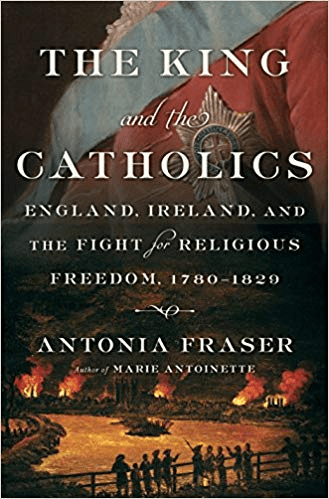
Frazer details the travails involved in passing Catholic Emancipation. The King and the Anglican establishment were strenuously opposed to liberalizing laws against Catholics. Despite the fact that he had Catholic friends, George III opposed emancipation because it violated his coronation oath to champion the Protestant religion.

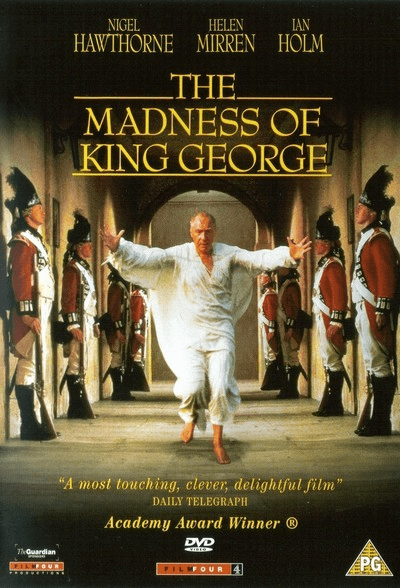
Prime Minister William Pitt proposed emancipation in 1801 and offered to resign if the King disapproved. This prompted George III’s descent into paranoia or “madness”. Frazer notes that

“There had already been a bout of this madness in 1788 and 1789, with the younger George as temporary Regent. Whatever the actual illness from which he periodically suffered, it included among the symptoms an obessional quality which certain topics unquestionably aroused. Catholic Emancipation, that appalling prospect which would cause him to be damned for breaking his sacred vow, was prominent among them:

None of this is mentioned in the 1996 film, featuring Nigel Hawthrone, of course!


Why did Catholic emancipation provoke this reaction? The British state faced a crisis in the early 19th century. Most accounts focus on the French and Industrial Revolutions, which disrupted the existing social order and alarmed ruling elites. Religion is scarcely mentioned. Thus from a Marxian perspective, the Chartists and the passing of the Great Reform Act — which extended the franchise to property holders — represent the bourgeoisie, demanding political rights to match their economic power. Acemoglu and Robinson model the transition from oligarchy to democracy as a game theoretic problem, in which the threat of revolution from below obliged elites to grant democratic rights, in order to make the promise of economic redistribution credible. Neither spends much time on religion.

But an older historical tradition saw the Catholic Emancipation as among the key causes of the constitutional crisis that the British state underwent in the 1820s and 1830s. According to John Derry (1963, 95):

‘The Protestant ascendancy was part of the Constitution: one might say without it the Constitution would never have existed. The Coronation Oath pledged the monarch to maintain the Protestant religion as by law established, while the Act of Settlement ensured a Protestant succession. Both the landed gentry and the commercial classes — as well as the urban mob — believed that if the Protestant ascendancy went the gates were open to unimaginable horrors.”

To understand why this was so, and why Catholic Emancipation paved the way for further liberalization and the rise of liberal democracy, let us revisit the argument of Persecution & Toleration.

The significance of the Protestant Ascendency reflected Reformation England’s Church-State equilibrium. The treatment of Catholics is a canonical instance of what we call condition toleration. Catholicism per se was not illegal, but it was constrained, and these constraints were justified in political terms. Throughout the 17th century, Protestants feared a return of Catholicism which they associated with unrestrained autocratic rule. For Henry Capel MP in 1679:

“From popery came the notion of a standing army and arbitrary power. Formerly the Crown of Spain, and now France, supports the root of this popery amongst us; but lay popery flat and there’s an end of arbitrary government and power. It is a mere chimera without popery”.

It was on these grounds that the Whigs sought to disbar James II from the throne. After the Glorious Revolution, the Toleration Act of 1689 excluded both Catholics and atheists. And famously, the great advocate of religious toleration, John Locke rejected toleration for Catholics, as they were loyal to a foreign prince.

The religious aspect of the Glorious Revolution is neglected in the seminal accounts of it in the political economy and economic history literatures (i.e. here). But the Glorious Revolution settlement did not only guarantee the independence of Parliament from the Crown, it also safeguarded the political position of the Anglican Church by excluding Catholics from positions of power. In return, the Church of England remained the mainstay of state. As J.C.D. Clark (1985, 438) observed:

“The Church justified its established status on a principle of toleration — the toleration of other forms of Trinitarian Christian worship. It drew a sharp distinction between this and the admission of Nonconformists to political power.”

This was particularly significant in Ireland, where the Protestant Ascendency ensured the political and economic dominance of the Anglo-Scottish Protestant elite over the Catholic majority.

Now 18th century Britain was much less reliant on religion to legitimate political authority than prior regimes. As Jared Rubin argues, one consequence of the Reformation was a decline in the legitimizing power of religion; it was superseded by institutions such as parliaments, which represented economic rather than religious elites.

Other things had changed too. The ascendancy of the Church of England was seen as crucial to state security in post-Reformation England. But this was no longer the case by 1800. Following the initial break with Rome in the 16th century, these fears had not been groundless: Protestant Englishmen felt threatened by revanchist Catholic powers such as Spain and France and, in the Gunpowder plot, Catholic conspirators threatened the death of the king and the destruction of Parliament. The fact that the vast majority of Catholics were loyal to crown and country was not enough to alleviate Protestant fears, which occasionally erupted into persecutions, such as those that accompanied the Popish plot.

Following the French Revolution, however, Catholicism was no longer associated with an aggressively expansionist continental power. The old enemy was now secular. Catholic priests fleeing Revolutionary persecution found sanctuary in Britain. And by the 1820s there was a growing pragmatic and liberal opinion in favor of Catholic Emancipation. Lord Palmerston’s argument, as summarized by Frazer (p 157), was that

“. . . times had inevitably changed, and the argument to history could not be sustained: what if Nelson, Fox and Burke had all happened to be Catholics by birth. Would it have been right to deprive the nation of their services?”

Liberal Protestant clergy further argued that

“a Catholic layman who finds all the honor of the state open to him, will not, I think, run into treason and rebellion” (quoted from Frazer, 2018, 158).

Translated into the framework of Persecution & Toleration: the equilibrium had changed. Catholics no longer posed a political threat. The legitimatizing power of the Church of England was waning. Population growth, urbanization — particularly the rise of new urban centers — as well as immigration from Ireland, undermined the ideological hold of the Church of England.

Nevertheless, when the issue finally came to head in 1827–1829, it brought down the government. Catholic Emancipation was the Brexit of its day. When the pro-emancipation George Canning became Prime Minister, its leading opponents, the Duke of Wellington and Robert Peel resigned and the Tory party split into two. Canning then died. But the move towards liberalization now had momentum. Agitation in Ireland raised fears of revolution. In 1828 the Test Act was Repealed. Wellington and Peel reluctantly switched sides. 1829 Catholic Emancipation passed, despite the fact that King George IV disapproved of it.

Thus according to J.C.D. Clark’s insightful (though contested) account:

“As significant were the consequences of Emancipation: the belief that the sovereign would not resist massive constitutional change; and the profound schism which now rent the party of Wellington and Peel” (Clark, 1985, 536).

Catholic Emancipation thus set in motion a more general constitutional revolution. Both Whigs and Tory ultras who opposed Catholic Emancipation lost faith in the existing Parliamentary system. A fundamental pillar of society, the Church-State alliance, had been undermined. It was followed by the Great Reform Act and the rise of liberal democracy. In Clark’s word’s

“. . . the effect of the measures of 1828–1832 was to open the floodgates to a deluge of Whig or radical reform aimed against the characteristics institutions of the former social order . . . English society can point to few events which changed the pattern on the ground with the totality and the dynamism of 1776, 1789 or 1917: 1832 was not such an event. It was, however, decisive in many other ways, for it dealt a death blow to England’s old order. In the process, it produced what in other disciplines is called a ‘paradigm shift’”(Clark 1985, 555–556).

Nightcap

  1. United States of Africa? Hakim Adi, History Today
  2. Eric Hobsbawm’s awkward embrace of the Establishment Geoffrey Wheatcroft, New Republic
  3. The philosopher who usurped Aristotle’s place in the Islamic world Peter Adamson, Times Literary Supplement
  4. Who are the real Kazakhs? Michael Griffin, Literary Review

Watson my mind today

Apart from grading, reviewing, and my soon-to-be 5-yr-old’s birthday, that is…

–  A good question from Don Boudreaux. “Assuming (contrary to fact) that American trade deficits do necessarily cause Americans’ indebtedness to foreigners to rise, why do you bemoan these deficits? Why not instead cheer them? … Being indebted to foreigners means that we Americans must repay these debts, which in turn means that we Americans must in the future work to produce more goods and services for export. Isn’t this situation precisely what you and other protectionists want? Isn’t a rise in the demand for American exports – especially a rise not derived from, or offset by, a simultaneous rise in American imports – your very ideal?”

–  Speaking of protectionism, Tyler Cowen on Elizabeth Warren’s agriculture proposal: “a disappointment on two fronts: too wonky to be considered a purely political document, but not nearly wonky enough to be defensible in terms of substance.” It fails to understand inflation and food price data, calls for more protectionism, and doesn’t remove subsidies. He says he might be persuadable on a “right to repair” law, but worries about copyright infringement.

–  One of the issues Ludwig von Mises himself, I am told, never fully settled in his mind was over patents and copyright. It seems a necessary evil to encourage innovation, but granting someone a government-sanctioned monopoly just grates the wrong way. Now we’ve got “patent trolls” to add to the mix, who do not innovate themselves but buy up patents to collect licenses and sue or threaten to sue others. A paper finds that patent trolls encourage more upstream innovation while discouraging downstream innovation.

–  Why does Scott Sumner simultaneously support the Federal Reserve’s interest rate hike last year and expect a cut this year? As a market monetarist, he would like the market to dictate Fed policy and “the fed funds futures market forecasts a rate cut. … Because markets continue to forecast slightly below 2% inflation, even as the economy slows, the market forecast of an interest rate cut should be taken as evidence that a rate cut is probably needed at some point this year.” I also enjoyed the picture that goes with the article – he is an owl, neither a hawk nor a dove.

–  There’s a dictionary, detailing how Africans speak about politics, including some fascinating idioms. “Three-piece suit voting” refers to supporting the same party for all elected positions. On the contrary, “skirt-and-blouse voting” means to vote for different parties for presidential and legislative elections.” Other enjoyable examples at the link.

–  538 has an interesting piece on the perceived fairness of kidney donation systems, and the real struggle that still exists trying to get people to accept slightly less-regulated systems (let alone actually compensating donors’ families).

–  David Henderson: Occupational Licensing is a Bad Idea. Still. Really.

Nightcap

  1. NATO at 70: ten of history’s most important alliances Brandon Christensen, RealClearHistory
  2. Rethinking American efforts to boost partner militaries Jason Fritz, War on the Rocks
  3. Brexit is getting worse Tom Harris, CapX
  4. On the eve of the Great Psychedelic Debate Matthew Blackwell, Quillette

Nazism: left or right? (again)

A few days ago, Brazil’s Foreign Affair’s Minister declared that Nazism “derives from the left”. Asked about his minister’s remark, president Jair Bolsonaro confirmed that he understands Nazism as a left-wing movement.

The understanding that Nazism is a left-wing movement is growing among Brazilian conservatives, especially those who support Bolsonaro’s government. On the other side of the debate, Bolsonaro’s adversaries ridiculed his remark or manifested concern with his “historical revisionism”.

Seems to me that classifying Nazim as a left-wing movement is not a Brazilian exclusivity. Political commentators from other countries (such as Dinesh D’Souza) are saying the same thing. It is probably more accurate to say that Brazilians are following a trend.

This trend, however, is not new. One of Friedrich Hayek’s main points in Road to Serfdom was to tell social democrats (who were indeed democrats in the classical liberal sense of the word) that they were closer to Nazis than they would like to admit. Hayek’s remark was as polemic then as it is now, but mainly because he is saying the truth: as Milton Friedman said, “The society that puts equality before freedom will end up with neither. The society that puts freedom before equality will end up with a great measure of both.” If I remember correctly, it was also Friedman who said that in order to obtain perfect equality more government would be necessary, which would completely undermine the desire for equality, for those in government would most certainly not be equal to everyone else.

The standard in Political Science is, of course, to call Nazim a right-wing movement. However, we see in moments like this how political and how little scientific Political Science can be. What many people observe is that Nazism shares a lot with communism: both are violent, both emphasize the collective (and not the individual), both rely on popular leaders, and so on. Of course, there are also differences: Nazism has nothing of the class-struggle so central to communism and certainly doesn’t appeal to the cosmopolitanism present in “workers of the World, unite!”.

With all that said, I have a growing feeling that there are only two political tendencies: “live and let live” and all others. Some people can’t stand the possibility of having others living a different lifestyle from them. Some people can’t stand people who disagree. Some people like to blame others. Some people truly believe that those who think and do like they do are superior to everyone else. These people come together and ask the government to force everyone else to comply.

Proposal: Let’s stop calling them “Property Rights”

I think an alternative that is both clearer and more general is “Decision Rights”. When I teach Coase Theorem I use both terms, and (I think) students have an easier time grasping it when they realize that property rights are really just rights to make certain decisions. I can’t see a good reason to keep using the term property rights except that by historical accident it’s become entrenched jargon.

Property sounds like “stuff” to most people. And property rights sounds like “owning stuff”. This raises two points that need clarifying:

1. There is more to the world than just the physical, and there is more to property than just stuff.

I would argue that economic rights are human rights. (I would also argue that corporations are owned and staffed by humans but are not humans themselves.) And I would say that right to self-ownership is a particular type of economic/human right.

When we talk about environmental issues, the root problem is usually over some shared resource (e.g. we can’t neatly privatize the atmosphere and let now-private conflicts be resolved in court). It’s much easier to focus in on the relevant particulars when our language directs us to what’s really at stake (e.g. whether I can decide to put more than X amount of pollution into the atmosphere without legal consequences).

2. I own a bit of land and I can make many decisions about how to use it. But I can’t set up a nuclear reactor or burn a massive pile of debris. My ownership is not carte blanche, but a bundle of different rights. I have the right to use (for normal domestic purposes), to exclude, to sell, etc. By “I own” what I really mean is “I can make a particular set of decisions.

I hope my hard core libertarian friends will agree with me that the decisions I can make are not limited by what is explicitly legislated. I suspect my interventionist friends will disagree. But I also think interventionists can agree that it’s more reasonable for me to have a set of decision rights (how ever nebulous the extent of that set is) than some more magical sounding dominion/ownership over a particular fifth of an acre.

The notion of decision rights makes it clearer what political debates are over. If we want to pass a law saying you can’t put a pool in your yard because of spotted owls, “property rights” muddies the discussion. The law would take away a particular property right–which is to say, the right to make a particular decision. But the debate is going to devolve into “you’re taking our land” vs. “no we aren’t.” It’s close to the real issue, but not close enough.

tl;dr: When we talk about “property rights” or ownership what we really mean is a set of various decisions that one has a right to make. Those decisions might be over the use of what we traditionally call property (e.g. my yard), but it might also be over shared resources (e.g. the atmosphere), decisions with collective impacts (e.g. ecosystem management–or lack thereof), or socially constructed issues (e.g. intellectual property). The term “property rights” is not clear or obvious (particularly for people who aren’t already likely to read this blog). A better term would be “decision rights.”

Old Property

Property is the basis for every right and ounce of autonomy we have. James Madison called property “that dominion which one claims and exercises over the external things of the world, in exclusion of every other individual.” Madison went on to argue that basically every right we enjoy is reducible to a property right. We have property in our opinions, in the free use of our faculties, in the safety and liberty of our body, and so on. He believed that “Government is instituted to protect property of every sort” and a government can only be just if it “impartially secures to every man, whatever is his own.”

But government has not remained impartial in this endeavor. It has become a massive property owner in its own right.  It has also become a gatekeeper, setting the terms for individuals’ uses of their own property. It has also become a broker and redistributor of property. And finally, it has =become a creator of property in the form of entitlements–what Charles Reich famously called “new property.” It’s this last role that I’d like to discuss here.

Government’s role as a creator of property has muddled and watered down the strength of property rights. The problem began when U.S. courts started grappling with claims that individuals had been deprived of a constitutional right when government stripped them of a government-created entitlement, such as social security.

Courts confronted with this problem basically held that while constitutional rights do attach to entitlements, the government has an increased authority to limit the rights to those entitlements. Essentially, since the government created the entitlement, the government can define the scope and terms of that entitlement.

This “new property” doctrine then became entangled with a different idea altogether. The United States Constitution protects against deprivations of life, liberty, and property without due process of law. The Constitution, however, does not define property. Courts have held instead that state law defines property , and the Constitution then protects rights to that property.

That does not mean, however, that all property can be whisked away at a whim as if it is all “new property.” Rather, even though state law may establish what property is, states do not have the power to mutate and redefine all property rights on a whim. In essence, there is “new property” and then there is “old property.”

“Old property” is a bundle of long-recognized property rights rooted in common law. But just because those rights have arisen from common law courts over the centuries does not mean that these are property rights created by government in the same sense as less-protected “new property.” There is a fundamental difference, for constitutional purposes, between government recognizing a boundary line and creating a food stamp program. In some sense, this difference strikes a deeper philosophical chord, one that distinguishes between positive law and natural law–or fundamental rights that are acknowledged and respected by government, and entitlements that are created and controlled by government.

What are these fundamental property rights? Most are intuitive and understood by babies as soon as their hands are capable of grasping. They include the right to exclude others (the first property right understood by all children everywhere), the right to quiet enjoyment, the right dispose of the property by sale or lease, the right to develop and improve the property, etc. That right extends to chattel and land–things the government does not create but simply exist and are brought under human ownership through a first-in-time rule or a transfer.

The idea that “new property” deserves lesser protection because government dictates its bounds has bled over into the “old property” rights. This stems from confusion between government recognizing the existence of a fundamental right and government creating an entitlement. Extensive permitting regimes have only exacerbated this confusion. When local governments demand a permit before a property owner can do something with their land, the government looks upon that permit as an entitlement–a privilege and not a right. Thus, “new property” ideas come to overlay and suffocate “old property.” As permitting regimes expand, the world of “old property” retracts. But that permit is not a “new property” entitlement–it’s a condition placed upon a fundamental background right–an intruder upon natural law. When a permitting authority tries to strip away or deny a permit, that denial should be subjected to the full rigor of constitutional scrutiny offered to “old property,” not the weak sauce protections for entitlements.

If a government is only just if it limits itself to protecting what is ours, as Madison believed, then we don’t have many just governments left to us. Courts could help by establishing a clearer distinction between the old and the new forms of property so that governments can’t get away with redefining or stripping away fundamental property rights.

Nightcap

  1. A socialist wave in Chicago Will Bloom, Jacobin
  2. Chicago has clearly voted for change Aaron Renn, City Journal
  3. Teaching Machiavelli in Palestine Irfan Khawaja, Policy of Truth
  4. NATO in an age of populism David Reynolds, New Statesman

Nightcap

  1. Scientific self-abnegation Nick Nielsen, Grand Strategy Annex
  2. Logic and emotion: notes on Bach Anitra Pavlico, 3 Quarks Daily
  3. Max Weber, Islamism, and modernity Shahrukh Khan, JHIBlog
  4. The rise of moral simplicity Chris Dillow, Stumbling & Mumbling