- Global poverty decline denialism Ronald Bailey, Hit & Run
- Wishful thinking: too much, and too little Chris Dillow, Stumbling & Mumbling
- Marxism as religion Branko Milanovic, globalinequality
- When the Space Race was a dead heat Rick Brownell, Medium
Month: January 2019
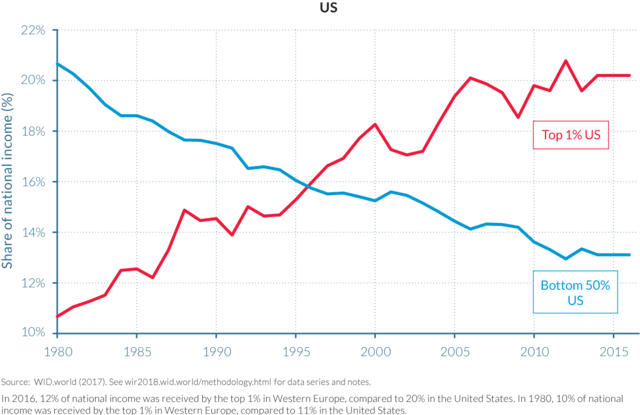
Shares of Income – Common Left Delusions
Two big conceptual mistakes are hidden in one small graph that help the leftist delusion.
1. I do not contest the data. I have not checked them. They may be correct. I don’t know; I have another purpose.
2. People who use this graph (though not the makers of the graph, maybe) implicitly assume that those who were in the top income 1% in 1980 are the same as those who are in the top 1% in 2016, or their parents. The graph says nothing about this. One thing is clear: Steve Job or his parents would not have been in the top 1% in 1980; Steve Jobs would have been, for sure, in 2010, his estate in 2016. The graph does not show the perpetuation of privilege and of inequality, as users almost always imply. Suppose that 100% of those who were in the 1% in 2016 were not (or their parents, or their grandparents) in 1980. This would show a fast change of economic elites. It might pose a problem but not the problem the envious imply when they display the graph.
The problem here is intellectual passivity.
3. The percentage of income that accrues to a given fraction of the population – including the top 1% – tells you nothing about how well anyone has fared economically, whether anybody is richer or poorer than he was at the beginning. Here is an example: Suppose, you and I both earn $1,000 at the beginning of the period of observation. Thus, we each get 50% of our joint income (1000/2000). Suppose further that during the period observation, my income doubles while yours quadruples, I am now getting only 33% while you are getting 66% (2000/2000+4000 vs 4000/2000+4000). My share in percentage terms has declined while yours has ballooned. Question: Am I now poorer than I was at the beginning of the period? That’s a “Yes/No” question.; don’t equivocate. The problem is here is failure to understand elementary school math.
The chart is produced by the World Inequality Organization, a single purpose outfit not dedicated to the possibility that inequality may be decreasing. The data it offers have not been certified by the usual scholarly processes This organization’s executive committee includes Thomas Piketty who could not get his data straight in his best-selling book. He had to refer critics to a website to get his story down. The earlier edition of the same book became famous for not including in US calculations: food stamps, rent support, free medical care, and more, in US welfare recipients’ incomes. I don’t know the others, which may or may not matter. Too many Europeans for my taste. I don’t like it, from 40 years of observation. That last remark is somewhat subjective, of course.
Together these simple comments add up to this critical judgment of the relevant chart: Either, those who use it normally don’t know what they are talking about or, they are not saying anything that matters.
Nightcap
- Kurds fed up with Erdogan and the PKK Fazel Hawramy, Al-Monitor
- Somalia’s fractious politics Anzalone & Hansen, War on the Rocks
- How to make anti-terrorism a misnomer Michael Koplow, Ottomans & Zionists
- Guess the rain’s down on Titan Caleb Scharf, Life, Unbounded
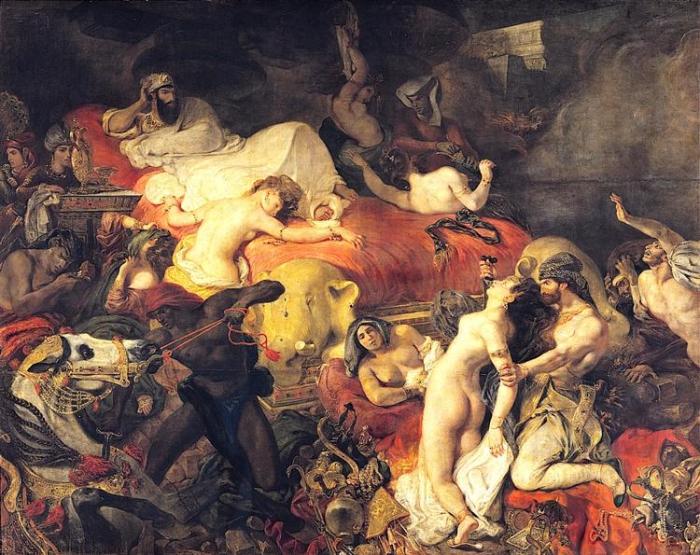
Afternoon Tea: Death of Sardanapalus (1827)
Delacroix requested Delacroix so, here you go:
Bad Religion
The Heidelberg Catechism is one of my all-time favorite Christian documents. Written in 1563, mostly by Zacharias Ursinus, the Heidelberg (as it is sometimes called) is composed by 129 questions and answers (the classical format of a catechism), supposed to be studied in 52 Sundays (that is, one year). I believe it is very telling that, being a catechism, the Heidelberg was written thinking mostly about younger people, even children. Ursinus himself was only about 29 years old when he wrote it. Maybe it is a sign of the times we live in that the Heidelberg sounds extremely deep for most readers today.
Throughout its questions and answers, the Heidelberg covers mostly three Christian documents: The Ten Commandments, the Lord’s Prayer (“Our Father who art in Heaven…”) and the Apostle’s Creed. The catechism is also divided into three main parts: Our sin and misery (questions 3-11), our redemption and freedom (questions 12-85), our gratitude and obedience (86-129). Probably an easier way to remember this is to say that the Heidelberg is divided into Guilt, Grace, and Gratitude. That is also, according to many interpreters, the basic division of the Apostle Paul’s Letter to the Romans, historically one of the most important books in the Bible.
I mention all these characteristics about the Heidelberg Catechism because I think they are worth commenting on. As I learned from a friend, that is the Gospel: Guilt, Grace, and Gratitude. As C.S. Lewis observed in Mere Christianity, Christians are divided on how exactly this works, but all agree that our relationship with God is strained. That is the guilt. However, in Jesus Christ, we can restart a peaceful relationship with God. That is the grace. This should be followed by a life of gratitude. That is the way the Gospel is good news. If you don’t emphasize these three points you are not really presenting the Biblical gospel. To talk about grace without talking about guilt is nonsense. To talk about guilt and not grace is not good news at all. To talk about guilt and grace but not of gratitude is antinomianism. To talk about gratitude (or obedience) without talking about guilt and especially grace is legalism. But also, notice how unbalanced the three main parts are: Ursinus dedicated way more space for grace and gratitude that he did for guilt.
That’s not accidental. Also, it is very interesting that he talks about the Ten Commandments when he is dealing with gratitude. It didn’t have to be this way. Ursinus could have included the Law when talking about guilt. He could use the law to show how miserable we are for not fulfilling it. But instead, he wanted to show that obeying God is a sign of gratitude. You are free already. Obeying will not make you any more saved. But it is certainly the behavior of a truly restored person.
If you read so far, I should first thank you for your attention, but also say that I am completely unapologetic for speaking so openly on Christian themes. At some point in history, Christians decided to adapt to the modern culture. That was the birth of Christian Liberalism. Modern man, some of them assumed, could no longer believe in stories of gods and miracles. Modern science was able to explain things that societies in the past thought to be supernatural occurrences. The Bible was at worst pure nonsense or at beast a praiseful reflection of the piety of people in the past, but certainly not a supernatural revelation from God. But if you take away the supernatural elements of the Bible, what do you have left? Good morals, some thought. I believe they were wrong.
The social gospel is one consequence of Christian liberalism. The central miracle in the Bible is that Jesus, a mortal man, was dead for three days and resurrected. That is indeed a miracle. Make no mistake: people in the first century knew as well as we do that people don’t come back to life after three days. Maybe they knew it better than we do, for in the 21st century, for many of us, death is not a part of everyday life. For them, it certainly was. Christians have believed through almost two thousand years that Jesus’ death and resurrection have something to do with us being reconciled to God. But if Jesus didn’t resurrect, and no one really heard from God that he is angry, what do we have left? The answer, according to Christian liberals, is social justice. Reform society. I believe that for this, they own society at large an apology, and I will explain why.
I heard from too many people that the reason they don’t go to church is that Christians are hypocrites. “Do as I say, but not as I do”. Maybe they are right. The balance between guilt, grace, and gratitude if fundamental for Christianism to work. Salvation (reestablishing a rightful relationship with God) is by grace, not by works. Say that salvation is by works and you set the board in a way that you are sure to lose. As I already mentioned, I think it is just wonderful that the Heidelberg Catechism talks about the Law of God (The Ten Commandments) when it is discussing gratitude, not guilt, and I believe this is a great lesson for us today.
I say all this today because I believe that political correctness is (at least to a great degree) the bastard son (or daughter) of the social gospel. See the recent Gillette commercial that caused so much controversy, for example. Are they really saying anything wrong? Don’t men behave sometimes in ways that are less than commendable? I believe we do. Especially coming from a Latino culture as I do, I am more than willing to say that men all too often are disrespectful towards women and also towards other men. However, how the people at Gillette know this? If there is no God, or if he didn’t speak, how can you tell what is ethically commendable behavior and what is not?
I am no specialist, but as far as I know, more than enough atheist philosophers are willing to admit that in a sole materialist worldview there are no universal grounds for morality. As the poet said, “if there is no God, then all things are permissible”. It is always important in a conversation like this to explain that I am not saying that atheists cannot be ethical people. That is absolutely not what I am saying. Some of the best people I ever met were atheists. Some of the worst were Christians who were at church every single Sunday. With that explained, what I am saying is that there is no universal guide for human behavior if there is no God and everything just happened by chance. There are particular guides, but not a universal one, and to adhere to them is really a matter of choice.
The way that I see it, people at Gillette want men to feel bad and to change their behavior. They want men to feel guilty and to have gratitude. But where is the grace? I believe that is why this commercial irritated so many people. It makes people at Gillette look self-righteous or legalistic. Or both! But it definitely doesn’t help men to change their ways, supposing that there is something to change. I believe there is. There is a lot to change! But political correctness is not the way to do it.
Nightcap
- James Madison won the shutdown Greg Weiner, Law & Liberty
- A Marxist defense of Venezuela Louis Proyect, Unrepentant Marxist
- Emergent complexity in a multi-planetary ecology Nick Nielsen, The View from Oregon
- Christian martyrs, marriage, and the Middle East Christian Sahner, Aeon
RCH: MacArthur’s rule over Japan
That’s the subject of my latest over at RealClearHistory. An excerpt:
The relative graciousness of the American occupation of Japan led to the most peaceful and prosperous era in Japanese history. MacArthur’s governing strategy for a conquered people was so successful that it was aped by Washington in 2001 and 2003 when the United States invaded and occupied Afghanistan and Iraq. What went wrong? You could write a dissertation trying to answer that question, but the most straightforward answer is that Iraq and Afghanistan were not conquered. The governments of Kabul and Baghdad never officially surrendered to Washington, and they never really had the capacity to wage war the way that Japan was able to wage war on the United States.
As always, I appreciate the clicks…
Nightcap
- Anthony de Jasay, RIP Alberto Mingardi, EconLog
- A grim portrait of human nature Lou Marinoff, Footnotes to Plato
- The last Englishman Soni Wadhwa, Asian Review of Books
- What can history tell us about the future of international relations? Sørensen & Møller, OUPblog
Blame it on Rio
I grew up in Rio de Janeiro in a very middle-class neighborhood. Not the fanciest one, but also not the poorest. Very much in the middle. This neighborhood also had the characteristic of being surrounded by hills. Many if not most hills in Rio de Janeiro have favelas. Favelas are poor neighborhoods that are formed by poor people who mostly want to live close to where the jobs are. Because I grew up in a middle-class neighborhood, studied in middle-class schools and had a middle-class family I was in danger of only knowing middle-class people. The thing that prevented me from that the most was going to church. In church, I lived with people from all kind of social backgrounds – including people who lived in favelas.
The history of Rio de Janeiro is mostly a history of expansion from the area we today call downtown. On several occasions, poor people (including my grandfather and his mother) were relocated (or frankly expelled) from their houses by the government that wanted to make some urban reform. People faced two options: to be relocated to far removed areas, far away from their jobs, or to occupy some undeveloped area in the vicinities of where they previously lived and form a favela.
Because Rio de Janeiro is the historic capital of Brazil, it received a lot of investment by governments over the decades. Many governments wanted to make it a vitrine of Brazil’s development. Also, Brazil has a strong history of developmentalism. Especially since Getúlio Vargas, who rule the country from 1930 to 1945 and again from 1951 to 1954, Brazilian presidents tend to believe that it is their job to bring economic development to the country. The higher the GDP growth, the best. I mean, who am I to say that GDP growth is a bad thing?! But we have a lot of stories worldwide of countries that grew too fast in too little time leading among other things to major population dislocations and new pockets of poverty around great cities. Lagos, in Nigeria, is a textbook example. So is Caracas, in Venezuela. So is Rio de Janeiro. This kind of development is pretty much like using steroids: the results are fast, but the side effects are terrible. Fernando Henrique Cardoso tried to “flip the page” from Vargas in the 1990s, but Lula da Silva and Dilma Rousseff returned to developmentalist policies in the 2000s. Even Jair Bolsonaro often talks as a developmentalist, apparently a tic from his military years. Anyways, developmentalism led to the fast growth of Rio de Janeiro over the decades – and the formation of new favelas.
One of the best stories of developmentalism in Rio de Janeiro is the neighborhood of Barra da Tijuca. Until the 1960s this part of the city, caught between the hills and the ocean, was basically desert. That’s when the government commissioned the architect and urbanist Lucio Costa to develop the area. Mr. Costa was also responsible for designing the city of Brasília, and it shows: Brasília and Barra da Tijuca are fairly similar. Not my kind of city or neighborhood. It’s very hard or even impossible to explore Barra da Tijuca on foot. Its area is roughly the size of Manhattan, but it has no subway lines. The bus lines are not very dependable. The city blocks are very large. Everything is very distant.
In my evaluation, Mr. Costa thought that he was God. Brasília and Barra and very interesting if looked from above, from the sky. But if you are on the ground level and don’t have a car, they are just not friendly. But that’s how modernists (including socialists) are: they swear they love humanity but hate human beings.
The news that the government was developing the Barra da Tijuca area spread fast. Many families came to the region looking for jobs in construction. Many of them settled in the vicinity of Rio das Pedras. Rio das Pedras became one of the main favelas of the region. In the absence of government, people started to organize themselves in neighborhood associations. Even with most of the construction projects done, the families never left. Barra da Tijuca became an affluent neighborhood with many jobs. Alongside came drug trafficking.
The “pre-history” of drug trafficking in Rio de Janeiro is almost idyllic. You just have to watch the movie City of God (2002). Of course, one could not sell drugs in fancy neighborhoods like Ipanema or Copacabana, where the government is strongly present.
So, most drug trafficking happened in the favelas, including Rio das Pedras. The first generation of drug dealers was mostly respectful towards residents of the favelas and other poor neighborhoods. Some even became legendary for pacifying the neighborhoods from other forms of crime: because they didn’t want to have trouble with the police, drug dealers would punish criminals themselves. However, this changed very fast. The dispute for territory led drug dealers to become more and more violent.
In response to drug dealers and the slackness of the government, people organized in militias. What once were neighborhood associations became paramilitary organizations. Just like happened with the drug dealers, the vigilantes were initially friendly towards the people living in the neighborhoods. However, this changed very fast. The dispute for territory led militias to become more and more violent. Eventually, drug dealers and militias became mostly indistinguishable. Some militia leaders entered politics.
Marcelo Freixo, a Rio de Janeiro politician of the PSOL (Socialism and Liberty Party – as I said before, a contradiction in terms) rose to fame in the 2000s for presiding over a parliamentary inquiry on the militias. Mr. Freixo had a character inspired on him in the movie Elite Squad 2 (2010). The first Elite Squad (2007) was a very good movie. The sequel, not so much. Elite Squad is somewhat based on real events and tells the story of (what else?) BOPE, an elite squad in the Rio de Janeiro military police (somewhat analogous to the SWAT), especially during the visit of Pope John Paul II to the city in the late 1990s. The movie has some similarities to Black Hawk Down (2001). If you haven’t watched it and want to be spoil free, you might want to skip to the next paragraph.
Pope John Paul II decided to stay in a dangerous neighborhood, surrounded by favelas. The BOPE was responsible for his security. Although disagreeing with the strategic intelligence of allowing the Pope to stay in a dangerous region of the city, the squad did its job. In very military fashion, “orders are orders”. The movie shows the police officers as very dubious figures: they are extremely violent and often disrespectful towards citizens. But they are also very honest and dutybound. Captain Nascimento, the main character, is a tragic figure. He became a police officer to protect innocent citizens. He discovers that by obeying orders he is often just putting his life in risk for very little or no results. Worse, he is misunderstood by all those around him, including his family.
Even his son ends up calling him a fascist. Elite Squad also portrays the drug dealers in a nuanced way. They are violent and vengeful, but Captain Nascimento himself understands that no one grows up dreaming about becoming a drug dealer. Drug dealers and BOPE members fight a private war and ironically might be the only ones to truly understand one another. The real villains of the movie are the upper-middle class youngsters who use drugs, financing the drug dealers who the BOPE fights. It is against them that the police officers direct most of their rage.
So, I believe that Elite Squad is a very good movie, that pictures quite well how life in Rio de Janeiro is for many people. Most of the time it is hard to precisely identify villains or heroes. However, no wonder, despite being very popular, the movie was trashed by leftist intellectuals who called it fascist. The sequel gains in quality in almost everything but the characters, and this makes it worse than the original. The villains are completely villainous and the heroes, heroic. It lacks the nuances of the original. The character inspired by Marcelo Freixo is morally perfect. The vigilantes whom he fights are cartoonish evil.
Brazilian and international media gave much attention last year to the assassination of Marielle Franco, a Rio de Janeiro politician who, just like Mr. Freixo, was a member of the PSOL. Ms. Franco’s assassination, like any other, is a tragedy. The police investigation is still ongoing, and no one really knows who killed her, but it seems very likely that she was murdered by members of a militia. Despite what international media might lead one to believe, Ms. Franco was far from being the first Rio de Janeiro politician to be murdered in the last few years. Mr. Freixo himself is under police protection for many years now. Other politicians from several political parties were not so lucky and didn’t receive the same attention from the media. The left’s last blow against president Jair Bolsonaro is to say that one of his sons, Flávio Bolsonaro, is somehow connected to Ms. Franco assassination. In their narrative, Flávio would be connected to militias who in turn killed Ms. Franco. All things are possible. Not all are plausible. Definitely, not all are proven. To be honest, there are people in the right saying that Jean Wyllys, also from the PSOL, is connected to Jair Bolsonaro’s assassination attempt last September. Maybe they should all go have a drink together. They have much in common.
Making a generalization (but I hope not an overgeneralization), politicians and intellectuals from the left tend to romanticize drug dealers. They are pictured as social victims or social bandits, almost Robin Hoods. On the other hand, they vilify the militias in a cartoonish way. Just like Elite Squad 2. I began this text mentioning that going to church prevented me from entirely growing in a middle-class bubble. Because of that, I heard people saying that old drug dealers had at least some sense of justice. Younger ones (sometimes as young as 16 years old) are almost animals, psychopaths without any sense of empathy. If you watched The Godfather trilogy you know what I mean. I also heard people frustrated with the government, that offered no protection against criminals. The same people were (at least initially) supportive of militias.
Politicians in the right, in turn, consider unimaginable to legalize any drug. But on the other hand, they were very slow to understand the danger of the militias, and citizens making justice with their own hands in general.
So, this is a story about Rio de Janeiro, one of Brazil’s most important cities. For decades politicians believed it was their job to bring economic development to the country – and to the city. This led to fast economic growth, which in turn led to the development of favelas. Favelas are areas where the official government is generally not present.
Therefore, its residents form neighborhood associations. Favelas are also places where, because of the lack of government, drug dealers can work in relative peace. However, over time drug dealers become more and more violent in their dispute for territory. The neighborhood associations, in turn, become militias. And the militias quite often become mafias. Some politicians rise to fame fighting these mafias, but the policies they defend are the same that begin this story in the first place. Politicians on the right are accused of dangerous liaisons. And no one seems to be willing to limit government to its primary function of protecting life and private property.
Afternoon Tea: No Kakinomoto Hitomaro (1835)
From Japanese artist Katsushika Hokusai:
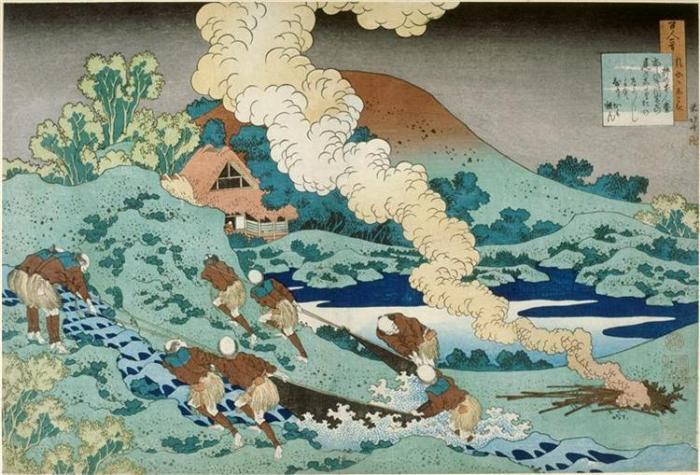
This one can be found at the Guimet Museum in Paris, in case you’re ever there…
Nightcap
- China’s foreign fighters problem Mathieu Duchâtel, War on the Rocks
- Your failure of imagination is not my problem Zoe Todd, anthro{dendum}
- Sustainable dystopia: a form of permanent stagnation Nick Nielsen, Grand Strategy Annex
- French is an Indian language Blake Smith, the Wire
Government shutdown – private vs. public responses
The recent shutdown of the government in America has caused a midsize crisis for state employees leaving them unpaid for 35 days straight. Although the shutdown ended on the 25th of January, one can still draw a conclusion about the crisis handling from a public and a private perspective.
A failure of government
When you take a closer look at the history of governmental crisis management, you mostly look at a huge collection of mismanagement. In the last few years there has been a tremendous amount of intriguing works dealing with the failures of public crisis responses, especially the case of hurricane Katrina (Wikipedia here lists more than 100 references), which has been one the of most investigated disasters in recent history.
Crisis can provoke the good as well as the bad inside humans. One might think of the countless volunteers after nature catastrophes doing their very best to help. On the other hand, there have also been stories of grieving and plundering mobs on the streets, after hurricane Katrina for example. So, what we can say for sure is that crises push human behaviour to the extremes. Keeping this in mind it sounds reasonable to leave it to the government to set up an agenda of rules to coordinate humanitarian efforts. However, the government fails most of the time to deliver effective responses to crises, whether they are man-made or exogenous.
Not being able to find an agreement over the federal budget indicates that the government also has very limited options to offer to their employees. And indeed, Lara Trump gave some very handy advice to unpaid workers: “Listen, it’s not fair to you, and we all get that, but this is so much bigger than any one person. It is a little bit of pain but it’s going to be for the future of our country. […] Their children and their grandchildren will thank them for their sacrifice right now.” Yes, please explain to your children how you nearly starved to death because of a dispute over a wall. Sounds reasonable.
Whereas Donald Trump’s kind of clumsy attempt to clarify Ross Wilbur’s statement that government workers should take out loans (Maybe a small loan of a million dollars, huh?) was not too stupid at all. He emphasizes that worker should “work along” with local grocery shop owners they know. He was very clear that employees could not expect help from the government, but instead, they should look out for support on a local level. I do not think that this is a good method of communicating this issue, but it is for sure a very honest one.
Mac & Cheese
A 35-day shutdown, so to speak nearly a missed monthly wage, might not sound unbearable for a central European. But keeping in mind the saving habits of many Americans, a huge amount of government workers are facing existential problems. A recent FED survey found out that about 40% of the American population is not able to cover a 400$ emergency expense without selling or borrowing something.
Witnessing the inability of the government to provide payments for their workers, private enterprises reacted in a remarkable way. The huge food company Kraft rented space for pop-up stores in Washington in which they gave away food entirely for free. One of the most demanded products was Mac & Cheese. The celebrity Chef José Andrés provided free groceries for affected government worker through his NGO “World Central Kitchen.” When the government stopped caring, people started to do so.
Learnings
The overwhelming care for the unpaid government workers by the private sector further strengthened the role and importance of individual responsibility. In situations of crises, people tend to be less submissive to authority and focus on voluntary cooperation of human beings. I feel like it is important to mention here that I do not want to praise crises as a suitable method of bringing people together. But when we take a closer look at the history of humanity it becomes evident that instead of governmental decisions, voluntary human cooperation made our modern life possible. And in times of crises, people become clear about the relevance of these values and processes, which normally guide human progress subconsciously and unnoticed. Private responses to crises are a sign to me that humans are capable to display kindness, cooperation, and humanity beyond the borders of government.
Time to emerge from the campaign finance mythology
Campaign finance laws long ago ascended to the Mount Olympus of political mythos. The mantra that we must exorcize money from politics has become an article of faith. But the basic premises undergirding this creed rest on a sandy foundation made up of unsound logic and unsupported claims. Not to mention a total disregard for First Amendment rights. The Supreme Court, however, will soon have a chance to reconsider campaign finance laws’ often dubious rationales and uncomfortable relationship with the First Amendment.
Campaign finance laws kicked off in the late nineteenth and early twentieth centuries with some early laws that banned corporation contributions, but they mostly gathered dust. Then, ironically, Republicans in 1947 used campaign finance laws to try and stifle union contributions, which led unions to create the much-hated PAC to dodge the restrictions. Then first serious attempt at comprehensive campaign finance regulation swept through in 1971 with the Federal Election Campaign Act. FECA laid down strict contribution and expenditures limits. Six years later, FECA led to the Supreme Court’s major canonical work in campaign finance lore, Buckley v. Valeo.
Buckley was a mixed bag. On the one hand, it struck down limits on independent expenditures by people who spend their own money on political communication during a campaign. On the other, it upheld limits on direct campaign contributions. Hence, both sides of the campaign-finance divide gripe about Buckley—First Amendment advocates want campaign contributions to be just as uninhibited as independent expenditures, and campaign-finance believers think government should be able to curtail independent expenditures to the same degree as campaign contributions.
As a speech advocate, I fall into the camp that feels Buckley did not do enough to protect First Amendment interests. Buckley relied on flawed notions about the nature of campaign contributions and the alleged need for limiting them. For example, the Buckley Court claimed that contributions don’t deserve as much First Amendment protection as expenditures because the speech facilitated by the contribution is someone beside the contributor. The trouble is that the same is true of expenditures—typically a political spender’s message is conveyed through a go-between, like an ad agency or a TV station. Courts have never held that reliance on someone else to convey your message robs you of the right to promote that message. Except for Buckley.
Another rationale for distinguishing contributions and expenditures is the “general” nature of a contribution. An expenditure allows the speaker to tailor his precise message. I.e.: I support Daenaerys Targaryen because she fries Lannisters with dragon fire. But if you just give a contribution to the Targaryen campaign, then no one knows why you support her. Anti-slavery? Dragons? Small Hands? You could be contributing for any reason, and the lack of specificity translates to a weaker First Amendment right. This is another lame excuse. After all, does the guy holding a “Warren 2020” deserve less First Amendment protection than someone holding a “Harris for better healthcare” sign? No case has ever said so or will ever say so. Except for Buckley.
The third rationale for contribution limits is that the quantity of the contribution does not strengthen or weaken the speech being regulated. That is, Buckley says if you give $5 or $500 to the Palpatine campaign, your message is the same. But surely the number is a clear metric for degree or intensity of support. If you gave $1 to Albus Dumbledore and $100 to Lord Voldemort, that says something about your viewpoint. If a cap is placed on contributions, the government is essentially saying that you can only support your candidate up to X amount—that’s more than a minor burden on someone’s right to political expression and participation. Plus, the contribution is not just about the symbolic act of giving—it’s also about the speech facilitated by that contribution, which is obviously affected by the quantity of the donation.
Buckley allowed contribution limits for the sake of combating corruption or the appearance of corruption. Here, too, Buckley falters. Study after study has failed to demonstrate that campaign contributions purchase special favors on anything approaching a widespread basis. Yet contribution limits take a widespread approach. Certainly, anecdotal evidence of quid pro quo exchange of contributions for favors exists. But that can hardly support a widespread cap where the overwhelming majority of contributions are motivated by ideological commitment, not a desire to obtain special political favors post-election.
Bereft of actual evidence, campaign finance zealots resort to bumper sticker slogans like “money buys elections.” Certainly, candidates who receive a lot of money tend to also receive a lot of votes. But this is just correlation. People will tend to donate to strong candidates, and people will also tend to vote for strong candidates. The likely variable here is a candidate’s popularity, not campaign contributions.
And what in the world is the “appearance” of corruption? No other First Amendment right that I know of lives or dies by the grace of the subjective feelings of the public. Rights are supposed to exist despite any prevailing hostility from the public. Yet that’s the Buckley standard. Indeed, courts have looked to public opinion polls and other tenuous evidence to uphold severe contribution limits in cities and states across the country.
While contribution limits likely don’t do any good, they do plenty of harm. Even beyond the injury done to the First Amendment interests of contributors, campaign finance laws tend to only help one group of people: incumbents. Campaign finance laws erect such arcane labyrinths that only the savvy, experienced politicians who can afford pinstriped election-law attorneys and have lots of name recognition will come out ahead. Contribution limits also do huge favors for wealthy, self-funded candidates.
Often, what political amateurs with no name recognition need is a concentrated boost of support from a small group of supporters to kickstart a competitive campaign. Contribution limits make this nigh impossible. But instead of loosening campaign finance laws that fortify incumbency, politicians peddle terrible ideas like term limits. If they truly wanted competitive politics (which they don’t), then they’d liberalize campaign finance.
Since we can hardly rely on the incumbents to break down incumbency protections, the time has come for the Supreme Court to return to Buckley. The Court will have the chance to do just that with a petition from a case called Illinois Liberty PAC v. Madigan. We could do for some fresh air in politics—the way to do that is to strip away an orthodoxy that only serves to protect the powerful.
Nightcap
- The plight of the political convert Corey Robin, New Yorker
- Fine grain futarchy zoning via Harberger taxes Robin Hanson, Overcoming Bias
- What happens to cognitive diversity when everyone is more WEIRD? Kensy Cooperrider, Aeon
- StarCraft is a deep, complicated war strategy game. Google’s AlphaStar AI crushed it. Kelsey Piper, Vox
Nightcap
- The internationalist disposition and US grand strategy Stephen Pampinella, Disorder of Things
- Let’s be blunt: classical liberalism is losing Johnathan Pearce, Samizdata
- On top tax rates Chris Dillow, Stumbling & Mumbling
- Are recessions about employment? Scott Sumner, Money Illusion
 Notes On Liberty