The legacy of autocratic rule in China

What is the long-term legacy of political persecutions? Here I want to present the main findings of my recent research with Melanie Meng Xue (UCLA Anderson). Our research is an attempt to undercover how a legacy of political persecution can shape social capital and civil society by studying imperial China. The full version of the paper is available here.

We know from other research that particular institutions, policies, and events can have a detrimental and long-lasting impact on economic and political outcomes (e.g. Nunn 2011, Voigtländer and Voth, 2012). But it is hard to find a setting where we can study the long-run impact of autocratic institutions. A key feature of autocracy is the use of persecutions to intimidate potential opponents. In our paper, Melanie and I argue that the intensification of imperial autocracy that took place in the High Qing period (1680-1794) provides an ideal setting to study the impact of such persecutions.

Qing China

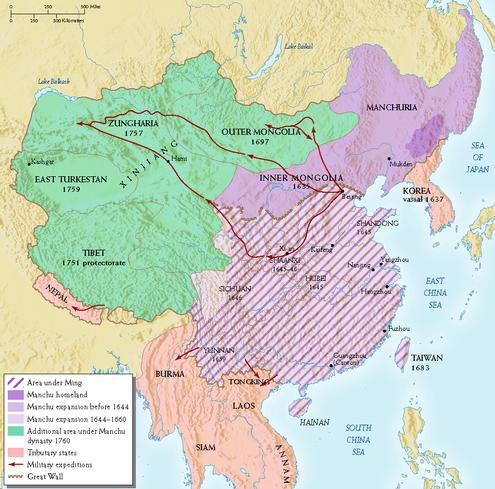
The High Qing period was one of great political stability, imperial expansion, and internal peace. Economic historians like Bin Wong and Ken Pomeranz have shown that China possessed a flourishing market economy during this period; it experienced Smithian economic growth and a massive demographic expansion. Rulers such as the Kangxi (1661-1722) and Qianlong Emperors (1735-1794) are seen as among the most successful in Chinese history. Nevertheless, as ethnic Manchus, these rulers were extremely sensitive to possible opposition from the Han Chinese. And during this period Qing tightened control over the gentry and implemented a policy of the systematic persecution of dissent. (Figure 1 depicts the Manchu conquest of China.)
chinamingqing
The Qing conquest of China

The Literary Inquisitions

The focus of our paper is on the impact of persecutions conducted by Qing China against individuals suspected of expressing disloyalty. We study the impact of these state-orchestrated persecutions on the social fabric of society. This allows us to speak to the kinds of concerns that authors like Hannah Arendt and George Orwell expressed about the long-run impact of totalitarianism in the 20th century.

These persecutions are referred to by historians as ‘literary inquisitions’. Existing scholarship suggests that the resulting fear of persecution elevated the risks facing writers and scholars, and created an atmosphere of oppression and a culture of distrust which deterred intellectuals from playing an active role in society. But these claims have never been systematically investigated. Putting together several unique datasets for historical and modern China, we explore the impact of literary inquisitions on social capital in Qing China and trace its long-run impact on modern China through its effect on cultural values.

spence
Jonathan Spence provides an excellent account of one of the most famous and unusual inquisition cases in his book Treason by the Book

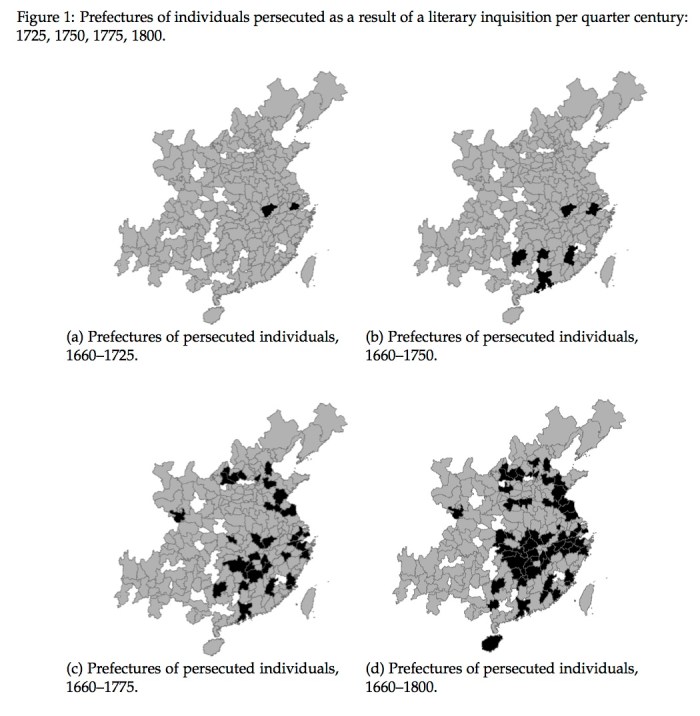
To conduct our analysis, we use data on 88 inquisition cases. We match the victims of each case (there are often multiple victims per case) to their home prefecture. This data is depicted in Figure 1. Since prefectures varied greatly in their economic, social, and political characteristics we conduct our analysis on a matched sample. This ensures that the prefectures “treated” by a literary inquisition are similar in terms of their observables to those we code as “untreated”. As our data is a panel, we are able to exploit variation across time as well as variation in space.

While individuals could be persecuted for a host of reasons, these were all but impossible to anticipate ex ante. Cases were referred to the emperor himself. Frederic Wakeman called this “the institutionalization of Imperial subjectivity.” The standard punishment in such cases was death by Lingchi or (slow slicing) and the enslavement of all one’s immediate relatives. In some cases, however, the guilty party would be executed by beheading. These persecutions aimed to deter opposition to Qing rule by signaling the ability of the Emperor to hunt down all potential critics or opponents of the regime.
Map.jpg

The Impact of Literary Inquisitions on Social Capital

We initially focus on the impact of persecution on the short and medium-run using our historical panel. We first examine the effects on the number of notable scholars.  In our preferred specification we find that a literary inquisition reduced the number of notable scholars in a prefecture by 33 percent relative to the sample mean.

We go on to show the effect of persecutions on collective participation among the gentry in China. Our measure of collective participation in civil society is the number of charitable organizations. Charitable organizations played an important role in premodern China providing disaster relief and local public goods such as repairing local roads. They were non-governmental organizations and played an important role alongside the government provision of disaster relief. In our preferred empirical specification, we find that a persecution number of charitable organizations by 38 percent relative to the sample mean.

These results are in keeping with the argument that literary inquisition had a major psychological impact on Chinese society. They are consistent with the rise of “inoffensive” literary subjects during the Qing period that have documented by historians. To reduce the risk of persecution, intellectuals scrupulously avoided activities that could be interpreted as constituting an undermining of Qing rule. Instead they “immersed themselves in the non-subversive “sound learning” and engaged in textual criticism, bibliography, epigraphy, and other innocuous, purely scholarly pursuits” (Wiens, 1969, 16).

The Impact of Literary Inquisitions on 20th Century Outcomes

We go on to examine how the effects of these persecutions can be traced into the 20th century. In particular, we focus on the provision of basic education at the end of Qing dynasty. In late 19th and early 20th century China, there was no centralized governmental provision of primary schools.  Basic education remained the responsibility of the local gentry who ran local schools.

Thus the provision of education at a local level was dependent on the ability of educated individuals to coordinate in the mobilization of resources; this required both cooperation and trust. We therefore hypothesize that if the persecution of intellectuals had a detrimental impact on social capital, it should also have negatively affected the provision of basic education.

We find that among individuals aged over 70 in the 1982 census – hence individuals who were born in the late Qing period – a legacy of a literary inquisition is associated with lower levels of literacy. This reflects the impact of literary inquisition on the voluntary schools provided by the gentry and is not associated with lower enrollment at middle school or high school. We show that result is robust to controlling for selective migration and for the number of death caused by the Cultural Revolution.

Finally, we show that literary inquisitions generated a cultural of political non-participation. Drawing on two datasets of political attitudes – the Chinese General Social Survey (CGSS) and the Chinese Political Compass (CPoC) – we show that individuals in areas in which individuals were targeted during literary inquisitions are both less trusting of government and less interested in political participation.

Finally, we find that individuals in prefectures with a legacy of literary inquisitions are less likely to agree that: “Western-style multi-party systems are not suitable for China” (Q 43.). This suggests that in areas affected by literary inquisitions individuals are also more skeptical of the claims of the Chinese government and more open to considering alternative political systems. Similarly, individuals in affected prefectures are more likely to disagree with the statement that: “Modern China needs to be guided by wisdom of Confucius/Confucian thinking.”

In summary, our analysis suggests that autocratic rule reduced social capital and helped to produce a culture of political quietism in pre-modern China. This has left a legacy that persisted into the 20th century. These findings have implications for China’s current political trajectory. Some scholars anticipate China undergoing a democratic transition as it’s economy develops (Acemoglu and Robinson, 2012). Others point to China as an example of “authoritarian resilience.” By showing that a long-history of autocratic rule and political persecutions can produce a culture of political apathy, our results shed light on a further and previously under-explored source of authoritarian resilience.
BC’s weekend reads

  1. China’s Legalist Revival
  2. Does Europe need a new Warsaw Pact?
  3. Daniel Larison (PhD in Russian History) on Trump’s foreign policy speech
  4. The Anti-Trumplodytes
  5. Why Popular Sovereignty requires the due process of law

Were Confucians the first internationalists?

Sheng [Hong] uses the term in this broader sense, so that we can say that tianxia zhuyi is the idea of a global civilization that encompasses a diversity of cultures. In fact, this interpretation matches with the historical evolution of the Chinese empire, which was a multiethnic body politic based on certain universal civilizational principles and artifacts such as the Chinese script.

It is essential why Sheng makes that distinction. He claims that globalism, which he considers to be a Western term, is actually violating basic principles of economic liberalism in opting for trade liberalization but containing international migration.

That is from Carsten Herrmann-Pillath, a Professor of Business Economics at the Frankfurt School of Finance and Management, in a chapter titled “Smith, Confucius and the Rise of China.” The chapter is in Volume 8 of The Adam Smith Review, edited by Fonna Forman, which in turn was a gift from Edwin to me. There is no mention of Mises or Hayek (or NOL!) in the bibliography. Herrmann-Pillath continues:

So, globalism is a conceptual framework which still builds on the conception of the nation state and hence economic nationalism […] Ideas about the transition from the ‘nation state’ to a new political order based on culture and civilization continue to flourish among Chinese intellectuals until today. (88)

Unlike Chhay Lin and Matthew, I don’t know very much about ancient or medieval Chinese political thought,  but I can buy Sheng’s argument. In fact, I’m surprised it has taken this long for scholars anywhere in the world to realize that certain schools of thought in an empire would be internationalist. What is more curious to me, though, is this “new political order based on culture and civilization.” Why not base it on the individual? It seems to me that basing political orders on hard-to-define terms like “culture” and “civilization” will only lead to major problems, such as cultural chauvinism, down the road.

An overview of India-China boundary disputes

I have a new paper that has just been published in Asian Affairs. Here is an excerpt:

Questions over the India-China border are not a new phenomenon. They are asked whenever there is a Sino-Indian state visit. Despite having close to $100 billion of trade between them, China and India have failed to bring their frontier disputes to an end. In the 1980s and 1990s it was thought that the increasing economic cooperation between the two countries would act as a prompt to resolve their political disputes, but it has not. Military stand-offs and confrontations between border guards from India and China occur at regular intervals. To address their boundary disputes, they have engaged in frequent dialogues (17 rounds of focused dialogues can be counted between 1988 and 2015), but nothing substantive has yet been yielded through such engagements.

The boundary disputes between India and China have their ultimate origin in the ‘Great Game’ played during the British Empire. At present, the two main areas of dispute along the Himalayan frontier are the western sector (Aksai Chin around 37,250 sq km/14,380 square miles) and the eastern sector (Arunachal Pradesh, around 83,740 sq km/32,330 sq mile). This article traces the roots of the boundary disputes between India and China and attempts to discuss sources of tensions and probable solutions.

The link to the whole paper can be found here [pdf].

Free Trade and Labor Market Displacement

A few days ago, I saw Noah Smith’s piece on free trade and why opening up with China may have yielded some undesirable results. In essence, his argument is that labor market adjustments have been slow. It created a small storm in the economics blogosphere. I wanted to reply earlier. I did not and I regret that. However, better late than never. So here are my three key reactions to the piece written by Smith (see his blog here).

  1. Slow labor market adjustments are not a cause of free trade: If anything, they are the results of a series of government intervention. Countries like Denmark, which may have large governments combined with fewer regulations on businesses, are very well able to adapt to free trade. The ability to start businesses is basically the ability to properly channel inputs towards more valued output. If you prevent an entrepreneur from doing just that while you open your borders to more efficient producers, it is quite obvious that free trade could be “less” beneficial. This point can be well seen in the role of states with “right to work (RTW) laws”. Although there is a debate as to whether or not RTW laws increase wages (James Sherk at Heritage says yes, the good people at the Employment Policy Institute say no and I say that both don’t get it, we should care about regionally adjusted real wage growth), it does seem that it helps industrial activity while boosting employment levels (see here too).  Unions would hinder adjustments to changes in trade patterns. In fact, its worth pointing out that of the 11 states that had RTW laws before 1948 – in only three of those states did the income share of the top 10% exceed that on the whole United States (see the data here) in 2013. While the entire country has seen an increase in income inequality, the RTW states have seen the share of all income of the top 10% increase by only 26% (1947 to 2013) compared to 42% nationwide. This suggests that RTW laws are probably helping workers adjusts to changes caused by free trade (otherwise, there would be a state-level increase in inequality). This finding seems to conform to large section of the literature on the links between RTW and inequality (here and here).  I am sure that if the Autor, Dorn and Hanson study (on which Noah Smith relies) was to be redone with attempts to control for right to work laws, the effect would be concentrated in non-RTW states. Thus, if the problem is labor laws, don’t blame free trade for the poor adjustments!
  2. Nobody said that free trade was “costless” to adapt to. I do economic history. I see cases of industries being protected for decades. Protectionism not only raise prices, but it changes relative prices between different inputs. It incites the adoption of an artificially profitable production method. It is profitable to do so, but it is by no means the most efficient approach. It was made profitable only by the artifice of regulation and duties. Once you eliminate that artifice by removing the barriers, you still have “time to build” problem and a need to change production methods. That takes time. However, governments are very good at making sure this takes more time than needed (see point 1)
  3. Trade agreements with China are not free trade agreements: this is the point I keep repeating (and the point that actually make Paul Krugman interesting), free trade agreements should normally fit on a napkin. If it takes 10,000 pages, it is free trade with 10,000 exceptions. Noah Smith should realize that he may be looking at a case of such “managed trade”.

That’s all folks!

Down All Your Markets

The US stock market had its worst ever initial trading weeks in 2016. Speculators are alarmed by the fall in the stocks of China. The economy of China has been growing more slowly, if at all. Also, most of the economies of the world are in growth recessions, a reduction in the rate of growth. The US dollar is high relative to other currencies, which reduces exports.

The government of China has yet to learn that interventions into financial markets often backfire. The Chinese chiefs have halted stock transactions when the market average falls to seven percent. They also have not allowed sales by investors who own more than five percent of a company. One problem with financial “circuit breakers” – a halt of trading – is that when stocks start to fall, speculators will panic and sell more quickly before trading halts. Restrictions on selling stocks create uncertainty when buying them. A speculator will fear being unable to sell shares later.

There is enough inherent uncertainty in markets without government adding to it. Uncertainty makes it important to let the market set the prices. Markets are a discovery process in which prices and quantities evolve through the bids of buyers and offers of sellers. When government interferes, we cannot know the price. Since the leaders of China have decided to have a market economy in goods, input factors, and financial assets, they should allow the market to do its job of setting the prices.

When I visited China three times, I saw a forest of cranes in all the cities I went to. Construction has driven the economy of China, along with exports. But, similar to real estate booms elsewhere, this construction was propelled by governmental policy. Throughout the world, cheap credit and fiscal subsidies to real estate have fueled unsustainable speculation.

Now China has much excess building capacity, and the halt in construction reduces related goods such as furniture and raw materials. The slow-down in China and sluggish growth elsewhere has resulted in a collapse of commodity prices.

The chiefs of China seek to move the country’s economy towards more domestic consumption. But they interfere with domestic spending by imposing a value-added tax of 17 percent on most goods other than real estate. The government of China probably chose to impose a VAT because the World Trade Organization allows the VAT to be subtracted from the price of exports, unlike an income tax. But Chinese consumers suffer a higher cost of living.

The Chinese leaders could have instead enacted LVT, land-value taxation, which would not add to the cost of goods. A tax on land value reduces the purchase price but not the land rent, so also not the price of goods. A tax on most of the rent or land value would stop the land speculation that has made a few people rich at the expense of the public.

The government of China still maintains tight control over the banking system. All the markets – real estate, financial, goods – would be more efficient if interest rates too were set by the market supply and demand for loanable funds. Of course the central banks of Europe, Japan, and the USA also are not letting their markets set the money supply and interest rates. But common practice does not imply optimal policy.

I don’t think the big drop in stock market averages imply impending economic doom. For 200 years, the US economy has had a real estate cycle of an average duration of 18 years. The current cycle began with the depression of 2008. The recovery has been slow, but the expansion has continued as employment and output have grown. Real estate construction has contributed to the expansion, and land values have recovered. The economy seldom has a recession while interest rates and commodity prices are low.

The economy of China has some severe long-run problems, but its economy is still developing and catching up. The government seems ready to let the currency trade more freely, and the coming acceptance of the currency (the yuan or renminbi) into the “special drawing rights” of the International Monetary Fund will boost the economy.

In the short run, the US stock market could fall some more, as markets often overreach, but over the next few years, financial markets will be consistent with the economic reality of restored world-wide economic growth, if there are no major destructive attacks. What we should be worried about is the unsustainability of debt and the next real estate speculative boom. The next economic disaster is about a decade into the future, and nobody is yet alarmed about that.

Are small autonomous political units economically viable?

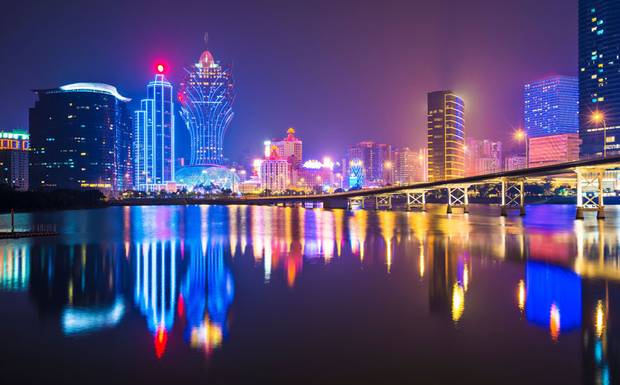
Macau Skyline

I am at the moment enjoying my end-of-year-holidays in Macau, a micro-state next to Hong Kong and like Hong Kong also a Special Administrative Region (SAR) of China. Being a SAR basically means that Macau is allowed political and economic autonomy, but still belongs to the People’s Republic of China. This construction is also known as the “One Country, Two Systems” constitutional principle. Being here makes me realize once again the unique position of micro-states. Although I understand that GDP per capita is no measure of everyone’s personal income, I would still like to stress that Macau has the second highest GDP per capita income in the world in 2014 according to the World Bank and that the CIA has placed Macau at spot number 3. Macau has furthermore the 2nd highest life expectancy rate (CIA, 2012). Some other interesting facts about Macau:

  • 0% VAT;
  • max. personal income tax rate of professional practices is 12% and only for incomes above MOP424,000 (~ 53,000USD);
  • currently 30% of this professional tax is waived;
  • tax free income threshold stands at MOP144,000 (~ 18,000USD);
  • Macanese residence in possession of an ID-card receive a yearly refund of 60% of the professional tax paid, subject to a cap of MOP12,000 (~ 1,500USD);
  • Macau is also known as a gambling/entertainment hub of Asia with the gambling/entertainment industry making up around 50% of the economy.

It is sometimes claimed that small autonomous political units are economically unviable, but Macau – like Hong Kong, Singapore, Monaco, Liechtenstein, Luxemburg and more – disprove this claim. Two reasons that are often given for the unviability of small autonomous political units are (a) economies of scale is difficult to realize in small states, and (b) they are vulnerable to trade shocks because their size prevents the states from wide diversification in economic activities. If these reasons would hold, then we would certainly find that micro-states are generally poorer than larger states. However, Easterly and Kraay (1999) have empirically found that micro-states[1] are 40-50% richer than other states when controlled for location by continent, controlled whether they are oil producers, and controlled whether they are members of OECD. In addition, Easterly and Kraay have found that life expectancies in these states are about four years higher and that the under-five infant mortality is lower by 22 per thousand. This suggests that micro-states do not suffer from developmental disadvantages.

Micro-states have been particularly more successful, because without abundant access to land and labour they are pressured to specialize their national economies[2] and to engage in international trade. International trade is particularly important in order to acquire goods that cannot be produced nationally. This pressure to trade encourages peaceful inter-state cooperation. Moreover, due to its small size, public policies are easier to follow which tends to result in greater political transparency. It hence increases the incentives of citizens to become politically involved. The rule over a small territory makes public policy targets also more efficient, and as a result fewer taxes are required. Nevertheless, one could still argue that micro-states in Easterly and Kraay’s research are large enough to be economically viable, but that especially those states that consist of maybe as few as 100 members would suffer from developmental disadvantages. This however, is a question of what the smallest possible size is for an economically well-functioning state. It is an interesting question that I unfortunately cannot answer. I will nonetheless leave a note from Plato on the subject to emphasize the importance of the division of labour in any well-functioning state. In Plato’s Republic, Socrates asserts that the state arises from the division of labour through which goods are efficiently supplied so that its citizens’ needs are fulfilled. The smallest notion of the state, as Socrates then asserts, exists of at least four persons who can produce the greatest human necessities: a farmer, builder, weaver, and shoemaker. I do not share the opinion that these specific four occupations are necessities for a small state, but I think you get the gist: for a (minimal) state to function well, you need at least division of labour.

Reference
Easterly, W., & Kraay, A., (1999). Small States, Small Problems? The World Bank.

Footnotes
[1] Micro-states are defined by Easterly & Kraay as states with populations of 1 million or less. Some examples of the 33 investigated states are Belize, Cyprus, Gabon, Iceland, Luxemburg and Suriname.
[2] Specialization increases productivity, and hence competitiveness.

Which countries are of US interest?

I was reading my news stream when I noted a blog post from the Cato Institute discussing the silliness of adding Montenegro to NATO. I don’t disagree per se. I certainly don’t see the value of adding Montenegro to NATO, if the purpose of NATO is to protect the US. Nor do I disagree with the general US-libertarian belief that the US has over extended itself in terms of military alliances.

I do wonder though what countries US-libertarians should desire to maintain a military alliance with. A North American military alliance, ranging from Canada to Panama and including the Caribbean, makes sense to me. The Atlantic and Pacific Oceans are our greatest defenses, but I welcome military cooperation from our geographical neighbors.

Beyond there though it gets tricky. Western Europe is certainly rich enough to protect itself. The main reason I am hesitant to leave NATO altogether is the nuclear question. France and the UK are the only European powers with nuclear weapons, but several others are part of NATO’s nuclear sharing program. Should the US leave NATO would these countries seek nuclear weapons for themselves? Would the UK/France provide substitute weapons? Ending military ties with Europe would likely be the easiest option in terms of cutting down on allies.

Japan and South Korea are likewise rich countries, but here too the nuclear question arises. Japan has a cultural aversion to nuclear weapons that I do not see it overcoming in the foreseeable future. South Korea may be willing to use nuclear weapons, but its strained historical relationship with Japan leaves me concerned about the future possibility of a Korean-Japanese alliance to counterweight China PRC. I believe that Japan should be encouraged to modify its constitution to allow its military greater freedom in action and to consider acquiring nuclear weapons of its own. Other nations in the region, such as the Philippines, are outmatched in conventional weaponry or, in the case of Australia, too far away geographically to be of much use in restraining China PRC’s influence in east Asia.

I am hopeful that within my lifetime China PRC will transition to a liberal democracy, but till then I am skeptical about allowing it free reign in east Asia. For the foreseeable future it is hard for me to consider an east Asia without a significant role for the US. Nor would I be particularly against offering South Korea and/or Japan statehood in a United States of the Pacific.

Thoughts? I admit that international politics is not my area of expertise and I more than welcome other’s thoughts on the matter. I also admit that I am not viewing these issues from a pure libertarian perspective but with a splash of nationalism.

As readers may know our own Brandon is playing around with creating a NOL foreign policy quiz similar to the Nolan libertarian quiz.

What About Terrorism?

Thoughts on terrorism from “The Moral Arc: How Science and Reason Lead Humanity toward Truth, Justice, and Freedom” by Michael Shermer (Holt, 2015).

I may be doing more quoting here than is allowed under “fair use” but here goes.  I will paraphrase his seven myths about terrorism.

  1. Terrorists are pure evil. This was what Bush said after 9/11, but studies show they are typically motivated by outrage at U.S. foreign policy.
  2. Terrorists are organized. There is no top-down, central organization directing terrorism.
  3. Terrorists are diabolical geniuses. The shoe bomber and others following 9/11 were incompetent.
  4. Terrorists are poor and uneducated. They are typically higher-income, better-educated individuals.
  5. Terrorism is a deadly problem. Compare 13,700 homicides per year with 3,000 from 9/11 and an average of 70 terrorist deaths per year, or 7.8 per year excluding 9/11.
  6. Terrorists will acquire and use a nuclear weapon or a dirty bomb. A real danger, but nuclear weapons require a lot of scarce material and sophisticated engineering.
  7. Terrorism works. Terrorists usually wait until after their deed is done and then proclaim that whatever outcome happened was in fact their goal.

Please read the book yourself.  The section I have paraphrased (pp. 80-86) is a response to objections to his thesis that the over-arching trend of recent decades is toward a safer, more peaceful world.

I’ll add some thoughts of my own:

  1. Groups based on violence and hatred will eventually self-destruct as they splinter into factions and devour one another.  But “eventually” leaves time for a lot of damage.
  2. This seems like a great opportunity for Western governments to cooperate with Russia and perhaps China because Islamic terrorism is a threat to all those parties.

Leaders of all the Western nations have expressed outrage, as has Putin.  Radio silence thusfar from leaders of Islamic nations which, one presumes, have a lot to gain by distancing themselves from terrorism.

From the Comments: The Contribution of American Allies to Pax Americana

Dr Stocker answers my concerns about free-riding and rent seeking with this gem:

Good points Brandon. On the rent seeking, I think you are broadly correct, but I would offer two qualifications. European nations/the EU often foot a lot of the bill/take on associated civilian tasks where America has taken military action, so that the US is not subsidising the defence and security needs of Europe quite as much as it might seem. So for example, in the Yugoslav breakup led to US military operations and a comparatively passive role for Europe, but a lot of the afterwork was taken on by Europe and there is no point in military intervention without work on building civil society to create long term security and stability. Going back a bit further to the first Gulf War/expulsion of Saddam from Kuwait, Germany and Japan did pay a lot towards the cost in return for not participating. Despite [this] they got a lot of abuse in the US Congress from politicians who don’t appear to understand that their non-intervention in the Gulf owed a lot to constitutions and attitudes which the US encouraged/imposed during post-World War II occupation. Recently, though European govts have been cautious in what they say in public about the Ukraine crisis and containing Putin, there is a growth in military spending and co-operation done in fairly quiet ways largely with the aim of deterring Putin from adventurism in the Baltic states. Just one example, Germany has recently taken 100 Leopard II tanks out of retirement and work is underway for the Leopard III. Moving to the Pacific, Japan is enhancing its military and weakening constitutional restrictions on the deployment of the military (imposed by the US in the post-war Constitution) in reaction to Chinese assertiveness.

While I think it is broadly correct that the US has been paying for a military burden which should be born by Europe and Japan, the situation is not as extreme as it often assumed in the US and as far as I can see is moving in a more balanced direction. In general while it is true that the US has a very impressive military machine with some impressive technology and officers, I think some Americans are a bit over confident about this. A lot of Americans, at least amongst those who take an interest in military kit, appear very convinced that the Abrams 2 is the best tank anywhere, I would suggest that in military capacity, for cost, the Leopard II is probably better (it certainly does much better in export markets) and even in absolute terms ignoring cost, the French Leclerc (which is extremely expensive) has a good claim to be the best tank around, and the Korean K2 is another strong but very expensive candidate. The Abrams is expensive, heavy, difficult to transport and difficult to keep in sufficient fuel, though it can certainly do a very good job. A lot of Americans appear to be incapable of thinking of France as anything other than a surrender monkey joke in military terms, which is really very far from the reality, as can be seen by the very strong role that France is now taking in northwest Africa against violent Islamist fundamentalists. The US military may well be able to have the same military capacity for lower cost if it moves away from the Abrams II model of a tank that is expensive to run and transport as well as build.

So broadly a correct point Brandon, but I think the situation is a bit better than is often understood in America and is moving in the right direction as Japan and Europe are getting used to the idea of taking responsibility for dealing with new threats from China, Putinist Russia and the hydra of Islamist fundamentalists.

A very good point, and an even better angle with which to view the world.

My only quibble is that the right direction American allies are moving can easily be changed without a more fundamental shift in institutional arrangements between us. Some sort of federal or confederal arrangement would go a long way toward addressing this issue, and would further deepen the economic and cultural ties between constitutional democracies.

Or am I just looking for problems where there are none, in order for my arguments to gain ground?

From the Footnotes: Ignorance of Islam and of the Decentralization of Power

There are widespread calls for an Islamic reformation such as Christianity experienced in the sixteenth century, but the Reformation cleaved Christianity into two major traditions and many splintered sects; each grew independently of the others, eroding any hope of a Christian center that could rein in extremes. After its early division into Sunni and Shi’a, Islam has come to suffer enough from this segmentation without a modern reformation. Indeed, Islam is a democratic religion, so thoroughly decentralized that even muftis are elected. Many Muslims are interested not in further schisms but rather in reconciliation among the competing doctrines and their extremist messengers, ultimately reducing the violence carried out against each other and other civilizations. As Gilles Kepel argues, though the rise of militant Islamism has been spectacular, its hyperviolence has proved to be a liability rather than an asset. (243)

This is from Parag Khanna’s 2008 book The Second World: Empires and Influence in the New Global Order. This footnote is in most respects a microcosm of the book as a whole: it’s on the cusp of providing theoretical insight into how the world works but just can’t seem to shake a certain type of dogma associated with the technocratic Left (I think he has done a better job of shaking this dogma post-2008).

This footnote is also in most respects why I’ll never be a Leftist again, even as a sleek, trade-friendly technocrat.

This footnote says to me that Khanna is arguing for a hands-off approach to Islam on the part of the West. Khanna is saying that Islam does not need a Christianity-style reformation. So far, so good. Khanna and I are in agreement. Then he goes off his rocker, though, by arguing that Christianity (and by implication European society) became a net loser because there was no Christian center to temper extremists.

What?

Correct me if I am wrong, but doesn’t Christian Europe have higher standards of living/tolerance/pluralist values today than anywhere else in the Old World? And isn’t Christian Europe the one place in the Old World where it is awfully hard to find Christian religious extremists? Wouldn’t you have a better argument if you stated that is was the lack of a Christian center which has been responsible for the dramatic increase in standards of living/tolerance/pluralist values in the West?

Maybe Khanna is thinking of medieval Europe, with its devastating series of religiously-inspired wars, but somehow I don’t think this is the case.

The Muslim world is decentralized culturally (like Europe) and is trying to decentralize politically (again, like Europe). The political decentralization is being hastened by trade liberalization and global economic integration. This same decentralization is being resisted by the international order (including, especially, Russia and China) due to nefarious but understandable interests of state but also to the severe lack of understanding that Western intellectuals like Khanna have of social organization. A center of cultural or political or economic power does not guarantee a waning of extremes. In fact, in some cases (in most?) such a center of power actually contributes to extremes.

Khanna was so blinded (and, again, I think he’s changed his tune post-2008) by technocratic Left-wing theory that he could not see what he was arguing: that a decentralized Christianity gave rise to Europe as we know it, therefore the West should step back so that the Muslim religion can build a monolithic consensus in order to combat “extremes.” Am I mischaracterizing Khanna’s footnote? Am I knocking down a straw man?

Khanna’s latest stuff has been much better than what I found in his 2008 book. He still doesn’t go far enough, though. He needs to undertake Brandon-style libertarianism in order to really be a bad ass: let the process of decentralization happen, but (but) recognize new states where it is smart and safe to do so (Kurdistan? The Islamic State? Baluchistan?) and then integrate them into the imperfect but important international order that the West has slowly been building for the last hundred years or so.

Khanna’s incoherence on geopolitical matters is not limited to interesting footnotes. Check out what he wrote in the introduction (again, this is from 2008):

Many believe that the emerging world order is polycentric: China will remain primarily a regional power, Japan will assert itself more nationalistically, the EU will lack influence beyond its immediate region, India will rise to rival China, Russia will resurge, and an Islamic Caliphate will congeal as a geopolitical force. (xviii)

This is basically what has happened so far, and it largely falls in line of where I would bet my money (but not place my dreams) on future events (the Muslim world excepted; see above). Khanna has none of it though:

All these views ignore a much deeper reality: The United States, the European Union, and China already possess most of the total power in the world. (xviii)

I think this argument, if anything, reveals Khanna’s (and, by implication, the technocratic Left’s) authoritarian impulses and desires. The United States is the world’s sole hegemon, and it will be for a long, long time. The EU is a basketcase and China’s GDP (PPP) per capita stands at Intl$ 11,907 in 2013, just below the Dominican Republic, Serbia, the world average, and Iraq. Khanna’s inclusion of the EU – with the social democratic values that technocratic Leftists mistakenly believe Europe harbors – and China – an ode to both the condescending identity politics of the same technocratic Left and its fixation with centrally-planned but privately-run enterprises (“corporatism”) – in the troika of world powers illustrates nicely the weaknesses of the Left.

Khanna’s dogma gets him in more trouble (still on the same introductory page):

Russia, Japan, and India cannot assert themselves globally, militarily or otherwise […] In fact, they are being gradually outmaneuvered by the United States, the EU, and China in their own regions. (xviii)

Don’t cry for Khanna. Last time I checked, he was on the board of several prominent think tanks.

Khanna’s best chapter is on the Middle East (it starts with a useful map on p. 168 and ends on p. 253). His treatment of post-Soviet Europe is laughable (“Ukraine: From Border to Bridge”) and his treatment of China (“Asia”) is overly laudable. India gets just three dismissive pages.

Would I recommend reading it?

Yeah, sure. I like the concept of “second world” that Khanna tries (but fails) to convey. I like the way he thinks and his post-2008 work is especially good. There are a lot of facts that aren’t really facts in the book though, and he applies those facts to theories that I think are weak at explaining how the world works. Then again, when has reading a book ever hurt you?

Does size matter?

No matter how one sees the ideal liberal world, there will always be differences in size between the sovereign entities on the globe. Even in an anarcho-capitalist world there will be different sizes of the communities that people voluntarily form, although they will of course lack sovereignty in any external legal meaning we now associate with the term. So the question is: does size matter in international relations?

There are many answers to this, and I will be unable to provide them all here (or elsewhere, for that matter). There are instances where size, measured in number of inhabitants of a particular state, does not matter at all. Trade is probably the most important one. After all, it is not countries that trade but people, and if the trade is free, the nationality or location of the traders is of no importance whatsoever. This more or less still applies to the completely distorted trade situation we now regard as normal, with states continually interfering through all kinds of tariffs and non-tariff trade barriers. The real exceptions are cases where political action forbids trade, such as with the several economic boycotts between Russia and the West at present.

Size does not matter in other important segments of international relations either. In cultural exchange, there is no general correlation between size of country and quality of cultural expressions. Of course in the mainstream Western arts (sculpture, paintings, opera, symphony orchestras, etc.), it helps if a country has reached a certain level of wealth, but this is independent of size. Also, talented artists will normally be recruited from all over the world, or be able to sell their (indigenous) works globally. The same applies to sports. If one corrects for population size, many medals at the Olympics, or other championships, are won by athletes from small or middle-size countries.

The size of an economy does matter. Richer countries (in terms of gross domestic product per head) are able to direct more resources to influence international relations. Not only through military expenditures, but also through resources deployed for diplomacy, international negotiations, ‘soft power’, or otherwise. Yet a rich country does not need to be big country, neither in land mass, or in number of inhabitants. And poor countries can still influence international affairs, take for example North Korea.

Still, there are greater and lesser powers in international politics. There is not one distinguishing feature, but most of them combine a large number of inhabitants, a fairly large land mass, either a developed economy which allows for significant military expenditure or the assignment of extraordinary share of GDP to the military. Even then there are real great powers (US, China, Russia at present), middle sized powers (UK, France, Brazil, Indonesia, South Africa) and countries punching under their international political weight (India, Germany, Japan, Egypt, the Philippines, perhaps Turkey). This division is never stable, as the past decades have shown, where only the US has been a consistent top dog. Even small countries can exert significant international political influence, as Singapore shows, although the sheer lack of size will always ensure they can rank higher than the middle category .

So the answer is clear: size hardly matters at all. All countries can become more, or less important, regardless of geography, inhabitants, or economic circumstances. Different policies may cause countries to rise or fall on the “international relations influence league.” Of course, liberals will aim at dynamics caused by liberty increasing policies. That is the perpetual opportunity for liberals across the globe.

Around the Web

  1. Athens on the Midway: Defending Leo Strauss
  2. Should Earth Shut the Hell Up?
  3. Space of Mediation: Why do international labor recruiters in China charge so much, and why are they difficult to regulate?
  4. The strange normality of life in the middle of Syria’s war

Christmas went well. I’ve got four books I have to read before the three books I ordered from amazon.com (thanks to a gift card) arrive.

Around the Web

  1. What if Leo Strauss was right?
  2. How many people does the War on Drugs put in prison?
  3. Sympathy for the Devil: Palestine’s Tragic Collaborators (movie review of Omar)
  4. The Other Somalia
  5. Do black people have equal gun rights?
  6. Strategy of Condescension

Around the Web

  1. The changing face of Chinese advertisements
  2. Paul Krugman’s Philosophy of Economics, and What It Should Be
  3. Impertinent Obstructions, Human Folly, and the Power of the Market
  4. Anthropologist David Graeber’s Debt: The First 5000 Years is now available free online (pdf)