The other pertinent issue raised by Rafia is about the patriarchal structure, which is a political institution now sanctioned by religious practices and with social acceptance. The plight of women is considered to be a private affair but it is a political programme through which one gender controls the activities of the other. It defines values and sets up norms to control and regulate the body of women. This control and regulation becomes strong in conflict-affected societies where the level of violence is high. The stronger group tries to abduct and carry out violence against women from other communities while the minority, in the name of protection of its ‘honour’, puts all forms of restrictions on their women and carries out violence against them within their own community.
Around the Web
- A Republic of Cuckoo Clocks: Switzerland and the History of Liberty (pdf)
- Pastoralism in a Stateless Environment: The Case of the Southern Somalia Borderlands (pdf)
- The Profits of Power: Land Rights and Agricultural Investment in Ghana (pdf)
- Rethinking Postcolonial Democracy: An Examination of the Politics of Lower-Caste Empowerment in North India (pdf)
- Working Across Borders: Methodological and Policy Challenges of Cross-Border Livestock Trade in the Horn of Africa (pdf)
Facts vs Narrative: American Peronismo
Anyone who has written anything other than an accident report, maybe even only three letters to his mother, knows or guesses the following: facts often interfere with the quality of a narrative. Only very great writers manage to incorporate all the relevant facts without damaging the beauty of their narratives. Or, they make up facts that will fit without damage into their narrative. I am thinking of Mark Twain among a few others. But that’s in mostly fiction writing, intended as fiction and perceived as such by the reader. The other option is to leave out all the hard facts to the benefit of narrative beauty and then, you have poetry!
Writers in genres other than fiction – old-school journalists, for example – face the same issue, the same dilemma. While they wish to communicate facts, they understand that an attractive narrative helps them in their task. If nothing else, an enthralling story, does keep the reader, and the listener awake; even merely a pleasantly told story Only the un-gifted who face what they think is a captive audience (no such thing, I think) abandon narrative altogether. They insist on bullet points of facts, a method that seldom achieves much of anything, or anything lasting, I believe.
There is thus another, more subtle reason to craft one’s narrative when transmitting facts, a reason to which I just alluded: Facts embedded in a good narrative are retained longer than facts thrown out at random.
Form really matters when you tell others things you believe they ought to know. But facts are often undisciplined, they often refuse to be choreographed into the opera you wish to stage.
Every writer of other than fiction faces the same issue although more or less frequently. The issue is this: what to do with facts that injure an attractive feature, or the whole integrity of the narrative to which it belongs, like this:
“Dear Mom and Dad: I really, really enjoy Camp Iroquois. In the morning, with have this huge breakfast outside with huge omelets and as much bacon as we can eat plus pancakes with syrup and jam. Then, we wash a little and sometimes the counselors make us brush our teeth and we throw wet towels at each other. After that we, play baseball or touch football until noon. (Don’t worry, Mom, I am wearing my cap and lots of sunscreen.) After games, we all have barbecued lunch with hot dogs and lots of relish and cold coke. And then, we rest under a big tree and a counselor reads us adventure stories. After the story, we go and bathe naked in the pond that’s very close. Just the other day, I went to the pond early by myself and I slipped into water that reached above my head. You couldn’t see anything underwater and there was lots of mud at the bottom. So, I forgot that I could swim a little and I swallowed some pond water. Fortunately, Counselor John, the tall one I told you about was just walking by the other side of the pond. He ran and he pulled me out just in time. I coughed a lot of brown water but I guess I am fine, now, so, don’t worry. And, Mom, don’t worry about the laundry either because we hardly wear any clothes most of the time. Plus, I have found a way to make my underwear last for more than one day by just turning it inside out. Oh, I almost forgot to tell you that right after diner, every night, the counselors make a big bonfire and we sing songs until we feel tired and we have to walk to our tents to sleep.
So, Mom, and Dad, you see, I am having a great time at camp so, don’t fret about me.
Your son, Peter.”
You see the problem? The narrative of a happy kid whose parents need not worry about a thing would be improved by the removal of the near-drowning episode. If the child were wise beyond his years, he would leave it out, right?
The same problem arises with every political narrative, including the long-flowing narratives that serve as action guides by default for political parties and for political currents:
Do you tell a good story on an ongoing basis or do you include the relevant facts even if they interfere with its flow?
It seems to me that there is a major difference between political left and right in their willingness to worsen the narrative with facts. I may be wrong. I will listen to criticism and to contradictions. If my perception is correct however this preference for the narrative explains a great deal. It explains the fact that the left everywhere is inured to its own failures and to the success of its adversaries. Curiously, it explains why there is such a preponderance of leftists in practically all the arts, from Hollywood to French singers.
This preference for form over fact even explains the continuing puzzle that is the country of Argentina. I explain: There is no reason why Argentina is not Canada, as prosperous as Canada or nearly so. In fact, three times in one hundred years, the Argentinean standard of living nearly equaled that of Canada. Each time, it was after an important conflict elsewhere. Each time, Argentinians squandered their wealth; each time, they allowed themselves to fall back into poverty instead of taking off and out of underdevelopment for good.
The current government in Buenos Aires is the third iteration of a populist movement called “Peronismo.” The movement is based on a good story: a benevolent, and originally elected dictator, distributes the unjustly acquired wealth of the insolent rich to the poor to the “descamisados,” to those who don’t even have a shirt on their back. Sure the process, is sometimes a little messy but it does not matter; it’s the intention and the goal that matter. And if you stop the clock at any time during the re-distribution process, you will easily find poor families that are better off this year than they were last year.
Peronismo promises to create social justice and a decent life without the rigors and the discipline of communism, for example. The first two times, Peronist regimes ended in economic disaster, the second time, also in a brutal, murderous military dictatorship that lasted for seven years. The current Peronist regime recently had to assassinate a prosecutor in his home because he was about to splash the presidency bloody with a precise, well documented tale of murder and corruption in high places. (Argentina is not a stereotypical Latin American dictatorship however; the current president, Cristina Fernández de Kirchner was properly elected .)
The thing, when you talk to Argentinians of the middle class is how civilized they are, how courteous, how well educated, how well informed, (much better informed that middle class Americans in general, if you ask me). And they speak a beautiful Spanish that bears lightly the faint echo of the millions of Italians that form the bulk of Argentina’s population. And their songsters and their singers are second to none. I am listening to Mercedes Sosa as I write, whose “Gracias a la vida” would make me shed tears if I could shed tears. Before her there was Atahualpa Yupánqui, a singer and poet of the poor much better than any country music singer I know (and I know many). Even Buenos Aires pimps invented the tango which is more than you can say about pimps anywhere else. And then, there is that gaucho sitting on his skinny horse sipping hierba mate from a silver tube in a gourd. He always looked to me like a more authentic version of Western movie cowboys because he is not that well groomed, if truth be told; he is just more manly.
In brief, Argentina, the nation, has an excellent narrative. It’s all the better because it is not spoiled, it does not contain disturbing facts: Destiny and history favored Argentinians from the beginning but they are poor most of the time. (Currently, the country has a GDP (PPP) per capita of $19,000, against Korea’s $33,000, a country that had nothing in 1955, and $53,000 for the US – CIA Fact Book) Argentines always dive into poverty for the same reason: They insist that dividing into twenty a pie intended for six will be just fine. They give no attention to the requisites for baking a bigger pie. They are quick to endorse concrete injustices committed in the name of abstract justice. (After all, the expressed wish of the sovereign people must take precedence over constitutional formalities.) If all these obvious historical facts were woven into it, the narrative would not be nearly as attractive; it would be disfigured. It might be disturbing enough to force them to pay attention and begin fixing what’s wrong with their society at last.
It seems to me that a preference for the flow, the coherence of a narrative over the inclusion of relevant facts is commonplace but I think it’s routine among the tribes of the left.* Communism killed at least 100 million people. Yes but it fought injustice. Cubans lead miserable lives in Cuba; those who fled with the shirts on their back are twice richer than those who stayed, after only a couple of years parking cars in Miami. Yes, but the Cuban revolution was deserving of a great movie and it ended by providing free medical care for everyone. That is justice.
Even worse, the US is an international bully variously attacking other, weaker countries for their oil or to force them to adopt institutions they don’t like. A sense of decency requires that Americans stop the bullying.
In the US, the Democratic Party, propelled by its energetic left wing, often garners the extra votes it needs to win – beyond the obligatory black votes, union votes and teachers’ votes – by telling a good story: It’s the party holding the fort against the “war on women,” it’s the party of the little guy; it’s the party of the perpetually racially oppressed, of those oppressed merely because of their sexual preference, even of the newly oppressed “middle class.” Its narrative tugs at your heart strings unless you are very critical and very well informed. It’s a narrative that is squarely opposed to facts. Here are some facts that would change the liberal American story’s face, if they were allowed into that story:
- The War on Poverty may have been a good idea originally. Fifty years later later, we are allowed to take stock. There is no reason to believe it was a success. There are reasons to think it was a failure.
- The death rate of young black Americans is stupendous. Few die at the hands of police however. Mostly, they kill one another and they succumb to drug overdoses.
- At any one time, at least half of American adults are opposed to abortion on demand. A high proportion of these think it’s murder plain and simple.
- There is no evidence that, on the average, women earn less money than comparably situated men. There is a law forbidding this and there is no evidence that it’s often violated.
- Out-of-wedlock birth is highly correlated with poverty for all social and racial groups.
- The thesis that human activities (industrial, cars) are causing a rapid rise in global temperature that will cause catastrophes for the environment and, eventually for humans, that thesis is not well established, if it is established at all. Evidence against as a well as evidence in support is amassing quickly.
- When the US does not act as a world policeman, unspeakable horrors multiply.
I could go on and on, obviously. Liberals don’t want to include these basic facts in their narrative of injustice and of oppression, domestic and international because it would simply destroy it. Absent the narrative, they would lose almost all elections. That’s why it matters to contradict tirelessly with facts the fairy tale in reverse tirelessly propagated by the left and by media now mostly at its beck and call.
Under the guidance of the Democratic Party (today’s Democratic Party), America would become another Argentina. The Democratic Party is not “socialist” as old Republicans are fond to grumble. (“Socialism” is a word that has lost any fixed meaning. It may never have had one. Perhaps, it was always only an incantation.) The Democratic Party is Peronist. Peronism is a form of soft, self-indulgent fascism that drags everyone except the dictator’s buddies into poverty. (See my short essay on fascism on this blog: “Fascism Explained.”)
* Here is an example of a conservative narrative that would be spoiled by relevant facts. Conservative media heads keep repeating that the first thing to do to solve the problem of illegal immigration, is to “secure the border.” Let’s not kid ourselves, they mean the southern border of the US, the border with Mexico. Missing from this concise and manly, energetic-sounding narrative:
The fact that most illegal immigrants today do not come from Mexico, or from elsewhere in Latin America.
The fact that those who do come from south of the Rio Grande don’t actually swim across that river or trudge in the desert at night but that they drive in and fly in and then, overstay their visa.
The fact that arrests of illegal aliens where they are easy to catch, at places of work that concentrate them such as slaughter houses, the fact the number of such arrests is tiny, year after year. (I mean that this requires an explanation.)
The fact that illegal immigrants who are arrested and who, under the law, are supposed to be deported by priority, criminals, often get to stay, mysteriously.
All these facts who detract from the “secure the border” narrative for the simple reason that none of facts above would be altered if the National Guard stood right on the border with Mexico elbow to elbow, fingers on the trigger of their machine guns.
Odysseus and Individuality
The Iliad is the story of Achilles moving from rage with an ally to sympathy with an enemy. Many other characters appear and the extremism of Achilles’ character, which leads him to remove himself from battle and therefore the narrative, lends itself to allowing other characters to present other possibilities of human personality.
The Trojan characters, particularly Hector, provide on obvious source of alternatives, but so do the other Greek hero warriors, and one of those who emerges most distinctly is Odysseus. Though Odysseus is a fierce remorseless warrior, inclined towards killing the enemy, particularly when the enemy can be seen as socially inferior, he is also characterised by his intellectual resources. It is highly indicative that one of the major appearances of Odysseus in The Iliad is on a spying trip into the Trojan camp. This early appreciation of the role of intelligence of in warfare is part of what makes the Homeric epics a classic of the theory of war, as well as a class of many other kinds.
Odysseus we see in The Iliad is the best adapted of the Greek kings to moderating disagreements, speaking with a constructive purpose in assemblies and councils, and thinking about the conduct of the war. This does not always make him sympathetic, but it does show that the human individual can exist in a very vivid and alive way through speech and thought as well as through anger and violence.
It is fitting then that Odysseus get his own epic, The Odyssey, which contrasts the very communal, even hyper communal, world of men at war, with the growing isolation of a man separated both from the brothers in arms community of Troy and from his family community back in Ithaca. The journey from Troy to Ithaca takes him right across the Greek world of the time, conveniently for symbolising other kinds of distance between the world of war and the world of human community. That is in part the distance between a world of plunder and slave girls on one side, and a world of productive labour and marriage on the other side. The Homeric poems does not make the contrast as favourable to the home community, as that might suggest.
Clearly the Heroes at Troy in some way feel most alive at war, straining their human faculties most in that endeavour. The Iliad also suggests other ways in which individuals can heighten the sense of life, the athletic competition at the funeral of the Patroclus and the desire to be remembered in poetry are the most obvious. These are not separate activities from war in Homer. Odysseus participates in games and weeps at poetic performance about himself in the land of the Phaeacians. In both cases war is very close. The games nearly turn in to violence between Odysseus and a Phaeacian who ‘accuses’ him of being a merchant and the poetry refers to the Trojan War.
With all due qualifications, we can still say that The Odyssey shows the value for an individual of getting back to the peaceful world of productive labours and familial affections. It also shows an individual losing all of the normal social bonds that define the self and finding other aspects of the self, which are not obviously present in the community of war and plunder or the community of family and labour. These are the aspects of the self which are part of ‘individualism’, of the idea as an individual as having an existence behind and, to some extent, separable from the most deeply entrenched social roles and connections. The appreciation of such aspects of the individual is the ethical foundation of political ideas of liberty, and Homeric poetry, though apparently the product of very communal communities, does much to establish that ethic (in some ways more than later philosophers in the antique world).
Odysseus confronts the possibility of a lonely death at sea after losing all his men in the long journey from Troy. The fault is partly his and partly his men. The vital passage for many of these issues is the adventure in the land of the Cyclops. Odysseus is thoughtless of danger when he takes some of his men to a cave whose occupant is absent, where they feast on the available food. Odysseus is taking assumptions about the applicability of laws of hospitality to an imprudent extreme here, and even tips over in plunder when it seems he plans to return to the ships with much of what is in the cave before the occupant returns.
The occupant, Polyphemus, returns too soon for that and is inherently more inclined to consume his guests than give them presents. Odysseus evades death through cunning, partly by telling Polyphemus that his name is ‘No man’. This idea of Odysseus that he might be taken as anyone and therefore no one, is itself a comment on how being some thing depends on being recognised as someone. It is also a resourceful individual thinking of how to use these abstractions to evade danger. Odysseus, however, guarantees ten more years of danger by boasting of his name and demanding it be known when he is sailing away from the island, incurring the enmity of Polyphemus’ father the god Poseidon.
The danger of the name and the desire for a name is emphasised later in the Sirens episode where malevolent demigoddesses try to lure Odysseus to his death with songs of the glory of Odysseus. To only want to live by your name as warrior heroics is dangerous. Odysseus has to resist this to live and again be thrown back on a very individualised kind of individuality.
The Homeric role in the origins of liberty is then partly bound up with the sense that even an individual very tied to the basic forms of community in his society can only fully thrive and live, if wiling to experience and play with, or suffer, separation from social bonds, and that the strength of those bonds itself rests most strongly on characters who can confront and live from encounters with extreme and even traumatic loss of communal bonds, and without becoming addicted to such situations and there dangers either.
The Framework Agreement on Iranian Nuclear Everything: Questions
Today, the day after President Obama announced in the Rose Garden a “framework agreement” intended to limit the Islamic Republic of Iran’s pursuit of nuclear weapons, I read the Wall Street Journal account carefully but it did not help. I don’t understand it. It may just be too early for a good analysis. In the meantime several questions loom large in my mind.
- If I don’t understand the details, do I believe in an agreement with a hostile country described by a man who promised that “you could keep your doctor”?
- Do I believe that this agreement is to the advantage of the United States? The question arises because it was negotiated principally by two men with a track record. The first, Pres. Obama, succeeded in exchanging five terrorist generals for a single American soldiers who is a deserter according to those who were on the battlefield with him. The second, the current Secretary of State, demonstrated that you could leave the Palestinian/Israeli relationship in an even worse state than you found it.
- The President and the Secretary of State did not manage, as a part of this supposedly momentous agreement, to get three Americans held by Iran released. One of them is a former Marine. It should have been a tiny footnote to the main text. Ah, well, there is no text, just an oral argument! Frankly, in the bigger picture the freeing of three people is a small, symbolic thing. Symbols matter a lot though when you don’t have access to the hard facts. I don’t, you don’t.
- Is the mullahs’ government – that always cheated in the past – going to abstain from lying, this time? If it does not, is this agreement going to be the cause of the death of thousands of innocent Iranians (as collateral damage)? I ask because, the next administration may not have the current administration’s difficult-to-believe indulgence. It may just decide to take care once for all of a sore festering for twenty years. If an American administration does no such thing, what is the likelihood that a future (future) government of Israel will take the chance to see millions of Jews murdered? This is not gratuitous fear mongering. Two days before the announcement, an Iranian general was on TV affirming that Israel has no right to exists.
- Do I believe that our European partners will stand firm and renew their sanctions if Iran is caught cheating? The question arises because they were salivating on all their national TV at the prospect of selling, selling anything in Iran once the sanction were lifted.
On the bright side, the lifting of some sanctions will unleash a torrent of Iranian oil on the world market. This will further depress of global oil prices. One more thorn in the foot of the gangster Putin.
Can we count on juries?
Towards the end of this week’s Cracked Podcast an important issue was raised: juries are peopled by human beings and human beings are not naturally good at figuring out cause and effect. Over the last few hundred years the sort of evidence juries would have to evaluate were fairly simple; things like “does the glove fit?” (Okay, that’s a bad example.) But now juries are faced with expert witnesses discussing things like DNA evidence which requires a jury capable of interpreting statistical evidence. This is fine if the defendant has the money to hire their own expert witnesses, but for poor defendants they might well get railroaded by the ignorance of the jury. Is there anything that can be done?
Some more thoughts on what to do with conspiracy theorists and other libertarian sympathizers
Just a quick note on a perennial topic…
Years ago I met my (now) ex-girlfriends crazy uncle. For whatever reason we ended up talking about how some policy or other was a bad idea. “Oh cool,” I thought, a fellow traveler. And then he started talking about how 9-11 was an inside job. “Okay, sure, whatever, but there’s so much else. We could actually convince people that, for example, a better regulatory system could improve the world.” To which he replied that yes indeed 9-11 sure was extra inside-job-y.
Now, this guy was a legitimately crazy uncle, so whatever. But this exchange wasn’t about his being a crazy uncle, because I’ve met plenty of non-crazy, non-uncles who have been similarly zombie-like. Whether they’re of the “Obama is a secret gay Muslim” variety, or any other variety of conspiracy theorist, they are just completely uninterested in attacking the Democratic party for any sensible reason. And this is true of anti-Republicans too. There the conversation is something like “war sure is bad, huh?” “Yeah, and Bush’s puppet masters set the whole thing up.” “Okay, let’s just assume that’s true, how do we reduce the amount of war?” “By getting hung up on evidence that only convinces people who don’t need any more convincing!” “I’m going to go get another drink.”
Here’s the thing: there are plenty of good arguments for opposing whoever it is you want to oppose. Yes, it feels good to talk about how the bums in charge are pawns for the cartoon-mustache-twirlingly-evil powers that be. But if you want to be taken seriously, keep it to yourself.
I see two things going on here. First, these conspiracy zombies are simply bad at thinking like economists. The first rule of being a good economist is that you have to recognize opportunity cost. By perseverating on the big, exciting, good-vs-evil struggle amongst competing factions of the Illuminati (I guess?) you attach all your attention to something you’re unlikely to have any real influence on at the expense of minor but achievable goals like marginal improvement of the immigration system, or school choice, or any number of other things the other side is willing to discuss with you (yeah, yeah, they aren’t willing to discuss that stuff because they’re convinced that your side is in a deal with the devil too…).
Second, and this is more troubling, people have a natural predilection to these sorts of things. People would rather get excited about conspiracies than actually make the world a better place. Is there anything we can do about that? I don’t know. Maybe we need to convince rank-and-file Republicans and Democrats that aliens are conspiring to pit humans against one another by making us argue unproductively rather than simply reform immigration policy. Maybe Krugerz was right?
What is a nation?
This is a reply to Brandon’s latest post. I offer similar thoughts to the below post in my post about ethnicity.
I agree with Brandon that in discussing things we should not limit ourselves to thinking in terms of states. We must consider, as Brandon puts it, both supra and sub states. We must also recall that states are much more fluid than we usually consider them.
When discussing international relations I attempt to get my conversation partners to agree that:
(1) National borders are not stable and,
(2) National identity is more fiction than reality.
The first is easily confirmed by looking at historical maps. Here is a map of the Levant/Greater Middle East in 14th century BC, in 830 BC, in 634 AD, in 1135 AD, and in 1900 AD.
Egypt and Persia are the only two entities that are present in some form or another throughout this time span, and even then their respective borders have fluctuated with only a few core regions being stable. I have yet to find someone who disagrees with the first point.
The second point is harder to get people to concede. We often think of ourselves as a given national identity and find it difficult to imagine that our nation did not exist since the beginning, or at least as far back as imaginable. Most nations have a foundation epic that makes little sense when seriously scrutinized.
Take for example American national identity. Three hundred million plus souls imagine themselves as ‘American’, but what exactly does that mean?
American identity cannot be equated with a specific phenotype; i.e. Americans are not all blue eyed blond people of English descent. In colonial days blacks outnumbered whites in several regions. Today whites in the Mid-Atlantic states are bronze skinned due to the dominance of Mediterranean descent there. The southwest is filled with “Hispanics” who overwhelming self-identify as white but are not considered really white, hence the curious demographic term “non-Hispanic white.” Even in the cradle of the American revolution, Massachusetts, the largest ancestry group is the Irish not English. The only state that is predominantly of English descent is Utah.
Among whites there is constant tension over who was really white and who is a “white negro.” Germans, who are today the largest ancestry group in the US, were the first ‘white’ subgroup to have to fight to prove that they were really white. The Irish, Italians, and others of European descent all had to fight for inclusion into the ‘white’ group. Today Hispanics and Asians are both vying for inclusion.
The revolutionary war serves as the US’ de facto national epic and the leaders of the rebellion are treated (and on occasion sculpted) as demi-gods. Yet the popular image of the revolution is more fiction than reality. Americans paid very little in tax relative to residents of the British isles. George Washington was a horrible military strategist. The founding fathers were not fighting to ensure liberty for the common man – they were fighting to shift control of government from elites in London to elites in Philadelphia. To be sure there were a few true revolutionaries, such as Thomas Paine, who were involved in the hope of genuinely reforming government. For every Paine, though, there were a dozen Hamiltons who wanted to preserve the British Empire, just without the British.
‘American’, in so far as it is an ethnic label, is non-stationary and continually evolving. I would not be amazed if the American label went extinct and was replaced with other labels in the future. Perhaps the Pacific Northwest will become inhabited by Cascadians in the future?
None of this is unique to the American moniker. It is easy to pick on the United States since it is a young nation, but most nations are just as fluid and nonsensical.
What does it mean to be British? Turkish? Austrian? Spanish?
Were the inhabitants of the British isles prior to the Norman invasion British?
The Byzantine Empire was only recently destroyed and many of its inhabitants inter married with Turkic migrants. The Ottomans gave themselves the title of Roman Emperor, “Kayser-i Rum.” A friend of mine jokingly calls Turks “Anatolian Greeks.”
‘Austrian’ as a national identity is arguably younger than the American moniker. Prior to the disestablishment of the Hapsburg Empire in WW1 there was no independent Austrian geopolitical entity. Austria was a constituent member of the Holy Roman Empire, the Hapsburg crown lands, the Austrian Empire, and Austria-Hungary before finally becoming simply Austria following WW1. Austrians are as culturally distinct from other Germans as Bavarians or Swabians are. Why then are Austrians a national group, but the latter two aren’t?
The Iberian peninsula has been under Muslim control (700s~1600s) longer than it has been under a united Spain. Spaniards continue to have significant traces of Arab/Berber genetic material. Despite the actions of Franco, Spanish (or “Castilian”) is not the sole language used in the country. Several million in the country’s northeast wish to cease being Spanish altogether in order to form an independent Catalan.
What is a nation? I argue that it is a group label that is invented and sustained in so far as it serves to further the goals of elites. Within an individual’s lifetime they appear unchanging, but from a historical perspective they are fluid and are frequently created, killed, or reborn as needed. When conversing about geopolitics we cannot ignore national identity, but we must keep in mind that in the long run nationality can be, and is, molded to suit political goals.
Barbarian Liberty and Civilisation in Homer
Following from my last two posts, this will explore the sort of ‘barbarian’ liberty that Tacitus recognised in his time, that is of the early Roman empire, and was further explored by Montesquieu and Humboldt in the eighteenth century in relation to the poetry of Homer. ‘Homer’ here refers to two Greek epic poems attributed to him, The Iliad and The Odyssey, which had a very large presence not only in Greek culture, but in Roman culture which produced a kind of sequel in Latin, The Aeneid of Virgil, a very major work in its own right deserving of separate consideration.
As already indicated Homer shows us warriors of extreme destructive ferocity, who consider it normal and admirable to destroy enemy cities, taking slaves, and collecting loot as well as killing without mercy. A reasonable immediate reaction to that from a liberty supporting point of view is that this is the opposite of what liberty is about, that liberty oriented thought treats unprovoked violence as the prime evil. Without denying any of that, the kind of violence that the Homeric Heroes engage in is part of a social bond within which voluntary co-operation of some sorts. Here I am referring to heroes not just in the sense of the main protagonists of a story, but the semi-divine status they are accorded in Homer, and by implication which is accorded to them in Mycenaean (late Bronze Age) Greece, where these stories originate.
The Homeric world is one in which there is trade and commerce, but it is regarded as less ‘honourable’ than Heroic violence, including piracy and physical destruction of cites. What this refers to, in fictionalised and poetic ways, is a world of weak enforcement of rules about property and individual security from violence outside small compact communities. Trade is clearly hazardous, running risks of the piracy referred to and maybe trading valuables of a kind acquired by violence, including slaves. Wealth is to a very large degree understood to consist of what can be seized or occupied through violence, including land, livestock and metal objects, rather than the less tangible and physically identifiable wealth of commercial life.
The value of ‘Heroic’ violence is then understandable in a world where there is very limited understanding of forms of wealth and security arising from relations of mutual advantage and respect for rules that apply to more than a small community and maybe its intimate contacts in other communities. Individual achievement and excellence is then understood in very large part as striving for excellence in war, and maybe in associated activities such as competitive sports which may suit strong aggressive warriors, and in which valuables looted in war or even originating with the gods (presumably a metaphoric poetic way of referring to the skilled workers in metal, leather, and precious stones that only the ‘Hero’ class could employ) may be awarded as prizes.
What this picture is building up is the importance of excellence and competition in the Homeric warrior society, and which continues into later stages of ancient Greek society, certainly up to the great cultural achievements and experiments with political liberty and democracy in Athens of the fifth century BCE. Of course the Homeric poetry maybe to a large degree reflects the growth of that culture of individual excellence and competition between whatever tales of Bronze Age wars are the starting point of the oral poetic tradition that leads to Homer and the writing down of the poems as we know them.
The Iliad begins with a story of extreme personal anger at an insult to honour in which the greatest Greek hero, Achilles, withdraws from the war. This is one aspect of the individualistic competitive nature of the warrior culture in Homer and while it is a classic case of uncontrolled temper which threatens social bonds, it is also a classic case of the growth of individuality. Achilles’ rage is the product of self-awareness of individuality and demands for respect of that individuality, which Achilles directs at someone with some claim to authority over him, Agamemnon the most powerful of the many kings ruling different parts of Greece, and the leader of the Greek league against Troy.
Achilles’ rage does not easily decline and is even increased when the Trojan hero Hector kills his best friend Patroclus. Achilles shows ‘barbaric’ cruelty in not only killing Hector himself, an inevitable response in this world, but in denying Hector’s body a funeral, even throwing it in the dust to decay and be eaten by wild animals. The greatest horror of the Homeric Heroes is to suffer such indignities in death, which are also an attack on the honour and welfare of family and of the community of that dead Hero. In the end, however, Hector’s father, King Priam of Troy, is able to persuade Achilles to return Hectors body and reflect on their shared experience of mourning for loved ones.
What we have in The Iliad is a kind of brutal but real individuality, which at least elevates warriors as individuals above a mass of identical individuals in a collective killing machine. The fierce kind of individuality which leads Achilles to rage at insults to his honour and the death of his friend also shows a capacity to judge wisely in disputes as in Achilles’ way of handling the games which are part of the funeral of Patroclus, and a capacity for empathy with the extreme emotions of others. That is Achilles shows a barbaric strength of warrior individualism and a growth of understanding of impartially administered justice and empathy with the sufferings of others, including his enemies. So we see that ‘barbarian liberty’ encompasses justice within the community and respect of some kind for the individual suffering of others, basic prerequisites for the development of a society in which individual liberty can flourish.
Next week the development of heroic individualism in the character of Odysseus and in The Odyssey.
Gracias, Carlitos
Me refiero a Carlos Bianchi, y el agradecimiento es por habernos enseñado cómo jugar la Libertadores; a los otros dos Carlos que lo merecen ya les corresponderá su post de agradecimiento.
Desde 2000, el record de Boca en la Copa es asombroso. Boca participó en 11 de 15 ediciones, llegando a la final en 6 ocasiones (55%); siempre pasó la primera fase, y sólo una vez se quedó en octavos de final (en 2009, contra Defensor Sporting). En otras palabras, Boca jugó los cuartos de final de dos de cada tres copas disputadas entre 2000 y 2014, y pasó en 6 de 7 semifinales (86%). Para poner esos números en contexto, de los otros 10 equipos que participaron en 9 o más ediciones,* únicamente Peñarol llegó a la final, en 2011 (perdió con Santos). Además de Boca, sólo Inter de Porto Alegre (ganó 2 de 2), Sao Paulo, Santos y Olimpia (1 de 2) llegaron a la final más de una vez.
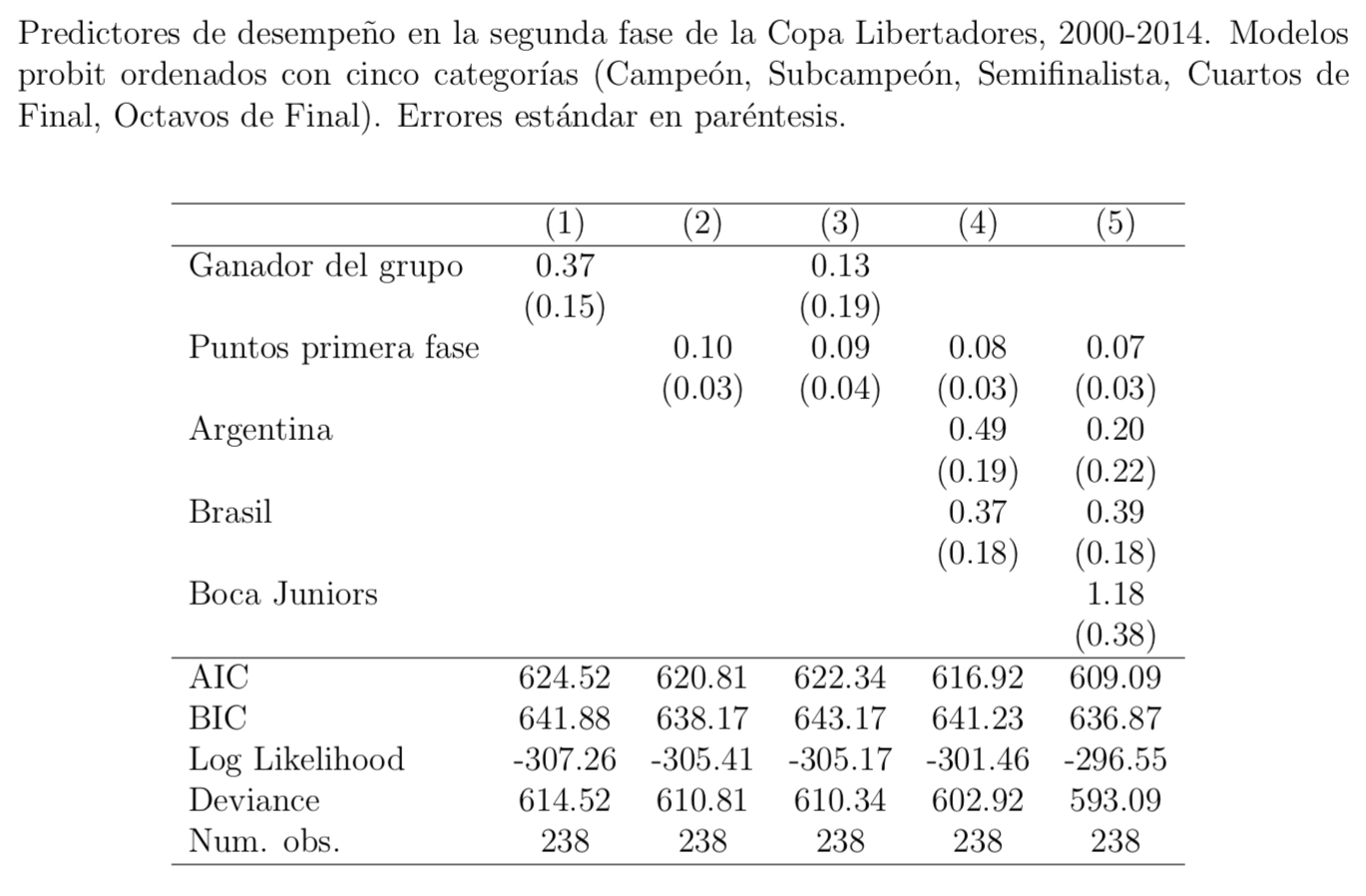
Una forma de examinar esos números con un poco más de rigor es estimar la probabilidad de que un equipo llegue a una determinada instancia (Final, Semi, Cuartos, etc) dadas ciertas variables, como su desempeño en la primera fase o su país de origen. Para ver si ése es el caso, estimé una serie de modelos probit ordenados donde la variable dependiente es la posición en que cada equipo terminó en cada Copa (Campeón, Subcampeón, Semifinal, Cuartos u Octavos). La muestra comprende todos aquellos equipos que llegaron a octavos de final.
Los modelos 1-3 muestran que los equipos a los que les va bien en la primera fase generalmente llegan más lejos, y que el total de puntos obtenidos es más importante que ganar el grupo. Por supuesto, ambas variables están correlacionadas–en promedio, el primero del grupo le saca tres puntos al segundo–, pero a los mejores primeros (y, presumiblemente, a los mejores segundos) les suele ir mejor. El modelo 4 muestra que incluso controlando por la cantidad de puntos obtenidos en la primera fase, los equipos argentinos y brasileños son más fuertes que el resto–lo que es de esperar si consideramos que casi 3 de cada 4 finalistas (22 de 30, ó 73%) vienen de Argentina o Brasil. Sin embargo, el último modelo revela que más que un “efecto Argentina”, lo que hay es un “efecto Boca”: cuando incluimos un dummy para Boca, los equipos argentinos ya no son tan buenos en comparación al resto, pero Boca sí lo es.
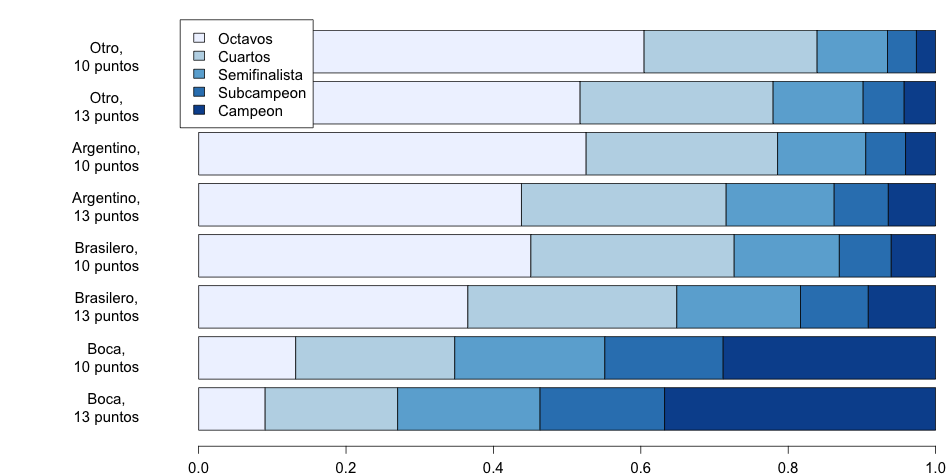
El gráfico de abajo ilustra la magnitude de ese efecto. Las barras indican la probabilidad de que distintos equipos lleguen a una determinada instancia de la Libertadores, dependiendo de su país de origen y el número de puntos obtenidos en la primera fase. Podemos apreciar cómo los equipos que no son argentinos ni brasileños (y los argentinos que pasan con sólo 10 puntos) tienen muchas probabilidades de quedarse afuera en Octavos; asimismo, la diferencia entre un equipo brasileño y uno argentino que no sea Boca es de alrededor de 3 puntos. Pero nada se compara con el Boca post-Bianchi, cuya probabilidad de ganar la final es la misma que la de un equipo brasileño de llegar a semifinales–y ni hablemos de pasar las primeras dos fases.
(*) Los otros equipos que participaron en 9 ó más ediciones son Nacional de Montevideo (15), Cerro Porteño y Libertad de Paraguay (11), Bolívar, Emelec, River, Vélez (10), Caracas, Peñarol y The Strongest (9).
(Publicado originalmente en https://elpaisgeneroso.wordpress.com/)
From the Comments: The Suprastate and the Substate
My post on American Senator Rand Paul’s recent remarks on Kurdistan elicited the following response from fellow Notewriter Michelangelo:
If a neo-Ottoman federation arises I suspect it will begin as a political alliance between Turkey and Israel. Perhaps such a federation will arise from the Mediterranean Union, who can know really. The two countries are already relatively close in interests and are, alongside a few of the Gulf States, the closest things the region has to secular liberal powers. The Turks at this time would not favor an independent Kurdistan though and I fear they might withdraw support for a federation if that was part of the package.
I think it would be easier to first form an Ottoman federation and afterward grant Kurds their independence within the federation.
It is hard for me to imagine the Arabs joining said federation either way. The Egyptian-Syrian Arab republic went nowhere. Part of me (an infinitely small part!) kind of hopes ISIS manages to defeat the Iraqi and Syrian forces and creates the core of a Pan-Arab nation.
I’ll let him have the last word here (be sure to scroll though the entire dialogue), but I just want to take this opportunity to stress the importance of thinking about the world in terms we might not be used to. The standard unit of measurement – for lack of a better term – for thinking about international affairs is the nation-state, but this way of thinking about the world has, like all devices humans use to make sense of their world, weaknesses as well as strengths. To my mind, as the world becomes increasingly interconnected thanks to liberalization, the nation-state becomes less and less useful as a tool for understanding human action.
What Michelangelo is doing here is thinking ahead of the curve; he is applying the notions of suprastate and substate to international affairs. A suprastate is an organization or union that is composed of various nation-states, such as the ones Michelangelo uses in his argument (i.e. “Mediterranean Union”). A substate is a region within a nation-state, such as Kurdistan or Scotland or Somaliland.
Often, especially in debates here at NOL, the notions of suprastate and substate are used in conjunction with the developing, or post-colonial, regions of the world. This doesn’t mean these notions can’t be applied to places like the United States or Argentina. Indeed, the US itself was created as a supranational union in order to combat the strategies of the British, French, Spanish, and various Native nations. If you can entertain the notions of suprastate and substate when you think about human action, you will be that much closer to advocating clearly for the free and open society (see this piece on the informal economy by Dr Gibson, for example).
A proposal to help curb grade inflation.
I have a stack of midterms I’m procrastinating grading, but I’m not simply going to babble on about some minor nuisance in my own life, I’m going to expound on a modest, but promising intervention into the problem of grade inflation which, I believe, costs us millions of dollars every year.
Here’s the basic problem: schools serve a mix of roles, including signaling, human capital formation, and pure consumption. Unfortunately, universities face a problem of grade inflation. I have encountered many students who were very angry that I should even dare to suggest that a C is an acceptable grade. This, despite the fact that C has never been sold as anything but “average- simple, common, adequate but ordinary”.
And why is grade inflation a problem? It makes the signal of a college degree less meaningful. And the result is that students have to pile on ever more credentials at ever more selective institutions to prove themselves. It also leads to students turning school into a GPA maximization game rather than an intellectual pursuit. For top students this isn’t a real problem, but for the rest it may be costly. So here’s my proposal…
Maybe we should be describing the grade distribution as being like the Fahrenheit scale… 73 is just about right; sure it’s a few degrees off, but it’s close enough for government work. 93 Is about as hot as you’d ever really want it to be. Any hotter is superfluous, and besides, this school doesn’t give A+’s. The 90’s are hot; exceptionally so, but the 80’s are pretty warm. Once in a while an 85 degree day can be quite nice, But you don’t really even want too many 80+ grades on your transcript. This is related to a fact that always amazes my students: in econ grad school an A means you over-invested in a class and wasted energy that could have been spent on advancing your dissertation. Too many B’s for a typical undergrad means that they aren’t doing enough intellectual, spiritual, social, and personal exploration outside of class. So what about F’s and D’s? Well, the analogy might fall apart here, but I don’t think we need to sell students on going for F’s, although I think one or two would probably build character.
I think that if this description spread through high schools and colleges then we might just calm the students and parents down a bit. Doing that might just allow us all to slow down enough that the students might actually learn something and retain it.
We Must Have Order!
I sometimes think that the small daily vexations of government do more to wake up regular people than the really big abuses of government. Below is a relevant anecdote.
Seven or eight years ago, the City of Santa Cruz forbade me from cutting the tree figuring in the picture below. It’s a redwood tree. It’s in my tiny front yard. Its invasion of a sewer line cost me $10,000 before I asked humbly for permission to remove the tree. Now, the tree roots are destroying the foundations of my house as well as the sidewalk in front of it. The city says that I am responsible for fixing the sidewalk, indefinitely, apparently because redwood tress grow at least for several hundred years.

Now, to be fair, the City arborist told me a few months ago privately that if I asked for permission to cut the tree again now, it would probably be approved. It does not do me much good now. She said no when I could afford to cut it now, I can’t afford it. Besides, the city insists that I have to pay for a permit to remove the tree I did not want in the first place. This is more offensive than the much higher cost of taking the tree down which involves real work, at least. (It’s true that I bought the property with the tree on it. I had no idea then that I could even be denied the permission to cut a forest tree.) I am quite insensitive to the need of my city to have redwood trees, specifically, within its boundaries.
First, everyone knows that redwoods are destructive. Moreover, they sterilize the area where they grow. Second, it’s not as if our citizens were deprived of trees, as people might be, say, in Arizona. In fact, there is a large forest a four minute drive from my house, seven minutes by bicycle, tops. It’s a 90% redwood forest. It’s not clear to me that I must recognize a duty to subsidize the redwood viewing of residents and visitors who are too lazy to drive or bike there.
Note my delicateness of mind: I admit that many of my fellow Santa Cruzans would be morally torn between the desire to commune with redwood trees, on the one hand and their fervent wish to not contribute to global warming by driving four minutes, on the other hand. But I think they can just bike there, or walk. I also admit that there are people in Santa Cruz who don’t own a car and who are physically unable to bike or walk to the forest. I would be in favor of a city-sponsored collection to bus them to the redwood forest four times each year. I would gladly contribute, voluntarily, that is.
Two deeply different views of the world are at odds here. Now, let me assure you that although I am a conservative, I like trees. I like cherry trees and apple trees mostly, for obvious reasons, but redwoods are OK because they give high grade lumber. And, yes, they look wonderful. That is, they look wonderful where they belong, in a forest, with their brothers and sisters and all the cousins around. My own redwood tree (the tree that my family and the City apparently jointly own) is a object of shame. It’s so bad, that I never use it to give directions to my house although it stands right out. It’s an object of shame because PG&E, the publicly regulated monopoly, has the right to shape it in any way it chooses. I am sure there are technicalities that escape me here but the shape it prefers makes my redwood tree look like an old, overused toilet brush. Sorry for the vision, I call them as I see them!
Well, I planted a yellow rose bush nearby and the bush found the spot attractive. It grew and grew under my firm benign neglect. Eventually, it had to discover that the nearby redwood tree makes a good ladder to the sun. The result is in the photo above. Well, I think you are not going to believe this but a member of the leftist and left-liberal city council complained about the rose bush on the tree. She says it looks unkempt. Here you have it – not left-wing thought, there is no thinking involved here – but the leftist temperament in a nutshell: Things have to be neat; personal preferences do not matter; bureaucracies give you predictability even if at stupendous cost, the market is inherently messy. We must have order even if it impoverishes our lives.
Robert Tracinski on the Left’s Anger Issues
Ooo-weee. I apologize for not being around very much this week. I’ve been bumming around and just got back into civilization in order to enjoy the second weekend of March Madness.
I have viewed Leftists as cowards for a long time now. Now, whether or not being a coward is a good thing is another question, but I nevertheless view them as cowards. Angry cowards are the worst kind of cowards, of course. Here’s Tracinski trying to figure out why Leftists are so angry:
There’s the fact that those of us on the right are accustomed to encountering a lot of ideological opposition. For most of our lives, the left has controlled the high ground of the culture, such as it is: the mainstream media, Hollywood, the universities, the arts. So we’re not used to crawling into a “safe space” and hiding from ideas we disagree with, which makes it easier for us to regard ideological opposition with a degree of equanimity.
The rest of the essay is pretty good, too. What’s that old school term for a coward? The dog who is all bark and no bite? I remember these type of people well, from when I marched in San Francisco against the Iraq War. If tomorrow’s best and brightest Leftists are refusing to even consider the opposition’s arguments, what does that say for the future of the West?
But really, though: How on earth did the government come to be in charge of the roads?
More on Liberty and Homer: Tacitus, Montesquieu, and Humboldt
As I have discussed before here, there is a way of writing about liberty in a conscious focus on political thought, which finds liberty to be emulated in some respect, going back at least to the first century Roman historian Tacitus. He was referring to the condition of the ancient Britons, within the Roman Empire, but rebelling against it, and the ancient Germans who could not be incorporated into the Empire.
The latter situation may have been at least as much for economic reasons as for the German fighting spirit, but they were certainly difficult to overcome and inflicted one of the great defeats on the Roman legions, at the height of Roman power in the Battle of the Teutoburg Forest in 25CE.
The image of barbarian liberty in Tacitus was certainly in some part shaped by Homer given the deep impact of Greek culture on the Romans, and most relevantly in this instance through the continuation of Homer in the greatest latin epic, Aeneid, which links Rome with the Trojan prince Aeneas. As I pointed out before here, Tacitus’ idea of barbarian liberty strongly influenced Montesquieu’s The Spirit of the Laws (1748, a work I will be posting on in future), whose view of liberty in modern Europe, in brutal but meaningful summary, was of a combination of Roman law and Germanic individualism.
Montesquieu was of course a great part of Classical Liberalism and we can follow up his interest in barbaric liberty with reference to other classical liberals. David Hume and Adam Smith, who were writing after Montesquieu, tended to write on ‘barbarism’ and a related idea of ‘savagery’ with some anxiety regarding the possibility that such societies, or societies closer to that stage than those European nations where civil society had advanced the most, might overwhelm commercial legalistic nations with their unrestrained force.
However, some element of respect for liberty in the most simple societies does manifest itself at times, but mostly through an interest in the earliest stages of the Roman and Greek republics of antiquity, which in Montesquieu’s thinking come between the Germanic individualism and the late Roman legalism. Tacitus was thinking of the ‘virtue’ (in the sense of patriotic courage and love of law) of the early Romans when addressing the courage, rough individuality, and fierce independence of the Britons and Germans.
The most interesting way of linking back from Enlightenment liberalism of the Eighteenth century, for me at least, is via Wilhelm von Humboldt, a thinker I will address in at least one dedicated post in future. Humboldt’s major contribution to political thought, The Limits of State Action, was written in the 1790s, so another generation on from Montesquieu, just after Smith and Hume.
At this point, we might think of a movement from Enlightenment to Romanticism in European thought. While we should be very careful about such general distinctions, and amongst other things not engage in simplistic oppositions, it is appropriate to think of Humboldt as belonging to a phase of interest in the history and current meaning of aesthetics, literature, culture, and language as part of the study of political ideas.
He was in fact a major thinker about language and the infinite capacities inherent in the combinatory nature of language, which was part of his thinking about individual human capacity and the power of voluntary co-operation.
It is the interest in aesthetics, language, culture, historical existence, and the capacity of the inner human which makes him ‘Romantic’ rather than ‘Enlightened’, though again we should avoid stereotype and simple opposition here. Humboldt was very much not against Enlightenment respect for reasons, and some of these ‘Romantic’ themes are in ‘Enlightenment’ texts.
One of the earlier big classics of Enlightenment, The New Science (1725, 1744) by Giambattista Vico, is a good example and that is a book giving great importance to Homer. Vico is someone else who merits at least one dedicated post, so there will be more about him at some point. I am not aware of any evidence that Humboldt read Vico, but he certainly made an impression on German thinkers of the time.
Anyway, Humboldt was a learned classicist from a philological and literary way, which has an impact on his idea of how liberty was strengthened in antiquity, which compensated for the tendency of the ancient state to interfere in the soul, as Humboldt thinks of antique laws and institutions to promote moral and religious traditions.
What compensates for this pressure on liberty is the struggle in the lives of ancient humans, which has two main aspects. First the struggle with nature to have enough food and shelter to preserve life. Second the military struggle with rival states and communities, which was a very frequent experience in antiquity, and was an aspect of the history of the early Greek and Roman republics.
The best place to look for that in antique sources is Homer, because of the breadth of the Homeric world, as well as its poetic qualities, as well as its enormous influence on Greek and Roman culture. I had meant to address how the kind of struggle which can promote some kinds of liberty does appear in Homer, but this post is already long enough, and the best thing is to address Homer directly in the next post.
In the meantime, careful reading of any of the translations in books and post on websites, of The Iliad and The Odyssey (or indeed the original Greek for those fortunate enough to have that linguistic capacity), should I hope provide material to confirm what I’m suggesting.

