Summing up: the year of irrationality

Brandon says I’ve got one last chance to write his favorite post of the year. But it’s the end of a long semester and I’m brain dead, so I’m just going to free ride on his idea: a year end review. If I were to sum up the theme of this year in a word, that word would be irrational.

After 21 months of god awful presidential campaigning, we were finally left with a classic Kodos vs Kang election. The Democrats were certain that they could put forward any turd sandwich and beat Trump, but they ultimately lost out to populist outrage. Similar themes played out with Brexit, but I don’t know enough to comment.

Irrationality explains the Democrats, the Republicans, and the country as a whole. The world is complex, but big decisions have been made by simple people.

We aren’t equipped to manage the world’s complexity.

We aren’t made to have direct access to The Truth; we’re built to survive, so we get a filtered version of the truth that has tended to keep our ancestors out of trouble long enough to get laid. In other words, what seems sensible to each of us, may or may not be the truth. What we see with our own eyes may not be worth believing. We need more than simple observation to actually ferret out The Truth.

Our imperfect perceptions build on imperfect reasoning faculties to make imperfect folk economics. But what sounds sensible often overlooks important moving parts.

For every complex problem there is an answer that is clear, simple, and wrong.

Only a small minority of the population will ever have a strong grasp on any particularly complex thing. As surely as my mechanic will never become an expert in economics, I will never be able to do any real work on my car. The trouble arises when we expect me or my mechanic to try to run the country. The same logic applies to politicians, whose job (contrary to what your civics teacher thinks) is to get re-elected, not to be a master applied social scientist. (And as awful as democracy is, the alternative is just some other form of political competition… there is no philosopher king.)

But, of course, our imperfect perception and reasoning have gotten us this far. They’ve pulled us out of caves and onto the 100th floor of a skyscraper*. Because in many cases we get good enough feedback to learn a lot about how to accomplish things in our mysterious universe.

We’re limited in what we can do, but sometimes it’s worth trying something. The trouble is, I can do things that benefit me at your expense. And this is especially true in politics (also pollution–what they have in common is hot air!). But it’s not just the politicians who create externalities, it’s the electorate. The costs of my voting to outlaw gravity (the simplest way for me to lose a few pounds) are nil. But when too many of us share the same hare-brained idea, we can do some real harm. And many people share bad ideas that have real consequences.

Voting isn’t the only way to be politically engaged, and we face a similar problem in political discourse in general. A lot of Democrats are being sore losers about this election rather than learning and adapting. Trump promised he would have done the same had he lost. We’re basically doomed to have low-quality political discourse. It’s easy and feels (relatively) good to bemoan that the whole world is going to hell.

We’re facing rational irrationality. Everyone is simply counting on someone else to get their shit together, because each of us individually is more comfortable with our heads firmly up our asses.

It’s a classic tragedy of the commons and it should prompt us to find some way to minimize the harm of our lousy politics. We’ve been getting better at this over the centuries. Democracy means the levers of power can change hands peacefully. Liberalization has entailed extending civil and economic rights to a wider range of people. We need to continue in this vein. More freedom has allowed more peace and prosperity.


So what do we do? I’d argue that we should focus on general rules rather than trying to have flawed voters pick flawed politicians and hope for the best. I don’t mean “make all X following specifications a, b, and c.” I mean, if you’re mad, try and sue someone. We don’t need dense and exploitable regulations. We don’t need new commissions. We just need a way for people to deal with problems as they arise. Mind you, our court system (like the rest of our government) isn’t quite ready for a more sensible world. But we can’t be afraid to be a little Utopian when we’re planning for the long run. But let’s get back to my main point…

We live in an irrational world. And it makes sense that it’s that way; rationality is hard. We can see irrationality all around us, but we see it most where it’s cheapest: politics and Facebook. The trouble is, sometimes little harmless irrational acts add up to cause real harm. Let’s admit we’ve got a problem with irrationality in politics so we can get better.


*Although that’s only literally true in 17 cases.

Trump and Tillerson Could Save Our Bacon

If Trump is anything like the deal-maker he claims to be, and if Tillerson can translate the expertise and connections he gained as CEO of a gigantic international corporation into diplomatic skills, we could be spared from a nasty confrontation with a nuclear-armed Russia.

Putin is not a nice man. His incursions into Crimea and Ukraine are inexcusable. But he does have a rationale for his claim of aggressive threats from NATO, and this has served hun well in diverting attention away from the drastic declines in liberty and prosperity in Russia. As this article indicates, the West promised not to expand NATO into Eastern Europe but did so anyway, even threatening to include Ukraine and Georgia, which are geographically Russia’s underbelly. How would we like it if the Soviet Union had proposed including Cuba in the Warsaw Pact?

Trump and Tillerson should make a deal with Putin. It must give Putin incentives to pull out of Ukraine and perhaps Crimea, although the latter was historically Russian and Tatar. It must give him something to brag about to his people.  This in contrast to Obama, who declared Russia to be merely a regional player.  Who could blame all Russians for taking this as an insult? He should have praised Russia as a major international player, capable of great contributions to world peace, while taking quiet steps to keep them from making trouble.

The Baltic states are indefensible. Neutralization has worked well for Finland and it ought to work well for the Baltics and Ukraine. Putin could be given a green light to take over Belarus, a socialist basket case that is ethnically very similar to Russia. He could even be invited to join NATO.  This may not be so crazy given that Russia and the West share Christian roots and a common threat from Islamo-fascists.

Some would bring up Chamberlain’s capitulation to Hitler. Skillful negotiations should be able to avoid that trap. The stakes are high, and right now Trump and Tillerson are our best hope of avoiding a possible catastrophe.

Does socialism need to be corrupt?

Brazil is going through a deep crisis right now. It is tempting to say that this is the greatest crisis in the country’s history, but I am quite afraid to make this comment. Unlike England and the United States, which have experienced significant institutional stability in the past 200 or 300 years, Brazil has gone through several political breakdowns in its history, and the current economic crisis is far from the hyperinflation of the 1980s. But there is a characteristic that links the present crisis to the previous ones: the presence of a tendentially authoritarian state.

Although Brazil was governed by an openly socialist party only between 2003 and 2016, this does not mean that socialist characteristics were not present in the country much earlier. One of the central theses of F.A. Hayek in the Road to Serfdom is that the democratic socialist parties of Western Europe (notably the Labor Party in England) had more features in common with the Nazis and fascists than they would have liked to admit. In other words, the differences between left (even a moderate left) and extreme right were illusory: they both had the fundamental characteristic of trying to plan society centrally.

The opposition between spontaneous order and central planning was one of the central theses in Hayek’s career. In Fatal Conceit he develops this theme a lot, showing how the opposition between central planning and lack of planning is a fallacy: society will forcibly be planned. The question is by whom: for a small group of people on behalf of all the others, or for a large group of individuals, each with limited responsibilities? According to Hayek, this distinction between central planning and individual planning is one of the central separations between an authoritarian society (left or right) and a truly free society.

It is difficult to say if the PT (“worker’s party”) government between 2003 and 2016 was the most corrupt in Brazilian history. Homesick people can always claim that corruption was also present in previous governments (it was just not investigated), and possibly they would be right. Before becoming a country ruled by a socialist party, Brazil has always been a patrimonialist country. And this is a fundamental point that adherents of socialism cannot understand: Brazil has never been a capitalist country, at least not in the sense that the liberal tradition employs.

Starting from Hayek, we conclude that central planning is impossible. Planners do not have the information they need to make their plans. As Mises taught, without private property there is no price formation, and without price formation the economic calculation is impossible. This opens space for what Hayek calls a fatal conceit: the assumption that it is possible to run a country from a central body, a presupposition that not only fails to achieve its goals, but also leaves piles of corpses on the way.

The PT government was probably the most corrupt in Brazilian history because it was what most rejected capitalism. The opposite of the free market is the attempt to centrally plan the economy. To centrally plan the economy, an army of administrators is needed. To watch over these administrators, a host of supervisors is needed, and so on. Corruption is inevitable.

Socialist governments are always among the most corrupt, and the reason is simple: the more government, the more corruption. A simpler, more decentralized government is not perfect. But it’s the best we can wish for. It would certainly be a government with less control over money, and thus less likely to steal.

How Well Has Cuba Managed To Improve Health Outcomes? (part 1)

Since the passing of Fidel Castro, I have devoted myself to researching a proper assessment of his regime’s achievements in matters of health care. The more I dig, the more I am convinced that his regime has basically been incredibly brilliant at presenting a favorable portrait. The tweaking of the statistics is not blatant or gigantic, it is sufficiently small to avoid alerting demographers (unlike when Davis and Feshbach, Eberstadt and Miller and Velkoff found considerable evidence of data tweaking in the USSR which raised a massive debate). Indeed, a re-computation of life expectancy based on life tables (which I will present in the new few weeks) to adjust for the false reclassification of early neonatal deaths as late fetal deaths (raising the low infant mortality rate by somewhere 28% and 96%) suggests that somewhere between 0.1 and 0.3 years must be knocked off the life expectancy figures. Given that the variations between different measurements available (WHO, World Bank, MINISAP, CIA, FAO) are roughly of that magnitude, it falls within a very reasonable range of errors. This statistical tweaking is combined with an over-dramatization of how terrible the situation was in 1959 (the life expectancy figures vary from 63.9 years to 65.4 years at the beggining of the Castrist regime). But that tweaking is not sufficient to invalidate the massive downward trend.  As a result, the majority of public health scholars seem confident in the overall level and trend (and I tend to concur with that statement even if I think things are worse than presented and the slope of the downward trend is too steep).

Those little tweaks have been combined with the use of massive coercive measures on the local population (beautifully described  by Katherine Hirschfeld in what should be an example of ethnographic work that economists and policy-makers should rely on because it goes behind the data – see her book Health, Politics, and Revolution in Cuba: 1898-2005) that go from using doctors as tools for political monitoring to the use of abortion against a mother’s will if it may hinder a physician’s chance of reaching the centrally-decided target without forgetting forced isolations for some infectious patients. Such methods are efficient at fighting some types of diseases, but they are associated with institutions that are unable to provide much economic growth which may act as a palliative counter-effects to how choices may make us less healthy (me having the freedom to eat too much salt means I can die earlier, but the type of institutions that let me eat that much salt also avoid infringing on my property rights thus allowing me to improve living standards which is the palliative counter-effect).  With such a trade-off, the issue becomes one of the ability of poor countries to improve in the absence of extreme violence as that applied by the Castrist regime.

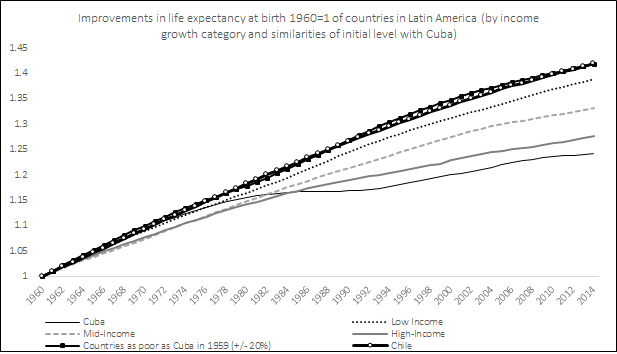
Over the next few weeks, I will publish many re-computations of health statistics to sustain this argument as I write my article.  The first one I am doing is the evolution of life expectancy from 1960 to 2014. What I did is that I created comparatives for Cuba based on how much living standards (income per capita). Cuban living less than doubled over that 49 years period (82% increase) from 1959 to 2008 (the latest available data from the high-quality Maddison data).  Latin American and Carribean countries that saw their living standards less than double (or even decline) are Argentina (+90%), Bolivia (+87%), El Salvador (+68%), Haïti (-33%), Honduras (+71%), Jamaica (+51%), Nicaragua (-17%) and Venezuela (+7%). This forms the low income group. The remaining countries available are separated in two groups: those whose income increased between 100% and 200% (the mid-income group composed of Brazil, Colombia, Mexico, Peru, Uruguay, Ecuador, Guatemala, Panama and Paraguay) and those whose incomes increased more than 300% (the high-income group composed Chile, Costa Rica, Dominican Republic, Puerto Rico and Trinidad & Tobago).  I also compared Cuba with a group of countries that had incomes per capita within 20% of the income per capita of Cuba.  So, how did Cuba’s life expectancy increase?

Well, using only the official statistics (which I do not fully trust although they are from the World Bank Development Indicators Database), Cuba life expectancy (which was already pretty high by Latin American standards in 1959) increased 24%. However, all other countries – which were well below Cuba – saw faster increases. The countries that had the least growth in Latin America saw life expectancy increase 38% and the countries that were equally poor as Cuba saw life expectancy increase an impressive 42%. Chile, whose life expectancy was only 57.5 years against Cuba’s 63.9 in 1960, also increased more rapidly (also 42%) and it has now surpassed Cuba (81.5 years against 79.4 years) and what is more impressive is that this rate has increased in a monotonic fashion regardless of changes in political regimes (democracy, socialism, Pinochet, liberal democracy) while Cuba’s rate seems to accelerate and decelerate frequently. Now, this is assuming that the figures for 1960 are correct. I have surveyed the literature and it is hard to find a way to say which of the estimates is the best, but that of the World Bank for 1960 is the lowest. There are other rates, contained in McGuire and Frankel’s work – the highest stands at 65.4 years for 1960. That means that the range of increase of life expectancy in Cuba is between 21.4% and 24.2%. Its not earth-shattering, but it makes Cuba’s achievements less impressive (although it is impressive to keep increase life expectancy from an already-high level). But as you can see, more important improvements could have been generated without recourse to such violent means. In fact, as a post that I will publish this week shows, the decline in car ownership from 1959 to 1988 probably played moderately in favor of the increase in life expectancy while the massive increase in car ownership in all other countries played (all else being equal) in favor of slowing down the increases in life expectancy (but being too poor or making it illegal to import a foreign car is not health care and I deem it improper to consider that this accident from misfortune should be praised).

improvementslifeexpectancy

In a way, what I am saying is that the benefit is not as impressive as claimed. Given the costs that Cubans have to assume for such a policy, anything that makes the benefits look more modest should make more inclined to cast a damning judgment on Castro’s regime.

Coming up (I will add the links as they are published) :

  1. Life Expectancy Changes, 1960 to 2014
  2. Car ownership trends playing in favor of Cuba, but not a praiseworthy outcome
  3. Of Refugeees and Life Expectancy
  4. Changes in infant mortality
  5. Life expectancy at age 60-64
  6. Effect of recomputations of life expectancy
  7. Changes in net nutrition
  8. The evolution of stature
  9. Qualitative evidence on water access, sanitation, electricity and underground healthcare
  10. Human development as positive liberty (or why HDI is not a basic needs measure)

When Black Unemployment Rates Were Equal to White Unemployment Rates…

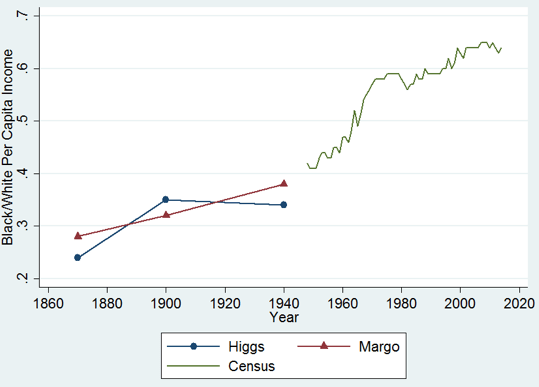
In a twitter-debate with Tariq Nasheed, I pointed out that the wages rates did converge between the 1940s and 1990s. Recently, Robert Margo of the University of Chicago extended this to per capita incomes since 1870. It is fascinating to see that there was convergence between 1870 and 1940 in spite of Jim Crow laws (it tells you how much more blacks could have achieved had the laws not existed – see notably the work of Bob Higgs on this).

income-convergece

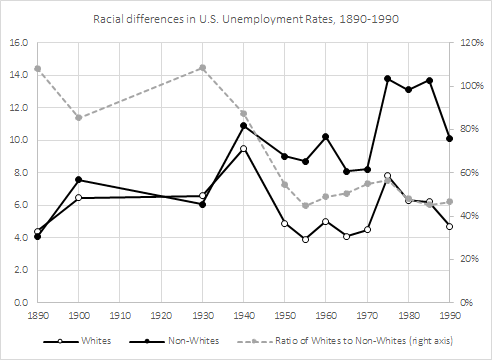
Each time I see this evidence, I am bemused. You see, I often debate colleagues on particular features of social policy in order to assess policy reforms or the effects of past reforms. But, its always good to take a step back and look at the long-view of history. It puts things in perspective. The Margo graph does just that. It tells me the story of what could have been. And just for the sake of remembering properly (infer whatever conclusions you like), it is worth showing racial differences in unemployment rates since 1890. What strikes me is how similar the rates are until the 1950s. What happened at that point? When you ask yourself this question, you’re forced to put everything in perspective. And it becomes harder to have “generic” answers in the lazy-form of “its racism”. Why would racism explain the difference after 1950, but not before?
whites

Maybe, just maybe, people like Tariq Nasheed should stop proving that H.L. Mencken was right in saying that “for every complex problem, there is an answer that is simple, clear and plainly wrong”.


Socialism is just a new form of slavery

When Fidel Castro died he was totally alone. It doesn’t matter if relatives or friends were standing beside him: in the end, we are all alone. We experience the world through our sense of perception. Of the things themselves we have no experience. On the other hand, all humans have perception of themselves. We just know that we are. This self awareness is a fundamental aspect of what it is to be human. Castro’s death already received a lot of attention, but I believe it is a moment really worthy of reflection. Under his half-century regime millions died or suffered, and it’s always important to remember that we are talking about a little country, an island in the Caribbean. Cuba was one of the most prosperous nations in the Americas, and today it is one of the most miserable.

It is really sad to see that most of my colleagues are unable to call evil by its name. In the mid-nineteenth century Karl Marx predicted that capitalism was going to collapse because of its internal contradictions. He was not saying that he wanted capitalism to collapse. He was saying that this was a scientific fact, as sure as the next eclipse predicted by an astronomer. Capitalism, of course, didn’t collapse. Marx’s economic theory was simply nonsensical, and was contradicted by logic and facts. But Marxists couldn’t admit it. Instead they replaced economics with culture, and the working class with Others as the oppressed. Blacks, women, Native Americans, underdeveloped countries and many others became the new oppressed class. Fidel Castro fit beautifully in the Marxism of the New Left. He was the charismatic dictator of the charming island nation of Cuba. The US, ruled by leftists in the 1960s and 1970s, was unable to give a consistent answer to it. Latin America, ruled by dictatorships that the left called “right” (no one wants to take their dictators home), was also not in place to contrast the evils of the Castro regime. A perfect storm.

Castro, for all we know, died with no regrets for the evils he committed in life. Political commentators say that history will judge him. But this is a lie. History can’t judge anyone. Only people can judge people. And it is fundamental that political commentators today judge Castro for all the evil he has done. Castro didn’t kill people in Cuba only. He supported, in one way or another, brutal regimes all over the world, mostly in Latin America. To this day he is partly responsible for the evils of Foro de São Paulo. But many political commentators insist in the lie that in Cuba there’s true freedom: they have enough to eat, universal healthcare and universal education. Why would they want freedom?

Freedom is the fundamental state of human beings. We are, in the end, all alone. Of what goes in our hearts, only we are aware of. Sometimes not even us. All of us make choices based on knowledge that’s unique. Circumstances of time and space shape the choices that we make. And life is made of choices. Marxism, socialism, and all forms of statism go against these fundamental truths.

People in Cuba are not free. They are all slaves to the Castro family. Some people want to have life in a cage, as long as they receive food every day. Of course this is a lie. In order to live in a cage you need to have someone outside the cage bringing the food. Someone has to be free. This person becomes your slave as well, and this constitutes a fundamental contradiction of socialism: Alexis de Tocqueville mentioned that socialism is just a new form of slavery. In slavery someone is forced to work for somebody else under the threat of physical violence. Under socialism everybody is forced to work for everybody else. Let’s hope that Castro’s death may help put socialism in the past, where slavery is, and that Latin America may finally see the light of freedom.

Identity Politics, the Alt-Right, and Empathy in Cultural Discourse

“Identity politics” have been an intensely large obsession of the American left or the past forty or so years. Academic leftists have devoted their entire careers and even the organizations of their departments to studying notions of identity and the specific history and interests of certain identity groups—such as women’s studies, African-American studies, and other similar programs. The Democratic Party has put special emphasis on mobilizing various minority groups based on identity, focusing on “Women’s issues” such as abortion or “the needs of the African-American community” such as police reform or “gay rights” to get a certain of segment of voters to turn out in elections.

Yet, with the election of Trump, many moderate leftists are questioning the utility of identity politics. Mark Lilla had a prominent recent piece in The New York Times declaring the “end of identity liberalism.” Lilla’s main criticisms of identity politics focus on it as a “strategic mistake” in electoral politics and how it has made liberals and progressives “narcissistically unaware of conditions outside of their self-identified groups,” particularly white, middle class, working men in the Midwest. Matt Yglesias, meanwhile, responded by sounding off that all politics is identity politics, people always organize themselves in interest groups, writing that “any plausible account of political behavior by actual human beings needs to concede that politics has always been practiced largely by mobilizing people around salient aspects of group identity rather than detailed policy proposals.” The left, he says, can’t abandon identity politics because “[t]here is no other way to do politics than to do identity politics.”

Those on what is traditionally considered the “right” end of the political spectrum (ignoring the specific phenomena of Trump voters and alt-righters, that is) tend to be dismissive of the whole project of identity politics. This approach is embodied by Robby Soave’s recent article in Reason claiming that identity politics is just a form of tribalism that seeks to subvert individual rights and overall social welfare to  the tribalist demands of some salient group people self-identify with. Soave also sees the rise of Trumpism as itself a form of identity politics for white men, a claim which I’ll address at length in a moment.

What is one to make, then, of identity politics in the Trump era? First, it seems there is considerable confusion about what identity politics even is in the first place. Lilla, for an example, seems to imply that the left’s obsession with appealing to minority political coalitions is merely a strategy for winning elections. Soave thinks it’s pure tribalist and collectivist ideology, and Yglesias defines it so broadly that any political mobilization at all is considered identity politics. How are we to understand what operative definition of what is commonly called “identity politics” is most useful, or at least is closest to how its commonly used in political discourse?

Lilla and Yglesias understanding, it seems, misses the point about why so many leftists are so passionate about identity politics. People who are interested in cultural dramas and issues related to group identity are not just Democratic strategists in campaign war-rooms, but, as I mentioned earlier, academics, and “true believer” bleeding-heart progressive activists. It seems to me that identity politics—at least at first (and still is in the minds of the true believers post-1960s progressivism)—is not about an election strategy. It’s certainly become that for Democratic strategists, but it originally was motivated by the old liberal concern with ending the misery for stigmatized groups. Identity politics is not merely a political strategy, but a strategy the left used for getting rid of racism, homophobia, and otherization of outgroups in society at large.

The idea is like this: try to get, for example, white people to sympathize with black people by getting whites to recognize that black people have their own meaningful web of cultural associations which is just as valid as those of the dominant culture. Its roots are in cultural studies academia, such as the writings of Judith Butler and Nancy Fraser. Essentially, identity politics is rooted in philosophical attempts to end prejudice through emphasizing “cultural recognition” of despised groups. As Richard Rorty wrote in describing this strategy:

It helps, when trying to recognise a common humanity in a person of another gender, class, or ethnicity, to think of them as having as rich an inner life as one does oneself. To picture such an inner life, it helps to know something about the web of memories and associations which make it up. So one way to help eliminate prejudice and erase stigma is to point out that, for example, women have a history, that homosexuals take pride in belonging to the same stigmatised group as Proust, and that African-Americans have detailed memories of the battles which make up what Russell Banks calls “the three hundred year War Between The Races in America” – the sort of memories whites are currently learning about from Toni Morrison’s novels. It helps to realise that all such groups wrap a comforting blanket of memories and traditions, customs and institutions, around themselves, just as do classical scholars, old Etonians, or members of the Benevolent and Protective Order of Elks.

Thus treating identity politics just as a way to get electoral coalitions out to vote, and also (as Soave does) as simply tribalism ideology when it was started as a strategy to mitigate tribalism, misses the point about why the left is so passionate about these cultural issues. It isn’t simple collectivism nor Machiavellian political strategy, but (hopefully) genuine concern for stigmatize groups that mobilizes this obsession.

Of course, as Rorty well-recognized, this way of ending prejudice is not the only way nor is it the most effective. First, it does make the left appear as this overly sensitive “politically correct” group of elitists who care little for the concerns of working class whites. As Rorty wrote that the left’s preoccupation with cultural identity politics would mean “the straight white male working class in America may find it tempting to think that the leftist academy is uninterested in its problems.” Indeed, most of why Lilla is concerned that identity politics has failed so spectacularly as an electoral strategy is that it has isolated progressives from middle America.

More importantly, however, is that emphasizing cultural difference has failed spectacularly at its initial aim of ending prejudice. The whole point of Soave’s Reason column is that leftist identity politics has become its own form of tribalism and have given rise to the right-wing identity politics of Trump. Not only have leftists often gotten so caught up in the identity politics language game that they call their own (such as Bernie Sanders) white supremacists for not playing along, it has created its own prejudice backlash. If your way of getting straight white males to recognize non-straight white males as worthy of equal treatment is to say “Those who are unlike you have different cultural values that are worth being celebrated and protected,” the response of straight white males is to say “Do not I also have a different culture worthy of being celebrated and protected?”

Indeed, this type of rhetoric is at the heart of the rise of the alt-right. It isn’t mere hatred of others that is animating this new populist, fascist movement (though that is certainly a concerningly large part of it), it is that they are making this hatred seem legitimate by couching it in terms of advancing “white interests” in a very similar rhetorical manner that the left has pushed the interests of minority groups. Richard Spencer’s “mantra” for the alt-right is “race is the foundation of identity” (emphasis mine) and calls himself an “identarian.” Even outside the small niche of the alt-right, average Trump voters often say they want a way to express and defend their identity—whether it is in the form of white nationalism or in forms of defending Christian “religious liberties” as its own identity coalition against gay rights.

Soave is correct that left-wing identity politics has given us this right-wing identity politics, and it is something Rorty himself saw as a potential consequence of this approach. In his 1998 book Achieving our Country, he explicitly predicted that the white working class would become disconnected from the academic left, and would “start looking around for a strongman to vote for—someone willing to assure them that, once he is elected, the smug bureaucrats, tricky lawyers, overpaid bond salesmen, and postmodernist professors will no longer be calling the shots[.]” He also predicted that when this strongman assumes office, “gains made over the past forty years by black and brown Americans, and by homosexuals, will be wiped out.” It is no coincidence that this sounds quite a bit like Trump.

It’s not surprising that emphasizing differences between the majority and a scapegoated group would mean that the majority group would start taking “pride” in its difference from the scapegoated. Of course, anyone who understands systemic power structures or how sociological hierarchy works understands why this response is not the same. There is a difference between cherishing the cultural differences of a scapegoated minority and using institutional power to coercively protect the cultural interests of the majority group at the expense of the minority. But you can’t expect a white adolescent basement-dwelling troll on 4-Chan or even a working class white voter from central Michigan to understand and fully internalize that difference, and they are likely to be very reluctant or overtly hostile to acknowledging it. All the alt-right has done is take identity politics and turn it against its original aim to advance the exact tribalism leftists have been trying to use identity politics to end.

A better strategy the left could have used was the strategy the old left used through classical feminism, abolitionism, the sixties Civil Rights movement, or some new progressives through the more pop-culture current of the gay rights movement. Rorty describes it beautifully:

Another way is to get the prejudiced to see the stigmatised as having the same tendency to bleed when pricked as they themselves: they too worry about their children and parents; they are possessed by the same self-doubts, and lose self-confidence when humiliated; their difficulties in moving from one stage of life to another are much like everyone else’s, despite the fact that their life-chances may be minimal. These ways of emphasising commonality rather than difference have little to do with “cultural recognition.” They have to do with experiences shared by members of all cultures and all historical epochs, and which remain pretty much the same despite cultural change.

There’s no real way for bigots to co-opt this approach to advance their bigotry. In fact, it explicitly avoids framing the discussion not as some necessary “culture war” between an oppressive majority and an oppressed minority as current identity politics rhetoric implies and alt-right identitarians have assumed as their rallying cry. Instead, it emphasizes the need to end culture wars in the first place by progressing people’s sentiments to stand in solidarity with an ever-growing chunk of humanity—it seeks to replace simple identity with empathy.

Is this approach still in the vein of “identity politics” as we currently understand it? If we take Yglesias’ understanding, sure it still “concede[s] that politics has always been practiced largely by mobilizing people around salient aspects of group identity,” but it seeks to make salient aspects of group identity as banal as possible, to make people stand in solidarity based off empathy for everyone’s common human shortcomings rather than based off who they happen to be culturally similar to, to make one’s ingroup as inclusive as impossible. It certainly isn’t tribalist or collectivist as Soave is concerned. Though it still recognizes diversity as important, Rorty still explicitly says that we should see this diversity “as a diversity of self-creating individuals, rather than a diversity of cultures[.]” This liberal (and classical liberal as I see it as drawing off of Hume, Smith, and Mill more than anything) vision is one that is both pluralistic and individualistic.

Is this, however, a winning electoral strategy, as Lilla is concerned? I’m not sure. Tribalist urges of racism are certainly very powerfully woven into how humans have psychologically evolved, and perhaps in our current broken discourse of race relations it isn’t the best electoral strategy. There is, however, some reason for optimism; popular support for gay rights is at an all-time high, after all, and this was probably more a function of the victory of emphasizing the similarity of love between gays to that of straights then getting straight allies to march in gay pride parades. Regardless of electoral outcomes, shouldn’t the goal of civil discourse not be to win elections, but to ensure the most just, peaceful, and prosperous civil society—the zero-sum game of coercive politics be damned? Leftists should try to change the current broken discourse, rather than try to work within it to gain political power.
Alguns mitos, equívocos e objeções comuns ao capitalismo parte 2

Continuando um post antigo, seguem mais alguns mitos, equívocos e objeções comuns ao capitalismo.

Três mitos a respeito da Grande Depressão e do New Deal

Mito #1: Herbert Hoover praticava o laissez-faire, e foi sua falta de ação que levou ao colapso econômico.

Na verdade Herbert Hoover era tremendamente intervencionista na economia. Sua intervenção cooperou para o início da depressão e sua continuada intervenção evitou que a economia se recuperasse logo.

Mito #2: o New Deal trouxe fim à Grande Depressão.

Longe de ser uma série de medidas coerentes contra a depressão, o New Deal foi uma tentativa de Frank Delano Roosevelt de demonstrar que estava fazendo alguma coisa. As medidas do New Deal apenas agravaram e prolongaram a crise. Países que adotaram uma postura menos intervencionista se recuperaram da crise mais rápido do que os EUA.

Mito #3: A Segunda Guerra Mundial deu fim à Grande Depressão.

Talvez este seja o pior mito de todos: a produção industrial no contexto da Segunda Guerra gerou empregos, aumentou o PIB, e com isso acabou com a Depressão. Conforme Friedrich Hayek afirmou, “da última vez que chequei, guerras apenas destroem”. Este mito é uma aplicação da falácia da janela quebrada, observada por Frédéric Bastiat. Guerras não produzem riqueza. Na verdade elas a destroem. O exame cuidadoso dos dados históricos demonstra que a economia dos EUA só se recuperou realmente quando a Segunda Guerra Mundial já havia acabado.

Mais alguns mitos, equívocos e objeções comuns ao capitalismo:

1. Capitalismo é racista e sexista

Considerando o capitalismo economia de livre mercado, onde indivíduos são livres para escolher, nada poderia estar mais longe da verdade. O capitalismo assim definido é cego para raça ou gênero. O que importa é a troca de valores. Para ficar em apenas um exemplo, as lideranças políticas do sul dos EUA pressionavam os donos de empresas de ônibus a segregar os passageiros com base na cor da pele. Os próprios empresários de ônibus queriam ganhar dinheiro com transporte de pessoas, independente da cor da pele. Apenas uma observação: recusar serviço com base em cor de pele, gênero, orientação sexual ou qualquer outro motivo é uma prerrogativa do indivíduo dentro do capitalismo. Leve seu dinheiro para uma instituição que o receba. A instituição que recusa serviço está perdendo dinheiro, e neste sentido já recebeu a punição dentro do capitalismo.

2. Capitalismo tende a bolhas e pânico

Esta é uma observação presente tanto em Marx quanto em Keynes. Conforme observado nos mitos sobre a Grande Depressão e o New Deal, exatamente o oposto é verdade. Conforme a Escola Austríaca em geral e Friedrich Hayek de forma especial observaram, é a intervenção do governo, particularmente no setor bancário e financeiro, que produz bolhas e pânico. A tentativa do governo de estimular a economia através de juros baixos e outros artifícios apenas cria ciclos de crescimento e queda. Milton Friedman e a Escola de Chicago fizeram observações semelhantes. Deixada livre a economia é de certa forma imprevisível, mas através do sistema de preços podemos nos guiar sobre quando e no que é melhor gastar.

3. Capitalismo não investe em coisas importantes

É difícil saber o que seria um investimento importante. Somente indivíduos podem avaliar o que é importante para eles mesmos. O raciocínio aqui é que há investimentos de longo prazo, que custam muito dinheiro e não produzem resultado imediato. Capitalistas não investiriam em voos espaciais ou na cura de doenças, por exemplo. Mais uma vez observa-se a falácia da janela quebrada: investir em uma coisa significa não investir na próxima melhor opção. Exemplos recentes mostram que empresas atuando no livre mercado podem fazer mais, melhor e com menos desperdício do que governos, inclusive quando o assunto é exploração espacial.

4. Capitalismo leva a produção de coisas duvidosas

Mais uma vez este é um argumento de orientação subjetiva. Aquilo que é duvidoso para um individuo pode ser bom para outro. Há aqui a velha máxima de que “o capitalismo produz necessidades artificiais”. Conforme Voltaire respondeu a Rousseau mais de 200 anos atrás, este argumento não se sustenta. O que é uma “necessidade artificial”? Tesouras são necessidades artificiais? E sabão? E pasta de dente? Porque seres humanos viveram por séculos sem estas coisas. Conforme já foi observado por Joseph Schumpeter, a grande virtude do capitalismo é justamente trazer conforto a baixo preço não para reis e rainhas, mas para as pessoas mais simples em uma sociedade. Ainda que alguns possam considerar certos produtos de consumo duvidosos. Apenas não comprem.

Referências:

3 Myths of Capitalism (YouTube)

Top 3 Myths about the Great Depression and the New Deal (YouTube)

Common Objections to Capitalism (YouTube)

Explicando a eleição de Trump para brasileiros

Para qualquer um que acompanhou as notícias pela grande mídia brasileira (leia-se especialmente Globo e Globonews) a eleição de Donald Trump para a presidência dos EUA parece ter sido em primeiro lugar uma surpresa imprevisível e em segundo lugar a maior desgraça que poderia se abater sobre aquele país e o mundo, quando ao mesmo tempo estes perderam a chance de serem agraciados com a primeira mulher presidente dos EUA, a imaculável Hillary Clinton. Para responder a esta avaliação, faço aqui algumas observações a respeito do sistema político e eleitoral dos EUA.

Há basicamente dois partidos políticos nos EUA: Democratas e Republicanos. Diferente de algumas bobagens que vi nos principais canais de notícias, o Partido Democrata não remonta a Thomas Jefferson. Remonta sim a Andrew Jackson, primeiro presidente populista dos EUA e notório assassino de índios. Ao longo do século 19 o Partido Democrata foi o grande defensor da escravidão, e com a abolição desta nefasta instituição tornou-se o grande defensor da segregação. Woodrow Wilson e Franklin Delano Roosevelt, famigerados presidentes democratas, muitas vezes tratados como grandes heróis da democracia, foram grandes expansores do governo federal e enfraquecedores da economia americana. Na década de 1960 o Partido Democrata criou uma versão norte-americana de Welfare State que desde então mais prejudica do que ajuda os mais pobres. Do século 19 ao 21, o Partido Democrata está sempre ao lado dos mais poderosos e contra os mais pobres, não importa se dizem o contrário.

A origem do Partido Republicano é menos antiga. O GOP (grand old party), como é chamado, foi formado pela união de vários movimentos abolicionistas, e seu primeiro presidente foi Abraham Lincoln. Em resposta à eleição de Lincoln, estados escravistas do sul dos EUA romperam com a União, dando início à Guerra Civil. Embora a história do GOP esteja cheia de controvérsias, o fato é que ao longo do tempo este partido foi mais inclinado ao livre mercado, defensor mais forte dos direitos individuais e menos populista do que seu adversário Democrata.

Para além dos partidos, a população dos EUA se divide basicamente em duas correntes políticas: liberais e conservadores. Diferente do que ocorre no Brasil ou na Europa, o termo liberal é utilizado nos EUA para indivíduos de esquerda. O termo liberal passou por uma mudança na virada do século 19 para o 20, sendo adotado por indivíduos do movimento progressivista (notoriamente o já citado presidente Woodrow Wilson), que defendia a expansão dos poderes do estado e menor liberdade de mercado. Eventualmente o termo liberal tornou-se associado aos Democratas.

Conservadores nos EUA são as pessoas que querem conservar o país como este foi fundado no final do século 18. Conservadores são mais constitucionalistas do que os liberais, defendem um governo mais limitado e maior liberdade de mercado. Em outras palavras, conservadores são liberais clássicos, enquanto que liberais deturparam este termo, quando deveriam se chamar de progressivistas (embora seja altamente questionável se sua posição promove algum progresso). Eventualmente conservadores também se tornou um termo ligado a cristãos, embora esta ligação seja menos necessária do que possa parecer. Conservadores estão particularmente ligados ao Partido Republicano.

Evidentemente é impossível que a população de um país grande como os EUA se encaixe perfeitamente em somente dois partidos políticos ou duas tendências ideológicas. Os liberais em geral defendem liberdades sociais (como legalização das drogas e união civil de homossexuais), mas são contra liberdades econômicas (como contratos livres entre trabalhadores e empregados). Conservadores são contra liberdades sociais e favoráveis a liberdades econômicas. Pessoas favoráveis aos dois tipos de liberdade sentem-se pouco representadas nos dois principais partidos, e, embora em geral optem pelo GOP, também tem como opção o Partido Libertário ou o movimento Tea Party (não um partido político formal, mas sim um movimento de protesto contra o crescimento do estado, em favor do retorno aos parâmetros constitucionais). Há também socialistas, ambientalistas, comunistas, e todo o tipo de tendência política nos EUA. O fato é apenas que somente dois partidos possuem uma representatividade nacional.

O fato de que os EUA possuiriam somente dois partidos políticos expressivos foi previsto bastante cedo por James Madison, um dos Pais Fundadores e principal autor da Constituição. No final do século 18, Madison previu que devido ao tamanho do país (ainda pequeno se comparado com as dimensões atuais) e sua diversidade, um partido de projeção nacional precisaria evitar extremismos e se focar em posições moderadas, que pudessem atender à população como um todo. Foi o que aconteceu. Ao longo de toda a sua história os EUA tiveram um sistema bipartidário, variando apenas os partidos que compõem este sistema. Republicanos e Democratas tem sido estes dois partidos desde meados do século 19.

Na primeira metade do século 19 outros partidos compuseram o sistema bipartidário previsto por Madison. Mudanças variadas levaram partidos antigos a perder relevância e serem substituídos por novos. É possível que o mesmo fosse ocorrer com Democratas e Republicanos, mas mudanças na lei eleitoral realizadas especialmente na década de 1970 tornaram mais difícil a entrada de competidores nas eleições. Estas mudanças são em parte responsáveis pela animosidade de grande parte do eleitorado, que não se sente representado por nenhum dos partidos, e consequentemente não se importa em votar. Este quadro é um alerta para pessoas que defendem uma genérica reforma política no Brasil, particularmente uma que limite a entrada de novos partidos.

Há em geral uma grande distância entre o que políticos falam em uma campanha e o que fazem uma vez nos cargos. Isto é particularmente verdade a respeito de Hillary Clinton. Graças à sua vasta experiência em cargos públicos, podemos dizer com segurança que Clinton é uma política profissional que busca angariar votos com argumentos que não necessariamente irão guiar suas ações uma vez no cargo. Trump é um político novato, e assim esta mesma avaliação torna-se impossível de fazer, mas há a impressão de que sua campanha foi conduzida como um dos reality shows de que ele fazia parte anos atrás: trata-se de uma realidade produzida com o objetivo de alcançar audiência, não de realidade real. É bastante provável que Trump presidente seja bem mais moderado do que Trump candidato, para o bem ou para o mal. Simpatizantes de Hillary podem se impressionar, assim como eleitores de Trump podem se sentir traídos.


Two points that bear repeating

  1. We could have elected Hitler and it wouldn’t have turned out significantly worse than if Clinton had won.
  2. The left and right aren’t speaking the same language, and whoever fails to take the first step (which is to not blame the other side) shares the larger share of the blame.

I just listened to the post election episode of the excellent series, The United States of Anxiety. Two interviews stand out: the Trump supporter who fails (I think) to understand the genuine (albeit overblown) fear of a black teenager, and the Trump opponent who fails to understand that trump supporter. (There was also a notably boring interview with another Trump opponent, some hand wringing by the hosts, and some genuinely insightful commentary from Chris Arnade stuffed into the back corner of the episode.)

Maybe I’m in a privileged position because I used to see myself as part of the right and now see myself as part of the left (what’s left of it). Many people on the left are being sore losers about this election and they’re making things worse. I’m talking about humans, not (necessarily) politicians. That’s what’s really disappointing.

To be fair, it’s a common pool problem. We each get social capital brownie points for being angry (“10 reasons you should be angry” gets more Internet points than “difficult social science that requires you to do things you don’t like“), and we don’t get the same rewards for sober reflection (or maybe NOL is a sensible echo chamber? Agree with me in the comments.).

The fact remains that in-group signalling trumps ideological inclusion. The result could mean wild swings of power between the right and the left with due process (and the blessings of civilization… like tolerance, economic growth, freedom, and social mobility) being steamrolled in the process.

It’s fun to blame Facebook, the media, politicians, or anyone else but ourselves. The truth is, consumer sovereignty is far stronger a force than is commonly accepted. We aren’t the victims, we’re the perpetrators. It feels good to have an ideologically tight-knit Internet cocoon and so we spend more time listening to our podcasts (talk radio) while driving our Priuses (pickups) past the coast (vast ocean of farms).

And we’ll always have some of that, but we’ve got important disagreements that we have to resolve… not permanently, but for the next generation or so. All sides (libertarians have to participate too; I don’t think we’re to blame, but some people do) have to eat some humble pie and try to genuinely understand what the others are talking about. They aren’t all morons (and we aren’t all geniuses).

What really struck me in those interviews (mostly the second, longer, better quality one by the well spoken liberal academic) was that they weren’t speaking as though they were really trying to convince their intellectual opponents. Patty (Trump supporter) was happy and felt like she was finally part of the decision making process in DC (whether that’s true is another issue). He was speaking to a liberal

Both sides need to try to adopt the language of the other side. You should be trying to convince them! Why should you expect any degree of success when you say shit like “just look at the evidence [you big dummy!]” as though they don’t think they’ve been looking at legitimate evidence. You’re both falling for confirmation bias.

The way forward is intellectual humility. Will that happen? Not a chance, but that’s all the more reason for me to shout into the void. Culture changes slowly.

People will always disagree, and always should. Ideologies have blind spots and need to depend on critics from the other ideologies to account for them. The policy we get reflects the desires of those who might do something about it. Even dictators have to walk a thin line to stay in power. What seems to be at issue here is meta-policy (Buchananian constitutional issues… not the literal constitution, but informal shared understandings about how government wields power). Right now the position from the two big camps is “to the victor go the spoils.” That’s happening because each camp has closed themselves off to the other. It’s similar to what Bastiat said; when we don’t get gains from ideological trade and cooperation, we get political strife.

Everything will be fine

Eight years ago I identified more with the right. Obama represented a charismatic leader with scary ideologies and an uncertain background. (McCain represented a very old man who didn’t seem to care much about freedom.) Obama had a cult of personality and looked ready to dismantle society.

What do I think now? I think he’s handled his position gracefully (though I haven’t been following too closely… gov’t is ~1/5 of the economy and I intend to keep it <1/5 of my life), and he’s done a good deal of harm (further entrenching the role of insurance in health care finance, drone strikes, etc.). But I don’t think he did any more harm than a Republican candidate in his position. The world didn’t end, and despite a big recession, freedom ultimately proved to be a hearty weed rather than a delicate flower.

I think Trump will follow a similar trajectory. He’ll make things worse, but the outcome won’t be dramatically different (overall) than if Clinton had won. Different special interests will be rewarded, and different special interest groups will suffer. But overall, four years from now we’ll be a little less free, a bit more rich (though probably going through a recession… that would have happened under either candidate), and ready for some more political change.

Bill Burr’s got it right: nothing’s going to change. Meet the new boss, same as the old boss.

Trump Will Probably Win the Election

What’s that you say? The election is over? In fact, the presidential election will be held on December 19, at which time each state’s chosen electors will meet in their respective state capitals to cast their votes. The results are due in Washington about a week later.

Did you really think you voted for President? In California, you voted for a slate of 55 electors who were appointed by your favorite party. You can find their names online.

The number 55 comes from the number of senators plus representatives. In Maine and one or two other states, each congressional district picks its own elector, and two more are selected at large. Maine’s delegation is split 3/1 for Clinton. That seems like a fair way to go. California, like most other states, is a winner-take-all state. Boo!

Does all this make any difference? I say it ain’t over till it’s over. There have been a few scattered instances of electors jumping ship, most recently Roger McBride, a Republican elector who changed his vote from Republican to Libertarian in 1972. Trump now has 290 electoral votes plus 16 more likely for a total of 306. If 37 of those people could be persuaded to change their votes, Trump would fall below the 270 needed to win. If that put Clinton over 270, she would win. If some of the votes went to Johnson or Sanders or Donald Duck, the election would be thrown into the House where each state would get one vote. Then the fireworks would start!

Why would they change their votes? I wouldn’t put it past the Clintonistas to resort to bribes or threats. A long shot to be sure, but stay tuned!

Lifehacks: How to use Facebook better

Despite disagreeing with many (most?) of my friends on political issues I don’t think I’ve lost any Facebook friends this election. Let me share my secrets.

Step 1: Empathize. Life is hard, and few of us are trained for political life.

Step 2: Listen. We all have the same goal… getting other people to agree with us. You’re not going to be successful by telling people their stupid. You’ll get lots of Internet points… but only from people who already agree with you. You’re actually making things worse because fewer people will listen to people who are apparently incapable of treating them like a decent human being (and most people outside the Beltway are, in fact, decent and human).

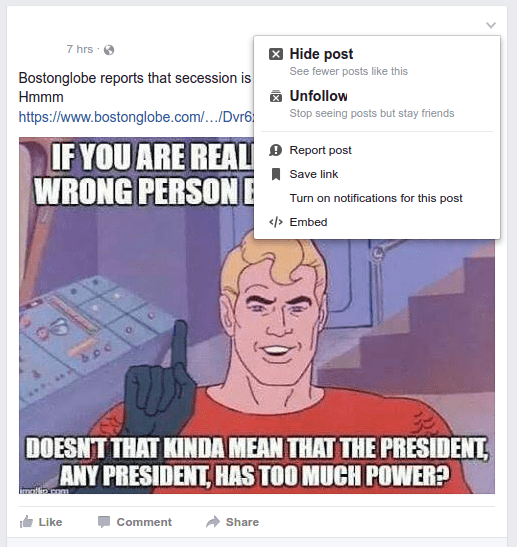
Step 3: Filter. (This is the big one.) You’re not going to convince everyone. For good or ill, morality isn’t about rationality for most people. So click that little “V” in the top right of your idiot friend’s post and tell Facebook to hide it.
fb-posts

Step 4: Relax. This stuff works by osmosis. You’re not going to change anyone’s mind over night (certainly not anyone over the age of 25). Be like the Colorado river. You don’t get a Grand Canyon of tolerance by refusing to trickle over land that doesn’t already agree with you.

Step 5: Step back. The government is about 20% of the economy. Try not to let it be more than 20% of your life. Your attention is scarce. Political life matters, but don’t let it get out of proportion. The Internet isn’t just for getting angry, it’s also for adorable gifs and pictures of pigs wearing boots.

Meta-intolerance doesn’t work. Take the worst case scenario: you’re Facebook friends with actual Hitler. You’ve got three options: A) Argue with him constantly. B) Unfriend him. C) Ignore his hateful posts and like his posts about his art. Which will do the most good for the world? Alright, potential employers and friends would probably prefer to avoid Hitler’s friends. But they’ll be more tolerant of your crazy uncle Rudy and you’ll do more good by being an occasional voice of reason in his feed than by stepping out of his Internet bubble entirely.

Most people are basically good even if they’ve got silly opinions about how to be good. And communication is hard. We speak different languages when we talk about politics and few of us have the tools to properly express ourselves. When people support politicians or policies you dislike, it might just be that they think that’s the lesser of two evils. (I’ve got opinions on why it’s sad that people think they’re “wasting” their vote by voting with their conscience, but I can hardly be mad at them for learning the fallacious reasoning that’s been foisted on them since high school civics. Let me add that if Vermonters had voted Stein and New Hampshirtonians had voted Johnson, then maybe next cycle we’ll get better options and we might push out of this two party system so many people dislike.)

I promised you Facebook lifehacks. They all boil down to this: tend your Internet bubble. You can do this with three easy steps:

  1. Like more non-controversial stuff than controversial stuff.
  2. Ignore and hide infuriating posts from people you’d rather respect (and imagine that you live in a world of respectable but flawed people instead of a world of evil charlatans).
  3. excellent

The US elections: good, bad, and ugly

Good

Media will finally start doing its job after 8 years of hanging all over Obama’s nuts.

Bad

The GOP has control of the executive branch and both houses of Congress.

Ugly

The ugly part is over. Trump won’t be as bad as the Left wants him to be (the Left might even like his protectionism), but he’ll still be plenty bad by libertarian standards. We’ve got a lot of work to do, if we’re to make his job as president as hard as possible.

Have a good day!

Brazil: the country of slavery yesterday is the country of socialism today

Although President Dilma Rousseff was impeached, and the PT (the Worker’s Party) suffered great losses in the municipal elections some weeks ago, it is still clear that PT in particular and socialism at large still has strong support among the population, especially in intellectual, cultural, and political circles. The Brazilian political spectrum often intrigues observers both from inside and outside the country: among the 35 registered political parties, almost none presents itself consistently as liberal or conservative. The only one to do so is the newly created Partido Novo (literally New Party). Other parties present themselves as socialist, social democrats, or don’t talk about this at all. To use the infamous left-to-right political spectrum, all political parties present themselves either as left or center. To present itself as right is still taboo for Brazilian political parties. Things surely seem to be changing as the already mentioned Partido Novo enters the scene and some individual politicians, such as Jair Bolsonaro, present themselves openly as right-wing. Also, social movements such as Movimento Brasil Livre and think tanks such as and Instituto Von Mises Brasil help create momentum for a new right in the country. It is possible that in future elections conservative and liberal candidates will gain seats, especially in the legislative chamber, but as parties are concerned, the right is still mostly a wasteland in Brazil. But why is that so?

Many analysts blame two factors for the lack of party representation for the Brazilian right. First, there’s the military government, from 1964 to 1985. Although statist both in political and economical terms (as it would be expected in a military government), this period was consistently identified as “right.” Therefore, to identify someone as right is still usually understood as to identify as a supporter of the military regime. Second, there is the successful work of the left, especially in the propaganda arena. The main reason for the 1964 coup was the threat of a communist revolution, such as in Cuba. The military was successful in fighting the communist guerrilla insurgency in the countryside, but were mostly unaware of the intellectual struggle in schools, universities, and other places (despite much talk of censorship to this day). Related to that or not, the fact is that the right is still underrepresented in intellectual and cultural spheres.

I’m not saying that either of the above explanations is wrong, but I’d like to suggest an alternative that goes much further in the past: Brazil is the country of socialism today because it was the country of slavery yesterday. When slavery was abolished in 1888, Brazil was the last country in the Western world to do so. An estimated four million slaves had been imported from Africa to Brazil, 40% of the total number of slaves brought to the Americas. This is ten times as many as were trafficked to North America and far more than the total number of Africans who were transported to all of the Caribbean and North America combined. According to the only national census accomplished during the monarchy, in 1872, Brazil had a population of about 10 million people. 15.24% were slaves, and 84.8% were free. It is most likely that this census doesn’t reflect the reality of the whole monarchical period, as successive laws against slavery, immigration, and other factors moved these percentages over time.

José Bonifácio de Andrada e Silva, a major figure in Brazilian politics of the time, praised freedom in his writings, but kept slavery in place, even with British pressure to abolish it and subsequent promises to help. He did that because he needed the slave owners’ money and thought that abolition wasn’t politically wise. Bernardo Pereira de Vasconcelos, founder of the Conservative Party, was a slave owner and even rented his slaves for public works. Many subsequent leaders of the Conservative Party, such as Paulino José Soares de Sousa, were part of the Fluminense slave-owning aristocracy either by birth or by marriage. Anyway, the Conservative Party wasn’t in a hurry to abolish slavery. The lack of revenue and the political implications were matters of much greater concern than the humanitarian cause. When they finally passed the gradual laws for abolition (and ironically they passed them all) it was to appease the liberal opposition, not for the sake of the cause. Conservatives were also unwilling to employ the Africans as free workers or to treat immigrants as free individuals: their plan was to gradually abolish slavery and to substitute it with a cheap immigrant labor force in large estates through laws restricting access to land. To their surprise, this plan never succeeded. Their last effort, to bring supposedly naïve Chinese in to substitute slaves, was barred by the liberals.

The legacy is that the country of slavery yesterday is the country of socialism today. As Herbert Spencer once said, “All socialism involves slavery.” Even better, Alexis de Tocqueville said that “Socialism is a new form of slavery.” Both share the same thought: slavery is forced labor of one individual to another. Socialism is forced labor of everyone to everyone else. When “rights” abound, it’s worth asking how they will be paid. Brazil is a country of rights, but not of duties or responsibilities. Just as it was the right of the elites of the past to have the slaves working for them, it’s the right of people today to receive social benefits from everyone else. People can (maybe naïvely) defend socialism as much as people in the past defended slavery, but to treat adults as infants is neither moral nor wise. Sure, Brazil still has a population that suffers from the mistakes of the past. But two wrongs don’t make a right.

To Women Voters:

I take the liberty to point out a small number of issues that I am told are important to women. I do it because I used to be a respectable social scientist and because I have been retired for ten years which gives me plenty of time to stay informed.

Women voters have been misled for years by propaganda explicitly pointed at them. It wasn’t necessarily a conspiracy though but a kind of uncritical cultural convergence. Many of those who spread misinformation believe it themselves. So, in a way, they are morally innocent. That’s no reason to follow them down the wrong path, and down the cliff. Below are five topics about which you may have received false information that has been repeated over and over until it sounded true.

The first female president

There is a widespread feeling among American women that it’s time finally to elect a female president. For some, it’s a sort of symbolic restitution. I can’t speak to this because I am only a man. Other voters, both females and males, seem to think that a female presidency would result in significant improvements in the lives of American women. A relevant reminder: Eight years ago, Americans elected the first African-American president. For many, it was a vote filled with hope for positive change in the area of race. After two Obama administrations, almost eight years later, it’s time to take stock. However you evaluate the Obama administrations in general, two facts stand out. First, race relations in American have not improved (to say the least). Second, African-Americans are not better off than they were eight years ago. In fact, they are slightly worse off economically. (My own position on having a woman President is straightforward: I would vote for Stanford Professor Condoleeza Rice, for President, in a heartbeat.)

Abortion

The 1973 Roe vs Wade decision made abortion on demand available throughout the territory of the United States. Candidate Trump has provided a list of potential nominees to the Supreme Court . Some of those nominees are pro-life. This raises the question of what would happen in the unlikely event that Roe vs Wade were overturned by a new Supreme Court. You may have been led to believe that abortion would become illegal. That’s simply not true. Legislation on abortion – if any – would revert to the individual states as the Constitution requires (same as murder, theft, sequestration, and spitting on the sidewalk). The likelihood that all fifty states would forbid abortion on demand is simply zero. The likelihood that half of them would is also zero, I believe. The worst case scenario is that abortion would become geographically inconvenient. (In case you wonder, I believe, just like former President Bill Clinton, that abortion should be legal, safe, and rare.) There is no chance that not electing Mrs Clinton will make abortion illegal.

Pay disparities

We have been told that women received interior pay for equal work for so long that it has almost become the truth. Even my local female Republican candidate for Congress uses this line. It’s not the truth. The reality is that women receive unequal pay for unequal work. There are various reasons why this is. (A broader treatment of this matter is on my blog and accessible through these two links.) In fact, paying women unequal pay for equal work has been against federal law for more than thirty years. Doing it is an invitation to costly class action suits. It’s probably important not to vote for someone on the basis of “facts” that are not facts at all. And then, there is the issue of why anyone would mislead you so badly. (Myself, I am going to vote for the Republican lady candidate for Congress although I think she should check her facts better.)

Immigration

Candidate Clinton has said clearly that she is is for open borders. This may come from a generous heart. Yet there are too many people from poor countries who want to come to the US to live. Even, if all of them are good people, the USA is like a lifeboat: If too many climb aboard, the boat capsizes and everybody drowns, the original passengers (Americans as well as existing immigrants) and the newcomers (would-be immigrants). To remain a decent society, a generous society, the US has to somehow restrict admission. Open borders is not a possible policy, it’s a dangerous fantasy. (In case you are wondering: I am an immigrant myself, so is my wife.)

Civility

Candidate Trump bragged – thirteen years ago – about making crude sexual gestures. There has not been a single formal complaint or any charge brought against him on this account. That’s although – unlike former Pres. Bill Clinton at the same stage – he has temptingly deep pockets, the kind of pockets that would give fighting courage to any moderately aggressive attorney. Candidate Trump often also has a filthy mouth, and he occasionally uses sexist language, that’s a fact. Candidate Clinton is good friends with and approves of, and patronizes artists who routinely sing of perpetrating gross sexual violence on women (including in the last days of her campaign). They too use obscene words. They do so routinely, every time they perform. (I don’t use such language myself but my wife of forty years does, another story, obviously.)

Please share this and ask your friends to share.