A short note on Brazil’s present political predicament

This Wednesday, O Globo, one of the newspapers of greater audience in Brazil, leaked information obtained by the Federal Policy implicating president Michel Temer and Senator Aécio Neves in a corruption scandal. Temer was recorded supporting a bribe for former congressman Eduardo Cunha, now under arrest, so that Cunha would not give further information for the police. Aécio, president of PSDB (one of the main political parties in Brazil), was recorded asking for a bribe from a businessman from JBS, a company in the food industry. The recordings were authorized by the judiciary and are part of the Operation Lava Jato.

In the last few years Oparation Lava Jato, commanded by Judge Sérgio Moro and inspired by the Italian Oparation Clean Hands, brought to justice some of the most important politicians in Brazil, including formed president Luis Inácio Lula da Silva. However, supporters of president Lula, president Dilma and their political party (PT) complained that Moro and his team were politically biased, going after politicians from the left, especially PT, and never form the right – especially PSDB. PSDB is not actually a right-wing party, if we consider right wing only conservatives and libertarians. PSDB, as it name implies, is a social democratic party, i.e., a left wing one. However, since the late 1980s and especially mid-1990s, PSDB is the main political adversary for PT, creating a complicated scenario that PT usually explores politically in its own benefit. In any way, it is clear now (although hardcore Lula supporters will not see this) that Operation Lava Jato is simply going after corrupt politicians, regardless if their political parties or ideologies.

With president Michel Temer directly implicated in trying to stop Operation Lava Jato, his government, that already lacked general public support, is held by a string. Maybe Temer will resign. Other possibility is that the Congress will start an impeachment process, such as happened with Dilma Rousseff just a year ago. In one way or another, the Congress will have to call for a new presidential election, albeit an indirect one: the Congress itself will elect a new president and virtually anyone with political rights in Brazil can be candidate. This new president would govern only until next year, completing the term started by Dilma Rousseff in 2014. There is also another possibility in the horizon: the presidential ticket that brought both Dilma Rousseff and Michel Temer to Brasília is under investigation and it is possible that next June Temer will be declared out of office by the electoral justice.

Politicians from the left, especially REDE and PSOL, want a new presidential election with popular vote. In case Temer simply resigns or is impeached, this would require an amendment to the already tremendously amended Brazilian constitution. This new election might benefit Marina Silva, virtual candidate for REDE and forerunner in the 2010 and 2014 presidential elections. Without a solid candidate, it is possible that PSOL will support Marina, or at least try a ticket with her. A new presidential election with popular vote could also benefit Lula, still free, but under investigation by Moro and his team. Few people doubt that Lula will be in jail very soon, unless he escapes to the presidential palace where he would have special forum.

Temer already came to public saying that he will not resign. Although a corrupt, as it is clear now, Temer was supporting somewhat pro-market reforms in Brazil. In his current political predicament it is unlikely that he will be able to conduct any reform. The best for Brazil is that Temer resigns as soon as possible and that the Congress elects equally fast a new president, someone with little political connections but able to run the government smoothly until next year. Unfortunately, any free market reform would have to wait, but it would also give time for libertarian, classical liberal and conservative groups to grow support for free market ideas among the voters until the election. A new presidential election with popular vote would harm everyone: it would be the burial of democratic institutions in Brazil. Brazil needs to show the World that it has institutions that are respected, and to which people can hold in times of trouble, when the politicians behave as politicians do.

Who is Jair Bolsonaro and why you should care

Since 1994, Brazilian presidential elections follow a pattern: PSDB and PT candidates are the main competitors, with a third candidate falling between the main leaders and countless dwarf candidates. Although this third candidate does not reach the presidency and does not even dispute the second round of the elections, its political influence tends to increase and its support happens to be disputed by the candidates of the PSDB and the PT. So it was mainly with Marina Silva in 2010 and 2014, and possibly will be so with Jair Bolsonaro in 2018.

After being defeated in 1989, 1994 and 1998, Luis Inacio Lula da Silva finally won the presidential election in 2002 and was re-elected in 2006. In 2002 Lula was benefited by the low popularity of President Fernando Henrique Cardoso (FHC), hurt by the circumstantial economic difficulties that the country was going through. FHC was practically absent from the campaign of his successor candidate, José Serra, apparently by common agreement of the incumbent and the possible successor. In addition, Lula and the PT had a radical change of stance that year, expressed mainly by the “Letter to the Brazilian People”. In this document Lula promised to abandon his historic struggle against free markets and to maintain the basic guidelines of FHC’s economic policy, which in the middle of the previous decade had taken the country from one of the worst economic crises in its history. The Brazilian economy left the circumstantial difficulty of 2002 and with this Lula secured his reelection in 2006. However, looking back, the arrival of Lula to the power was not accidental. Created in the late 1970s, the PT always faithfully (and not secretly) followed Antonio Gramsci’s guidelines of cultural Marxism: to come to power not by violence and also not by elections per se, but by cultural influence. This guideline guaranteed to Lula, even in the elections he lost, about 30% of the valid votes. The other 21% were electors dissatisfied (in the case of 2002) or excited (in the case of 2006) with the economic conditions of the moment. However, it is this same strategy of cultural Marxism that is now opening room for Jair Bolsonaro.

Bolsonaro is already an old congressman in Brazil, but has only really become famous in recent years. Elected for the first time in 1990, he fiercely criticized FHC’s free-market economic policy during the 1990s. In his view the then-president was a entreguista (something like a surrenderer) and the Brazilian economy needed to be protected against foreigners. Bolsonaro has also many times attenuated or even denied the fact that Brazil underwent a military dictatorship between 1964 and 1985. But what his followers (who call him Mito) really admire him for is the way he stands against political correctness, in a way reminiscent of Donald Trump. Bolsonaro became famous mainly for opposing the introduction of gender ideology as content in the country’s public schools. For this reason he is often accused of machismo and homophobia by his opponents. In recent statements Bolsonaro expresses greater support for the free market, but maintains his admiration for the military that governed Brazil in the past and a hard line against the politically correct.

Not only in Brazil, but in other parts of the world, the spell of cultural Marxism is turning against the sorcerer. When the facts refuted Marx’s economic theory (already brilliantly refuted by Mises) some Marxists, such as Oskar Lange, and more recently Thomas Piketty, sought a soft version of economic Marxism. Many others, however, took refuge in the cultural Marxism of Gramsci, Foucault, Herbert Marcuse, and others. The option was simple: instead of admitting that Marxism is not true, many Marxists decided that truth is relative. The main result of this is the identity politics that spread throughout the world. Everyone wants to identify themselves as members of minorities who are not represented by traditional politicians. It was only a matter of time before white middle-aged men began to complain that they were not represented. And so white middle-aged men have taken Britain out of the European Union, elected Trump US president and will shortly elect leaders in other countries or at least greatly annoy the globalist establishment.

Throughout the world there is a weakening of the semi-Marxist welfare state, and the same can be observed in Brazil. Important right-wing leaders have emerged in recent years, ranging from conservatism to libertarianism. In the case of Brazil, however, where the population is still largely socially conservative, there is a strong tendency towards a conservatism with which libertarians do not identify, and this trend is stopping the advance of communism in the country. Brazilians can accept Marxism in politics and economics, but they do not accept it in their bedrooms as easily. It is possible that Bolsonaro is accepting the basic premises of a free-market economy, but his main appeal is to be the most anti-Lula, anti-PT, anti-establishment and politically incorrect presidential candidate. Even if he is not elected president in 2018, or even reaches the second round of elections, Bolsonaro is already a political leader impossible to ignore.

Some ideas to guide your thoughts on health care

This post is meant to help my non-economist friends think more clearly about how we pay for health care. I’ll talk about markets, but the truth is that the American system is built of deeply bastardized markets. If our car markets worked like our health markets, most of us would walk to work. I’m trying to focus on the essential logic of the situation which is going to sound Utopian because Congress isn’t going to give us any sort of logical policy any time soon. But we aren’t going to get a logical solution until we as voters understand the logic of health care finance.

I’ve got a few big points to make:

  1. Trying to health insurance also work like charity is bound to end poorly for everyone.
  2. A single-payer system has a lot of nice features for individuals, but a lot of systemic problems.
  3. It’s fundamentally impossible to insure pre-existing conditions. Insurance is about sharing risk, not unavoidable expenses.

(This post is longer than I’d like, so thanks for your patience!)

Markets and Charity

I’ve said it before, and I’ll say it again: we don’t have to ruin markets to do charity.

The essence of markets is that they aggregate knowledge about the relative costs and benefits of different goods based on the preferences of the real people involved in producing and consuming those goods.

The demand side of markets provide information by giving you (as a consumer) a choice between more of something you like and more money to spend on other stuff. On the supply side they give you (as a supplier–probably of your own labor) the choice between providing more of what people are willing to pay for or having less money to buy the stuff you want. Markets crowdsource cost-benefit analysis.

Prices also give suppliers an incentive to produce things that consumers want while trying to save resources (i.e. cut costs). In other words, a price is a signal wrapped up in an incentive.

So what about fairness? The bad news is that markets are a system of “from each according to their ability, to each according to how much other people are willing to pay for the product of their ability.” (Not very catchy!) It’s mostly fair for most of us, but doesn’t do much good for people who are just unlucky (e.g. kids born with genetic defects). Here’s the good news: we can use charity alongside markets.

We can debate how much role government should play in charity some other time. For now, let’s whole-ass one thing instead of half-assing two things. We have to appreciate that interfering with markets interferes with the ability of those markets to function as sources of reliable information. It doesn’t matter how good our intentions are, we face a trade off here… unless we do something to establish a functioning charity system parallel to the health care finance system.

Single Payer

Anecdotes about the merits of a single-payer health care system are powerful because they shed light on the biggest benefit to such a system: individual convenience.

Part of the appeal has to do with the general screwiness of the American system. It’s a cathedral built of band-aids. But even in an idealized market system, a single-payer system has the advantage of not making me go through the work of evaluating which plan best suits my needs.

A single-payer system is, from an individual perspective, about as ideal as having your parents pay for it. But we don’t really  want our parents buying our stuff for us.

Single payer system sacrifice the informational value of markets (probably even more so than America’s current system of quasi-price controls). Innovation would be harder as long as new treatments had to be approved by risk-averse bureaucrats (and again, we already face a version of this with Medicare billing codes and insurance companies).

Essentially, a single payer system creates a common pool problem: each of us gets the individual benefit of being able to be lazy. But then we’re left trusting bureaucrats, special interest groups, and think tanks to keep an eye on things. It could be an improvement over the current American system, but that’s like saying amputation is better than gangrene.

Insurance

Premium = expected cost + overhead

Consider two alternatives. In scenario A you start with $150, flip a coin, and if it comes up tails you lose $100. In scenario B you get $90. The expected value of A is $100, but most of us would still prefer the sure thing.

Here’s how insurance works: You start with $150, give $60 to the insurance company, then flip the coin. If it comes up tails, you lose $100, but the insurance company gives you back $40. You’ve just gotten the sure thing. And by taking on thousands of these bets the insurance company is able to make enough money to pay their employees.

But here’s the thing: the premium they charge is fundamentally tied to that expected value. Change the odds, or the costs (i.e. the claims they have to pay for) and you’ll change the premium.

(BTW, Tim Harford did a nice ~8 minute podcast episode on insurance that’s worth checking out.)

Pre-existing conditions are the equivalent of changing our thought experiment to a 100% chance of flipping tails. No amount of risk sharing that will get you to the $90 outcome you want. You can’t insure your car after you’ve been in an accident and you can’t insure a person against a loss they’ve already realized. If you’re Bill Gates, that’s no big deal, but for many people, this might mean depending on charity. That’s a bummer, but wishful thinking can’t undo that.

If we insist that insurance companies cover pre-existing conditions* the result can only be higher premiums. This is nice for people with these pre-existing conditions, but not so great for (currently) healthy poor people. Again, charity matters needs to be part of the debate, but it needs to be parallel to insurance markets.

Covering more contingencies also affects premiums. The more things a policy covers, the higher the expected cost, and therefore the higher the premium. We each have to decide what things are worth insuring and what risks we’re willing to face ourselves. Politics might not be the best way to navigate those choices.

High deductibles and catastrophic care

Actuaries think about the cost of insuring as a marginal cost. In other words, they know that the odds that you spend $100 in a year are much higher than the odds that you spend $1000. So the cost of insuring the first dollar of coverage is much higher than the cost of insuring the 5000th dollar. This is why high deductible plans are so much cheaper… they only pay out in the unlikely situation where something catastrophically bad happens to you. This is exactly why most of us want insurance. We aren’t afraid of the cost of band-aids and aspirin, we’re afraid of the cost of cancer treatment.

For those of us firmly in the middle class, what we really need is a high-deductible plan plus some money in the bank to cover routine care and smaller emergencies. (Personally, my version of this is a credit card.) Such a plan has the added benefit of encouraging us to be more cost conscious.

A big problem with our current system is that it’s set up like an all-you-can-eat buffet. You pay to get in (your premiums) but once you’re in the hospital, any expenses are the insurance company’s problem (read: everyone else on your health plan). The logic here is the same as with pollution. When I drive my car I get the benefits of a quick and comfortable commute but I also suffer a little bit more pollution. But I don’t have incentive to think about how that pollution affects you so I pollute more than would be ideal. Multiply that by millions of people and we can end up with smog.

tl;dr

If I were trying to put together a politically palatable alternative to our current system, I’d have an individual mandate with insurance vouchers for the poor (it’s not very libertarian, and it’s far from my Utopian ideal, but I think it would be a huge improvement over what we’ve got now). I would also expand the role of market competition by encouraging high deductibles plus flexible health savings accounts.

Reality is complicated, but I’m trying to get at the fundamental logic here. We don’t have a properly functioning market system. To get there we need competition, transparency, and a populace with the mental tools and mathematical literacy necessary to understand what their insurance can and can’t do. That’s a tall order, but it doesn’t mean we shouldn’t keep trying to move in that direction.

To have a fruitful debate we need to understand what we want from our healthcare system: help for the poor (charity), convenience, and efficiency from an individual and social perspective. By trying to lump all these things together we muddy the waters and make it harder to understand one another.


*I don’t know what the deal is with the idea that the AHCA will treat rape as a pre-existing condition. Some webpages give a bunch of random tweets as evidence of this, and others call bullshit. Let’s just leave it at this: in a competitive market this would be considered terrible marketing and savvy companies wouldn’t do it. The lesson then is to keep calling companies on bad marketing, and avoid protecting politically powerful companies from market competition.

Turkey’s Referendum: Authoritarianism and Electoral Fixes

As previously indicated I will be posting an appendix to my posts on Coup and Counter-Coup in Turkey, referring to Ottomanism, Kemalist republicanism and related issues. The sixteenth of April referendum does require a response of a more immediate kind. The referendum was on amendments to the Constitution largely concerned with transforming Turkey from a parliamentary republic, which it has been at least in principle since the formation of the Republic of Turkey in 1923. Recep Tayıp Erdoğan had already been breaking the Constitution since 2014 when he was elected President of Turkey after more than a decade as Prime Minister. On becoming President he transferred the chief executive power to the presidential palace (which has more than 1000 rooms and was built on Erdoğan’s orders using executive privilege to override court bans on building on the land concerned). This in itself tells you everything you need to know about the decay of Turkish democracy, from a starting point which was itself not a shining beacon to the world of purist constitutional democracy.

Erdoğan’s ambitions for an executive presidency in Turkey precede his elevation to that role. The shift from a President elected by the National Assembly to a President elected by popular vote came from a referendum of 2007, though Erdoğan is the first President of Turkey to take the office in this way. Kemal Atatürk (1923-1938) and then İsmet İnönü (1938-1950) were powerful presidents in a parliamentary system. This paradox arose because Turkey was a de facto one-party state in which only the Republican People’s Party had seats in the National Assembly from 1923 to 1943, though the Free Republican Party won seats in local elections. The elections of 1946 resulted in an opposition party and some independent deputies entering the National Assembly. In 1950 İnönü became the first Turkish (or Ottoman) leader to give up power peacefully as the result of elections and the Republican People’s Party became the first political party to give up power in this manner. During the one party period, the President was the dominant figure in the Republican People’s Party and therefore acted as the head of government, though with a Prime Minister and some genuine divisions of responsibilities.

Not only did Erdoğan start using powers he had not been given in the constitution in 2014, the whole evolution towards a presidential system has been done in a way to benefit him personally. He was Prime Minister over three terms from 2002 to 2014, an office to be abolished in 2019 as a result of the recent referendum, and was the head of government. He has acted as effective head of government since 2014, regardless of the Prime Minister having this role. The office of Prime Minister will still exist until 2019 and most of the constitutional changes as a result of the referendum will not come into force until then. Erdoğan can then have the two terms of executive presidency in addition to the term he is currently serving which will still constitutionally limit his powers in ways that mean the Prime Minister should be head of government. In this sense, the system is working as in the days of the one party system. So Erdoğan can serve as head of government in Turkey from 2003 until 2029. Furthermore he may be able to add another term if the National Assembly goes to an early election during his second term.

The President will have the power to dissolve the National Assembly, and this could easily happen simply because the President wishes to have a third term. The amended constitution at least restricts the President to two five-year terms plus most of a third term in special conditions. So the possibility exists of Erdoğan running the Turkish government from 2003 to 2034, a highly unusual situation in any democracy and one likely to undermine the democracy in question, particularly as the powers of the President now include control of appointment of senior judges, senior civil servants, senior bureaucrats, the right to issue decrees as laws, the right to appoint all cabinet ministers without National Assembly approval, and the right to appoint two vice-presidents without National Assembly approval. Theses figures will not be required to answer questions in the National Assembly and, like the President, will benefit from lifetime immunity with regard to alleged crimes committed in office. That is to say, the President and his associates will have immunity for life unless the National Assembly votes to suspend the immunity, with a high enough majority required to make this unlikely unless there is a massive collapse in the number of AKP deputies, or of Erdoğan’s control of the AKP.

We cannot even say that these changes designed to produce a President above normal democratic constitutional checks and balances, dominating the whole governmental process and state machinery in a way unprecedented in Turkey’s multi-party history, have been agreed to by a genuine majority vote. The referendum was held in state of emergency conditions, which still prevails. A state of emergency in which opposition journalists have been detained in large numbers on flimsy charges as ‘terrorists’, opposition deputies (from Kurdish rights-leftist HDP) have been detained on a similar basis. State media and most private media groups operate as media organs of the AKP. The state of emergency has been applied in a particularly harsh way in the southeast (Kurdish majority) part of the country where elected local government has been replaced by central government appointees. There are 500,000 displaced persons in the southeast resulting from PKK terror and the state security reaction which led to military bombardment of whole towns and urban districts until they were reduced to rubble. It was clearly not easy for them to vote and it looks like a large number did not vote. Extreme intimidation of No campaigners was the norm in the southeast where large numbers of HDP election observers were denied access to polling booths. Intimidation of the No campaign took place elsewhere if in a less extreme way and public spaces were dominated by Yes publicity.

The count was itself full of flagrant irregularities. The number of polling stations recording a 100% vote for Yes was far greater than the number recording 100% AKP votes in recent elections. There was another party campaigning for the Yes, the hardline nationalistic MHP, but the party split over the leader’s support for Yes and all the evidence is that overwhelmingly most MHP voters did not vote Yes. Given that some AKP voters defected from Yes, not many but no less than 5%, there was no reason to expect an increased number of polling stations with a 100% vote and of course suspicion is in order about polling stations which recorded such results in the past.

An AKP politician who is a member of the national electoral board (itself packed with AKP appointees) requested that all ballot papers used to vote, but not carrying a stamp to show they have been authorised for that polling station by an official, should be counted. This is illegal but the request was granted. AKP apologists were quick to say that opposition requests in the past for counting such ballots (because maybe they were stuck together when the official was stamping papers) were granted in the past. Small illegality does not excuse large illegality and the scale of counting of such ballot papers was much larger than previously.

During the count the state news agency was announcing results before they were released by the electoral board. A strange and suspicious situation. The international media, following the state news agency, failed to see the discrepancy also confusing the percentage of ballot boxes opened with votes cast, giving a very misleading impression of a big lead amongst most votes cast early in the evening. The election board results then went off line and were not shared with the opposition. When results came back online they showed a very different pattern than before the break in service, more in line with the state news agency announcements.

Given the close (51.4% for Yes) nature of the official result, there are a number of reasons to think that No won in votes cast, and even if we ignore the voting irregularities, there is reason to think that in a less intimidating atmosphere, particularly in the southeast, more Yes voters would have cast a vote. In these circumstances I suggest that even on a very cautious reckoning, the number of votes cast for No was at least 51% and that with a less intimidating and disruptive atmosphere, another 2% would have gone to No. To say on this basis that 53% voted No is I believe a very cautious estimate. There is very probably a clear majority of Turkish voters against the new presidential system, at least 55%.

The narrow result clearly caused embarrassment to Erdoğan and the AKP who had predicted a very big victory for Yes. They have gone quieter since then, but with no let up in authoritarian measures. Just two days ago Wikipedia was blocked in Turkey, several thousand state employees were dismissed using emergency powers and a number of NGOs were closed in a similar way. The context of the supposed Yes victory gives hope that there is opposition to the Erdoğan/AKP destruction of liberal democracy, but recent measures suggest they are as determined as ever to use the tools of state to obliterate opposition, or just any sense of independence from the party-state machine.

Immigration and Jobs – Reprise

A good op-ed in the March 24 issue of the Wall Street Journal by Mark Krikorian forces me to go back to one of my recent postings on immigration: “Immigration and Jobs.”

Krikorian is executive director of the Center for Immigration Studies in Washington D.C. Mr Krikorian accuses everyone in America of “not facing the facts” about current and recent immigration. He insists that some questions must be posed instead of skirted. I agree, of course, but I don’t know that it’s true that people are not facing the facts. I think instead that many busy and fair people are hearing contradictory statements and that they don’t have a good framework to think things through. Krikorian states that he rests his case on an authoritative study by the National Academies of Science, Engineering and Medicine. The academies are a respected source. I take it seriously if Krikorian reports accurately. (Be aware that I have not read the study in question.)

Krikorian’s most troubling assertion is as follows: All Americans benefit from immigrants being in the US. This benefit is entirely extracted from the higher wages Americans competing with immigrants would receive absent wage lowering immigrants’ competition. In other words: Americans who compete with immigrants receive lower wages than they should; everyone else benefits from these lower wages.

I think that’s obviously overstating the case. There must be at least one immigrant generating product (GDP) that would not otherwise exist in the American economy. Maybe, there are two. One is in Silicon Valley, inventing a product – like the personal computer forty years ago – that will eventually cause the employment of thousands, or millions. The second is in Kansas, saving from demolition a beat-down hotel that provides immediate employment for two-to–four minimum wage-earning maids. (Both entrepreneurs are Indians, obviously). In general, immigrants might benefit all by offering additional, or better, services than do the native born. I develop this thesis below.

Krikorian seems to be operating from a standpoint where the work pie to be shared by Americans and by immigrants is of a permanently fixed size. This erroneous perspective, in turn, may well come from a respectable desire to stick close to research findings. Research that also (also) takes into account immigrants’ contribution to increasing the size of the pie is doable but it’s more difficult to perform and to integrate with previous findings than research that relies on a static representation of reality.

Let me admit that I don’t have any numbers at my disposal and that any reasonably credible set of numbers could blow out of the water everything I am going to say below.

First, it’s obvious that there are currently many unfilled jobs in the US. Organized labor and anti-immigration spokespeople will argue that all those jobs would be filled if the wages offered were high enough. I am skeptical of this argument for two reasons. First, Silicon Valley employers affirm vigorously that they just don’t find enough would-be employees with the required skills, at any price. I tend to believe them to some extent because they evidently spend energy and resources raiding each other for expensive existing personnel. This kind of practice suggests true, absolute scarcity. I have mentioned in one of the companion essays the difficulty farmers encounter in recruiting pickers even when they offer wages significantly superior to both the minimum wage and to the going wage in my job-poor area. I would argue that their difficulties are rooted in the same problem facing Silicon Valley employers: a shortage of local competence. Picking strawberries, for example, is not easy at all. And it requires a certain attitude, or fortitude, that is not common anymore among Americans, as I have argued elsewhere.

Second, presented below, a forbidden argument. But I must make a disclosure before I move to it: I am one of the 43 million foreign-born people now living in the US. I studied in the US and I was permanently admitted on a variant of a B1 visa. I had a main career as a university professor. I don’t believe that an extra teaching position was ever added in any university to accommodate me. (It happens for some foreigners, a very few, of star quality, like Einstein; I wasn’t one of them, let’s face it.) Of course, to obtain any university position, I had to possess the same credentials as native-born Americans who also wanted the position. (That’s right, there is no affirmative action track for white Europeans!) Good university positions are surprisingly competitive to obtain; earning tenure is even more competitive. Every position I obtained, I got from winning against similarly situated native-born.

Each time, I won the gold, if you will. This simple fact would seem to suggest that I was at least slightly better in conventional terms than those native-born who did not get the position. This fact implies at minimum that had I not competed for the position my students would have been served at best by a silver medalist. (I choose the Olympics language on purpose, from a surfeit of honesty. It’s not absurd to argue that the quality difference between the gold and the silver winners is insignificant or even accidental: On a different day, with a different wind, perhaps, the silver winner would have won the gold. But there is more.)

Like many but not all immigrants, I grew up in a language different from English, French in my case. So. I had to achieve the same credentials as my competitors in what was for me a second language. Forgive me for seeming to brag but doesn’t this indicate an intellectual competence over and above what the formal credentials express? If you doubt this shameless assertion, ask yourself how many native-born Americans are able to teach anything – besides the English language – in any francophone university anywhere. And I am not an extreme case of talent among immigrants to the US. I know a man, a distinguished biological scientist, who grew up in the African language Wolof, went to secondary school in French, to college and graduate school in English. Would you guess he possesses a certain mental nimbleness uncommon among determined monolinguals?

I will reluctantly take another step. I do it reluctantly because it is sure to lose me some friends. I will use my own case as an immigrant for an example because it’s the case I know best. It’s about the cultural endowment we carry around over and above, or aside from mastery of a foreign language.

Let me say right away that I don’t contend that I enjoy a 100% understanding of American culture, even after fifty years. I don’t understand the rules of baseball, for example. I never bothered to learn because the game seems boring. Yet, I must be conversant with a lot of national culture, just for having acquired my professional credentials and, even more so, for navigating everyday life in my society of adoption. The point is that the acquisition of another culture does not entail a one-for-one exchange, like changing clothes, for example. Much, most of what the immigrant brings with him, he retains, as one might easily assume. When I was learning American culture, I was not leaving French culture behind with the hat-check girl.

The first thing that immigrants, those who immigrate as adults, keep is mastery of their native language. This may sound mysterious to a monolingual person. It’s true that one can become “rusty” in a language one does not use. The quality of self-expression, for example, may deteriorate over time spent abroad. Yet, it’s very unlikely that an immigrant will lose the ability to watch the news in his native language, or to read a newspaper. So, I follow the news in English, of course, but also in French, some of the time. The reporting of the same events do not overlap perfectly, far from it. So, I am learning things I probably would not learn if I knew no French. (That’s in addition to carrying in my head much disorderly information from my society of origin. More below.) In my job as a teacher and as a scholar, I was routinely able to draw on broader information than did my native-born colleagues. I wouldn’t say (although I am tempted) that I had twice as large a store of information at my fingertips as they did but that I had definitely more than they.

So, in fact, I am arguing – with little embarrassment – that I must have been a better teacher and scholar than most (not all) of my native-born colleagues with similar credentials by virtue of being an immigrant.* There may be no metrics allowing an assessment of this outrageous claim. That’s because what college professors actually do is so mysterious. (Another story.)

It’s also true that to measure accurately the added work value of immigrants you have to find a way to factor in laziness, which varies much among individuals. In my case, I suspect strongly that if I had been native born, I could not have had the normal academic career I enjoyed, given my above-average level of laziness. In other words, the informational advantage associated with being a bilingual immigrant may have paid the fare for my laziness. Had I been the same person, with the same formal credentials, except less lazy, however, my presence would have much benefited American society. This detour supports my main argument of course: It does not make much sense to deny that competent bilingualism adds to normally credentialed efficacy. This is true in an occupation such as university teaching. It’s true though possibly to a lesser extent, for a plumber who will, at least, be a better citizen than a comparably situated monolingual. This is all common sense. No hard data are needed to give this scenario credence although hard figures might destroy it.

It should be fairly clear that a second language is like another tool in one’s personal toolbox. Immigrants have yet more, other additional tools that may be more elusive, more difficult to describe. I am giving it a try. All of us approach new situations through a filter that is made up partly of our past experiences, through the colander of past experiences if you will. Many of the experiences that compose the sifting device are repetitive, partly superfluous: The tenth car accident you witness does not have the same power to influence your driving as the first. There is often an excess of material in the sifter. This means that whatever the sifting process accomplishes would be accomplished as well, or nearly as well, on the basis of fewer past experiences.

My experiences in my society of origin do not perfectly duplicate those of a similarly situated native-born American. For example, I lived through a school system that was much more authoritarian than he experienced. I take from this the strong impression that my experiences in my society of origin adds to my experiences in my society of choice to give me a better sifter than what exists among the native-born population. It does this in a non-repetitive way (unlike, say, the 9th car accident.) I don’t mean that I have twice as large a sifter as they do but perhaps that I have 125% of what they carry in their heads.

This second extra tool in my tool box is factually associated with the first, bilingualism, but it’s not the same thing. An Australian, with a perfect command of English and perfectly innocent of knowledge of another language would carry the same extra tool as I do. The advantage gained through this second tool is difficult to express. It’s tacit. (I have never read anything about the topic.) I believe that my experience of another society – again, independently of bilingualism – acts like a second pair of glasses. I think I am able to watch events and people from one perspective, and then, to some extent, from a second perspective. I suspect it does not give me extra-depth but an edge in exercising common criticality. Possibly, it acts like a few IQ points that would be added to my measured IQ. Again, this thesis is very exploratory, supported by no real numbers. I must add that this second tool associated with being an immigrant is free from the effects of education. I think I have observed the expected extra resourcefulness among Mexican immigrants I knew to be semi-literate (in Spanish) performing ordinary manual jobs, in construction and in repair work, for example.

In conclusion: I and hundreds of other immigrants I have observed contribute to the society in which we live over and above the contributions of the native-born. Thus, we add to the general well-being even if we are paid exactly the same as the native-born.

The above is a short string of arguments in favor of immigration. None of it is a call for open borders. I subscribe to the lifeboat view of immigration. Too numerous immigrants could easily sink the boat that made them swim to developed societies in the first place. (According to retired foreign service officer Dave Seminara’s review of relevant studies – that I have not read – 150 million people world wide would like to move to the US, including 34% of Mexicans.) In addition, there are non-economic arguments against large-scale immigration that I support although they may be even more difficult to describe than what I tried to explain above. My analysis supports instead an active stance to design immigration policies that make rigorously the conceptual distinction between immigrants we need and immigrants in need. This distinction is not inimical to any refugee policy whatsoever; perhaps, the reverse is true.


* Please, don’t try to factor in a putative superior European education brought to the job of being an American academic as an alternative explanation. I am a French high school dropout.
How dairy farmers unions in Canada are distorting the facts about supply management

Under heat recently as President Trump has criticized supply management in Canada and retaliated against it, the different provincial associations representing dairy farmers have moved on the offensive. To promote the virtues of this system meant to reduce production in order to prop up prices through the use of trade tariffs, production quotas and price controls (how can we call those virtues), these unions have produced numerous infographics to make their case. It is even part of what they dub their These-infographics-show-that-diary-prices-are-lower-in-Canada-than-elsewhere, that milk is still a cheap drink relative to other type of drinks and those prices, supposedly, increase more slowly than elsewhere. All of these graphics are dishonest and must be dismantled.

The most egregious of these infographics – present in the “lobby day kit” – shows the price of milk in Australia (1.55 CAD), Canada (1.45 CAD) and New Zealand (1.65 CAD). They are seemingly using 2014 prices. First of all, they use data that conflicts massively with the reports of Statistics Canada that suggest that milk prices hover between 2.33$ to 2.48$ per liter.  Their data is provided by AC Nielsen but no justification is presented as to why they are better than Statistics Canada. The truth is that it is not better. Participants in Nielsen surveys come from a self-selected pool of storeowners who wish to participate and are then selected by Nielsen to be part of the data collection. Then, they can record prices. It should be mentioned that not all regions of Canada are covered in the data. Although the Nielsen data does have some uses (especially with regards to market studies), it hardly measures up Statistics Canada when comes the time to evaluate price levels. This is because the government agency collects information from all regions and tries a broader sweep of retailers in order to create the consumer price index.

But an even larger problem is that, in their comparison of prices, they don’t mention that New Zealand taxes milk. In New Zealand, all food items are subjected to sales tax, which is not the case in Canada and Australia. Hence, when they compare retail prices, they are comparing prices that exclude taxes and prices that include taxes. One would like to find if they acknowledge this fact in the methodological mentions, but there are none!

Using prices available at Numbeo.com and Expatisan.com and the exchange rates made available by the Bank of Canada, we can correct for this problem of theirs. Simply changing prices source leads to a massively different result with regards to Australia whose milk prices are lower than in Canada. Secondly, once we adjust for the sales tax in New Zealand, we find that prices in New Zealand are lower than in Canada. In fact they are lower than in one of Canada’s cheapest market, Montreal (let alone Toronto or Vancouver).  So the infographic they show in order to lobby governments is a fabrication.

Table 1: The real price of milk

Using Numbeo.com (regular milk)
Unadjusted Adjusted for taxes
 Australia  $           1.59  $                 1.59
 New Zealand  $           2.26  $                 1.97
 Canada  $           1.99  $                 1.99
 Using Expatisan.com (whole milk)
 Unadjusted  Adjusted for taxes
 Sydney  $           1.82  $                 1.47
 Wellington  $           2.42  $                 2.10
 Montreal  $           2.87  $                 2.87

Source: Numbeo.com and Expatisan.com, consulted May 16th 2014 and the Bank of Canada’s currency converter. Note: using the Statistics Canada price would make Canada’s situation even worse by comparison.

This is part of a pattern of deceit since they also massage data for numerous other graphs that are presented to Canadians in efforts to convince them of the virtues of supply management. One other example is an infographic that presents a figure of nominal milk prices in Australia before and after the abolition of supply management. Given that prices seem more volatile after 2000 and that they increase more steeply, they try to make us believe that liberalization was a failure. This is not the case. Any sensible policy analyst would deflate nominal prices by the general price index to control for inflation. When one does just that using the data from the Australian Bureau of Statistics, one sees that real prices stabilized in the first ten years of deregulation after increasing roughly 15% in the decade prior. And since 2010, real prices have been falling constantly.

Other examples abound. In one instance, the Quebec union of dairy farmers circulated an infographic meant to show that nominal prices for dairy products increased faster in the United States than in Canada. Again, they omit inflation. Since 1990 (their own starting date), prices of dairy products have risen more slowly than inflation – indicating a decline in real prices. In Canada, the opposite occurred – inflation increased more slowly than dairy prices indicating an increase of the real price.

The debate around supply management is complicated. The policy course to adopt in order to improve agricultural productivity and lower prices for Canadians is hard to pinpoint. But whatever position one may hold, no one is well-served by statistical manipulations offered by the unions representing dairy farmers.

Geopolitics and Asia’s Little Divergence: State Building in China and Japan After 1850

Crossposted at the Medium

Why did Japan successfully modernize in the 19th century while China failed to do so? Both China and Japan came under increasing threat from the Western powers after 1850. In response, Japan successfully undertook a program of state building and modernization; in China, however, attempts to modernize proved unsuccessful and the power of the central state was fatally weakened. The failure to build a modern state led to China’s so-called lost century while Japan’s success enabled it to become the first non-western country to industrialize. In a paper with Chiaki Moriguchi (Hitotsubashi University) and Tuan-Hwee Sng (NUS), we explore this question using a combination of historical evidence and formal modeling.

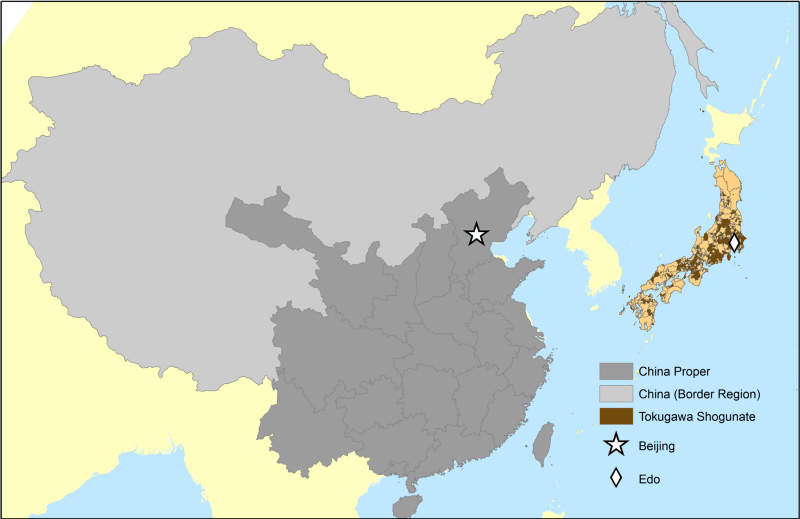
On the surface this East Asian “little divergence” is extremely puzzling. Qing China, as late as the end of the eighteenth century, was a powerful centralized empire. An impersonal bureaucracy selected by exams, and routinely rotated, governed the empire. In contrast, the institutions of Tokugawa Japan are usually described as feudal. The shogun directly ruled only 15% of the country. The remainder was divided into 260 domains ruled by lords known as daimyo who collected their own taxes, possessed their own armies, and issued their own currencies. To the outside observer China would have seemed much more likely to have been able to establish the institutions or a centralized state than Japan.

Figure 1: Qing China and Tokugawa Japan

For much of the early modern period (1500–1700) China and Japan possessed military capabilities that made them more than a match for any western power. This changed dramatically after the Industrial Revolution and their vulnerability exposed by the Opium War (1839–1840) and the Black Ships Incident of 1853, respectively. During the First Opium a small number of British ships overpowered the entire Chinese navy, while Commodore Perry’s show of force in landing in Japan in 1853 convinced the Japanese of western naval superiority. Within a few years, political elites in both countries recognized the need to modernize if only to develop the military capacity required to fend off this new danger.

* * *

koyamajapanperry
Figure 2: Commodore Perry in Japanese eyes

In China, after the suppression of the Taiping Rebellion, there were attempts at modernizing — notably the Self-Strengthening movement associated with Li Hongzhang and others. Recent scholarship has reevaluated this movement positively. At the purely military-technological level it was in fact quite successful. The Jiangnan Arsenal and the Fuzhou Shipyard saw the successful importation of western military technology into China and the Chinese were soon producing modern ships and weaponry. However, these developments were associated with a process of political decentralization as local governors took on more and more autonomy. The importation of military technology was not associated with more far-reaching societal or political reforms. There was no serious attempt to modernize the Qing state.

In contrast, Japan, following the Meiji Restoration, embarked on whole scale-societal transformation. The daimyo lost all power. Feudalism was abolished. Compulsory education was introduced as was a nationwide railway system. A new fiscal system was imposed in the teeth of opposition from farmers. The samurai were disarmed and transformed from a military caste into bureaucrats and businessmen.

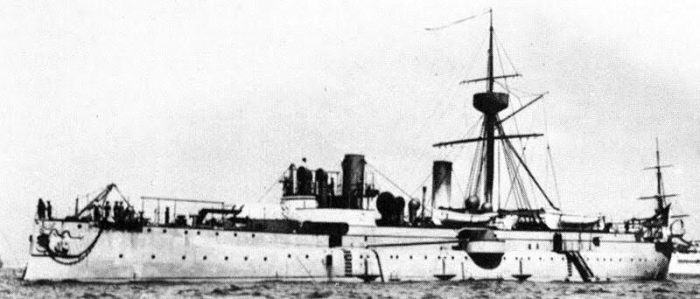
Qing China and the newly modernized Meiji Japan would collide in the first Sino-Japanese war (1894–1895). Before the war, western observers believed China would win in part because of their superior equipment. But the Chinese lacked a single national army. It was the Beiyang army and the Beiyang fleet that fought the entire Japanese military force. The fact that Japan had undergone a wholesale transformation of society enabled them to marshal the resources to win a rapid victory.


koyamabaiyanfleet
Figure 3: The Jingyuan, one of the ships in the Baiyang fleet

* * *

Why did the Japanese succeed in modernizing while Qing China failed to do so? Historians have proposed numerous explanations. In our paper, however, rather than focusing on cultural differences between Japan and China, we focus on how different geopolitical incentives shaped their decisions to invest in state capacity and state centralization.

Before the mid-19th century China only faced a threat from inner Asia from where historically nomadic invasions had routinely invaded and threatened the sedentary population of the Chinese plain. Due to this threat, historically China tended to be a centralized empire with its capital and the bulk of its professional army stationed close to the northern frontier (see Ko, Koyama, and Sng (2018)). In contrast, Japan faced no major geopolitical threats prior to 1850. This meant that it could retain a loose and decentralized political system.

After 1850 both countries faced major threats from several directions. China was threatened on its landward borders by Russian expansionism and from the coast by Britain and France (and later Germany and the United States). Japan was threatened from all directions by western encroachment.

We build a simple model which allows for multidirectional geopolitical threats. We represent each state as a line of variable length. States have to invest in state capacity to defend against external geopolitical threats. Each state can use centralized fiscal institutions or decentralized fiscal institutions.

If there is strong threat from one direction, as China faced prior to 1850, the dominant strategy is political centralization. In the absence of major geopolitical threats decentralization may be preferable as was the case in Tokugawa Japan.

The emergence of a multidirectional threat, however, changes things. A large country facing a multidirectional threat may have to decentralize in order to meet the different challenges it now faces. This is what happened in China after 1850. In contrast, for a small state with limited resources, an increase in the threat level makes centralization and resource pooling more attractive. For a small territory like Japan, the emergence of non-trivial foreign threats renders political decentralization untenable.

We then consider the incentives to modernize. Modernization is costly. It entails social dislocation and creates losers as well as winners, the losers will attempt to block any changes that hurt their interests. We show that for geographically compact polities, it is always a dominant strategy to modernize in the face of a multidirectional threat as the state is able to manage local opposition to reform. This helps to explain why all members of the Japanese political elite came around to favoring rapid modernization by the late 1860s.

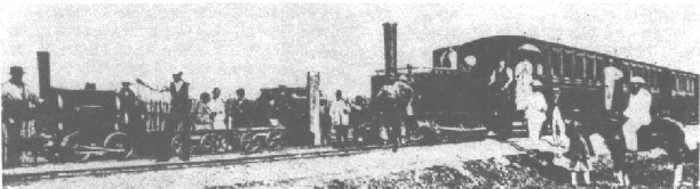
Consistent with our model, modernization was more difficult and controversial in China. The Qing government and particularly the Empress Dowager famously opposed the building of railroads. The most well-known example of this was the Wusong Road in Shanghai. Built using foreign investment it was dismantled in 1877 after locals complained about it. The Qing state remained reactive and prepared to kowtow to local powerholders and vested interests rather than confront them. Despite local initiatives, no effort was made at wholesale reforms until after China’s defeat at the hands of Japan in 1895.

koyamaindustrialization
Figure 4: The Wusong Railroad in 1876

* * *

By 1895 it was too late, however. The attempts of the Qing state to reform and modernize led to its collapse. Needless to state, East Asian’s little divergence would have lasting consequences.

Japan’s modernization program astonished foreign observers. Victory over Russia in 1904 propelled Japan to Great Power status but also set Japan on the path to disaster in the World War Two. Nevertheless, the institutional legacy of Japan’s successful late 19th century modernization played a crucial role in Japan’s post-1945 economic miracle.

Following the collapse of the Qing dynasty China fragmented further entering the so-called warlord era (1916–1926). Though the Nationalist regime reunified the country and began a program of modernization, the Japanese invasion and the Second Sino-Japanese War (1937–1945) devastated the country. The end result was that China came to be reunified by the Communist party and to experience more conflict and trauma until it began to embrace market reforms after 1979.

Would regulation stop the mistakes of rating agencies that contributed to the 2008 crisis?

I remember watching The Big Short and feeling great indignation at the S&P employee who told Steve Carell that rating agencies were pressured into issuing unreasonably high ratings because they were beholden to their customers. If true, this represented an unbelievable moral hazard, which is often cited as the reason for the failures of the ratings agencies–and as a reason for regulating these agencies.

However, more in-depth research and consideration reveals that this answer is incomplete and, in many ways, incorrect. Claire Hill, a law professor at the University of Minnesota Law School and director of the Institute for Law and Rationality, clearly and convincingly critiques this simplistic explanation by recognizing market influences and proposing alternate causes, which also means that if we are looking to avoid a future crisis, we need to look to alternative solutions to the regulatory measures that we currently employ. I don’t think it could be said better than she does in her abstract:

Why did rating agencies do such a bad job rating subprime securities? The conventional answer draws heavily on the fact that ratings are paid for by the issuers: Issuers could, and do, “buy” high ratings from willing sellers, the rating agencies.

The conventional answer cannot be wholly correct or even nearly so. Issuers also pay rating agencies to rate their corporate bond issues, yet very few corporate bond issues are rated AAA. If the rating agencies were selling high ratings, why weren’t high ratings sold for corporate bonds? Moreover, for some types of subprime securities, a particular rating agency’s rating was considered necessary. Where a Standard & Poor’s rating was deemed necessary by the market, why would Standard & Poor’s risk its reputation by giving a rating higher (indeed, much higher) than it knew was warranted?

Finally, and perhaps most importantly, giving AAA ratings to securities of much lower quality is something that can’t be done for long. A rating agency that becomes known for selling its high ratings will soon find that nobody will be paying anything for its ratings, high or low.

In my view, that issuers pay for ratings may have been necessary for the rating agencies to have done as bad a job as they did rating subprime securities, but it was not sufficient. Many other factors contributed, including, importantly, that rating agencies “drank the Kool-Aid.” They convinced themselves that the transaction structures could do what they were touted as being able to do: with only a thin cushion of support, produce a great quantity of high-quality securities. Rating agencies could take comfort, too, or so they thought, in the past – the successful, albeit short, recent history of subprime securitizations, and the longer history of successful mortgage securitizations.

“Issuer pays” did not so much make the rating agencies give higher ratings than they thought were warranted as it gave the agencies a “can do” mindset regarding the task at hand – to achieve the rating the issuers desired, working with them to modify the deal structures as needed. That the issuers were paying motivated the agencies to drink the Kool-Aid; having drunk the Kool-Aid, the agencies gave the ratings they did. My account casts doubt on the efficacy of many of the solutions presently being proposed and suggests some features that more efficacious solutions should have.

I very much recommend reading the full article, which gives more nuance and information about the weaknesses of proposed solutions for rating agency mistakes or malfeasance. This should also be food for thought concerning the general perspective we should have in examining “market failures,” as there are often market feedback systems that mitigate problems, and turning to regulation by reflex can cause unintended harm or even miss the mark entirely.


Reference: Hill, Claire. “Why Did Rating Agencies Do Such a Bad Job Rating Subprime Securities?” University of Pittsburgh Law Review (2010): 10-18. https://papers.ssrn.com/sol3/papers.cfm?abstract_id=1582539.

Emerging Political Realities in India

Whether one swallow it or not, Mahant Yogi Adityanath (Ajay Singh Bisht) -Chief Minister of Uttar Pradesh (UP)- is a new democratic reality of India, at least for present. He is well known for his questionable politics and political hold in and around Gorakhpur district in the eastern UP. Hindu Yuva Vahini (Hindu Youth Group) acts as his private brigade and has, allegedly, fomented and participated in communal activities. Even Yogi’s anti-minority diatribe during public meetings are well known. He is facing charges for rioting, related to intentional insult with intent to provoke breach of the peace, charges related to injuring or defiling place of worship with intent to insult the religion of any class, charges related to promoting enmity between different groups on grounds of religion, race, place of birth, residence, language, etc., and doing acts prejudicial to maintenance of harmony etc. All these were piled up during the non-Bhartiya Janta Party (BJP) governments at the Union and state levels. Instead of taking action against Yogi, his politics had been carefully nurtured during the rule of those governments. It is also alleged that they did so to keep the minorities with them. In past, this politics of fear has mechanically worked to serve the respective political interests of various political stakeholders.

With Yogi, as CM and the massive mandate BJP has got (won 312 seats out of 384 it contested), a question arises: is he a future or a temporary present? He may not be the future of India, but his politics is. He has an ability to divide the people in the name of religion, and at the same time can unite different castes of the Hindu community by arousing religious feelings. One of the reasons why most of the psephologists went wrong in their pre-poll analyses that they gave little attention to this uniting effect of the divisive politics. This pattern has taken years to develop. Analysts kept on writing and engage themselves into brain storming sessions on Mandal versus Kamandal while, on the ground, the two entered into a ‘comfortable’ symbiosis by making certain power related adjustments. In that adjustment, Kamandal has given political leadership to OBC, Dalits, and Schedule Tribes, and in return these leaders help in spread of Hindutva in their area and among their influence groups.

In contemporary India, one may analyse in a different way, but a larger reality is that the members, many of them, of the dominant Other Backward Castes or Dalits identify themselves as a Hindu first then a member of a non-upper caste group. They too believe that they are ‘different’ from the members of minority groups and, like majority members of the so called upper caste, many of them still practice social discriminations against the Muslims. This is evident during communal riots. This is essentially a result of Brahminization of a large section of OBCs, Dalits, and tribal groups carried out by the Hindu revivalist groups since the colonial era. This Brahminization dictates the cultural traits, behavioural pattern, and also dietary habits. Therefore, moral policing and forceful closure of chicken and mutton shops in UP find support from a substantive number of people. Moral policing is mean to regulate women’s sexuality and movement, and an attempt to check inter-caste mix up. Ad  banning of sale of meat is a form of  economic  attack  on  profession , largely, related with the members of  minority religious group and to those who do not adhere to Brahminical values.

As individuals wear multiple identities, they keep on changing them according to time and space. In the UP elections of 2017 majority of Hindu voters gave preference to their religious identity over the other identities. Almost all political parties are aware about this tenuous relationship between caste and religion, therefore no one shows enthusiasm or vocal about implementation of the recommendations of the Sachar Committee report to improve status of a large number of Indian Muslims.

One may ask that if this is the situation then why it did not work in Bihar in 2016. Well, in case of Bihar, BJP lost the election which was almost in its plate. Second, Nitish Kumar as a Chief Minister has always been considered to be a safety valve through whom others can ire their vent out while the upper castes can safeguard their political interests. In late 1990s he was a part of BJP’s such experiment in Bihar. In past he led coalition governments with BJP as an ally. Many such factors joined together to help him to develop similar political equation with the voters.

The results of a series of elections since 2014 general elections, with a few exceptions, prove that the BJP through its sister organizations has successfully captured the available political space in India, and is a dominant force with little or almost no opposition in coming years. Any challenge to its present position is possible only through a rise of an alternative politics from the below.

A short note on monarchical nostalgia

Kingship organizes everything around a high centre. Its legitimacy derives from divinity, not from populations, who, after all, are subjects, not citizens. In the modern conception, state sovereignty is fully, flatly, and evenly operative over each square centimetre of a legally demarcated territory. But in the older imagining, where states were defined by centres, borders were porous and indistinct, and sovereignties faded imperceptibly into one another. Hence, paradoxically enough, the ease with which pre-modern empires and kingdoms were able to sustain their rule over immensely heterogeneous, and often even contiguous, populations for long periods of time. (19)

This passage, from Benedict Anderson’s much-cited book on nationalism (Imagined Communities), does a good job of summarizing what the world looked like politically prior to the Industrial Revolution. It does a less good job of summarizing what monarchy is, politically (see this or this), but does do a great job of explaining why monarchies were able to exert governance over populations that were linguistically, religiously, and ethnically diverse.

What is less clear in this passage is its explanation for why paleolibertarians are so enamored with monarchy and why some non-paleo libertarians often write nostalgically about imperial pasts. Even though this is not clear in the passage (I doubt Anderson had intra-libertarian squabbles in mind when he wrote Imagined Communities), it is a great way to explore why libertarians have nostalgia for monarchy and empire.

Let’s start from the top, though. Libertarians don’t like nation-states because of nationalism, because of borders with taxes and restrictions on movement of goods and people, and because of the power that governments can exert over well-defined spaces of territory. So, instead of delving into the intricacies of why nation-states are around, some libertarians reach back to an older age, where “borders were porous and indistinct,” state sovereignty was not the end game of geopolitics, and governments had ways other than nationalist propaganda to bring diverse populations to heel. So on the surface, nationalism was non-existent, borders were open, and diverse groups of people lived together in relative harmony under one roof. What libertarian wouldn’t like that? Fred Foldvary’s post on restoring the Ottoman Empire is a good example of this kind of historical naivety. (Barry and Jacques have both written good rebuttals to this kind of wishful thinking.)

Historical naivety is one thing, but the arguments of so-called “anarcho-monarchists” are quite another. Arguing that monarchy is anarchy because monarchs don’t reign over a nation-state (instead they rule over the private property of the crown) is disingenuous at best, and nefarious at worst. Royal property and private property are two different things (“L’etat c’est moi“). This argument leads directly to the awful, embarrassing arguments of Hans-Hermann Hoppe and his acolytes, who have a bad habit of claiming that anarcho-monarchism is somehow libertarian. I’m going to skip over the specifics of their arguments (Zak has done great work on this topic, but in short Hoppeans claim that anarcho-monarchist societies would be able to physically remove undesirable people from their societies; “undesirables” mostly mean socialists, homosexuals, and non-Europeans), and instead point out that Hoppe and company are simply wrong about what a monarchy actually is.

Monarchies had porous borders, they constantly warred against their neighbors (sometimes for “interests of state”), and their populations were polyglot and illiterate. I haven’t spent any time reading Hoppe, so maybe I am treating him unfairly here and he is perhaps an advocate of a new type of monarchy, but as a student of Habermas I would assume Hoppe likes to use history as a guide for understanding and explaining the world around him. How on earth could he be so wrong about what monarchy actually is, unless he is being disingenuous about his whole anarcho-monarchist utopia?


On a completely unrelated note, Benedict’s Anderson’s book on nationalism is published by Verso Books, rather than a traditional academic press (such as Princeton University Press or University of California Press). Verso Books is a left-wing publishing house dedicated to radical critiques of everything non-leftist, so I find it a bit odd that Anderson’s book has come to be so well-cited in the academic literature on a number of topics. It’s a great book, don’t get me wrong, but I think it’s popularity, despite being an explicitly ideological book rather than an academic one, explains much of the strife currently happening on campuses across the West regarding freedom of speech and freedom of assembly.

Coup and Counter Coup VI: Presidential Authoritarianism in Turkey

(Previous posts here, here, here, here and here). The state of emergency proclaimed by President Erdoğan in Turkey on 20th July last year, in response to the coup attempt of five days before, is not a situation that will come to an end in a return to normality. It is the model for the presidential system that Erdoğan has been pushing for since 2007, when he was still admired by many liberal minded people inside Turkey (though not me) and abroad. One of the key provisions of the state of emergency is that the President can issue decrees with the force of law. There are doubts about the constitutionality of this form of ‘law making’ but two members of the Constitutional Court were arrested after the coup attempt and the chances of the court starting up to executive power are now extremely remote. Judges and prosecutors have been demoted and even arrested after making the ‘wrong’ decision during the state of emergency and I do not think Erdoğan and his associates would have any scruples at all about further arrests of judges in the Constitutional Court.

The Presidential system, or one person rule system, which Turks will vote on, will retain the decrees as law powers of the Presidency. There are some limits on the decrees issued, but as the President will control the appointment of most of the senior judiciary there are serious questions about whether the Constitutional Court will put any effective break on these powers to legislate through decree. There is no sign of the state of emergency ending, though at least now everyone can see the deception in the original decision to declare a state of emergency for three months only instead of the six months maximum allowed in the Constitution. The state of emergency is renewed every three months with no debate and no indication of when it will come to an end. Does Erdoğan have any intention of ending the state of emergency before he becomes a President elected with the new powers? In principle these powers should only be implemented after the next presidential election in 2019, coinciding with elections to the National Assembly. Erdoğan may wish to bring these elections forward, particularly for the National Assembly if he loses the referendum. While it may seem outrageous for the Council of Ministers to keep prolonging the state of emergency until 2019, the AKP government has been doing more and more previously outrageous and even unimaginable things now for some years, particularly since the Gezi protests of 2013.

What the state of emergency also means is that suspects can be held without charge and access to lawyers if charged with ‘terrorism’, which is defined in absurdly broad ways to cover any kind of contact with the Gülenists or sympathy for the Kurdish autonomy movement. Torture has been making a return in Turkey after becoming relatively unusual since the PKK terror campaign began again in 2015. The state of emergency conditions have now normalised it completely and though the government denies torture charges, in the normal manner of authoritarian regimes, claiming the charges are terrorist propaganda, you have to wonder how seriously they expect anyone to take the denials. Photographs of the alleged coup plotters immediately after the coup attempt showed they had been badly beaten, though of course this is explained away as the result of ‘resisting arrest’, another time-honoured evasion. Consistent reports suggest prisoners are denied food, placed in stress positions for long periods of time, beaten and sexually assaulted. In the more moderate cases, the prison officials merely restrict prisoners to a diet of bread and bad quality tap water in conditions of psychological abuse. There is amongst everything else in Turkey a growing problem of mental and emotion health problems amongst the survivors of these ordeals, which are of course excluded from the mainstream media.

The rhetoric and abuse used by police ‘special teams’ invading the media and political offices of ‘terrorist’, that is Kurdish autonomy and other leftist groups, involve extreme nationalism and Ottomanism. Kurds are insulted as covert Armenians. Actual Armenians are told that the Ottomans destroyed the Armenians and that Turks are the masters of Armenian. A particularly disgusting reference to the massacre of 1 500 000 Armenians during World War One. These are not aberrations, this behaviour reflects the deep ideology of the AKP, mixing extreme nationalism and Ottomanism, of course ignoring the tensions between these positions. The torture and abuse is legitimated in the minds of perpetrators by a political rhetoric and government measures which present opponents as terrorist and part of international conspiracies against the ‘innocent’ Turks who are so good they are naive. This I am afraid is no exaggeration of the political discourse of the moment.

There is no reason to think the abuse and political extremism will end, though of course we should hope it does. If all Gülenists – real and imagined – and all sympathisers with Kurdish autonomy or the far left are targeted, then there are essentially endless opportunities for authoritarianism, polarising dehumanising rhetoric and abuse. I can only presume the current atmosphere will last indefinitely, as Erdoğan has found it a successful strategy for staying in power and increasing his power.

It is of course not just a question of his own political power. There is the question of how his family occupy places of privilege in large Muslims NGOs (at the same time as non-AKP oriented NGOs come under increasing pressure) with huge budgets and sit on the boards of major companies in Turkey. Erdoğan does not envisage any situation in which these activities are placed under mainstream media examination, and even less legal investigation. The issue of legal immunity is a huge one in Turkish politics. The amended constitution would allow the President to appoint anyone to two vice presidential positions and to the cabinet. Like the President all these people would have lifetime immunity from prosecution for activities undertaken while in office. Though the National Assembly would have the power to send the President to the Constitutional Court, this requires a very high threshold, clearly designed to protect Erdoğan even if the AKP loses a large part of its support.

As mentioned above, there is an expectation that Erdoğan will call an early National Assembly election if he loses the referendum. It seems likely on current polling that two out of the three opposition parties currently in the National Assembly would fail to meet the electoral thresh hold of 10%. This means the National Action Party, which has split over the referendum, and the Kurdish radicals who have lost some of their more moderate support since the revival of PKK violence. In such a National Assembly, the AKP could certainly put any constitutional proposal to referendum and very possibly could have enough votes to amend the constitution without referendum. So even if Erdoğan loses the election, he could get the same measures, or close enough, through other means.

(Last post in the current series, though I will post an appendix on Ottomanist and Atatürkist legacies in Turkey, along with comments on related political thought.)

Coup and Counter Coup V: Jacobins and Grey Wolves in Turkey

Previous posts here, here, here and here. The post coup atmosphere created the impression of an invincible block of the AKP and the MHP, backed by some parts of Kemalist (Jacobinism alla turca) opinion, which would provide a massive majority for the Presidential republic desired by Erdoğan. The MHP did provide the votes in the National Assembly, for the super majority necessary to trigger a constitutional referendum. This was a complete turn about from the MHP’s previous position.

The background to this turn is partly in the state-PKK polarisation, but also in an internal female challenge to the MHP leader Devlet Bahçeli from Meral Aksaner. She is very popular with the Grey Wolf community and would have probably won a leadership election if a special party congress had been called. This became an issue in the courts, which did not in the end force the MHP leadership to act in accordance with an interpretation of laws on political parties (which are very prescriptive in Turkey), which in turn would require a congress. That Bahçeli was so resistant to calling a special congress tells its own story. He lost support within the MHP after their votes went down in the second general election of 2015, presumably also reflecting some previous accumulating weariness with his leadership. The whole story has raised suspicion of AKP supporting judges who twist the law in order to promote a MHP-AKP partnership, but there is no proof of this.

It can at least be said that Bahçeli hopes for some kind of deal in which the AKP-dominated media (that is a very large majority of the media, though not necessarily reflecting the inner views of journalists) treats the MHP gently, the AKP does not campaign against it, and the MHP can continue to get the minimum ten percent of votes necessary for a party list to have deputies in the National Assembly. He may also be hoping that in the Presidential system which Turks are voting on in the 16th April referendum, he or one of his surrogates will get one of the two vice-presidential positions and that the MHP has cabinet seats (which will all be appointed by the President, like the Vice-Presidential positions, with no parliamentary vote or scrutiny).

Meanwhile there is less of a story to tell about the Kemalists, who anyway do not have a clear leader or party. The CHP is their natural home but may be perceived as not pure enough. The bizarre character Doğu Perinçek provides a point of reference, but used to be pro-PKK and is generally just too strange and marginal. In any case, Perinçek has now recently and very publicly withdrawn his support from Erdoğan in reaction to Turkish support for the missile attack on a Syrian air force base. In general, the hardcore Kemalists have drifted back to opposing Erdoğan and supporting the CHP’s ‘No’ campaign. In at least some cases, there may have been second thoughts about how far exactly the government has gone in persecuting Gülenists, real and imagined, along with Kurdish movement politicians and activists; and a feeling that defending the Republic might also mean defending proper legal standards. Perinçek is at a vanguardist extreme where this is not an issue, but for those more influenced by foreign centre left parties and the wish for robust international standard rule of law, there has been a reaction, and a recollection of earlier objections to Erdoğan and his ambitions.

The Kurdish autonomy movement, the Grey Wolves, and the Kemalists will not disappear in Turkey. Positive developments in rule of law, constitutional democracy, individual liberties, and tolerant political culture require evolution in these movements. No government can come to power in Turkey which does not appeal to the concerns of at least one of these groups, and probably two. Erdoğan has never managed to completely absorb or eliminate any of them, though he has to some degree succeeded in keeping some appeal to both nationalist Turks and identity-oriented Kurds, particularly religious and socially conservative Kurds who may regard both CHP and HDP with suspicion. When the MHP and the Kemalist hardcore seemed to be behind Erdoğan after the coup, it seemed he might get more than 60% in the referendum. The MHP has now split in practice, and may well formally split after the referendum. Aksaner is the most popular MHP politician in Turkey and is campaigning for now. The CHP, and those most motivated by the CHP’s Kemalist roots, is solidly behind ‘No’. Right now, though ‘Yes’ may well win, it seems highly unlikely it will win with 60% plus and most expect a very tight vote. (to be continued)

Mid-Week Reader: The Justice of US Intervention in Syria

I’d like to announce a new weekly series of posts that I will be making: the Mid-Week Reader. Every Wednesday (hopefully), I will post a series of articles that I find interesting. Unlike most ventures in micro-blogging, though,  I will try to make all the articles focus on a specific topic rather than leave you with a random assortment of good articles (which Branden already does so well most weekends). This week’s topic: with Trump bombing Syria last week despite ostensibly being a dove (hate to say I told you so), I give you a series of articles on the justice, historical background, and press reaction to the bombing.

  • Fernando Terson and Bas van der Vossen, who are co-authoring on the topic of humanitarian intervention, each have interesting pieces at Bleeding Heart Libertarians debating the bombing of Syria from the perspective of Just War Theory. Terson argues that it was just, Vossen disagrees.
  • Over at The American Conservative, John Glasser of the Cato Institute has an article arguing that Trump’s invasion is neither legally authorized nor humanitarian.
  • Any discussion of foreign policy is incomplete without Chris Coyne’s classic paper “The Fatal Conceit of Foreign Intervention,” a political-economic analysis of foreign policy which concludes all sorts of foreign intervention are likely to fail for similar reasons that socialist economic intervention fails.
  • As perhaps a case study of Coyne’s analysis, Kelly Vee of the Center for a Stateless Society has an article summarizing the history of United States’ actions in Syria going back to World War II and how it’s gotten us into the current situation.
  • At Vox, Sean Illing interviews CUNY professor of journalism Eric Alterman on how the press fails to critically assess military intervention.

Coup and Counter Coup IV The Kurdish issue in Turkey

Previous parts here, here and here. As mentioned in the last post, in the immediate post coup atmosphere President Erdoğan appeared to have the support of some significant part of Kemalist (as in Kemal Atatürk who shaped the Turkish republic with reference to secularism, modernisation, national sovereignty and statism) opinion, the more hard core part, seeing shared enemies in both violent Kurdish separatists and Gülenist (members of a religious community, see previous posts) infiltrators into the state apparatus. The return of PKK (the Kurdish acronym for Workers’ Party of Kurdistan) violence against state forces and civilians (the latter largely undertaken by the Freedom Falcons of Kurdistan, TAK in the Kurdish acronym, a product of the PKK) in the summer of 2015 already placed the AKP, hardcore Kemalists, and the Nationalist Action Party (MHP, rooted in a ‘Grey Wolf’ or ‘Idealist’ ideology of absolutist state nationalism and Pan-Turkism) on the same side advocating a militant response including support for the army-led destruction of whole urban areas in PKK strongholds in the southeast. Previously the latter two groups had regarded the AKP as treasonous for holding talks with Abdullah Öcalan, the imprisoned founder-leader of the PKK, fearing a federalised Turkey with a southeast federal region under strong PKK influence. The talks were not at all public, no attempt was made to prepare public opinion for possible evolution in the Turkish state tradition, or to hold any kind of open discussion on the issues at stake.

The talks collapsed with Öcalan returned to strict prison conditions. Despite the MHP and hardcore Kemalist fears about federalisation on PKK terms, it seems likely that Erdoğan never intended more than token concessions to Kurdish identity and autonomy for the southeast, in exchange for operating for the PKK and a party with a common origin as an external support of the AKP. The party which has a common origin with the PKK is DBP (Turkish acronym for Democratic Regions Party) and the umbrella party it formed to accommodate small leftist groups (which don’t have specific Kurdish origins). It appears that the DBP hardcore does not like accommodating non-Kurds so the survival of HDP is not guaranteed. It poses a very happy image to leftist educated Turks, of interest in social liberalism, minority rights and left socialist policies. This reflects a historical feeling of marginalisation, because the CHP (Republican People’s Party: Kemalist/social democratic something like the French Socialist Party in merging Jacobin, social democratic and socialist traditions) is seen as too nationalist and not ‘really’ leftwing.

It tells you something about Turkish politics that there are people who insist that HDP is not leftwing despite its obvious leftwing policies and roots in the Maoist orientation of the PKK. This insistence is rooted in the belief that all left polices must be non-ethnic, that raising ethnic issues is inherently divisive and chauvinistic, reflecting of course a blindness to how some people experience the Turkish state as unaccommodating of, and even hostile to, expressions of identity by those people in Turkey who have a first language, and associated culture, other than Turkish. The Maoist and terrorist origins of the main expressions of Kurdish autonomy politics supports that majoritarian blindness and even chauvinism. Clearly they feed off each other.

The HDP has been turned into an effectively semi-legal party since the summer of 2015, which is not the right state reaction from the point of view of constitutional democracy and individual liberty. However, the HDP has to some degree brought this on itself, because while condemning the acts of terror directed from mountains in Iraq by the current PKK leader Cemil Bayık, it has never rejected the PKK as such, treating Öcalan as the symbolic leader of Kurds in Turkey, and adhering to a political rhetoric of ‘autonomy’ shared with the PKK.

The government has now used the state of emergency to take over the administration of all HDP led local government, that is local government throughout the southeast, appointing ‘trustees’ to run these municipalities. All media with an HDP orientation has been closed down and blocked online if based abroad.

Accusations have been made of the HDP using local government as infrastructure and a source of money for the PKK. This has yet to be proven in court. If it was, we would certainly have to consider the HDP to have taken a very bad path. As things stand, this has not been proven and the persecution of HDP politicians along with the takeover of HDP municipalities is highly premature, serving political power goals and grossly overriding any idea that guilt only exists if and when proven in court, preferably with judges under less political pressure than is the case at present in Turkey.

Unilateralism is not isolationism

One of the most frequent characterizations of US foreign policy in the 18th and 19th centuries is that it was isolationist. In 1796, when he decided not to run for a third presidential term, George Washington wrote (possibly with the help of Alexander Hamilton) a farewell address to public life. In one of the most quoted parts of this speech, Washington said that “It is our true policy to steer clear of permanent alliances with any portion of the foreign world.” Quite similarly, in 1821 John Quincy Adams warned that the United States should not “[go] abroad, in search of monsters to destroy.” We can also cite Thomas Jefferson, who in 1799 declared that “Commerce with all nations, alliance with none, should be our motto.” Finally, in 1823 James Monroe declared (with great help from the aforementioned John Quincy Adams) that “The political system of the allied powers [of Europe] is essentially different (…) from that of America.”

In short, it is by all the above (and other) quotations that historians often classify American foreign policy in the 18th and 19th centuries as isolationist. This trend, it follows, was altered in World War I by Woodrow Wilson, who broke away from traditional isolationism to lead the United States to fight in Europe. More than that: at the end of the war, in his 14 Points, Wilson proposed the creation of the League of Nations, a permanent multilateral international organization, with the objective of promoting the collective security of the member countries. The Wilsonian tendency was reversed by Republicans in the 1920s and 1930s, mainly because they refused to join the League of Nations, opting for isolationism. However, Woodrow Wilson’s proposal was retaken by Franklin Delano Roosevelt in World War II. The United States defeated the enemy forces in Europe and the Pacific and in the end war was one of the main founders of the United Nations, an international organization created to replace the League of Nations. Since then the United States has predominantly adopted Woodrow Wilson’s perspective and avoided the isolationism of the Founding Fathers and of the Republican presidents of the interwar period. Only ultra-conservatives believe and advocate that the US should retake the foreign policy of George Washington, Thomas Jefferson, John Quincy Adams, and James Monroe. However, all this evaluation already starts flawed when it characterizes American foreign policy in the 18th and 19th centuries as an isolationist. To explain why, we can differentiate two terms: isolationism and unilaterialism.

Predominantly, US foreign policy in the 18th and 19th centuries followed George Washington’s advice “to steer clear of permanent alliances with any portion of the foreign world.” However, it should be noted at the same time that this foreign policy followed Thomas Jefferson’s advice to establish “commerce with all nations.” In other words, despite the lack of permanent alliances with other countries (particularly European ones), what the United States did not lack in that period was a growing trade with other parts of the world, in addition to regular diplomatic contact (although not characterized by permanent alliances). To call this isolation is to force language too much. There are many historical examples of countries that have actually isolated themselves from the rest of the world: Japan between the 17th and 19th centuries, China between the 15th and 19th centuries, Paraguay from 1811 to 1844, and more recently North Korea are just a few. US foreign policy in the 18th and 19th centuries would be better characterized as unilateralist or non-interventionist. This means simply that the US didn’t subject its international relations to foreign authority.

There was no US isolation before the 20th century. What happened was a policy of avoiding permanent alliances. Meanwhile, the country had no problem with expanding its diplomatic contacts and its international trade (although some economic protectionism was practiced, but I leave this subject to another time). The same can be said about the attitude taken by the presidents in the interwar period: not participating in the League of Nations did not mean isolation from the rest of the world, quite the opposite: the US actively participated in the economy and international politics at that time. It just did not do this through the international organization proposed by Woodrow Wilson. It is perfectly possible to participate actively in international relations unilaterally, i.e. without the formation of permanent or binding alliances with multilateral international organizations.

Confusing the terms isolation and unilateralism may just be an oversight or an evaluation error. But it can also be a purposeful strategy. Confusing the terms may hide an undeclared requirement (or assumption): the only accepted international participation is that made through multilateral international organizations such as the League of Nations or the United Nations. No other is good enough. In this way, those who characterize US foreign policy before Woodrow Wilson as isolationist are severely limiting the possibilities for US international participation.