The Enforcement Costs of Immigration Laws are Greater than Alleged Welfare Costs

As I mentioned in my note yesterday, the common argument that immigration is significantly costly through welfare is mostly empirically falsified. The fact of the matter is immigrants usually aren’t qualified for such programs, illegal immigrants mostly cannot and do not receive them, and immigrants as a whole wind up contributing more to the government’s balance sheet through economic growth and tax receipts than they take through welfare transfer payments.

However, there is one fact I neglected to mention yesterday worthy of its own post: if those opposed to immigration on the grounds of welfare costs were really sincere in that argument, they also need to consider the fiscal costs of enforcing their beloved immigration laws. As the New York Times editorial board pointed out yesterday, these costs are not insignificant:

The Migration Policy Institute reported in 2013 that the federal government spends more each year on immigration enforcement–through Immigration and Customs Enforcement and the Border Patrol–then on all other federal law enforcement agencies combined. The total has risen to more than $19 billion a year, and more than $306 billion in all since 1986, measured in 2016 dollars. This exceeds the sum of all spending for the Federal Bureau of Investigation; the Drug Enforcement Administration; the Secret Service; the Marshals Service; and the Bureau of Alcohol, Tobacco, Firearms, and Explosives.

These fiscal costs get worse when you consider that Donald Trump wants to expand ICE’s budget even further and, of course, the $8-$12 billion dollar wall.

Further, if you are a civil liberties type concerned with the social and fiscal costs of mass incarceration, immigration enforcement looks even bleaker:

ICE and the Border Patrol already refer more cases for federal prosecution than the entire Justice Department, and the number of people they detain each year (more than 400,000) is greater than the number of inmates being held by the Federal Bureau of Prisons for all other federal crimes.

The war on immigrants makes the war on drugs look tame.

Of course, these costs are pretty small when compared to the welfare state, but immigrants are not the ones driving up those welfare costs and they might even reduce it with more tax receipts. The truth is that furthering immigration restrictions and enforcement is truly fiscally irresponsible, not respecting the right to freedom of movement and contract.

Rules of Warfare in Pre-Modern Societies

As my first foray into NOL blogging, I figured I would bring up a recent debate I had liberty, war, and peace that lingered in my mind: how have rules of war been maintained throughout history without a central enforcing agency? This question is fundamental to the understanding of the nation-state in IR theory, and is also an astonishing example of spontaneous order in an anarchic and chaotic scenario.

The quandary exists because even the laudable negative rights of life, liberty, and property ownership, as Eric Mack discusses in his essay on Just War Theory, require a positive enforcement by others. Similarly, “rules of war”–such as refraining from attacking non-regulars, not attacking neutral parties, abiding by the terms of treaties, treating prisoners of war with respect, etc.–are, theoretically, difficult to establish and dependent on positive enforcement. This is because if Party A respects these rules, they provide a perverse incentive to Party B to take advantage of Party A’s restraint, and if doing so gives Party B the upper hand, they can enjoy the benefits of betraying the rules of war with impunity. This is a classic Prisoner’s Dilemma, and if it generalized across many nations, the theory of rational choice would lead us to expect a coordination problem, in which those using the strategy of Party B would dominate the Party A’s.

I am certainly not the first to identify this, and the literature on overcoming coordination problems through iteration of the Prisoner’s Dilemma, regime collaboration, and international organizations and treaties is incredibly thorough (just for a taste, you can see James Morrow’s book, F.V. Kratochwil’s book, and articles by Duncan Snidal, Arthur A. Stein, and even James Buchanan and Victor Vanberg). However, I thought it would be interesting to examine the historical evidence of effective rules of war, particularly from the premodern period. Because global communication technology and networks, international courts, treaties, and organizations, and deterrence based on the terrifying weapons of modern war were lacking in antiquity and on through roughly the 18th century (open to argument on that one), premodern societies seem to be the best test of the effectiveness of rules of war and their mechanisms. I won’t discuss any in detail, and I am skipping many rules of war for which their effectiveness is not discernable (such as the Mahabarata, Deuteronomy, and the Quran), but here is a list of interesting examples for discussion:

  • The archaic Greek poleis:
    • As Victor Davis Hanson argues in his influential book, the Western Way of War, the incentive to focus on agricultural production and the fact that citizen-warriors were personally responsible for military service made the costs of long-term campaigns, especially given the lack of siege technologies and the difficulty in laying waste to wheat fields and olive trees, higher than the potential benefits. However, there were still disputes to be resolved, and raiding was still harmful to the agriculture of polis that was raided. In order to limit costs to both invader and defender, the poleis developed the hoplite warfare strategy, in which citizen-soldiers met for decisive conflicts in traditional, if not previously agreed, locations, in which limited territorial gains were afforded to the victor. While this does not describe every aspect of 7th-5th century warfare in Greece, this strategy pervaded the Greek mainland and allowed disputes to be resolved with minimal collateral damage and investment.
  • Thucydides’ Athens:
    • Though Thucydides’ History of the Peloponnesian War is seen as the invention of realism based on its “the strong did what they could, and the weak suffered what they must” representation of self-interest in foreign policy, his narrative as a whole shows an important constraint in war: if a military power makes war with the expressed intent of empire-building without casus belli, they will entrench their enemies, alienate neutral states, and cause divisiveness on the home front because they have lost the moral high ground. Thucydides notes that the majority of Greeks opposed Athens on the grounds of their selfish empire-building, and because of their inability to convince Sparta of their just motives, brutality to neutral states, internal dissension during the Sicilian expedition, and many other misfortunes of war (plague, death of Pericles, Persian intervention), Athenian power was broken. The lesson: Party B (from above) must consider the international reaction to abusing Party A, and at least make a public showing that the war is just. Also, if Hitler had only read his Thucydides, he might have known that marching through Belgium may be tactically sound, but he was risking the same reaction that the Athenians risked in the Melian massacre.
  • POW’s and ransoming in antiquity
    • Several rules of warfare were maintained through the mutual benefits to combatants, the most notable being the conventions concerning ransoming. From at least 5th century Greece (in the Sphacteria incident) to Caesar, citizens could be ransomed following a battle—and there were even conventional levels of payment for these POW’s. This was a benefit specifically afforded to “civilized” foes, and Roman practice increasingly became enslavement rather than ransom, but this convention was widespread for centuries, possibly showing that ransoming enemies is an Iterated Prisoner’s Dilemma.
  • Ancus Marcius and Just War Theory:
    • Along the same lines as the Thucydides example, the Romans engaged in the ritual of the fetiales, including the enumeration of the just cases for war, before invading an enemy. This limited war to official disagreements with neighboring states, and other religious conventions were maintained that limited certain tactics in war (a noteworthy passage of the Aeneid shows that putting on the armor of your enemies for stealth purposes would be doubly punished by the gods). These conventions included looking down on poison as woman’s weapon and on taking some religious statuary as booty, and though Roman generals still poisoned wells or robbed cities of their gods, they received negative reactions by their contemporaries.
  • Hostage policies throughout antiquity:
    • Another problem with the rules of war is the enforcement of treaties, which have credible commitment problems. Both Greeks and Romans made imperial gains by breaking treaties, but it was common practice to overcome the credible commitment problems of both alliances and treaties to end wars that hostages, usually the children of influential citizens or nobles, were exchanged. Whether they were exchanged both ways (more common in alliances) or passed only one way (usually from the defeated to the victorious), hostages were used at least 250 times by Rome and countless times by other ancient civilizations to ensure the enforcement of treaties.
  • Carthage’s “Truceless War”:
    • While we often think of ancient war as anarchic and based on the whims of generals, wars that completely lacked conventions or limitations were rare. In fact, following truces that allowed for collection of the dead, ransoming of both the living and the dead, and supplication for one’s own life go back at least as far as the Iliad, and wars that lacked such conventions were shocking to ancient historians. Such wars occurred when one side broke a general convention, usually the convention of allowing enemies to surrender alive and be ransomed. Because of this betrayal, their opponents would also stop following any rules of war, and such wars became not about achieving strategic goals but annihilating the opponent entirely. Carthage, following their loss in the First Punic War, fought a truceless war with their former mercenaries due to lack of payment that featured escalations in mutilation and crucifixion until the mercenaries were wiped out, at great cost in men and money to Carthage.
  • Roman 3rd party arbitration or intervention:
    • The Romans, after they gained international prominence but before they ruled the whole Mediterranean, took an interest in wars between their neighbors. While this sometimes included imperialism, in several instances they served as a 3rd party arbitrator of peace, and even as an enforcer of peace in Antiochus IV’s invasion of Egypt.
  • Blood feuds:
    • While mentioning blood feuds brings up images of Hatfields, McCoys, and senseless brutality over generations, blood feuds were actually a mechanism for limiting violence through threat of reprisal. While the effectiveness of this mechanism may be debatable, its intention as a limitation of violence is notable in several pre-modern societies, especially the Scots and Slavs.
  • Chivalric codes:
    • We should be careful of romanticizing this example, but from the 12th to 14th centuries, chivalry established rules of conduct for how knights should treat knights on and off the battlefield. Much of the conception of chivalry comes from poetic fictions about historical figures that were vicious or corrupt in many ways. However, it was actually the battlefield codes, such as ransoming rather than killing noble foes, that were actually practiced the most often, a trend that saw a brutal reversal in the War of the Roses. One might point out that neither the chivalric codes nor the earlier Roman codes of war included avoidance of harming civilians. This shows that, while rules of war were effective in practice at many points in history, they did not always have the same conceptions of what these rules were made to protect.
  • The Roman Catholic Church:
    • Catholicism influenced the rules of war in two ways: like the fetiales of the Romans, it established the grounds on which war was justifiable (and was influential on the ideals of chivalry), and the pope himself, through the power of excommunication, could limit the warring impulses of kings and lords. While many popes used their power to cause conflict, the church still had both moral influence and bargaining power, and was a powerful international institution for centuries that forced treaties on Christian rulers, provided a court of arbitration, and, several times, that tried to unite these leaders in war against non-Christians. The influence of Catholic peacekeeping measures waxed and waned from Charlemagne onward, but the Peace and Truce of God was one of the earliest attempts to protect non-combatants in wartime

This very incomplete list represents a lot of the more conventional examples of this phenomenon (sorry, but I am very conventionally educated). I would love if those who have other examples, especially from outside of Greece, Rome, and the Western World, would bring them up in the comments so I can expand my knowledge of the history of the rules of war!

The many iterations of rules of war in pre-modern societies shows the effectiveness of spontaneous order in creating systems that promote liberty and peace. These rules did not eliminate violence, cruelty, or imperialism, but they forced self-interested parties to check their selfish impulses. This is not an argument that international organizations with the goal of limiting war are unnecessary (and the Geneva Conventions are a laudable example of voluntary self-enforcement), but rather a demonstration of the wide reach of both Smith’s invisible hand and Hayek’s spontaneous order: even in the most anarchic of trades, long-term individual self-interest can support general interest, and a certain level of order is imposed on the chaos of war through the unplanned conventions of societies.


ἐν μὲν γὰρ τῇ οἱ παῖδες τοὺς πατέρας θάπτουσι, ἐν δὲ τῷ οἱ πατέρες τοὺς παῖδας

In [peace], sons bury their fathers, but in [war], fathers bury their sons.

–Herodotus, The Histories, 1.87.4.

Where the state came from

One of the questions that led me to libertarianism was “what is the state?” More than that: Where did it come from? How it works? What’s the use? Analogous questions would be “what is politics?” and “what is economics?” If my classroom experience serves as a yardstick for anything, the overwhelming majority of people never ask these questions and never run after answers. I do not blame them. Most of us are very busy trying to make ends meet to worry about this kind of stuff. I even sought an academic training in politics just to seek answers to these questions. For me it’s nothing to have answers, after all, I’m paid (albeit very poorly paid) to know these matters. Still, I wish more people were asking these types of question. I suspect that it would be part of the process to review the political and economic situation in which we find ourselves.

Many times when I ask in the classroom “what is the state?” I receive in response that Brazil is a state. In general I correct the student explaining that this is an example, not a definition. The modern state, as we have it today, is mainly the combination of three factors: government, population, and territory. The modern state, as we have it today, can be defined as a population inhabiting a specific territory, organized by a centralized government that recognizes no instance of power superior to itself. Often, in the academic and popular vocabulary, state and government are confused, and there is no specific problem in this. In fact, the two words may appear as synonyms, although this is not a necessity. It is possible to distinguish between state and government thinking that the state remains and governments go through.

The state as we know it today is a product of the transition from the Middle Ages to the Modern Age. I believe that this information alone should draw our attention enough: people have lived in modern states only in the last 500 years or so. Throughout the rest of human history other forms of political organization have been used. I am not saying (not here) that these other forms of organization were better than the modern state. I am simply saying that the modern state is far from being natural, spontaneous, or necessary. Even after 1500 the modern state took time to be universally accepted. First, this model of organization spread throughout Europe at the beginning of the Modern Era. It was only in the late 18th century and early 19th century that this model came to be used in the American continent. The modern state spread globally only after the decolonization movement that followed World War II. That is: the vast majority of modern states are not even 70 years old!

What is the purpose of the state? At least in my experience, many people respond by “providing rights” or “securing rights.” People think about health, education, sanitation, culture, security, etc. as duties of the state towards society. It is clear that many people think about health, education, housing, etc. as rights, which in itself is already questionable, but I will leave this discussion for another time. The point I want to put here is that empirically states have only cared about issues like health and public education very recently. In the classic definition of Max Weber (late 19th century), the state has a monopoly on the legitimate use of violence. In other words, virtually anyone can use violence, but only the state can do it legally. That is: the primordial function of the state is to use violence within a legal order. Other functions, such as providing health and education, came very late and only became commonplace with the welfare state that strengthened after World War II.

I find it always interesting to see how we live in a young world. Basically the entire world population today lives in some state and expects from this state a minimum level of well-being. However, this reality is only about 70 years old. The idea that we need to live in states that provide us with a minimum of well being is not natural and far from obvious. To understand that the modern state is a historical institution, which has not always existed, it is fundamental to question its validity. Moreover, to note that the functions of the state that seem obvious to us today did not exist 70 years ago leads us to question whether it is valid to expect things such as health and education from the state.

My personal perception is that the modern state (defined by territory, population, and government) is better than any alternative that has already been proposed. However, the state of social well-being is only a sugar-watered socialism. Socialism, by definition, does not work, as Ludwig von Mises very well shows. Partial socialism is as likely to function as full socialism. Expecting the state to use violence within legal parameters is valid and even fundamental. But to expect that this same state may successfully diversify its activities entering the branches of health, education, culture, etc. is a fatal conceit.

Why did the Pseudo-Libertarians Bring a White Nationalist to ISFLC in the first place?

This weekend I attended the International Students for Liberty Conference in DC, the largest global meeting of libertarian students, professionals, and intellectuals. I was excited to meet a few friends I seldom get to see from across the world, listen to a few exciting talks by some of my favorite intellectual influences, such as Jonathan Haidt, Steve Horwitz, Edward Stringham, Sheldon Richman and the like. It was my third time attending the conference, and I always enjoy myself there.

However on Saturday afternoon, something that I did not want to see at all had reared its ugly face and even more hideous haircut: alt-right pseudo-intellectual think tank head and noted white nationalist blowhard Richard Spencer decided to come and troll us libertarians. I was just walking through the lobby when I looked over and saw him sitting at the hotel bar surrounded by a gang of ostensible thugs wearing “Make America Great Again” hats.

Now at this point, it is worth noting that Richard Spencer was in no way invited to this event by SFL in any official capacity. It is easy to be misled on this point as Spencer, being a complete fraud, had a sign next to him saying “Richard Spencer at ISFLC” as though he were invited. Immediately after seeing Spencer, I walked over to talk to some SFL staff who said he would not be allowed in the conference and, though he had every right to just hang out in a public space outside of the conference, he was in no way allowed in the conference itself.

Instead, Spencer was invited by a group calling themselves “The Hoppe Caucus,” named after noted bigot Hans-Hermann Hoppe. It is perhaps revealing that a bunch of students who want to invite a self-proclaimed white nationalist who does the Nazi salute to Trump and calls for “ethnic cleansing” of non-whites to a libertarian conference give themselves this name. The organizers were originally planning to invite Augustus Sol Invictus (the linked post was deleted) to do a similar event hijacking the conference, but were unable to pay for his travel. (The same Augustus Sol Invictus who was kicked out of a Libertarian Party Senate race for being a “neo-Nazi” who supports eugenics and participating in Satanic goat-sacrificing rituals.)

The “Hoppe Caucus” is nothing more than a Facebook page started by a couple of alt-right crypto-fascists masquerading as libertarians surrounding websites like the oxymoronically named The Liberty Conservative and the grossly misnamed trashy click-bait site  Liberty Hangout. I do have the misfortune of knowing a couple of the people who were involved in organizing Spencer. Only one of whom at any point in any official capacity associated with SFL as a low-level campus coordinator, and is mostly associated with YAL as a state chair and various other alt-right blogs. He shall remain unnamed as, from what I’ve seen, he’s been too cowardly to explicitly associate himself with the group publicly. Notably, he also recently left SFL’s CC program after some SFL staffers were blocking him from bringing Augustus. Another is a former YAL chapter leader who is now doing work with a number of right-wing think tanks in the midwest and writes for the Liberty Conservative, whose name is Mitchell Steffen.

I stood around at a distance observing Richard Spencer and the growing crowd around him, it appeared to me to be fairly standard relatively boring tone of conversations that happen at the conference, just with the notable difference of a fair amount of complete bigotry and Nazism. I went downstairs and decided not to feed the trolls. But about a half an hour to forty minutes later, I heard that Jeffery Tucker of the Foundation for Economic Education, a conference speaker who was actually invited there, went upstairs to confront Richard Spencer. You can watch a recording of the exchange here. After the conversation got heated, hotel security intervened and kicked Spencer out of the venue. As Robby Soave notes in Reasonsome have reported that Spencer requested for security to escort him out, though it is unclear if that is the case (there is at least one video, see around 40:33 which seems to suggest Spencer asked for security, though was being kicked out).

Now, to combat further misinformation put out by the same group of complete liars who brought Spencer at the Liberty Conservativeno, Richard Spencer did not “nearly start a riot.” Meanwhile in reality, while Tucker was visibly upset, he did not threaten nor engage in violence at all, nor did any other attendee at the conference. First, Spencer and Tucker talked for nearly twenty minutes without any physical altercation, and Tucker arrived after nearly an hour of peaceful discussion between Spencer and some students. You can watch the videos linked above for proof. If merely getting impassioned in a debate is “nearly a riot,” these Hoppe occultists are the true snowflakes who need a safe space.

Further, Tucker and the other attendees were not upset because Spencer “merely show[ed] up in the Hotel Bar.” We were upset because these frauds dishonestly put up a sign implying that Spencer was invited and was there in an official capacity. In order to attend, one needed to pay a registration fee for the conference, which Spencer didn’t, and needed to be invited to be a speaker, which he wasn’t. He was committing fraud and attempting to disrupt a peaceful private event, if he went unchallenged the press (like Liberty Conservative’s fact-free report implies) would assume he was invited there officially. Additionally, it is a complete lie to say that around fifty attendees was “one of the best attended breakouts” at the conference, of all the breakouts I attended the smallest was around 45 (Stringham’s lecture) and most were well above 150 (eg., Haidt’s lecture and Caplan and Wilkinson’s Basic Income debate). I know you alt-righters love your alternative facts, but just because you can put them on your dumpy little click-bait site doesn’t make them true.

Regardless of the reality of the situation, some pseudo-libertarians have rushed to Spencer’s defense saying Tucker reacted in a hyperbolic fashion and didn’t take Spencer’s right to free speech seriously. Some have even idiotically claimed that the “left libertarians” at SFL (I am one of the few, the majority of the conference attendees are not, by the way) used force to oust Richard Spencer. Somehow, when Tucker asserts the liberty and dignity of all human beings it’s some act of aggression because the fascist snowflakes didn’t like his tone, but if Hoppe fanboys demand that communists get thrown out helicopters and their homeboy Spencer demands the state ethnically cleanse black people, that’s hunky dory.

First, nobody from SFL ousted Spencer, he either left of his own accord because he couldn’t handle Tucker’s debate or the hotel kicked him out, which the hotel is well within its rights to do because of this thing these pseudo-libertarians have apparently forgotten called private property. Spencer intruded on a private event with the intention of misleading everyone about his involvement in it, Tucker cleared up Spencer’s and the Hoppe Caucus’ fraud, and the hotel kicked him off of their private property for trespassing. It’s amazing how these crypto-fascists think “free association” is primary if you’re a bigot who doesn’t want to serve a gay person a wedding cake, wants to “physically remove, so to speak” people they disagree with from society or is a racist who discriminates against black people. But when it comes to an actual libertarian not wanting a Nazi at their private event all of a sudden “free association” doesn’t matter because they can lazily caterwaul “free speech.” It’s almost like they don’t actually believe in free association unless you’re a white, straight Christian fascist like them.

Further, the idea that all ideas always get the same hearing is a gross misunderstanding of the point of free speech and the usefulness of public discourse in a liberal political order. The fact is, there is always an opportunity cost to inquiry. Racism, Nazism, white nationalism and the like were long ago proven to be continuously false and extremely dangerous, and it would be a misuse of intellectual resources to continually need to “engage with them.” This is for the same reason astronomers do not need to continually write academic papers disproving flat-earth conspiracy nutters, medical biologists do not need to continually refute anti-vaxxer cranks, and economists do not need to continually engage with erroneous labor theories of value in their original academic work. The intellectual resources of the community of inquiry can be better used by addressing new ideas that are actually relevant to our current situation, not by continually discussing with dogmatic cranks who spew pseudo-scientific lies about race.

Of course, it is arguable that this principle is not applicable in the current situation because ideas like Spencer’s have gained popularity, possibly in part because of a breakdown in discourse in the United States caused by some on the left refusing to engage in any serious discourse with anything they don’t agree with. This means one ought to write refutations of the odious seeds of the alt-right, like Tucker himself has done. But free speech, and even the necessity of engaging with an intellectual (or in this case, pseudo-intellectual) opponent does not mean you hand him the loudspeaker by inviting him to your conference, and it does not mean you let him defraud and defame you by pretending to be a part of a private event to which he was not invited. Just because a Nazi has the liberty right to free speech does not mean they have the claim right to oblige you to give them a platform for said speech. (The difference between claim-rights and liberty-rights is lost on both Hoppe fans and Hoppe himself.)

Even though I am happy that my libertarian peers stood up to Spencer at the conference, I think this is time for libertarians to engage in serious reflection. These weren’t just a group of odious, intellectually immature, adolescent edge-lords crashing an event. Though they were also that, this was a group of pugnacious kids who were to some extent legitimized by prominent student groups. One made it past the screening into SFL’s CC program, and while it is worth noting he’s one of a very few bad CC’s out of over a hundred across the country and is no longer a CC because SFL was stopping his excesses, the fact that he thought SFL would be a good platform for his nonsense and that he was a CC for this long (about six months) in the first place should cause some concern. Further, he and others involved are prominent in YAL, not only chapter presidents but even state chairs.

Why would a group of pretty overt fascists feel comfortable masquerading as libertarians and naming their fake news sites after the ideas of liberty? Why would they feel and think inviting a prominent neo-Nazi to a large libertarian event was a good idea in the first place? Why are pseudo-intellectual occultist hacks, snake-oil salesmen, bigots and conspiracy theorists like Milo, Molyneux, Cantwell, Hoppe, Alex Jones, and the like so revered by self-proclaimed “libertarians” in such large circles? Why, when I mention I’m a libertarian, do I feel the need to disassociate myself with so many other libertarian students who are newer to the movement? I think this points to a series of deep problems with the infrastructure of the “libertarian movement” as it exists, and I will chronicle them one by one: an overly intensive focus on activism, populism, a history of right-wing fusionism of various sorts, and immature contrarianism.

Activism
Activism is clearly something any political movement of any form is going to have to engage on at some level. By activism, here, I mean recruiting new people to your movement, spreading your ideas through popular culture, engaging a little in the political process and engaging in grass-roots movement building with activities like tabling, advertising for and organizing events, and the like. It’s something I’m admittedly not particularly good at nor do I enjoy doing it, so I do have reason to downgrade its importance on some personal level admittedly. However, I still believe that a number of student groups in the liberty movement–particularly YAL and to a lesser extent SFL–have put far more emphasis on it than is warranted, and I think it is doing legitimate damage to their cause.

Activism is all about the numbers–how many chapters did you start? how many emails did you get on your list from tabling? how many attendees do you have at your event? how many votes did your candidate get?–and not about the quality of participation or ideas–do your chapters actually do good work, if any at all? will the people you got on your email list ever actually engage with you? did your attendees at the event get anything meaningful or useful out of your event? did the voters actually vote for your candidate because he was good? Undoubtedly, the numbers are important–part of the reason why libertarianism was stifled for so long was high-quality white papers were just being written by think tanks and nobody would read them. However, lately numbers seem to be all that too many people in the development departments of political activist non-profits and think tanks and too many activists think about it alone. It’s all about quantity, not about quality.

YAL has next to no screening–at least that I’m aware of–for who can start a YAL chapter and who makes it up in their ranks. SFL, meanwhile, does have some screening and an application process for becoming a CC, but it’s still obviously pretty easy for alt-right entryists to make it pass that process. Because what seems to matter most to them–and all that seems to matter for YAL–is that they can brag that they have a hundred CCs and hundreds of YAL chapters. The result: you have a recently-resigned SFL campus coordinator and current YAL State Chair bringing a neo-Nazi to a prominent SFL event. Further, they train their activists to focus on these metrics and not metrics of quality (which they don’t even really provide often) for measuring their goals and success of their activism. The result: YAL presidents are trained not to worry that when they invited Milo to “#trigger” leftists that Milo said nothing even remotely related to libertarianism, or that the attendees of his event got nothing substantive out of it; all that mattered was that YAL scored a media-hit because their rabble were roused and their leftist ideological opponents were upset, and that they got a lot of attendees.

Now the reason for the focus on activism is understandable: it’s the easiest way to prove to your donors as an organization that their money is doable, and it is absolutely true that if you don’t have a readily available way to measure the success of your well-state goals means there’s no way to improve. Things like attendance numbers, number of email registrations, and number of chapters and media hits, are an easy way to do this. But when your activism has deteriorated in quality to the point that you have a bunch of entryist activists who are promoting ideas that are literally antithetical to your cause, when they–while representing your organization–are bringing Nazis to a libertarian event, maybe it’s time to reconsider the usefulness of your metrics. They are such a poor measure of quality and can easily be substituted for things like surveys of the attendees of the event for their perception on the event’s quality (IHS does this a lot, and I see SFL doing it more and more often). Further, why not train your activists not only to be activists but to be legitimately good ambassadors for your ideas, or even to be remotely familiar with the ideas they’re supposed to be promoting in the first place (which far too many activists are not beyond a very superficial level)?

Further, this activist mindset creates an in-your-face attitude almost akin to religious proselytizing. The activist thinks “I have the truth already and am now just looking to spread it” and uses in-your-face style evangelism to do so. That mindset is not likely to produce quality ideological ambassadors, but rather pugnacious little dogmatists. As my fellow Notewriter Brandon Christensen once noted in a Reason Papers article, it is at odds with the humility inherent in the libertarian ethos, but very much at home in morally chauvinist ideologies like fascism which Richard Spencer loves. It’s not surprising that YAL-style in-your-face activism is attracting the undesirables just because the type of social interaction it requires is not at home with the psychological mental state libertarianism requires, but is very at home with crypto-fascists like Hoppe.

Populism
I won’t spend a lot of time on this one since I spent ample time in an article on the dangers of populism to liberty last month. Suffice it to say, the events of this weekend reaffirms what I had to say in that article about how populism inherently will lack principles and turn into something nasty:

Because the main thing driving populist movements are “the people vs. the elites” rather than the core principles the movement tries to espouse, there’s good reason to think the base of that movement will abandon many of those principles as it grows simply on the basis that they have something similar to what “the elites” believe. It’s not surprising that many of the younger pseudo-libertarians who supported Ron Paul have since jumped on either the Trump or Sanders bandwagon, or, even worse, have defected into the crypto-fascist, dark corners of the alt-right (Stefan Molyneux and Chris Cantwell’s occultists are examples of this). Even left-wing populist movements often have abandoned leftist principles throughout history (the Jacobins in the French Revolution, for example).

Now add the pseudo-libertarians who have jumped on the Richard Spencer and Hans-Herman Hoppe bandwagon to the list of evidence for why populism is so toxic.

Right-Wing Fusionism
When libertarianism in its present form was first fomenting in the seventies, the biggest global conflict was between the communist Soviet Union and the United States. Further, at the time the biggest issues in domestic policy were about creeping state economic regulatory policy left over from the progressive era and social welfare programs with Johnson’s Great Society. All these were big issues for libertarian ideology so they formed a coalition with what was currently the biggest political opposition to those: the emerging post-war conservative movement. It was always an awkward marriage, with intellectuals lashing out against each other from both sides, and honestly both making good points about how libertarianism and conservatism were wholly incompatible. But the awkward coalition, it was argued, was necessary to resist the growing state at home and the specter of communism abroad (even though libertarians and conservatives at the time, obviously, deeply disagreed and fought about the Vietnam war and America’s militaristic impulse to resist the Soviets with foreign intervention).

Today, though, it is clear that this alliance is no longer working. The right in the United States, for one, has morphed into something even more incompatible with liberty than the old Buckley-Kirkian conservatism with which it was once awkward bedfellows with into an ultra-nationalistic program of protectionist economic planning, opposition to cultural pluralism, and hostility to religious liberty (for non-Christians).

If one knows the history of right-wing libertarian fusionism, it should surprise no one that modern ideological delinquent libertarians are are inviting a white nationalist to speak at your conference. There was, of course, the odious phase of “paleo-libertarianism” Rothbard and his cult tried to launch in the early nineties embracing Pat Buchanan like the Hoppe Caucus embraces Trump, the toxic fruit of which includes the infamous outright racist Ron Paul letters which read like some of Richard Spencer’s delusions. In fact, there is a direct line from this “paleo” poison and Hoppe himself to Richard Spencer, Spencer and another white nationalist Jared Taylor were invited to speak at Hoppe’s Property and Freedom Society Conference in 2010 and 2013 respectively on the alt-right and race relations. Hoppe started the Property and Freedom Society in 2006 after feeling that the old Mont Pelerin Society, started by Hayek and Friedman in the forties, wasn’t sufficiently racist-friendly for him.

Even one of my personal favorite libertarian thinkers, FA Hayek, fell for the fusionist vial of toxin in his uncomfortably close relationship with a certain Chilean fascist dictator (obviously not that this discredits his stellar academic work). The point is that even our best intellectuals, and obviously sophomoric college kids, wind up being more defined by what they oppose that they are willing to ally with anyone who’s an enemy of their enemy–including those most opposed to their ideas–at the expense of actually improving anyone’s lives when political alliance is valued over principle.

This does not mean we substitute right-wing fusionism with some left-wing fusionism where we let the likes of Elizabeth Warren get away with saying “The heart of progressivism is libertarianism” like Reagan did. This doesn’t mean we form an alliance with the left and pretend to be ideologically in the same place as politicians from major leftist political parties who poison our ideas by doing things that have nothing to do with our ideology. It would be a fool’s errand to institutionally ally ourselves on as many issues as we can with existing leftist institutions, like libertarians did with right-wing ones in the past. I much prefer the infuriatingly slow, though necessary, process of social and intellectual change through discourse, cultural engagement, entrepreneurship, and resisting state tyranny where we can. If need be, maybe ally with groups like the ACLU or Heritage on a single issue where we may agree with them. But don’t sit there and pretend that the alliance is anything more than a temporary, single-issue co-authorship for expedience. These little alliances should not make you delude yourself into thinking something like “liberaltarian” (in the American progressive sense of liberal) is anymore meaningful than the oxymoronic “conservatarian” and start bringing Stalinists to your conferences.

My point is that, obviously, fusionism has had a corrosive effect on libertarians to the point that it’s not even clear what self-identified libertarians believe at this point, if it claims to support liberty while its members feel comfortable giving a platform to white nationalist neo-Nazis. I understand the need for a movement to be big-tent and not fraction off with infighting, but when your movement includes people who work for self-identified white nationalists while everyone else is trying to claim something from the classical liberal tradition your big-tent is turning into a circus dominated by demented clowns.

Contrarianism
This last point is something pointed out well by Kevin Vallier a few years ago in reaction to one of Hoppe’s more vitriolic racist screeds:

Libertarianism is an unpopular view. And it takes particular personality types to be open to taking unpopular views. Some of these personality types are people who are open to new experience, love the world of ideas and have a disposition for independent thought. However, some of these personality types simply enjoy holding outrageous and provocative views, who like to argue and fight with others, who like insult and and shock. The contrarian is someone of the latter type.

…The worst flaw in the contrarian trap is that it makes libertarians open to views that deserve to be unpopular and despised, including the thinly-veiled racism of the sort the Hans Hermann Hoppe trades in from time to time. The social democratic left can’t just be wrong about the state, they have to be wrong about everything, and obviously wrong at that.

And this applies not just to libertarians, but also to the edge-lord alt-righters who have now successfully co-opted a number of American conservative institutions. In reality, these are just people with the psychological composition and intellectual (im)maturity of a 14-year-old troll in his mommy’s basement posting nonsense on 4Chan who use cartoon frogs to try to thinly veil their odious ideology. They are just contrarians who never grew out of going “No” when their teacher told them to do something in high school, but instead of the teacher telling Pink to “eat your meat” it’s Jeffery Tucker saying “respect the basic liberties of other human beings.” The problem is because libertarianism is still somewhat on the fringe, but just mainstream enough for it to be popular among contrarians, it is attractive to people with that level of immaturity. This is exacerbated by the fact that, for the reasons listed above, the libertarian movement are giving these immature edge-lords a platform.

My main reason for making these points is that while SFL is completely justified in pointing out about how they had nothing to do with Spencer’s presence and opposed it, and libertarians should be happy that we stood up to a Nazi in our midst, we need to remember: not playing footsies with Nazis is the bare minimum for being ideologically tolerable, and not something to be celebrated. We need to recognize that the reason Spencer even felt comfortable showing up and the reason minor leaders in libertarian student organizations felt comfortable inviting him his a symptom of a deeper disease that’s been in the making for quite some time. I do not know exactly how to address this disease, but the first step to fixing a problem is admitting that we have one.

The Roots of Truth and the Roots of Knowledge

John Oliver raises a Hayekian point on the roots of knowledge:

Just because they believed you and you believed them, doesn’t make it true! This isn’t like Peter Pan where believing in fairies will keep Tinker Bell alive. This isn’t a magic thing Peter, she has Lou Gehrig’s Disease.

He’s rightly picking on Donald Trump, who has a) been a particularly bad epistemologist, and b) should be held to a higher standard because he’s the president.

But the truth is that we’re all in the same boat: we believe what we hear from what we believe are reputable sources (because we heard those sources were reputable from sources we believed to be reputable). Most of our knowledge we take on faith from other people. In essence, we can’t simply know the truth in a vacuum; we depend on the context created by our culture, language, and personal experience. It’s only by trusting others that we can stand on the shoulders of giants.

What’s so special about science is that the standards are higher than in other domains. Knowledge has been carefully curated over generations by fallable humans engaged in a particular subculture of society. To the extent science makes good predictions, it creates value in society, and to the extent it can verify and capture that value, its practitioners get funding and get taken (mostly) seriously by the educated public.

You might notice that there are many places where science can go wrong. And the history of science is replete with blind alleys and shameful episodes. But also glorious advances in our knowledge, capability, and humanity. The same is true of all areas of life that deal with knowledge from politics and journalism to how you clean your kitchen. To the extent we see both competition and cooperation (in a variety of institutional forms) we will tend to see knowledge and truth converge. (I think.)

In this respect, we’re all, essentially, in the same boat. We should expect fallability and adopt a humble attitude. As surely as I want to believe John Oliver’s portrayal of current events (most of the time), I’m not about to fly to DC to check things out for myself.

Because, this isn’t about belief, it can’t be… Faith and Fact aren’t like Bill Pullman and Bill Paxton. When you confuse them it actually matters. Real people get hurt when you make policy based on false information.

We face trade offs when it comes to knowledge. Received wisdom might be correct enough to operate a bed and breakfast. But we’ve created real fragility in our political system by vesting so much power in the White House. It means that the standard of truth has to be so high that not even a crazed billionaire hell-bent on becoming president (a segment of society usually celebrated for their levelheadedness!) can be trusted to pursue.

Let me sum up:

  1. Our knowledge is always based on the trust we place in others. As such we can be more or less certain about any thing we might know. I am very certain (0.99×10^-100) that gravity exists and keeps me rooted to the earth, but less certain (0.05) that I am organizing my bookshelves correctly.
  2. We can, and do, have different standards of truth in different areas of our lives. I don’t make any important decisions that don’t account for the severity of gravity. But I’m not going to sweat it if I put a new book on an inappropriate shelf.
  3. We absolutely need to hold our government to very high standards. Nuclear weapons are scary, but lesser powers also call for very high standards. The level of certainty I’d insist on for nukes is at least an order of magnitude higher than the level for regulating pollution. But the level of certainty for the latter is orders of magnitude higher than might be possible under alternative arrangements.
  4. At the same time, we have to accept our own fallability, particularly when it comes to our ability to accurately know the truth. But that’s no reason to be nihilistic; it should inspire a striving for constant improvement in general (while making the appropriate trade offs on the margin).

On 7 million deaths from air pollution

ATTN published a video of An-huld (the really cool guy who made my childhood by being in all my favorite action movies like Predator* and who ended up being the governor of California). In that short clip, Schwarznegger starts by saying that 7 million individuals die from pollution-related illnesses.

That number is correct. But it is misleading.

People see pollution as “all and the same”. But some forms of pollution increase with development (sulfur emissions and some would argue that too much CO2 emissions is pollution as it causes climate change). However, others drop dramatically – especially heavy particules (Pm10) which are a great cause of smog. Julian Simon (the late cornucopian economist who is one my greatest intellectual influence) pointed out this issue and noted that the deadliest forms of pollution are those that relate to underdevelopment.

Back in 2003, Jack Hollander published the Real Environmental Crisis: Why Poverty, Not Affluence is the Environment’s Number One Enemy. Hollander pointed out that simply from the combustion of organic matter (read: firewood and animal manure – literally burning fecal matter) indoors for the purposes of heating, cooking and lighting was responsible for close to 2 millions deaths.

Since then, the WHO came out with a study pointing out that around 3 billion people cook and heat their homes with open fires and stoves that rely on biomass or anthracite-coal. They put the number of premature deaths directly resulting from this at over 4 million people. This is close to 60% of the figure cited by the former President of California (yes, I know he was governor – see here). In other words, 60% of the people who die prematurely as a result of strokes, ischaemic heart diseases, chronic obstructive pulmonary diseases and lung cancers can be attributed to indoor air pollution. That means pollution resulting from the fact that you are so poor that you have to burn anything at hand at the cost of your health.

True, richer countries pollute and there are policy solutions (I have often argued that governments are better at polluting than at reducing pollution, but that is another debate) that should be adopted. But, these forms of pollution do not harm human life as much as those that come with poverty.

* By the way, when you watch Predator, do you realize that there are two future American governors in that movie? I mean, imagine that when Predator came out, some dude from the future told you that two of the main actors would end governing American states. Pretty freaky!

Against Libertarian Populism

Over at The Liberty Conservative (which is, in my opinion, something of an oxymoronic name), Alex Witoslawski of the Leadership Institute recently wrote an article defending populism as a strategy for libertarian activists to embrace. I am going to disagree with Alex at almost every turn, but it should be known that I am friends with Alex and mean no ill-will towards him. In fact, he privately asked me for my input and asked that I publish my criticisms publicly.

Alex defines populism as “a political strategy that aims to mobilize a largely alienated base of the populace against out-of-control elites.” In order for a movement to be populist, Alex claims it must use four distinguishing factors:

Messaging: the central message obviously has to revolve around the theme of populism – “the people versus the privileged elites”

Strategy: put simply, the central strategy of populism is to bypass the ruling class – academia, mainstream media, and political establishment – in order to get the message out directly to the masses

Tactics: in order to achieve the strategic goal of bypassing the ruling class, populist candidates and organizations must make use of grassroots organizing, events, digital communication (social media and email), and the alt-media to communicate directly with the masses

Issues: the message of “the people vs. the elites” is closely adhered to on every single issue advocated; in addition to this, the policies advocated for must be sufficiently radical to inspire a core base of supporters who will passionately support the populist campaign/organization as donors and activists.

To cite reasons why libertarians should embrace this populist ethos, Alex cites the recent surprising election of Donald Trump and the relatively successful Ron Paul primary campaigns of 2008 and 2012, and gives the example of Lew Rockwell’s and Murray Rothbard’s infamous paleolibertarian phase in the late eighties and early nineties for inspiration. Let me give eight reasons why principled libertarians–and classical liberals–neither can be nor should be populists:

1. Is Populism even Necessary for Electoral Victory?
It’s not even apparent that populism is always and everywhere the best electoral strategy in the first place. The three best turnouts, for example, in LP history for president were the decidedly non-populist Gary Johnson campaigns and the non-populist, left-leaning Ed Clark/David Koch 1980 campaign, ranking much lower with less than half the votes of Clark/Koch was the much more populist Ron Paul 1988 campaign. For further evidence, there were many similarities between populists and progressive parties in the late nineteenth and early twentieth century, one of the few major differences were the degree of technocracy and even outright elitism that progressives embraced (populists were more Jacksonian, progressives Wilsonian). Which parties and candidates were more popular at polls? Progressives. All this is, of course, anecdotal and casual historical evidence from which no necessary causality can be established, but so are the examples of Trump vs. Cruz and Rand vs. Ron that Alex gives. There’s likely an empirical political science literature on the electoral effectiveness of populist messaging that might shed light on this question, one with which I am admittedly ignorant, but, at any rate, this is an antecedent point to my main argument.

2. The Narrow Focus on Electoral Politics
Even if populism does win elections, it’s not even clear that’s a good goal. As any good anarchist will tell you, electoral victories are not the only, or even a particularly good, measure of a political movement’s accomplishments. Who can cater to a rationally ignorant and irrational voting population has little to do with whether your ideology is actually improving anyone’s lives. In fact, for reasons I’ll get to in a later, if all you’re doing is winning elections, there’s a fair chance you’re making people’s lives worse. The goal should be to minimize the real world importance of elections, to get politics out of people’s lives, not to make electoral politics the end goal. Consistent libertarianism is (or at least should be), in fact, not really a political movement at all; it seeks the abolition of politics to begin with.

3. Populism’s Democratic Ethos Leads to Support for Bad Policies 
Even if you manage to get a majority of voters to vote for ostensibly libertarian politicians, the question of how to implement those principles in real-world policy is much more complex. Populists, because the goal is to “tear down the establishment,” are likely to call for haphazard, potentially dangerous policies which democratize institutions that shouldn’t be controlled by the people (eg., courts, central banks, etc.) and make currently controlled democratic institutions more democratic. It goes without saying that putting coercive institutions in control of rationally ignorant and irrational political actors is pretty rash–be they “elites” like politicians and bankers or “the little guy” like supposedly disenfranchised voters.

Examples of such bad ideas supported by populist libertarians include congressional term limits or auditing the fed. Those policies may have libertarian normative goals, but it requires working technical economics and institutional analysis to know if they’re the best way to work towards those goals. For reasons anyone who knows the first thing about public choice can tell you, the masses will never have such knowledge. In fact, the populist attacks on “the elites” are likely to lead people to detest those who do have such knowledge, exacerbating the Dunning-Kruger effect. (Call me an elitist, but I’d go far as to say that populism of any form is just the political manifestation of the Dunning-Kruger effect.)

4. Populism will Likely Turn into Something Nasty
Because the main thing driving populist movements are “the people vs. the elites” rather than the core principles the movement tries to espouse, there’s good reason to think the base of that movement will abandon many of those principles as it grows simply on the basis that they have something similar to what “the elites” believe. It’s not surprising that many of the younger psuedo-libertarians who supported Ron Paul have since jumped on either the Trump or Sanders bandwagon, or, even worse, have defected into the crypto-fascist, dark corners of the alt-right (Steffan Molyneux and Chris Cantwell’s occultists are examples of this). Even left-wing populist movements often have abandoned leftist principles throughout history (the Jacobins in the French Revolution, for example).

The irrationality of the masses makes it hard for them to have any principles–libertarian or not–for very long. Indeed, even the examples Alex gives are pretty bad examples of libertarians. Rothbard and Rockwell, of course, embraced outright racist and homophobic nonsense to appeal to their culturally conservative base (sometimes using Ron Paul’s name), which is antithetical to the classically liberal ethos of libertarianism which values reducing all forms of coercion–be it through casual institutional forms of oppression or statist coercion.

5. Populism’s Demand for Immediate Change is Likely to Cause Unforeseen Harm
Unlike other methods Alex mentions, populism is a form of immediatism. It really is just a post-enlightenment, first-world, institutionally democratic form of revolution. It’s no coincidence that most populist movements, from Bernie Sanders to Ron Paul rely on the language of revolution to further their appeal. However, there is good reason to be skeptical of any accelerated method of political change–be it “the masses” taking over and overhauling the errors of “the elites,” or violent revolutions like those in late eighteenth century France or early twentieth century Russia.

Institutions and policies often serve tacit functions in society of which we aren’t even focally aware. We are in a radical position of ignorance about what the effects of sudden change that populism demands, such as swapping out entirely who’s in power and changing all policies to the whims of “the masses,” whether those whims are libertarian principles or not. In sum, ironically given the name of the site Alex writes for, populism can never really even be conservative–not in the bastardized tea party or paleo sense, but in the principled Burkean sense. Even if I agree with the ends any political movement aims for, epistemic humility necessitates far more gradualism than populist rhetorical strategy can possibly accommodate.

6. Populism Leads to a Breakdown in Discourse and Awful Praxis
Whether you’re a conservative, libertarian, or liberal, if you are existing in a democracy the main thing you should strive for is to be understood by others. In fact, the alleged raison être for democracy–though famously fails at in its present institutional form–is aiming at better forms of government through arriving at some sort of consensus through open and honest public discourse. In order to have any sort of functional democracy in this sense–which, again, we are already woefully lacking in existing democracies–fulfill the primary function of speech, which is understanding. In order to do this, a necessary norm for discourse to function is the assumption of the good will of all participants in discourse.

The first assumption of populism, much like most crude forms of Marxism, is a violation of what is necessary for such discourse. It assumes, after all, that “the elites” are just an out-of-touch, greedy, mean group of people that “the masses” must depose and everything they’ve done is wrong and must be replaced with the vox populi. Anyone, then, who disagrees–even those within populist movements–is liable of being charged with being “one of the elites” (not unlike accusations of being “bourgeoisie” and “counter-revolutionary” after Lenin’s Vanguard Party took control), and ignored, leading to a communicative breakdown. Discussion is shut off, possible perspectives and principles that could improve the state of affairs are ignored if they bear any even superficial affinity to “the elites,” and one of the few sets of norms–those of communicative action taken from the lifeworld–that make existing democracy at least quasi-functional is replaced with simple partisan hackery. Try talking to your standard dogmatic Trump, Bernie, or even Ron Paul supporter (or really any overly partisan hack, including dogmatic Clinton supporters), and you’ll see exactly what I mean.

7. Populism is Inherently Illiberal and Opposed to Liberty

Populism tells us the problem is that “the elites are in power” and demands that the elites be deposed and replaced with “the masses.” But libertarians say the problem isn’t the fact that the wrong people are in power, the problem is that anyone is in power in the first place. As a consequence, classical liberals have always with good reason been very skeptical of the wisdom of the masses, and have had an ambivalent relationship towards any form of democracy. The radically Jacksonian democratic demeanor of populism, which asserts the masses are equipped to use coercive political institutions, is fundamentally at odds with classical liberalism’s value placed on individual liberty–which asserts that nobody is equipped to use coercive institutions. That’s a fine distinction populist rhetoric necessarily blurs, and you can’t expect “the masses” to understand.

Even if you say you’re just using populist rhetoric to depose those in power, the populist faction of our movement (once “the elites” are out of power) are going to ask, “What’s next?” and are liable to be upset when you say “nothing.” As Hayek tells us, one of the main reasons people get so heavily involved in the political process is that they want to be in charge, that’s true of “the masses” as it is “the elites.”

8. Populist Alliances Often lead to the Destruction of Libertarian Values
Alex mentions the rise of the religious right and other right-wing populist movements as possible fruitful avenues for libertarians to ally with and pursue. However, I’m of the opinion that any sort of fusionism is probably a really bad idea. Not just because many on the religious right want to be unfathomably cruel to me because I’m gay, but because libertarians have philosophical, fundamental disagreements with the people in those movements that cannot be bridged. It is simply not true that the religious right and nationalists are “anti-statist in their nature,” the fact that he cites “forced integration” from immigration supported by nationalists (derived from an infamously bad argument by Hoppe) as common ground is telling. Indeed, if you press most “fusionist” “conservatarians” (including paleos) or “liberaltarians” very far, you’ll find that outside of a few superficial single issues on which they agree with some libertarians, they do not even remotely understand or apply the principles very widely at all. If your movement is composed of walking Dunning-Krugers who do not really understand the extent to which coercive is possible and are not able to engage in constructive dialogue and you’re relying on rhetoric of “take power from the elites” to motivate them, you’re probably not going to have a very libertarian movement.

To illustrate, there’s no reason why “populism” needs to take on a right-wing flair for libertarians at all. In Rothbard’s young years, for example, he attempted to ally with left-wing populist progressives from the anti-war movement. Today, I could say, libertarians should ally with left-wing Sanders supporters. They, after all, share a skepticism towards foreign policy intervention, attacks on social freedom for religious freedom, and corporatist crony capitalism. In fact, there’s a case to be made that Sanders’ supporters are more libertarian than Trump’s, though I don’t necessarily agree with it. Regardless, it is worth noting libertarians have philosophically more in common with those on ‘the left’ in general, but that’s, again, an antecedent point.

Alex would probably reply “But Sanders supporters are socialists, and are fundamentally opposed to libertarians.”  Ignoring the fact that neither Sanders nor most of his supporters are really socialists, he’d mostly be right that they are fundamentally opposed libertarianism. Regardless, Trump supporters are nationalist–which Hayek famously called “the twin brother of socialism”–and are fundamentally opposed to libertarians. Alex might reply, correctly, that some right-wingers can become libertarians by engaging with the populist movement, but so can Sanders supporters. All that point establishes is libertarians should communicate with non-libertarians, and work with non-libertarians on single-issues with which we agree, that need not take on a populist flavor.

The Alternative
If we’re going to forego a focus on electoral politics, and not to populism, what should we replace it with? Alex mentions two possible alternatives:

Hayekian educationism, named after Friedrich Hayek’s theory of social change expounded in his essay “The Intellectuals and Socialism,” relies first on persuading a core group of intellectuals to adopt libertarian ideas. Then, according to Hayek’s model, those intellectuals persuade a growing number of what Hayek calls “second-hand dealers in ideas” like journalists, teachers, and politicians to propagate their ideas among the general populace.

Fabian incrementalism, named after the Fabian socialists of late 19th century Britain, relies on a similar group of individuals – intellectuals, journalists, and policy wonks – to persuade government bureaucrats and politicians to adopt gradual changes in policy. This, performed consistently over a long period of time will, theoretically, lead to the adoption of long-term social changes that the reformers set out to achieve.

First of all, Alex misunderstands Hayek’s theory of social change. The claim is n’t that you “persuade a core group of intellectuals to adopt libertarian ideas,” and completely ignore political actors and everyday people, the idea is that ideas coming from intellectuals filter down into the extended order of society and eventually become actualized. It’s not as if you just convince a bunch of professors and philosopher kings that you’re right and they’ll create a libertarian utopia, it’s that you put the ideas out there and they eventually filter down, a messy process which takes an extremely long time (possibly centuries), and one which libertarians have really only barely started.

A necessary thing that must occur before they actually become actualized is that the general population is at least subsidiarily aware of the ideas, which requires communicating with the general population in some form (which can and should include what Alex calls “grassroots organizing,” like engaging with them through the electronic forms and the alt-media). But that communication cannot take on the populist message for reasons given, it requires education and dialogue, it requires populizers–which can include educators, journalists, communicators, activists, and even to some extent politicians (though they are not acting qua politicians in the ideal typical capacity used in the model when doing this) to communicate with the masses. Contra Rothbard, it’s not about convincing the “ruling class,” it’s about overcoming them.

Regardless, I will agree that the method some beltway libertarians, unfortunately, take from Hayek’s theory of just writing academic journals and white papers is incomplete. You do need to communicate with the masses, but  I am heavily skeptical that this communication needs to be political in nature. Alex’s narrow focus on elections leads him to neglect other, possibly more fruitful, methods of social change. You can engage in direct action, agorism, or entrepreneurial action (eg., what Zak Slayback, et. al. talk about in “Freedom Without Permission“). In these forms, it requires actively defending the masses (in direct action), spreading ideas by improving the lives of real people by providing alternatives (agorism and entrepreneurial action), and making the effects of state intervention felt on people (eg., when entrepreneurial innovations, like Uber and Lyft, are taken away, the hypocrisy of regulation is made clear). They all accomplish the goal of making the ideas known, even if tacitly, among the masses, while adding bonuses of actually doing things that improve their lives without the riskiness inherent in using coercive institutions like elections to do so.

Though those aren’t necessarily at odds with populism (or Hayekian educationalism for that matter; in fact, I think it’s an inherent part of Hayek’s theory of social change), I put far more faith in these than in elections in which irrational, ignorant people only legitimize the state. Socio-political change happens at the micro-level, through everyday social interactions, through lived real-world experiences, through you reading this article, through good discourse and conversation. If you want to change, you need to alter the lifeworld in which individuals live, just focusing on getting “the masses” to turn out the polls is insufficient. Political activism can only get you so far.

Trump Is Right!

It is easy to emphasize all that is bad about the new American President. For sure, I think he is a clown who will do a few bad things to the US and the world at large. His protectionist agenda is of course a libertarian nightmare, which will also make the people who elected him worse off. Still, the US President is not a dictator, so some trust in the institutions and the actors that fill them still seems appropriate.

Trump is also plainly right on a number of issues. Foremost, his plea (also in yesterday’s inaugural address) for the partners of the USA, especially in NATO, to contribute in equal measure. This is not new, all recent American Presidents have pointed this out to their European allies. It is simply outrageous to let Mrs Jones from North Dakota pay for the defense of other rich countries, such as my home country of The Netherlands. The Europeans got away with major free riding. Only recently did they start to get their act a little bit together, as the Russian threat is looming again. The defense budgets in almost all European NATO members have decreased drastically since the early nineties, which is plainly immoral if you are in the world’s most important security organization together. So hopefully Trump will pressure them to the max.

He is also right in pointing out that many US foreign interventions have been a disaster. And it is good that he wants some closer scrutiny from now onwards. I am not a great fan of military intervention, although I also do not want to rule them out them perennially (as opposed to many others in the liberal tradition). Many of the interventions over the past few decades have lead to nothing though, and created their own follow-up problems. So it’s pretty good if that same Mrs Jones is not likely to lose her son or daughter at the battlefield in some faraway country.

And of course Trump is right in asserting that the government is not ruling the citizens, but is just a service provider on behalf of the people, and fully accountable to them. Sure this is bit more complicated in practise, but it is the only proper principle.

So in these three respects: hail to the new chief! Hopefully he sticks to them and does not screw up too dramatically at all other policy fields.

Is Trump So Old? Its all relative really!

Today is inauguration day. Donald Trump will officially be the 45th President of the United States of America. Many have pointed out that Trump is the oldest president (slightly above 70 years of age). I disagree.

Old is not a “purely” absolute concept. Advances in living standards mean advances in our ability to live longer lives. Not only do we live longer lives than in the past, but at any point in our life, our health is better. Someone who reached 65 years of age in 1900 probably did not have the same health prospects as someone who reaches that age today. Basically, the “quality” of old age has increased over time (see this great book on the economic history of aging). So, when people say “old”, I ask “old as compared to what”.

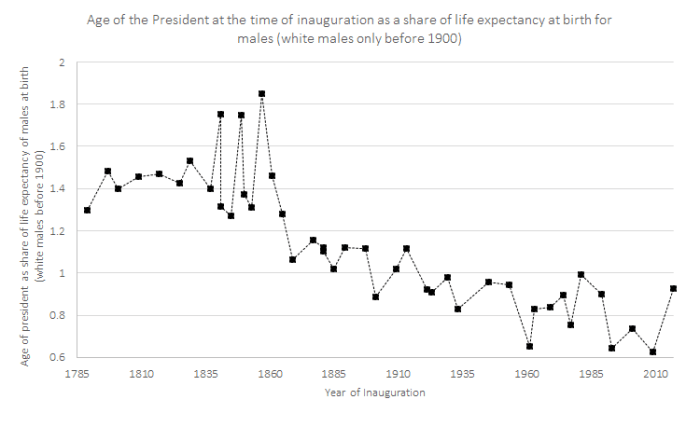
To meet that test, I took the CDC data on life expectancy as well as soon historical database  from 1900 to today. I combined it with David Hacker’s work on life tables in the US from 1790 to 1900 which can be found in this article of Historical Methods.  Hacker’s data concerns only the white population. I took only the age expectancy at birth of males. Then, I plotted the age of the president at the time of inauguration as a share of the life expectancy at birth (E0). This is the result:

inauguration

As one can see, the age of presidents as a share of life expectancy is falling steadily since the early 1900s. In this light, Donald Trump is not the oldest president. In fact, the oldest president is …. drumroll…James Buchanan (1.85 times the life expectancy of white males at birth). Moreover, in this light, the youngest president at inauguration is not Teddy Roosevelt (Kennedy was the youngest elected). Rather, the youngest is Barack Obama followed very closely by Bill Clinton and John F. Kennedy.

I find this post to be interesting as it shows something more important in my eyes: how the poorest in society have done. Presidents have generally stemmed from the top of the income distribution. Over time, the ages of presidents at inauguration (in absolute terms) has not followed any clear trend. The drop seen in the graph above is entirely driven by increases in the life expectancy of the “average” American. In a certain way, it shows that the distance between that “Joe the Plumber” and the “Greatest Man in America” (huh…Lord Acton anyone?) seems to be diminishing over time.

What is Wrong with Income Inequality? Five Reasons to be Concerned

I sometimes part ways with many of my libertarian and classical liberal friends in that I do have some amount of tentative concern for income/wealth inequality (for the purposes of this article, the otherwise important economic distinction between the two is not particularly relevant since the two are strongly correlated with each other). Many libertarians argue that inequality ultimately doesn’t matter. There is good reason to think this drawing from the classic arguments of Nozick and Hayek about how free exchange in a market economy can often interrupt preferred distributions.

The argument goes like this: take whatever your preferred distribution of income is, be it purely egalitarian or some sort of Rawlsian distribution such that the distribution benefits only the worst off in society. Assume there is one individual in the economy who has some product or service everyone wants to buy (in Nozick’s example it was Wilt Chamberlain playing basketball), and let everyone pay a relatively small amount of income to that one individual. For example, assume you have a society with 10,000 people all who start off with an equal endowment of $5 and all of them decide to pay Wilt Chamberlain $1 to watch him play basketball. Very few people would object to those individual exchanges, yet at the end Wilt Chamberlain ends up with $10,005 dollars and everyone else has $4, and our preferred distribution of income has been grossly upset even though the individual actions that led to that distribution are not objectionable. In other words, allowing for free exchange precludes trying to construct an optimal result of that free exchange (a basic consequence of recognizing spontaneous order).

Further, these libertarians argue, it is more important to ensure that the poor are better off in absolute terms than to ensure they are better off relative to their wealthier peers. Therefore, if a given policy will increase the wealth of the wealthiest by 10% and the poorest by 5%, there is no reason to oppose this policy on the grounds that it increases inequality because the poor are still made richer. Therefore, it is claimed, we should focus on policies that improve economic growth and the incomes of the poor and be indifferent as to its impact on relative inequality, since those policies are strongly correlated with bettering the economic conditions of the poor. In fact, as Mises Argued in Liberalism and the Classical Tradition, a certain amount of inequality is necessary for markets to function: they create a market for luxury goods that can be experimented and developed into future mass-consumption goods everyone can consume. Not everyone could afford, for an example, an IPod when it first came out, however today MP3 players are cheap and plentiful because the very wealthy were able to demand it when it was very expensive.

I agree with my libertarians in thinking that this argument is largely correct, however I do not think it proves, as Hayek argued, that social justice (understood in this context as distributive justice) is a “mirage” or that we should be altogether unconcerned with wealth or income distributions. All this argument does is mean that there is no overall deontological theory for an ideal income distribution, but there still might be good consequentialist reasons to think that excessively unequal distributions can impact many of the things that classical liberals tell us to worry about, such as the earnings of the poor, more free political economic outcomes, or overall economic growth. Further, even on Nozick’s entitlement theory of justice, we might oppose income inequality if it arises through unjust means. Here are five reasons why libertarians and classical liberals should be concerned about income inequality (note that they are mostly empirical reasons, not claims about the nature of justice):

1) Income Inequality as a Result of Rent Seeking

Certain government policies result in uneven income distribution. For an example, a paper by Patrick MacLaughlin and Lauren Stanley at the Mercatus Center empirically analyze the regressive effects of regulatory policy. Specifically, Stanley and MacLaughlin find that high barriers to entry create barriers to entry which worsens income mobility. Poorer would-be entrepreneurs cannot enter the market if they must, for an example, pay thousands of dollars for a license, or spend a large amount of time getting costly education and certifications to please some regulatory bureaucracy. This was admitted even by the Obama Administration in a recent report advising reform of occupational licensing laws. As basic public choice theory teaches, regulators are subject to regulatory capture, in which established business interests lobby regulators to erect barriers to entry to harm would-be competitors. Insofar as inequality is a result of such rent-seeking, libertarians have an obvious reason to oppose it.

Many other policies can worsen inequality. When wealthy corporations receive artificial monopolies from policies such as excessive intellectual property laws, insulating them from competition or when they gain wealth at the expense of poorer taxpayers through improper subsidies. When the government uses violent policing tactics to unequally enforce drug laws against poorer communities, or when it uses civil asset forfeiture to take the property of the worst off. When the government uses eminent domain to take the property of disadvantaged individuals and communities in the name of public works projects, or when they implement minimum wage laws that displace low-skilled workers. Or, if the structure of welfare benefits discourages income mobility, which also worsens inequality. There are a myriad of bad government policies which benefit the rich and exploit the poor, some of which are a direct result of rent-seeking on behalf of the wealthy.

If the rich are getting richer, or if the poor are stopped from becoming wealthier, as a result of government coercion, even Nozick’s entitlement theory of justice calls for us to be skeptical of the resulting income distribution. As Matt Zwolinski argues, income distributions are not only a result of, pace Nozick, a result of the free exchanges of individuals, but they are also a result of the institutions in which those individuals exchange. Insofar as inequality is a result of unjust institutions, we have good reason to call that inequality unjust.

Of course, that principle is still very hard to empirically apply. It is hard to tell how much of an unequal distribution is a function of bad institutions and how much is a function of free exchange. However, this means we can provide very limited theories of distributive justice not as constructivist attempts to mold market outcomes to our moral desires, but as rough rules of thumb. If it is true that unequal distributions are a function of bad institutions, then unequal distributions should cause us to re-evaluate those institutions.

2) Income Inequality and Government Exploitation
Of course, many with more Marxist inclinations will argue that any amount of economic inequality will inherently result in class-based exploitation. There are very good, stand-by classical liberal (and neoclassical economic) reasons to reject this as Marxian class analysis as it depends on a highly flawed labor theory of value. However, that does not mean there is not some correlation between some notion of macro-level exploitation of the worst-off and high levels of inequality which libertarians have good reason to be concerned about, for reasons closely related to rent-seeking. Those with a high amount of economic power, particularly in western democracies, are very likely to also have a strong influence over the policies set by the government. There is reason to fear that this will create a class of wealthy people who, through political rent-seeking channels discuss earlier, will control state policies and institutions to protect their interests and wealth at the expense of the worst-off in society. Using state coercion to protect oneself at the expense of others is, under any understanding of the term, coercion. In this way, income inequality can beget rent-seeking and regressive policies which lead to more income inequality which leads to more rent-seeking, leading to a vicious political-economic cycle of exploitation and increasing inequality. In fact, even early radical classical liberal economists applied theories of class analysis to this type of problem.

3) Inequality’s Impacts on Economic Growth

There is a robust amount of empirical literature suggesting that excessive income inequality can harm economic growth. How? The Economist explains:

Inequality could impair growth if those with low incomes suffer poor health and low productivity as a result, or if, as evidence suggests, the poor struggle to finance investments in education. Inequality could also threaten public confidence in growth-boosting policies like free trade, says Dani Rodrik of the Institute for Advanced Study in Princeton.

Of course, this is of special concern to consequentialist classical liberals who claim we should worry mostly about the betterment of the poor in absolute terms, since economic growth is strongly correlated with bettering living standards. There is even some reason for these classical liberals, given their stated normative reasons, to (at least in the short-term given that we have unjust institutions) support some limited redistributive policies, but only those that are implemented well and don’t worsen inequality or growth (such as a Negative Income Tax), insofar as it boosts growth and helps limited the growth of rent-seeking culture described with reasons one and two.

4) Inequality and Political Stability

There is further some evidence that income inequality increases political instability. If the poor perceive that current distributions are unjust (however wrong they may or may not be), they might have social discontent. In moderate scenarios, (as the Alsenia paper I linked to argue) this can lead to reduced investment, which aggravates third problem discussed earlier. In some scenarios, this can lead to support for populist demagogues (such as Trump or Bernie Sanders) who will implement bad policies that not only might harm the poor but also limit individual liberty in other important ways. In the most extreme scenarios (however unlikely, but still plausible), it can lead to all-out violent revolutions and warfare. At any rate, libertarians and classical liberals concerned with ensuring tranquility and freedom should be concerned if inequality increases.

5) Inequality and Social Mobility

More meritocratic-leaning libertarians might say we should be concerned about equal opportunities rather than equal outcomes. There is some evidence that the two are greatly linked. In particular, the so-called “Great Gatsby Curve,” which shows a negative relationship between economic mobility and income inequality. In other words, unequal outcomes can undermine unequal opportunities. This can be because higher inequality means unequal access to certain services, eg. Education, that can enable social mobility, or that the poorer may have fewer connections to better-paying opportunities because of their socio-economic status. Of course, there is likely some reverse causality here; institutions that limit social mobility (such as those discussed in problem one and two) can be said to worsen income mobility intergenerationally, leading to higher inequality in the future. Though teasing out the direction of causality empirically can be challenging, there is reason for concern here if one is concerned about social mobility.

The main point I’m getting at is nothing new: one need not be a radical leftist social egalitarian who thinks equal economic outcomes are necessarily the only moral outcomes to be concerned on some level with inequality. How one responds to inequality is empirically dependent on the causes of the problems, and we have some good reasons to think that more limited government is a good solution to unequal outcomes.

This is not to say inequality poses no problem for libertarians’ ideal political order: if it is the case that markets inherently beget problematic levels of inequality, as for example Thomas Piketty claims, then we might need to re-evaluate how we integrate markets. However, there is good reason to be skeptical of such claims (Thomas Piketty’s in particular are suspect). Even if we grant that markets by themselves do lead to levels of inequality that cause problems 3-5, we must not commit the Nirvana fallacy. We need to compare government’s aptitude at managing income distribution, which for well-worn public choice reasons outlined in problems one and two as well as a mammoth epistemic problem inherent in figuring out how much inequality is likely to lead to those problems, and compare it to the extent to which markets do generate those problems. It is possible (very likely, even) that even if markets are not perfect in the sense of ensuring distribution that does not have problematic political economic outcomes, the state attempting to correct these outcomes would only make things worse.

But that is a complex empirical research project which obviously can’t be solved in this short blog post, suffice it to say now that though libertarians are right to be skeptical of overarching moralistic outrage about rising levels of inequality, there are other very good empirical reasons to be concerned.

“Ugly Conservative Sacred Cows”

I think this piece has regained currency. Look at it when you have a chance.

Thank you.

From the Comments: Ottoman autocracy, Turkish liberty

Jacques, if you want to look at a libertarian/classical liberal case for the Ottoman Empire you should look at Islam without Extremes (Norton 2013) by Mustafa Akyol. I can’t claim to have got round to reading it myself, but I have seen Akyol’s summaries of his argumnents.

The power of Akyol’s argument in term of Turkey’s political scene has been somewhat undermined by his support for the AKP governemnt until after the Gezi Park protests. He is very critical of the AKP now, but as he was previously known as an AKP apologist (and enthusiast for Intelligent Design theory) it’s doubtful how much of an asset he is to Turkey’s rather small pro-liberty scene.

In any case I do not endorse myself straight on Ottomanist libertarianism and there are reasons it does not have much of a hold in Turkey’s pro-liberty scene though there are a few who think like this. The problems are endless and complex because the Ottoman system lasted from the 14th to 20th centuries and you can’t really talk about the same system, or at least few historians think you can. The millet system is a term applied late in Ottoman history, while the system was at its peak in terms of the size of the empire, along with it general prestige in the world, in the sixteenth century. Of course at that time, it could be said to have established some version of some liberty with order as good as many Christian states, and to me more power ful than any. I don’t think even at its height though you could say the Ottoman empire had more liberty than the most law governed and tolerant places in ‘Christendom’ and certainly while European thinkers respect the Ottoman system at its height it very much looked like an example of strong orderly monarchy, not decentralised liberty.

Even at its peak the Ottoman system obliged Balkan Christian families to send one son away at a very early age to be brought up as Muslim convert soldier-bureaucrat slave of the Sultan. The Janissary system, a very privileged kind of slavery and forced conversion, but that is what it was. The Sultan employed black eunuch slaves, transported from Africa, again a privileged position but not really an example of liberty.

Jumping forward, the Ottoman system started to imitate the west in some respects from the late eighteenth century, following military defeats to Russia. The biggest act of ‘reform’ was the violent repression/massacre of the Janissaries which formed a whole class of soldiers, bureaucrats and Istanbul firemen who were also market traders on the side, blocking the Sultan’s ideas of reform, including the formation of a more modern military.

Jumping forward again, the Ottoman sultan most revered by Turkey’s current Ottomanists on the whole, Abdulhamit II, suspended the national assembly, pursued a program of bureaucratic-military-technical centralisation, which included the early massacres of Armenians to which you refer. In the end he was overthrown as a ruker (not as holder of the title of Sultan) by westernising reformers (Committee of Union and Progress/Young Turks) who ended up continuing a centralising reform process which alienated people outside the Muslim Ottoman elite and the Anaotlian heartlands of the Empire. Jumping back to the period between the suppression of the Janissaries and Abdulhamit II’s rule, the Greek Independence movement was resisted with staggering levels of violence and cruelty (the Greek insurgents were not always fastidious in their methods either, it must be also be said). By the nineteenth century, the Ottoman system of relative tolerance towards non-Muslims on a communal rights basis was looking less impressive compared with a growing European tendency towards tolerance based on individual rights.

The ‘millet system’ at its peak provided a way Muslims, Christians and Jews could live together, but mostly as separate communities able to continue communal traditions, within a hierarchy in which Muslims had the real power. As with looking to models of liberty in ‘feudal’, medieval Europe, we may see some liberty benefits in the elements of localism and communal autonomy under a monarchy, but in both cases we are not talking about a system of individual rights or free interaction, we are talking about individuals constrained by communal traditions and hierarchies, along with the hierarchies between communities. If we value individual rights under common legal rights then this is not a model for us, even if we can see some lessons.

Even at its peak the Ottoman system blocked the spread of printing, one of the major elements of modern liberty. The reasons for the block combine the power of religious conservatism and the guild interests of manuscript copyists which seems to me to sum up the problems of even peak time Ottomanism for liberty. It was a system based on an assemblage of local, communal and guild privileges finding change difficult except through dramatic acts of autocratic rulers. The transition from Empire to French-modeled republic, but less liberal than the France of the time, in the 20s and 30s under Atatürk was itself the last great example of this and was a product of the difficulties the Ottoman system had with peaceful consensual change, even if it did have a few good moments on that score (e.g. the 1840 Tanzimat reforms).

Finally the Ottoman system was condemned by its own failure to defend itself, the last Sultan could only give into the victorious powers of World War One, while the republican-nationalists, who emerged from the most educated sections of the Ottoman elite, were able to mobilse a successful military struggle (the Independence War) even without control of the state apparatus. A system which can’t win a war is not a successful system, regardless of how sad the importance of war in human history is.

Arguments now about reviving the Ottoman Empire are surely self-evidently hypothetical only for anyone who does not take Erdoğan’s more bombastic statements seriously. In what way would the Middle East resolve anything by rule from Istanbul, particularly as part of a centralised state ruled by Erdoğan? If the question is should the Ottoman Empire have been prolonged at the end of World War One, the Ottoman government of the war undermined that possibility by massacres of Arabs, along with the leaders Faisal gave to Arab nationalists, aided by devious British and French policy.

The Ottoman Empire was in the Balkans before it was in the Middle East. Ottoman sultans used the title Kaiser-i rum (Emperor of Rome) after the Fall of Constantinople before they adopted the title of Caliph (leader of the faithful) after the later conquest of the Hezaz (i.e. the region containing Mecca and Medina). There is nothing natural or inevitable about a Turkey leaning predominantly towards the Middle East and nothing inherently desirable about Beirut, Amman, Riyadh, Damascus, etc coming under the dominance of Turks; there is nothing obviously healing for Arab Shiite Muslims in living under a Sunni Caliph in a palace on the Bosphorus, not now and not in 1919.

Ottomanist libertarianism makes most sense for those inclined to paleolibertarianism based on dispersal of power between homogenous traditionalist localised communities. I don’t see it has so much to offer to other kinds of libertarian. If we think about more modern liberal forms, there was some interest in Britsh style liberalism (already at that time in transition from classical liberalism to left liberalism) amongst the last Ottomans, most notably Prince Sabahattin, but this was a minority within a weakened elite, discredited by collaboration with British occupation at the end of World War One, which never had anything like a politics capable of mobilising the elite (very influenced by French republicanism politically and intellectually by the sociological expression of French republicanism in the work of Emile Durkheim), never mind the population as a whole.

(Yes Brandon I should be posting this kind of thing, in refined and revised form, but I really don’t have time to do this properly at present, believe me I really am in extreme crisis mode with writing/editing deadlines), after a particularly busy semester, believe me I will be posting when I can, and I should be able to manage within the next few months, sorry I can’t say any more than that, but it is the reality.)

This is from Barry Stocker, responding to Jacques’ musings on the Ottoman Empire and libertarian arguments that are sometimes in favor of it. The rest of the thread is pretty good too, though Dr Delacroix has yet to respond…

A Common Conservative Fallacy

I believe folly serves liberals better than it serves conservatives. Our way is the rational way while liberals tend to rely on their gut-feelings and on their sensitive hearts which make them comparatively indifferent to hard facts. That’s why they voted for  Pres. Obama. That’s why they voted for Mrs Bill Clinton against all strong evidence (known evidence, verifiable, not just suppositions) of her moral and intellectual unsuitability. That’s why many of them still can’t face emotionally the possibility of buyer’s remorse with respect to Mr Obama. That’s why they can’t collectively face the results of the 2016 election. So, conservatives have a special duty to wash out their brains of fallacy often.

It’s the task of every conservative to correct important errors that have found their way into fellow conservatives’ mind. Here is one I hear several times a week, especially from Rush Limbaugh (whom I otherwise like and admire). What’s below is a paraphrase, a distillation of many different but similar statements, from Limbaugh and from others I listen to and read, and from Internet comments, including many on my own Facebook:

“Government does not create jobs,”

and

“Government does not create wealth (it just seizes the wealth created by business and transfers it to others).”

Both statements are important and both statements are just false. It’s not difficult to show why.

First, some government actions make jobs possible that would not exist, absent those actions. Bear with me.

Suppose I have a large field of good bottom land. From this land I can easily grow a crop of corn sufficient to feed my family, and our poultry, and our pig, Gaspard. I grow a little more to make pretty good whiskey. I have no reason to grow more corn than this. I forgot to tell you: This is 1820 in eastern Ohio. Now, the government uses taxes (money taken from me and from others under threat of violence, to be sure) to dig and build  a canal that links me and others to the growing urban centers of New York and Pennsylvania. I decide to plant more corn, for sale back East. This growth in my total production works so well that I expand again. Soon, I have to hire a field hand to help me out. After a while, I have two employees.

In the  historically realistic situation I describe, would it not be absurd to declare that the government gets no credit, zero credit for the two new jobs? Sure, absent government tax-supported initiative, canals may have been built as private endeavors and with private funds. In the meantime, denying that the government contributed to the creation of two new jobs in the story above is not true to fact.

Second, it should be obvious that government provides many services, beginning with mail delivery. Also, some of the services private companies supply in this country are provided elsewhere by a branch of government. They are comparable. This fact allows for an estimation of the economic value of the relevant government services. Emergency services, ambulance service, is a case in point. Most ambulances are privately owned and operated in the US while most ambulances are government-owned and operated in France. If you have a serious car accident in the US, you or someone calls a certain number and an ambulance arrives to administer first aid and to carry you to a hospital if needed. Exactly the same thing happens in France under similar circumstances. (The only difference is that, in France, the EM guy immediately hands you a shot of good cognac. OK, it’s not true; I am kidding.)

In both countries, the value of the service so rendered is entered into the national accounting and it does in fact appear in the American Gross Domestic Product for the year (GDP) and in the French GDP, respectively. The GDP of each country thus increases by something like $500 each time an ambulance is used. Incidentally, the much decried GDP is important because it’s the most common measure of the value of our collective production. One version of GDP (“PPP”) is roughly comparable between countries. When the GDP is up by 3,5 % for a year, it makes every American who knows it, happy; also some who don’t know it. When the GDP shrinks by 1%, we all worry and we all feel poorer. If the GDP change shrinks below zero for two consecutive quarters, you have the conventional definition of a recession and all hell breaks lose, including usually a rise in unemployment.

Exactly the same is true in France. The government-provided French ambulance service has exactly the same effect on the French GDP.

Now think of this: Is there anyone who believes that the equivalent service supplied in France by a government agency does not have more or less the same value as the American service provided by a private company? Would anyone argue that the ambulance service supplied in France, in most ways identical to the service in America, should not be counted in the French GDP? Clearly, both propositions are absurd.

Same thing for job creation. When the French government agency in charge of ambulances hires an additional ambulance driver, it creates a new job, same as when an American company hires an ambulance driver.

By the way, don’t think my story trivial. “Services” is a poorly defined category. It’s even sometimes too heterogeneous to be useful (not “erogenous,” please pay attention). It includes such disparate things as waitressing, fortune-telling, university teaching, and doing whatever Social Security employees do. Yet it’s good enough for gross purposes. Depending on what you include, last year “services” accounted for something between 45% and 70% of US GDP. So, if you think services, such as ambulance service, should not be counted, you should know that it means that we are earning collectively about half to three quarters less than we think we do. If memory serves, that means that our standard of living today is about the same as it was in 1950 or even in 1930.

Does this all imply that we should rejoice every time the government expands? The answer is “No,” for three reasons. These three reasons however should only show up after we have resolved the issue described above, after we have convinced ourselves that government does provide service and that it and does create real jobs, directly and indirectly. Below are the three questions that correspond to the three reasons why conservatives should still not rejoice when government enlarges its scope. Conservatives should ask these three questions over and over again:

1 Is this service a real service to regular people or is it created only, or largely, to serve the needs of those who provide it, or for frivolous reasons? Some government services fall into this area, not many, I think. Look in the direction of government control, inspection, verification functions. Don’t forget your local government.

Often, the answer to this question is not clear or it is changing. Public primary and secondary education looks more and more like a service provided largely or even primarily to give careers to teachers and administrators protected by powerful unions. It does not mean that the real, or the expected service, “education,” is not delivered, just that it’s often done badly by people who are not the best they could be to provide that particular service; also people who are difficult or impossible to replace.

2   Is this particular service better provided by government or by the private sector? Is it better provided by government although the provision of the service requires collecting taxes and then paying out the proceeds to the actual civil servants through a government bureaucracy? That’s a very indirect way to go about anything, it would seem. That’s enough reason to be skeptical. The indirectness of the route between collecting the necessary funds and their being paid out to providers should often be enough to make government service more expensive than private, market-driven equivalent services. Note that the statement is credible even if every government employee involved is a model of efficiency.

The US Post Office remains the best example of a  situation where one would say  the private sector can do it better.

Only conservatives dare pose this question with respect to services one level of government or other has been supplying for a long time or forever. The Post Office is inefficient; if it were abolished, the paper mail would be delivered, faster or cheaper, or both. Some paper mail would not be delivered anymore. Many more of us would count it a blessing than the reverse. While there is a broad consensus across the political spectrum that children should be educated at collective expense, there is growing certitude that governments should not be in the business of education. In many parts of the country, the public schools are both expensive and bad. Last time I looked, Washington DC was spending over $20,000 per pupil per year. Give me half that amount and half the students or better will come out knowing how to read, I say. (It’s not the case now.)

3   This is the most serious question and the most difficult to answer concretely: Does the fact that this service is provided by government (any level) have any negative effect on our liberties? This is a separate question altogether. It may be that the government’s supply of a particular service is both inefficient and dangerous to freedom. It may be however that government supply is the most efficient solution possible and yet, I don’t want it because it threatens my freedom. As a conservative, I believe that my money is my money. I am free to use it to buy inefficiently, in order to preserve liberty, for example. I am not intellectually obligated to be “pragmatic” and short sighted.

To take an example at random, if someone showed me, demonstrated beyond a reasonable doubt, that Obamacare would reduce the cost of health care without impairing its quality, if that happened, I would still be against it because of the answer I would give to the third and last question above.

I don’t want a any government bureaucracy to make decisions that are ultimately decisions of life and death on my behalf. The possibility of blackmail is too real. Even thinking about it is likely to make some citizens more docile than they otherwise would be. So much power about such real issues must have a chilling effect on the many.

The rule of thumb is this: Every expansion of government reduces individual freedom. That’s true even if this expansion creates and efficient and effective government agency, say, a real good Post Office we don’t even know how to dream of. And this is not an abstract view. The well-intentioned and in other ways laudable recognition of homosexual marriage was followed in short order by threats and fines against a hapless baker who declined to bake a cake for a gay wedding. We must keep in mind at all times that, of course, the power to fine, like the power to tax, is the power to destroy.

An efficient but ethically objectionable government service is not something I worry much about, in the case of Obamacare specifically, by the way. It is inefficient, ineffective and dangerous to individual liberty all at once.

Conservatives don’t do enough to proclaim that their opposition to big government has an ethical basis, that it’s a moral position independent of the quality of big government. This silence makes if easy for liberals to caricature conservatives as just selfish grouches who don’t want to pay taxes.

Most of the time, I don’t want to pay taxes because I don’t want to be forced. I would gladly give away twice the amount of my taxes if there were a way to do it voluntarily instead of paying taxes.

I am so opposed to this kind of force that I think even the undeserving and obscenely rich should not be despoiled by the government. It’s an ethical position, not a pragmatic one. And, it sure cannot be called “selfish.” (WTF!)

Public Support for OReGO: Preliminary Results

tldr version;

Road pricing can be a useful means of addressing infrastructure fiscal issues, reducing congestion, and improving environmental quality and it has a chance of being implemented if advocates focus on mobilizing urban voters.

Thanks to all respondents.


This post is a quick detour from the NoL Foreign Policy Survey posts.

Among other projects I am working on, I am tinkering with a public opinion project aimed at the OReGO project. The OReGO is a pilot program operated by the State of Oregon to experiment with an alternative to the existing gasoline tax. Currently Oregonians pay 30 cents per gallon of gasoline, on top of the federal 18.4 cent per gallon tax. Volunteer participants of OReGO instead pay a charge of 1.5 cents per mile driven on state roads.

orego

The primary goal of the program is to find a better way to fund the state’s infrastructure. The current system is inadequate because automobiles are becoming increasingly more fuel efficient and so, on a per mile basis, pay less for road use. Despite paying less these automobiles still rack up costs in road damage.

Advocates of OReGO, and other road pricing schemes, also hope that the program will serve as a means of combating congestion by making drivers more conscious of the marginal cost of their driving and encouraging them to avoid excess driving. The gasoline tax does this already, but very crudely in comparison.

Some advocates also hope to use road pricing as a means of improving local environmental quality and addressing climate change. Automobiles are a significant source of pollution and so reducing their use would yield environmental benefits. Even if the program kept the same number of cars on the road it could reap benefits if it reduced stop and go traffic; automobiles pollute more in stop and go traffic than free flow.

There is quite a bit of research from economists and urban planners on the issue, but public opinion research on it is relatively rare. What research exists tends to focus on either toll roads or in foreign regions. The reason for the gap in the literature is simple enough to explain – no jurisdiction in the United States has adopted road pricing. There have been a few small scale experiments, but they were largely engineering tests and surveyed only the opinion of participants. I hope to fill this gap in the literature by (eventually) conducting a large scale public opinion study of Oregonians.

The below pilot study had 220 respondents recruited through various Oregon sub-reddits (e.g. Portland, Eugene, and Salem). Respondents were obviously not representative of Oregon at large. The sample size was also small for an academic study of Oregon and there is a lot of noise. Most of the results presented are statistically insignificant. As a convenience sample though this survey was nonetheless useful. My goal in this survey was more about testing the survey before fielding it more broadly.

I thank all respondents to the survey – you’ve all helped the progress of science.

Survey Experiment Results:

The survey had a survey experiment. The purpose of survey experiments is to see how changes in phrasing, or other survey elements, influences response.

The experiment was in how OReGO was presented. Respondents were split into three sub-groups and received slightly different explanations of the program. In the base scenario they were told the program was simply a funding mechanism. In the congestion scenario they were also told about its possible congestion benefits. In the final they were additionally told about its possible environmental benefits.

OReGo is a pilot program currently being operated by the Oregon Department of Transportation. Participating drivers are being given the opportunity to pay 1.5 cents per mile they drive on public roads instead of the current 30 cent per gallon tax that the state of Oregon currently charges.

Advocates of OReGO, and similar road pricing schemes, argue that the program serves as a more dependable means of funding infrastructure than the current gasoline tax. They point out that as vehicles become more fuel efficient the amount that drivers pay per mile is decreasing, but costs associated due to road damage are not similarly decreasing. This means that in the long term the current gasoline tax will be unable to cover infrastructure costs. (/End of Base Scenario)

Advocates of OReGO also point out that the program can help reduce congestion by discouraging excessive driving and encourage the use of alternative means of transportation such as bicycling, walking, or transit. Although drivers currently pay for their automobile use in the form of the gasoline tax, many view it as a fixed payment. OReGO, which is charged on a per mile basis, may serve to make drivers more conscious of the marginal cost of their driving. (/End of Congestion Scenario)

OReGO could lead not only to reduced congestion, but could also serve to improve local air quality. One of the major sources of air pollution is automobiles, especially in stop and go traffic. (/End of Environmental Scenario)

Looking at support for adopting OReGO within five years the different treatments are little different from one another. The congestion treatment received a decline in support, but it is pushed back up in the environmental treatment.

I regret not adding a fourth group where respondents are told about the base option and the environmental benefits, but congestion is not added. As it is, it is hard to tell if the decline in support for OReGO in the congestion treatment is because people don’t care about ways to address congestion, or they dislike attempts at social engineering.

favororegobytreatment

When we look at treatment effects among only those who identified living in an urban area the effects get more interesting. Urban voters were very responsive to the idea of environmental benefits and increased support for OReGO by over 10 percentage points.

FavorOregobyTreatmentUrban.png


favororegobyurban

What seems to be driving the difference in support for OReGO is inter-regional differences in perceived local air quality. Those who perceive local air quality to be ‘very good’ are least likely to support OReGO. This finding is exaggerated when looking at only urban respondents.

I played around to see if this was a statistical artifact from the above treatment; i.e. it is possible those who lived in ‘very good’ air quality regions received the ‘environmental treatment’  and I am picking up the latter effect. This was not the case.

favororegobylocalair

favororegobylocalairurban

Is this a simple case of those living in high quality areas having no interest in improving the region? A “I have mines” attitude. No. When I look at support for OReGO by how respondents judged local air quality had changed in the past five years, those who thought their local air quality was improving also had the highest support for OReGO.

There is a definite relationship here between support for OReGO and perception of one’s local air quality. I can’t put my finger on it just yet.

favororegobychangeairurban

Bonus result: daily bicyclists are those most supportive of OReGO.

favororegobybikefreq

NoL Foreign Policy Results: Preliminary

tldr version; Libertarians are not isolationists in their foreign policy. Left-libertarians in particular are more supportive of things like NATO. Left-libertarians are also more supportive of acting on migration and climate change issues.


These are the preliminary results of the NoL Foreign Policy Survey 2017 Pilot. I will release the raw data and more results in the coming days. I am still in the process of cleaning things up.

The survey targeted self-identified libertarians through online libertarians communities (e.g. the Ron Paul Forums, reddit subreddits, facebook groups, etc.). The survey aimed to better understand the foreign policy views of self-identified libertarians based in the United States. The survey was conducted between December 23rd 2016 and January 1st 2017 and received over 600 replies.

Warning: This survey was a pilot and I discourage trying to generalize its results to the wider libertarian movement with any high degree of certainty.


Methodology:

The survey uses a survey experiment where respondents were placed into one of four alternative scenarios. Each scenario received similar questions, but had slight wording differences in two questions:

(1) whether the respondent supported providing military aid to a US ally and
(2) whether the respondent supported allowing in refugees from that country

The four scenarios were:

(1) A US ally being attacked by a neighbor – the base scenario
(2) The Baltic republics being attacked by Russia
(3) Afghanistan being attacked by Russia
(4) Taiwan ROC being attacked by China PRC

The survey can divided roughly into four parts:

(1) Military policy
(2) Migration policy
(3) Climate change policy and
(4) Trade policy


Results:
supportmilitaryaidbyattackedcountry

In the base scenario libertarians we find that the majority of libertarians favor providing military aid to a generic US ally. However that support goes down substantially when details are provided. If Afghanistan, a non-NATO major ally, were attacked it would receive support from less than 10 percent of respondents.

supportrefugee

Likewise support for allowing refugees in from the attacked country is high in the base scenario, but drops for Afghanistan. Support for allowing refugees from Taiwan or the Baltic republics is not statistically different from the base scenario.

unilateral

In the above graphs we see respondents’ support for unilateral action in free trade (“remove all trade barriers”), open borders, and addressing climate change. Support for unilateral action is almost twice as high for free trade than either support for open borders or climate change.

unilateral2

When I dig further into type of libertarian we see that left-libertarians are more willing to act on open borders and climate change than their counterparts. Almost 100 percent of market anarchists are in favor of abolishing all trade barriers.

int

Respondents are split on support for international groups like NAFTA or NATO. If we look at sub-groups within the libertarian movement (i.e. libertarians, left-libertarians, and market anarchists) we see that left-libertarians are more supportive and market anarchists are less supportive of international action.

int2