Catalonia: a philosophical case for Secession

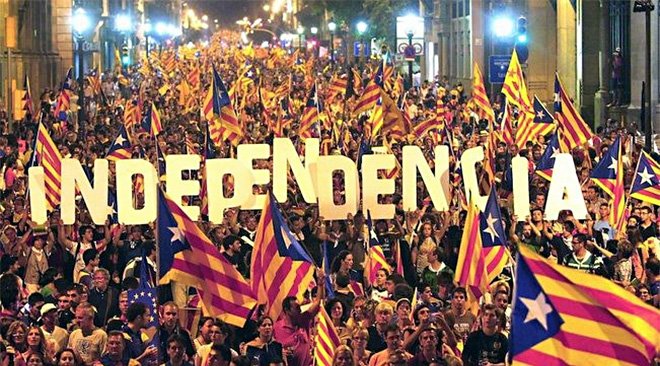
Yesterday, the Catalan government has overwelmingly voted for independence from Spain and to establish an independent republic. 70 were in favour, 10 were against, and 2 votes were blank. Unfortunately, it was rejected by the central governments of Spain and many other countries. Nonetheless, the Catalan case may inspire the other independence movements in Europe.

In this post I’d like to provide a philosophical case for the ethical right of secession based on a libertarian perspective of self-ownership. My argument is exclusively theoretical, although a discussion on how secession could be achieved practically would be interesting as well. I may save that for a post in the future.

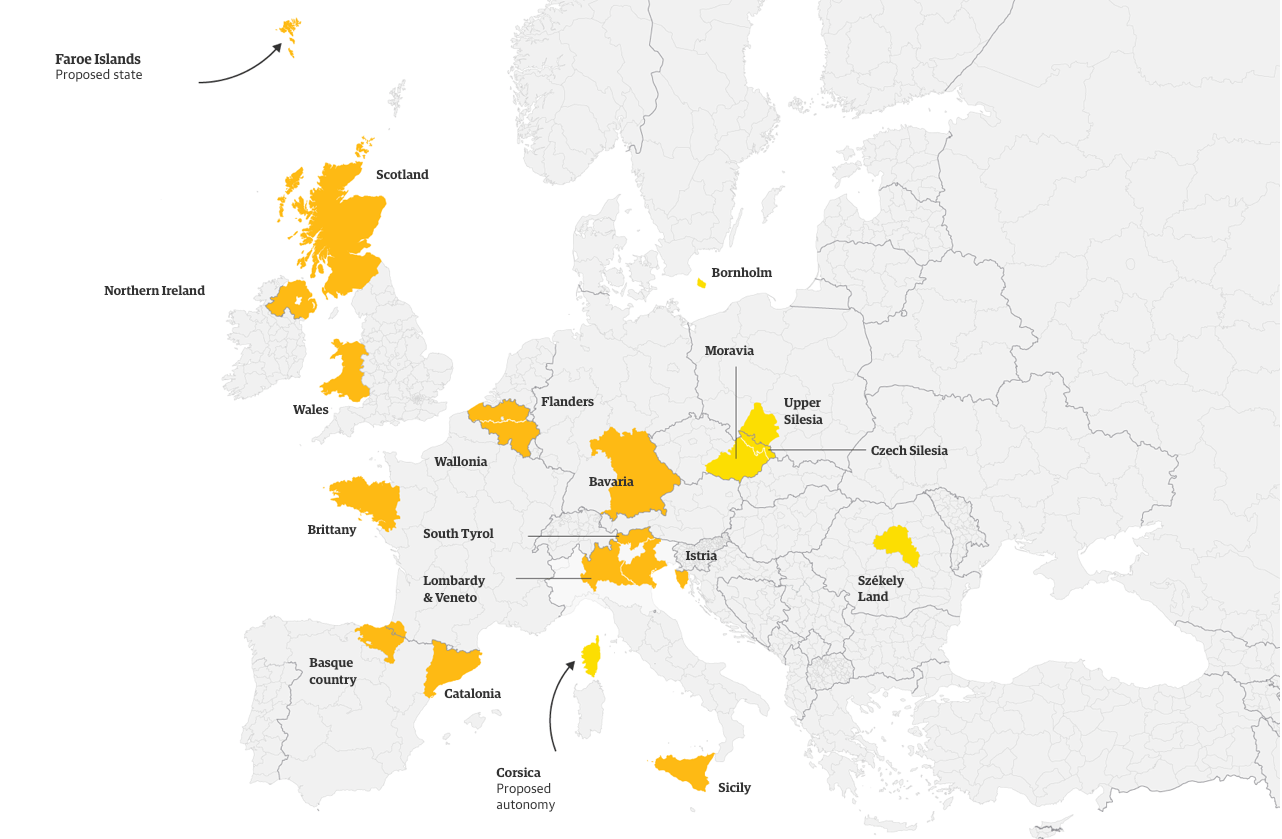
Below, you can find a map of other places in Europe with strong secessionist movements:

Structure of my argument

My argument is deductive and runs as follows:

  1. People have the right of self-ownership in accordance with the non-aggression principle, and based on the natural rights philosophy put forward by the political philosopher Murray Rothbard;
  2. If people have the right of self-ownership, they also have the right of voluntary association, voluntary formation of communities, and the right to choose their own leaders;
  3. Sometimes the state that the individual belongs to, violates the rights of the individual to the extent that the individual does not feel associated with it anymore;
  4. Under such circumstances the individual may perceive the state as an unacceptable aggressor, and he is justified to revolt by separating himself from the state. He can form communal associations to secede as a new political unit;
  5. There is no limit to secession. Provinces have the right to secede from a state, a district from the province, a town from the district, a neighbourhood from the town, a household from the neighbourhood, and an individual from the household.

The right of self-ownership and property rights

In For a New Liberty (1973), Murray Rothbard deduces natural law from the essential nature of human beings. He writes that it is in man’s nature to use his mind in order to select values, ends and the means to attain these ends so that he can “act purposively to maintain himself and advance his life”. He furthermore contends that it is absolutely “antihuman” to interfere violently with a man’s “learning and choices” as “it violates the natural law of man’s needs”. Therefore, man’s nature should be protected through his right of self-ownership. This right asserts that man has the absolute right to “own” his body and “to control that body free of coercive interferences”. This right includes the practice of such essential activities as thinking, learning, valuing, and choosing ends and means without any coercion, since such activities are necessary for the enhancement of man’s life.

From this natural right follows the right to do anything with one’s body, including the right to form free associations and communities, and the right not to be violated in one’s self-ownership. Thus, one has the right to associate oneself with the leader of one’s choice, but not the right to impose a leader unto someone else. Likewise, people should be free to join and to leave communities voluntarily.

In addition to the right of free association, people also have property rights. Rothbardian property rights are directly derived from self-ownership rights, and are based on the Lockean homesteading theory. It states that since man owns his person, he owns his labour, and therefore he also owns the fruits thereof. John Locke (1689) has put homesteading theory in the following way:

… every man has a property in his own person. … The labour of his body and the work of his hands, we may say, are properly his. Whatsoever, then, he removes out of the state of nature hath provided and left it in, he hath mixed his labour with it, and joined it to something that is his own, and thereby makes it his property.

Given that man has the right of self-ownership, and that he must employ natural objects for his survival, then the sculptor has the right to own the product he has made through the mixing of his labour. In other words, by producing something with one’s energy through the utilization of unowned nature, one has, as Rothbard calls it, “placed the stamp of his person upon the raw material”. One therefore rightfully owns the product. Any violation of self-ownership and property rights should hence be regarded as an act of aggression.

The state

The state is nonetheless a social institution that has historically interfered most often with people’s self-ownership and property rights. Max Weber has recognized it as an institution with a territorial monopoly of compulsion in his essay ‘Politics as a Vocation’ (1919). Hoppe, in Democracy – the God that failed (2001), asserts that every government will use this monopoly to exploit its citizens in order to increase its wealth and income.

“Hence every government should be expected to have an inherent tendency toward growth”. (Hoppe)

State exploitation happens in the form of expropriation, taxation, and regulation of private property owners. A state at best respects the rights of individual sovereignty and private property, but because its functioning is dependent on the expropriation of its citizens’ wealth there is a natural conflict between the state and its citizens. According to Franz Oppenheimer (1908), the state can impossibly finance itself without its productive citizens. It can only take that what has already been produced, and therefore it can only exist as a result of the “economic means”. However, this confiscation often involves state violence and aggression as nearly no one is willing to give up on his property voluntarily.

Under such circumstances, it is understandable that conflicts may arise between citizens and the state; sometimes resulting in citizens’ feelings of dissociation from their governments.

Secession

Frédérik Bastiat maintains in The Law (1850) that if everyone has the right to “his person, his liberty, and his property”, then

“a number of men have the right to combine together to extend, to organize a common force to provide regularly for this defense.”

Following Bastiat’s reasoning, I believe that citizens who feel dissociated can then revolt and opt for secession as a form of self-defense against state aggression on their self-ownership and property. Any state that does not recognize its citizens’ rights of secession does not sufficiently recognize the sovereignty of its people. Secession is a powerful means of political action to show the people’s discontent with their leaders. If secession would be impermissible, then the people who want to disassociate themselves from the state have the following three options:
(1) continue living under the oppressive state rule;
or (2) revolt against the state;
or (3) emigrate to another state.

By doing (1), the people continue living under perpetual state aggression, and their sovereignty is continually violated.

If the people choose option (2), then there will be severe and costly consequences which can involve war and destruction of private property. In addition, there are also no guarantees that the revolt against the state will be successful. For these two reasons, this option seems to most secessionists to be the least preferable of the three.

The people can alternatively choose (3) and emigrate to another state. This alternative is often used as an argument against secession under the presumption that those who are unhappy within one particular state, should simply emigrate. However, the cost of emigration can be so significantly high that it is unfeasible. One has for example the costs of finding information on the procedure of emigration, becoming accepted by the other state, finding a new workplace etc… The state can also exert barriers of emigration through tedious bureaucratic processes and passport controls, which makes emigration even more unattractive.

Who are morally justified to secede?

Following man’s right of free association, the answer should be: anyone, as long as it happens on a voluntary basis. Even though most secessionist movements are built on a common ethnicity or common cultural heritage, such precepts are not necessary to justify secession. Moreover, secessionists should not be prescribed any form of social organization as they should be free to choose their own form of government. This means that a multitude of social organizations are possible, including those that are currently non-existent. By being epistemologically modest of what governmental form is best, communities are allowed to experiment and find their own form of government. This will eventually add to our understanding of human social organizations.

Lastly, it is important to note that if secession is ethical, ultimately based on the principle of self-ownership, then it follows that the individual has the right to secede as well.

This right cannot be exclusively granted to groups, because only individuals can have ownership of their own bodies. Self-ownership cannot be shared, just like the mind cannot be shared. The mind is an attribute, inherent only to individuals, and collectives only derive their rights from the rights of their individual members. Therefore the right of self-ownership must necessarily imply the right to practice unlimited secession.

As Rothbard would assert, provinces should have the right to secede from a state, a district from the province, a town from the district, a neighbourhood from the town, a household from the neighbourhood, and an individual from the household. This logical consequence is anarchism.

Conclusion

In setting forward a natural rights defense of self-ownership, I have concluded that individuals have the right to free association and property rights. Unfortunately, states sometimes violate these rights to the extent that its people do not want to be associated with their state anymore. Under such circumstances they retain the right to secede. Secession should however not only be limited to communities. Single individuals also bear the right to secede, since only individuals can possess self-ownership, and since groups can only derive their rights from its individual members.

A quick rant on NY’s Excelsior Scholarship

Long Island Business News had a cover story last week: “Free for all?

And the answer is no.

NoL readers don’t need to be reminded that there ain’t no such thing as a free lunch. But I want to focus on the “for all” aspect. And the answer there is also no. This is a program that benefits the middle class and simply won’t be available for the poorest kids in the state.

There are a lot of different programs for paying for schooling costs, and I don’t want to get bogged down in specifics. So here’s (roughly) how this new program works: full time students whose family income is below (approximately) the 75th percentile get more money for school. That money goes away if they stop meeting those criteria.

This is not going to be helpful to poor students who don’t have to resources necessary to go to school full time. It sounds inclusive, but they might as well make the income requirement family income between the 60th and 75th percentile.

In the best case scenario, we might end up getting a positive return on this program (generating more tax revenues from more productive workers). But we still have to ask about what alternatives were possible.

Here are three problems with that outcome:

  1. If those kids were going to go to school anyways, then we’re just creating a common pool problem where costs and benefits aren’t compared by the relevant decision makers.
  2. If some of those kids weren’t going to go to school otherwise, then we’ve increased the pressure on poor kids to get a college degree without helping them out. And if we’re thinking of this like an investment, the returns would be higher on getting more poor kids to go through school.
  3. If this program doesn’t have a return on investment high enough to offset the costs, then that budget line has to compete with some other program (tax returns would be nice, or investment in infrastructure, or something else).

I don’t expect any legislation to solve the problem once and for all. But this program is more likely to make the underlying problems worse, at the expense of poor people, and with little net gain. Not only is this bad economics, it’s not even in line with the more honorable goals of progressives. It’s simply a way for politicians to buy votes with other people’s money.

White Supremacists

“White supremacy” has become a central part of the left’s narrative. In an hour and a half of casual news watching on television in early October 2017, for example, I heard three references to white supremacy. That’s more than I did in the decade 2005 to 2015, I believe.

One utterance came from the sports channel ESPN’s African-American commentator Jemele Hill who called president Trump a “white supremacist.” She added that he surrounded himself with white supremacists. Perhaps, by implication of the term “surround,” she meant several millions of his 63 million voters, or even all of them. This kind of verbal hysteria is not new and neither are intemperate television commentators but, in the recent past, such breathless declarations would have been laughed out of the park or negatively sanctioned, or both. Not anymore. Ms Hill’s statement was not exactly an isolated incident either.

In the first two weeks of October 2017, I hear the word “supremacist” on radio or television at least once a day. I am sure it has not happened before in my fifty years in this country (as an immigrant). This new tolerance makes some sense in political context.

For the inconsolable of Pres. Trump’s election, I suspect – but I don’t know for a fact – that the claim is by way of passing the baton at a time when the investigation on “Russian collusion” to elect him, now in its thirteenth month, is going nowhere. If he did not betray the country, what can we accuse him of that’s difficult for decent minded people to forgive, they ask? Digging into this country’s complex and troubled past is always a good bet if you are looking for dirt to throw at an American.

Mr Trump’s own intemperate comments – although never directed at the usual African-Americans targets of real supremacists – helped identify a valuable, superficially semi-plausible charge. The sudden emergence in the collective consciousness of unhappy young white Americans on the occasion of the 2016 election also contributed. (“…in the collective consciousness…;” they were around before that.) Unhappy young whites can but with little effort be turned into the racist rednecks of countless movies. Thus, the white supremacy narrative may be part of a half-blind collective endeavor to discredit for the long term the social forces thought to be associated with the sensational defeat in 2016 of a moderate liberal (and a feminist to boot; more on this below).

My first impression of the reality of a white supremacist movement, based on reading and listening to radio – including National Public Radio – about five days a week, besides watching television, is that there isn’t actually much going on nationwide in this respect. Yet, I am mindful of the fact that I live in “progressive” Santa Cruz, in liberal California. In neither place would one expect to bump casually into white supremacists. And if there were one, he would probably just clench his teeth and keep his mouth shut. In lily-white Santa Cruz, on the contrary, a black supremacist would probably be elected mayor on the first try without really campaigning. (OK, I may be exaggerating a little, here.)

I realize also that my reading habits as a conservative may not lead to chance encounters with supremacist tripe.* So, I wonder: What’s the actual situation? To try and explore this question more deeply, I use a two-step strategy. I look first for existing credible empirical reports on the topic. Second, I look for what should be the products of white supremacist groups, the tracks they should logically be expected to leave on the internet and elsewhere. But first, a brief historical detour. Continue reading

The Dreamers and Me

President Trump just announced that he was rolling back an Obama executive order intended to give respite to illegal immigrants brought to the US by their parents when they were minors. I know what I feel about this action. I have to figure out what I think.  (I can cry with the best of them! Left-wing liars are having a field day right now. One just said on NPR that the purpose of the decision is to make America “white again,” N. S.!)

I am an immigrant. I immigrated into this country at 21. I was a high school dropout from France. I had no marketable skill but I knew English pretty well. I had no money. (That’s “Not any.”) I carried a small suitcase containing mostly some Navy clothing from my recent service. The Unites States did not need me.* No one had invited me except the late George and Rose-Marie McDaniel of Novato, California. (They had met me during my stint as a high school exchange student three years earlier, financed by others.) Don’t worry, I am not going to cram down your throat yet another heroic story of hard immigrant work and well deserved achievement.

I prospered in this country for more than fifty years. I had a very good American life. I lived well and I thrived unexpectedly from an intellectual standpoint. My wife, an artist and also an immigrant, was able to paint as we raised our children. All of this because many individuals and several institutions gave me a push and a pull, an encouraging word, and downright gifts along the way (including free tuition at both a community college and a major university). If I were given only two words to describe American society, they would be: “generous, fair.”

The American society I know does not visit upon the sons the sins of the fathers. It especially does not do so when the sins of the fathers were mostly misdemeanors at the time they were committed – entering the country illegally was only a misdemeanor. The American society I know would not throw over the fence its young neighbors to somehow manage in a foreign country they know little or not at all, in a language they may know badly or, again, not at all. Those among us who would do either must be blinded by anger. (And there are good reasons to be angry about immigration.)

In his announcement, President Trump did not throw out anybody, as the Left-leaning media made it sound. First, he gave Congress six months to do what Congress should have done in the first place: Solve through legislation the human and ethical problem posed by the presence in our country of hundreds of thousands of immigrants who are technically illegal through no fault of theirs. The president is playing chicken with Congress: If you do nothing, you will be collectively responsible for a gross, un-American injustice. Keep in mind that the president retains the right to promulgate his own royal reprieve it Congress fails to act.

Second, the president is using this opportunity to prod Congress, Republicans and Democrats alike, to begin instituting wholesale immigration reform. It’s a reform just about everyone agrees must take place. It has not begun because it’s a political hot, hot potato for both parties. For the Republicans, there is the honest realization that our borders must, in the end, be under control lest our cherished institutions end up dissolving. Let me give you an example. How many people can we admit who believe that separation of church and state is anathema, an insult to the face of God, and still live in our constitutional republic? (And, if you think the question is Islamophobic, you are just afraid of questions!)

For the Democrats the issue is how to stem the rising anger of many of their troops about immigration without turning off the spigot of automatic Democratic voters that immigrants mostly are. (The Democratic Party is vanishing, I think. That’s why it’s so mean. Without a steady flow of poor immigrants, its death will be hastened. The Republican Party has different problems which also threaten it existence, possibly.)

Notice what I did not say here: I did not say anything about any kind of immigrants having rights as immigrants. I don’t think we do.


* Nevertheless, I have a document somewhere that certifies that my continued presence in the US serves the welfare of the country. It was earned 12 years later, another story, obviously. If I could find it, I would frame it and put it online to enrage “progressives.”

Declare Peace on North Korea!

The United States should offer a peace treaty with North Korea and offer diplomatic relations. The Korean War did not officially end. Let’s end it now.

The chiefs of North Korea have feared an invasion by the USA. They recognize that several heads of countries without nuclear weapons, such as in Lybia and Iraq, were overthrown. It is recognized that nuclear weapons that can be sent to the USA provide a deterrent against an overthrow of the state and even against an assassination of the Korean head of state.

The government of North Korea has evidently convinced the people there that the USA is their enemy and a threat. That propaganda would be less effective if there were a peace treaty.

So the US government should, together with South Korea, China, Russia, and the United Nations, offer to negotiate a peace treaty with North Korea.

The USA has negotiated with North Korea on a stoppage of its nuclear weapons project, but North Korea will not give up its weapons, and negotiations along with economic pressure will not be effective, since their greatest accomplishment has been their nuclear achievements, and the Chinese leaders seek to avoid an economic collapse.

Therefore a peace treaty with North Korea should not seek to end the nuclear status of the regime, but eliminate the deeper problem of mutual fears. The peace treaty would state that the U.S. recognizes North Korea as a sovereign country, and that there will be no invasion.

If the government of North Korea refuses to negotiate a peace treaty, then it will be seen that the hostility is being generated by North Korea, not the USA. The USA should then declare peace unilaterally. With the governments of South Korea and China, the USA would write a peace treaty and they would declare unilateral peace. The US would offer diplomatic relations, and if refused, would appoint an ambassador anyway, who would reside in China.

The US government would then broadcast to the people of North Korea, and send them messages via leaflets and computer files, that the USA has declared peace.

The opponents of a peace treaty could argue that this would leave North Korea with weapons that could reach US territory. But if the North Koreans will refuse to give up their nuclear capability, the peace treaty does not increase the danger. Indeed, the treaty, when agreed to by North Korea, would increase safety by prohibiting North Korea from providing nuclear materials and technology to others.

If North Korea accepts the peace treaty, the US would withdraw its troops from South Korea. Their presence is antiquated, since the threat would be from missiles rather than from an invasion by North Korean troops.

North Korea would gain four advantages from a peace treaty. First, assurance that the US is no longer a potential threat. Second, global diplomatic recognition. Third, removal of US troops from Korea. Fourth, the ability to trade freely with the rest of the world.

If the North Korean regime is not suicidal and seeks to maximize its well being, it would accept a peace treaty. But even if it does not accept a treaty, a unilateral offering would deflate its fears and propaganda.

———————————

This article also appears in http://www.progress.org

What is going on in Brazil

I’ve been thinking about writing a short essay about some of the things going on in Brazil right now, especially concerning politics and economics, for my English speaking friends. I guess one can get really lost in the middle of so much news, and to the best of my knowledge, some left-leaning journalists are saying quite some nonsense already. So here we go!

President Dilma Rousseff was impeached over a year ago. Her party, the Workers Party (Partido dos Trabalhadores, or PT in Portuguese) is officially a social democrat party, close to the European social democracy tradition, i.e., socialists who want to attain power through a non violent, non revolutionary path. In the end, as it happens with so many big parties, PT has many internal tendencies and in-fighting, but I believe the party can be summarized especially in two tendencies.

On one hand you have cultural Marxists, in the Frankfurt School but even more in the Antonio Gramsci tradition. Many people in PT and other Brazilian socialist parties understood long ago that they had to win a cultural war before they won the political war. And so, these factions are much more interested in feminism, gay rights, and minority rights in general than in anything else. To the best of my knowledge, this is a strategy that backfires somewhat: cultural Leftism is a self defeating philosophy, and so, cultural Marxists are more and more into a witch hunt that damages even themselves. They make a lot of noise, to be sure, but they can’t run a country.

On the other hand, many Brazilian socialists are almost entirely pragmatic. It seems that they forgot about Marxism long ago, and are somehow even convinced of the Washington Consensus. They know basic economics, such as money doesn’t grow on trees and there’s no such thing as free lunch. But they also don’t want to lose face, and most importantly, don’t want to lose position. So, they surely won’t take measures that really shrink the size of the state to a healthy degree.

Dilma’s supporters still say she was the victim of a coup. Of course, she wasn’t. She was impeached with overwhelming evidence of her wrongdoings according to Brazilian law. Other than that, it is hard to believe in a coup where all branches of government agree and the military are not involved in any way. Eventually her supporters sophisticated the argument by saying she was the victim of a “parliamentary coup.” It is nonsense, but if we take it with a grain of salt we can be reminded of something important in Brazilian politics – or politics in general. Dilma was not impeached because of her wrongdoings. Many politicians in Brazil have done similar or worse things than her. She was impeached because she lost support, mostly in the legislative branch. For the wrong reasons (opposition to Dilma), the representatives did the right thing.

One of the problems that Brazil faces today is that the same congress that impeached Dilma for the wrong reasons expects from her successor, Michel Temer, the political favors they used to get from Dilma’s predecessor, Luis Inacio Lula da Silva. But these favors are not cheap. Other than that, even if he is a crook, Temer seems to realize that Brazil can’t suffer any more socialism. In the end Brazil is facing some (sort of) free market reforms, but without really shaking the basis of a state too big to function properly.

Inventions that didn’t change the world

Have you ever learned about an amazing invention–whether it was the Baghdad battery or the ancient Roman steam engine or Chinese firecrackers–and wondered why it didn’t do more to change the world? In this podcast, we examine a selection of curiosities and explore hypotheses for why their inventors didn’t use them to full effect.

We move VERY quickly through a range of fascinating examples and hypotheses, and therefore leave a lot up to discussion. We hope to see your thoughts, feedback, and additions in the comments section!

For any invention that you want to learn more about, see the links below:

Knossos’ toilets

In the 2nd millennium BC, a “palace” (now thought to be a building that served as administrative, trade, and gathering hub) had running-water toilet flushing. Much like the Roman Cloaca Maxima, likely a HUGE public-health benefit, but basically died out. Does this show that military protection/staving off the “Dark Ages” was the only way to maintain amazing inventions?

Link: http://www.nature.com/news/the-secret-history-of-ancient-toilets-1.19960;

The Nimrud lens

Whether it was a fire-starter, a magnifying glass, or (for some overeager astronomy enthusaists), the Neo-Assyrian ground-crystal Nimrud lens is an invention thousands of years out of place. While the Egyptians, Greeks, and Romans all used lenses of different sorts, and glass-blowing was certainly popular by the 1st century BC in Roman Egypt, no glass lenses were made until the Middle Ages and the potential scientific and engineering uses of lenses–that can hardly be understated even in their 16th-to-18th-century applications–had to wait another couple millennia. Many devices like the Baghdad battery and Antikythera device are heralded for their possible engineering genius, but this seems like a simple one with readily available applications that disappeared from the historical record.

https://en.wikipedia.org/wiki/Nimrud_lens

Hero of Alexandria’s steam engine

In the 1st century AD, Hero was a master of simple machines (that were mostly used for plays) and also invented a force pump, a wind-powered machine, even an early vending machine. However, he is likely most famous for his Aeolipile, a rotating steam engine that used heated water to spin an axle. The best attested use of this is for devotion to the divine and party tricks.

https://en.wikipedia.org/wiki/Aeolipile

The ancient mechanical reaper

Ancient Gallo-Romans (or just Gauls) invented a novel way of grain harvesting: rather than using sickles or scythes, they used a mechanical reaper, 1700 years before Cyrus McCormick more than tripled the productivity of American farmers. This antiquated device literally but the cart before the oxen and required two men to operate: one man to drive the beasts, and another to knock the ears off the stalk (this reaper was obviously far less sophisticated than McCormick’s). This invention did not survive the Volkswanderung period.

http://www.gnrtr.com/Generator.html?pi=208&cp=3

http://reapertakethewheel.blogspot.com/2013/03/impacts-of-invention.html

Note: the horse collar (which allowed horses to be used to plow) was invented in 1600-1400 BC in China AND the Levant, but was not applied widely until 1000 AD in Europe. https://en.wikipedia.org/wiki/Horse_collar.

Inoculation

Madhav, an Indian doctor, compiled hundreds of cures in his Nidana, including an inoculation against smallpox that showed an understanding of disease transmission (he would take year-old smallpox-infected flesh and touch it to a recently made cutaneous wound). However, the next 13 centuries did not see Indian medical understanding of viruses or bacteria, or even copied techniques of this, development. https://books.google.com/books?id=Hkc3QnbagK4C&pg=PA105&lpg=PA105&dq=madhav+indian+smallpox+inoculation&source=bl&ots=4RFPuvbf5Y&sig=iyDaNUs4u5N7xHH6-pvlbAY9fcQ&hl=en&sa=X&ved=0ahUKEwic8e-1-JXVAhUp6IMKHfw3DLsQ6AEIOjAD#v=onepage&q=madhav%20indian%20smallpox%20inoculation&f=false

At least, thank god, their methods of giving nose jobs to those who had had their noses cut off as a punishment survived: https://en.wikipedia.org/wiki/History_of_rhinoplasty

The Chinese:

List of all chinese inventions:

https://en.wikipedia.org/wiki/List_of_Chinese_inventions#Four_Great_Inventions

Gunpowder

Gunpowder was discovered by Chinese alchemists attempting to discover the elixir of life (irony, no?)

https://www.thoughtco.com/invention-of-gunpowder-195160

https://en.wikipedia.org/wiki/Four_Great_Inventions

(maybe a good corollary would be Greek fire, which was used effectively in naval warfare by the Byzantines, but which was not improved upon and the recipe of which is still secret: https://en.wikipedia.org/wiki/Greek_fire)

Printing

The Chinese invented the printing press possibly as early as the 6th century. However, unlike the explosion of literacy seen in much of Europe (particularly Protestant Europe–see our last podcast), the Chinese masses never learned to read. In fact, in 1950 fewer than 20% of Chinese citizens were literate. Compare this to Europe, where some societies saw literacy rates of as high as 90% (Sweden, Male population) in some societies within a few centuries of the introduction of the printing press. Why? There may be several reasons–cultural, religious, political–but in our opinion, it would have to be the characters: 100,000 blocks were needed to create a single set.

http://www.nytimes.com/2001/02/12/news/chinas-long-but-uneven-march-to-literacy.html

https://en.wikipedia.org/wiki/History_of_printing_in_East_Asia

They also invented pulped paper by the 2nd century BC: https://en.wikipedia.org/wiki/List_of_Chinese_inventions.

The compass

Invented by 200 BC for divination and used for navigation by the Song dynasty; despite this and the availability of easily colonizable islands within easy sailing distance, the Chinese did not colonize Indonesia, Polynesia, or Oceania, while the Europeans did within the century after they developed the technology and first sailed there.

https://en.wikipedia.org/wiki/History_of_the_compass.

The rudder

While they did not invent the rudder, they invented the “medial, axial, and vertical” sternpost rudder that would become standard in Europe almost 1,000 years before it was used in Europe (1st century AD vs 11th century).

Natural gas

The Chinese discovered “fire wells” (natural gas near the surface) and erected shrines to worship there.

https://link.springer.com/referenceworkentry/10.1007%2F978-1-4020-4425-0_9568

They even understood their potential for fuel, but never developed beyond primitive burning and bamboo piping despite having advanced mining techniques for it by the 1st century BC.

Chinese miscelleni:

Hydraulic powered fan: https://en.wikipedia.org/wiki/Fan_(machine)#History

Cuppola furnace for smelting and molding iron: https://en.wikipedia.org/wiki/Cupola_furnace.

Coke as a fuel source: https://en.wikipedia.org/wiki/Coke_(fuel).

Belt-drive spinning wheel: https://en.wikipedia.org/wiki/Coke_(fuel).

The Precolumbian wheel

The pre- and early Mayans had toys that utilized primitive wheels, but did not use them for any labor-saving purpose (even their gods were depicted carrying loads on their backs). This may have been because scaling up met with mechanical difficulties, but the potential utility of wheels in this case with a bit of investment literally sat unrealized for centuries.

https://tcmam.wordpress.com/2010/11/11/did-pre-columbian-mesoamericans-use-wheels/

The Tucker:

http://www.smithsonianmag.com/history/the-tucker-was-the-1940s-car-of-the-future-135008742/

The following book contained some of our hypotheses:

https://books.google.com/books?id=ynejM1-TATMC&pg=PA399&lpg=PA399&dq=roman+and+greek+labor-saving+devices&source=bl&ots=BI6GVGTrxC&sig=8ZJqirOVUyjH7TNq0fcW6UUPn1k&hl=en&sa=X&ved=0ahUKEwj55O7395XVAhVqwYMKHSb2Dy4Q6AEIKTAB#v=onepage&q=roman%20and%20greek%20labor-saving%20devices&f=false


The rest of our hypotheses were amalgamated from our disparate classes in economics and history, but none of them are our own or uncommon in academic circles. Thanks for listening!

Make neo-Nazis flop off Broadway: public choice and Tina Fey’s sheetcaking

tumblr_n2evlqgunn1sbf1mqo4_500

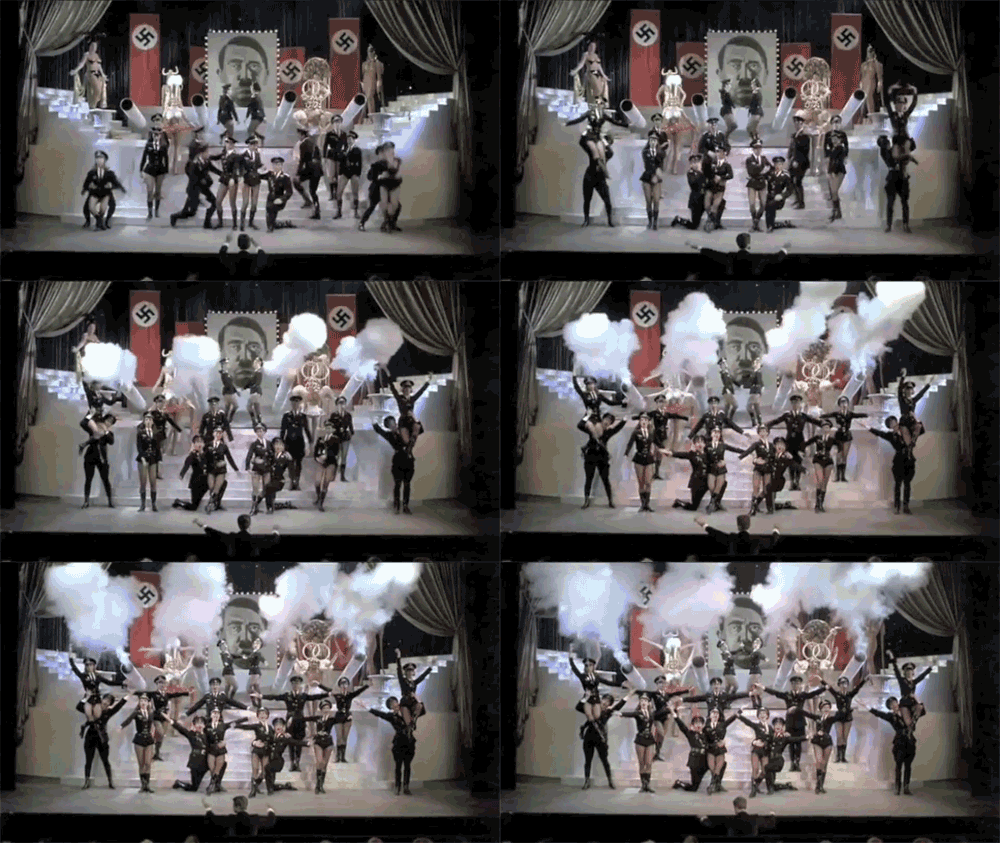
A week ago a white supremacist rally in Charlottesville protesting the taking down of Confederate Memorial statues turned fatally violent. Other protests were due to take place this weekend in multiple U.S. cities, including New York (now postponed). How should citizens and public authorities deal with this upsurge in violent neo-Nazi protest? I am with Tina Fey on this one: don’t show up, have some cake, and encourage the NYPD to prevent violence.

Some on the left have tried opportunistically and mistakenly to associate Virginian school public choice scholarship with the far-right. This is a sadly missed opportunity because James Buchanan’s theory of club goods helps explain how far-right street protests emerge and suggest how authorities might best subdue them. I draw on John Meadowcroft’s and Elizabeth Morrow’s analysis of the far-right English Defence League (EDL).

Continue reading

Public choice and market failure: Jeffrey Friedman on Nancy MacLean

Screen Shot 2017-08-09 at 23.25.50

Jeffrey Friedman has a well-argued piece on interpreting public choice in the wake of Nancy MacLean’s conspiratorial critique of one of its founding theorists, James Buchanan. While agreeing that MacLean is implausibly uncharitable in her interpretation of Buchanan, Friedman suggests that many of Buchanan’s defenders are themselves in an untenable position. This is because public choice allows theorists to make uncharitable assumptions about political actors that they have never met or observed. In this sense, MacLean is simply imputing her preferred own set of bad motives onto her political opponents. What is sauce for the goose is good for the gander.

I think Friedman’s arguments are a valid critique of the way that public choice is sometimes deployed in popular discourse. A lot of libertarian commentary assumes that those seeking political power are uniquely bad people, always having self-interest and self-aggrandisement as their true aim. Given that this anti-politics message is associated with getting worse political leaders who are becoming progressively less friendly to individual liberty, this approach to characterising politicians seems counterproductive. However, I don’t think Friedman’s position is such a good fit for Buchanan himself or most of those working in the scholarly public choice tradition.

Continue reading

From the Comments: Israel and Palestine

Irfan and Jacques are going the rounds on Israel and Palestine (Canaan?). The dialogue, so far, is excellent. Jacques started things off and Dr Khawaja responded with this fine piece of pop-ethnography:

I just spent three weeks in Jerusalem, about a hundred yards from the scene of the action Jacques describes in this post, and spent hours observing the events Jacques describes (and many he doesn’t describe) at first hand. I described this post on Facebook as “factually challenged,” and promised to set it straight. So here I am. (A different version of this comment included about a dozen links substantiating my claims, but the post didn’t go through that way, so I’ll send the links separately.)

I had originally wanted to divide my post into two sections, first laying lay out the number of sheer inaccuracies Jacques has crammed into this post, and then identifying what I would call handwaving claims–large claims made without substantiation, or misleading claims made without clarification. It turns out to be impossible to do this, because Jacques has managed to combine inaccuracy with handwaving in a way that makes it impossible to disentangle the two. In any case, my claim is that when we add the sheer inaccuracies to the handwaving in his post, a rational reader would conclude that the post tells us nothing of value about recent events in Jerusalem.

1. Jacques tells us that there were violent riots in Jerusalem. Correct. He doesn’t mention that despite the outbreaks of violence, the demonstrations were largely peaceful. Nor does he venture to tell us who started the violence, or under what circumstances. The word “riot” seems to imply a series of violent disturbances caused or initiated by rioters, but alas, one word can’t stand in for real-world observation of what actually happened. Nothing in Jacques’s account settles the crucial issue: who started the violence?

I have read almost all of the press coverage on recent events in Jerusalem, and saw the events themselves up close–at a few yards’ distance, for hours, in real time. I can’t easily summarize what I saw. There were at least four different demonstrations taking place simultaneously, within a few “blocks” of each other, and different things happened at different places at different times. On some occasions, I saw Israeli police officers either initiating or provoking violence. In other cases, Palestinians did so. There are also questions worth asking about what counts as an initiation of force under these circumstances. Typically, pointing a gun at someone without cause is regarded as a form of assault. But Israeli police officers and soldiers do this all the time. An Israeli border police officer played chicken with me with her M-16 for no reason other than her amusement. If I’d been armed and shot her, would my shooting have been an initiation or a retaliation? Nothing in Jacques’s account settles or even deals with this, but one can’t understand events in Jerusalem without settling issues like this.

Suffice it to say that the press coverage of relevant events, especially the American press coverage, was either non-existent or extremely defective. It is very easy to claim that what took place in Jerusalem consisted of riots if all you do is wait for violence to break out, film it, and then declare that “the event” you just covered was a “riot.” It doesn’t follow, and isn’t true, that that’s what really happened. And I can assert, categorically, that it wasn’t. In short, there is a lot more to the story than “riots.” For a starters, there were all those events that took place when no one was rioting.

(I’ve discussed some of the micro-level issues involved here on Facebook, some on public and some on private settings.)

2. Jacques tells us that “all of Jerusalem” is under Israeli control. He doesn’t mention that “Jerusalem” is a moving and expanding target that lacks an eastern boundary, as does the “Israeli control” he mentions. He also neglects to mention that the phrase “under Israeli control” is an equivocal claim: Shuafat refugee camp is technically within the jurisdiction of Jerusalem, but it is run by the UNRWA; it is not de facto governed by the Jerusalem Municipality or by Israel. Something similar is true of the “Haram Sharif” complex that is the subject of Jacques’ post: it is technically within the boundaries of the Jerusalem municipality, but (as Jacques himself admits) it is managed or administered by the waqf under the auspices of the Jordanian government. Oddly, having told us that “all of Jerusalem” is under Israeli control, and then noting himself that Haram Sharif (in Jerusalem) is administered by Jordan, Jacques fails to draw the obvious inference: sovereignty over Jerusalem is contested, not settled. Israel claims sovereignty over “it,” as do the Palestinians, but claiming sovereignty and having sovereignty are two different things. (Many people have asserted sovereignty over Texas, but it doesn’t follow that their say-so resolves the issue.) I put the word “it” in scare quotes because in calling “it” the “Temple Mount,” Jacques manages to confuse a further set of issues that I’ll discuss below (in [4]).

3. Jacques: “In addition, most Palestinians from the adjacent West Bank are allowed to visit on a controlled basis, for religious purposes only.”

Two problems here. First, does Jacques mean to say that most Palestinians are in fact allowed into Jerusalem? This would imply that 51% or more of West Bank Palestinians are permitted into Jerusalem. I’d like to see a source for that claim. There are roughly 2.5 million Palestinians in the West Bank. Jacques’s “most Palestinians” claim implies that something like 1.25 million West Bank Palestinians have entry permits for Jerusalem, which strikes me as implausible in the extreme. It’s unclear how many permits are in fact given, but the usual figure is in the thousands. Not a representative sample, but: I know a few dozen Palestinian West Bankers; only one of them has an entry permit for Jerusalem. The rest are consigned to remain indefinitely in the West Bank.

In any case, permits are not given “for religious purposes only.” Permits are given for entry into Jerusalem/Israel, full stop. They’re checked at checkpoints into Jerusalem, but not thereafter, and what is checked is simply whether you have a permit or not, and whether you’re carrying contraband or not (unless a given soldier decides to initiate his own “investigation,” which sometimes happens). Once past the checkpoint, there is no mechanism in place to determine whether someone entering Jerusalem is doing so to pray at Al Aqsa or to score chicks on the beaches of Jaffa (or both). Further, permits are given for a variety of reasons, including medical care, family unification, and work. But they are given far more stingily than Jacques’s description would imply.

I raise both points (one favorable to the Palestinians, the other to the Israelis) to raise questions about the sources of Jacques’ information on the subject. His description of facts on the ground is unrecognizable to anyone who’s actually had to deal with those facts, as I have.

4. Jacques: “At the center of the preoccupations of the three monotheistic religions is a place called the Temple Mount.”

This paragraph of Jacques’ repeats the conventional wisdom on the subject, at least in the United States. Unfortunately, the conventional wisdom reflects total ignorance of even basic facts of geography, which is hard to convey to those who haven’t been to the place in question.

Let’s start from scratch. The contested location is a big rectangle located in the Old City of Jerusalem. The western end of the rectangle contains what Jews call the Western Wall and its plaza. The eastern part of the rectangle contains a large complex housing the Dome of the Rock, Al Aqsa mosque, a few auxiliary religious facilities, and a large plaza connecting them. Parts of the rectangle are declared off-limits to civilians by the Israeli authorities.

Jews refer to the *whole* rectangle, including the Muslim shrines, as the “Temple Mount” and claim it (all of it) for their own. Particularly hard core Zionists want to expropriate the Muslims altogether, claim the whole site for their own, destroy the Muslim shrines on it, build a temple on their ruins, and exclude Muslims from entering. Such people have grown increasingly powerful over the years.

Muslims refer to the *eastern part* of the rectangle as “Haram Sharif,” or the Noble Sanctuary, and claim it, in its entirety, for Islam. Hard core Muslims want to exclude Jews from this area altogether.

It is worth noting, however, that not even hard core fundamentalist Muslims wish to expropriate Jews of the Western Wall, much less build a mosque there, despite the fact that the Western Wall Plaza was built on the ruins of the so-called Mughrabi neighborhood–an Arab neighborhood expropriated and destroyed after Israel’s conquest of East Jerusalem in 1967.

It is also worth noting that though Israel divides the Old City into quarters, including the Jewish and Muslim Quarters, it permits Jewish settlement of the Muslim Quarter, but not the reverse. The “Jewish Quarter” is conveniently defined to include the Western Wall–though its plaza was built on a Muslim neighborhood, and you have to pass through Muslim neighborhoods to reach it–but no mosque within the Jewish Quarter is permitted to operate at all. Nor has “the Muslim Quarter” been re-defined to include the mosques that happen to lie in the “Jewish Quarter.”Indeed, a passerby would have no idea that these mosques are in fact mosques at all: they’re shut down and deliberately being left to fall into decay. The same is true of mosques in Jerusalem but in neighborhoods where Muslim entry would be deemed undesirable, e.g., the mosque of Mary in Ein Kerem.

Finally, Jacques’s claim that Jews are forbidden to enter Haram Sharif, whether on rabbinical or secular grounds, is laughably preposterous: they do it all the time, and are encouraged to. Indeed, the Israeli settler group Ateret Cohanim advertises tours that it conducts into Haram Sharif.

Of all of the claims Jacques makes in this post, this last one suggests (with all due respect) that he has no idea what he’s talking about. The whole controversy over the “Temple Mount” arises precisely because Jews ARE allowed into the mosque complex (and take advantage of that right), and Muslims suspect their intentions in doing so. Contrary to what one reads in the American press, these suspicions have a credible basis. Muslims suspect Jewish intentions in Jerusalem because of the example of Jewish settlement activity in Hebron, where apparently innocuous Jewish entry into a religious shrine led, gradually, to the wholesale expropriation and depopulation of the Palestinian neighborhoods of the Old City. Today, Hebron is (for Palestinians) partly an open-air prison and partly a ghost town. The case of Hebron H2 zone has been amply documented. Jacques follows American convention in ignoring this documentation, and proceeding to talk about Jerusalem as though the two things had nothing to do with each other. Jacques also wonders out loud why Muslims would take issue with what he regards as ordinary security measures.

Even setting aside what “ordinary security measures” have done in Hebron (or Nablus, Qalqilya, Tulkarem, Silwan, or Issawiya), he assumes that the measures would be deployed in good faith. No one who has actually dealt with Israeli police officers or soldiers would believe this. It may not occur to Jacques, but occurs to them, that security measures can be abused so as to treat the people covered by them as playthings. Jacques’s post shows literally zero awareness of a fact known to just about anyone who has dealt with Israeli security: most border police officers and soldiers are bored, immature, and heavily armed but lightly supervised children between the ages of 18-28 who will do just about anything to relieve their boredom–up to and including murder, battery, and torture. The Israelis may talk up a propaganda storm about their security needs, but once one sees what these “needs” look like on the ground, one’s sympathy for them begins to evaporate.

Further, Muslims and Jews do not “pray within a stone’s throw of each other,” whether literally or metaphorically. Though adjacent to the mosque complex, the Western Wall is separated from it by huge stone walls. Entry into the Western Wall plaza is entirely separate from entry into the mosque complex. Informally (the place is heavily policed, and the police often make their own rules), Arabs are discouraged from entering the plaza, and seldom do. Muslims and Jews only come into contact when Jews enter the mosque area, or when Jews walk (or march) through Muslim neighborhoods en route to the Kotel. I have never seen or even heard of a case in which Muslims entered the Western Wall plaza en masse in the way that Jews enter Haram Sharif. Indeed, doing so would be almost physically impossible. (Put it this way: Muslims would have to be very, very determined to do it.)

Contrary to Jacques’s assertion, Christians do visit both the Western Wall Plaza and the mosques. That they visit the Western Wall should be obvious. If you want a pleasant confirmation of Christians visiting the mosques, I’d suggest searching “Visit Al Aqsa Mosque with Me!” on You Tube. You’ll be taken on a delightful tour of the area with a perky Christian Palestinian woman named Maha who can also teach you how to make hummus or say “Merry Christmas” in Arabic. (Her Old City tour also goes to the Western Wall.)

I wonder whether Jacques has gotten his information from the Wikipedia entry on “Temple Mount Entry Restrictions.” Much of what he says dutifully parrots what is said there. That was a mistake, to put it mildly. Wikipedia is often useful, but not here.

5. Jacques mentions the shooting of July 14, and then mentions Israel’s security measures, wondering why they should be thought so controversial. I have a challenge for him. The shooting of July 14 took place outside of the Temple Mount/Al Aqsa complex, not within it. The attackers came from a neighborhood of Um al Fahm, a city about an hour or so to the north of Jerusalem. As should be self-evident, in order to bring weapons near the Temple Mount complex (which is in the Old City), these attackers had to bring those weapons into the Old City itself. The Old City is a walled structure that can only be entered by a series of gates (seven of them). The gates are easily identifiable, easily guarded, and it’s easily possible to put metal detectors in front of each of them.

If security were the paramount consideration Jacques takes it to be, why didn’t the Israeli authorities install the metal detectors at each of the gates of the Old City? Doing so would have prevented the July 14 attack, and would prevent any similar attack. But installing them in front of Al Aqsa would not have prevented the attackers from bringing weapons into the Old City and shooting someone outside of Al Aqsa, correct? Which is exactly what they did. Why then install security measures in front of Al Aqsa rather than at the entrance to the Old City itself? A common sense question for a person who claims to possess it.

6. While I’m posing questions about “common sense” security measures, here is another. After the July 14 shooting, and in advance of any rioting, the Israeli authorities shut down whole neighborhoods of East Jerusalem–something they do as a matter of course in Jerusalemite neighborhoods like Issawiya, and as a matter of course in the West Bank. I got to see these closures in a tediously microscopic way, and could probably write a couple of thousand words on them alone. But just to make things clear: large swatches of Jerusalem as well as the West Bank are under a semi-permanent state of lockdown, a lockdown imposed by the Israelis on its Palestinian population.

Now, remarkable as this information may be, shootings take place in the United States just as they do in Israel. Indeed, on average, a shooting takes place just about every other day in my county, often just a mile or two from where I live. Yet, no one regards it as legitimate to close down whole neighborhoods over any given shooting, or to institute curfews over them–and to do so simply on the basis of the ethnicity of the presumed shooter. To put the matter as simply as I can: a black person may well shoot and kill someone in a nearby neighborhood in north Jersey, but that doesn’t imply that every black neighborhood in the vicinity of the shooting will be locked down and put under curfew as a result. But that is what routinely happens in Arab Jerusalem, and what Jacques appears to be defending as a matter of “common sense.”

Is it, really? If so, why not try it right here in the States? If we did, would it be any surprise that the people locked down might eventually fight back? Would they be wrong to? The undiscussed issue here is what the police can permissibly do, on ethnic grounds, in the name of collective punishment of what it regards as an unruly population. Suffice it to say that it’s not obvious that collective punishment is a legitimate mode of law enforcement.

Jacques refers to Israel as a “garrison state,” treating its Jewish population as the besieged. The claim is utterly preposterous. Israeli Jews not only aren’t besieged in Israel, but generally don’t feel besieged. Spend some time in the streets of Haifa, Tel Aviv, or Jerusalem and ask yourself whether the people around you are operating with a siege mentality. What Jacques seems not to have grasped is that it is not Israeli Jews who are garrisoned by Israel, but its Palestinian Arab population.

A “garrison” is a body of troops stationed to defend a piece of territory. Typically, a garrison defends an “inside” against outsiders. But in this case, the garrison consists of Israeli troops treating insiders as though they were outsiders–and then complaining about the result. Well, that’s the price of creating a sectarian state in a place where a significant part of the population doesn’t belong to your sect. The more I visit Israel, the more I see of Israel; the more I see of it, the less sympathy I have for Israelis and their supporters. And, I might add, the less patience I have for Americans who defend Israel from afar without knowing what things look like on the ground.

And:

the views he expresses on Jerusalem are well within the boundaries of conventional, mainstream American opinion, which is why I took the time to respond to them. Most American defenders of Israel believe most of the things Jacques asserts, and many would go much farther than he has. American discourse on Israel is just wildly skewed, and French as he may be, Jacques’ views are just an instance of that all-American phenomenon.

More here, including links.

In general I am inclined to side, if I must, with Irfan’s argument, but Jacques, as usual, presents a case, in the threads, that can not so easily be dismissed or debunked:

The fact that, in this case, two Palestinians (with Israeli citizenship) tried to assassinate members of Israeli forces counts for nothing, explains nothing [in Irfan’s argument]. Palestinians live under military occupation, have for the longest time. I am sure it’s really unpleasant. It should stop. Stopping it, of course, requires negotiations between rational, motivated people.

Here’s a bunch of stuff at NOL on rationality (or rather, irrationality). And here is Barry’s long, somewhat famous, essay on Israel, Palestine, and rational debate.

AI: Bootleggers and Baptists Edition

“Elon Musk Is Wrong about Artificial Intelligence and the Precautionary Principle” – Reason.com via @nuzzel

(disclaimer: I haven’t dug any deeper than reading the above linked article.)

Apparently Elon Musk is afraid of the potential downsides of artificial intelligence enough to declare it “a rare case where we should be proactive in regulation instead of reactive. By the time we are reactive in AI regulation, it is too late.”

Like literally everything else, AI does have downsides. And, like anything that touches so many areas of our lives, those downsides could be significant (even catastrophic). But the most likely outcome of regulating AI is that people already investing in that space (i.e. Elon Musk) would set the rules of competition in the biggest markets. (A more insidious possible outcome is that those who would use AI for bad would be left alone.) To me this looks like a classic Bootleggers and Baptists story.

Trump Jr.

Last school year I had to deal with a pair of students (Tweedledee and Tweedledum) I caught cheating on a takehome final. When confronted with the evidence, each insisted that it was the other’s fault, and that only that other student should face any consequences.

Bear in mind that if they complete their degrees, they would be in the top 30% of the population in terms of educational attainment. In today’s world, that basically means they’re among the best and brightest, they’re high status, and they’re “the future”. If we could meaure status on a linear scale, getting a college degree still pushes you high up on that scale. 

At the time I figured that they were at least towards the bottom of that top 30%. Certainly, I still hope they’ll grow out of it. Unfortunately, Draco Malfoy’s Junior’s latest scandal shows that being bad at cheating isn’t the social hinderance we might have hoped for.

Related link: http://reason.com/blog/2017/07/13/how-trump-apologists-will-defend-the-ind

Algeria: a sparse memory

In 1962, France and the Algerian nationalists came to an agreement about Algerian independence. That was after 130 years of French colonization and eight years of brutal war including war against civilians. I participated in the evacuation of large number of French civilians from the country as a little sailor. The number who wanted to leave was much greater than anyone expected. It was too bad that they left in such large numbers. It was a pity for all concerned. The events were a double tragedy or a tragedy leading to a tragedy. The Algerian independence fighters who had prevailed by shedding quantities of their blood were not (not) Islamists. In most respects, intellectually and otherwise, they were a lot like me.

The true revolutionaries were soon replaced however by professional soldiers that I think of as classical but fairly moderate fascists. I went back to Algeria six years after independence. I was warmly received and I liked the people there. People invited me to lunch; I shared with them the fish I caught and a baby camel tried to browse my hair in a cafe.

I still think the nationalists were on the right side of the argument but I miss Algeria nevertheless. It’s like a divorce that should not have happened. And I am very sorry about where French incompetence and rigidity led everyone, especially the Algerians who keep migrating to France in huge numbers because they can’t find what they need at home.

The Deleted Clause of the Declaration of Independence

As a tribute to the great events that occurred 241 years ago, I wanted to recognize the importance of the unity of purpose behind supporting liberty in all of its forms. While an unequivocal statement of natural rights and the virtues of liberty, the Declaration of Independence also came close to bringing another vital aspect of liberty to the forefront of public attention. As has been addressed in multiple fascinating podcasts (Joe Janes, Robert Olwell), a censure of slavery and George III’s connection to the slave trade was in the first draft of the Declaration.

Thomas Jefferson, a man who has been criticized as a man of inherent contradiction between his high morals and his active participation in slavery, was a major contributor to the popularizing of classical liberal principles. Many have pointed to his hypocrisy in that he owned over 180 slaves, fathered children on them, and did not free them in his will (because of his debts). Even given his personal slaves, Jefferson made his moral stance on slavery quite clear through his famous efforts toward ending the transatlantic slave trade, which exemplify early steps in securing the abolition of the repugnant act of chattel slavery in America and applying classically liberal principles toward all humans. However, this very practice may have been enacted far sooner, avoiding decades of appalling misery and its long-reaching effects, if his (hypocritical but principled) position had been adopted from the day of the USA’s first taste of political freedom.

This is the text of the deleted Declaration of Independence clause:

“He has waged cruel war against human nature itself, violating its most sacred rights of life and liberty in the persons of a distant people who never offended him, captivating and carrying them into slavery in another hemisphere or to incur miserable death in their transportation thither.  This piratical warfare, the opprobrium of infidel powers, is the warfare of the Christian King of Great Britain.  Determined to keep open a market where Men should be bought and sold, he has prostituted his negative for suppressing every legislative attempt to prohibit or restrain this execrable commerce.  And that this assemblage of horrors might want no fact of distinguished die, he is now exciting those very people to rise in arms among us, and to purchase that liberty of which he has deprived them, by murdering the people on whom he has obtruded them: thus paying off former crimes committed against the Liberties of one people, with crimes which he urges them to commit against the lives of another..”

The second Continental Congress, based on hardline votes of South Carolina and the desire to avoid alienating potential sympathizers in England, slaveholding patriots, and the harbor cities of the North that were complicit in the slave trade, dropped this vital statement of principle

The removal of the anti-slavery clause of the declaration was not the only time Jefferson’s efforts might have led to the premature end of the “peculiar institution.” Economist and cultural historian Thomas Sowell notes that Jefferson’s 1784 anti-slavery bill, which had the votes to pass but did not because of a single ill legislator’s absence from the floor, would have ended the expansion of slavery to any newly admitted states to the Union years before the Constitution’s infamous three-fifths compromise. One wonders if America would have seen a secessionist movement or Civil War, and how the economies of states from Alabama and Florida to Texas would have developed without slave labor, which in some states and counties constituted the majority.

These ideas form a core moral principle for most Americans today, but they are not hypothetical or irrelevant to modern debates about liberty. Though America and the broader Western World have brought the slavery debate to an end, the larger world has not; though countries have officially made enslavement a crime (true only since 2007), many within the highest levels of government aid and abet the practice. 30 million individuals around the world suffer under the same types of chattel slavery seen millennia ago, including in nominal US allies in the Middle East. The debates between the pursuit of non-intervention as a form of freedom and the defense of the liberty of others as a form of freedom have been consistently important since the 1800’s (or arguably earlier), and I think it is vital that these discussions continue in the public forum. I hope that this 4th of July reminds us that liberty is not just a distant concept, but a set of values that requires constant support, intellectual nurturing, and pursuit.

For more underrecognized history surrounding the founding of America, see my Before the Fourth series!

“Fuck Your Vote!”

That’s what I have been hearing ever since the morning after the presidential election. That what I keep hearing on most cable television and on National Public Radio. That’s what I see in most of what I read, and that’s what I am told is being published in the liberal print media I stopped reading long ago. That’s also what I find when I go slumming in left-wing sectors of Facebook.

No one has actually told me directly, in those exact words, “Fuck your vote,” not yet, but that’s what the ceaseless hounding of Pres. Trump means: My vote for him ought to be ignored; it can’t possibly count. If you had not had any news for six months, you would think that there had been a coup in the United States; that a horrid, caricature capitalist had taken over the country by stealth and by force, both. You would guess that the intellectually and morally live segments of American society were resisting a brutal takeover as best as they could. You would not guess there had been a hotly disputed election, fielding 16 viable candidates on one side.

A grass-root movement with a strategy

The verbal lynching to which Pres. Trump is subjected on a 24-hr cycle is not a conspiracy. There is no secrecy to it. It’s all overboard. It’s a regrouping of the political establishment, of the 90% leftist media, of the 90% leftist academia, of the vast tribe of government bureaucrats, of the many others who live off tax revenue, of the labor unions leaders, of the teachers’ unions, especially. So, after a fashion, it’s a genuine grass root movement. It’s a grass root movement of the well-bred and of the semi-educated who spend all their time – always did – feeling “appalled.”

It’s not a conspiracy but it’s a deliberate plot. It has a strategy: Hound him until he loses his cool completely. Harass him to the point where he cannot govern at all. At worst, we can keep him so busy his intended policies kind of vanish. The Santa Cruz AM station where I had a political show for three years has its own well-known, semi-official leftist caller, “Billy.” Billy thinks he is well informed and a genuine, deep-thinking intellectual because he is leisurely. In fact, he does not work for a living; he lives off his rich wife instead. (I would not make this up.) He called the station about two weeks before this writing to sound off on one thing or another that the president had done or said. Then, he declared straightforwardly, “We are hounding him out of office,” and also, with commendable clarity, “It’s a slow coup.” I would not have dared used these words in my conservative (“libéral” en Français) polemical writing, too provocative, possibly exaggerated.

Or take this short, childishly coded message I picked out from from an ordinary left-liberal’s Facebook page:

“47 could end up being Pelosi if we drag it out til 18.”

Translation: the current minority leader in the House could become the next president (the 47th). If we drag what out? For overseas readers and for American readers who went to the beach when the US Constitution was taught in high school: What has to happen before the minority leader of the House of Representatives becomes president outside of a presidential election? The constitutional order of succession if the president dies, in any way of manner, or becomes incapacitated, or is remove from office for any reason is this: Vice-President, Speaker of the House. In the partial elections of 2018, Nancy Pelosi may become Speaker of the House again. She would automatically become president if and only if both President Trump and Vice-President Pence were eliminated. Hence the FB message: Keep up the harassment. Note: Some readers might think I am making this up. I will give the name and FB address of the person from whom this is taken to anyone asking me privately.

What does not revolt me: Donald Trump is a bad person

What is it that makes me angry? Let me begin by telling you what does not make me deeply angry.

First, everyone here and abroad has every right to dislike Mr Trump personally, Trump the man. There is a lot I don’t like about the man myself. He talks too much; he is ignorant of many things; his ignorance does not stand in the way of his having strong opinions about the very same things; he often talks before he thinks; he brags too much; he is too frequently crude. (Actually, I am of two minds about the latter. Official crudeness may be the form that starting to roll back political correctness must take.)

I did not vote for Donald Trump because I loved him but mostly because of the character of the only, single alternative to him at the time of the presidential election. (Keep in mind that Sen. Sanders was not on the ballot. Remember what happened to him?) I had no illusions from day one. I knew that Mr Trump is not at all like suave President Obama, for example, who was awarded a Nobel Peace Prize within barely ten months of taking office.* I voted for Trump also for policy reasons. I thought there was a good chance he would appoint a conservative Supreme Court Justice, as promised. He did, within days. I thought he would deregulate to some extent. He is doing just that. I thought we stood a better chance of having serious tax cuts with him than with the Democratic candidate. I still think so. Tax cuts are the most direct path to vigorous economic growth, I believe. (Shoot me!)

A short digression: As I was writing this cri du coeur, the liberal media were exulting about President Trump’s loss of a few points of general approval. (Actually, it’s about the same as Bill Clinton’s at the same period in their presidencies.) They don’t mention that there is zero evidence that he has lost any ground among those who voted for him, that they feel any voter remorse. Myself, I like him better than I did when I voted for him. He has begun to make America stand up again. He has been a bulwark against several forms of hysteria – including Endofworldism – to a greater extent than I counted on.

What does not revolt me: Opponents trying to stop and sink his program

The second thing to which I do not object in the treatment of President Trump is legislative maneuvering. Democrats and dissident Republicans have every right to block and undermine Mr Trump’s legislative programs, be they tax cuts or “the wall.” (Personally, I want the first ones and think of the second as a silly idea.) The media have every right and sometimes an obligation to support this exercise in checks and balances between executive and legislative that is at the heart of the US constitution. No problem there either. I understand that when you win the presidency, in the American system, that’s all you have got, the presidency. After that, you have to convince Congress to pay for what you want, for what you (conditionally) promised.

What annoys me without revolting me: the courts’ usurpation

The Founding Fathers decided that courts had to be able to curtail or block just about any executive or legislative action. This, to make extra sure that neither branch of government could ever create unconstitutional law. This, to avoid the tyranny of the majority. It often rankles but that’s how our constitutional democracy works. Accordingly, the third going on that annoys me but that I accept is the several courts’ endeavors to stop the president from taking the measures he thinks necessary to keep the country safe. (I try to distinguish between dislike and a negative judgment of illegitimacy. This distinction is a the heart of the problem about which I am writing.) I accept, for example the decisions of the two or three courts who stopped the presidential executive order banning the admission of peoples from a handful of countries. I accept them, although:

Public opinion and – I think – one court, call it a ban “on Muslims,” even if only 9% of all Muslims worldwide would be affected; although half of those are citizens of a country – Iran – that is the declared enemy of the US and officially a sponsor of terrorism as far as we (Americans) are concerned.** and ***.

I accept it although there is nothing in the Constitution that prevents the executive branch from stopping people entering the US based on their religion.

I accept it although there is no part of the US Constitution that recognizes any rights to foreigners who are neither under American jurisdiction nor at war with the US.

I accept it although there is a statute, a law, that explicitly gives the president the right to ban the entry of anyone for any reason.

I accept these court orders but my acceptance is a testimony to my strong commitment to constitutional democracy.

Now, on to what I object to deeply and irreversibly in the attacks on the president.

Extirpating electoral legitimacy

What really, really disturbs me are the nearly daily attempts at removing, at extirpating the legitimacy of the 2016 presidential election results, the desperate and brutal, unscrupulous attempts to make people believe that Mr Trump is not really president. They make me livid because they are not attacks on Mr Trump but rather, they are attacks on me. They are assaults on my right to exercise my constitutional right to cast my vote and to have it counted. And also the rights of sixty-three million Americans**** who voted as I did. The slow coup against Mr Trump defies reason and it resembles nothing I have seen in fifty years in this country. It does remind me of several historical precedents though. (Look up “March on Rome,” you will be amazed.)

More than the mechanics of democracy is at stake. The principle of government by the consent of the governed itself is under assault, the attack is systematic and unrelenting. When I cast one of approximately sixty-three million votes for Donald Trump, I thought I was choosing the lesser of two evils. That’s nothing new; I don’t remember ever voting in a national election for someone who inspired enthusiasm in me. And perhaps, that’s the way it should be. Enthusiasm about a person may not be even compatible with democracy. Free men and women don’t need saviors and they are leery of leaders, even of leadership itself. Be it as it may, I cast my vote as I did and no one (that’s “no”) has the right to try and nullify it, to cancel it. As I write this self-evident truth, I fear that many of the people still having hysteria about the 2016 Democrats’ failure are not sophisticated enough to understand the difference between opposing the consequences of my vote through accepted, traditional parliamentary and judicial maneuvers on the one hand, and nullifying my vote, on the other hand.

Fascism is neither of the left or of the right. It thrives on moral confusion and on bad logic. Hysteria is its main sustenance.

“The Russians” made them lose everything

The daily assault on the Trump legitimacy changes form almost every day. Right now, it has been focusing for several weeks on alleged Russian intervention in the presidential election.

It matters not to the Trump haters that in 2016 Democrats lost everything they could lose besides the presidential election: governor races, state legislatures, Congress. This swath of defeats seems to me to indicate that the Democratic Party in general was not popular, forget Trump. If “the Russians” had actually handed out the presidency to Mr Trump, there would still be a need to explain the Democrat routs at all other levels. Did “the Russians” also organize the rout, including of county boards of supervisors, and at all other minute local levels?

It does not matter that Mrs Clinton was never made to explain how and why she caused to erase or ditch 30,000 emails belonging to the government, a cynical suppression of evidence if there was ever one.

A considerable work of imagination

Thus far, the mud has been thrown at Mr Trump and at his whole team, at any one who has ever met him perhaps in connection with “Russian” interference in the presidential election. Mud has no shape; it’s amorphous. I don’t know about him but when I suspect someone of something, the something has a shape, at least a rough description. You never say, “I suspect you,” but, “I suspect you of X or of Y.” The Trump accusers have never been able to reach even that primitive level of concreteness. None of them has (yet) been stupid enough to suggest that the Russian secret services hacked or tricked up the voting machines in the hundreds of jurisdictions that would be needed to make a difference. So, what have “the Russians” done, really?

The most tangible thing they have against the Trump campaign to-date is a supposition, a product of the collective imagination, and it need not even involve Trump or his agents at all. What we know is that someone hacked the Democratic National Committee emails. Some contents were leaked by Wikileaks which did not say where it got it from. Wikileaks has friendly links with Russia. It’s possible Russians hackers gave it the info. If this is what happened, here is what we still don’t know:

We don’t know that those imagined Russian hackers worked for Pres. Putin. Entrepreneurial Russian hackers have been dazzling us for twenty years. The DNC email seems to have been poorly protected, anyway. A Putin intervention is superfluous in this story.

Furthermore: Do you remember what Wikileaks disclosed (thanks to “the Russians.”)? It showed that the Democratic establishment engineered, by cheating, the defeat of candidate Sanders in the Democratic primary elections. In my book, the anonymous, perhaps Russian, hackers deserve a medal, an American medal for casting light on dysfunction and plain dishonesty within an American political party. The Congressional Medal of Honor is not out of the question, in my book.

Moreover: The leftist media keep referring to “collusion” between members of the Trump campaign and some unnamed Russians. Sounds sinister, alright. But as the Harvard Law Professor Alan Dershowitz, – a Democrat – pointed out recently, “collusion” is not illegal. It’s what you collude to do (rob a bank) that makes it criminal. Colluding to eat a pizza is not criminal. Mr Trump and his entourage are daily accused -without proof – of having committed acts that are not illegal.

The first Comey testimony

The 06/08/17 open, public Senate Judiciary hearing of dismissed FBI Director Comey was awaited by the left and media, and also by some genteel Republicans, like the Roman plebe awaited the lions’ feasting on the Christians. That hearing was a disappointment too. I am writing here as if I thought every word uttered by Mr Comey were exactly true (100% true) although there is no reason to do so. The hearing showed ex-FBI Director to be a leaky wimp, of shaky integrity caught in corrupt and difficult circumstances, first under Obama with the Clinton Follies, then with the unpredictable Trump presidency. It did showcase a great deal of inappropriate behavior by President Trump. But the hearing did not even begin to point to any illegal behavior on the part of the president, not to a single whiff of illegality. If you don’t trust my legal judgment (although I watch many crime shows on TV), refer again to Democrat and Harvard Law School professor Dershowitz who thinks as I do on this issue. The fact is that hardly anyone, possibly no one, voted for Mr Trump because of the appropriateness of his behavior or of his statements. If anyone was about to do so during the election, the airing by the Clinton campaign of a tape describing Mr Trump’s manual approach to seduction would have cured that illusion.

Next?

Personally, I think there is nothing to investigate. Nevertheless, I hope the Special Counsel (a friend of Comey’s, it turns out) will do his job of investigating the possibility that President Trump did whatever he is supposed to have done with I know not what Russians. There is a chance that merely having a single person in charge – what the left demanded – will reduce the daily din of anti-Trump insults. There is even a possibility that it will allow Pres. Trump to get to work on some more of the projects***** for which I gave him my vote. If the investigation reveals real illegal behavior by Mr Trump, felony-level crimes, I think he should be peaceably removed from office, with Vice-President Pence taking over as required by the US Constitution. Anything else, any other succession would be a form of fascism. Any other scenario of Trump removal turns my attention to the Second Amendment (me and hundreds of thousands of gun-crazy, church going “deplorables.”)

How it will end

I don’t see a reasonable finish to all this unless the president is found guilty of something. When the smoke finally clears, when the investigation of President Trump’s collusion to do whatever with whatever Russians ends, I think there is no chance that the matter will be finally put to rest. If the Special Counsel that liberals clamored for concludes that Mr Trump and his whole entourage never committed any illegal act in connection with the 2016 election, there will still be voices pointing out that an intern on Trump’s campaign once ate Russian caviar on a date, which raises serious questions! Or something.

The undisputed fact, that Mr Trump’s improprieties revolt many who voted for the only real alternative, is not an argument for overthrowing an elected government. They are the same people who tried to elect – directly or indirectly – an old woman apparently in failing health, a lackluster former Secretary of State, at best, a person who campaigned incompetently, a candidate for the highest office who never managed to articulate her vision of government, a person who cheated during the primary election, one who ended up losing against a rank political amateur who spent less than half the money she spent on campaigning. With a large majority of voters guilty of such a poor choice, this country has bigger fish to fry, I would think, than presidential rudeness and/or insensitivity.

Conclusion

Dear Trump–hating fellow citizens: One thing that did not cross my mind when I voted was that should my candidate win – a long shot at the time – there would be a massive, multi-pronged endeavor to make believe that I had not voted, or that I had voted other than the way I voted, or that my vote somehow did not count. I thought I was living in a democracy. I assumed the democracy was lodged not only in the rules we follow to form governments but in the hearts of my fellow-citizens. I assumed that the rules were internalized, that they were part of the moral baggage of everyone including those whose vote countered mine.

If you will not accede to the modest wish that my vote should be honored, why bother with elections at all? They are costly and disruptive, they often disappoint, sometimes more than half of the population, and they provide many opportunities for the expression of deplorable taste. Why not, for example, convene a governing directory selected by an assembly of university professors, of well-bred employees’ union leaders, of Democratic politicians, and of media personalities (excluding Fox, and also Rush Limbaugh, of course), all chaired by the Editor-in-Chief of the New York Times?


* Just because you ask, I will tell you that I am guessing that the silly old men of the Norwegian Nobel Committee actually thought they were giving the Prize to the American left electorate for electing a Negro (“neger,” in Norwegian). It’s also a fact that Mr Obama always looks good in a suit.

** To my overseas readers: It was not Pres. Trump who designated officially Iran as a sponsor of terrorism. It happened several presidential administrations back, many years ago.

*** I wonder if the said executive order would have been acceptable to the courts if President Trump had thrown in say, a Buddhist country or two, and a pair of Catholic countries from South America, for example, like this: ban on admission to the US for citizens of Somalia, Yemen, Laos, Syria, Paraguay, Iran, etc.

**** Note to my overseas readers: That’s 2.8 million fewer than won by candidate Clinton. In the US system the candidate who obtains the largest number of votes cast by citizens (the “popular vote”) does not necessarily win the presidency. We have indirect elections instead. This may seem strange but the fact is that neither big party has ever really tried to change the constitution in this respect. So, after the two Obama victories, no one in the Democratic party said, “We have to change this system to make sure the popular vote prevails.” And if we had a popular vote system, all candidates would have campaigned differently. Mr Trump might have won the popular vote handily, or Mrs Clinton may have won with a margin of ten million votes or more; or the Libertarian Party may have received enough votes to deny either candidate a majority. There are many other possibilities in the world of “what if….”

***** Some of his campaign promises are being fulfilled at a fast clip in spite of the ceaseless persecution to which the president is subjected. The loosening of the regulatory hands of the Federal Government on the economy’s neck, for example, is going well.