Not much to say about this one. Helps me to take the edge off stressful times.
Culture
Watson my mind … while I walk the streets of Moscow

Nomic-nomics?
Perhaps the coolest thing I’ve found on the Small Internet so far is the game Nomic. From where I found it:
Nomic was invented in 1982 by philosopher Peter Suber. It’s a game that starts with a given set of rules, but the players can change the rules over the course of the game, usually using some form of democratic voting. Some online variants exist, like Agora, which has been running since 1993.
It’s a game that’s about changing the game. Besides offering a tempting recreational opportunity, I think this could be formalized in such a way to make it rival the Prisoners’ Dilemma (PD) in shedding light on the big social scientific questions.
The PD is a simple game with simple assumptions and a variable-sum outcome that lets it work for understanding coordination, competition, and cooperation. One of my favorite bits of social science is Axelrod’s Evolution of Cooperation project. It’s basically a contest between different strategies to an iterated PD (you can play a variation of it here). That the “tit for tat” strategy is so successful sheds a lot of light on what makes civilization possible–initial friendliness, willingness to punish transgressions, and willingness to return to friendliness after punishing these transgressions.
A fantastic extension is to create a co-evolutionary simulation of a repeated PD game. Rather than building strategies and pitting them against each other, we can be totally agnostic about strategies (i.e. how people behave) and simply see what strategies can survive each others’ presence.
The evolutionary iterated PD is about as parsimonious a model of conflict/cooperation as we could make. But there is still a lot of structure baked in; what few assumptions remain do a lot of heavy lifting.
But if the structure of the game is up for grabs, then maybe we’ve found a way to generalize the prisoners’ dilemma without assuming on extra layers of complexity.
Of course, the parsimony of the model adds complexity to the implementation. Formalizing Nomic presents a formidable challenge, and getting it to work would surely create a new
But even if it doesn’t lend itself to simulation, it strikes me as the sort of exercise that ought to be happening in classrooms–at least in places where people care about building capacity for self governance (I’ve heard such places exist!).
Let’s play!
A bit of stage setting, then let’s start a game in the comments section. I get the impression that this game is nerdier than Risk, so you’ve been warned (or tempted, as the case may be).
The basic premise is that are mutable rules and immutable rules (like Buchanan’s view of constitutions). Players take turns to propose rule changes (including transmuting rules from a mutable to an immutable state). As part of the process, we will almost surely redefine how the game is won, so the initial rule set starts with a pretty boring definition of winning.
We’ll use Peter Suber’s initial rules with some variations to suit our needs. The rules below will be (initially) immutable.
117. Each round will happen in a new comment thread. A new round cannot start until the rule change proposed in the previous round has been voted on. If technical problems result in having to start a new comment thread, that thread should include the appropriate reference number and it will be understood to be part of the same comment thread.
I will take the first move to demonstrate the format in the comments section.
118. The final vote count will be determined after 24 hours of silence. Players may discuss and cast votes, and change their votes. But after 24 hours of no new comments, the yeas and nays will be tallied and the outcome determined accordingly. In cases requiring unanimity, a single nay vote is enough to allow a player to start a new round without waiting the full 24 hours. The final vote will still occur (for purpose of calculating points) after 24 hours of silence.
Despite being numbered 118, this rule will take priority over rule 105.
119. Anyone who is eligible to comment is eligible to play. If it is possible to start a new round, anyone may start that round. In the event that two people attempt to start a round at the same time (e.g. Brandon and I post a comment within a couple minutes of each other) priority will be given to whichever was posted first and the second comment will be voided.
120. The game will continue until someone wins, or everyone forgets the game, in which case the winner will be the last person to have had their comment replied to.
Sunday Poetry: Gender Equality where it matters? The Scandinavian Unexceptionalism
Deja-Vu! Social Democrats once again bring up the topic of “Democratic Socialism” to cure all of the evils of the world. Once again, the Scandinavian countries (Sweden, Finnland, Denmark and Norway) are used as an example of how “a third way Socialism” can work. Although I still would consider myself young, I have already lost all of my stamina to engage in the same debates all over again until they pop up again a few months after.
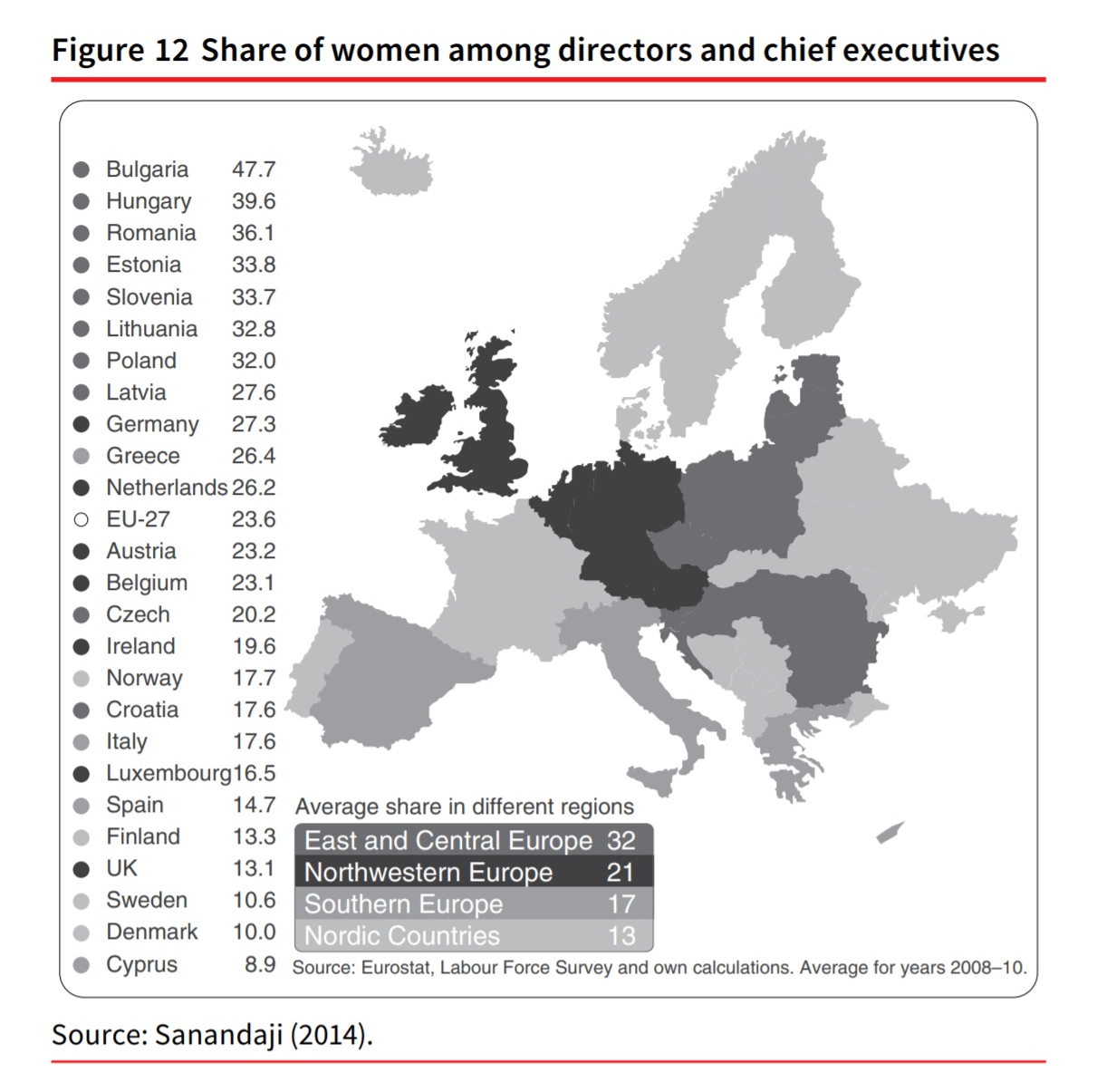
So, instead of pointing out the fallacy in labelling the Scandinavian countries moderately socialist (Nima Sanandaji, for example, does an excellent job in doing so), I want to look at one aspect in particular: The myth of peak emancipation of woman in the labour market in these countries. So apologies for neglecting Poetry once again for the sake of interesting information. Have a look at the following graphic and the remarks by Sanandaji:
“Some boards in Nordic nations are actively engaged in how the companies they represent are run. Others have a more supervisory nature, meeting a few times a year to oversee the work of the management. The select few individuals who occupy board positions – many of whom reach this position after careers in politics, academia and other non-business sectors – have prestigious jobs. They are, however, not representative of those taking the main decisions in the business sector. The important decisions are instead taken by executives and directors. Typically individuals only reach a high managerial position in the private sector after having worked for a long time in that sector or successfully started or expanded a firm as an entrepreneur. The share of women to reach executive and director positions is the best proxy for women’s success in the business world. Eurostat has gathered data for the share of women among ‘directors and chief executives’ in various European countries between 2008 and 2010. The data show that Nordic nations all have low levels of women at the top of businesses. In Denmark and Sweden, only one out of ten directors and chief executives in the business world are women. Finland and the UK fare slightly better. Those Central and Eastern European countries for which data exist have much higher representation.

[…]
A key explanation lies in the nature of the welfare state. In Scandinavia, female-dominated sectors such as health care and education are mainly run by the public sector.
A study from the Nordic Innovation Centre (2007: 12–13) concludes: Nearly 50 per cent of all women employees in Denmark are employed in the public sector. Compared to the male counterpart where just above 15 per cent are employed in the public sector. This difference alone can explain some of the gender gap with respect to entrepreneurship. The same story is prevalent in Sweden. The lack of competition reduces long-term productivity growth and overall levels of pay in the female-dominated public sector. It also combines with union wage-setting to create a situation where individual hard work is not rewarded significantly: wages are flat and wage rises follow seniority, according to labour union contracts, rather than individual achievement. Women in Scandinavia can, of course, become managers within the public sector, but the opportunities for individual career paths, and certainly for entrepreneurship, are typically more limited compared within the private sector.
If you are interested in the whole book, it is completely available online for free.
I wish you all a pleasant Sunday.
My Back to the Land Movement
Of course there’s no such thing as a Golden Age–some forgotten time in the medium-past where things were unambiguously better. The past is full of backwards savages and hard living. And even so, you can’t go home.
But I’ve got this suspicion that back in my day the Internet was better. It didn’t take itself too seriously, and so was actually worth while. But at some point in the last decade (maybe earlier) things changed for the worse. The Internet, like all the rest of the world, just isn’t what it could be–what it should be!
I’m being at least a little hipstery here–it was cool before it was cool, but now it’s uncool because it’s popular. But the truth is, the crappiness that is Facebook is just a reflection of a large swath of consumers. And I’m allowed to opt out.
Sitting on the Internet at the start of 2020, I feel like I’m sure I would have in 1970. Everything is bullshit and I don’t want anything to do with it. I want to buy a school bus and drive to some part of the country nobody cares about and start a farm. Of course the truth is, I really have no business going back to the land. I’ve taken up gardening as a hobby and learned that it’s hard.
But I do have this imagined past on the Internet I can attempt to go back to. I’m going to make an effort to return to the Internet of the early 2000’s. The Internet that Craigslist (for example) still protects–simple, excellent, and not trying to eat the world.
Don’t get me wrong, I’m still going to use the Big Corporate Internet. I’m only imagining my packets being sent via artisinal servers lovingly tended to by ye olde sysadmin.
What made the Small Internet great was the artisinal content. Weird stuff made and shared by weird people. That stuff is still out there. The Big Internet filters still capture it sometimes. But the marketers have gotten to the filters that used to serve us so well. Reddit just isn’t the same as a Conde Nast property.
One move I’ve made is to join MetaFilter, a social media site that goes back to 1999! So far it’s been a delightful place (without sucking me in the way Reddit used to). Hitting the random button brought me Where’s Wallace–an homage to The Wire, which is still worth re-watching. A more recent post introduced me to an excellent advent calendar that brought more new and weird things across my radar.
Why should this experiment matter?
Partly this is an act of civil society. It’s not all markets and government out there. We’ve got this space to share and improve our public spaces. The Internet is one of those spaces and my Small Internet project is sort of like making an effort to walk through my neighborhood instead of just going back and forth from the freeway.
It’s also an exercise in questioning implicit assumptions in how I engage with this part of the world.
I like Stephen Wolfram‘s notion of exploring the computational universe for useful programs. You don’t even need to take a metaphorical leap in applying the idea to media consumption habits. There’s a lot more “content” (facts, opinions, entertainment, editorial judgement, comments sections, provocations, etc.) out there than I can (or want to) deal with. So I have to choose some sort of filter. Once upon a time, Facebook was a great filter, then Reddit, but now I want to try something different.
I don’t exactly know what I’m looking for yet. But I’m going to wander off into the computational universe in search of a better Internet, less encumbered with the interests of behemoths and more closely tied with serendipity, good humor, and those weird human things that made the back-in-my-day-Internet so much better.
Sunday Poetry: Halal Cookery by the SS
First of all: Happy New Year Peeps!
I am trying my best to get some routine in blogging by sticking to this series. However, I do not know if I can still pull it off during the upcoming finals. We will see.
This week’s Poetry is less poetic yet very much informative (at least to me). David Motadel in his book “Islam and Nazi Germany’s War” reconstructs the bizarre relationship between Nazi Germany and Islam (and thus sheds light on another Myth of the Nazi Regime). What sounded completely counterintuitive to me, was this short passage on the halal cookery courses organized by the SS:
“In the end, both the Wehrmacht and the SS also took Islamic food regulations into consideration. In his instructions of 1942, Niedermayer ordered to ensure that the dietary requirements of Muslim soldiers, especially the ban on pork, were respected. Similar instructions were issued for Arab Wehrmacht soldiers. The SS went even further here. In July 1943, Himmler personally instructed Berger to find out “what Islam prescribes to its soldiers with regard to food” and added that he wanted to ensure that religious rules were observed. Shortly afterwards, Berger informed Himmler that the soldiers were not allowed to eat pork or drink alcohol. The Reichsführer-SS reacted promptly and ordered: “All Islamic members of the Waffen-SS and the police are granted as an unbreakable special right that, in accordance with their religious rules, they are never given pork as well as sausage containing pork and never alcohol to drink. An equally valuable diet is guaranteed in any case.” The SS even organized halal cookery courses near Graz.”
I wish you all a pleasant Sunday.
The Real Meaning of Christmas
…Jesus Christ matters a great deal for this atheist. For Christians, Easter, the Resurrection, is the big date. For us it’s Christmas. When someone wishes me “Good Holidays” in my simplistically minded libprog town, I respond with a cheery, “Merry Christmas.” I don’t do it just to be churlish (though I wouldn’t put this beyond me). No, I mean it.
What happened in Bethlehem is that God became a human, completely, with a conventional birth and all, and a regular upbringing.* This is not another small unimportant religious tale. In time, it’s a world-changing myth.
When God is man, we are only one step removed from Man becoming God. In the long run, it’s the beginning of the end of our collective submission to an often savage Bronze Age divinity. It took about 1500 years but it did happen and only in the parts of the world that had been Christian (plus, maybe, in Japan. Why in Japan? Beats me!).
* By the way, the doctrine of the Immaculate Conception is not what many people think it is. I keep hearing the mistake on the radio. (It takes an atheist to help with Christian theology, N.S.!)
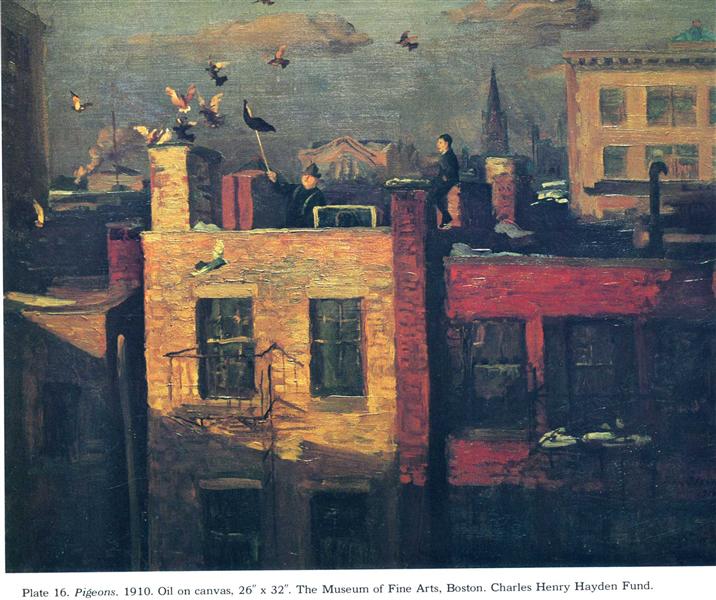
Afternoon Tea: Pigeons (1910)

This is from John French Sloan, an American and a socialist. Check out his wiki. Click here to zoom in on this marvelous painting.
Sunday Poetry: Rüstow vs. Mises
One of the bests books I’ve read this year was Serge Audier’s & Jurgen Reinhoudt’s relatively unknown (unfortunately!) translation of the protocols of the Walter-Lippmann-Colloquium. The NOUS-Network organized a wonderful seminar in which we thoroughly discussed the book and the emergence of Neoliberalism. For the preparation of this weekend’s Hayek-Kreis seminar, I reread the book and stood once again in awe of the magnificence of the discussion during the Colloquium.
By the way: If you are an undergraduate, graduate, or PhD scholar, please consider joining the NOUS-Network for Constitutional Economics and Social Philosophy as a Young Affiliate! NOUS is an information platform and a community for interdisciplinary research. The network links all academic fields relevant for thinking about social order and liberty. It spans philosophy, politics, economics and fosters scholarly research, contact and exchange.
In the following excerpt, it becomes clear, that the participant’s opinion on the psychological and sociological causes of the decline of Liberalism differed significantly. Mr Rüstow eloquently captures the standpoints of the two opposing groups (not without bias to be fair) and even cheekily disses Ludwig von Mises.
“Mr Rüstow: ‘All things considered, it is undeniable that here, in our circle, two different points of view are represented. One group does not find anything essential to criticize or to change in traditional liberalism, such as it was and such as it is, apart from, naturally, the adjustments and the current developments that are self-evident.
In their view, the responsibility for all the misfortune falls exclusively on the opposite side, on those who, out of stupidity or out of malice, or through a mixture of both, cannot or do not want to discern and observe the salutary truths of liberalism.
We, on the other hand, we seek the responsibility for the decline of liberalism in liberalism itself; and, therefore, we seek the solution in a fundamental renewal of liberalism. In order to justify in a positive manner this second point of view, I have to refer to what I have said and, especially, to the excellent arguments of Mr Lippmann.
Here, I would only like to draw attention to the fact that if the unwavering representatives of old liberalism were right, the practical prospects [for liberalism] would be almost hopeless. Because it does not really seem that old liberalism has gained in persuasive and in seductive force or that the arguments, no matter how shrewd they may be, of these representatives have the least possibility of bringing about a conversion movement within the realm of Bolshevism, Fascism, or of National Socialism. If they did not listen to Moses and the prophets—Adam Smith and Ricardo—how will they believe Mr. von Mises?'”
Scholars and Public Intellectuals: The Bad Old Days Before Blogging
I am flattered to be in the company Brandon places me in. When I was still growing up, I wanted to be Tyler Cowen then, I figured he moved way too fast for me. I have the utmost respect for Robert Higgs but I wouldn’t dream of mimicking his nearly super-human determination. I suspect Brandon put me on purpose in that flattering company and that he will soon ask me to stay after the meeting to sweep the room in return. Brandon also implicitly gave me permission to do what old dudes love to do (and often do well): reminisce.
I had a mostly but not exclusively academic career. It began so long ago that the hardest part of my doctoral dissertation was getting it typed from its long-hand last draft (yes, “typed,” with a typewriter; do you even know what this is?) Few graduates students knew how to type. Those who did were all females who had taken the trouble to learn in high school,. Below are two things that have changed for the better since those days, changed specifically in connection with blogging.
When I was a young scholar, I quickly discovered that having good co-authors was extraordinarily important. Myself, with one exception I won’t name, I always had co-authors, that is, co-investigators, I did not deserve. The difference in quality, in reach, in scope, between what I could produce by myself and what I did with others was so great that I seldom even tried to go it alone once I had discovered the force multiplier of well chosen others.* But finding potential research partners was costly, haphazard and often disappointing.
Apart from the necessarily limited local offering at your own university, you had to wait for your first high-powered publication, hoping it would draw admirers who would then take the trouble to contact you. Of course, you could do the same with others. To some extent, it involved the same sort of hesitancy one experiences trying to pick up a good-looking person in a public place. And, in some disciplines, publishing an admirable article in a well esteemed periodical may take years, of course. The poor traditional remedy was attending academic conferences, listening to others at formal presentations sessions and then, making advances. This worked to some extent but it was an inefficient system with a piteous yield.
The contemporary blog with a theme, such as Notes on Liberty, offers the young scholar the immense advantage of being able to present in a stress-free fashion samples of his work to many strangers of a similar cast of mind who are also hanging out around the blog in a relaxed frame of mind. Some of these will turn out to be potential coauthors. The blog will give them a social context for reaching out that is less intimidating than most.
Needless to say, the same features of the blog may facilitate being noticed by useful senior scholars. (I said “may” because I have no certainty about the extent to which such august persons go slumming on blogs. I have my suspicions though.)
Next: many people who become academics begin a with a general interest in ideas. Soon, they discover that the organizations that are willing to put bread on their table while they indulge their tastes are mostly universities. This is certainly true in the English speaking world. It seems to me that this is also largely the case in the French speaking world, and in the Spanish speaking world as well.
Once involved in a university career, the same people soon figure out that to progress in that career, or simply to remain in the career, they must publish in scholarly journals at a good clip. Unfortunately, in most disciplines, journals require a much narrower enterprise than the typical aspiring public intellectuals dreams of. This is intentional: Specialization encourages attention to detail in reasoning and it punishes sloppy logic. It also promotes respect for facts. (I mean outside of the post-modern English discipline, of course). Scholarly formats often leave authors unsatisfied in one particular respect, the formal limits they imposes on their discourse. I have often myself been in a situation, – and likewise observed others to be – with an eighteen page empirical paper that seemed to me honestly to authorize fifty pages of innovative narrative. The journal format usually allowed only one to three pages, four, if you played your cards right, or if the editor dated your sister.
Some will comment that a person can pursue a two-track career with scholarly publications on one side, and more general narratives in other media, on the other. That’s true enough but if you consider the large number of America academics in general compared to the two handfuls nationwide who have a public voice, you will guess that the dual career path must present formidable obstacles.
The one I encountered personally – which I think is quite common – is that the gates of outlets for general well-informed but non-technical narratives were as narrow of those of the most respected academic journals, and also vastly more capriciously opened. And in case, you are wondering no, I am not thinking only of the New York Review of Books. It will take me a long time to recover from the contemptuous rejection I received from the newspaper of my local community college. (That was twenty years ago. I was a well respected scholar by then.)
A good blog with an open editorial policy such as Notes on Liberty will give many a chance to circulate opinion pieces and other narratives not fitting a normal scholarly format. Those may spring, by the way, from the same source as their scholarly production narrowly defined. When I was churning out statistical empirical papers in the sociology of economic development, I felt I had lots of things to say to the general intelligent public, springing from the endeavor of producing those papers, things that never got said.
I am not sure how many of those who read these words are academics, or aspiring academics, or frustrated academics who long to be also public intellectuals. I hope I reached a few of you, all the same. What I can tell you is that my life would have been more satisfying (even more satisfying) if blogs such Notes on Liberty had been available when I was just sharpening my pencils.
* Nonetheless, I wrote alone and off the top of my head a little paper that keeps cropping up in the class syllabi of several military schools forty years later: “The distributive state in the world system.” Studies in Comparative International Economic Development, 15-3: 3-21. 1980. (A little harmless bragging!)

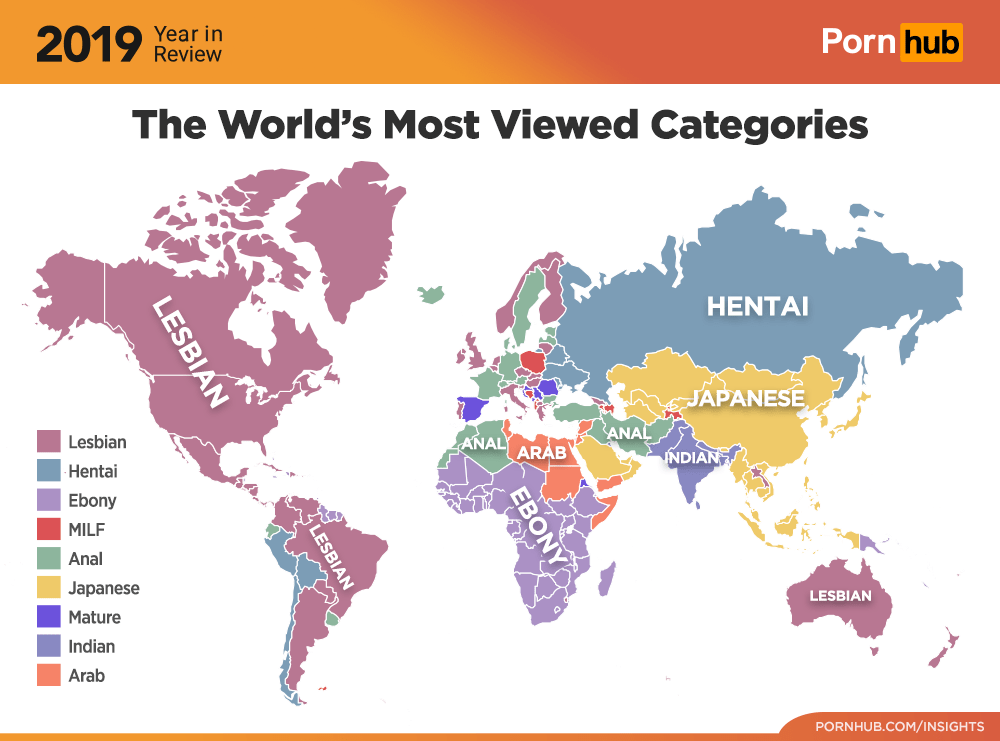
Eye Candy: Most popular porn categories, by country, in 2019

Well then. Discuss? This is from PornHub. Thanks to r/mapporn.
Public libertarian intellectuals
Consider the post-Hayek/Rothbard/Friedman era of libertarianism.
Who has stepped up to fill their shoes? It’s hard to say, but 4 academics who stand out are Tyler Cowen, Mike Munger, Robert Higgs, and Bryan Caplan. Their scholarly output is comparable to our own Jacques Delacroix, and their influence within the libertarian quadrant is – or was at some point in time – much greater than Jacques’.
All four of these scholars cut their teeth blogging. The blog is how they teach. The blog is how they vent. The blog is how they share news and knowledge. The blog is how they went from well-respected to essential. All four write opinion pieces for professional outlets, but that’s not how they became essential to libertarians across the globe. Sharing their day-to-day thoughts about the world, to the world (and not just their walled-off social media accounts), is how they were able to step up and usher libertarianism into the next generation.
As the new year approaches, I encourage you to think about what liberty means to you. (Is it best left in the hands of professional Libertarians? You know the incentives they face. You know the choices they’ve made.) I also encourage you to be bold in your goofiness. Be strange! Be strong. Be artsy. Be rude (but never cruel). The professional outlets will always be there, waiting patiently to edit out your voice from The Message. Make 2020 the year a new generation of libertarians stepped up and took on the burden of responsible citizen-scholarship.
Sunday Poetry: Junger’s War Observations
Without noticing it, I heavily built my reading schedule this year around of what one might call a “post-liberal reading list”. The idea, that the demise of social institutions might be the inevitable consequence of an ongoing individualization of society struck me as initially convincing. I am currently in search of good examinations on the ultimate effect Liberalism has on the development of social institutions. Hopefully, Steven Horwitz’ “Hayek’s Modern Family” will provide me with some compelling arguments to refute the post-liberal agenda.
Not directly being post-liberal, but pointing towards the importance of “homecoming and belonging”, Sebastian Junger’s book “Tribe” has had a lasting influence on me. I found the following observations of a war refugee voluntary reentering Sarajevo during its siege both fascinating and devastating.
“What catastrophes seem to do – sometimes in the span of a few minutes – is to turn back the clock on ten thousand years of social evolution. […]
“‘I missed being that close to people. I missed being loved in that way’, she told me. ‘In Bosnia – as it is now – we don’t trust each other anymore; we became really bad people. We didn’t learn the lesson of the war, which is how important it is to share everything you have with humans being close to you. The best way to explain it is that the war makes you an animal. We were animals. It’s insane – but that’s the basic human instinct, to help another human being who is sitting or standing or lying close to you.’
I asked Ahmetašević if people had ultimately been happier during the war.
‘We were the happiest,’ Ahmetašević said. Then she added: “And we laughed more.'”
I wish you all a pleasant Sunday.
Psychedelics versus modern philosophy
Anyone who studies philosophy has run into the assumption that psychoactive drugs and philosophy go hand-in-hand. Really, after analytic and continental, and whatever other traditions people come up with, there could be another sect, that of “stoner philosophy,” which is something like Mister Rogers, Alan Watts and Bob Ross thrown into a peaceful blender. This is when you’re sitting around getting high, wondering if aliens exist, instead of sitting in a classroom, wondering if other people’s minds exist.
A historical study of this connection, from East to West, would probably scandalize a lot of “serious” philosophers, and show some regular inebriation, but in general, I think the two are opposed (tragically or not). Particularly, the institutionalization of philosophy, when “natural philosophy” and “moral philosophy” etc all became separated some time after Hobbes, is opposed to what it sees as a lay way of thinking about the world. As my philosophy of science professor told me – you become a philosopher when you have your doctorate.
Professional philosophers and “psychonauts” are in opposition to each other. The analytics and continentals have spent centuries building elaborate systems – developing monstrous levels of specificity, so as to make their work completely incomprehensible to the rest of the world – and earning credentials to close the gates of access. Meanwhile, the casual or professional tripper is able to buy a tab for less than $10 and experience, or imagine they experience, market-price existentialism without reading a page of Camus.
The professional philosopher sneers in bad faith at psychedelic profundity because it makes them seem irrelevant.
On the other hand, the inarticulate tripper is not in such a great place. The psychonaut rests on intuition, and is probably not equipt with the critical thinking and logical itinerary to make sense of the journey on the comedown. A trip promises insight but also promises that neither your epistemic priors nor a rational reconstruction will be enough to establish its validity – by its very nature. (Psychedelic knowledge is “revealed,” not “discovered,” right?) You might get an insight that looks good, but is bad, without you knowing it. (I wrote about this in college. Holy shit my writing was bad.)
What happens when you irrationally, psychonautically attach to an idea that’s immune to logical tinkering? If you believe something for irrational reasons you’ll hang on to it for even longer than something that you believed for rational reasons, because new rational reasons can talk you out of a logogenetic idea, but not an irrationally-formed one. Depending on the centrality of the belief, of course.
The psychonaut claims easy knowledge, but could have trouble organizing it in the other, orderly web of belief of his coldly-discovered priors. However, this kind of knowledge has taken a high prestige today, with help from accredited social figures like Steve Jobs dosing LSD. In a way, the win of casual inebriated profundity is a “people’s victory” over the esoteric, pretentious toils of the professional philosophers. If you can figure out Truth by serotonin-fucking yourself on any day of the week then there’s no need to study Heidegger… and there’s even less reason to get a PhD in phenomenology, making institutional philosophy obsolete.
So, philosophers will be opposed to the psychonauts because it trivializes their hard-earned degrees (bad faith), and trivializes all their carefully crafted logic (slightly less bad faith). Psychonauts will be opposed to the philosophers for their specialized field which must explicitly reject such spontaneous routes to knowledge. The people taking psychedelics find themselves fighting some sort of anti-scientific elitism war, doing Feyerabend’s work. The tension is worse with the professional, modern philosophical class, but still exists in general.
A survey of history would show a lot of intertwining, but ultimately, I think the newer age of philosophy has a lot more overlap with other drugs than psychedelics (specifically Epicurean as opposed to elucidatory drugs, e.g. Adderall, analgesics, cocaine) — which is its own interesting question.
Afternoon Tea: Pear Tree (1903)

This is from Gustav Klimt, my favorite artist of all time. Click here to zoom. I just started getting in to his “nature” stuff. He and Egon Schiele made cool landscapes. Have a good rest of the day!