What is a nation?

I know Michelangelo has already asked and answered this question, and NOL has dealt extensively with “the nation” before, but:

Nations are now defined not as races or peoples but by their possession of a state, and states are legitimate only if they express political will of a nation. The strange new idea of nation-building was born, the other side of the coin of state-building in the decolonizing world. It is a game played by given rules, above all that no other forms of political will and action were legitimate, especially wars of conquest.In outcome, the poor, the small, and the marginal gain the freedom of self-determination, the telos of independence, but their democratic rights extinguish utterly at the border. They have right of influence anywhere else.(137-138)

I have just two thoughts about this nugget of insight from American anthropologist John D Kelly, writing on the Wilsonian ideal in his book The American Game: Capitalism, Decolonization, World Domination, and Baseball. 1) The “given rules” Kelly writes of are still a factor in today’s world. You can most clearly see them via international governing organizations (IGOs) like the UN, World Bank, IMF, WLO, etc. Given rules are handed down to former colonies by IGOs not as a way to control these colonies but to guide them gently into the modern era. This may seem quaint, but this is how Wilson and his ilk viewed their rules and their fellow man in the colonies of Africa and Asia. If you think about institutions, even weak ones like IGOs, you know that the rules and ideals that such institutions were created to embody are hard to break; often a critical juncture is needed to do so. So the given rules of the international system are, I would argue, still based on condescending early 20th century notions about non-European peoples. This is partly why Scots and Catalonians are allowed to vote on their secessionist arguments while Kurds and Balochs and Biafrans are labelled terrorists or rebels, and states like Montenegro and Kosovo are allowed to enter the international system with virtually no hiccups while Kurdistan, Balochistan, and South Ossetia are ignored by IGOs and only informally recognized when an official state like the US requires an ally to fight an enemy.

2) This is hard for me to admit as a libertarian, but the Wilsonian ideal has helped to almost entirely eliminate old-school imperialism (violent conquest followed by oppressive government and extractive economic policies) from the earth.

Classical Liberalism and the Nation State

Barry’s response to my earlier post is another interesting read, yet it is also rather broad brush historical. I think he is erroneous if he claims that ‘it did not occur to classical liberals, on the whole, to question the state system as they knew it’. In fact the founding fathers of classical liberalism, David Hume and Adam Smith, were very much aware of other, often cosmopolitan ideals of world order. Yet they argued that the nation was attached to individual emotion, which could not be the case for entities beyond the nation state. This was also the position of later classical liberals such as Von Mises and Hayek, as I show in Classical Liberalism and International Relations Theory (Palgrave, 2009).  Let me elaborate a little, also in the wider context of international political theory.

Liberalism is the political expression of individualism, yet cooperation of individuals in groups is valued positively. For classical liberals the nation, or the country, is the largest group in society which is the object of human passion, both positive in the sense of national pride and negative in the sense of shame and humiliation. Hume noted that there are few men entirely indifferent to their country, and both he and Adam Smith underlined that humans sympathise more with people to whom they are close than with strangers or foreigners. Feelings for the nation are strong, natural motivational forces for individuals.[i]

This also applies in the age of modern states and nationalism. Despite the atrocities committed in the name of national glory throughout the twentieth century, Mises and Hayek never predicted nor called for the end of the nation state. Mises thought that language was the essence of nationality, and with the fragmentation of the polyglot Austro-Hungarian Empire in mind he argued that multi-language countries were doomed to failure. His solution was an increase in possibilities for individual self-determination and group secession, but not in the expectation that this would lead to a world without sovereign states.[ii] Hayek saw the nation as a prime source of human bonding and individual loyalty, but recognised the negative aspects of nationalism. He valued the nation, but nationalism was a poison,[iii] not least because he saw a strong relation between nationalism and imperialism. After all, it is a small step from thinking good about one’s country to trying to rule and civilise allegedly inferior others. Often, although certainly not in all cases, the nation as a group is politically organised as a sovereign state. In the classical liberal view, states are the most important actors in international relations.

To maximise individual freedom the state should only have a limited number of tasks. The state is an important protector of natural rights, but history has shown that it is also the biggest abuser of these rights. The principle of the rule of law intends to protect the negative liberty of individuals. Classical liberals think the state can best be bound by a combination of constitutions; separation of the legislative, executive and judicial powers; and the limitation of positive law.

In international affairs this means that states should be cautious about concluding and ratifying treaties and other forms of positive law. These are often binding commitments that are very hard to change or to get rid of, with a large possible negative impact on individual freedom. Some international agreements may be useful to smooth the working of the international society of states, or to settle practical matters. But the dangers of overregulation are just as real in world politics as they are in national politics. Besides some specific cross-border issues, the classical liberal rule of thumb is that there is no need for international state action if there is no domestic state task.

Consequently, attempts to build a better world by establishing international organisations and regimes are rejected. Mises and Hayek were strong critics of the League of Nations and its successor the United Nations, and Hayek was a fierce critic of the International Labour Organization. Their main concern was that these and other organisations were taking up tasks they should not perform, just like overactive states in national circumstances. Social constructivism is bad, no matter at what level it is performed.[iv]

In Degrees of Freedom (Transaction, 2015)  I have tried to illuiminate the differences between the different forms of liberalism (and conservatism, also see my earlier post on the differences between them entitled “Let’s clear up the liberal mess”), including their views in international relations. In summary it looks like this:

Liberalism, Conservatism and International Relations

Classical liberalism Social liberalism Libertarianism Conserva

tism.

Nation as limit of individual sympathy Yes No No Yes
State as prime actor in world politics Yes No No Yes
International governmental

institutions/regimes

No Yes No No
Can war be eliminated No Yes Yes No
Does trade foster peace? No Yes Yes No

Source: Edwin van de Haar, Degrees of Freedom. Liberal Political Philosophy and Ideology (Transaction Publishers, 2015).

That also explain partly why Barrry can rightly argue that the ideas of Kant, Mill and to a lesser extent Montesquieu differ from those of Hume, Smith, Mises and Hayek: they are not classical liberals but social liberals.

Notes:

[i] Hume, Treatise,79, 317; Adam Smith, The Theory of Moral Sentiments (Indianapolis: Liberty Fund, 1982), 299; also Edwin van de Haar, ‘David Hume and International Political Theory: A Reappraisal,’ Review of International Studies, 34:2 (April 2008), 225–242.

[ii] Ludwig von Mises, Nation, State, and Economy. Contributions to the Politics and History of Our Time (New York and London: Institute for Humane Studies & New York University Press, 1983), 39–40, 82.

[iii] Friedrich Hayek, Studies in Philosophy, Politics and Economics (New York: Simon and Schuster, 1967), 143.

[iv] Mises, Nation, State and Economy, 90–91; Ludwig von Mises, Omnipotent Government. The Rise of the Total State and Total War (Grove City: Libertarian Pres, 1985), 292–294; Friedrich Hayek, The Road to Serfdom (London: Routledge, 1997), 176.

Reply to ‘Classical Liberalism, Cosmopolitanism and Nationalism’

I write in reply to Edwin van de Haar’s post ‘Classical Liberalism, Cosmopolitanism and Nationalism’, which contains some generous remarks about my social media posts while putting forward a view different from my own about the role of the nation state. Edwin argues that the nation state is foundational to classical liberalism in that post. I have previously argued for the benefits of the United Kingdom staying in the European Union, just before the referendum which has put the UK on the path to leaving.

I will start with the doctrinal issues of how far classical liberalism might be considered as something that is embedded in the emergence of the nation state as we know it. It is true that classical liberalism arose as the nation state emerged and consolidated and it did not occur to classical liberals, on the whole, to question the state system as they knew it. That is a system defined in early modern natural law and contractual theory about law and state as one of a very unified system of sovereignty in a world of ‘a state of nature’, anarchy, or lawlessness between states.

We have to note at least one major deviation in the familiar list of classical liberal authors, which is Immanuel Kant, thinking of his essays ‘Idea for a Universal History with a Cosmopolitan Purpose’ (1784) and ‘Perpetual Peace: a philosophical sketch’ (1795), which do not question the internal  sovereignty of states, but does argue for a law governed set of relations between states with a global institution of some sort to prevent republics going to war with each other.

We should consider John Stuart Mill’s thoughts on federal states in Considerations on Representative Government (1861), particularly chapter XVII, ‘Or Federal Representative Governments’ which looks at the possibility of a state with decentralised decision making functions. A nation state can be federalised, at least in principle, but what are the components of the federation other then sub-nations, where the population may even regard them as nations within the state. Mill was building on the experience of the United States since the constitution of 1787, and Switzerland, particularly since the federal constitution of 1848.

The United States and Switzerland did not come out of nowhere. The US consolidated the links between thirteen colonies of Great Britain while federal Switzerland built on the Swiss Confederation and its links with places like Geneva which were associated with the confederation, but were not part of it until the restructuring of European states in the Napoleonic period. The point here is that modern states may be federal as well as unitary states and that includes continuity with pre-modern links between at last partly self-governing regions-nations. We could even say that kind of state of associated states was the Medieval norm.

The example, and even idealisation, of this Medieval structure enters classical liberalism via Montesquieu’s The Spirit of the Laws (1748), along with the work of Swiss jurists of the time, particularly in Berne. Montesquieu was building on the experience of the kind of medieval and early modern monarchy where he thought there was liberty, moderation in government, distinguishing it from tyranny. In such situations different laws and assemblies for towns and for historic regions was quite normal under the monarchy. In so far as such states, like France, were tending to evolve in states based on the absolute sovereignty of the centre, in the formation of what we call a nation state, Montesquieu saw the danger of despotism.

The historical experience that Montesquieu was drawing on was the way that Medieval monarchies were constructed through assembling  patch work of  the monarch’s personal domains, regions with their own lords and institutions, and church domains, along with increasingly self-governing towns. He also looked at the antique experiences of allying republics in a federation, which he thought was preserved in the Netherlands and Switzerland of his time. Germany, which at that time was a kind of federal/confederal empire of very varied forms of sub-imperial sovereign units including princes with lands outside the Empire, was also a form of federation for Montesquieu.

If we go back to the German history of the century before Montesquieu, the idea of the modern nation state is strongly associated with the Treaty of Westphalia (1648), which ended the Thirty Years war, focused on Germany, but drawing in most of Europe. ‘Westphalian state system’ has become a label for an internal system of states which are completely sovereign internally and face each other as equal legal personalities with no higher instance of sovereignty or collective instrument for enforcing the laws of nations, which do have some basis in the natural law doctrines of the time, and earlier.

The trouble with this understanding of Westphalia is that though it has some truth for Europe outside the German Empire (officially known as the Holy Roman Empire), it is very misleading for the Empire, and therefore for those European powers, including Sweden and Denmark, which had land within the Empire. The princes, cities and other territorial units within the Empire were under the legal authority of the Emperor, who largely served as a judge of interstate disputes though with far greater powers in the lands of the Habsburg family (consolidated as the Austrian Empire in the Napoleonic era) which always had the Emperor, though the Emperor was legally an elective office. The Habsburgs land extended outside the Empire into central Europe so the Westphalian system of Imperial authority brought in other European nations and extended outside the Empire strictly speaking.

Westphalia modified a system rooted in the Middle Ages of Germany as a middle European federation or confederation, drawing in other parts of Europe and therefore anchoring a European system of some kind. Periods of dominance by France or Spain complicate this story, but French claims always overlapped with Imperial claims and the peak of Spanish power was when the Spanish monarchy was from the same family as the German Emperors.

The Napoleonic era disrupted these arrangements severely, but we can see Napoleon as trying to revive the original Empire of the Romans under Charlemagne in the ninth century, which united France, Germany and neighbouring territories under a Frankish over-king. Charlemagne was know as ‘father of Europe’ in his time, perhaps more in connection with Europe as Christendom and his wars against Muslims in Spain, then with Europe as we might think of it now, but this is part of the story of what it is for there to be a Europe and a European system. Coronation by the Pope and recognition of the Frankish kingdom as heir to ancient Rome connects the medieval German Empire with the first great European political system, the Roman Empire.

The aftermath of the Napoleonic period in Germany was a confederation, which again included those European powers (the United Kingdom was one) which had lands in Germany. This evolved into the German Empire founded in 1871, which was itself an extraordinary mixture of Greater Prussia, federation, democracy, aristocracy, monarchy, and so on. It was more of a nation state than German predecessor systems in that it was a sovereign unified part of the international state system. The size and growing economic power of the Kaiserreich, incorporating Polish, French and Danish speaking areas, made it a destabilising force in Europe. Too big for the security of other European states, too small to anchor a European system.

The First World War and the Second World War were both consequences of this unstable system. The European Union is in large part an attempt to solve the problem by creating a European system which Germany anchors, though since unification the dominance of Germany has become an issue again. Whatever the problems, the EU provides a better framework for structuring a European system in which Germany is both contained and can exert influence in a consensual manner.

Returning to the issue of the nation state, Germany was never a nation state in the strictest sense of a very unitary state with a single language and ethnicity. France has usually been taken as the model of the nation state ‘strictly speaking’, but even so it has only been a country of speakers of standard French since the late nineteenth century. As it is now, it includes speakers of Breton, Basque, Occitan and Alsace German. Corsica has special status and Alsace-Lorraine also has some special arrangements in recognition of its specificities.

The European world before the First World War was more of a Europe of multi-national Empires than nations, with four Empires (German Hohenzollern, Austrian Habsburg, Turkish Ottoman, Russian Romanov) dominating the centre and east. Spain in practice has always been an extended Castille in which other regions-nations have played variable distinct roles. The United Kingdom never completely integrated as a nation state; even at the peak of integration in the nineteenth century, Scotland kept its own legal, state church and educational system and since then in a rather complicated way the UK has become more loosely integrated and may lose Scotland in a few years.

Even with the imminent departure of the UK from the EU, Europe continues to be a political system, not just an aggregate of nation states. The larger European states are not nation states in the strictest sense. Even without the EU, European states accept various kinds of obligation with regard to north Atlantic security and global trade which limit sovereignty. The UK will negotiate some kind of membership of the internal market of the EU and its passport union aspect, as well as participation in various EU schemes. It will therefore continue to be part of a European system anchored by Germany.

Ever since the Romans, Europe has needed a European system of some kind, and the German anchor schemes going back to 800 have recognised the Roman precedent. In reality there has never been a Europe of nation states and the periods closest to that model ended in catastrophic wars. Disaggregation of the European system as it is now may not result in war, but it has the potential to unleash trade wars, protectionism, competitive currency devaluation, erosion of chances to live, work, and study abroad, associated labour market sclerosis, destabilising struggles for political-diplomatic dominance, and an incapacity to ally in order to deal with global and strategic issues affecting Europe, including migration flows, Russian expansionism, and Middle Eastern conflict and terror.

(more on the consequences of the UK leave referendum soon)
Classical Liberalism, Cosmopolitanism and Nationalism

In another thought-provoking post on Facebook (does the guy ever write mediocre stuff, I wonder?) Barry raised the question of the relation between classical liberalism, nationalism and cosmopolitanism. He wrote the following:

“On the capture of classical liberal/libertarianism by anti-cosmopolitans. This is very influential at the heart of the ‘leave’ ‘elite’ in the UK, and can only be destructive of classical liberalism/libertarianism. The immediate political consequence of Leave is the elevation of Theresa May to Tory leadership/Prime Minister’s office on a much more ‘Red Tory’, communitarian, corporatist foundation than existed under Cameron. ’To the extent to which the current wave of populism maps into a conflict over national versus transnational identity (Dan Drezner is unconvinced), the problem is not an excess of cosmopolitanism but rather its absence, especially on the conservative, free-market right.”

He seems to take a positive relation between classical liberalism and cosmopolitanism as the default position. Of course Barry did not provide definitions in a FB post, but here I take cosmopolitanism to mean “the idea that all human beings, regardless of their political affiliations, belong to a common moral community. Cosmopolitans often believe that all individuals have the same basic moral status, and tend to downplay the importance or desirability of national political institutions. [They are] opposed to nationalism” (source: Matt Zwolinski (editor), Arguing About Political Philosophy, Routledge, 2009).

I argue that Barry overlooks that classical liberalism combines a cosmopolitan side, with a strong defense of national political institutions (e.g. the state). The cosmopolitan side is perhaps easiest to see, if one takes the idea of free trade as the guiding principle. Free trade is by nature morally neutral for the individuals involved, and has numerous positive economic effects; it fosters cultural exchange as well as innovation and knowledge sharing. In that sense classical liberalism is indeed related to cosmopolitanism.

Yet this stops where the national state comes into play. Classical liberals never predicted any positive political effects of trade (see my earlier notes on this topic) and, just as importantly, they actually favor a strong state, with a limited number of tasks. At the same time, from Hume and Smith onwards to Mises and Hayek, they strongly dislike the idea of transnational political institutions, because these lack any substantial emotional basis which nations do posses. Also, these large political institutions easily become a threat to individual liberty, even more so than national states with too many tasks. So, there is no really no relations between political cosmopolitanism and classical liberalism at all.

There is also no relation between nationalism and classical liberalism. A preference for the national state does not lead to nationalism, which is the vicious and poisonous belief in the superiority of one’s country, often accompanied with a dislike of allegedly inferior neighboring countries or peoples or groups. This is collectivism turned even worse, which is a double ‘no’ from a classical liberal perspective. This said, if patriotism is defined as national pride, then classical liberalism and patriotism can and will go together. There is a fine line between the two sometimes, but patriotism is not violent and dividing, but a binding force between individuals sharing a national state.

The last point is on the European Union. Hayek and Mises have been on record with strong support for a European Federation, primarily as a remedy to war-torn and nationalism-infected Europe. In these circumstances the default position of an international order as a society of states no longer functioned, so there was a need to seek an alternative. Needless to say their federation had little resemblance with the current super state we know as the European Union, which has become a classical liberal nightmare in terms of liberty and property rights violations it commits on a daily basis.

The current EU has some classical liberal traits (the imperfect common market is the single most important one), which is of tremendous use to all European individuals. It is, however, way too cosmopolitan in the bad political way. A likely consequence of Brexit is that this will become even worse, now that the French and their allies will get more room for their collectivist fallacies.

BC’s weekend reads

  1. Dr Khawaja is back in Palestine for the summer
  2. The nation-state is making a global comeback
  3. Nationalism isn’t replacing globalism
  4. Can Multiculturalism Be Exported? Dilemmas of Diversity on Nigeria’s “Sesame Square” (pdf)
  5. The West’s biggest statue: a tall tale

A quick note on the Brexit debacle

I think Barry (here and here) and Edwin (here and here) have made the best contributions to the debate on the EU and sovereignty here at NOL to date, so I’m just going to add a couple of open-ended thoughts to the recent vote (which I think was a huge mistake).

One of the big theoretical debates over the years concerning the EU is the concept of European-ness and how it can never replace the nationalisms that already exist in each state across the pond. This makes no sense to me, though, especially if you buy the argument (as I do) that nations come and go largely in reaction to current events. German-ness or French-ness or British-ness could easily be subsumed by a European-ness.

I don’t want to be one of those doomsayers who claims that, because things did not go my way, all will be lost. The UK is going to be in for a little bit of hurt, financially, as is the European Union; losing the UK is a big deal, and so is leaving the EU. However, the UK is not exactly Sweden or Germany. The United Kingdom is poorer than Mississippi, the poorest administrative unit in the United States. It’s possible, if a bit unlikely, that the UK will be better placed to negotiate itself back to economic prominence if it doesn’t have to work through the EU to attain some of its goals. The UK has deep connections with a number of states and regions around the world thanks to its now-dead worldwide empire, and I don’t why a more Euroskeptic UK would decide to shun the rest of the world too, especially if the “rest of the world” was once a part of the UK’s empire (the glorious past of the UK seems to be an important talking point for Euroskeptics).

Immigration may not cease either. An irony here is that the Euroskeptics who won rode hard a wave of anti-immigration sentiment sweeping across the UK (and the rest of Europe, too). But it seems to me that, because of the UK’s deep connections to its former imperial provinces, most of the immigrants in the UK are going to be South Asian or Gulf Arab rather than Polish or Greek. Given that much of the anti-immigrant rhetoric in Europe stems from a deep distrust of Islam, I find it odd that British voters could be so gullible on this matter.

Does anybody know if this vote is the final say on whether or not the UK will leave the EU? [UPDATE: see Dr van de Haar’s comment for an answer to my question] It seems to me that there has got to be some legal mechanisms, via courts, that have been put into place in order to slow down things like mob rule mass voting.

A short note on two types of political structures

I just came across an excellent review by Herman Belz of a book on American history recently published by Nicolas Barreyre, a French history professor. The main thrust of the book Belz is reviewing has to do with American Reconstruction, but the theoretical thrust of the book is all about state-building and political economy. The whole article is worth your time, but I wanted to hone in on a particular paragraph that caught my attention:

In the 20th century, Progressive “living-Constitutionalism” dedicated to constructing a centralized administrative state […] undermined the Founders’ establishment of a territorial federal republic as the constitutional ground of American liberty. Americans were the territorial people of the United States. Sovereignty resided in the people of the state in which they lived as well as in the states united as a national whole. In the 21st century, the aspirations of Progressive statism reach beyond national borders to the conceit of transnational global authority.

In this paragraph Dr Belz draws a distinction between two political structures:

  1. a centralized administrative state
  2. and a territorial federal republic

The centralized administrative state is a much worse option than a territorial federal republic in Belz’ view (and my own), mostly because in the federal republic sovereignty resides in both “the people” and in the various “states” that have federated to form a republic (Belz suggests this made the United states “a national whole,” but I don’t think that’s true, largely because of Belz’ own description of what Barreyre calls “sectional” politics at the time, but I digress; see Michelangelo for conceptions about “the nation”).

The territorial federal republic is thus a bottom-up approach to a more inclusive, more open society, whereas the centralized administrative state relies on experts, many of whom are unelected and unknown, to govern public affairs.

Belz is largely correct in his summaries of these two political structures, but I think his conclusion (“the aspirations of Progressive statism reach beyond national borders to the conceit of transnational global authority”) misses the mark. This is not because he is right to suspect the Left of wanting to create and sustain a centralized administrative state with a global reach (i.e. the UN), but because he leaves out the possibility that a territorial federal republic can also have a global reach while still avoiding the pitfalls of morphing into a centralized administrative state. Belz is probably more conservative than I am, and hence more pessimistic about the chances of a “transnational global authority” being republican in nature rather than administrative, but I still think my argument is better…

From the Comments: Why care about Syrians?

Dr Gibson notes:

I’d say the “big question” makes no sense. Surely some Syrians would be better off under ISIS and some under Assad.

And there’s a bigger question: who the hell cares? Few if any of us Americans have enough information to judge this issue nor should we. We have our own fish to fry. The Washington politicians have done incalculable damage with their ceaseless meddling in the affairs of the Middle East and elsewhere. Let the Syrians and their immediate neighbors sort this out.

I wanted to draw this excellent comment out for two reasons. Reason number one has to do with Dr Gibson’s first paragraph. Questions rarely make sense (which is why you ask people for help), but suppose you asked whether Syrians would be better off under capitalism or socialism. Some Syrians would be better off under socialism than capitalism, but that doesn’t mean it’s just as good as capitalism. Right? One of those systems is better for far more people than the other, and as an individual don’t you have a moral duty to support the more just system in some form or other? These are questions that libertarians, especially libertarians in the United States, should be asking themselves more often than not. There is a disturbing tendency among this faction of libertarians to lean in the direction of nationalist parochialism when it comes to matters outside of our borders. This brings me to reason number two for highlighting Dr Gibson’s (quite excellent) comment: Reminding libertarians and classical liberals that our creed is an international (and a humble) one.

War refugees represent the humblest of our species. The UN estimates that the war has affected nearly 12 million Syrians so far and, of course, that doesn’t include all of the people outside of Syria’s borders who have been affected. Russians, Europeans, North Americans, Syria’s immediate neighbors, and East Africans have all been affected by the ongoing war. How could you not be interested, especially from an individualist point of view?

I think the problem of the American libertarian’s parochialist nationalism stems from Murray Rothbard’s Cold War-era writings. Unlike F.A. Hayek and Ludwig von Mises, who were both big supporters of more international cooperation (but who both saw the glaring flaws in organizations like the UN and what is now the EU), Rothbard’s writings on foreign affairs were heavily influenced by the fact that the world was dominated by two superpowers and that the government he lived under used lies and deceit to counter Moscow’s power plays. Rothbard’s world of bi-polar geopolitics is long gone. It doesn’t exist. It will not exist again in my lifetime. Ours is a world of multipolarity. Yet somehow Rothbard’s writings on foreign affairs (which descended into outright incoherence near the end of his life) still have a profound impact on the American libertarian movement.

Much of my work here at NOL is dedicated to eviscerating this long-expired mindset from the American libertarian movement. Isolationism is nationalist, plain and simple (just pay attention to the rhetoric of libertarians like Justin Raimondo or Doug Bandow if you need more convincing), but Warren’s point about Washington’s meddling in the affairs of other states remains pertinent. So perhaps a different question to ask (even if it doesn’t make sense) is what a more internationalist-minded, in the vein of Hayek and Mises and Adam Smith, US foreign policy would look like. (I’ve been asking this question for a while now.)

Colonialism and Identity in Wasolon (and everywhere else, too)

The notion of the person is constantly renegotiated and is at stake between groups situated within the same political entity as well as between neighboring political entities. With advent of [France’s colonial] district register and the resulting written registration of identity, the notion of a person acquired a greater fixity. It became much more difficult to change identity or even to modify the spelling of one’s first or last name. Since it could no longer affect the components of the person, the negotiation of identity shifted, as in the case of the West, onto other sectors of social and individual life. (135)

This is from the French anthropologist (and high school friend of our own Jacques Delacroix) Jean-Loup Amselle, in his book Mestizo Logics: Anthropology of Identity in Africa and Elsewhere. The book is hard to read. The English translation (the one I’m reading) was published by Stanford University Press in 1998, but the original French language version came out in 1990. Between the translation and the fact that the book was written for specialists in the field of political anthropology and the region of French Sudan, strenuous effort was required on my part to stay focused and motivated to finish the book. The preface alone is worth the price of admission, though, especially if you’ve been following my blogging with any great interest over the years.

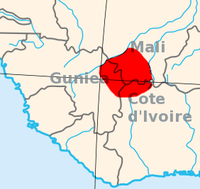
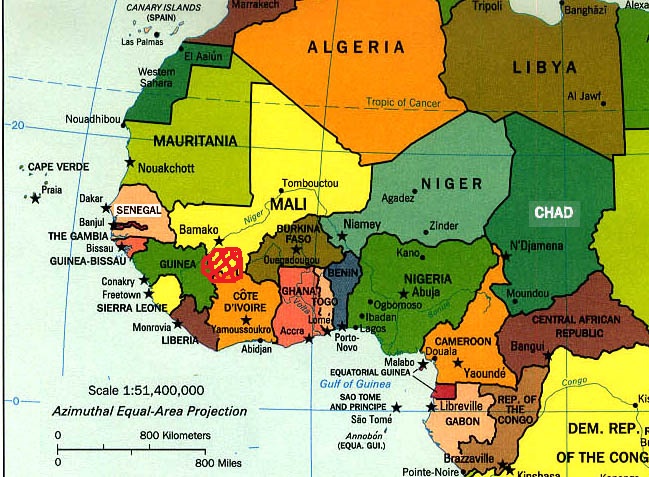
My intent is not to write a review, but rather to build off Amselle’s work and present some of my efforts in blog form here at NOL. But first, a map of the region, Wasolon, that Amselle specializes in:

Wasolon is that big red marking that I've drawn on the map. You can see that it's about as big as Sierra Leone.

Wasolon is that big red marking that I’ve drawn on the map. You can see that it’s about as big as Sierra Leone. Just for clarity’s sake, here is a second map with a closer view of Wasolon:

blog wasolon 2
Notice the rivers? source: wikipedia

Amselle’s argument for why his approach to identity is superior to others’ is convincing. He performed all of his fieldwork (15 years’ worth as of 1990) in Wasolon, or briefly in neighboring areas, reasoning that “research within numerous regions of a well-circumscribed area […] has allowed me to observe systems of transformation [in] societies that have been in contact for centuries. This has protected me from being forced into large analytical leaps and from engaging in [the current anthropological trends of] abstract comparativism and the identification of structures (xii-xiii).” This defense of his methodology, coupled with his insights on French colonial administration in the late 19th and early 20th centuries, gives me reason to believe that Amselle’s work is an excellent blueprint for better understanding the complete and utter failure of post-colonial states and the violence these collective failures have produced.

I want to take a specific route using the introductory quote, even though I could take a number of different routes using that passage. I could, for example, focus on the invention of the individual and muse about its consequences in regards to the rise of the West. I could go on and on about how other societies had writing – but not the individual- and therefore did not have the institutions necessary for “capitalism” that the West did around the 16th century. Et cetera, et cetera. Instead, I’m going to take a geopolitical route (the West is still practicing colonialism) that has a decidedly philosophical direction to it (nationalism and ethno-nationalism are both bullhooey).

First, the geopolitical context. Wasolon was basically a war zone in the 18th and 19th centuries. It was an important producer of cotton, a minor producer of rubber and ivory, and a net exporter of slaves. Wasolon was unfortunate enough to be caught between Saharan empires backed by Arabic culture, money, and technology, and coastal empires recently enriched through cultural, economic, and technological exchange with rapidly-expanding European populations. Caught between these two geographic poles, polities in Wasolon oscillated between being decentralized chiefdoms, small independent states, empire builders themselves, and vassals of empires. In such an uncertain setting, the identity of people themselves necessarily oscillated as often as their political systems did.

When the French arrived militarily on the scene (there was already a long history of economic, political, and cultural exchange between the “French” and Wasolonians; I put French in quotation marks because, of course, many Europeans found it to be much easier to use “French” as an identity in French Sudan rather than their own), Wasolon was home to many decentralized chiefdoms, and they were all in the midst of a protracted and brutal war with the Samori Empire, a Saharan polity that rose quickly and ruthlessly to prominence in the late 19th century.

The Samori Empire – which the French military was in contact with due to its centralized political structure (it had a bureaucracy and an organized military, for example) – claimed Wasolon as a vassal state and the French, out of ignorance or expediency (to attribute it to malice gives French central planners too much credit), simply took Samori at its word (a policy that continues to play out to this day in international affairs, but more on this below).

The French military commanders and, later, colonial administrators eventually figured out that Wasolon was not a loyal vassal. From the French perspective, the resisting chiefdoms in Wasolon had formed an alliance against the Samori Empire, and this alliance was based on an ethnic solidarity shared by all Fulani. Amselle labors to make the point that this alliance  was based on a “mythical charter” long prominent in Fula oral traditions (and has some basis in the historical accounts of Arab and European travelers). This “mythical charter” served as the basis for the French colonial understanding of the Fula and eventually for the notion of a Fulani ethnic identity. The problem here is that the “mythical charter” was just that: a myth.

I’ll start by extracting an insight from the footnotes:

As we saw in Chap. 5, colonial ethnology merely reproduces this local political theory by taking it literally, thereby assimilating these “mythical charters” to a real historical process. Such a reproduction is what makes this ethnology truly colonial. (179)

In the Chapter 5 that Amselle alludes to in his footnotes, Mestizo Logics explains how the Fula people of Wasolon adopted fluid political identities over the centuries, depending on who was in power and who was about to be in power. This fluidity played, and continues to play, a much more important role in how people identified themselves politically (“local political theory”) than either culture or language.

Amselle illustrates this point best by pointing out that a number of chiefdoms in Wasolon claimed to be Fula at the time of the French conquests in the late 19th century, but that the populations spoke a different language than the Fula and were culturally distinct from the Fula (these Wasolon chiefdoms claiming Fulaniship were Banmana and Maninka in language and culture rather than Fula). Amselle then points out that Fula chiefdoms existed outside of Wasolon that don’t claim to be Fula – even though they are culturally and linguistically Fula – and instead identified as something more politically expedient (he doesn’t elaborate on what those non-Fula Fulani identify as, only that they did, and still do).

The French state’s act of writing down and categorizing this “mythical charter” as a distinct feature of Wasolon’s Fulani thus created the Fula ethnic group and, through imperial governance, ensconced this new group into its empire’s hierarchy based on traits that ethnographers, colonial administrators, historians, and managers of state-run corporations had recorded (accounts written by merchants not connected to the state in some way could not be trusted, of course).

Basically, when the French showed up to build their empire in west Africa they bought the narrative espoused by a couple of the factions in the region and based their empire (which was only feasible with the advent of peace in Europe after the Napoleonic Wars) on that narrative. The results of this policy are eye-opening. Aside from the fact that the present-day states of Mali, Cote d’Ivoire, and Guinea are failures, the old rules of fluid identity used by Wasolonians for political and economic reasons were erased and new rules, based on bureaucratic logic (“ethnicity”), were wrested into place by the French imperial apparatus. These new ethnic identities soon took on characteristics, ascribed to them by others, that quickly became stereotypes. The ethnic groups with good stereotypes (like being hard-working) ended up – you guessed it – in positions of power, first in France’s imperial apparatus and then for a short time after independence.

Sound familiar?

If it doesn’t, think about international governing institutions (IGOs) like the United Nations or the World Bank for a moment. Why don’t these institutions recognize the likes of Kurdistan, Baluchistan, or South Ossetia? Is it because these IGOs are evil and oppressive, or simply because these bureaucracies cannot adapt quickly enough to a world where identity and the necessities of political economies are always in flux?

This phenomenon is not limited to post-colonial Africa, either. Think about African-Americans here in the United States and the stereotypes attributed to them. Those stereotypes – good and bad – are a direct result of bureaucracy.

Individualism, to me, is the best way to tackle the long-standing problem created by colonial logic abroad, and racism at home. Government programs that seek to help groups by taking from one and giving to another are just an extension of the bureaucratic logic revealed by Amselle’s work in French West Africa. But what is a good way to go about implementing a more individualized world? Open borders? Federation?

“Landscapes of Nationalism” interview

Here is an interview a colleague of mine did with me last month regarding my summer trips, which somewhat are connected by a same thematic thread – on how I stumbled upon incidents of big and small nationalisms. It appeared in our obscure university newsletter with an open access. An excerpt:

When I left Estonia and arrived in St. Petersburg, which is in northern Russia, the first thing I saw, when coming out of the airport, was a large posh car that was passing me. Its windshield was decorated with an orange and black “St. George ribbon”; this ribbon (a symbol of the patron saint of the Russian military) is currently a badge of patriotism for millions of my former compatriots. The back of the car sported big letters in blue: “Onward to Berlin! I honor WWII vets.” The irony of the situation was that the car driven by that well-to-do patriot was a German Mercedes! By the way, the topic of World War II is a “sacred cow” in Russia. From the Soviet times to the present, the government and conservative elements have been constantly bombarding people with two pieces of propaganda. First, they have being arguing that the Soviet Union/Russia had singlehandedly saved the world from fascism. For this reason, the whole world owes them everything. Second, since the country lost in that war more people than any other country, Russians suffered more than anybody else and, again, for this reason, the world owes them. Many people internalized this mythology.

Myths of Sovereignty and British Isolation XVI, Britain’s Significant Others: France and Germany (1)

Moving on from the narrative of British history concluded in the last post, some thoughts about the way that Britain has existed as a European nation in comparison with other nations, mostly Germany and France. Britain has been defining itself in comparison with these two, in more or less friendly ways since Germany emerged as a modern unified state in 1871. The comparisons with France go back further, as has been partly explored in the narrative posts from Æthelred II’s (the Unready) marriage to a French princess to the Tudor loss of Calais.

The attitude to Germany has been coloured by the pre-1870 Prussian monarchy which became the imperial family of Germany, while retaining the Prussian royal title, in 1871. Even the Prussian monarchy, though, is new compared with the French state. The Prussian kingdom only goes back to 1701, as an elevated form of the Margravate of Brandenburg in which the Hohenzollern family had been the Margraves since 1415, and even that is rather recent compared with the beginning of the history of France. Anyway, we cannot think of Brandenburg-Prussia as a pre-formation of the German state until the early nineteenth century when it took lands on the Rhineland and emerged as the joint leading power in Germany, along, with Austria, after the European  settlement at the end of the Napoleonic wars.

It is not entirely clear when we can date the beginning of the French state, since the earliest form, or preformation, of it was the Frankish kings who became rulers of some part of what is now France in the fifth century with the collapse of Roman rule in what had been Gaul. The Franks were German and the sense that the aristocracy of France had a different national origin from the common people lingered into the nineteenth century. It is only in the ninth century that Old French emerges as a written language of state business while the title of King of the Franks was separated from that of the dominant ruler of Germany, holding the title of Emperor of the Romans since the Frankish king Charlemagne was crowned by the Pope in 800.

The official title King of France only stated to replace King of the Franks in the late twelfth century, but it is safe to say that something like a swell defined the French state with a very broadly defined sense of shared culture between king and French speaking subjects goes back to the ninth century, after a preformation going back to the fifth century. Of course it should be remembered in relation to that it was only in the nineteenth century that a shared mass competence in the French of Paris prevailed across France including communities which were historically Basque, Flemish, Breton, German, Italian and Occitan (southern versions of French including Povençal), though a linguistic unity of the educated goes back much further.

One aspect of the sketches of French and German history above, is that the history of the dominant power in western Europe is often the history of France and Germany in various sometimes overlapping forms. This continues into the European Union which is at its heart a Franco-German union and that can be seen in the Euro which comes out of the French belief that it could import German economic success and discipline through a common currency, as well as the belief that it could mitigate German influence in Europe after post-Cold War unification though a shared monetary mechanism. One problem with British membership, maybe the most important, is a lack of interest in the French and German belief in a shared destiny best managed by some pooled sovereignty in a unified Europe, largely if not entirely consisting of countries strongly influenced in their history by contacts with France and Germany.

The most important issue in this post, though, is that France has a history as old and as grandiose as that of Britain, in fact preceding the unified British state history of England and Scotland only going back to 1603. The reason for emphasising this is the British sovereigntist-Eurosceptic tendency to regard France, like all European nations other than Britain in their view, as somehow less proud of their nationality, less patriotic, and less real as nations than Britain.

Really this is preposterous nonsense, and it should not be said that all British eurosceptics hold to this view, but it is hard to imagine the Eurosceptic current existing in Britain without this aspect of its culture, and hard to imagine even many of the more fastidious Eurosceptics do not believe this in their guts. The apparent willingness of France to share sovereignty with Germany in the EU even when Germany has become clearly the dominant EU country may to some degree explain this, but does not justify it.

More on this in the next post

From the Footnotes: Race, Nationality, and Empire

We have more to say than space allows about ‘race’ and ‘community’ as an imperial organizing category, especially in the British Empire, and about complex transformations and incongruities in decolonization as plural, hierarchical fields of multiply ‘races’ and ‘communities’ were constituted into new nation-states. A return to the dictionaries shows that while definitions of ‘nation’ before World War II sometimes connected nations to states, they invariably defined nations as ‘races’ and made the connection to race, not state, primary. Challenges to this linkage of nation and race were available at the time, notably Renan’s 1882 lecture rejecting race, language, and territory as bases for nationality. This argument eventually became famous. But the dictionaries changed only after that crescendo of failure of nations seeing themselves as races destined to dominate empires, the global catastrophes following the German effort to found an Aryan Third Reich and the Japanese effort to build a Co-Prosperity Sphere with the Yamato race as nucleus. Benedict Anderson deserves credit for insisting upon annihilation of the shared descent definitions of nation, for insistence that the nation is first of all imagined, ideal, and realized in co-dependence with a state. Yet in this, we think, he is the theorist observing at dusk, theorizing the world-order of quiescent nation-states built decades before by the architects of a United Nations in the rubble of the Second World War – and theorizing them not as 20th-century contingencies but as a modern necessity. To Anderson, the disconnection of nation from race or descent group and its connection to the state was, ironically, not an historical development but something intrinsic to the nation. The fact of the Nazis notwithstanding, he found scholarship seeing any connection between nationalism and racism simply ‘basically mistaken’.

This from “Nation and Decolonization: Toward A New Anthropology of Nationalism” by John D Kelly and Martha Kaplan in Anthropological Theory (gated, unfortunately).

What is a nation?

This is a reply to Brandon’s latest post. I offer similar thoughts to the below post in my post about ethnicity.

I agree with Brandon that in discussing things we should not limit ourselves to thinking in terms of states. We must consider, as Brandon puts it, both supra and sub states. We must also recall that states are much more fluid than we usually consider them.

When discussing international relations I attempt to get my conversation partners to agree that:

(1) National borders are not stable and,

(2) National identity is more fiction than reality.

The first is easily confirmed by looking at historical maps. Here is a map of the Levant/Greater Middle East in 14th century BC, in 830 BC, in 634 AD, in 1135 AD, and in 1900 AD.

Egypt and Persia are the only two entities that are present in some form or another throughout this time span, and even then their respective borders have fluctuated with only a few core regions being stable. I have yet to find someone who disagrees with the first point.

The second point is harder to get people to concede. We often think of ourselves as a given national identity and find it difficult to imagine that our nation did not exist since the beginning, or at least as far back as imaginable. Most nations have a foundation epic that makes little sense when seriously scrutinized.

Take for example American national identity. Three hundred million plus souls imagine themselves as ‘American’, but what exactly does that mean?

American identity cannot be equated with a specific phenotype; i.e. Americans are not all blue eyed blond people of English descent. In colonial days blacks outnumbered whites in several regions. Today whites in the Mid-Atlantic states are bronze skinned due to the dominance of Mediterranean descent there. The southwest is filled with “Hispanics” who overwhelming self-identify as white but are not considered really white, hence the curious demographic term “non-Hispanic white.” Even in the cradle of the American revolution, Massachusetts, the largest ancestry group is the Irish not English. The only state that is predominantly of English descent is Utah.

Among whites there is constant tension over who was really white and who is a “white negro.” Germans, who are today the largest ancestry group in the US, were the first ‘white’ subgroup to have to fight to prove that they were really white. The Irish, Italians, and others of European descent all had to fight for inclusion into the ‘white’ group. Today Hispanics and Asians are both vying for inclusion.

The revolutionary war serves as the US’ de facto national epic and the leaders of the rebellion are treated (and on occasion sculpted) as demi-gods. Yet the popular image of the revolution is more fiction than reality. Americans paid very little in tax relative to residents of the British isles. George Washington was a horrible military strategist. The founding fathers were not fighting to ensure liberty for the common man – they were fighting to shift control of government from elites in London to elites in Philadelphia. To be sure there were a few true revolutionaries, such as Thomas Paine, who were involved in the hope of genuinely reforming government. For every Paine, though, there were a dozen Hamiltons who wanted to preserve the British Empire, just without the British.

‘American’, in so far as it is an ethnic label, is non-stationary and continually evolving. I would not be amazed if the American label went extinct and was replaced with other labels in the future. Perhaps the Pacific Northwest will become inhabited by Cascadians in the future?

None of this is unique to the American moniker. It is easy to pick on the United States since it is a young nation, but most nations are just as fluid and nonsensical.

What does it mean to be British? Turkish? Austrian? Spanish?

Were the inhabitants of the British isles prior to the Norman invasion British?

The Byzantine Empire was only recently destroyed and many of its inhabitants inter married with Turkic migrants. The Ottomans gave themselves the title of Roman Emperor, “Kayser-i Rum.” A friend of mine jokingly calls Turks “Anatolian Greeks.”

‘Austrian’ as a national identity is arguably younger than the American moniker. Prior to the disestablishment of the Hapsburg Empire in WW1 there was no independent Austrian geopolitical entity. Austria was a constituent member of the Holy Roman Empire, the Hapsburg crown lands, the Austrian Empire, and Austria-Hungary before finally becoming simply Austria following WW1. Austrians are as culturally distinct from other Germans as Bavarians or Swabians are. Why then are Austrians a national group, but the latter two aren’t?

The Iberian peninsula has been under Muslim control (700s~1600s) longer than it has been under a united Spain. Spaniards continue to have significant traces of Arab/Berber genetic material. Despite the actions of Franco, Spanish (or “Castilian”) is not the sole language used in the country. Several million in the country’s northeast wish to cease being Spanish altogether in order to form an independent Catalan.

What is a nation? I argue that it is a group label that is invented and sustained in so far as it serves to further the goals of elites. Within an individual’s lifetime they appear unchanging, but from a historical perspective they are fluid and are frequently created, killed, or reborn as needed. When conversing about geopolitics we cannot ignore national identity, but we must keep in mind that in the long run nationality can be, and is, molded to suit political goals.

Nationality, Ethnicity, Race, Culture, and the Importance of Citizenship for the Individual

Judging by some of the fruitful dialogues that have gone on here in the distant past and just the other day, I’d say that there is still a lot of work to do regarding a few concepts that seem to have meaning to them but are not really well-defined or well-understood.

I am writing about nationality, ethnicity, race, and culture, of course.

Dr Stocker and myself have taken aim at nationality before, and Michelangelo has taken aim at ethnicity while Jacques has taken a few cracks at race and ethnicity. Mike has some notes on ethnic identity as well. Culture has been discussed here at NOL before, but an effort to systematically define it has not been undertaken. (Update 12/8/14: Matthew has also taken a crack at ethnicity.)

The problem of these concepts can best be illustrated with a hypothetical (with apologies to Matthew!): There is a tribe in the state of Kenya known as the Maasai. In Kenya the Maasai are more than a tribe, though. The Maasai are considered by both the Maasai themselves and their neighbors to be an ethnic group. The Maasai and their neighbors within Kenya also consider themselves to be Kenyans. The Maasai have a distinct culture that sets them apart in some way from other ethnic groups in Kenya. Most Kenyans, including the Maasai, consider themselves to be racially black.

Now suppose that a single Maasai man from Kenya goes to Syria, or Belgium, or Canada, or China for a vacation. The Maasai man is suddenly no longer Maasai, for all intents and purposes. He still has a nationality, and an ethnic, a cultural, and a racial component to him, though. The Maasai man’s ethnicity suddenly becomes Kenyan rather than Maasai abroad. So, too, does his culture become Kenyan or simply African. He is still black racially. Notice, though, that these concepts mean different things in different contexts.

Suppose further that our Maasai man goes to Ghana for a vacation. Ghana is in west Africa, whereas Kenya is on the east coast. Africa is huge, and the gulfs between societies on the west coast and east coast of sub-Saharan Africa are cavernous. Nevertheless, our Maasai man is likely to be able to identify ethnically as a Maasai in Ghana. He is likely to be able to identify as part of the Kenyan nation. Culturally, though, our Maasai man is also going to be identified as Kenyan rather than Maasai.

Confused? Yeah, me too.

Here is another way to confuse you. The Ashanti people of Ghana are considered by others in the region to be a nation, but not an ethnic group. The Ashanti belong, instead, to a pan-regional group of people known as the Akan, and the Akan are considered to be the ethnic group while the smaller Ashanti group is considered to be a nation. This, of course, comes into conflict with what it means to be a Ghanaian. In Europe or Asia or the New World, a member of the Ashanti nation would be considered instead as a member of the Ghanaian nation.

In sub-Saharan Africa everybody who is not black is white. So Persians, Arabs, Eskimos, Armenians, Koreans, Japanese, French, English, Dutch, and Brahmins are all racially white to Africans. Africans base their distinctions between whites on their different behavioral patterns. So a Sudanese man may be working with two groups of white people but he only distinguishes them (suppose one is Chinese and one is English) by how they behave toward each other, toward him and his associates, and in relation to the rules of the game established in Sudan. Race is the most prominent feature of foreigners in Africa, but curiosity about differences between whites abounds.

The combinations for confusion are endless. I have not even broached the topic of what is means to be ‘American’, for example.

This is where the importance of viewing the world as made up of individuals comes into play. This is where the abstract legal notion of individual rights becomes an important component of good governance and internationalism.

I think we could all agree that is does no good to ignore these confusing identities and attempting instead to cram them into a specific framework (“Western individualism”). This is where economists go wrong, but paradoxically it’s also where they are most right.

As I noted a couple of days ago, economics as a discipline tends to be more hierarchical but also more successful than the other social science disciplines. I didn’t have enough space to note there that this hierarchy is limited to a very small segment of society. Is it at all possible to establish a hierarchy of sorts, a unified code of laws that protects the individual but prevent this hierarchy of last resort from becoming the norm in other ways? A hierarchy that leaves plenty of space for independent networks and fragmented communities of choice?

I don’t even know how these question tie in to my title. I simply know that they do. Somehow.

Nations, States, and Foreign Policy Fantasies

Below is my attempt to make sense of the world, especially that of the Middle East. It’s best viewed in tandem with two earlier posts on the subject, and deals with military intervention (as opposed to outright war).

This post concerns the issue of scholars, journalists, intelligent laymen, and activists continually evoking the nation-state as their point of reference for discussing and analyzing foreign affairs. Here are two general examples:

I don’t think all nation-states are morally equal.

And,

The list of nation-states involved in the Syrian fiasco are few in number.

This is logical as far as it goes, and there is something to be said for using the nation-state as a tool for better understanding the world around us, but in the post-colonial, developing world there are no nations attached to the states there.

Let me see if I can explain. The nation-state is a rare and parochial political unit found only in Europe and in parts of East Asia. Notice the hyphenation of the words “nation” and “state.” These are two very different concepts, and yet they are applied – together – nonchalantly in nearly every study or report to be found on international relations.

The interwar economist and patron saint of the present-day libertarian movement, Ludwig von Mises, studied nations after World War I out of a desire to better understand why large-scale violence occurs and how it can be prevented. I appeal to the authority of Mises on this matter because of the attempt by some libertarians today to simply disparage understandings of collectivist concepts such as “nation” with a brusque “the world is composed of individuals and nothing else, so your argument is invalid as well as incoherent.” It is true that individuals should be at the forefront of any question asked about society, but attempting to do so with tabula rasas won’t get you anywhere.

Here is Mises on nations, in the first chapter of his excellent 1919 book Nation, State, and Economy (pdf; and one of only two books I’ve read by Mises), making my point for me much better than I could ever hope to do:

If we wish to gain insight into the essence of nationality, we must proceed not from the nation but from the individual. We must ask ourselves what the national aspect of the individual person is and what determines his belonging to a particular nation. (34)

When a libertarian points out that the world is composed of individuals he is correct, but when he brushes aside any and all attempts to understand collectivist ideas such as nationalism he puts himself at an intellectual disadvantage. Perhaps this is because many libertarians, especially the post-Ron Paul 2008 ones, don’t want to think things through anymore. Perhaps it’s power they crave, rather than liberty and truth.

At any rate, Mises continues his thoughts on nationality with this sentence: “We then recognize immediately that this national aspect can be neither where he lives nor his attachment to a state. (34)” Nationalism isn’t even a phenomenon that can be tied to a specific geographical location, much less a specific state. (It’s worth noting that this is still the rough understanding of “nation” that sociologists and anthropologists have today. Many other theories about the “nation” have been swept away into the dustbin of history. I point this out because classical liberals tend to produce works that stand the test of time, and this is because of their commitment to the individual.) How can a conception of “nationhood” not be directly tied to territorial or political attachment?

I don’t claim to know, but here is how I break this recognition down. The tie-in to US foreign policy is coming, I promise.

The New World (Canada, the US and Latin America) is home to a small number of large republics that broke away from an imperial center at some point in the past. This is a very different arrangement from the large number of small nation-states in Europe and Japan/Korea mentioned earlier. There is no Brazilian nation to speak of. No American nation or Colombian nation to brag about. Only Brazilian, or American, or Colombian citizens are found in the republics of the New World.

While there are arguments to be made about the seriousness of nationalism in the New World republics, I don’t pay them much heed because the distinction between ‘citizen’ and ‘nation’ explains well Europe’s and Japan’s inability to assimilate immigrants as successfully as the republics of the New World.

The chronic bouts of fascism afflicting Latin America (and FDR’s United States) are largely the result of attempts to create a nation out of citizens.

In the Old World not consisting of Europe and Japan/Korea (i.e. the developing, post-colonial world), there is a small number of Western-educated elites who have been attempting, like the caudillos of Latin America, to create nations where there are none. These nation-builders are, consistent with their conformist Western education, national socialists. They borrow from liberalism its secularism but not its other laissez-faire underpinnings.

The advocates of Western military intervention, including Dr van de Haar and Dr Delacroix here at NOL, firmly believe that replacing the “bad” national socialists, such as Saddam Hussein, Hosni Mubarak, and Bashar al-Assad, with “good” national socialists will bring about viable, meaningful change in the region. Just sprinkle some fairy dust and – poof! – the new batch of national socialists will behave differently.

When pressed on this inevitable scenario, libertarian-ish military interventionists will renege on removing a dictatorship and replacing it with an alternative (which, again, will itself inevitably become a dictatorship). They recognize the futility of such an enterprise. Instead, they change tact and argue that a protracted bombing campaign would be a better option. This option, of course, has the effect of prolonging a conflict, which is blatantly at odds with the supposed humanitarianism of a military intervention in the first place.

The military interventionist simply assumes that a nation actually exists in these post-colonial, developing states, but nationhood is a concept that is limited to a small elite. An elite, I might add, that is just as illiberal as its Islamist (and other conservative) enemies.

Historians have long attributed the rise of the nation-state in Europe to wars and the absence of a hegemonic power. The decentralized nature of Eurasia’s backwater western region created the nations and states of Europe. Wars forced states to harness the potential of their citizens through political, economic and social nation-building. The lack of a hegemon forced these same states to compromise in otherwise uncompromisable situations.

Prolonging the war in Syria through a protracted bombing and arming campaign against ISIS, as military interventionists advocate, will not only keep the blood flowing, it will prevent a clear winner from emerging. “Humanitarian” intervention will prevent dialogue about what it means to be a nation. Indeed, it will prevent dialogue period.

If military interventionists truly want freedom and a lasting peace for the Middle East (and it is not clear that this is what they want) they would do well to stop relying upon the logical inconsistencies that they have fed to themselves over the past century. No amount of fairy dust or unicorn shit will be able to compensate for their fatal conceit.

What is missing from the Middle East is a vibrant sense of nationhood. It is no accident that the peoples in the Middle East with a strong sense of nationhood – the Turks, the Palestinians, the Kurds, and the Israelis – have had to fight for survival over the last 100 years or so to create, to retain, and to promote the cause of their nations.

Preventing dialogue, preventing compromise, and preventing victory in Syria by inadvertently playing different sides off on each other is not a humanitarian option. It’s not even a good “smart power” option. The military power of the West has been overrated for about a hundred years now. Its true power rests in the international institutions – international governmental organizations (IGOs) – it has been creating piecemeal over the past five hundred years. I blogged about wielding this influence most recently here and here. (and here is an older one). Also, open borders is an option that is never entertained by the international relations community (which is probably because it can only be implemented with some sort of political integration).