It’s the mag’s first-ever special issue, and it’s a doozy:
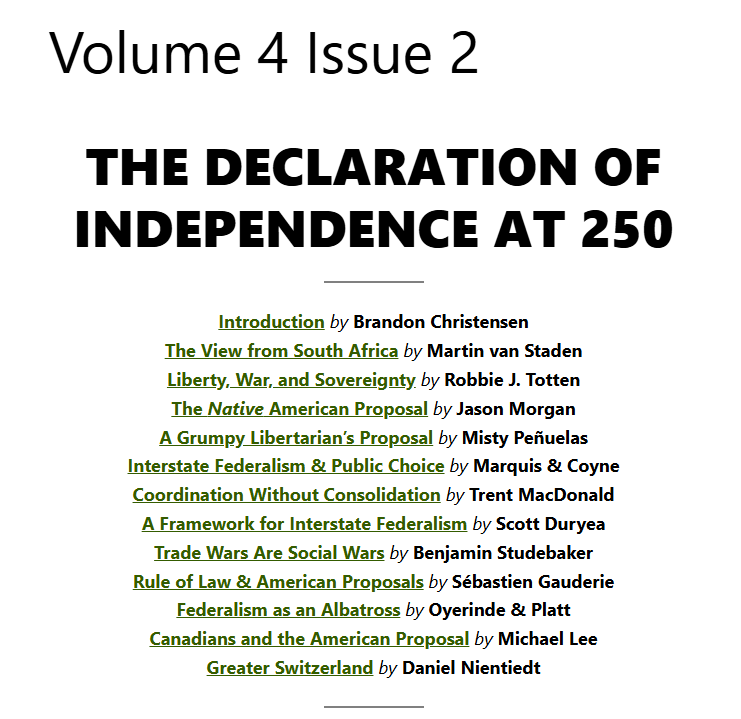
Click here to read it. Notes On Liberty (and a special guest — a Notewriter) makes an appearance in the coda 🙂
It’s the mag’s first-ever special issue, and it’s a doozy:
Click here to read it. Notes On Liberty (and a special guest — a Notewriter) makes an appearance in the coda 🙂
It’s the mag’s first-ever special issue, and it’s a doozy:
Click here to read it. Notes On Liberty (and a special guest — a Notewriter) makes an appearance in the coda 🙂
It’s the mag’s first-ever special issue, and it’s a doozy:
Click here to read it. Notes On Liberty (and a special guest — a Notewriter) makes an appearance in the coda 🙂
It’s the mag’s first-ever special issue, and it’s a doozy:
Click here to read it. Notes On Liberty (and a special guest — a Notewriter) makes an appearance in the coda 🙂
On Thursday, Parler was the most popular app in the United States. By Monday, three of the four Silicon Valley monopolies united to destroy it.
With virtual unanimity, leading U.S. liberals celebrated this use of Silicon Valley monopoly power to shut down Parler, just as they overwhelmingly cheered the prior two extraordinary assertions of tech power to control U.S. political discourse: censorship of The New York Post’s reporting on the contents of Hunter Biden’s laptop, and the banning of the U.S. President from major platforms. Indeed, one would be hard-pressed to find a single national liberal-left politician even expressing concerns about any of this, let alone opposing it.
Not only did leading left-wing politicians not object but some of them were the ones who pleaded with Silicon Valley to use their power this way. After the internet-policing site Sleeping Giants flagged several Parler posts that called for violence, Rep. Alexandria Ocasio-Cortez asked: “What are @Apple and @GooglePlay doing about this?”
The rest is here. Do read it. (H/t Mark from Placerville)
I haven’t jumped into American domestic politics for a long, long time. It’s nice to see that Glenn Greenwald is still the same ol’ Glenn Greenwald. I saw on Twitter awhile back that some Leftists were savaging him because he refused to take their side on something or other.
The tribal trend is one that is here to stay, I think, at least for the duration of my lifetime. In the old days, in the United States, politics was more polarized. Whole families based part of their identity on a political party. What we are seeing is a return to the norm after 80 years of postwar boom (and bust), when being an American trumped being a Democrat/Republican. Coming to terms with a bug in the democratic system (polarization), is going to be difficult for a lot of Americans.
The problem is not just ignorance with polarization, either. Before the postwar boom, America’s federal government did a lot less than it does now. Our polarized society, which again is a normal feature of democracies that don’t win world wars, is fighting for resources that are now wielded largely by one entity rather than by hundreds of local entities. There are plusses and minuses to this. The federal government is more professional about such things, and graft is harder to commit, but this also means that there will be more losers (for those federal goodies).
In the past, violent riots were the product of racist and Nativist animosities that were not dealt with effectively by local authorities. Basically, black Americans and immigrants were not able to get any public goods from local and “state” governments unless they literally fought for a place at the table. Today, and for the foreseeable future, the animosities are going to be federal in scope rather than local, so violence will not be a product of racist or Nativist abuse. Violent riots will probably flare up more often than they once did, too, but they won’t be as deadly as the racist or Nativist riots of old.
I hope I’m wrong, but I rarely am.
One of my papers was accepted for publication in the libertarian journal The Independent Review. Here’s an excerpt:
This essay aims to fill that gap by making four arguments:
1. Prominent classical liberals and libertarians have long recognized the importance of interstate federalism for not only individual liberty but security for liberal polities in the international arena as well.
2. The American federalists of the late 18th century faced the same problems we face, and the distinct interstate order that they patched together to solve those problems is not an outmoded Leviathan; it is the missing piece of the puzzle to the libertarian and classical liberal tradition of interstate federalism.
3. The piecemeal federation of political units under the U.S. constitution would achieve more freedom for more people, and this interstate federalism should be enthusiastically embraced as the foreign policy principle for libertarians and classical liberals.
4. The American Proposal would solve the security (and cost-sharing) dilemma for liberal polities, but it would also contribute to a decline in the worrisome trend of presidential government in the United States.
I gotta give props to the editors and the referees of the journal. I know they didn’t like my argument, but they were fair, helpful, and a whole lotta fun. I’ll have more on this soon. In the mean time, here’s a sneak peak (pdf).

