Why farms die and should die


In Canada, I have the frustrating habit of criticizing government support to the agricultural sector especially entry-barriers in the form of production quotas. Most of those policies are regressive in the sense that they reallocate income from the poorest to the richest. In fact, their entire aim is to artificially increase the income of farmers (especially dairy and poultry farmers) at the expense of the rest of the population. However, when lobbyists for these subsidies come out in public, they do so under different disguises. Their favorite? Farms are dying.

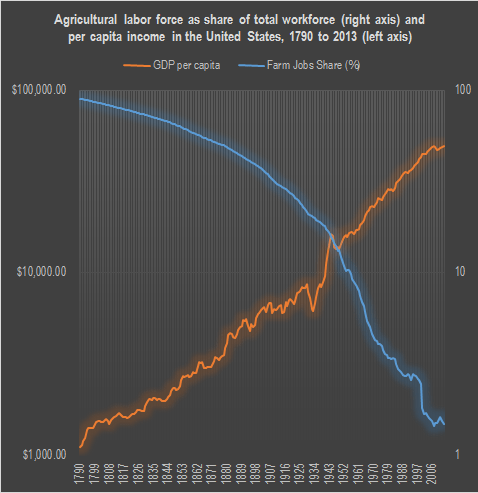
In each radio debate where that boogeyman is raised, I reply that “yes, they are dying and its a good thing”. If we can feed more and more people with less and less farmers using less and less land, that’s a good thing. In fact, it’s the greatest thing that happened in economic history. Less two centuries ago, 90% of the workers in some western economies were involved in agricultural activities. Today, that proportion has fallen to less than 1.5%. Thousands of farms disappeared, we liberated millions of acres of land to return to their natural state and in the process, we became rich and well-fed!

In testimony of this fact, which is my favorite economic history fact, I decided to recompute a graph by Mark Perry of the American Enterprise Institute but I added the GDP per capita figures for the same period (1790 to 2013).

GDPagriculture

Yes, let the farms die. Let the most productive stay in the fields and let them feed humanity while the others become engineers, doctors, teachers, businessmen, welders, carpenters or whatever trade they are best at!

Basic income: a debate where demand magically disappears!

For a few months now, the case for the basic income has resurged (I thought it died with Milton Friedman in 2006, if not earlier). In the wake of this debate, I have been stunned by the level of disconnect between the pundits and what the outcome of the few experiments of basic income have been. The most egregious illustration of this disconnect is the case of the work disincentive.

To be clear, most of the studies find a minor effect on labor supply overall which in itself does not seem dramatic (see Robert Moffitt’s work here). Yet, this is a incomplete way to reflect on the equilibrium effect of a massive reform that would be a basic income.

Personally, I think that there is a good reason to believe that the labor supply reaction would be limited. At present, many tax systems have”bubbles” of increasing marginal tax rates. In some countries like Canada, the phasing out of tax credits for children actually mean that the effective marginal tax rate increases as income increases from the low 20,000$ to the mid 40,000$. As a result, a basic income would flatten the marginal tax rate for those whose labor supply curve is not likely to bend backward. In such a situation, labor supply could actually increase!

Yet, even if that point was wrong, labor supply could shift but without any changes in total labor provided. Under most basic income proposals, tax rates are dropped significantly as a result of a reduced bureaucracy and of a unified tax base (i.e. the elimination of tax credits). In such a situation, marginal tax rates are also lowered. This means greater incentives to invest (save) and acquire human capital. This will affect the demand for labor!

A paper in the Journal of Socio-Economics by  Karl Widerquist makes this crucial point. None of the experiments actually could estimate the demand-side reaction of the market. Obviously, a very inelastic labor demand would mean very little change in hours worked and the reverse if it was very elastic. But what happens if the demand curve shifts? Widerquist does not elaborate on shifts of the demand curve, but they could easily occur if a basic income consolidates all transfers (in kind and conditional monetary) allows a reduction in overall spending and thus the tax take needed to fund activities. In that case, demand for labor would shift to the right. A paper on the health effects of MINCOME in Manitoba (Canada) shows that improvement in health outcomes are cheaply attained through basic income which would entail substantial health care expenditures reduction.

I have surveyed the articles compiled by Widerquist and added those who have emerged since. None consider the possibility of a shift of the demand curve. Even libertarian scholars like Matt Zwolinski (who has been making the case forcibly for a basic income for sometime now) have not made this rebuttal point!

Yet, the case is relatively straightforward: current transfers are inefficient, basic income is more efficient at obtaining each unit of poverty reduction, basic income requires lower taxes, basic income means lower marginal tax rates, lower marginal tax rates mean more demand for investment and labor and thus more long-term growth and a counter-balance to any supply-side effect.

I hope that the Bleeding Heart Libertarians will take notice of this crucial point in favor of their argument!

From the Comments: Military intervention, democracy, and stability

Longtime reader (and excellent blogger in his own right) Tam has an interesting response to Chhay Lin’s thoughts on the Paris terrorist attacks:

It is an interesting read indeed but there are two or even more sides to every story. What we are also noting is that many of these groups that hate Western interventionist policies also hate their own people for being different in one way or the other. However, I agree that the misplaced perception of democracy as the superior form of governance overlooks the essential internal historical and socio-political factors behind the politics of the different countries that have become victims of Western ‘sanctification’ processes fronted by bombs after daring to opt not to embrace democracy. Libya and Iraq were stable before Western intervention.

Tam’s point strikes at the heart of the difference between military interventionists and non-interventionists, I think. Libya and Iraq were indeed stable, but not everybody was free. In Iraq, Shias, Kurds, liberals, and religious Sunnis were all brutally suppressed, and this oppression stood in stark contrast to the freedoms that secularists, women, union members, some socialists, and the politically apathetic enjoyed. The sociopolitical dynamics in Libya were the same, though with different local actors.

This reality is something that both sides of the interventionist debate recognize, though the interventionist side seems to place much more faith in government when it comes to “doing something.” Jacques and Edwin, for example, have both argued that bombing ambiguous factions in Iraq, Syria, and Libya would contribute to the freedoms of the oppressed factions in those countries. Looking back on the debate makes it clear that they weren’t wrong, but look at what those freedoms have produced. Those freedoms have come at the expense of the freedoms of the factions that the dictators were protecting.

What this situation shows me is that the states of the post-colonial world are unviable. Stability comes at too steep a price (dictatorship), and democracy’s unpredictability only leads to predictably violent results in the post-colonial world.

This impasse, which I cannot be the only one in the world who recognizes, has led me to take a hard glance at two specific peace processes in the Western world: The diplomatic efforts of Europeans after the Napoleonic Wars (“Concert of Europe”) and the founding of the American republic, which is, in my mind, the most successful endeavor in the history of international relations. Neither of these efforts led to the complete abolition of war, but both have helped to maintain a relatively peaceful co-existence between large numbers of factions for long periods of time.

The Concert of Europe bought time for factions in the region to solidify their legitimacy at home, culminating in both the creation of Germany and Italy in the late nineteenth century and the infamous overseas imperial  domains of France, the UK, and the Netherlands (among a few others). While this peace process brought about prosperity for Western Europe, it was not inclusive and it still adhered to the Westphalian notion of state sovereignty. What state sovereignty means is that each state, in the context of international affairs, has a right to do whatever it pleases within the confines of its own borders (such as massacre hundreds of thousands of people in the name of stability). The Concert of Europe was also the precursor to the post-1945 peace process that created the state system that we all live with today, though I would argue that there are some elements that could be republican, such as the IMF and World Bank, provided some changes in mindset.

Aside from the problems produced by the notion of state sovereignty, the states of the post-colonial world today suffer from an issue of legitimacy, both from domestic populations and from foreign ones. Domestically, all of the factions that stability-inducing dictatorships oppress do not buy in to the argument that the states purporting to govern them are legitimate. In foreign affairs, many factions do not believe that these post-colonial states are legitimate either. Hence the calls for bombing campaigns, proxy wars, or outright invasions and occupations of states like Iraq and Libya by states like the US or France (even if these invasions come at the expense of domestic and international rule of law).

This situation, where post-colonial states claim to have sovereignty within an international state system but where domestic and international factions ignore such claims, is where we’re at today. It’s the status quo, and while it worked relatively well in a small part of the world for about hundred years or so, it’s obviously failing today.

Enter the founding of the American republic. Unlike the Concert of Europe, self-determination à la breaking away from the UK was a guiding principle of the federal system, rather than state sovereignty. Like the Concert of Europe, the statesmen who crafted the American republic were concerned about invasion, hegemony, and all of the other bad stuff that happens in the international arena. So they set up an inclusive, republican system of states rather than attempt to balance power off on each other, like they did in Europe. The republican, or federal, system tied each state up into the affairs of the other states, whereas the balance of power system contributed to the formation of rival blocs within the system. This is why Europe switched from trying to maintain yet another balancing act to building an actual confederation (though one that is far too complex than it has to be) after World War II.

From a strictly war and peace view, the republican state system has led to one war so far (dating from 1789). From the end of the Napoleonic Wars, in 1815, to today, the balance of power state system has led to numerous wars.

Now, I know what you’re thinking: Woodrow Wilson’s foreign policy was based on self-determination, and his foreign policy was a disaster. This is true, though I would argue that Wilson was simply confused about what self-determination actually implied. For Wilson, recognizing the self-determination of various groups within empires would lead to state sovereignty for these groups, and that this state sovereignty would then be protected by the institutions trying to maintain a balance of power. Wilson never entertained the notion of republicanism when it came to recognizing the self-determination of peoples living in empires, he simply thought empires were undemocratic. Thus, he was actually a proponent of state sovereignty rather than self-determination.

What I am not arguing for here is a Concert of Europe-type effort for Middle Eastern actors. I think it would be a disaster, largely because regional efforts at peace-building (rather than, say, trade agreements) are useless in today’s globalized world. The Middle East needs the West, and vice-versa. Peace will only be achieved if self-determination is embraced (by not only large swathes of Mideast factions, but Western ones as well) and the new polities can be incorporated into existing republican-esque institutions. This way, more factions have a voice, and bad actors can be more easily isolated. I am not necessarily arguing that the US or EU should welcome burgeoning Mideast states into their federations, but policymakers and statesmen from these countries should at least start thinking about how to encourage and embrace the notion of a Middle East that looks a lot like our own republican world and less like the one we gave them following the destruction of the Ottoman Empire.

Stability is overrated, especially if the notion of creative destruction is taken into account.

Women and secular stagnation

As an economic historian, I’ve always had a hard time with the idea of secular stagnation. After all, one decade of slow growth is merely a blip on the twelve millenniums of economic history (I am not that interested with the pre-Neolithic history, but there is some great work to be found in archaeology journals). Hence, Robert Gordon’s arguments fall short on me.

That was until I was sparked to react to a comment by Emily Skarbek at Econlib. Overall, she is skeptical of Gordon’s claims of secular stagnation. But not for the same reasons. She claims that there are many improvements in welfare that we are not capturing through national income accounts. This is basically the same point as the one made by the great Joel Mokyr (the gold standard of economic historians).

It is true that national accounts have some large conceptual problems regarding measuring output when there are massive technological changes. Yet, all these problems don’t go in the same direction. More precisely, they don’t all lead to underestimation of growth.

My favorite example of one that leads us to overestimate growth is the one I keep giving my macroeconomics students at HEC Montreal. Assume an economy with a labor-force participation rate of 50%. Basically, only males work. All women stay at home for household chores and childcare. In that case, all measured output is male-produced output. Since national accounts don’t consider household production, all the output of women in the households of this scenario is non-existent.

Now assume a technological change causing a shift of 10% of women to the workforce at the same wage rate as men. That boosts labor participation rate to 55% and output by 5%. However, that would largely overestimate growth caused by this shift. After all, when my grandmothers were raising my parents, they were producing something. It was not worthless output. Obviously, if my grandmothers went to work, there was some net added value, but not as much as 5%. However, according to national account, the net increase in GDP is … 5%.

Obviously wrong right? Now, think of the economic history of the last 100 years. Progressively, female labor-force participation increased as marriages were delayed and family sizes were reduced. Unmarried women stayed on the market longer. Then, the introduction of new household technologies allowed some married women to join the labor force more actively. Progressively, women accumulated more human capital and became more active in the labor force. So much that in many western countries, both genders have equal labor-force participation rates.

As they shifted from household production to market production, we considered that everything they did was a net added value. We never subtracted the value of what was produced before. Don’t get me wrong, I am happy that women work instead of toiling inside a household to handwash dirty clothes. Yet, it would be both statistically incorrect and morally insulting to say that what women did in the household had no value whatsoever. 

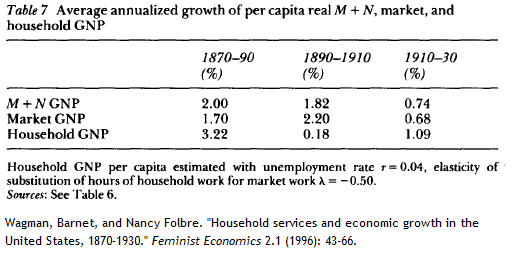
The role of household production in reducing the quality of growth estimates goes back to the 1870s! A 1996 article in Feminist Economics (which I use a lot in my own national account sections of macroeconomics classes) shows the following changes in growth rates when we account for the value of household production. Instead of increasing to 1910 and then falling to 1930, growth in the United States falls to 1930. While the growth rates remain appreciable, they nonetheless indicate a massively different interpretation of American economic history.

SecularStagnation


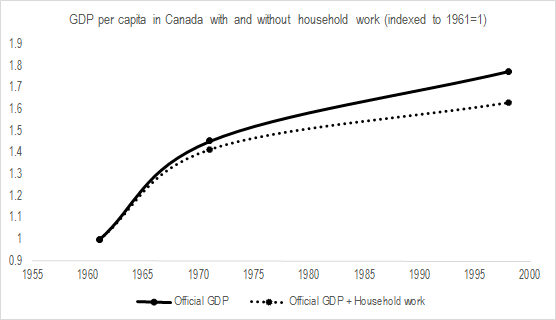
Sadly, I do not possess a continuation of such estimates to later points in time for the United States. I know there is an article by the brilliant Valerie Ramey in the Journal of Economic History, but I am not sure how to compute this to reflect changes in overall output. I intend to try to find them for a short piece I want to submit later in 2016. Yet, I do have estimates for my home country of Canada. Combining a 1979 paper in the Review of Income and Wealth with a working paper from Statistics Canada, it seems that the value of household production falls from 45% of GNP in 1961 to 33% in 1998. When we adjust GDP per capita to consider the changes in household work in Canada, the growth path remains positive, but it is less impressive.

SEcularStagnation2

I am not saying that Gordon is right to say that growth is over. I am saying that the accounting problems don’t all go in the direction of invalidating him. In fact, if my point is correct, proper corrections would reduce growth rates dramatically for the period of 1945 to 1975 and less so for the period that followed. This may indicate that “slow growth” was with us for most of the post-war era. That’s why I reacted to the blog post of Skarbek.

It also allows me to say the thing that is the best buzz-kill for economics students: national accounting matters!

Of Uber, cab drivers and compensation

What a title for a blog post right? Where am I going with this? A few days ago, I debated a few of my academic colleagues who tend towards libertarianism in the predominantly left-leaning province of Quebec. The topic? How the rise of Uber is killing the taxi cartel? I authored a paper on ride-sharing a year ago and I cannot be more enthusiastic towards such technologies that are allowing consumers much more choices at lower prices than with the taxi cartel. Thus, we were all in agreement. The point of contention appeared when the topic of compensation was raised. I favor partial compensation of the owners of taxi licences. Instantly, I was cast in the minority position and branded as a statist. A debate ensued and I made the case that it was not acceptable to right a wrong by committing another wrong (how Christian of me).

First, let me lay out some facts first and some assumptions

  1. A taxi licence restricting competition is a subsidy. But it is a strange type of subsidy that occurs through a redistribution of property rights (limiting the right to use one’s own car to carry individuals in exchange for payment to those who buy the transferable right to do so). Unlike cash subsidies, quotas, trade barriers and tax credits, it is the only form of income transfer that exists that is a property. You can abolish any cash subsidy, tariff, quota, tax, tax credits or legal monopoly without having to compensate since no one has property of such things. That is the source of the odd nature of the taxi licence – a subsidy with a property deed.
  2. The two benefits from these licences occur through limiting competition and thus allowing higher prices/quality ratios and through higher asset value (the permit’s value). The extent of those benefits depends on the extent of the curtailment of the liberties of other to compete. The more restrictive the policy, the greater the redistribution from consumers to producers in the long-run.
  3. However, new drivers have to pay a high price and they must have some time to recoup the acquisition of the asset. Their recovery will take some time as they also hike prices and lower quality.

So, if you want to abolish a taxi licensing scheme, is it acceptable not to compensate? According to my colleagues, yes it is. Since the benefits of higher prices were so considerable to those drivers (at the expense of consumers), compensation is not necessary.

Yet, the drivers do own property don’t they? The licence is worth many thousands of dollars, basically the value of a small house. Many drivers rely on this asset for their retirement. Now, let me make another presumption which is crucial to this discussion: the change is caused by legal changes, not technological changes.

I believe that, in the presence of the technological change, there is no case for compensation. Nobody would compensate telecoms companies for the rise of Skype since it is a process of entrepreneurship. However, the case is different if a government decides to abolish the licences. So here, my entire reasoning for compensation is contingent to a case where the state abolishes the licences, not a situation where technologies render the licences worthless like the car killed the street horses.

Clearly, it was unjust for consumers to deal with a cartel that gouged them and which was legally sanctioned to do so. But can you right an injustice by committing another injustice (the de facto dispossession of an asset)? Normatively speaking, I simply believe that using the monopoly of violence of the state to right the abuses caused by past uses of the monopoly of violence of the state is not that productive. Why? Because I have this assumption lodged firmly in my head as a result of my training in public choice theory: rent-seeking matters.

Rent-seekers will always exist. They are the social-science equivalent of gravity in physics. You just have to deal with their existence. Rent-seekers are basically political entrepreneurs who have very concentrated benefits from applying policies whose costs are not that obvious or that important for a large population. These political entrepreneurs are very alert to opportunities and they will seize them. Sometimes, they discover that their preferred course of action leads to resistance. They will automatically shift gear and find another way to obtain an unearned reward thanks to the complicity of those they bargain with (politicians and bureaucrats). Their rhetoric will change, their narratives will change, their arguments will evolve, but at the core, they will continue to rent-seek. True, you can conceive constitutional rules that limit rent-seeking (I am a big fan of that). However, one way or another, it will remain and some will find ways to connive with politicians and bureaucrats to obtain undue rewards. And even if there was such a utopia free of rent-seekers (I just won’t buy that for a dollar) where a constitution would ban their activities or even a stateless utopia (again, I am not buying it), is it acceptable to justify all means possible to reach such a destination?

What if associations of cab drivers lobby for special tax discounts on gasoline since they provide a public service? What if they lobby for stricter security checks on drivers (needless security checks) which end up having the same effects? What if they convinced regulators that only certain types of vehicles (less than 5 years old for example) should be allowed to operate? What if they mandated association with a dispatcher to better avoid traffic jams? How could a politician oppose special tax treatment for drivers, better security for consumers or all these other bogus motives? In the end, they will find a way to rent-seek. However, by dispossessing them of an asset worth many hundred of thousands of dollars, you are basically creating the certainty that they will aggressively rent-seek to recuperate their losses. Thus, you don’t end up breaking a vicious policy cycle, you end up encouraging its continuation in stranger, hidden and subtle manners whose perniciousness continues equally.

Hence my case that you can’t right a wrong by committing a wrong. Respect the rule of law, liberalize the market and compensate and attempt to rewrite constitutions to prevent arbitrary redistribution of property rights.

Malthusian pressures (as outcome of rent-seeking)

Nearly a week ago, I intervened in a debate between Anton Howes of King’s College London whose work I have been secretly following  (I say “secretly” because as an alumnus of the London School of Economics, I am not allowed to show respect for someone of King’s College) and Pseudoerasmus (whose identity is unknown but whose posts are always very erudite and of high quality – let’s hope I did not just write that about an alumnus of King’s College). Both bloggers are heavily involved in my first field of interest – economic history.

The debate concerned the “Smithian” counter-effect to “Malthusian pressures”. The latter concept refers to the idea that, absent technological innovation,  population growth will lead to declining per capita as a result of marginally declining returns. The former refers to the advantages of larger populations: economies of scale, more scope for specialization and market integration thanks to density. Now, let me state outright that I think people misunderstand Malthusian pressures and the Smithian counter-effect.

My point of is that both the “Smithian counter-effect” and “Malthusian pressures” are merely symptoms of rent-seeking or coordination failures. In the presence of strong rent-seeking by actors seeking to reduce competition, the Smithian counter-effect wavers and Malthus has the upper hand. Either through de-specialization, thinner of markets, shifting to labor-intensive technologies, market disintegration and lower economies of scale, rent-seeking diminishes the A in a classical Cobb-Douglas function of Total Factor Productivity (Y=AKL). This insight is derived from my reading of the article by Lewis Davis in the Journal of Economic Behavior and Organization which contends that “scale effects” (another name for a slight variant of the “Smithian counter-effect) are determined by transaction costs which are in turn determined by institutions. If institutions tend to favor rent-seeking, they will increase the likelihood of coordination failure. It is only then that coordination failures will lead to “Malthusian pressures” with little “Smithian counter-effect”. Institutions whose rules discourage rent-seeking will allow markets to better coordinate resource use so as to maximize the strength of the “Smithian counter-effect” while minimizing the dismal Malthusian pressures.

In essence, I don’t see the issue as one of demography, but as one of institutions, public choice and governance. I am not alone in seeing it this way (Julian Simon, Jane Jacobs and Ester Boserup have documented this well before I did). Why the divergence?

This is because many individuals misunderstand what “Malthusian pressures” are. In an article I published in the Journal of Population Research, me and Vadim Kufenko summarize the Malthusian model as a “general equilibrium model”. In the long run, there is an equilibrium level of population with a given technological setting. In short-run, however, population responds to variation in real wages. Higher real wages from a “temporary” positive real shock will lead to more babies. However, once the shock fades, population will adapt through two checks: the preventive check and the positive check. The preventive check refers to households delaying family formation. This may be expressed through later marriage ages, planned sexual activities, contraception, longer stays in the parental household and greater spacing between births. The positive check refers to the impact of mortality increasing to force the population back to equilibrium level. These checks return to the long-term equilibrium. Hence, when people think of “Malthusian pressures”, they think of population growth continuing unchecked with scarce ressources. But the “Malthusian model” is basically a general equilibrium model of population under fixed technology. In that model, there are no pressures since the equilibrium rates of births and deaths are constant (at equilibrium).

However, with my viewpoint, the equilibrium levels move frequently as a result of institutional regimes. They determine the level of deaths and births. “Poor” institutions will lead to more frequent coordination failures which may cause, for a time, population to be above equilibrium – forcing an adjustment. “Poor” institutions would also lead to an inability to respond to a change in constraints (i.e. the immediate environment) by being rigid or stuck with path-depedency problems which would also imply the need for an adjustment.  “Good” institutions will allow “the Smithian counter-effect” to intervene through arbitrage across markets to smooth the effect of local shocks, a greater scope for specialization etc.

My best case for illustration is a working paper I have with Vadim Kufenko (University of Hohenheim) and Alex Arsenault Morin (HEC Montréal) where we argue that population pressures as exhibited by the very high levels of infant mortality rates in mid-19th century Quebec were the result of institutional regimes. The system of land tenure for the vast majority of the population of Quebec was “seigneurial” and implied numerous regressive transfers and monopoly rights for landlords. This system was also associated with numerous restrictions on mobility which limited the ability of peasants to defect and move. However, a minority of the population (but a growing one) lived under a different institution which did not impose such restrictions, duties and monopolies. In these areas, infant mortality was considerably lower. We find that, adjusting for land quality and other factors, infant mortality was lower in these areas for most age groups. Hence, we argued that what was long considered as “Malthusian pressures” were in fact “institutional pressures”.

Hence, when I hear people saying that there are problems linked to “growing population”, I hear “because institutions make this a problem” (i.e. rent seeking).

Was Murphy Foolish to Take Caplan’s Bet?

A few days ago, Bryan Caplan posted on his bet with Robert Murphy regarding inflation. Murphy predicted 10% inflation. He lost … big time. However, was he crazy to make that bet?  In other words, what could explain Caplan’s victory?

Murphy was not alone in predicting this, I distinctly remember a podcast between Russ Roberts and Joshua Angrist on this where Roberts tells Angrist he expected high inflation back in 2008. Their claims were not indefensible. Central banks were engaging in quantitative easing and there was an important increase of the state money supply. There was a case to be made that inflation could surge.

It did not. Why?

In a tweet, Caplan tells me that monetary transmission channels are much more complex than they used to be and that the TIPS market knew this. Although I agree with both these points, it does not really explain why it did not materialize. I am going to propose two possibilities of which I am not fully convinced myself but whose possibility I cannot dismiss out of hand.

Imagine an AS-AD graph. If Murphy had been right, we should have seen aggregate demand stimulated to a point well above that of long-run equilibrium. Yet, its hard to see how quantitative easing did not somehow stimulate aggregate demand.  Now, if aggregate demand was falling and that quantitative easing merely prevented it from falling, this is what would prove Murphy wrong. However, all of this assumes no movement of supply curves.

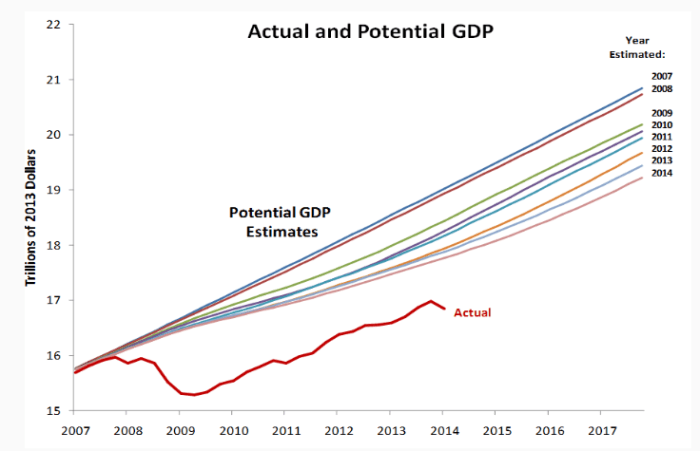
While AD falls and before monetary policy kicks in, imagine that policies are adopted that reduce the potential for growth and productivity improvement. In a way, this would be the argument brought forward by people like Casey Mulligan in work on labor supply and the “redistribution recession” and Edward Prescott and Ellen McGrattan who argue that, once you account for intangible capital, the real business cycle model is still in play (there was a TFP shock somehow). This case would mean that as AD fell, AS fell with it. I would find it hard to imagine that AS shifted left faster than AD. However, a relatively smaller fall of AS would lead to a strong recession without much deflation (which is what we have seen in this recession). Personally, I think there is some evidence for that. After all, we keep reducing the estimate for potential GDP everywhere while the policy uncertainty index proposed by Baker, Bloom and Davids shows a level change around 2008.  Furthermore, there has been a wave – in my opinion of very harmful regulations – which would have created a maze of administrative costs to deal with (and whose burden is heavy according to Dawson and Seater in the Journal of Economic Growth). That could be one possibility that would explain why Murphy lost.

download

There is a second possibility worth considering (and one which I find more appealing): the role of financial regulations. Now, I may have been trained mostly by Real Business Cycle guys, but I do have a strong monetarist bent. I have always been convinced by the arguments of Steve Hanke and Tim Congdon (I especially link Congdon) and others that what you should care about is not M1 or M2, but “broad money”. As Hanke keeps pointing out, only a share of everything that we could qualify broadly as “money” is actually “state money”. The rest is “private money”. If a wave of financial regulations discourages banks to lend or incite them to keep greater reserves, this would be the equivalent of a drop of the money multiplier. If those regulations are enacted at the same time as monetary authorities are trying to offset a fall in aggregate demand, then the result depends on the relative impact of the regulations. The data for “broad money” (Hanke defines it as M4) shows convincingly that this is a potent contender. In that case, Murphy’s only error would have been to assume that the Federal Reserve’s policy took place with everything else being equal (which was not the case since everything seemed to be moving in confusing directions).

globr-asia-nov-2014-1bg

In the end, I think all of these explanations have value (a real shock, a banking regulation shock, an aggregate demand shock). In 25 years when economic historians such as myself will study the “Great Recession”, they will be forced to do like they do with Great Depression: tell a multifaceted story of intermingled causes and counter-effects for which no single statistical test can be designed. When cases like these emerge, it’s hard to tell what is happening and those who are willing to bet are daredevils.

P.S. I have seen the blog posts by Scott Sumner and Marcus Nunes regarding my NGO /NGDP claims. They make very valid points and I want to take decent time to address them, especially since I am using the blogging conversation as a tool to shape a working paper.

Are small autonomous political units economically viable?

Macau Skyline

I am at the moment enjoying my end-of-year-holidays in Macau, a micro-state next to Hong Kong and like Hong Kong also a Special Administrative Region (SAR) of China. Being a SAR basically means that Macau is allowed political and economic autonomy, but still belongs to the People’s Republic of China. This construction is also known as the “One Country, Two Systems” constitutional principle. Being here makes me realize once again the unique position of micro-states. Although I understand that GDP per capita is no measure of everyone’s personal income, I would still like to stress that Macau has the second highest GDP per capita income in the world in 2014 according to the World Bank and that the CIA has placed Macau at spot number 3. Macau has furthermore the 2nd highest life expectancy rate (CIA, 2012). Some other interesting facts about Macau:

  • 0% VAT;
  • max. personal income tax rate of professional practices is 12% and only for incomes above MOP424,000 (~ 53,000USD);
  • currently 30% of this professional tax is waived;
  • tax free income threshold stands at MOP144,000 (~ 18,000USD);
  • Macanese residence in possession of an ID-card receive a yearly refund of 60% of the professional tax paid, subject to a cap of MOP12,000 (~ 1,500USD);
  • Macau is also known as a gambling/entertainment hub of Asia with the gambling/entertainment industry making up around 50% of the economy.

It is sometimes claimed that small autonomous political units are economically unviable, but Macau – like Hong Kong, Singapore, Monaco, Liechtenstein, Luxemburg and more – disprove this claim. Two reasons that are often given for the unviability of small autonomous political units are (a) economies of scale is difficult to realize in small states, and (b) they are vulnerable to trade shocks because their size prevents the states from wide diversification in economic activities. If these reasons would hold, then we would certainly find that micro-states are generally poorer than larger states. However, Easterly and Kraay (1999) have empirically found that micro-states[1] are 40-50% richer than other states when controlled for location by continent, controlled whether they are oil producers, and controlled whether they are members of OECD. In addition, Easterly and Kraay have found that life expectancies in these states are about four years higher and that the under-five infant mortality is lower by 22 per thousand. This suggests that micro-states do not suffer from developmental disadvantages.

Micro-states have been particularly more successful, because without abundant access to land and labour they are pressured to specialize their national economies[2] and to engage in international trade. International trade is particularly important in order to acquire goods that cannot be produced nationally. This pressure to trade encourages peaceful inter-state cooperation. Moreover, due to its small size, public policies are easier to follow which tends to result in greater political transparency. It hence increases the incentives of citizens to become politically involved. The rule over a small territory makes public policy targets also more efficient, and as a result fewer taxes are required. Nevertheless, one could still argue that micro-states in Easterly and Kraay’s research are large enough to be economically viable, but that especially those states that consist of maybe as few as 100 members would suffer from developmental disadvantages. This however, is a question of what the smallest possible size is for an economically well-functioning state. It is an interesting question that I unfortunately cannot answer. I will nonetheless leave a note from Plato on the subject to emphasize the importance of the division of labour in any well-functioning state. In Plato’s Republic, Socrates asserts that the state arises from the division of labour through which goods are efficiently supplied so that its citizens’ needs are fulfilled. The smallest notion of the state, as Socrates then asserts, exists of at least four persons who can produce the greatest human necessities: a farmer, builder, weaver, and shoemaker. I do not share the opinion that these specific four occupations are necessities for a small state, but I think you get the gist: for a (minimal) state to function well, you need at least division of labour.

Reference
Easterly, W., & Kraay, A., (1999). Small States, Small Problems? The World Bank.

Footnotes
[1] Micro-states are defined by Easterly & Kraay as states with populations of 1 million or less. Some examples of the 33 investigated states are Belize, Cyprus, Gabon, Iceland, Luxemburg and Suriname.
[2] Specialization increases productivity, and hence competitiveness.

On celebrating the new year with a thought experiment

Each time I start teaching classes at the business school where I am a course lecturer, I am always amazed at the disconnect between the quantitative facts and the beliefs that individuals have. My favorite relates to poverty and inequality.

Everybody seems to think that poverty is increasing and that worldwide inequality is increasing. Each time, I have to show figures to shoot down those beliefs. I also do it in the french media of my home province of Quebec where – as a result of pointing out those facts – I am branded as a “neoliberal” for being optimistic for the fate of mankind.

However, let’s think about it in the context of the new year to see why there is room for optimism. Let’s make a thought experiment similar to John Rawls’ original position but somewhat differently. You have a hat with all the years since the neolithic age, each on a separate piece of paper. If you had to hope for one year in particular, which would prefer? I would pick 2016!

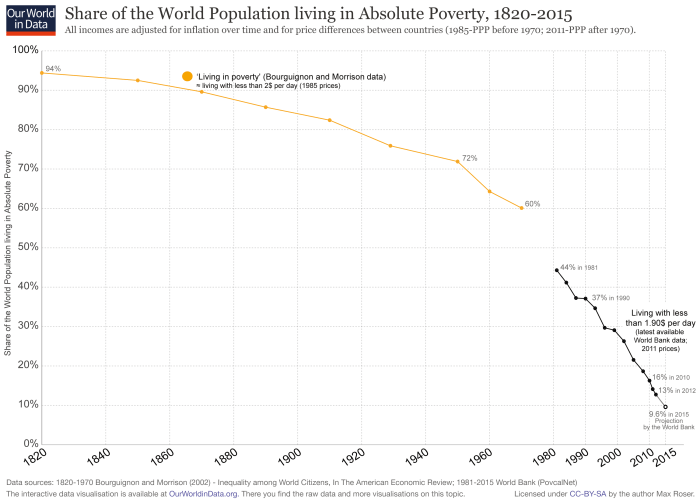
By picking 2016, I have one chance in ten of living under extreme poverty. At any earlier point in time, these odds would have been close to 90%. (The data comes from the Our World In Data project by the amazing Max Roser).

World-Poverty-Since-1820-full

Although this diminished poverty does not explain every improvement with regards to every other metrics of living standards (life expectancy, infant mortality, nutrition, heights, body mass, survival to diseases), it does explain an appreciable part of these improvements.

Sit down with some friends to celebrate the new year and ask them about this “thought experiment”. Ask them if they would pick 2016. Once it is presented as such, I am sure that in spite of all the headwinds facing mankind, they will be optimistic.

NGDP, NGO and total expenditures

I did not think that my post on NGO versus NGDP would gather attention, but it did (so, I am happy). Nick Rowe of Carleton University and the (always relevant) blog Worthwhile Canadian Initiative responded to my post with the following post (I was very happy to see a comment by Matt Rognlie in there).

Like Mr. Rowe, I prefer to speak about trade cycles as well. I do not know how the shift from “transactions” to “output” occurred, but I do know that as semantic as some may see it, it is crucial. While a transaction is about selling a unit of output, the way we measure output does not mean that we focus on all transactions.  I became aware of this when reading Leland Yeager (just after reading about the adventures on Lucas’ Islands). However, Nick (if I may use first names) expresses this a thousand times better than I did in my initial post. When there is a shift of the demand for money, this will affect all transactions, not only those on final goods. Thus, my first point: gross domestic product is not necessarily the best for monetary transaction.

In fact, as an economist who decided to spend his life doing economic history, I do not like gross domestic product for measuring living standards as well (I’ll do a post on this when I get my ideas on secular stagnation better organized). Its just the “least terrible tool”. However, is it the “least terrible” for monetary policy guidance?

My answer is “no” and thus my proposition to shift to gross output or a measure of “total spending”. Now, for the purposes of discussion, let’s see what the “ideal” statistic for “total spending” would be. To illustrate this, let’s take the case of a change in the supply of money (I would prefer using a case with the demand for money, but for blogging purposes, its easier to go with supply)

Now unless there is a helicopter drop*, changes in the money supply generate changes in relative prices and thus the pattern (and level) of production changes too. Where this occurs depends on the entry point of the increased stock of money. The entry point could be in sectors producing intermediary goods or it could closer to the final point of sale. The closer it is to the point of sale, the better NGDP becomes as a measure of total spending. The further it is, the more NGDP wavers in its efficiency at any given time. This is because, in the long-run, NGDP should follow the same trend at any measure of total spending but it would not do so in the very short-run. If monetary policy (or sometimes regulatory changes affecting bank behavior “cough Dodd-Frank cough”) causes an increase in the production of intermediary goods, the movements the perfect measure of total spending would be temporarily divorced from the movements of NGDP. As a result, we need something that captures all transaction. And in a way, we do have such a statistic: input-output tables. Developed by the vastly underrated (and still misunderstood in my opinion) Wassily Leontief, input-output tables are the basis of any measurement of national income you will see out there. Basically, they are matrixes of all “trades” (inputs and outputs) between industries. What this means is that input-output tables are tables of all transactions. That would be the ideal measure of total spending.  Sadly, these tables are not produced regularly (in Canada, I believe there are produced every five years). Their utility would be amazing: not only would we capture all spending (which is the goal of a NGDP target), but we could capture the transmission mechanism of monetary policy and see how certain monetary decisions could be affecting relative prices.** If input-output tables could be produced on a quarterly-basis, it would be the amazing (but mind-bogglingly complex for statistical agencies).

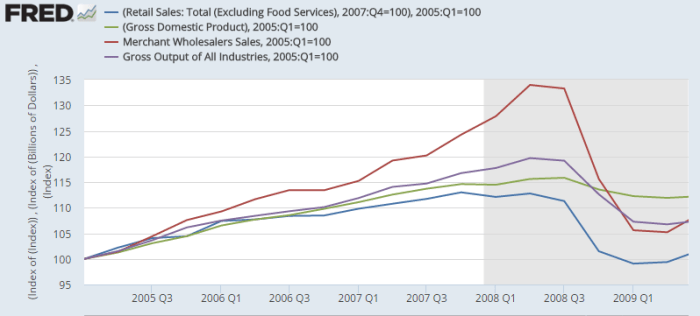
The closest thing, at present, to this ideal measure is gross output. It is the only quarterly statistic of gross output (one way to calculate total spending) that exists out there. The closest things are annual datasets. Yet, even gross output is incomplete as a measure of total spending. It does not include wholesale distributors (well, only a part of their activities through value-added). This post from the Cobden Centre in England details an example of this. Mark Skousen in the Journal of Private Enterprise published a piece detailing other statistics that could serve as proxies for “total spending”. One of those is Gross Domestic Expenditures and it is the closest thing to the ideal we would get. Basically, he adds wholesale and retail sales together.  He also looks at business receipts from the IRS to see if it conforms (the intuition being that all sales should imitate receipts claimed by businesses). His measure of domestic expenditure is somewhat incomplete for my eyes and further research would be needed. But there is something to be said for Skousen’s point: total nominal spending did drop massively during the recession (see the fall of wholesale, gross output and retail) while NGDP barely moved while, before the recession, total nominal spending did increase much faster than NGDP.

NGONGDP1

In all cases, I think that it is fair to divide my claim into three parts: a) business cycles are about the deviation from trends in total volume of trades/transactions, thus the core variable of interest is nominal expenditures b) NGDP is not a measure of total nominal spending whose targeting the market monetarist crowd aims to follow; c) since we care about total nominal spending, what we should have is an IO table … every month and d) the imperfect statistics for total spending show that the case made that central banks fueled spending above trend and then failed to compensate in 2008-2009 seems plausible.

Overall, I think that the case for A, B and C are strong, but D is weak…

* I dislike the helicopter drop analogy. Money is never introduced in an equal fashion leading to a uniform price increase. It is always introduced through a certain number of entry points which distort relative prices and then the pattern of trade (which is why there is a positive short-term relation between real output and money supply). The helicopter drop analogy is only useful for explaining the nominal/real dichotomy for introductory macro classes.
** Funny observation here: if I am correct, this means that Hayek’s comments about the structure of production would have been answered by using Leontief’s input-output table. Indeed, the Austrians and Neoclassicals of the RBC school after them have long held that monetary policy’s real effects are seen through changes in the structure of production (in the Austrian jargon) or by inciting more long-term projects to be undertaken creating the “time to build” problem (in the RBC jargon). Regardless of which one you end up believing (I confess to a mixed bag of RBC/Austrian views with a slight penchant to walk towards Rochester), both can be answered by using input-output tables. The irony is that Hayek actually debated “planning” in the 1970s and castigated Leontief for his planning views. Although I am partial (totally) to Hayek’s view on planning, it is funny that the best tool (in my opinion) in support of Hayek is produced by an intellectual adversary

South Asia and the Glass Ceiling

That is the broad topic of my latest article (pdf), which was just published by Pakistan Journal of Women’s Studies: Alam-e-Niswan. Here is the abstract:

South Asia is one of the most violent societies in the world, and also the most patriarchal. Both characteristics have led to continuity of violence, in which women are the silent and non-recognised victims. The situation is such despite the fact that women have occupied the highest office in their respective countries. The post-1991 wave of globalisation has led to the emergence of two parallel societies, based on different values, in almost all South Asian countries. In both societies women are being exploited and violence has been unleashed on them. Revolution in information and communication technology has helped in the dissemination of patriarchal values through ‘objectification’ of women in the name of ‘liberation’ from the grip of tradition. These patriarchal trends are clearly reflected in the making of domestic policies as well as formulating foreign policies of South Asian states. In such a situation, an academic argument for feminist foreign policy is relevant, though not encouraged by social actors.

You can also find the article on my ‘About…‘ page here at NOL.

Giving Up On The Masses

In 2012, during Ron Paul’s second presidential candidacy as a Republican, I felt deflated with the masses again. Again, the masses were not going to vote a libertarian into office. It was the same year in which I read Murray Rothbard’s Ethics of Liberty and Hans-Hermann Hoppe’s Democracy: The God That Failed. What struck me at that time was the realization that democracy is actually an extremely poor political system to make society become more libertarian. Democracy is not even a guarantee whatsoever for political and economic freedoms. Its success is dependent on the uprightness of the masses, but where are the masses to stand up against war, bank bailouts, taxation, police aggression etc? If the government is truly a gang of thieves and murderers, as I believe it is, then the voting masses are advocates of theft, harassment, assault, and murder.

I do not believe that the masses are ready for freedom, because freedom means taking responsibility for one’s life and actions – a frightening prospect for the masses who lack the strength to face insecurities in life. Ingrained with fear of their own and their neighbours’ incapability to live a ‘responsible’ life, they are attracted to masters who can arrange their lives for them. The masses have also never thirsted for truth. Whoever can supply them with illusions is easily their master, and whoever attempts to destroy their illusions is always their victim. They want to be comfortable and cuddled to death. Thinking is too much hassle for the mass-man. The masses have moreover a love for egalitarianism and a disdain for those who are different, who are more successful and more beautiful. They hate freedom, because in freedom man naturally maintains his distance from his fellow human beings.

Being discontent with the masses and deflated in my philosophical views on politics and economics, I took Peter Thiel’s following dictum to heart: “The masses have given up on unregulated capitalism, so those who still support unregulated capitalism should give up on the masses.” Instead, I have put my hope on such technological advances of decentralization as cryptocurrencies, seasteading, 3D-printing, and localized energy conservation and production.

Don’t target NGDP, target NGO!

Before I start blogging at Notes on Liberty, I just want to say how happy I am to join this collaborative venture. I generally blog in French at the Journal de Montréal and my English writings are confined to my academic papers. Hence, I am very happy to communicate with English audiences.

Actually, this is an opportunity to write about NGDP targeting. In the anglosphere, this rule-based approach to monetary policy has been very popular. In the french world where I evolve, it is close to a fringe point of view (given a strong Old Keynesian/New Keynesian viewpoint). As a result, any effort to expand on the issue requires that the issue first be raised. Hence, I have avoided discussing monetary policy in my French writings. But there is a point that needs to be made about NGDP targeting as advanced by people like Scott Sumner, George Selgin, the late Bill Niskanen, Marcus Nunes, Benjamin Cole, David Beckworth, Lars Christensen and David Glasner : the idea of targeting nominal spending (me switching from the term NGDP to “nominal spending” is important) does not mean that we ought to target nominal gross domestic product.

The intuition behind NGDP target is that monetary policy should be aimed at reacting to changes in demand for money. Thinking of the equation of exchange (MV=PY), a change in V should be matched by an opposite change in M so that MV remains stable. Any increases in Y(output)should be met by reductions in P(rices) and no changes in MV. In practice, NGDP targeting is about avoiding deviations from long-term trends in NGDP. However, while the equation is often presented as MV=PY, the original papers by Irving Fisher and others present it as MV=PT where Y (output) is substituted by T (transactions).

But is PT the same as NGDP? At any point in time, total spending in the economy is much greater than the sum of final goods. There are intermediate goods which are being produced – intangible capital, capital inputs and producers goods.  NGDP avoids calculating these because it would lead to double-counting. Work by Austrian-friendly scholars like Mark Skousen proposes that the double-counting is actually a strength in certain cases. This is because the double-counting gives greater weight to production.  Skousen calls it “Gross Output”(GO) and he finds that GDP is generally a fraction of GO (at 53% in 1982).

Now, GDP is best for measuring welfare in the long-run. However, for short-run discussion, nominal GDP is not (at all) the sum of nominal spending. Imagine an easy monetary policy which incites firms to produce more, there might be a lag between the increased production and “arrival on shelves” for consumers to buy.  This occurs as firms acquire new producer goods and/or gear themselves to producing goods for other producers. This means that in the short-run, the ratio of NGO to NGDP (nominal Gross Output) could vary. Easy monetary policy could make NGO grow faster than NGDP.

In a way, I am saying that NGDP is while the equation of exchange should be about all transactions (T in the original Irving Fisher papers) and transactions is best represented by NGO. As a result, NGO is a better proxy for trends of nominal spending. Let’s make a first test of this (and I hope this gets the ball rolling) by looking at the data.

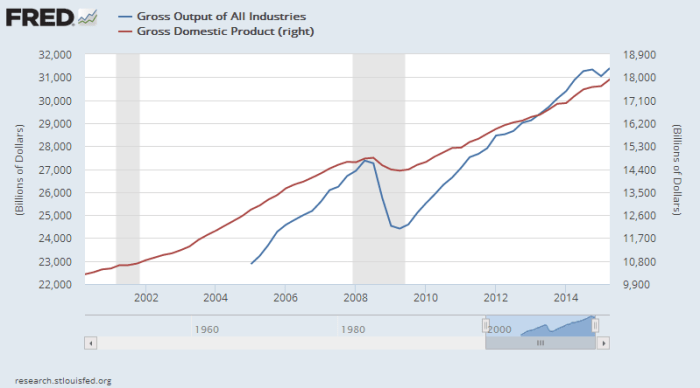
The NGDP crowd claims that prior to 2008, monetary policy was easy, allowing NGDP to grow above trend. Tight monetary policy during 2008-2009 led to a significant drop below trend which was the cause of the recession. With NGO (gross domestic output for all industries as presented by St-Louis Fed), we see the same story but much more clearly!

NGONGDP

From 2005 (when the data start for NGO) to 2008, NGO grows much more rapidly that NGDP (the ratio actually increases to 2008) and then it falls dramatically in 2008-2009 and barely recovers to remain stable thereafter. However, the drop from 2008-2009 is much more pronounced than that for NGDP. This suggests that “overall” nominal spending did fall more than NGDP suggests.

If monetary policy should shift to targeting nominal spending, NGDP is not the best indicator – NGO is.

Natural Rights and Taxation

A moral right is a correlative or flip side of a moral wrong. The right to have X means that it is morally wrong or evil to deny the holder from having X by stealing or destroying it. The right to do X means it is evil for others to forcibly prevent a person from doing X.

People have the natural right to do anything that does not coercively harm others, and the natural right to be free from coercive harm. Natural rights are based on natural moral law, as expressed by the universal ethic. By the universal ethic, all acts, and only those acts, which coercively harm others are evil. I and others have written on natural moral law, easily searched on the Internet.

A legal privilege is a special power or income granted to particular people because of their political status. A king is privileged because of his inheritance and laws regarding this. A slave owner is privileged to own another human being. There are no privileges in natural moral law, since one of the premises from which the universal ethic is derived is human moral equality, an equality of moral worth, implemented as equality before the law and equal legal rights.

In the Constitution of the United States, the 9th Amendment states, in its entirety, “The enumeration in the Constitution, of certain rights, shall not be construed to deny or disparage others retained by the people.” The other rights are common-law and natural rights. Therefore the U.S. Constitution recognizes natural rights, and all laws in the USA should be consistent with the 9th Amendment, although in practice, the 9th is ignored and not widely understood.

This brings us to two court cases. In Murdock v. Pennsylvania, 319 U.S. 105 (1943), the Supreme Court stated that a law requiring solicitors to purchase a license was an unconstitutional tax on the Jehovah’s Witnesses’ right to freely exercise their religion. The Court ruled that “The state cannot and does not have the power to license, nor tax, a Right guaranteed to the people,” and “No state shall convert a liberty into a license, and charge a fee therefore.”

In another case, the Court ruled similarly, that “If the State converts a right (liberty) into a privilege, the citizen can ignore the license and fee and engage in the right (liberty) with impunity.” (Shuttlesworth v. City of Birmingham, Alabama, 373 U.S. 262).

The principles behind the statements of the Court have to apply generally. The federal and state governments may tax privileges, but may not tax a natural right. Since people have a natural right to engage in labor for wages, taxes on wages violate natural rights and therefore the Constitutional rights recognized by the 9th Amendment. Taxes on trade and goods also violate natural rights, which is why state laws claim, incorrectly, that, when they impose a sales tax, they are taxing the privilege of selling goods. (For example, it is written that “California assesses a sales tax on sellers for the privilege of doing business in California.”)

If natural rights are violated by taxing wages, the same applies to the products of labor and the income from the products. Thus a person has the natural right to fully keep and trade produced goods and the financial counterparts as shares of companies and their incomes.

The U.S. Constitution does provide government with the power to tax. Article I, Section 8, states, “The Congress shall have power to lay and collect taxes, duties, imposts and excises.” The 16th Amendment restricts the income tax to being levied as an indirect tax, but otherwise did not alter or add to the powers of Article I.

There is an apparent contradiction. Article I empowers government to tax imports and goods, and other taxes, but the 9th Amendment prohibits taxing acts which are natural rights.

Clearly the founders did not oppose taxing as such. But the letter and spirit of the law have to go beyond the intents of the founders. The Constitution also did not explicitly outlaw slavery, despite its recognition of preexisting rights. When slavery was later abolished, this was in accord with justice as prescribed by natural moral law and the 9th.

If a parent says to a child, you may go outside and play, and also says, do not throw rocks at the squirrels, the permission to play does not imply that anything goes. Thus when the Constitution authorizes taxes, but then, in an Amendment, says, by implication as recognized by the Supreme Court, that government may not tax a right, then the power of taxation has been constrained.

The U.S. Constitution creates an imposed but limited government, and the founders recognized the need for revenues. The sources of government revenue boil down to two original sources: labor and land. There is human exertion, and there is what nature provides.

Since human exertion and its gains are a natural right, the only source left is nature’s resources, land. Thus the moral question is whether the ownership of land is a natural right. This issue is, of course, much disputed. In my judgment, the moral law of property is, “To the creator belongs the creation, and where there is no creator, the benefits belong to the people in equal shares.” The universal ethic is based on the premise, from the nature of humans being, as John Locke wrote, “all equal and independent,” the independence being that thinking and feeling occur individually.

The benefits of land are measured as its economic rent. Therefore, the rent belongs to the people, and by natural moral law, the individual right of the possession of land is conditional on paying the rent to the rightful owners, the people. A tax on land rent does not violate the natural rights of the title holder.

Although the rent really belongs to the people and not to an imposed government, since government is already an imposition, it violates natural rights the least when rent is used for public revenues to pay for public goods that generally benefit the people. The people receive the rent in kind rather than in cash.

If consistently implemented, the 9th Amendment, backed up by the Murdock case, implies that the income tax as well as excise taxes should not tax the right of labor and trade. The greatest challenge of humanity is to recognize the full spectrum of human natural moral rights.

—————————————————

A similar article by me appears in progress.org as “Rights and Privileges”.
BC’s weekend reads

  1. The Criminalization of Curiosity
  2. Britain needs Christianity – just ask Alan Partridge
  3. Libertarians have nowhere to turn
  4. In light of ongoing events in Poland, this October piece by Dr Stocker here at NOL is worth reading again
  5. The West in the Arab world, between ennui and ecstasy