From the Comments: What is a “National Interest”? (Why not federalism?)

Michelangelo writes:

I sympathize with your pro-federation views, but it is admittedly a difficult position to argue from a purist libertarian view. I would support offering statehood to Japan and South Korea, as I mentioned earlier this week.* I would not however offer the same deal to Ukraine or the Baltic states. If pressed why I would be okay with federation with one group of countries but not another is because I consider the Ukraine/Baltic region to have little value to American interests. I can see Japan/South Korea federation helping economic growth and military might to the US and therefore in our interests. Note my use of plural pronouns.

From a purely libertarian basis what regions would you offer federation with? Or, if you’d offer federation to all of them, which regions would you offer federation with first? Taiwan might entertain an offer to join the federation tomorrow, but I suspect the PRC or Russia wouldn’t.

*I imagine they’d join as multiple states in practice. I wouldn’t offer Japan 114 seats in the senate, but I would entertain giving them 10 senators.

Why only ten? Michelangelo’s quibble about the number senators can illustrate why federation is more libertarian than isolationism (I’ll get to his question in just a minute).

The Japanese would never accept any sort of union where they give up some sovereignty for other benefits and only have ten representatives in the senate. That wouldn’t be a bargain for the Japanese; it’d be highway robbery. The key conceptual point to keep in mind in this scenario is that there are two sides bargaining and cooperating with each other in order to arrive at a mutually beneficial deal. Japan and the US cease to exist as sovereign political units but become more secure militarily, economically, and politically through a federation with each other.

Contrast this view with what, say, isolationists such as Doug Bandow or Daniel McAdams argue; they want much less cooperation and, by implication, much less choice. Cooperation would be limited to negotiating trade details, arming factions, and coordinating responses to natural disasters. This is radically different from the status quo, but not in a beneficial way. Think of all the things isolationism and the status quo exclude from their policies. People in Japan and the US are overwhelmingly in favor of a continued US presence in Japan. The reasons for this are clear, but as it stands the Japanese are taking the US for a ride. Isolationist arguments are arguably worse, as they’d remove US troops (angering vast swathes of both societies in the process), which would put Japan in a position to fend for itself. Isolationism is “doing something,” and it’s doing something uncooperative.

I agree wholeheartedly with mainstream libertarians about the unfair nature of the status quo. I just think their proposals are equally unfair (if not worse). A libertarian position should emphasize cooperation, choice, and trade-offs above all else. The current stable of libertarian foreign policy experts don’t do this, despite their pertinent critiques of the status quo.

Now, before I get to Michelangelo’s question of who (I promise it’s coming), I want to spend a little time on his proposal for 10 senators, and tie it into the concept of “national interest,” which is a fuzzy concept and hence popular to wield in public discourse.

What is the national interest (or US interest)?

Think it through and write down your answer on a piece of scratch paper you have lying around.

Go ahead. I’ll wait patiently.

Is your answer really the national interest, though? Why is your definition of the national interest true and Walter Russell Mead’s not? Here is how I defined the concept of a national interest back in 2014:

…the national interest is an excuse [scholars and activists use] for a policy or set of policies that [they believe] should be taken in order to strengthen a state and its citizens (but not necessarily strengthen a state relative to other states…)

Now go back and look at what you wrote down as “the national interest.” Am I right or am I right? There’s no such thing as a national interest. Cooperation, choice, and trade-offs do exist, though, and I think they can walk us through a hypothetical federation between Japan and the US.

Michelangelo rightly decries the fact that Japan, a country with 126 million people in it (California has 40 million) should get 114 senators. Yet 10 senators seems far too few to give up sovereignty for federation. This appears to be a stubborn impasse, right? Wrong! One of the great benefits of cooperation is having to learn new things.

The 47+ prefectures of Japan, for example, have been in use since 1888. The prefectures had steadily been declining in number as the Meiji oligarchy began in earnest to nation-build in what is now Japan. Up until the surrender of Japan to the US, these prefectures were not representative and had little say in how each prefect was to be governed. MacArthur’s constitution gave these 47+ prefectures some autonomy in 1947, but recent attempts at reforming the administrative units of Japan have called for the abolition of these prefectures in favor of fewer administrative units that will also have much more independence from Tokyo. The policymakers who want to take this track are not creating these fewer administrative units out of thin air, either. Rather, reformists are calling for representative units to be based on the unofficial cultural areas of the country that have been around for centuries. Check out the map:
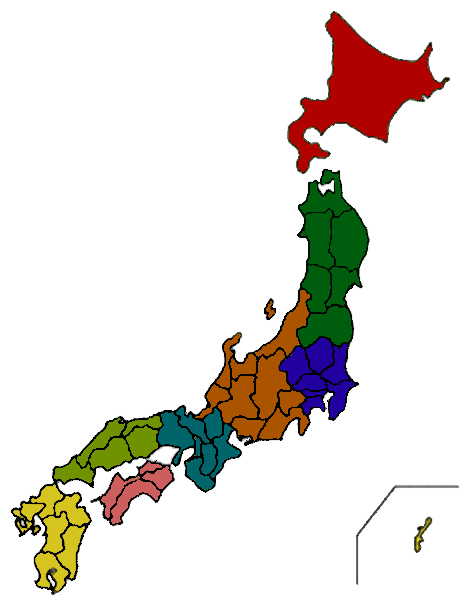
This map shows nine regions, but some people argue that there are actually 13-14 cultural regions within the country (a tough problem to have!). source: wikipedia
This map shows eight cultural areas, but some people argue that there are actually 12-14 cultural regions within the country. source: wikipedia

A cooperative approach to tackling free-riding and imperial expenses would be to reach out to the factions that want fewer administrative states with more autonomy. Adding anywhere from 8 to 14 administrative units into the Madisionian system is much more doable than, say, trying to incorporate 47 administrative units, especially since the latter units have little experience with the autonomous governance that federalism requires of its “states.” At most, there would be 28 additional members of the Senate. The costs associated with free-riding would be gone, and the Japanese people would get the benefits of being a part of the most powerful military the world has ever seen.

Would 28 Senate seats be enough to give up sovereignty? I don’t know, but I do know that the status quo is unsustainable and so, too, are current alternatives.

To finally answer Michelangelo’s question (“From a purely libertarian basis what regions would you offer federation with? Or, if you’d offer federation to all of them, which regions would you offer federation with first?”), I’d start with the Canadian provinces and Mexican states (though I would make it clear that any region is welcome to apply for membership). Then I’d approach the Caribbean islands, the administrative units in Western Europe (including the Baltic states but excluding Ukraine), and the administrative units in Japan and South Korea. Good neighbors and military allies.

My reasoning behind this approach is simply that 1) most of these regions are almost as rich as the United States, 2) they have a good history of actually being representative of their constituents, 3) they have a long history of either interacting with the Madisonian system or acknowledging its tremendous benefits, and 4) they have experience with being somewhat autonomous in a federal system (a federal system that is much less liberal than the one found in the US, but a federal system nonetheless).

Again, I’m not opposed to allowing poor regions to apply and join such a federation, but I think they would be less inclined to do so. Why? Because poorer states are more parochial, more protectionist, and more likely to be uncooperative than rich ones. If regions within these poorer states wanted to apply for membership, we should be open to it, but we’d have to recognize that these poorer regions have a long, hard slog ahead of them. They would, for example, have to market reasons for why they should no longer be a part of a poor state, and they’d have to do it under the harsh watch of the said poor state. Not an easy task, to be sure, but it can be done and the Madisonian federation should be open to the idea of picking apart post-colonial states if it means federating with an oppressed (or poorly governed) region.

Why “post-colonial”? Because of Realpolitik. Entertaining applications from the likes of Tibet or Chechnya is too risky. Entertaining applications from Baluchistan or Biafra? I’d have no problem risking the ire of Pakistan or Nigeria if it meant partnering up with people who want a better life and are willing to cooperate in order to get it.

PS: I think the dialogue in the ‘comments’ thread of this 2014 piece is also worth reading in tandem with my thoughts on Michelangelo’s comment here.

A Very Merry Christmas, from India

Dr Ranjan sent me the following email:

Dear Brandon and gang

I wish you and to your family members a merry Christmas in advance. Hope you will have a great time this Christmas.
Have fun
4-christmas-cards
Thanks for the thoughtful card, Dr Ranjan. (And a Merry Christmas to all of you!)

Urging Cambodians To Critique Their Culture

Brandon has recently referred to my comment that the Cambodian culture is ‘backward’ in this post. In response to that, I would like to share some more thoughts about the Cambodian culture and why I would urge all Cambodians (and all others) to critique their own culture.

I notice that some Cambodian people romantically adore their Khmer culture. Some people’s adoration stretches to the extent that they cannot accept any critiques about their culture as if critiquing the culture equals criticizing the person. Their adoration takes levels that are frightening me – examples are sentiments of supreme nationalism, the gullible belief in distorted histories that have pushed Cambodians into a victimized position that they gladly exploit in political and personal relations, and their willingness to fight and die for the country. To them, the excessive love of one’s culture or nation is noble, but to me it is ridiculous. It doesn’t require heart to love something, it requires more heart to critique the thing you love.

Several aspects of the Khmer culture that I find absolutely deplorable:

  • the hierarchical structure of its social life. Cambodian children are raised to respect and to be obedient toward their elders and toward Buddhist monks. Instilled with strict social rules, the Cambodians are unable to properly reflect on social values and social norms. Children are not encouraged to think for themselves, and to oppose their elders as the elders are always considered right. It should be no surprise that they grow up lacking self-reflective skills;
  • the people´s highly status oriented attitude and their low demeanor toward those who are more wealthy. Cambodian people are extremely status oriented and excessively adore those who enjoy a higher status. It is considered impolite to make eye contact with someone of higher status. In return, empowered by a feeling of superiority despite their plain stupidity, those of higher status look down on the lower classes;
  • their idleness and slowness, which seems to be common among most native South-East-Asians and which may be attributed to their tropical climate. Cambodian people are lazy and like to spend their time gazing around mind-numbingly;
  • its false and pretentious intelligentsia. The Cambodian intelligentsia are like dogs: they bark so much, but they know absolutely nothing! Equipped with beautiful words and eloquent expressions, their words are often empty of substance. They are good at doubtlessly regurgitating any knowledge or wisdom that they have read, but are incapable of critical thinking and of constructing their own ideas;
  • and worst of all its culture of self-pity. Cambodians like to pity their own existence and it is in this self-pity that their suffering is multiplied and their extreme egoism is revealed. This most self-destructive emotion which drowns them in a sea of depression is often used as a weapon to manipulate others, and is sometimes expressed through hysterical lamentations. See here and here for some examples of their miserable cries.

Although I know that my harsh critique of Cambodian culture does not please some Cambodians, they should know that in criticism there is often a desire to improve the people’s situation and to elevate them. It requires effort and energy to care enough about something to speak freely about it. I would urge all Cambodians who would like to improve their nation to gather the strength to stand above their culture so that they can look down on it, reflect on it, and critique it – even better, make fun of it and eventually transcend it.

Hence, Cambodian, go and indulge yourself in some self-mockery!

Freedom of Speech on Campus

Much controversy rages over campus speech these days. Examples abound; here’s one from George Washington University about students hanging flags from their dorm windows. What legitimate free speech rights do students enjoy on campus? The answer is: it depends.

Before examining the dependency, let’s distinguish natural rights from contractual rights. Natural rights are entitlements that stem directly from our humanity. It’s often said that freedom of religion and freedom of speech are natural rights but they aren’t. The only genuine natural rights are property rights: control of our own body, control of our own material and intellectual creations, and control of things we have acquired through voluntary transactions.

Contractual rights arise from an exchange that plays out over time. If I’m a student at GWU, a private University, I may have been promised that in return for my tuition, I will acquire a number of entitlements including freedom of speech on campus, within limits (no yelling “fire!” in a crowded lecture hall). That’s the only freedom of speech I have on campus. If GWU should want to forbid pro-Israel speeches on campus, for example, and I accept that as a condition of admission, then I have no right to lobby for Israel on campus.

Things get complicated when the institution is publicly owned.[1] Who owns San Jose State University? Not “the people”—that would be meaningless. The owner is the person or group who has final say over campus property and policies. That might be the Board of Trustees of the California State University, but how much of their control have they relinquished to what other parties? Hard to say, and in particular it’s hard to say who gets to set restrictions on campus speech—and of course all manner of such restrictions are necessary if the business of the University is to go forward. No blocking hallways, no disrupting classes, etc.  In the case of a public university, somebody has to decide what sort of speech is allowed, usually according to what is politically palatable to the loudest voices.


To repeat, the only genuine natural rights are property rights. Freedom of speech or religion are not fundamental rights but are contingent on the ownership of property involved in any particular speech or religious activity.

[1] “Public ownership” is actually an oxymoron because ownership means some people are excluded while public means everybody is included.

Why Few ‘Social Justice Warriors’ Actually Care About Social Justice

I notice that many people love to defend ‘equality for the sexes’, ‘equality for all ethnicities’, because ‘everyone is beautiful… everyone is awesome… everyone is sacred’. All these sound extremely good, noble and well, but I have realized throughout the years that most of these so-called ‘social justice warriors’ do not truly care about social justice at all as one cannot truly stand for justice without an inquisitive mind.

These people repeat everything that sounds good, but barely put any effort in understanding the issues at hand. They lack the critical faculty to subject ideals to severe critical scrutiny. For this reason, they are extremely susceptible for ideals that at first sight seem wonderful, but that are actually rotten and damaging. They also do not possess enough modesty in how little they know. Most social justice warriors are therefore irrationally and vehemently defending a cause they do not truly understand. The worst thing is that many of them refuse to explore the issues of social justice, to look for underlying evidence to support their arguments, to read, and to learn. Many of them are self-deceivers, and discussions with them often turn out to be a vexation as it is impossible to appeal to their reason.

I agree with Michael Huemer that actually most people who fight for a ‘noble cause’ “are chiefly moved, not by a desire for some noble ideal, but by a desire to perceive themselves as working for the noble ideal – not, for example, by a desire for justice, but by a desire to see themselves as promoting justice” (Huemer, 2012, p. 19). The ultimate test to find out whether a social justice warrior truly cares about justice is to have a rational conversation about issues of justice and see whether he is willing to defend his noble ideals rationally and whether he is open for learning.

Reference
Huemer, M. (2012). In Praise Of Passivity. Studia Humana, 1, 2, pp. 12-18.

A Warm Welcome

Folks, NOL is coming up on 5 years as a cooperative venture. It’s been a lot of fun and it wouldn’t have the feel it has without your continued support and encouragement. I’d like to extend a warm welcome to two new members of the consortium: Dr Vincent Geloso and William Rein. Behold:

Vincent Geloso has recently completed his PhD dissertation at the London School of Economics and Political Science in the field of economic history. He specializes in law and economics, development economics, and economic demography. He has published articles in Journal of Population Research, Essays in Economic and Business History and Economic Affairs.

Vincent was my roommate at a FEE summer seminar back in 2009 (the same summer I met Rick at an IHS summer seminar). He’s from Quebec but is a Canadian first and foremost. You can start checking out his non-NOL work here. If you are considering a non-profit to give to for this holiday season, I highly recommend IHS and FEE. Just look at what their work has done in regards to NOL. And:

William Rein is a sophomore studying Philosophy and Criminal Justice at Chico State University. He married jurisprudence a long time ago, starting seeing modern physics on the side, and just recently has been hooking up with phenomenology. Every now and then he gets caught up in journalism and opinion writing.

You can start checking out his non-NOL work here. I have many a fond memory of Chico State (and some not-so-fond ones too). Please, be on your best behavior for at least their first couple of posts!

A quick update on NOL’s art project

Chhay Lin sent me this email detailing a rough timeline for the NOL art project he initiated:

I met my friend about the art project last weekend. He told me that he is experimenting with an Escher-esque logo/banner for NOL. He doesn’t know how long it will take, and is not working on it full-time. In the meantime he is busy moving out from the city of Breda to Rotterdam, opening his own workshop, and making portraits for a book that he and I are working on. 🙂 I’ll keep you up to date if I hear anything new about the NOL artsy project.

His friend, Cheerted Keo, has a website that you can check out here.

BC’s weekend reads

  1. A rifle’s journey from Belgium to Gaza
  2. No Libertarian Case for Empire (this is the piece that sparked my little tirade yesterday)
  3. A dust-up over dissenting views at Ohio State law
  4. What really happened on Thanksgiving (le duh; this screams “why Econ 101 is so important”)

A Quick PSA: Putting “boots on the ground” in Syria is still a dumb idea

Readers might be mistaken into thinking that I am some kind of statist or rabid interventionist because I often put forth arguments that are nowhere to be found at the Cato Institute or the Mises Institute when it comes to American foreign policy.

I have argued that the federation of countries would be a good idea. I have argued that multilateralism is of the utmost importance when it comes to solving problems. I have no problem using IGOs like the UN or the IMF to bolster diplomacy. I have entertained the notion that the US should take a back seat in hot spots in order to better bait autocratic states into committing blood and treasure to the said hot spot, and then unleashing hell. Sanctions are dumb and never work, but building closer trading ties with an adversary’s enemies is a underdeveloped path.

Statist AF, right?

Wrong!

I am trying to put forth alternatives to “boots on the ground.” I understand that military interventions are a bad thing. I don’t want “boots on the ground.” I understand that the costs far outweigh the benefits. I understand that war is the health of the state. What I don’t understand is how “doing nothing” is a libertarian position. Dogmatic slogans made us lazy a century ago. We lost our claim to the title “liberal” because of it. Dogmatic slogans made us lazy a century and a half ago, and we lost our claim to the title “internationalist” because of it. What will our laziness cost us today?

Boots on the ground? We should be so lucky.

To Pledge or Not to Pledge

I attended a public meeting last night as I do from time to time. It’s a bad habit I can’t seem to shake. Like many of the more formal public meetings in this country, it started with the Pledge of Allegiance. (Foreign readers may not know that this is a 31-word quasi loyalty oath of allegiance to “the flag.”) When the time comes, everyone is supposed to stand, put their heart on their hand, face the flag, and recite the Pledge in unison, which is drummed into all schoolchildren.

My policy during the last several years has been to stand and remain silent with my hands at my side. I don’t make a spectacle of myself by staying seated, but I’m not willing to say the Pledge, for several reasons.

  • It’s too much like religion, and not just because of the “Under God” phrase
  • I don’t like feeling like a sheep following the herd
  • I don’t like the implication that we should bow and scrape to our rulers

Plenty of people would brand me a traitor for my attitude, an ingrate who doesn’t appreciate the benefits of living in the good ol’ U.S.A. In fact, I am quite grateful that I live in the U.S.A. because

  • I grew up in this culture and feel a part of it (omitting rock “music”)
  • The land is beautiful
  • Our politicians are less rapacious than in some other countries
  • We still have a reservoir of individualist sentiment that resists the “Progressives” and the neocons and their relentless push for a made-in-America brand of fascism
  • The libertarian movement has grown enormously in the years since 1971 when I signed on

I do indeed feel some kind of loyalty to the land and the people. But not to the government. And to swear allegiance to the Constitution, as the newly elected councilmen did last night, is a farce because the Constitution was shredded years ago, starting with Abraham Lincoln and perhaps earlier. At the federal level, they swear allegiance to the Constitution and then turn around and spit on it.

But wait, you might say, if you’re loyal to the people you have to be loyal to the government because we elect our leaders. But that’s a slender thread indeed. The government is controlled by unelected bureaucrats and powerful special interests. The government is not “the people.”

So, with only the mildest misgivings, I’ll go on boycotting the Pledge.

From the Comments: Why did Cambodians trade foreign terror for domestic horror?

John Cyberome pitches the question to Chhay Lin on his post about the terrorist attacks in Paris. Chhay Lin’s response (which I have broken up into smaller paragraphs) deserves a closer look:

I don’t understand why Cambodians traded foreign terror for native horror. It’s something I’ve always wanted to understand. I don’t remember a time when I did not have such questions as: how can people be so cruel to each other or would they (the friends I had) be able to commit such horrendous acts to me if they would live during the Khmer Rouge period? It seems like there is a terrible part of human nature that is called upon in certain circumstances. I think the Milgram Experiment and the Stanford Prison Experiment have been examples of how peaceful people can move to extremely horrifying acts. I also think that the Khmer Rouge had good intentions. In their eyes, they were saving the nation from corruption, from immorality, from foreign invaders and from domestic traitors.

Cambodia by the way, is a country that is quite paranoid. Until this day, they still fear that the Thai or the Vietnamese will one day take over the country. Some already believe that the country only exists by name, but that it’s actually under Vietnamese rule. According to them, after the Vietnamese occupation from 1979-1989, they have installed a pro-Vietnamese ‘puppet’. This paranoia feeds nationalism – a sentiment, I believe, that can be easily manipulated into hatred towards foreign Khmer like Sino-khmer or Vietnamese-khmer.

Besides that, I also think that the poorer people were envious of the wealthy class. When the Khmer Rouge came into power and turned the social hierarchy upside down by installing the poor people into higher social positions, they may have been especially cruel to those fellow Cambodians who they believed were better off.

I also think that we can partly blame it on the Cambodian culture. The culture is very hierarchical. People of status look down on poorer people and treat them like crap. The poor don’t even dare to look the better-off in their eyes. It’s a culture that breeds envy and discontents between classes. I think these are a few reasons why the Cambodians had traded foreign terror for native horror. In all honesty, I find the culture quite backward 😛.

This is a whole lotta insight packed into one short ‘comment’.

For starters, I would be comfortable in suggesting that land is the crucial factor of production in Cambodia, rather than capital. (I am not as confident as Rick in arguing that land, labor, and capital are basically obsolete tools, in large part because there are big swathes of the world that don’t share the institutions that have created the West.) Land-based societies that I have read about all share the same general cultural characteristics as those mentioned by Chhay Lin (though none would dare call these characteristics ‘backward’!).

Trade has, in my reading of history, been the traditional arbiter of destruction for land-based interests. Does anybody have any good information on international trade and Cambodia? I’ve looked in to a few sources (World Bank, OECD, Heritage) and it looks like the volume of trade has been increasing since at least 2010, but that there are institutional problems which have yet to be addressed.

‘Creative destruction’ is such a strange concept, especially to a libertarian like me.

Which countries are of US interest?

I was reading my news stream when I noted a blog post from the Cato Institute discussing the silliness of adding Montenegro to NATO. I don’t disagree per se. I certainly don’t see the value of adding Montenegro to NATO, if the purpose of NATO is to protect the US. Nor do I disagree with the general US-libertarian belief that the US has over extended itself in terms of military alliances.

I do wonder though what countries US-libertarians should desire to maintain a military alliance with. A North American military alliance, ranging from Canada to Panama and including the Caribbean, makes sense to me. The Atlantic and Pacific Oceans are our greatest defenses, but I welcome military cooperation from our geographical neighbors.

Beyond there though it gets tricky. Western Europe is certainly rich enough to protect itself. The main reason I am hesitant to leave NATO altogether is the nuclear question. France and the UK are the only European powers with nuclear weapons, but several others are part of NATO’s nuclear sharing program. Should the US leave NATO would these countries seek nuclear weapons for themselves? Would the UK/France provide substitute weapons? Ending military ties with Europe would likely be the easiest option in terms of cutting down on allies.

Japan and South Korea are likewise rich countries, but here too the nuclear question arises. Japan has a cultural aversion to nuclear weapons that I do not see it overcoming in the foreseeable future. South Korea may be willing to use nuclear weapons, but its strained historical relationship with Japan leaves me concerned about the future possibility of a Korean-Japanese alliance to counterweight China PRC. I believe that Japan should be encouraged to modify its constitution to allow its military greater freedom in action and to consider acquiring nuclear weapons of its own. Other nations in the region, such as the Philippines, are outmatched in conventional weaponry or, in the case of Australia, too far away geographically to be of much use in restraining China PRC’s influence in east Asia.

I am hopeful that within my lifetime China PRC will transition to a liberal democracy, but till then I am skeptical about allowing it free reign in east Asia. For the foreseeable future it is hard for me to consider an east Asia without a significant role for the US. Nor would I be particularly against offering South Korea and/or Japan statehood in a United States of the Pacific.

Thoughts? I admit that international politics is not my area of expertise and I more than welcome other’s thoughts on the matter. I also admit that I am not viewing these issues from a pure libertarian perspective but with a splash of nationalism.

As readers may know our own Brandon is playing around with creating a NOL foreign policy quiz similar to the Nolan libertarian quiz.

Good Health Will End Civilization

Good health and decisive minds. With maybe about 5% probability. We’re far more likely to destroy ourselves with war or stupidity, but knowledge could do us in too.

The basic problem is that as our knowledge of health and aging increases, we’re going to end with a lot of old people around. We’re going to be those old people, which is great for us, but it could be deadly in the long run.

Institutions are made up of formal rules, and informal interpretations of those rules by members of society. We learn how to interpret our environment by observing how our predecessors did so, copying them, ideally refining their approach, occasionally rebelling against the old ways and finally pushing our ways on the next generation.

This sets up an evolutionary process where variation and generational turnover occur together. The basic problem is that few people change their minds once they’re about 25. You might be able to teach an old dog new tricks, but odds are good you can’t teach him a new way of looking at the world.

Yeah, some people can change with the times, but on the whole Bill Burr’s pretty much spot on: [as far as other people are concerned] you can live too long. The older the median voter, the further removed their view of the world is from the actual reality of the time.

Now, there’s certainly some optimal degree of conservatism. We don’t want to upend society every five years in the name of progress. But if generational turnover grinds down to a glacial pace, so may institutional adaptation.

But of course we don’t know what the future holds. Perhaps an older, wiser median voter is a good thing. Perhaps the key to longer lifespans includes therapy to stimulate neural plasticity.

In any case, I hope that coming generations will hear a message that mirrors advice given to my generation. We were told “don’t expect to have the same job forever.” Now we need to be told “don’t expect to have the same opinion forever.”

Fretting over Christmas gifts?

Fret no longer! Dr Amburgey smugly reports:

My daughter is a political science major at Queen’s University. She’s putting together her applications for grad school right now [she’s interested in political theory]. Last summer she went to a Libertarian student conference in Montreal [I enthusiastically funded her travel]. At any rate I was doing my annual struggle to come up with good Christmas presents when a visual cue from NOL made the proverbial light bulb light up. She will be tickled when she discovers that Santa Claus gave her a copy of Degrees of Freedom: Liberal Political Philosophy and Ideology by Edwin van de Haar. 😀

I hope I don’t spoil anything here! If political philosophy isn’t your target’s cup of tea, there are plenty of other books by the Notewriters to check out in the book pile to your right (Dr Gibson’s new book comes out in January, but that’s no excuse not to pre-order it now!).

I realize, too, that there’s a way to work with amazon so that when you buy a Notewriter’s book from an NOL account a portion of the money goes back to us (meaning me), or something like that, but I’m lazy and this is a labor of love. Lazy love is the best kind of love.

Happy Holidays.

My Publishing Adventure

As you see in the right-hand column, I am co-author of a new book, “The World’s Your Stage.” The intended audience is performing artists (musicians, dancers, etc.) and those who manage artistic groups. So it isn’t directly related to this blog, and in fact my co-authors are not libertarians. But readers who are thinking of publishing may be interested in what I learned from dealing with a commercial publisher, so I’ll write a little about those experiences here.

A great deal more is involved in getting a decent book out the door than writing and editing. Most would-be authors know (I hope) that a good editor is essential. Our first editor did a poor job and was fired, at which point the publisher, perhaps out of embarrassment, assigned their top editor to us. He was very helpful. Some editorial corrections can be very hard to swallow. One has to give a great deal of latitude to an experienced editor, while knowing when to stand firm on an essential point.

It had all started with a contract. They sent us a long document that we had to initial in about forty places. We were promised an advance, which showed up about a year after we signed the contract: $5,000 split three ways. I expect to see little or nothing beyond that, making this very much a labor of love. A learning experience, certainly.

They want you to conform to their specifications for writing the document in MS Word (font, spacing, figures, etc.). No problem there.

Publishers are scared silly about copyright infringement. For example, I had used a 52-word quote from a book, but they said I would either have to cut it to 49 words or get written permission from the author. I cut it to exactly 49. There were lots of other places where we did have to get permission. Fortunately one of my co-authors had the patience to get most of these.

They are also picky about citations. In several instances they wanted sources for facts that I thought were common knowledge.

Several times I thought we were through with revisions only to find out we weren’t. After the editor comes a copy editor whose job (I think) is to read it all for consistency and various other picky but necessary things. These good people don’t miss a thing.

A good cover is essential, and for that they have graphic designers who sent us proofs for our approval. A dramatic pictorial graphic would have been nice but beyond the budget, no doubt. They needed photos of us for the jacket along with the photographer’s name, for credit. Mine was a selfie, which had them scratching their heads at first.

Quite a few competent professionals seem to have spent time on our book, and they don’t come cheap, especially when the publisher is headquartered in Manhattan.

So the book is in print and we’re done, right? Not exactly. For a niche book like ours, marketing is pretty much up to us. So one co-author is working on a web page, and we’re all thinking of where and how we might pitch the book. The other co-author was head of public TV in New York for 20 years and there are lots of doors he can open. He got Rene Fleming, an opera star, to write a plug for the back cover. He can easily get speaking gigs and possibly TV appearances.

Now I’m thinking about my next book. Even with this first book in hand, getting a publisher for the second is a long shot so I’m looking at self-publishing. I think there’s a lot I could do on my own, using my experience from the first book, and a lot where I would need help. I would hire an editor, but how to find a good one? And a graphic designer—who? How to market it? Stay tuned.