On Gentrification, Inequality and Zoning

On the CityLab blog, Richard Florida posted a piece pointing out that gentrification has virtually no effects on homeowners. I can buy that result, especially since I wrote a policy piece for a think tank back in the summer of 2016 on the issue. The important point that Florida underlines (by citing a paper by Martin and Beck in Urban Affairs Review) is that homeowners are not being displaced, but renters are more likely to be. This will probably fuel some people who are concerned about inequality. I disagree.

I want to point out that my interest in the issue is entirely related to the issue of inequality which some individuals have tried to tie to gentrification (sometimes without understanding that causality can run both ways). If you want to tie the two issues together, then you must realize that there are four “types” of gentrification. First of all, gentrification always appear in an area that is poor and it is always a result of a shift in demand for land in that area. However, that area can be largely unoccupied or heavily inhabited. It can also be in a district where zoning is lax or burdensome. In each of these situations, you will different effects with different interpretations for inequality.

  • Scenario 1 (largely vacant, lax zoning laws): in this situation, demand shifts right but there is slack in the local housing market and in any case, supply can adjust easily. In that case, the effects on rents will be minimal and will probably be smaller than the economic gains in terms of local economic activity. In this situation, there is little displacement and there is in fact a reduction in inequality.
  • Scenario 2 (largely vacant, heavy zoning laws): same happens, except that the restrictions on construction and building conversions put a ceiling on the capacity of a local area to adapt. The effect on rents is ambiguous and depends largely on the relative quantity changes (how many people relative to empty units). There are probably small to moderate gains in the area. There are ambiguous effects on inequality.
  • Scenario 3 (heavily occupied, lax zoning laws): in this situation, the influx of individuals creates a temporary surge in rents. This is because, in the short-term, housing supply is inelastic. In the long-run, the supply is more elastic and new units can be added to counterbalance the price effects. So, there is a long-term benefit that comes after a small bump. More individuals will be displaced than in scenario 1. Overall, a reduction in inequality might occur.
  • Scenario 4 (heavily occupied, heavy zoning laws): in this situation, the influx happens in a market where the supply is highly inelastic (short and long-run). In that case, the shift in demand creates a substantial increase in rents. This is where gentrification can hurt and be tied to inequality.

These four scenarios are important because they show something important that some people have to understand. Gentrification can increase inequality. However, that depends on the context and the institutions (zoning) surrounding the area in which it happens. In all cases, gentrification is a normal process that can’t really be stopped but turns sour because of zoning laws. Thus, if you really want to tie gentrification to inequality, it should twice removed since the first parents are zoning laws and construction limits.

On Sugary Drinks, Taxes and Demand Curves

A few days ago, I discovered a blog post on the website of Jayson Lusk (a very good agricultural economist whose work has often guided some of my own economic history research given that most economic history is also agricultural history). The post relates to a study of the implementation of a sugary drink tax in Berkeley to fight obesity.

Obviously, a tax will reduce the consumption of any good. That is pretty axiomatic and all that we need to know is how much. In other words, how elastic is demand. If all things are held constant, the quantity consumed relative to the price change will give you that measure.* However, the study that Lusk pointed too basically shows that we often do not hold everything constant.

The authors of the study point out that when tax is passed, there is generally a debate that occurs beforehand. This generates publicity about the issue. This alters the behavior of consumers because they face more information. This is an effect that must be isolated from that of the tax itself.  That is what the authors do in their papers and they find that a reduction of soft drinks consumption did occur during the campaign and after the tax was adopted but before it was implemented (they rely on on-campus sales of soft drinks at a “major university” which we can assume is UC-Berkeley). Thus, the reduction in consumption preceded the price change. Lusk himself found something similar in a case related to animal welfare. Using a Californian electoral proposition regarding animal welfare in the production of eggs, he found that the publicity surrounding the proposition changed consumer behavior.

Lusk, rightly in my opinion, points out this suggests that information-based policies are probably more efficient than heavy-handed measures like taxes.

But I think there is a deeper point to make. When you inform consumers, you don’t only change the location of the demand, you also change the slope of the curve. If a consumer is made aware of the costs (and benefits) of his consumption that he had not previously considered, he may become more sensitive to the price. Informing people about the ill-effects of sweet drinks might make them more sensitive to the price they pay. Imagine that the information campaign during the Berkeley vote on the tax caused consumption to become more elastic. That means that the tax’s effects is being amplified by the information effect from the publicity. Had the tax been imposed as a surprise, the effect would have been smaller. Basically, Lusk’s presentation of the argument is understating the effects of information-based policies.


* On a tangential point, I would like to remind that people can reduce their consumption of soft drinks without changing their total calorific intake. Indeed, if I am taxed when I consume a soft drink, I can switch to coffee with cream. Thus, pundits often confuse a reduction in soft drinks consumption after a tax as a step in favor of reducing obesity.

Anarchism

Below is an excerpt from my book I Used to Be French: an Immature Autobiography. You can buy it on amazon here.


I had my first revolutionary encounter at another Cub Scout camp near a different lake. We were organized in squads of six, as I said, each with its appointed leader. One day, my squad leader gave me an order I did not like. Or maybe, I just did not like his tone. I said “No.” He insisted. Our voices rose. His authority contested publicly, he shoved me lightly. I shoved back and I called him out formally. We repaired out of sight to the lakeside. It was not the Clash of the Titans because I must have been nine and he, eleven. The leader must have lacked faith in his own charisma, or else, I got lucky because I gave him a bloody nose. This stopped the fight in accordance with the ancient dueling rule of “first blood drawn.” He washed off the blood in the lake. We walked back to our tent separately. It was sunset; everyone went to bed. Nothing more was said.

I remember the fight clearly and I remember well that the squad leader was the furthest thing from a bully. He was not a bad guy and I did not even dislike him. I just did not like hierarchies. I was a natural anarchist in the true, etymological sense of the term: I did not want to have a chief, or a leader, or whatever you call them these days. This trait never changed. I am just the same as I was at nine in this respect. I have never had any desire to exercise power over others either. Most exercises of power repel me viscerally. I suspect many or most are unnecessary. Moreover, I now think coercion is the worst way to obtain the orderliness that is necessary to a good society. I am pretty sure coercion causes more disorder overall than it eliminates or avoids. Its costs are usually too high.

“Growing up” did not help me in that department either. I never “learned through experience;” life did not “beat it into me.” In this respect, as in many others, I keep marveling at the constancy of individual characters from childhood, perhaps from infancy. I don’t know why there isn’t more mention of this constancy except that it contradicts the namby-pamby liberal faith in environmental determinism. If you believe religiously that societal influences – such as poverty, emotional abuse, being deprived of cookies, being fed the cookies of the wrong color – decide what the adult’s character will be, it’s hard to notice that much of the character was already in the child, or even in the toddler. It’s difficult to even imagine that it was possibly already in the zygote. This possibility was an academic taboo subject for the best part of forty years. Hardly anyone felt free to study it.

On Tax Resistance, Censuses and the Cliometrician’s Craft

In the process of finalizing another research article (under revise and resubmit for Agricultural History), I found a small case of tax resistance in Canada East (modern day Quebec) in 1851  that is interesting.

The district of Grenville, northwest of Montreal, was an ethnically mixed district (25% French, the rest were English-Canadians) operating under the British freehold tenure system (as opposed to most of the rest of the province that operated under French seigneurial tenure). During the 1851 census, the enumerator complained that the population of roughly 2,000 inhabitants refused to report statistical information.

Basically, the enumerator pointed out that the majority supposed the information they were giving was “the precursor of a general tax for schools which they are strongly opposed to”.

tax-resistance-in-the-censuses

I find this to be interesting because it is a nice little case of how hard to master the craft of an economic historian. As a cliometrician, my task is to find the best data possible to answer historical questions with strong economic theory (while enriching theory with historical evidence). The data for that area would be biased downwards as peasants would understate their incomes to avoid being heavily taxed. Any statistical test to assert the applicability of a theory to historical questions of Canada (or Quebec) would be altered by this reaction on the part of peasants.

True, for some broad questions (like measuring GDP), this would not be too dramatic an issue. However, for more specific questions like “what was the role of tenure systems in explaining Quebec’s relative poverty”, the issue would be more problematic.

How much do the little things matter, right?

Trump Is Right!

It is easy to emphasize all that is bad about the new American President. For sure, I think he is a clown who will do a few bad things to the US and the world at large. His protectionist agenda is of course a libertarian nightmare, which will also make the people who elected him worse off. Still, the US President is not a dictator, so some trust in the institutions and the actors that fill them still seems appropriate.

Trump is also plainly right on a number of issues. Foremost, his plea (also in yesterday’s inaugural address) for the partners of the USA, especially in NATO, to contribute in equal measure. This is not new, all recent American Presidents have pointed this out to their European allies. It is simply outrageous to let Mrs Jones from North Dakota pay for the defense of other rich countries, such as my home country of The Netherlands. The Europeans got away with major free riding. Only recently did they start to get their act a little bit together, as the Russian threat is looming again. The defense budgets in almost all European NATO members have decreased drastically since the early nineties, which is plainly immoral if you are in the world’s most important security organization together. So hopefully Trump will pressure them to the max.

He is also right in pointing out that many US foreign interventions have been a disaster. And it is good that he wants some closer scrutiny from now onwards. I am not a great fan of military intervention, although I also do not want to rule them out them perennially (as opposed to many others in the liberal tradition). Many of the interventions over the past few decades have lead to nothing though, and created their own follow-up problems. So it’s pretty good if that same Mrs Jones is not likely to lose her son or daughter at the battlefield in some faraway country.

And of course Trump is right in asserting that the government is not ruling the citizens, but is just a service provider on behalf of the people, and fully accountable to them. Sure this is bit more complicated in practise, but it is the only proper principle.

So in these three respects: hail to the new chief! Hopefully he sticks to them and does not screw up too dramatically at all other policy fields.

Trump’s Inauguration: Ageing Pains

fa87a4aa3343c8063a073e8f11be03b29c8f12e7e1973f5b4f6808bf4e0760fd

Vincent has discussed the relative age of US presidents. There is something to be said about the age of electorates.

I was living in the United Kingdom when we voted for Brexit (I was a soft remainer). I was living in the United States when Trump won the election. So I can’t help but feel that Trump’s inauguration is part of a generalised nationalist turn that, ironically, transcends national borders. Why is this nationalist turn happening? And why has it wrong-footed pollsters and political scientists more than once now?

We are repeatedly, and correctly, warned not to over-interpret individual events as somehow determined by given factors. Both the Brexit vote and the presidential election were close, with Trump taking the electoral college without the popular vote. One domino that didn’t fall last year was the Austrian presidency that, after a close call, went to a Green rather than a Nationalist. So whatever explanation we are looking for has to be a tendency that’s slightly shifted the odds in favour of nationalist politicians without the experts being able to anticipate it in advance.

Some suggest that this resurgent economic nationalism is an inevitable outcome of the overreach of trade liberalisation that has undermined national self-determination and humiliated local cultures. Others argue that the real cause is growing income and wealth inequality. I think a potentially more straightforward factor is demography. The electorate is simply older than it used to be.

There are a few reasons why this explanation may work better than the more popular ones. The ageing electorate is almost unprecedented in history. This could make it harder for political scientists to predict its impact on elections. Surveys might be able to tell us how older people vote as individuals without being able to work out how older people surrounded, in addition, by lots of older peers will behave.

Countries like Italy and Japan were somewhat ahead of us on this demographic transition. And perhaps not entirely coincidentally, Italy repeatedly elected a mini-Trump, Silvio Berlusconi as Prime Minister, while continuing to support the elderly at the expense of opportunities for the young. Meanwhile, Japan has always been more ethno-nationalist than other developed economies and in some ways has grown more politically reactionary in recent decades.

This explanation chimes with the fact that Trump voters were not typically economically disadvantaged. They were older and less educated but typically economically secure. Age was also a big factor explaining support for Brexit. At the same time, an ageing population presents real economic challenges that translate into politically salient problems. Demography is probably responsible for a great deal of the sustained drop in real interest rates, precisely the sort of thing that worries ageing savers with slowly growing pension pots.

Trump wants to boost infrastructure, construction and manufacturing. But these sectors do best with young and growing populations, where families want new and bigger houses and offices, roads to connect them and cars to drive to and from them. What happens when everyone already has a great deal of material goods and a country hasn’t got as many young adults to demand new stuff? Inevitably, an economy’s trend growth declines and may even contract, leaving investors with fewer places to get a good return.

What could this mean about the future? On the one hand, this could be quite a pessimistic explanation. There is very little that can be done in the short or medium term about the demographics of an electorate. So we might just be in for a more reactionary period. The vote is not about strength of belief, just the sheer numbers nudged in that direction, and that is what age can do.

On the other, this could be an optimistic hypothesis. The situation we find ourselves in is a side-effect of two generally attractive outcomes: people living much longer, and lower fertility thanks to women becoming more educated. The balance between the young and the elderly might eventually improve once the demographic bulge of the baby boomers has passed into history (this depends critically on whether institutions permit new family formation). In addition, tomorrow’s elderly are not the same as today’s elderly. They will probably be more educated, less nationalist and possibly less subject to cognitive decline than the current generation. They are less likely to be impressed by a bad sales pitch.

Is Trump So Old? Its all relative really!

Today is inauguration day. Donald Trump will officially be the 45th President of the United States of America. Many have pointed out that Trump is the oldest president (slightly above 70 years of age). I disagree.

Old is not a “purely” absolute concept. Advances in living standards mean advances in our ability to live longer lives. Not only do we live longer lives than in the past, but at any point in our life, our health is better. Someone who reached 65 years of age in 1900 probably did not have the same health prospects as someone who reaches that age today. Basically, the “quality” of old age has increased over time (see this great book on the economic history of aging). So, when people say “old”, I ask “old as compared to what”.

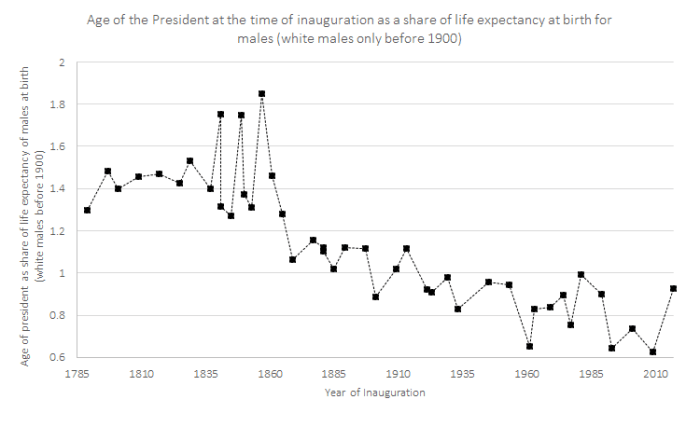
To meet that test, I took the CDC data on life expectancy as well as soon historical database  from 1900 to today. I combined it with David Hacker’s work on life tables in the US from 1790 to 1900 which can be found in this article of Historical Methods.  Hacker’s data concerns only the white population. I took only the age expectancy at birth of males. Then, I plotted the age of the president at the time of inauguration as a share of the life expectancy at birth (E0). This is the result:

inauguration

As one can see, the age of presidents as a share of life expectancy is falling steadily since the early 1900s. In this light, Donald Trump is not the oldest president. In fact, the oldest president is …. drumroll…James Buchanan (1.85 times the life expectancy of white males at birth). Moreover, in this light, the youngest president at inauguration is not Teddy Roosevelt (Kennedy was the youngest elected). Rather, the youngest is Barack Obama followed very closely by Bill Clinton and John F. Kennedy.

I find this post to be interesting as it shows something more important in my eyes: how the poorest in society have done. Presidents have generally stemmed from the top of the income distribution. Over time, the ages of presidents at inauguration (in absolute terms) has not followed any clear trend. The drop seen in the graph above is entirely driven by increases in the life expectancy of the “average” American. In a certain way, it shows that the distance between that “Joe the Plumber” and the “Greatest Man in America” (huh…Lord Acton anyone?) seems to be diminishing over time.

On the (big) conditions for a BIG

This week, EconTalk featured a podcast between Russ Roberts and Michael Munger (he of the famous Munger-proviso which I live by) discussed the Basic Income Guarantee (BIG). In the discussion, there is little I ended up disagreeing with (I would have probably said some things differently though). However, I was disappointed about a point (which I made here in the past) which economists often ignore when discussing a BIG: labor demand.

In all discussions of the BIG, the debates always revolve around the issue of labor supply assuming that it will induce some leftward shift of the supply curve. While this is true, it is irrelevant in my opinion because there is a more important effect: the rightward shift of the labor demand curve.

To make this argument, I must underline the conditions of a BIG for this to happen. The first thing to say is that a) the social welfare net must be inefficient relative to the alternative of simply giving money to people (shifting to a BIG must be Pareto-efficient); b) the shift mean that – for a fixed level of utility we wish to insure – the government needs to spend less and; c) the lower level of expenditures allows for a reduction in taxation.  With these three conditions, the labor demand curve could shift rightward. As I said when I initially made this point back in January 2016:

Yet, the case is relatively straightforward: current transfers are inefficient, basic income is more efficient at obtaining each unit of poverty reduction, basic income requires lower taxes, basic income means lower marginal tax rates, lower marginal tax rates mean more demand for investment and labor and thus more long-term growth and a counter-balance to any supply-side effect.

As I pointed out back then, the Canadian experiment (in Manitoba) with a minimum income led to substantial improvements in health outcomes which meant lower expenditures for healthcare. As a result, b) is satisfied and (by definition) so is a). If, during a shift to a BIG, condition c) is met, the entire discussion regarding the supply effects becomes a mere empirical issue.

I mean, equilibrium effects are best analyzed when we consider both demand and supply…

P.S. I am not necessarily a fan, in practice, of BIG. Theoretically, the case is sound. However, I can easily foresee policy drifts where politicians expand the BIG beyond a sound level for electoral reasons (or even tweak the details in order to add features that go against the spirit of the proposal). The debate between Kevin Vallier (arguing that this public choice reasoning is not relevant) and Phil Magness (who argues the reverse) on this issue is pretty favorable to Magness (in my opinion). UPDATE: Jason Clemens over at the Fraser Institute pointed to a study they made regarding the implementation of a BIG in Canada. The practical challenges the study points too build upon the Magness argument as applied in a Canadian perspective. 

The Pox of Liberty – dixit the Political Economy of Public Health

9780226922171

A few weeks ago, I finished reading the Pox of Liberty authored by Werner Troesken. Although I know some of his co-authors personally (notably the always helpful Nicola Tynan whose work on water economics needs to be read by everyone serious in the field of economic history – see her work on London here), I never met Troesken. Nonetheless, I am what you could call a “big fan” in the sense that I get a tingling feeling in my brain when I start reading his stuff. This is because Troesken’s work is always original. For example, his work on the economic history of public utilities (gas and electricity) in the United States is probably one of the most straightforward application of industrial organization to historical questions and, in the process, it kills many historical myths regarding public utilitiesThe Pox of Liberty is no exception and it should be read (at the risk of become a fan of Troesken like I am) as a treatise on the political economy of public health.

Very often, it will be pointed out that public health measures are public goods that government should provide lest it be “underprovided” if left to private actors. After all, it is rare to hear of individuals who voluntarily quarantined themselves upon learning they were sick. As a result, the “public economics” argument is that the government should mandate certain measures (mandatory vaccination and quarantine) that will reduce infectious diseases. Normally, the story would end there. And to be sure, there is a lot of evidence that mild coercive measures do reduce some forms of mortality (mandatory vaccination and quarantine). The more intense the policies, the larger the positive effects on health outcomes. For example, taxes on cigarettes do reduce consumption of cigarettes and thus, secondhand smoke. In fact, even extreme coercive measures like smoking bans seem to yield improvements in terms of public health (another example is that of Cuba which I discussed on this blog).

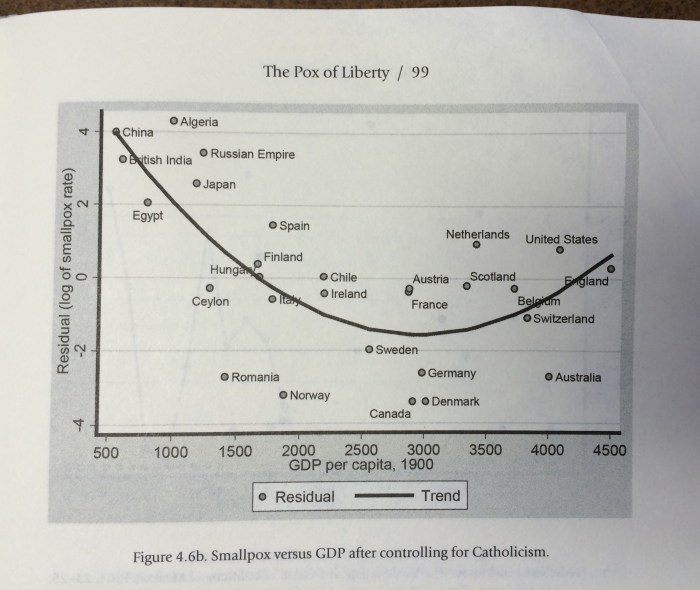
However, Troesken’s contribution is to tell us that the story does not end there. In a way, the “public economics” story is incomplete. The institutions that are best able to deploy such levels of coercion are generally also the institutions that are unable to restrain political meddling in economic affairs. Governments that are able to easily deploy coercive measures are governments that tend to be less constrained and they can fall prey to rent-seeking and regulatory capture. They will also tend to disregard property rights and economic freedom. This implies slower rates of economic growth. As a result, there is a trade-off that exists: either you get fast economic growth with higher rates of certain infectious diseases or you get slow economic growth with lower rates of certain infectious diseases (Troesken concentrates mostly on smallpox and yellow fever). The graphic below illustrates this point of Troesken. Countries like Germany – with its strong centralizing Prussian tradition – were able to generate very low levels of deaths from infectious diseases. But, they were poorer than the United States. The latter country had a constitutional framework that limited the ability of local and state governments to adopt even mild measures like mandatory vaccination. Thus, that meant higher mortality levels but the same constitutional constraints permitted economic growth and thus the higher level of living standards enjoyed by Americans relative to the Germans.

fullsizerender

But Troesken’s story does not end there.  Economic growth has some palliative health effects (in part the McKeown hypothesis*) whereby we have a better food supply and access to better housing or less demanding jobs. However, in the long-run economic growth means that new sectors of activity can emerge. For example, as we grow richer, we can probably expend more resources on drugs research to extend life expectancy. We can also have access to more medical care in general.  These fruits take some time to materialize as they grow more slowly. Nonetheless, they do form a palliative effect that contributes to health improvements.

However, there is an analogy that allows us to see why these palliative effects are important in any political economy of public health provision. This analogy relates to forestry. The health outcomes fruits from a “coercive institutional tree” can only be picked once. Once they are picked, the tree will yield no more fruits.  However, the yield from that single harvest is considerable. In comparison, the “economic growth tree” yields fewer and smaller fruits, but it keeps yielding fruits. It never stops yielding fruits. In the long-run, that tree outperforms the other tree. The problem is that you cannot have both trees. If you chose one, you can’t have the other.

In this light, public health issues become incredibly harder to decipher and understand. However, we can see a much richer wealth of information under this light. In writing the Pox of Liberty, Troesken is enlightening and anyone doing health economics should read (and absorb his work) as it is the first comprehensive treatise of the political economy of public health.


* I should note that I think that the McKeown hypothesis is often unfairly lambasted and although I have some reservations myself, it can be adapted to fit within a wider theoretical approach regarding institutions – like Troesken does. 

How Well Has Cuba Managed To Improve Health Outcomes? (part 3)

As part of my series of blog post reconsidering health outcomes in Cuba, I argued that other countries were able to generate substantial improvements in life expectancy even if Cuba is at the top. Then I pointed out that non-health related measures made Cubans so poor as to create a paradoxical outcome of depressing mortality (Cubans don’t have cars, they don’t get in car accidents, life expectancy is higher which is not an indicator of health care performance). Today, I move to the hardest topic to obtain information on: refugees.

I have spent the last few weeks trying to understand how the Cuban refugees are counted in the life tables. After scouring the website of the World Health Organization and the archives of Statistics Canada during my winter break, I could not find the answer.  And it matters. A lot.

To be clear, a life table shows the probability that an individual of age will die by age X+1 (known as Qx). With a life table, you will obtain age-specific death rates(known as Mx), life expectancy at different points and life expectancy at birth (Lx)(Where x is age). Basically, this is the most important tool a demographer can possess. Without something like that, its hard to say anything meaningful in terms of demographic comparison (although not impossible).The most common method of building such a table is known as a “static” method where we either compare the population structure by age at a single point in time or where we evaluate the age of deaths (which we can compare with the number of persons of each group alive – Ax). The problem with such methods is that static life tables need to be frequently updated because we are assuming stable age structure.

When there is important migration, Qx becomes is not “mortality” but merely the chance of exiting the population either by death of migration. When there are important waves of migration (in or out), one must account for age of the entering/departing population to arrive at a proper estimates of “exits” from the population at each age point that separate exits by deaths or exits (entries) by migration.

As a result, migration – especially if large – creates two problems in life tables. It changes the age structure of the population and so, the table must be frequently updated in order to get Ax right. It also changes the structure of mortality (exits). (However, this is only a problem if the age structure of migrants is different from the age structure of the overall population).

Since 2005, the annual number of migrants from Cuba to the United States has fluctuated between 10,000 and 60,000. This means that, on an annual basis, 0.1% to 0.5% of Cuba’s population is leaving the country. This is not a negligible flow (in the past, the flow was much larger – sometimes reaching north of 1% of the population). Thus, the issue would matter to the estimation of life tables. The problem is we do not know how Cuba has accounted for migration on both mortality and the reference populations! More importantly, we do not know how those who die during migration are measured.

Eventually, Ax will be adjusted through census-based updates (so there will only be a drift between censuses). However, if the Cuban government counts all the migrants as alive as they arrive in a foreign country as if none died along the way, it is underestimating the number of deaths. Basically, when the deaths of refugees and emigrants are not adequately factored into survival schedules, mortality schedules are be biased downward (especially between censuses as a result of poor denominator) and life expectancy would be accordingly biased upward.

Now, I am willing to reconsider my opinion on this particular point if someone indicates some study that has escaped my gaze (my Spanish is very, to put it euphemistically, poor). However, when I am able to find such information for other Latin American countries like Chile or Costa Rica and not for Cuba, I am skeptical of the value of the health statistics that people cite.

The other parts of How Well Has Cuba Managed To Improve Health Outcomes?

  1. Life Expectancy Changes, 1960 to 2014
  2. Car ownership trends playing in favor of Cuba, but not a praiseworthy outcome

Even More Sex

Below is an excerpt from my book I Used to Be French: an Immature Autobiography. You can buy it on amazon here.


My mother routinely spoke irresponsibly in front of her children, as if we did not understand the language. Many times, in my early years, I overheard her describing a wayward female movie star, sometimes even a neighborhood woman, as “a prisoner of her senses.” She did not say this in a censorious manner but sympathetically, with a tinge of envy perhaps. The repetitiousness of the assertion loosened high expectations in me. In adolescence and even later, I kept looking for such “prisoners.” It took me a long time but, when I recognized one, I married her without hesitation.

I am not sure when my mother tried to provide formal sex education per se. I may have been eight or nine. I declined her instruction, not because I was prudish about the facts but because her pompous language style, derived on that occasion from bodice-buster serials in her weekly newspaper, made me uncomfortable. I would have been more at ease with concrete descriptions of the exchange of body fluids.

On other, more casual instances her wording was often quite vigorous. When the first blue jeans appeared in Paris, I may have been about twelve, or so. My mother declared then and there her opposition to this new type of garment on the ground that they were explicitly designed to emphasize men’s private parts thus inflaming the young women. One of her many off-hand remarks that contributed to make me optimistic about women’s erotic vulnerability and the ease of their conquest. My mother could describe an innocent, practical article of clothing as a kind of more or less gratefully accepted form of public rape. For this talent, I forgave and I forgive much that she did that was truly evil.

What is Wrong with Income Inequality? Five Reasons to be Concerned

I sometimes part ways with many of my libertarian and classical liberal friends in that I do have some amount of tentative concern for income/wealth inequality (for the purposes of this article, the otherwise important economic distinction between the two is not particularly relevant since the two are strongly correlated with each other). Many libertarians argue that inequality ultimately doesn’t matter. There is good reason to think this drawing from the classic arguments of Nozick and Hayek about how free exchange in a market economy can often interrupt preferred distributions.

The argument goes like this: take whatever your preferred distribution of income is, be it purely egalitarian or some sort of Rawlsian distribution such that the distribution benefits only the worst off in society. Assume there is one individual in the economy who has some product or service everyone wants to buy (in Nozick’s example it was Wilt Chamberlain playing basketball), and let everyone pay a relatively small amount of income to that one individual. For example, assume you have a society with 10,000 people all who start off with an equal endowment of $5 and all of them decide to pay Wilt Chamberlain $1 to watch him play basketball. Very few people would object to those individual exchanges, yet at the end Wilt Chamberlain ends up with $10,005 dollars and everyone else has $4, and our preferred distribution of income has been grossly upset even though the individual actions that led to that distribution are not objectionable. In other words, allowing for free exchange precludes trying to construct an optimal result of that free exchange (a basic consequence of recognizing spontaneous order).

Further, these libertarians argue, it is more important to ensure that the poor are better off in absolute terms than to ensure they are better off relative to their wealthier peers. Therefore, if a given policy will increase the wealth of the wealthiest by 10% and the poorest by 5%, there is no reason to oppose this policy on the grounds that it increases inequality because the poor are still made richer. Therefore, it is claimed, we should focus on policies that improve economic growth and the incomes of the poor and be indifferent as to its impact on relative inequality, since those policies are strongly correlated with bettering the economic conditions of the poor. In fact, as Mises Argued in Liberalism and the Classical Tradition, a certain amount of inequality is necessary for markets to function: they create a market for luxury goods that can be experimented and developed into future mass-consumption goods everyone can consume. Not everyone could afford, for an example, an IPod when it first came out, however today MP3 players are cheap and plentiful because the very wealthy were able to demand it when it was very expensive.

I agree with my libertarians in thinking that this argument is largely correct, however I do not think it proves, as Hayek argued, that social justice (understood in this context as distributive justice) is a “mirage” or that we should be altogether unconcerned with wealth or income distributions. All this argument does is mean that there is no overall deontological theory for an ideal income distribution, but there still might be good consequentialist reasons to think that excessively unequal distributions can impact many of the things that classical liberals tell us to worry about, such as the earnings of the poor, more free political economic outcomes, or overall economic growth. Further, even on Nozick’s entitlement theory of justice, we might oppose income inequality if it arises through unjust means. Here are five reasons why libertarians and classical liberals should be concerned about income inequality (note that they are mostly empirical reasons, not claims about the nature of justice):

1) Income Inequality as a Result of Rent Seeking

Certain government policies result in uneven income distribution. For an example, a paper by Patrick MacLaughlin and Lauren Stanley at the Mercatus Center empirically analyze the regressive effects of regulatory policy. Specifically, Stanley and MacLaughlin find that high barriers to entry create barriers to entry which worsens income mobility. Poorer would-be entrepreneurs cannot enter the market if they must, for an example, pay thousands of dollars for a license, or spend a large amount of time getting costly education and certifications to please some regulatory bureaucracy. This was admitted even by the Obama Administration in a recent report advising reform of occupational licensing laws. As basic public choice theory teaches, regulators are subject to regulatory capture, in which established business interests lobby regulators to erect barriers to entry to harm would-be competitors. Insofar as inequality is a result of such rent-seeking, libertarians have an obvious reason to oppose it.

Many other policies can worsen inequality. When wealthy corporations receive artificial monopolies from policies such as excessive intellectual property laws, insulating them from competition or when they gain wealth at the expense of poorer taxpayers through improper subsidies. When the government uses violent policing tactics to unequally enforce drug laws against poorer communities, or when it uses civil asset forfeiture to take the property of the worst off. When the government uses eminent domain to take the property of disadvantaged individuals and communities in the name of public works projects, or when they implement minimum wage laws that displace low-skilled workers. Or, if the structure of welfare benefits discourages income mobility, which also worsens inequality. There are a myriad of bad government policies which benefit the rich and exploit the poor, some of which are a direct result of rent-seeking on behalf of the wealthy.

If the rich are getting richer, or if the poor are stopped from becoming wealthier, as a result of government coercion, even Nozick’s entitlement theory of justice calls for us to be skeptical of the resulting income distribution. As Matt Zwolinski argues, income distributions are not only a result of, pace Nozick, a result of the free exchanges of individuals, but they are also a result of the institutions in which those individuals exchange. Insofar as inequality is a result of unjust institutions, we have good reason to call that inequality unjust.

Of course, that principle is still very hard to empirically apply. It is hard to tell how much of an unequal distribution is a function of bad institutions and how much is a function of free exchange. However, this means we can provide very limited theories of distributive justice not as constructivist attempts to mold market outcomes to our moral desires, but as rough rules of thumb. If it is true that unequal distributions are a function of bad institutions, then unequal distributions should cause us to re-evaluate those institutions.

2) Income Inequality and Government Exploitation
Of course, many with more Marxist inclinations will argue that any amount of economic inequality will inherently result in class-based exploitation. There are very good, stand-by classical liberal (and neoclassical economic) reasons to reject this as Marxian class analysis as it depends on a highly flawed labor theory of value. However, that does not mean there is not some correlation between some notion of macro-level exploitation of the worst-off and high levels of inequality which libertarians have good reason to be concerned about, for reasons closely related to rent-seeking. Those with a high amount of economic power, particularly in western democracies, are very likely to also have a strong influence over the policies set by the government. There is reason to fear that this will create a class of wealthy people who, through political rent-seeking channels discuss earlier, will control state policies and institutions to protect their interests and wealth at the expense of the worst-off in society. Using state coercion to protect oneself at the expense of others is, under any understanding of the term, coercion. In this way, income inequality can beget rent-seeking and regressive policies which lead to more income inequality which leads to more rent-seeking, leading to a vicious political-economic cycle of exploitation and increasing inequality. In fact, even early radical classical liberal economists applied theories of class analysis to this type of problem.

3) Inequality’s Impacts on Economic Growth

There is a robust amount of empirical literature suggesting that excessive income inequality can harm economic growth. How? The Economist explains:

Inequality could impair growth if those with low incomes suffer poor health and low productivity as a result, or if, as evidence suggests, the poor struggle to finance investments in education. Inequality could also threaten public confidence in growth-boosting policies like free trade, says Dani Rodrik of the Institute for Advanced Study in Princeton.

Of course, this is of special concern to consequentialist classical liberals who claim we should worry mostly about the betterment of the poor in absolute terms, since economic growth is strongly correlated with bettering living standards. There is even some reason for these classical liberals, given their stated normative reasons, to (at least in the short-term given that we have unjust institutions) support some limited redistributive policies, but only those that are implemented well and don’t worsen inequality or growth (such as a Negative Income Tax), insofar as it boosts growth and helps limited the growth of rent-seeking culture described with reasons one and two.

4) Inequality and Political Stability

There is further some evidence that income inequality increases political instability. If the poor perceive that current distributions are unjust (however wrong they may or may not be), they might have social discontent. In moderate scenarios, (as the Alsenia paper I linked to argue) this can lead to reduced investment, which aggravates third problem discussed earlier. In some scenarios, this can lead to support for populist demagogues (such as Trump or Bernie Sanders) who will implement bad policies that not only might harm the poor but also limit individual liberty in other important ways. In the most extreme scenarios (however unlikely, but still plausible), it can lead to all-out violent revolutions and warfare. At any rate, libertarians and classical liberals concerned with ensuring tranquility and freedom should be concerned if inequality increases.

5) Inequality and Social Mobility

More meritocratic-leaning libertarians might say we should be concerned about equal opportunities rather than equal outcomes. There is some evidence that the two are greatly linked. In particular, the so-called “Great Gatsby Curve,” which shows a negative relationship between economic mobility and income inequality. In other words, unequal outcomes can undermine unequal opportunities. This can be because higher inequality means unequal access to certain services, eg. Education, that can enable social mobility, or that the poorer may have fewer connections to better-paying opportunities because of their socio-economic status. Of course, there is likely some reverse causality here; institutions that limit social mobility (such as those discussed in problem one and two) can be said to worsen income mobility intergenerationally, leading to higher inequality in the future. Though teasing out the direction of causality empirically can be challenging, there is reason for concern here if one is concerned about social mobility.

The main point I’m getting at is nothing new: one need not be a radical leftist social egalitarian who thinks equal economic outcomes are necessarily the only moral outcomes to be concerned on some level with inequality. How one responds to inequality is empirically dependent on the causes of the problems, and we have some good reasons to think that more limited government is a good solution to unequal outcomes.

This is not to say inequality poses no problem for libertarians’ ideal political order: if it is the case that markets inherently beget problematic levels of inequality, as for example Thomas Piketty claims, then we might need to re-evaluate how we integrate markets. However, there is good reason to be skeptical of such claims (Thomas Piketty’s in particular are suspect). Even if we grant that markets by themselves do lead to levels of inequality that cause problems 3-5, we must not commit the Nirvana fallacy. We need to compare government’s aptitude at managing income distribution, which for well-worn public choice reasons outlined in problems one and two as well as a mammoth epistemic problem inherent in figuring out how much inequality is likely to lead to those problems, and compare it to the extent to which markets do generate those problems. It is possible (very likely, even) that even if markets are not perfect in the sense of ensuring distribution that does not have problematic political economic outcomes, the state attempting to correct these outcomes would only make things worse.

But that is a complex empirical research project which obviously can’t be solved in this short blog post, suffice it to say now that though libertarians are right to be skeptical of overarching moralistic outrage about rising levels of inequality, there are other very good empirical reasons to be concerned.

“Ugly Conservative Sacred Cows”

I think this piece has regained currency. Look at it when you have a chance.

Thank you.

From the Comments: Ottoman autocracy, Turkish liberty

Jacques, if you want to look at a libertarian/classical liberal case for the Ottoman Empire you should look at Islam without Extremes (Norton 2013) by Mustafa Akyol. I can’t claim to have got round to reading it myself, but I have seen Akyol’s summaries of his argumnents.

The power of Akyol’s argument in term of Turkey’s political scene has been somewhat undermined by his support for the AKP governemnt until after the Gezi Park protests. He is very critical of the AKP now, but as he was previously known as an AKP apologist (and enthusiast for Intelligent Design theory) it’s doubtful how much of an asset he is to Turkey’s rather small pro-liberty scene.

In any case I do not endorse myself straight on Ottomanist libertarianism and there are reasons it does not have much of a hold in Turkey’s pro-liberty scene though there are a few who think like this. The problems are endless and complex because the Ottoman system lasted from the 14th to 20th centuries and you can’t really talk about the same system, or at least few historians think you can. The millet system is a term applied late in Ottoman history, while the system was at its peak in terms of the size of the empire, along with it general prestige in the world, in the sixteenth century. Of course at that time, it could be said to have established some version of some liberty with order as good as many Christian states, and to me more power ful than any. I don’t think even at its height though you could say the Ottoman empire had more liberty than the most law governed and tolerant places in ‘Christendom’ and certainly while European thinkers respect the Ottoman system at its height it very much looked like an example of strong orderly monarchy, not decentralised liberty.

Even at its peak the Ottoman system obliged Balkan Christian families to send one son away at a very early age to be brought up as Muslim convert soldier-bureaucrat slave of the Sultan. The Janissary system, a very privileged kind of slavery and forced conversion, but that is what it was. The Sultan employed black eunuch slaves, transported from Africa, again a privileged position but not really an example of liberty.

Jumping forward, the Ottoman system started to imitate the west in some respects from the late eighteenth century, following military defeats to Russia. The biggest act of ‘reform’ was the violent repression/massacre of the Janissaries which formed a whole class of soldiers, bureaucrats and Istanbul firemen who were also market traders on the side, blocking the Sultan’s ideas of reform, including the formation of a more modern military.

Jumping forward again, the Ottoman sultan most revered by Turkey’s current Ottomanists on the whole, Abdulhamit II, suspended the national assembly, pursued a program of bureaucratic-military-technical centralisation, which included the early massacres of Armenians to which you refer. In the end he was overthrown as a ruker (not as holder of the title of Sultan) by westernising reformers (Committee of Union and Progress/Young Turks) who ended up continuing a centralising reform process which alienated people outside the Muslim Ottoman elite and the Anaotlian heartlands of the Empire. Jumping back to the period between the suppression of the Janissaries and Abdulhamit II’s rule, the Greek Independence movement was resisted with staggering levels of violence and cruelty (the Greek insurgents were not always fastidious in their methods either, it must be also be said). By the nineteenth century, the Ottoman system of relative tolerance towards non-Muslims on a communal rights basis was looking less impressive compared with a growing European tendency towards tolerance based on individual rights.

The ‘millet system’ at its peak provided a way Muslims, Christians and Jews could live together, but mostly as separate communities able to continue communal traditions, within a hierarchy in which Muslims had the real power. As with looking to models of liberty in ‘feudal’, medieval Europe, we may see some liberty benefits in the elements of localism and communal autonomy under a monarchy, but in both cases we are not talking about a system of individual rights or free interaction, we are talking about individuals constrained by communal traditions and hierarchies, along with the hierarchies between communities. If we value individual rights under common legal rights then this is not a model for us, even if we can see some lessons.

Even at its peak the Ottoman system blocked the spread of printing, one of the major elements of modern liberty. The reasons for the block combine the power of religious conservatism and the guild interests of manuscript copyists which seems to me to sum up the problems of even peak time Ottomanism for liberty. It was a system based on an assemblage of local, communal and guild privileges finding change difficult except through dramatic acts of autocratic rulers. The transition from Empire to French-modeled republic, but less liberal than the France of the time, in the 20s and 30s under Atatürk was itself the last great example of this and was a product of the difficulties the Ottoman system had with peaceful consensual change, even if it did have a few good moments on that score (e.g. the 1840 Tanzimat reforms).

Finally the Ottoman system was condemned by its own failure to defend itself, the last Sultan could only give into the victorious powers of World War One, while the republican-nationalists, who emerged from the most educated sections of the Ottoman elite, were able to mobilse a successful military struggle (the Independence War) even without control of the state apparatus. A system which can’t win a war is not a successful system, regardless of how sad the importance of war in human history is.

Arguments now about reviving the Ottoman Empire are surely self-evidently hypothetical only for anyone who does not take Erdoğan’s more bombastic statements seriously. In what way would the Middle East resolve anything by rule from Istanbul, particularly as part of a centralised state ruled by Erdoğan? If the question is should the Ottoman Empire have been prolonged at the end of World War One, the Ottoman government of the war undermined that possibility by massacres of Arabs, along with the leaders Faisal gave to Arab nationalists, aided by devious British and French policy.

The Ottoman Empire was in the Balkans before it was in the Middle East. Ottoman sultans used the title Kaiser-i rum (Emperor of Rome) after the Fall of Constantinople before they adopted the title of Caliph (leader of the faithful) after the later conquest of the Hezaz (i.e. the region containing Mecca and Medina). There is nothing natural or inevitable about a Turkey leaning predominantly towards the Middle East and nothing inherently desirable about Beirut, Amman, Riyadh, Damascus, etc coming under the dominance of Turks; there is nothing obviously healing for Arab Shiite Muslims in living under a Sunni Caliph in a palace on the Bosphorus, not now and not in 1919.

Ottomanist libertarianism makes most sense for those inclined to paleolibertarianism based on dispersal of power between homogenous traditionalist localised communities. I don’t see it has so much to offer to other kinds of libertarian. If we think about more modern liberal forms, there was some interest in Britsh style liberalism (already at that time in transition from classical liberalism to left liberalism) amongst the last Ottomans, most notably Prince Sabahattin, but this was a minority within a weakened elite, discredited by collaboration with British occupation at the end of World War One, which never had anything like a politics capable of mobilising the elite (very influenced by French republicanism politically and intellectually by the sociological expression of French republicanism in the work of Emile Durkheim), never mind the population as a whole.

(Yes Brandon I should be posting this kind of thing, in refined and revised form, but I really don’t have time to do this properly at present, believe me I really am in extreme crisis mode with writing/editing deadlines), after a particularly busy semester, believe me I will be posting when I can, and I should be able to manage within the next few months, sorry I can’t say any more than that, but it is the reality.)

This is from Barry Stocker, responding to Jacques’ musings on the Ottoman Empire and libertarian arguments that are sometimes in favor of it. The rest of the thread is pretty good too, though Dr Delacroix has yet to respond…

From the Comments: New Republics, Westphalia, and Russian Strategy

Thomas L. Knapp (check out his two contributions to the most recent Cato Unbound symposium on voting) has a great comment about Ukraine (Russia) that deserves further scrutiny:

In order for Putin to “pull out of” Ukraine, he’d first need to be in Ukraine.

The new republics which seceded from Ukraine are not in Ukraine.

Knapp brings up an interesting point that most geopolitical outlets and experts rarely consider (the Washington Post‘s Worldviews is a notable exception, as is Ilya Somin over at Volokh Conspiracy), and because of that these outlets fail to provide any depth or light to the world around us. There are three aspects of Knapp’s excellent comment that I’d like to hone in on.

The new republics

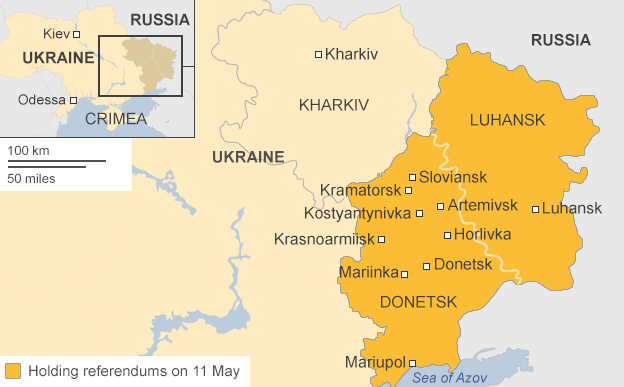
First, what are these “new republics” Knapp mentions? If you don’t count Crimea (wiki), which Moscow formally recognized in 2014, then the new republics that declared their independence from Ukraine are Luhansk (wiki) and Donetsk (wiki). Both polities are roughly 3300 square miles in area and house roughly 1.5 million people (you can get the exact numbers from the wiki links I provided above). Here is a map:

74717073_ukraine_donetsk_luhansk_referendum_624
(source)

Alarmingly, both republics style themselves “people’s republics” and (less alarmingly) have aligned publicly with Moscow. Russia, by the way, has not recognized these “new republics,” for geopolitical reasons I hope to make clear below.

Westphalian sovereignty

Russia does not like to recognize new polities (“republics”) because of its adherence to the ideal of Westphalia, which is state sovereignty (elsewhere at NOL Barry Stocker argues that the Westphalian ideal can be better understood as an early modern cosmopolitanism rather than state sovereignty). All throughout the Cold War Russia and China were staunch supporters of the Westphalian ideal (as were states in Africa and Asia that broke away from colonial empires), and they became even more so after the collapse of socialism in 1993. State sovereignty is the idea that states (“countries”) have sole control over what goes on in their own borders, and that any interventions of any kind, by any type of organization, needs to be approved by the state. It is called “Westphalian” because of the Treaty of Westphalia that was signed by a number of major and minor European states in the 17th century. The major states were able to maintain a balance of power and the minor states were able to assert more sovereignty over their territories than ever before because they were signatories of an international treaty. (Edwin van de Haar’s article in the Independent Review [pdf] on the balance of power as the most libertarian option available is worth reading, and is made stronger, I believe, by Giovanni Arrighi’s argument [pdf] that the balance of power led directly to the “capitalist oligarchies” that eventually pushed feudalistic institutions out of Europe beginning in the late 15th century.)

Russia, China, and other autocratic regimes prefer an international system that is respectful of state sovereignty because of the fact that this idea helps their governments to administer an amount of coercion on populaces that Western states consider immoral or rights-violating.

Russian strategy

Why did Russia hint at recognizing Donetsk and Luhansk, but ultimately decide not to recognize them? Because the West has been recognizing separatist republics since the USSR fell apart, and it has done so in the traditionally Russian sphere of influence (noticeably carving up Yugoslavia at Serbia’s geographic expense). The West has not carved up post-Soviet space by simply recognizing the sovereignty of self-proclaimed republics, but also by incorporating these polities into the international system that it dominates. Russia wants to show elites (but not necessarily the public) that it is tired of policymakers ignoring Westphalian notions of sovereignty (which are enshrined in the UN charter that almost all recognized states have signed; when they sign it they get rent-seeking privileges, but that’s a story for another day…).

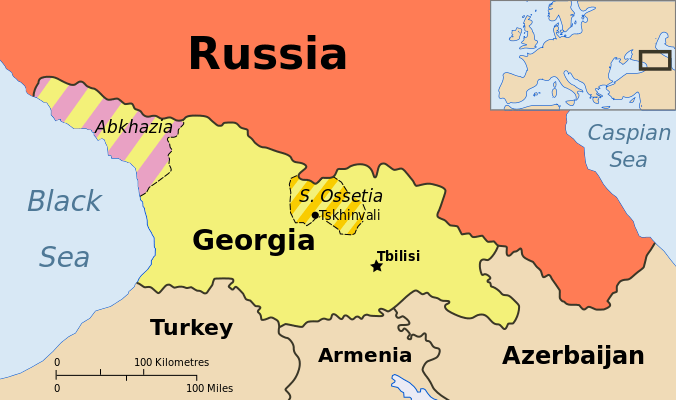
This is fairly straightforward logic on Moscow’s part. When the West supported Kosovo’s secession from Serbia (in defiance of Article 2(4) of the UN charter), Russia responded by supporting South Ossetia and Abkhazia breaking away from Georgia before annexing them. The interesting thing here is that Russia even mimicked Western use of force to back up its play. When the West supported Montenegro’s secession from Serbia (in defiance of Article 2(4) of the UN charter), Russia responded by supporting Donetsk, Crimea, and Luhansk breaking away from Ukraine before annexing Crimea. The interesting thing here is that Russia even mimicked Western use of force to back up its play. Both Russia and the West used minimal military resources to achieve their objectives, and both played the sovereignty card to back up their actions.

blog-map-of-caucasus
(source)

Western policymakers will never be able to bring liberty to Russia, and liberty will never be known by Russians if the rule of law is trumped by geopolitics. The West dominates the world’s international governing organizations. It has made the rules. It has drawn up the contracts. It has invited the non-West to participate. It has given concessions in order to gain the non-West’s support. So when the West breaks the rules it first outlined and drew up, the non-Western polities it convinced to join IGOs in the first place cannot be expected to take such rules seriously. The fact that Russia does play by the West’s rules, by taking seriously the claims of breakaway regions, suggests that the West has been in the wrong post-1993.

American media pundits and critical thinking

All of this leads me back to sensationalist headlines about nefarious Russian meddling in the American presidential election. Don’t believe any of that garbage. Firstly, look at how often American foreign policy pundits have been wrong. Just look! Amid the cries of Russian meddling in the Clinton-Trump contest you can surely hear the faint echoes about weapons of mass destruction in Iraq. Secondly, all good analyses of geopolitical affairs provide at least some bit of historical context to them. Does your foreign policy pundit use history as a guide? Thirdly (and lastly), when thinking about a country remember that most accounts will have a point of view that shadows the consensus found in the world’s political and financial centers, which are useful but will sacrifice important details in the name of efficiency (and efficacy).

American libertarians, of all the factions out there, realize this best. Unfortunately, until they can shake the isolationist dogma that has paralyzed the movement since the Rothbard era of the 70s and 80s, they will continue to be marginalized in contemporary discussions about foreign policy, either as token libertarians in a Republican administration or as token libertarians in the “anti-war” movement (I put “anti-war” in scare quotes because by now it should be obvious that this movement represents the Democratic Party [pdf], not an ideal; see, though, Michael Kazin’s excellent, if ultimately unconvincing, argument for a different take on the disappearance of the anti-war movement once Obama and the Democrats came to power). New republics, secessionist movements, and other endeavors of exit are often embraced by American libertarians because of their autonomist appeal, but if they don’t pay attention to how state actors view such movements, especially regional and global hegemons, they may end supporting some very nasty regimes in the name of liberty.