A Common Conservative Fallacy

I believe folly serves liberals better than it serves conservatives. Our way is the rational way while liberals tend to rely on their gut-feelings and on their sensitive hearts which make them comparatively indifferent to hard facts. That’s why they voted for  Pres. Obama. That’s why they voted for Mrs Bill Clinton against all strong evidence (known evidence, verifiable, not just suppositions) of her moral and intellectual unsuitability. That’s why many of them still can’t face emotionally the possibility of buyer’s remorse with respect to Mr Obama. That’s why they can’t collectively face the results of the 2016 election. So, conservatives have a special duty to wash out their brains of fallacy often.

It’s the task of every conservative to correct important errors that have found their way into fellow conservatives’ mind. Here is one I hear several times a week, especially from Rush Limbaugh (whom I otherwise like and admire). What’s below is a paraphrase, a distillation of many different but similar statements, from Limbaugh and from others I listen to and read, and from Internet comments, including many on my own Facebook:

“Government does not create jobs,”

and

“Government does not create wealth (it just seizes the wealth created by business and transfers it to others).”

Both statements are important and both statements are just false. It’s not difficult to show why.

First, some government actions make jobs possible that would not exist, absent those actions. Bear with me.

Suppose I have a large field of good bottom land. From this land I can easily grow a crop of corn sufficient to feed my family, and our poultry, and our pig, Gaspard. I grow a little more to make pretty good whiskey. I have no reason to grow more corn than this. I forgot to tell you: This is 1820 in eastern Ohio. Now, the government uses taxes (money taken from me and from others under threat of violence, to be sure) to dig and build  a canal that links me and others to the growing urban centers of New York and Pennsylvania. I decide to plant more corn, for sale back East. This growth in my total production works so well that I expand again. Soon, I have to hire a field hand to help me out. After a while, I have two employees.

In the  historically realistic situation I describe, would it not be absurd to declare that the government gets no credit, zero credit for the two new jobs? Sure, absent government tax-supported initiative, canals may have been built as private endeavors and with private funds. In the meantime, denying that the government contributed to the creation of two new jobs in the story above is not true to fact.

Second, it should be obvious that government provides many services, beginning with mail delivery. Also, some of the services private companies supply in this country are provided elsewhere by a branch of government. They are comparable. This fact allows for an estimation of the economic value of the relevant government services. Emergency services, ambulance service, is a case in point. Most ambulances are privately owned and operated in the US while most ambulances are government-owned and operated in France. If you have a serious car accident in the US, you or someone calls a certain number and an ambulance arrives to administer first aid and to carry you to a hospital if needed. Exactly the same thing happens in France under similar circumstances. (The only difference is that, in France, the EM guy immediately hands you a shot of good cognac. OK, it’s not true; I am kidding.)

In both countries, the value of the service so rendered is entered into the national accounting and it does in fact appear in the American Gross Domestic Product for the year (GDP) and in the French GDP, respectively. The GDP of each country thus increases by something like $500 each time an ambulance is used. Incidentally, the much decried GDP is important because it’s the most common measure of the value of our collective production. One version of GDP (“PPP”) is roughly comparable between countries. When the GDP is up by 3,5 % for a year, it makes every American who knows it, happy; also some who don’t know it. When the GDP shrinks by 1%, we all worry and we all feel poorer. If the GDP change shrinks below zero for two consecutive quarters, you have the conventional definition of a recession and all hell breaks lose, including usually a rise in unemployment.

Exactly the same is true in France. The government-provided French ambulance service has exactly the same effect on the French GDP.

Now think of this: Is there anyone who believes that the equivalent service supplied in France by a government agency does not have more or less the same value as the American service provided by a private company? Would anyone argue that the ambulance service supplied in France, in most ways identical to the service in America, should not be counted in the French GDP? Clearly, both propositions are absurd.

Same thing for job creation. When the French government agency in charge of ambulances hires an additional ambulance driver, it creates a new job, same as when an American company hires an ambulance driver.

By the way, don’t think my story trivial. “Services” is a poorly defined category. It’s even sometimes too heterogeneous to be useful (not “erogenous,” please pay attention). It includes such disparate things as waitressing, fortune-telling, university teaching, and doing whatever Social Security employees do. Yet it’s good enough for gross purposes. Depending on what you include, last year “services” accounted for something between 45% and 70% of US GDP. So, if you think services, such as ambulance service, should not be counted, you should know that it means that we are earning collectively about half to three quarters less than we think we do. If memory serves, that means that our standard of living today is about the same as it was in 1950 or even in 1930.

Does this all imply that we should rejoice every time the government expands? The answer is “No,” for three reasons. These three reasons however should only show up after we have resolved the issue described above, after we have convinced ourselves that government does provide service and that it and does create real jobs, directly and indirectly. Below are the three questions that correspond to the three reasons why conservatives should still not rejoice when government enlarges its scope. Conservatives should ask these three questions over and over again:

1 Is this service a real service to regular people or is it created only, or largely, to serve the needs of those who provide it, or for frivolous reasons? Some government services fall into this area, not many, I think. Look in the direction of government control, inspection, verification functions. Don’t forget your local government.

Often, the answer to this question is not clear or it is changing. Public primary and secondary education looks more and more like a service provided largely or even primarily to give careers to teachers and administrators protected by powerful unions. It does not mean that the real, or the expected service, “education,” is not delivered, just that it’s often done badly by people who are not the best they could be to provide that particular service; also people who are difficult or impossible to replace.

2   Is this particular service better provided by government or by the private sector? Is it better provided by government although the provision of the service requires collecting taxes and then paying out the proceeds to the actual civil servants through a government bureaucracy? That’s a very indirect way to go about anything, it would seem. That’s enough reason to be skeptical. The indirectness of the route between collecting the necessary funds and their being paid out to providers should often be enough to make government service more expensive than private, market-driven equivalent services. Note that the statement is credible even if every government employee involved is a model of efficiency.

The US Post Office remains the best example of a  situation where one would say  the private sector can do it better.

Only conservatives dare pose this question with respect to services one level of government or other has been supplying for a long time or forever. The Post Office is inefficient; if it were abolished, the paper mail would be delivered, faster or cheaper, or both. Some paper mail would not be delivered anymore. Many more of us would count it a blessing than the reverse. While there is a broad consensus across the political spectrum that children should be educated at collective expense, there is growing certitude that governments should not be in the business of education. In many parts of the country, the public schools are both expensive and bad. Last time I looked, Washington DC was spending over $20,000 per pupil per year. Give me half that amount and half the students or better will come out knowing how to read, I say. (It’s not the case now.)

3   This is the most serious question and the most difficult to answer concretely: Does the fact that this service is provided by government (any level) have any negative effect on our liberties? This is a separate question altogether. It may be that the government’s supply of a particular service is both inefficient and dangerous to freedom. It may be however that government supply is the most efficient solution possible and yet, I don’t want it because it threatens my freedom. As a conservative, I believe that my money is my money. I am free to use it to buy inefficiently, in order to preserve liberty, for example. I am not intellectually obligated to be “pragmatic” and short sighted.

To take an example at random, if someone showed me, demonstrated beyond a reasonable doubt, that Obamacare would reduce the cost of health care without impairing its quality, if that happened, I would still be against it because of the answer I would give to the third and last question above.

I don’t want a any government bureaucracy to make decisions that are ultimately decisions of life and death on my behalf. The possibility of blackmail is too real. Even thinking about it is likely to make some citizens more docile than they otherwise would be. So much power about such real issues must have a chilling effect on the many.

The rule of thumb is this: Every expansion of government reduces individual freedom. That’s true even if this expansion creates and efficient and effective government agency, say, a real good Post Office we don’t even know how to dream of. And this is not an abstract view. The well-intentioned and in other ways laudable recognition of homosexual marriage was followed in short order by threats and fines against a hapless baker who declined to bake a cake for a gay wedding. We must keep in mind at all times that, of course, the power to fine, like the power to tax, is the power to destroy.

An efficient but ethically objectionable government service is not something I worry much about, in the case of Obamacare specifically, by the way. It is inefficient, ineffective and dangerous to individual liberty all at once.

Conservatives don’t do enough to proclaim that their opposition to big government has an ethical basis, that it’s a moral position independent of the quality of big government. This silence makes if easy for liberals to caricature conservatives as just selfish grouches who don’t want to pay taxes.

Most of the time, I don’t want to pay taxes because I don’t want to be forced. I would gladly give away twice the amount of my taxes if there were a way to do it voluntarily instead of paying taxes.

I am so opposed to this kind of force that I think even the undeserving and obscenely rich should not be despoiled by the government. It’s an ethical position, not a pragmatic one. And, it sure cannot be called “selfish.” (WTF!)

Ten best papers/books in economic history of the last decades (part 2)

Yesterday, I published part 1 of what I deemed were the best papers and books in the field of economic history of the last few decades. I posted only the first five and I am now posting the next five.

  • Carlos, Ann M., and Frank D. Lewis. Commerce by a frozen sea: Native Americans and the European fur trade. University of Pennsylvania Press, 2011.

This book is not frequently cited (only 30 cites according to Google Scholar), but it has numerous gems for scholars to include in their future work. The reason for this is that Carlos and Lewis have pushed the frontier of economic history into the history of Natives in the New World. This issue of Natives in North America is one of those topics that irritates me to no end as an economic historian. A large share of the debates on economic growth in the New World have been centered on the idea that there was either some modest growth (less than 0.5% per year in per capita income) or no growth at all (which is still a strong testimonial given that the population exploded). But all that attention centres on comparing “whites” (and slaves) in the New World with everyone in the Old World. In the first decades of the colonies of Canada and the United States, aboriginals clearly outnumbered the new settlers (in Canada, the native population around 1736 was estimated at roughly 20,000 which was slightly less than the population of Quebec – the largest colony). Excluding aboriginals, who comprised such a large share of the population, at the starting point will indubitably affect the path of growth measured thereafter. My “gut feeling” is that anyone who includes natives in GDP accounting will lower the starting point dramatically. That will increase the rate of long-term growth. Additionally, the output that aboriginals provided was non-negligible and probably grew more rapidly than their population (the rising volume of furs exported was much greater than their population growth). This is why Carlos and Lewis’s work is so interesting: because it is essentially the first to assemble economic continuous time series regarding trade between trappers and traders, the beaver population, property rights and living standards of natives. From their work, all that is needed is a few key defensible assumptions in order to include natives inside estimates of living standards. From there, I would not be surprised that most estimates of growth in the North American colonies would be significantly altered and the income levels relative to Europe would also be altered.

  • Floud, Roderick, Robert W. Fogel, Bernard Harris, and Sok Chul Hong. The changing body: Health, nutrition, and human development in the western world since 1700. Cambridge University Press, 2011.

This book is in the list because it is a broad overview of the anthropometric history that has arisen since the 1980s as a result of the work of Robert Fogel. I put this book in the list because the use of anthropometric data allows us to study the multiple facets of living standards. For long, I have been annoyed at the idea of this unidimensional concept of “living standards” often portrayed in the general public (which I am willing to forgive) and the economics profession (which is unforgivable). In life, everything is a trade-off.  A peasant who left the countryside in the 19th century to get higher wages in a city manufacture estimated that the disamenities of the cities were not sufficient to offset wage gains (see notably Jeffrey Williamson’s Coping with City Growth during the British Industrial Revolution on this). For example, cities tended to have higher food prices than rural areas (the advantage of cities was that there were services no one in the countryside could obtain).  Cities were also more prone to epidemics and pollution implied health costs. Taken together, these factors could show up in the biological standard of living, notably on heights. This is known as the “Antebellum puzzle” where the mean heights of individuals in America (and other countries like Canada) fell while there was real income and wage growth. The “Antebellum puzzle” that was unveiled by the work of Fogel and those who followed in his wake represents the image that living standards are not unidimensional. Human development is about more than incomes. Human development is about agency and the ability to choose a path for a better and more satisfying life. However, with agency comes opportunity costs. A choice implies that another path was renounced. In the measurement of living standards, we should never forget the path that was abandoned. Peasants abandoned lower rates of infant mortality, lower overall rates of mortality, the lower levels of crowding and pollution, the lower food prices and the lower crime rates of the countryside in favor of the greater diversity of goods and services, the higher wages, the thicker job market, the less physically demanding jobs and the more secure source of income (although precarious, this was better than the volatile outcomes in farming). This was their trade-off and this is what the anthropometric literature has allowed us to glean. For this alone, this is probably the greatest contribution in the field of economic history of the last decades.

  • De Vries, Jan. The industrious revolution: consumer behavior and the household economy, 1650 to the present. Cambridge University Press, 2008.

Was there an industrious revolution before the industrial revolution? More precisely, did people increase their labour supply during the 17th and 18th centuries which lead to output growth? In proposing this question, de Vries provided a theoretical bridge of major significance between the observations of wage behavior and incomes in Europe during the modern era. For example, while wages seemed to be stagnating, incomes seemed to be increasing (in the case of England as Broadberry et al. indicated). The only explanation is that workers increased their labor supply? Why would they do that? What happened that caused them to increase the amount of labor they were willing to supply? The arrival of new goods (sugar, tobacco etc.) caused them to change their willingness to work. This is a strong illustration of how preferences can change more or less rapidly (when new opportunities are unveiled). In fact, Mark Koyama (who blogs here) managed to insert this narrative inside a very simple restatement of Gary Becker’s model of time use. Either you have leisure that is cheap but time-consuming (think of leisure in the late middle ages) or leisure that is more expensive but does not consume too much time (think the consumption of tea, sugar and tobacco). Imagine you only have the time-expensive leisure which you value at level X. Now, imagine that the sugar and tea arrive and, although you pay a higher price, it provides more utility than the level and it takes less time. In such a context, you will likely change your preferences between leisure and work. I am grossly oversimplifying Mark’s point here, but the idea is that the industrious revolution argument advanced by de Vries can easily fit inside a simple neoclassical outlook. On top of solving many puzzles, it also shows that one does not need to engage in some fanciful flight of Marxian theory (I prefer Marxian to Marxist because it is one typo away from being Martian which would adequately summarize my view of Marxism as a social theory). If it fits inside the simpler model, then you don’t need the rest.  De Vries does just that.

  • Anderson, Terry Lee, and Peter Jensen Hill. The not so wild, wild west: Property rights on the frontier. Stanford University Press, 2004.

Governance is not the same as government (in fact, they can be mutually exclusive). In recent years, I have been heavily influenced by Elinor Ostrom’s work on how communities govern the commons in very subtle (but elaborate) ways without the use of coercion. These institutional arrangements are hard to simplify into one variable for a regression, but they are theoretically simple to explain: people respond to incentives. Ostrom’s entire work shows that people on the front line of problems generally have the best incentives to get the right solution because they have skin in the game. What her work shows is that individuals govern themselves (see also Mike Munger’s Choosing in Groups) by generating micro-institutions that allow exchanges to continue. Terry Anderson and Peter Hill provide the best illustration in economic history in that regard by studying the frontier of the American west. Settlers moved to the American West faster than the reach of government and the frontier was thus an area more or less void of government action. So, how did people police themselves? Was it the wild west? No, it was not. Private security firms provided most of the policing, mining clubs established property rights without the need for government, farmers established constitutions in voluntary associations that they formed and many “public goods” were provided privately. The point of Anderson and Hill is that governance did exist on the frontier in a way that demonstrates the ability of voluntary actions (as opposed to coercive government actions) to generate sustainable and efficient solutions. The book has a rich theoretical framework on top of a substantial body of evidence regarding the emergence of institutions. Any good economic historian should own and read this book.

  • Vedder, Richard K., and Lowell E. Gallaway. Out of work: unemployment and government in twentieth-century America. NYU Press and Independent Institute, 1997.

The last book on the list is an underground classic for me. Richard Vedder and Lowell Gallaway are very good economic historians. It was produced like many other underappreciated classics (like Higgs’s Crisis and Leviathan) by the Independent Institute (see their great book list here). Most of their output was produced from the 1960s to the 1980s. However, as the 1990s came, they moved towards the Austrian school of Economics. With them, they brought a strong econometric knowledge – a rarity among Austrian scholars. They attempted one of the first (well-regarded) econometric studies that relied on Austrian theory of the labor-market (a mixture of New Classical Theory with Austrian Theory). Their goal was to explain variations in unemployment in the United States by variations in “adjusted real wages” (i.e. unit labor costs) all else being equal. At the time of the publication, they used very advanced econometric techniques. The book was well received and even caught the attention of Brad DeLong who disagreed with it and debated Vedder and Gallaway in the pages of Critical Review. Although there are pieces that I disagree with, the book has mostly withstood the test of time. The core insights of Out of Work regarding the Great Depression (and many of its horrible policies like the National Industrial Recovery Act) have been conserved by many like Scott Sumner in his Midas Paradox and they feature prominently in the works of scholars like Lee Ohanian, Harold Cole, Jason Taylor, Price Fishback, Albrecht Ristchl and others. In the foreword to the book, they mention that D.N. McCloskey (then the editor of the Journal of Economic History) had pushed hard for them to publish their work regarding the 1920s and 1930s. McCloskey was right to do so as many of their contentions are now accepted as a legitimate (if still debated) viewpoint. The insights regarding the “Great Depression of 1946” (a pun to ridicule the idea that the postwar reduction in government expenditures led to a massive reduction in incomes) have been generally conserved by Robert Higgs in his Journal of Economic History article I mentioned yesterday (and in this article as well) and even by Alexander Field in his Great Leap Forward However, Out of Work remains an underground classic that is filled with substantial pieces of information and data that remains unused. There are numerous unexploited insights (some of which Vedder and Gallaway have followed on) as well. The book should be mandatory reading for any economic historian.

Ten best papers/books in economic history of the last decades (part 1)

In my post on French economic history last week,  I claimed that Robert Allen’s 2001 paper in Explorations in Economic History was one of the ten most important papers of the last twenty-five years. In reaction, economic historian Benjamin Guilbert asked me “what are the other nine”?

As I started thinking about the best articles, I realized that such a list is highly subjective to my field of research (historical demography, industrial revolution, great divergence debate, colonial institutions, pre-industrial Canada, living standards measurement) or some of my personal interests (slavery and the great depression). So, I will propose a list of ten papers/works that need to be read (in my opinion) by anyone interested in economic history. I will divide this post in two parts, one will be published today, the other will come out tomorrow.

  • Higgs, Robert. “Wartime Prosperity? A Reassessment of the US Economy in the 1940s.” Journal of Economic History 52, no. 01 (1992): 41-60.

Higgs’s article (since republished and expanded in a book and in follow-ups like this Independent Review article) is not only an important reconsideration of the issue of World War II as a causal factor in ending the Great Depression, it is also an efficient primer into national accounting. In essence, Higgs argues that the war never boosted the economy. Like Vedder and Gallaway, he argues that deflators are unreliable as a result of price controls. However, he extends that argument to the issue of measuring GDP. In wartime, ressources are directed, not allocated by exchange. Since GDP is a measure of value added in exchanges, the wartime direction of resources does not tell us anything about real production. It tells us only something about the government values. As a result, Higgs follows the propositions of Simon Kuznets to measure the “peacetime concept” of GDP and finds that the prosperity is overblown. There have been a few scholars who expanded on Higgs (notably here), but the issues underlined by Higgs could very well apply to many other topics.  Every year, I read this paper at least once. Each time, I discover a pearl that allows me to expand my research on other topics.

  • Allen, Robert C. The British industrial revolution in global perspective. Cambridge: Cambridge University Press, 2009.

I know I said that Allen’s article in Explorations was one of the best, but Allen produces a lot of fascinating stuff. All of it is generally a different component of a “macro” history. That’s why I recommend going to the book (and then go to the article depending on what you need). The three things that influenced me considerably in my own work were a) the use of welfare ratios, b) the measurement of agricultural productivity and c) the HWE argument. I have spent some time on items A and C (here and here). However, B) is an important topic. Allen measured agricultural productivity in England using population levels, prices and wages to proxy consumption in a demand model and extract output from there (see his 2000 EREH paper here). As a result, Allen managed to compare agricultural productivity over time and space. This was a great innovation and it is a tool that I am looking to important for other countries – notably Canada and the US. His model gives us the long-term evolution of productivity with some frequency. In combination with a conjonctural estimate of growth and incomes or an output-based model, this would allow the reconstruction (if the series match) of a more-or-less high frequency dataset of GDP (from the perspective of an economic historian, annual GDP going back into the 17th century is high-frequency). Anyone interested in doing the “dirty work” of collecting data, this is the way to go.

  • Broadberry, Stephen, Bruce MS Campbell, Alexander Klein, Mark Overton, and Bas Van Leeuwen. British economic growth, 1270–1870. Cambridge University Press, 2015.

On this one, I am pretty biased. This is because Broadberry (one of the authors) was my dissertation supervisor (and a pretty great one to boot). Nonetheless, Broadberry et al. work greatly influenced my Cornucopian outlook on the world. Early in my intellectual development, I was introduced to Julian Simon’s work (see the best of his work here and here and Ester Boserup whose argument is similar but more complex) on environmental trends. While Simon has generally been depicted as arguing against declining environmental indicators, his viewpoint was much broader. In essence, his argument was the counter-argument to the Malthusian worldview. Basically, Malthusian pressures caused by large populations which push us further down the curve of marginally declining returns have their countereffects. Indeed, more people means more ideas and ideas are non-rival inputs (i.e. teaching you to fish won’t make me unlearn how to fish). In essence, rising populations are no problems (under given conditions) since they can generate a Schumpeterian countereffect (more ideas) and a Smithian countereffect (size of market offsets). In their work, Broadberry et al. basically confirm a view cemented over the last few decades that England had escaped the Malthusian trap before the Industrial Revolution (see Crafts and Mills here and Nicolinni here). They did that by recreating the GDP of Britain from 1270 to 1870. They found that GDP per capita increased while population increased steadily which is a strong piece of evidence. In their book, Broadberry et al. actually discuss this implication and they formulate the Smithian countereffect as a strong force that did offset the Malthusian pressures. Broadberry and al. should stand in everyone’s library as the best guidebook in recreating long-term historical series in order to answer the “big questions” (they also contribute to the Industrious Revolution argument among many other things).

  • Chilosi, David, Tommy E. Murphy, Roman Studer, and A. Coşkun Tunçer. “Europe’s many integrations: Geography and grain markets, 1620–1913.” Explorations in Economic History 50, no. 1 (2013): 46-68.

Although it isn’t tremendously cited yet, this is one of the best article I have read (and which is also recounted in Roman Studer’s Great Divergence Reconsidered). This is because the paper is one of the first to care about market integration on a “local” scale. Most studies of market integration consider long-distance trade for grains and they generally start with the late 19th century which is known as the first wave of globalisation. However, from an economic historian perspective, this is basically studying things once the ball had already started rolling.  Market integration is particularly interesting because it is related to demographic outcomes. Isolated markets are vulnerable to supply shocks. However, with trade it is possible to minimize shocks by “pooling” resources. If village A has a crop failure, prices will rise inciting village B where there was an abundant crop to sell wheat to village A. In the end, prices in village A will drop (causing fewer deaths from starvation) and increase in village B. This means that prices move in a smoother fashion because there are no localized shocks (see the work of my friend Pierre Desrochers who argues that small local markets were associated for most of history with high mortality risks). In their work, Chilosi et al. decide to consider the integration of markets between villages A and B rather than between country A and B. Basically, what they wonder is when geographically close areas became more integrated (i.e. when did Paris and Bordeaux become part of the same national market?). They found that most of Europe tended to be a series of small regions that were more or less disconnected from one another. However, over time, these regions started to expand and integrate so that prices started moving more harmoniously. This is an important development that took place well before the late 19th century. In a way, the ball of market integration started rolling in the 17th century. Put differently, before globalization, there was regionalization. The next step to expand on that paper would be to find demographic data for one of the areas documented by Chilosi et al. and see if increased integration caused declines in mortality as markets started operating more harmoniously.

  • Olmstead, Alan L., and Paul W. Rhode. Creating Abundance. Cambridge Books (2008).

This book has influenced me tremendously. Olmstead and Rhode contribute to many literatures simultaneously. First of all, they show that most of the increased in cotton productivity in the United States during the antebellum era came from crop improvements. Secondly, they show that these improvements occured with very lax patents systems. Thirdly, they show how crucial biological innovations were in determining agricultural productivity in the United States (see their paper on wheat here and their paper on induced innovation). On top of being simply a fascinating way of doing agricultural history (by the way, most economic history before 1900 will generally tend to be closely related to agricultural history), it forces many other scholars to reflect on their own work. For example, the rising cotton productivity explains the rising output of slavery in the antebellum south. Thus, there is no need to rely on some on the fanciful claims that slaveowners became more efficient at whipping cotton out of slaves (*cough* Ed Baptist *cough*). They also show that Boldrine and Levine are broadly correct in stating that most types of technological innovations do not require extreme patents like those we know today (and which are designed to restrict competition rather than promote competition). In fact, their work on biological innovations have pretty much started a small revolution in that regard (see one interesting example here in French). Finally, they also invalidated (convincingly in my opinion) the induced innovation model that generally argued that technologies are developped merely to ease scarcities of factors. While theoretically plausible, this simplified model did not fit many features of American economic history. Their story of biological innovations is an efficient remplacement.

Skills and creativity

Below is an excerpt from my book I Used to Be French: an Immature Autobiography. You can buy it on amazon here.


My mother was pretty much a part-time monster but she had big talents and one immense virtue.

She had been trained as a seamstress in a good technical high-school. Sometimes, when my father was working at night, she would hustle the five children through a hasty dinner of coffee with milk, bread, butter, jam and cheese and then, send everybody to his or her room. (She had to do that behind my father’s back because he belonged to the old French school that believes that if you don’t get two five-course, balanced meals a day, you will sicken in a short time.) She would lock herself in the dining room with fabric, her sewing machine, and her big scissors. By morning café au lait time, she would have a new outfit of extreme chic with appropriate gloves and detachable collars. Once, she produced in two nights matching tweed overcoats and golf pants for the three boys. Even little boys could see that the outfits were exquisitely elegant though the pants felt scratchy. No matter, we had to wear them to church and for a part of Sunday afternoon.

As long as she had defenseless offspring at home, my mother never saw a children’s costume event she did not like. She would enter as many of her children as would submit. The last time it happened to me, I was eleven and tall for my age. She dressed me up as a Roman legionnaire, with a cardboard armor ingenuously painted with stove silver coating. It almost killed me, not the armor, the embarrassment. I never wore a costume again until I was twenty-five though I must admit I have retained a certain flair. At least, I was never one of those social cowards who go to a Halloween party in jeans and keep a cowboy hat in their car just in case everyone else is costumed. (You know who you are, spineless scum!)

I was aware early that my mother used her talent to gain face and to pull rank on almost all other neighborhood women. Nevertheless, watching her cut and sew through the glass door exposed me early to the concept of creativity in general, and of visual creativity, in particular. I also picked up the broad notion that creativity not served by solid skills is meaningless. In my fifties, I began to paint, without hesitation although I am quite critical, because I had retained from observing her two forceful ideas: Skills will reveal talent, if any; with practice, skills can only improve.

My mother’s living example of inventiveness was at the antipodes of the narrow, sober petty-bourgeois values my whole environment projected. It belied what she was trying to teach her children every day. She contradicted with her hands what she  preached with her mouth.

BC’s weekend reads

  1. The dangers of football safety equipment
  2. Want less pollution? Privatize the roads (just ask the bicyclists)
  3. Octopuses Are ‘the Closest We Will Come to Meeting an Intelligent Alien’
  4. Are Humans the Real Ancient Aliens?
  5. Tennessee Whiskey

A beautiful bit of small world mojo

The first time I went to Boston was to look for an apartment. On my last day I was hanging around Downtown crossing. Gmail confirms it was June 12th, 2010. I was having a polish sausage, and this guy approached me. I don’t remember what we talked about, but we chatted for a few minutes. Good town. That sort of thing is exactly what I’d expect in SLO (Central Coast California) or Santa Cruz… but this was in a place with a skyline! Anyways, he wasn’t in a cult and I didn’t get robbed.

Flash forward to some time that fall. I was in Inman Square and saw a chair left on the curb for anyone who needed a chair. I needed a chair. I lived in Union Square, but that was just the next neighborhood north (if I lived on Prospect Hill, there’s no way that chair would have made it, but I might have realized that before picking it up). So I pick up this chair and walk. Google Maps puts my route at 0.5 miles. I got a couple blocks short of that before I crap out. Fortunately I’ve got a place to sit down. So I’m sitting in an easy chair on the sidewalk, hauling it forward a few yards, and plopping down again.

Across the street, someone’s trying to get my attention. He comes over, and he’s the guy I’d randomly met months earlier. He lives across the street from me! And he helps me carry home my chair. We have a beer and chat.

Flash forward to Thanksgiving of that fall. I’m hanging out by myself. This is my first Thanksgiving alone. Neighbor guy knocks on my door and invites me over. Inside are a bunch of his musician friends, and this fantastic music is coming from one of the bedrooms. An impromptu jam session is playing the sort of dusty sounding blues I’m enamored with at the time. After they finish I mention that it sounds like this African blues guitarist, Ali Farka Toure. It turns out I pronounced his name right, because I’m immediately informed that his son was playing guitar just now!

Just now I was listening to Spotify, and a song reminds me of another song which led me to the song above from that album I’d bought when I lived in SLO and was trying to be worldly. Absolutely fantastic music, a mish-mash of cultural influences bouncing back and forth around the world, and I got to experience something of it first hand because of the grace and generosity of a fellow human.

But more than that, a mix of technology, globalization, and absolutely random chance created that beautiful memory and triggered it again just now. We live in a beautiful world.

On How Poor France Was in the 18th Century?

I have recently completed a working paper which has now been submitted (thank you a great many scholars who provided comments notably Judy Stephenson and Mark Koyama). That paper basically went back modestly on one datapoint in the work of Robert Allen which was published in 2001 in Explorations in Economic History. 

Probably one of the greatest ten papers in the field of economic history for the last twenty-five years, Allen’s article has had a tremendous influence. It introduced a new method of comparing real wages at a time when very few goods were traded internationally and most prices were determined at the local level. In using what we now call “welfare ratios” (which are akin to poverty lines), Allen managed to compare many countries before the industrial revolution.

My entire research agenda has been to improve on this stupendous work and to increase the constellation of observations as part of an “uncoordinated” (many scholars are working on this separately) effort to map living standards prior to the mid 19th century. The main part of my agenda is to add Canada and devote more attention to the important issue of relative prices in comparing old world (high labor to land ratios) and new world (high land to labor ratios) economies. In the process of comparing parts of the world, I had to re-examine some data for some established countries. One of my reconsiderations was for Strasbourg in France where I found that Allen might have misclassified wages of skilled workers which included in-kind payments as unskilled workers receiving full compensation in money wages.

When I enacted corrections to the money wage rate, I found that the Alsace region where Strasbourg is located had living standards more or less in line with those observed in Paris (rather than living standards at less than half the level of Paris). If you’re interested, the note is available here.

Note: For those who are interested, I really recommend reading this short article in Cliometrica by Sharp and Weisdorf who also discuss comparisons between France and England (and how it may relate to topics like the French Revolution).

The Ottoman Empire and Libertarianism

Every so often libertarians ask, in a speculative mode, whether the re-establishment of the Ottoman Empire would not be a formula for peace in the troubled Middle East. The question is interesting on several counts, one of which is that the regions affected by the Islamic State today, Arab and Kurdish alike, plus all of southern Iraq, plus Kuwait, plus Jordan and Palestine (including the current Israel), plus, more loosely, all of the Arabian Peninsula, were more or less under Ottoman/Turkish control until the end of World War One.

Libertarians allude to the “millet” system under which many different ethnic or national groups co-habitated peacefully for several centuries. Those are pretty much the same groups that have been eviscerating one another for several years and pretty much every time a strong and dictatorial leader does not clamp down on them. There is one large fault in this happy vision: the attempted genocide of the Armenians begun under full Ottoman power in 1895 and nearly completed as the empire was falling apart during World War One.

The millet system of governance should be of interest to libertarians who generally wish for less government, less expensive government, more responsive government and, especially, less intrusive government. Under the millet system, at least when it was fully functional, the Ottoman governor of say, the province of the empire that now encompasses Lebanon and Western Syria would summon yearly the Patriarch of the Greek Orthodox Church. He would address him as follows:

“Your Eminence is well I trust, and his family, and I hope that his sons are brave a wise. I am happy to hear that Almighty God has blessed Your Eminence with many grandchildren. And I am told your community is thriving. Now, based on the figures your office gave me and based on my own information, I think that the Greek Orthodox community must deliver to our master the Sultan, one hundred pounds of gold and three hundred fit young men of military age this year. Agreed? Thank you for your visit and may you and your community, Your Eminence, continue to prosper under the benign, enlightened and fair rule of our great sultan.”

Then, the governor would ask over the main Ayatollah of the Shiite Muslims and deliver himself of a similar oration. And so on.

But I must pause for a confession. The quote marks around the above monologue are metaphorical. I am not reproducing a real monologue. Something like the monologue above must have been delivered thousands of times but I must admit I was not present to hear any of them. (On the other hand, I spent time in Turkey on vacation ten years ago and I regularly drink coffee with Turks. And, I like Turks in general.)

Again, the millet system is a good historical example of extreme decentralization and of minimally intrusive government. It was also very inexpensive to administer. It had little permanent bureaucracy to speak of that could grow upon itself and reproduce itself endlessly thus forever shrinking the area of individual autonomy. At the same time as the comparable Hapsburg Empire was developing a large bureaucracy, at the time when territorially much smaller France was perfecting the art of centralized bureaucracy, at the time when the small Kingdom of Prussia was developing the very model of modern bureaucracy that was to become a model for the whole world, the millet system endured in the Ottoman Empire. In general, the Ottoman government was small and it seemed to be treading lightly on the land, you might say. It sounded a little like a sort of libertarian dream.

But, wait a minute, I need to complete significantly the imaginary monologue of the Ottoman governor above. On parting, the governor would have probably added: “Enjoy life and enrich yourselves. Everything will be fine unless I hear too much about you. If I do, bad things will happen to your community.” Or, he did not even need to utter the words. Everyone knew about the bad things that would happen if disorder arose. Some of these bad things were community leaders’ heads on a spike in village centers.

The Ottoman Empire that relied on the light, non-invasive, decentralized millet system was also famous for the fierceness of its repression. And this haven of diversity disintegrated swiftly throughout the 19th century with a speed that must give pause.

The unraveling of the Ottoman Empire began around 1805 when the large and important Egyptian subdivision gained all but nominal independence through an armed revolt and even waged successful war on the Empire. During the rest of the 19th century, the areas of the Empire now comprising Greece, Bulgaria and Romania decisively seceded. In the meantime, much of the rest of the officially defined Empire drifted away, such as Libya and Tunisia. Later, during World War One, the British (Lawrence) and the French did not have much trouble talking the remaining Arab areas of the empire into open rebellion. And yes, there was an attempted massive genocide of Armenians, in two phases. The first phase was under full Ottoman power in the 1890s; the second, much larger step occurred during the waning days of Ottoman rule starting in 1915.

Now, one can argue – and historians routinely do – that the spectacular disintegration of the Ottoman Empire was due to external pressures from the rising, fast industrializing European powers. Yet, the fact that national (ethnic) entities took up every opportunity to leave the Empire does not speak well of the effectiveness of Ottoman administration. The fact that they sometimes did it a a cost of great bloodshed, the Greeks in particular, does not strengthen the idea of contentment of the administered. The fact is that the subject people of the Ottoman Empire including the many governed through the millet system described above seem to have left as soon as the opportunity arose.

The disintegration of the Ottoman Empire poses a conceptual problem: Did it fall apart in spite of the admirable millet system of government or because of it? Was internal peace maintained in the Empire for a long time because of the virtues of the millet system or because of the ever-present threat of a large and fierce army facing a divided and unarmed populace?

Was the Ottoman Empire taken apart from within, and also from without, because the administrative principles behind the millet system impeded the supply of the means of self-preservation?

Beyond this lies an even graver question for anyone with libertarian aspirations: Do systems of administration that share the main features of the millet system, decentralization, low cost, and low-level invasiveness contain the seeds of their own destruction? Does administrative lightness actually nurture violent intervention from above and/or from outside?

I don’t know the answers to these serious questions. I think libertarians of all feathers don’t discuss these and related issues nearly enough. I suspect libertarian circles harbor their own form of political correctness that paralyzes such essential inquiries. I do what I can. I know it’s not much.

Free lunch: college edition

Andrew Cuomo recently proposed making college free taxpayer funded for middle class New Yorkers. He argues that college is a “mandatory step if you really want to be a success.” For the sake of argument, let’s assume that he’s making adequate adjustments for vocational training.

As a SUNY employee, I’m not sure how to feel about this. On the one hand, it means an increased demand for my services. On the other hand, it means increased pressure to keep costs down, which could mean a fall in my future earnings potential. Increased admissions pressure means I might have easier to teach students, but also probably means less chances for the low-income students coming from the worst public schools.

At best, we’re looking at a middle-class to middle-class transfer that will trade off the benefits of market pressure against the benefits (to families paying for school) of not having to think too hard about how to manage a large expense.

I won’t go into the issue of signaling (see Bryan Caplan), or the sheer wastefulness of having people get bachelor’s degrees for jobs that don’t need them (see Dick Vedder… esp. table 1). These are important points, because they get at the root problem Cuomo is misdiagnosing. College is mandatory because of subsidies and subsidies will only make it worse. But we don’t even need to be that sophisticated to understand why this plan is a problem.

Here’s my basic problem with “free” college tuition: it’s too good to be true. I get the desire to help out poor people, but the average household in NY makes just under $60K/year and this plan is for all households making less than $125K. That’s “free” tuition to a lot of households that would be sending their kids to school anyways. That money has to come from somewhere. The people paying for this program will largely overlap with the people benefiting from it.

If everyone thinks their kids should go to school, then what’s the point in taking away their money to send their kids to school?! We all like burritos, so give me your money and I’ll buy us all the burritos we want. Doesn’t make sense! Giving up control of your spending can only make you worse off, so this will ultimately be a bad thing for the middle class. And that lack of control from middle class helicopter parents will likely be a bad thing for the working poor people who could have been net beneficiaries (hopefully… I’m not certain this won’t back fire on net). Even if subsidizing higher-ed were a good idea, this is almost certainly a terrible way to go about it.

Public Support for OReGO: Preliminary Results

tldr version;

Road pricing can be a useful means of addressing infrastructure fiscal issues, reducing congestion, and improving environmental quality and it has a chance of being implemented if advocates focus on mobilizing urban voters.

Thanks to all respondents.


This post is a quick detour from the NoL Foreign Policy Survey posts.

Among other projects I am working on, I am tinkering with a public opinion project aimed at the OReGO project. The OReGO is a pilot program operated by the State of Oregon to experiment with an alternative to the existing gasoline tax. Currently Oregonians pay 30 cents per gallon of gasoline, on top of the federal 18.4 cent per gallon tax. Volunteer participants of OReGO instead pay a charge of 1.5 cents per mile driven on state roads.

orego

The primary goal of the program is to find a better way to fund the state’s infrastructure. The current system is inadequate because automobiles are becoming increasingly more fuel efficient and so, on a per mile basis, pay less for road use. Despite paying less these automobiles still rack up costs in road damage.

Advocates of OReGO, and other road pricing schemes, also hope that the program will serve as a means of combating congestion by making drivers more conscious of the marginal cost of their driving and encouraging them to avoid excess driving. The gasoline tax does this already, but very crudely in comparison.

Some advocates also hope to use road pricing as a means of improving local environmental quality and addressing climate change. Automobiles are a significant source of pollution and so reducing their use would yield environmental benefits. Even if the program kept the same number of cars on the road it could reap benefits if it reduced stop and go traffic; automobiles pollute more in stop and go traffic than free flow.

There is quite a bit of research from economists and urban planners on the issue, but public opinion research on it is relatively rare. What research exists tends to focus on either toll roads or in foreign regions. The reason for the gap in the literature is simple enough to explain – no jurisdiction in the United States has adopted road pricing. There have been a few small scale experiments, but they were largely engineering tests and surveyed only the opinion of participants. I hope to fill this gap in the literature by (eventually) conducting a large scale public opinion study of Oregonians.

The below pilot study had 220 respondents recruited through various Oregon sub-reddits (e.g. Portland, Eugene, and Salem). Respondents were obviously not representative of Oregon at large. The sample size was also small for an academic study of Oregon and there is a lot of noise. Most of the results presented are statistically insignificant. As a convenience sample though this survey was nonetheless useful. My goal in this survey was more about testing the survey before fielding it more broadly.

I thank all respondents to the survey – you’ve all helped the progress of science.

Survey Experiment Results:

The survey had a survey experiment. The purpose of survey experiments is to see how changes in phrasing, or other survey elements, influences response.

The experiment was in how OReGO was presented. Respondents were split into three sub-groups and received slightly different explanations of the program. In the base scenario they were told the program was simply a funding mechanism. In the congestion scenario they were also told about its possible congestion benefits. In the final they were additionally told about its possible environmental benefits.

OReGo is a pilot program currently being operated by the Oregon Department of Transportation. Participating drivers are being given the opportunity to pay 1.5 cents per mile they drive on public roads instead of the current 30 cent per gallon tax that the state of Oregon currently charges.

Advocates of OReGO, and similar road pricing schemes, argue that the program serves as a more dependable means of funding infrastructure than the current gasoline tax. They point out that as vehicles become more fuel efficient the amount that drivers pay per mile is decreasing, but costs associated due to road damage are not similarly decreasing. This means that in the long term the current gasoline tax will be unable to cover infrastructure costs. (/End of Base Scenario)

Advocates of OReGO also point out that the program can help reduce congestion by discouraging excessive driving and encourage the use of alternative means of transportation such as bicycling, walking, or transit. Although drivers currently pay for their automobile use in the form of the gasoline tax, many view it as a fixed payment. OReGO, which is charged on a per mile basis, may serve to make drivers more conscious of the marginal cost of their driving. (/End of Congestion Scenario)

OReGO could lead not only to reduced congestion, but could also serve to improve local air quality. One of the major sources of air pollution is automobiles, especially in stop and go traffic. (/End of Environmental Scenario)

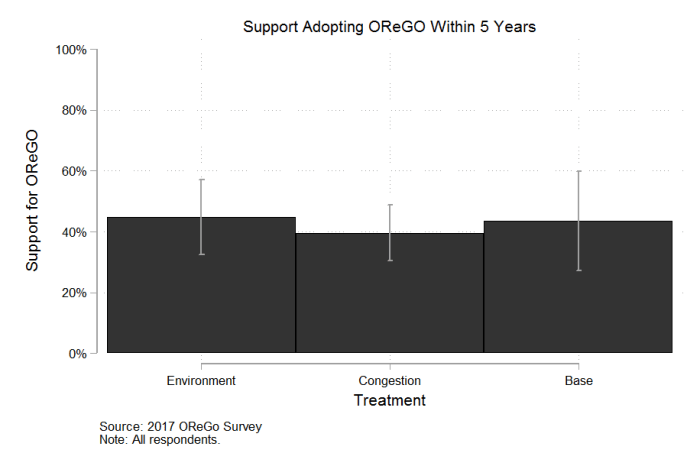
Looking at support for adopting OReGO within five years the different treatments are little different from one another. The congestion treatment received a decline in support, but it is pushed back up in the environmental treatment.

I regret not adding a fourth group where respondents are told about the base option and the environmental benefits, but congestion is not added. As it is, it is hard to tell if the decline in support for OReGO in the congestion treatment is because people don’t care about ways to address congestion, or they dislike attempts at social engineering.

favororegobytreatment

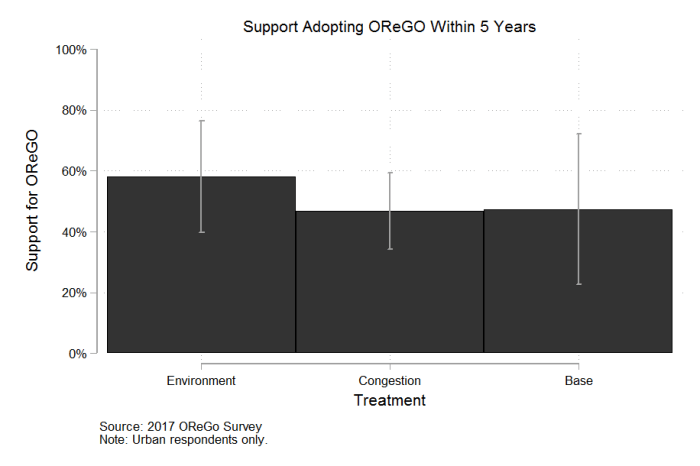
When we look at treatment effects among only those who identified living in an urban area the effects get more interesting. Urban voters were very responsive to the idea of environmental benefits and increased support for OReGO by over 10 percentage points.

FavorOregobyTreatmentUrban.png


favororegobyurban

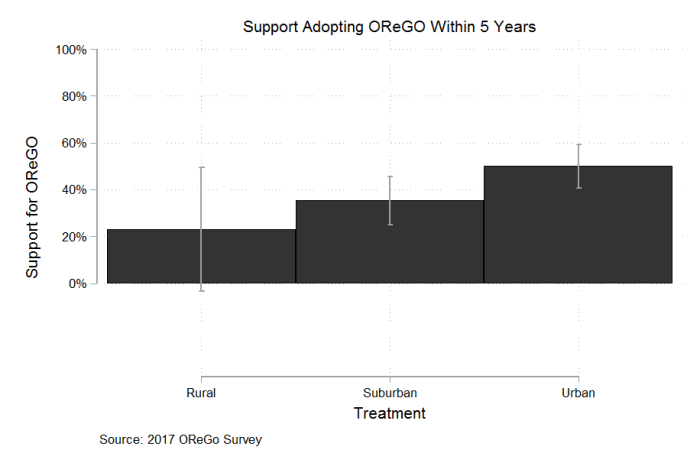
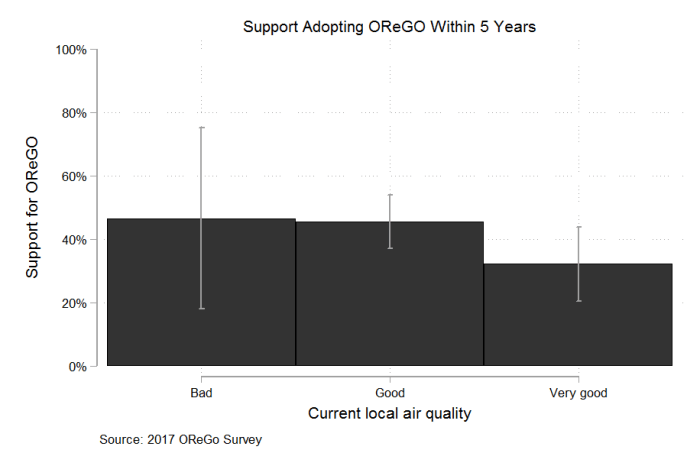
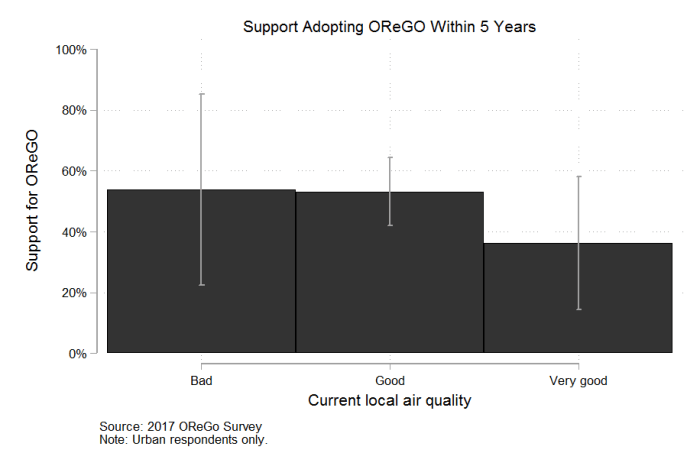
What seems to be driving the difference in support for OReGO is inter-regional differences in perceived local air quality. Those who perceive local air quality to be ‘very good’ are least likely to support OReGO. This finding is exaggerated when looking at only urban respondents.

I played around to see if this was a statistical artifact from the above treatment; i.e. it is possible those who lived in ‘very good’ air quality regions received the ‘environmental treatment’  and I am picking up the latter effect. This was not the case.

favororegobylocalair

favororegobylocalairurban

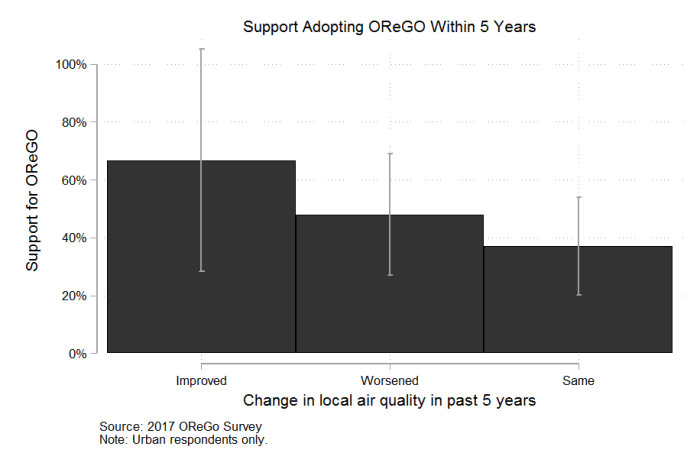
Is this a simple case of those living in high quality areas having no interest in improving the region? A “I have mines” attitude. No. When I look at support for OReGO by how respondents judged local air quality had changed in the past five years, those who thought their local air quality was improving also had the highest support for OReGO.

There is a definite relationship here between support for OReGO and perception of one’s local air quality. I can’t put my finger on it just yet.

favororegobychangeairurban

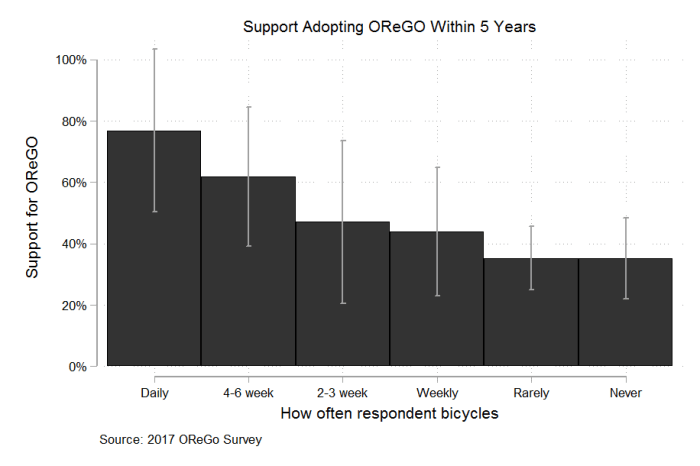
Bonus result: daily bicyclists are those most supportive of OReGO.

favororegobybikefreq

Libertarians on Climate Change

This post is part of the preliminary results of the NoL Foreign Policy Survey 2017 Pilot. I will be posting results throughout the week as I play around with the data. As always, I strongly emphasize that this is a pilot survey and these are just preliminary results

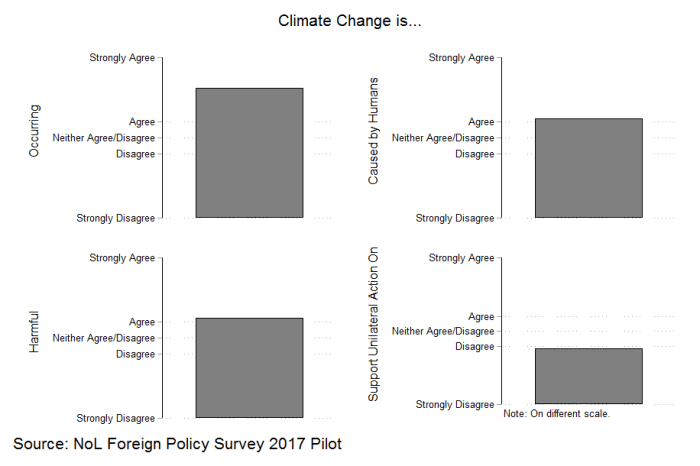
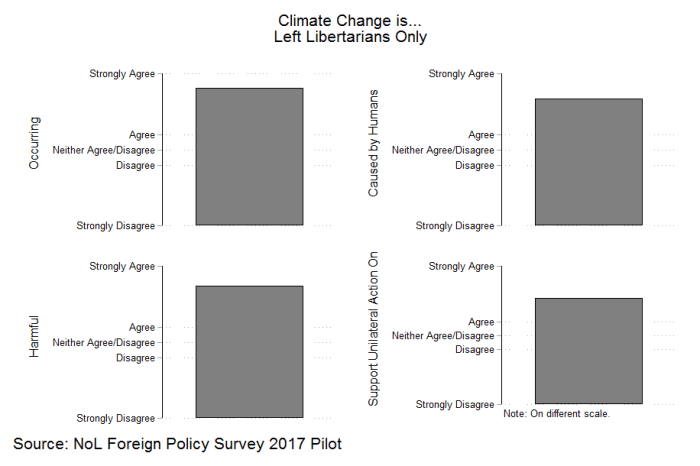
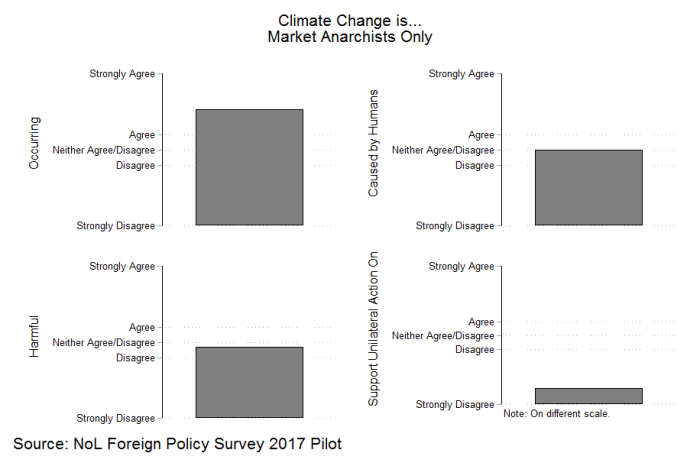
Are libertarians climate change deniers? No. The majority agree that it is occurring, caused by human activity, and that it is harmful. They do not however support unilateral action by the United States government. At least not the average libertarian respondent.

climatechange

Note that the last question, asking about supporting unilateral action, is on a different scale from the other three.


When you drill down by type of libertarian though you start to see stark differences. Left-libertarians agree much more strongly that climate change is occurring, caused by human activity, and harmful. They are also much more in support of unilateral action to prevent climate change.

climatechangell


What is driving the differences between type of libertarian? Part of the story seems to be that those who think climate change is harmful are more willing to act to address it, but I suspect a large part of the story is also that some libertarians, particularly market anarchists, simply do not trust the government. Market anarchists are less likely to believe climate change is harmful or caused by humans compared to libertarians at large, but the big difference in opinion is whether the government should act on it.

Thoughts? Tomorrow I will be posting the demographics of those who took the survey.

climatechangema

Update: Updated graphs; minor coding error.

French Expatriates and Foreign Francophiles

First, a definition: an expatriate is someone who lives outside the country of his birth on a more or less permanent basis. I am dealing here with French expatriates specifically, a fairly rare breed in relation to the size of the French population, rarer than English and American expatriates, for example.

The French expatriates often land in a particular town of a particular country at a particular time for no particular reason. They may have been heading somewhere else and gotten stuck along the way. They always include wives and former wives of natives who may have divorced them, or died. Coming from different epochs (such as before and after the establishment of French social democracy in the 1980s), they form historical strata. Each stratum remembers a different France, and the strata may entertain disparate and often incompatible visions of the fatherland.

They have developed new habits in the country where they live and, without knowing it, they have drifted far from their culture of origin. Many disseminate patently false notions about the country where they were raised; they do it more or less innocently because myth-making and absence go well together. Their French self is forever a young person, or even a child. Their own children are simply natives of their land of residence with a smattering of the French language and no real curiosity, forever strangers to their parents.

The Francophiles are yet another story. They are people who don’t have the luck to have been born French but who love what they imagine is French culture with a degree of repressed hysteria. No part of the world is free of them. I have bumped into them everywhere I have been; they have victimized me everywhere with their undeserved love. Many but by no means all are also francophone to some extent. Some gain standing in their own mind via their real or imagined mastery of what they have decided is a superior national culture.

They are usually very parochial, doubly so because they are fixated on France and on their own country, to the exclusion of knowledge of any other part of the world. Others are teachers of French who feel professionally obligated to revere that which they teach and, by extension, everything French. Often, they don’t even know the language very well, limited as they are by the cramped discourse of textbooks, without awareness of the vigor, of the colorfulness, and, especially, of the frequent crudeness of the real French language of both literature and everyday life. (“Cul-de-sac,” for example, means “ass of a bag.”)

Once, a long time ago, in Bolivia of all places, I observed that the two groups mixed well. It was at a Bastille Day celebration at the French consulate. The French expats and the Francophiles shared the rudimentary popular imagery of the 1789 French revolution, that beheaded a king for the sake of “public salvation,” and his pretty, frivolous young queen, just in case. (That was after storming a prison-fortress, the Bastille, that was largely undefended.)

Think of reading my book: I Used to Be French: an Immature Autobiography. It’s available from Amazon, under my name. I need the bucks. Please!

Minimum wage and length of poverty spells

I had a pre-programmed blog post on the issue of the minimum wage and poverty which was preempted by Mark Koyama (a blogger here at Notes on Liberty). The tweet is below and it has forced me to adjust the post.

Mark is absolutely right! Let me explain why with my own spin on it.

First of all, the demand curve slopes downwards – always. However, the method of adjusting to price changes (wages are a price and the minimum wage is a price control) is not an empirical constant.  I am unlikely to fire workers for a 1% in the inflation-adjusted minimum wage. Firing workers implies transaction costs that are dependent of context (for example, if I am friend with my employee, this is a transaction cost in the form of a lost friendship), firm size (I won’t fire my only employee which represents 50% of my output for a 1% hike in MW) laws (firing and hiring regulations), institutions (social institutions, reputation, norms), my clientele (how elastic is their demand) and technological alternatives. For a 1% increase, I am likely to reduce work hours or cut marginal benefits (no free soup for you). For a 10% increase, I am more likely to consider the option of firing a worker or I may shift to a new technological set that reduces my demand for labor.  It may happen rapidly or take some time, but there will eventually be an adjustment.

In any case, the minimum wage will imply some losses with a deadweight loss. Only the method by which it materializes is debatable.  By definition, some people will be hurt and generally and even if supply is super-elastic (doubtful), some suppliers (workers)  will be ejected from the market (or the quantity of labor they can supply will be ulitmately reduced). Since the minimum wage generally tends to fall on unskilled workers, this must be correlated with workers close to the poverty line.

Ideally, we’d need a measure of the minimum wage to be compared with the “at-risk” population over a long period of time in order to encapsulate all the effects of the minimum wage. The perfect measure is the “length of poverty spell” variable which has been emerging progressively from the BLS. The problem is that it is not broken down by state. Fortunately, Canada has that variable (well, a low-income variable which is a relatie poverty measure) for provinces. Inside the Survey of Labor and Income Dynamics (affectionally known as the SLID), this longitudinal variable has a span of eight years. Basically, we can know if a person has been below the low-income threshold for up to eight years. Let’s take that extreme measure and plot it against the minimum wage divided by the average wage.

As one can see from the scatter plot below, there is a more or less clear relationship between the minimum wage as a share of the average wage and the length of poverty spells. What is more impressive is that this graph is not a regression. More precisely, the provinces with the highest minimum wages (like my own province of Quebec and the province of Nova Scotia) also have the most extensive social welfare nets. Alberta,  a province with the lowest minimum wage ratio and one of the least “generous” social welfare net in Canada, is at the very bottom of the pack in terms of the persistence of poverty.

minimumwagepoverty

I think this graph acts in very modest (but clear) support to Mark’s point (which is also the point of Burkhauser, Sabia, MaCurdy and many others)

NoL Foreign Policy Results: Preliminary

tldr version; Libertarians are not isolationists in their foreign policy. Left-libertarians in particular are more supportive of things like NATO. Left-libertarians are also more supportive of acting on migration and climate change issues.


These are the preliminary results of the NoL Foreign Policy Survey 2017 Pilot. I will release the raw data and more results in the coming days. I am still in the process of cleaning things up.

The survey targeted self-identified libertarians through online libertarians communities (e.g. the Ron Paul Forums, reddit subreddits, facebook groups, etc.). The survey aimed to better understand the foreign policy views of self-identified libertarians based in the United States. The survey was conducted between December 23rd 2016 and January 1st 2017 and received over 600 replies.

Warning: This survey was a pilot and I discourage trying to generalize its results to the wider libertarian movement with any high degree of certainty.


Methodology:

The survey uses a survey experiment where respondents were placed into one of four alternative scenarios. Each scenario received similar questions, but had slight wording differences in two questions:

(1) whether the respondent supported providing military aid to a US ally and
(2) whether the respondent supported allowing in refugees from that country

The four scenarios were:

(1) A US ally being attacked by a neighbor – the base scenario
(2) The Baltic republics being attacked by Russia
(3) Afghanistan being attacked by Russia
(4) Taiwan ROC being attacked by China PRC

The survey can divided roughly into four parts:

(1) Military policy
(2) Migration policy
(3) Climate change policy and
(4) Trade policy


Results:
supportmilitaryaidbyattackedcountry

In the base scenario libertarians we find that the majority of libertarians favor providing military aid to a generic US ally. However that support goes down substantially when details are provided. If Afghanistan, a non-NATO major ally, were attacked it would receive support from less than 10 percent of respondents.

supportrefugee

Likewise support for allowing refugees in from the attacked country is high in the base scenario, but drops for Afghanistan. Support for allowing refugees from Taiwan or the Baltic republics is not statistically different from the base scenario.

unilateral

In the above graphs we see respondents’ support for unilateral action in free trade (“remove all trade barriers”), open borders, and addressing climate change. Support for unilateral action is almost twice as high for free trade than either support for open borders or climate change.

unilateral2

When I dig further into type of libertarian we see that left-libertarians are more willing to act on open borders and climate change than their counterparts. Almost 100 percent of market anarchists are in favor of abolishing all trade barriers.

int

Respondents are split on support for international groups like NAFTA or NATO. If we look at sub-groups within the libertarian movement (i.e. libertarians, left-libertarians, and market anarchists) we see that left-libertarians are more supportive and market anarchists are less supportive of international action.

int2

Our Daily Bread and a Horse’s Ass

Below is an excerpt from my book I Used to Be French: an Immature Autobiography. You can buy it on amazon here.


A little later, the old man harnessed his plow horse to the cart. The women climbed with great caution onto the wooden benches in the back, all three in their Sunday best, including hats, and leather shoes instead of the usual wooden clogs. The old man motioned me to the seat near him, up front. While this seemed the normal place for a boy, I was suspicious because he kept cackling unnaturally and his wife reprimanded him in dialect several times from the back of the cart. Before we had gone a hundred feet, the horse started blowing powerful and odoriferous farts right into my face. It never let off until we reached the church. The old man had deliberately fed him a breakfast of oats to which the beast was unaccustomed. Everyone thought that was a good joke but the old lady was concerned about my big city sensitivities. I just thought it was the old man who was the horse’s ass but his precise planning and his foresight impressed me all the same, not to mention his control over the animal’s gut.