Ukraine: The Diplomatic Solution; the Conservative Blessing in ObamaCare!

There is a distinct preference out there, for solving our differences of opinion with the Putin gangster state “through diplomacy.” An elementary explanation is sadly in order here.

Diplomacy refers to one party explaining to the other with polite words how much harm it could do to that other party. And then, the second party takes its turn explaining to the first how much damage it could do to it if it really wanted to.

Once everyone understands concretely the other party’s capacity for evil, the parties get together to arrive at a compromise that minimizes the evil that  either party does to the other. That’s in successful diplomacy. Diplomacy often fails however. In 1939, Hitler and the Brits were talking to each other until the exact eve of the invasion in the west.

So, in this case, diplomacy only has a chance of  succeeding if doing severe harm is on the table in a credible manner. No perceived credible threat, no diplomacy.

Does anyone really believe that you can talk softly, talk sweet reason to Putin and that he will come to his senses and begin acting nice at last?

Another thing: As everyone knows, Obamacare is foundering. I am beginning to believe it’s a blessing in disguise. Whole young generations who really needed it are learning why Big Government is bad even when it’s trying to act nice. One of my young liberal friends is in the process of making a U-turn, I think. I don’t give myself the credit, much as I would like to. Mr Obama did it. My friend has a new bumper sticker on his car that says: “Obama- Dick-Dick.” That’s in Santa Cruz County so, it takes some courage. At least, he does not care a bit if his car is scratched! (My, that’s was evil and sly; I already feel a little ashamed!)

The Obama administration is not releasing figures the citizenry has a legitimate interest in knowing, such as: How many who signed up are also paid up? How many of the new sign-ups were without health insurance before? What is the net gain – if any -in insured  people who did not join publicly supported health insurance?

Refusing to divulge these figures has only one purpose. It’s to impede the opposition. That’s already Fascism. Not gathering these figures when you can and when you know some part of the public wants them is also Fascism. (Fascism is not an epithet, it’s political description. (See:  “Fascism Explained” and others on this blog. )

ObamaCare was a dishonest venture from the first. If it had not been, its first act would have been to make all health insurance available across state lines so as to maximize competition between insurance companies. If any Republican lawmakers had resisted, it would have been a blood feast for the Democratic Party. Large-scale buddy capitalism is also part of a  classical Fascist program.

Undercover Occupants

[Editor’s note: the following is a short essay by Payam Ghorbanian. Payam was born in Tehran, Iran. He got his bachelor of science in Engineering from Zanjan University in Zanjan, Iran. He has been participating in liberal political activities and he was involved with some think tanks in Iran. He is doing research in the field of international relations and Iran’s foreign policy as an independent activist. He is now living in San Jose, California.

I am excited to post his thoughts because of their potential as a conduit for intercultural dialogue and exchange. I have left his essay largely intact, but did break up some of his longer paragraphs for clarity’s sake. Thanks to Payam for taking the time to write this.]

One of the worst Persian attitudes, which really makes me upset, is that we really like make everyone feel pleased and at the same time we are trying to make our friends, our families member, and finally ourselves feel proud. This seems to be just wasting of time and even sometime more than wasting. It really holds us back from being flexible and being more focused just on our life.

The fatal mistake in terms of power games is taking one step back because of pacifying your enemies. I remember these fatal mistakes occurred during Mr. Khatami presidency (1997 – 2005) and it seems that it is going to happen again. During that time reformists tried to please everyone. Liberals, communists, and extremists could fit in themselves in what they portrayed for future of Iran. The goal of “let’s get together” is just useful for the specific action and in a limited time not for unstable country like Iran. We are not taking the issues for the country like Switzerland. In fact, you cannot just chant when your enemies are ready to die for their sinister goals.

Mr. Rohani and his consultants during last month just tried to convince the middle class people that they are so preoccupied about what he has promised during his presidency campaign.  Rohani also said: “… I have never forgotten what I had said to my people but you should understand; there would be a prolonged way with unforeseen obstacles that we have to pass it through together…”. However, this is not the way that people of Iran are thinking and believing at this time. The fact is that the imprisonment of leaders of green movement has been lasting up until now and there are still so many political prisoners in prison. In fact the pace of executions is still through the roof and opposition can be called easily sedition.

All of these issues just mean that the new government and the new goals of basis changes have not been acknowledged by the powerful organizations that live in the parallel world of responsibility. These groups of extremists can take any action whenever they want without taking any obligation and no one has the authority to prosecute them. They are not supposed to be questioned and on the other hand, no one knows who they really are. I call them “Undercover Occupants” which means obviously they are connected to somewhere but where exactly this department of power is remains the question that no one has the answer of. There are always lots of rumors which they are the members of Basij militia or some religious departments but it is still in denial.

Four years age, in 2008, during the rebellious days of Tehran, these undercover occupants attacked The University of Tehran. So many students were injured and finally the supreme leader commanded the “Supreme National Security Council” to get involved and back them off. They also tried to condemn in public during the chairman of Islamic parliament (Ali Larijani) speech. In fact Ali Larijani is so close to the supreme leader! These undercover occupants were also involved in occupation of the embassy of the Great Britain in Tehran, which caused the big collapse of foreign policy for Iran. I can count thousands of these nonsense and non-logical movements which sometimes caused the supreme leader’s reactions. Occupants recently confronted president Rohani and actually went up against him after he got back home from New York. They criticized him that he was not authorized to talk to president Obama and that he put country down.

They are just like the people who think the mission of possessing of sacred goal is on their shoulders, no matter what would be the responsibility. When they think there is a threat they just interfere. I heard some of them are the presidents of the industries who occupied the manufacturing companies of Iran after the revolution and also the business men who could take advantage of governmental economic rent during these 35 years; therefore, they should be concerned about their positions when the wind of change flows.The undercover occupant groups really remind me of the Nomenklatura category inside the Soviet Union

Obviously President Rohani has decided to discard his goals about his domestic policy for a while until the nuclear issue and sanctions are still on the table. He really thinks being triumphant in talks between Iran and 5+1 can help him precede his domestic policy inside the country. However and on the flip side, the extremist members of the Islamic Parliaments and some members of the Revolutionary Guard put their total vigor to not let him proceed. The upcoming parliament’s election and economical situations will be so important for the players of this poker table. The supreme leader has not taken a side yet which is so meaningful in Islamic Republic of Iran. As I have heard, during this year the economic situations in Iran are getting better. The hope of better future has still long way to be cultivated but people are still hopeful to upcoming talks. These are all proofs that show us having better relations with powerful countries will help you to have better chances. We are not living in the separate worlds and our planet is so combined that being isolated just deprives you not anyone else.

Last month, foreign ministers of European countries and especially Mrs. Ashton had several meetings with foreign minister Zarif. Mrs. Ashton recently went to Iran and talked in person with Mr. Rohani. She had also a meeting with some political prisoners and their family members, which dragged the undercover occupants to the front of the Austria Embassy where that meeting had occurred. They were claiming who let her to talk to the “Fitna” followers, the name which they have been using for naming oppositions in Iran during election in 2008. After while the extremists in parliaments called up Mr. Zarif and the Minister of Intelligence and Security. They asked the same question that undercover occupants had asked before.

One of the recent issues which might partially help the extremists inside Iran for improving their positions is the issue of Ukraine. The commander of IAF (Iranian Armed Forces), Hassan Firuzabadi, clearly shows respect to what Russia has done inside the Ukraine and Crimea. He also said the vandals just pulled off the coup and it was not the process of legitimate transactional and transformational leadership. Now they believe the most newest powerful country just pops up and subsequently the consolidation of 5+1 is fragile right now so there is no need for retreating at this time which I think it could be somehow the fact that the United States and the NATO don’t want to respond literally to the Russia and president Putin in order to force them back. Finally the internal battle inside Iran would go on and this battle would demonstrate the balance of political groups, the supreme leader and the Revolutionary guard. It could be one of the effective occurrence for Iranians.

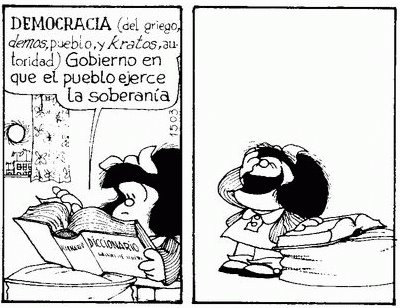
Demos sin cracia

democracia2

Las democracias modernas instituidas como “el gobierno de la mayoría” comenzaron a aparecer ya entrado el siglo XIX y se popularizaron velozmente.  Al lado de ella, la promoción de los ideales del sufragio universal, la igualdad de derechos y obligaciones entre hombre y mujer, la abolición de la esclavitud y del trabajo forzoso de curso legal, entre otros principios empezaron a dispersarse como un veloz germen en las sociedades occidentales y sus ex-colonias.  Han pasado ya 200 años desde que el germen democrático se dispersó por el mundo.  Sin embargo, los más recientes acontecimientos que han perturbado el flujo de las democracias de mayorías se ha visto afectado en Ucrania, Venezuela y desde hace dos días en El Salvador.

¿Por qué será que el ideal de la democracia ha “fallado” en estos países? 

Los argumentos a favor y en contra son muchos y muy complejos. Deben ser comprendidos desde distintas perspectivas y entender las posiciones tomadas por todos los actores que se han visto afectados de manera directa e indirecta por estos eventos.  Nosotros, el resto del mundo observador, podemos participar con ideas para ojalá descubrir más preguntas en nuestro camino. Hoy quiero compartirles una idea que cruzó por mi mente.

¿Acaso nuestro problema no ha sido que hemos tenído más “demos” que “cracia” en nuestro gobierno y en el desarrollo de nuestro rol ciudadano?

¿A qué me refiero con esto?

El término democracia es antiguo y complejo y se forma a partir de los vocablos “demos” traducido al castellano como -pueblo y/o poder- y “cracia” que indica un -gobierno o sistema-.  Así y actualizando el término desde la antigua Grecia a nuestros días, la democracia se refiere al gobierno del pueblo.

¿Pero acaso no ha sido el pueblo el que se ha volcado a la rebelión en Ucrania, Venezuela y El Salvador? Entonces, ¿la democracia reaccionó en estos países contra la democracia?

Quizás lo que ocurre en estos tres países (que son producto de la colonización y de la subyugación a los imperios durante la Guerra Fría) es que quizás no han pasado el suficiente tiempo en independencia institucional y maduración de sus gobiernos como para lanzarse desbocados a procesos democráticos que deben ir de la mano de una reforma educativa y cultural de la ciudadanía.  Pero, ¡alto! Que conste, que no me refiero a que estos países post-coloniales y post-guerra fría deban regresar bajo el control de un dictador o de una metrópoli.  Sino que, la participación del pueblo (demos) no debería avanzar cuando se ha descuidado o se ha impedido continuar el proceso de institucionalización de la democracia en la vida ciudadana.

Ucrania, Venezuela y El Salvador tienen como un común denominador la inmensa pobreza y la enorme desigualdad educativa y cultural entre la elite gobernante que heredó el poder de sus antiguos amos colonizadores y el grueso de la población. La mayoría de la población en estos países ha sido condicionada a servir como un “agente legitimador” al momento de ejercer su voto pero no se le ha permitido adquirir conciencia absoluta de su rol como “ciudadano legitimador empoderado”. Porque es su voto el que le permite exigir responsabilidad, honestidad y resultados en el equipo de gobierno que eligió en las urnas.

Titulo: 7 killed in post-election protests
Via: FoxNews

En Venezuela ha sido la población cansada y agotada de la corrupción la que ha tomado conciencia del poder de su voto al exigir la renuncia del gobierno revolucionario (aún a pesar de que recientemente había sido electo por el voto de las mayorías).  Es acá que el pueblo ha empezado a ilustrarse en su poder como votante y garante.

Titulo: Days of Protest in Ukraine
Via: The Atlantic

En Ucrania ha sido el pueblo el que también ha tomado conciencia del poder de su voto y de su derecho de autodeterminación pidiendo la anexión de Crimea y su mayoría étnica rusa a Rusia debido a sus distintos intereses económicos, políticos y culturales con el resto del país.

Titulo: El TSE pidió a los contendientes que respeten los resultados que el pueblo decida.
Via: http://www.lapagina.com.sv

Y en El Salvador desde el día lunes debido a que las elecciones presidenciales concluyeron con una cercana diferencia de votos entre los partidos ARENA y FMLN. ARENA rechazó el conteo de las elecciones luego del anuncio de su derrota. 6,000 votos marcaron la diferencia y el partido ARENA rechazó la legalidad del proceso democrático.

Espero que no sea aún tarde para extender una invitación a reflexionar a los ciudadanos salvadoreños sobre el funcionamiento del gobierno democrático y de la necesidad de estudiarlo a más profundidad y, quizás, comprender que el voto de la mayoría (aún si efectivamente ganará por 6mil votos de diferencia) no es garante suficiente de legitimidad.  Y que, es urgente que ambos partidos realicen un pacto serio, democrático y honesto antes de queso se derramé una sola gota de sangre.

En Venezuela, Ucrania y El Salvador es aún posible alcanzar acuerdo y pactos de concertación que partan del respeto al gobierno democrático y que busquen una inclusión de ideas, actores y modificaciones a los actuales procesos en los que el Pueblo (demos) colabore en la construcción y progreso del del Sistema de gobierno (cracia).

Esto evitará muertes y violaciones a los derechos individuales.  Pero más importante aún, permitirá la evolución y maduración de sistemas democráticos de gobierno en estos países que aún ahora se vieron afectados por la injerencia de los poderes imperiales en sus asuntos. Que envidia que en estos países quizás estén a las puertas de un desarrollo democrático del cual nuestros países vecinos podrían aprender mucho.

El legado de Hugo Chávez

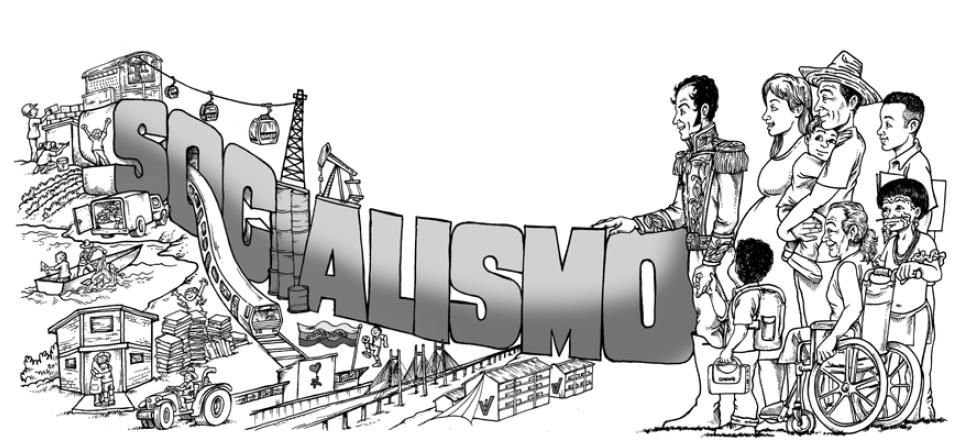
Propuesta del Candidato de la Patria Comandante Hugo Chávez Para la gestión Bolivariana socialista 2013-2019. Via: http://forajidosdelanetwar.blogspot.com/2012/11/caricaturas-e-imaginarios-en-la.html

Hace un año el actual presidente de Venezuela, Nicolás Maduro, anunció la muerte de Hugo Chávez.  Chávez fue el líder de la Revolución  Bolivariana en Venezuela y gobernó el país durante 14 años.  Maduro fue juramentado luego Presidente y recientemente ganó la reelección popular con una campaña que prometía continuar  con el legado de su mentor.

En el 2013, los datos del legado que dejaban los 14 años del gobierno socialista presentados por el Centre for Research on Globalization y por la Embajada Venezolana en los Estados Unidos son reveladores:

  • Venezuela cuenta con servicios de salud y educación universales gratuitos. Antes, 70% de los venezolanos no tenía acceso a servicios de salud.
  • Se eliminó el analfabetismo en el país.  Antes, 40% de los venezolanos eran analfabetos.
  • En los últimos 10 años, el PIB venezolano ha crecido al ubicarse en un nivel alrededor de los 300 mil millones de dólares. Esto representa un crecimiento sustancial frente a la década de los noventa cuando el PIB del país no llegaba a los 100 mil millones de dólares.
  • Se redujo en un 40% el costo de los productos de la canasta básica.
  • Aumentó el salario mínimo en más del 600%
  • Redujo el desempleo del 20% al 6%
  • El Índice de Desarrollo Humano (IDH) en Venezuela aumentó de 0,69 en  1998 a 0,84 en  2008, lo cual eleva a Venezuela a ser un país con rango de desarrollo humano medio a uno con rango alto.
  • De 2008 a 2012, el IDH descendió a 0,748 y alcanza el puesto 71 de 187 naciones y territorios que participaron de la medición.
  • Venezuela ocupa el puesto 71 entre los 179 países que figuran, según el informe anual del Programa de Naciones Unidas para el Desarrollo (PNUD). El coeficiente de Gini, que mide la desigualdad de ingresos, alcanzaron en 0.390 en 2012, el nivel más bajo en la historia de Venezuela y el más bajo en el Continente latinoamericano. En 1998, era de 0,4865.
  • Desde 1999, Venezuela incrementó sus relaciones comerciales con otros países en el hemisferio, así como con otras regiones del mundo. La mayor parte del comercio de Venezuela continúa siendo llevado a cabo en la región, con alrededor del 70% de las exportaciones de petróleo con destino a los países de las Américas, y los mercados de América del Sur, América Central y el Caribe están ganando importancia.
  • En 2012, un año antes de la muerte de Chávez, Venezuela era el tercer socio comercial más grande de Estados Unidos en América Latina y el número 14 más grande en el mundo, además de ser el cuarto proveedor de petróleo a EE UU.

Pero no todo ha sido fácil de conseguir en esta bonanza de estadísticas sociales y los drásticos cambios en el nivel de vida del pueblo venezolano han sido el resultado de muchos sacrificios impuestos en la población venezolana.

Con el ascenso de Chávez y el éxito inmediato de los cambios socioeconómicos en la población, la élite política chavista se aseguró el poder absoluto al conseguir el voto mayoritario en elecciones democráticas gracias a millones de venezolanos beneficiados por las reformas socialistas.  Este poder absoluto (democrático) permitió al gobierno socialista continuar con su plan e imponer restricciones a la libertad de expresión de la oposición, expropió sin muchos problemas industrias, eliminó fácilmente y sin mucha oposición el derecho a la propiedad privada y capturó los ahorros de millones de venezolanos.

Para Maduro, Chávez y muchos otros ideólogos socialistas antes de ellos, cualquier medio era justificable para la consecución del ideal revolucionario socialista.  Latino América, que durante décadas sirvió de laboratorio para experimentos económicos y políticos de líderes del mundo desarrollado fue la arena idónea para regresar a la dulce tentación socialista que había sido lograda con relativo éxito en otros continentes.

La fórmula del legado de Chávez es simple y poderoso:

Populismo anti-imperialista

+

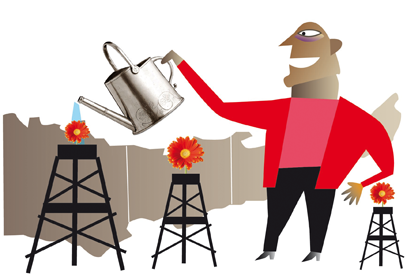
petróleo nacionalizado

=

Socialismo clientelista 

Titulo: Sembrar petróleo. Por Emiliano Teran Mantovani. via: http://forajidosdelanetwar.blogspot.com/2012/11/caricaturas-e-imaginarios-en-la.html

La movilización y apoyo de los votantes en una nación democrática es fácil de conseguir cuando se posee el capital económico, político y/o militar para ofrecer al pueblo una salida de los sistemas de economía mixta extractivos que durante el siglo XX fueron implementados por las naciones desarrolladas del Norte Global y que fueron apoyadas por elites patrimonialistas en los territorios del Sur. El éxito de la revolución Bolivariana aseguró para otros países interesados en este experimento una segura y jugosa fuente de donativos para facilitar el efecto domino socialista que tanto temieron los ideólogos realistas gringos durante la Guerra Fría.  Sin duda, el legado de Chávez sigue vivo un año después de su muerte.

En los últimos dos meses la movilización de un importante grupo de la población venezolana causó manifestaciones en las ciudades más importantes del país.  Los manifestantes tenían muchas peticiones que iban desde reclamos por la corrupción del partido gobernante, reclamos por los altos índices de inflación que afronta el país y solicitudes de renuncia de los líderes de la revolución bolivariana.

Independientemente de cuántos  años más dure el partido revolucionario en el poder es seguro que su legado fue la implementación de una exitosa revolución socialista clientelista sostenida en la venta de petróleo a las economías mixtas del resto del mundo que mejoro los índices de desarrollo humano como nunca antes habíamos visto.  Así es que mientras el mundo siga dependiendo del oro negro, el mundo seguirá escuchando del legado de Chávez.

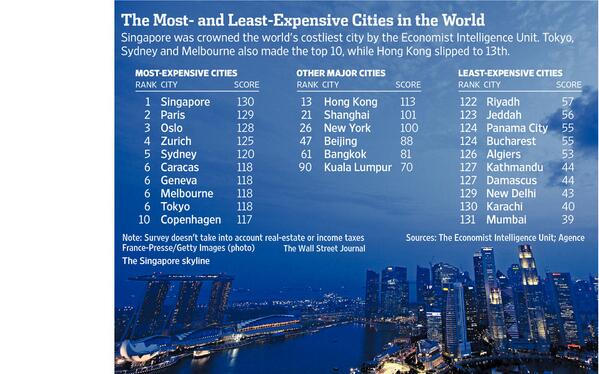
Este caro legado ha costado la libertad y los derechos de propiedad de miles de individuos. Venezuela sigue y continuará enfrentando desafíos en materia de seguridad, pues la tasa de homicidios de la región es la más alta del mundo. El regimen chavista es diariamente acusado de corrupción, incompetencia y la probabilidad de que esto cambie no es del interés de nadie. El año pasado la inflación fue del 56% y la escasez de productos básicos continuó agudizándose hasta este año.  Caracas se ha convertido en una de las ciudades más caras del mundo ocupando el puesto #6 según datos del WSJ.

Embedded image permalink

A Bit More on Ukraine

Evgeniy’s plea for balance in the Russia-Ukraine conflict has produced, in my mind, an interesting dialogue on propaganda – both of the Western and of the Russian variety.

Let me come out and say with some conviction that I am not a supporter of the Putin regime. Nor do I believe much of the analysis that comes out of the Russian press. (This is because the vast majority of the Russian press is controlled by the state, and not because it is Russian or because it generally espouses pro-Russian sympathies.)

Evgeniy, for example, cites reports from the Russian press claiming that half a million people have fled Ukraine for Russia since the beginning of the year (when the demonstrations started). If half a million people fled from one place to another in a month, from anywhere in the world it would be headline news, but for some reason only Russian citizens have heard of this exodus? I don’t buy it.

Now, this number may be a misunderstanding based on a bad translation. In fact, I think this may be the case. My translation of Evgeniy’s comment states that the Russian press reports that “since the beginning of the year (January 2014) in Russia has resettled about 500,000 refugees from Ukraine.” Emphasis mine. Has this resettlement been ongoing since the end of the Cold War? However, judging by Evgeniy’s comment, it looks as if resettlement has only begun in January of this year, so if this is indeed the claim that the Russian press is making then it is obviously false.

Terry’s excerpted quote from the Daily Beast fares no better in the facts department, though, despite the Daily Beast being a private organization. The op-ed is an attempt to debunk “Putin’s Crimea Propaganda Machine” as if Putin has the power to control everything the Russian press publishes. State control of the media, especially in a country as large and diverse as Russia, does not mean that the bureaucratic process magically disappears. Bureaucracies and especially regulators are actors in their own right, and as such are beholden to certain constraints and processes that come with the way these institutions are organized.

So in the spirit of open inquiry and debate, there are a couple of facts I’ve gathered that I think are important to note.

  1. The President of Ukraine was ousted in a coup. He was elected by a very slim margin and accusations (from both sides) of voter fraud were rampant.
  2. The opposition that recently installed a new President therefore gave democracy the finger. This is not in itself a bad thing, but many Western observers tend to side with the pro-West faction as if it was democratic. It is not.
  3. The exiled President signed an agreement with the opposition last month guaranteeing early elections and more power to the legislature at the expense of the executive branch. This is as peaceful and as democratic as it gets, and the opposition gave, as I said, the finger to this agreement.
  4. The opposition has fascists in its cabinet. It has also installed Ukrainian Jews to high-ranking positions. The Muslim Tartars in Crimea stand to lose the most during Russia’s occupation.
  5. Ukrainians are sick of their government – right or left, pro or anti -and this has yet to be addressed by anyone other than Dr Foldvary as far as I can tell.
  6. No shots have been fired. Moscow has reiterated that it is in Crimea to protect its naval base and Russian citizens. I have a feeling that Russian troops will be back in Russia within the year. Crimea will get to keep its autonomous status within Ukraine, and Kiev will be forced to think twice before it attempts to impose its will on Crimea arbitrarily. This is a good thing, as it limits the size and scope of government.
  7. So far most, if not all, information about military activities have been coming from governments, not from the free press. This can only lead to more misunderstanding and more suspicion.
  8. War is the health of the state. In times like these, journalists should be criticizing their own governments rather than the governments of others. In the West, where the press remains relatively free, there is more criticism of government policies concerning foreign affairs than there is in Russia.

At the end of the day, I have to agree with Evgeniy’s plea for toleration and prudence: “Please do not judge this conflict only from one side.”

Are small businesses entrepreneurial?

Between 1958 and 1980 the number of businesses in the U.S. economy increased from 10.7 million to 16.8 million. But the relative economic importance of small business in the overall economy declined over this period. Between 1958 and 1977 the share of employment accounted for by firms with fewer than 500 employees decreased from 55.5 percent to 52.5 percent. Between 1958 and 1979 the share of business receipts obtained by companies with less than $5 million in receipts declined from 51.5 percent to 28.7 percent. Between 158 and 1977 the share of value added contributed by firms with 500 or fewer employees decreased from 57 percent to 52 percent. (Zoltán J. Ács, Bo Carlsson, and Charlie Karlsson 1999, 7)

That’s an enormous relative increase in the importance of big businesses. Consider that change in light of macroeconomic conditions and political thought at the time. It seems almost like the dark ages. I think it also shows an apparent correlation between business, government, and ideology. Since the mid ’70s, small businesses have gained importance in the U.S. economy while also leaving the dark ages of mid-20th century illiberalism.

From the Comments: Musings on the Ukraine Fiasco

Riffing off of my post about the current crisis in Ukraine, Matthew writes:

Based on the track record of Russia vis a vis the West, I imagine the following scenario unfolding:

Russia (continues) to occupy the Crimea, while America and Europe (continue) to demand the withdrawal of Russian forces from the province. Putin, calculating that the West lacks the stomach for direct confrontation, refuses. Hysteria in the media and in government publications, which are ultimately the same thing, rises. A lack of direct conflict between Russian and Ukrainian forces, however, lends little credence to the mass panic broadcast over Western media. The furor dies down in time. Russian presence becomes normalized in the Crimea.

Or, the interim government, bolstered by further illicit monetary aid from America, pulls a Georgian move and attacks the Russian forces stationed in Crimea. Russian forces will quickly rout the Ukrainians sent against them, and most likely march towards Kiev – whether they take it or not will depend on the response of the international community, as with Georgia. Regardless of who instigated the violence, the Western media will blame Russia, and the war drums will grow louder. UN sanctions are unlikely, since Russia is a permanent member of the Security Council, but some form of economic punishment will occur. Russia will draw closer to China, Iran, and Syria. The status quo ante will be upended in no one’s favor: Ukraine will be in shambles, Russia and America will be set at odds.

Regardless of the above two scenarios, meanwhile, the Ukrainian economy is in free fall, and the IMF offers the dual poisons of austerity and liberalization to the interim government. Facing an intransigent Russia and the wolf-faced smile of the West, the interim government accepts the IMF’s offer. Like Russia before it, Ukraine is left even worse for wear by the rapid pace of economic liberalization, and is thus too weak to resist the Russian presence in Crimea. Thus, the West has succeeded in breaking off a chunk of post-Soviet Ukraine and bringing it into its influence, while Russia largely retains what it had beforehand: its Black Sea Fleet in Sevastopol, along with the de facto annexed province of Crimea. It is too early to tell, but perhaps the rest of Russified Ukraine will also join their brothers in Russified Crimea, and the state will break up along linguistic lines.

Who can tell what will occur? My money is on Russia, but maybe Obama will come up with some game winning stratagem (don’t snicker!).

Does anybody else care to make their predictions? You know where the ‘comments’ sections is!

Le nouveau racisme américain et l’impérialisme français

La tache est infinie d’eduquer les Francais pour leur faire jeter aux orties les cliches anti-Americains plus ou moins malveillants qu’ils trainent depuis soixante ans. Comme personne d’autre ne le fait, je me porte volontaire, de temps en temps, pour les aider a les remplacer par des cliches plus frais sur les Etats-Unis.

La Cour d’Appel qui correspond a la region de San Francisco vient de donner raison au directeur d’une ecole secondaire qui avait interdit a ses eleves le port ou l’affichage du drapeau …americain. Le tribunal a donne pour raison que ce drapeau risquait d’offenser les “Mexicains” de l’ecole.

Le debut de l’histoire remonte a Cinco de Mayo (en Espagnol dans le texte) de l’annee derniere. Il s’agit d’un fete officielle de l’Etat de Californie qui commemore une victoire militaire Mexicaine de 1862. C’est une fete qui passe inapercue presque partout au Mexique.

L’Etat de Californie l’a adoptee on ne sait plus trop pourquoi. Peut-etre que c’etait sous l’impulsion propre de la gauche cul-cul bien pensante locale aussi ignorante qu’avide demontrer sa sensibilite vis-a-vis des “minorites.” Peut-etre que cela a ete impose par un groupe de pression de Mexicano-Americains, raciste et fascisant qui se nomme lui-meme: “La Raza, ” “la Race.” (Ai-je meme l’imagination d’inventer de telles insanites?) En tous cas, selon mes sondages, forcement peu scientifiques mais tres frequents, le pourcentage d’Anglos capable de d’identifier les evenements ainsi commemores tourne autour de 0. Le pourcentage des jeunes d’origine hispanique monte jusqu’a 5. Il me faut ajouter pour etre honnete, qu’un 5% additionnel de ces derniers est en mesure d’affirmer: “Je ne sais pas ce que c’est mais je sais que ce n’est pas l’anniversaire de l’independance mexicaine.” En tous cas, cette commemoration a des effets positifs sur la consommation californienne de bieres mexicaines (d’ailleurs tres bonnes).

Et l’imperialisme francais alors, vous dites-vous? Et bien voila, en 1861, l’armee francaise du soi-disant Empereur Napoleon II (socialiste pour une bonne partie de sa carriere ploitique) a recu l’ordre d’aller attaquer la Prusse. Manque de chance, elle a tourne a doite au lieu d’a gauche. Elle s’est donc retrouvee au Mexique. De fil en aiguille, ell a fini par conquerir brievement tout le pays et a y installer un empereur fantome, un Autrichien obscur et palot. Ell profitait alors bien sur du fait que les Etat-Unis etaient eux-memes preocupes par le projet de s’entretuer pendant leur propre guerre civile. En attendant, au debut, les Mexicains de presidet Benito Juarez avaient bel et bien gagne contre le corps expeditionaire francais.

Pour en revenir a la Californie, le 5 Mai de l’annee derniere, dans une ecole sans importance d’une ville sans importance situee au sud de San Jose (Silicon Valley), des eleves d’origine mexicaine s’etaient presentes en class a portant des t-shirt figurant le drapeau mexicain. Des eleves Anglos avaient replique en enfilant des t-shirts a l ‘image du drapeau americain. Il y avait eu des bousculades entres eleves des deux groupes sans nulle doute echauffes par la presence de filles, aussi des deux groupes, en t-shirts sans dessins particuliers mais bien moulants.

La Cour d’Appel, en interdisant de fait de montrer le drapeau americain en Amerique a elle-meme fait la preuve d’une sorte de racisme, anti-blanc, cette fois-ci. En plus, elle a bien demontre son prejuge racial inconscient en identifiant comme “Mexicains” la categorie sociale que sa decision est censee proteger des bobos spirituels. Il est certain qu’elle voulait dire: “Americains d’origine mexicaine” car il n’y probablement pas ou que tres peu de “Mexicains” dans cette ecole. (N.B.: Toute personne nee aux Etats-Unis est citoyenne americaine, un point, c’est tout.)

PS Moi-meme, je suis tres satisfait de l’existence en Californie d’une forte emigration d’origine mexicaine (30% ou plus de la population de ‘Etat.) , y compris les sans-papiers. D’une part, se sont de gens faciles a aimer. D’autre part, ils apportent beacoup. Je crois meme bien que les enfants qu’ils font aujourd’hui supporteront la majeure partie du poids financier de la retraite Securite Social de mes propres enfants, vers 2045.

Ukraine, Russia, the West and a Coasean Bargain?

Economist Tyler Cowen worries about the events in Ukraine:

For Russia, matters in Ukraine are close to an existential crisis, as Ukraine is intimately tied up with Russia’s sense of itself as presiding over a mini-empire of sorts.  Nor could an autocratic Russia tolerate a free and prosperous Ukraine, developing along the lines of Poland.  America cares about Ukraine less, and cares more about Syria and Iran, or at least cares about saving face in those latter venues.  Therefore there is a Coasean deal to be had between America and Russia, where Russia gets to partition part of Ukraine, create a buffer against Europeanization and democratization, keep the larger Ukraine unit weak, and also keep its Black Sea fleet.  In turn Russia would do something less than totally sabotage all American plans for Syria and Iran.  (Of course that is Coasean for the leaders, and not necessarily for the citizenries.)

The thing is…China.  What kind of signal would such a Coasean deal of partition send to China?

That is what I worry about.

I argee that there is a Coasean bargain to be had between the US and Russia in this case, but it’s not the one Dr Cowen sees. Let’s assume that the US does have more interest in the Middle East than it does in Russia’s backyard, but even with this assumption I don’t think it follows that the West will give up Ukraine for Syria and Iran.

The West has been down in the doldrums lately, it’s true, but there is still plenty of fight left in it and plenty of resources with which to do the fighting.

Really quickly: I know I’ve mentioned this before, but making two states out of one (“partitioning Ukraine”) will be a good deal for almost everybody involved (the minorities in Russian Ukraine will not fare so well). As it stands today, Ukraine is simply too big to be governed effectively. This is a problem with many, if not most, post-colonial states in Asia, Africa and Europe.

International recognition is something that would be observed by almost all sides (minorities in Russian Ukraine will not like it), which is one of the requirements I’ve pointed out that needs to be completed before secession (or partition) is undertaken in postcolonial states.

The other major requirement is that the new states are part of regional or international trading unions of some sort. The more the better, but any is a start. Russian Ukraine will be good to go, as it would be in Russia’s orbit, and the West could easily ensure that the Ukrainian Ukraine gets more attention than it now currently has. This is where the West should dig in its heels and fight: After partition. Ukrainian Ukraine will need to be drawn into the West’s economic orbit rather than offered up as a sacrificial lamb, and this definitely doable. This is the Coasean bargain, not Ukraine for Iran and Syria.

The China angle Dr Cowen brings up is also an interesting one. Beijing is authoritarian not stupid. Here is what conservative military leaders in Beijing probably see:

Ukraine might get no love from the EU or the US, but it is much weaker than Japan or South Korea or even Taiwan. So China could not take any of these states militarily without high costs, while Russia could conceivably take all of Ukraine without significant military losses (the political damage would be too much for Moscow, so it won’t happen; but it is a possible scenario).

The socialist roots of Nazism (and the Left’s typical response)

One of my constituents once complained to the Beeb [BBC] about a report on the repression of Mexico’s indigenous peoples, in which the government was labelled Right-wing. The governing party, he pointed out, was a member of the Socialist International and, again, the give-away was in its name: Institutional Revolutionary Party. The BBC’s response was priceless. Yes, it accepted that the party was socialist, “but what our correspondent was trying to get across was that it is authoritarian”.

Amazing! This is from Daniel Hannan writing in the Telegraph.

Plebiscito: la solución para los problemas de Nicolás Maduro

Foto: Reuters

El día de ayer el presidente de Venezuela, Nicolás Maduro, envió  un duro mensaje a los opositores que desde hace mes y medio fueron a las calles a exigir cambios en el gobierno y los culpó de la crisis social que sufre el país. “Fascistas, uno por uno los voy a capturar, uno por uno voy por ustedes”, sentenció Maduro, y afirmó que todos estos grupos “le verán la cara a la ley”.

Pero en realidad no hay nada de “fascismo” en las ideas y reclamos de los líderes y en los cientos de opositores al gobierno bolivariano que hasta el día de hoy continúan protestando. El fascismo es una ideología política que busca instaurar el corporativismo estatal totalitario y una economía dirigista que regule la vida de los ciudadanos. El fascismo es también una ideología que propone la sumisión del individuo ante un ferviente interés nacionalista y universalista en el que no hay divisiones ideológicas y políticas de izquierda, derecha, etcetera y que condena a todos aquellos que se oponen al mismo. Pero, nada de lo anterior es parte de lo que han dicho en la televisión los manifestaste que aún están en las calles venezolanas.  Es más, ¿acaso la República Bolivariana de Venezuela no es todo lo anterior según lo han demostrado sus violentas acciones represivas?

Desde mi visión minarquista liberal sí lo es.  El interés individual de los ciudadanos venezolanos ha sido puesto en sumisión al interés bolivariano de la república que fundó el ya fallecido Hugo Chávez.  Además, el gobierno bolivariano de Chávez y de Maduro en repetidas ocasiones ha negado tener una posición específica en el espectro político de izquierda y derecha, y ha volcado esta discusión al espectro de la lucha constante que debe sufrir el nacionalismo bolivariano ante la amenaza imperialista de los Estados Unidos de América y de sus títeres en otros gobiernos latinoamericanos.  Maduro ha insistido que esta manifestación es producto de una campaña imperialista de parte de los Estados Unidos en contra de su gobierno democrático.

¿Cómo es entonces que Nicolás Maduro acusa de fascistas a los opositores del mismo sistema e ideología que me parece él y su partido han establecido en Venezuela?  y  ¿qué podría el liderazgo manifestante aprovechar de la postura del Presidente Maduro?

Al llamar a la oposición “fascista”, Maduro implica que su gobierno es el antónimo del fascismo y el antónimo del fascismo es la democracia.

Sin duda, el gobierno de Maduro fue electo con mecanismos democráticos y este mecanismo legitimó su gobierno. Sí, su gobierno fue electo mediante una democracia representativa nos guste o no.  Punto y final.

Pero también es uno de los principios de cualquier gobierno democrático y representativo que, en ocasiones, los mismos pueden ser criticados cuando los los líderes han estado en el poder por mucho tiempo.  Existen mecanismos democráticos para resolver estos problemas y Maduro insiste en ignorarlos mientras pone en riesgo la vida de los ciudadanos a quienes prometió defender cuando ganó las elecciones.  Maduro olvida o ignora que una característica que suele acompañar a las democracias es el derecho de sus ciudadanos a opinar distinto y sin temor de ser enviado a prisión por sus ideas.  Cuando un grupo amplio de la sociedad insiste en que es necesario confirmar la legitimidad de un gobierno se pueden tomar muchas acciones que no son necesariamente la represión y la amenaza del uso de la fuerza policial.  Así, una decisión consistente con la democracia de un líder democrático debería de ser utilizar uno de los mecanismos de la Democracia.  El mecanismo idóneo para esta situación de inestabilidad se llama Plebiscito o más específico, un referéndum consultivo.  Al realizar un referéndum, el Presidente Maduro podrá consultar a los venezolanos que lo eligieron si están de acuerdo con que el continúe gobernando y fortalecerá la legitimidad de su gobierno con el pueblo venezolano.

Al inicio de las manifestaciones que ya han costado la vida de varios ciudadanos venezolanos, los reclamos eran la escasez de productos básicos, los altos índices de criminalidad y los reportes de violaciones a los derechos humanos que han manchado el gobierno de Nicolás Maduro. El Presidente Maduro es la única persona con el poder de evitar que una sola gota más de sangre inocente sea derramada.

Si el Presidente Maduro es en realidad un líder democrático permitirá que cualquier opinión, por muy débil o pequeña que sea,  sea considerada no una amenaza fascista sino un sentimiento de inconformidad válido de discutir.  En las manos del Presidente Maduro está que su gobierno sea recordado como  el de un absolutista del corte “L’État, c’est moi” o como un demócrata forjador de la Libertad y la Democracia en imitación del gran líder Nelson Mandela. Ojalá y la palabra referéndum empiece a sonar más y más en las próximas semanas para que la paz regrese al vecino país sudamericano.

Thoughts on climate change

Last week I heard a sermon on climate change (no, it was an actual sermon). I’m roughly agnostic on the existence and degree of climate change, but I err on the side of assuming it is a large problem of externalities with no obvious property rights solution and will have costs. And I think that under those assumptions there is an important moral element to it. With that in mind, below are some of my thoughts on the weak points of the sermon:

1) Authority is only a starting point; we cannot defer ultimate responsibility to authority. If an expert or someone I trust tells me something about X, and I don’t have any prior knowledge about X, then I believe them. In the case of global warming there are two basic sorts of information you will get from information: a) diagnosis (temperatures could rise X degrees in the coming century), and b) prescription.

The climatology involved in a) is well above my pay grade, and so rather than undergo the costs of informing myself on the existence or importance of climate change, I just figure the truth is somewhere in the middle of what reasonably informed people say and instead focus my effort on my areas of comparative advantage. Now the actions in b) are typically about reducing waste and that’s well within the realm of economic thinking, so I’ll comment on that!

1b) Blindly deferring to authority to assuage your guilt is wrong and bad. Someone says you should drive an electric care to save the environment? Don’t do it before thinking through the matter, this is a big decision for most people. Where’s the energy coming from to power that car? (Coal. That is burned hundreds of miles away from your car… that’s like having a car with a hundred mile long drive shaft.) How much energy and material does it take to make the car? (Hint: look at prices.)

2) It’s called climate change, not climate universal and uniform worsening. If climate change means a warmer climate for Canada and Russia, that will come with extended growing seasons and savings on winter heating costs. Burma? It’s probably going to suffer a lot. Climate change will surely have the biggest impact on the poorest people in the world, and this is where I see the real moral issue because…

3) We can respond to climate change in a way to reduce suffering. Specifically, we can open borders. First off, that would increase human well being, with an enormous benefit to the world’s poorest people. Second, the effects of climate change won’t harm the poor as much as they could. Is climate change still a bad thing if we do this? Sure, but if a building is burning, why not help people get out?

Loose ends:

Should I recycle everything? Only if it will actually help. Recycled aluminum is chemically identical to virgin aluminum and uses fewer resources to produce (which is why it’s cheaper!). Recycling paper creates a lower quality product, uses a lot of energy and creates pollution.

Paper bags are brown, that’s good, right? Plastic bags are almost ethereal; they use a fraction of the material per unit of carrying capacity resulting in big savings. Yes, there are offsetting costs to using plastic, but it isn’t as simple as “this brown, it must be natural and therefore good!” And while we’re on the topic, brown M&Ms are stupid. There’s a layer of white sugar between that brown outer layer and the actually brown chocolate. Brown M&Ms are as unnatural as any of the other colors.

Should I buy local? Maybe if you live in California, but not if you live in Massachusetts. The biggest environmental impact of food is growing it; plowing fields, planting, watering (outside where the water could just evaporate!), and harvesting use a lot more energy than transportation. So if you live in a place with poor growing conditions, then buying local only does more harm. That said, fresh food tastes better, so by all means pay the cost if you value the flavor, just don’t delude yourself into thinking you’re reducing energy usage by doing so.

Consider opportunity cost and present value! So you’ve got a solar panel and now electricity is free for the next 20-30 years! Or you’ve installed new modern insulation for your home. Or you bought a car that costs less to run (and you’ve promised not to increase your usage). But at what cost? If your solar panel used 40 years worth of energy to build and install, then you’ve done more harm than good. And you’ve done that harm upfront. Even if one of these investments has a positive return (it saves more resources than it uses), you should still consider whether it’s a good investment. We don’t have unlimited resources, and that means that if you spend $10,000 on insulation that will give you a 0.4% ROI then you’ve given up the chance to invest that money into something that will generate more good.

A taste of local flavor: Remington Outdoor Company to announce major expansion to Huntsville

Remington Outdoor Company to announce major expansion to Huntsville

“The site will rank with ROC’s largest facilities. Ilion, N.Y., is home to the largest facility at more than 1 million square feet, followed by other sites such as its ammunition plant in Lonoke, Ark., and its factory in Mayfield, Ky.

Sources say manufacturing operations in Ilion will not be affected by the expansion and there are no plans to move manufacturing from that site, where Remington has been building firearms for nearly 200 years.”

I have to wonder how much Governor Cuomo’s anti-gun policies contributed to this decision.  We will see if Remington holds true to their word but this author is predicting the Ilion factory to be gone in the next five years.

I would also like to suggest that any New Yorkers check out this page for information on anti-gun restriction protests happening this spring.  While they are not a libertarian organization there is some semblance of solidarity.

Thousands of Connecticut Gun Owners ‘Flout’ New Registration Law

THOUSANDS OF CONNECTICUT GUN OWNERS ‘FLOUT’ NEW REGISTRATION LAW

The most prescient point from State Senator Tony Guglielmo is “I honestly thought from my own standpoint that the vast majority would register.” He then added, “If you pass laws that people have no respect for and they don’t follow them, then you have a real problem.”

It seems that in many cases the average person is more libertarian than they realize.  Or to use the phrase provided by pseudo-libertarian author Robert Heinlein:

“I am free, no matter what rules surround me. If I find them tolerable, I tolerate them; if I find them too obnoxious, I break them. I am free because I know that I alone am morally responsible for everything I do.”

The Republican Proposal on Illegal Immigrants and, the French Are Coming

I am responding to a Republican radio and TV ad about illegal immigration. It’s presented as the Republican counter-proposal or response to Pres. Obama demand for “comprehensive immigration legislation.” It displays involuntarily some of the main fallacies Republicans commonly entertain in connection with illegal immigration and other topics. It demonstrates disturbing collective ignorance in my camp. (I am a registered Republican.) Here are four major fallacies in that short ad:

1 The ad continues to be based on the false notion that there exists an alternative to illegal immigration in the form of some orderly visa queue. In this perspective, illegal immigrants are rude, unprincipled line jumpers. Everyone hates such people.

In fact, there is no such queue. The average unmarried Mexican has no way (zero) way to come live in the US legally. (An unmarried Mexican can try to marry a US national or legal immigrant to gain a quick visa. Some do. This is hardly a more principled way to immigrate into this country than overstaying a tourist visa, for instance.)

2 The Republican proposal demands “no amnesty.” The Republican proposal contains an amnesty: amnesty for those who entered the country illegally. It rewards those who took the matter into their own hands against other foreigners who would like to move to the US but do not wish to violate laws to do so. Again, illegal immigration is the only way to enter the US and stay for almost everyone in the world.

There is no way to regularize the status of current illegals living in this country without an amnesty of some kind. I predict that neither the federal government nor the individual states will ever engage in the massive police action that would be required to hunt down illegal aliens in their homes, places of work, churches, and schools (including kindergartens). Everyone else also knows this to be true. Republican leaders have yet to acknowledge this simple fact of life.

3 The Republican proposal would require illegal aliens to “learn English” as a condition of their legalization. This is ill-informed as well as downright stupid.

First, illegal aliens are very busy learning English. They are all aware of the fact that knowing the main local language is a condition of real economic success in this country. To say otherwise is to make a tremendously xenophobic statement by implicitly calling immigrants stupid. That’s in addition to ignoring the facts on the ground.

Second: What are we going to do with Juan if he flunks his English midterm? Throw him over the border? How about Mr Lee, who has been here (illegally) for fifteen year and who owns a restaurant employing six people? Do we ship him back to Canton if he gets two C- in a row on his English grammar test?

Plus, what is the federal government going to do when some ill-intentioned academic reveals that a significant percentage of American-born US citizens also flunked the midterm, the same midterm?

Is this “obligation” to learn English, specifically, even constitutional? The last time I checked, the US had no official language. Why not Navajo?

This all smacks of the insane dreams of comfortably monolingual individuals who believe they would master Spanish if they could only clear a dozen Saturday mornings. Do these people take advice from anyone? Do they read anything?

“Securing the border” has become a mindless Republican incantation. It’s increasingly irrelevant for the purpose of immigration control, at least closing the southern border is. Several relevant points. At them same time as we were having our endless economic crisis killing thousands of jobs, the Mexican economy was doing better than before. And, Mexican population growth has almost ceased. The huge hordes of hungry Mexicans massed at the border to jump in and take over everything American have evaporated. Mexicans have almost stopped coming. Those who do use a student visa or a tourist visa and just don’t go home until they are good and ready.

Securing the border may serve a purpose in the context of a drug war. If that’s the issue, Republicans should have the coraje (same as “cojones” but more polite) to tell the truth.

And now, what the Republican leadership is not doing or not doing enough: Shout to the rooftops that legalizing illegals and awarding them citizenship are only artificially linked (by artful Democrats seeking free votes for generation). European countries have established successfully for many years the fact that citizens of another country can live in forever without acquiring political rights at all. (A recent well publicized Swiss vote on immigration does not deal with this matter.) Fellow immigrant Nikiforov and I explored this idea in depth in connection with the US and Mexico in our article “If Mexicans and Americans Could Cross the Border Freely” featured in the libertarian journal Independent Review.

Here is a real immigration issue the Republican leadership is not attending to: Tens of thousands of younger French people want to move to this country. The issue is so serious that there is a brand new French cabinet post dedicated to stemming the flow. Many of the would-be French migrants possess to a high degree the kind of training Silicon Valley companies say they can’t find. Many of the same well-educated French citizens who wouldn’t dream of opening a lollipop stand under French conditions discover that they possess a big entrepreneurial gene a couple of years after landing here. Let me also point out that the quality of food improves automatically after a surge of knowledgeable and demanding French customers. (Yes, some stereotypes are well founded.)

At this point, there is no legal way to bring in these high quality immigrants. Our immigration system is forcing into illegal immigration the most determined and least law-abiding segment among exactly the kind of immigrants we want.