Greenland and the Spirit of 1776

On this sacred 250th anniversary of our Republic’s birth, to fully grok how the liberation of Greenland can fulfill our unextinguishable Spirit of 1776, we must discard the outdated notion that the Arctic is a frozen, peripheral wasteland. 

Throughout my career analyzing Arctic sovereignty, borderlands, and geopolitics, I have argued (since I was a young man in 1991) that the Far North is emerging as a central arena for global freedom, resource independence, and democratic sovereignty. Upon this July 4th’s sacred, quarter-millenium celebration of our liberty, this long-foreseen centrality has come to pass.

In my view, the Spirit of 1776 is not a static historical event: it is instead an ongoing, dynamic process of expanding self-determination, rolling back old-world colonial empires, and securing our continental perimeter against authoritarian overreach. 

To fulfill our Spirit of 1776 in the 21st century, the United States must extend its democratic umbrella northward! This is not an act of alliance-imploding imperial conquest as Denmark has sought to portray; rather, it is an inclusive act of collaborative liberation

By helping Greenland sever its last colonial ties to Europe and integrating it into North America’s hemispheric security and economic architecture, we can achieve three philosophical and strategic imperatives:

Continental Completeness: We complete the geopolitical vision of the Monroe Doctrine, ensuring North America is entirely governed by consent and free from European or Asian state interference.

Democratic Self-Determination: We empower the Kalaallit (Greenlandic Inuit) people with true economic and military independence, backed by American constitutional guarantees.

Frontier Ethos: We re-ignite the American pioneer spirit on the Arctic frontier, viewing the far north as a dynamic space for democratic civilization.

To help actualize this collabarative liberation, Greenland can craft a Constitution mirroring while customizing our own paradigmatic Constitution. Some key components could include the following.

A Proposed Constitution of the Republic of Kalaallit Nunaat

Preamble

We, the people of Kalaallit Nunaat, grateful to our ancestors who survived and thrived across the Arctic frontier, determined to preserve our culture, our language, and our environment, and committed to the universal principles of human liberty and democratic self-governance, do establish this Constitution for our sovereign Republic.

Article I: Sovereign Status and Geography

  1. The Republic of Kalaallit Nunaat is a sovereign, democratic, and independent nation encompassing the entire island mass of Greenland, its continental shelf, and its territorial waters.
  2. The sovereign power resides in the people, to be exercised through their elected representatives and direct democratic referendums.
  3. The official national languages are Greenlandic (Kalaallisut) and English.

Article II: Bill of Rights and Liberties

  1. Fundamental Rights: Every citizen is born free and equal in dignity. No law shall discriminate based on race, ancestry, language, or creed.
  2. Freedom of Expression: The right to free speech, a free press, and peaceful assembly shall not be abridged.
  3. Property and Private Enterprise: The right to private property is guaranteed. Free-market enterprise is the baseline economic system of the Republic, protected against arbitrary state nationalization.
  4. Indigenous Customs: The collective right of the Inuit people to hunt, fish, and manage local community lands in accordance with sustainable tradition is permanently protected.
  5. The Right to Bear Arms and Self-Defense: The right of the people to keep and bear arms for self-defense, protection against wildlife, hunting, and the security of the Republic shall not be infringed. No law shall prohibit the possession, carry, or responsible use of firearms by citizens. Licensing and registration shall be kept minimal and non-prohibitive to ensure remote families are never left defenseless against the elements or predators.
  6. Inherent Rights to Traditional Harvest and Lifeways: The right of citizens to engage in traditional hunting, fishing, gathering, and harvesting is an unalienable birthright. This includes the absolute right to harvest marine mammals, specifically whaling and sealing, as well as terrestrial fur trapping. The use, breeding, training, and deployment of sled dogs (Qimmit) for transportation and hunting is protected. No administrative regulation or international treaty shall penalize or restrict these practices. The local trade, consumption, or garment-making of legally harvested furs, skins, or traditional foods shall not be criminalized.
  7. Conversion of Ecological Zones to Subsistence Hunting Preserves: All lands previously designated as national parks, restrictive nature reserves, or ecological preserves under foreign administration are permanently converted into National Subsistence Hunting Preserves. The right of local populations to access these lands for subsistence hunting, traditional trapping, fishing, and temporary shelter is absolute and supreme over pure preservationist mandates.
  8. Family Sovereignty and Prevention of Child Removal: The family is the foundational and sacred unit of society. No agency of the state or external non-governmental organization shall have the authority to separate families or remove children from their parental home based on poverty, standard of housing, or adherence to traditional indigenous child-rearing practices. Separation shall be permitted only as an absolute last resort in instances of proven, severe physical harm, established by an independent jury of peers in a court of law. Preferential placement must be given to extended kinship networks and local community members.

Article III: Legislative Branch (Inatsisartut)

  1. Legislative power is vested in a unicameral parliament, the Inatsisartut, consisting of 31 members elected by proportional representation every four years.
  2. It has sole authority to pass domestic laws, levy taxes, approve national budgets, control and restrict immigration, and ratify commercial treaties.
  3. All laws concerning the extraction of critical mineral wealth require a three-fifths supermajority vote.

Article IV: Executive Branch (The Presidency)

  1. The executive power of the Republic is vested in the President, elected by direct popular vote for a term of five years, limited to two terms.
  2. The President serves as the Head of State, Head of Government, and Commander-in-Chief.
  3. Strategic Alliance Provision: The President has the constitutional power, with the consent of parliament, to delegate the external defense and aerospace protection of the Republic to the United States of America under a permanent Compact of Free Association.

Article V: Judiciary

  1. The judicial power is independent of the executive and legislative branches, vested in a Supreme Court and lower regional courts.
  2. The courts interpret the laws of the Republic, integrating western common law with traditional Inuit customary justice.

Article VI: Amendment and Ratification 

  1. Amendments to this Constitution may be proposed by a two-thirds vote of the Inatsisartut or by a petition signed by twenty percent of registered voters.
  2. An amendment becomes valid only when ratified by a majority vote of the citizens in a nationwide referendum.

Why This Fulfills the Spirit of 1776

Greenland’s current status under the Danish Realm represents a lingering anomaly of old-world European colonialism. While Nuuk has enjoyed increasing “Home Rule” and later “Self-Rule” governance, its security, defense, and monetary systems remain anchored in Copenhagen, with multiple levels of continuing dependency.

The Rejection of Imperial Feudalism: The Spirit of 1776 revolted against a small island nation in Europe governing a vast continent across the sea. Denmark’s management of Greenland inverse-mirrors this dynamic with a small continental nation governing a vast North American Arctic island. Facilitating Nuuk’s exit completes the decolonization of the Western Hemisphere.

Guarding the Empire of Liberty: Thomas Jefferson envisioned a continental space where democratic institutions could multiply safely. By more tightly integrating Greenland into America’s hemispheric perimeter, we can more ably protect critical minerals and contested seabeds from our rivals, while expandine the rule of law and the zone of liberty.

Self-Actualization of Indigenous Peoples: My scenario of liberation places the Kalaallit people at the center of their own destiny. By partnering with the United States, they trade a paternalistic European welfare state for a high-growth, constitutionally protected partnership, becoming absolute masters of their own nation.

It is time for their colonial dependency to end. It is time for the whole of North America to be free. It is time, on this sacred quarter millennium since America’s birth, for Greenland to declare its own independence, and to join us in the brotherhood of nations and free peoples. Let our 250th Independence Day become Greenland’s first!
El legado de Hugo Chávez

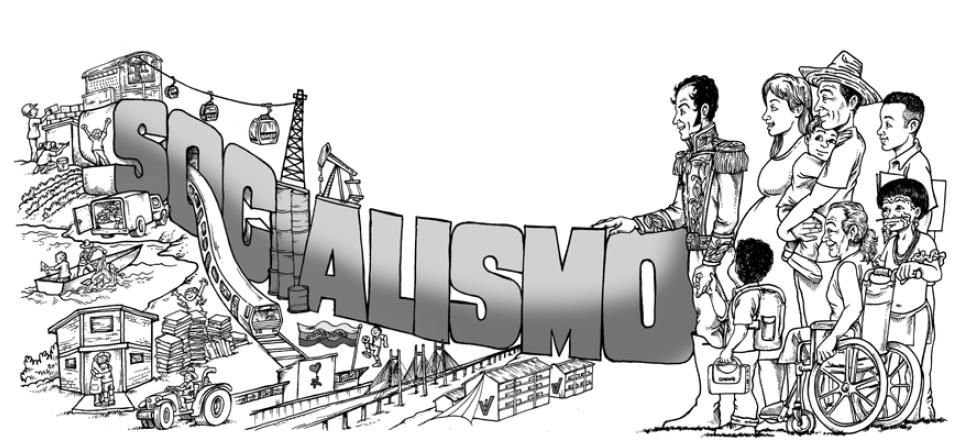
Propuesta del Candidato de la Patria Comandante Hugo Chávez Para la gestión Bolivariana socialista 2013-2019. Via: http://forajidosdelanetwar.blogspot.com/2012/11/caricaturas-e-imaginarios-en-la.html

Hace un año el actual presidente de Venezuela, Nicolás Maduro, anunció la muerte de Hugo Chávez.  Chávez fue el líder de la Revolución  Bolivariana en Venezuela y gobernó el país durante 14 años.  Maduro fue juramentado luego Presidente y recientemente ganó la reelección popular con una campaña que prometía continuar  con el legado de su mentor.

En el 2013, los datos del legado que dejaban los 14 años del gobierno socialista presentados por el Centre for Research on Globalization y por la Embajada Venezolana en los Estados Unidos son reveladores:

  • Venezuela cuenta con servicios de salud y educación universales gratuitos. Antes, 70% de los venezolanos no tenía acceso a servicios de salud.
  • Se eliminó el analfabetismo en el país.  Antes, 40% de los venezolanos eran analfabetos.
  • En los últimos 10 años, el PIB venezolano ha crecido al ubicarse en un nivel alrededor de los 300 mil millones de dólares. Esto representa un crecimiento sustancial frente a la década de los noventa cuando el PIB del país no llegaba a los 100 mil millones de dólares.
  • Se redujo en un 40% el costo de los productos de la canasta básica.
  • Aumentó el salario mínimo en más del 600%
  • Redujo el desempleo del 20% al 6%
  • El Índice de Desarrollo Humano (IDH) en Venezuela aumentó de 0,69 en  1998 a 0,84 en  2008, lo cual eleva a Venezuela a ser un país con rango de desarrollo humano medio a uno con rango alto.
  • De 2008 a 2012, el IDH descendió a 0,748 y alcanza el puesto 71 de 187 naciones y territorios que participaron de la medición.
  • Venezuela ocupa el puesto 71 entre los 179 países que figuran, según el informe anual del Programa de Naciones Unidas para el Desarrollo (PNUD). El coeficiente de Gini, que mide la desigualdad de ingresos, alcanzaron en 0.390 en 2012, el nivel más bajo en la historia de Venezuela y el más bajo en el Continente latinoamericano. En 1998, era de 0,4865.
  • Desde 1999, Venezuela incrementó sus relaciones comerciales con otros países en el hemisferio, así como con otras regiones del mundo. La mayor parte del comercio de Venezuela continúa siendo llevado a cabo en la región, con alrededor del 70% de las exportaciones de petróleo con destino a los países de las Américas, y los mercados de América del Sur, América Central y el Caribe están ganando importancia.
  • En 2012, un año antes de la muerte de Chávez, Venezuela era el tercer socio comercial más grande de Estados Unidos en América Latina y el número 14 más grande en el mundo, además de ser el cuarto proveedor de petróleo a EE UU.

Pero no todo ha sido fácil de conseguir en esta bonanza de estadísticas sociales y los drásticos cambios en el nivel de vida del pueblo venezolano han sido el resultado de muchos sacrificios impuestos en la población venezolana.

Con el ascenso de Chávez y el éxito inmediato de los cambios socioeconómicos en la población, la élite política chavista se aseguró el poder absoluto al conseguir el voto mayoritario en elecciones democráticas gracias a millones de venezolanos beneficiados por las reformas socialistas.  Este poder absoluto (democrático) permitió al gobierno socialista continuar con su plan e imponer restricciones a la libertad de expresión de la oposición, expropió sin muchos problemas industrias, eliminó fácilmente y sin mucha oposición el derecho a la propiedad privada y capturó los ahorros de millones de venezolanos.

Para Maduro, Chávez y muchos otros ideólogos socialistas antes de ellos, cualquier medio era justificable para la consecución del ideal revolucionario socialista.  Latino América, que durante décadas sirvió de laboratorio para experimentos económicos y políticos de líderes del mundo desarrollado fue la arena idónea para regresar a la dulce tentación socialista que había sido lograda con relativo éxito en otros continentes.

La fórmula del legado de Chávez es simple y poderoso:

Populismo anti-imperialista

+

petróleo nacionalizado

=

Socialismo clientelista 

Titulo: Sembrar petróleo. Por Emiliano Teran Mantovani. via: http://forajidosdelanetwar.blogspot.com/2012/11/caricaturas-e-imaginarios-en-la.html

La movilización y apoyo de los votantes en una nación democrática es fácil de conseguir cuando se posee el capital económico, político y/o militar para ofrecer al pueblo una salida de los sistemas de economía mixta extractivos que durante el siglo XX fueron implementados por las naciones desarrolladas del Norte Global y que fueron apoyadas por elites patrimonialistas en los territorios del Sur. El éxito de la revolución Bolivariana aseguró para otros países interesados en este experimento una segura y jugosa fuente de donativos para facilitar el efecto domino socialista que tanto temieron los ideólogos realistas gringos durante la Guerra Fría.  Sin duda, el legado de Chávez sigue vivo un año después de su muerte.

En los últimos dos meses la movilización de un importante grupo de la población venezolana causó manifestaciones en las ciudades más importantes del país.  Los manifestantes tenían muchas peticiones que iban desde reclamos por la corrupción del partido gobernante, reclamos por los altos índices de inflación que afronta el país y solicitudes de renuncia de los líderes de la revolución bolivariana.

Independientemente de cuántos  años más dure el partido revolucionario en el poder es seguro que su legado fue la implementación de una exitosa revolución socialista clientelista sostenida en la venta de petróleo a las economías mixtas del resto del mundo que mejoro los índices de desarrollo humano como nunca antes habíamos visto.  Así es que mientras el mundo siga dependiendo del oro negro, el mundo seguirá escuchando del legado de Chávez.

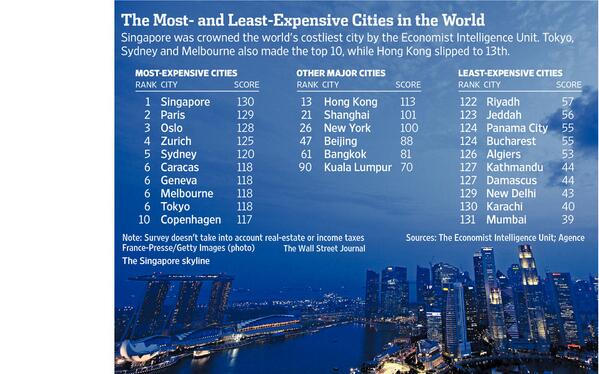
Este caro legado ha costado la libertad y los derechos de propiedad de miles de individuos. Venezuela sigue y continuará enfrentando desafíos en materia de seguridad, pues la tasa de homicidios de la región es la más alta del mundo. El regimen chavista es diariamente acusado de corrupción, incompetencia y la probabilidad de que esto cambie no es del interés de nadie. El año pasado la inflación fue del 56% y la escasez de productos básicos continuó agudizándose hasta este año.  Caracas se ha convertido en una de las ciudades más caras del mundo ocupando el puesto #6 según datos del WSJ.

Embedded image permalink

Introducing the Weekly Wakeup

History is one of my passions and one I share with the late Murray Rothbard.  His examinations and refutations of the commonly accepted truth were one of my early inspirations into exploring libertarian thought.  I urge you to consider this quote from Plato’s Apology: “I am wiser than this man, for neither of us appears to know anything great and good; but he fancies he knows something, although he knows nothing; whereas I, as I do not know anything, so I do not fancy I do. In this trifling particular, then, I appear to be wiser than he, because I do not fancy I know what I do not know.”  This is the first in what should be a long series of weekly blurbs about common misconceptions and downright lies about history.  I will be looking forward to responses and suggestions for future topics in the comments.

Weekly Wakeup for 01-17-2014

Myth:  Early European colonists in North-America enacted a systemic genocide of native peoples from the start.

Reality: “The most hideous enemy of native Americans was not the white man and his weaponry, concludes Alfred Crosby,’but the invisible killers which those men brought in their blood and breath.’ It is thought that between 75 to 90 percent of all Indian deaths resulted from these killers.”

Another source confims:

“[B]ased on the data, the team estimates that the Native American population was at an all-time high about 5,000 years ago.

The population then reached a low point about 500 years ago—only a few years after Christopher Columbus arrived in the New World and before extensive European colonization began.

Study co-author Brendan O’Fallon, a population geneticist who conducted the research while at the University of Washington in Seattle, speculates that many of the early casualties may have been due to disease, which ‘would likely have traveled much faster than the European settlers themselves.’

For instance, the Franciscan friar Toribio de Benavente—one of the first Spanish missionaries to arrive in the New World in the early 1500s—wrote that Mexico was initially ‘extremely full of people, and when the smallpox began to attack the Indians, it became so great a pestilence among them … that in most provinces more than half the population died.'”

Myth: This disease epidemic was directly caused by settlers through planned biological warfare.

Reality:

Unfortunately for this thesis, we know of but a single instance of such warfare, and the documentary evidence is inconclusive. In 1763, [ed. Notably long after the “500 years ago” mark where the population was already markedly declined] a particularly serious uprising threatened the British garrisons west of the Allegheny mountains. Worried about his limited resources, and disgusted by what he saw as the Indians’ treacherous and savage modes of warfare, Sir Jeffrey Amherst, commander-in-chief of British forces in North America, wrote as follows to Colonel Henry Bouquet at Fort Pitt: ‘You will do well to try to inoculate the Indians [with smallpox] by means of blankets, as well as to try every other method, that can serve to extirpate this execrable race.'”

I would like to point out that this attack, if it ever did actually happen, was initiated not by individual settlers but instead by the military government in that region.  A group that I do not and would not defend under any circumstances.   I would also like to preemptively say that I am not attempting to justify the forced relocation of Native peoples later in history, wars waged by either side or the murder of civilians by either group.  Instead I merely wish to question the assertion that there was an intentional and premeditated genocide.  A fact that seems obvious when you consider up to 90% of the native population was already dead from disease before the first colonists even arrived.