Animation Review #1: Burn the Witch

I am a big fan of animation, but I often have to ‘turn my brain off’ to enjoy a comic trying to make political commentary. With rare exceptions, like the Incredibles series, the industry has a strong statist bent. The industry is so statist that Superman: Red Son, a story line with the premise that Superman landed in the Soviet Union instead of the United States, ends with the message that communism would work if only it were a bit more democratic. Note that I say statist bent, as opposed to leftist bent. They are smaller in number, but there are several conservative comics (e.g. the Kingsman) that leave a statist aftertaste.

I can’t do much on the supply side of liberty-friendly comics, but I can at least highlight those comics that I think fellow libertarians might enjoy via blog posts.

First off is Burn the Witch, a new comic series published by Shonen Jump. I was pleasantly surprised when I read through Tite Kubo’s Burn the Witch. Tite Kubo is best known for authoring Bleach, a comic about Japanese school children fighting demons in fantasy Mexico.

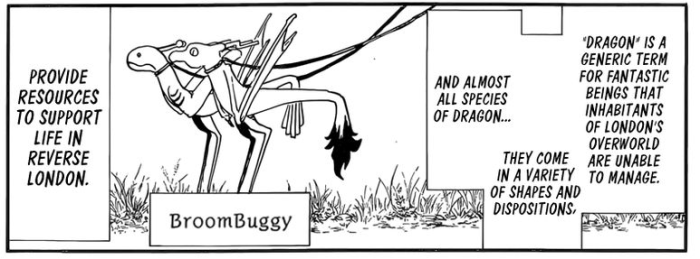
Dragons.png

Burn the Witch is about Anglo-Japanese school children fighting demons in fantasy Britain. The twist? Unlike their counterparts in fantasy Mexico, the British demons (referred to as ‘Dragons’ in-series) aren’t killed outright. Instead they are raised for the resources they provide. Only ‘bad’ demons who are killing humans or otherwise causing destruction are killed. It is noteworthy that the protagonists refer to themselves as ‘conservationists’. They kill the occasional demon, providing the story with action scenes when doing so, but their primary purpose is to conserve them. In an off hand comment the protagonists note that their fantasy Mexican counterparts are barbaric and indiscriminately kill their demons.

Contrary to the protagonist’s comments, it isn’t that individual fantasy Mexicans are barbaric so much that fantasy Mexico doesn’t recognize property rights in demons. Since no one has a property right in demons, no one has an incentive to conserve, much less domesticate, them in fantasy Mexico. Fantasy Britain enjoys strong property rights and consequently has minimal problems associated with its demons. One of the protagonists is ethnically from fantasy Mexico, but seems to be thriving under fantasy Britain’s rules. The story’s lesson? Property rights matter.

Only one chapter of Burn the Witch has been published thus far, and it’s unclear if it’ll become a recurring series, but I like what I’ve seen so far.

Thoughts? Comments? As always, write in the comments below. If you’re a fan of animation and a fellow libertarian, consider joining the anime libertarian alliance facebook group.

The Helsinki Follies

Myself, my wife, Rush Limbaugh, and a couple of others on FB, alone of those who express themselves publicly, have taken leave of their senses. The obvious has stopped waiving at the American intelligentsia (Russian word, on purpose).

Mr Mueller, in charge of demonstrating that Russia gave Mr Trump the election, announces three days before a president’s meeting with Mr Putin that he has charged 12 Russian military intelligence officers with crimes (presumably, violations of American law).

Several things are wrong with this picture.

First, is it a surprise that Russian military intelligence is trying to mess with us? Is this new? Did they used not to? Why make a major announcement of it? It’s routine stuff. Catch them; slap them! Is it the case that US intelligence agencies never tried to mess with Mr Putin’s endless re-elections? What’s their excuse if they did not? Is it the case that our intelligence agencies are not interfering with, say, Venezuela’s political processes today? Really? I liked better the days when our CIA had balls and was the scourge of everything and everyone progressive and socialist.

Second, ignoring the futility of the charges, what’s the chance any of the twelve is going to show up to be tried in America? Not great? Reminder, tentative reminder: Kidnapping them on foreign soil to bring them to American justice would probably violate someone’s law. So, why bother; why indict them? What was the purpose? What was the purpose, a couple of days before President Trump was to meet Mr Putin publicly? Was the purpose other than satisfying justice? Was the purpose to cover up and distract from something more important? Did it have to do with Mrs William Clinton?

Mr Putin offered – short of extraditing the twelve – several compromise solutions so that Mr Mueller could interrogate the Russian intelligence officers named. Will Mr Mueller accept any of those offers? Why not? Give a good reason why he should not.

Reminder: Extradition treaties between countries are always reciprocal: I send you the people you charge; you send me the people I charge. There are really good reasons the US should not want to have such a treaty with Russia.

Does Mueller really want to interrogate the Russian intelligence officers he charged, really? Does he want the truth? (Isn’t it already known?)

How was Mr Trump supposed to respond to such a brutal and vicious attack on his honesty, proffered by Mr Mueller while he was going to be on foreign soil? Was he supposed to lower his eyes, smile sweetly and keep mute? I would not have! He should not have! Should he not have allowed doubt about our intelligence agencies pass his lips, after what the FBI, for example, did? Is he crazy; is he stupid?

Putin is a brutal dictator, a meddler, and probably a murderer. With its nuclear arsenal, his country is the only one really capable of hurting us irreversibly. Good reason to talk to him. We don’t have to be friends but some formal courtesy is required.

The collective reactions of the American political class to the Helsinki meeting tells me that it has lost touch with elementary reality. It’s folly; it’s in a state of collective hysteria. I remember being there before. That was in the eighties.

Warning: If you are sensitive, please, don’t read the next sentences.

In the 80s, the media were awash with denunciations of brutal sex abuse of small children by Satanic cults. People were charged, convicted and sentenced on the testimony of four-year-old coached by eager, man-hating social workers. I remember well, especially, a story in The Atlantic. A father of two confessed to nailing his small daughters to the floor of his living room so his buddies could rape them. The next day, the girls would go to school as usual. No problem! I believe no apologies were ever issued. The justice system was very reluctant to let go of the imprisoned.

A senior Wall Street Journal journalist, Dorothy Rabinowitz, had a solitary struggle of several years to get the wrongs righted.

Wake up, America; get a grip! Those are wooden nickels you are taking!

Ottomanism, Nationalism, Republicanism VI

The end of World War Two placed Turkey between the Soviet Communist world and the western democracies. It’s Middle Eastern neighbours consisted of one outright colony (thinly disguised as a League of Nations mandate), French Syria; one de facto colony of Britain, Iraq (formally independent after a mandate period); one country whose sovereignty was highly compromised by United States and British ‘interests’, that is Iran. After decades of rule by the secularist-nationalist Republican People’s Party (CHP is the Turkish acronym), the idea of a Middle Eastern orientation was not a major one at any kind of obvious level, and had limited practical applicability even for those oriented towards the kind of traditionalist Islam which inevitably looks for some kind of connection with the original Muslim heartland.

The Muslim Brotherhood was formed in (British dominated) Egypt in 1928 and that becomes more important in Turkey over time. A Turkish version, National View, was founded by Necmettin Erbakan in 1969, and forms the core of the AKP today, led by Recep Tayyıp Erdoğan. Turkish history from the 1940s to the AKP coming to power in 2002 can look like an inevitable process, and with some qualifications that is probably a reasonable one-sentence way of thinking. Qualifications include the dangers of seeing history as the inevitable unfolding of a single unified process, and the constant possibility that better decisions by secular leaders at various time could have prevented this outcome. The decisions of the small numbers of self-defined liberals in Turkey were not really any better, sad to say.

İnönü’s response to the post-war world was to adopt multi-partyism. The Democrat Party was allowed to form under Adnan Menderes, who had been a member of the short-lived Free Republican Party and then a CHP deputy, and former prime minister Celâl Bayar. The DP contested the 1946 election, which was not all fully free and fair, but came to power in a more properly conducted election in 1950. Bayâr became President and Menderes became Prime Minister. This worked more as the Turkish constitution suggested than when the CHP was the only party in the national assembly. The result was that Menderes was the decision making person.

This political opening up helped Turkey into the Council of Europe (the grouping of European democracies) in 1949 and made it eligible for Marshall Aid under İnönü. Under Menderes, Turkey joined NATO in 1952. Acceptance into NATO was helped by substantial Turkish participation in the Korean War. The participation of conscript peasant soliders from Anatolia is still remembered in folk songs.

All these ways in which Turkey was acknowledged as part of the community of European democracies took place simultaneously for Greece, so the countries were taken as a pair during this period. The peaceful transfer of power through election from İnönü and the CHP to Menderes and the DP was the first such occasion in Turkish and Ottoman history. Some have seen İnönü as ‘only’ responding to US pressure and therefore denied him credit. This has, in the past, been the default position of most Turkish liberals though I believe that the latest historical work shows that İnönü was much more of an active enthusiast for the transition to genuine elections. On this matter, and others, it looks like time for the default ‘liberal’ position to change.

In any case, the whole idea that İnönü only responded to pressure is unsatisfactory. Of course he made his decision in a context of international balances of power of the time. Others made different decisions. In Spain, for instance, Francisco Franco stuck to ultra-conservative, Fascist-influenced dictatorship, accepting US military bases and continuing previous valuable trading relations. In Portugal, the corporatist dictatorship of António de Oliveira Salazar joined NATO after the adoption of an absurd imitation of party pluralism, with a purely token licensed opposition. Spain and Portugal were not aid recipients, but were able to get considerable trade advantages from the differing deals they made to associate with North Atlantic democracies. İnönü could have found ways to stay in power for ever, but did not.

There were limits to İnönü’s moves towards political pluralism and it was certainly not the ideal process. To some degree, it was one part of the CHP agreeing to the demands of the other part (which left to form DP) to have its turn in power after the current, most favourable to state-led joint secularism and modernity had been in power for so long. More on the DP in the next post.

Returning to İnönü’s rule after the war, the left became victims after a period relative tolerance in the latter years of World War Two, when it looked like the western allies would win in alliance with the US, so the Turkish state showed more tolerance of leftists and less of pan-Turkish nationalists who had the most tolerance of Fascism and Nazism (there has never been a self-identified fascist or national socialist political movement in Turkey).

Not only did İnönü oppress leftist groups outside the CHP as he moved towards genuinely contested elections, he identified left-Kemalist loyalists to the regime as communists who needed to be purged. This was at least in part to gain favour in the US by presenting himself as the main enemy of a real communist threat. Left-Kemalist academics who lost their university jobs at the time included Neyazi Berkes, the most notable Kemalist intellectual of any kind, who went onto an academic career in the west. Measures against left groups outside the CHP included using a religious conservative gang to smash the printing presses of a left newspaper. The willingness of the state to tolerate, and even promote, illegal violence by far right groups supposed threats to the regime and has been a frequent occurrence ever since.

To be continued

Defending Political Liberty in an Administered World

This is a very rough work in progress continuing on from my recent post on ‘Law, Judgement, Republicanism’.

The problems with a free and open political and judicial culture were diagnosed by Max Weber in his discussion of bureaucracy, which itself draws directly and indirectly on various accounts of the problems of bureaucratisation and administration of the social world (which itself began in the 18th century, at least in terms of explicit discussion  of bureaucracy). Wilhelm von Humboldt’s comments on bureaucracy in Limits of State Action is, as far as I can see, the first clear instance. Before that, the closest precedents are, I believe, in comments on the rigidity of Roman law in Montesquieu, which may have been at least in part against the laws and legal institutions of France in his own time.

Bureaucratisation and an administered world can themselves be seen as resting on the necessity of an integrated, hierarchical, rigid, and institutionalised legal system of a ‘Roman’ model, which is true even when thinking of ‘common law’ jurisdiction in England and its off-shoots (England, not Britain, because Scotland has its own more Roman system, and differences between English and Scottish legal institutions survived political union). This process, described in various ways by Weber, Schmitt and Foucault, Austrian school liberals and Frankfurt School Marxists, also rested on the simultaneous formation of commercial society and national economy described by Arendt. Arendt’s account is particularly enriched by comparison with Foucault on the emergence of the art of government. 

The consequences of these legal, administrative, governmental, and economic processes  is that the political sphere is deprived of content as a means for addressing the community as a community of judging, reflective individuals. Politics becomes competition for control of administration and the distribution of economic benefits that come with with this control. The political world is influenced by a drive to the kind of homogenisation favoured by the world of administration and positive law, which turns into struggles about identity and ‘political correctness’. That is, the struggle to define the dominant identity, with claims to a pluralist position still governed by the wish to establish the dominating identity as more tolerant (which can happen in a ‘progressive’ manner), as in a community seen as a community of communities or a ‘conservative’ manner, where there are distinct communities tied to nations or possibly non-interacting historical communities within nations. 

Arendt suggests a perspective aristocratic contest in politics taken from Greek antiquity, particularly Athens, as the antidote to the above. Foucault also has a perspective taken from Greek antiquity, of care of the self, which can also be understood as aesthetic techne, in which our capacity for self-affection is developed in self-creation and recreation, though not as a purely aesthetic play. Machiavelli was in some respects the advocate of the modern integrated state, of sovereignty concentrated in an individual who integrates society through the power of his political skill and creation of a dominating rhetoric or symbolism. In Machiavelli, though, we can also see much that comes from Ancient republicanism filtered through the republicanism of the late medieval city states of northern Italy.

There is not just the remnants of ancient republicanism but its transformation in a world where the state is increasingly invested in territorial control, distinct from the personalised nature of the state as understood before (either in the person of the monarch or the persons making up a republic). The ‘cynicism’ of Machiavelli has its starting point in Aristotle’s Rhetoric, where reason is applied to speech in public places, particularly the courts of law and the political assembly. Though Aristotle distinguishes between the rhetoric of courts and assemblies, he does show a commitment to the idea that they belong to a common world of persuasive speech. Rhetoric appeals to the less deductive parts of human judgement, even the parts of human judgement which come from immediate emotional reactions, but never just that.

The prince who is human and animal, moral and self interested, is also the strong lion and the cunning fox, within his animal self. There is a sense of the total possibility: symbolism and self invention of individuals engaged in the political world. The judicial connection with politics and the social world for whom law is in some sense dead, an accumulated wisdom from the ancients now codified and open to commentary, but not part of political life except in the administrative and governmental roles that Machiavelli himself had for a while on the basis of his legal training, mingled with humanistic (Latinate and literary) education.

Even so, we can see some ideas lingering in Machiavelli of the importance of law in political life, so that it is the ‘parlements’, partly independent and locally representative law courts, of France which gives its monarchy some of the liberty of a republic. In The Prince it is the case that the energy of the people defending its state and its liberties, where they have some history, outweighs the power of the princely ruler, so that classical Polybian republicanism of the Discourses is never completely absent from The Prince.

Most significantly, Machiavelli leaves a legacy which can be seen behind the 20th century attempts to find an alternative to an administered social world. There is the charismatic leader in Weber, the agonistic aspects of politics in Arendt, and the ethics of self-creation and transformation of the self in Foucault. The charismatic leader in Weber should not be understood as a dictator or a person above politics, but as the way in which legally and formally constrained politics can still engage with the social world and the free judgements of individuals. The agonistic politics in Arendt is not just nostalgia for Athens, but an account of what it is to have individual goals and public awareness in a political community. Ethics in Foucault is not just self-creation out of nothing or a non-political playfulness, it is about how we can have free judgement in politics and law. The glory the prince seeks in Machiavelli, and by the citizens of a republic, is a way of seeing that politics combines autonomy and prestige as driving forces in a historically located and contingent political community. Machiavelli anticipates the ways that Arendt understands political freedom to be related to a Homeric culture of seeking fame in public life.

Brexit Breakdown

Ir has been obvious for at least a month now that soft Brexit has won out in the UK, though the Prime Minister Theresa May would never admit such a thing directly. Government discussion of access to the EU internal market at its existing level, or very close, and keeping the border open between the Republic of Ireland and Northern Ireland (a fundamental of the peace settlement in the north) would at the very least require continuing regulatory alignment in goods (that is, following the rules made by the European Union).

It seems very likely that negotiations of the terms of exit with the EU itself would make even this partial alignment with the internal market inadequate in order to get the desired level of access. At the very least EU negotiators would demand some inclusion of services (financial services are the big issue here) and something at least resembling free movement of labour.

That inclusion would be full UK access to the internal market after exiting and would require at least a Swiss style relationship with the EU, in which there is full market access in exchange for accepting EU rules and something close to free movement of labour. Such a relationship would mean accepting judgments of the European Court of Justice even if they are not incorporated into UK law. The UK might not follow Switzerland into EFTA (European Free Trade Association, see paragraph below).

It has even been suggested that the UK might find it necessary to adopt a ‘Norway’ solution, in which the UK is directly a member of the European Economic Area. Norway has free movement but opts out of common agricultural and fisheries agreements. It is not part of the EU customs agreement. Like Iceland, Lichtenstein, and Switzerland, it is a member of the European Free Trade Area, which essentially harmonises regulations between these countries and the EU; that is, EU regulations are enforced by EFTA institutions.

It is clear that most Conservative MPs and businesses (though more large business than small business) regard something like the arrangements above, soft Brexit, as preferable to hard Brexit (trade agreement with the EU as a completely external country, possibility of no deal). These MPs and business people, along with most Treasury economists and economists in general, believe that keeping complete access to EU markets is more valuable than vague claims of a trade boom through deals with non-EU states across the world.

Hard Brexiteers believe that economic growth of other parts of the world requires breaking free of EU shackles on global free trade. The soft Brexit, as well as Remain, argument is that membership of the EU does not prevent trade with the rest of the world and that some EU countries are already doing that very well compared with the UK. On this argument, geographical proximity will always make EU trade disproportionately important so that limiting access to EU markets in the hope that non-EU countries will want free trade agreements is unnecessary and probably very damaging.

May’s drift towards soft Brexit after presenting herself as the guardian of hard Brexit has the support of most of the Cabinet, and Conservative MPs, but has been disappointing hard Brexiteers for some time. An agreement of the full cabinet at the Prime Minister’s country residence for soft Brexit has led to the resignation of the two most hard Brexit-oriented ministers.

It seems unlikely this this will deter May from a soft Brexit policy, which everyone agrees can only become more soft in negotiations with the EU to achieve an agreed exit. It also seems unlikely that most Conservative MPs will resist this policy. The biggest problem for May could be that the opposition parties want to vote against the government in call circumstances, so could vote with hard Brexit Conservative MPs to bring down any Brexit agreement.

At this point Brexit might completely break down, with the UK becoming a full member of EFTA, so in practice a member of the EU which exchanges some opt-outs for absence from the decision making processes and institutions. It might even lead to a suspension of Brexit, or a second referendum in which the electorate chooses between the exit package and staying in the EU.

At present, the most likely options in descending order are: 1. soft Brexit, outside formal association with the EU, but like that in practice, 2. formal association with the EU, maybe meaning membership of EFTA, 3. the complete breakdown of Brexit. This could change and so far change has been to move further and further away from hard Brexit.

Personally I support continuing membership of the EU. It is inevitable that large parts of the UK economy will ‘align’ with EU regulations, so it is best to be part of the institutions and processes which decide on these regulations. That is the most pragmatic version of my argument.

I am also a strong European integrationist, even a federalist romantic. The qualification of this idealism is that integration should not go further than public opinion or institutional capacity can accept at any one moment and that economic realities should guide the relationship with Europe for and against the kind of integration I favour at heart.

My own ideal is a kind of revival of the medieval dreams of ‘universal’ (i.e. European) Empire. The poet Dante was a great exponent of such a vision in his classic of political thought On Monarchy, which does not exclude city republics, even favours them under a high European sovereign. We can join it with Marsiglio of Padua’s slightly later call for an empire with elections to have something like democratic federation for Europe.

Leaving my European romanticism aside for the moment, the current realities are that the UK’s exit from the EU has become more and more complicated by the disadvantages of disentangling complex and far reaching institutional and economic links, particularly when most people involved want to keep an open border with the Republic of Ireland and keep 100% of the current level of access to the internal market.

Turkey at the start of one-man rule

1. Yesterday (Monday) Recep Tayyıp Erdoğan took office under the system of executive presidency, which gives him arbitrary personalised powers, based on the claim that a system of such extreme powers for one person is the most democratic system if that person is elected. The changes came about as the result of a referendum last year, which gave a narrow victory for the constitutional changes. It seems to me, and many others, that rigging allowed victory in the election. For the first time in Turkey, all ballot papers unstamped by an electoral officer were counted, allowing unlimited fraud. There are other issues about intimidation and irregularities, but this is not the moment to go into further detail, but I will just point out that radical changes to the constitution were ‘legitimised’ by pseudo-democratic fraud.

2. The constitutional changes enable the President to: legislate by decree, appoint most Constitutional court judges, appoint the army chiefs, appoint police chiefs, appoint all higher level members of the bureaucracy, appoint government ministers and vice-presidents without reference to the National Assembly. There is no Prime Minister. The President, Vice-Presidents, and Ministers are not obliged to answer questions in the National Assembly. In principle the National Assembly can reverse decrees as laws, but to allow the President to legislate in such an unaccountable way in the first place undermines all understanding of what a national assembly is for and what the limits on the head of government or head of state (now the same person) should be in a state which is constitutional and democratic.

3. Ministerial appointments have most notably included the elevation of Erdoğan’s son-in-law, Berat Albayrak, to the Ministry of Treasury and Finance. Albayrak is a major businessman whose rise in business and then politics have taken place since Erdoğan became the most powerful man in Turkey in 2002.

4. Other appointments have given business people ministerial posts for areas of the economy in which they have a dominant market position. Erdoğan’s own family doctor who owns a medical business is health minister. The education minister owns a private college.

5. The appointments of business people and a son-in-law show carelessness about propriety in the separation of the administration of public affairs from private and family interests, to put it in the mildest way possible. It also suggests that Erdoğan thinks he is too big for the party which brought him to power, AKP. It has been clear for some time that the most powerful people in the AKP are this son-in-law and one of the sons. That is, the AKP exists as a vehicle of one family, and its businesses associates. In this case, it is hardly a properly functioning democratic party.

6. The appointments were preceded by a presidential decree on the appointment of the governor and vice-governors of the central bank, which reduces its autonomy and makes it more vulnerable to Presidential pressure. Erdoğan has clearly been struggling to live with central bank decisions to raise interest rates in response to inflation and the falling value of the Turkish Lira. Anyway, the currency lost 20% of its value and inflation is at nearly 16% though the central bank’s target is 5%.

7. Market confidence in Turkey, even of a very minimal kind, was resting on one man, Mehmet Şimşek, who has western training in economics and is the last remnant of the days when the AKP appeared to many to be a centre-right reformist party, and did manage to behave in part like such a party. Şimşek appears to have been increasingly unhappy with his situation, putting a rational face on polices he knows are going in the wrong direction, occasionally winning battles to raise interest rates. One of Erdoğan’s main obsessions is that interest creates inflation. He has found it necessary to curtail that belief on occasions. Şimşek apparently wanted to resign from government recently, but no one ‘betrays’ Erdoğan in that way. Şimşek was bullied into staying and has now been sacked. His replacement is Erdoğan’s son-in- law. The markets have been spooked and the lira fell very sharply yesterday evening.

8. The Erdoğanists do have a solution to lack of international market confidence in Turkey. It is to create a Turkish ratings authority which will rate Turkish government credit as the government wishes! This absurd proposal, which will only reduce the credibility of the lira and government debt, shows the depths to which economic policy run on political paranoia has sunk in Turkey. Political paranoia because low credit ratings are due to foreign conspiracies!

9. Going back to last month’s election, about 2% of ballots cast have been declared invalid by the Supreme Electoral Council. HDP (Kurdish rights and leftist party) has pointed out that most ‘invalid’ ballots are from polling stations where it did not have observers. The HDP is defined as ‘terrorist’ by the followers of Erdoğan and its presidential candidate is in prison on ‘terrorism’ charges. This is all based not on credible evidence of co-operation with the PKK, which does have common roots with HDP, but on absurdly broad definitions of terrorism which take in people who do not oppose the PKK enough or which offer any criticism of state policy towards the PKK.

10. Based on point 9, it looks very much like 2% of votes cast were spoiled to take votes from the HDP. It hardly seems likely that would be the limit of fraud. As mentioned in point 1, all ballots were counted which did not have the basic security guarantee of a stamp from an electoral official on the ballot itself or the envelope containing the ballot. It is inherently difficult to arrive at accurate figures in this matter, but it looks very much like at least 4% of the ballot was fixed (that would merely double the most obvious form of rigging, which I do not think is an extravagant assumption, after all most rigging will take place in very hidden ways). If I am correct then the pro-Erdoğan electoral list for the National Assembly did not get a majority of votes and Erdoğan did not get a majority of votes in the presidential election.

11. The government-state machine extends claims that the HDP is terrorist to the main opposition party, CHP, on the grounds that the CHP has offered some criticisms of the detention of the HDP presidential candidate, and that some CHP supporters voted HDP to help it overcome fraud and reach the 10% of votes necessary to enter the National Assembly. CHP provincial leaders have been banned from attending the funerals of soldiers killed by the PKK, soldiers who in some cases will be CHP supporters, showing the kind of spite, vengefulness, and abuse of state power driving the AKP.

12. The Istanbul municipal government has announced that public transport will be ‘only’ half price during next month’s Kurban Bayram (Sacrifice Festival; religious festival and public holiday) instead of free as has been normal for a long time. This shows the strains that public finances are under in Turkey. The AKP are specialists in providing ‘free’ benefits to electors, along with favours for individuals and families, building up a base in local government in this way before they came to power nationally. The Istanbul news is a small thing in itself, but is suggestive of a decline in the capacity of the AKP to use public money to buy votes.

13. Given increasing personal indebtedness, rising inflation, the falling value of the currency, the decline of foreign investment and the credibility of government debt instruments, we could see some very difficult economic times in Turkey. It is clear that this process was important in holding the recent election 18 months early. The loyalty of the AKP and Erdoğanist base is intense, but was formed at a time of economic growth and expanding public services. We see going to see what happens to loyalty in less happy circumstances.

Eye Candy: Mexican election results (2018)

NOL Mexican elections
Click here for data

Yikes, the red team is a left-wing populist party (like the one that governs Venezuela). How did it come to this? Here’s a more optimistic take.

Ottomanism, Nationalism, Republicanism IV

The previous post in this series covered the early stages of the formation of the Republic of Turkey out of the debris of the Ottoman state on the basis of ethnic nationalism combined with republicanism. Ottoman reformers were influenced by the western model. The new republicanism expressed itself in the forms of constitutionalism and representative democracy on a strictly western model, with an elected national assembly, a prime minister responsible to the assembly, and a president elected by that assembly. This post continues with an account of the early Republic which is mainly descriptive and with the aim of more analytic and evaluative comments in later posts in this series.

The nature of the fledgling state was very French influenced, in that it was a very unitary state with a very assimilationist attitude towards non-majority cultures and languages, along with a project for creating citizens of an enlightened republic. The comment of the 19th century Piedmontese-Italian politician Massimo d’Azeglio, ‘we have made Italy, now we must make Italians’ applies in a more radical way to Atatürk’s Turkey, who was someone of much more radical republican inclination than d’Azegio. Roughly speaking the work of French republicanism and reformism from 1789 to the 1920s was squeezed into Atatürk’s period of leadership, from 1919 until his death in 1938.  For this reason, the Kemalist program is sometimes referred to as Jacobin in Turkey.

Sharia law was abolished and previous adaptations from western law were turned into the complete incorporation of the Italian criminal code and the Swiss civil code as Turkish law codes. The first republican constitution made reference to Islam as the language of the state, but from the beginning it was the intention of Atatürk (who in Enlightenment style was a deist) and his associates to weaken the role of religion in public life, as in France. The laicist ambition became more explicit over time and mosque was separated from state. The Ottoman Empire, particularly in its later centuries, was regarded negatively as non-Turkish and decadent. State education reflected this along with positive attitudes towards science and the modern. Co-education of the sexes became normal.

The language itself was transformed, as the Ottoman use of the Arabic alphabet was replaced by a version of the Latin alphabet for a language that was sufficiently changed in both grammar and vocabulary to become a distinct language. Persian and Arabic grammatical influences were removed along with many words from the Persian and Arabic languages. New vocabulary was based on old Turkish roots going back to central Asia. Surnames for Muslims were legally enforced for the first time. President Mustafa Kemal (Kemal is a name given by his school teacher, according to Ottoman Muslim practice of the time) became the first person to receive a surname under this law: Atatürk.

Religion was not just pushed out of the public sphere, as the state sought to reduce the general social influence of religion, prohibiting religious brotherhoods and saints’ tombs. A religious affairs ministry was set up to regulate Sunni Islam, controlling the Friday midday sermons and repressing the more radical expressions of religion. Civil marriage was made compulsory on the French model, so that religious marriages were no longer recognised.

These changes, usually known in Turkey as the Atatürk Reforms or Turkish Revolution, were accompanied by a very strong drive towards assimilation into a majority Turkish culture, as defined by the republican elite. The Kurdish language (or languages), most the Kurmanji dialect (or language) in Turkey was not made part of the education system and was actively discouraged by the state. The same applies to the Zazaki language, or dialect, of the Tunceli region which as far as I can see is more a dialect of Farsi than Kurdish (or is a language closer to Farsi than the Kurdish language, which are certainly all related).

Not surprisingly, given such radical state led changes, violent resistance and state violence to overcome resistance is a major issue at this time. In 1925 Sheik Said Nursi led a revolt of Kurds to defend religious tradition and the traditional tribal-patriarchal power structures the state was challenging. This was put down with considerable violence. A rebellion around Tunceli (which was previously known as Dersim and is still frequently referred to as such) in 1937 to 1938, was in reaction to a 1925 law requiring the dispersal of the population to ensure Turkification. The rebellion was put down with considerable counter-insurgency state violence, which killed civilians as armed rebels. In the end, the law was never enforced in Tunceli or anywhere else.

Politically, Atatürk welcomed the principle of pluralism, but was not willing to follow it in principle. At Atatürk’s own initiative a Free Republican Party was founded as an opposition to his own Republican People’s Party in 1930. The intention was that it would be a loyal opposition concentrating on economic issues, but it became radicalised beyond the intentions of its leaders as it became a gathering point for various kinds of radical opposition including religious conservatives and leftists. The party was dissolved in the same year and the Republican People’s Party was uncontested in national elections until 1946 and first conceded electoral defeat in 1950.

Ottomanism, Nationalism, Republicanism III

Previous posts in this series have looked at the preconditions for the proclamation of the Republic of  Turkey in 1923. The Ottoman Empire was in a very difficult situation from the early 19th century, effectively lacking the capacity to prevent erosion of its territory, extraterritorial legal rights for the stronger Great Powers which were extended to non-Muslim subjects the powers claimed to protect, and ‘mediation’ regarding break away groups within the Empire. The survival of the Empire was certainly in doubt by 1914 and World War One killed it, along with three other empires: Russian, German, and Austro-Hungarian. In a more long term way, the war hastened the end of colonial European empires, though the French and British Empires gained territory from the Paris Peace Treaties.

It is hard to see how the Ottoman Empire could have survived except as a rump state, even without the war. It might have been smaller than the current republic and certainly would not have been larger. Had its German and Austro-Hungarian allies won the war, it would have survived with some territorial gains in north Africa, but as an effective dependency of Germany.

Defeat in the war destroyed the power of the Trio (Enver, Talat and Cemal) of military and bureaucratic figures who ran the Empire under the continuing nominal sovereignty of the Sultan in a secretive and unaccountable manner. They came of the Committee of Union Progress, the political party expression of the Young Turks who came to power in 1908. The methods of the trio are the culmination of the rapid movement of the CUP from a constitutional party to a conspiratorial and authoritarian political force: Kemal Atatürk was a member of the CUP but resigned because of its lack of republican radicalism, with perhaps some motivation from more personal kinds of dispute.

As World War I ended in 1918, the Sultan regained powers and followed a policy of appeasement towards Britain, continuing the logic of earlier dependency on Germany, that is the logic in which the state could only survive through appeasement of at least one Great Power. The government was superficially more liberal than what came before, but had so little basis in the residual Empire it’s hard to see any circumstance in which it would not have collapsed or resorted to state violence to replace the power of Britain, which was occupying Istanbul.

The 1920 Treaty of Sèvres gave all the remaining Arab provinces to Britain and France, who also occupied parts of Anatolia along with Italy and Greece (which was given most of eastern Thrace). An American backed Armenian state was envisaged in eastern Anatolia and a confederation of Kurdish majority provinces in the southeast with the British mandate in Mesopotamia-Iraq. As far as the elements of the Ottoman elite influenced by nationalism and republicanism were concerned, particularly those who were, or had been, active in the CUP this was entirely unacceptable, leaving a rump Ottoman state in the central and northern parts of Anatolia, separated from Istanbul in the southeast, the east, the south, and the west. A Greek invasion of Izmir and other parts of the west to enforce its Sèvres gains met with armed force.

Though the Ottoman state appeared to be completely defeated and helpless, the CUP had left a legacy of public and conspiratorial political and security organisation which led to considerable resistance. A general known as Mustafa Kemal Paşa, later Kemal Atatürk, was able to leave Istanbul and join up with anti-Sèvres forces in the east, under cover of ‘inspection’ of Ottoman forces, possibly with the connivance of elements of the residual Sultan regime. Atatürk’s strength of personality and political vision, along with military prestige from the Battle of Gallipoli, enabled him to become the military and political leader of these forces, so that a secularist radical vanguardist republican was at the head of a national assembly full of traditional Ottoman Muslims.

The consequences of this formative national movement (which had Kurdish as well as Turkish support) was that Mustafa Kemal was able to defeat the Greek expansion into Anatolia, push other occupying forces out, and that he was able to insist on a replacement for the Treaty of Sèvres, which is the Treaty of Lausanne. The whole process continued the ethnic violence which marked movements of rebellion against the Ottoman Empire and state counter-violence. It is very had to see how any postwar Ottoman or republican state could have avoided the continuation of early ethnic violence.

The republican regime emerged from a national movement against ethnically inspired partition and occupation, so was not going to aim for a consociational or federalist state to get ethnic groups to share a state. It was not even going to aim for pluralism within a unitary state. Turkish republicanism was based on nationalism, and ethnic nationalism at that, as the only likely basis for an enduring state. The means by which this was obtained during the War of Independence and the early republican regime were ugly, but the alternative was ugly attacks on Anatolian Muslims, principally Turks and then Kurds.

With all due respect to the dangers of ‘whataboutery’, the process in which parts of the Ottoman state kept breaking away to form Christian majority states was no more pleasant. The same applies to the Russian annexation of what had been Ottoman lands in the Caucasus, which appears to have led to the killing of one million, or more, Cherkez (Circassian) Muslims.

From the time of  Albanian revolts of the early years of the 20th century, the Ottoman Empire was beginning to part ways with its Muslim population outside Anatolia and Thrace. The conflict between Arabs and the Ottoman state was extremely ugly on both sides. As I have mentioned, the Austria-Hungary fragmentation at the end of the First World War was unique in not leaving a state which represented the core of the Empire.

It is not an easy subject, but the evidence of the First World War and the 1920s is that a state needs some kind of core nationality and territory to survive, which we see even in a the multi-ethnic Yugoslav state, which had Serbs at its core. In Turkey the ethnic core of Turks, in alliance with a lesser number of Kurds and various ethnicities including Cherkez and Bosnşian which had been refugees from the post-Ottoman states, based in the territorial core of Anatolia, provided a basis for a national movement. The national movement was strongly influenced at elite levels by republican ideas of unified popular will, which could fit with nationalism.

To be continued

Ottomanism, Republicanism, Nationalism I

The Republican experiment in Turkey goes back formally to 1923, when Mustafa Kemal (later Kemal Atatürk) proclaimed the Republic of Turkey after the deposition of the last Ottoman Sultan, becoming the first President of the Republic after holding the office of Speaker of the National Assembly. The office of Caliph (commander of the faithful), which had a symbolic universalism for Muslim believers world wide and was held by the Ottoman dynasty, was abolished in the following year. The Republic, as you would expect in the early 20s, was founded on intensely nationalistic grounds, creating a nation for Turks distinct from the Ottoman system which was created in an era of religiously defined and personalised rule rather than ethnic-national belonging.

The move in a republican-national direction can be taken back to the Young Turk Revolution of 1908, which itself put down a counterrevolution in 1909, and might be taken as a model for current political divisions (in a qualified clarification through simplification manner). The name rather exaggerates the nationalist element of the revolution. The governments which came after 1908, ruling under an Ottoman dynasty reduced to a ceremonial role, were torn between Turkish nationalist, Ottomanist, and Islamist replacements for the personalised nature of Ottoman rule.

In this context Ottomanist refers to creating the idea of an Ottoman citizenship and shared institutions rather than restoring the political power of the dynasty. Variations on these ideas include Pan-Turkism/Turanism (the unity of Turkish peoples from the Great Wall of China to the Adriatic Sea) and a Dual Monarchy of Turks and Arabs modeled on the Habsburg Dual Monarchy of Austrians and Hungarians (that is the Habsburgs were Emperors of Austria in the Austrian lands and Kings of Hungary in the Magyar lands).

The move away from a patrimonial state based on the hereditary legitimacy of dynasties, who were not formally restricted by any laws or institutions, goes back to the Tanzimat edict of 1839, issued by Sultan Abdulmejid I in 1839, establishing administrative reforms and rights for Ottoman subjects of all religions. This might be taken as providing a model of moderate or even conservative constitutional reformism associated with the Young Ottoman thinkers and state servants. It has its roots in the reign of Mahmud II. Mahmud cleared the way for the reform process by the destruction of the Janissary Order, that is the military corps which had expanded into various areas of Ottoman life and was an important political force. The Tanzimat period led to the constitution and national assembly of 1876, which was suspended by Sultan Abdul II in 1878.

Abdul Hamit carried on with administrative reforms, of a centralised kind which were seen as compatible with his personal power, accompanied by war against rebellious Ottoman subjects of such a brutal kind that he became known as the Red Sultan. His status has been greatly elevated by President Erdoğan who evidently wishes to see himself as a follower of Abdul Hamit II, rather giving away his tendency to regard democracy and constitutionalism as adornments to be displayed when they can be bent and twisted to his end, rather than as intrinsic values. The brutality of Abdul Hamit II, the violent reactionary, was foreshadowed in the reformism of Mahmud II. His destruction of the arch-conservative corps of the Janissaries was a highly violent affair in which an Istanbul mutiny provoked by Mahmud was put down through the execution of prisoners who survived the general fighting.

In this sketch, I try to bring out the ways in which the Ottoman state used systematic violence to reform and to push back reform, when giving rights and when taking them away. There is no Ottoman constitutional tradition respecting the rights of all and the pre-republican changes were just as violent as the most extreme moments of the republican period.

The ‘millet system’ of self-governing religious communities under the Sultan was a retrospective idealisation of ways in which the Ottomans accommodated religious diversity, at the time the capacity of the state to have legitimacy over non-Muslim subjects was declining. Serbia started revolting in 1804, leading to self-government within the Empire in 1817, on the basis of national post-French Revolution, not the ‘millet’ tradition rooted in classical Muslim ideas of ‘protected’ minorities. The strength of modern nationalism in the Ottoman lands is confirmed by Greek Independence, internationally recognised in 1832, following a war in which western educated Greeks familiar with ideas of nationalism and sovereignty provided the ideology.

The republican national tradition in Turkey is sometimes seen as a fall away from Ottoman pluralism and therefore as regressive. The ‘regression’, as in the influence of nationalism and reconstruction of the Ottoman state through centralisation and centrally controlled violence, actually goes back much further. The Ottoman state was not able to find ways of accommodating the aspirations first of non-Muslim subjects then even of Muslim subjects outside Anatolia and Thrace. In this process the Ottoman state was step by step becoming what is now Turkey, based on the loyalty of mostly ethnic Turkish subjects, including Muslim refugees from break-away states who fled into Anatolia, and to some degree on the loyalty of Kurds in Anatolia to the Ottoman system. Antagonism towards Ottoman Armenians was one part of this.

To be continued

Pakistan’s dynastic politics and the PML-N’s Sharif family

As in other parts of South Asia, dynastic politics is an integral feature of Pakistan’s politics. Both the PPP (Pakistan People’s Party) and the PML-N (Pakistan Muslim League-Nawaz) are essentially family-run political parties. While the PPP has been dominated by the Bhutto family, the PML-N has been dominated by the Sharif family.

Resentment against family domination in PML-N

In the recent past, there has been resentment against the rise of both Maryam Nawaz Sharif (daughter of former Prime Minister Nawaz Sharif) and Hamza Shehbaz, son of Shehbaz Sharif (PML-N party chief and younger brother of Nawaz Sharif).

The latest resignation from PML-N was that of Zaeem Qadri, once a confidante of Shehbaz Sharif, who was denied a seat for the NA-133 (an electoral constituency in Pakistan). Qadri used some harsh words for Hamza Shahbaz, saying ‘Hear Hamza Shahbaz! Lahore is neither your, nor your father’s property.’ Qadri also stated, that one of the reasons he did not get the ticket was that he did not possess adequate resources.

In the run up to the elections, internal dynamics of the PML-N, as well as the role of the Pakistan military, will be crucial (it has been lending tacit support to the opposition, to weaken the PML-N, especially in the party’s citadel of Punjab).

Dynastic politics and differences within the Sharif family

If one were to look at the resentment against Maryam Nawaz, only last year, Chaudhry Nisar, former Interior Minister, who does not share particularly cordial relations with the Sharifs, said that it is too premature to compare Maryam Nawaz with Benazir Bhutto. Said Nisar in an interview with Geo TV:

Comparing Maryam Nawaz to Benazir Bhutto is wrong […] Maryam Nawaz should understand and partake in practical politics. Only then can she be considered a leader.

Another minister, Saad Rafique, too had stated that Maryam Nawaz should be ‘cautious while addressing public meetings.’

Rivalry between Hamza Shehbaz and Maryam Nawaz

It has been argued that one of the main reasons for the strained relationship between Shahbaz Sharif and Nawaz Sharif was the rivalry between their children. After Nawaz was removed from Prime Ministership in July 2017, one of the reasons why Shahbaz (now the PM candidate) was not immediately appointed interim Prime Minister, as well as President of the PML-N, was that there was a clamor for Hamza Shahbaz as Chief Minister of Punjab and Nawaz’s family was not comfortable with an arrangement where both father and son would be powerful. Later on, Nawaz appointed Pervez Malik, instead of Hamza Shehbaz, as campaigner in charge for NA-120, which was fought by his wife Kulsoom Nawaz.

Military’s behind the scenes manuevres and defections

In recent months, the Pakistan army has been trying to engineer a number of defections from the PML-N to PTI, and even though the military shares a comfortable relationship with Shehbaz, as compared to Nawaz, it is believed that now they would be most comfortable with Imran Khan as PM. There have also been reports of the military not just arm twisting political leaders of the PML-N, but censoring the media as well. Whether the latest resignation was prompted by the military is in the realm of speculation of course.

The Army and Nawaz’ reaction to the resignation of Qadri

Interestingly, Qadri’s resignation may be welcomed not just by the military, since it would have come across as a setback to the PML-N, which is considered the dominant force in Punjab. In his heart of hearts, Shahbaz’ brother Nawaz too may not mind this, since it will not only clip Hamza’s wings but also weaken Shahbaz’ position to some extent. During his press conference, Qadri made a mention of Nawaz Sharif, saying that the Former PM had told Qadri that many within the PML-N were not happy with his presence in the party.

While the two brothers share a very strong rapport, in spite of temperamental differences in the past year, there has been a degree of friction. After Nawaz’ remarks on the Mumbai attacks, where he blamed Pakistan for delaying the trial of the accused, Shahbaz had to intervene, and apparently told Nawaz not to talk to the press without consulting Shehbaz. In an interview to the Dawn newspaper, Nawaz had said:

Militant organisations are active. Call them non-state actors, should we allow them to cross the border and kill 150 people in Mumbai? Explain it to me […] Why can’t we complete the trial?

In spite of the differences within the PML-N, and some tensions between both brothers, there is a strong realization that the main crowd puller for the PML-N still remains Nawaz Sharif, and with the elder Sharif being in London due to his wife’s ill health (she has been on ventilator since June 14 2018) it is unlikely that he will be able to spearhead the campaign.

On the whole, defections like Qadri’s are not likely to have much of an impact on the prospects of the PML-N, given Nawaz’ charisma and goodwill, along with the fact that he is looked at as an individual who has taken on the army, and Shahbaz Sharif’s performance as Chief Minister. What will really be crucial is the success of the Pakistan military’s back door machinations, and to what extent will it go all out to back PTI Chief Imran Khan, who himself has been in the eye of a storm after a book written by his former wife and senior journalist, Reham Khan, has made some serious accusations against him, and could dent his prospects amongst certain sections.

Conclusion

It is in Pakistan’s interest that the 2019 election verdict results in the strengthening of the democratic set up. Apart from a dire need for change in the military’s mindset, political parties in Pakistan (like in other South Asian countries) too need to get their house in order and move beyond being family concerns. It is also important to have greater intraparty democracy.

Turkey after the Election

Grim Facts

Turkey held National Assembly and Presidential elections last Sunday (24th June). Recep Tayyıp Erdoğan won an overall majority of votes and retained the presidency without a second round of voting. The pro-Erdoğan electoral list of his AKP (Justice and Development Party/Adelet ve Kalkınma Partisi) and the older (the second oldest party in Turkey) but smaller MHP (Milliyetçi Hareket Partisi/Nationalist Action Party) took a majority of votes. The MHP took more votes than the breakaway Good Party (İYİ Parti/IP), though IP’s leader (Meral Akşener) is more popular than the MHP leader (Devlet Bahçeli) and the IP has more members.

The MHP broke through the 10% barrier to entry into the National Assembly in the votes cast for it, within the joint electoral list, though it was mostly expected to fall short by a distinct margin. Since the more moderate elements of the MHP joined IP, MHP forms part of a presidential majority in the National Assembly, with its authoritarian monolithic variety of nationalism unrestrained.

The main opposition party, the Republican People’s Party (Cumhuriyet Halk Partisi/CHP, a centre left and secularist-republican party), lost about one tenth of its National Assembly votes. The third party in the opposition electoral list, SP (Saadet Partisi/Felicity Party), a religious conservative party with the same roots as AKP, failed to get up to 1% in either the presidential or National Assembly elections, thus failing to increase its vote significantly and failing to take any notable fraction of the AKP vote.

CHP and then IP leaders failed to live up to promises to demonstrate outside the Supreme Election Council building in Turkey to protest against likely electoral rigging. Opposition data on voting gathered by election monitors ended up almost entirely coinciding with ‘official’ results (strictly speaking official results will not be available until 5th July) and earlier information is preliminary only.

Qualification of Grim Facts 

The above gives the bare facts about the results with regard to the most disappointing aspects from the point of view of the opposition. This is a disappointing result for anyone opposed to the authoritarian regime of Recep Tayyıp Erdoğan, which began by appealing to supporters of reform in a country with rather limited liberalism in its democracy.

Erdoğan has since made it clear that he regards democracy as the unlimited power of one man who claims to represent the People against liberal, westernised, secularist, and leftist ‘elites’ and ‘marginals’, along with foreign and foreign manipulated conspiracies against the Nation.

One qualification to the bad news above is that the opposition during the election is fighting against bias, exclusion, threatening accusations, harassment, violence and legal persecution from the state apparatus, state media, private media effectively under state direction (which is most of the private media), and gangs of thugs, some armed. At the very least the opposition held its ground in terrible circumstances, which have been getting continuously worse for years.

Another ‘optimistic’ aspect is that while there was certainly some vote rigging of a kind it was difficult for opposition monitors to capture. This includes pre-marked voting ballots. As in last year’s referendum vote, videos of pre-marking of ballots have been circulating on social media.

In the referendum campaign the electoral authorities broke the law by accepting ballot papers which had not been stamped by a polling station official. This was legalised in time for the election and broadened to allow counting of ballot papers in unstamped envelopes.

Legal changes have also made it easier for state authorities to move polling stations and remove ballot boxes from polling stations to be counted elsewhere. On a less official level, reports indicate harassment of voters by armed gangs and some employers requiring evidence from a phone camera photograph of voting for the government.

There have been problems for decades with polling stations (especially in areas where the opposition does not send monitors because of a small local base) ignoring opposition votes and recording ‘100%’ for the party in control of the state at the time.

It is very difficult to know what the overall number of votes is changed by these malpractices. It is, however, clear that the southeast of the country (that is the Kurdish majority region) is much more vulnerable to such practices because of the atmosphere created by PKK (far left Kurdish autonomy terrorist/insurgent group) and the security-state counter operations.

The main Kurdish identity party, the leftist HDP (Halkların Demokratik Partisi/Peoples’ Democratic Party), competes with the AKP for first place in the southeast. It is regularly accused of supporting PKK terrorism and even of being an organic part of the PKK in government oriented media and legal cases opened by highly politicised state prosecutors.

There is certainly overlap between PKK sympathisers and HDP supporters, but ‘evidence’ that the HDP supports terrorism consists of statements calling for peace, criticising security operations against the PKK and it’s Syrian partner (PYD), and criticising state policy towards the PKK. Whatever one might think of the HDP’s policies and statements, these are not evidence that it is a terrorist organisation. The idea that it is legitimises official harassment (including imprisonment) and less officials forms of intimidation and vote rigging. It also legitimises less widespread but very real harassment of the CHP on the grounds that some supporters voted HDP to get is past the 10% thresh hold and, in a limited and very moderate way, the CHP has expressed some sympathy for persecuted HDP leaders and activists.

I can only make guesses but I think it is reasonable to estimate that 1% of votes have been historically manipulated and that this has increased along with the strengthening grip of the AKP on the state and parts of civil society, and also with its increasing demonisation of opposition.

I’ll estimate 3% for the votes manipulated.

Election evening results indicated just over 53% for Erdoğan as president and for the electoral list backing him. This has however been going down as later ‘preliminary’ results so it may now be about 52% for both votes. In this case, if 3% of votes are manipulated (a very sober estimate in my view) then we could be looking at 49% for Erdoğan and his supporters. This might still give a slight majority in the National Assembly, as distribution of seats is biased towards rural and small town conservative areas, and since 100% of votes are not represented by seats in the National Assembly in even the most pure form of proportional representation (because there are always some micro-parties which get some votes but do not enter the National Assembly).

A run-off for president after Erdoğan gets 49% seems very likely to still set up Erdoğan as the winner in the second round. It is of course wrong in principle to rig at this level but it doesn’t change anything important presuming rigging is at the level I’ve suggested. I will have a clearer idea about this when all results are officially released on 5th July.

On further relatively good news, the CHP vote in the presidential election was at 30%, about one fifth higher than before.

The presidential candidate Muharrem İnce turned out to be an inspiring campaigner and public speaker able to appeal to a variety of sections of Turkish society. He seems like a natural fit for the leadership of CHP, though so far the incumbent, Kemal Kılıçdaroğlu has been slow to step down and clear the way.,

The final results seem likely to show at least a slight decline for Erdoğan since the 2014 presidential election. IP is new and has no local government base. As there are local elections at the end of March next year, they should be able to establish local strongholds and build on that nationally.

The AKP does not have a majority in the National Assembly for the first time since 2002. MHP makes up the majority at present and as stated above seems likely to behave in a very nationalist-authoritarian way. However, its vote seems to have been increased by disaffected AKP voters (particularly in the southeast) who are not ready, so far, to vote against Erdoğan and a pro-Erdoğan electoral list. This makes their support rather unstable and the MHP is likely to see advantage in turning away from Erdoğan at some point, or at least cause him trouble by asserting its independence. Erdoğan is not someone to welcome, or live with, this kind of division in his support bloc and a conflict of some kind seems likely at some point.

A note on the three Californias and arbitrary borders

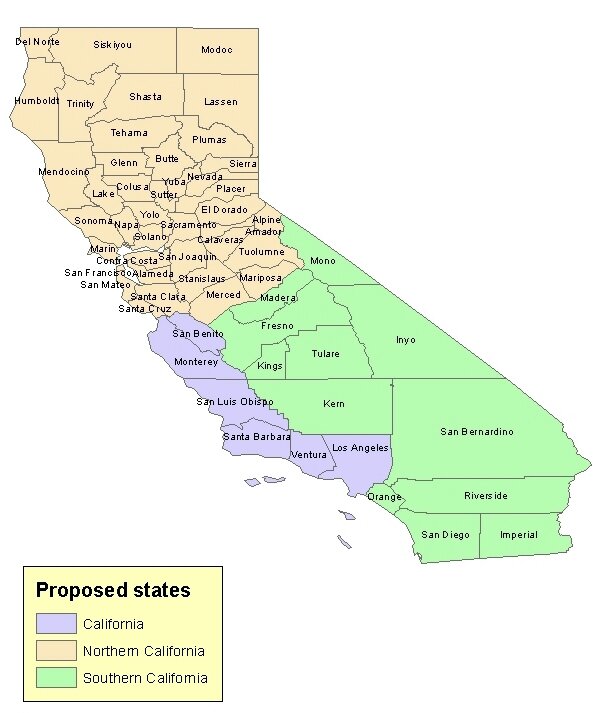
As many of you may know, there is a proposal to split up California into three parts: north, south and ‘ye olde’ California. This proposal is idiotic on several fronts. For starters the best university in LA, the University of Southern California, would find itself in ye olde California. Meanwhile my university, UC Riverside, would overnight become USC Riverside. Now, I wouldn’t be against the Trojan football team relocating to Riverside, especially since Riverside doesn’t have a team of it’s own. However the proposed split would cut off the Inland Empire and Orange County from Los Angeles county.

This despite the fact that the greater LA area is composed of LA-Ventura-Riverside-San Bernardino-Orange counties. These counties are deeply interwoven with one another, and dividing them is bizarre. Imagine the poor “Los Angeles Angels at Anaheim”. What horrendous name will they have to take on next? The “San Diego Angeles at Anaheim”?

Beyond it’s idiocy the proposal makes a larger point: government borders are, for the most part, arbitrary and plain stupid. The proposal to split up California ignores the regions socio-cultural ties to one another, but there are countless other examples of senseless borders.

For example, who was the bright guy that decided to split up Kansas City between Missouri and Kansas? And let’s not even get started on the absurd borders of the old world.

Thoughts? Disagreements? Post in the comments.

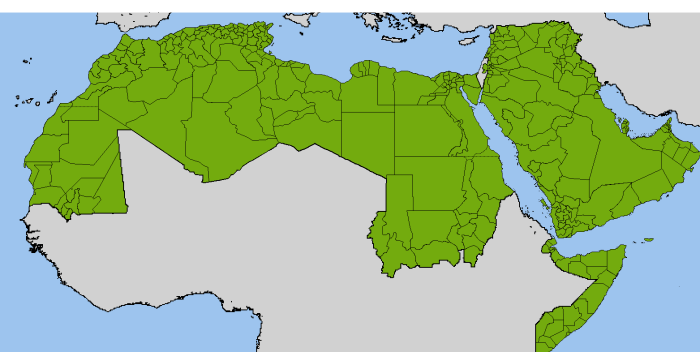
Eye Candy: the Arab world’s administrative divisions

NOL map Arab world admin divisions
Click here to zoom

Imagine if these divisions were all states in a federal republic. Myself, I think some of them,maybe even half of them, could be combined, but if that ever happened, and the resulting combined administrative divisions of the Arab world federated, the region would be in much better shape. (The federation of Arabia would need a Senate, of course.)

What if the OECD did the same? Or simply the US and it’s closest allies?

Turkey elections: Elections, Rappers, Media, Micro-Party, Rigging, Iraq

The Turkish State’s War On Rap

The election campaign has not slowed down the Erdoğanist state in its efforts to punish anyone who deviates from Erdoğan’s ideal of obedient, socially conservative, and conformist citizens. One of the best known Turkish rappers, Ezhel, with very leftist and counter culture lyrics, has been arrested recently for ‘encouraging drug use’. A prosecutor ordered his detention, which was implemented after he voluntarily went to the police station to answer a ‘complaint’, with no warning about detention. Onur Dinç (known as Khontkar), and Young Bego have also been detained. They can all be found on Spotify and YouTube. Listening on Spotify generates a little income for people who deserve a bit of solidarity at the moment.

İnce’s Presidential Campaign

An interview on HaberTürk TV with the leading opposition candidate for President of Turkey, Muharrem İnce (from the secularist, centre-left Republican People’s Party), has gone down very well. The interviewers let İnce express his views and had a selfie with him afterwards. HaberTürk TV is a private channel but, like all commercial private channels, accepts (and has no real choice) the biases and silences imposed by the Erdoğanist-AKP regime.

It is normal for Erdoğan himself to phone media groups and complain about coverage, demanding firings of journalists, where the bias is not as complete as he requires. So how long are these journalists, and the responsible manager, going to survive? A manager on another private channel was fired (officially ‘left for personal reasons’, ha ha ha) after allowing a very brief segment on the second most popular opposition, and more right wing, candidate, Meral Akşener. Will these HaberTürk people survive until the election? Are they more willing to push the limits because the opposition is doing better than expected?

On recent polls (leaving aside companies who enjoy close relations with the Erdoğanists) only rigging (or some extreme situation) can now stop 1. the opposition winning a majority in the National Assembly (could be stopped on current polling by stealing/losing about 2/3% points from HDP, a Kurdish rights-leftist party which appears to be between 1 and 3% points above the 10% election threshold). The main left-right opposition list seems to be about 3 points behind the right wing government list 2. the presidential election going to a second round, i.e. Erdoğan cannot get 50%+ of the vote in a several-candidate field (except by rigging at least 7% points of votes cast) and might lose in the run off.

I can only presume the interviewers of İnce will be out of a job if Erdoğan and the AKP-dominated electoral list do win by some means, and HaberTürk will suffer other penalties. Yes, polls can be wrong and they don’t all show the same thing, but those most favourable to the government tend to be run by cronies and there is widespread suspicion that in the current atmosphere in Turkey, some voters would prefer not to tell a stranger they are voting for an opposition party, particularly HDP. This is confirmed by the relation between opinion polls and the final result in last year’s referendum on moving to a presidential system (in which the final result itself may have been affected by losing and faking ballots, and by the difficulty that many voters in the Kurdish southeast had with getting to polling stations, a tactic the regime is setting up for this time as well).

The AKP-Erdoğanist Media Strategy: Why Turkish Media promotes an ex-terrorist micro-party.

Presenting the Opposition

Following on from the above, though İnce gets a lot less coverage on all media, including state media which is legally required to provide balanced coverage, than Erdoğan for the Presidential campaign, he gets far more than the more nationalist-conservative opposition candidate Meral Akşener (who would be the first female President of the Republic). She is polling behind İnce, but mostly by a moderate margin. She receives almost no coverage, her campaign is in fact a completely banned subject in the Erdoğan-controlled media (that is all state media and all the major private media groups).

Clearly the Erdoğan strategy (and we can be sure that he dictates it, without any delegation of overall strategy to campaign organisers) is to promote İnce as the only opposition candidate, in the belief that Akşener is a more of a threat to conservative support for himself. I used to believe this, but as far as we can tell from polls, İnce is leading in the first round and would do as well as Akşener in a second round play-off, both going down to very narrow defeat. This strategy has a high chance of backfiring by enabling someone further from Erdoğan in politics to become President.

The media manipulations may not make much difference since people open to voting for the opposition are going to treat the Erdoğanist media with scepticism and seek other news sources, but it is at least worth noting what the strategy is. It might be that the main aim is to make electors forget that Akşener’s party İYİ (Good) exists, on a common list with İnce’s party, but voters for the list can choose between them. It is unlikely that many voters are unaware of Akşener, the İYİ party, and the common list, and those that are unaware must be hardcore Erdoğanists who will not switch support to anyone in this election for any reason.

Promoting a Micro-Party

The most bizarre aspect of Erdoğanist coverage of the elections is that Hür Dava Partisi receives a great deal more coverage than İYİ. Hür Dava Partisi means Free Cause Party and the Turkish name is usually contracted to Hürda Partisi or Hüda Par. It was founded by people who had supported the Kurdish religious terrorist group Hizbollah. This is nothing to do with Hizbollah in Lebanon, which is a Shi’a group. Hizbollah in Turkey is defunct and was Sunni Muslim, as is Hüda Par.

It advocates religious law in Turkey and operates only in southeastern provinces where ethnic Kurds are in a majority, and has no more than 5% support in any individual province, giving it overall less than 5% in the whole region and less than 1% in the whole country. For it to receive much election coverage is of course absurd. The reason this happens is in the hope that the more religious Kurdish voters who are dissatisfied with the AKP after voting for it in the past (AKP is the second party in the region) will vote for Hüda Par instead of the secular-leftist HDP, which is the leading party in the region. The aim is to keep the HDP vote below 10% nationally, the electoral threshold for the National Assembly.

I don’t think it is possible that Hüda Par can soak up those votes sufficiently, but from the Erdoğanist point of view, it is worth trying and might just keep HDP below 10% in conjunction with electoral trickery such as moving polling stations away from HDP areas to make it less easy for them to vote and the possibility of outright electoral fraud, particularly in those polling stations where opposition observers may not turn up, in remote very pro-AKP areas. Electoral law has been changed recently to make removal of ballot boxes by the police easier and to legalise the illegal decision of the Supreme Election Council to count unstamped ballot papers in last year’s referendum.

On current polling, the opposition electoral list is a few percentage points behind the Erdoğanist list, so keeping the HDP out of the National Assembly would give his list an overall majority. This is why a micro-party of extreme religious conservative Kurds gets a high level of coverage in the Turkish media compared with conservative nationalists in İYİ who oppose Erdoğan and have created the third largest party in Turkey in terms of opinion polling.

Resisting Electoral Fraud

The possibility of electoral fraud and the use of fraud to keep HDP out of the National Assembly to the advantage of the Erdoğanists has of course been noted by the opposition and they are co-operating to work against this. The electoral list which comprises the second, third, and fourth parties in Turkey (secular centre-left CHP, nationalist conservative İP, and religious conservative SP) is cooperating with the HDP in a platform to ensure a fair and accurate count of votes. That the more nationalist parts of the opposition list and the Kurdish autonomy leftist people are able to work together on this is itself a good sign. There are no guarantees that the platform can prevent decisive fraud, but at least it will make fraud more difficult and shows there is unity in a very diverse opposition against the AKP-Erdoğan abuse of power.

Iraq Surprise?

I’ve seen a report that Turkish army units in the Kurdistan Regional Government of Northern Iraq, which have been stationed in a mountainous border part of the region for some years by ‘invitation’ (or possibly in reality extreme pressure), are moving closer to the PKK (Kurdish separatist and extreme left terrorists of Turkey) base in Kandil. Kandil is in the mountains and provides obvious difficulties for an army aiming to destroy the PKK. It is inherently difficult to observe, fire on, occupy, and completely control a mountainous region. It is a certainty that the PKK has contingency plans to move its base through the mountain, dispersing it if necessary.

I cannot predict if the Turkish Armed Forces will attack the Kandil base soon, or if it can succeed in a mixture of eradication and control. The PKK is a dangerous terrorist organisation and should be eliminated, but whether it can be eliminated in practice, without lessening the reasons some Turkish Kurds want to fight for it (very misguided people in my view) is another matter.

What I can say at the moment is I won’t be surprised if there is an offensive against Kandil before the election on June 24th, particularly if polling shifts against Erdoğan and his electoral list, or if the Turkish lira resumes its decline against foreign currencies. The consequences, militarily and political, are not matters I can think through at present.