Why Hayek was Wrong about American and European Conservatism II

The first post in this series concentrates on the more radical authoritarian populist side of conservatism in Europe. Before getting on to American conservatism and other aspects of European conservatism, I will respond to requests in the comments for definitions of what I mean by liberalism and conservatism. The shortest class definition I am aware of is that of David Hume in his essay ‘Of the Parties of Great Britain’ where he suggests that Whigs (liberals) favour liberty with a monarchy and that Tories (conservatives) favour monarchy with liberty. This can be expanded with little, if any controversy, to be taken as: liberals advocate liberty with order; conservatives favour order with liberty.

I will move from Hume to Benjamin Constant in Principles of Politics Applicable to all Governments. Constant is surely an unimpeachable source on what it is to be a classical liberal and it is important to note that Constant thinks there is something different in a politics based on principles of freedom than the thought of Edmund Burke. The distinction Constant makes is key to thinking about the relation between classical liberalism and conservatism, so is key to the claim that I make that (classical) liberalism are very distinct.

To increase the force of collective authority is never other than giving more power to some individuals. If the wickedness of men [an emphasis on this is a mark of conservative thinking], it is an even stronger one against power. For despotism is only the freedom of one or a few against the rest. Burke says that freedom is power. One can likewise say that power is freedom.(Book XV, Chapter 2)

This thought flows right into this thought from a later chapter:

Freedom is a power only in the sense that a shield is a weapon. So that when one speaks of possible abuses of the principle of freedom, such an expression is inaccurate. The principles of freedom would have prevented anything under the heading of abuses of freedom. These abuses, whoever their author, taking place always at the expense of another’s freedom, have never been the consequence of these principles, but rather their reversal.  (Book XVII. Chapter 1)

In my summary of the above: conservatism defines freedom as limited because of a dangerous power in excess, so requiring tradition, hierarchy, and the aggressive use of state sovereignty to to curb it, while liberalism suggests that more freedom is the answer to abuses of power.

Since Burke is a key figure for those advocating some kind of kind of intimate alliance, or even identity, between (classical) liberalism and conservatism or libertarian conservative fusionism, Constant’s criticism of Burke is important. I won’t get into the detail of Reflections on the Revolution in France, Burke’s central text on politics here, I will just note that the reader of this classic of conservatism will find many passages on the absolute sovereignty of the state, the virtues of rigid social hierarchy and of traditions supporting such hierarchy, along with the perfection of the British constitution of the time.

These passages, it seems to me, should raise concern to the advocate of liberty, which I believe derives its energy from the criticism of tradition, hierarchy, and existing institutions. As Constant recognises, we should not be quick to replace institutions that have grown over centuries with a perfect new design, but we should certainly not be afraid to innovate either, as we should not be slow to notice the growing faults of institutions over time as they come into conflict with new circumstances.

Burke was perhaps a bit more liberty-minded and a bit more innovation-friendly than the other famous critics of liberalism and Jacobinism – de Maistre, de Bonald and Donoso Cortés, but the understanding of liberty as particular Liberties inherited from tradition, upheld by a state that insists on its own absolute authority is something he has in common with them. For Constant, the excesses of the French Revolution are a reason to argue for more liberty, for Burke they are a reason to uphold hierarchy, tradition, and royal authority along with endless war against the French.

While addressing comments to the last post, I should refer to my fellow Notewriter, Edwin van de Haar, though thinking just as much of a previous social media conversation as his recent comment. As far as I understand, he advocates a definition of conservative liberalism that corresponds with F.A. Hayek’s views in The Constitution of Liberty and a share of GDP devoted to public spending substantially below the the average in advanced industrial countries. I’m not aware of anywhere in which Hayek used such a term, though he was certainly more sympathetic to Burke than I am here.

My argument is that there is nothing inherent to conservatism that makes it opposed to expanding the state in terms of welfare intervention or in terms of the police power of the state. Otto von Bismarck is just one particularly notable conservative from history who had a great belief in an intrusive state in various ways, including measures designed to take voters away from the strong Marxist-socialist current of the time, through incorporating socialist-friendly policies. Conservatism is a doctrine of order, state power (where national or imperial), and tradition.

Where conservatives have favoured market-friendly and relatively small state polices, they have done so in order to preserve order, the core of state power and tradition. Economically liberal conservatives like Margaret Thatcher and Ronald Reagan were also great believers in narratives of restored national grandeur, the security state, ‘law and order’ and ‘war on drugs’ polices expanding state power, while sucking an increasing number of people into the extreme state-socialist institution of prison.

As far as I can see Thatcher and Reagan are the heroes of ‘liberal conservatism’. With all due respect to their valuable economic reforms, the liberalism seems to me to be very subordinate to the conservatism. As I pointed out in the last post, ideas of aggressive populism are growing in the conservative world, ideas which have deep precedents in the ways that Bismarck figures have mobilised nationalism, statism, and reactionary identity politics against liberals.
Why Hayek was Wrong About American and European Conservatism I

The title of this post refers to F.A. Hayek’s essay ‘Why I am Not a Conservative’, which can be found as an appendix to his 1960 book The Constitution of Liberty. What this post is really about is the deficiencies of American conservatism and the general idea of liberal conservatism or a natural alliance between classical liberals and conservatives. However, first a few words about Hayek’s essay as Hayek is an important figure for liberty advocates. The essay in question is well known and particularly easy to find online.

Hayek’s criticism of conservatism overestimates the extent to which it is just a limiting position, slowing down change. The relation of conservatism to tradition is seem too much as conservatism being too slow to accept changes to tradition. Traditionalist conservatism, however, has been a much more active and dangerous force than that. ‘Traditionalism’ as far as I know is a 20th century term used particularly in France (René Guénon) and Italy (Julius Evola) to refer to a spiritual based for politics of an extreme conservative kind which found natural alliance with fascism. It seems clear enough that it has precedents in late 18th and 19th century conservative monarchist thinkers like Joseph de Maistre, Louis de Bonald, and Juan Donosó Cortes.

Carl Schmitt, who was maybe the greatest 20th century admirer of those thinkers, joined the Nazi Party in 1933, though found himself purged as not properly Nazi from his post as head of a jurists’ association in 1936. Not only did Schmitt admire the French and Spanish thinkers mentioned, he was a great admirer of Edmund Burke. Burke is a favourite of those claiming a conservative-liberty affinity. It would be unfair to suggest that Burke would have welcomed National Socialism (though the same applies to de Bonald, de Maiste, and Donosó Cortes).

It is a fact that a large part of conservative thinking of the time of the rise of Fascism, and allied forms of illiberal government such as corporatism, regarded it as a legitimate counter to Bolshevism and disorder. Even Ludwig von Mises defiled his own 1927 book Liberalism with generous words about Fascism as a counter to Bolshevism. The reality is that at the time such regimes came to power there was no immediate risk of Communist take over and this is a horrifying position, which cannot be justified by suggesting that Mises was writing in the heat of the moment as Bolsheviks stalked power in any particular country. Winston Churchill welcomed Fascism in Italy and even initially welcomed Hitler’s rise in Germany, before becoming acquainted with the reality of his regime. It is of course the case that Fascism and National Socialism had socialist roots as well as traditionalist conservative roots, but then a liaison between socialism and traditionalist conservatism as a counter to liberal individualism has a history going well back into the 19th century.

We can see right now in Europe the growing force of conservatism with a populist-nationalist emphasis targeting abnormals (as in everyone who does not fit their assumptions of a normal person in their country). This is not some new addition to the repertoire of the right. The strong man of the Northern League in Italy, Metteo Salvini, has aligned himself with Mussolini recently by tweeting a variation of Mussolini’s slogan ‘many enemies, much honour’ on Mussolini’s birthday. The Hungarian equivalent of Salvini, the Prime Minister Viktor Orbán, has rehabilitated the pre-war authoritarian leader Miklós Horthy. The Legue, Orbán’s Fidesz party, the Bannonite wing of the Republican Party and the like are stuffed with Vladimir Putin apologists, or at least as in Bannon’s case slippery arguments according to which he does not like Putin, but we should ally with him. In any case, Bannon is very active supporting the pro-Putin parties in Europe.

These parties draw on long traditions of conservative populism, monarchist anti-liberalism, and the like. The appeal to conservative love of monarchy, state church, and social conformity was a major weapon of monarchist conservative forces after the 1848 Springtime of the Peoples in Europe, helped by violent Russian intervention in the Austrian Empire to ‘restore order’. We see something like this now in the growing strength of a brand of conservatism which does not just limit change but fosters change in the direction of illiberalism, nationalism, xenophobia, Islamophobia, Christian identity, free trade, liberal protections of the individual from state power, the rights of civil society organisations to stand up to the state, and economic protection, seeking inspiration from the kleptomaniac nationalist authoritarian regime in Russia.

Enthusiasm for Recep Tayyıp Erdoğan is less obvious, but Orbán has put him on his list of ‘illiberal democracy’ heroes, and we can reasonably say that the rhetoric and methods of Erdoğan have been an inspiration for the populist right throughout Europe, even as, like Órban, it puts Islamophobia at the centre.

The role of Donald Trump and Steven Bannon as friends of, and models for, European populists should give reason to wonder whether Hayek misunderstood US conservatism. More on this in the next post.

How will Imran Khan’s electoral triumph affect Pakistan’s relationship with China?

All eyes are on how Imran Khan will fulfill the ambitious promises which he and his party (Pakistan-Tehreek-i-Insaaf, or PTI) have made for creating a ‘Naya Pakistan’ (New Pakistan). Khan, who will take his oath as Prime Minister on August 11, 2018, needs to hit the ground running given the myriad of economic (Pakistan’s external debt is well over $90 billion, and accounts for over 30 percent of the country’s GDP) and geopolitical challenges. As Pakistani senior officials were drawing up plans to approach the IMF for a loan (estimated at $12 billion), US Secretary of State Mike Pompeo warned the IMF that there is absolutely no justification for ‘IMF Dollars’ to bail out ‘Chinese bond holders’ or China.

Given the high expectations as well as the impatience amongst the youth, Khan is not likely to have a very long honeymoon period.

Pakistan-China relationship under PTI government

It will be interesting to see how the crucial Beijing-Islamabad relationship pans out under Imran Khan. During his first address (after his party’s victory) to the Pakistani nation, he dubbed the Pakistan-China relationship as the most important for Pakistan. Khan also emphasized the point that Pakistan had a lot to learn from China in the context of poverty alleviation, as well as the latter’s anti-corruption campaign.

China’s relationship with Imran Khan

In the past, Khan, while supporting the China-Pakistan Economic Corridor (CPEC) project in principle, had expressed certain apprehensions during his meetings with Chinese diplomats. Khan had also stated that the government of Pakistan needs to be more transparent with regard to the contours of the project, and that each province should get it’s rightful due.

The Chinese in turn were uncomfortable with Khan’s dharna (protests) of 2014 (it was as a consequence of these protests that the inauguration of the CPEC Project had to be delayed). Khan’s 2016 protests against the Nawaz Sharif government (after the names of three of Sharif’s family members, who held offshore accounts, appeared in the Panama leaks) were also watched with skepticism by the Chinese.

It would be pertinent to point out that the PTI manifesto, while praising the project, has pointed to some of CPEC’s short comings, including investments as a consequence of ‘insufficient transfer of knowledge and capabilities, fewer partnerships with local businesses and Pakistan’s high dependence on imports of goods and services from China’.

PTI’s chief rival, the PML-N, often spoke about the need for an independent foreign policy, but never ever alluded to this aspect.

Beijing’s preference for PML-N

It would also be pertinent to point out that while Beijing has had problems with Pakistan, it has had a close relationship with the Pakistan Muslim League (Nawaz), or PML-N. Beijing, which has maintained robust relations with the army, also shared cordial relations with Shehbaz Sharif, the President of PML-N and former Chief Minister of Punjab. China has praised Shehbaz Sharif for his efficiency more than one occasion, even referring to his style of working as ‘Shehbaz Speed’ and Punjab speed. When Shehbaz was appointed President of the PML-N, he received a congratulatory message from senior members of the Chinese Communist Party.

The PML-N also sought to take credit for the CPEC project on more than one occasion. In August 2016, while addressing a meeting of his party’s parliamentary committee, then-Prime Minister Nawaz Sharif stated:

He [Xi Jinping] said this is a gift to you from China. They were also waiting for the time when our government would be in power so that they could make this investment.

Chinese Media’s comments on Imran Khan and CPEC

Post the election results, Chinese media has sought to be positive, and has been confident that the CPEC project will go ahead as planned. One op-ed published in the Global Times (‘Will Imran Khan pivot Pakistan from US to China’) referred to how the West was creating unnecessary paranoia with regard to the economic ramifications of the CPEC project. The op-ed also said that Imran Khan may take Pakistan further into the ‘Chinese orbit’ and that he had no problem with the CPEC project. The article cites the PTI manifesto to bolster its argument (saying that PTI has dubbed the project as a ‘game changer’). Other sections of the Chinese media have also welcomed Imran Khan’s election. Only one analyst, Tom Hussain, has categorically made the point that PTI had strained ties with China in the past. Said Hussain:

the PTI has been working overtime to repair its relations with the Beijing, which had been damaged by its disparaging remarks and allegations of corruption about CPEC projects in the past.

Likely developments in the short run

Imran Khan doesn’t have too many options, but there could be some re-examination of some of the CPEC projects. While Pakistan is now dependent upon China given Islamabad’s rock bottom ties with the US, the question on many people’s minds is if Khan can do a Mahathir (Malaysia’s Prime Minister), where maintaining good ties with China does not mean shying away from questioning the financial feasibility of certain projects within CPEC.

In the short run, this is impossible, and many would argue that even in the long run this may seem like nothing but a pipe dream. Yet, if Imran Khan can harness relations more effectively with neighbors (as he emphasized in his speech) and build a robust economic relationship with India (something which the Chinese may not mind), we could witness a course correction. One of the reasons why Nawaz Sharif advocated good ties with India was so that Pakistan could develop an independent foreign policy and end its dependence upon the US. One of Sharif’s slogans in 2013 was ‘Trade not Aid’. While Imran himself has spoken about trade ties with India, will the establishment allow him to go ahead.

Changing geopolitical dynamics in South Asia

If one were to look beyond economics, even in the context of Afghanistan, one of the significant developments in South Asia has been a decision by India and China to work jointly in Afghanistan. It remains to be seen how Imran Khan’s government perceives this. India and Pakistan are also likely to participate jointly in anti-terror drills in Russia, in August 2018, under the umbrella of the Shanghai Cooperation Organisation (SCO).

Conclusion

It is very tough to predict how Imran Khan handles ties with China, but one thing is for sure: Beijing may publicly be welcoming Khan’s election but from the opinion pieces in the Global Times, there is a worry deep down concerning his maverick nature. Imran, unlike the Sharif’s (who were businessmen), may not be as transactional in the economic sphere. His economic ideology is left-of-center (with a strong thrust on welfare). While he needs foreign direct investment, he is not as obsessive about mega projects as the Sharif’s.

Imran on his part will have numerous challenges to contend with, and needs to strike a fine balance. A less hostile relationship with the neighbors will benefit him, and a slightly less hostile relationship with the US would give him space. Given the plethora of challenges he is likely to face, no real changes should be expected in the context of Pakistan-China ties, though over a period of time, recalibration of policies should not be ruled out.

The promise and peril of blockchain distributed governance

neoliberalthoughtcollective

I was very fortunate to learn that my essay ‘Markets for rules‘ has won the Mont Pelerin Society’s 2018 Hayek essay competition for young scholars (one of the perks of academia is being defined as young well until your 30s). I am now looking forward to presenting at MPS’s famous conference, originally organised by F.A. Hayek to build the post-war intellectual case for liberalism.

The essay is an attempt to explain the governance possibilities of blockchain technology through the lens of new institutional economics and more specifically private governance. Blockchains allow people to develop rules that can then be enforced autonomously by the participants that use them without further central direction. This could allow communities to rely more on common rules and less on formal coercive authorities to achieve widespread social cooperation. I am cautiously optimistic about the technology (it could also turn into a dystopian nightmare) though not any particular currently existing blockchain.

Here is the abstract: Classical liberals seek the paradoxical: government powerful enough to protect individuals from preying off each other, but limited enough to prevent it becoming a fierce predator itself. The emergence of blockchain technology heralds a potential revolution in our collective capacity to implement limited government. Blockchains offer a more secure and transparent way of implementing rules while permitting individual choice between rulesets that can co-exist at the same time and place. What this could ultimately mean is that a great deal of what we have traditionally conceived to be governance might be disintermediated from the territorially defined monopolistic coercive authorities that classically define states.

Ottomanism, Nationalism, Republicanism VIII

Continuing from Ottomanism, Nationalism, Republicanism VII.

The Democrat Party returned to power under the name of Justice Party (a name possibly referring to ‘justice’ for Adnan Menderes, who was certainly executed as the result of a very politicised trial, but was no genuine martyr of democracy) in 1965. This hint at an enduring idealisation of Menderes sets up many problems in Turkey to the present day.

Recep Tayyıp Erdoğan has appealed to the same theme, which has very evidently turned under his rule into a drive for ‘revenge’ against anyone who supposedly defies the National Will.

The National Will, in practice, is based on preserving a monolithic majoritarianism based on ethnic Turkish nationalism and Sunni religious identity along with loyalism to the state under its rightful leader, who looks more like a Reis (a traditional chief) than the head of a liberal democracy.

This process begins under Süyleman Demirel (1924-2015) as leader of the AP (short for Adalet Partisi, the Turkish words for Justice Party). Demirel himself was despised by Erdoğan, and in the end sided with his old enemy, the Republican People’s Party, against Erdoğan’s AKP. However, AKP stands for Adalet ve Kalkınması Partisi, which is Justice and Development Party, so clearly Erdoğan placed himself in Demirel’s tradition. Demirel was Prime Minister or President for nearly half of the time from 1965 to 2000, but never acquired the status of a giant in national history, as such a long occupation of the highest offices of state might suggest.

The most grotesque single item of evidence of Demirel’s desire for revenge over the 1960 coup came in the case of Deniz Gezmiş, a leading figure on the revolutionary left, who was arrested for the kidnapping of two American soldiers. Gezmiş was executed in 1972, along with two associates, after Demirel had said ‘we want three’, in a clear reference to the execution of Menderes and two of his ministers in 1961, and possibly referring to Gezmiş’ self-declared Kemalism (though he is usually seen as more a revolutionary Marxist). We have two major problems in Turkish politics in one here. Firstly the attraction of some parts of the left to political violence; secondly the unendingly vengeful attitude of the right towards the 1960 coup and a belief in state violence as the solution to the far left.

State violence against the far left has been constant in the Republic. As long as there was Soviet Socialist Russia and then the USSR, the far left tended to be seen as part of an assault by a traditional national rival, whether run by a Tsarist or Bolshevik regime. This combined with a never ending fear of the weakness of liberal democracy in the face of possibly existential enemies in which political compromise has been seen as treason.

The continuing idolisation of Gezmiş, who was it must be said an attractive and charismatic person, who died young and very good looking, by the far left continues a vicious cycle in which the state establishment under various governments treats any expression of far left views as subversion, only one stop at most from outright terrorism, while the far left can then see violence as politically legitimate. Not everyone who continues the memory of Gezmiş advocates violence and we can only hope he does become a symbol of revolutionary purity detached from advocacy of political violence.

The existence of the revolutionary groups where Gezmiş operated itself tells us something about the difficulties of the 1960s. Economic growth and stability was reasonable, but there was no state understanding of how to incorporate the most disaffected parts of society. The far left was not very working class in its base, which has a stronger social core in Aleviism, that is a heterodox off shoot of Shia Islam, which constitutes the largest religious minority in Turkey.

The strongest geographical concentration of Alevis is in the Tunceli (also known as Dersim) region. These Zazaki (Persian dialect) speaking Alevis, along with Alevis elsewhere, had an antagonism to the Republican People’s Party as a result of extreme suffering during state-Zazaki Alevi conflict in Tunceli during the later 30s. However, when the Democrat Party-Justice Party line became the new state establishment and expression of Sunni supremacy, Alevi support switched to the Republican People’s Party and has stayed with it ever since as a major component. The far left also has a strong Alevi component, expressed at its most extreme in the DHKP/C terrorist/insurgent group.

Support for the far left reflects to some degree the incapacity of the state to deal with Alevi identity, while also failing to adapt to the kind of radicalised student political culture of the late 60s that existed on a global level. A significant part of this international trend comes from the growth of higher education to accommodate more people from non-elite backgrounds, which meant an increasing proportion of students with little hope of achieving the elite status more easily achieved by earlier students.

Pesant families were moving from the land into illegally constructed buildings in city suburbs, creating a target audience for the far left, though providing more support overall for the most conservative aspects of the right. The ultranationalist right found political expression in the Republican Peasants’ National Party after its take over by Alparslan Türkeş. Türkeş had announced the 1960 coup on the radio, but in politics deviated from the Kemalist ideology of the military government, certainly by the late ’60s when Türkeş went on pilgrimage to Mecca and changed the name of the party to Nationalist Action, with a party emblem of three crescent moons, referring to an Ottoman military standard.

The Nationalist Action Party was named as such in 1969, the year that Necemettin Erbakan founded National View. National View is a Muslim conservative movement which takes much of its inspiration from the Arab-based Muslim Brotherhood. The National View of Erbakan evidently refers to Turkish nationalism. The nationalist movement had secular aspects and the religious conservative movement had aspects of a Muslim universalism beyond nations, though particularly directed towards the Arab world, so seeking a kind of authentic source for religion. On the whole, the Grey Wolf/Idealist Hearth nationalists of Türkeş and the National View religious conservatives of Erbakan converged. This tendency is often referred to as the Turkish-Islamic Synthesis and has roots going back to the late 19th century, but is mostly thought of as something that grew in the 60s.

More on this and related topics in the next post.

Brexit Breakdown and Confusion

I posted earlier this month on Brexit Breakdown suggesting that the aims of enthusiasts for the United Kingdom of Great Britain and Northern Ireland, leaving the European Union, have been eroded as the UK government’s positions drifts towards ‘soft Brexit’ accepting alignment with EU regulations on industrial goods and food, at the very least. This is still the case, but the situation has become increasingly complex, driven in an unpredictable way by contradictory forces, as I will attempt to explain below.

Full ‘soft Brexit’ would mean membership of the European Free Trade Association (EFTA), with almost complete adherence to European regulation. ‘Hard Brexit’ means eliminating any adherence to EU regulations, which in its most rock hard form means a willingness, even a preference, for crashing out of the EU with no agreement, resorting to World Trade Organisation rules to govern trade. On the other side are ‘Remainers’, including myself, who ideally would like to stay in the European Union after a referendum reversing the decision of two years ago; and who if this is not possible will work for the return of the UK to the EU at a future date.

It is still the case that over time the government has drifted towards soft Brexit, though not EFTA, and seems likely to end up agreeing to an even softer Brexit after EU negotiations are complete. The most notable area of likely compromise with the EU is to preserve an almost completely open border between Northern Ireland and the Republic of Ireland by allowing de facto membership of the EU Customs Union of Northern Ireland through a de facto border in the Irish Sea between Great Britain and Northern Ireland, largely in the form of EU customs inspections on ships between Northern Ireland and Great Britain.

The House of Commons anyway came very close recently to voting for the UK as a whole to form a customs union between the UK and the EU, so a proposal backed by the government for a form of customs union between the UK and the EU allowing an open border between Northern Ireland and the Republic without a customs border in the Irish Sea would certainly pass the House of Commons. It is one of the oddities of Brexit that a free vote of the House of Commons would result in the UK joining EFTA and this is resisted by the leadership of the two largest parties.

The Labour Party leadership resists EFTA (or any other way in which the UK stays in the Customs Union or the Single Market) though most Labour Party Members of Parliament, party members, and voters support remaining in the EU. The Labour leader Jeremy Corbyn supported Remain in the referendum though he has always looked like a socialist critic of the EU as a capitalist club. The Conservative Party leadership resists EFTA, though most Conservative MPs supported Remain in the referendum and would vote for EFTA now, and the leader (who is also Prime Minister), Theresa May, supported Remain during the referendum. In the case of the Conservatives though, party members and voters are mostly Leave and hard Brexit.

Theresa May gathered her Cabinet at the Prime Minister’s country residence, Chequers, recently to force through a soft Brexit package, in the hope of ending increasingly public conflict on the issue. Two members of the Cabinet have since resigned and Brexiteers in the House of Commons have forced some concessions, though of a rather secondary kind, which might disappear in further negotiations with the EU and the final parliamentary vote on the exit deal.

The consequences of recent political manoeuvres are as follows:

  1. The government has moved towards a softer Brexit,
  2. Hardcore Brexiteers have pushed back with some success,
  3. A second referendum seems more likely though not the most likely scenario,
  4. A no deal hard Brexit seems more likely though not the most likely scenario.

These four things do not seem to go together and what has happened is a drift from what seemed like the overwhelming probability of a hard Brexit with an agreement, to a relatively chaotic situation in which it is becoming harder and harder to decide on the most likely of the possible outcomes.

Hard Brexit without a deal has come to seem more likely because hard Brexiteers in the Conservative Party may undermine any agreement the Prime Minister (who has recently started to exercise direct control over negotiations) may reach with the EU and there are signs that the United Kingdom Independence Party (UKIP) will take voters from the Conservatives in the case of a soft Brexit. Theresa May is trying to achieve a position which can get most MPs behind her, and most Conservative MPs will probably support any deal she proposes. However, the hard Brexit people are willing to do anything to undermine a deal they consider inadequate and may vote with Labour in voting down a deal, though for very different reasons.

May’s hold on the Conservative Party is weak after her very poor performance in last year’s general election and no one expects her to be the leader at the next election (though given that the impossible seems to be becoming possible maybe we should not accept this as a given). Any election for the leader requires a contest in the parliamentary party to determine two candidates, with the Conservative Party membership as a whole deciding between them. The membership will undoubtedly vote for the more hard Brexit candidate, which at the moment seems likely to be Boris Johnson or Jacob Rees-Mogg. Rees-Mogg has absolutely no governmental experience at all, which would create an unprecedented situation if he does become Conservative leader and Prime Minister.

Neither Rees-Mogg nor Johnson is popular with the parliamentary party, so there must be a real possibility that neither makes it the final list of two candidates, presuming the parliamentary party does not persuade the candidates behind the leader of the first round to abandon the contest, which is what happened in May’s case. This could set off a major crisis in the Conservative Party.

The possibility of a second referendum (labelled a People’s Vote by its main advocates) is increasing because it seems likely that hard Conservative Brexiteers allied with the Labour Party will vote down any soft Brexit, and it also seems likely (but less likely as hard Brexiteers are more willing to vote against their own government) that an alliance of soft Conservative Brexiteers and the Labour Party will vote down any hard Brexit. It also seems very possible that the EU will reject any UK offer, as the arguments within Parliament and the Cabinet on the terms of Brexit refer to what can be agreed within British politics, not what the EU might find acceptable. At the very least it seems increasingly likely that substantive Brexit will be postponed, apart from withdrawal of UK representatives from EU institutions, for at least a couple of years after next year’s formal withdrawal.

The various forms of deadlock described above have not yet made a second referendum likely, but are increasing the likelihood of a second resort to the People to find a solution, though the question that would be asked, the form of any such referendum, its timing and so on remain unclear. Opinion polls show increasing support for a second vote and for then remaining in the EU, while the media is giving more coverage to the possibility. I would be happy to see such a result myself. The increasing uncertainty about what Brexit means itself undermined Leave claims that it would be an easy exit. Nevertheless, I have to say that the UK is probably leaving and that a no-deal Brexit is also increasing in probability.

Is NoL discriminating against Trojan fans?

I should, as all good academics should, be writing. Instead I’m using my Saturday afternoon to settle an academic wager. Click here if you wish to help do so.

Image result for trojan usc beaten

For over a year now I’ve been obsessed with figuring out why studies find that non-whites are discriminated against in the labor market and in political representation. It isn’t that I don’t believe that elites indulge themselves in discrimination. I think that the marketplace places a cost to discrimination but that some people have a sufficiently high willingness to pay to discriminate.

What I have difficulty believing is that people decide to discriminate on something as mundane as responding to resumes. Imagine that you work for human resources in Notes On Liberty Inc. Your job is to screen resumes and, if someone meets the bare requirements they get considered for recruitment. Regardless of whether they are recruited to the company or not, you don’t actually have to interact with this individual. You work a 9-5 shift and are based remotely somewhere in westwood. Why should you care if NoL Inc hires someone you personally dislike (say a Trojan fan), if you never interact with them?

One possibility, related to existence value for those versed in the environmental econ literature, is that the very idea of a Trojan fan being employed causes you distress. It doesn’t matter that you never actually interact with them. This distress is high enough that you are willing to both actively reduce their likelihood of being employed by NoL Inc and to increase the likelihood that your boss will fire you for unethical behavior.

Another possibility is that you, the human resource manager, aren’t discriminating against Trojan fans at all. It is possible that the algorithm that receives resumes from Trojan fans, for some reason, flags them as spam and filters them away before any human being gets involved. Maybe the algorithm mis-interprets the USC Trojan logo as an actual Trojan virus. Likewise is that possible that ethnically non-white names (e.g. Jamal, Xochitl) are flagged by resume algorithms as likely spam due to their relative weirdness.

If you’re willing to help me test this possibility, please click here.

How will Imran Khan’s electoral triumph affect Pakistan’s relationship with India?

Many analysts (internal and external) believed that the 2018 election would be a tough fight with the PTI (Pakistan-Tehreek-I-Insaaf) having a slight edge (as a consequence of support from Pakistan’s deep state). Surveys also predicted a close fight (the importance of undecided voters was highlighted in all of these) with the PTI having a slight edge.

Former PM Nawaz Sharif’s return to Pakistan, along with daughter Maryam Nawaz Sharif, in spite of both facing jail terms, was thought of by many as a gamble which could have been a game changer in Punjab. Sharif returned to Pakistan, leaving his ailing wife Kulsoom Nawaz in London, and this, many believed, would help PML-N (PTI’s chief rival) in securing sympathy votes.

Ultimately, the PTI actually romped home quite comfortably, and emerged as the single largest party with 119 parliamentary seats, while the PML-N was a distant second with 63 seats (PML-N did emerge as the single largest party in the provincial election) and the People’s Party of Punjab (PPP) was at the third position.

Imran Khan’s India Policy

While there has been a lot of focus on the support which PTI has received from the army, there is also curiosity about what sort of policy Imran Khan will follow vis-à-vis India. It has been argued that the Indian establishment is not particularly comfortable with Imran Khan (who, unlike Sharif, may not challenge the Pakistan army’s India policy). The Indian High Commission in Islamabad is supposed to have been in touch with some of his close advisors (every government keeps channels of communications open with all political forces, and there is nothing unusual about this) in the run up to the elections.

At this stage, it is very tough to predict Imran Khan’s precise approach towards India. On the one hand, he has made belligerent statements against India, accusing Nawaz Sharif of being soft on India. While speaking in 2016, Khan had stated:

‘Our premier [Nawaz Sharif], instead of raising voice [for Kashmiris], is busy in making his business flourish there.

On another occasion he had taken a dig at Nawaz Sharif, saying that not every Pakistani is more concerned about his business than his country.

In fact, a day before the polls, Khan stated that Nawaz Sharif was more concerned about India’s interests and was even willing to discredit Pakistan’s army, which is why India preferred him.

How seriously should we take Imran Khan’s rhetoric

In the past few elections, including Nawaz Sharif’s triumphs in 1997 and 2013, anti-India propaganda did not find much traction, and the PML-N itself has indulged in anti-India rhetoric. So Khan’s statements should not be taken seriously.

A retired diplomat who has served in Pakistan, TCA Raghavan, also the author of a book titled People Next Door very aptly stated:

These statements are very common in Pakistan politics. We have to separate political rhetoric from what he actually does when he is in power.

No substantial headway can be expected over the next few months, between both countries, given the mammoth geopolitical and economic challenges which Imran Khan is facing. On the Indian side too, no grand gesture can be expected, given the fact that elections are to be held in May 2019. Backdoor diplomacy, of course, cannot be ruled out. A meeting between Imran Khan and Indian Prime Minister Narendra Modi on the sidelines of the United Nations General Assembly (UNGA) is also a possibility.

In the long run however, there could be some movement forward. In his first address to the Pakistani people, Imran Khan spoke in favor of resolving contentious issues through dialogue, while also pitching for closer economic linkages and jointly combating poverty.

In a media interview recently, he stated:

If you have a good relationship with India, it opens up trade, and trade with a huge market. Both countries would benefit.

PTI has made strong inroads into Punjab, and the business community of the province has been in favour of closer economic ties with India for sometime.

Imran’s familiarity with India

During Khan’s address to the Pakistani people, he also spoke about his familiarity with India, as well as personal ties through his cricketing career.

In 2015, during his visit to India, Imran met with PM Modi and backed peace initiatives between both countries. During his visit, Imran also met with Delhi Chief Minister Arvind Kejriwal (who he praised) and, in the past, he has had kind words for Nitish Kumar’s governance.

Even some of Khan’s close advisors, like former Foreign Minister Khurshid Kasuri and current Vice President of PTI Shah Mahmood Qureshi (who also served as Foreign Minister during the PPP government led by Asif Ali Zardari), are experienced and are familiar with India. Kasuri has numerous personal friendships in India, Qureshi, an agriculturalist, was president of the Farmers Association of Pakistan and has strong links in Indian Punjab.  

Conclusion

Pakistan is facing numerous internal challenges and it is virtually impossible to comment on how things will pan out in the context of India-Pakistan ties. A lot will, however, depend upon the intent of the Pakistan army, as well as ties between Imran Khan and the army, and the role which both China and the United States play in South Asia. While Imran Khan’s initial overtures should be welcomed, it is best to wait and watch and not prophesize, as far as India-Pakistan relations are concerned.

Ottomanism, Nationalism, Republicanism VII

Now this series moves onto the first government that resulted from a peaceful electoral transfer of power in Turkish and Ottoman history, the government of Adnan Menderes and the Democrat Party (DP), which came to power in 1950.

The DP was more open to religious conservative sentiment and more free market oriented, though that has to be understood in a very relative way. In power, the DP expanded the number of state enterprises, used economic clientelism to generate business backing, and tolerated an inflation rate of about 20%, though it did also open the economy more to international investment. It was not only more open to religious conservatism (which included creating more pressure for school students to take religion classes and openly Islamist attitudes from some DP politicians), but had a highly nationalist aspect to it, which overlapped. This can be seen most dramatically in the case of the attacks on Greeks in Istanbul in 1955, leading to systematic destruction of property and the loss of about 30 lives.

Though the Menderes government tried to deny involvement and engaged in a token crackdown on ultranationalist groups afterwards, there is plenty of eye-witness information that Democrat Party officials orchestrated mob violence and the police were ordered to remain passive. The army also played a role, drawing on the NATO Gladio structure (groups preparing to resist Soviet occupation, which have also been associated with violent deep state activities in Italy and Spain), to establish a covert command-and-control group. The riots were orchestrated in reaction to armed Greek resistance to British rule in Cyprus, which was seen as threatening the reduction of Cypriot Turks to a second class minority in Cyprus.

We see here the intersection of religious chauvinism (as in Muslim hatred of Orthodox Christians), nationalist chauvinism (as in Turkish hatred of Greeks), inter-state conflict (Greek-Turkish rivalry over the future of Cyprus), inter-communal tension in a historically connected territory (Greek-Turkish rivalry in Cyprus which was an Ottoman possession for centuries), decolonisation (the breakdown of British colonialism in Cyprus) and Cold War covert security structures.

We also see here how troubled claims of the Turkish right to offer something more liberal than Kemalism are. There has been a persistent tendency of some Turkish liberals to go along with this for Menderes in the 50s, Türgüt Özal in the 80s, and Erdoğan in the 2000s and even early 2010s. This is all highly misguided, as will be discussed in future posts. For now, we can concentrate on the record of the Menderes government in encouraging and instrumentalising a combination of ethnic and religious chauvinism, along with growing attacks on the freedom the press and freedom of opposition culminating in the imposition of martial law in early 1960.

The Democrat Party pioneered the politics now followed by the AKP, in which democracy means the dominance of the majority (understood in artificially homogenous terms) in terms of political processes and officially promoted culture combined with the squeezing out of minority and oppositional politics and culture. Elements of economic liberalisation become drowned in state cronyism and inflationary debt-financed vote buying. This is what we might now call authoritarian populism, illiberal democracy, or electoral authoritarianism. Sad to say this has taken place with the assistance of those in Turkey who describe themselves as liberal.

This bad understanding of democracy was promoted by the manner in which the Menderes government ended. A military coup led to: government by military council, the dissolution of the Democrat Party, the arrest of DP politicians, the subsequent execution of Menderes and two other ministers, the adoption of a new constitution by referendum during the military government, the creation of a military-dominated national security committee with power to place issues on the cabinet agenda, and the encouragement of nationalisation.

The complication in this highly illiberal process is that aspects of the new constitution were good from a liberal point of view, including the creation of an elected senate (the first upper house in republican history) and the legalisation of the socialist left, which had been previously heavily squeezed by both the Republican People’s Party and the Democrat Party. Some of the more liberal members of the Democrat Party contributed to the constitutional revision process, so we just can see the process as a straightforwardly anti-liberal process, however undesirable the process was from a liberal point of view.

The political change through coup left disturbing elements in later Turkish political life, which are still with us: the attitude that military intervention is a normal way to end political crisis, the identification of opposition to government with the formulation of a military coup, a victim-desire for revenge mentality amongst the most socially and religiously conservative parts of Turkish society.

The army colonel who proclaimed the 1960 coup on state radio, Alparslan Türkeş, was already known as a militant nationalist. He was purged from the military government along with other colonels who were formulating some kind of long term radical authoritarian regime, and carried on in politics as the most prominent figure in the history of Turkish ultranationalism.

İsmet İnönü enjoyed his last period in power from 1961 to 1965 as Prime Minister. Süleyman Demirel emerged as the new big figure on the centre right. Türkeş and his associates entered politics through infiltration of the National Peasant Party, which broke away from the Democrat Party in the 60s with a more aggressively religious and nationalist program. More on this and later developments in the next post.

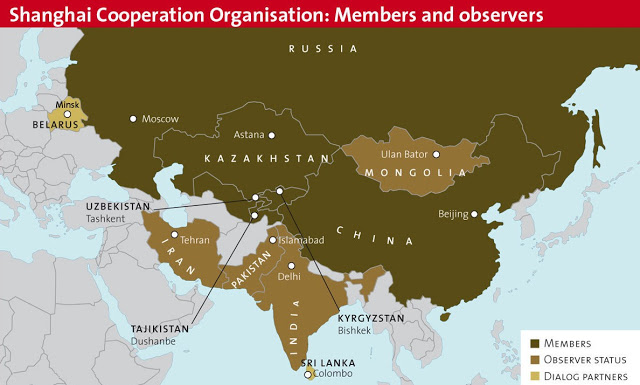
Eye Candy: Shanghai Cooperation Organization

NOL map SCO 2018
Source

First off, Shanghai and Warsaw are two very different cities, and because of that I think the SCO is a different animal than the Warsaw Pact. For one thing (aside from the difference in the two cities, one being selected for its geographical prominence, the other for its commercial acumen), the Warsaw Pact was a military alliance led by the Soviet Union, while the SCO is dedicated to political and economic cooperation as well as military security. Notably, the security aspect of the SCO is dedicated to coordinating state-led efforts against terrorism and separatism rather than against a rival alliance.

I don’t see anything wrong with multilateral efforts undertaken by states other than the US. I don’t see any need to worry, fret, or otherwise suspect the SCO of undermining world peace and prosperity. The fact that the SCO is made up of cooperating autocratic regimes rather than democratic ones does not faze me. The SCO has been making overtures to the democracies of India, Iran, and Sri Lanka (be sure to check out Tridivesh’s excellent take on India and the SCO), and multilateral cooperation among states is in itself an exercise in political participation among equals, albeit not at an individual level.

There is also cause to be happy that China and Russia have bound themselves up in such a prominent cooperative venture, too, given the two powers’ history of fighting each other. The SCO is contributing to peace and prosperity, and while it appears on the surface that the venture is designed to be a rival of the Western-built world order, the Shanghai Cooperation Organization actually contributes to it.

(h/t Nick)

Animation Review #1: Burn the Witch

I am a big fan of animation, but I often have to ‘turn my brain off’ to enjoy a comic trying to make political commentary. With rare exceptions, like the Incredibles series, the industry has a strong statist bent. The industry is so statist that Superman: Red Son, a story line with the premise that Superman landed in the Soviet Union instead of the United States, ends with the message that communism would work if only it were a bit more democratic. Note that I say statist bent, as opposed to leftist bent. They are smaller in number, but there are several conservative comics (e.g. the Kingsman) that leave a statist aftertaste.

I can’t do much on the supply side of liberty-friendly comics, but I can at least highlight those comics that I think fellow libertarians might enjoy via blog posts.

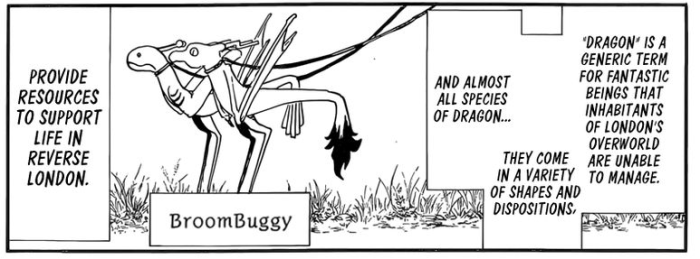
First off is Burn the Witch, a new comic series published by Shonen Jump. I was pleasantly surprised when I read through Tite Kubo’s Burn the Witch. Tite Kubo is best known for authoring Bleach, a comic about Japanese school children fighting demons in fantasy Mexico.

Dragons.png

Burn the Witch is about Anglo-Japanese school children fighting demons in fantasy Britain. The twist? Unlike their counterparts in fantasy Mexico, the British demons (referred to as ‘Dragons’ in-series) aren’t killed outright. Instead they are raised for the resources they provide. Only ‘bad’ demons who are killing humans or otherwise causing destruction are killed. It is noteworthy that the protagonists refer to themselves as ‘conservationists’. They kill the occasional demon, providing the story with action scenes when doing so, but their primary purpose is to conserve them. In an off hand comment the protagonists note that their fantasy Mexican counterparts are barbaric and indiscriminately kill their demons.

Contrary to the protagonist’s comments, it isn’t that individual fantasy Mexicans are barbaric so much that fantasy Mexico doesn’t recognize property rights in demons. Since no one has a property right in demons, no one has an incentive to conserve, much less domesticate, them in fantasy Mexico. Fantasy Britain enjoys strong property rights and consequently has minimal problems associated with its demons. One of the protagonists is ethnically from fantasy Mexico, but seems to be thriving under fantasy Britain’s rules. The story’s lesson? Property rights matter.

Only one chapter of Burn the Witch has been published thus far, and it’s unclear if it’ll become a recurring series, but I like what I’ve seen so far.

Thoughts? Comments? As always, write in the comments below. If you’re a fan of animation and a fellow libertarian, consider joining the anime libertarian alliance facebook group.

The Helsinki Follies

Myself, my wife, Rush Limbaugh, and a couple of others on FB, alone of those who express themselves publicly, have taken leave of their senses. The obvious has stopped waiving at the American intelligentsia (Russian word, on purpose).

Mr Mueller, in charge of demonstrating that Russia gave Mr Trump the election, announces three days before a president’s meeting with Mr Putin that he has charged 12 Russian military intelligence officers with crimes (presumably, violations of American law).

Several things are wrong with this picture.

First, is it a surprise that Russian military intelligence is trying to mess with us? Is this new? Did they used not to? Why make a major announcement of it? It’s routine stuff. Catch them; slap them! Is it the case that US intelligence agencies never tried to mess with Mr Putin’s endless re-elections? What’s their excuse if they did not? Is it the case that our intelligence agencies are not interfering with, say, Venezuela’s political processes today? Really? I liked better the days when our CIA had balls and was the scourge of everything and everyone progressive and socialist.

Second, ignoring the futility of the charges, what’s the chance any of the twelve is going to show up to be tried in America? Not great? Reminder, tentative reminder: Kidnapping them on foreign soil to bring them to American justice would probably violate someone’s law. So, why bother; why indict them? What was the purpose? What was the purpose, a couple of days before President Trump was to meet Mr Putin publicly? Was the purpose other than satisfying justice? Was the purpose to cover up and distract from something more important? Did it have to do with Mrs William Clinton?

Mr Putin offered – short of extraditing the twelve – several compromise solutions so that Mr Mueller could interrogate the Russian intelligence officers named. Will Mr Mueller accept any of those offers? Why not? Give a good reason why he should not.

Reminder: Extradition treaties between countries are always reciprocal: I send you the people you charge; you send me the people I charge. There are really good reasons the US should not want to have such a treaty with Russia.

Does Mueller really want to interrogate the Russian intelligence officers he charged, really? Does he want the truth? (Isn’t it already known?)

How was Mr Trump supposed to respond to such a brutal and vicious attack on his honesty, proffered by Mr Mueller while he was going to be on foreign soil? Was he supposed to lower his eyes, smile sweetly and keep mute? I would not have! He should not have! Should he not have allowed doubt about our intelligence agencies pass his lips, after what the FBI, for example, did? Is he crazy; is he stupid?

Putin is a brutal dictator, a meddler, and probably a murderer. With its nuclear arsenal, his country is the only one really capable of hurting us irreversibly. Good reason to talk to him. We don’t have to be friends but some formal courtesy is required.

The collective reactions of the American political class to the Helsinki meeting tells me that it has lost touch with elementary reality. It’s folly; it’s in a state of collective hysteria. I remember being there before. That was in the eighties.

Warning: If you are sensitive, please, don’t read the next sentences.

In the 80s, the media were awash with denunciations of brutal sex abuse of small children by Satanic cults. People were charged, convicted and sentenced on the testimony of four-year-old coached by eager, man-hating social workers. I remember well, especially, a story in The Atlantic. A father of two confessed to nailing his small daughters to the floor of his living room so his buddies could rape them. The next day, the girls would go to school as usual. No problem! I believe no apologies were ever issued. The justice system was very reluctant to let go of the imprisoned.

A senior Wall Street Journal journalist, Dorothy Rabinowitz, had a solitary struggle of several years to get the wrongs righted.

Wake up, America; get a grip! Those are wooden nickels you are taking!

Ottomanism, Nationalism, Republicanism VI

The end of World War Two placed Turkey between the Soviet Communist world and the western democracies. It’s Middle Eastern neighbours consisted of one outright colony (thinly disguised as a League of Nations mandate), French Syria; one de facto colony of Britain, Iraq (formally independent after a mandate period); one country whose sovereignty was highly compromised by United States and British ‘interests’, that is Iran. After decades of rule by the secularist-nationalist Republican People’s Party (CHP is the Turkish acronym), the idea of a Middle Eastern orientation was not a major one at any kind of obvious level, and had limited practical applicability even for those oriented towards the kind of traditionalist Islam which inevitably looks for some kind of connection with the original Muslim heartland.

The Muslim Brotherhood was formed in (British dominated) Egypt in 1928 and that becomes more important in Turkey over time. A Turkish version, National View, was founded by Necmettin Erbakan in 1969, and forms the core of the AKP today, led by Recep Tayyıp Erdoğan. Turkish history from the 1940s to the AKP coming to power in 2002 can look like an inevitable process, and with some qualifications that is probably a reasonable one-sentence way of thinking. Qualifications include the dangers of seeing history as the inevitable unfolding of a single unified process, and the constant possibility that better decisions by secular leaders at various time could have prevented this outcome. The decisions of the small numbers of self-defined liberals in Turkey were not really any better, sad to say.

İnönü’s response to the post-war world was to adopt multi-partyism. The Democrat Party was allowed to form under Adnan Menderes, who had been a member of the short-lived Free Republican Party and then a CHP deputy, and former prime minister Celâl Bayar. The DP contested the 1946 election, which was not all fully free and fair, but came to power in a more properly conducted election in 1950. Bayâr became President and Menderes became Prime Minister. This worked more as the Turkish constitution suggested than when the CHP was the only party in the national assembly. The result was that Menderes was the decision making person.

This political opening up helped Turkey into the Council of Europe (the grouping of European democracies) in 1949 and made it eligible for Marshall Aid under İnönü. Under Menderes, Turkey joined NATO in 1952. Acceptance into NATO was helped by substantial Turkish participation in the Korean War. The participation of conscript peasant soliders from Anatolia is still remembered in folk songs.

All these ways in which Turkey was acknowledged as part of the community of European democracies took place simultaneously for Greece, so the countries were taken as a pair during this period. The peaceful transfer of power through election from İnönü and the CHP to Menderes and the DP was the first such occasion in Turkish and Ottoman history. Some have seen İnönü as ‘only’ responding to US pressure and therefore denied him credit. This has, in the past, been the default position of most Turkish liberals though I believe that the latest historical work shows that İnönü was much more of an active enthusiast for the transition to genuine elections. On this matter, and others, it looks like time for the default ‘liberal’ position to change.

In any case, the whole idea that İnönü only responded to pressure is unsatisfactory. Of course he made his decision in a context of international balances of power of the time. Others made different decisions. In Spain, for instance, Francisco Franco stuck to ultra-conservative, Fascist-influenced dictatorship, accepting US military bases and continuing previous valuable trading relations. In Portugal, the corporatist dictatorship of António de Oliveira Salazar joined NATO after the adoption of an absurd imitation of party pluralism, with a purely token licensed opposition. Spain and Portugal were not aid recipients, but were able to get considerable trade advantages from the differing deals they made to associate with North Atlantic democracies. İnönü could have found ways to stay in power for ever, but did not.

There were limits to İnönü’s moves towards political pluralism and it was certainly not the ideal process. To some degree, it was one part of the CHP agreeing to the demands of the other part (which left to form DP) to have its turn in power after the current, most favourable to state-led joint secularism and modernity had been in power for so long. More on the DP in the next post.

Returning to İnönü’s rule after the war, the left became victims after a period relative tolerance in the latter years of World War Two, when it looked like the western allies would win in alliance with the US, so the Turkish state showed more tolerance of leftists and less of pan-Turkish nationalists who had the most tolerance of Fascism and Nazism (there has never been a self-identified fascist or national socialist political movement in Turkey).

Not only did İnönü oppress leftist groups outside the CHP as he moved towards genuinely contested elections, he identified left-Kemalist loyalists to the regime as communists who needed to be purged. This was at least in part to gain favour in the US by presenting himself as the main enemy of a real communist threat. Left-Kemalist academics who lost their university jobs at the time included Neyazi Berkes, the most notable Kemalist intellectual of any kind, who went onto an academic career in the west. Measures against left groups outside the CHP included using a religious conservative gang to smash the printing presses of a left newspaper. The willingness of the state to tolerate, and even promote, illegal violence by far right groups supposed threats to the regime and has been a frequent occurrence ever since.

To be continued

Defending Political Liberty in an Administered World

This is a very rough work in progress continuing on from my recent post on ‘Law, Judgement, Republicanism’.

The problems with a free and open political and judicial culture were diagnosed by Max Weber in his discussion of bureaucracy, which itself draws directly and indirectly on various accounts of the problems of bureaucratisation and administration of the social world (which itself began in the 18th century, at least in terms of explicit discussion  of bureaucracy). Wilhelm von Humboldt’s comments on bureaucracy in Limits of State Action is, as far as I can see, the first clear instance. Before that, the closest precedents are, I believe, in comments on the rigidity of Roman law in Montesquieu, which may have been at least in part against the laws and legal institutions of France in his own time.

Bureaucratisation and an administered world can themselves be seen as resting on the necessity of an integrated, hierarchical, rigid, and institutionalised legal system of a ‘Roman’ model, which is true even when thinking of ‘common law’ jurisdiction in England and its off-shoots (England, not Britain, because Scotland has its own more Roman system, and differences between English and Scottish legal institutions survived political union). This process, described in various ways by Weber, Schmitt and Foucault, Austrian school liberals and Frankfurt School Marxists, also rested on the simultaneous formation of commercial society and national economy described by Arendt. Arendt’s account is particularly enriched by comparison with Foucault on the emergence of the art of government. 

The consequences of these legal, administrative, governmental, and economic processes  is that the political sphere is deprived of content as a means for addressing the community as a community of judging, reflective individuals. Politics becomes competition for control of administration and the distribution of economic benefits that come with with this control. The political world is influenced by a drive to the kind of homogenisation favoured by the world of administration and positive law, which turns into struggles about identity and ‘political correctness’. That is, the struggle to define the dominant identity, with claims to a pluralist position still governed by the wish to establish the dominating identity as more tolerant (which can happen in a ‘progressive’ manner), as in a community seen as a community of communities or a ‘conservative’ manner, where there are distinct communities tied to nations or possibly non-interacting historical communities within nations. 

Arendt suggests a perspective aristocratic contest in politics taken from Greek antiquity, particularly Athens, as the antidote to the above. Foucault also has a perspective taken from Greek antiquity, of care of the self, which can also be understood as aesthetic techne, in which our capacity for self-affection is developed in self-creation and recreation, though not as a purely aesthetic play. Machiavelli was in some respects the advocate of the modern integrated state, of sovereignty concentrated in an individual who integrates society through the power of his political skill and creation of a dominating rhetoric or symbolism. In Machiavelli, though, we can also see much that comes from Ancient republicanism filtered through the republicanism of the late medieval city states of northern Italy.

There is not just the remnants of ancient republicanism but its transformation in a world where the state is increasingly invested in territorial control, distinct from the personalised nature of the state as understood before (either in the person of the monarch or the persons making up a republic). The ‘cynicism’ of Machiavelli has its starting point in Aristotle’s Rhetoric, where reason is applied to speech in public places, particularly the courts of law and the political assembly. Though Aristotle distinguishes between the rhetoric of courts and assemblies, he does show a commitment to the idea that they belong to a common world of persuasive speech. Rhetoric appeals to the less deductive parts of human judgement, even the parts of human judgement which come from immediate emotional reactions, but never just that.

The prince who is human and animal, moral and self interested, is also the strong lion and the cunning fox, within his animal self. There is a sense of the total possibility: symbolism and self invention of individuals engaged in the political world. The judicial connection with politics and the social world for whom law is in some sense dead, an accumulated wisdom from the ancients now codified and open to commentary, but not part of political life except in the administrative and governmental roles that Machiavelli himself had for a while on the basis of his legal training, mingled with humanistic (Latinate and literary) education.

Even so, we can see some ideas lingering in Machiavelli of the importance of law in political life, so that it is the ‘parlements’, partly independent and locally representative law courts, of France which gives its monarchy some of the liberty of a republic. In The Prince it is the case that the energy of the people defending its state and its liberties, where they have some history, outweighs the power of the princely ruler, so that classical Polybian republicanism of the Discourses is never completely absent from The Prince.

Most significantly, Machiavelli leaves a legacy which can be seen behind the 20th century attempts to find an alternative to an administered social world. There is the charismatic leader in Weber, the agonistic aspects of politics in Arendt, and the ethics of self-creation and transformation of the self in Foucault. The charismatic leader in Weber should not be understood as a dictator or a person above politics, but as the way in which legally and formally constrained politics can still engage with the social world and the free judgements of individuals. The agonistic politics in Arendt is not just nostalgia for Athens, but an account of what it is to have individual goals and public awareness in a political community. Ethics in Foucault is not just self-creation out of nothing or a non-political playfulness, it is about how we can have free judgement in politics and law. The glory the prince seeks in Machiavelli, and by the citizens of a republic, is a way of seeing that politics combines autonomy and prestige as driving forces in a historically located and contingent political community. Machiavelli anticipates the ways that Arendt understands political freedom to be related to a Homeric culture of seeking fame in public life.

Brexit Breakdown

Ir has been obvious for at least a month now that soft Brexit has won out in the UK, though the Prime Minister Theresa May would never admit such a thing directly. Government discussion of access to the EU internal market at its existing level, or very close, and keeping the border open between the Republic of Ireland and Northern Ireland (a fundamental of the peace settlement in the north) would at the very least require continuing regulatory alignment in goods (that is, following the rules made by the European Union).

It seems very likely that negotiations of the terms of exit with the EU itself would make even this partial alignment with the internal market inadequate in order to get the desired level of access. At the very least EU negotiators would demand some inclusion of services (financial services are the big issue here) and something at least resembling free movement of labour.

That inclusion would be full UK access to the internal market after exiting and would require at least a Swiss style relationship with the EU, in which there is full market access in exchange for accepting EU rules and something close to free movement of labour. Such a relationship would mean accepting judgments of the European Court of Justice even if they are not incorporated into UK law. The UK might not follow Switzerland into EFTA (European Free Trade Association, see paragraph below).

It has even been suggested that the UK might find it necessary to adopt a ‘Norway’ solution, in which the UK is directly a member of the European Economic Area. Norway has free movement but opts out of common agricultural and fisheries agreements. It is not part of the EU customs agreement. Like Iceland, Lichtenstein, and Switzerland, it is a member of the European Free Trade Area, which essentially harmonises regulations between these countries and the EU; that is, EU regulations are enforced by EFTA institutions.

It is clear that most Conservative MPs and businesses (though more large business than small business) regard something like the arrangements above, soft Brexit, as preferable to hard Brexit (trade agreement with the EU as a completely external country, possibility of no deal). These MPs and business people, along with most Treasury economists and economists in general, believe that keeping complete access to EU markets is more valuable than vague claims of a trade boom through deals with non-EU states across the world.

Hard Brexiteers believe that economic growth of other parts of the world requires breaking free of EU shackles on global free trade. The soft Brexit, as well as Remain, argument is that membership of the EU does not prevent trade with the rest of the world and that some EU countries are already doing that very well compared with the UK. On this argument, geographical proximity will always make EU trade disproportionately important so that limiting access to EU markets in the hope that non-EU countries will want free trade agreements is unnecessary and probably very damaging.

May’s drift towards soft Brexit after presenting herself as the guardian of hard Brexit has the support of most of the Cabinet, and Conservative MPs, but has been disappointing hard Brexiteers for some time. An agreement of the full cabinet at the Prime Minister’s country residence for soft Brexit has led to the resignation of the two most hard Brexit-oriented ministers.

It seems unlikely this this will deter May from a soft Brexit policy, which everyone agrees can only become more soft in negotiations with the EU to achieve an agreed exit. It also seems unlikely that most Conservative MPs will resist this policy. The biggest problem for May could be that the opposition parties want to vote against the government in call circumstances, so could vote with hard Brexit Conservative MPs to bring down any Brexit agreement.

At this point Brexit might completely break down, with the UK becoming a full member of EFTA, so in practice a member of the EU which exchanges some opt-outs for absence from the decision making processes and institutions. It might even lead to a suspension of Brexit, or a second referendum in which the electorate chooses between the exit package and staying in the EU.

At present, the most likely options in descending order are: 1. soft Brexit, outside formal association with the EU, but like that in practice, 2. formal association with the EU, maybe meaning membership of EFTA, 3. the complete breakdown of Brexit. This could change and so far change has been to move further and further away from hard Brexit.

Personally I support continuing membership of the EU. It is inevitable that large parts of the UK economy will ‘align’ with EU regulations, so it is best to be part of the institutions and processes which decide on these regulations. That is the most pragmatic version of my argument.

I am also a strong European integrationist, even a federalist romantic. The qualification of this idealism is that integration should not go further than public opinion or institutional capacity can accept at any one moment and that economic realities should guide the relationship with Europe for and against the kind of integration I favour at heart.

My own ideal is a kind of revival of the medieval dreams of ‘universal’ (i.e. European) Empire. The poet Dante was a great exponent of such a vision in his classic of political thought On Monarchy, which does not exclude city republics, even favours them under a high European sovereign. We can join it with Marsiglio of Padua’s slightly later call for an empire with elections to have something like democratic federation for Europe.

Leaving my European romanticism aside for the moment, the current realities are that the UK’s exit from the EU has become more and more complicated by the disadvantages of disentangling complex and far reaching institutional and economic links, particularly when most people involved want to keep an open border with the Republic of Ireland and keep 100% of the current level of access to the internal market.