Jordan Peterson’s Ignorance of Postmodern Philosophy

Up until this point, I’ve avoided talking about Jordan Peterson in any serious manner. In part because I thought (and continue to hope) that he’s the intellectual version of a fad diet who will shortly become irrelevant. My general impression of him is that when he’s right, he’s saying rather banal, cliché truisms with an undeserved bombastic air of profundity, such as his assertions that there are biological differences between men and women, that many religious myths share some similar features, or that taking personal responsibility is good. When he’s wrong, he’s talking way out of the depth of his understanding in his field (like the infamous lobster comment or this bizarre nonsense). Either way, it doesn’t make for a rather good use of time or opportunity for interesting, productive discussion—especially when his galaxy-brained cult-like fanboys are ready to pounce on anyone who criticizes their dear leader.

However, since everyone seems to be as obsessed with Jordan Peterson as he is with himself, I guess it’s finally time to talk about one example of him ignorantly bloviating that particularly annoys me as a philosophy student: his comments on postmodernism. There’s a lot one can talk about with Jordan Peterson because he says almost anything that comes to his mind about any topic, but for the present purposes you can pretend that I think everything he’s ever said that isn’t about postmodern is the deepest, most insightful thing ever said by any thinker in the history of western thought. I’m not interested in defending any overarching claims about him as a thinker. At the very least, his work on personality psychology does seem rather well respected and he surely got to his prestigious academic position with some merit, though I am not qualified to really appraise it. I am, however, more prepared to talk about his rather confused comments on philosophy which might shed light on why people are generally frustrated with his overly self-confident presence as a public intellectual.

Postmodernism, According to Peterson

Peterson often makes comments about “postmodern neo-Marxism,” which he calls a “rejection of the western tradition.” Now the very phrase “postmodern neo-Marxism” strikes anyone remotely familiar with the academic literature on postmodernism and Marxism as bizarre and confused. Postmodernism is usually characterized as skepticism towards grand general theories. Marxism is a grand general theory about how class struggle and economic conditions shape the trajectory of history. Clearly, those two views are not at all compatible. As such, much of the history of twentieth century academia is a history of Marxists and postmodernists fighting and butting heads.

Many commentators have pointed out this error, but Jordan Peterson now has a response. In it he tries to offer a more refined definition of postmodernism as two primary claims and a secondary claim:

Postmodernism is essentially the claim that (1) since there are an innumerable number of ways in which the world can be interpreted and perceived (and those are tightly associated) then (2) no canonical manner of interpretation can be reliably derived.

That’s the fundamental claim. An immediate secondary claim (and this is where the Marxism emerges) is something like “since no canonical manner of interpretation can be reliably derived, all interpretation variants are best interpreted as the struggle for different forms of power.”

He then goes on to concede to the criticism that Marxism and postmodernism can’t be described as theoretically aligned, but moves the goal posts to say that they are practically aligned in politics. Further, he contends postmodernisms’ commitment to analyze power structures is just “a rehashing of the Marxist claim of eternal and primary class warfare.”

It is worth noting that this attempt at nuance is surely an improvement at Peterson’s previous comments that postmodern a Marxism are a coherent “doctrine” that just hated logic and western values. But his attempt at a “definition” is unsatisfactorily way too restrictive for every thinker who gets called “postmodern,” and the attempt to link the politics of postmodernism up with the politics of Marxism is a complete mischaracterization. Further, his attempt to “critique” this position, whatever one wants to call it, is either (at best) vague and imprecise or (at worst) utterly fails. Finally, there really is no alliance between postmodernists and Marxists. Whether or not a thinker is called a “postmodernist” or not is not a very good predictor of their political views.

Why Peterson’s Definition isn’t what Postmodernists Believe and his Critique Fails

First of all, I am really not interested in dying on the hill of offering a better “definition” of postmodernism. Like any good Wittgensteinian, I tend to think you can’t really give a good list of necessary and sufficient conditions that perfectly captures all the subtle ways we use a word. The meaning of the word is the way it is used. Even within academia postmodernism has such broad, varied usage that I’m not sure it has a coherent meaning. Indeed, Foucault once remarked in a 1983 interview when asked about postmodernism, “What are we calling postmodernity? I’m not up to date.” The best I can give is Lyotard’s classic “incredulity toward metanarratives,” which is rather vague and oversimplified. Because this is the best I think one can do given how wildly unpredictable the usage of postmodernism is, we’re probably better off just not putting too much stock in it either as one’s own philosophical position or as the biggest existential threat to western civilization and we should talk about more substantive philosophical disagreements.

That said, Jordan Peterson’s definition is unsatisfactory and shows a poor understanding of postmodernism. While the first half of the fundamental claim is a pretty good stab at generalizing a view most philosophers who get labeled as postmodern agree with, the second half is rather unclear since it’s uncertain what Peterson means by “canonical.” If he takes this to mean that we have no determinate way of determining which interpretations are valid, then that would be a good summary of most postmodernists and an implication of Peterson’s own professed Jamesian pragmatism. If what he thinks it means is that all perspectives are as valid as any other and we have no way of deciphering which ones are better than the other, then nobody relevant believes that.

Peterson objects to is the implication “that there are an unspecifiable number of VALID interpretations.” He tries to refute this by citing Charles Pierce (who actually did not at all hold this view) and William James on the pragmatic criterion of truth to give meaning to “valid interpretations.” He says valid means “when the proposition or interpretation is acted out in the world, the desired outcome within the specific timeframe ensues.” However, it doesn’t follow from this view that you can specify the number of valid interpretations. It just begs the question of how we should understand what “the desired outcome” means, which just puts the perspectivism back a level. Even if we did agree on a determinate “desired outcome,” there are still multiple beliefs one could have to achieve a desired outcome. To put it in a pragmatically-minded cliché, there is more than one way to skin a cat. This is why, in fact, William James was a pluralist.

Perhaps by “specifiable,” he doesn’t mean we can readily quantify the number of valid interpretations, just that the number is not infinite. However, nobody believes there are an infinite number of valid perspectives we should consider. The assertion that a priori we cannot quantify the number of valid perspectives does not mean that all perspectives are equally valid or that there are an infinite number of valid perspectives. Peterson’s argument that we have limited cognitive capacities to consider all possible perspectives is true, it’s just not a refutation of anything postmodernists believe. On this point, it is worth quoting Richard Rorty—one who was both a Jamesian pragmatist and usually gets called postmodern—from Philosophy and the Mirror of Nature:

When it is said, for example, that coherentist or pragmatic “theories of truth” allow for the possibility that many incompatible theories would satisfy the conditions set for “the truth,” the coherentist or pragmatist usually replies this merely shows that we have no grounds for choice among thse candidates for “the truth.” The moral to draw is not to say they have offered inadequate analyses of “true,” but that there are some terms—for example, “the true theory,” “the right thing to do”—which are, intuitively and grammatically singular, but for which no set of necessary and sufficient conditions can be given which will pick out a unique referent. This fact, they say, should not be surprising. Nobody thinks that there are necessary and sufficient conditions which will pick out, for example, the unique referent of “the best thing for her to have done on finding herself in that rather embarrassing situation,” though plausible conditions can be given as to which will shorten a list of competing incompatible candidates. Why should it be any different for the referents of “what she should have done in that ghastly moral dilemma” or “the Good Life for man” or “what the world is really made of?” [Emphasis mine]

The fact that we cannot readily quantify a limited number of candidates for interpretations or decide between them algorithmically does not that we have absolutely no ways to tell which interpretation is valid, that all interpretations are equally valid, nor does it mean there are an infinite number of potentially valid interpretations. Really, the view that many (though not all) postmodernists actually hold under this “primary claim” is not all that substantially different from Peterson’s own Jamesian pragmatism.

As for the secondary claim, which he thinks is Marxist, that “since no canonical manner of interpretation can be reliably derived, all interpretation variants are best interpreted as the struggle for different forms of power.” This view is basically just one just Foucault might have held depending on how you read him. Some would argue this isn’t even a good reading of Foucault because such sweeping generalizations about “all interpretations” is rather uncharacteristic of a philosopher who’s skeptical of sweeping generalizations. However, you read Foucault (and I’m not really prepared to take a strong stand either way), it certainly isn’t the view of all postmodernists.  Rorty criticized this habit of Foucault (Contingency, Irony, and Solidarity, p. 63), and thought that even if power does shape modern subjectivity it’s worth the tradeoff in the gains to freedom that modern liberalism has brought and thus is not the best way to view. It’s also telling that Peterson doesn’t even try to critique this claim and just dogmatically dismisses it.

Postmodernism’s Alleged Alliance with Marxism

So much for his vague, weak argument against a straw man. Now let’s see if there’s any merit to Peterson’s thought that Marxism and postmodernism have some important resemblance or philosophical alliance. Peterson says that the secondary claim of postmodernism is where the similarity to Marxism comes. However, Marx simply did not think that all theories are just attempts to grab power in the Foucauldian sense: he didn’t think that dialectical materialism the labor theory of value were just power grabs, and predicted a day when there was no competition for power in the first place at the end of history since a communist society would be classless. If anything, it’s the influence of Nietzsche’s Will to Power on Foucault, and oddly enough Peterson thinks rather highly of Nietzsche (even though Nietzsche anticipated postmodernism in rather important ways).

The only feature that they share is a narrative of one group trying to dominate another group. But if any attempt to describe oppression in society is somehow “Marxist,” that means right libertarians who talk about how the state and crony capitalist are oppressing and coercing the general public are “Marxist,” evangelicals who say Christians are oppressed by powerful liberal elites are “Marxist,” even Jordan Peterson himself is a “Marxist” when he whines about these postmodern Marxist boogeymen are trying to silence his free speech. He both defines “postmodernism” too narrowly, and then uses “Marxism” in such a loose manner that it basically means nothing.

Further, there’s Peterson’s claim that due to identity politics, postmodernists and Marxists now just have a practical political alliance even if it’s theoretically illogical. The only evidence he really gives of this alleged “alliance” is that Derrida and Foucault were Marxists when they were younger who “barely repented” from Marxism and that courses like critical theory and gender studies read Marxists and postmodernists. That they barely repented is simply a lie, Foucault left all his associations with Marxist parties and expunged his earlier works of Marxist themes. But the mere fact that someone once was a Marxist and then criticized Marxism later in their life doesn’t mean there was a continuing alliance between believers in their thought and Marxism. Alasdair MacIntyre was influenced by Marx when he was young and became a Catholic neo-Aristotelian, nobody thinks that he “barely repented” and there’s some overarching alliance between traditionalist Aristotelians and Marxists.

As for the claim that postmodernists and Marxists are read in gender studies, it’s just absurd to think that’s evidence of some menacing “practical alliance.” The reason they’re read in those is mostly courses is to provide contrast for the students of opposing perspectives. This is like saying that because Rawlsian libertarians are taken seriously by academic political philosophers there’s some massive political alliance between libertarians and progressive liberals.

Really, trying to connect postmodernism to any political ideology shows a laughably weak understanding of both postmodernism and political theory. You have postmodernists identifying as everything from far leftists (Foucault), to progressive liberals (Richard Rorty), to classical liberals (Deirdre McClosky), to anarchists (Saul Newman), to religious conservatives (like Peter Blum and James K.A. Smith). They don’t all buy identity politics uniformly, Richard Rorty criticized the left for focusing on identity issues over economic politics and was skeptical of the usefulness of a lot of critical theory. There really is no necessary connection between one’s highly theoretical views on epistemic justification, truth, and the usefulness of metaphysics or other metanarratives and one’s more concrete views on culture or politics.

Now Peterson can claim all the people I’ve listed aren’t “really” postmodern and double down on his much narrower, idiosyncratic definition of postmodernism which has very little relation to the way anyone who knows philosophy uses it. Fine, that’s a trivial semantic debate I’m not really interested in having. But it does create a problem for him: he wants to claim that postmodernism is this pernicious, all-encompassing threat that has consumed all of the humanities and social sciences which hates western civilization. He then wants to define postmodernism so narrowly that it merely describes the views of basically just Foucault. He wants to have his cake and eat it too: define postmodernism narrowly to evade criticism that he’s using it loosely, and use it as a scare term for the entire modern left.

Peterson’s Other Miscellaneous Dismissals of Postmodernism

The rest of what he has to say about postmodernism is all absurd straw men with absolutely no basis in anything anyone has ever argued. He thinks postmodernists “don’t believe in logic” when, for example, Richard Rorty was an analytic philosopher who spent the early parts of his career obsessed with the logic of language. He thinks they “don’t believe in dialogue” when Rorty’s whole aspiration was to turn all of society into one continuous dialogue and reimagine philosophy as the “conversation of culture). Or that they believe “you don’t have an individual identity” when K. Anthony Appiah, who encourages “banal ‘postmodernism’” about race, believes that the individual dimensions of identity are problematically superseded by the collective dimensions. This whole “definition and critique” of postmodernism is clearly just a post-hoc rationalization for him to continue to dishonestly straw man all leftists with an absurd monolithic conspiracy theory. The only people who are playing “crooked games” or are “neck-deep in deceit” are ignorant hucksters like Peterson bloviating about topics they clearly know nothing about with absurd levels of unmerited confidence.

Really, it’s ironic that Peterson has such irrational antipathy towards postmodernism. A ton of the views he champions (a pragmatic theory of truth, a respect for Nietzsche’s use of genealogy, a naturalist emphasis on the continuity between animals and humans, etc.) are all views that are often called “postmodern” depending on how broadly one understands “incredulity towards metanarratives,” and at the very least were extremely influential over most postmodern philosophers and echoed in their work. Maybe if Peterson showed a fraction of the openness to dialogue and debate he dishonestly pretends to have and actually read postmodernists outside of a secondary source, he’d discover a lot to agree with.

[Editors note: The last line has been changed from an earlier version with an incorrect statement about Peterson’s source Explaining Postmodernism.]

Cities in capitalism are more beautiful

The other day I wrote about some of the reasons why I love capitalism. One of them is that cities in capitalism are more beautiful. I am convinced of this when I think about some cities I am more familiar with, including their geography and history.

Most foreigners I know have difficulty to answering correctly, when asked, “What is Brazil’s national capital?”. Most people answer Rio de Janeiro, but it is actually Brasilia. Many people say that beauty is in the eyes of the beholder, but I am very inclined to say that this is not so. I am still not 100% sure about this, but I believe that there is something objective about beauty. Maybe it is not something so strict, like a point. Maybe it is something broader, like an area. But still, I am inclined to say that there is something objective about it. At least for me, Brasilia is one of the ugliest cities conceivable. I am really glad to say that. Its architecture was designed by Oscar Niemeyer and Lucio Costa. Growing up in Brazil, questioning that Niemeyer was a genius is almost anathema, almost like saying that Maradona was better than Pelé or that Ayrton Senna was not the best Formula One pilot ever. Because of that, I was always happy to say that Niemeyer’s buildings are among the ugliest things on the surface of this planet. It was like shouting that the king is naked.

Brasilia is very beautiful from the sky. Its shape resembles an airplane or a cross. But that is the problem: the city is beautiful from heaven, but not for the people walking in it. It was made for God to see from up there. But, as Niemeyer was a convinced atheist, I am not sure who is watching his creation. My guess is that Niemeyer thought that he was a god. A very mean god, who didn’t care about people having to spend lots of time in cars driving long distances.

Niemeyer was also related, with Lucio Costa, to Barra da Tijuca, a neighborhood in Rio de Janeiro where I spent lots of time growing up. Lucio Costa, as far as I’m concerned, was not a communist. I believe he was closely connected to the Brazilian version of positivism. Because positivism and communism are basically the same, it doesn’t make much of a difference. Barra da Tijuca is very similar to Brasilia: very beautiful if looked at from the sky, but very unpleasant for the pedestrian. Very long distances to walk. Cars are mandatory.

The most pleasant neighborhoods in Rio de Janeiro are the result of spontaneous order. As Hayek noticed, spontaneous order is one of the central features of capitalism. People usually contrasted between planned economies (such as the USSR) and unplanned economies (such as the US in some moment of its history). But Hayek observed that all economies are planned. Some are centrally planned. Others are planned by several individuals who are not following a specific central plan.

I am convinced that cities that follow no plan, or a very simple plan, are more beautiful than cities that follow a very specific central plan. New York, as far as I know, followed a simple plan, a grid. But other than that, there was a lot of freedom in the use of the space for much of its history. It’s a city that I just love. I am more comfortable talking about Rio de Janeiro. It is a city that was at its best before modern architecture, positivism, socialism, Developmentalism, and other isms. It was better when Brazil had a little more classical liberalism.

Christianism and Liberalism

In 1929 John Gresham Machen dropped his professorship at Princeton Theological Seminary to establish Westminster Theological Seminary. Machen fought the Theological Liberalism in the seminary and in his denomination (PCUSA) for many years, until he gave up and decided to form a new seminary and eventually a new denomination as well (the Orthodox Presbyterian Church).

Machen’s attitude of abandoning his seminary and his denomination might seem harsh. After all, can’t we all just get along? Theologically he was considered a fundamentalist. His followers are called to this day “Machen’s Warrior Children,” people who are theologically unwilling to compromise.

People have all the right to disagree, but for Machen, some things were not negotiable. That is why he wrote Christianity and Liberalism (1923), a book in which he unapologetically calls Theological Liberalism “another religion,” separated from historical Christianism.

Interestingly, the same Machen who so fiercely opposed theological liberalism was not a conservative regarding politics, because he was suspicious of mixing religion and politics. He found attempts to establish a Christian culture by political means insensitive to minorities. In practical terms, he opposed school prayer and Bible reading in public school. He also opposed Prohibition, something very costly considering that at that time abstinence was common ground among Protestants. In sum, Machen was, politically, a libertarian.

In Road to Serfdom, Hayek observes that Liberal Christians, who don’t believe in the supernatural aspects of the Bible, tend to embrace Social Gospel and tear down the wall of separation between church and state. Machen, on the other hand, was a living proof that a fundamentalist Christian can want nothing but a distance from the government.

What is Cultural Marxism, anyway?

I remember many years ago when Sarah Palin was in the spotlight and she accused Obama of socialism. Back then, I thought this was nonsense and I couldn’t see why conservatives in the US hated Obama so much. However, coming from my academic and cultural background I should know better.

This year we have presidential elections in Brazil. After many years we have presidential candidates who unapologetically call themselves right-wing. Until not many years ago, people in Brazil were simply ashamed of describing themselves in this way. Maybe it has to do with the military dictatorship Brazil was under from 1964 to 1985. Back then, to be “right-wing” was to be in favor of the dictatorship. To be left-wing was to oppose it. The armed forces took power in Brazil to avoid the communists of doing so. I am every day more convinced that this backfired. Because they were fought by the military, communists posed as victims who were simply fighting for democracy. Of course, nothing could be farther from the truth: they were terrorists who wanted to transform Brazil into a South American USSR. But the communists-as-democrats is the narrative I and many Brazilians learned in school.

Brazil has a long history of communist influence. Since the 1920s the USSR tried to influence politics in my country, including a failed coup in the 1930s, the Brazilian uprising of 1935. However, communists eventually learned that Brazilians were socially too conservative to accept communist rule. That’s about when they discovered cultural Marxism, especially Antonio Gramsci and the Frankfurt School. Brazil’s strongest socialist party, the Worker’s Party (PT) is much more influenced by Gramsci than by Lenin or even Marx. Marx is more like a shadow, a mythical figure that very few people actually read.

Cultural Marxism is not a well defined academic paradigm. It is a political program. For some years the main leaders of PT were not even secretive about this. They accepted in their economic policy many of the basics of the Washington Consensus. In their cultural agenda, however, they took in anything that would help overturn conservative values (I mean here Judeo-Christian). But even here, they would not fight it openly. Jesus was not entirely overthrown. Instead, he turned into a revolutionary, a 1st century Che Guevara,  by Liberation Theology. In the political program of winning culture, any help is welcome. That’s how Foucault, Derrida, the Frankfurt School, anything that questions modern liberal capitalist society, is used to question “everything that is.”

Cultural Marxism, in sum, is nihilism. They don’t really have anything to substitute the culture they want to overturn. That is why it sounds so abstract. Academically, that’s exactly what it is. Politically, however, it serves a very specific purpose: power.

Cultural marxism and the Overton window

According to all accounts, Karl Marx was not an easy person. Basically, he had the habit of making the life of all around him miserable. However, as Joseph Schumpeter (himself far from being a Marxist) loved to point out, he was extremely well read. This allowed him to build a complex economic theory focused on factory workers, without ever (or almost ever, at least) stepping into a factory. Life for a factory worker in 19th century Britain was not easy, and Marx was very able in pointing that out. His economic theory, however, was a complete failure, as Ludwig von Mises aptly pointed out.

Marxism should have died in the mid-20th century when it became clear that all socialist countries are poor and oppressive. However, it survived as cultural Marxism. People like Antonio Gramsci, Michel Foucault, Jacques Derrida, and everybody in the Frankfurt School were not interested in economics. Instead, they wanted to study culture. The oppressed were not the factory workers anymore, but the social minorities. Libertarians and Conservatives should sympathize with that. It is true that women, non-whites, and homosexuals suffered a great deal in the masculine, white, heterosexual West. To point out that they suffer even more outside the West is not particularly helpful. We don’t have to throw the baby out with the bathwater. However, as with much of original Marxism, cultural Marxism is only good at pointing the problems, not at offering solutions. Modern civilization, as Sigmund Freud very well observed, is full of discontents. This is an old argument. Rousseau points out how modern civilization is cruel. Voltaire answers that, as cruel as it might be, it is still better than the alternative.

Our problem today is that cultural Marxism was successful in pushing the Overton window in their favor. That was precisely Gramsci’s objective: to fight “bourgeois” cultural hegemony with Marxist cultural hegemony. To a great degree, he succeeded. We need to fight the cultural war. As much as modern life can be bittersweet, I still haven’t heard a better alternative. Besides, as a Christian, I have to say with Saint Augustine that men have a “God-shaped hole” that no civilization – Modern, pre-modern or postmodern – can fill. But still, I enjoy the things that capitalism, capitalism that originated from the Protestant ethic, has to offer.

The Sad Retreat

Do not go gentle into that good night / Rage, rage against the dying of the light.


~ Dylan Thomas

Thomas’ villanelle to his dying father is one of the most iconic English poems of the 20thcentury. It is also curiously relevant today, though not in a literal sense. The traditional American zeitgeist is the willingness to step forward fearlessly into the unknown, and in doing so to illuminate it and to dispel infantile terror of the dark. Sadly, the contemporary spirit is one of moribund confidence and the acceptance of stagnation.

There was nothing more indicative of the American spirit than the opening lines of Star Trek: The Original Series: “To boldly go where no man has gone before.” The root of the phrase’s power lies in action, an acceptance that man is capable of seizing control and carrying himself into space. Yet, despite the television series’ timing, the American people were not going boldly into the night, or darkness of space, but rather were starting a retreat that continues into the present.

The retreat is not an apparent one. To all appearances there has been no pell-mell flight from a battlefield with weaponry and protective gear to signal a loss of confidence. To quote Kevin D Williamson, “Nothing happened.” It is the lack of action, the stagnation, that signals a retreat occurred.

In his book Slouching to Gomorrah (1996), the late Robert Bork (1927 – 2012) catalogued the ways he believed America had declined since his youth. Buried among the musings are some anecdotes about Bork’s time at Yale as a young law professor in the late 1960s. In that decade, according to Bork, the university had quietly relaxed its admissions criteria and admitted applicants who would not have qualified under the previous standard. From a position of authority, Bork observed as these young people – mostly men as the problem was concentrated at the undergraduate level and the only women at Yale at the time were graduate students – struggled academically due to lack of adequate preparation. Many of these new students began to flunk as individual faculty refused to dilute their syllabi or grading standards.

As he explained, the stakes at the time were particularly high: in 1968, the time of Bork’s first semester, the draft and deployment to Vietnam would immediately and ruthlessly punish academic failure. Additionally, the students described largely came from middle-America and bore the full weight of their families and local communities’ expectations, causing failure to be particularly humiliating. Although Bork rejected the Marxist and anti-intellectual aspects of the 1968 student protests, he presented a hidden facet to the protestors whom he identified as young people angry at a system they felt had betrayed them and doomed them to failure. The message extracted from a well-intentioned policy change was that these people were ones who couldn’t – they couldn’t keep up with their peers, they couldn’t succeed, and all the indicators of their time pointed toward a truncated future. In short, they didn’t matter; they were not strictly necessary for broader society. Aside from property destruction, the turn toward Marxism and anti-intellectualism was a retreat, a flight from reality. With the rout – entirely self-imposed since the simple solution to the problem was to go to the library and catch up, rather than go burn the books, which is the choice the students made – the United States unknowingly set off on a path of becoming a nation of “cannots.”

To present an analogy, in the training of thoroughbred racehorses, a promising colt is raced against another, less able one in order to build the former’s confidence. The second horse is not only expected to lose, he is rewarded for doing so, but very often at the cost of his spirit and willingness to compete. This analogy is somewhat limited since the Yale student protestors of the 1960s chose the role of second horse themselves, but the result, anger, wanton destruction, and futile rage in the face of their inadequacies, are human indicators of broken spirit and loss of competitive edge. These two traits have, since the 60s, trickled down through all echelons of American society, accompanied by all the symptoms of anger and unnecessary misery. The American people have become the second horse.

All statistical evidence indicates that the quality of life in America is higher than ever before; we have record low rates of crime, better healthcare, and unparalleled access to consumer goods and luxury technologies. Under circumstances such as these, we should possess an equally high level of national confidence and happiness. But this is not the case. Currently, a Gallup poll from late 2017 shows that, despite the country’s increased prosperity under the new administration, subjective, or perceived, happiness has declined since the 2016 election. In other words, middle America is no happier now than it was pre-November 2016: it is less happy. Combined with the rise of “deaths of despair (official term for deaths from addiction or suicide in middle-aged or younger people)” and the mediatized claims of loss of opportunity due to – O tempora, o mores – technology and the new economy, the story is one of surrender, nothing else.

In the narrative, especially the one surrounding the 2016 election, the story is one of middle-America neglected and in need of special favors and treatment. As part of this picture, its authors and advocates on both sides of the political aisle sneer at the idea of self-determination, in the way of Michael Brendan Dougherty in the piece that Williamson rebutted with his “Nothing happened.” Technology is a particular target of Dougherty’s ire as somehow destructive to a utopic version of American community and family – his most recent article from May 1, 2018, was an apology for using the internet as a work medium – but ignoring the path to financial independence and economic integration that it provides. Hatred of technology and change, a desire to return to the “good old days” is a symptom of the retreat.

Today the logical and economic fallacy, identified by AEI’s Arthur Brooks, of “helping poor people” instead of “needing them” is dominant. Yet, it is a betrayal at all levels of the American ethos. Protectionism, insularity, and above all else, a desire to justify the degraded state of the American worker, pinning the fault on a wide range of people and things, are all signs of the willful betrayal of the American spirit. Although there are individual Americans who are leaders in technology and new industry, the American people are collectively falling behind, and our policy-makers are rewarding us for becoming the second horse through protectionism and populist speeches that reinforce the notion that there is a wronged group of “left behind.” We are no longer going “boldly where no man has gone before;” instead we are docilely being led into the “good night,” all while thinking that we are raging against it. Without a change, the pasture of irrelevance awaits us.

Eye Candy: the languages of Brazil

NOL map Brazil languages
Click here to zoom

My only question: no Spanish, anywhere? Not even along the borders?

The Intolerance of Tolerance

Just recently I read The Intolerance of Tolerance, by D. A. Carson. Carson is one of the best New Testament scholars around, but what he writes in this book (although written from a Christian perspective) has more to do with contemporary politics. His main point is that the concept of tolerance evolved over time to become something impossible to work with.

Being a New Testament scholar, Carson knows very well how language works, and especially how vocabulary accommodates different concepts over time. Not long ago, tolerance was meant to be a secondary virtue. We tolerate things that we don’t like, but that at the same time we don’t believe we should destroy. That was the case between different Protestant denominations early in American history: Baptists, Presbyterians, and so on decided to “agree to disagree,” even though they didn’t agree with one another completely. “I don’t agree with what you are saying, but I don’t think I have to shut you up. I’ll let you say and do the things I don’t like.” Eventually, the boundaries of tolerance were expanded to include Catholics, Jews, and all kinds of people and behaviors that we don’t agree with, but that we decide to tolerate.

The problem with tolerance today is that people want to make it a central value. You have to be tolerant. Period. But is that possible? Should we be tolerant of pedophilia? Murder? Genocide? Can the contemporary tolerant be tolerant of those who are not tolerant?

Postmodernism really made a mess. Postmodernism is very good as a necessary critic to the extremes of rationalism present in modernity. But in and by itself it only leads to nonsense. Once you don’t have anything firm to stand on, anything goes. Everything is relative. Except that everything is relative, that’s absolute. Tolerance today goes the same way: I will not tolerate the fact that you are not tolerant.

The news cycle vs. current events

The other day, while badgering my fellow Notewriters to blog more often, I mentioned that current events are different from the news cycle, and are still important to dissect and blog about. This distinction between the news cycle and current events was sparked by economist Arnold Kling’s recent post on where he gets the news (found in one of last week’s Nightcaps). Basically, the news cycle is terrible. I rarely pay any attention to it. CNN, a left-of-center media outlet that almost everybody has heard of, has on its front page today (the wee morning hours of 4-23-17) a great example of the news cycle:

  • Kellyanne Conway to Dana Bash: OK, you went there
  • Conway says asking about her husband’s anti-Trump tweets is a ‘double standard’
  • Analysis: Trump’s score-settling creates jarring contrast
  • WSJ: Trump to ask North Korea to dismantle nuclear arsenal before talking sanctions relief
  • Opinion: Macron’s bromance with Trump will come at a price
  • Biographer: Trump has lied since youth
  • Melania Trump plans state dinner on her own
  • Stelter: One Trump lie is crystal clear

You get the idea, and remember that CNN is a well-established, long-running media outlet. Other media outlets that focus on the news cycle are just as bad, if not worse (at least CNN pretends, most of the time, to wrap its clear bias in a cloth of objectivity). This is a far cry from the concept of “current events.” Current events, in my view, are arguments about ideas, events, or even people that take place between at least two sides in specific time frame. Most of the time, “current events” involve using events (usually) or people (rarely) to defend or attack an idea. You see the difference? Have a better definition?

The news cycle is largely garbage, but it can still be useful, especially for international news. I never visit RealClearPolitics, for example, because it focuses on the news cycle, but I stop by RealClearWorld, which usually conveys the news cycles of other countries, once or twice a day. Even though I’m consuming a news cycle, I’m still learning something because it’s a news cycle about a place very different from my own.

Five or ten years from now, the bullet points from CNN will be useless and forgotten, but the arguments put forth into the stream of current events will be useful and maybe even prized. What baffles me is that the news cycle, while almost universally loathed, is far more popular in terms of consumption than current events. Doesn’t everybody know how to use Google by now?

Eye Candy: Computer games, worldwide

NOL map computer games.png
Click here to zoom

These are the most-owned games on Steam, a digital distribution platform (wiki). This was fascinating to me for a bunch of different reasons. You can come up with your own, I’m sure. Here are the wikis for the games:

I have played none of these games…

The problem with Brazil (and it’s not socialism)

The problem with Brazil is not Luis Inacio Lula da Silva. It’s not the Worker’s Party. It’s not Socialism.

Certainly one of the most important politicians in Brazilian History was Getulio Vargas. Vargas came to power in a coup (that symptomatically most Brazilian historians call a revolution) in 1930. He ended up staying in power, without ever being elected by popular vote, until 1945. Then he peacefully resigned, not without electing his chosen successor, Eurico Gaspar Dutra. Vargas came back to power immediately after Dutra, and committed suicide while in office. Almost all Brazilian presidents from 1945 to 1964 were from Vargas’ close circle.

Brazilians to this day are still taught that Vargas was a hero, persecuted by an evil opposition. Initially, Vargas was some kind of Brazilian positivist. He was anti-liberal because liberalism is weak and slow. We need a strong technical government, able to identify problems and come with solutions fast. However, while in office, he became “the father of the poor,” a defensor of the lower classes. Nothing could be farther from the truth, of course, but that’s how Vargas is remembered by many.

One of my favorite interpretation of Brazil comes from Sergio Buarque de Holanda. According to Holanda, the problem with Brazil is that Brazilians are cordial. What he means by that is this: using Weber’s models of authority, he identified that Brazilians were never able to support a Legal-Rational authority. Vargas was seen as “a father.” not a president. The country is seen as a big family. Lula used a very similar vocabulary and tried to reenact Vargas’ populism.

As I mentioned, Holanda’s interpretation is Weberian. Weber’s most famous book is The Protestant Ethic and the Spirit of Capitalism. The problem with Brazil is that it never went through a protestant reformation. And because of that, it never developed the “spirit of capitalism” that Weber describes. Brazil is still, to a great degree, stuck with traditional and charismatic forms of authority.

To be sure, Brazil has many features of a modern liberal state. Since late 18th century Portugal tried to copy these from more advanced nations, especially England. Brazil followed suit. But you can’t have the accidents without the substance. Unless Brazil actually goes through a transformation in its soul, it will never become the modern liberal state many want it to be. Quoting Domingo Faustino Sarmiento, “An ignorant people will always choose Rosas.”

Eye Candy: Kurdistan

NOL map Kurdistan.png
Click here to zoom (courtesy of the excellent Decolonial Atlas)

Countries with significant Kurdish populations in the Near East: Turkey, Syria, Iraq, and Iran.

Countries with significant Kurdish populations in the Near East that the United States has bombed or put boots on the ground in: Iraq and Syria.

Countries with significant Kurdish populations in the Near East that the United States has threatened to bomb and possibly invade: Iran.

Countries with significant Kurdish populations in the Near East that the United States is allied with: Turkey.

Three of the four countries with significant Kurdish populations in the Near East are (or was, in the case of Iraq) considered hostile to the US government, so the use of Kurds to further American Realpolitik in the region is almost obvious, until you consider that Turkey has been a longtime ally of Washington.

Suppose you’re a big-time Washington foreign policy player. Do you arm Kurdish militias in Syria, encourage continued political autonomy in Kurdish Iraq, finance Kurdish discontent in Iran, and shrug your shoulders at Istanbul? Seriously, what do you do in this situation?

From Petty Crime to Terrorism

I grew up in France. I know the French language inside out. I follow the French media. In that country, France, people with a Muslim first name are 5% or maybe, 7% of the population. No one estimates that they are close to 10%. I use this name designation because French government agencies are forbidden to cooperate in the collection of religious (or ethic, or racial) data. Moreover, I don’t want to be in the theological business of deciding who is a “real Muslim.” Yet, common sense leads me to suspect that French people who are born Muslims are mostly religiously indifferent or lukewarm, like their nominally Christian neighbors. I am not so sure though about recent immigrants from rural areas bathed in a jihadist atmosphere, as occur in Algeria, and in Morocco, for example. Continue reading

Eye Candy: Poo-Pooing in Public, Percentages

NOL map open defecation 2015
click here to zoom

My only question is: how do they compile data on this? The World Bank put this thing together, but I can’t see any economists doing fieldwork on this. Maybe the Bank hired anthropologists to do the poo-poo stuff…

The President’s commission on opioids (2/2)

Here’s the second half of an abridged essay I wrote for a public policy course. First half is here, and next week I’ll write about the FDA’s new enemy, kratom.


Epidemic status

The DEA’s 2015 declaration of an opioid epidemic was the first sign of large-scale federal attention to prescription analgesics, to my knowledge. On the CDC’s official glossary, “outbreak” and “epidemic” are interchangeable: “the occurrence of more cases of disease than expected in a given area or among a specific group of people over a particular period of time.”

The classification of addiction as a disease is sometimes controversial. (See also Adam Alter’s Irresistible for a popularized form of the psychological takes on addiction.) For the opioid problem to be an epidemic, the focus must be the addition rate, and not the overdose or death rate alone. The federal government usually refers to the opioid situation as an epidemic or emergency (which presupposes a value judgment), and when media has covered it (as with the deaths of Philip Seymour Hoffman, Heath Ledger and Prince) they use the same language. One definitive media moment might have been last year, when John Oliver announced for a young progressive crowd that “America is facing an epidemic of addiction to opioids.”

Oliver was referring specifically to addiction — criticizing companies like Purdue Pharma (creator of OxyContin) for misleading or misinformative advertising about addictiveness. But usually it does not seem like the focus is on addiction. As stated, nonmedical usage of opioids is generally down or stabilized from the last couple years, and the problem is mostly overdoses. (True, these are intimately connected.) This might indicate that cutting the pills with other drugs or general inexperienced use are greater problems than general addiction. So, there is an epidemic in the colloquial usage — extensive usage of something which can be harmful — but only questionably in the CDC’s medical definition, as the usage rates are expected to be up as synthesized morphine-, codeine- or thebaine-based pain relievers diversified, and these have mostly stabilized except for heroin (thought as often beyond opioid status) and fully synthetic derivatives which get less attention (fentanyl, tramadol).

Why the standard of abuse fails

John Oliver — worthy to talk about because much of the public plausibly started paying attention after his episode — noted that the pills are assigned to patients and then, even if the patient doesn’t develop an addiction, they end up in the “wrong hands.” What happens at this point? The Commission recommends that companies design their prescription drugs for “abuse-deterrent” formulations (ADF). After spikes in opioid abuse, Purdue Pharma and other companies began researching mechanisms to prevent abusers from easily obtaining a recreational high by tampering with the pill or capsule. In a public statement, FDA commissioner Scott Gottlieb asserted that the administration’s focus is on “decreasing unnecessary exposure to opioids,” but, recognizing the real role that prescription opioids play in pain relief, Gottlieb continues that “until we’re able to find new nonopioid forms of pain management … it’s critical that that we also continue to promote the development of opioids that are harder to manipulate and abuse, and take steps to encourage their use over opioids that don’t offer any form of deterrence.” Some of these abuse-deterrent options are crush resistance or wax coating to make dissolving more difficult.

However, opioid abuse comes in two forms which are conflated by the legal language. The first is when a patient takes more than their recommended allocation or takes it in the wrong way. The second is when someone with or without a prescription consumes them purely for recreation. Many drug savvy abusers of the second variety have adapted methods to get a recreational high but avoid potential health risks, the most popular method being “cold water extraction” (CWE). Most opioid pills contain both a synthesized opium alkaloid (from morphine, codeine or thebaine) and acetaminophen: Percocet contains oxycodone and paracetamol; Vicodin contains hydrocodone and paracetamol. The acetaminophen or APAP has no recreational benefits (a pure pain reliever/fever reducer) and can cause severe liver problems in large quantities, so recreational users will extract the opium alkaloid by crushing the pill, dissolving it in distilled water, chilling it to just above freezing, and filtering out the uncrystallized APAP from the synthesized opium. This way a greater quantity of the opioid can be ingested without needlessly consuming acetaminophen. Other recreational users that want less of the opium derivative can proceed without CWE and insufflate or orally ingest the particular pills.

ADFs might be able to dent the amount of abusers of the second variety. If the pills are harder to crush (the route of Purdue’s 2010 OxyContin release) or, for capsules, the interior balls are harder to dissolve (the route of Collegium Pharmaceutical’s Xtampza), amateur or moderately determined oxycodone enthusiasts may find the buzz is not worth the labor. As the Commission observes, more than 50% of prescription analgesic misusers get them from friends and family (p. 41) — these are not hardcore aficionados, but opportunists who might be dissuaded by simple anti-abuse mechanisms. Abusers of the first variety, though, are unaffected: at least in the short term, their abuse rests on slightly-over-the-recommended doses or a natural tendency to develop an addiction or non-medical physical dependency. And, if the political core of the opioid emergency is patients that develop an addiction accidentally (those that stay addicted to pharmaceuticals and those that graduate to heroin), abuse-deterrent focuses are unlikely to create real change in addiction rates. It could even have the unintended consequence of higher overdose deaths for amateur narcotics recreationalists, who aren’t skilled enough to perform extractions and opt to consume more pills in one sitting instead.

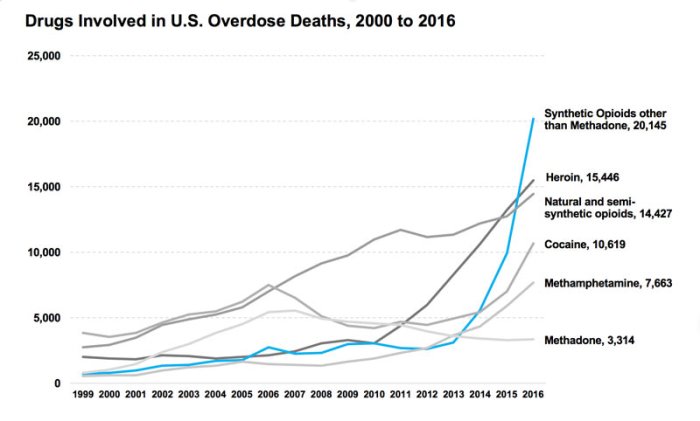
And furthermore, ADFs can be incorporated into the naturals and synthetics that are usually bonded with APAP like codeine, oxycodone, hydrocodone and tramadol, but cannot for the drugs that come in pure form like heroin or fentanyl. And those are the problem drugs. The NIDA research on drugs involved in overdose deaths across the board, for one, shows that overdose deaths are on the rise as a whole (except for methadone), and also that the synthetic opioids are much more deadly than the naturals and semi-synthetics: fentanyl is the biggest prescription analgesic killer (it’s much more potent than morphine, and tramadol is not very good for recreation).

drugoverdosedeaths

(This graph also shows, however, that the natural/semi-synthetic usage rate was possibly leveling out but resuscitated in 2015.) So ADFs are useless for the drugs most massively causing the “opioid epidemic.” Making them harder to abuse only dents the second category of abuser, and does not limit their addictiveness for those prescribed them for postsurgical pain or otherwise.

Moreover, from a libertarian standpoint, the second category of abuser does not really belong in the “public health crisis” discussion. Those who knowingly consume opioids for recreation are not a problem, they are participants in a pleasure-seeking activity that doesn’t tread on others. So long as their costs are not imposed on other people, it might be better to separate them from the “epidemic” status. Blurring the lines between the groups that fall under “abusive” means that those with a side-interest in OxyContin on Friday nights are lumped in with addicts suffering from physical dependency. Someone who has a glass of wine each night is not “abusing” alcohol, but we can recognize someone who is an alcoholic; the same distinction should be applied medically to opioid users. By painting all consumers outside of direct medical usage as “abusers,” there can be no standard for misuse, and thus no way for a recreationalist to know how much is too much, when health problems might set in, if they are really trapped in their recreation, etc. Research and knowledge are threatened by the legal treatment and classification.

Conclusion

To summarize, the government terminology of “abuse” obscures a legitimate distinction that is justified on both medical-political and civil liberty grounds. Some of the approaches in the Commission report, like the market-based CMS package recommendation, will likely succeed at quelling opioid exposure (and thus addiction and overdoses), while other maneuvers like an education campaign or ADFs should be treated with cautious skepticism. The trends show that heroin and fentanyl are actually the biggest contributors to the opioid epidemic, although semi-synthetics are climbing again in overdose deaths after leaning toward stabilization two years ago. Evidence that prescription abuse and street use are linked, as well as testimony from former addicts, indicates that drug users easily swing between the legal and black market.