Legal Immigration Into the United States (Part 4): Bad and Worse Immigrants, and Fallacies

A study by the Center for Immigration Studies indicates wide variations in immigrant families’ propensities to receive welfare, according to their country of origin. Unfortunately, the study was published in 2011. Based on the Center’s appearances on television, it’s fair to say that it’s mostly anti-immigration although I am sure this is an oversimplification.

The score for Mexicans is 57%, 33% for Russians, 19% for Chinese, 14% for Indians, and only 12.5% for (the ever-saintly) Canadians. But the report of these seemingly clear differences may harm rational decision making in the way I warn against above. There are three reasons.

First, by emphasizing country of origin, the table seems to assume that different national groups have been in the US for the same length of time. In fact, nearly all immigrants arrive poor. Now, suppose that the average time in country for Mexicans is one year, and ten years for the Chinese. The 38 percentage point gap might vanish if the Chinese immigrants captured by the table had also been in the country for only one year.  Obviously, those are made up figures. I don’t know what we would find if proper control for length of stay in country had been applied. It would have to be an average length of stay which complicates both data gathering and interpretation again although it can be done.

Second, immigrants from different countries probably belong to systematically different classes. This would affect their propensity to go on welfare, irrespective of national culture of origin. Suppose that all Indian immigrants are medical doctors or engineers, and all Mexicans casual laborers. This difference would suffice to account for the 43 point welfare gap between the two groups. The statement, “Indians are much less likely to go on welfare than Mexicans,” in this case, may be more about doctors and laborers than about Indians and Mexicans. That’s irrespective of time in-country. Note that I am not arguing that the two groups are equally desirable as immigrants but that their respective desirability may have nothing to do with the national propensity to go on welfare by Mexicans, specifically. I can think of arguments in favor of admitting more doctors and also arguments in favor of more laborers, factoring in the cost of their possible landing on welfare for a while. Note that the gap in two categories’ propensity to go on welfare may have no ethical meaning associated with nationality of origin. After all, we don’t know what the welfare participation of Mexican immigrants would be if they were at all doctors.

Third, we have to look at immigrants contributions, positive and negative, across several generations, as we do in connection with Latino youth gangs, for example. In fact, immigrants of the same national origin may be objectionable today while their children may be desirable for American society tomorrow. An example: Suppose all Mexican immigrants are young, married, unschooled laborers from rural backgrounds. Such people tend to have many children – more than, say, unmarried, older men from the best engineering schools in India. The first group will be more likely to go on welfare than the second and it will supply America society in the next generation with more contributors to the Social Security fund. In this scenario, paradoxically, the large number of Mexican immigrants may compensate for the likely lower income of their children compared to both the native-born and other immigrants’ children.

[Editor’s note: In case you missed it, here is the link to Part 3]

Sine qua non: No shortcuts

This past summer at language school a young man invited me to a party, which I had to refuse since there was a major exam coming up. In response he said, “But you’re smart, why do you have to study?” He was genuinely astonished at the idea that intelligent people have to study; for him, intelligence meant that one was spared the bother of having to work to master a skill or a subject. His bewildered reaction made me start thinking about the nature of the work surrounding achievement and how it is perceived.

Bluntly put, achievement is very hard work and requires tremendous sacrifice. Last weekend, Oxford had its matriculation ceremony, after which the individual colleges arranged group photoshoots. While waiting for one shoot, I overheard two young women discussing a celebratory evening party. One said that she couldn’t go because she had to finish the reading for the next day, but the other said that she had risen at five o’clock that morning in order to finish her reading so that she could attend the party. Neither one was bothered by the choices she had to make, and they were united in their agreement that study came first. Missing a party or missing sleep were simply prices for achievement.

There is an ancient Egyptian legend about a couple who stole the Book of Thoth, which contained all the wisdom of the natural and supernatural worlds, copied it down on a stone writing tablet, washed the stone, and then drank the runoff water; in doing so they acquired all that knowledge without having to read the book. (For those who are interested, the story doesn’t end well, mostly because Thoth is annoyed that his book is gone, but also because, having not genuinely learned the material, the couple can’t control their new-found powers.) In the Folger Museum in Washington DC, there is a medieval manuscript (MS V.b.26 (1)) that contains a spell to compel the spirits to do your writing for you, though as a friend of mine drily pointed out, there’s nothing promised about the quality of writing delivered. What is interesting about myths and spells concerning shortcuts to knowledge and accomplishment is that they are all focused on bypassing the sacrificial process, while still being crowned with the laurels.

The ancient/medieval view was that the spiritual sphere, being responsible in the first place, could help create a world where everyone could achieve without the bother of the foundational work. Now, in a post-Frankfurt School, Utilitarianist world, society speaks in terms of “talent,” as if it is a supernatural thing that requires no cultivation, existing fully formed in a vacuum. We have come from Thomas Jefferson arguing that every person should be free to pursue his own interests according to his endowments to John Rawls’ yowling about the “injustice” of modern society and a world where smart, talented people appear to “have it all.” In order for the Rawlsian vision of the world to work out in completely equitable justice, the work put in by achievers in pursuit of their goals must be negated.

On a personal note, I remember one chillingly funny episode when, during a seminar, a classmate informed a group of us that our coming in prepared, having done the readings and written up commentary, was an act of oppression against her. Her basic argument was that we were too smart, and it wouldn’t cost us anything to show up unprepared once in a while in order to let her shine. We finished on time; I ran into her three days before all MA theses were due for submission and she hadn’t started writing yet. I’m willing to bet, though, that in her movie she’s a victim and we’re all oppressors.

In a way, the romaticization and mythicization of people of genius has been very unhelpful to society, especially since the popular conception of these people appears to support Rawls and Co.’s complaints. Let us take the example of Wolfgang Amadeus Mozart, partially because his myth is a perfect example and partially because this is a topic I would be happy to discuss for days on end. The popular myth is fairly well established: genius infant who miraculously taught himself everything and created beautiful music as a three-year-old, before dying tragically young, in keeping with the romantic tradition of great geniuses.

The reality, while hardly prosaic, is much less romantic. W.A. Mozart’s parents, Leopold and Anna Maria, were superbly well-educated for the standards of their time. Their familial letters, written in a mix of German, French, Italian, Latin, some English, and mathematical substitution ciphers are a jumble of thoughts and observations on literature, music, art, history, political events, social commentary, and professional talk, along with some infantile humor. Musicologist Nicholas Till wrote a wonderful book, Mozart and the Enlightenment: Truth, Beauty and Virtue in Mozart’s Operas, that covers exactly how having an Enlightenment-era (possessing an unbound belief in the benefits of education and faith in the individual), Renaissance man (good at everything) for a father affected Mozart and his sister.

Due to the extensive concertizing tours undertaken throughout Wolfgang and Marianne Mozart’s childhood,[1]music history tends to treat their father as the epitome of a deranged stage parent. But one of Leopold’s primary reasons for the tours was to procure music lessons for his son with the best musicians in the world. On the infamous “Grand Tour,” where the Mozart family travelled across Europe, from 1763 to 1766, the family spent over a year in England, on stretched financial means, so Wolfgang could study composition with Johann Christian Bach, one of Johann Sebastian Bach’s surviving sons and a much-sought after composer and teacher. Leopold was absolutely determined that his son would study with a Bach and the family had first spent time in the Netherlands in an unsuccessful effort to contact Carl Philipp Emmanuel Bach, J.C.’s brother. Mozart senior also applied the same strategy to obtaining private instrumental and voice lessons for Wolfgang. So much for the spontaneous aspect of the child genius story; during his boyhood, the composer had lessons with masters for whom he had to prepare work and have it judged. Genius might exist, but it had to be formed and cultivated, a process that the Mozart myth has completely and deceptively lost.

Losing sight of the work, sacrifice, and constructive elements of achievement has, I believe, provided valuable fuel to the social resentment industry. It is easier to envy the accomplishments and standing of others if one believes that they are unearned endowments because the person holding them is “gifted.” In my own path and work that I do, I’ve seen many people of envious or resentful inclination become devastated emotionally and psychologically when they come into close contact with high-achievers and see the amount of work, time, investment, and sacrifice that being one requires.

In my experience, these people either develop personal persecution narratives, such as the girl from my class, or flounce out proclaiming that they “have a life.” My personal experience has made me doubt the efficacy of Charles Murray’s solution, proposed at the end of Coming Apart: The State of White America, 1960 – 2010, that the best cure for the culture of resentment and anger is for the top twenty percent, representative of the high-achieving, to become visible to the bottom eighty and in doing so to allow the bottom sectors to see how hard the top actually works. Historically, the argument is probably justified; returning to the example of the Mozart family, their close association with the aristocracy, both hereditary and professional, certainly provided impetus for the children to set themselves new challenges as part of winning respect and recognition. But that family had an openness to self-improvement, a belief in the possibility of it that as a larger cultural force was, as Nicholas Till repeatedly pointed out, unique to the Enlightenment.

The people of contemporary society not only lack such a belief, they are closed even to the possibility that there is room for improvement. This is not new; Nietzsche observed and decried the culture of ressentiment– defined by the OED as “a psychological state resulting from suppressed feelings of envy and hatred that cannot be satisfied.” Only now there is no suppression. Achievement through self-improvement is replaced with cries for equality of outcome. People are no longer willing to work for achievement, instead they want is for what they have done, no matter how small, no matter how inadequate, to be recognized as achievements, citing that they did invest time, energy, and money it their banalities. Since the investment aspect is very important, I’ll close here and we’ll look at it next.


[1]Marianne Mozart was, according to the entire family, the better musician and performer of the two siblings. By the time of her early teens, she had surpassed her father and brother as a violinist and pianist to such an extent that her brother gradually ceased playing seriously himself in order to concentrate on composing for her. However, her parents had her retire from the stage once she turned seventeen in order to leave her open for an aristocratic marriage, which she eventually made. After she was widowed, she became a very successful teacher and was able to support single-handedly her children, step-children, and nephews and leave behind a massive fortune.

Doctor Who – a commentary on Brexit?

The Doctor has always had a special preference for the Brits. They flit in and out of the wondrous and often alien-infested towns of England, woo them with their British (briefly Scottish) accent and manage to introduce to the kids (it was originally intended to be an educational program for the kids) some moral propositions. The last few seasons have been famously against war and violence of any sort. The regenerated Doctor retains the abhorrence for violence as a means for conflict resolution. And it is conflict resolution that the Doctor sees as their purpose of life. To find out who, in the big, vast universe, needs help and to give help whenever asked for.

The latest season is iconic. The Doctor is a female for the first time. The Doctor has reached the end of their regeneration cycles. This is to be the last and final life of the alien problem solver who seems to love humanity more than they ever will. But in the two episodes that have been released, the Doctor has also thrown sufficient shade at Brexit and the events that have unfolded since. The first episode contains a superbly written but not so subtle speech about evolving while retaining past identities. With their signature kindness, they try to convince the villain that change is possible, and it does not require jettisoning who we were to become a better version of ourselves. The second episode reinforces the importance of sticking together. The moment where the Doctor triumphantly yells ‘Stronger Together!’ is especially noticeable. Many see the message of diversity in the inclusion of a female ethnic companion (although the Doctor has previously had POCs as companions), the dynamic between the two male companions (a white male step-grandfather and a black male step-grandson) mirrors the generation gap that was evident in the Brexit vote.

The symbolism is relevant for two reasons. Firstly, the Doctor has not displayed political undertones previously. The change reflects how the creators and possibly the entertainment industry views their jobs. Perhaps the seepage is unintentional. It must be difficult to disentangle oneself from the events unfolding all around you. Secondly, and most importantly, as a series that has come to be a part of the British culture, the Doctor wields considerable power. The Doctor represents England in science fiction. The Doctor promoting teamwork sends a powerful message about inclusion (albeit with not much debate, but we have a season left for that!).

The timelessness of the series is both a gift and a curse. Just like the chauvinist Doctors of the past have been judged harshly (by the new-age Doctor them self), the latest Doctor too runs the risk of judgment from future generation. Or maybe they will be revered and celebrated for being so sure of their position. Just like Brexit, we won’t know. For now, let us travel across time and relative dimension in space and hope for the best, just like the Doctor.

Eye Candy: millennials (ages 25-29) living at home (Europe)

NOL millennials in europe
click here to zoom

Woah.

A shift in the Great Conversation

I was alerted to this piece in n+1, a left-wing publication, on the decline of reading and writing in Western societies thanks to the newfound power of Twitter and the prominence this power gives to the op-ed (h/t John Holbo over at Crooked Timber).

There is one really good point in an otherwise predictable piece, but first I’d like to highlight why I continue to maintain that the Left is still the reactionary ideology of our times. The editorial’s complaints about technology (Twitter) giving a voice to radical factions (right-wingers like Andrew Sullivan and the Fox News brigade) are just the same ol’ excuses served up by the Leftists of yore to censor views they don’t like. It’s ho-hum all the way down.

At any rate, here is the part that really grabbed me:

Back then, we could not have imagined feeling nostalgic for the blogosphere, a term we mocked for years until we found it charming and utopian. Blogs felt like gatherings of the like-minded, or at least the not completely random. Even those who stridently disagreed shared some basic premises and context — why else would they be spending time in the comments section of a blog that looked like 1996? Today’s internet, by contrast, is arbitrary and charmless.

I find myself in aesthetic agreement with these reactionaries, again. I’ve always found myself more drawn to the tastes of leftists than conservatives, whose tastes are often too crass for me. (A dead animal’s head on your wall? Really?) And today, I find the internet arbitrary and charmless. Op-eds, and their charmless cousin, the jargon-laden academic paper, are everywhere.

This is part of the reason why I continue to blog. I know that blogging is becoming less and less popular. I understand that clicks and traffic and attention are more important to most people who take time out of their lives to write. I get it.

The intimacy that a blog affords, though, is too good to pass up, especially for someone like me. I like reading voices from Argentina like Federico’s. I enjoy Jacques’ posts on sex and politics. (A true Frenchman, that one, no matter how hard he tries to be otherwise.) Rick, the Canadian-turned-American living in New York, always manages to bring a smile to my face. I like being able to read Michelangelo, an authentic voice from Los Angeles, the crown jewel of the American Empire.

The conversational nature of the blog is not in vogue right now, but that doesn’t mean it’s not important. Indeed, if anything, it means that the conversations that continue to play out over what’s left of the blogosphere will be far more important to far more people in far more places than the latest Twitterstorm. Twitter is an incredibly useful place for mining knowledge, but it’s worthless for shaping that knowledge into something useful and precious for today and tomorrow. Only writing can do that.

Op-eds aren’t going anywhere. There’s no use trying to delegitimize them, or ban them. You can choose to ignore them. That’s what I do. Instead of reading an op-ed, I continue to browse the blogosphere, where conversation about ideas and events remains as boisterous, and relevant, and as ever.

PS: I hope you are enjoying my “nightcaps.” The Notewriters have all reached out to me to let me know they’ve got something in the pipeline. Life gets hectic. People get busy. But writing notes on liberty will never get old.

LARB can’t figure out why South Korea’s government is so bad at marketing campaigns

Colin Marshall is a blogger for the Los Angeles Review of Books (LARB), a great publication that has featured NOL‘s own Barry Stocker before. Marshall is puzzled by the fact that Seoul’s best marketing comes from independent filmmakers rather than the South Korean government. I guess I shouldn’t say “puzzled” because Marshall has a theory as to what is to blame, but I thought the piece was interesting because it highlights so well why libertarianism is so important.

Here is a link to Marshall’s piece. It is filled with lamentations about the Korean government’s inability to produce good marketing for the country. Instead of going for the jugular, though, and pointing out that incentives matter, here is where Marshall pins the blame:

I often wonder whether the problem has to do with the difficulty Koreans have in seeing Korea clearly, at least when looking for its good points; when dwelling on the negative, they suffer from no such lack of perceptual acumen. Many an acquaintance here has asked me, indeed insisted I reveal to them, what displeases me about Korea. For years I didn’t have a straight answer, but then I realized that nothing bothers me quite so much as Korea’s culture of complaint itself.

Got that? Marshall is wondering aloud (blaming) Korean culture for the bland marketing campaigns of the Korean government, even though he recognizes the brilliant marketing campaign of the independent filmmaker in the beginning of his piece. Not only does he blame Koreans for a problem that affects all governments, he attacks the “culture of complaint” that Koreans are well-known for.

Complaining, critiquing, one’s culture is a necessary component for a free and open society (Chhay Lin wrote about this at NOL awhile back, regarding Cambodia).

Am I engaging in bad faith here? Is Marshall really that ignorant of markets and alternative orders that he fails to understand why the Korean government cannot produce anything creative? Is Marshall so stupefied by the predictable failure of the Korean government to produce anything creative that he would stoop to insulting his hosts? Help me out here, folks.

We have seen the algorithm and it is us.

The core assumption of economics is that people tend to do the thing that makes sense from their own perspective. Whatever utility function people are maximizing, it’s reasonable to assume (absent compelling arguments to the contrary) that a) they’re trying to get what they want, and b) they’re trying their best given what they know.

Which is to say: what people do is a function of their preferences and priors.

Politicians (and other marketers) know this; the political battle for hearts and minds is older than history. Where it gets timely is the role algorithms play in the Facebookification of politics.

The engineering decisions made by Facebook, Google, et al. shape the digital bubbles we form for ourselves. We’ve got access to infinite content online and it has to be sorted somehow. What we’ve been learning is that these decisions aren’t neutral because they implicitly decide how our priors will be updated.

This is a problem, but it’s not the root problem. Even worse, there’s no solution.

Consider one option: put you and me in charge of regulating social media algorithms. What will be the result? First we’ll have to find a way to avoid being corrupted by this power. Then we’ll have to figure out just what it is we’re doing. Then we’ll have to stay on top of all the people trying to game the system.

If we could perfectly regulate these algorithms we might do some genuine good. But we still won’t have eliminated the fundamental issue: free will.

Let’s think of this through an evolutionary lens. The algorithms that survive are those that are most consistent with users’ preferences (out of acceptable alternatives). Clickbait will (by definition) always have an edge. Confirmation bias isn’t going away any time soon. Thinking is hard and people don’t like it.

People will continue to chose news options they find compelling and trustworthy. Their preferences and priors are not the same as ours and they never will be. Highly educated people have been trying to make everyone else highly educated for generations and they haven’t succeeded yet.

A better approach is to quit this “Rock the Vote” nonsense and encourage more people to opt for benign neglect. Our problem isn’t that the algorithms make people into political hooligans, it’s that we keep trying to get them involved under the faulty assumption that people are unnaturally Vulcan-like. Yes, regular people ought to be sensible and civically engaged, but ought does not imply can.

Philosophy of science and free speech

Here’s a link to an article I wrote just published in FEE.

I consider this part of an ongoing, gradual effort to incorporate Paul Feyerabend into the liberty canon. It’s probably a mistake, but I’m doing it anyway.

I also want to give a shoutout to the person that commented I’m “pretending that Ayn Rand didn’t exist.” Of course I know what Ayn Rand is, that’s the island next to Great Britain.

A Millennial’s New Perspective on Home Ownership

The last few years I’ve loudly protested that home ownership is overrated; it’s a bad investment plus lots of responsibility. And yet, this summer my fiance and I bought a 100 year old house on the south shore of Long Island.

Yes, I have lost my mind.

I basically stand by my earlier position, but with greater nuance. Owning a home is a complicated undertaking. But it’s given me a greater appreciation for the nuance involved in managing real estate.

Home ownership is a great big Gordian knot of inter-dependencies. It’s massive set of knowledge problems wrapped in externality problems.There’s a massive role for local knowledge which means policy makers’ attention should be less focused on things like home ownership rates, and more on guiding the right people into the right places to take advantage of that local knowledge.

With local knowledge comes local politics. I don’t know anything about local politics, but expect more posts about what’s going on in my town hall over the next few decades.

So what have I learned in this first month of home ownership?

  • There’s something to be said about pride in ownership

It’s still a real trip to turn on my lights in my kitchen so I can do my laundry in my laundry machines. I didn’t think I’d enjoy it this much. The endowment effect is real. One effect has been to increase my interest in contributing to local public goods via civic engagement and other routes.

I haven’t been to a town hall meeting yet, but I plan on going to one tomorrow. I suspect it will be awful. But I’m walking distance, so I’ll be a little bit drunk.

  • The real estate market has some serious frictions

This might be obvious, but it’s interesting. There are artificial and natural obstacles to the efficient use of real estate. Transaction costs are significant and property rights issues are hairy.

Buying a house is a complicated transaction and going through the process has really made clear to me how difficult it is to commodify land. Each piece of land has a unique location and history. Information asymmetries are substantial. The neighborhood you’re buying into is utterly out of your control. Put simply: Amazon won’t be selling real estate any time soon.

Part of the reason I’m happy with buying a house is that our rent had been increasing about $100/month/year. Land lords absolutely take advantage of real estate frictions to charge as much as they can. The alternative (which I chose) is to lock-in to a specific property.

  • The required knowledge to operate a home is significant and difficult to evaluate.

It takes a lot of knowledge to manage a house. If I were to take a wild guess (at this non-quantifiable variable), I’d say that between 5% and 50% of a homeowner’s brain is necessary to operate a house. Even if you bring in experts to do everything, evaluating those experts is a lot of work.

There are repairs and upgrades to make, and my formal education prepared me for exactly none of those projects. On the other hand, I’ve got the Internet. Without YouTube and Reddit I’d be a half dozen unlucky mistakes away from homelessness.

On the other other hand, I’ve learned a ton of stuff I’ve got no use for. Like how to grow asparagus (which it turns out it isn’t worth doing except out of boredom).

You can’t evaluate knowledge until it’s too late. And there’s more to learn than you ever will, so you have to make mistakes. It’s true of home ownership and it’s true of life more generally.

  • Gardening is a real trip.

In History of Economic Thought professor Gonzalez shared a story about two economists meeting in Switzerland during WWII. On showing his vegetable garden to the visiting economist, the visitor said “that’s not a very efficient way to grow food,” to which the gardener said, “yes, but it’s a very efficient way to grow utility.”

I’ve wanted to garden for some time, but the market for gardens is thin. So now I’m starting with almost no useful experience. My public stance has been that lawns are boring and dumb. But figuring out how to manage a little ecosystem ain’t easy. I now get why someone would just put in a lawn and be done with it.

At my old apartment complex the entire ecosystem was made of: humans, trees, lawns, cockroaches. I suspect the cockroaches did so well because all their competition was poisoned away. As an emergent order guy, I’m not really into that. But I get it now. In the same way the king wants everyone living in neat little taxable rows my life would be easier if I could just slash and burn all the complexity out of my yard.

Tl;dr: My biggest surprise as a new home owner is just how big a cognitive load owning a house is. You hear homeowners talk about how much work it can be, but I think it’s rare to hear someone talk about how much know-how is required.

Given the capacity to generate externalities, I’m a bit surprised that there isn’t more public policy devoted to issues of home ownership* (beyond subsidizing finance and increasing barriers to entry). I supposed I’ll learn a lot more about these issues as I learn about local politics.

*That isn’t to say I think it’s a good idea to get the government involved in trying to tell people how to go about the business of daily life. I think homeowners are (basically) doing fine left to their own devices.

Eye Candy: travel advice for Dutch citizens

NOL Dutch travel advice
Click here to zoom

Interesting map, for a few reasons. The United States is in green, which means there are “no special safety risks” to worry about. What I take this to mean is that as long as you stay out of, say, North Sacramento, or East Austin, when the sun goes down you’ll be safe.

The “pay attention, safety risks” label makes quite a big jump in my conceptual understanding of this map. What this warning means is that if you are particularly stupid, you won’t end up getting mugged and losing your wallet (like you would in green areas), you will instead end up losing your life or being kidnapped for ransom (or slavery).

This is quite a big jump, but it makes perfect sense, especially if you think about the jump in terms of inequality and, more abstractly, freedom.

Naipaul (RIP) and the Left

The most interesting reflection on V.S. Naipaul, the Nobel Prize winner who died earlier this week, comes from Slate, a low-brow leftist publication that I sometimes peruse for book reviews. Naipaul, a Trinidadian, became loathed on the left for daring to say “what the whites want to say but dare not.”

The fact that Slate‘s author tries his hardest to piss on Naipaul’s grave is not what’s interesting about the piece, though. What’s interesting is what Naipaul’s wife, a Pakistani national and former journalist, has to say about Pakistan:

[…] she smiled and asked if I knew what Pakistan needed. I informed her that I did not. “A dictator,” she replied. At this her husband laughed.

“I think they have tried that,” I said, doing my best to stay stoic.

“No, no, a very brutal dictator,” she answered. I told her they had tried that, too. “No, no,” she answered again. Only when a real dictator came in and killed the religious people in the country, and enough of them that the streets would “run with blood,” could Pakistan be reborn. It was as if she was parodying a gross caricature of Naipaul’s worst views—and also misunderstanding his pessimism about the ability of colonial societies to reinvent themselves, even through violence—but he smiled with delight as she spoke.

“That’s so American of you,” she then blurted out, before I had said anything. My face, while she had been talking, must have taken on a look of shock or disgust. “You tell a nice young American boy like yourself that a country needs a brutal dictator and they get a moralistic or concerned look on their face, as if every country is ready for a democracy. They aren’t.”

Damn. This testy exchange highlights well what the developing world is facing, intellectually. Religious conservatives heavily populate developing countries. Liberals, on the left and on the right, in developing countries are miniscule in number, and most of them prefer, or were forced, to live in exile. Liberty is their highest priority, but the highest priority of Western elites, whose support developing world liberals’ desperately need, is democracy, which empowers a populace that cares not for freedom.

So what you get in the developing world is two kinds of autocracies: geopolitically important autocracies (like Pakistan), and geopolitically unimportant autocracies (think of sub-Saharan Africa).

That Naipaul and his wife had the balls to say this, for years, is a testament to the magnificence of human freedom; that Leftists have loathed Naipaul for years because he had pointed this out is a bitter reminder of why I left the Left in the first place.

By the way, here is Naipaul writing about the GOP for the New Yorker in 1984. And here is my actual favorite piece about Naipaul.

Feyerabend: Westernization and culture

There is a short thought, quoted by Paul K. Feyerabend in “Notes on Relativism”, that I’ve been thinking about a lot recently. Paul, ever critical of Western rationalism, is commenting at length on the expansion of (Western, capitalist) industrial scientific society to the margins of the developing world and minority cultures. He quotes François Jacob from The Possible and the Actual:

In humans … natural diversity is … strengthened by cultural diversity, which allows mankind to better adapt to a variety of life conditions and to better use the resources of the world. In this area, however, we are now threatened with monotony and dullness. The extraordinary variety which humans have put into their beliefs, their customs and their institutions is dwindling every day. Whether people die out out physically or become transformed under the influence of the model provided by industrial civilization, many cultures are disappearing. If we do not want to live in a world covered with a single technological, pidgin-speaking, uniform way of life — that is, in a very boring world — we have to be careful. We have to use our imagination better.

Prima facie, I want to say, the general message is correct: the world is slowly homogenizing, and homogeneity is boring. People no longer just consult their local markets and preserve culture organically; we buy and sell all over. Although Dallas and San Francisco have very different cultures, to some extent Los Angeles looks like Seattle looks like St. Louis looks like New York City… looks like Athens looks like downtown Rome, etc. This doesn’t explain what we should do — neither Jacob as quoted, nor Feyerabend in his entire book explain how we should “use our imagination better” (which is what makes this paragraph so unsettling). Feyerabend offers some views in other writings, e.g., using the state to intervene with the success of the sciences.

Feyerabend can be interpreted in a plethora of contradictory ways. Though co-opted by the political left (perhaps to their own detriment), far-right nationalists, primitivists and humanists can all find theoretical support in his ideas. He seems to have written surprisingly little specifically about capitalism, although there are plenty of implications in his anthropology; maybe understanding his views on political economy could provide the path to extracting a substantive political philosophy. In any case, the concern of Jacob and Feyerabend is a consequence of, to a large extent, the West’s powerful free markets, globalizing trade, science and universalistic liberalism. And, I want to say, their concern is not only prima facie correct but a growing left/right critique of Western capitalism/liberalism, and therefore one worth addressing.

There may not be a market approach to preserving cultural diversity; maybe all we can say is that so long as homogeneity is a result of the free interactions of individuals it is not undesirable. Here are a few responses anyway, which may or may not be satisfying.

  1. The process of homogenization predates capitalism, and is really just a function of multicultural nations living side by side and competing and trading. Cultures grow, die and are subsumed ad nauseam, some survive well past the initial spawning phase and become hegemonic but eventually these too face extinction or subsumption.
  2. Homogenization in a free world means that the “best of the best” is accessible for societies which, though previously they may have maintained unique non-Western cultures, were far worse-off before the commercial tsunami. Firstly, the people in these societies didn’t consider the expatriate cultural elements “boring” when they arrived, and secondly, they would prefer “boring” Western/industrial culture than their previous dilapidated state. (We may want interesting tourism destinations, but does that take precedent over human well-being and free choice?)
  3. With the success of industrial, liberal society, science has grown and actually developed better preservation technology (and projection tech, like 3D modeling underground structures). Ancient artifacts from long dead cultures are able to survive longer to be appreciated, and living cultures are better able to create and preserve in the present.
  4. Globalization/Westernization means that we discover living cultures we would never have known otherwise. Under the eye of Western society they are opened up to the melting pot process, but discovery is mutual. We take and they take, and therefore,
  5. Another response could be to actually reject Jacob’s story. We are not trending toward a single McWorld, because although Starbucks can be found nearly globally, it functions alongside original cultural products and cuisine, and at the same time foreign cuisine thrives in the West and impacts our identity.

Evaluating the consolidation of cultural diversity sits at an uneasy crossroads between rights concerns, utilitarianism and aesthetics. I’m not sure these responses would be satisfying to those that buy Jacob’s argument, but it’s likely I’ll be returning to this subject at length in the future.

Animation Review #1: Burn the Witch

I am a big fan of animation, but I often have to ‘turn my brain off’ to enjoy a comic trying to make political commentary. With rare exceptions, like the Incredibles series, the industry has a strong statist bent. The industry is so statist that Superman: Red Son, a story line with the premise that Superman landed in the Soviet Union instead of the United States, ends with the message that communism would work if only it were a bit more democratic. Note that I say statist bent, as opposed to leftist bent. They are smaller in number, but there are several conservative comics (e.g. the Kingsman) that leave a statist aftertaste.

I can’t do much on the supply side of liberty-friendly comics, but I can at least highlight those comics that I think fellow libertarians might enjoy via blog posts.

First off is Burn the Witch, a new comic series published by Shonen Jump. I was pleasantly surprised when I read through Tite Kubo’s Burn the Witch. Tite Kubo is best known for authoring Bleach, a comic about Japanese school children fighting demons in fantasy Mexico.

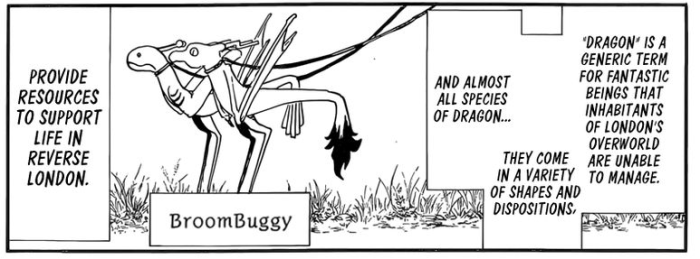
Dragons.png

Burn the Witch is about Anglo-Japanese school children fighting demons in fantasy Britain. The twist? Unlike their counterparts in fantasy Mexico, the British demons (referred to as ‘Dragons’ in-series) aren’t killed outright. Instead they are raised for the resources they provide. Only ‘bad’ demons who are killing humans or otherwise causing destruction are killed. It is noteworthy that the protagonists refer to themselves as ‘conservationists’. They kill the occasional demon, providing the story with action scenes when doing so, but their primary purpose is to conserve them. In an off hand comment the protagonists note that their fantasy Mexican counterparts are barbaric and indiscriminately kill their demons.

Contrary to the protagonist’s comments, it isn’t that individual fantasy Mexicans are barbaric so much that fantasy Mexico doesn’t recognize property rights in demons. Since no one has a property right in demons, no one has an incentive to conserve, much less domesticate, them in fantasy Mexico. Fantasy Britain enjoys strong property rights and consequently has minimal problems associated with its demons. One of the protagonists is ethnically from fantasy Mexico, but seems to be thriving under fantasy Britain’s rules. The story’s lesson? Property rights matter.

Only one chapter of Burn the Witch has been published thus far, and it’s unclear if it’ll become a recurring series, but I like what I’ve seen so far.

Thoughts? Comments? As always, write in the comments below. If you’re a fan of animation and a fellow libertarian, consider joining the anime libertarian alliance facebook group.

Crediting Co-Authorship

“… Who worked with you”

“Didn’t you know? It was Tamwile Elar. He worked out the theory that made the device possible and I designed and build the actual instrument.”

“Does that mean he took the credit, Dr. Monay?”

“No, no. You mustn’t think that. Dr. Elar is not that kind of man. He gave me full credit for my share of the work. In fact, it was his idea to call the device by our names – both our names – but he couldn’t.”

“Why not?”

“Well, that’s Professor Seldon’s rule, you know. All devices and equations are to be given functional names and not personal ones – to avoid resentment.”

-Forward the Foundation, Isaac Asimov

Most of my research is co-authored. As I noted in my previous post, I strongly believe that science is a collaborative enterprise. I of course have a few solo authored working papers, mainly those that I hope to include in my dissertation, but for the most part my work is with others. A problem with this is deciding how to credit the paper. Who gets the prized first author spot? Is it the most senior member of the team? The person who came up with the initial idea? The former RA who got upgraded to co-author status to avoid having to pay them? All of these can be tricky and can lead to resentment among co-authors.

I’ve seen various alternative arrangements to try to side step the issue. There are those who list co-authors by alphabetical order or alternate first authorship (Landgrave & Christensen 2015, Christensen & Landgrave 2016, etc etc). A few, like my grand advisor, combine their names with frequent co-authors (e.g. McNollgast). As cool as Christgrave sounds, I think these alternatives ultimately fall short because they continue to personalize science. It’s not clear to me what the benefit of this is. Not only does this lead to resentment among co-authors but it, I think, slows down the revision process as people mis-interpret critic on a given idea as a personal attack.

It is entirely possible, for example, to dislike JM Keynes’ work but to be indifferent or even warm towards the man himself. Likewise, it is possible to praise someone’s work, but find them to be personally awful.

Would it not be better to refer to papers by institutions or ‘labs’? Coase’s theory of the firm would, for example, be referred to as LSE 1937, as opposed to Coase 1937.

Thoughts? Comments? As always, write in the comments section!

#microblogging

Some quick thoughts from Athens

I spent the last week and a half in Greece (mainly Athens and other historical sites in the Peloponnese) thanks to the Reason, Individualism and Freedom Institute, and explored ancient political philosophy in a modernly turbulent state. I’m writing this in Naples. Here are a few thoughts I had from the first couple days in Athens.

There is a strong antifa presence (at least judging from graffiti, small talk with some locals and the bios of Grecian Tinder girls). I can’t help but imagine the American antifa pales in comparison. Our black bloc — thrust into the spotlight in mostly superficial college campus debates — tends to be enthusiastic, whereas the antifa in Hellas, culturally sensitive to millennia of dictatorships, entrenched aristocracies, Ottoman annexation, great power puppeteering and a century of neighbouring fascist regimes, must be somber and steadfast. Our antifa crowd has so little targets to find Ben Shapiro a worthy protest, whereas Golden Dawn, the ultranationalist, Third Reich-aesthetics Metaxist party gets 7% in the Hellenic Parliament. Nothing here is spectacle. (Moreover, the extreme-right in Greece, according to our tour guide, has been known to worship and deify mainstream Christian figures as well as the ancient gods spawned of Uranus and Gaia. Umberto Eco’s immortal essay Ur-Fascism explained phenomena like this as the ‘syncretic’ element of fascist traditionalism.)

Moving past the fascists and antifa, in general Greece is left. The Communist Party of Greece, KKE, gets about 5% of the votes and displays a sickle and hammer. More telling still, plenty of the leftist graffiti is actually representing the KKE. Political parties tend to de-radicalize, or are supposed to in theory, and the fringe ideologues disavow the party for centrism or weakness (it’s funny to think of American socialists spray-painting the initials of the CPUSA). The graffiti stretches all the way to Lesvos, of Aristotle’s biology and Sappho’s poetry, and to Corinth of the cult of Aphrodite, but is most prominent in downtown Athens.

Athens has an anarcho-friendly district with a rich history called Εξάρχεια, Exarcheia. Antifascist tagging is complimented by antipolice, antistate, antiborders and LGBT designs, the Macedonian question is totally absent, and posters about political prisoners stack on each other like hotels on ruins. Our friends at KEFiM warned us about Exarcheia — it has a history of political/national xenophobia, and one member had been violently assaulted — but I had already visited on the first day. Aside from a recently blown-up car, it wasn’t too different from Berkeley — nice apartments and restaurants juxtaposed with street art and a punk crowd, drug dealing, metal bars on windows. Granted, this was in daylight and I saw only what was discoverable with Google maps. Still, I had the fading remains of a black eye and my usual clothing is streetwear, so maybe I wasn’t too out of place — even as an American and thus most hated representative of that target of so much antifascist graffiti, NATO.

Much of the larger politics of Greece were not easy to discover from our various tour guides. Just like the ancient myths of the country, they constantly contradict each other.

The Athens underground metro was incredibly clean and modern — infinitely more than in Atlanta, San Francisco, Los Angeles, etc. — while their roads are constipated and chaotic. Duh, the city itself is one of our most ancient settled, and so roads have proceeded in a particularly unorganized fashion. But it did cause me to consider the beauty that on a planet where our civilizations literally build on each other generation after generation — and, in an uncommon historical epoch where conquering is out of fashion — sometimes the only place to go is down. Humans have expanded our surface area in dimensions completely unfathomable to the diasporic colonizers from ancient Crete.

The syncretic chaos of the streets, though nauseating to the newcomer, lends itself to almost divine levels of flânerie, such that one can walk hours without reaching any particular destination and feel accomplished. Nothing much looks the same when Times Square melts into an ancient agora melts into a Byzantine church melts into the beach. Attica is wildly heterogeneous and beautiful; modernist adherents to classical Greek conceptions of precision-as-beauty should be humbled.

I should add also that my first impressions of Athens (and Catania) was how much it looked like something out of a videogame. The condition of 21st century man is that, upon visiting foreign cities for the first time, he will invariably compare them to Call of Duty maps.

On a few occasions, enough for me to notice but not enough for me to declare it a custom, my server (who sits me, takes my order and waits on me) gave me extra food on the side. This only happened at small restaurants that aren’t overly European and might be an orange juice, fruit bowl or something small and similar. Every time, of course, I left a larger tip. These actions put us in a sort of gamble. For the waiter to bring me something periphery, he might expect a grander gratuity. Then, when I notice the extra item, I have to assume that it’s not just a mistake — that he didn’t think I ordered something extra which will appear on my tab. He and I are both sort of gambling our luck. Of course, it’s not a real gamble — in every instance we were at least partially sociable prior and lose nothing substantial if it doesn’t work out. What is interesting is that we’ve removed ourselves just a little from the law — I am only legally obligated to pay for what I ordered; he is only legally obliged to bring me what I paid for. Still, without the legal backdrop, everyone leaves happy. Left-libertarians would like it.

(As everyone knows, the Greeks are very hospitable and friendly, and this is a testament to that. A counter-example: I went to a gay club for the first time in the rainbow district of Athens. I can’t speak enough of the tongue to talk to women anyway, and there is at least a chance that some guy will buy us drinks. Nobody buys us drinks. The only conclusions are that we’re not handsome enough or the Greeks are not as friendly. It has to be the latter.)

I should quickly add something about coffee. Where it not for the drought of drip coffee, I could easily stay in the Mediterranean forever. Alas, to literally order an “iced coffee” — kafe frappe — you are ordering a foamy concoction with Nescafé. To order a Greek coffee (known as a “Turkish coffee” before tensions in the 1960’s) means an espresso-type shot with grounds/mud at the bottom. But, the coffee culture is fantastic — the shops are all populated with middle-aged dudes playing cards, smoking rollies, and shooting the shit. I don’t think I need to describe the abominable state of American coffee culture. Entrenched in their mud, the Greeks resisted American caffeine imperialism. Starbucks tried and failed to conquer the coffee market: there were already too many formulas, and the Greeks insisted on smoking inside.