Around the Web: Notewriters Edition

Woah, it’s been a slow week here at NOL. I can’t speak for anybody else, but I’ve been busy. Michelangelo and Edwin have both recently had their work published by the Cato Institute, and that’s cool.

I wish, of course, that my fellow Notewriters would toot their own horns a little more often, especially on the blog, but rest assured loyal readers, we’re staying busy.

Around the Web

  1. Why Women Hunt: Risk and Contemporary Foraging in a Western Desert Aboriginal Community (pdf)
  2. Competing to Be Leaderless: Food Sharing and Magnanimity Among Martu Aborigines (pdf)
  3. In Pursuit of Mobile Prey: Martu Hunting Strategies and Archaeofaunal Interpretation (pdf)
  4. Signaling Theory, Strategic Interaction, and Symbolic Capital (pdf)
  5. Rethinking Rights (and Freedom): A Series (be sure to scroll through the ‘comments’)
  6. Deconstructing Colonial Historiography: A Case Study of Afanasy Nikitin

“Rand Paul’s Libertarian Lecture in New Hampshire”

That’s the title of this short piece of reporting by the Weekly Standard‘s Michael Warren (the Weekly Standard is a neoconservative outlet). I recommend the whole thing, but cannot resist sharing an excerpt:

Without mentioning his name, Paul took on fellow Republican senator Lindsey Graham of South Carolina, who may be running for president and who spoke to the conference just a few minutes after Paul. Paul and Graham were on opposing sides during a 2011 Senate debate on indefinite detention of American citizens accused of terrorism. Graham’s argument was that these Americans ought to be classified as unlawful enemy combatants, and that the rules of war apply so long as Congress has authorized military action. Enemy combatants can be detained for as long as hostilities continue or when Congress otherwise says so, goes the thinking. “And when they say, ‘I want my lawyer,’ you tell them ‘Shut up. You don’t get a lawyer. You’re an enemy combatant,'” Graham had said during the floor debate.

But Paul didn’t see it that way.

“One of them said, ‘When they ask for a lawyer, you just tell them to shut up.’ Really? That’s the kind of discourse we’re going to have in our country? Tell them to shut up?” Paul said. “You would send an American citizen to Guantanamo Bay without a lawyer, without a trial? He said, ‘Yeah, if they’re dangerous.’”

Paul cracked a smile as he launched into full libertarian lecture mode.

“It sort of begs the question, doesn’t it? Who gets to decide who’s dangerous and who’s not dangerous?” he said, pacing back and forth across the stage in blue jeans and without a jacket. “Has there been a time in our history when we decided who was dangerous based on the color of your skin? Has there been a time in our history when we decided someone was dangerous because of different beliefs, didn’t look like us, or had a different religion? Are we going to give up on our right to trial so easily?”

Say what you will about Paul, but you won’t see anybody else in the primaries discussing the issues he discusses. The rest of the article has a lot more great stuff, and not only about the battle for the soul of the GOP, but bigger issues – thanks in part to Paul’s initiatives in the Senate, but also to the work of libertarian theorists and activists for the good part of four decades – such as asset forfeiture. Also, more subtly, you can find a penetrating insight into democracy itself (and if you find it, brag about it in the ‘comments’ threads, as I’d like to discuss it further). (h/t James Parsons)

New issue of Reason Papers is out

“A Journal of Interdisciplinary Normative Studies.” Check it out (pdf). Yours truly makes an appearance at the end of the journal, if you’re interested (I critique the student libertarian movement using an informal ethnographic method).

Here is the rest of the line-up:

Symposium: Christine Vitrano’s The Nature and Value of Happiness

Human Happiness and Virtue: Are They Related and, If So, How? —John Kleinig

Happiness, Pleasure, and Satisfaction —Christopher Rice

Response to My Critics —Christine Vitrano

Symposium: Emergencies

Consent-Based Permission to Kill People and Break Their Things —Stephen Kershnar

Catastrophic Events versus Infectious Disease Outbreak: Distinct Challenges for Emergency Planning —Thomas May et al.

Discussion Notes

Happiness or Life, or Both: Reply to Ole Martin Moen —David Kelley

Reply to Danny Frederick’s “Review Essay: Mark D. Friedman’s Nozick’s Libertarian Project: An Elaboration and Defense” —Mark D. Friedman

Reply to Mark Friedman —Danny Frederick

Articles

Fetuses Are Like Rapists: A Judith-Jarvis-Thomson-Inspired Argument on Abortion —Stephen Kershnar

The Scope of Attorney Confidentiality —Clifton Perry

Portraits of Egoism in Classic Cinema II: Negative Portrayals —Gary James Jason

Don’t Be an Ass: Rational Choice and Its Limits —Marc Champagne

Review Essay

Review Essay: Philip Booth’s . . . and the Pursuit of Happiness: Wellbeing and the Role of Government —Gary James Jason

Book Reviews

Robert Audi’s Moral Perception —Danny Frederick

Paul Blackledge’s Marxism and Ethics —Dan Swain

Gerhard Böwering et al.’s The Princeton Encyclopedia of Islamic Political Thought —Adam Walker

Afterwords

The Symbolic Clash of Whiplash —Robert Begley

In Search of Student Radicalism: YAL, SFL, and the GOP —Brandon Christensen

Be sure to check out the easy-to-navigate archives, too. Browsing through these issues is well-worth your time. Here (pdf), for example, is an issue with an excellent symposium on Sari Nusseibeh’s What Is a Palestinian State Worth?

Around the Web

  1. “It is a Strict Law That Bids Us Dance”: Cosmologies, Colonialism, Death, and Ritual Authority in the Kwakwaka’wakw Potlatch, 1849 to 1922 (pdf)
  2. Prime Factors
  3. Competitive Displays: Negotiating Genealogical Rights to the Potlatch at the American Museum of Natural History (pdf)
  4. Bad Weather: On Planetary Crisis (pdf)
  5. Do Muslims Belong in the West?

Calls for harsh criticism: my first (of four) graduate school statement of purpose

Note: this is my statement of purpose (SOP) for a graduate program in anthropology at Emory University. I am also going to apply to Stanford, New Mexico, and Chicago. This is only a rough draft. I have given myself plenty of time to make these perfect, so I am posting this here in order to get harsh feedback and also in case anybody ever finds himself in my position (looking online for examples). The application process consists of five parts: grades, GRE score, Letters of Recommendation, SOP, and resume. My big weaknesses are the SOP and Letters of Recommendation. Any help I could get on my SOP would be great! UPDATE (4/14): Dr Khawaja has kindly provided a forum for my other weakness, the Letters of Recommendation, over at Policy of Truth and I have been learning a lot.

I am interested in land contestations, property rights in stateless regimes, and state formation. There are two main reasons for this. First, I spent three months in the Ghanaian village of Wiamoase, a remote outpost in the Ashanti region, with a medical anthropologist who was then doing graduate work on placebo effects and shamanism at Boston University. Ghana was on the threshold of a third consecutive, coup-free presidential and parliamentary election cycle and I was able to observe how these elections were interpreted by rural Ghanaians. Two major factions figured prominently in the electoral calculations of Ghanaians: the aid-lending Global North and rival, ethnic-based domestic factions. These calculations reminded of the work done by the historian Charles Tilly on the slow rise of democracy in France and the role played in this contestation by the landowning aristocracy. I then decided to conduct an informal survey where I asked villagers whether they had more trust in the politicians of Accra or in the land-holding chiefs who leased out farmland. The unanimous response to my unscientific survey was that the trust of the villagers was in the land-holding chiefs.

Second, at Cabrillo College – a community college in central California – I did Honors research on Javanese political strategies and the Dutch colonial practices that those strategies induced. I was particularly intrigued by the narrative of condescension that dominated Western scholarship up until the 1960s, when the Javanese finally began to be depicted by (some) historians as active, willing participants in the new relationships that were formed by the arrival of European settlers. I presented the results of this research at Stanford University in 2011 as part of a Bay Area Honors consortium, where challenging feedback from professors and participants allowed me to show how this research is relevant to understanding today’s examples of both large-scale organized violence and economic development (or lack thereof).

This research was also featured, in modified form, at RealClearHistory in February of 2014. RealClearHistory is part of the RealClear online series that features work from academics, policymakers, and journalists from around the world on issues ranging from science to history to international relations. RCH also featured my articles on the limits of Japanese imperial ambitions during the Shōwa era and on the European Union’s potential for avoiding the nationalisms of the 20th century by providing inclusive outlets for separatist aspirations. The research done for these features, coupled with my electoral experience in Ghana, produced two notions of democracy in my mind: democracy as a colonial project, and democracy as a power-sharing institution; both of these notions feature prominently in Somalia, my main area of interest, today.

Building upon the work of Peter Little, states are generally taken to be a necessity because of the benefits they provide in regards to public goods. In the postcolonial context, however, states are often wielded as a bludgeon and used as an ATM machine by those who attain its levers of power. When a faction – usually ethnic- or geography-based – wins out in a postcolonial state, the other factions lose power (this is in contrast to long-established, more-or-less democratic states, where “losers” still have institutional representation in a number of ways).

Given this situation, I am interested in both the process of state formation in the postcolonial context, and in the idea of taking seriously notions of informal sovereignty – as exemplified by non-state (indigenous) cooperation at the regional and local levels of borderlands – within current internationally-sanctioned boundaries. In the course of writing my article on nationalisms and the EU, for example, I discovered that three distinct cultural cores of the world – South Asia (India, Pakistan, Bangladesh, Nepal, Bhutan, and Sri Lanka), the Horn of Africa (Somalia, Eritrea, Ethiopia, Yemen, Sudan, Djibouti), and the European Union – have similar geographic spaces, ranging in size from 4.31 million km² to 4.482 million km². Yet within these similar geographies, the comparative number of states is stark: both the Horn of Africa and South Asia are comprised of six states each, while the European Union has nearly five times as many (twenty-eight since 2013). The GDP (PPP) per capita – a leading measurement tool used to gauge the economic health of a country – of these regions (based on 2012 IMF estimates) provides another stark insight: the EU’s GDP (PPP) per capita stands at $31,018, whereas South Asia’s stands at $3,805 and the Horn of Africa’s is $1,679. These are simple but profound economic and geographic quantitative rifts that have yet to be fully explained, especially in the context of the contestation over defining democracy. Can these macro-level data, in turn, be complemented by looking at informal, cross-border market cooperation, comparative interethnic & intraethnic trading strategies, and power-sharing political institutions? More theoretically: Do these informal economies form the basis of viable states?

The pastoralists in southern Somalia offer an avenue of exploration into these questions, especially the cross-border trade between pastoralists and cattle traders in Somalia and Kenya. I am unaware of research being done on how property rights are agreed upon by the parties involved in this sector of the economy, but the quasi-corporate organizational structure of the actors in the cattle supply chain identified by Dr. Little have ample potential. While much work has been done on the destination of Somali cattle products, and on the traders who act as intermediaries between herders, sellers, and producers, the perspective of Somali herders on the regional informal economy has not been studied in depth. How does both land – as an economic factor of production – and conceptions of property rights affect pastoralists’ economic decisions and political acumen? Ethnographic accounts of herder perspectives on informal economies in general and on the supply chain of their cattle in particular can also build upon the foundations necessary for understanding larger-scale social phenomena such as state formation and neocolonial institutions.

I spent most of my time at UCLA living in an outdoor track-and-field stadium and hauling around a cardboard box with all of my belongings in it, which taught me to be determined and I only mention this because it’s good evidence that I have the perseverance necessary to pursue a doctoral degree from your program. My experience in homelessness is not limited to my time at UCLA. I was born in the cultural center of the Mormon world and, when I left that world at a relatively young age, was exposed to the sometimes harsh realities of poverty in the United States. I mention this experience because it has taught me who to pay attention to depending on what I need and what I want. The work of Peter Little on the formal and informal economies of pastoralists in the Horn of Africa has, in particular, attracted my attention, and I hope to be able to learn directly from him. David Nugent’s work on comparative state formation methods is also an area of research I would learn much from, as is the work of Michael Peletz on Islamic law and its relationship with state formation in Southeast Asia.
From the Comments: Types of Federalisms, Good and Bad

Adrián‘s response to responses by me and Michelangelo on his initial response to a comment by Michelangelo that I highlighted in a post of mine (whew!) deserves a closer look:

Guys, thanks for your comments, and apologies for the delay in responding!

1. I share your love for idle speculation. I’d say my fundamental difference with you lies elsewhere: you grew up/are very familiar with a country where federalism has worked pretty well (with notable exceptions, such as slavery and the Jim Crow laws), while I came from another where federal institutions are full of perverse incentives. So, whenever somebody proposes a federal arrangement, I immediately perceive the costs, while you’re more open to the potential benefits.

2. That said, I think an useful way for thinking about federal structures is to analyze the incentives faced by subnational governments. (a) Some subnational governments are accountable to domestic audiences, and thus they seek a federal structure where subnational governments retain considerable autonomy, including autonomy over taxation. This is the kind of federation that fosters tax competition and experimentation, with the US and the EU as good examples. (b) In other contexts, subnational governments are not fully accountable to domestic audiences (even with elections) and thus they devise federal institutions as mechanisms for extracting and distributing rents among themselves, and they use these rents to perpetuate themselves in power. Rather than keeping authority over taxation, they purposefully delegate their tax authority in the federal government to collect taxes for themselves. In other words, the federal government acts as a enforcer of a cartel: it establishes the same tax rate everywhere, collects the money, and distributes it between the states according to some highly politicized formula. This is the kind of federalism that predominates in Latin America: Argentina, Mexico, and to a lesser extent Brazil.

In sum, my point is that creating a federation among governments that are not responsive to voters will lead to the second type of federation. I don’t see the Middle East creating a fully functional federal system unless governments in the region become fully responsive to voters, which will require much more than competitive elections.

3. Michelangelo: I agree with 95% of what you say about Turkey and Israel, especially the EU part, and I obviously believe that it is a good thing these countries trade more and develop better relationship with each other. That said, the main reason why I don’t see these countries forming a federation is a more fundamental one: (a) that neither Turkish nor Israeli politicians have anything to win by creating a federal arrangement, and (b) given Turkey’s enormous size with respect to Israel, this problem is especially important from the Israeli point of view.

There is more on federalism at NOL here. Check out Adrián’s posts here, and Michelangelo’s are here.

Around the Web

  1. A Republic of Cuckoo Clocks: Switzerland and the History of Liberty (pdf)
  2. Pastoralism in a Stateless Environment: The Case of the Southern Somalia Borderlands (pdf)
  3. The Profits of Power: Land Rights and Agricultural Investment in Ghana (pdf)
  4. Rethinking Postcolonial Democracy: An Examination of the Politics of Lower-Caste Empowerment in North India (pdf)
  5. Working Across Borders: Methodological and Policy Challenges of Cross-Border Livestock Trade in the Horn of Africa (pdf)

From the Comments: The Suprastate and the Substate

My post on American Senator Rand Paul’s recent remarks on Kurdistan elicited the following response from fellow Notewriter Michelangelo:

If a neo-Ottoman federation arises I suspect it will begin as a political alliance between Turkey and Israel. Perhaps such a federation will arise from the Mediterranean Union, who can know really. The two countries are already relatively close in interests and are, alongside a few of the Gulf States, the closest things the region has to secular liberal powers. The Turks at this time would not favor an independent Kurdistan though and I fear they might withdraw support for a federation if that was part of the package.

I think it would be easier to first form an Ottoman federation and afterward grant Kurds their independence within the federation.

It is hard for me to imagine the Arabs joining said federation either way. The Egyptian-Syrian Arab republic went nowhere. Part of me (an infinitely small part!) kind of hopes ISIS manages to defeat the Iraqi and Syrian forces and creates the core of a Pan-Arab nation.

I’ll let him have the last word here (be sure to scroll though the entire dialogue), but I just want to take this opportunity to stress the importance of thinking about the world in terms we might not be used to. The standard unit of measurement – for lack of a better term – for thinking about international affairs is the nation-state, but this way of thinking about the world has, like all devices humans use to make sense of their world, weaknesses as well as strengths. To my mind, as the world becomes increasingly interconnected thanks to liberalization, the nation-state becomes less and less useful as a tool for understanding human action.

What Michelangelo is doing here is thinking ahead of the curve; he is applying the notions of suprastate and substate to international affairs. A suprastate is an organization or union that is composed of various nation-states, such as the ones Michelangelo uses in his argument (i.e. “Mediterranean Union”). A substate is a region within a nation-state, such as Kurdistan or Scotland or Somaliland.

Often, especially in debates here at NOL, the notions of suprastate and substate are used in conjunction with the developing, or post-colonial, regions of the world. This doesn’t mean these notions can’t be applied to places like the United States or Argentina. Indeed, the US itself was created as a supranational union in order to combat the strategies of the British, French, Spanish, and various Native nations. If you can entertain the notions of suprastate and substate when you think about human action, you will be that much closer to advocating clearly for the free and open society (see this piece on the informal economy by Dr Gibson, for example).

Robert Tracinski on the Left’s Anger Issues

Ooo-weee. I apologize for not being around very much this week. I’ve been bumming around and just got back into civilization in order to enjoy the second weekend of March Madness.

I have viewed Leftists as cowards for a long time now. Now, whether or not being a coward is a good thing is another question, but I nevertheless view them as cowards. Angry cowards are the worst kind of cowards, of course. Here’s Tracinski trying to figure out why Leftists are so angry:

There’s the fact that those of us on the right are accustomed to encountering a lot of ideological opposition. For most of our lives, the left has controlled the high ground of the culture, such as it is: the mainstream media, Hollywood, the universities, the arts. So we’re not used to crawling into a “safe space” and hiding from ideas we disagree with, which makes it easier for us to regard ideological opposition with a degree of equanimity.

The rest of the essay is pretty good, too. What’s that old school term for a coward? The dog who is all bark and no bite? I remember these type of people well, from when I marched in San Francisco against the Iraq War. If tomorrow’s best and brightest Leftists are refusing to even consider the opposition’s arguments, what does that say for the future of the West?

But really, though: How on earth did the government come to be in charge of the roads?

Around the Web

  1. Contrary to popular myth, Democrats are just as ideological as Republicans, and Republicans are just as group-centric Democrats
  2. The Rule of Karlowitz: Fiscal Change and Institutional Persistence (pdf)
  3. The Privilege of Checking White Privilege
  4. The Wealth of Subnations: Geography, Institutions, and Within-Country Development (pdf) (h/t Adrián)
  5. Shakespeare in Tehran “I also noticed among the men a few who stood apart and did not seem to be either students or faculty. It was not difficult to imagine who these might be.”
  6. The new economic history of Africa (pdf)

Whither the ‘Liberty Canon’ series, amongst other questions?

For those of you who have been wondering what happened to Dr Stocker’s posts here at NOL, the man has been busy:

Apologies for lack of blogging. Rather basic tasks, particularly very detailed note taking on Homer for a philosophy and literature class on Homer and Vico, are the main reason. Hopefully the immersion in Homer will pay off soon in blogging, research and writing, as well as teaching.

Anyway rather appropriately given my current preoccupation, I have very recently been offered a contract by Macmillan Palgrave to co-edit the Palgrave Handbook of Philosophy and Literature. It should be out in 2017, comprising a large number of essays on basic topics in philosophy and literature, with the editors contributing an apparatus of an introduction, conclusion, index and the like, along with an essay each.

The other editor is Michael Mack of the Department of English Studies, Durham University, UK. Do have a look at his university homepage and see details of his extensive and excellent contributions to philosophy and literature. I’m very fortunate that he has agreed to work with me on this project.

Back to Homer now. Blogging here again and getting on with other commitments soon.

Congrats are in order to Dr Stocker, though I have to say I’ll miss him while he’s working. Maybe when he’s done with his very serious work, I can convince him to blog not only about the history of thought in the Western world, but also to blog more often about domestic Turkish politics and liberal (i.e. libertarian) UK politics, and affairs in the Middle East (three more areas where his expertise is second to none; see here and here, for example). What do you say?

I know I state this often, but be sure to follow along in the ‘comments’ threads to some of our conversations. Unlike a lot of blogs, they’re of pretty high quality (if you ask me!).

I know Jacques just got back from Mexico, and Matthew is still trolling Europe (last I heard he was in Greece), so hopefully their travels will elicit some expert notes about the world.

Has Senator Rand Paul been reading NOL?

Oooo lawdy!

“Part of the problem is the Kurds aren’t getting enough arms,” Paul said. “The Kurds are the best fighters. The arms are going through Baghdad to get to the Kurds and they’re being siphoned off and they’re not getting what they need. I think any arms coming from us or coming from any European countries ought to go directly to the Kurds. They seem to be the most effective and most determined fighters.”

In addition, Paul called for giving the Kurds their own country for them to defend against radical Islamists.

“But I would go one step further: I would draw new lines for Kurdistan and I would promise them a country,” Paul said.

Cue the notes here at NOL on adhering to a more internationalist foreign policy: decentralization, secession, devolution, and federation. Notice that Paul is not calling for the US to draw up boundaries between imperial powers. He’s simply calling for the international community that the US largely built to recognize the sovereignty claims of peoples in the post-colonial world, peoples who were ignored when the imperial powers did their carving up over a century ago.

Which option sounds better to you: 1) ignoring the whole situation in the Middle East, 2) pretending that states in the Middle East are legitimate and continuing with the status quo (random bombing campaigns, giving money to dictators to squelch Islamists and socialists), or 3) recognizing that the US could contribute to a more internationalist world by welcoming aspirant regions into statehood, and destroying the legacies of colonialism and Third World nationalism?

Eye Candy: the GDP (PPP) per capita of OECD Administrative Units (UPDATED)

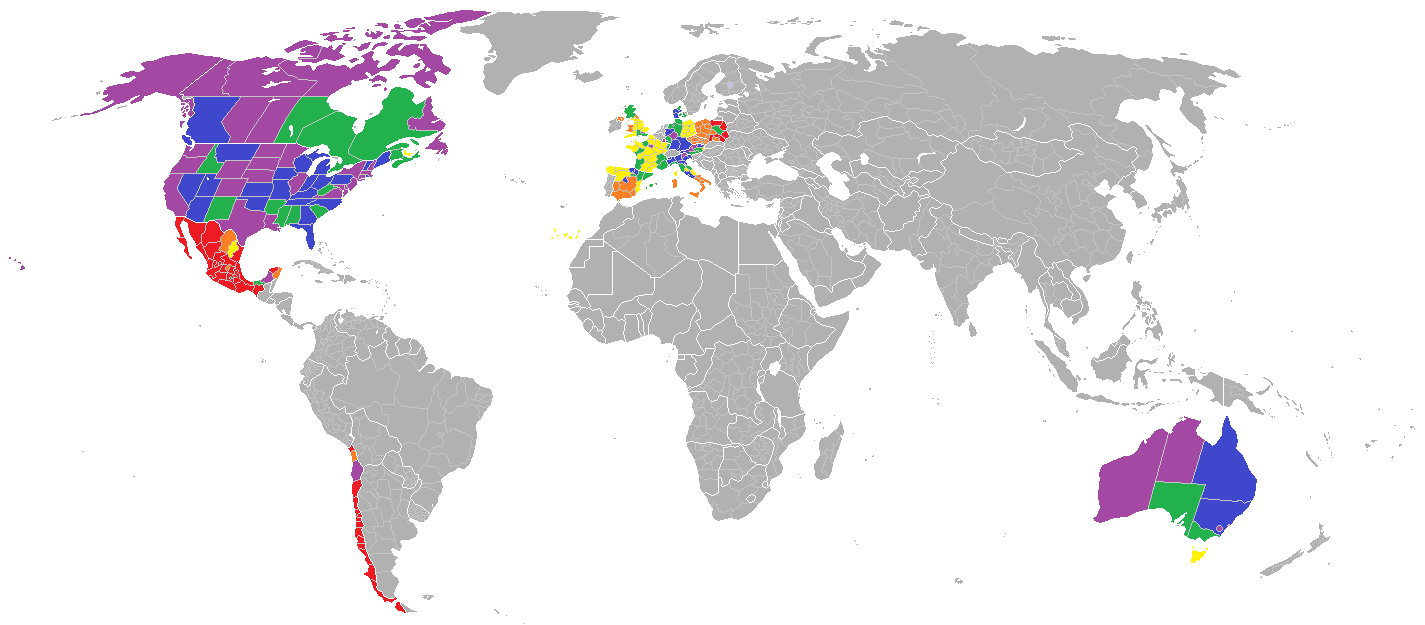
Here is what I was able to patch together in my free time.

The countries I’ve filled in were about half of the OECD. The data is hard to get on administrative units elsewhere in the world (I got my data from the OECD website), but it was also hard to get for OECD states. The reason it was hard is because OECD data collectors divide up administrative units into two separate categories (TL2 and TL3) that sometimes correlate to traditional administrative units (such as California or New South Wales) and are sometimes arbitrary creations of EU or OECD bureaucrats designed specifically for data collection (rather than for understanding the historical trajectory of regions within a state).

Does this make sense?

To make matters worse, sometimes the TL2 category correlated with an actual administrative unit with political representation in a capital, and sometimes the TL3 category was the actual administrative unit with political representation. So I had to thumb through the nitty-gritty details of how OECD states send representatives to central parliaments and then match those real-life details to the data collectors TL2 and TL3 categories.

Does this make sense?

The map above highlights the US, Canada, Australia, Germany, France, the UK, Spain, Poland, Austria, Italy, Czech Republic, Chile, Denmark, and Mexico. These countries are all TL2 states.* I have no idea what that is supposed to mean for data collectors, but it means to dorks like me that their TL2 categories send political representatives to capital cities, whereas their TL3 categories likely send political representatives to regional capitals.

Does this make sense?

I have continued entering the data that the OECD has provided for the GDP (PPP) per capita of TL3 units (which send political representatives to capital cities), but the map I downloaded does not outline TL3 units (it only outlines TL2 units). So unless I want to spend time carving out TL3 units onto a TL2 map I am going to have to stop filling out the map. I’m all for collaboration on this, of course.

Here is the table I have (very slowly) been working on, but when I colored in the map above (the TL2 states), I divided them up into six groups based on highest GDP (PPP) per capita to lowest. The richest administrative units were purple, followed by blue, followed by green, followed by yellow, followed by orange, followed by red. So: purple is rich, red is poor. Got it? Because I started adding the TL3 states to the table, and because the map doesn’t allow for me to add the TL3 states to it, I forgot the range of the colored TL2 units. Dividing them up into six groups is a pretty easy task, though, so you should just trust my coloring scheme.

The map I created doesn’t have a very good zoom-in function, but what I found interesting is that Europe has a lot more economic inequality than the US, Canada, and Australia. Look at France. It’s mostly yellow, and the only purple (rich) administrative unit is Paris metro. This suggests, of course, that wealth in France is concentrated in the capital. The UK looks just like France (as does Spain). Germany is divided in half (as is Italy), and Austria and Denmark are cool, rich colors. Canada and Australia only have one yellow province each, and the US has none. Mexico looks just as Michelangelo described it, and Chile looks like Spain.

This is the OECD page I’ve been using. Here’s how I find regional GDP (PPP) per capita:

  • select “Regions and Cities”
  • select “Large (TL2) and Small (TL3) regions” – remember it’s either/or here: either TL2 or TL3 but not both
  • select “regional GDP per capita”
  • Then for measures (top of table) select “per head, current prices, current PPP”

I’ve been using 2011.

This pdf lists the “territorial grids” (TL2 and TL3 regions) of the OECD. The pdf didn’t help me figure out which regions send political representatives to capital cities and which are arbitrary, bureaucratic creations (I got to do that on my own!), but lists can definitely be helpful. In many cases I was able to figure out which units are politically viable and which are arbitrary for data collecting purposes just by looking at the list.

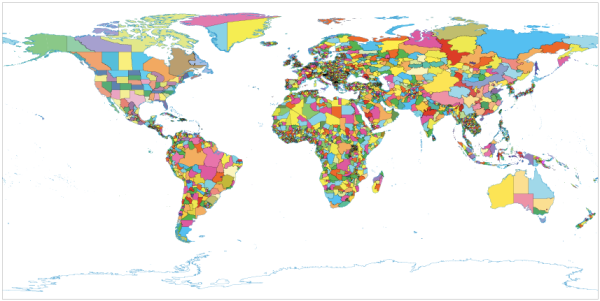
Finally, here is a map – courtesy of kelsocartography.com – of the world’s administrative units, at the TL2 level. Lots of work to do.

A good map of the world's administrative units
Here is a map of the world’s administrative units (courtesy of kelsocartography.com), but not necessarily the units that data collectors use to calculate GDP (PPP) per capita.

I like using the GDP (PPP) per capita of administrative units because I think it gives a much more stark picture of life around the world. I have pointed out before that the UK is now poorer than Mississippi, but breaking down the UK in the same manner as we do the US reveals that not only is the UK poorer than the poorest US state, the purchasing power parity of British citizens within the UK looks a lot more unequal than what we see in the United States. What is going on in the UK? The NHS can’t be that bad.

* – Oops, except for Denmark (it’s TL3)

UPDATED (3/11/2015): Continue reading

Some notes I wrote that I’ll never finish

Here you go. Make of them what you will – BC.

—————————–

I would argue that it can matter, and often does, from a certain vantage point.

The West is not open-minded when it comes to recognizing centrifugal forces in a post-colonial state, though. The argument is that smaller states will have less power than the single, unified state currently in place. (when Democrat Joe Biden borrowed my arguments by suggesting Iraq be carved up into three states.) This doesn’t refute your musings, at all, but complements them in a way.

So size does matter, from a certain point of view.

———————————————————————————-

zero-sum game is not real; logic is sharp mostly in socialists and libertarians, so then we move on to facts to get at the truth of the matter.

————————————————————

I tend to see the West as Europe, the Anglo-Saxon world, and Latin America. Korea, Japan, and India are also Western in my mind, but I am an open-minded son-of-a-bitch and realize that some folks just can’t see the connection. They see brown and yellow people, and they see the struggle between conservatism and liberalism being played out there, and they think to themselves “those aren’t Western societies!”

Russia is somewhere in-between the West and the other West. India, Pakistan, Bangladesh, Iran, Turkey, the entire Levant, North Africa, hell, the entire Arab world save for Saudi Arabia and Yemen were Western until the Cold War ramped up.

Why do Europeans and Latin Americans tend to be much more hawkish than North Americans? (I can’t say much about Indians and East Asians, though I suspect they are somewhere in between North Americans and Europeans.Latin Americans because their choices are very different from the traditional West’s; Pakistan and China are very different from Russia and the Arab world, and the US plays different roles in Asia as well.)

——————————————————

Fuddy-duddy conservatives and large swathes of the Left are not advancing the conversation. Jacques complains that Foucault is full of shit. Leftists – far from being offended or threatened, simply roll their eyes (if he’s lucky), or – more often – simply ignore him.

Irfan’s link to Reason Papers shows this well. I think it’s absolutely true that postmodernism is dead. I think it was invented to replace socialism. The paper is correct in all of these things. What do conservatives do in response to this simple fact? Throw poo-poo at Leftists and stay stubbornly in their ideological cage.

This is why Barry’s posts are so impressive. They advance knowledge and understanding. The reactions – from both the monkeys in the cage on the Left and the monkeys in the cage on the Right – to Barry’s pieces range from vitriolic to rudely skeptical. This signals, to me at least, that Barry is on the right track. He is much closer to the Truth than the poo-poo flingers.

Unfortunately in the post-colonial world, those fuddy-duddy conservatives and murderous Leftists dominate the conversation.

————————

http://en.wikipedia.org/wiki/List_of_princely_states_of_India

————————-

“If free enterprise becomes a proselytizing holy cause, it will be a sign that its workability and advantages have ceased to be self-evident. (111)” – Eric Hoffer, True Believer 1951 (1989 reprint)

—————————

I wonder if Falk includes supporting bad laws in this maxim?

—————————-

Is ISIS Islamic? Yes and no. Obviously, it is in some respects, but it’s a new kind of Islam. It’s political and has designated its ideological others as ‘the West’, while operating against the notion of the nation-state. I think it’s postmodernism carried to its logical end, with a regional twist of course. (Think of the destruction, real and imagined, of all those ancient artifacts. That’s post-modernism at work, not the strains of Islam we’ve been accustomed to for the last 1,500 years.