Whither the ‘Liberty Canon’ series, amongst other questions?

For those of you who have been wondering what happened to Dr Stocker’s posts here at NOL, the man has been busy:

Apologies for lack of blogging. Rather basic tasks, particularly very detailed note taking on Homer for a philosophy and literature class on Homer and Vico, are the main reason. Hopefully the immersion in Homer will pay off soon in blogging, research and writing, as well as teaching.

Anyway rather appropriately given my current preoccupation, I have very recently been offered a contract by Macmillan Palgrave to co-edit the Palgrave Handbook of Philosophy and Literature. It should be out in 2017, comprising a large number of essays on basic topics in philosophy and literature, with the editors contributing an apparatus of an introduction, conclusion, index and the like, along with an essay each.

The other editor is Michael Mack of the Department of English Studies, Durham University, UK. Do have a look at his university homepage and see details of his extensive and excellent contributions to philosophy and literature. I’m very fortunate that he has agreed to work with me on this project.

Back to Homer now. Blogging here again and getting on with other commitments soon.

Congrats are in order to Dr Stocker, though I have to say I’ll miss him while he’s working. Maybe when he’s done with his very serious work, I can convince him to blog not only about the history of thought in the Western world, but also to blog more often about domestic Turkish politics and liberal (i.e. libertarian) UK politics, and affairs in the Middle East (three more areas where his expertise is second to none; see here and here, for example). What do you say?

I know I state this often, but be sure to follow along in the ‘comments’ threads to some of our conversations. Unlike a lot of blogs, they’re of pretty high quality (if you ask me!).

I know Jacques just got back from Mexico, and Matthew is still trolling Europe (last I heard he was in Greece), so hopefully their travels will elicit some expert notes about the world.
Has Senator Rand Paul been reading NOL?

Oooo lawdy!

“Part of the problem is the Kurds aren’t getting enough arms,” Paul said. “The Kurds are the best fighters. The arms are going through Baghdad to get to the Kurds and they’re being siphoned off and they’re not getting what they need. I think any arms coming from us or coming from any European countries ought to go directly to the Kurds. They seem to be the most effective and most determined fighters.”

In addition, Paul called for giving the Kurds their own country for them to defend against radical Islamists.

“But I would go one step further: I would draw new lines for Kurdistan and I would promise them a country,” Paul said.

Cue the notes here at NOL on adhering to a more internationalist foreign policy: decentralization, secession, devolution, and federation. Notice that Paul is not calling for the US to draw up boundaries between imperial powers. He’s simply calling for the international community that the US largely built to recognize the sovereignty claims of peoples in the post-colonial world, peoples who were ignored when the imperial powers did their carving up over a century ago.

Which option sounds better to you: 1) ignoring the whole situation in the Middle East, 2) pretending that states in the Middle East are legitimate and continuing with the status quo (random bombing campaigns, giving money to dictators to squelch Islamists and socialists), or 3) recognizing that the US could contribute to a more internationalist world by welcoming aspirant regions into statehood, and destroying the legacies of colonialism and Third World nationalism?

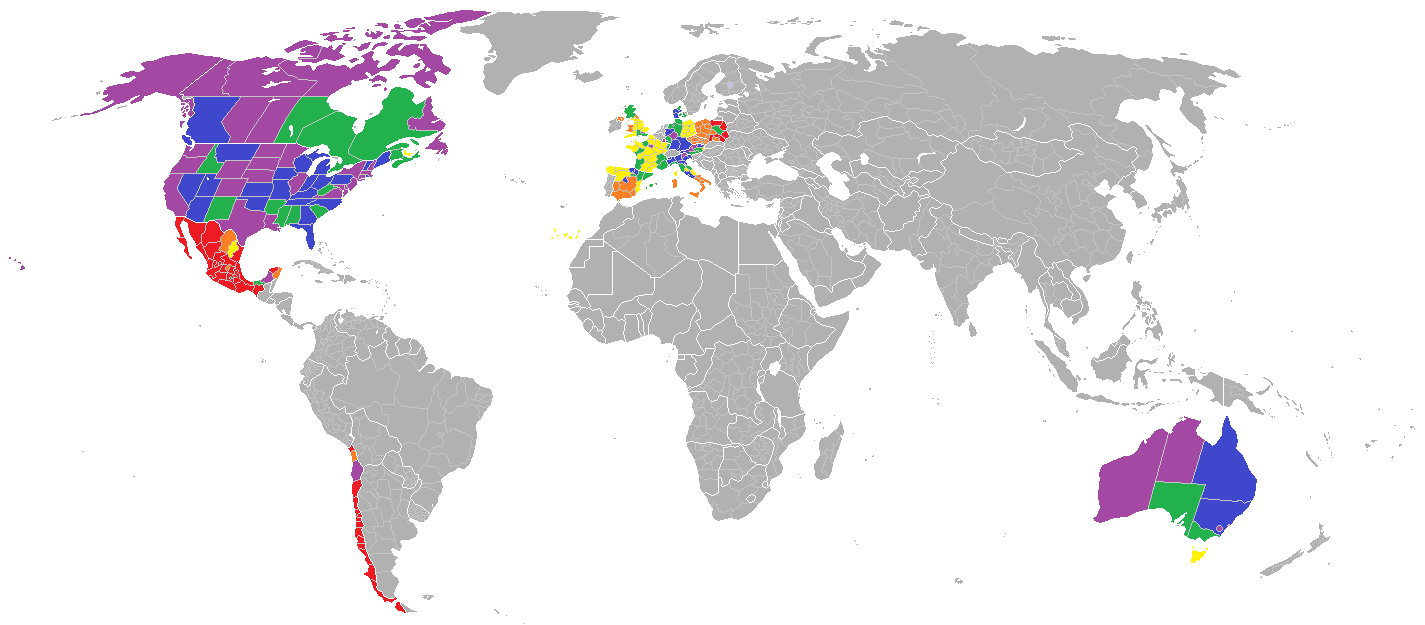
Eye Candy: the GDP (PPP) per capita of OECD Administrative Units (UPDATED)

Here is what I was able to patch together in my free time.

The countries I’ve filled in were about half of the OECD. The data is hard to get on administrative units elsewhere in the world (I got my data from the OECD website), but it was also hard to get for OECD states. The reason it was hard is because OECD data collectors divide up administrative units into two separate categories (TL2 and TL3) that sometimes correlate to traditional administrative units (such as California or New South Wales) and are sometimes arbitrary creations of EU or OECD bureaucrats designed specifically for data collection (rather than for understanding the historical trajectory of regions within a state).

Does this make sense?

To make matters worse, sometimes the TL2 category correlated with an actual administrative unit with political representation in a capital, and sometimes the TL3 category was the actual administrative unit with political representation. So I had to thumb through the nitty-gritty details of how OECD states send representatives to central parliaments and then match those real-life details to the data collectors TL2 and TL3 categories.

Does this make sense?

The map above highlights the US, Canada, Australia, Germany, France, the UK, Spain, Poland, Austria, Italy, Czech Republic, Chile, Denmark, and Mexico. These countries are all TL2 states.* I have no idea what that is supposed to mean for data collectors, but it means to dorks like me that their TL2 categories send political representatives to capital cities, whereas their TL3 categories likely send political representatives to regional capitals.

Does this make sense?

I have continued entering the data that the OECD has provided for the GDP (PPP) per capita of TL3 units (which send political representatives to capital cities), but the map I downloaded does not outline TL3 units (it only outlines TL2 units). So unless I want to spend time carving out TL3 units onto a TL2 map I am going to have to stop filling out the map. I’m all for collaboration on this, of course.

Here is the table I have (very slowly) been working on, but when I colored in the map above (the TL2 states), I divided them up into six groups based on highest GDP (PPP) per capita to lowest. The richest administrative units were purple, followed by blue, followed by green, followed by yellow, followed by orange, followed by red. So: purple is rich, red is poor. Got it? Because I started adding the TL3 states to the table, and because the map doesn’t allow for me to add the TL3 states to it, I forgot the range of the colored TL2 units. Dividing them up into six groups is a pretty easy task, though, so you should just trust my coloring scheme.

The map I created doesn’t have a very good zoom-in function, but what I found interesting is that Europe has a lot more economic inequality than the US, Canada, and Australia. Look at France. It’s mostly yellow, and the only purple (rich) administrative unit is Paris metro. This suggests, of course, that wealth in France is concentrated in the capital. The UK looks just like France (as does Spain). Germany is divided in half (as is Italy), and Austria and Denmark are cool, rich colors. Canada and Australia only have one yellow province each, and the US has none. Mexico looks just as Michelangelo described it, and Chile looks like Spain.

This is the OECD page I’ve been using. Here’s how I find regional GDP (PPP) per capita:

  • select “Regions and Cities”
  • select “Large (TL2) and Small (TL3) regions” – remember it’s either/or here: either TL2 or TL3 but not both
  • select “regional GDP per capita”
  • Then for measures (top of table) select “per head, current prices, current PPP”

I’ve been using 2011.

This pdf lists the “territorial grids” (TL2 and TL3 regions) of the OECD. The pdf didn’t help me figure out which regions send political representatives to capital cities and which are arbitrary, bureaucratic creations (I got to do that on my own!), but lists can definitely be helpful. In many cases I was able to figure out which units are politically viable and which are arbitrary for data collecting purposes just by looking at the list.

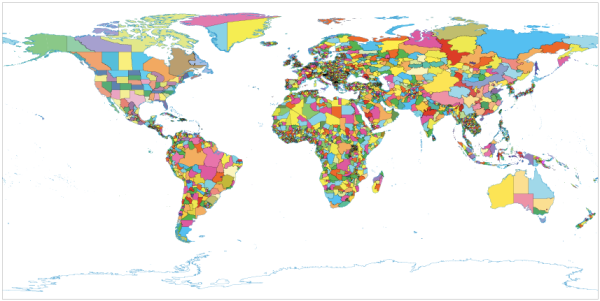
Finally, here is a map – courtesy of kelsocartography.com – of the world’s administrative units, at the TL2 level. Lots of work to do.

A good map of the world's administrative units
Here is a map of the world’s administrative units (courtesy of kelsocartography.com), but not necessarily the units that data collectors use to calculate GDP (PPP) per capita.

I like using the GDP (PPP) per capita of administrative units because I think it gives a much more stark picture of life around the world. I have pointed out before that the UK is now poorer than Mississippi, but breaking down the UK in the same manner as we do the US reveals that not only is the UK poorer than the poorest US state, the purchasing power parity of British citizens within the UK looks a lot more unequal than what we see in the United States. What is going on in the UK? The NHS can’t be that bad.

* – Oops, except for Denmark (it’s TL3)

UPDATED (3/11/2015): Continue reading

Some notes I wrote that I’ll never finish

Here you go. Make of them what you will – BC.

—————————–

I would argue that it can matter, and often does, from a certain vantage point.

The West is not open-minded when it comes to recognizing centrifugal forces in a post-colonial state, though. The argument is that smaller states will have less power than the single, unified state currently in place. (when Democrat Joe Biden borrowed my arguments by suggesting Iraq be carved up into three states.) This doesn’t refute your musings, at all, but complements them in a way.

So size does matter, from a certain point of view.

———————————————————————————-

zero-sum game is not real; logic is sharp mostly in socialists and libertarians, so then we move on to facts to get at the truth of the matter.

————————————————————

I tend to see the West as Europe, the Anglo-Saxon world, and Latin America. Korea, Japan, and India are also Western in my mind, but I am an open-minded son-of-a-bitch and realize that some folks just can’t see the connection. They see brown and yellow people, and they see the struggle between conservatism and liberalism being played out there, and they think to themselves “those aren’t Western societies!”

Russia is somewhere in-between the West and the other West. India, Pakistan, Bangladesh, Iran, Turkey, the entire Levant, North Africa, hell, the entire Arab world save for Saudi Arabia and Yemen were Western until the Cold War ramped up.

Why do Europeans and Latin Americans tend to be much more hawkish than North Americans? (I can’t say much about Indians and East Asians, though I suspect they are somewhere in between North Americans and Europeans.Latin Americans because their choices are very different from the traditional West’s; Pakistan and China are very different from Russia and the Arab world, and the US plays different roles in Asia as well.)

——————————————————

Fuddy-duddy conservatives and large swathes of the Left are not advancing the conversation. Jacques complains that Foucault is full of shit. Leftists – far from being offended or threatened, simply roll their eyes (if he’s lucky), or – more often – simply ignore him.

Irfan’s link to Reason Papers shows this well. I think it’s absolutely true that postmodernism is dead. I think it was invented to replace socialism. The paper is correct in all of these things. What do conservatives do in response to this simple fact? Throw poo-poo at Leftists and stay stubbornly in their ideological cage.

This is why Barry’s posts are so impressive. They advance knowledge and understanding. The reactions – from both the monkeys in the cage on the Left and the monkeys in the cage on the Right – to Barry’s pieces range from vitriolic to rudely skeptical. This signals, to me at least, that Barry is on the right track. He is much closer to the Truth than the poo-poo flingers.

Unfortunately in the post-colonial world, those fuddy-duddy conservatives and murderous Leftists dominate the conversation.

————————

http://en.wikipedia.org/wiki/List_of_princely_states_of_India

————————-

“If free enterprise becomes a proselytizing holy cause, it will be a sign that its workability and advantages have ceased to be self-evident. (111)” – Eric Hoffer, True Believer 1951 (1989 reprint)

—————————

I wonder if Falk includes supporting bad laws in this maxim?

—————————-

Is ISIS Islamic? Yes and no. Obviously, it is in some respects, but it’s a new kind of Islam. It’s political and has designated its ideological others as ‘the West’, while operating against the notion of the nation-state. I think it’s postmodernism carried to its logical end, with a regional twist of course. (Think of the destruction, real and imagined, of all those ancient artifacts. That’s post-modernism at work, not the strains of Islam we’ve been accustomed to for the last 1,500 years.

How to think like an individualist

Postmodernism is disposed of incisively. “Just as Western politicians and generals annex foreign lands, postcolonial theorists argue, so Western intellectuals impose their knowledge on the rest of the world,” Malik writes. But Western philosophy does not replicate the ways and methods of Western imperialism. Its criteria and methods, but also its values, are completely different. So is its relationship to the non-European world, which is not one of subjugation and annexation, but of interaction and accommodation. The key concepts of Western secular modernity that are hardest to contest – universalism, democracy and individual liberty – were not, in reality, products of Western imperialism, and are actually not compatible with it. Anti-colonialism in modern times is as much a product of Western philosophy as of non-European thought, or more so. There are also other key Western ideas, such as Marx’s critique of capitalism, that have demonstrated an impressively wide appeal in every part of the globe but remain as much contested today in the West as anywhere else.

Kenan Malik stole all my ideas. I guess I should start applying for insurance salesman positions, eh? Read the rest, by Jonathan Israel. But wait, there’s more.

Any nation that has an official religious establishment faces the problem of “standardizing” the religion to satisfy the demands of the establishment. Note that the law [passed by Austria’s parliament forcing Austrian Muslim organizations to use a German-language Qur’an] doesn’t outright ban competing translations of the Qur’an, but gives the official imprimatur of the Austrian government to an approved translation. It doesn’t seem to have occurred to Austrians to distinguish the rights-protecting and religious-establishment-establishing functions of the state, and to dump the latter over the side. But I suspect it hasn’t occurred to the Austrian Parliament because it hasn’t quite occurred to Austrian Muslims, either. There are perks to be had if you accept government sponsorship of your religion: once you’re enticed by them, it becomes hard not to do a deal with the Devil to keep them in place. I don’t know about the standardized German translation, but my translation of the Qur’an suggests that seduction is the Devil’s AOS.

This is from the infamous Irfan Khawaja over at Policy of Truth. Read it.

From the Comments: Mass Migration and Open Borders

Fears of mass migration are overblown. Each person who migrates must cover certain costs – one must abandon one’s social network, often must abandon property, must fund transportation and the transition.

For instance, when I crossed America from Pennsylvania to California, I had to pay for transportation expenses, the first month’s rent, a security deposit, and other expenses. Migration, whether within or between countries, tends to be self-limiting.

This is from papalibertarian. Check out his blog. I am still ambivalent about the whole open borders project. Of course I support freedom of movement for individuals (“labor”) to cross arbitrary borders, just as I do for goods (“capital”). Papa L’s comment only bolsters my support for open borders, but what about the people who don’t migrate?

What about the people who, for all the reasons Papa L describes and more, cannot migrate?

Federation or some other form of political union answers this question much better than mere open borders. Think about the old couple in California who would like to move to Mexico because of its lower cost of living. Under open borders, they can do it but they wouldn’t have many rights (tit-for-tat and all that). If that old couple migrated from California to Oregon they’d still have all their rights. Why shouldn’t they have these rights simply for migrating from California to Sonora? Federation would strengthen migrants’ rights whereas mere open borders would only grant migrants the ability to cross borders.

I suspect many open borders advocates are incrementalists, so I can’t fault them for not answering my silly questions, but I do hope that they come to see open borders as an incremental phase leading to a much more politically integrated world (as well as economically and socially integrated).

From the Comments: Russia Resurgent and a Libertarian Strategy

I am working on a speculative piece about the recent assassination of liberal (i.e. libertarian, a.k.a. internationalist) politician Boris Nemtsov in front of the Kremlin. In the mean time, here is an old comment of mine on Russia’s new grand strategy:

Thanks Dr A,

I still think this is all a part of Russia’s symbolic strategy against the West. As you mention, the referendum is not legally binding and nobody aside from Moscow has recognized it.

What I think the best option available to the West would be to go ahead and recognize the independence of regions within Russia’s “official” borders (the territories you mentioned, for example).

To back this up, simply make a mockery of the whole process going on in Crimea. Have a couple of silly press conferences. Then, to add teeth to the recognitions, publicly announce some weapons deals with Georgia and Ukraine. Publicly announce that all Western arms-related bans in the Caucasus are to be repealed.

Then point out, in a rueful manner, that Canada and Mexico are under threat from domestic fascists and must be invaded in order to protect the American citizens and lovers of American citizens in those two countries.

Mocking Russia’s current moves in Crimea will have a much greater impact on policy decisions and public opinion than economic sanctions (which will only make things much, much worse).

Sanctions are a prelude to war.

There is also the issue of secession and political oppression to think about. As it stands, the Crimeans should be able to vote their way out of a political union with Kiev. So, too, should Dagestanis, Chechens, Karelians, etc., be able to vote their way out of a political union with Moscow. The fact that only guns have so far been able to secure a vote in favor of public opinion (Crimean secession from Ukraine) suggests that liberalism has yet to reach enough minds and institutions to have the positive impact that I think it could have on the world.

I also don’t buy the argument, made by some, about the fact that at least one of these oppressed post-socialist, post-Soviet regions was able to secede from a political center it deemed oppressive and should therefore be viewed in a positive light, even if it was Moscow’s guns which brought about the change. To me this line of reasoning is akin to arguing that the US invasion of Iraq was a cautious positive for the world, even though half a million people died due to the invasion, because there is now one less dictator in the world.

Secession needs to be viewed as a legitimate political option for peoples and this recognition needs to be incorporated into the legal systems of liberal societies if we want to avoid more conflicts like the one between Russia and Ukraine. The world is devolving politically, which means secessionist tendencies will increase, and if there is no political or legal mechanism (much less intellectual recognition) for dealing with these aspirations then be prepared for more problems in the post-colonial world (see this and this), but not so much in the West (see this and this). Liberals, of course, have been at the forefront of the secession debate since John Locke first brought it up in his 1689 classic Second Treatise of Government.

Around the Web

  1. Beyond Authenticity: ISIS and the Islamic Legal Tradition
  2. Le Corbusier’s Visions for Fascist Addis Ababa
  3. What can the Left learn from Friedrich Hayek?
  4. Assassins of the Mind
  5. How Argentina ‘Suicides’ the Truth

Memoirs of a homeless piece of sh*t

I normally don’t do this, but here is a link to my most recent personal musings.

Hell, we’ve all known each other long enough. Hope your weekends have been swell so far.

From the Comments: Why do France’s banlieues have 40% unemployment?

Dr Amburgey asks the question, and Dr J gives the answer:

Terry: Good question but the answer is implied: Policies that allow for much higher economic growth than has been the case since about 1985.

It’s hard to figure an explanation for persistent French economic stagnation that does not implicate government action (ACTION, not inaction). Two examples: Retail stores can only hold sales for twice two weeks in a year. (That’s as in “on sale.”) The government decides when the sales seasons take place all over France, at the same time, irrespective of local conditions. Yes, you read that right. Second example. An ideological battle has been running for at least ten years at the highest level of government about whether or not to allow large stores to be opened on Sundays. The pros just lost again! [but see Dr J’s update – bc]

I am a weak man, I can’t resist adding a third example: On Sunday mornings, you can buy delicious croissants in bakeries everywhere but they are not allowed to sell coffee! The cafes open late on Sundays. Dunking is effectively illegal in France for several hours every week.

The French political elite, almost all statist, seldom loses an opportunity to prevent employment from growing. Note that I am not especially blaming the current Socialist administration. There are almost no conservative parties in France today, have not been for many years. The word “libertarian” has no current French equivalent. (The French word “libertaire” is related but it means something else.)

French schools are mostly very bad. They are run by a centralized government bureaucracy.

Of course, economic stagnation is not about the children and grandchildren of immigrants specifically. It’s just that those least favorably positioned with respect to the job market tend to suffer most from stagnation. Children and grandchildren of immigrants are among those. If the French economy grew at an annual rate of say 2.5% – the current US rate, I think – even the children of immigrants in remote banlieues would see their employment opportunities multiply. At least, they could compete for something. There is not much leftist municipalities largely in charge of those immigrant-heavy areas can do, really. The best among them set up good soccer clubs, that’s about it.

Poor economic performance does not strike everyone equally. The offspring of immigrants are disadvantaged mostly for reasons that would not matter elsewhere, in Germany, next door, for example. I think racism and xenophobia play a small role. It seems to me that both were much much worse in the sixties and seventies yet, immigrants and their children had work then when the country’ s economy was growing at a normal pace.

Stagnation does not hit everyone equally: The outflow of graduates from the best schools (mostly engineering schools) is perceived to be so great that last year, the Socialist government created a new cabinet post for them. I suspect it’s to hold them back or to try and lure them back. Would I make this up?

Being an immigrant is just a potential basis for social organization (a la Marx). Being an immigrant from already secular Portugal or from Romania is not a good basis for such. Being an immigrant from a Muslim country (probably most immigrants to France) creates clear delineation because so much of Muslim culture is violated every day by ordinary French behavior. (Yes, some stereotypes are factually correct!)

Going back to your question about libertarianism specifically: I think that if 10 % of all government economic regulations were abolished suddenly, on a lottery basis, the French GDP growth rate would double immediately, with positive consequences for immigrants’ progeny, of course.

Terry you should read Delacroix (recently in Liberty Unbound). [“Religious Bric-à-Brac and Tolerance of Violent Jihad” – bc, again]

The rest of the thread is well worth reading, too, as Jacques and Terry size up each others’ views on the European Union.

A Short Note on Islam and Violence: Russian Edition

Many notable, and many more unnotable, commentators will swear by Islam’s “violent penchant.” They don’t care for nuance. They don’t care for facts. Instead, they adhere to the old principle of repeating something often enough until it becomes true.

I think there is an issue with Sunni Arabs and cultural chauvinism (the Qur’an is supposed to be memorized in the Arabic language only, for example) masquerading as religion. I think religion itself is mentally and emotionally abusive. Yet I am confident in stating matter-of-factly that there is no penchant for violence in Islam. Each instance of violence perpetrated by an Islamist can be explained by his or her political, or better yet institutional, situation. Islamism is, after all, a relatively new political paradigm that has arisen only with the advent of the nation-state in the Middle East.

Incidentally, these same detractors – the ones who repeat themselves over and over again – are also hawks when it comes to Russia. If I am not mistaken, Russia is a Christian nation (with a few exceptions along its peripheries) and unofficially a Christian state (did anyone catch the Patriarch’s recent speech to the Duma?). The Russian state is violent and aggressive. Russian society is violent and parochial. Moscow routinely violates individual rights. Because the vast majority of Russian citizens support the aggressiveness of both the Russian state and the Russian communities in post-Soviet space, this means that all Christians are violent and aggressive, right?

How the Left Failed France’s Muslims: A Libertarian Response

Walden Bello, a sociologist in the Philippines, has a piece up over at the far-Left Nation titled “How the Left Failed France’s Muslims.” As with everything Leftist, it was packed with mostly nonsense coupled with a couple of really good nuggets of insight. The nonsense can be explained by the Leftist urge to attribute grand theories that don’t involve an understanding of supply-and-demand to problems dealing with oppression. Below is a good example of another weakness of the present-day Left:

Failure of the French Model of Assimilation

In the “French model,” according to analyst Francois Dubet, “the process of migration was supposed to follow three distinct phases leading to the making of ‘excellent French people.’ First, a phase of economic integration into sectors of activities reserved for migrants and characterized by brutal exploitation. Second, a phase of political participation through trade unions and political parties. Third, a phase of cultural assimilation and fusion into the national French entity, with the culture of origin being, over time, maintained solely in the private sphere.”

What the technocrats didn’t face up to was that by the 1990s the mechanism sustaining the model had broken down. In the grip of neoliberal policies, the capitalist economic system had lost the ability to generate the semi-skilled and unskilled jobs for youth that had served as the means of integration into the working class for earlier generations of migrants. Youth unemployment in many of the banlieues reached 40 percent, nearly twice the national average. And with the absence of stable employment, migrant youth lacked the base from which they could be incorporated into trade unions, political parties and cultural institutions.

Impeded by ideological blindness to inequality, political mishandling of the Muslim dress issue and technocratic failure to realize that neoliberalism had disrupted the economic ladder to integration, authorities increasingly used repressive measures to deal with the “migrant problem.” They policed the banlieues even more tightly, with an emphasis on controlling young males—and, most notably, they escalated deportations.

Notice how Bello doesn’t challenge the fact that the French government has a model for integrating human beings into a system it assumes is already in place? That’s the problem in Europe (and Japan/South Korea), but instead of acknowledging this – or even recognizing it as an issue – Leftists throw in terms like “capitalist economic system” and “neoliberalism” to explain away the failures of the French state’s central planning efforts. Naturally the real threat according to Bello is a Right-wing populism rather than the widespread, unchallenged belief (including by Bello) that government can assimilate one group of people with another in stages.

Just keep government off the backs of people, and they’ll associate in peace (peace is not the absence of conflict, of course, but only the ability to handle conflict through peaceful means, such as through elections or boycotts or marches or consumption). Does this make sense? Am I being naive here?

Ceding power to a central government in order to integrate immigrants into a society in a manner that is deemed acceptable to the planners is going to cause conflict rather than temper it. Planners are beholden to special interests (this is not a bug of democracy but a feature; ask me!), and they cannot possibly know how their plans are affecting the individuals being planned for. Immigrants, left largely to their own devices (which include things like communities, religion, and creativity), are beholden to their own interests (again, which include things like communities, religion, and creativity). Which way sounds less likely to cause resentment all around? Again, am I being naive here? Am I knocking down a straw man? Is this really how European governments approach immigration and assimilation? Is this really how the US approaches immigration and assimilation? These are genuine questions.

An even bigger question remains, of course: how can Europe better assimilate immigrants? Open borders, discussed here at NOL in some detail (perhaps better than most places on the web), is one option, but in order for open borders to work you need political cooperation, and political cooperation means more than just cooperation on matters that interest libertarian economists. Thus, I argue for federation instead of plain ol’ open borders. Another option would be to have governments in Europe cease planning the lives of immigrants for them. This option is a very viable short-term policy that probably does not get the attention it deserves because Leftists are currently unable to see the forest for the trees. Exposing neoliberalism and capitalism is, arguably, more important than petty day-to-day politics after all.

Another round of warm welcomes, please

Ladies and germs, may I present to you Adrián, Amit, and Chhay Lin:

Adrián Lucardi (personal website) is a Ph.D. candidate in the Department of Political Science at Washington University in St. Louis. He got his B.A. in Political Science at the University of San Andrés (Buenos Aires, Argentina), where he developed a long term interest in political institutions, federalism, and subnational politics. He is currently working on a dissertation on the interaction between government and opposition parties in competitive authoritarian regimes. But from time to time you can also see him rambling about more fundamental issues, notably Argentine politics, soccer, and literary criticism.

Amit Ranjan is currently a Research Fellow at the Indian Council of World Affairs in New Delhi. He earned his PhD in South Asian Studies from the School of International Studies at Jawaharlal Nehru University, also in New Delhi, in 2013. His essays have appeared in Journal of Asian Politics and History, Asian Affairs, Foreign Policy Research Centre Journal, Himalayan and Central Asian Studies, Pakistaniat: A Journal of Pakistan Study, and several scholarly and popular outlets. His ongoing research interests include disputes and conflicts over water, Indian foreign policy and internal security, and Pakistan.

Chhay Lin Lim is a blog writer who has earned a BBA in International Management (Amsterdam School of Economics and Management) and a MA in Philosophy & Public Affairs (University College Dublin). He also embarked on a BSc. Economics program (University of Amsterdam), but left the program to co-found the company AgroLim in Cambodia which cultivates such food commodities as corn, cassava, bananas, mangoes and papayas. His parents are of Cambodian origins (Kampot), but due to the civil war in the 70s they fled to Thailand. It was in a refugee camp in Thailand (Khao I Dang) that Chhay Lin was eventually born. He is currently mainly occupied with his work in logistics and a second agricultural company, BCS-Cambodia, that he has recently founded. However, he still loves devoting his free time to engage in conversations about Philosophy, Economics, and Public Affairs.

Adrián will be blogging mostly in Spanish (he’s already started), and Amit and Chhay Lin will be adding their thoughts from the front lines of the war between liberalism and conservatism. Please, give ’em a hearty, NOL-style welcome when you get the chance.

A Humble Creed

I’m talking about substance, not style. Regrettably, someone could display arrogance while insisting that neither he nor anyone else could possibly know enough to plan other people’s lives. However off-putting that style, it does not change the fact that the position embodies a fundamental humility. There are inherent limits to any individual’s knowledge, and therefore government social engineering, which requires the use of aggressive force, must fail.

To put it succinctly, libertarianism has humility baked in at the most fundamental level.

Humility is not to be conflated with radical doubt, however. One can be humble while also believing it is possible to know things. And some things, including the nature and market implications of human action, can be known conceptually. One can know, for example, that intelligently planning an economy or even a particular market is beyond anyone’s, including one’s own, capacities.

This is from the one and only Sheldon Richman, writing for the FFF. Check out the rest. (h/t Warren G)

NOL‘s own tagline, “Spontaneous thoughts on a humble creed,” comes from this same recognition. I first came across the argument that libertarianism is a “humble creed” in F.A. Hayek’s The Constitution of Liberty. Hayek’s simple but hard-to-see point was what sold me on libertarianism actually.

Strange Historical Facts

Not long thereafter, they erected the first sawmill in what was to become the state of Washington on a site by the lower falls of the Deschutes River. Much of the capital for erecting the mill apparently came from George W. Bush, Washington’s first black resident. The cut of this mill, it has been claimed, was marketed through the Hudson’s Bay Company at Fort Nisqually and found its way to Victoria and the Hawaiian Islands. The first shipment was supposedly made on the Hudson’s Bay Company steamer Beaver in 1848.

Um, wow. I don’t know where to begin. This excerpt comes from page 25 of a 1977 book by historian Thomas R Cox titled Mills and Markets: A History of the Pacific Coast Lumber Industry to 1900. Aside from the interesting anecdote quoted above, it’s not very good. I picked it up because of the possibilities associated with such a subject, but instead of a theoretical narrative on globalization, identity, state-building, and property rights, it is a book that reads a lot like the excerpt I quoted above (the local history aspect I have enjoyed, though; local history is one of my secret pleasures, the kind of stuff that never makes it into grand theoretical treatises but always lights up my brain because of the fact that places I know and places I have lived are the focus of the narrative).

I blame it on the year it was published, of course. 1977 was at the height of the Cold War, which means that scholarly inquiry was inevitably going to be policed by ideologues, and also that works appraising global or regional scales and scopes just weren’t doable. For instance, there was virtually no mention of Natives in the book. (See archaeologist Kent Lightfoot’s excellent, highly-recommended work – start here and here – for more on how this is changing.)