- Liberating the precolonial history of Africa Toby Green, Aeon
- The real Gujarat Model is not about economic growth Shikha Dalmia, the Week
- The Methodist split everybody should be talking about Todd Webb, Age of Revolutions
- The economic policy of Elizabeth Warren Tyler Cowen, Marginal Revolution
Year: 2020
New thorns in the Special Relationship: Persian, Chinese, and populist
The past few days have been witness to some important statements made in the context of the Joint Comprehensive Program for Action (JCPOA) — also referred to as the Iran Nuclear deal. US allies, including the UK and some EU member states, do not seem to be in agreement with the US President’s Iran policy in general, and especially his inclination towards scrapping entirely the JCPOA.
Boris Johnson’s interviews and his comments on the JCPOA
In an interview to the BBC on January 14, 2020, British Prime Minister Boris Johnson stated that the JCPOA could be renegotiated, and seemed to be accommodative towards Trump. Said Johnson: ‘Let’s work together to replace the JCPOA and get the Trump deal instead.’ Johnson’s remarks came a day after the UK, Germany, and France had issued a joint statement announcing that all three countries were totally in favor of keeping the JCPOA alive. The UK, Germany, and France had also said that they were keen to ensure that the nuclear non-proliferation regime is kept intact, and that Iran is prevented from developing nuclear weapons.
Earlier, in a telephonic conversation last week with Johnson, US President Donald Trump told him that the deal was ‘foolish‘ and that the other signatories should also walk out of it.
During the course of his interview with the BBC, which happened to be Johnson’s first interview with the media after the victory of the Conservative Party in the UK’s recent general election. Johnson, while having a dig at Trump, said that the US President thought himself of as a good negotiator, as did many others. Johnson also made the point that the current deal had been negotiated by Trump’s predecessor, Barack Obama, and alluded that this was one of the key reasons why Trump wanted to renegotiate the JCPOA.
Members of Johnson’s cabinet and their comments on the Iran deal
UK Foreign Secretary Dominic Raab, while criticizing Iran for failing to meet with the compliances related to the JCPOA, also stated that the UK is keen to keep the deal intact. Before Raab, another member of Johnson’s cabinet, British Defence Secretary Ben Wallace, had also indulged in some straight talk, lambasting the Trump administration for its increasingly isolationist approach towards global issues, and Trump’s tendency of taking Washington’s allies for granted. Wallace had also stated that US support for the UK’s coalition should not be taken for granted.
Responses of Trump and Rouhani to Johnson’s remarks
Trump’s response to Johnson’s suggestion regarding a fresh JCPOA was predictable: he welcomed it. Meanwhile, Iranian President Hassan Rouhani, in an aggressive address on January 15, 2020, lashed out at the EU and UK, saying that all Trump knew was violation of contracts, so there was no question of a new Iran deal.
UK-US relations
Interestingly, Johnson in his interview to the BBC, had also said that there was no real need for the UK to have been informed in advance by the US with regard to the killing of Iranian General Qasem Soleimani. It would be pertinent to point out that not just members of the Labor Party, but even a senior Tory MP, Tom Tugendhat, who is also a former chairman of the Commons Foreign Affairs Committee, criticized the US for not consulting the UK.
This brings us to another important point. While Johnson’s main challenge is perceived to be the withdrawal of the UK from the EU by January 31, 2020, there are likely to be important differences between Washington and London over dealing with Iran. A close advisor of Trump, Richard Goldberg, who until recently was a member of the White House national security council (NSC), has already stated, for example, that if Johnson wants a UK-US Free Trade deal, the UK should immediately pull out of the Iran deal.
US-UK FTA and Trump’s support for the same
Trump has been in favor of a Free Trade Agreement (FTA) with the UK (which happens to be the 5th largest trading partner of the US) for some time. In fact, in his congratulatory tweet to Johnson after his victory in December 2019, Trump had said that Britain and the U.S. will now be able to forge a significant new trade deal after Brexit. At the G7 Summit in 2019, Trump had spoken about how the US would sign a pathbreaking trade deal with the UK, post Brexit.
It has been argued that while the conservative lobby in both the US and UK has been in favor of bilateral FTA, there are lobbies in both countries which are fervently opposed to such an idea. It also remains to be seen whether the Trump Administration is serious about imposing conditionalities on the UK regarding the FTA — such as, supporting the US stance vis-à-vis Iran. Given the reactions by some members of Johnson’s cabinet (to Trump’s handling of the Iran issue), it is tough to really predict the UK’s reaction.
Not just Iran, US-UK also differ over Huawei
Another issue that could be an impediment to the further consolidation of economic and strategic relations between the US and the UK is the British use of Huawei’s hardware for the development of next-generation 5G wireless networks. Johnson’s predecessor, Theresa May, had stated that non-core technologies of 5G were acceptable while core parts would be banned. At a meeting of the National Security Council (NSC) in 2019, some of May’s colleagues, including Jeremy Hunt (then Foreign Secretary), Sajid Javid (then Home Secretary and now treasury secretary), Gavin Williamson (then Defence Secretary), and Penny Mordaunt (then international development secretary), had opposed May’s decision. Interestingly, Williamson had been sacked for allegedly leaking the proceedings of the meeting.
Johnson’s approach towards Huawei
In the interview to BBC, Johnson stated that he did not want to jeopardize cooperation with any of the other “5 Eyes Intelligence alliance partners” (Australia, Canada, New Zealand, and the US are the other members of this network). While hinting at the US stand on Huawei, Johnson said that those criticizing one technology also needed to provide an alternative.
Differences between US and other allies over other crucial economic and strategic issues
It is not just the UK but other allies, like India, who will be closely watching Trump’s approach on crucial geopolitical issues. For instance, the US had earlier stated that India would get a waiver from CAATSA (Countering America’s Adversaries Through Sanctions Act) even if it went ahead with the purchase of S400 missiles from Russia, but a State Department spokesperson recently commented on the waiver to India and stated that there was no blanket waiver. Of course later, the State Department spokesperson did clarify that the US views these issues on a case by case basis.
Conclusion
If one were to look at the scenario for bilateral relations between the UK and the US (defined as a ‘special relationship’ first by Winston Churchill in 1946), there are numerous challenges. There is a tendency to oversimplify bilateral relationships by looking to the personal chemistry of leaders or to leaders’ ideological inclinations, as in the case of Johnson and Trump. There are likely to be a number of obstacles which may come in the way of the bilateral relationship (discussed above).
In addition to this, there is a note of caution for other allies like EU member states (especially Germany and France), Canada, and Japan, which have already borne the brunt of Trump’s insular economic policies, and his myopic and transactional approach towards complex geopolitical issues.
Nightcap
- The strange death of libertarianism John Quiggan, Crooked Timber
- No sympathy for Bernie Sanders Paul Mirengoff, Powerline
- Deporting Ho Chi Minh Tom Vaizey, History Today
- The politics of American aid to the Soviets Joshua Sanborn, TLS
The Blockchain Basics Book has been published and is available for free
Our Blockchain Basics book (Blockchain Basisboek in Dutch) has just been published on January 17th. You can download it here for free. The book will be used in classrooms across more than 8 local universities in the Netherlands. Hopefully, other universities will follow soon.
In this post, I’d like to discuss why I started the initiative to write the ±550 pages book, and what other project I have in mind to further improve blockchain education in the Netherlands.

The current state of blockchain education in the Netherlands
After two months of teaching blockchain at a local Dutch university, October 2018, I realized that blockchain education in the Netherlands (probably in most parts of the world) is still lacking.
I have identified the following 7 issues with our blockchain education in the Netherlands.
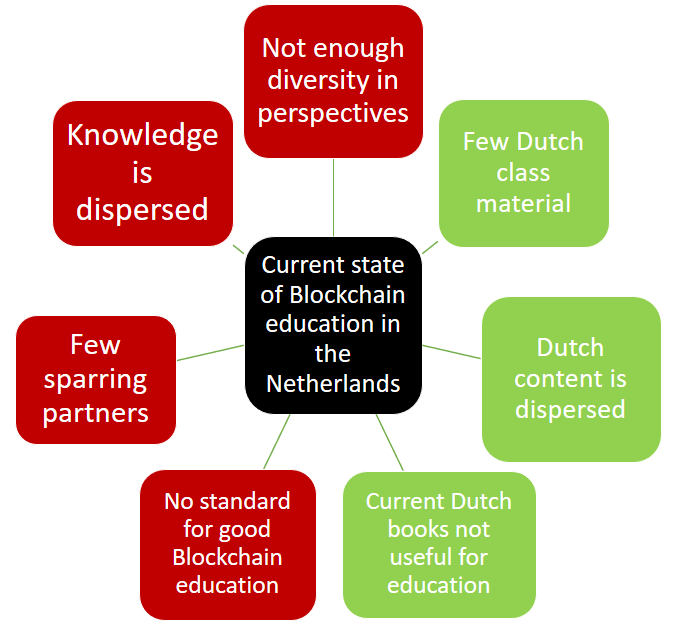
- Few Dutch class material. Good blockchain content is mostly written in the English language. My required reading list therefore consists mainly of English material, which proves to be a high barrier for Dutch-speaking students that are not at all familiar with (a) the technology and (b) the technical jargon used in the blockchain space.
- Dutch content is dispersed. Good content in Dutch is very dispersed among many different websites.
- Current Dutch books are not very useful for educational purposes. The books available on the Dutch market are not comprehensive enough and are not suitable for students.
- There is no standard for good blockchain education. Most universities are developing curricula on their own and there’s no standard on what good blockchain education consists of.
- Few sparring partners. Most universities don’t share their class materials or experiences teaching blockchain. Fortunately, the Dutch Blockchain Coalition is trying to change this, but we need to put much more effort to do cross-institutional sharing. Many universities also want to develop blockchain education, but lack the expertise. It would be good if these universities jointly develop their blockchain curriculum with other universities and share teachers.
- Knowledge is dispersed. Different faculties within a university are developing blockchain education in isolation and have their own blockchain experts who don’t know that some of their colleagues are also working on blockchain. Someone who’s working on the legal side of blockchain may not know that there’s someone at another faculty who is working on the technical or ethical side of blockchain. Bringing knowledge from different people together can lead to interesting and surprising new perspectives.
- Not enough diversity in perspectives. Blockchain can be approached from many different perspectives. Most classes only focus on a limited number of perspectives. A business department may heavily focus on blockchain applications and little on the technical side. Not knowing the technical side of blockchain, a business teacher may talk about potential blockchain applications and develop business models that are technically unfeasible.
I wrote the Blockchain Basics book, together with my colleague Arthur Janse, to tackle the first 3 issues (in green).
Main topics of the book
The book comprises three parts:
- Part I contains the technical side of blockchain and relevant innovations. Topics that we discuss are Bitcoin, current payment systems, consensus protocols, mining, nodes, forks, cryptography, smart contracts, governance, cryptoeconomics, and self-sovereign identities.
- Part II contains the economic and philosophical background of the Bitcoin blockchain. It discusses the different economic schools and in particular how the Austrian School of Economics and libertarianism, crypto-anarchism and cypherpunk have influenced Bitcoin.
- Part III contains topics revolving around enterprise blockchain. It discusses decentralized business models and enterprise applications.
What’s next?
While writing the book, I came up with the idea to create an organic community based open access digital knowledge platform that anyone can join for free. I pitched the idea in September 2019 at a Dutch Blockchain Coalition (DBC) event for all universities in the Netherlands. The DBC and other universities responded enthusiastically. Four months later, we have a proposal ready to develop the platform with 6 universities and the DBC.
We would like to use the Blockchain Basics book as the foundation of the platform, and – acknowledging that knowledge is decentralized – give all users the right to add new or revise already existing content. A public reviewing feature and a reputation system will be put in place to make sure that wrong content becomes corrected and to incentivize users to add good content. Students can also submit their Bachelor, Master and PhD dissertations and researchers can submit their papers on the platform.
I think that the multidisciplinary and cross-institutional cooperation will structurally improve blockchain education in the Netherlands. Doing so, I think we can tackle all the other issues (issues number 4 – 7).
Nightcap
- The United States, Iran, and the 1953 coup Gregory Brew, TNSR
- Iran, Kurdistan, and reality in 2020 Iraq Amberin Zaman, Al-Monitor
- “America First” and its forgotten Senator Richard Drake, American Conservative
- “We want sound money, and lots of it” Joseph Salerno, Mises Wire
Nightcap
- Goodbye, Neal Peart Suleman Khawaja, Policy of Truth
- Great economics, bad politics (Banerjee & Duflo) Chris Dillow, Stumbling & Mumbling
- The Golden Age of the Federal Reserve is here Scott Sumner, MoneyIllusion
- Randolph Borne and the Progressives Nikhil Pal Singh, New Statesman
Nightcap
- A classical liberal view of the Iran crisis? Van de Haar & Kamall, IEA
- Great essay on state capacity libertarianism Geloso & Salter, AEIR
- The loneliness of the resistance protester Micah Sifry, New Republic
- The Woke primary is over and everybody lost Matt Welch, Reason
Be Our Guest: “Suing Juul Won’t Solve Anything”
NOL‘s “Be Our Guest” feature is as popular as ever this year. Here’s John Lancaster with the latest:
Peer driven rumors, videos of experimentation, forums, news, and entertainment sources provide nigh infinite opportunities for young ones to pick up on vices. The appeal of vaping would’ve caused widespread exposure through said channels anyway. The most marketing does at that point is convince the willing participants to choose a particular brand rather than take on the act itself.
Juul is a company that sells vapes, which are those cigarette replacements that have been so popular lately. Please, read the rest, and shoot us an email if you want your voice heard!
Nightcap
- Sir Roger Scruton (1944-2020) Johnathan Pearce, Samizdata
- Sir Roger Scruton and free market economics Chris Dillow, Stumbling & Mumbling
- Roger Scruton’s conservatism Bradley Birzer, American Conservative
- The problem of defining civilization Nick Nielsen, Grand Strategy Annex
Nightcap
- Outlaw universities (affirmative action) Michael Huemer, Fake Nous
- The case against judicial supremacy Marc DeGirolami, Law & Liberty
- Another case against executive supremacy David Cohen, Politico
- From outer space, the Earth is mostly blue Margarette Lincoln, Literary Review
Nomic-nomics?
Perhaps the coolest thing I’ve found on the Small Internet so far is the game Nomic. From where I found it:
Nomic was invented in 1982 by philosopher Peter Suber. It’s a game that starts with a given set of rules, but the players can change the rules over the course of the game, usually using some form of democratic voting. Some online variants exist, like Agora, which has been running since 1993.
It’s a game that’s about changing the game. Besides offering a tempting recreational opportunity, I think this could be formalized in such a way to make it rival the Prisoners’ Dilemma (PD) in shedding light on the big social scientific questions.
The PD is a simple game with simple assumptions and a variable-sum outcome that lets it work for understanding coordination, competition, and cooperation. One of my favorite bits of social science is Axelrod’s Evolution of Cooperation project. It’s basically a contest between different strategies to an iterated PD (you can play a variation of it here). That the “tit for tat” strategy is so successful sheds a lot of light on what makes civilization possible–initial friendliness, willingness to punish transgressions, and willingness to return to friendliness after punishing these transgressions.
A fantastic extension is to create a co-evolutionary simulation of a repeated PD game. Rather than building strategies and pitting them against each other, we can be totally agnostic about strategies (i.e. how people behave) and simply see what strategies can survive each others’ presence.
The evolutionary iterated PD is about as parsimonious a model of conflict/cooperation as we could make. But there is still a lot of structure baked in; what few assumptions remain do a lot of heavy lifting.
But if the structure of the game is up for grabs, then maybe we’ve found a way to generalize the prisoners’ dilemma without assuming on extra layers of complexity.
Of course, the parsimony of the model adds complexity to the implementation. Formalizing Nomic presents a formidable challenge, and getting it to work would surely create a new
But even if it doesn’t lend itself to simulation, it strikes me as the sort of exercise that ought to be happening in classrooms–at least in places where people care about building capacity for self governance (I’ve heard such places exist!).
Let’s play!
A bit of stage setting, then let’s start a game in the comments section. I get the impression that this game is nerdier than Risk, so you’ve been warned (or tempted, as the case may be).
The basic premise is that are mutable rules and immutable rules (like Buchanan’s view of constitutions). Players take turns to propose rule changes (including transmuting rules from a mutable to an immutable state). As part of the process, we will almost surely redefine how the game is won, so the initial rule set starts with a pretty boring definition of winning.
We’ll use Peter Suber’s initial rules with some variations to suit our needs. The rules below will be (initially) immutable.
117. Each round will happen in a new comment thread. A new round cannot start until the rule change proposed in the previous round has been voted on. If technical problems result in having to start a new comment thread, that thread should include the appropriate reference number and it will be understood to be part of the same comment thread.
I will take the first move to demonstrate the format in the comments section.
118. The final vote count will be determined after 24 hours of silence. Players may discuss and cast votes, and change their votes. But after 24 hours of no new comments, the yeas and nays will be tallied and the outcome determined accordingly. In cases requiring unanimity, a single nay vote is enough to allow a player to start a new round without waiting the full 24 hours. The final vote will still occur (for purpose of calculating points) after 24 hours of silence.
Despite being numbered 118, this rule will take priority over rule 105.
119. Anyone who is eligible to comment is eligible to play. If it is possible to start a new round, anyone may start that round. In the event that two people attempt to start a round at the same time (e.g. Brandon and I post a comment within a couple minutes of each other) priority will be given to whichever was posted first and the second comment will be voided.
120. The game will continue until someone wins, or everyone forgets the game, in which case the winner will be the last person to have had their comment replied to.
Be Our Guest: “The U.S. Economy: A Fading Illusion?”
This essay, by longtime NOL reader and CPA Jack Curtis, is the first essay of 2020’s “Be Our Guest” feature. Here is a snippet:
This widespread financial vulnerability seems a natural result of government policies that minimize interest rates and support monetary inflation as the Federal Reserve and other central banks have continued to do in recent decades. There is little incentive to save money when it offers no significant return and its value is inflated away. Governments that cling to such policies are imposing dependence upon their citizens, forcing them in essence to live hand to mouth, deprived of the ability to provide for their own futures.
Jack paints a pretty gloom picture of the U.S. economy. Does this square with what economists have been telling us about the state of the world? Please, read the whole essay, and if you have been thinking about writing for the public in 2020, give us a holler. We’d be happy to put your thoughts up for the whole world to read.
Protecting your privacy: symmetric cryptography (part 1)
In my previous post, I discussed the decline of internet freedoms around the world. While writing the post, I realized that I should follow-up on the topic and discuss how we can use cryptography to protect our communication from surveillance by governments and corporations.
This is the first of four posts in which I discuss cryptography. If you read all four posts, you will understand the differences between symmetric and asymmetric cryptography, why the US government were against the spread of modern cryptography, how it has resulted in the first crypto war between code rebels (techno-libertarians) and the US government, and how you can easily protect your privacy using Pretty Good Privacy (PGP).
The topics of the four posts are:
- What is symmetric cryptography;
- What is asymmetric (public key) cryptography;
- The first crypto war between code rebels and the government;
- How to easily use PGP to protect your e-mail communication.
What is symmetric cryptography
The use of cryptography is more than 4,000 years old. A classic example of symmetric cryptography is the Caesar cipher. It was used by Julius Caesar for his private correspondence with his generals.
The principle of the Caesar cipher is simple. The receiver of the message has to replace each letter with another letter, some number of fixed positions down the alphabet. If a Caesar cipher, for example, makes use of a rotation of three to the left,
- A in the encrypted text becomes X
- C becomes Z
- E becomes B
- etc…

A Caesar cipher, compared to modern encryption methods, can be easily deciphered. You can for example make a frequency analysis of letters and see whether the letters in the encrypted text resemble typically Dutch or English writing. Also, each letter in the encrypted text only has 26 possibilities in the decrypted text, including itself. You can also make a table in which you write down the text and let a computer replace each letter with all 26 possibilities.
Up until the 1970s, cryptographers made use of this type of cryptography – also known as symmetric cryptography.
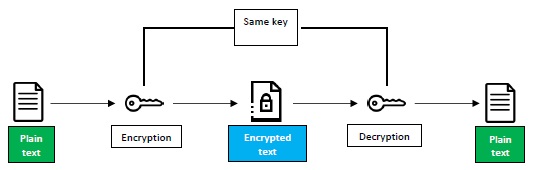
With symmetric cryptography, there is one key (the secret key) that is used for encrypting and decrypting the message. It’s therefore necessary for the sender of the message to share the secret key with the party he would like to correspond with.
The Caesar cipher is considered to be symmetric cryptography, because knowing the exact rotation (secret key) that is used to encrypt the message, you do also know how to decrypt the message.
Disadvantages of symmetric cryptography
There are several disadvantages to symmetric cryptography.
The first disadvantage is that the secret key has to be shared between the sender and receiver for messages to be exchanged privately. Sending the secret key over an unprotected communication channel is not recommended. In the next post, we will see how asymmetric (public key) cryptography allows us to send the encryption key safely over unprotected communication channels, while keeping the decryption key safely in our own possession.
The second disadvantage is that the secret key is now on two different locations. Thus, there are now two points of attack.
The third disadvantage is that the sender has to trust the receiver that he will not steal or copy the key or give it to someone else. It’s comparable to sharing the keys to your apartment: you also have to trust the other person not to steal your key, or copy your key, or give the key to another person.
The fourth disadvantage is limited scalability. Assuming that we’d like to communicate with a great number of parties, and that we’d like to provide each party with a different secret key for security reasons, we’d need to maintain a database of secret keys. For this setup to be user friendly in an environment like the internet, it would probably require an infrastructure of specialized distribution centers that generate secret keys each time two parties would like to initiate a private conversation. As these distribution centers would hold many secret keys, it would be a honey pot for hackers.
An example of symmetric cryptography is the Data Encryption Standard (DES), which was released on the market in 1975. It was developed by IBM, and was primarily meant to protect electronic communication between large financial organizations. Up until DES, cryptography was mainly a field for governments’ secret intelligence agencies to protect state communication. When the DES was released, it was received very well by cryptographers, until people found out that the National Security Agency (NSA) was involved with the development of the encryption key and purposefully influenced IBM to limit the key sizes from 64 bits to 56 bits. With 56 bits, there are 2^56 possible key combinations. This is considerably less than 64 bits keys. It is therefore much easier to break the encryption. Cryptographers believed that it would just be a matter of time before someone would find the right keys through a brute force search – meaning that you are trying all possible key combinations to find the right one.
Symmetric cryptography was the way cryptography was done until 1976 when two young researchers from Stanford University, Whitfield Diffie and Martin Hellman, invented asymmetric or public key cryptography.
Both researchers were discontent with DES, and Hellman even addressed a letter to the Secretary of Commerce, Elliot Richardson, saying:
I am writing to you because I am very worried that the National Security Agency has surreptitiously influenced the National Bureau of Standards [NBS] in a way which seriously limit the value of a proposed standard, and which may pose a threat to individual privacy. I refer to the proposed Data Encryption Standard. … I am convinced that NSA in its role of helping NBS design and evaluate possible standards has ensured that the proposed standard is breakable by NSA.
In my next post, I will discuss how public key cryptography works. Eventually, at the end of the post series, you will be able to encrypt your e-mails using public key cryptography.
Nightcap
- How the French Revolution reshaped the Catholic Church Glauco Schettini, Age of Empires
- The man who saved the Electoral College Christopher DeMuth, National Affairs
- Is the name of the country Myanmar or Burma? Mark Clifford, Asian Review of Books
- Suicide is not an act of cowardice Ken White, the Atlantic
Sunday Poetry: Gender Equality where it matters? The Scandinavian Unexceptionalism
Deja-Vu! Social Democrats once again bring up the topic of “Democratic Socialism” to cure all of the evils of the world. Once again, the Scandinavian countries (Sweden, Finnland, Denmark and Norway) are used as an example of how “a third way Socialism” can work. Although I still would consider myself young, I have already lost all of my stamina to engage in the same debates all over again until they pop up again a few months after.
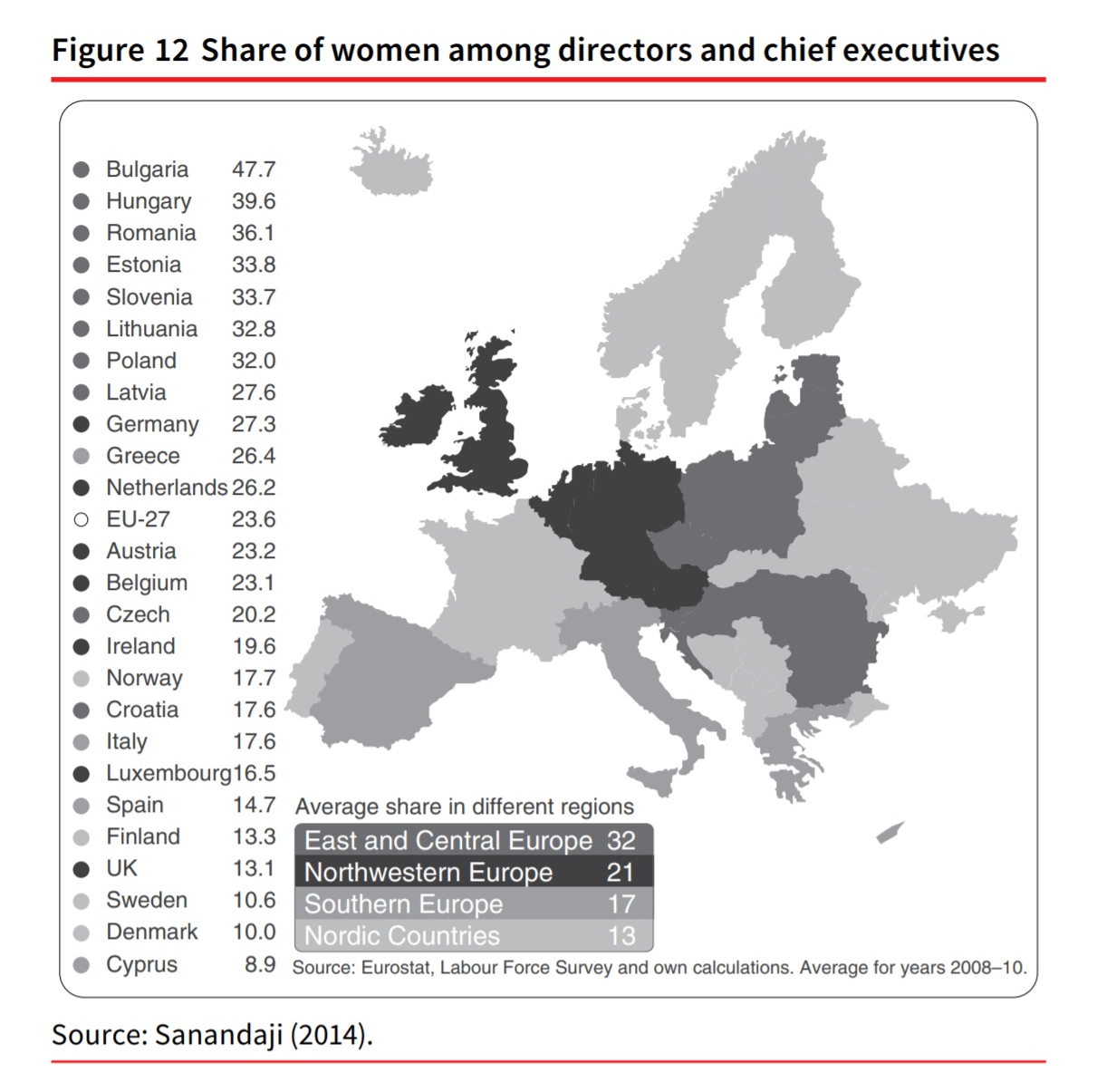
So, instead of pointing out the fallacy in labelling the Scandinavian countries moderately socialist (Nima Sanandaji, for example, does an excellent job in doing so), I want to look at one aspect in particular: The myth of peak emancipation of woman in the labour market in these countries. So apologies for neglecting Poetry once again for the sake of interesting information. Have a look at the following graphic and the remarks by Sanandaji:
“Some boards in Nordic nations are actively engaged in how the companies they represent are run. Others have a more supervisory nature, meeting a few times a year to oversee the work of the management. The select few individuals who occupy board positions – many of whom reach this position after careers in politics, academia and other non-business sectors – have prestigious jobs. They are, however, not representative of those taking the main decisions in the business sector. The important decisions are instead taken by executives and directors. Typically individuals only reach a high managerial position in the private sector after having worked for a long time in that sector or successfully started or expanded a firm as an entrepreneur. The share of women to reach executive and director positions is the best proxy for women’s success in the business world. Eurostat has gathered data for the share of women among ‘directors and chief executives’ in various European countries between 2008 and 2010. The data show that Nordic nations all have low levels of women at the top of businesses. In Denmark and Sweden, only one out of ten directors and chief executives in the business world are women. Finland and the UK fare slightly better. Those Central and Eastern European countries for which data exist have much higher representation.
[…]
A key explanation lies in the nature of the welfare state. In Scandinavia, female-dominated sectors such as health care and education are mainly run by the public sector.
A study from the Nordic Innovation Centre (2007: 12–13) concludes: Nearly 50 per cent of all women employees in Denmark are employed in the public sector. Compared to the male counterpart where just above 15 per cent are employed in the public sector. This difference alone can explain some of the gender gap with respect to entrepreneurship. The same story is prevalent in Sweden. The lack of competition reduces long-term productivity growth and overall levels of pay in the female-dominated public sector. It also combines with union wage-setting to create a situation where individual hard work is not rewarded significantly: wages are flat and wage rises follow seniority, according to labour union contracts, rather than individual achievement. Women in Scandinavia can, of course, become managers within the public sector, but the opportunities for individual career paths, and certainly for entrepreneurship, are typically more limited compared within the private sector.
If you are interested in the whole book, it is completely available online for free.
I wish you all a pleasant Sunday.
 Notes On Liberty