Some problems with postmodernism

Despite its contributions, postmodernism is also the subject of much criticism. One of the most recurrent is its tendency to nihilism, that is, to pleasure for nothing. Postmodern deconstruction may be efficient at demonstrating the randomness of many of our concepts, but it can lead us to a point where we have nothing but deconstruction. We find that the world is made up of dichotomies or binary oppositions that cancel out, without any logic, leaving us with an immense void.

Another weakness of postmodernism is its relativism. In the absence of an absolute truth that can be objectively identified one gets subjective opinions. There is an expectation of postmodern theorists that this leads to higher levels of tolerance, but ironically the opposite is true. Without objective truths individuals are isolated in their subjective opinions, which represents a division of people, not an approximation. Moreover, postmodernism leads to a concern that all claims may be attempts at usurpation of power.

But the main weakness of postmodernism is its internal inconsistency. As mentioned in previous posts, postmodernism can be defined as unbelief about metanarratives. But would not postmodernism itself be a metanarrative? Why would this metanarrative be above criticism?

Another way of defining postmodernism is by its claim that there is no absolute truth. But is not this an absolute truth? Is it not an absolute truth, according to postmodernism, that there is no absolute truth? This circular and contradictory reasoning demonstrates the internal fragility of postmodernism. Finally, what happens if the hermeneutics of suspicion is turned against postmodernism itself? What gives us assurance that postmodern authors do not themselves have a secret political agenda hidden behind their speeches?

It is possible that postmodernists do not really feel affected by this kind of criticism, if they are consistent with the perception that there is no real world out there, or that “there is nothing outside the text”, but that the Reality is produced by discourses. That is: conventional theorists seek a truth that corresponds to reality. Postmodernists wonder what kind of reality their speeches are capable of creating.

Be that as it may, in spite of the preached intertextuality (the notion that texts refer only to other texts, and nothing objective outside the texts), postmodern theorists continue to write in the hope that we will understand what they write. Moreover, postmodernists live in a world full of meanings that are if not objective are at least intersubjective. Perhaps our language is not transparent, but that does not mean that it is opaque either. Clearly we are able to make ourselves understood reasonably well through words.

As C.S. Lewis said, “You cannot go on ‘seeing through’ things forever. The whole point of seeing through something is to see something through it. It is good that the window should be transparent, because the street or garden beyond it is opaque. How if you saw through the garden too? It is no use trying to ‘see through’ first principles. If you see through everything then everything is transparent. But a wholly transparent world is an invisible world. To ‘see through’ all things is the same as not to see”. This critique fits very well to postmodernism.

Did Inequality Fall During the Great Depression ?

Inequality

The graph above is taken from Piketty and Saez in their seminal 2003 article in the Quarterly Journal of Economics. It shows that inequality fell during the Great Depression. This is a contention that I have always been very skeptical of for many reasons and which has been – since 2012 – the reason why I view the IRS-data derived measure of inequality through a very skeptical lens (disclaimer: I think that it gives us an idea of inequality but I am not sure how accurate it is).

Here is why.

During the Great Depression, unemployment was never below 15% (see Romer here for a comparison prior to 1930 and this image derived from Timothy Hatton’s work). In some years, it was close to 25%. When such a large share of the population is earning near zero in terms of income, it is hard to imagine that inequality did not increase. Secondly, real wages were up during the Depression. Workers who still had a job were not worse off, they were better off. This means that you had a large share of the population who saw income reductions close to 100% and the remaining share saw actual increases in real wages. This would push up inequality no questions asked. This could be offset by a fall in the incomes from profits of the top income shares, but you would need a pretty big drop (which is what Piketty and Saez argue for).

There is some research that have tried to focus only on the Great Depression. The first was one rarely cited NBER paper by Horst Mendershausen from 1946 who found modest increases in inequality from 1929 to 1933. The data was largely centered on urban data, but this flaw works in favor of my skepticism as farm incomes (i.e. rural incomes) fell more during the depression than average incomes. There is also evidence, more recent, regarding other countries during the Great Depression. For example, Hungary saw an increase in inequality during the era from 1928 to 1941 with most of the increase in the early 1930s. A similar development was observed in Canada as well (slight increase based on the Veall dataset).

Had Piketty and Saez showed an increase in inequality during the Depression, I would have been more willing to accept their series with fewer questions and doubts. However, they do not discuss these points in great details and as such, we should be skeptical.

Coup and Counter Coup in Turkey II (Immediately after the coup and party politics)

Continuing from here. President Recep Tayyıp Erdoğan proclaimed a state of stare of emergency on the evening of twentieth July 2016. He preceded that announcement by asking his audience, the Council of Ministers, for a round of applause for the opposition parties in the National Assembly, because they had opposed the coup. On the night of the coup (fifteenth to sixteenth July), deputies from all parties sheltering in a basement of the National Assembly, while it was under attack from fighter jets, drew up an anti-coup proclamation. Erdoğan also dropped a large number of cases for ‘insulting the President’ as a good will gesture. This generosity to the opposition did not last long, though there appears to have been at least one further disingenuous conversation. Apparently Erdoğan told the main opposition leader, Kemal Kılıçdaroğlu, about this time that he was unaware that the opposition received a fraction of the coverage on state television of that enjoyed by the government party and thought this should change. Of course the situation has not changed and the government has intensified its efforts to weaken opposition in every way. Prosecutions for insulting the President have continued and often lead to imprisonment, even for legal juveniles.

An account of the political parties in Turkey, along, with some political history, is advisable here so that readers can follow political events. The governing party is the AKP, standing for the Turkish language equivalent of Justice and Development Party. It has centre right, religious conservative, Ottomanist, and nationalist components. The first component has evidently declined over the years and the hardcore was always driven by the three other components. At one time it presented itself as more liberal, pro-EU and sympathetic to Kurdish rights than the other parties. It now clearly occupies contrary positions.

The leading opposition party is the CHP standing for the Turkish language equivalent of Republican People’s Party. It was founded by Kemal Atatürk in 1919 (though at one point as the People’s Party) and is Turkey’s oldest party. It has social democratic, left nationalist/sovereigntist and secularist components. As the party of Atatürk it is associated with the elites (Kemalist elites referring to Atatürk’s first name Kemal, which was his second name, but not family name until he instituted family names for Muslims) and maintained it as a secularist nation state until the AKP came to power in 2002. However, the CHP was only in government for ten years after 1950, so is associated more with a permanent ‘Kemalist’ state elite rather than government.

The third party in the National Assembly is the HDP, standing for the Turkish language equivalent of People’s Democratic Party. It is itself an umbrella party for an alliance of the BDP (Democratic Regions Party), which is based in the Kurdish southeast, with a number of small Turkish leftist parties and activist groups. It is very socialist and socially liberal in orientation though some of its base is non-leftist Kurds, including major land owning families who support BDP-HDP as a Kurdish party rather than a socialist or socially liberal party.

The fourth party in the National Assembly is the MHP, standing for the Turkish language equivalent of Nationalist Action (or Movement) Party. It goes back to the sixties and is largely what its name suggests, an ultranationalist party which has a an aggressive and even violent hard core base of support. It’s nationalism mixes ethnic Pan-Turkism (referring to Turkish peoples in the Middle East, Caucasus and Central Asia), Ottomanism, and Atatürkism (which on the whole bases nationalism on identity and culture rather than ethnic origin). Religious identity plays a role, but the MHP defines itself as following secularist republicanism. This is interesting tension with the party symbol, which is an Ottoman grouping of three red crescent moons, but that is in the nature of the MHP.

Both the AKP and MHP have a base in Turkish nationalism and Sunni Islam. The AKP has had Kurdish support but has largely lost this as it emphasises nationalism along with state action against Kurdish radicals more. The Sunni identity is partly promoted in contrast with the Alevi population. Alevis are the largest religious minority in Turkey. Defining Alevism is itself contentious, but it can be said to be either a branch of, or related to, Shia Islam, the main alternative to Sunnism within Islam as a whole. It maybe resembles Ismaili Islam, as in the community led by the Aga Khan. Christian and Jewish groups constitute no more than 0.2% of the population. At least since the sixties it has been identified with the left and with secularism, reinforcing traditional Sunni suspicions amongst religious conservatives of supposed heresy and deviant practices of various forms. The CHP core vote includes Alevis, who are otherwise likely to support HDP. The AKP and MHP support is concentrated in the central areas of Anatolia (the main land mass of Turkey), those parts of Istanbul where there has been most immigration from Anatolia, and the Black Sea coast. The CHP is geographically concentrated in Thrace (the Balkan part of Turkey) and the Aegean coast. These geographical distinctions, which of course conceal a great deal of detailed mixture at the local level, coincide with the political distinctions in which the AKP and MHP represent the most Turkish traditional and Muslim parts of heartland Turkey, while the HDP represents the Kurdish population of the southeast, and the CHP represents the more western and European oriented parts of Turkey.

The electoral threshold to enter the National Assembly is ten percent and all parties other than the four above get some mere fraction of one percent. The only party with some kind of classical liberal or libertarian foundation is the Liberal Democrat Party, which gets a small fraction of one percent.

I have tried to be concise in this summary of party politics in Turkey, but have still taken up the space of a reasonably sized post. I will return very soon to recent and current political events very soon, to be followed by some deeper history.

Artificial Intelligence and Medicine

When teaching the machine, the team had to take some care with the images. Thrun hoped that people could one day simply submit smartphone pictures of their worrisome lesions, and that meant that the system had to be undaunted by a wide range of angles and lighting conditions. But, he recalled, “In some pictures, the melanomas had been marked with yellow disks. We had to crop them out—otherwise, we might teach the computer to pick out a yellow disk as a sign of cancer.”

It was an old conundrum: a century ago, the German public became entranced by Clever Hans, a horse that could supposedly add and subtract, and would relay the answer by tapping its hoof. As it turns out, Clever Hans was actually sensing its handler’s bearing. As the horse’s hoof-taps approached the correct answer, the handler’s expression and posture relaxed. The animal’s neural network had not learned arithmetic; it had learned to detect changes in human body language. “That’s the bizarre thing about neural networks,” Thrun said. “You cannot tell what they are picking up. They are like black boxes whose inner workings are mysterious.”

The “black box” problem is endemic in deep learning. The system isn’t guided by an explicit store of medical knowledge and a list of diagnostic rules; it has effectively taught itself to differentiate moles from melanomas by making vast numbers of internal adjustments—something analogous to strengthening and weakening synaptic connections in the brain. Exactly how did it determine that a lesion was a melanoma? We can’t know, and it can’t tell us.

More here, from Siddhartha Mukherjee in the New Yorker (h/t Azra Raza).

And, in the same vein, here are some thoughts on terrorism.

The Antebellum Puzzle, Anthropometric History and Quebec

I recently gave an interview on Economics Detective Radio with Garrett Petersen to talk about my forthcoming article in Economics & Human Biology (with Vadim Kufenko and Alex Arsenault Morin). In the interview, I explain why anthropometric history is important to our understanding of living standards, their evolution and short-term trade-offs in economic history. The interview is below, but you should subscribe to Garrett’s podcast as he is well on his way to becoming a serious competitor to EconTalk with the bonus that he does lots of economic history.

Podcast link (download).

Can Median Voter Theorem explain political polarization?

When I began dipping my toes into game theory and rational choice theory, like many others, I learned about the Median Voter Theorem (MVT). This theory is essentially the Hotelling’s Law of voting, in which two competing politicians, on any given issue, will adopt views similar to the median on a spectrum of views of that issue, in order to maximize the number of votes they receive. Any movement toward either extreme, so the theory goes, would allow the opponent to gain the votes of centrists by moving in the same direction, but not as far, effectively gaining all voters on the other extreme AND the centrists. According to MVT, the most successful politicians should, if rational choice theory can be said to apply to elections, represent (if not hold) the views closest to those of the median voter, who should be relatively “centrist” even if extremist voters outnumber centrists.

This is, rather dramatically, not the case. History and current events offer a plethora of examples: a brief look at the makeup of the US government implies that centrist voices (and especially centrist voters) are outnumbered and drowned out. If MVT has any effect at all, why is increasing political polarization such a hot topic?

What are the possible explanations for this? Is MVT fundamentally wrong in its core idea, and is voting in fact not possible to model in rational choice theory? I do not think so, so here are several ideas, some old and one novel, about why the application of MVT does not lead to centrist politicians winning most elections in practice:

  • Voter preferences are polarized. If voter opinions are not only not normally distributed, but are in fact gathered at two poles with no centrist voters, MVT may actually function, but it would predict that centrists would lose a lot (because the median voter would be at one pole or the other). The idea that voters resemble a barbell graph more than a normal distribution may be very salient, because many issues are dominated by extreme views. However, the voting population is demonstrably more centrist on some issues, so this cannot fully explain the difference between reality and MVT.
  • Third parties spoil things. This hearkens back not only to Arrow’s Impossibility Theorem, but also to the influence of Ross Perot and Ralph Nader on presidential elections. Third party participation does not spoil MVT, because it still fundamentally follows the idea of rational choice theory about elections, but it complicates two-candidate models.
    • Further note: multi-party systems are vulnerable to extremists. The possibility of invasion by extreme views is higher in multi-party systems, because if multiple centrist parties compete for median voters, extreme groups gain power disproportionate to their constituency.
  • Primaries spoil things. This is an old idea in US politics: in primaries, you have to run to the extremes, and then in the general election, run to the center. The very logic behind this idea, and any empirical evidence of it, proves the viability of MVT, but it does introduce complications to any model of it that fails to account for the two different elections many politicians must win. Also, we must remember to factor in the fact that politicians have a negative utility in abandoning past positions (especially recent decisions) of seeming inauthentic or losing their base.
  • The Electoral College spoils things. Outside of US presidential elections, “swing states” may not have the same power, but in the US, candidates would be “rational” to pursue votes in swing states much more assiduously than they do in states that are nearly sure bets. This is only narrowly applicable, but the campaign focus on swing states indicates that candidates do at least campaign rationally (see academic studies or news reports), in that they seek votes strategically and not indiscriminately.
  • Voter turnout skews MVT. In elections without mandatory voting, those who are less committed to the issues at stake—who are more likely to be centrists—tend to vote less than those who care greatly one way or another. Therefore, voting may be more about mobilizing one’s base than appealing to centrists. (Note: this is not an endorsement of mandatory voting, which can allow more zero-sum games in politics and the enforcement of which seems worse than the problem).
  • People do not vote based on rational weighing of stances. This would be a troubling conclusion, and suggests that people may align with parties and candidates based on motives other than matching candidate views to their own. While this is certainly true to some extent, MVT can still predict the overall “centrism” of politicians. Also, just because many people have an irrational method of weighing stances does not mean that the aggregate result does not mean that the utility of favoring centrist positions would not be positive.
  • Voting is multidimensional. Since single candidates represent dozens if not hundreds of salient issues in a single election, voters are forced to compromise on some issues in order to win others. This multidimensionality is not a counterargument to MVT, but an extreme complication, because “median” politicians could lose based on voter preference not within an issue, but between issues. That is, a politician can gain voters by recognizing weighting each voter’s stance by how likely that issue is to change their vote. This can be observed in the fact that referenda tend to follow MVT in a more straightforward fashion than elections. It is also a possible explanation for the rise of certain coalitions: no matter if constituents have deep disagreements on many issues, they end up aligned behind the same candidate based on inter-issue preferences. This may have been a major motivation for federalization and separation of power: different decisions are constrained to certain elections, allowing voters to communicate on each individual issue more clearly because of the reduced multidimensionality. The game theory on multidimensional voting is well developed, but still has some complications that have not been specifically argued:
    • Complication: Special interest compared to general interest. Multidimensional voting allows politicians to promise concentrated special interest to voters on certain issues in order to gain votes rather than appeal to general interest across many issues. The implications of this have been shown in game form, especially in special interest influence on enforcement. In this, public choice theory proves the idea that governments tend to favor dispersed costs and concentrated gains.
    • Complication: Singe issue voters. This is a subset of the above, or at least related to it. In multidimensional elections, voters obviously have to weigh issue preferencing. However, if a voter decides that they would choose a candidate so long as he agrees with the voter on a single issue, then on that issue, the single-issue voter has a hugely disproportionate influence on the candidate’s opinion on that issue. The reason: if the candidate runs to the center on that single issue, he risks his opponent capturing the vote of all single-issue voters on that side by running slightly more to the extreme. The Nash Equilibrium of such a situation would depend on how many single-issue voters there are at either extreme (I assume here that single-issue voters are not centrists, based on examples shown below, but I am open to argument) and how much of the non-single-issue constituency is ceded by focusing on single-issue voters, but it is distinctly possible that issue preferencing, especially the power of the ultimatum implied in single-issue voting, makes it rational for politicians to run to the extremes. Interesting examples of this phenomenon include background checks for guns, defense spending, and possibly marijuana legalization. (Please note that this does not constitute an endorsement of these ideas—whether the majority is correct is a different question from whether the majority idea is enacted by politicians).
      • The single-issue voter idea continues to fascinate me. Most of all, it fascinates me how little (apart from some basic preferencing models in the literature) I can find that either theorizes or empirically examines the specific influence of single-issue voters and voter preferencing. I hope it is out there, and I just can’t find it (so send it to me if you have found one!). But if not, is anyone out there a public choice theorist who wants to help me figure this out?

Thanks for sticking with a long read, and please give me feedback if you have any examples of this phenomenon or another angle on MVT!

First year in California for good, as an immigrant

Below is an excerpt from my book I Used to Be French: an Immature Autobiography. You can buy it on amazon here.


I met other interesting characters at the Moulin Rouge (a bar in San Francisco where I spent much of my time after immigrating for good). One was a Frenchman in his early forties who told me he was a pirate on vacation. He said he owned an old surplus US Navy PT boat armed with a machine gun he used to prey on Chinese ships in the Celebes (Indonesia). “How come you are not in prison for 20 or 25 years? How about the police, the local coast guard, the navy?” I asked. “Nobody cares about the rich Chinese in Indonesia; besides, we never, never kill anyone. We wave big guns at them, my crew and I, and they always pay up. Sometimes, they bargain a little with me. I am not unreasonable,” he explained. He invited me to join him in a piracy campaign on my next summer vacation. I told him that I would like to but I would probably have to study in the summer, too. Even at a young age, seasoned as I was by military service, I had my values straight: junior college first, piracy second, and the latter, only if there was time.

Dutch politics, after the elections

Now that the Dutch elections for the Lower House are over, as well as the unprecedented international hype surrounding it, it is time for a few pointers and reminders.

Turkey

Prime Minister Mark Rutte used the crisis with Turkey to his greatest advantage. When the crisis just loomed he escalated, helped of course by the increasingly hysterical reactions of the Turkish authorities, particularly the President.

I have not been able to get figures, but it is rather normal for foreign ministers, including from Turkey, to visit the Netherlands and address their nationals, also for political purposes. This is just the consequence of allowing Turkish people to have dual nationality and -in the Turkish case- also double voting rights. With the referendum in Turkey coming up, it is only logical to allow proponents and opponents to campaign as well.

This said, any thinking person would strongly object to the plan to give even more power to the already way too powerful Turkish executive. Dictatorship looms (please read Barry’s much better informed blogs on this).

Politicians almost always choose the short term over the long term. Certainly four days before elections. Still, the downside of Rutte’s actions are immense, as they also serve the interest of Erdogan, enabling him to play the victim of the ‘racist Dutch’. It might even pull the deciding number of voters into his camp. That would be bad for Turkey, and for Europe.

Chances for Turkey joining the European Union were already small, but have now disappeared completely. (Which I personally do not mind much, but others differ, including many in Rutte’s own party).

Populism

Another topic of international concern surrounding the election was the rising populism and its alleged ending by the electorate at the ballot box. Indeed, Geert Wilders’ Party for Freedom did not become the biggest party, yet he did win votes again. An increase of a third actually, from 15 to 20 in the 150-seat Lower House. His party thus became the second largest party in parliament.

He was never going to be Prime Minister anyway, as all parties had said before the elections they would not collaborate with him. This was important as the Dutch electoral system has a low threshold, which means many parties can enter parliament and no party has ever won a majority of 76. It demands parties to negotiate a governing coalition. After Wednesday at least four parties are needed for such a majority, which will take months.

There is a less-noted, other ‘bad populism’, which includes the largest winner, the Green Left party. This party represents are the radical environmental left, led by a young good looking leader who has been able to attract a lot of young people, in particular women, according to electoral research. There are also other populist parties elected, most notably the party for pensioners, the Islamic party DENK,  and the Forum for Democracy, the intellectual version of Geert Wilders’ party.

Coalition building

It remains to be seen whether Green Left will get a seat in government, given the large differences with the other parties who will be negotiating the new government: the centre right VVD of Rutte, the social liberals of D66, and the Christian democrats.

This process is slow and boring for most people, except for political junkies like myself. So chances are you will not hear about Dutch politics until a new government has finally been installed. Do not be surprised if this does not happen before Christmas.

Immigration and Jobs

A couple of thoughts about immigration. It seems that there is a widespread belief in the US that immigrants take jobs from Americans. It makes superficial sense if you also assume that the number of jobs to be filled is fixed and that just about anyone can do any kind of work.

Both assumptions are mostly false. Here is an example that illustrates why.

I keep hearing native-born Americans trained in various high-tech fields who claim that they are unemployed because of competition from low-cost H1B visa holders. H1B visas go to foreigners with skills deemed to be needed by the American economy. A large number of H1B visa holders are from India and many are from China; they also come from a wide variety of other countries, including Russia, France, Bulgaria, etc. The implicit affirmation is that were such visas stopped completely, those who complain would step right into the vacant jobs.

Two things. First the claim that foreign H1B visa holders work for less is largely unsubstantiated although it should be easy to investigate such abuse. Second, I think it’s illegal to pay H1B holders less than Americans. Why would many employers risk a distracting lawsuit? Of course, a few might because there are irrational people everywhere.

Next and last: Hundreds of thousands of high-tech jobs are going begging as I write. Are employers so vicious that they would rather have the work not done at all than to give it to a credentialed American? Or is it more likely that the unemployed native-born high-tech workers have skills that do not match demand? If the second supposition is correct, ending the H1B visa program would cause even more high-tech positions to remain empty. Of course, this would have a negative effect on everyone, on every American’s prosperity.

Missing from this narrative: the possibility that high power, accelerated re-training programs would bring unemployed Americans the skills the high-tech sector requires.

I have to begin a confession that’s going to make me even more unpopular locally than I already am. I mean unpopular among my conservative friends. I taught in an MBA program in the middle of Silicon Valley for 24 years, two quarters each year. It was an evening program squarely directed at the ambitious hard-working. During that span of time, I must have had 150 students from India. I remember only one who was a bad student. I was intrigued, so I made inquiries. Sure enough, he had an Indian first name and last name, and the corresponding appearance but he was born in the US.* I cannot report so glowingly about other, non-Indian students that sat in my classroom through the years.

This little narrative proves nothing, of course. Consider it food for thought. Do it especially if you voted for Pres. Trump – as I did.

Reminder: H1B visas are awarded to individuals with an occupational qualification deemed to be in short supply in the US. Right now, it’s likely that most of those who get an H1B are trained in some IT area but that’s not all. For a long time, farriers from everywhere could easily get one. (If you don’t know what a farrier is, shame on you and look it up.)

There are other – presumably non-specialized – categories of immigrants who are widely suspected of taking jobs from Americans. The truth is not always easy to discern, not even conceptually. Five or six miles from where I live in Santa Cruz, there are growers who are tearing off their hair. Their problem is that they can’t figure out who is going to pick the crops they are now putting into the ground. As I have said repeatedly, the Mexicans they counted on in years past have largely stopped coming.

A quarter of a mile from where I live, and in the same direction, there are dozens of perfectly healthy US-born Americans who are working as “sales associates.” The apparent conceptual issue is this: sales associates earn $10/hr while a moderately experienced crop picker earns $15. The question arises of why we don’t see a full exodus from the sales positions to jobs that pay 50% more?

I think it’s lazy to call the US-born sales associates “lazy.” The reality is that the Mexicans who came, and are still coming, to pick vegetables and fruits in California overwhelmingly came from a rural population. They were reared under conditions where almost everyone around them labored in the fields. When they arrive in the US – legally through family reunion – or illegally, they are ready to take picking jobs. They then just do here more or less the same work they would do at home but for five times the pay or more.

In American society that kind of population disappeared several generations ago through mechanization and, of course, through the importation of foreign labor, precisely. Native-born Americans won’t do the work because it’s alien to their background. I think US-born people of Mexican ascendancy whose parents labored in the field won’t do the work either. Their parents do what they can to make their own work experience alien to their children. I am not surprised, that’s another expression of the American dream. It’s  what many would do back in Mexico but then, why emigrate?

I am pretty sure that any immigration reform should include a temporary agricultural program, a sort of H1A ( “A” for “Agriculture”) visa. It would allow foreigners to come to the US legally, just to work in the fields and for a set period only. It would not lead to permanent residency, nor, of course, to citizenship. Such a program existed between the forties and the early sixties, if memory serves. It was called the “Bracero program.” I don’t know why it was terminated. (Perhaps a reader can tell us.)

Mexicans would be the first to take advantage of such a program. As Mexico’s economy develops, they may be replaced by Central Americans and, eventually, by Africans. Such a program would sidestep the kind of assimilation problem France, for example, is facing right now with its North African population.

PS Personally, I think Mexicans make good immigrants to the US. I would bet than in ten years we will be begging them to come.


* Disclosure: I am married to an Indian woman. She is not in high-tech unfortunately.

BC’s weekend reads

  1. Understanding Trump’s trade mistakes
  2. Empiricism and humility
  3. Epistemological modesty and unintended consequences
  4. Immigrants and slaves
  5. 5 takeaways from the Dutch election

Coup and Counter Coup in Turkey (first of a series of posts on Turkey since 15th July 2016 and background topics)

On July 15th 2016, a group of army officers up to at least the Brigadier General (one star general) level attempted to seize control of the Turkish state. On the morning of the 20th it was evident that the coup had collapsed though the government, along with its allies in the media, social media, think tanks and so on was eager to promote the idea of an unended coup which might spring back into life, like the villain in a horror film, at any moment over a long indefinite period of time. No follow-up coup materialised. The most that can be said for that unending coup mentality was that it is difficult to know how much of the army would have gone over if the coup organisation had captured or killed President Erdoğan. What the never-ending coup claims achieved was to legitimise and mobilise paranoia, intolerance, and authoritarian state reactions with regard to anyone who might be in opposition to the Erdogan/Justice and Development Party (AKP) government.

The overwhelming feeling among government supporters and opponents on the 21st was that the coup was instigated by followers of Fetullah Gülen, a religious leader who went into exile before the AKP came to power in 2002. His followers control an international network of businesses, banks, schools, and media organisations. They carefully targeted the most sensitive areas of state employment in Turkey with the goal of creating a Gülenist dominated state and were aided in this enterprise by the AKP governments who wanted a network to rival the ‘Kemalists’, relatively secular people in the state, business, media, and educational sectors. Their relationship broke down in 2013 for reasons which are inevitably obscure at present, but appear to arise from the conflicting extreme ambitions for absolute power on both sides.

The coup may have been joined by Kemalists and the coup organisers gestured towards this position when a television announcement proclaimed that the coup council name referred to a well-known slogan of Kemal Atatürk, ‘Peace at home, peace in the world’. Kemalism of course refers to the ideology of secularist nationalist republicanism endorsed by Kemal Atatürk, the founder of the Republic of Turkey. I will return to this topic in a later post, but in brief Kemalism of some kind – and there are many kinds and many grey areas – was the dominant influence in the army and allied parts of the state until recently. It is roughly analogous to the Jacobin tradition in France and in the same way has referred both to popular sovereignty and vanguardism. There are some who promoted the idea in the past that Kemalism was the problem and the AKP was the solution, and they are having difficulty in not seeing the 15th July Coup attempt as at least a Gülenist-Kemalist partnership. However, there is no evidence that Kemalists participated in any more than an individual ad hoc basis. Indeed after the 15th, retired generals associated with Kemalism were called back into service, in a process which now seems to have ended Kemalist sympathy for Erdoğan as a bulwark against the Gülenists and the PKK (socialist-Kurdish autonomy guerrilla/terrorist group), which intensified its activities in the summer of 2015.

Vast waves of arrest began after the coup attempt, which, unlike the coup itself, have not ended. For the first wave of arrests it was just about possible to believe they were genuine attempts to find coup plotters, but it quickly became apparent that the scope of arrests was much wider. President Erdoğan announced soon after the coup attempt that it was a gift of God and showed how he wanted to use this gift on July 20th, when he proclaimed a state of emergency. The state of emergency has become the means for Erdoğan to purge and punish tens of thousands who have no connection with the coup. The AKP supporters who obsessed about the follow-up coup were right, but the follow-up coup came from their own side. The state of emergency is the real coup, though it is also just a moment in the process of the creation of an AKP-Erdoğanist state, designed to facilitate what appears to be Erdoğan’s final goal (though maybe there will be others later): the creation of an extreme version of the presidential political system in which the head of state is more an elected dictator than the head of a system of checks and balances under law. More soon.

Main postmodern theorists and their main concepts

Postmodernism has been defined as “unbelief about metanarratives.” Metanarratives are great narratives or great stories; comprehensive explanations of the reality around us. Christianity and other religions are examples of metanarratives, but so are scientism and especially the positivism of more recent intellectual history. More specifically, postmodernism questions that there is a truth out there that can be objectively found by the researcher. In other words, postmodernism questions the existence of an objective external reality, as well as the distinction between the subject who studies this reality and object of study (reality itself), and consequently the possibility of a social science free of values, assumptions, or neutrality.

One of the main theorists of postmodernism (or of deconstructionism, to be more exact) was Jacques Derrida (1930-2004). Derrida noted that Western intellectual history has been, since ancient times, a constant search for a Logos. The Logos is a concept of classical philosophy from which we derive the word logic. It concerns an order, or logic, behind the universe, bringing order (cosmos) to what would otherwise be chaos. The concept of Logos was even appropriated by Christianity when the evangelist John stated that “In the beginning was the Logos, and the Logos was with God and the Logos was God,” identifying the Logos with Jesus Christ. In this way, this concept is undoubtedly one of the most influential in the intellectual history of the West.

Derrida, however, noted that this search for identifying a logos (whether it be an abstract spiritual principle, the person of Jesus Christ, or reason itself) implies the formation of dichotomies, or binary oppositions, where one of the elements of the binary opposition is closer to the Logos than the other, but with the two cancelling each other out in the last instance. In this way, Western culture tended to value masculine over feminine, adult over child, and reason over emotion, among other examples. However, as Derrida observes, these preferences are random choices, coupled with the fact that it is not possible to conceive the masculine without the feminine, the adult without the child, and so on. Derrida’s proposal is to identify and deconstruct these binaries, demonstrating how our conceptions are random.

Michel Foucault (1926-1984) developed a philosophical system similar to that of Derrida. At the beginning of his career he was inserted into the post-WWII French intellectual environment, deeply influenced by existentialists. Eventually Foucault sought to differentiate himself from these thinkers, although Nietzsche’s influence can be seen throughout his career. One of the recurring themes in Foucault’s literary production is the link between knowledge and power. Initially identified as a medical historian (and more precisely of psychoanalysis), he sought to demonstrate how behaviors identified as pathologies by psychiatrists were simply what deviated from accepted societal standards. In this way, Foucault tried to demonstrate how the scientific truths elaborated by the doctors were only authoritarian impositions. In a broader sphere he has identified how the knowledge produced by individuals and institutions clothed with power become true and define the structures in which the other individuals must insert themselves. At this point the same hermeneutic of the suspicion that appears in Nietzsche can be observed in Foucault: distrust of the intentions of the one who makes an assertion. The intentions behind an assertion are not always the explicit ones. Foucault’s other contribution was his discussion of the pan-optic, a kind of prison originally envisioned by the English utilitarian philosopher Jeremy Bentham (1748-1832) in which the incarcerated are never sure whether they are being watched or not. The consequence is that the incarcerated need to behave as if they are constantly being watched. Foucault imagined this as a control mechanism applied to everyone in modern society. We are constantly being watched, and charged to suit our standards.

In short, postmodernism questions Metanarratives and our ability to identify absolute truths. Truth becomes relative and any attempt to identify truth becomes an imposition of power over others. In this sense the foundations of modern science, especially in its positivist sense, are questioned. Postmodernism further states that “there is nothing outside the text,” that is, our language has no objective relation to a reality external to itself. Similarly, there is a “death of the author” after the enunciation of a discourse: it is impossible to identify the meaning of a discourse by the intention of the author in writing it, since the text refers only to itself, and is not capable of carrying any sense present in the intention of its author. In this way, discourses should be analyzed not by their relation to a reality external to them or by the intention of the author, but rather in their intertextuality.

The tortuous road to higher education

Below is an excerpt from my book I Used to Be French: an Immature Autobiography. You can buy it on amazon here.


I spent nearly two years aboard a French Navy aircraft carrier between ages 19 and 21. What follows takes place at the end of my period of military service.

Concurrently with the beach-boy fantasies, I developed a more complex and more convoluted life plan, centering on journalism. There was one journalism school in Paris that would accept students without baccalauréat, the sacred university admission exam I had failed twice. The school relied instead on a personal dossier of achievements, a blatant abnormality in the frigid, constipatedly meritocratic French educational system. I thought I might qualify by becoming one of the few French people – aside from some language teachers – who could really write English. Looking back on it, it was an imaginative but reasonable project. I imagined I would go back to California and spend two years in community college, concentrating on writing and literature classes. Older California friends had sent me the catalog of College of Marin, situated near San Quentin prison. I noticed that the college offered many courses in “Penology.” Of course, I thought that those were about using a pen, about writing, in other words. I applied and was accepted on the basis of the social promotion high-school diploma I had obtained during my one year in the US.

As soon as I was discharged from the service, with a one-way train ticket to Paris and fifty of today’s dollars in separation pay, I went back to work at the hotel where I had labored during my teen-age years. I had left such a good impression there that the concierge tried to talk me into becoming his successor. That was not a trivial offer but a sure path to riches. The concierges of high-end hotels are in a position to do wealthy guests many favors, from finding rare theater tickets at the last minute to procuring call-girls in the wee-hours of the morning. Often, both sides of a transaction reward them. Even a prosaic service such as getting shoes resoled overnight generates income. In his early forties, the concierge owned a stable of race horses. His plan was that he would sell me his position and that I would pay him over several years from the graft generated by my talents.

I was absolutely poor so, the offer was tempting. Yet, I declined cordially because, by that time, the thought of studying had become attractive. I saved enough tips in two months to buy a one-way ticket, passage on a student ship to New York, and a little more. On the ship, I met a buxom Christian Scientist blonde who was not a very good Christian but had a lively interest in science, at least in Anatomy. She could not bear to part with me so, she made me detour through Saint-Louis, her hometown. She was sweet and had beaucoup de tempérament, as my mother would have put it, but her father, an Army officer, was soon on to me and I had to keep going. By the way, the same girl had made such a strong impression on me that I hitched-hiked back to Saint Louis in the middle of the winter to be with her. And, no, she wasn’t very beautiful. I cannot tell this story here because writing soft-core is not my purpose right now!

I left Saint Louis by Greyhound bus. I arrived in San Francisco two weeks before classes were to start at the community college. I had no money left at all because the bus had made several stops in Nevada. At twenty-one, after three senior years in high-school (two in France and one in the US), after a few months traveling around Europe and getting into nothing but trouble, after almost two years well warehoused by the French Navy, I was finally ready. Suddenly, I became a first-rate student.

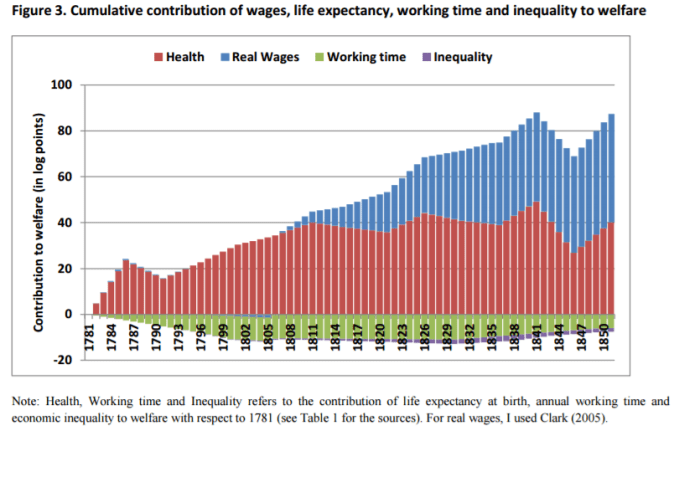
Aggregate measures of well-being, England 1781-1850

I went in the field of economic history after I discovered how much it was to properly measure living standards. The issue that always interested me was how to “capture” the multidimensional nature of living standards. After all, what weight should we give to an extra year of life relative to the quality of that extra year (see all my stuff on Cuba)?

However, I never tried to create “a composite” measure of living standards. I thought that it was necessary, first, to get the measurements right. However, I had been aware of the work of Leandro Prados de la Escosura who has been doing considerable work on this in order to create composite measures (Leandro also influenced me on my Cuba reasoning – see this article).

A year ago, I discovered the work of Daniel Gallardo Albarrán from the University of Groningen at the meeting of the Economic History Society (EHS). Daniel’s work is particularly interesting because he is trying to generate a composite measure of well-being at one of the most important moment in history: the start of the British industrial revolution.

Because of its importance and some pieces of contradicting evidence (inequality, stature, amplitude of real wage increases, amplitude of income increases, urban pollution leading to increased mortality risks etc), the period has been begging for some form of composite measure to come along (at least a serious attempt at generating it). Drawing on some pretty straightforward microeconomic theory (the Beckerian in me likes this), Daniel generates this rich graph (see the paper here).

Daniel

The idea is very neat and I hope it will inspire some economic historians to attempt an expansion upon Daniel’s work. I have already drawn outlines for my own stuff on Canada since I study an era when (from the early 1800s to the mid-1850s) real wages and incomes seem to be going up but stature and mortality are either deteriorating or remaining stable while inequality is clearly increasing.

Star Trek Did More For the Cultural Advancement of Women Than Government Policies

The fondest memories of my childhood center on the time I spent with my father watching Star Trek. At the time, I simply enjoyed science fiction. However, as an adult I have often revisited Star Trek (on multiple occasions) and I realized that I had incorporated subconsciously many elements of the show into my own political reasoning.

Not to give too much away about my age, my passion with Star Trek started largely with the Voyager installments. As a result, I ended up seeing Kate Mulgrew as Captain Janeway. And that’s what she was: the captain. I never saw the relevance that she was a woman. A few years ago, I saw her speak at the Montreal Comic-Con (yes, I am that kind of Trekkie) and she mentioned how crucial she thought her role to be for the advancement of women. By that time, I had already started to consider Star Trek as one of the most libertarian-friendly shows ever to have existed. While its economics were strange, its emphasis on tolerance, non-intervention and equality of rights make it hard to argue that it is not favorable to broadly-defined liberal mindset. However, I had not realized how much so until I heard Mulgrew speak about her vision of the role. After all, I had somehow forgotten that Mulgrew was a woman and how novel her role was.

One person who understands how important was this point is Shannon Mizzi who wrote a piece for Wilson Quarterly which I ended up reading while I was still a PhD student. Her core point was that in Star Trek, women were simply professionals. They were rarely seen doing other things than their work. While she argues that this meant that Star Trek played an underappreciated role in the history of women’s advancement, I am willing to go a step further. That step is to assert that the cause of the cultural advancement of women has been better served by Star Trek than by governments. (Please note that I am only considering cultural advancement)

The pre-1900 economic and social history of women would be sufficient in itself to make this point of mine. After all, women were given a lesser legal status by governments. This is both a necessary and sufficient element to assert that, overall, governments have been noxious to women’s advancement over many centuries. One century of legal emancipation would still leave Star Trek as a net positive force. But that would be a lazy argument on my part and I should simply focus on the present day. In fact, thanks to a wealth of data on wage gaps, gender norms and measures of legal institutions, I can more easily back up the claim.

My friend Rosemarie Fike of Texas Christian University is the first person that comes to mind in that regard. Her own doctoral dissertation, Economic Freedom and the Lives of Womenintroduced me to a wide literature on the role of economic freedom in the advancement of women. To be sure, Rosemarie was not the first to try to measure the role of economic freedom (which we should understand as how small and non-interventionist a government is). There had already been some research showing that higher levels of economic freedom were associated with smaller hourly wage gaps between genders and how liberalizing reforms were associated with wage convergence between genders. However, some economists have been arguing that there are other “soft sides” to economic freedom – like in the promotion of cultural equality and norms that promote certain types of attitudes. This is where Rosemarie’s work is most crucial. In a section of her dissertation, she essentially builds up on the work of (my favorite Nobel laureate) Gary Becker regarding preferences and discrimination. Basically, the idea is that free markets will penalize people who willingly discriminate. After all, if an employer refuses to hire redheads for some strange reason, I can compete by hiring the shunned redheads at a lower wage rate and out-compete him. In order to stay in business, the ginger-hating fool has to change his behavior and hire redheads which will push wages up. Its hard to be a racist or misogynist when it costs you a lot of money.

However, if you prevent this mechanism from operating (by intervening in markets), you are making it easier to be bigoted-chauvinistic-male-pigs. As a result, laws that prevent market operations (like the Jim Crow laws did for blacks) enshrine discriminatory practices. Individuals growing up in such environment may accept this as normal and acceptable behavior and strange beliefs about gender equality may cement themselves in the popular imagination. When markets are allowed to operate, beliefs will morph to reflect the actions taken by individuals (see Jennifer Roback’s great story of tramways in the US South as an example of how strong markets can be in changing behavior and see her article on how racism is basically rent-seeking). As a result, Rosemarie’s point is that societies with high levels of economic freedom will be associated with beliefs favorable to gender equality.

But the mirror of that argument is that government policies, even if their spirits have no relation to gender issues, may protect illiberal beliefs. Case in point, women are more responsive to tax rates than men – much more. In short, if you reduce taxes, women will adjust their labor supply more importantly at the extensive and intensive margin than men will. This little, commonly accepted, fact in labor economics is pregnant with implications. Basically, it means that women will work less in high tax environments and will acquire less experience than men will. Since it is also known that differences in the unmeasured effects of experience weigh heavily in explaining the remaining portion of the gender pay gap, this means that high tax rates contribute indirectly to maintaining the small gender pay gap that remains. Now, imagine what would be the beliefs of employers towards women if they did not believe that women are more likely to work fewer hours or drop out of the workforce for some time? Would you honestly believe that they would be the same? When Claudia Goldin argues that changes in labor market structures could help close the gap, can you honestly say that the uneven effect of high tax rates on the labor supply decisions of the different genders are not having an effect in delaying experimentation with new structures? This only one example meant to show that governments may, even when it is not their intent, delay changes that would be favorable to gender equality. There are mountains of other examples going the larger effects of the minimum wage on female employment to the effects of occupational licencing falling heavily on professions where women are predominant.

With such a viewpoint in mind, it is hard to say how much governments helped the cultural advancement of women (on net) over the 20th and 21st centuries . However, Star Trek clearly had a positive net effect on that cultural advancement.  That is why I am willing to say it here: Star Trek did more for the cultural advancement of women than governments did.