From the Comments: Foucault’s purported nationalism, and neoliberalism

Dr Stocker‘s response to my recent musings on Foucault’s Biopolitics is worth highlighting:

Good to see you’re studying Foucault Brandon.

I agree that nationalism is an issue in Foucault and that his work is very Gallocentric. However, it is Gallocentric in ways that tend to be critical of various forms of nationalist and pre-nationalist thought, for example he takes a very critical line of the origins of the French left in ethnic-racial-national thought. Foucault does suggest in his work on Neoliberalism that Neoliberalism is German and American in origin (which rather undermines claims that Thatcherism should be seen as the major wave). He also refers to the way that Giscard d’Estaing (a centre-right President) incorporated something like the version of neoliberalism pursued by the German Federal Chancellor, Helmut Schmidt, from the right of the social democratic party.

Thoughts about the relations between France and Germany going back to the early Middle Ages are often present in Foucault, if never put forward explicitly as a major theme. I don’t see this as a version of French nationalism, but as interest in the interplay and overlaps between the state system in two key European countries.

His work on the evolution of centralised state judicial-penal power in the Middle Ages and the early modern period, concentrates on France, but takes some elements back to Charlemagne, the Frankish king of the 8th century (that is chief of the German Franks who conquered Roman Gaul), whose state policies and institutional changes are at the origin of the French, German and broader European developments in this are, stemming from Charlemagne’s power in both France and Germany, as well as other areas, leading to the title of Emperor of the Romans.

Getting back to his attitude to neoliberalism, this is of course immensely contentious, but as far as I can see he takes the claims of German ordoliberals to be constructing an alternative to National Socialism very seriously and sympathetically and also regards the criticisms of state power and moralised forms of power with American neoliberalism in that spirit. I think he would prefer an approach more thoroughly committed to eroding state power and associated hierarchies, but I don’t think there is a total rejection at all and I don’t think the discussion of ordoliberalism is negative about the phenomenon of Germany’s role in putting that approach into practice in the formative years of the Federal Republic.

Here is more Foucault at NOL, including many new insights from Barry.

Foucault’s biopolitics seems like it’s just a subtle form of nationalism

I’ve been slowly making my way through Michel Foucault’s The Birth of Biopolitics, largely on the strength of Barry’s recommendation (see also this fiery debate between Barry and Jacques), and a couple of things have already stood out to me. 1) Foucault, lecturing in 1978-79, is about 20 years behind Hayek’s 1960 book The Constitution of Liberty in terms of formulating interesting, relevant political theory and roughly 35 years behind his The Road to Serfdom (1944) in terms of expressing doubts over the expanding role of the state into the lives of citizens.

2) The whole series of lectures seems like a clever plea for French nationalism. Foucault is very ardent about identifying “neo-liberalism” in two different models, a German one and an American one, and continually makes references about the importation or lack thereof of these models into other societies.

Maybe I’m just reading too deeply into his words.

Or maybe Foucault isn’t trying to make a clever case for French nationalism, and is instead trying to undercut the case for a more liberal world order but – because nothing else has worked as well as liberalism, or even come close – he cannot help but rely upon nationalist sentiments to make his anti-liberal case and he just doesn’t realize what he’s doing.

These two thoughts are just my raw reactions to what is an excellent book if you’re into political theory and Cold War scholarship. I’ll be blogging my thoughts on the book in the coming weeks, so stay tuned!

BC’s weekend reads

  1. Generals and Political Interventions in American History
  2. they neglect to take account of the experiences of postcolonial states that form the vast majority of members of the international system. “
  3. The U.S. Hasn’t ‘Pulled Back’ from the Middle East At All
  4. No special sharia rules in American courts for Muslims’ wrongful-death recovery
  5. Is Gary Johnson a True Libertarian? American libertarianism has a purge problem
  6. Identity politics and the perils of zero-sum thinking

NGDP 3% per year; NGO much less!

A few days ago, Scott Sumner blogged about the “new normal” of NGDP trend (3% a year) (here and here). Overall, I tend to agree with him that the aggregate nominal expenditures are now at a new and historically low trend growth rate. I think that he is way too optimistic! 

As readers of this blog are aware, I am not convinced that NGDP is the proper proxy for nominal expenditures. I believe that Nominal Gross Output (NGO) is a better proxy as it captures more goods and services traded at the intermediate level (see blog posts herehere and here).  The core of my argument is that NGO will capture many “time to build” problems that will not appear in GDP as well as capture intangible investments which are now classified otherwise (see literature on intangible investment as capital goods here).  Thus, my claim that NGO captures more expenditures (especially between businesses). (Note: I am in the process with some colleagues of finalizing a paper on the superior case for NGO – more on this later.)

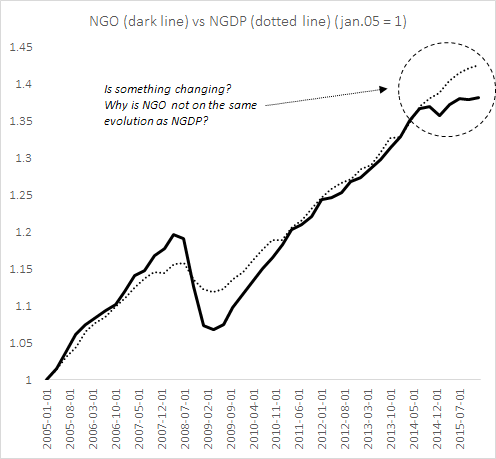
Are we at a new normal point where growth in nominal expenditures is slower than in the past? Yes! But according to Sumner and others, this is 3%. If we use NGO we are much lower! Again, using the FRED dataset, here is the evolution of NGO and NGDP since January 2005 (the start date of the NGO series in a quarterly form). The graph shows something odd starting in mid-2014 : NGO is growing much more slowly.

NGDPNGOaug2016geloso

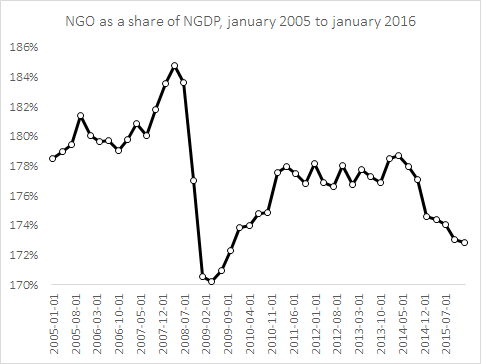
To see this better, let’s plot the evolution of NGO as a percentage of NGDP in the graph below. If the ratio remains stable, then the trend is similar for both. As one can see, the recession saw a much more pronounced fall of NGO than NGDP with a failure to return to the initial levels. And since 2014, the ratio has started to fall again (indicating slower growth of NGO than NGDP).

NGDPoverNGOgeloso2016aug

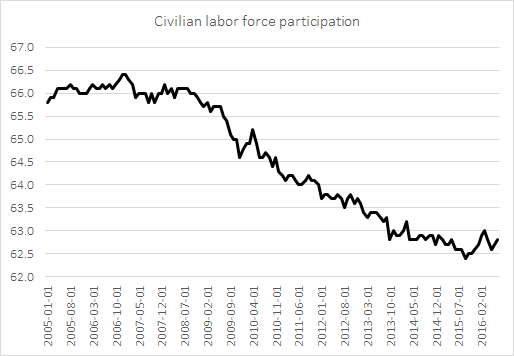
So what is happening? Why is there such a difference? I am not one hundred percent sure about the causes of this difference. However, I am willing to contend that NGO is fitting better than NGDP with other indicators indicating a tepid recovery. If we look at the labor force participation rate in the US, it continues to fall in a nearly mechanical manner. Fewer and fewer workers are at work (or looking for work) in comparison to the population that could be working while investments are disappointing.

CivilianLaborForceParticipation

Maybe Scott Sumner is being overly optimistic. The new trend might simply be substantially lower than he believes.*


*Readers should note that I believe that monetary policy is, at present, too restrictive. However, I believe the culprit is not the Federal Reserve but financial regulations that restrict the circulation of “private money” (the other components of broad money found in divisia indices – see my blog post here). 

A Note on Trump, Immigration, and Healthcare Reform

Hopefully, the US election will start getting out of the he-said-she-said of assassination attempts and badmouthing parents of military personnel and start being about actual policy issues. Unfortunately, that isn’t going to happen at all, but in a minuscule and futile attempt to help get us there, I’m going to blog about some policy issues for a minute.

Trump’s campaign released a brief memo about his healthcare positions recently. For the most part the positions—though not quite detailed enough to really call a “plan”—are fairly decent. They contain most of the reforms free-market analysts have been proposing for decades such as opening insurance competition across states, allowing for Health Savings Accounts, and streamlining Medicaid funding. Notably missing was abolishing the employer mandate to reduce price fragmentation, as Milton Friedman proposed, although Trump proposes taking steps in that direction by introducing a tax deduction for individual insurance plans.

But what stuck out to me was that Trump, surprise, surprise, made xenophobia an element of his health care proposal by furthering the myth that immigrants are a further drain on our healthcare and welfare programs:

Providing healthcare to illegal immigrants costs us some $11 billion annually. If we were to simply enforce the current immigration laws and restrict the unbridled granting of visas to this country, we could relieve healthcare cost pressures on state and local governments.

Meanwhile in reality, undocumented immigrants actually contribute more to Medicare than they withdraw. It is unclear where Trump is getting his $11 billion figure, but he is ignoring the increased payroll taxes undocumented immigrants pay into these programs. A 2015 study found that, in fact, between 2000 and 2011 immigrants paid up to $3.8 billion more into Medicare than they took out. From the results of the study:

From 2000 to 2011, unauthorized immigrants contributed $2.2 to $3.8 billion more than they withdrew annually (a total surplus of $35.1 billion). Had unauthorized immigrants neither contributed to nor withdrawn from the Trust Fund during those 11 years, it would become insolvent in 2029—1 year earlier than currently predicted. If 10 % of unauthorized immigrants became authorized annually for the subsequent 7 years, Trust Fund surpluses contributed by unauthorized immigrants would total $45.7 billion.

Poor immigrant children, both legal and illegal, are also less likely to be enrolled in Medicaid or CHIP than citizens.

Thus Trump’s campaign is being factually dishonest by claiming that restricting immigration will help fund government healthcare systems, it will actually make Medicare go insolvent sooner. Which is especially concerning given that, until this memo, Trump has shown no interest in any meaningful entitlement reform.

This refrain—that immigrants are a fiscal drag on America’s welfare programs—has been among the most common refrains from Trump, and has even been popular among libertarians who are otherwise sympathetic towards immigration. But, as I’ve argued extensively in the past, it is completely false. Almost every major study shows that immigrants, at worst, pay as much into welfare programs as they get out of them.

Some thoughts on the Olympic Games and cosmopolitanism

Right now my city, Rio de Janeiro, is hosting the Summer Olympic Games. It is in many ways a great moment, and it is especially good to see people from so many parts of the world together in relative harmony. In other words, a good example of cosmopolitanism. The cosmopolitanism in the city today reminds me of the attempts of multilateralism that marked Brazilian (and world) foreign policy in previous governments, but that now seem to fade away. The two terms, cosmopolitanism and multilateralism, are not exactly synonyms, but are closely related: multilateral policies should work in bringing peoples together in a more cosmopolitan world. Concerning that, I think of a multilateralism that does not work in bringing people together through cosmopolitanism, and one that can work in that way.

When the Cold War was over, multiple theories were presented to explain what would happen to a world without the tension between two superpowers. Some suggested that the US would reign as a lone superpower; others that it would embrace some form of benign hegemony, in a New World Order. Others still believed that US power was in decline, and that the World would see more multilateralism in the 21st century. This last view was especially dear in Brazil, but as the 21st century progresses, it does not seem to hold as much water anymore.

One great example of multilateralism substituting American hegemony was the integration of Western Europe, but that does not seem to be the case anymore. It is true that beginning shortly after WWII European countries experienced growing levels of regional integration, culminating with the European Union and the Euro in the 1990s. But even then, economists warned politicians and the general public that such a level of integration was not possible, at least not without a central government in Europe. Successive economic crises, Brexit, and the harsh questioning of immigration policies show today that economists were right back then.

Another example of multilateralism celebrated in the 1990s was the growing importance of the UN. Successive humanitarian missions and interventions in several countries suggested that that UN could now surpass the dawn that marked the relationship between USA and USSR in the previous period. Optimism went so far as to discuss themes such as the ‘obligation to intervene’, substituting previous understandings of state sovereignty. But as the years go by, cases like Haiti, Rwanda, Sudan, and many others show that the optimism was at best too high.

Finally and more recently, Brazil and other underdeveloped and developing countries focused greatly on South-South Cooperation, trying to substitute the more standard paradigm of North-South Foreign Aid. This materialized in initiatives such as UNASUR and BRICS. Although presented as a new development, that was actually very reminiscent of The Non-Aligned Movement, The Group of 77, and other initiatives from the 1960s and 1970s. Now, as Brazil, Venezuela, Ecuador, Bolivia, Turkey, China, Russia, and several other countries face growing levels of economic and political hardship, attempts to “overcome American hegemony” seem but preposterous.

New forms in multilateralism in Europe, the Global South, and even the World (in the UN) did not work because they are not really democratic, as they claim to be. Behind a rhetoric of democracy, empowerment of the poor, and so on, they are just new forms of mercantilism: political elites trying to control the economy, not just at the national level, but the international one as well. The point was never to actually bring people together, but to maintain the status quo by avoiding real competition.

The multilateralism that can bring about cosmopolitanism, and that somewhat shows in the Summer Olympic Games in Rio, is one characterized by spontaneous order. People do come together: that is the natural ways of things. The desire to trade spontaneously brings different peoples closer to one another, and as they are closer they realize how much they have in common, and also what can be learnt from the differences. It is not always a peaceful dealing, but the more people are educated to tolerate the differences and to benefit from them, the more cosmopolitan they become.

A top down approach to cosmopolitanism is just a deformed clone of the real thing. Even if some results appear, they always seem to fall somewhere in the uncanny valley, and anyway, the results do not last very long. A bottom up cosmopolitanism is the real thing, and if only elites let it be, it can grow stronger, bring more wealth, and even a little more peace to the world.

Voting For Potty-Mouth Trump

I think Donald Trump has the attention span of a two year-old and the potty mouth of a six year-old reared by an indulgent grandmother who is also hard of hearing. I also think he is deeply ignorant on a very important issue (international trade) and I disagree forcefully with him on another (illegal immigration from the south). Finally, I believe there is little chance that a President Trump’s foreign policy would reverse the Obama precipitous decline of the US on the world stage, which I think is dangerous for Americans.

Not a pretty picture overall. So, it takes serious concerns for a dedicated, generally well-informed rationalist like me to vote for him. Here are the reasons why I will.

First, Trump has already told us whom he would appoint for the Supreme Court which sets the life conditions of American society for a generation or more. All his potential appointees are fine by me. It’s not difficult to guess that no Clinton appointee would be acceptable, not one, zero. Any of them would facilitate the creeping abrogation of the US Constitution we witnessed under Obama.

Second, I am certain – because it’s difficult to imagine otherwise – that a President Trump would try to stop and reverse most the climate change cult nonsense and relegate it to the level of a private religion where it belongs. His administration would allow an energy revolution sufficient in itself to rekindle economic growth. I see no prospect of normal economic growth under a Hillary Clinton presidency. (I mean 3% per year and over.) She has said herself that she would continue Pres. Obama’s paralytic policies.

Third, through the example of his sheer verbal brutality, Trump would lift some the yoke of political correctness. This is not a superficial or a light reform. I believe that political correctness actually paralyzes Americans’ criticality on nearly all issues. (Examples on request.)

My last reason is Democratic candidate Clinton of course, even if I leave aside every single one of the leftist policies she is likely to try to implement. Mrs Bill Clinton is still bought and paid for. The fact that I don’t know exactly by whom or by what only makes it worse. (Someone who would not braggingly share her $250,000 a shot speeches with the public is unthinkable to me.) On that account alone, if I had to choose between H. Clinton and Al Capone for president, it would be a toss-up. We know what interests Al was serving, after all.

There is worse: Her lies about her lies, her lies that have zero chance of being believed have become a proof that she is delusional, at least part of the time. By contrast, Trump ‘s untruths are like those of a little boy who can’t help himself from opening his mouth before he talks.

Presidential elections are not only about the presidency, of course. They give the winner’s party a confirmation of the validity of the principles it proclaims and of the policies it embodies. This is obviously true for well defined policies such as Obamacare. It’s true, more subtly, about cultural policies both explicit and implicit. Seven and half years of Obama administration have established firmly – with Big Media complicity – the language of envy and the spirit of beggardliness in American political discourse. Public speech is now built around platitudes, clichés, half-truths, and big lies repeated so frequently that they have become truth, Goebbels-style. The new liberal language is disgusting but completely predictable and thus boring. It’s also a form of child abuse. (Individuals who were 10 during Pres. Obama’s first campaign are now 19. They have never known public sanity.) As for Demo principles, there aren’t any. I count my blessings!

Donald Trump on his part, is his own buffoon. He is only an epiphenomenon. His objectionable traits are not part of a cultural movement. He is not contagious. There is zero chance the Republican Party, or the conservative movement are going to adopt his crudeness. Neither could if they tried.

I am angry about this cultural deterioration because I believe that in the long run what people do, what they accomplish collectively, is strongly constrained by culture. The contemporary American left-liberal culture shackles the imagination, and by doing so destroys many possible futures. Again, the Obama/Clinton conceptual swamp is vastly more of a lasting threat to America than the childish vulgarity and the ignorance Trump displays so frequently.

Being on the side of Trump often puts me in embarrassing company, I admit. But being on Clinton’s side would place me knowingly in vicious company. It would also range me squarely on the side of an intellectual class that has spent decades consolidating its collective blindness and its collective deafness about the reality of the world. It’s a class I know well because much of it lives in universities. There is no doubt that Trump as president is a big gamble. But Clinton is no gamble at all; her evilness is predictable.

Sometimes, to be a man of conscience, you have to gamble. That’s what I plan to do, on my behalf and on your behalf.*

* Public persons often contribute unwittingly to me finding my bearings: If Harry Reid, the corrupt real estate and proud deliberate liar loudly condemns Trump, there has to be something right about supporting Trump.

Invitation to Steemit – a blockchain based social media platform

As some might already suspect from some of my previous posts, I am a cryptocurrency enthusiast. As of now, there is another crypto-project founded by two libertarian anarchists that I find extremely interesting and that I would like to share with you.

In this post, I’d like to introduce this project called Steemit, a new social media platform where content creators (bloggers) can earn money with every ‘upvote’ (comparable to ‘likes’ on Facebook) they receive from the community. I am not encouraging my fellow note writers to quit posting articles on Notes on Liberty, but I would recommend them to share their articles both here and on the Steemit platform.

So what is Steemit?

“Collectively, user-generated content has created billions of dollars worth of value for the shareholders of social media companies, such as Reddit, Facebook, and Twitter. Steem supports social media and online communities by returning much of its value to the people who provide contributions by rewarding them with virtual currency.”

Steemit is most similar to Reddit, but with the important difference that you can monetize your blog. You can take a look at my first two ‘hits’ on Steemit for proof that you can monetize your blogging skills:

Steemit was founded half a year ago by entrepreneurs Ned Scott and Daniel Larimer. Daniel Larimer has been a familiar face in the cryptocurrency scene as the founder of Bitshares, which currently ranks as the 19th largest cryptocurrency in market cap on www.marketcap.com. Steem itself, the currency that drives steemit, has risen in prominence among other cryptocurrencies. According to www.marketcap.com, Steem is now the 4th largest behind Bitcoin, Ethereum and Ripple.

The concept behind Steemit is very simple, and you don’t need in-depth knowledge of the workings of cryptocurrencies to start writing (and curating posts) and earning some money. If you have a facebook account or a reddit account, you can sign up at www.steemit.com. At first sign up, you will receive $10 worth of Steem Power – I will later get to Steem Power to explain what it is. Once you sign up you can immediately start submitting posts or comments on other people’s submissions. You can earn money through both ways.

The website is still in beta, and you may argue that it is not as user friendly as Reddit or other social media networks, but the pace in which applications have been rolled out on the platform in the one month that I have been using it is impressive!

A chat functionality with private messaging, a functionality to follow other writers, and weekly insights in your earnings have for example all been added in the past four weeks.

Steemit roadmap

This, however, is just the beginning. The founders of Steemit have far larger plans than just creating a blockchain based social network. The social network is the means to attract enough users of its currency (Steem and Steem Dollars) that a full-fledged market place based on these currencies can emerge. The first step is to increase the user base, but next steps are to create a market place in which people can trade goods with Steem and Steem Dollars and where Steem will grow in such prominence that it will compete with already existing fiat currencies like the USD, Euro, GBP, Yen, and RMB. We are still far off from this actually happening, but it’s great to see these kinds of experiments with the free market.

Is Steemit a scam?
I have read about people who have called it a scam, but the funny thing is that you don’t need to put any monetary investments in the platform to submit an article and earn some money. Normally in scams, you are encouraged to give away your money for little or nothing in return. With Steemit, all you need is to create content that the community values and in return you will receive some money.

Steem, Steem Power and Steem Dollars
Lastly, I’d like to say some words about the three tokens you can hold when using Steemit: liquid Steem, Steem Power and Steem Dollars (SBD).

Liquid Steem, or simply Steem by name, is immediately convertible to bitcoin and fiat currencies as USD. People who would like to speculate on the price of Steem can hold it to sell at a higher price.

You can also convert your Steem into Steem Power. Steem Power gives you, if I am not mistaken, interest of approximately 0.7% in Steem Power per day. Holding Steem Power is like holding a stake in the long-term development of Steemit as you can only convert 1% per week of your Steem Power in Steem and exchange it for bitcoins and fiat currencies.

Steem Dollars are tokens pegged to the USD at an exchange rate of around 1 : 1. People who don’t like the volatility of cryptocurrencies can hold Steem Dollars.

For more information about Steemit, you can read the Steem White Paper or watch this excellent interview of its founders:

I hope that I have triggered your curiosity about Steemit, and I hope that you will take this invitation to post your content not only on Notes on Liberty, but also on www.steemit.com. Please don’t forget to follow me once you are on Steemit. You can find me at www.steemit.com/@chhaylin.

A Muslim Woman and the Sea

Here is another short story. (I don’t have the talent to compose characters so, most of my stories are autobiographical by default.)

I am on the same free-diving and spear fishing expedition I mentioned in another story. We are driving and living in a VW bus I equipped myself for the purpose. This time, my then future ex-wife (“TFEW”) and I are stopped in a small town in coastal western Algeria. We just arrived and it’s a sunny quiet morning. We are enjoying a rare cup of real coffee at the also rare terrace of a small café. I will never forget that insignificant non-event, because, suddenly, out of nowhere, a baby camel came ambling down the street. The charming animal walked straight up to me and began browsing my hair. (Go ahead, don’t believe me; I have a picture!)

So, we are just lingering when a handsome teenage boy stops by to make conversation (in French, of course): Where are you from? What are you doing here? What kind of fishing, again? How do you like Algeria?

We invite him to sit down and have coffee with us but he insists he is in a hurry. He wishes us a good vacation and walks away. Then, suddenly, he wheels around to tell us he would like to invite us to his house for couscous. He is too young to be married and to have his own house. I ask him how his mother would respond to sudden unannounced guests. He replies that she would love it, that she misses her old French bosses; that she likes to speak French with real French people. I am beginning to feel peckish. Against my better judgment, we follow him around the corner.

We drive through a metal gate he closes behind us. The young man stops at the door to the house and calls out with several sentences in Arabic. A woman’s voice responds and the door opens immediately. A woman in her early forties stands smiling at us. Her dark shiny hair is partially covered. She has beautiful apricot skin and dancing black eyes. Under other circumstances, in spite of a fifteen-year age difference, I might have fallen in love with her on the spot. I must have been fairly obvious because the TFEW secretly yanked hard on the back of my shirt.

We sit down on cushions in the living room. There is an opening into the kitchen so we can communicate with the mother while she works. Actually, I am pretty much the only one doing the communicating because the TFEW is not a native French speaker and she is a little hesitant on that account. The thought crosses my mind that the mother is flirting with me verbally a little from the kitchen where I cannot see her face. The charming son soon serves us tea and two quiet teenage girls dart in and out on what I think is a mission to keep us company although they do not say anything. I am not sure whether they were shy or if they did not know French. There is no man in sight and no mention of any adult male.

After quite a long time bantering back and forth without the help of an adult beverage precisely, the steaming couscous garni appears on the rug in front of our knees. (Tech note: “couscous” is the grits-like grain; it’s “garni” when it is accompanied by a vegetable stew including chickpeas, and meat, usually boiled mutton, sometimes chicken.) Everyone is starving by that time and the family sits around and next to us each holding a bowl into which the mother dishes out couscous topped with veggies and mutton. One of the girls has thoughtfully placed a spoon in front of us, the visitors, which we make a point of honor to ignore, of course because we want to appear cool.

The mother tells us gaily how she had worked for fifteen years for a French family, as a servant with broad responsibilities, including the care of small children and the kitchen. She says she loved the lady of the house and the lady of the house loved her “like a niece.” I guess that’s how she has learned her grammatically perfect and lively French. After the French left, suddenly, feeling threatened (and probably with good reason) there was no work for a woman with her skills. Nothing is said, again in this story, about a husband. There is no explanation about how the family sustains itself.

It’s often difficult to say how poor people are following a revolution. Those don’t look poor. They are all well though simply dressed. The house in which they live is consequential and Western-style. (I mean that I would have moved into it in a minute.) As far as I know, it is her beloved lady boss’s house they are all occupying. Perhaps, the lady boss has slipped her the title before fleeing. I am told there was a lot of that that went on. I am also told the new Algerian government, its hands full of pressing matters, was happy to let sleeping dogs lie on this issue. I can’t judge what the family’s everyday food is like but none of them look skinny and the couscous was well garnished and ample. (But then again, the latter is not a good indicator of anything in North Africa where a feast is a feast however meagre the fare on ordinary days.)

If you eat enough food and it’s tasty enough, at the end of the meal, you will feel a little like drunk. Those who talk after dinner, including the Mom, talk louder. The pleasant son tells me of his wish to go work in France and of his modest ambitions in general. Even the young girls smile more broadly. Perhaps seeing their mother happy makes them feel happy. I am asked to explain for the tenth time in Algeria what I am doing there. I explain my quest for big fish and spiny lobster (and also for slipper lobster, a grotesque looking but delicious creature). I describe how I go under water holding my breath to shoot them in the face with a rubber spear gun. The family seems a little incredulous but they are visibly charmed by the concept. They have already made themselves believe that the TFEW and I really sleep in the VW bus as we travel from place to place. (The bus was parked out of view in their courtyard while we ate.)

Then, out of nowhere, the mother says something astounding: I envy you – she says to spend so much time looking at the sea. I love the sea and I haven’t seen it for so long. Say this again, I request. Isn’t this house, your house, about four or five blocks from the sea cliff? It is, she said but I can’t go there (“Je ne peux pas y aller.”) French does not not distinguish between physical impossibility and moral interdiction. So, I am a little confused but not for long. I guess quickly what’s on her mind.

I have an idea, I say. I tell you what: Tomorrow morning at five when the sun is up but everyone is still asleep, you will put on your hijab and wear a shawl around your shoulders that you can raise to hide your face if necessary. Your son will open the gate to let my bus out and then, he will sit next to me in front where everyone can see him. You will be in the back next to my wife with the curtains drawn. Your son will direct me to a suitable point on the cliff where I will park. There, you will raise the curtain as much as you want to and look at the sea as long as you wish. She agrees and her face is filled with anticipation.

Early the next morning, the son wake us up with cups of hot coffee. There is a defeated look on his face. He tells us that his mother has changed her mind and that she will not take up my proposal after all; that she says thank you and good-bye. He adds she is too embarrassed to get up and wish us a good trip face-to-face. We shake hands and leave with much sadness in our hearts.

Is this a story about religion? All Algerians were Muslims, if nothing else, by default; so was our pleasant hostess, no doubt Yet Muslim intellectuals will point out that there is no part of the Islamic sacred scriptures that enjoins women to hide at home. There is certainly nothing in the same scriptures that says they can’t enjoy contemplating the sea, one of God’s first creations, in Islamic as well as in Jewish and Christian tradition.

Personally, I disagree. I think this is a story about religion although indirectly. If the woman had been a Lutheran, a Catholic, a Buddhist, a Zoroastrian, or a Mormon, she would have had her fill of the sea before I met her. I can even imagine a Hindu woman being somewhat self-cloistered but not one fluent in a foreign language, not one with a long history of happy interaction with Westerners.

Two main points. First, every follower of a religion is not a scriptural expert. What people think is their religion often differs a great deal from what theologians say is true religion. I addressed this issue in an article in Liberty Unbound. (“Religious Bric-a-Brac and Tolerance of Violent Jihad.”) Second, religions are vehicles for all kinds of cultural practices that are not religious or only in a distorted manner. Thus, Catholicism, besides its rich history of burning people alive for their opinions, is largely responsible for the consumption of fish among inland Catholics. It probably even had a lot to do with the establishment of the long lasting Newfoundland cod fishery. (Ask me.) It’s fair to judge religions for the cultural baggage they carry and that they could put down if they really wanted to. Passive assent is a form of complicity.

Theory versus Common Sense? The case of Free Trade

[…] the [World Baseball Classic] allows Organized Baseball to sustain the structures that constitute its inner purity, maintaining the boundaries of its regular and post seasons above all against all challenge by foreign teams, all the while increasing its global reach in recruiting talent and vending its commodity […A]ll the champions and perennial powers of the world’s other leading leagues need not apply.

[…] To call [Organized Baseball] an empire, or even a monopoly, is to seriously underestimate it. It is to fail to see the form of power it wields in shaping the separateness of its own commodious world, controlling access, avoiding and deflecting competition, limiting liability, sustaining and elaborating fictions of separate but equal, and mostly separate.

[…] For all of our ease in understanding objections to racism, for all that we can see the flaws in separate but equal when it generated the Major Leagues and the Negro Leagues, most of us now, not only but especially Americans, have no inkling how strange and immoral will someday seem our sanguine acceptance of the legal fortresses of limited liability and nation-state self-determination. (170-172)

These passages are from the last few pages of American anthropologist John D Kelly’s short book The American Game: Capitalism, Decolonization, World Domination, and Baseball. You can read it for yourself, but my short summary of the book is that it pleads for free trade. Not the theoretical free trade of economists, mind you, but of a practical free trade that opens up borders to labor (Kelly points out that it is really hard to play in the Majors if you are not an American, but shortsightedly blames US policy when other nation-states harbor just as much of the blame; if anything, the US has one of the more open immigration policies in the world today) and to marketplace competition (i.e. capital) in the realm of goods and services. I don’t know if this is a conclusion that Kelly would be comfortable being associated with, given that he is a man of the Left, but what would you call a world where baseball teams from Cuba, the US, the Netherlands, Japan, etc. compete with each other on an even playing field for labor, fans, and prestige?

The stubbornness of the Left is sometimes astounding. Kelly is right to lament the fact that the American baseball league (“Organized Baseball”) wields so much power in international baseball, but he doesn’t spell out an explicit remedy for solving this issue. Instead, it seems as if he is mystified as to how this could possibly happen. He understands and acknowledges that Organized Baseball derives much of its power from being located in the world’s most powerful nation-state, but he also understands that free trade (of labor and capital) is the answer to this issue without explicitly acknowledging this fact.

It seems to me that this is an issue where libertarians and internationalist Leftists can work together, provided we clarify a few concepts. Free trade is the answer for a lot of problems in the world today. Internationalists on both the Left and the Right realize this (see also Delacroix). The New Left intelligentsia, though, wants a practical free trade, and it often accuses economists of arguing for a theoretical free trade. But this critique is made in bad faith: Because economists are more familiar with the theoretical version of free trade, they are, as a whole, more willing to make compromises in the form of small steps towards more free trade. The New Left intelligentsia, instead of taking into account all the various options that can be done to move toward a freer world, including political limitations on what can be done to open societies up more to each other, has decided instead to poo-poo the small steps advocated by economists, and all in the name of practicality!

I agree with Kelly and others about the nation-state being a tool of segregation in today’s world. Unlike the New Left, though, I wholeheartedly embrace the pragmatic steps being taken to erode this segregation through the peaceful medium of free trade, even if it is not True Free Trade.

What sort of “Meritocracy” would a libertarian endorse, if he had to?

The first attempt to answer this question should say: “none.” Notwithstanding that this is the correct approach, we can’t help but feel uneasy about it. Libertarians have had to deal with this uncomfortable truth for so long. In respect to my own personal experience, I remember where I was when I read, for the first time, “Equality, Value, and Merit,” the title of Chapter 6 in Friedrich A Hayek’s The Constitution of Liberty. I was attending a weekly reading group about that book, and we were gathered in a cafê in Buenos Aires. The number of attendees was enough to find every kind of reader you could expect (and not expect) to meet in such a group:

  • There was the one who had already studied and condensed each chapter and then was re-reading and re-assessing the whole book; the one who did his “homework” without any effort;
  • the one who the embarrassment of failing to accomplish the reading requirements for the meeting overcame the pleasure of any type of procrastination (i.e. me, mostly because I was one of the promoters);
  • and the one who gave to the group the enthusiasm to last for six months in a row and finish the whole book. The latter, in this case, was a truly “natural Libertarian,” the one who had the pure Libertarian position for each subject by not showing an excessive regard for what Hayek was actually saying.

I remember that I arrived to the “Equality, Value, and Merit” meeting with a feeling of uncertainty. Hayek argued that there is no merit to acknowledging in a market process, none of any sort, a just compensation for the value of one’s apportation – a value whose magnitude depends on the relative scarcity of the marginal product. The reader who always accomplished his reading duties without any effort shared my sentiment of awe. Almost the whole meeting was conducted by our companion who was reading the book for a second – or perhaps third – time. In effect, Hayek left no place to meritocracy, since it is impossible to decide democratically among any scale of merit (remember Kenneth Arrow’s theorem on the impossibility of democracy, cited later on the third volume of Law, Legislation and Liberty), so retributions based on value enable the system to adapt spontaneously to the changes in the environment with more efficiency. The explanation was a bit of an unpopular one, but accurate. Not without reluctance, almost all of us accepted it. All of us but one: our true spontaneous Libertarian. She would under no condition surrender her convictions on the merit of the retributions that the market process assesses spontaneously to each one in accordance to the marginal value of their activity. While we acknowledged no merit to the results of the market process, she was prone to endorsing a moral value to the blinded results of the allocation of goods adjusted to the changes in their relative scarcities.

Many years after our debate took place, I am now starting to acknowledge that there might be a particle of truth in the statements of our natural Libertarian and, what is most outstanding, that these statements could be deducted from other chapters of the same book (The Constitution of Liberty), particularly the one which concerns on the definition of liberty (“Liberty and Liberties”). I said a particle of truth, not the whole truth, but at least that particle which is needed to start an intellectual quest.

In The Constitution of Liberty, written in 1960, Hayek made a quick outline of the different notions of liberty that were popular at that moment in time. Positive liberty, negative liberty, inner liberty, individual liberty, freedom from, freedom to, and freedom of were some of the categories mentioned. He made it clear that an in-depth discussion of each notion was not his main aim, but instead that was trying to make a quick account of them in order to give a conceptual frame to the one of his choice: a variant of the individual negative liberty defined as “the absence of arbitrary coercion.”

Slavery is the subjection to the will of another person, without boundaries of any kind. A slave could be subject to a good master who allows him to keep a normal life, but he could lose all of his freedom on a whim of his master at any time. On the other hand, the boundaries to the freedom of a free man are imposed by abstract and general laws and by contracts and the judicial decisions based on those contracts. The ordinary experience of a man enables him to discover principles and patterns of what would be regarded by others as just conduct, and to form in such way expectatives on how a given conflict could be solved. This concept of individual liberty as an absence of arbitrary coercion stated by Hayek in 1960 finds a strong resemblance today in the notion of liberty as an “absence of domination” by contemporary republican authors such as Quentin Skinner, Philip Pettit and, here in Argentina, Andrés Rosler.

The outcome of such a system is that every individual is enabled with a set of possible actions to be taken at his sole will, which we call an “individual sphere of autonomy.” In principle, these spheres are delimited by general and abstract laws and any controversy on the limits between two of them will be solved by an impartial court whose decision will be based on principles expressed by these norms. These judicial decisions would be in accordance to the patterns of just conduct that everyone had previously formed by ordinary experience, so they will prove correct the expectatives of most people and then will be regarded as non-arbitrary.

Of course, we could find that some judicial decisions would be taken by equity or that some administrative decisions would be based on expediency. But such a system could stand some exceptions, most of them aimed to solve an unexpected situation. Some of these new “precedents” are compatible with the principles which inform the existing laws and then their formulation will be a sort of “discovery” of new norms that until that moment were “implicit” in such a normative system. A criterion to distinguish the discovery of new norms from a decision based on expediency might be that the universalisation of the former brings about stability to the system; it makes the law work as a negative feedback system while the universalisation of the latter would only cause an increasing process of disorder.

Friedrich Hayek developed his theory of law – savagely summarised in the previous paragraphs – in Law, Legislation and Liberty and it provides us with an accurate modelization of how it would work a legal system that could not be experienced as “arbitrary” by the individual. In Hayek’s legal model, the fulfillment of the law would imply the respect of individual freedom as the absence of arbitrary coercion, since all boundaries to one’s will are previously known or reasonably expected and, then, our individual plans are conceived and accomplished regarding such limits.

After such a long digression we may come back to our initial enquiry: if a Libertarian had to “do meritocracy,” what sort of meritocracy would it be? The usual answer is, as we noted above, “none.” But I suspect that the wrong statements of some intuitive Libertarians carry within them a kernel of truth: the assignment of functions and subsequent retributions are expected not to be arbitrary, because even the changing value of the marginal products implies (1) some sort of predictability, (2) an impersonal process, and (3) a learning feedback system that fosters increasingly correct pattern predictions.

If we state that liberty is one, be it political, economic or social, we cannot use a definition of liberty in the political realm and another notion of it in the economic one. The “none answer” implies just plain individual negative liberty (absence of coercion) in political economy issues, while our definition of individual liberty is “absence of arbitrary coercion,” and this should be applied to the definition of economic liberty as well.

Therefore, I dare to state that a non-arbitrary distribution of functions and its subsequent remunerations should be a central problem to economic liberty, if we define it as “absence of arbitrary coercion.” Since our spheres of individual autonomy are delimited by a system of norms of just conduct, general and abstract, which distinguish arbitrary from just coercion, the economic liberty is expected to be found in such a framework.

Usually, the legal framework of a free market is regarded to be a neutral one: general and abstract rules, whose source could be the legislation sanctioned by an assembly of deputies of the people and notable citizens or the customs acknowledged as mandatory by the judiciary courts. In any case, general and abstract rules that are not conceived by a single will but have the impartiality of a plurality of legislators or juries. In this sense, “absence of arbitrary coercion” is identified with “absence of coercion by discretionary powers of the state.” Nevertheless, we consider that this is not enough: we should be conceptually endowed to do an evaluative judgement about the outcome of such economic system. We need to determine if the result of a neutral legal framework produces a non-arbitrary distribution of functions and retributions.

A neutral legal framework works like a peaceful, predictable, and secure Lockean Civil Society – i.e. the opposite of a Lockean Civil Society. Since we accept that legal norms express rules of just conduct whose obedience brings about a rightful delimitation of each individual sphere of autonomy, the remaining normative conflicts will be related to moral and social norms. But these normative conflicts will not occur among competitive orders, such as legal order against moral order or against social order, since we acknowledge the preeminence of the rule of law over any other source of obligations. Modernity relegates moral and social norms to the inner of each individual sphere of autonomy or, at most, to conflicts among different individuals which will never escalate and balloon into physical violence. That means that morals and social customs will not bring about an alternative order to society, but that they will enable the individual with an order to rule the inner aspects of his personality and a limited scope of his interactions with other individuals. These sets of moral and social rules will not integrate the formal institutions – to use the categories coined by Douglass North – but will be embodied in “packs of precepts of life” that we usually name “virtues” (a term cherished by the republicans mentioned above and by libertarian authors such as Deirdre McCloskey.)

These “virtues” are expected to contribute to the fulfilment of most individual plans in a system of inner stability. What we regard as good and wrong are a set of received values accrued after generations of trial and error processes. “Being honest,” for example, might be considered as a pack of precepts of life which successfully spread all over the members of the society structured by a neutral legal framework. The unit of evolution is neither the society nor even the individuals, but the “virtues” that are spread among the individuals that compounds that society.

At this stage, we must admit that what we regard as “neutral” is just an analytical category that means a set of fixed elements that work as a framework for other elements which change their respective relative positions. This framework is what Hayek named “order” (we can find in his Sensory Order the most accurate definitions of this concept: more than one). These notions allow us to do a clear distinction between the concepts of “evolution” and “change.” Change occurs among the relative positions of different elements given a stable framework – a Hayekian “order” – while “evolution” – in our terms – is related to a modification in the framework where the ordinary events occur. In the words of Douglass North, “evolution” is an incremental change in opposition to a disruptive change – or revolution. Notwithstanding this use of the terminology at hand, only Hayekian orders “evolve,” while their elements (or events) simply “change” their relative positions.

Nevertheless, to use an Arthur Schopenhauer image, events are the eyes of the blind machine which is the spontaneous order. Given a certain abstract order, the population with some types of virtues extended among the individuals will prevail over other ones. For example, Max Weber, in his Protestant Ethic, showed how the habits of frugality, self-confidence, hard work, and so on, were once considered by most people as eccentric but eventually took over whole communities and changed the meaning of good and evil in a process that ended up in an “iron cage of liberty”: the dissolution of the transcendent values that had previously given a religious sense to those habits into a neutral framework of standard moral duties immanent to the social system.

Another classical book that illustrate a process of “natural selection” of virtues might be The Prince by Nicoló Machiavelli: from the very beginning, the author warns us that a different set of virtues would be needed to be develop in a Republic and that he treated that matter in another book, The Discourses on the First Decades of Titus Livius. The Prince, instead, is focused on determining which virtues is a Prince to be enabled with in order to survive in a realm where no one has the sense to be bound by any moral or legal obligation, i.e.: in a set of non-cooperative games. The whole book can be read as a succession of mental experiments about which virtue could make the Prince survive over his competitors. In Richard Dawkins terms, the ones which are competing are the virtues, and the politicians who struggle with each other are the “vehicles” of those virtues. A very well-known example shows how the population of the ones who seek to be feared at the risk of being hated will displace the population of the ones who seek to be loved at the risk of being scorned. To put this another way: in the “ethical pool” the trait “seek to be feared” will outshine the trait “seek to be loved.” Finally, at the last paragraph of the book, the very virtue of the Prince rules supreme among the other ones: the initiative.

Besides the fact that The Prince – as Quentin Skinner pointed out – should be regarded as a satire (but see Barry here and here for a contrary account) , the emergence of the virtue of the initiative as the inner quality of a political leader of a non-republican system scraps any moral sense of the term “virtue.” Virtues are a compound of personality traits that conditions the agent’s decisions from the inner. But certain virtues depend on the legal framework to spread over the “ethical pool.” As we have said, the virtues that will prevail in an authoritarian regime will be different from those which flourish in a republic. The “republican virtues” described by Machiavelli in his Discourse on the Decades can only proliferate among people within a given set of procedural rules. A similar distinction was made later by David Hume: “natural virtues,” such as empathy, can emerge at any given circumstances, as they are embodied in human nature, but artificial virtues such as “justice” will depend upon a determinate legal framework.

Virtues will erode or shore up a formal institutional framework by incremental change (D. North), yet this will occur only as a response to the change in the environment (virtues as the eyes of the blind machine of the spontaneous order). For example, Gutenberg’s press discovery allowed the evangelical movement to gain force since anyone could then start to count with a Bible. Within the Evangelical movement took place a Puritan one, which at its turn changed the sense of morality in the people for whom it took place. This resulted, for example, in the anti-slavery political movement in certain states of the US or cities of the UK such as Bristol, even at a price of high economic cost.

Nevertheless, while spontaneous changes in virtues lead to incremental political and legal change, a disruptive change of the latter could bring about a dramatic shift in uses and customs of the people involved. This need not to be a violent revolution, since democratic institutions are enabled to issue the required laws to make a significant change for the good – or for the bad – in the said virtues to spread among the society. Sound money is a condition for the virtue of frugality to appear, for example. On the other hand, the Adam Ferguson’s book When Money Dies shows how the people change their main traits due to the phenomenon of hyperinflation.

Since virtues are – in the definition stated here – a mere pack of ethical traits that condition the individuals who are their vehicles from the inner, allowing them to survive and pass their virtues to the next generation of individuals, on what basis should we endorse some virtues over other ones? Our theory cannot provide us with a normative answer by itself, since it leads us to the conclusion that what we regard as good and evil comes from a process of blind evolution. As we have said, a learned libertarian would not endorse a meritocracy of any kind.

However, the complex order compounded by the legal framework and the moral and social virtues extended in society might be “neutral” for each individual involved in such society, but the legal framework will not be neutral to the moral and social virtues that are spread in that society. Different types of frameworks will deliver different sets of virtues to be spread. An authoritarian regime will deliver the set or virtues described by Machiavelli in The Prince, while a republic will spread the virtues of The Discourse on the Decades of Titus Livius. Moreover, the difference between the former and the latter is found in the proportion of decisions taken on the basis of expediency and the ones taken on the basis of principles. The whole message of Hayek’s Road to Serfdom might be exemplified in the transition from a system of public decisions based on principles (i.e.: a republic), to a system of public decisions based on expediency. Each system will deliver a different set of “virtues.”

Thus, we are now in a better position to answer the question “what sort of meritocracy would a libertarian would endorse, if he had to?” A natural libertarian will expect that the distribution of functions and retributions will correlate with the virtues most expected to be found in a legal and political system in which most decisions are taken on the basis of general and abstract principles. Such a system of norms and values will be experienced by the individual as “non arbitrary” and then the ideal of negative individual liberty as “absence of arbitrary coercion” will be achieved, not only in the political realm, but also in the economic and social ones.

In a “Keynesian turn,” we could point out that a system whose decisions are taken purely on the basis of principles is an “especial case” and that we usually find mostly the opposite. In most constitutional systems the “macroeconomic policy” is not a matter subject to the courts and we have to acknowledge that the spreading of some virtues over other ones are more conditioned by monetary or tariff policies than by a neutral legal framework. Nevertheless, this reality is not a reason to disregard the value of the virtues that would arise should those policies be neutral (i.e. not being policies at all, but legal norms). Moreover, these objections just pointed out are good reasons to claim for a republican system of liberties as a fairer system.

To summarize: natural libertarians are not so wrong when they aim to achieve a special kind of meritocracy – the one in which the functions and retributions would correlate with the virtues spread in a society where liberty as absence of arbitrary coercion is respected. In such a system, most political decisions will be taken on the basis of general and abstract principles. After all, the dissatisfaction manifested by a natural libertarian when most of the wealth of a society goes to the rent seekers is rooted in a well founded claim for a “free and virtuous society.”
The Coup in Turkey

I am based in Turkey and have been at the edge of some dramatic events. Before I was in Turkey, I was in the Turkish sector of Cyprus (officially designating itself the Turkish Republic of Northern Cyprus, but only recognised as such by Turkey), where I followed the Postmodern or Indirect Coup of 28th February 1997 when military representatives on the National Security Council were able to force the collapse of a coalition government under an Islamist Prime Minister. Later that year I relocated to Istanbul where I experienced sporadic terrorism from Kurdish separatists and Jihadists. In June of this year I landed at the Atatürk airport just after an ISIS suicide attack. In a more gradual way I saw the disappearance of a Turkish political system under the guardianship of Jacobin laicist army generals, known as Kemalists after the first President of the Republic of Turkey, Kemal Atatürk.

The changes in Turkey came about through a de facto alliance between a party with Islamist roots, the AKP (JDP, Justice and Development Party) and the followers of Fetullah Gülen. Gülen was himself a product of Nurcu Islam, which developed in the early years of the Republic before World War Two as a reaction against the state-led secularisation of Turkey. Gülen was a not very well educated preacher who operated in the context of a fragment of the Nurcu movement, which is not as a whole connected with him. Given the enormous tension between laic Kemalists and the religiously observant population, there was room for a movement devoted to developing conservative Muslim power in civil society and the state.

The Gülenists were preceded in this by the Nakşibendi community, which targeted the state bureaucracy and had followers in politics, notably Türgüt Özal, Prime Minister and then President in the 1980s. Secretive and manipulative politics has been a feature of Turkish and Ottoman politics for a long time. The power of the Janissary elite military and bureacratic corps during the Ottoman period was tied to a religious community, the Bektaşis, creating a parallel system to the legal power of the Sultan until they were violently crushed in the late eighteenth century.

The Committee of Union and Progress, which came to power with military support in the last phase of Ottoman history, developed into a conspiratorial organisation rather than a parliamentary political parry, and a secret arm of it was at the centre of the destruction of Anatolian Armenians in 1915. Secretive groups of Unionists provided a power base for Kemal Atatürk when he revolted against the restored power of the Sultanate and its subservience to the partition/occupation of what is now Turkey after World War One.

The idea of a secret part of the state was maybe not so strong during the early years of the Republic when a one-party system (though in principle the republic was under popular sovereignty) under the dominance of Kemal Atatürk and then İsmet İnönü maybe made it less necessary. Nevertheless, the conditions were established for a revived politics of manipulation behind the scenes. Unfortunately, İnönü’s decision to join the west after World War Two played a part in this. The reorientation resulted in free elections in 1950, with a change in government, and Turkish membership of NATO in 1952.

As in some other countries, the Gladio units played a role in dark political activities. These were the units established to engage in resistance in the event of a Soviet invasion. They had a secretive army within an army aspect and were inevitably a magnet for the most fiercely anti-communist officers, including Alparslan Türkeş, who played an important role in the 1960 Coup. Türkeş was expelled from the coup government, which found him too radical, but he founded the extreme right party in Turkey, Nationalist Action, which is comparatively moderate now, but was heavily involved in political destabilisation and terrorism along with the most anti-communist parts of the state.

What came later was infiltration of the state by Nakşibendis and then Gülenists. Their activity was rather overshadowed by the darker activities of the army and its extreme right allies, often also connected with the Mafia. This network is often known in Turkey as the Deep State. It tended to favour a secular democratic system in terms of formalities, but with concessions to religious conservatism along with an anything goes attitude to covert war against communists and then more importantly Marxist Kurdish autonomists, as well as very limited tolerance for the Left. The hard right element of the army with a base in Gladio was not the whole story. There were far left army officers, particularly up to 1971 and a general staff that tended to be in the middle, though the middle tended to move further right from 1960 to 1980, and then became unwilling to launch anymore violent coups after the 1980 military council stepped down in 198. The general staff itself became increasingly concerned about infiltration by Islamists, including Gülenists.

As it turns out the army’s fear was more than justified. The country liberalised, from a very illiberal base, in the late 1990s, and while the army to some degree went along with that, it launched a peaceful ‘post-modern’ coup in 1997 against the Islamists and was left with the image of the pillar of anti-democracy and anti-liberalism in Turkey. This is an important part of the background to the AKP ‘moderate’ Islamist/conservative democrat electoral victory of 2002 along with the economic crisis of 2001, which along with the 1997 coup left the secular parties very fragmented. The AKP gained a lot of liberal and libertarian support (a very small proportion of Turkey though) and more general reformist support from those who believed it would be a vehicle for reducing the military role in politics and for generally less nationalist-statist politics.

The AKP had very few supporters in place in the military, in the state bureaucracy, or in senior positions in education. The Fetullah Gülen campaign to turn his supporters into the dominant force in Turkey meant they had people in these positions, partly through infiltration of state institutions and partly through founding private educational institutions. This was just one part of the Gülen empire, which include major media groups, banks, and industrial companies in Turkey, and in many countries outside Turkey including the USA. Gülen himself moved to the USA to avoid prosecution by the Kemalist old guard before AKP came to power, claiming to have no links with the economic and educational empire of his supporters which is clearly less than honest of him.

The Gülenists expected a large role in the AKP government and served them most spectacularly in purging the armed forces after an attempted website coup in 2007. In that year the armed forces, unwilling to launch an outright coup, hoped to influence public opinion and the political process by placing a message on its website proclaiming the army’s guardian role in relation to secularism. This turned into the final political defeat of the army’s Kemalist guardian-tutelary role. The AKP won a general election and a referendum to change the method of electing the President. This triumph of civil electoral politics was, however, undermined by the trials of supposed armed coup plotters in the armed forces. Such trials gave the impression of completing the civilian dominance over the army, but were themselves rigged using weak and outright faked evidence. The judges and prosecutors were from the Gülen movement and were creating space for their own people to take the high offices in the armed forces.

The AKP began a campaign against the Gülenists after making its own illiberal core attitude very clear in 2013 in its highly intolerant and authoritarian reaction to the Gezi protest movement. It was increasingly clear to the (even then) most enthusiastic of liberal fellow travellers with the AKP that it was Islamo-nationalist and statist at its core, reducing democracy to the unlimited will of the party elected to government. The Gülenists and the AKP now found the state was not big enough for both of them and the Gülenists decided to use conspiratorial methods against the AKP. Audio files and video tapes of AKP figures and associates, which had evidently been kept in reserve and which suggested widespread corruption were released. Recep Tayyıp Erdoğan (then Prime Minister and now President) and the AKP government succeeded in sacking, retiring and transferring  enough Gülenist police officers, prosecutors and judges to stop this evidence coming to court. They then declared the Gülenists to be a parallel state and a terrorist group, entering into a process of purging the state of Gülenists and seizing their assets in the media, educational and other sectors. The coup conspiracy convictions against army officers, and others, were overturned and it became widely accepted that Gülenists had rigged the trials.

On 15th July this year, I was at a small party on a terrace in the Üsküdar district of Istanbul, overlooking one of the Bosphorus bridges, though by quite a large distance. We could see traffic interrupted on the bridge and news began filtering through of a confrontation between police and army units in what was described as an anti-terrorist operation gone wrong, but was beginning to sound like the beginning of a coup. It turned out that a coup had started and for a brief part of the night it appeared that the old Kemalist-Guardian army had come back to dispose of a government that was elected but increasingly authoritarian. Any welcome in the party where I was, of secular anti-AKP Turks and foreigners was strongly outweighed by a fear that a coup regime would be authoritarian, would create new problems, and the AKP or something like it, if not worse, would be in power for ten or twenty years by way of reaction. This turned out to be the mood of anti-AKP and anti-Erdoğan Turkey. It also became increasingly reported and accepted across the political spectrum that though the putschists had adopted Kemalist language, they were for the most part Gülenists rising up before a purge of the army in a last grasp at domination of the Turkish state.

Since then a purge has unfolded against the Gülenists in state and society, covering the universities (the sector where I work), which has already led to the sacking and arrests of about 60 ooo, including constitutional court judges, army generals and university rectors. The number will certainly at least double before the purge and the current state of emergency is over. Such sweeping action is understandable up to a point given the violent actions of 15th July, and the accumulating evidence over the years of Gülenist infiltration to create a Gülenist-controlled state and society, but clearly the potential exists for massive and systematic individual injustice with abuses of state power affecting over enemies of the state, real and imagined. Some of the language President Erdoğan has used since the coup has been highly polarising and vengeful, demanding submission to state power; some of his rhetoric has been more conciliatory, recognising that all political parties opposed the coup and that deputies across the spectrum sheltered together in the basement of the National Assembly fearing for their lives. I cannot say I am hopeful that the post-coup atmosphere will be beneficial to liberty, but we should hope for and work for the best in Turkey, while being vigilant in working against further declines of liberty.

One thing is for sure: republican politics will not come from the army now and Turkish republicanism must renew itself through engagement and re-engagement with the whole history of republican thought, which is at the origin of classical liberal and libertarian thought. In theoretical and philosophical terms, which is where I work, the discussions of republicanism and liberty going back to Hannah Arendt in the last century, along with the revived study of MachiavellianRenaissanceEarly Modern Republicanism and the way the classical liberals were dealing with the republican legacy of ancient Greece, ancient Rome and medieval city-states are particularly apposite given that Turkish politics, avowedly Kemalist or not, deals so much in a republican language of shared sovereignty and popular mastery.

Gun Control Works Just Fine in France

In semi rural Normandy, in France, a mass is interrupted by two young men who speak Arabic among themselves. They force the aged priest to kneel. They demand that some of the faithful present video the next scene. Then they cut off the priest’s head with a long knife. They don’t shoot him!

After this, they take several people hostage, injuring one seriously and they attempt to escape. The police are waiting for them outside and shoot the decapitators dead.

In this true story, only the police had guns just like liberals and President Obama want it to be the case in the US. The murderers almost did not commit their crime because they only had one gun that was not even functional, almost didn’t.

ISIS quickly claimed the crime as committed by some of its “soldiers” (brave soldiers, murdering an eighty-year old priest). One of the dead assassins was immediately identified as a local young man. He was on electronic bracelet parole after being arrested in Turkey and sentenced for trying to join Islamic State. The French authorities don’t joke when it comes to terrorism!

The main French imam condemned the crime immediately and in the most vigorous terms. He did not comment on the mode of the assassination, beheading. He did not speculate whether this could have some cultural resonance for some Muslims, given that the Prophet Mohamed himself demonstrated a certain preference for beheading as a way to dispatch his enemies. (References on request.)

The French are brain frozen. No one in France has wondered publicly about what would have happened if one of the faithful at mass had carried a hidden handgun.

What is a nation?

I know Michelangelo has already asked and answered this question, and NOL has dealt extensively with “the nation” before, but:

Nations are now defined not as races or peoples but by their possession of a state, and states are legitimate only if they express political will of a nation. The strange new idea of nation-building was born, the other side of the coin of state-building in the decolonizing world. It is a game played by given rules, above all that no other forms of political will and action were legitimate, especially wars of conquest.In outcome, the poor, the small, and the marginal gain the freedom of self-determination, the telos of independence, but their democratic rights extinguish utterly at the border. They have right of influence anywhere else.(137-138)

I have just two thoughts about this nugget of insight from American anthropologist John D Kelly, writing on the Wilsonian ideal in his book The American Game: Capitalism, Decolonization, World Domination, and Baseball. 1) The “given rules” Kelly writes of are still a factor in today’s world. You can most clearly see them via international governing organizations (IGOs) like the UN, World Bank, IMF, WLO, etc. Given rules are handed down to former colonies by IGOs not as a way to control these colonies but to guide them gently into the modern era. This may seem quaint, but this is how Wilson and his ilk viewed their rules and their fellow man in the colonies of Africa and Asia. If you think about institutions, even weak ones like IGOs, you know that the rules and ideals that such institutions were created to embody are hard to break; often a critical juncture is needed to do so. So the given rules of the international system are, I would argue, still based on condescending early 20th century notions about non-European peoples. This is partly why Scots and Catalonians are allowed to vote on their secessionist arguments while Kurds and Balochs and Biafrans are labelled terrorists or rebels, and states like Montenegro and Kosovo are allowed to enter the international system with virtually no hiccups while Kurdistan, Balochistan, and South Ossetia are ignored by IGOs and only informally recognized when an official state like the US requires an ally to fight an enemy.

2) This is hard for me to admit as a libertarian, but the Wilsonian ideal has helped to almost entirely eliminate old-school imperialism (violent conquest followed by oppressive government and extractive economic policies) from the earth.

McCloskey, Western equality, and Europe’s Jews

Warren shot me the following email a few days ago:

Brandon, do you know the name Deirdre McCloskey?

She is a first-rate economist with extensive expertise in history, literature and anthropology.  She recently finished a trilogy, the third volume of which is “Bourgeois Equality.” It’s a fat book but you would be well rewarded for time invested.  You don’t have to read the first two volumes to benefit from the third.

The purpose of the trilogy is to explain why we’re 30 times richer than our forebears of 250 years ago, as best that can be estimated.  Conventional answers like the industrial revolution and rule of law don’t go far enough.  The answer lies in attitudes toward commerce.

I haven’t read McCloskey’s book yet, but it’s been on my amazon wishlist for awhile and thanks to Warren’s prodding it’ll be my next purchase. (Here is all of NOL‘s stuff on McCloskey so far, by the way.)

My first instinct on this topic is to think about Europe’s Jews. Bear with me as I lay out my thoughts.

McCloskey’s book, which as far as I can tell takes readers to the Netherlands and the United Kingdom from the 17th to 19th centuries, is about how Europeans began to reconceptualize equality in a way that was very different from notions of equality in the past.

A very basic summary is that notions of equality in Europe prior to the modern era largely aligned with notions of equality elsewhere in the world. Basically, an established hierarchy based on either inherited land ownership or clerical ranking was justified in all cultures by a religious appeal: “we’re all Christians or Buddhists or Muslims or fill-in-the-blank, so don’t even worry about what we have and you don’t have.” This way of thinking was irrevocably altered in 17th century northwestern Europe. Once I actually read McCloskey’s book, I can give you more details (or, of course, you can just read it yourself).

This argument, that northwestern Europe became free and prosperous because of a change in ideas about equality, is of course very broad and qualitative, but I buy it. The big “however” in this line of reasoning is Europe’s treatment of its Jews.

I forget where I heard the argument before, but somebody or some school of thought has argued that because Europe’s Jews were forced by legislation to go into “dirty trades” like commerce, they became more broadly open-minded than other ethnic groups in Europe and therefore more prosperous. Dutch and British bourgeois culture no doubt had a Jewish influence, and because bourgeois culture is internationalist in scope this Jewish influence must have penetrated other European societies, but anti-Semitism in these other bourgeois centers was more rampant than than it was in the UK and the Netherlands. Why was this?

My main guesses would be “Protestantism” (because Protestants at the time were more open-minded due to being at odds with the Catholic Church), or “the seafaring character of British and Dutch societies.” These are just guesses though. Help me out!