Stock markets and economic growth: from Smoot-Hawley to Donald Trump

In a recent article for the Freeman, Steve Horwitz (who has the great misfortune of being my co-author) argued that stock markets tell us very little about trends in economic growth. Stock markets tell us a lot about profits, but profits of firms on the stock market may be higher because of cronyism. Basically, that is Steve’s argument. He applies this argument in order to respond to those who say that a soaring stock market is the proof that Donald Trump is “good” for the economy.

I know Steve’s article was published roughly a month ago, so I am a little late. But I tend to believe it is never too late to talk about economic history. And basically, its worth pointing out that there are economic history examples to show Steve’s point. In fact, its the best example: Smoot-Hawley.

Bernard Beaudreau from Laval University has advanced, for some years, an underconsumptionist view of the Great Depression (I consider it a “dead theory”). While I am highly unconvinced by this theory (in both its original and current “post-keynesian” reformulation), Beaudreau tries hard to resurrect the theory (see here and here) and merits to be discussed. In the process, Beaudreau attempted to reestimated the effects of of Smoot-Hawley on the stock market with an events study. Unconvinced about the rest of his research, this is a clear instance of sorting the wheat from the chaff. In this case, the wheat is his work (see here for his article in Essays in Economic and Business History) on Smoot-Hawley.

Basically, Beaudreau found that good news regarding the probability of the adoption of the tariff bill actually pushed the stock market to appreciate. Thus, Smoot-Hawley -which had so many negative macroeconomic ramifications* – actually boosted the stock market. Firms that gained from the rising tariffs actually saw greater profits for themselves and thus the firms on the stock market would have been excited at the prospect of restricting their competitors. If that is true, could it be that Donald Trump is the modern equivalent (for the stock market) of Smoot-Hawley.

*NDLR: I believe that Allan Meltzer was right in saying that the Smoot-Hawley might have had monetary ramifications that contributed to the money supply collapse. It was a real shock that precipitated the collapse of weak banks which then caused a nominal shock and then the sh*t hit the proverbial fan.

The Asian Age

I love Asia. Ever since my student days I have had a keen interest in South East Asia and China, with my course on the Politics of the Asia Pacific at the London School of Economics in the run up to the handover of Hong Kong as a high point. This was followed almost a decade later with four years of living in Manila, with time spend as a freelance journalist covering Philippine politics and society, as well as teaching for three years at the European Studies Program at the elitist Ateneo de Manila University. I also had the opportunity to travel to almost all countries in the region (with the notable exceptions of Laos, Taiwan and the Koreas, but one should keep something to be desired). I admire the resilience of the Asians, their humour, great work ethics, the beauty of their countries, and of course their sumptuous food.

As a classical liberal I always have a keen interest in the economic developments of the region, which to me serve as the prime evidence for the great and positive impacts freeing up economies have. The rise of Asia in essence is the empirical proof that classical liberal ideas work, that capitalism has the capacity to improve the life of millions of people, in a very short term. This despite the imperfect implementation of capitalism throughout the region, so there is much room for further improvement. In this light it is also interesting to see how long economic freedom and political lack of freedom can co-exist. Classical liberal ideas predict, most clearly expressed by Milton Friedman in Capitalism and Freedom, that one follows the other. Economic and political freedom cannot be separated forever (nor forever suppressed together, as the experiences in the former Soviet bloc continue to make clear, even despite Putin’s increasing autocratic rule).

For an international relations observer from Europe, the developments in the Asia Pacific are of particular interest, because the rise of Asia seems to go together with the fall of Europe as a geopolitical player. Or more precisely: the fall of the middle rank European powers, as the European Union itself is a significant player in trade politics only, the only field where it represents all member states and policy is determined at the European level, with a leading role for the European Commission.

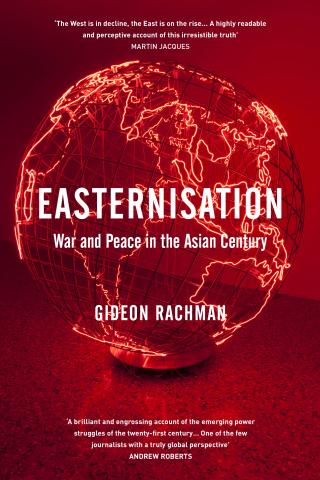
The recent book Easternisation: War and Peace in the Asian Century, by Financial Times journalist Gideon Rachman, deals precisely with this issue.

blog-easternisation

It is a great book, bringing together Rachman’s extensive experience in the US, Asia, and Brussels. Often, books written by journalists lack sound analysis for the mid to long term, and historical perspective. While Easternisation is not an academic tome either, it does provide sufficient deep analysis, especially by tackling developments in all important countries which play a role in the process. It is not just another volume of simply USA or EU bashing, as we have seen before with the huge literature on the alleged Japanese take-over of the US economy.

Rachman’s main argument is that the influence of the West, Europe in particular, has crumbled. This may lead to a major conflict in the Asia Pacific, most notably between China and the US, which also endangers the global economic order. Yet many other conflicts are also building up, in a region which heavily invests in armaments. In short, in the 21st century, ‘rivalries between the nations in the Asia Pacific will shape global politics, just as the struggles between European nations shaped world affairs for over 500 years from 1500 onwards’. I think this is an important message, which should be taken seriously by everybody. Certainly by the Europeans, who are in danger of just inhabiting the world’s largest open air museum within a few decades.  One thing is certain: the Asians will not wait for them to come to terms with the current shift of power.

BC’s weekend reads

  1. Pakistan’s ambitious naval delusions
  2. Diplomatic assassinations have a long and tragic history
  3. When tyranny takes hold
  4. Nullification and secession in America (review)
  5. A liberal global trading system without the United States
  6. Floating exchange rates and tariffs

On 19th Century Tariffs & Growth

A few days ago, Pseudoerasmus published a blog piece on Bairoch’s argument that in the 19th century, the countries that had high tariffs also had fast growth.  It is a good piece that summarizes the litterature very well. However, there are some points that Pseudoerasmus eschews that are crucial to assessing the proper role of tariffs on growth. Most of these issues are related to data quality, but one may be the result of poor specification bias. For most of my comments, I will concentrate on Canada. This is because I know Canada best and that it features prominently in the literature for the 19th century as a case where protection did lead to growth. I am unconvinced for many reasons which will be seen below.

Data Quality

Here I will refrain my comments to the Canadian data which I know best. Of all the countries with available income data for the late 19th century, Canada is one of those with the richest data (alongside the UK, US and Australia). This is largely thanks to the work of M.C. Urquhart who recreated the Canadian GNP series fom 1870 to 1926 in collaborative effort with scholars like Marvin McInnis, Frank Lewis, Marion Steele and others.

However, even that data has flaws. For example, me and Michael Hinton have recomputed the GDP deflator to account for the fact that its consumption prices component did not include clothing. Since clothing prices behaved differently than the other prices from 1870 to 1885, this changes the level and trend of Canadian incomes per capita (this paper will be completed this winter, Michael is putting the finishing touch and its his baby).  However, like Morris Altman, our corrections indicate a faster rate of growth for Canada from 1870 to 1913, but in a different manner. For example, there is more growth than believed in the 1870-1879 period (before the introduction of the National Policy which increased protection) and more growth in the 1890-1913 period (the period of the wheat boom and of easing of trade restrictions).

Moreover, the work of Marrilyn Gerriets, Alex Chernoff, Kris Inwood and Jim Irwin (here, here, here, here) that we have a poor image of output in the Atlantic region – the region that would have been adversely affected by protectionism. Basically, the belief is a proper accounting of incomes in the Atlantic provinces would show lower levels and trends that would – at the national aggregated level – alter the pattern of growth.

I also believe that, for Quebec, there are metrological issues in the reporting of agricultural output. The French-Canadians tended to report volume units in manners poorly understood by enumerators but that these units were larger than the Non-French units. However, as time passed, census enumerators caught on and got the measures and corrections right. However, that means that agricultural output from French-Canadians was higher than reported in the earlier census but that it was more accurate in the later censuses. This error will lead to estimating more growth than what actually took place. (I have a paper on this issue that was given a revise and resubmit from Agricultural History). 

Take all of these measurements issue and you have enough doubt in the data underlying the methods that one should feel the need to be careful. In fact, if the sum of these (overall) minor flaws is sufficient to warrant caution, what does it say about Italian, Spanish, Portugese, French, Belgian, Irish or German GDP ( I am not saying they are bad, I am saying that I find Canada’s series to be better in relative terms).

How to measure protection?

The second issue is how to measure protection. Clemens and Williamson offered a measure of import duties revenue over imports volume. That is a shortcut that can be used when it is hard to measure effective protection. But, it may be a dangerous shortcut depending on the structure of protection.

Imagine that I set an import duty so high as to eliminate all entry of the good taxed (like Canada’s 300% import tax on butter today). At that level, there is zero revenue from butter import and zero imports of butter. Thus, the ratio of protection is … zero. But in reality, its a very restrictive regime that is not being measured.

More recent estimates for Canada produced by Ian Keay and Eugene Beaulieu (in separate papers, but Keay’s paper was a conference paper) attempted to measure more accurate indicators of protection and the burden imposed on Canadians. Beaulieu and his co-author found that using a better measure, Canada’s trade policy was 11% more restrictive than believed. Moreover, they found that the welfare loss kept increasing from 1870 to 1890 – reaching a figure equal to roughly 1.5% of GDP (a non-negligible social cost).

It ought to be noted though that alongside Lewis and Harris, Keay has found that the infant industry argument seems to apply to Canada (I am not convinced, notably for the reasons above regarding GDP measurements). However, that was in the case of Canada only and it could have been a simple outlier. Would the argument hold if better trade restriction measures were gathered for all other countries, thus making Canada into a weird exception?

James Buchanan to the rescue

My last argument is about political economy. Was the institutional arrangement of protection a way to curtail government growth? Protection is both a method for helping national industries and for raising revenues. However, the government cannot overprotect at the risk of loosing revenues. It must protect just enough to allow goods to continue entering to earn revenues from imports.  This tension is crucial especially since most 19th century countries did not have uniform general tariffs (like a flat 5% import duty) which would have very wide bases. The duties tended to concern a few goods very heavily relative to other goods. This means very narrow tax bases.

Standard public finance theory mandates wide tax bases with a focus on inelastic sources. However, someone with a public choice perspective (like James Buchanan) will argue that this offers the possibility for the government to grow. Basically, a public choice theorist will argue that the standard public finance viewpoint is that the sheep is tame. Self-interested politicians will exploit this tameness to be elected and this might imply growing government. However, with a narrow and elastic tax base, politicians are heavily constrained. In such a case, governments cannot grow as much.

The protection of the 19th century – identified by many as a source of growth – may thus simply be the symptom of an institutionnal arrangement that was meant to keep governments small. This may have stimulated growth by keeping other sectors of the economy more or less free of government meddling. So, maybe protection was the offspring of the least flawed institutional arrangement that could be adopted given the political economy of the time.

This last argument is the one that I find the most convincing in rebuttal to the Bairoch argument. It means that we are suffering from a poor specification bias: we have identified a symptom of something else as the cause of growth.

A moral inquiry

Below is an excerpt from my book I Used to Be French: an Immature Autobiography. You can buy it on amazon here.


Note: I was born and reared mostly in Paris but I spent most summers in Brittany. Brittany summers left a deeper mark in me than the Paris school year.

In the Breton architectural fashion, my grandmother’s granite house shared a wall with the houses of two neighbors. On one side was the good looking old guy and his too virtuous old wife. On the other side of my grandmother’s house was a family of fishermen: old Pop, old Mom, grown daughter and grown son. They all lived in a single room that served as kitchen, dining room and bedroom. The parents shared a carved oak armoire-bed, accessible by climbing on a trunk and equipped with a sliding door to provide privacy. The adult children each had their small iron bed, placed at opposite corners of the room, I am pleased to report. There was no bathroom, of course, only an outhouse in the backyard. It was never scooped, never moved. It was surrounded by the most beautifully, healthy cabbage I have ever seen. The fisherman’s children never married. Perhaps they were too afraid of their parents; or, they liked each other too much. (But this is only hearsay.)

At the end of the dirt road, fifty yards away, lived the town ditch-digger and his large brood. The ditch digger’s boys were always hungry. They stole eggs, from wild birds’nests and from hen houses alike. They also picked wheat and toasted it in the fields, which was tolerated. In September, ripe hazelnuts were available for the picking. I don’t know what they did after September and I will never know because my family never stayed beyond that month. But school was back in session then, and there, they got at least one square a day.

Sometimes, we would climb over the priest’s orchard wall to steal his excellent pears. This happened less often than one might think because it presented moral problems: Everyone knew that the priest would not beat you hard if he caught you so, it was kind of unsporting to pick on him. And there was the issue of having to tell him in confession that you had stolen his pears. We discussed whether one would go to Hell for abstaining from confessing that single particular sin. There was no theological consensus.

Foreign Policy Survey

A project I’ve been playing around with for a while has been better understanding the policy views of libertarians. In a few policy areas one should expect near-unanimous agreement on what constitutes the libertarian position. I would, for example, find it hard to believe someone was a libertarian if they supported minimum wage laws. In other areas though it isn’t clear what the libertarian position is.

Foreign policy is one such area. As has been discussed on NoL, it isn’t clear that a singular libertarian foreign policy can exist. Contemporary libertarianism is heavily tied to the US, which further complicates matters. A US based libertarian might oppose NATO on grounds that it over extends the power of the government. A libertarian based in Poland on the other hand might support NATO as a necessary countermeasure to the threat of attack from Russia.

To answer these questions I’m playing around with a pilot study.  The survey can be accessed here. It should take 10-15 minutes and I would appreciate if you could all take it. The survey is aimed for US libertarians, but feel free to take if you’re elsewhere.

Emphasis on the ‘pilot’. I am still playing around with wording and such. I am debating which demographic questions can be removed to reduce possibility of identification – I know many libertarians are skeptical about taking these surveys out of privacy concerns. If you have any comments/suggestions feel free to do so in the comments.

Spanish GDP since 1850

Among the great economic historians is Leandro Prados de la Escosura. Why? Because, before venturing in massively complex explanations to explain academic puzzles, he tries to make sure the data is actually geared towards actually testing the theory. That attracts my respect (probably because it’s what I do as well which implies a confirmation bias on my part). Its also why I feel that I must share his most recent work which is basically a recalculation of the GDP of Spain.

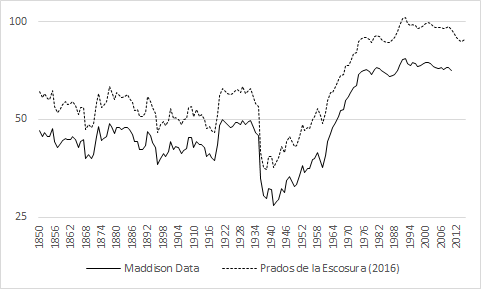
The most important I see from his work is that the recomputation portrays Spain as a less poor place than we have been led to believe – throughout the era. To show how much, I recomputed the Maddison data for Spain and compared it with incomes for the United Kingdom and compared it Leandro’s estimates for Spain relative to those for Britain (the two methods are very similar thus they seem like mirrors at different levels). The figure below emerges (on a log scale for the ratio in percentage points). As one can see, Spain is much closer to Britain than we are led to believe throughout the 19th century and the early 20th century. Moreover, with Leandro’s corrections, Spain convergence towards Britain from the end of the Civil War to today is very impressive.

spanishgdp

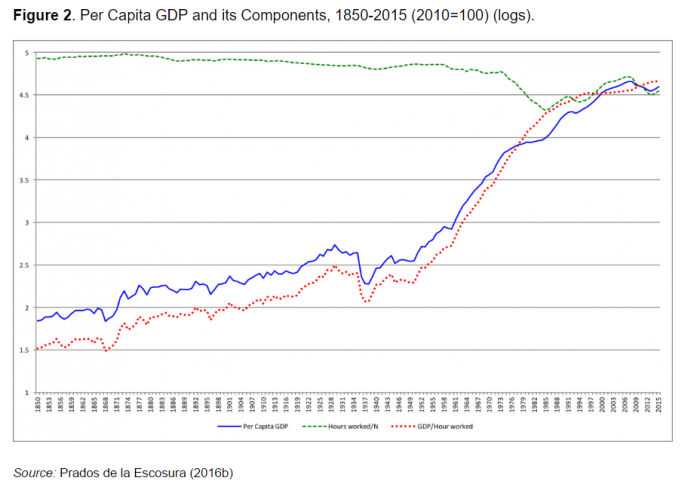
The only depressing thing I see from Leandro’s work is that Spain’s productivity (GDP / hours worked) seems to have stagnated since the mid-1980s.

spanishproductivity

On getting the data right : price disparities before 1914

I am a weird bird. I get excited at weird things. I get excited at reading economics and history papers (and books). I get particularly excited when I read papers and books that “get the data right”. This is because I believe that most theoretical debates in economics stem from poor data forcing us to develop grandiose theories or very advanced models to explain simple things. One example of that is the work of Joshua Hendrickson who argued that monetary aggregates (M1, M2 etc.) are not necessarily perfect indicators of money. However, these aggregates were used in statistical tests and generated strange results inconsistent with theory. This issue has been the cause of many debates. Josh stepped in and said that we just had a variable that was not created to measure what the theory said. Using broader measures of money, he found the results consistent with theory. The debates were driven by poor data (as I think is the case in issues over fiscal multipliers, crowding-out and business cycles).

Thus, I am always excited to see data work that “get things right”. One recent example that adds to cases like that of Hendrickson is Peter Lindert’s working paper at the National Bureau of Economic Researcher. Now, before I proceed, I must state that I am very partial to Lindert as he has been a big supporter of my own research and has volunteered important quantities of his time to helping me move forward. Thus, I have a favorable bias towards Lindert (and his partner in crime, Jeffrey Williamson).  Nonetheless, his working paper requires a discussion because it “gets prices right”.

The essence of his new working paper is that our GDP per capita estimates prior to 1914 may overestimate divergence between countries over time.

Generally, when we measure GDP, we try to derive “volume indexes” that measure quantities produced at a fixed vector of prices. For example, when I measured Canadian economic growth from 1688 to 1790 (I am submitting it in a few weeks), I took the quantities of grain reported in censuses and weighed them by prices for a fixed year. This is a good approach for measuring productivity (changes in quantities). Nonetheless, there are issues when you try to move this method over a very long period in time. The prices may become unrepresentative.  So you get time-related distortions. Add to this that all the time-related distortions may be different over space. After all, should we believe the relative price of wheat to oats in 1910 was the same in Canada as it was in Russia?  Variations in relative prices over space will affect this issue. Basically, you juxtapose these two types of distortions when trying to measure GDP per capita over centuries and you may end up so far in the left field that you’re in fact in the right field.

In his working paper, Lindert tried to adjust for those problems by moving to prices that were more representative. The approach he used is basically the one used by Robert Allen in his work on the Great Divergence. You create a bundle of goods that capture the cost of living in different regions – a basic bundle of goods. This generates purchasing power parities. From there, he recomputed incomes per capita with these measures prior to 1914. The results are striking: there is much more divergence between Europe and Asia that commonly proposed and the United States are much richer than otherwise believed (and were more richer very early on – as far back as the colonial era).

Now, why does this matter?

Well, consider the debate on convergence. Many scholars have been unimpressed by the level of income convergence across countries (at least until the 1980s). However, Lindert’s estimates suggest that the starting point was well below what we think it was. In a way, what this is telling us is that many puzzles regarding the “catching-up” of poor countries may be simply related to poor data. Imagine, for a second, that we could redo what Lindert did with many more countries at a higher time frequency. What would this tell us? Imagine also that this new data would confirm Lindert’s point, what would that entail for those entangled in debates over development?

Basically, what I am saying is this: most of our debates often stem from poor data. If a simple (and theoretically sound) correction can eliminate the puzzles, maybe our task as economists should be to stop bickering over advanced theory and make sure the data is actually geared towards testing our theories!

We can’t engineer our way out of this

Folks on the left have been getting more interested in science lately (though history tells us that might be something to worry about). They’re right to celebrate the incredible results of scientific progress–but scientific victory isn’t uniform across disciplines.

In some areas (including just about all areas on the cutting edge), scientists disagree with one another.It’s a big, complex world we live in, and we don’t understand it fully. That disagreement doesn’t mean we should discount science entirely, but it does mean we should be careful with it.

Imagine a world where engineers disagreed about the capabilities of their techniques and the strength of the materials they use. Some might be beholden to special interests (which gives me an idea for a public choice version of the Three Little Pigs), others might be dogmatic/superstitious. But even without concerns of systemic issues, we should be hesitant to try to get to the moon. That disagreement should tell us that we aren’t certain enough in our knowledge to make anyone but volunteers put their lives in the hands of those engineers.

Social scientist in particular frequently disagree with each other. Most are trying earnestly to apply the scientific way of thinking to understanding the social world, and it’s worth considering their view points. But applying that knowledge should only be done in a decentralized way. Applying the incredible insights of behavioral economics from the top down is appealing, but it’s probably best to do it piecemeal.

Social engineering and social science are harder than physical engineering and the physical sciences. Part of the problem Western governments face is that they’re trying to engage in social engineering. And politicians are promising them greater degrees of social engineering to improve the well-being of their constituents.

The trouble is two-fold: 1) those social engineering techniques aren’t good enough, even if they’re sometimes appealing. 2) The cost to decision makers of buying snake oil is too low in voting booths.

To my friends who are looking to the government to make things better: whether your hope is for government to help people be better versions of themselves, or to stop bad guys, we should push as much of that policy to the local level as possible. It might be nice if the whole country were more like Berkeley or Salt Lake City, but trying to make it happen at the national level is a recipe for conflict, disorder, and doing more harm than good. Keep policy local.

My favorite posts at NOL this year

Last week I promised y’all a post on my favorite reads at NOL this year. I almost always keep my promises, so below is a long-ish list of essays I really enjoyed reading and learning from this year.


My absolute favorite essay of 2016 at NOL was Barry Stocker’s analysis of the attempted coup in Turkey. Dr Stocker has spent a quarter of a century in the Turkish-speaking world and all of his acquired wisdom of the region is on display in the piece. Barry didn’t post much here this year, but I am hoping that, given the geopolitical situation in his neck of the woods (Dr Stocker teaches political philosophy at Istanbul Tech), he’ll be able to provide much more insight into the challenges the region will face in 2017.

Jacques, who has become sidetracked ever since Donald Trump became the GOP nominee, had an excellent post titled “A Muslim Woman and the Sea” that everyone should read. I don’t agree with it, but the quality of his writing almost demands that you read through the entire piece. In it is the peaceful nostalgia for both youth and French Algeria, the almost careless way he describes his surroundings, and the slow, deliberate manner in how he attacks his enemies. It is all on display for you, his audience, to devour at your leisure. Dr Delacroix is a world-class storyteller.

Mark Koyama’s piece on Jewish communities in premodern Europe garnered a lot of praise, but I found his post on medieval China to be much more fascinating. In the post, Dr Koyama summed up his recent paper (co-authored with UCLA Anderson’s Melanie Meng Xue) on literary inquisitions during the Qing era (1644-1912). What they did was tally up the number of times the state dragged scholars and artists to court in order to accuse them of delegitimizing the Qing government. This had the unfortunate (but predictable) effect of discouraging discussion and debate about society in the public sphere, which stifled dissent and emboldened autocratic impulses.

Chhay Lin had a number of great posts here, some of which were picked up by major outlets like RealClearWorld and 3 Quarks Daily, and Notes On Liberty is lucky to have such a cool cat blogging here. My favorite post of his was the one he did on his childhood in a Cambodian refugee camp along the Khmer-Thai border. What an inspiring story! I hope there are more to come in 2017. (Chhay Lin, by the way, splits his time at NOL with SteemIt, so be sure to check him out there).

Zak Woodman had lots of good posts in his debut year (including NOL‘s most-read article), but the two I enjoyed most were his thoughts on empathy in cultural discourse and his Hayekian take on safe spaces. Both pieces took a libertarian line on the freedom of speech, but Mr Woodman’s careful articles, which are as much about being true to the original meaning of some of the 20th century’s best thinkers as they are about libertarianism, suggests that he has a bright future ahead of him as one of the movement’s deeper thinkers (he’s an undergraduate at UM-Ann Arbor). I look forward to his thoughts in 2017.

Bruno Gonçalves Rosi burst on to NOL‘s scene this year with a number of posts (in both English and Brazilian Portuguese). His blistering critiques of socialism were fundamental and – to me, at least – reminiscent of the debates between libertarians and statists here in the United States in the 1970s and 1980s. My favorite of Dr Rosi’s 2016 posts, however, was his reflection of the 2016 Rio Paralympics that took place in the late summer (at least it was late summer here in Texas). Bruno brilliantly applied the Games to the famous argument about inequality between 20th century American philosophers Robert Nozick and John Rawls. I hope the piece was but a glimpse of what’s to come from Dr Rosi, who also has a keen interest in history and international relations.

Lode Cossaer is probably busy with his very intriguing dissertation (“the institutional implications of the tension between universal individual rights and group self governance”), but he did manage to find some time to dip his feet into the blogging pool with a few insightful posts. My favorite was his explanation of Donald Trump’s Carrier move, which was blasted from all sides of the political spectrum (including libertarians) for being a prime example of “crony capitalism.” Cossaer, in his own delightfully contrarian manner, pointed out that there is a trade-off between the rule of law and lower taxes. This trade-off might not be pretty, but it exists regardless of how you feel about it. Lode, in my opinion, is one of very few thinkers out there who can walk the tight-rope between Rothbardian libertarianism and plain ole’ classical liberalism, and he does so ruthlessly and efficiently. I hope we can get more contrarianism, and more insight into Cossaer’s dissertation, in 2017.

Vincent has been on a roll this month, and I simply cannot choose any single one of his 2016 posts for recognition. His pêle-mêle comments on the debate between historians and economists over slavery is well-worth reading, especially his insights into how French Canadians are portrayed by economic historians in graduate school, as are his thoughts on the exclusion of Native Americans from data concerning living standards in the past. These posts highlight – better than his more famous posts – the fact that economists, along with political philosophers and anthropologists, are doing way better historical work than are traditional historians. Dr Geloso’s post on fake news as political entrepreneurship did a wonderful job, in my eyes, of highlighting his sheer passion for history and his remarkable ability to turn seemingly boring topics (like “political entrepreneurship”) into hard talking points for today’s relevant policy debates.

Federico is still practicing corporate law in Argentina, so every article he writes at NOL is done so in his free time. For that I am deeply grateful. His early August question, “What sort of meritocracy would a libertarian endorse, if he had to?” was intricately stitched together and exemplifies Federico’s prowess as one of the world’s most novel scholars of Hayekian thought. I also enjoyed, immensely, a careful, probing account of human psychology and our ability to act in this short but rewarding post on homo economicus. I look forward to a 2017 filled with Hayekian insights and critical accounts of social, political, and economic life in Buenos Aires.

Rick spent the year at NOL blogging about whatever the hell he wanted, and we were all rewarded for it. Dr Weber is obviously emerging as important conduit for explaining how “politics” works in democratic societies, and perhaps more importantly how to be a better, happier person within the American system. I hope Rick continues to explore federalism though a public choice lens, but I also suspect, given Dr Weber’s topics of choice this year, that Elinor Ostrom would have been interested in what he has to say as well. 2017 awaits! Here is Rick breaking down Trump’s victory over Clinton. You won’t get a finer explanation for why it happened anywhere else. Oh, and how about a libertarian argument for an FDA?

Michelangelo, who is now a PhD candidate in political science at UC Riverside, won my admiration for his brave post on safe spaces and the election of Donald Trump. While 2017 may be composed of uncertainties, one thing that is known is that Trump will be president of the United States. We need to be wary and vocal (just as we were with Bush II and Obama).  Michelangelo was in top form in his piece “…Why I Don’t Trust the Police,” so much so that it stuck with me throughout the year. It is libertarianism at its finest.

William Rein, a sophomore (“second-year”) at Chico State, has been impressive throughout the year. His thoughts do very well traffic-wise (literally thousands of people read his posts), and it’s all well-deserved, but I thought one of his better pieces was one that was relatively slept on: “Gogol Bordello & Multiculturalism.” Mr Rein points out that Political Correctness is destroying fun, and the election of Donald Trump is merely the latest cultural challenge to PC’s subtle tyranny. William weighed in on the safe spaces concept as well and, together with Zak’s and Michelangelo’s thoughts, a coherent libertarian rationale has formed in response to this cultural phenomenon. If you want to know which clouds young libertarian heads are in, NOL is a great place to be.

Edwin initiated the best debate of the year here at NOL with his post on classical liberalism, cosmopolitanism, and nationalism. Barry replied (in my second-favorite post of his for 2016), and Dr van de Haar responded with a third volley: “Classical Liberalism and the Nation-State.” At the heart of their disagreement was (is?) the concept of sovereignty, and just how much the European Union should have relative to the countries comprising the confederation. Dr Stocker concluded the debate (for 2016, anyway) with a final post once again asserting that Brexit is bad for liberty. For Edwin and Barry, sovereignty and international cooperation are fundamental issues in Europe that are not going away anytime soon. NOL is lucky to have their voices and, like Dr Stocker, I hope Dr van de Haar will be able to provide us with many more fascinating and sometimes contrarian insights in 2017.

Lucas Freire wasn’t able to post much here this year (he is doing postdoc work in South Africa), but his post on economics in the ancient world is well worth reading if you are at all interested in methodology and the social sciences. Dr Freire has continually expressed interest in blogging at NOL, and I am almost certain that 2017 will be his breakout year.

Those are my picks and I’m sticking to ’em (with apologies to Rick). Notewriters are free to publish their own lists, of course, and if readers would like to add their own in the ‘comments’ I’d be honored (you can always email me, too). The post I most enjoyed writing this year, by the way (thanks for asking…), was a snarky one questioning the difference between Saudi Arabia and Islamic State. Thanks for everything.
How Well Has Cuba Managed To Improve Health Outcomes? (part 2)

In a recent post, I pointed out that life expectancy in Cuba was high largely as a result of really low rates of car ownerships.  Fewer cars, fewer road accidents, higher life expectancy. As I pointed out using a paper published in Demography, road fatalities reduced life expectancy by somewhere between 0.2 and 0.8 years in Brazil (a country with a car ownership rate of roughly 400 per 1,000 persons). Obviously, road fatalities have very little to do with health care. Praising high life expectancy in Cuba as the outcome Castrist healthcare is incorrect, since the culprit seems to be the fact that Cubans just don’t own cars (only 55 per 1,000). But that was a level argument – i.e. the level is off.

It was not a trend argument. The rapid increase in life expectancy is undeniable, so my argument about level won’t affect the claim that Cubans saw their life expectancy increase under Castro.

I say “wait just a second”.

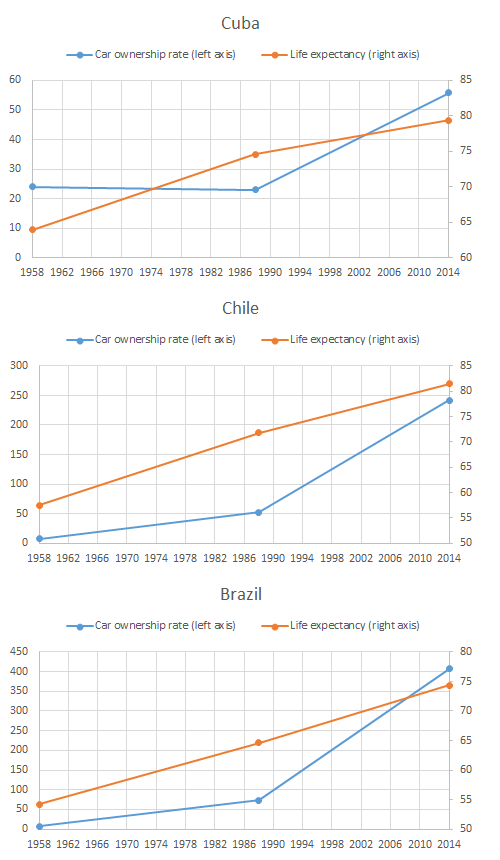
Cuba is quite unique with regards to car ownership. In 1958, it had the second highest rate of car ownership of all Latin America. However, while the rate went up in all of Latin America between 1958 and 1988, it went down in Cuba. During that period, life expectancy went up in all countries while there were substantial increases in car ownership (which would, all things being equal, slow down life expectancy growth). Take Chile and Brazil as example. In these countries, the rate went up by 6.9% and 8.1% every year – these are fantastic rates of growth. During the same period, life expectancy increased 25% in Chile and 19% in Brazil compared with Cuba where the increase stood at 17%. In Cuba, the moderate decline in car ownership (-0.1% per annum) would have (very) modestly contributed to the increase of life expectancy. In the other countries, car ownership hindered the increase. (The data is also from the WHO section on Road Safety while the life expectancy data is from the World Bank Database)

This does not alter the trend of life expectancy in Cuba dramatically, but it does alter it in a manner that forces us, once more, to substract from Castro’s accomplishments. This increase would not have been the offspring of the master plan of the dictator, but rather an accidental side-effect springing from policies that depressed living standards so much that Cubans drove less and were less subjected to the risk of dying while driving. However, I am unsure as to whether or not Cubans would regard this as an “improvement”.

Below are the comparisons between Cuba, Chile and Brazil.

cars

The other parts of How Well Has Cuba Managed To Improve Health Outcomes?

  1. Life Expectancy Changes, 1960 to 2014
  2. Car ownership trends playing in favor of Cuba, but not a praiseworthy outcome
  3. Of Refugeees and Life Expectancy
  4. Changes in infant mortality
  5. Life expectancy at age 60-64
  6. Effect of recomputations of life expectancy
  7. Changes in net nutrition
  8. The evolution of stature
  9. Qualitative evidence on water access, sanitation, electricity and underground healthcare
  10. Human development as positive liberty (or why HDI is not a basic needs measure)

New Year Research Resolutions – or – What are you working on?

Hi everyone. I am your co-blogger. Seeing as the end of the year is approaching I thought it would be nice to know what everyone is working on research wise. So if you have the time post the three (or less) research projects you hope to finish in the upcoming year in the comments below and in a short sentence describe each one.

I’ll start off:

(1) Social Remittances:

I am exploring how social remittances, the transmission of political capital through emigrants, affected the 2000 Mexican elections by increasing demand for improved institutions. Based on an earlier NoL post here.

(2) Libertarian Public Opinion Project:

I’m working on this with Brandon; the plan is to field a survey of the libertarian movement to answer questions such as ‘Is there a uniform libertarian foreign policy?’. Reddit apparently has done a straw poll of market anarchists: 2016, 2015, 2014, 2013

(2) Rodney King Riots 25 Years Later:

Next year will be the 25th anniversary of the Rodney King Riots and I plan to combine new survey data with older regional surveys to see if race relations have improved in Los Angeles since then.

My review for Rogue One: A Star Wars Story

I just watched Rogue One: A Star Wars Story, and I believe it is a very important movie to review if you are a lover of liberty in the classical liberal tradition. Before starting the review itself, I’d better say that I like the old Star Wars movies very much (episodes IV to VI), especially Empire Strikes Back and Return of the Jedi, but other than that, my knowledge of the Star Wars universe is very limited. With that said, please be kind with me hardcore fans, and, of course, spoilers ahead!!! Continue reading

On quasi-rents and the minimum wage

Ryan Murphy of Southern Methodist University has a new article published in Economics Bulletin regarding the minimum wage and “quasi-rents”.  The argument made by Ryan has the advantage of theoretically fleshing out a point made by many skeptics of the new literature. Generally, the argument has been that in the short-term, the minimum wage may have minimal effects, but in the long-term, firms will adjust.

I tended, until Ryan’s article, to be more or less skeptic of the value of this counter-argument. My point has always been that the new literature (like the Dube-Lester-Reich paper) tends to act as a partial equilibrium story (focusing only on one sector only or one indicator). My view has always been very “Coasian” in the sense that there are transaction costs to adapting to any new minimum wage rate.

The height of the hike and what industries are primarily affected will determine the method of adjustments. Firms can cut on benefits, substitute between forms of labor (the minimum wage increases the supply of older workers which remplace younger inexperienced workers), hours or training. They can also, depending on the elasticity of demand for their products, increase prices or cut quality. They can also cut employment. All of these are channels of adjustment and they will be used differently depending on the context. They are all different expressions of the fact that the demand curve slopes downward. But each expression has costs to be used that are to be weighted against their benefits – which are highly circumstantial. For example, if I have a firm of two employees, I will not sacrifice half my workforce by firing a worker (thus sacrificing 50% of my output) for a 5% hike in the minimum wage. Not only would this be an over-reaction, but there are transaction costs for me to fire that worker : separation fees, emotional pain, learning what the employee was doing etc. Reducing his hours would be a safer adjustment.

Until there is a study that measures all of these adjustments channels at once, I am skeptical.

So where does Ryan’s story come in? Well, none of my arguments had a long-term component. They were largely void of any time dimension. While I am aware of research like those of Meer and WestClemens and Wither and Clemens regarding job growth patterns following minimum wage hikes, I always discounted that argument. I was always reluctant to engage in long-term reasoning because I felt it was conceding a point that ought not to be conceded even if that counter-point is valid.  I only used it to top up the rest of my argument. But Ryan introduced to me the concept of quasi-rents, of which I had vaguely heard during my undergraduate microeconomics class.

Basically, here is the argument about quasi-rents: in the short-term, there are rents to be extracted from fixed factors of productions. Firms need these quasi-rents to remain in business, but only in the long-run.  However, if labor can find a way to capture the rents in the short-run, they will get higher earnings and employers will not fire people as much. As a result, there is basically a reshuffling of the consumer surplus. However, in the long-run, nothing is fixed and firm owners can adjust by shifting to different production methods. Thus, they will reduce their future hirings. In Ryan’s words:

But the on-impact negative effects of minimum wages may be hidden. In the longer run, after the quasi-rent is dissipated, the owner would have the incentive to eventually switch from more labor-intensive methods to ones that are less globally efficient (this being the conventional “demand slopes down” result). More perniciously, the threat of future increases in the minimum wage may create regime uncertainty undermining a willingness to invest in the types of technology and capital complementary to low skilled labor, thereby reducing employment for low skilled workers. That is to say, the risk of the appropriation of quasi-rents can shift investment towards capital unlikely to be appropriated via the minimum wage. Repeated and arbitrary increases in the minimum wage worsen this risk. This is consistent with the recent shift towards long run effects of increases in the minimum wage, for instance Meer and West (2016).

This is exactly what Andrew Seltzer found for the introduction of the minimum wage during the Great Depression in certain American industries. In the short-term, the capital was more or less fixed and production methods could not be abandonned easily. In the long run, firms adapted and shifted production methods. This is why Ryan’s argument is convincing. It offers a theoretical explanation for the empirical results observed by Dube, Lester and Reich or Card and Krueger. It fits well with theories of imperfect markets (damn I hate that word that is basically saying that all markets have frictions) like those of Alan Manning (see his Monopsony in Motion here).

This is the kind of work on the minimum wage that, if measured, should force considerable requestionning on the part of minimum wage hike advocates.

The struggle for life

Below is an excerpt from my book I Used to Be French: an Immature Autobiography. You can buy it on amazon here.


In elementary school, grades were handed out in class in a terrifying monthly ceremony. The same deranged Principal would walk into each classroom in turn holding a thick pile of “livrets scolaires,” individual grade-booklets, rather than simple, one-shot report cards, under his arm. There was one livret per student per year with numerical scores and verbal comments for each subject matter, and a monthly overall ranking of students. The Principal would lay the grade-books upside down, in reverse order of students’ ranking for the month ending hence, lowest-ranking student first.

For several years, every month, without fail, the lowest-ranking pupil and the first on the mental scaffold was a runty, scrawny, rheumy-eyed boy who always sat in the last row, “Colinet.” The Principal would start ranting as he entered the room; his glasses would drop down his nose and he would deliver himself of the same furious tirade at the top of his voice against miserable, crouching Colinet. He was a large middle-aged man whose eyes became globulous when he was angry. He would foam at the mouth and spittle would dribble down his shirt as he promised Colinet the guillotine or worse. Colinet never got used to it. I sure did not. I almost crapped my pants several times although I was sitting near the front row and the Principal was staring over my head, straight at the back of the room, as he yelled and screamed. As he called out names from Colinet to the higher-ranking pupils, he would calm down, his voice would subside, and his comments became briefer. By the time he reached the livret of the tenth-ranker, his manner had become civilized as if there had been no raging storm minutes earlier.

In my family, there was a completely arbitrary rule that only the first six places were acceptable. I think my parents secretly thought only the first five were really acceptable but added the sixth because it made them feel magnanimous. Once the Principal had called out the ninth-ranked name, my body began to relax and I was breathing normally. If the Principal was down to the fifth livret and my name had not come up, the sweet song of victory began ringing in my heart. “Very good, my boy,” the Principal would say in a low, calm voice as he handed me my livret (to be signed by both parents).