Review of Claire Conner’s Wrapped in the Flag

I recently posted a review at Amazon of Claire Conner’s Wrapped in the Flag: A Personal History of America’s Radical Right. (The paperback edition changed the subtitle to What I Learned Growing Up in America’s Radical Right, How I Escaped, and Why My Story Matters Today.) The review begins below. It unfortunately is buried within a stack of over a hundred favorable reviews at Amazon. But anyone who wants to read the review there can go here. Then if you find it worthy, you can click the button that says the review is helpful and move it up in the queue:

I thoroughly enjoyed this book despite myself. The author, Claire Conner, entertainingly interweaves a personal story of her growing up with parents who were avid and prominent members of the John Birch Society with a history of the Birch Society itself. I am only four years younger than Conner, and my own story has many intriguing parallels to hers. My parents never joined “the Society,” as its members referred to it, but they (particularly my mother) became what could be called Birch Society “fellow travelers,” involved in right-wing politics after the election of 1960. Many of their friends were Society members. I therefore imbibed much of the same literature as Conner, listened to similar public lectures, and was taken to and participated in similar events. She and I both, for example, were peripherally involved in the 1964 Goldwater campaign.

Our similar backgrounds even influenced both Conner’s and my choices of college. In her case, she was required by her parents to attend the Catholic University of Dallas, at a time when Willmoore Kendall (who had previously been one of Bill Buckley’s mentors at Yale) was teaching there. I chose to attend the Presbyterian Grove City College, studying economics under Hans Sennholz (who wrote for the Society’s magazine, American Opinion, for a span of years) and history under Clarence Carson (a frequent contributor to the Foundation for Economic Education’s Freeman). Finally, she and I eventually grew up to reject the Society’s conspiratorial worldview.

But there the similarities end. I drifted from conservatism to libertarianism, whereas Conner became a leftwing, progressive activist. Her narrative is filled with many fascinating tidbits and anecdotes about Birch Society activities and luminaries. But unlike me, she had parents who were domineering and dogmatic to the point of being abusive. Thus, she is unable to separate fully her wrenching childhood from the ideas and opinions of those she generally identifies as right wing. While there is always a note of tenderness in her writing about her parents, their fanatical harshness becomes the template for her damning of not only all Birchers but also most conservatives and even libertarians.

This makes her utterly oblivious to the extent to which she is still trapped in a conspiratorial worldview, but one of the Left rather than of the Right. She has graduated from her parents’ belief that America was threatened by a giant left-wing conspiracy, in which every liberal was either a Communist or a Communist fellow-traveler to a belief that America is threatened by a giant radical-right conspiracy, stretching from the 1950s to the present. She lumps together with the Birch Society in this gigantic, ongoing, and diffuse conspiracy such disparate individuals and organizations as Bill Buckley and his conservative National Review; politicians such as Barry Goldwater, George Wallace, and Ronald Reagan; Ayn Rand and her Objectivist followers; the libertarian Cato Institute; the modern Tea Party; and white supremacists of the Klan.

To support this portrayal, Conner engages in the same kind of guilt by association that Birchers employed to charge, for instance, that Martin Luther King was a secret Soviet agent. Thus, the fact that Fred Koch, the father of Charles and David, was a founding Council member of the Birch Society (who ultimately left because of opposition to the Vietnam War) implicates every person and organization associated with him and his sons. Although she honestly reports that Buckley eventually denounced the Birch Society, this cuts no ice for her. She recognizes no significant difference between the racist, anti-Semitic Revilo Oliver (kicked out of the Birch Society for those very reasons), who became virulently anti-Christian, and Jerry Falwell’s Christian Moral Majority, which was unabashedly pro-Israel. Indeed, nearly anyone who thinks that government has become too intrusive and extensive is somehow involved, wittingly or unwittingly. Most disgraceful and bizarre of all, the book’s introduction slyly tries to insinuate that the radical right somehow contributed to the Kennedy assassination, yet while fully accepting that Lee Harvey Oswald was actually the assassin as well as a Communist.

An occasional, slight acknowledgment that her parents or others she wishes to expose were correct about a few things slips into Conner’s story. Thus, only in a footnote to her memories about her parents indoctrinating her in the 1960s about how “the ultimate fiend was Mao Zedong” (p. 43), worse than Hitler, does she concede, “My parents were right about Mao” (p. 225). Late in the book she admits “I never would have guessed, not in a hundred years, that the John Birch Society would be as critical of President Bush and the fiasco in Iraq as I was” (p. 212). But none of this can soften her blanket denunciation of everything her parents advocated or embraced. As stated above, there is much fascinating historical detail in this readable book. With a little more nuance, balance, and objectivity, it could have been far more compelling and credible. Conner’s account of how her parents mistreated her, in particular, is in many places heartbreaking. Which makes it all the more sad that her scarred upbringing has turned her political landscape into the exact mirror image of that of her parents.


California Times Six

I live in California. It’s a great state. Too great.

A proposition to split California into six states may be on the ballot in 2016. “Six Californias” has announced that it has collected sufficient signatures. Why six? California’s population of over 38 million is six times lager than the US state average. The ruling powers may find a way to block the proposal, as some opponents claim that the signature gathering was unlawful. If “Six Californias” does get on the 2016 ballot, in my judgment, this will be a rare chance for fundamental reforms.

Many Californians have said that the state is too big to govern effectively. But the governance problem is not size, but structure. After the property-tax limiting Proposition 13 was adopted in 1978, taxes and political power shifted from the counties and cities to the state government. California could be governed well if decentralized, but the concentration of fiscal power to the state has made the state among the highest taxed and worst regulated in the USA.

There have been many attempts to reform the lengthy California constitution, but they have all failed. Attempts to replace the Proposition 13 have gone nowhere. The best option is to start over. Creating new states would provide six fresh starts.

Critics of the six-state plan say that the wealth of the new Californias would be unequal. The Silicon Valley state would include the high-tech wealthy counties of San Francisco, San Mateo, and Santa Clara, among others. The promoter of this initiative, Timothy Drapers, happens to be a Silicon Valley entrepreneur.

But the current 50 US states are also unequal in wealth. The income inequality problem is a national and global problem. Income can become more equal without hurting production by collecting the land rent and distributing it equally among the population. Since the critics of Six Californias are not proposing or even discussing this most effective way to equalize income, their complaints should be dismissed as irrelevant, immaterial, and incompetent.

US states have been split in the past. Maine was split off from Massachusetts in 1820, and West Virginia was carved out of Virginia in 1863.

If the initiative passes, a board of commissioners would draw up a plan to divide the state’s assets and liabilities among the six new states. A good way to do this would be to divide the value of the assets by population, but to divide the liabilities (including both the official debt and the unfunded liabilities such as promised pensions) by the wealth of each state. That would go a ways to deal with the inequality problem.

California’s complex water rights could be simplified by eliminating subsidies, instead charging all users the market price of water. There could continue to be a unified water system with a water commission with representatives from the six state.

If this measure is approved by the voters and by Congress, each state will design a constitution. The new constitutions should be brief, like the US Constitution, in contrast to the lengthy current California constitution that contains many provisions best left to statute law.

The new constitutions should retain the declaration of rights in the current state constitution, including Article I, Section 24: “This declaration of rights may not be construed to impair or deny others retained by the people.” This wording, similar to the US 9th Amendment, recognizes the existence of natural and common-law rights. This text should be strengthened with something like this: “These rights of the people include the natural right to do anything which does not coercively invade the properties and bodies of others, notwithstanding any state interest or police power.”

These new constitutions will be an opportunity to replace California’s market-hampering tax system with economy-enhancing levies on pollution and land value. There should be a parallel initiative stating that if Six Californias passes, the states will collect all the land rent within their jurisdictions and distribute the rent to all six states based on their populations. A tax on land value is by itself market enhancing, better than neutral, because it promotes an efficient use of land, it reduces housing costs for lower-income folks, and eliminates real-estate bubbles. Combined with the elimination of taxes on wages, business profits, and goods, the prosperity tax shift would raise wages and make California the best place in the world for labor and business.

This is all a dream, but the past dreams of abolishing slavery, having equal rights for women, and eliminating forced segregation all came true. This proposition will at least provide a platform for discussing such fundamental reforms.
—————————————-
This article was first published at http://www.progress.org/views/editorials/california-times-six/

Delacroix’s new book is available in hard copy

As you all know, Dr Delacroix recently called it quits here at Notes On Liberty (he still blogs at Facts Matter), but I thought I’d give his new book a shout-out:

My book:

Jacques Delacroix: I Used to Be French: an Immature Autobiography

is available from me by email : jdelacroixliberty@gmail.com. Please, send me $17 so I can buy fishing bait. Please, add $1.50 for taxes and $4 to help support the US Post Office. Total: $22.50

This is cheap for much entertainment and a little bit of
enlightenment. The book contains many items of esoteric high-brow trivia you will be able to use to make yourself sound brilliant at cocktail parties (Marin County) and at barbecues (elsewhere).

The electronic version is also available in the Kindle Store at:

http://www.amazon.com/dp/B00JY0G3SA

On reading devices other than Kindle: August 2nd

The electronic version costs only $7. (Every time you buy one I can afford another cappuccino.)

Other unimportant news: My slim collection of stories and essays in French will be on Amazon (electronic only) soon. It’s entitled: Les Pumas de grande-banlieue.

You can also find his book on the sidebar of the blog here.

Secession and international alliances go together

It is important to scrutinize the intellectual strength of libertarian ideas about international relations. Here are a few – admittedly only partly systematic- thoughts about the relation between secession and international relations. Or more precise: some libertarians are positive about secession, yet at the same time negative about international alliances. How does that relate?

Pleas for secession can be found in the works of Von Mises, Rothbard, Hoppe and other luminaries of libertarian thought, broadly defined. In an informative chapter on the issue, Mises-biographer Jörg Guido Hüllsman (at mises.org) defined secession as the ‘one-sided disruption of (hegemonic) bonds with a larger organized whole to which the secessionists have been tied’. Recent examples are the bloody secessions of South Sudan or Eritrea. Yet the issue also remains topical in Western Europe, for example in Scotland. It is not my purpose to emphasize the practical failures and wars associated with secession. From a libertarian perspective the principal benefit of secession is that a group of sovereign individuals decide for themselves how and by whom they are governed, and in which type of regime this shall happen. So far, no problem.

Let’s assume a world where secessions take place freely, peacefully and more frequent than in the past twenty-five years, where the number of sovereign states just went up by approximately twenty recognized independent countries. The logical result will be the fragmentation of the world in numerous smaller states, or state-like entities, of different sizes, composed of different groups of people. Perhaps some of these states will comply to an anarcho-capitalist libertarian ideal, so with a strict respect for property rights and the use of military defense only for clear-cut violations of these rights by others. However, it is unlikely that all states will be characterized in this way. Consequently, there remain a lot of causes for international conflict and war. For example, as there are more borders, there are also potentially more border disputes, about natural resources, water, stretches of land, et cetera. Of course humans are not angels, and no libertarian ever claims they will be. It simply means none of the other causes of war are perpetually eradicated in a world of free secession either.

So how to defend oneself in such situation, particularly when your state is much smaller than one or more other states in the vicinity? In such a situation you are unable to defend yourself against the most viable threats. Even if you declare yourself a neutral state it is unlikely this will always be respected. After all, it takes at least two to tango in international politics. Of the many possibilities to defend your property rights and sovereignty, the negotiation of agreements with other countries, or joining an international alliance seems logical and potentially beneficial (of course depending on the precise terms). It would amount to a system of multiple balances of power around the globe, very much like for example former Cato Institute scholar Ted Galen Carpenter favored for the current world. Surely, this would not be ideal, and would not be able to eradicate war either. Yet it will prevent many wars and safeguard the liberties and property rights of the participants.

This differs significantly from the pleas by people who simultaneously favor secession while calling for a non-interventionist foreign policy without alliances, such as Rothbard, Ron Paul (see for example in a column), or many contributors on www.lewrockwell.com.

Admittedly, most of these anti-alliance commentaries are directed against particular parts of current US foreign policy. However, it is still fair to demand theoretical consistency. Either these writers overlook there might be an problem, or they choose to ignore it. Still it is important to acknowledge there is an issue here. It is too simple to reject international alliances while embracing secession at the same time.

Around the Web

  1. Paupers and Richlings: Piketty’s ‘Capital’ by Benjamin Kunkel (h/t Mark Brady)
  2. The neoconservatives have ramped up their attacks on Rand Paul. This means his foreign policy ideas are winning out, of course. Neoconservatives have also begun blaming libertarians rather than liberals for the failure of their Iraq war campaign
  3. Liberals and libertarians have been finding common ground in the US House of Representatives
  4. What does the BRICS bank mean? From Dan Drezner
  5. Want to solve the border crisis? Give free drugs to addicts. This is from Marc Joffe, and includes a very thoughtful analysis of charter cities and how they can help improve the institutional problems that would still plague Central America even if the drug war were to end
  6. Help! I’m a Marxist who defends capitalism

Riding Coach through Atlas Shrugged: Chapter 2 – Whistling In the People’s Key.

Part One

50th Anniversary edition pages 20-32

Chapter Summary – We are introduced to Dagny Taggart, brother of James, who reflects on neo-classical music, throws her family name around a bit, cuckolds her brother’s business, and smokes, also Kellogg turns down an offer he can’t refuse.

Dagny is one of the characters who I am somewhat familiar with due to cultural osmosis. Her strong willed antagonism, her intelligence and stubbornness, her anger, her misery, and her smoking. All things that I expected that were confirmed in her first chapter in Atlas Shrugged.

What I didn’t expect however was the amazing paragraphs about Richard Halley’s symphony.

“It was a symphony of triumph…”

the notes of the symphony

“spoke of rising and were the rising itself.

Emphasis mine. The way Dagny is enveloped by the symphony, it consumes her, and just for a moment she can do nothing but feel when she hasn’t in so long.

Then it is revealed that she is merely hearing it being whistled from across the train car by some blond brakeman. If one man whistling one part of that symphony can fill Dagny with such joy then what effect would a full orchestra have on her, on the people, on society?

That feeling is the very thing I hope to gain from this project. The sense of wonder that Dagny is overwhelmed with and a reminder that

“[T]his is why the wheels have to be kept going, and this is where they’re going.”

The brakeman is interesting as well. Rand’s description of him as a worker with no loose muscles was very telling to me. This blue-collar laborer is the one carrying the tune that is Dagny’s hope. This is in stark contrast to the train conductor for example who doesn’t seem to care about the problems he faces and simply hopes everything will work out.

He jerked his head up at the red light. “I don’t think the signal is going to change. I think it is busted.”

“Then what are you doing?”

“Waiting for it to change.”

I almost wonder if this theme of hard working but uneducated versus apathetic educated middle class will continue. I always felt that Rand was somewhat anti-laborer, that those who were not entrepreneurs were merely leaches on the productive members of society but I am beginning to think that impression may have been unfounded.

Speaking of entrepreneurs there were two major economic principles stated in this chapter. First was Dagny exemplifying the attributes of an entrepreneur when she makes the call to use Rearden Metal for the new railroad tracks. When James protests the use of the new metal she tells him that she is making the call using her own judgment, knowledge, and personal experience. She is willing to assume the risk for this venture based on a gut feeling and her own personal belief that it will work. It is important to notice that she doesn’t deflect responsibility or assume some other person or entity will absorb any losses if she is wrong.

The second economic point was in regards to monopolies. A great exchange takes place between Dagny and James that goes as follows:

“It isn’t fair,” said James Taggart.

“What isn’t?”

“That we always give all our business to Rearden. It seems to me we should give somebody else a chance, too. Rearden doesn’t need us; he’s plenty big enough. We ought to help the smaller fellows to develop. Otherwise, we’re just encouraging a monopoly.”

“Don’t talk tripe, Jim,”

“Why do we always have to get things from Rearden?”

“Because we always get them.”

“I don’t like Henry Rearden.”

“I do. But what does that matter, one way or the other? We need rails and he’s the only one who can give them to us.”

“The human element is very important. You have no sense of the human element at all.”

“We’re talking about saving a railroad, Jim.”

“Yes, of course, of course, but still, you haven’t any sense of the human element.”

“No. I haven’t.”

This exchange exemplifies the free market vs anti-property positions on monopolies but misses one crucial point. This anti-monopoly activity is driven solely by the free choice of the individual. Taggart is perfectly able to restrict his business from any source he chooses for any reason he chooses and this is the pure libertarian position on the matter.

Now, don’t get me wrong, he is making a poor entrepreneurial choice since Associated Steel has repeatedly failed to deliver on the contract and from a purely economic standpoint Dagny is correct. From a libertarian standpoint however, both are correct.

James is totally justified running his business into the ground for any reason he chooses and Dagny has every right to seek out new opportunities. Assuming of course she owns part of the company or has been granted the authority to act in the company’s name. The latter is the case here as far as I can tell.

I would also like to point out that other non-humanistic arguments against monopolies are almost universally false. Predatory pricing for example has essentially never happened successfully even in the case that made it illegal.

Now for the negatives.

Primarily I feel like James is a bit too obvious as a villain, he is almost too petulant and whiny. I just don’t buy that anyone would follow him and that the board of directors would have kicked him off years ago. I suppose Rand is pushing the whole feudalism thing. How many nations have fallen because of a weak King or Queen?

Also, I just don’t know how to feel about Dagny yet. The quirkiness is what bothers me the most. Sitting on the arm of the chair, her snarkyness and her general self-importance. I am not sure how much I am going to like her character yet but there is plenty of book to go so we shall see.

Finally I have to give the last story beat in this chapter credit. The final conversation Dagny has with Kellogg was an amazing piece of the mystery that literally gave me chills of anticipation. Where are these people going? Why are the best and brightest suddenly missing but still creating? And most importantly…

Who is John Galt?

A California Crack-Up?

We can only hope.

There has been a small flurry of news articles covering the success of a political initiative by a Silicon Valley entrepreneur to split California into six states rather than one. If this sounds familiar, it’s because many Notewriters have been advocating for more decentralization – both in the US and abroad – since NOL was founded back in 2012. Because breaking up states within free trade zones is such a sophisticated idea, many mainstream pundits have been reluctant to read up on it. Instead, Left-wing reactionaries (and really, are there any other kind?) simply resort to slandering the entrepreneur responsible for the initiative (his name is Timothy Draper, by the way, and you can look up his wiki here), slandering libertarianism, and slandering rich people (Slate, predictably, covers all of the fallacious bases in one fell swoop).

Luckily, the internet now provides people with more than three television channels.

There are two things you need to know about secession within the US free trade zone. First, it is extremely hard to break up one state into many. There is a constitutional process for the whole idea (I don’t understand why the framers, and subsequent legal experts, can respect secession within free trade zones but cannot bother to apply their reasoning to secession in matters outside of a free trade zone’s jurisdiction; Texas, for example, provides us with a great case study of what happens when an administrative polity breaks away from a federal state only to join a rival federal state; Why should this concept not be applied to the West’s foreign policies today?).

In order for a potential administrative unit (“state”) to become an actual US state, it must first be approved by state legislatures. So, in California’s case, only the California legislature needs to approve of the secession. However, there are rules in the constitution allowing for states to join up with each other, or for one region between two US states (like the hippie area in northern California and southern Oregon) to apply for statehood as well. When two or more states are involved, the legislatures of each state must approve of the secession (or marriage). Are we all clear?

Second, after the state legislature(s) approve of the secession, the move must then be approved by the US Congress (both houses). Andrew Prokop, of the Left-wing site vox.com (lest I be accused of being too ideological), explains well what this means:

The biggest difficulty of all would be getting Congressional approval. Giving California 12 Senate seats would be an extremely tough sell. Though those seats wouldn’t necessarily be overwhelmingly Democratic […] they would dilute the power of every existing senator.

Indeed. Now you can hopefully see why libertarians generally support decentralized governance (and let it be remembered that federalism – even a territorially-expansionist federalism – is likely to be the quickest, but still legally-soundest, way towards decentralized governance). As I wrote in a ‘comments’ thread last September (2013):

[…] the federal pie itself would not grow in the event of a few states splitting up.

Think of it this way: suppose the federal budget is $100 for the year. Currently, there are 100 Senators and 435 members of the House, so altogether there are 535 politicians dividing up the $100 pie.

Now suppose the number of states suddenly doubled. You now have 200 Senators and say 870 members of the House.

Numbers like this guarantee that each politician will have less power.

Additionally, you cannot grow the federal pie simply by creating new states out of thin air. If this were the case, then politicians and intellectuals who favor the government redistribution of wealth approach would have long ago advocated for more states. Advocates of redistribution recognize that more decentralization of power makes it harder to come to a consensus about policy options.

And the less government does, the better off everybody will be.

Now, with this being said, there is more than one type of pie. There are state pies and county pies and private sector pies, too. Secession would weaken the power of state-level politicians (Governor Brown could only inflict damage on northern Californians rather than all Californians, for example).

County pies may or may not grow, but in my estimation I do not think growth at the county level is all that important.

The one pie that would grow would be the private sector pie, largely due to the lack of consensus (or, in other words, the greater amount of special interests) at the federal level that decentralization brings about.

Speaking of ‘comments’ threads: One of the things I like most about blogs is the fact that many of the insights I receive about an idea or an event are found in the ‘comments’ threads rather than in an original post. The openness of the blogging platform provides not only an avenue for individuals to express their thoughts, no matter how primitive or vulgar, but also a way for people to expand their horizons and learn something new. This is one of the reasons I try to encourage readers, as well as my fellow Notewriters, to get more involved in the ‘comments’ threads, although y’all are understandably weary of trolls.

Another Liberty Canon: Foucault

Michel Foucault (1926-1984) was a French writer on various but related topics of power, knowledge, discourse, history of thought, ethics, politics, and so on. His name to some summons negative associations of French intellectual fashion, incomprehensibility, and refinements of Marxist anti-liberty positions.

However, his influence in various fields has become too lasting, and too much taken up by people who do not fit into the categories just mentioned, for such reactions to be considered adequate. Foucault himself resisted and mocked labels, which was a serious issue for him because in his work he tried to question the absolute authority of any one system of knowledge and the  authority of isolated great thinkers.

He said that once he had written something it was no longer what he thought, which is in part a playful attempt to resist labelling, but also a rather serious point deeply embedded in his thought, about the nature of subjectivity, how it is always more than what we say or more than the identity that power relations impose on us.

It seems to me that any ethics of subjectivity has pro-liberty implications, and despite the image some might have of Foucault as morally irresponsible or indifferent, he increasing developed the idea of  self-invented subjectivity, based on care of the self, the art of existence, and related terms.

The self-invention does not mean that Foucault thought we can arbitrarily will our self to be anything, it does mean that he thought we have possibilities to cultivate ourselves to live in a way that relates to, and challenges our existing strengths and goals.

Despite the image for some of intellectual fashion round Foucault, these ideas were partly developed through study of Ancient Greek and Roman ideas about ethics and style of living, which included interaction with scholars in the field.

Another theme he developed through his interests in antique knowledge and culture was that of ‘parrhesia’, Greek word that refers to free speaking, which in the context of ancient city states, particularly the Athenian democracy, had strong overtones of courage in truth telling before the city assembly, a prince of any other source of power.

The ethic of truth telling relates to Foucault’s own work on the language of knowledge and the history of science, as well his political ideas. He did not believe in absolute final systems of knowledge, autonomous of context, but he did believe that trying to find truths within whatever perspectives was an ethical enterprise connected with the kind of self cultivation he advocated.

Foucault’s own father had been a doctor and on at least one occasion Foucault suggested his own work was a continuation of the doctors work that evidently combines ethical and scientific aspects. It must also be said that Foucault was a great critic of the authority of experts, including doctors, so he might also be seen as struggling with the memory of his father.

The ambiguity and the personal involvement in ideas suggested there is very much at work throughout Foucault’s writing, in its tension and energy. It is part of his ‘difficulty’, which also comes from the philosophical and literary interests he had, which relate to the creative possibilities of linguistic disruption. We can see that in the most obvious way when he quotes literary texts of Borges, Beckett and so on.

The existential commitments in Foucault’s work is clear if we think about the book that made him famous, History of Madness (also known as Madness and Civilisation), and his personal experience of mental ill health and psychiatric treatment, particularly in his student years.

We can also think about his constant critique of power and his individual  willingness to physically confront power, as in the beatings he received from the police at demonstrations for rights in both France and in Tunisia (where he taught for a few years just after becoming a celebrity public intellectual in France).

Returning to the topic of experts and power, one of Foucault’s most pervasive ideas now is of ‘biopolitics’, that is the way that power expresses itself through prolongation of life. As the state has moved from a basis in the power of death over criminals and other supposed enemies, to a promotion of population, public health, and prolongation of life, it has demanded corresponding powers of intervention and control.

At the extreme this means the ‘racial hygiene’ ideas that German National Socialists used to justify the Holocaust, and in a more routine way means expanding state activity justified by public health goals. We can readily see the contemporary significance of Foucault’s ideas here in relation to ever expanding state and ‘expert’ attempts to limit smoking, drinking alcohol and supersized fizzy drinks, eating sugary and fatty foods, and so on.

The ideas about biopolitics builds on the discussion of modern power in maybe his most widely read book, Discipline and Punish, which deals with the way that the prison becomes the central means of punishment after the eighteenth century Enlightenment, and suggests the dangers of Enlightenment becoming a controlling form of rationalism.

The way the prison works, around observation, or surveillance, of prisoners to ensure adherence to prison routine was the model of modern power for Foucault including factories, schools, and armies, in a model of ‘disciplinarily’. Again Foucault’s intellectual interests correspond with life commitments, as he was a prominent campaigner for prisoner rights, under the inspiration of the man with whom he shared his life, the academic sociologist Daniel Defert.

Foucault’s analyses in Discipline and Punish, and related material, draw on the ‘classical sociology’ of Emile Durkheim and Max Weber with regard to norms and authority, as his views on the emergence of the modern state draw heavily on the ‘pre-sociology’ to be found in the historical and social work of the classical liberal thinkers Charles-Louis de Secondat, Baron of La Brède and Montesquieu and Alexis de Tocqueville.

There is some drawing on Marx, but one should be wary of those left socialist inclined advocates of Foucault who emphasise this strongly, since they don’t mention the other points of orientation so much. The same applies to remarks Foucault made about the importance of the twentieth century Marxist theory of the Frankfurt School, as those who emphasise such remarks ignore accompanying remarks about the importance of Max Weber and ‘Neoliberalism’ (i.e. classical liberal and libertarian thought since the Austrian Liberal school of Menger, Hayek, Mises etc).

Strange as it might seem, Foucault suggests we take Marx, Weber, the Frankfurt School, and Neoliberalism together as attempts to explore liberty and power. Maybe it shouldn’t seem so strange, however awful the consequences of Marxist ideas coming in power have been, that does not mean we should ignore Marx and Marxism, which starts by drawing heavily on classical liberalism and does have some noteworthy things to say about constraints on liberty in a capitalist society, even if offering bad solutions.

Certainly Foucault is not your man if you think a pro-liberty position means uncritical embrace of the links between private enterprise and state power, but since the liberty tradition has in a very significant way been concerned with criticism of rent seeking and crony capitalism, of the drives within capitalism to betray itself, then I don’t think we need to reject Foucault in this area. Indeed it is even a part of the liberty tradition to reject ‘capitalism’ as tied to the state and concentrations of power and argue for markets, property, and association rights liberated from state alliances with economic power.

This is the core of left-libertarianism, and even Foucault’s most Marxist leaning fans would find it hard to deny that left-libertarian is an appropriate label for Foucault. Clearly he was a natural maverick and critic of all power, including state socialist power. I suggest his life, his activism, and his writing, can be taken as an inspiration for all liberty-inclined people. Even on the more conservative side, Foucault’s thoughts about self-cultivation are a version of virtue theory, of an emphasis on cultivating virtue, so Foucault has a lot to offer to all streams of liberty thought.

Those Foucault texts most relevant to political thought about liberty

Monographs 

History of Madness (also published as Madness and Civilisation)

Discipline and Punish

History of Sexuality (3 volumes: Will to Knowledge, The Uses of PleasureThe Care of the Self)

Collected lectures

(Foucault’s rather early death means that much of his work was in lectures that would have been later revised into published material. The task of bringing those lectures into print is still underway).

Fearless Speech

The Government of Self and Others

The Birth of Biopolitics 

Security, Territory, Population 

Hermeneutics of the Subject 

Society Must be Defended 

How the Rentenbank Stopped Inflation

After World War I, Germany had to pay reparations to the United Kingdom and France. Having sold off its gold, the German government had no specie with which to back its currency, the mark. Therefore Germany issued fiat money, not backed by anything. It was called the Papiermark, the paper mark.

With its economy in ruins, the German government printed more and more currency with which to pay its bills, and the German expansion of money became the world’s most famous example of hyperinflation.

The inflation induced alternative currencies in Germany. In 1922, the Roggenrentebank was established, issuing notes backed by rye grain. In 1923 several local governments issued small-denomination loan notes denominated in commodities such as rye, coal, and gold. The commodity front served as a price index relative to marks for the notes.

The inflation came to a halt with the replacement of the Papiermark with a new currency, the Rentenmark on October 15, 1923*. One Rentenmark could be exchanged for a trillion Papiermarks.

The Rentenmark was fronted by bonds indexed to amounts of gold. Since the US dollar was backed by gold then, the Rentenmark was thus also pegged to the US dollar at 4.2 RM to $1. To “back” a currency means to exchange it for a commodity at a fixed rate. It was not enough to merely index the units of the Rentenmark to gold. To become stabilized, the new currency needed to be fronted by a commodity that was actually used. That commodity was real estate.

The Deutschen Rentenbank, the central bank of Germany, established reserves that included industrial bonds as well as mortagages on Germany’s real estate. A currency is fronted when the issuer has collateral that it can deliver in exchange for indexed units of the money. Real estate rentals payable in Rentenmarks were fronts for the new German currency. “Rente,” derived from French, means income in German, such as a pension.

After having stabilized the money, the Rentenmark was replaced by the legal-tender Reichsmark in 1924 one-to-one, although Rentenmark notes continued to serve as money until 1948.

Previous attempts to front a currency with land value failed, because such frontage is insufficient. In France during the early 1700s, John Law’s bank issued money on the collateral of land in Louisiana, but that hypothetical land value did not constrain the over issue of the banks’ notes. Then during the French Revolution, the government issued “assignats” on the collateral of confiscated church land, but that too did not prevent the inflation of the money.

Land rent cannot “back” a currency, since there are no uniform units of land that can be exchanged for units of money. But land rent can be a “front” for money when taxes are payable in that currency, which helps give that money its value. But that alone does not prevent an excessive expansion of the money. To stabilize the currency, it also needs to be backed by or indexed to some commodity. And gold has been a common and suitable backing for paper and bank-account currency.

The German experience also shows that the gold backing does not require large amounts of gold. It is sufficient for stabilization that there is some credible limit to the expansion of the money. The Germans were lucky in 1923 in having monetary chiefs such as Hans Luther of the Finance Ministry, and Hjalmar Schacht, Commissioner for National Currency, who maintained the gold index by limiting the expansion of the new currency.

But as the experience of France, shows, it is risky to depend on the integrity of monetary chiefs. Permanent monetary stability requires a structure of money and banking that is self-correcting. That structure is best provided by free-market banking, in which the real money (outside money) is some commodity beyond the control of the banks, and the banks issue “inside money” or money substitutes backed by the real money. Competition and convertibility prevent inflation.

Any kind of tax can serve to help endow money with value, but a land-value tax offers the greatest frontage for currency, because in effect, LVT acts as a mortgage on land value, and the government can take over land when the tax is not paid. Unlike with taxes on income, nobody goes to prison for not paying a real estate tax, because the rent serves as a reliable collateral. Land rent can serve as collateral not just for real estate loans, but also for taxation, and for currencies. All countries can have “renten money” when they covert from market-hampering taxes on production to market-enhancing taxes on the economic surplus that is land rent.

* This was corrected from an earlier typo listing the year as 2013 instead of 1923.

Tabarrok on “Bernanke vs. Friedman”

Alex Tabarrok has a very flattering post at Marginal Revolution about my 2011 article,  “Ben Bernanke versus Milton Friedman: The Federal Reserve’s Emergence as the U.S. Economy’s Central Planner.” It seems that the President of the Richmond Fed has independently just made a similar argument.

Riding Coach Through Atlas Shrugged. Chapter 1: The Calendar Hung Itself.

50th Anniversary Edition pages 11-20*

*Note: The actual chapter ends on page 33 but I am splitting these up based on POV changes for easier digestibility.

Chapter Summary: White-collar worker Eddie Willars runs into a peculiar homeless man, reflects on a decaying city, and attempts to convince his boss of an urgent matter in Colorado.

My initial impressions are all pretty positive. The opening line: “Who is John Galt?” accomplishes everything an opening should and most importantly sets up a mystery to pique the reader’s interest.

Even with my limited knowledge of small parts of this book I was still immediately hooked by the questions presented on the first page: “Who is John Galt?”, “Why does it [the above question] bother you?”, and without missing a beat (or answering those questions) Rand describes the world that frames these questions quite beautifully with several potent, if a bit obvious, metaphors.

The bum as the faceless masses, intelligent but wearied and cynical without the energy to change their station but able to if inspired. “The face was wind-browned, cut by lines of weariness and cynical resignation; the eyes were intelligent.”

It also seems to be relevant that the bum is our introduction to the character of John Galt. The nameless, faceless masses knowing about the coming change almost instinctively and long before the more comfortable and well off middle class.

The city, in my estimation, represents society as a whole. Once beautiful but now decaying and, like the old tree on the Taggart estate, hollow and rotting from within. “…the shafts of skyscrapers against them were turning brown, like an old painting in oil, the color of a fading masterpiece.” The seed of beauty and triumph is there but it has rotted from within.

Eddie is who really intrigued me though; he reminded me a lot of Tolstoy’s Ivan Ilyich. A middle man in society who knows something is wrong but doesn’t have the skills to do anything about it. While he cannot identify the sinking feeling that permeates every fiber of his being he does have a stable foundation to latch onto.

“When he was asked what he wanted to do [in life], he answered at once, “whatever is right”…”twenty two years ago. He had kept that statement unchallenged ever since; the other questions had faded in his mind…[B]ut he still thought it self evident that one had to do what was right; he had never learned how people could want to do otherwise.”

As a natural-rights libertarian I believe that there are absolute moral and ethical truths and Eddie’s commitment to a similar personal philosophy deepened my ability to relate to the character. It also stands in stark contrast to more modern interpretations of ethics such as “rule utilitarianism” which will always decay to subjective act-utilitarianism.

“David Lyons argued that collapse occurs because for any given rule, in the case where breaking the rule produces more utility, the rule can be sophisticated by the addition of a sub-rule that handles cases like the exception. This process holds for all cases of exceptions, and so the ‘rules’ will have as many ‘sub-rules’ as there are exceptional cases, which, in the end, makes an agent seek out whatever outcome produces the maximum utility.”

In short, any attempt to prevent the “ends justify the means” outcome of utilitarian ethics, without some sort of higher moral authority, inevitably fails and the system is reduced to one of pure utilitarianism. I was actually under the impression that Rand was a bit of a utilitarian herself so I will be interested to see if this commitment to the universal “right” turns out to be a character flaw in Eddie or whether it remains an ideal to be upheld.

Eddie’s confrontation with James Taggart was also quite inspiring. A man who knows he is stepping out of line but is willing to do so for the sake of his personal convictions is an ideal that many of us could due to imitate. I will save my examination of James until the next installment but the important thing I took from this interaction between James and Eddie was how uncomfortable James grew when Eddie looked into his eyes.

“What Taggart disliked about Eddie Willars was this habit of looking straight into people’s eyes. Eddie’s eyes were blue, wide and questioning; he had blond hair and a square face, unremarkable except for that look of scrupulous attentiveness and open, puzzled wonder.”

If, as I suspect, Eddie is the everyman (or reader avatar) in this story and James is an (the?) antagonist then what I am supposed to take from this is that the villains in this world, and in ours, cannot stand up to scrutiny. They are filled with uneasiness when we examine their actions and question their motivations. If Eddie is an ideal, then his attentiveness is an ideal as well.

Eddie’s relationship with the Taggarts as a whole is something I hope is explored more. It is obvious he admires and respects Dagny since they grew up together and the fact that he still has some sort of respect for James leads me to believe that the latter wasn’t always so insufferable. What made Eddie so devoted to this family? Was it simply their entrepreneurial spirit or was there something more?

I had a few small criticisms but I am going to have to wait to see how they play out. As I mentioned briefly at the start of this entry Rand’s metaphors were really straight forward which isn’t bad in and of itself but simply something I am taking note of and will look for as the chapters go by.

I cringed a bit when Eddie admitted that he was simply a serf pledged to the Taggart lands. The whole feudalism angle is one that I am going to keep an eye on since one of the most common attacks on libertarianism is that it would descend into a neo-feudal corporatist society.

Of course I may be taking the line a bit too seriously since Eddie was simply trying to get James to agree to his requests to support the Rio Norte line. In fact it could very well turn out to be a rebuke of that attack once all is said and done.

Finally I have no idea what the giant calendar is supposed to represent or foreshadow. Perhaps it is simply a literal translation of the city’s days being numbered which would both be very clever and kind of groan-worthy at the same time. Hopefully Eddie shows up again soon to let us know but I have a sneaking suspicion that our protagonist isn’t Mr. Willars despite my initial preoccupation with his character.

Check in next time for first impressions of Dagny, a word of support for monopolies, and our first real look at James Taggart. I wish this was a George R.R. Martin novel so maybe he would be dead before the book was over. Hey, I never said I would be impartial.

Part 2

Into the ear of every anarchist that sleeps but doesn’t dream…

We must sing, We must sing,We must sing…


There is no libertarian art.

Well, that is a slight exaggeration, but not much of one. Art is a vital part to any social movement and it is one area where libertarians suffer immensely. Sure there are libertarian leaning authors such as Robert Heinlein and modern Austrian economic art like the guys over at www.econstories.tv but for the most part there are few non-academic ways to inspire potential libertarians.

This is a problem I lament when I am feeling negative about the prospects for a free society which, to be fair, is usually the case. Sometimes reading an article about Intellectual Property just isn’t enough to get the passion flowing.

“But Wait!” You say, “you failed to mention the author who brought tens of thousands of people into the libertarian fold. The late, the great, the Ayn Rand!”


….yea about that.


I don’t like Ayn Rand. There, I said it. Bring out the pitchforks and tie me to a Rearden Steel railroad track if you must but I stand by my statement. Now I know what you are all thinking: “But her works exemplify the individual freedoms that a libertarian society should strive for!” or “Dagny is a strong independent woman who don’t need no government!”

Yes, I am aware, but it isn’t Ayn Rand the author I dislike. Actually it isn’t even Ayn Rand the person that I dislike. I don’t like the idea of Ayn Rand. The metaphysical zeitgeist that surrounds and worships her throughout every circle of the libertarian movement from Walter Block to Milton Friedman to every other subscriber on www.reddit.com/r/libertarian.

All too often I have had to argue about libertarianism through the lens of someone whose only exposure to the philosophy is Ayn Rand and the objectivist selfishness that nearly everyone associates with capitalism. In short, I think she is bad for libertarianism and provides no end of ammunition that can be used against those of us with a more nuanced moral/ethical position.

Here is the kicker though. I have not read a single Ayn Rand novel. Not Anthem, not the Fountainhead, and especially not her magnum opus Atlas Shrugged. My knowledge of her works (outside of objectivist philosophy) comes mostly through a bit of osmosis during many diatribes in my conversion to libertarian thought and the first few chapters of Anthem I read in high school before being bored to tears.

I feel that my lack of personal experience with the work of Ayn Rand is a great injustice to someone so influential to many (but certainly not all) of the ideals that I hold so dear and maybe, just maybe, I can siphon off some of the passion that so many others feel when reading her novels.

So it is my objective to spend the next several weeks (months perhaps) reading Atlas Shrugged along with you, the faithful readers here at www.notesonliberty.com, and recording chapter based summaries of my thoughts, opinions, and analysis from a literary, ethical, and philosophical standpoint. These will be full of personal anecdotes and armchair analysis so be prepared for a tumultuous ride through one of the “great?” works of the 20th century.

Part one of many comes tomorrow morning.

How to Achieve Peace in Gaza

Israel’s bombing of Gaza has not stopped its rocket attacks, so it is counterproductive. Instead, Israel should help the people of Gaza establish a communitarian democracy.

The government of Israel would announce on radio, television, web sites, and leaflets, that it will be sending in troops, not to fight against the people of Gaza, but to empower their communities.

The Israeli government would also apologize for its misguided policies of the past, and for the suffering and humiliation it caused for the Gaza Palestinians. Of course the Israelis have suffered also, but if one demands a counter apology, one is not really repenting and regretting.

The Israeli administration would designate neighborhood boundaries for communities of about 1000 residents and also enterprise owners. Residents would volunteer to serve on the community council. The Israeli troops would defend the community from any extremist opponents of the new democracy. The communities would set up their own protective elements, and the Israeli troops would withdraw.

Israel should have democratized Gaza in 1967 rather then let the area fester. Then in 2005, Israel removed its settlements without negotiating with the Palestinian rulers. Now Israel should do what occupiers world-wide have failed to do, lay down an infrastructure of democracy.

The community councils of Gaza would elect representatives to regional associations, and the regions would elect representatives to a Gaza parliament. The Palestinians of the West Bank should also elect their own parliament. Then the two parliaments would elect a Palestinian federation of two provinces, Gaza and the West Bank (perhaps renamed East Palestine). It would be best to leave local matters to the two provinces.

Israel should then stop imposing tax policy on the Palestinians and let them set up their own public finances. But advisers should encourage the Palestinian councils to collect the land rent and use that for public revenue rather than tax their wages and goods.

Unfortunately the Palestinian governors have focused their resources on fighting Israel rather than economic development. But after the communities in Gaza have become empowered, Gaza will no longer be occupied territory. Israel would remove the barriers around Gaza gradually, since there will still be extremists who seek destruction. But Israel should facilitate the greatest possible mobility for the Palestinians under the constraint of protection, rather than treat the Palestinians with the arrogance that has been practiced in the past. “No more humiliation” should be the stated slogan.

A similar policy should be pursued in the West Bank. The Palestinian authority chiefs will resist transferring power to the people and their local councils, but a democratic Gaza (or West Palestine) will cause the East Palestinians to demand genuine democracy. A bottom-up governance in the West Bank would then result in a federation of West and East Palestine that would then negotiate a lasting peace with Israel.

There have been some peace gatherings among Israelis and Palestinians to humanize their relations and to see that individuals are people much like themselves. But such personal interactions are no substitute for confronting the essential issue of who shall own the land.

The solution that is both just and politically feasible is to recognize the pre-1967 boundaries and then convert the Israeli settlements as leaseholds that pay rent to the Palestinian government.

Ideally all landowners in Israel and Palestine should pay the market rent of their land possessions. Land rent would serve as the best public revenue for a Confederation of Israel and Palestine. Palestine would be a state within the Confederation and would itself also be a federation of West and East Palestine.

The other contentious issue has been the return of displaced Palestinians to their pre-1948 lands. A peace treaty should allow a limited return of Palestinians to Israel, with some compensation for lands that have become homes for others. So long as justice is sought, the maximalists will usually be in the minority.

If justice is not established, time will be an enemy of both the Israelis and the Palestinians, as extremists and nuclear perils are on the rise. The choice is either justice now or destruction later.
————————————-
Note: this article is also at http://www.progress.org/views/editorials/democracy-and-justice-for-gaza/

1953

In 1953 I was just old enough to have some sense of what was going on in the world.  Have things gotten better since then or worse?  On the whole, better, I’d say.  Herewith, two lists to which many more items could be added.

Ten things that were better then:

  1. Clean entertainment, tuneful music
  2. Safe streets
  3. Good schools
  4. Low rate of illegitimate birth
  5. Predominance of two-parent families, most mothers staying at home
  6. Stable neighborhoods
  7. High standards of dress and deportment
  8. Less intrusive government
  9. Lower tax burden
  10. Korean war ending, cold war not yet ramped up

Amplifications:

  • That great scourge of western civilization, rock-and-roll “music,” was still over the horizon.
  • The best schools were not as good as today’s best schools: no AP programs, limited facilities.  The worst schools were far better than today’s worst schools.  On average, I would say schools were better.
  • The top marginal income tax rate was very high but hardly anyone paid that rate.  In Ohio, there was no state income tax and the state sales tax was 3%.

Ten things that weren’t so good

  1. Polio
  2. Crummy cars
  3. Three TV channels, primitive receivers
  4. Expensive monopoly telephone service
  5. De facto segregation, marginalization of women
  6. Air and water pollution
  7. Primitive medicine and dentistry
  8. The military draft
  9. Atmospheric nuclear weapons tests
  10. CIA overthrow of elected leaders in Guatemala and Iran

Amplifications:

  • Polio was a crippling and and contagious disease.  Our municipal swimming pool was closed during the summer of 1953 because of fears of polio.  The Salk vaccine was just over the horizon.
  • Car fenders would begin to rust through after a couple of years because of road salt.  It was common to have to grind the valves at 35,000 miles or so.  A 60,000-mile car was ready for the junk pile.
  • Air quality had improved somewhat due to the post-war switch from coal-fired furnaces to natural gas.  But if you painted your house white it would gradually take on a reddish tinge due to emissions from factories and foundries.  Lake Erie was unsafe for swimming within 50 miles either side of Cleveland.
  • If you were black, you couldn’t buy a house or rent an apartment in suburbs like Cleveland Heights where I lived.  There were no legal barriers, just an understanding among sellers and landlords.
  • The detrimental effects of ionizing radiation were not well recognized, not just with regard to weapons tests.  Dental X-rays inflicted 50 times as much radiation as they do now.  When my mother took me shopping for shoes, I stuck my feet into slots at the bottom of a machine called a fluoroscope with three viewing ports on top that showed X-ray images of my feet, to show whether a candidate pair of shoes fit well.  One such exposure probably didn’t hurt me, but the cumulative effect of many such exposures might have.
  • Opportunities for women were beginning to spread beyond the traditional fields of nursing, teaching, clerking and a few others.  Professions weren’t closed to women, but there were hurdles.

The Origin of Expression “Nazi” and How it was Introduced into English Usage

My hearty greetings to the Notes on Liberty “tribe” and special thanks to Brandon for inviting me to become part of this forum. I would like to share with you my side project that recently mutated into an article submitted to Independent Review. Last June, I was doing research in Vienna, Austria, working on a totally different topic (Mongol-Tibetan religious prophecies (Shambhala and the like) and their perceptions by Westerners). Taking advantage of my stay in that gorgeous city, in my spare time, I visited local museums and various prominent landmarks.

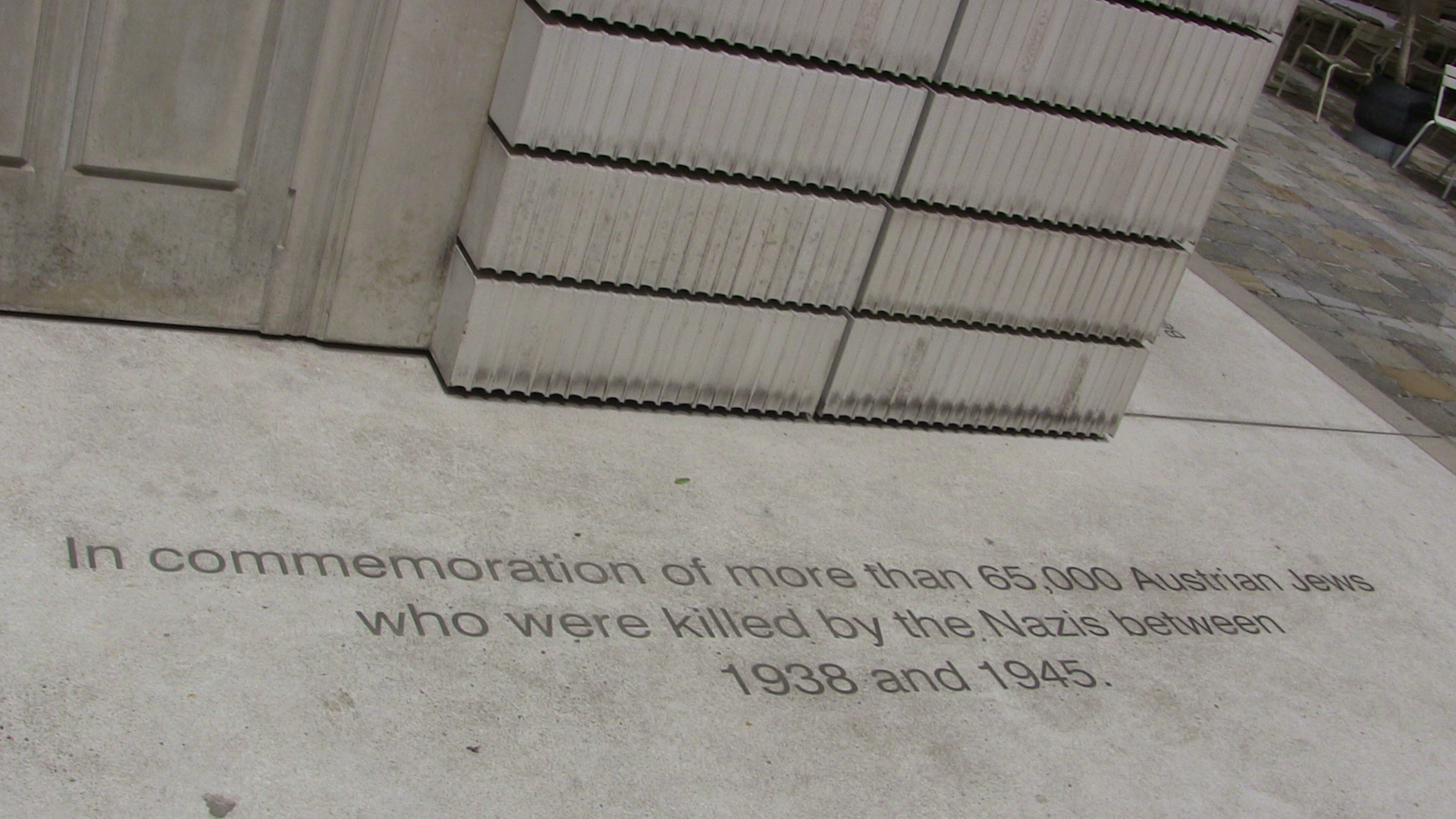
Thus, I strolled into so-called Jewish Plaza in downtown Vienna. The place has a monument that commemorates the memory of 65,000 Austrian Jews murdered by Hitler’s regime during World War II. In fact, I briefly visited this place earlier during one of my previous trips to Vienna. Yet, now looking at three identical inscriptions in three languages at the foundation of the monument I noticed something that earlier had not caught my attention. The inscription on the left is in German, the one on the right is in English, and the one in the middle is in Hebrew. The German one says, “In commemoration of more than 65,000 Austrian Jews who were killed by the National Socialists between 1938 and 1945.” So does the Hebrew one in the middle. Yet, the English version reads: “In commemoration of more than 65,000 Austrian Jews who were killed by the Nazis between 1938 and 1945.”

IMG_0687

IMG_0694

IMG_0698

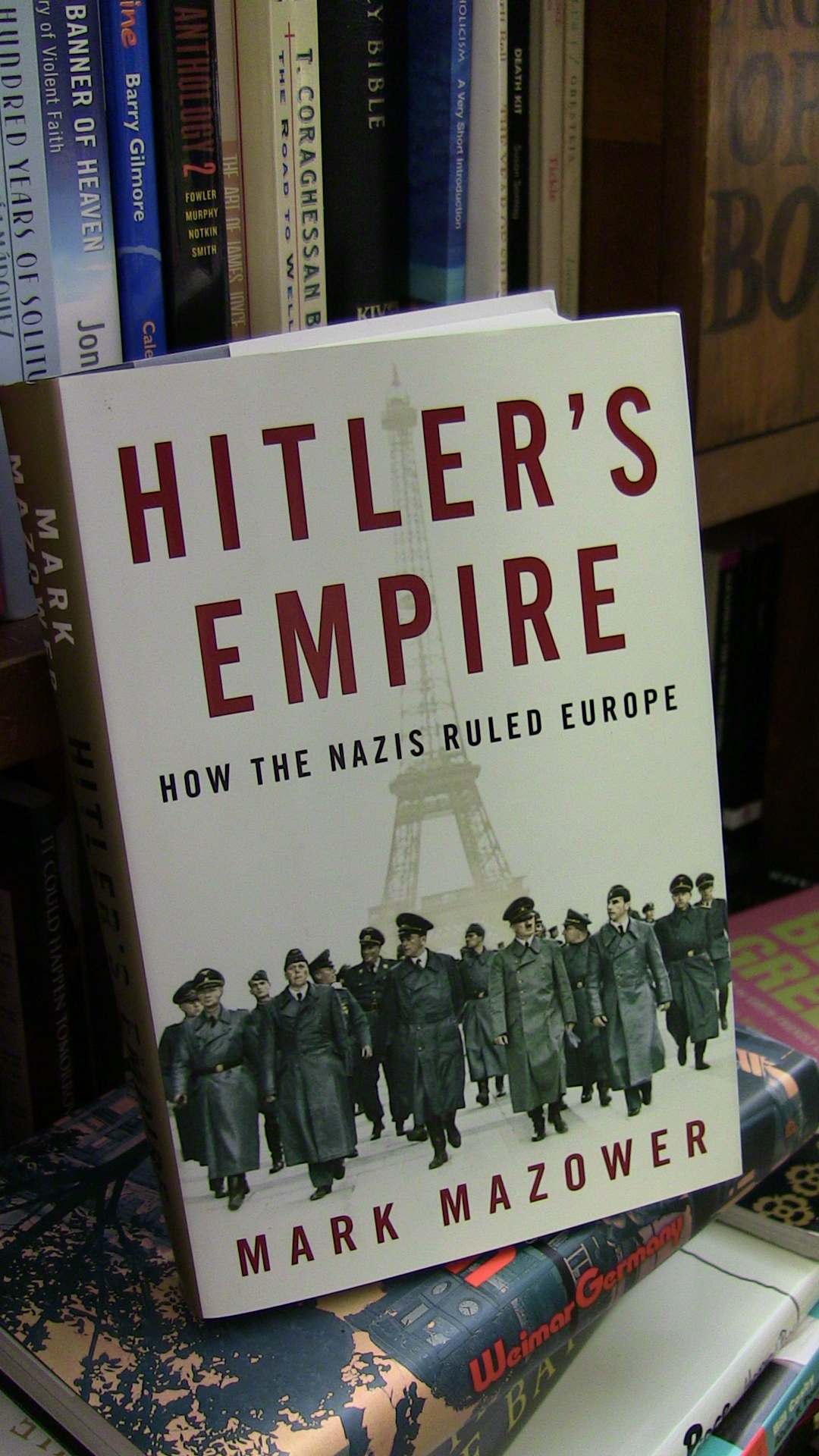
The same day I happened to go to Thalia, the biggest bookstore in Vienna. There, browsing shelves with social science and humanities literature that I stumbled upon a German translation of Hitler’s Empire: How the Nazis Ruled Europe, a 2009 book by the noted American historian Mark Mazower. The German edition of that book, which has the same cover picture, reads Hitlers Imperium: Europa unter der Herrschaft des Nationalsozialismus [Hitler’s Empire: Europe under the National Socialism Rule.]

IMG_0951IMG_0855

So I became curious about this linguistic discrepancy. Eventually, my curiosity took me further and further. The first thing one notices is that when English-speaking people write and talk about the 1930s-1940s’ Germany, more often than not they routinely use the word “Nazi.” Thus, in English we have books and articles about Nazi economy, Nazi labor policy, Nazi geopolitics, Nazi genetics, and so forth. In contrast, when Germans refer to the same turbulent years, they usually say “National Socialism” (Nazionalsozialismus).

So here is the result of my quest – an attempt to answer why in English we use “Nazi” and also who and why introduced this expression in English. The article has not been published yet. At first, I decided to prepare a brief digest of that paper and post it on this forum. Then I changed my mind. To make things more interesting, I decided to prepare a small multimedia audio presentation about why, how, and when the expression “Nazi” emerged in the first place and how it was introduced in English language and post it as a 20-minute video clip on my YouTube channel maguswest. Here it is:

National Socialists into Nazi: Politics and the English Language

A good friend of mine, who is an excellent narrator, assisted me in this. Click this link to see/listen to this talk and, if you wish, give me your critical feedback: Do not skip the ending of the clip, for it features a music tune (so-called Aviation march) that was shared by both Soviet Stalinist and National Socialist marching bands in the 1930s (words are different but music is the same).