Colonialism and Identity in Wasolon (and everywhere else, too)

The notion of the person is constantly renegotiated and is at stake between groups situated within the same political entity as well as between neighboring political entities. With advent of [France’s colonial] district register and the resulting written registration of identity, the notion of a person acquired a greater fixity. It became much more difficult to change identity or even to modify the spelling of one’s first or last name. Since it could no longer affect the components of the person, the negotiation of identity shifted, as in the case of the West, onto other sectors of social and individual life. (135)

This is from the French anthropologist (and high school friend of our own Jacques Delacroix) Jean-Loup Amselle, in his book Mestizo Logics: Anthropology of Identity in Africa and Elsewhere. The book is hard to read. The English translation (the one I’m reading) was published by Stanford University Press in 1998, but the original French language version came out in 1990. Between the translation and the fact that the book was written for specialists in the field of political anthropology and the region of French Sudan, strenuous effort was required on my part to stay focused and motivated to finish the book. The preface alone is worth the price of admission, though, especially if you’ve been following my blogging with any great interest over the years.

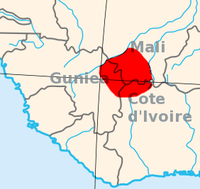
My intent is not to write a review, but rather to build off Amselle’s work and present some of my efforts in blog form here at NOL. But first, a map of the region, Wasolon, that Amselle specializes in:

Wasolon is that big red marking that I've drawn on the map. You can see that it's about as big as Sierra Leone.

Wasolon is that big red marking that I’ve drawn on the map. You can see that it’s about as big as Sierra Leone. Just for clarity’s sake, here is a second map with a closer view of Wasolon:

blog wasolon 2
Notice the rivers? source: wikipedia

Amselle’s argument for why his approach to identity is superior to others’ is convincing. He performed all of his fieldwork (15 years’ worth as of 1990) in Wasolon, or briefly in neighboring areas, reasoning that “research within numerous regions of a well-circumscribed area […] has allowed me to observe systems of transformation [in] societies that have been in contact for centuries. This has protected me from being forced into large analytical leaps and from engaging in [the current anthropological trends of] abstract comparativism and the identification of structures (xii-xiii).” This defense of his methodology, coupled with his insights on French colonial administration in the late 19th and early 20th centuries, gives me reason to believe that Amselle’s work is an excellent blueprint for better understanding the complete and utter failure of post-colonial states and the violence these collective failures have produced.

I want to take a specific route using the introductory quote, even though I could take a number of different routes using that passage. I could, for example, focus on the invention of the individual and muse about its consequences in regards to the rise of the West. I could go on and on about how other societies had writing – but not the individual- and therefore did not have the institutions necessary for “capitalism” that the West did around the 16th century. Et cetera, et cetera. Instead, I’m going to take a geopolitical route (the West is still practicing colonialism) that has a decidedly philosophical direction to it (nationalism and ethno-nationalism are both bullhooey).

First, the geopolitical context. Wasolon was basically a war zone in the 18th and 19th centuries. It was an important producer of cotton, a minor producer of rubber and ivory, and a net exporter of slaves. Wasolon was unfortunate enough to be caught between Saharan empires backed by Arabic culture, money, and technology, and coastal empires recently enriched through cultural, economic, and technological exchange with rapidly-expanding European populations. Caught between these two geographic poles, polities in Wasolon oscillated between being decentralized chiefdoms, small independent states, empire builders themselves, and vassals of empires. In such an uncertain setting, the identity of people themselves necessarily oscillated as often as their political systems did.

When the French arrived militarily on the scene (there was already a long history of economic, political, and cultural exchange between the “French” and Wasolonians; I put French in quotation marks because, of course, many Europeans found it to be much easier to use “French” as an identity in French Sudan rather than their own), Wasolon was home to many decentralized chiefdoms, and they were all in the midst of a protracted and brutal war with the Samori Empire, a Saharan polity that rose quickly and ruthlessly to prominence in the late 19th century.

The Samori Empire – which the French military was in contact with due to its centralized political structure (it had a bureaucracy and an organized military, for example) – claimed Wasolon as a vassal state and the French, out of ignorance or expediency (to attribute it to malice gives French central planners too much credit), simply took Samori at its word (a policy that continues to play out to this day in international affairs, but more on this below).

The French military commanders and, later, colonial administrators eventually figured out that Wasolon was not a loyal vassal. From the French perspective, the resisting chiefdoms in Wasolon had formed an alliance against the Samori Empire, and this alliance was based on an ethnic solidarity shared by all Fulani. Amselle labors to make the point that this alliance  was based on a “mythical charter” long prominent in Fula oral traditions (and has some basis in the historical accounts of Arab and European travelers). This “mythical charter” served as the basis for the French colonial understanding of the Fula and eventually for the notion of a Fulani ethnic identity. The problem here is that the “mythical charter” was just that: a myth.

I’ll start by extracting an insight from the footnotes:

As we saw in Chap. 5, colonial ethnology merely reproduces this local political theory by taking it literally, thereby assimilating these “mythical charters” to a real historical process. Such a reproduction is what makes this ethnology truly colonial. (179)

In the Chapter 5 that Amselle alludes to in his footnotes, Mestizo Logics explains how the Fula people of Wasolon adopted fluid political identities over the centuries, depending on who was in power and who was about to be in power. This fluidity played, and continues to play, a much more important role in how people identified themselves politically (“local political theory”) than either culture or language.

Amselle illustrates this point best by pointing out that a number of chiefdoms in Wasolon claimed to be Fula at the time of the French conquests in the late 19th century, but that the populations spoke a different language than the Fula and were culturally distinct from the Fula (these Wasolon chiefdoms claiming Fulaniship were Banmana and Maninka in language and culture rather than Fula). Amselle then points out that Fula chiefdoms existed outside of Wasolon that don’t claim to be Fula – even though they are culturally and linguistically Fula – and instead identified as something more politically expedient (he doesn’t elaborate on what those non-Fula Fulani identify as, only that they did, and still do).

The French state’s act of writing down and categorizing this “mythical charter” as a distinct feature of Wasolon’s Fulani thus created the Fula ethnic group and, through imperial governance, ensconced this new group into its empire’s hierarchy based on traits that ethnographers, colonial administrators, historians, and managers of state-run corporations had recorded (accounts written by merchants not connected to the state in some way could not be trusted, of course).

Basically, when the French showed up to build their empire in west Africa they bought the narrative espoused by a couple of the factions in the region and based their empire (which was only feasible with the advent of peace in Europe after the Napoleonic Wars) on that narrative. The results of this policy are eye-opening. Aside from the fact that the present-day states of Mali, Cote d’Ivoire, and Guinea are failures, the old rules of fluid identity used by Wasolonians for political and economic reasons were erased and new rules, based on bureaucratic logic (“ethnicity”), were wrested into place by the French imperial apparatus. These new ethnic identities soon took on characteristics, ascribed to them by others, that quickly became stereotypes. The ethnic groups with good stereotypes (like being hard-working) ended up – you guessed it – in positions of power, first in France’s imperial apparatus and then for a short time after independence.

Sound familiar?

If it doesn’t, think about international governing institutions (IGOs) like the United Nations or the World Bank for a moment. Why don’t these institutions recognize the likes of Kurdistan, Baluchistan, or South Ossetia? Is it because these IGOs are evil and oppressive, or simply because these bureaucracies cannot adapt quickly enough to a world where identity and the necessities of political economies are always in flux?

This phenomenon is not limited to post-colonial Africa, either. Think about African-Americans here in the United States and the stereotypes attributed to them. Those stereotypes – good and bad – are a direct result of bureaucracy.

Individualism, to me, is the best way to tackle the long-standing problem created by colonial logic abroad, and racism at home. Government programs that seek to help groups by taking from one and giving to another are just an extension of the bureaucratic logic revealed by Amselle’s work in French West Africa. But what is a good way to go about implementing a more individualized world? Open borders? Federation?

An overview of India-China boundary disputes

I have a new paper that has just been published in Asian Affairs. Here is an excerpt:

Questions over the India-China border are not a new phenomenon. They are asked whenever there is a Sino-Indian state visit. Despite having close to $100 billion of trade between them, China and India have failed to bring their frontier disputes to an end. In the 1980s and 1990s it was thought that the increasing economic cooperation between the two countries would act as a prompt to resolve their political disputes, but it has not. Military stand-offs and confrontations between border guards from India and China occur at regular intervals. To address their boundary disputes, they have engaged in frequent dialogues (17 rounds of focused dialogues can be counted between 1988 and 2015), but nothing substantive has yet been yielded through such engagements.

The boundary disputes between India and China have their ultimate origin in the ‘Great Game’ played during the British Empire. At present, the two main areas of dispute along the Himalayan frontier are the western sector (Aksai Chin around 37,250 sq km/14,380 square miles) and the eastern sector (Arunachal Pradesh, around 83,740 sq km/32,330 sq mile). This article traces the roots of the boundary disputes between India and China and attempts to discuss sources of tensions and probable solutions.

The link to the whole paper can be found here [pdf].

Asking the Wrong Question

How do the United States and others achieve victory against Islamic State without empowering sectarian actors who will seek to poison the reconciliation that Iraq needs to hang together?

That’s the question posed by Craig Whiteside, an associate Professor of Theater Security Decision Making for the Naval War College at the Naval Postgraduate School, over at War on the Rocks. Dr Whiteside’s recommendations (“avoid all cooperation with sectarian militias, continue to target Islamic State with minimal collateral damage, patiently train and equip the security forces, ensure it’s done by Iraqis with subtle, behind the scenes help”) are just what you’d expect from a military strategist with a PhD, but his question highlights well what’s wrong with current thinking on non-state actors in Washington and also explains why central planning fails in areas other than managing an economy.

Whiteside’s line of thought is pretty standard, and it goes something like this: Islamic State is bad and Iraq is good. Islamic State is bad not because it lawlessly slaughters more people than Iraq (obviously not true, especially when you account for the Hussein regime), but because it is a non-state actor with political, economic, cultural, and military capabilities that threaten the existence of state actors. Hence his worry over how to defeat Islamic State while still keeping Iraq in one piece.

This is a terrible way to think about international relations and strategy, and it governs the logic of the republic’s finest thinkers.

Why not think about the situation in the Levant in the following way instead:

There is a “world order” of sorts that is composed of states. The states themselves have been patched together over the course of centuries. The world order itself has been patched together over the course of centuries.

Iraq is a state that was patched together by the UK and France, in accordance with the logic of the world order at the time. Thus, Iraq was able to become a legitimate member of organizations like the UN, FIFA, OPEC, etc. However, because Iraq was patched together by the world order rather than by the people of Iraq (acting through contentious factions), it can only, ever “hang together” under a regime governed by a strong man.

The appearance of Islamic State in what is now Iraq is just an attempt by Iraqis to govern themselves. Islamic State is an attempt, made possible by the power vacuum left by the invasion and occupation of the US and its allies, to join the world order (hence the “state” in Islamic State). It’s a horrible attempt, which is just what you’d expect from a people who have likely never had a chance to experiment in self-governance. Nevertheless, people in what is now Iraq are trying to patch together their own states.

The world order should recognize these attempts instead of trying to maintain the status quo. Change can be a good thing. As an example, just compare the brutality of the Hussein regime, a legitimate state actor, with that of Islamic State. It’s not even a contest, especially in terms of people murdered.

Wouldn’t recognizing Whitehead’s “sectarian actors,” instead of seeking to isolate or destroy them, be a much better avenue to peace and prosperity in the region? Recognition by the world order, haphazardly and pragmatically patched together itself, would bestow responsibility onto non-state actors. It would signal a trust in the ability of Iraqis to govern themselves. It would help to rationalize diplomacy and trade in the region. And it would put an end to the vicious cycle of strong men in the Middle East.

Instead of asking what the US and its allies can do to eliminate violent non-state actors from the region, isn’t it time to start asking what the West can do, as equal partners, to facilitate more self-governance in the Levant?

That central planning suffers from a knowledge problem is a given in many elite economics circles today (even economists at the Federal Reserve recognize it), but I don’t think this argument has extended into other fields of thought or other bureaucracies yet. A fatal conceit indeed.

What’s the difference between Saudi Arabia and Islamic State?

One has captured the rent associated with being a state in the post-World War II world order. This means that one of these polities gets to build embassies in other states. It gets to participate in congresses. It gets to fly its flag at the United Nations and has access to the World Bank, military hardware markets (“for defense”), and FIFA tournaments.

Rent capture isn’t all good, of course. There are still costs. When Saudi Arabia beheads people, for example, it gets condemned internationally. Its reputation suffers. It has to repair relationships and launch rigorous public relations campaigns. Saudi Arabia has to do these things because if it looks intransigent to enough of its fellow states, there might be official repercussions for its actions. Saudi Arabia can’t just go around killing and looting and raping at will. It has to formalize its killing, looting, and raping through the international order by coming up with a national interest. (A national interest is also important for shoring up domestic support for such activities.)

But incorporating Islamic State into the international order is unfathomable. It’s an immoral action rewarding an immoral pseudo-polity. Besides, the sovereignty of the states of Iraq and Syria would be violated and their borders destroyed. It’s better to just keep bombing the region Islamic State claims to govern and arming the factions that claim to be its enemies. That’s been our policy towards the post-colonial world since 1945 and, while imperfect, it’s been working out well so far…

What I’m reading (but not yet writing about)

I have been reading a lot lately. I apologize for the lack of blogging on my part. I am reading through Mestizo Logics by the French anthropologist Jean-Loup Amselle, Degrees of Freedom by our own Edwin van de Haar (a Dutch political theorist), and A Cat, A Man, and Two Women by the Japanese novelist Junichiro Tanazaki. I’ll be blogging about Amselle’s book in the near future, so stick around!

I am also reading through some excellent papers on colonialism.

Michelangelo: I gave apples to the ladies and cigars to the gentlemen (and to a couple of ladies in the English Dept). That was as an undergraduate though…

How to think like an individualist

Postmodernism is disposed of incisively. “Just as Western politicians and generals annex foreign lands, postcolonial theorists argue, so Western intellectuals impose their knowledge on the rest of the world,” Malik writes. But Western philosophy does not replicate the ways and methods of Western imperialism. Its criteria and methods, but also its values, are completely different. So is its relationship to the non-European world, which is not one of subjugation and annexation, but of interaction and accommodation. The key concepts of Western secular modernity that are hardest to contest – universalism, democracy and individual liberty – were not, in reality, products of Western imperialism, and are actually not compatible with it. Anti-colonialism in modern times is as much a product of Western philosophy as of non-European thought, or more so. There are also other key Western ideas, such as Marx’s critique of capitalism, that have demonstrated an impressively wide appeal in every part of the globe but remain as much contested today in the West as anywhere else.

Kenan Malik stole all my ideas. I guess I should start applying for insurance salesman positions, eh? Read the rest, by Jonathan Israel. But wait, there’s more.

Any nation that has an official religious establishment faces the problem of “standardizing” the religion to satisfy the demands of the establishment. Note that the law [passed by Austria’s parliament forcing Austrian Muslim organizations to use a German-language Qur’an] doesn’t outright ban competing translations of the Qur’an, but gives the official imprimatur of the Austrian government to an approved translation. It doesn’t seem to have occurred to Austrians to distinguish the rights-protecting and religious-establishment-establishing functions of the state, and to dump the latter over the side. But I suspect it hasn’t occurred to the Austrian Parliament because it hasn’t quite occurred to Austrian Muslims, either. There are perks to be had if you accept government sponsorship of your religion: once you’re enticed by them, it becomes hard not to do a deal with the Devil to keep them in place. I don’t know about the standardized German translation, but my translation of the Qur’an suggests that seduction is the Devil’s AOS.

This is from the infamous Irfan Khawaja over at Policy of Truth. Read it.

Dumbing Down the World

Public education has been a slowly degenerating disaster throughout the West, and now it seems we’re exporting it to the rest.

At a United Nations meeting 15 years ago, the world’s governments agreed on the goal of enrolling every child on the planet in primary schooling by this year.

Indeed, they have nearly succeeded, with 2014’s reports indicating that 90 percent of children in developing regions now attend primary school. Presumably, the numbers for developed countries are above 95 percent.

But strangely, this lofty plan did not say anything about the quality of the schooling into which we have now driven more than 9 out of every 10 human children; the whole idea is to get children into government-approved classrooms, apparently regardless of what happens there.

The reports of UN agencies like Education for All (EFA) are full of ideas on how to get kids to go to school in developing countries: making education entirely taxpayer funded (commonly by taxpayers from richer countries), providing free medication or food to students who show up, or even just paying cash to the parents in return for kids’ attendance.

But are the pupils who spend more time at these schools actually learning more as a result? Has the goal of putting more kids into classrooms actually led to more kids getting a proper education? MIT’s Abdul Latif Jameel reports, “Several programs which have raised participation, from providing worm medicine to free meals, show no evidence that children are learning more as a result.”

And EFA’s Fast Track Initiative admits, “In nearly all developing countries the levels of learning achievement are shockingly low.… In many low-income countries students learn virtually nothing and end up functionally illiterate.”

In fact, the situation is so bad that Jameel says one area to be improved is “more regular attendance of teachers.”

A crucial fallacy

The international education agencies seem to have been duped by what Austro-libertarian Murray Rothbard calls “a crucial fallacy … confusion between formal schooling and education in general.”

Promising to educate every child in every culture through primary schooling is a bit like promising to clothe every child in every climate by giving them a parka.

In fact, until recently, nearly all children learned the important skills of life largely outside of schools, through observing and joining in with the activities of adults. Rothbard writes with respect to American education, “Education is a lifelong process of learning, and learning takes place not only in school, but in all areas of life. When the child plays, or listens to parents or friends, or reads a newspaper, or works at a job, he or she is becoming educated.”

All the medicine handouts and free school lunches EFA proposes are attempts to offset the direct economic opportunity cost of the child spending a day at school instead of working on the farm or in a factory. While these handouts do take into account the child’s economic contribution to the family’s labor, what about that labor’s educational contribution to the child? What about the educational opportunity cost?

If students in many schools are learning very little and graduating “functionally illiterate,” if attendance doesn’t actually produce real education, and if teachers sometimes don’t even bother to show up, perhaps the parents and children feel that they would learn more outside the schools than in.

The presence of this educational opportunity cost may help explain why, despite all the subsidies and bonuses meant to drive kids into classrooms, the 2014 report on this goal laments, “high dropout rates [of children] remain an impediment to universal primary education.”

The kids are going into school, they and their families are seeing the results, and they and their families are deciding they are better off elsewhere.

But sadly, this important educational opportunity cost doesn’t seem to be on the global pedagogical philanthropists’ radar. Jameel says only that “there is no consensus on why so many poor children don’t attend school, or the best way to increase participation. If children’s labor is crucial to their family’s welfare … it may prove very difficult to attract more children to school.”

There is no mention of any learning that might happen while the child is outside the classroom.

For the moment, let us grant this assumption: Only schooling is education. No learning happens outside of schools.

Under this assumption, not only do children’s minds profit nothing from a day spent at home or in the bush, but most of the parents of children in the developing world are themselves totally un-“educated” — benighted savages whose heads are filled with cobwebs.

Thus, for our benevolent pedagogical overlords, it could make sense to get those kids away from their parents and into schools as soon as possible, even if, as EFA acknowledges, “in some countries nearly every aspect of the schooling system is seriously deficient — infrastructure, teaching materials, teacher availability and qualifications, lack of student assessments and lack of incentives for improving learning outcomes.”

Furthermore, in many poorer countries, the office jobs (the only ones for which schooling is actually required) are nearly all government and international NGO jobs. That’s because these countries have not (or at least not yet) developed a strong market demand for literate and numerate workers. So those kids who do succeed in school end up moving to the capital and writing reports on the importance of international funding for schools.

The kids who do not do well in school go back home to the farms or the factories, having spent years of their lives learning, in some cases, “virtually nothing.” But since the bureaucrats seem to believe that the traditional cultures the children might have spent those years immersed in held no knowledge anyway, this result might not be seen as much of a loss.

Setting young minds free

No doubt, some kids who would profit from schooling are being kept out of it by very bad things: wars, forced prostitution, and outright poverty. EFA’s programs to make schooling more accessible could have a huge positive impact on these children’s lives.

But instead of focusing on gimmicks to get kids into the classes governments want to teach, educators should focus on materials that kids want to learn — or that their parents are willing to invest in.

James Tooley has reported on the existence of an entire underground economy of black- and gray-market private schools in the slums of India and Kenya. Since these schools either hide themselves from the local authorities (to avoid being shut down) or are hidden by the local authorities from the national and international authorities (to avoid embarrassing the public schools), it’s difficult to know how prevalent they are.

What is clear is that these dirt-cheap private schools are operating with a profit motive under serious competition. Students’ parents often have to choose whether to pay for a loaf of bread or a day in school. How good would your kid’s school have to be for you to pay for it under those circumstances?

Meanwhile, these schools’ profits are being siphoned off in bribes to the local inspectors.

We could unleash these not-quite-legal schools from their government shackles by breaking the chain between government and education. Ending the drive for compulsory, state-run, subsidized schooling would, in Rothbard’s words, “give children their head” and let them seek out “a genuine and truly free education, both in and out of formal schools.”


This article was originally published in the Freeman online, and is based on an older article written for Mises Daily. Many thanks to Max Borders and BK Marcus for the opportunity to publish in the Freeman, and to Dan Sanchez for the opportunity to publish in the Mises Daily during his tenure.
Federalizing the Social Sciences

A few days ago I asked whether the social sciences could benefit from being unified. The post was not meant to make an argument in favor or against unification, although I myself favor a form of unification. The post was merely me thinking out loud and asking for feedback from others. In this follow up post I argue that the social sciences are already in the process of unification and a better question is what type of unification type this will be.


What is a social science?

First though allow me to define my terms as commentator Irfan Khawaja suggested. By social sciences I mean those fields whose subjects are acting individuals. For the time being the social sciences deal with human beings, but I see no particular reason why artificial intelligence (e.g. robots in the mold of Isaac Asimov’s fiction) or other sentient beings (e.g. extraterrestrials) could not be studied under the social sciences.

The chief social sciences are:

Economics: The study of acting individuals in the marketplace.

Sociology: The study of acting individuals and the wider society they make up.

Anthropology: The study of the human race in particular.

Political Science: The study of acting individuals in political organizations.

There are of course other social sciences (e.g. Demography, Geography, Criminology) but I believe the above four are those with the strongest traditions and distinctive methodologies. Commentators are more than encouraged to propose their own listings.

In review the social sciences study acting individuals.  A social science (in the singular) is an intellectual tradition that has a differentiating methodology. Arguably the different social sciences are not sciences as much as they are different intellectual schools.


Why do I believe the social sciences will be unified? 

On paper the social sciences have boundaries among themselves.

In practice though the boundaries between the social sciences blurs quickly. Economists in particular are infamous for crossing the line that the term ‘economics imperialism‘ has been coined to refer to the application of economic theory to non-market subjects. This imperialism has arguably been successful with Economists winning the Nobel prize for applying their theory to sociology (Gary Becker), history (Douglass North, Robert Fogel), law (Ronald_Coase) and political science (James M. Buchanan). The social sciences are in the process of being unified via economic imperialism.

Imperialism is a surprisingly proper term to describe the phenomenon taking place. Economists are applying their tools to subjects outside the marketplace, but little exchange is occurring on the other end. As the “Superiority of Economists” discusses, the other social sciences are reading and citing economics journals but the economics profession itself is very insular. The other social sciences are being treated as imperial subjects who must be taught by Economists how to conduct research in their own domains.

To an extent this reflects the fact that the economics profession managed to build a rigorous methodology that can be exported abroad and, with minimal changes, be used in new applications. I think the world is richer in so far that public choice theory has been exported to political science or price theory introduced to sociology. The problem lays in that this exchange has been so unequal that the other social sciences are not taken seriously by Economists.

Sociologists, Political Scientists, and Anthropologists might have good ideas that economics could benefit from, but it is only through great difficulty that these ideas are even heard. It is harder still for these ideas to be adopted.


Towards Federalizing the Social Sciences

My answer to economic imperialism is to propose ‘federalizing’ the social sciences, that is to say to give the social sciences a common set of methodologies so that they can better communicate with one another as equals but still specialize in their respective domains.

In practice this would mean reforming undergraduate education so that social science students take at minimum principle courses in each other’s fields before taking upper division courses in their specializations. These classes would serve the dual purpose of providing a common language for communication and encouraging social interaction between the students. Hopefully social interaction with one another will cause students to respect the work of their peers and discourage any one field from creating a barrier around itself. A common language (in the sense of methodology) meanwhile should better allow students to read each other’s work without the barriers that jargon terminology and other technical tools create. It is awful when a debate devolves into a semantics fight.

Supplementary methodologies will no doubt be introduced in upper division and graduate study, reflecting the different needs that occur from specialization, but the common methodology learned early on should still form the basis.

The unification of the social science need not mean the elimination of specialization. I do however fear that unless some attempt is made in ‘federalizing’ the social sciences we will see economics swallow up its sister sciences through imperialism.

As always I more than encourage thoughts from others and am all too happy to defer to better constructed opinions.

Privilege in the Classroom

https://i0.wp.com/d268xzw51cyeyg.cloudfront.net/wp-content/uploads/sites/1375/2014/12/636_110711_fx_scolding_finger.jpg

I just finished teaching my intro anthropology course on Thursday afternoon. At the end, the students heartily applauded me.

Every year, between 30% and 100% of my students are indigenous women (I’m never totally sure, because I don’t take a survey, and random chromosomal sorting and centuries-long interbreeding mean that you can be half Ojibwa and look like Cameron Diaz): Cree, Ojibwa, Dakota, Metis — you name it.

My indigenous students are extremely diverse intellectually and culturally. Some of them grew up telling their friends they were Italian in the hopes of avoiding getting called a dirty Indian. Some of them grew up declaring, loud and proud, who they are. Some of them grew up thinking they were of pure French stock, and only later found out the dirty family secret that they were Metis.

220px-Cameron_Diaz_by_David_Shankbone

Some of them are energetically engaged in shamanic rituals. Some of them are fiercely Christian. Some are quiet atheists.

What my students were applauding was that I’d kept a strict classroom environment (so the douchey cellphone-wielding students don’t interrupt us), provided a welcoming discussion environment (so the dedicated students can engage verbally in the class), provided clear evaluation criteria that incentivize learning, entertained them with jokes and anecdotes, and helped them understand interesting phenomena in human nature and their lives.

What I find is that my indigenous students (and everyone else) are fascinated and empowered by my course if I drop hints along the way explaining how their own experience and their family’s history of anarchic indigenous traditions, recent domination by the state, discrimination by everyday racists (and very often, internal cultural breakdown and internalized, self-hating racism) connects to broader phenomena of human nature and cultural diversity.

Throughout the course, I make sure to cover a few cultures that have similar experiences of anarchic tradition and colonial oppression. There are some striking similarities with the once-nomadic Ju/’hoan of southern Africa, for instance.

And when my students eventually start raising their hands to say “Hey, that’s just like on the Indian reserve I grew up on!” Or “Is that like what happened in Canada to the Aboriginal people?” I encourage them enthusiastically: “Yes, that’s exactly right!” By the end of the class, when we actually do talk a bit about North American indigenous cultures, these students are confident and curious enough to engage fully and bring their personal knowledge to bear.

I developed this technique based on the good things I learned from the privilege-oriented leftists I went to grad school with. Actual aggression (especially by states and state-backed corporations) against the indigenous people is one layer of the problem. Hostile racism and other douchey attitudes (especially by state officials and rightists) are another layer. But there’s a subtle, third layer, which is patronizing racism (especially by academics and leftists: “Oh your people are so in tune with nature! So egalitarian!”) and the assumption that only experts have the ability to explain “exotic” cultures. Layers 2 and 3 can be stupefying and degrading even when they aren’t violent.

So if the professor goes into the classroom and (as some of my colleagues do) starts talking right away about how evil Western cultures are and how dignified and beautiful indigenous cultures are, the students can fall prey to that third layer. They never develop their own voice and vision.

If you go in and lay down a bunch of conclusions and facts to memorize for the test, the students never get the incentive do their own intellectual work of asking how their own individual lives connect to the broader themes of academic study. Maybe they adopt the prevalent academic interpretation (capitalism BAD!). Maybe they just shut up and don’t share their vision with the class because they know it’s not “what the teacher wants to hear.” Or maybe they simply decide that they must not really know what their own life means.

So instead, I like to drop some breadcrumbs and let the students do the detective work.

Yes, yes, yes, “privilege” is all around us. And yes, yes, yes, I’m a white dude privileged to teach in this environment. But what makes my classes work, for me and my students, is not some guilt-ridden confession session about privilege, nor some moralizing lessons from me, lecturing them on how valid their life experience is, and lecturing the white students on how privileged they are. Instead, what works is to set up the incentives for my students to study hard and talk lots, and then to set up the clues so they can do the work of connecting the dots on their own.

Furthermore, “privilege” guilt sessions and “antiracist” moralizing have a very high rate of turning off the white folk in class, because they feel (somewhat rightly) that they’re being attacked. So, 9 times out of 10, they lash out or dumb down their own voices and visions. But when I drop the breadcrumbs, the white students can connect the dots too. And because I use fun, discussion-based classes, they can discuss the evidence and discover the truth step by step along with their indigenous peers. Fun is a better motivator of learning than guilt.

I do hope that my teaching leads in the long run to some liberation in the NAP sense. But I am certain it leads to some liberation in the psychological sense of shaking off the subtle, sneaky, racist, collectivist assumptions that tend to sneak into classrooms.

***

Originally published at Liberty.me.

Columbus Day needs to go, but…

I deplore Columbus Day. It it a state-sponsored celebration of state-sponsored genocide. I argue that it needs to be abolished because Columbus was a bad man with bad motives.

However, there are a number of talking points, put forth by the Left, that are simply wrong and need to be debunked before we can have an honest discussion about why Columbus was such a bad guy.

The conquests of New Spain and Brazil undertaken by Spain and Portugal were state-sponsored, while the slow, eventual westward push by other European peoples were only indirectly sponsored by states (through corporate charters and the like) until the mid-nineteenth century (a time frame of over four centuries). This state sponsorship can largely explain why Latin America is the red-headed stepchild of the West today.

I don’t buy the argument, put forth by Politically Correct Leftists, that the genocide of Native Americans was perpetrated solely by white men and their cunning and guile. This counter-narrative is just as dishonest as the traditional narrative proclaiming Columbus to be a great discoverer. It takes away the agency and the complexity of Native societies with one fell, condescending swoop.

As an example, consider yesterday’s (American) football game between the Cardinals and the Redskins in Phoenix. The owner of the Redskins, under fire for keeping the name ‘Redskins’, invited the current, democratically-elected President of the Navajo nation to watch the game with him and his family. The President and his wife obliged, and wore Redskins gear to accentuate their support for the Redskins owner.

The couple did this while hundreds of anti-Redskins protesters stood outside the stadium with signs and slogans. Native fans brandished signs inside the stadium declaring their support for the Redskins name.

Many appointed Native leaders simply sold their people out to Europeans. Many more thought assimilation between their culture and the Europeans’ would be the better option going forward. Many Native factions actively slaughtered other factions for money, land, or other goods and services.

I often wonder if traditionalists don’t see what Leftists are doing when they deliberately display such a proud ignorance of historical facts. It’s as if traditionalists relish the role of bad guy in society when they play into the dishonest hands of Leftist so-called reformers.

At any rate, here is economist Bryan Caplan on Columbus Day, and here is philosopher Irfan Khawaja. Both are worth reading. Both are libertarian, to one degree or another, and both pieces move well beyond the usual garbage that passes for debate in this country.

How to Achieve Peace in Gaza

Israel’s bombing of Gaza has not stopped its rocket attacks, so it is counterproductive. Instead, Israel should help the people of Gaza establish a communitarian democracy.

The government of Israel would announce on radio, television, web sites, and leaflets, that it will be sending in troops, not to fight against the people of Gaza, but to empower their communities.

The Israeli government would also apologize for its misguided policies of the past, and for the suffering and humiliation it caused for the Gaza Palestinians. Of course the Israelis have suffered also, but if one demands a counter apology, one is not really repenting and regretting.

The Israeli administration would designate neighborhood boundaries for communities of about 1000 residents and also enterprise owners. Residents would volunteer to serve on the community council. The Israeli troops would defend the community from any extremist opponents of the new democracy. The communities would set up their own protective elements, and the Israeli troops would withdraw.

Israel should have democratized Gaza in 1967 rather then let the area fester. Then in 2005, Israel removed its settlements without negotiating with the Palestinian rulers. Now Israel should do what occupiers world-wide have failed to do, lay down an infrastructure of democracy.

The community councils of Gaza would elect representatives to regional associations, and the regions would elect representatives to a Gaza parliament. The Palestinians of the West Bank should also elect their own parliament. Then the two parliaments would elect a Palestinian federation of two provinces, Gaza and the West Bank (perhaps renamed East Palestine). It would be best to leave local matters to the two provinces.

Israel should then stop imposing tax policy on the Palestinians and let them set up their own public finances. But advisers should encourage the Palestinian councils to collect the land rent and use that for public revenue rather than tax their wages and goods.

Unfortunately the Palestinian governors have focused their resources on fighting Israel rather than economic development. But after the communities in Gaza have become empowered, Gaza will no longer be occupied territory. Israel would remove the barriers around Gaza gradually, since there will still be extremists who seek destruction. But Israel should facilitate the greatest possible mobility for the Palestinians under the constraint of protection, rather than treat the Palestinians with the arrogance that has been practiced in the past. “No more humiliation” should be the stated slogan.

A similar policy should be pursued in the West Bank. The Palestinian authority chiefs will resist transferring power to the people and their local councils, but a democratic Gaza (or West Palestine) will cause the East Palestinians to demand genuine democracy. A bottom-up governance in the West Bank would then result in a federation of West and East Palestine that would then negotiate a lasting peace with Israel.

There have been some peace gatherings among Israelis and Palestinians to humanize their relations and to see that individuals are people much like themselves. But such personal interactions are no substitute for confronting the essential issue of who shall own the land.

The solution that is both just and politically feasible is to recognize the pre-1967 boundaries and then convert the Israeli settlements as leaseholds that pay rent to the Palestinian government.

Ideally all landowners in Israel and Palestine should pay the market rent of their land possessions. Land rent would serve as the best public revenue for a Confederation of Israel and Palestine. Palestine would be a state within the Confederation and would itself also be a federation of West and East Palestine.

The other contentious issue has been the return of displaced Palestinians to their pre-1948 lands. A peace treaty should allow a limited return of Palestinians to Israel, with some compensation for lands that have become homes for others. So long as justice is sought, the maximalists will usually be in the minority.

If justice is not established, time will be an enemy of both the Israelis and the Palestinians, as extremists and nuclear perils are on the rise. The choice is either justice now or destruction later.
————————————-
Note: this article is also at http://www.progress.org/views/editorials/democracy-and-justice-for-gaza/

Demos sin cracia

democracia2

Las democracias modernas instituidas como “el gobierno de la mayoría” comenzaron a aparecer ya entrado el siglo XIX y se popularizaron velozmente.  Al lado de ella, la promoción de los ideales del sufragio universal, la igualdad de derechos y obligaciones entre hombre y mujer, la abolición de la esclavitud y del trabajo forzoso de curso legal, entre otros principios empezaron a dispersarse como un veloz germen en las sociedades occidentales y sus ex-colonias.  Han pasado ya 200 años desde que el germen democrático se dispersó por el mundo.  Sin embargo, los más recientes acontecimientos que han perturbado el flujo de las democracias de mayorías se ha visto afectado en Ucrania, Venezuela y desde hace dos días en El Salvador.

¿Por qué será que el ideal de la democracia ha “fallado” en estos países? 

Los argumentos a favor y en contra son muchos y muy complejos. Deben ser comprendidos desde distintas perspectivas y entender las posiciones tomadas por todos los actores que se han visto afectados de manera directa e indirecta por estos eventos.  Nosotros, el resto del mundo observador, podemos participar con ideas para ojalá descubrir más preguntas en nuestro camino. Hoy quiero compartirles una idea que cruzó por mi mente.

¿Acaso nuestro problema no ha sido que hemos tenído más “demos” que “cracia” en nuestro gobierno y en el desarrollo de nuestro rol ciudadano?

¿A qué me refiero con esto?

El término democracia es antiguo y complejo y se forma a partir de los vocablos “demos” traducido al castellano como -pueblo y/o poder- y “cracia” que indica un -gobierno o sistema-.  Así y actualizando el término desde la antigua Grecia a nuestros días, la democracia se refiere al gobierno del pueblo.

¿Pero acaso no ha sido el pueblo el que se ha volcado a la rebelión en Ucrania, Venezuela y El Salvador? Entonces, ¿la democracia reaccionó en estos países contra la democracia?

Quizás lo que ocurre en estos tres países (que son producto de la colonización y de la subyugación a los imperios durante la Guerra Fría) es que quizás no han pasado el suficiente tiempo en independencia institucional y maduración de sus gobiernos como para lanzarse desbocados a procesos democráticos que deben ir de la mano de una reforma educativa y cultural de la ciudadanía.  Pero, ¡alto! Que conste, que no me refiero a que estos países post-coloniales y post-guerra fría deban regresar bajo el control de un dictador o de una metrópoli.  Sino que, la participación del pueblo (demos) no debería avanzar cuando se ha descuidado o se ha impedido continuar el proceso de institucionalización de la democracia en la vida ciudadana.

Ucrania, Venezuela y El Salvador tienen como un común denominador la inmensa pobreza y la enorme desigualdad educativa y cultural entre la elite gobernante que heredó el poder de sus antiguos amos colonizadores y el grueso de la población. La mayoría de la población en estos países ha sido condicionada a servir como un “agente legitimador” al momento de ejercer su voto pero no se le ha permitido adquirir conciencia absoluta de su rol como “ciudadano legitimador empoderado”. Porque es su voto el que le permite exigir responsabilidad, honestidad y resultados en el equipo de gobierno que eligió en las urnas.

Titulo: 7 killed in post-election protests
Via: FoxNews

En Venezuela ha sido la población cansada y agotada de la corrupción la que ha tomado conciencia del poder de su voto al exigir la renuncia del gobierno revolucionario (aún a pesar de que recientemente había sido electo por el voto de las mayorías).  Es acá que el pueblo ha empezado a ilustrarse en su poder como votante y garante.

Titulo: Days of Protest in Ukraine
Via: The Atlantic

En Ucrania ha sido el pueblo el que también ha tomado conciencia del poder de su voto y de su derecho de autodeterminación pidiendo la anexión de Crimea y su mayoría étnica rusa a Rusia debido a sus distintos intereses económicos, políticos y culturales con el resto del país.

Titulo: El TSE pidió a los contendientes que respeten los resultados que el pueblo decida.
Via: http://www.lapagina.com.sv

Y en El Salvador desde el día lunes debido a que las elecciones presidenciales concluyeron con una cercana diferencia de votos entre los partidos ARENA y FMLN. ARENA rechazó el conteo de las elecciones luego del anuncio de su derrota. 6,000 votos marcaron la diferencia y el partido ARENA rechazó la legalidad del proceso democrático.

Espero que no sea aún tarde para extender una invitación a reflexionar a los ciudadanos salvadoreños sobre el funcionamiento del gobierno democrático y de la necesidad de estudiarlo a más profundidad y, quizás, comprender que el voto de la mayoría (aún si efectivamente ganará por 6mil votos de diferencia) no es garante suficiente de legitimidad.  Y que, es urgente que ambos partidos realicen un pacto serio, democrático y honesto antes de queso se derramé una sola gota de sangre.

En Venezuela, Ucrania y El Salvador es aún posible alcanzar acuerdo y pactos de concertación que partan del respeto al gobierno democrático y que busquen una inclusión de ideas, actores y modificaciones a los actuales procesos en los que el Pueblo (demos) colabore en la construcción y progreso del del Sistema de gobierno (cracia).

Esto evitará muertes y violaciones a los derechos individuales.  Pero más importante aún, permitirá la evolución y maduración de sistemas democráticos de gobierno en estos países que aún ahora se vieron afectados por la injerencia de los poderes imperiales en sus asuntos. Que envidia que en estos países quizás estén a las puertas de un desarrollo democrático del cual nuestros países vecinos podrían aprender mucho.

What’s up with decentralization (“Administrative Unit Proliferation”) in Uganda these days?

I just came across a fascinating new article on decentralization by two political scientists. Here is the abstract:

Numerous developing countries have substantially increased their number of sub-national administrative units in recent years. The literature on this phenomenon is, nonetheless, small and suffers from several theoretical and methodological shortcomings; in particular, a unit of analysis problem that causes past studies to mistakenly de-emphasize the importance of local actors. We posit that administrative unit proliferation occurs where and when there is a confluence of interests between the national executive and local citizens and elites from areas that are politically, economically and ethnically marginalized. We argue further that although the proliferation of administrative units often accompanies or follows far-reaching decentralization reforms, it likely results in a recentralization of power; the proliferation of new local governments fragments existing units into smaller ones with lower relative intergovernmental bargaining power and administrative capacity. We find support for these arguments using original data from Uganda.

The article is by Guy Grossman & Janet Lewis and it’s fascinating. Read the whole thing. I found one especially interesting argument that I’d like to mull over (the piece also produced a couple of off-topic questions in my mind). Grossman and Lewis argue that the process of decentralization first undertaken by rebels-turned-politicians has actually led to a recentralization of power in Uganda. From page 33:

Turning to political dependence, in recent years local government officials are increasingly appointed by the center, rather then [sic] being elected. Most dramatically, a 2008 amendment to the Local Government Act stripped from the directly elected District Chairperson the power to appoint the Chief Administrative Officer (CAO) and other senior level administrators. Instead the central government’s Public Service Commission was granted the power to appoint senior level administrators, who are assigned to districts by the Ministry of Local Government. The 2008 amendment has, in effect, put the entire technocratic arm of the district under the purview of the central government rather than the district’s elected political leadership.

So what is happening in Uganda (and, according to authors, elsewhere in the developing world) is that more and more administrative units (think counties or states in a US context) are being produced, but that this is actually making the executive branch stronger rather than weaker. Does this make sense? If not, you know where the comments section is.

I find this process of decentralization fascinating, largely because I think it is more conducive to freedom (in the broadest possible sense) and as a result produces more economic prosperity (see my pieces on secession within the US, EU). What I had not accounted for was the fact that decentralization could actually make it easier for a tyrant to control a swath of territory. So naturally I had to ask why this recentralization has come about.

The answer, I think, is on page 35 of the same article:

Since the late 1980s, key players in the international development community—such as the World Bank and USAID—have encouraged developing countries to implement far reaching decentralization reforms.

So foreign aid is probably the cause of loss of local power, but also the catalyst for such decentralization in the first place (by bribing post-colonial governments to decentralize; but what about ideology? From what I can tell, the rebels who set up Uganda’s new government were committed to decentralization in order to maintain peace between tribes and limit power of the center, rather than to get money from Western lending institutions).

Let me try again. Decentralization became all the buzz in development circles after the collapse of the Berlin Wall. Western lending institutions began paying governments when they decentralized. However, there may have been an indigenous drive for devolution that is overlooked here, and this drive may have been overpowered by the bribes given to governments by Western aid donors. This clash – between Western donors and indigenous attempts to assert sovereignty while integrating into the world economy – is what I think would be worth exploring further.

There is also the issue of economic prosperity. While decentralization may have led to a recentralization of power in the post-colonial world (I am not convinced that decentralization is to blame; I think foreign aid is largely responsible for the inability of developing states to fully decentralize), I am inclined to argue that decentralization has also led to a dramatic decline in poverty levels.

I mentioned the halving of global poverty a couple of days ago, and this decline, coupled with the increase in decentralization, suggests that the libertarian impulse to decentralize power structures does lead to wealthier, healthier societies. So with the dramatic increase of world prosperity in mind, I have to ask if the recentralization efforts of governments are given too much weight in the Grossman & Lewis paper.

I am sure that decentralization has not been perfect. I am sure that decentralization has left many people who supported it deeply unsatisfied. What I am less sure about is that supporting the status quo (that is to say, prohibiting decentralization by any means necessary) would have been a better option than the one post-colonial states have been pursuing for the last twenty years. It seems to me like the process of decentralization has been a good one, all things considered.

So, now that I have made it known that I think foreign aid is to blame for the (perceived) recentralization of power in Uganda, and now that I have made it known that I think decentralization has been more good than bad for people, what do I think needs to be done to address the problem of recentralization that Grossman & Lewis argue is occurring?

My quick, lazy answers are 1) create a Senate, and 2) keep liberalizing the economy.

There are other, supplemental prescriptions (such as ensuring property rights protections are strong; this is probably best handled by integrating indigenous property laws with generally agreed upon rules governing world trade; in this respect, African states that were a part of the British Empire generally do a great job, and the failures of these states can largely be attributed to protectionist policies after decolonization), but I think my lazy answers are more straightforward, and would get better results (at least in the context former British colonies). (h/t Joshua Keating)

The Power of Propaganda and the Japanese Empire

Economist Kurt Schuler has a fascinating post on the various currencies that were used in mainland East Asia during World War II over at the Free Banking group blog.

Unfortunately, there are three paragraphs in the post that attempt to take libertarians to task for daring to challenge both the narrative of the state and the narrative of the nation regarding that horrific reminder of humanity’s shortcomings. He is writing of the certainty of the US’s moral clarity when it came to fighting Japan (the post was published around Pearl Harbor remembrance day):

The 1940 U.S embargo of certain materials frequently used for military purposes was intended to pressure Japan to stop its campaign of invasion and murder in China. The embargo was a peaceful response to violent actions. Japan could have stopped; it would have been the libertarian thing to do. For libertarians to claim that the embargo was a provocation is like saying that it is a provocation to refuse to sell bullets to a killer.

Then, in December 1941, came not just the Japanese bombing of Pearl Harbor, but an attack on the whole of Southeast Asia: Hong Kong, Singapore, what is now Malaysia (British colonies), Indonesia (a Dutch colony), the Philippines (scheduled under American law to become independent in 1945), Thailand (independent). In 1942 there followed the invasion of Burma, a bit of India, and a few of the Aleutian Islands, plus the bombing of Darwin, Australia.

With that history in mind, how can anybody think that the United States could have made a durable peace with Japan? It would have lasted as long as would have been to Japan’s military advantage, no longer. Japan was hell-bent on conquest. Nothing since its emergence as a major international power suggested a limit to its ambitions. It only ceded in the face of superior force. Even as Allied forces retook territory, Japanese fanaticism was such that the government did not surrender until after the U.S. military dropped two atomic bombs. To ignore the long pattern of Japanese aggression as quite a few libertarians are wont to do is not just historically ignorant but dangerous, because it closes its eyes to the hard truth that some enemies are so implacable that the only choice is between fighting them and being subjugated by them. It took a prolonged U.S. military occupation to turn Japan from the aggressor it was to the peaceful country it has become. (source)

This is an unfortunate mischaracterization of what went on in World War 2, but it also does a fairly good job of demolishing some of the arguments that libertarians have come up with in regards to this debate. You see, the issue of World War 2 is one that is usually foisted upon libertarians as an example of the benevolence of the State: Washington crushed two powerful, evil war machines in one fell swoop and then stood up to a third evil empire for forty years.

Libertarians often get confronted with this interpretation of history and they get bothered by it. This argument gets under their skin. They often make up excuses for Japan’s actions, or they avoid dealing with what actually happened in the time period. This response is also unfortunate because the general principles of libertarianism – individual freedom, strong property rights, internationalism – explain the events of World War 2 well, but only once the facts are looked at clearly and thoroughly. The power of propaganda is immense. The fact that so many people believe that the United States was the good guy in the war against Japan is astounding, and I think the heavy weight that is placed upon the shoulders of those who dare to defy the standard account of the US’s war with Japan flusters the seeker of truth.

Even though libertarians get hot-headed on this issue and stumble, thus making Schuler right in a sense, his argument is absolutely wrong. What follows is an attempt to calm things down, and to explain why Schuler is wrong and what libertarians need to get right.

Tokyo did not want to expand beyond a certain point, due to the ideological consensus of the governing party at the time. The narrative of the governing party was that great civilizations had natural territories over which they naturally lorded. For the Japanese, this natural territory (which was, of course, entirely arbitrary and ahistorical) was called, amongst other things, the East Asia Co-Prosperity Sphere. It included the Korean peninsula, Manchuria, Southeast Asia, Indonesia, the Philippines, coastal China, Mongolia, Malaysia (including Singapore and Brunei), and a separatist region in India known as Azad Hind. Any territory beyond these lands were inhabited by – again according to the ideology of the dominant political party at the time – peoples who did not conform to the standards set by the Japanese people (and those ranked directly beneath them; the ones I just mentioned). These foreign peoples were treated accordingly, especially in Melanesia.

What this suggests is that, contra Schuler, the Japanese were not “hell-bent on conquest.” Rather they simply wanted to carve out a territorial space that has obvious parallels with the German conception of Lebensraum. This is not a coincidence, by the way, for the ideologies of the dominant parties in Germany and Japan were cut from the same racist cloth.

Hawaii might have been a target for the Japanese military eventually, due to the large number of people living there with Japanese ancestry, but even this is stretching the limits of generosity. Hawaiians of Japanese ancestry considered themselves to be Hawaiians, or Americans, before Japanese (this probably due to the fact that the Japanese government sent some of its citizens over to Hawaii by force, but that is another story for another day; hopefully you can see why loyalty to Hawaii and the US was a given to people of Japanese ancestry on the islands). A Japanese invasion of the US mainland is simply an incredibly silly notion, which is why I think Dr Schuler relies upon the irrefutable fact of Japanese lust for conquest. Can you not see where propaganda is at work here?

Now, obviously the Japanese were warmongering at the time. There is no doubt about this. However, it hardly follows that the Japanese were a threat to the American republic.

For instance, look at what the Japanese military ended up attacking:

  • European and American colonies (which were burdens rather than boons for both the colonized and the colonizing)
  • Thailand, a kingdom with a long history of playing foreign powers off on each other
  • and parts of China (which could hardly lay claim to much of its territory anyway)

If I’m not mistaken, Europe and the United States are thousands of miles away from Japan, and yet they had militaries occupying foreign lands in East Asia. Again, Japan was certainly an aggressive state in the early 20th century, but it seems extremely unfair to ignore the military occupation – by Western states – of Asian lands and the Jim Crow-esque political regimes that they enacted and enforced. Notice, too, that the military incursions of the Japanese Empire do not stray too far from the official ideology of the governing political party. This is also true of Nazi Germany and Fascist Italy. It was also true of Soviet Russia, but for different reasons. The Soviets engaged in worldwide imperial ambitions (“spreading the revolution”) after solidifying their rule at home, and this imperialism was part and parcel of the dominant ideology of Leninism. I am digressing.

Japan did declare war on the US, so I think Washington’s war was just, but it hardly follows that Japan was “hell-bent on conquest,” or that its military would have invaded the United States, or that Tokyo’s decision not to curl up in the fetus position and simply accept US economic warfare was “unlibertarian.” Suppose Japan had conquered the US. What would its armies have uncovered?

Think of it this way: What incentive would Japan have to conquer the United States? Where were the plans to do so? Doesn’t it make more sense to look at Japan’s war on the US as part of its broader effort at creating and maintaining its hold over the territory it deemed to be the natural lord over? Why waste so many resources invading and occupying a territory dominated by people who were part of another race (as per the prevailing ideology of Tokyo at the time)? Oh, that’s right: Because Japan was “hell-bent on conquest.”

Propaganda is very powerful, but it’s also important not to label everything you disagree with as propaganda. That makes you sound like a crackpot. For instance, I don’t think anything Dr Schuler argues is driven by pure propaganda. Such an insinuation on my part would simply be garbage, and (rightly) treated as such in the public sphere. However, the notion that the US military stopped a war machine “hell-bent on conquest” is a product of propaganda. This notion is strengthened by personal and cultural narratives, and in time it takes on a life form of its own.

One last thing: Dr Schuler argues that the embargo Washington placed on Tokyo “was a peaceful response to violent actions,” but surely you can see how that policy was actually a violent response to violent actions. Whether that violence to counter other violence was a good thing or not is a question that cannot be answered in this already-too-long post.

(One more last thing: Here is an excellent essay on ideology in developing states that might be worth checking out; it doesn’t deal directly with the Japanese Empire but does deal with some of the concepts [especially nationalisms] that confront us when thinking about the rise of the Japanese Empire.)

From the Comments: Was Colonialism Good for the Natives?

NEO, in response to my musings on the rule of law in Africa, writes:

Thanks, Brandon. Like I said, I don’t know very much at all about Africa, right now I’m looking a bit more at the British in Egypt/Sudan. But currently I know mostly what I read and I suspect you know what I see, so I’m not about to argue with you on it.

Given what you know, I see really good things ahead for them. And that is very good, both for them and us. Somebody once said that prosperous folks try to avoid wars because its hard on the china. I know, it’s simplistic but, its also true.

I get the impression, and I could easily be wrong here, that it might have been better for everyone if the Empires had lasted a few more decades, it looks to me like the people learned the lessons but not the mechanics of creating the institutions.

Excellent point NEO, especially about wars being bad for the china.

Now, the colonial empires were bad for just about everybody (the factions that were able to capture the rent generated by imperial policies were excepted, of course). While European imperialism did open up the markets in Africa and Asia to their mercantile spheres of influence, these policies did not open up the markets to genuine world trade. This has had several ramifications for individual liberty in the post-colonial world.

In order to open up the economies of Africa and Asia to their mercantile systems, the Europeans created a great legal code for the mercantile systems. These legal codes helped reduce transaction costs and protected the private property of European citizens abroad, which helped to foster more trade within the mercantile systems. Unfortunately, the legal codes of both the British and the Dutch (I can’t speak for the Latin states, but judging by the state of affairs that these regions are now in, I assume that such policies were just as bad, if not worse) created a two-tiered system of justice: Europeans and a small number of local elites were able to count on the legal system to protect their private property, but everybody else was relegated to a second-class citizenship. This two-tiered system was not good for the populations of Africa and Asia, nor were they good for European citizens.

It goes without saying that the colonial apparatuses did not have to do much work in regards to grafting the indigenous legal and political systems of the African and Asian polities onto the mercantile system. Most of the African and Asian polities that the Europeans subdued were already protectionist and despotic, so colonial policy became a careful matter of picking the right factions to ally with. It is important to note that the policies of the polities in Africa and Asia were responsible for their weakened state, not any sort of cultural attributes. Up until the Napoleonic Wars, Europe was still pretty much on par with the rest of the world as far as living standards went. With the advent of peace on the continent, and new legal codes that extended private property rights (including rights to freer trade in the world) to a larger segment of its citizens, Europe became far too powerful for everybody else.

We could argue, of course, that certain cultural attributes of Europeans at that time contributed to successful implementation of such policies (and we would be right), but culture is always changing. It is our task to ensure that we continue to contribute to a culture that values individual liberty above all else.

Again, this is not say that African and Asian peoples have never known liberty. Private property has been around for a long time. The arrival of European states (not merchants) into these regions of the world created a burgeoning market for all things war, and as hostilities increased, so too did the health of these states.