- Holocaust remembrance under communism (and after) Tim Judah, Financial Times
- Viruses and globalisation Johnathan Pearce, Samizdata
- Britain’s forgotten citizens Jorge Giovannetti-Torres, History Today
- On leaving Facebook alone John Samples, Cato Unbound
Climate crisis or censorship crisis?
Yesterday, the Chair of the U.S. House Select Committee on the Climate Crisis wrote an ominous letter to the CEO of Google. For the second time, the Chair is leaning on Google to police and remove “dangerous climate misinformation” on YouTube. The letter doesn’t threaten direct legal action against Google, but it nonetheless raises serious concern because it runs so counter to the free speech tradition and the value of a robust internet.
According to the Chair, “YouTube has been driving millions of viewers to climate misinformation videos every day, a shocking revelation that runs contrary to Google’s important missions of fighting misinformation and promoting climate action.” The Chair states her own unequivocal commitment to “promoting ambitious federal policy that will … eliminate barriers to action, including those as pervasive and harmful as climate denial and climate misinformation.” It’s hard not to see the veiled threat here.
Note the letter’s subtle casting of the consumers of information as passive actors that must be protected, rather than rational actors who choose what information to consume, a choice they’re entitled to make. She says “YouTube has been driving millions of viewers to climate misinformation” and that Google should “correct the record for millions of users who have been exposed to climate misinformation.” This language strips accountability and action from the viewers, as if they are a captive audience held down and forced to view climate denial videos with eyelid clamps like a scene from A Clockwork Orange. But if that content is promoted and viewed, that’s because there’s a consumer demand for it. The passive language used in the letter exemplifies the paternalism that often lurks behind censorship: for their own welfare, we must protect the public from information they wish to consume.
Note also the absolutism woven into the letter. Google cannot both be committed to climate action and committed to an open culture of public discourse. In the war for humanity’s survival, one priority must dominate above all others.
The letter also relies on the tired tactic of impugning speakers’ motives. Anyone who expresses “climate misinformation” on YouTube just wants “to protect polluters and their profits at the expense of the American people.” It’s impossible for an absolutist to consider that views opposed to her own might be sincerely held. Plus, research has shown that political views frequently do not line up with individual self-interest. Only a shallow thinker or someone with an agenda assumes a political viewpoint is rooted in a selfish motive.
As for the constitutional implications of the letter, there is no question that the federal government cannot impose on Google the duty to remove “climate misinformation” or “climate denial” content. False speech is not exiled from the sanctuary of First Amendment protection. Of course, some false speech can be penalized, such as libel, slander, or fraud. But these are circumstances where there’s some other legally cognizable harm associated with the false statement for which recovery is warranted. There is no general rule that false speech is unprotected.
Government should never be in the position of arbitrating truth. Particularly in the context of hotly debated political controversies, allowing government to label one side as gospel and penalize dissidents opens the door to legally enshrined orthodoxy. As Justice Robert Jackson said 80 years ago: “If there is any fixed star in our constitutional constellation, it is that no official, high or petty, can prescribe what shall be orthodox in politics, nationalism, religion, or other matters of opinion or force citizens to confess by word or act their faith therein.” That’s what the power to ban “climate misinformation” entails.
Indeed, government refereeing of truth will almost always shade toward discrimination against disfavored viewpoints. For example, there is “misinformation” out there on both sides of the climate debate. Those who peddle wild doomsday predictions are just as unhinged as those denying the realities of climate change. Yet the Chair does not propose to censor such misinformation.
When I see such zealous effort to shut someone up, I can’t help but ask myself why the censor is so afraid. The targeting of this speech is likely only draw attention to it. Why worry about the hacks? I’ve always believed what John Milton expressed centuries ago in the Areopagitica: “Let [Truth] and Falsehood grapple; who ever knew Truth put to the worse in a free and open encounter?” Of course, that doesn’t mean that falsehoods lack convincing power, but truth in the end has the edge. Rather than pick the winner in advance, we do much better by letting truth emerge through open debate, bloodied but victorious.
Nightcap
- Libertarians can’t save the planet (but is this a bad thing?) John Quiggin, Jacobin
- Great piece on class and contemporary film in the US Robin Hanson, Overcoming Bias
- Against the “balance sheet” approach to colonialism (or, how Leftists turn conservative) Robert Heinze, Africa is a Country
- If a monopoly gives away free services is it a problem? Izabella Kaminska, Alphaville
Nightcap
- The first Great Powers: Babylon & Assyria John Butler, ARB
- We don’t want economic growth Chris Dillow, Stumbling & Mumbling
- Comparative disadvantage Oren Cass, Law & Liberty
- The Nazification of the Ku Klux Klan Assael & Keating, Politico
Nightcap
- The science of Roman history Alberto Prieto, Inference
- On some newly translated Brazilian books Sheila Glaser, New York Times
- Postcolonialism does not exist in France Haythem Guesmi, Africa is a Country
- In cold blood (reversing death) Philip Jaekl, Aeon
Nightcap
- Michel Houellebecq’s fragile world Siddhartha Deb, New Republic
- Classical liberalism vs libertarianism John McGinnis, Law & Liberty
- State capacity libertarianism is just old fashioned conservatism Samuel Hammond, Niskanen
- Meritocracy and capitalism in China today Long Ling, LRB
Chinese government idolatry in a time of the coronavirus
I just found this video about some people’s initial responses to the coronavirus in China. The idolatry for the Chinese government, within China, is very remarkable: “Not afraid! We have our government, government can protect us!”
Nightcap
- The enemies of writing George Packer, Atlantic
- The headaches of war Irfan Khawaja, Policy of Truth
- The politics of annexation Michael Koplow, Ottomans & Zionists
- Political thought in India under the British Rahul Sagar, Scroll
Protecting your privacy: asymmetric cryptography (part 2)
This is the second of four posts in which I discuss cryptography. If you read all four posts, you will understand the differences between symmetric and asymmetric cryptography, why the US government were against the spread of modern cryptography, how it has resulted in the first crypto war between code rebels (techno-libertarians) and the US government, and how you can easily protect your privacy using Pretty Good Privacy (PGP).
The topics of the four posts are:
- What is symmetric cryptography;
- What is asymmetric (public key) cryptography;
- The first crypto war between code rebels and the government;
- How to easily use PGP to protect your e-mail communication.
What is asymmetric (public key) cryptography
In my previous post, I mentioned four disadvantages of symmetric cryptography. These disadvantages are:
- The secret key must be shared between sender and receiver, before messages can be exchanged safely, preferably over a secure channel.
- The secret key is in two separate places.
- The sender of the message must trust the receiver that he will not steal or copy the secret key.
- It is not scalable for, for example, e-commerce.
Soon after the publication of the Data Encryption Standard (DES), asymmetric (public key) cryptography was invented by the Stanford graduate student, Whitfield Diffie, and Stanford Professor, Martin Hellman. This was a huge revolution within cryptographic research, because up until then it was thought that there should always be a shared secret key for the communication between the sender and receiver. The main question that Diffie and Hellman were trying to solve was: how can you create secure communication over a unsecure channel, when two corresponding people have never had contact with one another and therefore have not yet been able to share secret keys with each other.
The solution, public key cryptography, was introduced by Diffie and Hellman in their paper, ‘New Directions in Cryptography’ (1976). It inspired more cryptographic research outside the circles of secret agencies. Soon after the first publication on public key cryptography, three young Professors at MIT, Ron Rivest, Adi Shamir and Leonard Adleman, developed the now famous RSA public key cryptosystem in 1977.


Public key cryptography works as follows. There are two separate keys that correspond mathematically with one another: the public key and the private key. The public key is used to encrypt a message, and can be shared to other people. The private key is used to decrypt a message, and should be kept secret. Public key cryptography is hence a two way function. Just by knowing someone’s public key, it’s not possible to find out the person’s private key.
In our below example,
- Alice would like to send a secret love message to Bob.
- Bob has a corresponding public an private key, and sends the public key over a unsecure channel to Alice.
- Alice uses Bob’s public key to encrypt her secret love message.
- Alice sends the secret love message to Bob.
- Bob uses the corresponding private key to decrypt the message and finds out that Alice loves him.
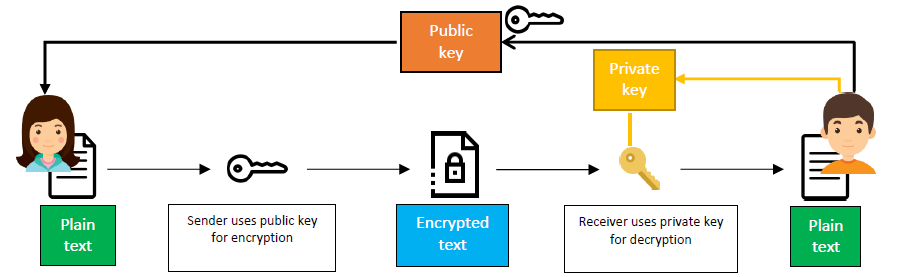
Doing so, you can have private correspondence over an unsecure channel. Actually, we’re using public key cryptography all the time. Whenever you see a green padlock in front of the URL bar, it means that the data you enter on the website is first encrypted before it’s sent out.
Digital Signatures
Public key cryptography is not only used for the encryption and decryption of messages, but also for message authentication. If Alice would not have encrypted her message with Bob’s public key, but with her own private key, then the encrypted message can be decrypted with her public key. If you receive a message of John Locke and you’d like to know whether it’s really sent out by Locke, then you could look up his public key and use it to decrypt his message. If the result is plaintext, and assuming that Locke is the only person in the world who possesses the only private key that can produce the encrypted message, you can be sure that the message was sent by Locke. In other words: applying a private key to a message is the equivalent to putting a digital signature.
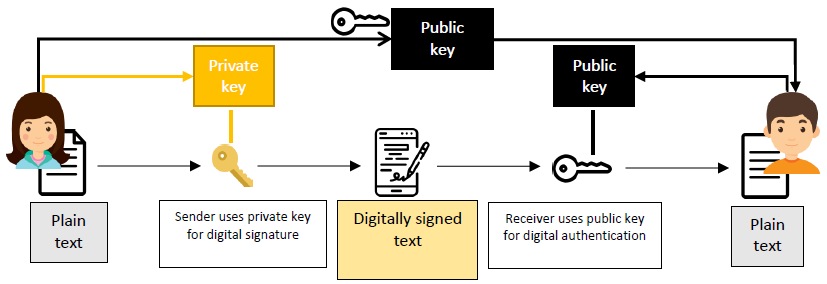
Digital signatures are particularly important, because they provide the following security aspects:
- Authentication: it offers proof that the message comes from the right person.
- Non-repudiation: we cannot deny that the signee has sent it.
- Data integrity: the message cannot be altered after it has been signed.
Diffie and Hellman saw great potential for public key cryptography in the coming digital age. The US secret intelligence, however, were not happy with this development in cryptography and tried to prevent public use of this new cryptosystem. The standoff between privacy advocates of whom many were cryptographers and the US government is known as the first crypto war.
In part three of this series, we will discuss the crypto war. Eventually, at the end of the post series, you will be able to encrypt your e-mails using public key cryptography.
Nightcap
- Can Francis change the Church? Nancy Dallavalle, Commonweal
- A Catholic debate over liberalism Park MacDougald, City Journal
- Why Hari Seldon was part of the problem Nick Nielsen, Grand Strategy Annex
- How not to die (soon) Robin Hanson, Overcoming Bias
Computational Economics is the Right Perspective
Here’s a vastly oversimplified picture of mainstream economics: We pick some phenomenon, assume all the context into the background, then build a model that isolates only the variables specifically relevant to that phenomenon.
Once you’ve simplified the problem that way, you can usually build a formal mathematical model, make a few more (hopefully) reasonable enough assumptions, and make some strong ceteris paribus claims about your chosen phenomena.
That’s a reasonable enough approach, but it doesn’t shed much light on big picture issues. I’m interested in root causes, and this “reduce things to their component parts” approach doesn’t give enough of a big picture to find those roots.
How do we broaden our perspective? One approach is to return to the more “literary” approach of the pre-Samuelson days. A bit of philosophy of science has me convinced that the primary flaw of such an approach is rhetorical. Written and mathematical arguments leave some assumptions in the background, but the latter is more convincing to a generation of economists trained to be distrustful of natural language (and too trusting of algebra).
As a pluralist, I think we should use as many approaches as we can. Different schools of thoughts allow you to build different imaginary worlds in your mind. But the computational approach isn’t getting enough play. I’d go so far as saying agent based modeling is the right form of mathematics for social science.
What does this mean? In a nutshell, it means modelling processes, simulating those processes, and seeing how interactions between different agents leads to different sorts of outcomes.
A common trope among Emergent Order folks is how ants are individually stupid but collectively brilliant. Neoclassical economics runs into the opposite problem: individually brilliant individuals who get trapped in Prisoners’ Dilemmas.
Computational economics starts with models that are more like ants than homo economicus. Agents are essentially bundles of heuristics/strategies in an out-of-equilibrium world. But these competing (and cooperating) strategies can interact in interesting ways. Each agent is a part of all the other agents’ environment, so the mix of strategies is a function of the success of the strategies which is a function of the mix of strategies in the environment.
In essence, computational economics starts from what the mainline economists have long recognized: human society is a complex, interwoven, recursive process. The world is, essentially, a sort of meta computer with a complex web of programs interacting and evolving. We don’t need to assume in any sort deus ex machina (that’s a bit of an overstatement, but we haven’t got time to explore it this week), we just need replicating entities that can change over time.
Such a view, to my mind, provides an end run around rationality assumptions that can explain the brilliance of entrepreneurship (without making heroes out of the merely lucky) as well as the folly unearthed by Behavioralist economics (without the smugness). We’ve always known it. It’s all just evolution. But the methodology hasn’t made its way into the main stream of economics. If there are any undergrads reading this on their way to a PhD program, let me know in the comments so I can point you in some interesting directions!
Supreme Court hears vital freedom-of-religion case
Today, the Supreme Court heard the most important case on the intersection of religion and education to arise in decades–Espinoza v. Montana Department of Revenue. A few years back, Montana had passed its first school-choice program, a tax-credit scheme that allowed a small tax credit for donations to scholarship programs that helped kids afford private school.
As in any state, many of Montana’s private schools are religious. Right after the state legislature passed the tax-credit statute, the Montana Department of Revenue promulgated a rule that immediately gutted the program by forbidding students attending religious schools from receiving scholarship money.
The Department based its rule on Montana’s Constitution, which says the legislature can’t “make any direct or indirect appropriation or payment from any public fund or monies . . . for any sectarian purpose or to aid any church, school,” etc. Plenty of states have very similar “no-aid” clauses. Revenue claimed that scholarships for religious students under the tax-credit scheme violated the “no-aid” clause.
It’s worth taking a moment to consider how bizarre this argument is. These scholarships are funded by private donations–the money never enters a public coffer. Yet Revenue thinks such donations would constitute state aid to religion because the donor gets a tiny tax credit (up to $150) for the donation. Underlying this argument is the strange notion that any money the government declines to collect from you is still the government’s money. This would mean, for instance, that every charitable donation eligible for a tax deduction would likewise constitute a government appropriation. Revenue’s argument has always looked to me like an extremely weak pretext for blatant discrimination against religious students.
So Kendra Espinoza and a few other parents with kids at religious schools sued the Department of Revenue, claiming, among other things, that Revenue’s rule violated their free exercise of religion under the First Amendment. Kendra won at trial, and then lost spectacularly at the Montana Supreme Court. In fact, the Montana Supreme Court did something even worse than the Department of Revenue–it invalidated the entire tax-credit program, such that even students at secular private schools could no longer receive scholarship assistance.
Thankfully, the Supreme Court took up the case, and they heard oral argument today. (My colleagues and I filed an amicus brief with the Court in support of Kendra).
The oral argument transcript shows a Court divided along the typical ideological lines. The liberal justices seemed preoccupied with standing–whether the petitioners had the right to sue. One justice implied that only taxpayers (who have a financial interest because of the tax credit) and schools (who receive the scholarship money) should have the right to sue. This is a weird take, given that families and students are obviously the intended beneficiaries of the scholarship program.
A number of the justices discussed a odd quirk about the Montana Supreme Court’s decision. The basic question they raised is this: since the Montana Supreme Court took the scholarship program away from everyone, are petitioners now being treated equally? But the sole reason the Montana Supreme Court struck down the program was to prevent religious students from receiving scholarship. A government action taken for a discriminatory reason is, well, discriminatory. If the legislature had excluded religious students when it enacted the program, the program would still stand. And if the legislature tried to enact the same program, providing equal treatment to religious and secular students alike, the Court would strike it down. That’s discrimination based on religious status–pretty straightforward.
One justice cited to James Madison’s famous Memorial and Remonstrance Against Religious Assessments, arguing that the founders wouldn’t have wanted public funds flowing to religious schools like this (again no public funds were flowing to Montana religious schools under this program, but why let accuracy get in the way of a good narrative). That’s a terrible misreading of Madison. The Memorial and Remonstrance was an attack on preferential aid to religion, not to a program that provided public benefits to all groups, including religious ones. The difference is vital. Can the government deny churches police protection, fire protection, sewer connections, electrical service, or any other public benefit on the grounds that the government would be providing indirect public funding to religious institutions? Surely not. In fact, that’s exactly what the Supreme Court said in a recent case called Trinity Lutheran, where Missouri denied a church daycare access to a government program that helped renovate playgrounds.
There is a difference between Trinity Lutheran and this case, arguably, which is that here the money goes more directly to religious indoctrination, not something secular like playground materials. But at bottom, public funding is fungible. Providing police protection and other general public benefits obviously makes it easier for a religious institution to fulfill its religious mission.
This case should be an easy one. The government offered a benefit to all private schools. To include religious schools doesn’t “establish” religion. It just treats religious groups equally, as the Constitution requires.
Nightcap
- Surviving Modi’s undeclared war on Muslims Furquan Siddiqui, Baffler
- Do the Democrats have a foreign policy? Jessica Mathews, NYRB
- Praise for Elizabeth Warren’s student debt plan Thomas Knapp, TGC
- A cocktail: cosmopolitanism as a culture Brooke Allen, New Criterion
“A classical liberal view of the Iran crisis?”
Classical liberals will not be surprised by the repeated occurrence of violence and war in the Middle East and will understand the realities of the unstable region where Iran is an important player. Their analysis will view the regional balance of power in the context of the global balance of power. They will also take account of the history of US-Iranian relations […]
This is from fellow Notewriter Edwin, writing for the Institute for Economic Affairs in London. It was part of a nightcap a few days ago, but I thought I’d give it some more love with a post of its own.
Edwin likes to use the “balance of power” strategy to explain the classical liberal position (check out his now classic article in the Independent Review), but I don’t know how true this is. Traditionally, hasn’t the balance of power method been favored by conservatives like Metternich and Kissinger?
I know he’ll respond by telling me that I have a socially liberal view of IR because I favor more federation, but I don’t know how true this is either. Shouldn’t trade-offs and cooperation in the context of power take precedence in classical liberal theories of IR? What sounds more liberal to you, then: a strategy of balancing power between separate actors, or a strategy of finding trade-offs and binding actors together in a manner (federal) that maximizes those trade-offs?
Nightcap
- One positive to come out of Zimbabwe’s chaos Peter Carty, Spectator
- Proxy wars and blowback Irfan Khawaja, Policy of Truth
- The fate of the Kurds Janet Klein, Origins
- Before the Kochs, there were the… Darren Dochuk, Politico

