- Madonna offers oral sex for those who vote Hillary Clinton
- Trump-inspired ‘pussy’ ad banned in San Francisco subway
- The poverty of democracy
- The battle for the Arctic
- Countries rush for upper hand in Antarctica
- Why not world government? (Part 2)
- Meet China’s state-approved Muslims
- The good, the bad, and the ugly of Somaliland secession
An undignified part of me (of which I am ashamed)
There is a part of me, an undignified part of me of which I am ashamed. That part thinks that it would be poetic justice for Mrs Bill Clinton’s lifelong presidential ambitions, intricately tied to primitive feminism, awkwardly paired with her husband’s sexual assaults, to founder because of the actions of a notorious public penis shaker.
It would be a twisted take on the Gospel according to Matthew:
“Put your sword in its place, for all who take the sword shall perish by the sword” (Matthew 26: 52).
Some Thursday afternoon love
I’ve been busy with real life for so long that I haven’t been able to produce shorter blog posts that give you a snapshot into my daily thinking routine. That should change now, but for today I wanted to give a shout-out to a bunch of bloggers who have put NOL on their blog rolls. Please be sure to check them out and add them to your daily feeds!
- Catallaxy Files: “Australia’s leading libertarian and centre-right group blog”
- Farmer Hayek: A group blog of agricultural economists based out of the American midwest
- Maggie’s Farm: A group blog of non-conformists based out of the American northeast
- The Money Illusion: The infamous-though-prestigious economist Scott Sumner’s personal blog
- Policy of Truth: Irfan, David, and the gang discuss philosophy, Israel/Palestine, and American politics and culture (amongst other interesting things)
- Popehat: a law blog that is much more than that
- Samizdata: A (mostly) British group blog of libertarian-ish bad asses
These guys are all on our blog roll, too, so don’t feel like you have to save this page in order to find them in the future.
These guys are also really cool, obviously, so feel free to jump into their ‘comments’ threads and introduce yourselves. They’ll talk back.
I’ve noticed a trend over the past few years of blogs getting rid of their blog rolls altogether, and I think it’s stupid. People think it makes their blog look sleeker, and that blogging as a form of communication between like-minded people has come to an end, but that’s all hogwash.
Show these guys some love!
A quick update on life in ATX
Hey all,
I just put in my two weeks’ notice at the bar I’ve been working at for the past 13 months. I’ve had a lot of fun, even though I took the job seriously, and am looking forward to my next adventure in life. Right now, though, I’ll just be chillin’ in ATX and reading and writing as much as possible. That means more blogging from me! (Hopefully my fellow Notewriters will follow suite…)
Austin is described by intelligent locals as a “blue dot in a sea of red,” meaning it’s a liberal city in a very conservative state. During the primaries, I saw mostly Bernie Sanders signs in the areas of Austin I frequent (east side, Riverside, downtown; i.e. the poor, fun parts). Ron Paul is a popular figure in Austin, too, but he has long since faded away from the politico-electoral scene.
The south and west sides of Austin are much more affluent, and therefore more conservative, and I have a feeling that if I were to end up in those neighborhoods I would see a lot of “Hillary” signs. It’s the strangest thing, the be living in a state that is known culturally in the US as the conservative state (and made to be diametrically opposed to California, which is the liberal one), and see nothing but support for thoughtful candidates within the two major political parties.
There is not much knowledge or support for 3rd party candidates in Austin. The LP and the Green parties get superficial nods of approval whenever they are brought up in conversation, but for the most part Texas Leftists and millennials support “the little guy” of the major parties. Again, it is weird. But so, too, am I and with that I’ll sign off for the day…
UPDATE: Speaking of weird, check out this review by Bryan Caplan of a new biography about Brigham Young.
Does academia have a diversity problem?
As those of you who have me on Facebook may know, I’ve spent the past few months running around in a Trump costume at various comic conventions. I did so for the simple reason that I found it humorous for a Mexican to be running around as Trump. To my surprise the experience was surprisingly enlightening.
When dressed in Trump I got a range of reactions from people wanting a comedic photo with/of me, being attacked by a pair of Hispanics dressed as ‘cholo’ Mario and Lugio, and Bernie supporters saying they hated my guts until I explained I didn’t support Trump.
Yesterday though, when dressed as Trump for Halloween, I got the strangest reaction when walking around my university campus. A meek boy came up to me and asked me if I identified as a Republican, I responded that I did but that I had actually supported Jeb in the primaries*, and his eyes light up. He began to shake my hand and talk about how great it was to find someone else after looking for so long.
The incident really hit home for me since I recall my own undergraduate years of feeling politically isolated from my peers. I had resigned myself to biting my tongue whenever politics were discussed. This didn’t work though since I was often in social sciences and my leanings quickly showed when we had freedom to elect subjects for our assignments. So I just kept shut and tried to produce as bland as possible papers so that I wouldn’t be singled out.
This didn’t change until I discovered there were a few conservative/libertarian professors sprinkled across the university. I didn’t become a chatter box in their classes, but I felt an immense weight off my shoulders knowing that I could voice an opinion outside the mainstream Democratic party line and not have to defend myself from claims of being a racist one-percenter.
Unfortunately, as Landberg et al.’s recent paper shows, there just aren’t many non-Democratic professors in academia. Does academia have a diversity problem? Yes it has an intellectual diversity problem, but its not clear what can be done about it.
Thoughts? Have others had similar experiences?
*This is of course relative to my disdain for the Democratic Party.
Great quotes by Vladimir Lenin
Last week I posted some quotes by Joseph Stalin. I’m afraid too many people are still misguided by the myth that Lenin was a good leader whose plans were somehow distorted by Stalin. Nothing could be further from the truth. Joseph Stalin had a great teacher, Vladimir Lenin, and brought the plans of his teacher to perfection. Here are some quotes by Lenin, so that we can learn more about international Marxism. Notice that he sounded very reasonable and pacific before 1917, and not so much so when revolution actually came.
On terror:
The Congress decisively rejects terrorism, i.e., the system of individual political assassinations, as being a method of political struggle which is most inexpedient at the present time, diverting the best forces from the urgent and imperatively necessary work of organisation and agitation, destroying contact between the revolutionaries and the masses of the revolutionary classes of the population, and spreading both among the revolutionaries themselves and the population in general utterly distorted ideas of the aims and methods of struggle against the autocracy.
Lenin, Vladimir Ilich (July–August) [1903], “Second Congress of the RSDLP: Drafts of Minor Resolutions”, Collected Works, 6, Marxists.
It is necessary — secretly and urgently to prepare the terror. And on Tuesday we will decide whether it will be through SNK or otherwise.
Memorandum to Nikolay Nikolayevich Krestinsky (3 or 4 September 1918) while recovering from an assassination attempt by Socialist-Revolutionary Fanni Kaplan on 30 August 1918; published in The Mitrokhin Archive: The KGB in Europe and the West (1999) Christopher Andrew and Vasili Mitrokhin, p. 34.
On democracy:
Whoever wants to reach socialism by any other path than that of political democracy will inevitably arrive at conclusions that are absurd and reactionary both in the economic and the political sense.
Lenin, Vladimir Ilich (Summer) [1905], “Two Tactics of Social Democracy in the Democratic Revolution”, Collected Works, 9, Marxists, p. 29.
You cannot do anything without rousing the masses to action. A plenary meeting of the Soviet must be called to decide on mass searches in Petrograd and the goods stations. To carry out these searches, each factory and company must form contingents, not on a voluntary basis: it must be the duty of everyone to take part in these searches under the threat of being deprived of his bread card. We can’t expect to get anywhere unless we resort to terrorism: speculators must be shot on the spot. Moreover, bandits must be dealt with just as resolutely: they must be shot on the spot.
“Meeting of the Presidium of the Petrograd Soviet With Delegates From the Food Supply Organisations” (27 January 1918) Collected Works, Vol. 26, p. 501.
On individual liberty:
Everyone is free to write and say whatever he likes, without any restrictions. But every voluntary association (including the party) is also free to expel members who use the name of the party to advocate anti-party views. Freedom of speech and the press must be complete. But then freedom of association must be complete too.
Lenin, Vladimir Ilich (13 November 1905), “Party Organisation and Party Literature”, Novaya Zhizn (Marxists) (12).
We set ourselves the ultimate aim of abolishing the state, i.e., all organized and systematic violence, all use of violence against people in general. We do not expect the advent of a system of society in which the principle of subordination of the minority to the majority will not be observed.
In striving for socialism, however, we are convinced that it will develop into communism and, therefore, that the need for violence against people in general, for the subordination of one man to another, and of one section of the population to another, will vanish altogether since people will become accustomed to observing the elementary conditions of social life without violence and without subordination.
Lenin, Vladimir Ilich, The State and Revolution, Ch. 4: “Supplementary Explanations by Engels”
On violence:
No Bolshevik, no Communist, no intelligent socialist has ever entertained the idea of violence against the middle peasants. All socialists have always spoken of agreement with them and of their gradual and voluntary transition to socialism.
“Reply to a Peasant’s Question” (15 February 1919); Collected Works, Vol. 36, p. 501.
When violence is exercised by the working people, by the mass of exploited against the exploiters — then we are for it!
“Report on the Activities of the Council of People’s Commissars” (24 January 1918); Collected Works, Vol. 26, pp. 459-61.
BC’s weekend reads
- NATO sends a message to Russia
- Iraq doesn’t need to break up to be successful (so says a scholar at Brookings)
- Benedict Anderson (political science) reviews Clifford Geertz (anthropology)
- The Muddled Mystique of Karl Polanyi
- The prison house of gender
- Investigating Madison’s Political Religion (central planning is hard to do)
Great quotes by Joseph Stalin
Sometimes I like to read quotes by famous intellectuals and leaders. I believe it is a great way to learn one thing or two about several subjects, and specially the thought of said people. I suddenly became curious about Joseph Stalin, and to my surprise he was at times a very reasonable (albeit terribly evil) person. Here are some quotes by Joseph Stalin I subjectively find interesting:
On Social Democracy:
Social democracy is objectively the moderate wing of fascism…. These organisations (ie Fascism and social democracy) are not antipodes, they are twins.
Joseph Stalin, “Concerning the International Situation,” Works, Vol. 6, January-November, 1924, pp. 293-314.
On Anarchism:
We are not the kind of people who, when the word “anarchism” is mentioned, turn away contemptuously and say with a supercilious wave of the hand: “Why waste time on that, it’s not worth talking about!” We think that such cheap “criticism” is undignified and useless.
(…)
We believe that the Anarchists are real enemies of Marxism. Accordingly, we also hold that a real struggle must be waged against real enemies.
Anarchism or Socialism (1906)
On differences within the communist movement:
We think that a powerful and vigorous movement is impossible without differences — “true conformity” is possible only in the cemetery.
Stalin’s article “Our purposes” Pravda #1, (22 January 1912)
He did make a lot of people conform to his ideas.
On diplomacy:
A sincere diplomat is like dry water or wooden iron.
Speech “The Elections in St. Petersburg” (January 1913)
On the press:
The press must grow day in and day out — it is our Party’s sharpest and most powerful weapon.
Speech at The Twelfth Congress of the R.C.P.(B.) (19 April 1923)
On elections:
I consider it completely unimportant who in the party will vote, or how; but what is extraordinarily important is this—who will count the votes, and how.
Said in 1923, as quoted in The Memoirs of Stalin’s Former Secretary (1992) by Boris Bazhanov [Saint Petersburg]
On education:
Education is a weapon whose effects depend on who holds it in his hands and at whom it is aimed.
Interview with H. G. Wells (September 1937)
On Hitler:
So the bastard’s dead? Too bad we didn’t capture him alive!
Said in April 1945 — On hearing of Hitler’s suicide, as quoted in The Memoirs of Georgy Zhukov
On his role as a leader at the USSR:
Do you remember the tsar? Well, I‘m like a tsar.
To his mother in the 1930s as quoted in Young Stalin (2007) by Simon Sebag Montefiore
To finish, a comment by George Orwell about Stalin, and above that, about people in the West who failed to see what the USSR actually was:
I would not condemn Stalin and his associates merely for their barbaric and undemocratic methods. It is quite possible that, even with the best intentions, they could not have acted otherwise under the conditions prevailing there.
But on the other hand it was of the utmost importance to me that people in western Europe should see the Soviet regime for what it really was. Since 1930 I had seen little evidence that the USSR was progressing towards anything that one could truly call Socialism. On the contrary, I was struck by clear signs of its transformation into a hierarchical society, in which the rulers have no more reason to give up their power than any other ruling class. Moreover, the workers and intelligentsia in a country like England cannot understand that the USSR of today is altogether different from what it was in 1917. It is partly that they do not want to understand (i.e. they want to believe that, somewhere, a really Socialist country does actually exist), and partly that, being accustomed to comparative freedom and moderation in public life, totalitarianism is completely incomprehensible to them.
George Orwell, in the original preface to Animal Farm; as published in George Orwell : Some Materials for a Bibliography (1953) by Ian R. Willison
The legacy of autocratic rule in China
What is the long-term legacy of political persecutions? Here I want to present the main findings of my recent research with Melanie Meng Xue (UCLA Anderson). Our research is an attempt to undercover how a legacy of political persecution can shape social capital and civil society by studying imperial China. The full version of the paper is available here.
We know from other research that particular institutions, policies, and events can have a detrimental and long-lasting impact on economic and political outcomes (e.g. Nunn 2011, Voigtländer and Voth, 2012). But it is hard to find a setting where we can study the long-run impact of autocratic institutions. A key feature of autocracy is the use of persecutions to intimidate potential opponents. In our paper, Melanie and I argue that the intensification of imperial autocracy that took place in the High Qing period (1680-1794) provides an ideal setting to study the impact of such persecutions.
Qing China
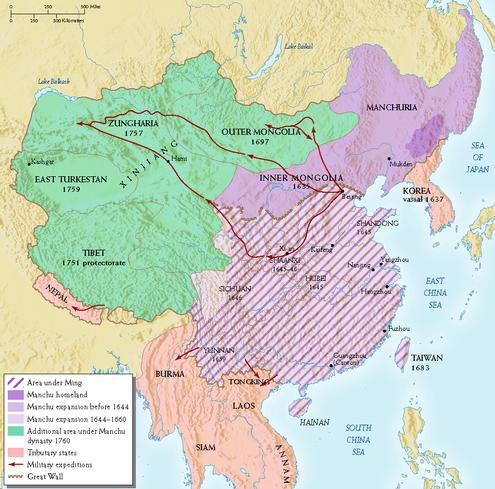
The High Qing period was one of great political stability, imperial expansion, and internal peace. Economic historians like Bin Wong and Ken Pomeranz have shown that China possessed a flourishing market economy during this period; it experienced Smithian economic growth and a massive demographic expansion. Rulers such as the Kangxi (1661-1722) and Qianlong Emperors (1735-1794) are seen as among the most successful in Chinese history. Nevertheless, as ethnic Manchus, these rulers were extremely sensitive to possible opposition from the Han Chinese. And during this period Qing tightened control over the gentry and implemented a policy of the systematic persecution of dissent. (Figure 1 depicts the Manchu conquest of China.)
The Literary Inquisitions
The focus of our paper is on the impact of persecutions conducted by Qing China against individuals suspected of expressing disloyalty. We study the impact of these state-orchestrated persecutions on the social fabric of society. This allows us to speak to the kinds of concerns that authors like Hannah Arendt and George Orwell expressed about the long-run impact of totalitarianism in the 20th century.
These persecutions are referred to by historians as ‘literary inquisitions’. Existing scholarship suggests that the resulting fear of persecution elevated the risks facing writers and scholars, and created an atmosphere of oppression and a culture of distrust which deterred intellectuals from playing an active role in society. But these claims have never been systematically investigated. Putting together several unique datasets for historical and modern China, we explore the impact of literary inquisitions on social capital in Qing China and trace its long-run impact on modern China through its effect on cultural values.

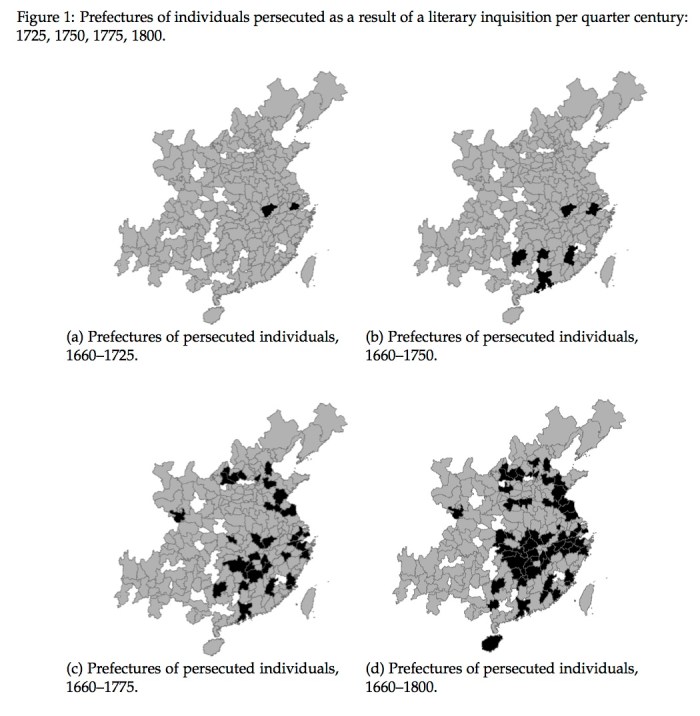
To conduct our analysis, we use data on 88 inquisition cases. We match the victims of each case (there are often multiple victims per case) to their home prefecture. This data is depicted in Figure 1. Since prefectures varied greatly in their economic, social, and political characteristics we conduct our analysis on a matched sample. This ensures that the prefectures “treated” by a literary inquisition are similar in terms of their observables to those we code as “untreated”. As our data is a panel, we are able to exploit variation across time as well as variation in space.
While individuals could be persecuted for a host of reasons, these were all but impossible to anticipate ex ante. Cases were referred to the emperor himself. Frederic Wakeman called this “the institutionalization of Imperial subjectivity.” The standard punishment in such cases was death by Lingchi or (slow slicing) and the enslavement of all one’s immediate relatives. In some cases, however, the guilty party would be executed by beheading. These persecutions aimed to deter opposition to Qing rule by signaling the ability of the Emperor to hunt down all potential critics or opponents of the regime.
The Impact of Literary Inquisitions on Social Capital
We initially focus on the impact of persecution on the short and medium-run using our historical panel. We first examine the effects on the number of notable scholars. In our preferred specification we find that a literary inquisition reduced the number of notable scholars in a prefecture by 33 percent relative to the sample mean.
We go on to show the effect of persecutions on collective participation among the gentry in China. Our measure of collective participation in civil society is the number of charitable organizations. Charitable organizations played an important role in premodern China providing disaster relief and local public goods such as repairing local roads. They were non-governmental organizations and played an important role alongside the government provision of disaster relief. In our preferred empirical specification, we find that a persecution number of charitable organizations by 38 percent relative to the sample mean.
These results are in keeping with the argument that literary inquisition had a major psychological impact on Chinese society. They are consistent with the rise of “inoffensive” literary subjects during the Qing period that have documented by historians. To reduce the risk of persecution, intellectuals scrupulously avoided activities that could be interpreted as constituting an undermining of Qing rule. Instead they “immersed themselves in the non-subversive “sound learning” and engaged in textual criticism, bibliography, epigraphy, and other innocuous, purely scholarly pursuits” (Wiens, 1969, 16).
The Impact of Literary Inquisitions on 20th Century Outcomes
We go on to examine how the effects of these persecutions can be traced into the 20th century. In particular, we focus on the provision of basic education at the end of Qing dynasty. In late 19th and early 20th century China, there was no centralized governmental provision of primary schools. Basic education remained the responsibility of the local gentry who ran local schools.
Thus the provision of education at a local level was dependent on the ability of educated individuals to coordinate in the mobilization of resources; this required both cooperation and trust. We therefore hypothesize that if the persecution of intellectuals had a detrimental impact on social capital, it should also have negatively affected the provision of basic education.
We find that among individuals aged over 70 in the 1982 census – hence individuals who were born in the late Qing period – a legacy of a literary inquisition is associated with lower levels of literacy. This reflects the impact of literary inquisition on the voluntary schools provided by the gentry and is not associated with lower enrollment at middle school or high school. We show that result is robust to controlling for selective migration and for the number of death caused by the Cultural Revolution.
Finally, we show that literary inquisitions generated a cultural of political non-participation. Drawing on two datasets of political attitudes – the Chinese General Social Survey (CGSS) and the Chinese Political Compass (CPoC) – we show that individuals in areas in which individuals were targeted during literary inquisitions are both less trusting of government and less interested in political participation.
Finally, we find that individuals in prefectures with a legacy of literary inquisitions are less likely to agree that: “Western-style multi-party systems are not suitable for China” (Q 43.). This suggests that in areas affected by literary inquisitions individuals are also more skeptical of the claims of the Chinese government and more open to considering alternative political systems. Similarly, individuals in affected prefectures are more likely to disagree with the statement that: “Modern China needs to be guided by wisdom of Confucius/Confucian thinking.”
In summary, our analysis suggests that autocratic rule reduced social capital and helped to produce a culture of political quietism in pre-modern China. This has left a legacy that persisted into the 20th century. These findings have implications for China’s current political trajectory. Some scholars anticipate China undergoing a democratic transition as it’s economy develops (Acemoglu and Robinson, 2012). Others point to China as an example of “authoritarian resilience.” By showing that a long-history of autocratic rule and political persecutions can produce a culture of political apathy, our results shed light on a further and previously under-explored source of authoritarian resilience.
The right to lose
After a year of being shocked by Trump’s behavior, people are now finally out of meaningful things to be upset about. We’re down to “Trump isn’t going to accept the results if he loses?!” The tone on the FiveThirtyEight elections podcast (mostly from Clare Malone) was “How dare he?! He must accept the outcome of the election!”
He’s not going to storm the White House, he’s just going to be a sore loser. Why, at this point, should we expect him to lose gracefully? What benefit would that give anyone? He’s not weakening institutions, just being a big baby. We shouldn’t be surprised!
I’m not saying that Trump gets an out because he’s exceptional. I’ve got two related points: 1) Good deeds lose their meaning if they weren’t done by choice. We don’t have to celebrate him being a sore loser, but we shouldn’t try to stop him (whatever that might mean) either. 2) If you aren’t free to be wrong, you aren’t free. Yes, democracy isn’t actually about freedom, but we are still trying to be a free country.
What’s the difference between open borders and Open Borders?
There are two meanings here. I’ll define them below:
- There are open borders, where borders are open and anyone can move between them
- There are Open Borders, where borders to rich states are open to people from poor states, but the borders to poor states are closed to immigration
Open borders are fairer than closed borders. If people can move from poor states to rich ones, that’s good. But what about people who want to move from rich states to poor ones? Open Borders addresses the first issue but not the second one. Libertarians are enamored with the second type of open borders these days, for a couple of reasons. The main reason, and the only one I’m going to name here, is that most of us are pragmatic and therefore support any kind of liberalization in labor markets we can get. If we can get our respective polities to open up their borders to poor migrants, so be it. Let’s do this in any way we can.
But what we are advocating for is not open borders. It’s labor market liberalization. I understand the need for sloganeering these days. I get it. Y’all are thinking on the margin. I’m all for Open Borders.
How, though, do we get actual open borders?
How can senior citizens from the US have the freedom to choose retirement in not only Florida or Oregon, but Tamaulipas or Veracruz, too?
How can middle class Californians have the freedom to choose between not only Texas or Colorado for relocation, but Chihuahua or Neuvo Leon?
My answer is, of course, federation, but I also realize my argument is politically unfeasible for the time being (even though it’s an old argument). Any other ideas, or is Open Borders the best we can do for now?
Porque privatizar (ou desestatizar) o ensino é uma das melhores reformas que se pode fazer
Talvez seja somente uma percepção subjetiva sem maior relevância objetiva, mas a impressão que tenho é que a privatização do ensino é um dos maiores tabus da sociedade brasileira. Até onde eu sei nenhum partido, figura política ou figura pública de destaque está defendendo a privatização total do ensino no Brasil. Segundo as notícias que chegam até mim, o recente anúncio de corte de gastos na educação causa uma de duas reações: indignação ou pesar. Alguns reagem com indignação, e não aceitam que qualquer corte seja feito; outros reagem com pesar, mas consideram que os cortes são necessários. Ditas estas coisas, penso que cabe a mim agir como Walter Block e “defender o indefensável”: o governo (ou o estado – use o vocabulário que lhe convir) não deveria ter qualquer papel na educação. Para isso irei expor brevemente o que é economia, como ela funciona, e o que isso tem a ver com governo, indivíduos e educação. É uma exposição breve, e pode deixar alguns pontos pouco desenvolvidos. Para uma exposição mais profunda deste tema, recomendo o livro Educação: Livre e Obrigatória, de Murray Rothbard.
Economia é a gestão de recursos necessariamente escassos que possuímos. Os recursos são necessariamente escassos porque somos seres humanos finitos, e não deuses. Alguns paradigmas econômicos (notoriamente o marxismo) partem de um pressuposto de abundancia de recursos, mas isto é falso e até mesmo perigoso: até mesmo o homem mais rico do mundo tem somente 24 horas no seu dia. Tem somente um corpo, e não pode estar em dois lugares ao mesmo tempo. Tem energia limitada, e fica cansado. Todos nós possuímos recursos limitados (ainda que alguns possuam mais recursos à sua disposição do que outros). A economia é a arte de melhor gerir estes recursos.
A gestão dos recursos limitados que possuímos é feita através de escolhas. O nome que os economistas dão a isso é “custo de oportunidade”: a não ser que você detenha infinitos recursos, gastar em uma coisa significa não gastar na segunda melhor alternativa. Exemplos: comprar o carro A significa não comprar o carro B; morar na cidade X significa não morar na cidade Y; casar com Z significa não casar com W; e escolher a carreira α significa não escolher a carreira λ. Como disse um antigo professor meu, “a vida é feita de escolhas”.
Considerando que possuímos recursos finitos e precisamos fazer escolhas, qual é mecanismo mais eficiente para tomar decisões? Certamente muitas pessoas gostariam de tomar decisões com base nos seus gostos pessoais. Gostariam de escolher aquilo de que mais gostam. Porém, aquilo de que mais gosto nem sempre está ao meu alcance. Exemplos: ainda que eu goste mais de uma Ferrari do que de um fusquinha, talvez eu precise me contentar com a segunda opção. Ou ainda que eu queira viajar, talvez eu tenha que me contentar em pagar o tratamento para um problema de saúde que acabei de descobrir que tenho. É por coisas assim que a economia ficou conhecida como “ciência triste”. Muitas vezes ela está aí para lembrar que nem sempre podemos ter o que queremos. Dito isto, a melhor forma de tomar decisões é pelos preços: os preços nos dizem se aquilo que desejamos é compatível com os recursos disponíveis.
Os preços são geralmente definidos em termos de dinheiro. Dinheiro é melhor definido por aquilo que faz do que por aquilo que é. Muitas coisas podem ser dinheiro: papel, metais preciosos, cigarros, balas ou dígitos num computador. Mas o que dinheiro faz é servir como uma linguagem: o dinheiro transmite de uma pessoa para outra o valor dos recursos envolvidos numa mercadoria ou num serviço. E valor é algo subjetivo. Contrariando a teoria do valor trabalho, é impossível saber de forma objetiva qual é o preço de uma determinada mercadoria ou serviço: é necessário que este valor seja definido por relações de oferta e procura. E é de incontáveis relações de oferta e procura que os preços são feitos. Em outras palavras, os preços nos transmitem de forma simples algo que jamais poderia ser calculado por uma pessoa: uma infinidade de relações de oferta e procura, escolhas e preferências, dentro da economia. Como disse Friedrich Hayek, “a economia somos nós”.
E assim chegamos à educação. Como eu disse acima, escolher a carreira α significa não escolher a carreira λ. Como essa decisão é feita? Certamente que muitas pessoas escolhem sua carreira com base em aptidões que percebem em si mesmas, ou em considerações sobre o que poderá ser uma atividade profissional mais prazerosa. Porém, este é um luxo que não está disponível para todos: muitas pessoas precisam escolher uma carreira com base no que pode dar mais retorno financeiro com menor investimento e menor risco. Posso escolher uma carreira que promete um grande retorno financeiro, mas com grande risco de não conseguir emprego num mercado de trabalho altamente competitivo, ou com um investimento de recursos (em tempo em dinheiro) que não posso arcar. A vida é feita de escolhas, e essas escolhas muitas vezes envolvem riscos. Escolher uma carreira é dizer não (ao menos temporariamente) para todas as outras. Algumas pessoas tem a chance de arriscar mais. Outras não têm o mesmo luxo. Considerações como relação candidato/vaga, salário médio, nível de empregabilidade e outras são semelhantes aos preços, e podem ser bons parâmetros ao se decidir por uma carreira. Mas com o governo criando vagas em universidades, determinando regras de acesso ao mercado de trabalho e adotando outras medidas, os preços não refletem a real relação de oferta e procura. Em outras palavras, a linguagem é distorcida, e as decisões não são as melhores, nem para os indivíduos, e nem para a sociedade.
Compreendo que pensar assim possa soar extremamente cínico, e pode ser um banho de água fria, especialmente para os mais jovens ou mais sonhadores. Muitas pessoas preferem tomar decisões considerando seus gostos pessoais, sua vocação, seu desejo de ajudar o próximo ou outras considerações. Não estou desmerecendo nenhuma destas considerações. Estou apenas dizendo que somos seres humanos limitados que vivem num mundo de recursos limitados. Precisamos fazer o melhor uso possível destes recursos. Embora os recursos sejam limitados, nossa criatividade para aproveitá-los não demonstra um limite óbvio. O uso criativo e sustentável dos recursos necessita de uma bússola, um guia. O sistema de preços é o melhor guia que possuímos. Sem propriedade privada não há formação de preços, e sem formação de preços o cálculo econômico é impossível. Por esta razão os gastos com educação não param de aumentar e a qualidade dos resultados não para de cair: o melhor juiz para determinar como os recursos serão empregados é o individuo fazendo uso de seus próprios recursos. A interferência do governo prejudica ou até desfaz este julgamento.
Em tempo: estou defendendo que o governo precisa sair da educação e deixá-la para a iniciativa individual (até mesmo porque somente indivíduos podem ter iniciativa). Não estou defendendo que educação precisa ser necessariamente paga pelos alunos. Como disse Milton Friedman, “não existe almoço grátis” (mais uma dessas frases que tornam os economistas – especialmente os liberais clássicos e libertários – pessoas pouco populares). Mas quando uma pessoa tem fome e não pode pagar pelo almoço, outra pode fazer isso. O nome disso é caridade, e quero incentivá-la o máximo possível. Caso você se preocupe com os pobres, sugiro que pare de mandar dinheiro para Brasília na forma de impostos, que serão necessariamente mal empregados (segundo tudo que discuti aqui), e procure pessoas que precisam. Com certeza você não terá dificuldade de encontrá-las.
Sweet Skateboard Tales
The words “skateboard” and “sweet” are seldom found together. Skateboarders tend to have a bad reputation because they are mostly male, because they act too male, and because of their lamentable fashion sense. Yet, many or most are both athletes and artists. They do things in the middle of my street of such perilous inventiveness that I am not brave enough even to think about them.
So, the other day, I am watching the ocean on West Cliff Drive in Santa Cruz. Now, West Cliff is a sea-hugging street with a million dollar view of Monterey Bay. (I mean this literally: Move the same house that has the ocean view one block inland and its value drops by a cool million or more.) West Cliff is a good place for spotting whales but it’s mostly used by many Santa Cruz residents as a walking venue and a place to ride their bikes.
Suddenly, from the corner of my eye, I spot a man on a skateboard. Skateboarders seldom use West Cliff. It’s often crowded, it’s too ordinary, and it offers few opportunities to do tricks. This skateboarder is a bit older than most, perhaps in his early thirties. He is moving quite fast, I think. A six year-old is clinging to his left leg, a four year-old to his right leg. It’s stunning and it’s adorable. The next day one who knows more than I tells me that it must have been an electrically propelled skateboard. I love living in California. The inventiveness here is bracing.
Not a day later, I am standing in from of the Post Office shooting the breeze with my pal, Dennis the Homeless. (Dennis is homeless, not brainless; he knows a lot and he makes bamboo flutes.) My mind can’t believe what my eyes see. If I had been asked, I would have said it couldn’t be done. A boy and a girl are skateboarding together, each with his own board but holding hands. The harmony, the intuitive synchronicity! Ah, young love! The sweet music they must make in bed. Again, I don’t know where else I would be treated to this kind of spontaneous, charming show.
A “don’t rock the boat” theory of political change
You’d think that as long as we’ve known Trump and Clinton it would be more obvious which is better (okay, least bad). But here we are. That said, I largely agree with Brandon’s thoughts: Hilary is the better of the two. If we’re thinking about the trajectory of freedom in this country, it’s like we had been climbing an upward path till 9/11 gave military-industrial complex a new project. Clinton is offering to keep leading us down a gentle incline and Trump is saying “let’s go through that thicket of poison oak!”
I stand by my old advice that a vote for the big two parties is a wasted vote. People will argue that in swing states it might be close and you might regret your vote. Those people are really arguing that you might regret the vote of hundreds-thousands of strangers. Your vote still is not decisive. Even if you convince a thousand strangers in a swing state to vote your way, you’re still highly unlikely to affect the outcome.
I think, in terms of voting, you do much more good by sending a Johnson signal than you do by slightly increasing the margin by which Clinton wins (or slightly decreasing the margin by which she loses depending on your state).
But my advice is given in the context of a world where Johnson is expected to get 6% of the vote. That affects my cost-benefit calculus. What would it mean for the long-run success of liberty if Johnson were to actually win?
To build on Brandon’s third point (“Clinton is a lawyer and she knows how our government is supposed to work”), this isn’t just a competition to get into the white house. It’s a sales pitch that requires buy in from the electorate. If Johnson won the election, he’d be in the position of some newfangled gadget America bought on a whim. He could catch on, like the microwave, or sink like the Segway.

Truthfully, I’m not sure that scenario would be that good for freedom–I think Johnson is a pretty good voice for liberty, and a great third party candidate. But if he actually won, I think he might be too different from the environment he’d have to operate in. It could turn people off of libertarianism for another generation.
But then, the point of your vote isn’t to pick the winner, it’s to express your political beliefs. You’ll do a much better job of voting by voting your conscience than by trying to vote strategically. So vote for Johnson, but root for Hillary… this time.
 Notes On Liberty