How I Helped Win World War Two

Below is an excerpt from my book I Used to Be French: an Immature Autobiography. You can buy it on amazon here.


All of a sudden, that road was flooded by a long column of trucks overflowing with big, loud, laughing men in distinctive uniforms. People were shouting greetings and waving flags. It seems that an American soldier jumped off his vehicle, swept me up into his arms and kissed me on both cheeks. That may have been because my mother, who had wanted her second child to be a daughter, processed my long blond hair into Goldilock-style ringlets. That I am straight today is a testimony to the resiliency of genetic programming. My mother always insisted the kissing soldier was black. On the one hand, she may have made up this detail for colorful effect. On the other hand, there were so many trucks the soldiers may have belonged to a transport unit and hence, probably to a black unit in the segregated Army of the day.

It was August 1944. I was two and my family lived in a (nice) city project right on the periphery of Paris, near one of its main access roads. One thing that bothers me about this visual and auditory recollection is that we lived on the east side of Paris. American soldiers should have been arriving from Normandy, in the west. Yet, the memory is clear.

Before the American forces reached Paris, my mother had sewn a makeshift tricolor French flag. The blue came from my father’s old military service flannel sash (a forgotten and now incomprehensible item of clothing). The red came from a Nazi flag my father had stolen from a German general’s car he was supposed to guard. (The Germans were packing up at the time and very nervous. He might have been shot on the spot if he had been caught.) At a loss for white, my mother made the center piece out of one of my diapers. That’s why I have always felt I played a part, although a small one, in the liberation of Paris, a symbolically important phase of WWII.

I was born and conceived during the Nazi Occupation of France when life was tough and entertainment scarce. My father was a Paris cop. His life was not so tough, however, that he did not have the energy to make my mother pregnant one more time before the Liberation, this time with twins. There was little to eat and milk was rationed so, my mother breastfed me for the longest time. I was precocious. At one point, I think I was able to ask for the breast in grammatically perfect French. It must have been embarrassing for her. Or perhaps I made this up on the basis of bits and pieces I picked up while I was growing up, like some of the other early recollections in these truncated memoirs. They stop at age 21 when I moved to the US for good. I made that choice because I think the second part of my life would be less  interesting to an American readership than the first, the preparatory phase, so to speak.

I  described above my first, full, cinematographic memory. From the days before the Liberation, I remember bit and pieces, like still photographs with some sound, glimpses of German uniforms and the vast, beautiful fire of the Paris general mills, a mile away, set by the US Army Air Corps. It’s a little known fact that the Allies bombed the hell out of France right before and during the Normandy landing. The French never complained much; they were different then, and too sick of the German presence to bitch about collateral damage. When the air raid siren sounded, my mother would wrap me up in a blanket and take me down to the basement of our seven-story apartment house. Some tenants were so jaded by then that they did not bother to take shelter. The basement was a crowded but not especially tragic place.

In spite of this dramatic, first, fully formed memory, nothing really important ever happened to me. I have escaped the Chinese curse, of “living in interesting times,” although I did live in fact in quite interesting times. I waltzed through the murderous second half of the twentieth century with hardly a scratch to show for it. All my life, I have been mostly fortunate. The undeserved lucky breaks more than made up for the few unjustified blows fate has dealt me. The luckiest break was my first coming to the US at eighteen, a prelude to immigration three years later. In this country, no one ever oppressed me successfully though a few tried.  Many gave me a push at just the right moment. Mine is a happy story. This makes it worth telling to the largely glum denizens of the twenty-first century.

I live in the sunny, warm climate I longed for as a child, near the sea I always loved, in a small town rich with the small pleasures I have always appreciated: a variety of movies, a good café in an interesting, animated downtown, several bookstores within easy reach, and young people everywhere. My wife is a talented painter whose work I enjoy so much I don’t ever like her to sell it. She has few obligations, and she has not had many for  quite a while. That’s what keeps her beautiful, I think. She is also an immigrant, from the other side of the world from me, yet we see eye-to-eye on most matters. Nevertheless, we each have our own house, feet apart, each gracious in its own way. Although, it’s in the center of town, our tiny plot contains an apple tree, a plum tree, two lemon trees, and a big fig tree. All bear fruits, especially the fig tree, a sort of miracle I never fully grasp, for reasons that will become clear below.

I am a retired university professor and scholar, fairly proud of my scholarship, happy to have been a professor and equally happy to not be one anymore. Most mornings, weather permitting (it permits often, here in California), after the gym and after coffee at Lulu’s, I am forced to decide whether I want to go sailing, or fishing, or just putter about my boat, or start one of my sometimes fairly good postcard paintings, or again, write a micro-story. Sometimes, I just simply spend the whole day reading, for no particular reason and to no particular purpose. I read much history but also almost anything anyone hands me. That would include a fair amount of trash. You guessed it: I am a satisfied lazy man.

The pages below tell the tale of the unlikely beginnings of the journey that brought me to my current state of beatific smugness.

On the trade off between the rule of law and lower taxes

The recent Carrier deal has caused some controversies in liberty-oriented circles. For example, The Mises Institute published a defense of the deal, arguing (along other lines, please read the article yourself):

there is nothing inherently wrong with an administration focused on keeping jobs in America — especially if this is accomplished by relieving tax and regulatory burdens.

The point I wish to make here is a general point, so I won’t go into the specifics of the Carrier deal. Among other reasons: I don’t know the specifics of the deal (I don’t know the content and I don’t know how the deal came to pass.) What I wish to do here is to argue the general case on how to view these kinds of tax exceptions.

The point we ought to remember, I think, is that there are a trade offs between two important liberal values, although they are important in different ways. On the one hand, we have the idea of rule of law, the idea that the law is general, not specific, applies to everyone rather than some, and that it’s not designed to favor some because it should serve an open-ended order. Things that contribute to such a legal order are ipso facto prima facie good, things that take away from such a legal order are ipso facto prima facie bad.

On the other hand we have the idea that taxes are bad. Things that lower taxes are prima facie good, things that increase taxes are prima facie bad.

But neither of these things trump all other considerations. Let me give you two examples.

  • Suppose there was a law that said that the taxes on, for example, business started by family members of politicians are automatically exempted from taxes. Would this be a good law?
  • Suppose there was a law that said that everyone has to be drafted and has to serve mandatory military service overseas, except the family members of politicians. Again: would this be a good law?

In both of these questions, the answer depends on the liberty-inspired framework you use to answer the question. If you think the value of the rule of law outweighs the value of individual liberty of those family members (who are, after all, not responsible for the actions of their political family members) than you think these are bad laws. If you think the increase in individual liberty for those family members is more important than the violation of a rule of law principle, than you think these are good laws. My point is not to say how one should determine this, my point is that there are two liberty-inspired frameworks that can justify an outcome, and both of these frameworks are relevant in determining what kind of laws we ought to support.

To make the issue slightly more applicable: is the increased damage on the rule of law (created by allowing a specific exception on the general laws on taxes) larger or smaller than the benefits that allow a company to have less taxes?

Some people have tried to argue by analogy – for example, comparing it to the draft. The problem is that analogies quickly run into the problem of changing the relative values of the two important concepts. For example: is it a good thing that women are exempted from the draft? Yes, this seems like obviously a good thing. Would it be a good thing that male children of politicians would be automatically exempted from the draft? This seems like less obviously a good thing.

Would it be a good thing if white people were automatically exempted from the draconian drug laws? Maybe it would, but maybe that also lowers the chance of getting rid of the drug laws altogether. Different margins matter in these kinds of evaluations.

The wrong thing to think is that all policies are pro tanto good just because they increase liberty on some margin for some people, especially if this allows for the prolonging of bad policies by the current ruling class. Some policies can be bad on some margins and good on others and reasonable people can disagree whether the complete net effect of this is good for all.

Maybe it’s a good thing that some people are exempted from evil laws (such as taxes), but it’s not good that the political class gets to choose who does so. Because those who will be exempted will be those who are connected to the political class. So one can absolutely like lower taxes, oppose politicians’ power to choose who is exempted and oppose that, and still be happy for a company that they got a tax cut. (Unless, of course, the company itself is evil. This is certainly possible if they are partners in, for example, the wars that the USA commits.)

So tl;dr. As I posted somewhere on facebook:

Rule of law and lower taxes are two good things. A president (or important person connected to the ruling class such as the president elect) getting to pick and choose winners isn’t desirable, but a tax break is. A higher tax isn’t desirable, but a rule of law is.

Trying to argue the case based on principle seems wrong. It depends on the margins. In the case of the draft, the margin *against* rule of law seems important enough to say it’s a clear victory for liberty to not have women included.

In the case of tax breaks, this is less obvious and reasonable people can come out on different sides of this, I think.

When Black Unemployment Rates Were Equal to White Unemployment Rates…

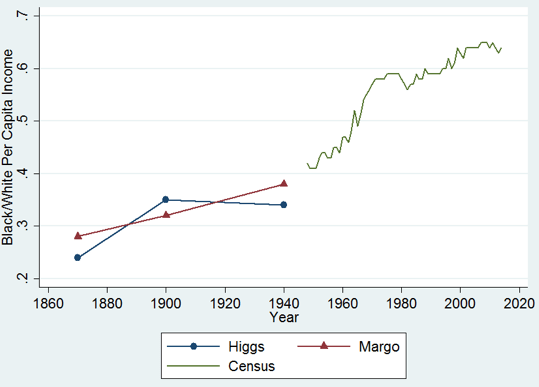
In a twitter-debate with Tariq Nasheed, I pointed out that the wages rates did converge between the 1940s and 1990s. Recently, Robert Margo of the University of Chicago extended this to per capita incomes since 1870. It is fascinating to see that there was convergence between 1870 and 1940 in spite of Jim Crow laws (it tells you how much more blacks could have achieved had the laws not existed – see notably the work of Bob Higgs on this).

income-convergece

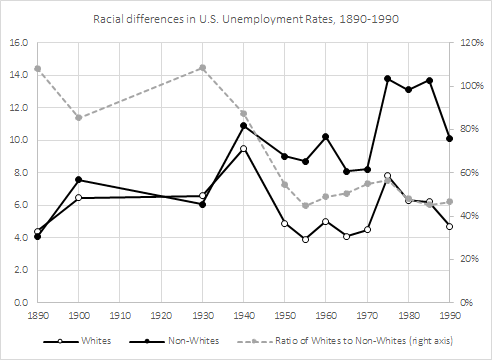
Each time I see this evidence, I am bemused. You see, I often debate colleagues on particular features of social policy in order to assess policy reforms or the effects of past reforms. But, its always good to take a step back and look at the long-view of history. It puts things in perspective. The Margo graph does just that. It tells me the story of what could have been. And just for the sake of remembering properly (infer whatever conclusions you like), it is worth showing racial differences in unemployment rates since 1890. What strikes me is how similar the rates are until the 1950s. What happened at that point? When you ask yourself this question, you’re forced to put everything in perspective. And it becomes harder to have “generic” answers in the lazy-form of “its racism”. Why would racism explain the difference after 1950, but not before?
whites

Maybe, just maybe, people like Tariq Nasheed should stop proving that H.L. Mencken was right in saying that “for every complex problem, there is an answer that is simple, clear and plainly wrong”.


Who needs a list of progressive professors?

Turning Point USA has a new list out of progressive professors. The list has already begun to be attacked as signaling the rise of a new era of McCarthyism where academics will be prosecuted for anti-American discourse.

I agree that the list should be attacked in so far that it tries to define what is acceptable discourse in academia. Academia should be a place where ideas, no matter how absurd or controversial, can be discussed and this list doesn’t help that goal.

There may be a limited place for safe places. Recently I’ve been willing to accept ‘safe places’ in those cases where individuals genuinely cannot handle certain ideas being discussed. There’s no point in, for example, attending the university’s Jewish student club and claiming that the Holocaust didn’t happen. There’s no point in going to a support meeting of transsexuals and claiming they’re going to hell. Etc etc. Emphasize on the limited though. I am willing to hold my tongue in support group settings, but that’s it.

That said the list, and the response to it, are funny in several ways.

Turning Point USA crafted the list to indicate professors who have been documented attacking conservatives. One professor barged into a Republican student and shouted profanity. I can see a point in the list if it listed only those professors who had a reputation for encouraging an environment of hostility – there is a different between being able to discuss radical ideas and yelling fire in a theater. I’m not so clear why Holocaust deniers are listed though. I don’t agree with such individuals, but if they only express the ideas I see no reason to avoid them. If Turning Point USA is serious about promoting a culture where conservative ideas can be freely discussed in academia it must be willing to protect the Holocaust deniers. Does Turning Point USA not realize the absurdity of trying to, on one hand, create a safe place for Judeo-Christian conservatives, and promoting the right of conservative ideas to be discussed in academia

What I find funny about progressives talking about the need for universities to tolerate their own ‘radical’ speech (what’s radical about wanting more government?), they themselves are intolerant to conservatives. Consider this: I’m a double minority – an illegal alien libertarian. Which of these two identities do you think is more cumbersome in academia?

After the election of Trump several members of the academic community assured me that I would be protected if need be. Yesterday the President of the University of California system released an op-ed defending the undocumented student community. Earlier today she announced that the UCs, including its police force, would refuse to cooperate with any deportation efforts.

In comparison as a libertarian I am often advised to keep quiet about my political views. At minimum I should try to avoid researching things that make it clear that I diverge from the rest of academia in political thought. Otherwise I will have a hard time getting my research published or be cut off from the social networks needed in the job market. On occasion I have found myself ostracized socially for voicing dissent on things like the minimum wage or affirmative action. I’m not alone in this.

In an ideal world I should be able to be an illegal alien, a Holocaust denier*, homosexual, and a devout Muslim** without feeling the need to suppress my view points. Academia should be a safe place for ideas no matter how radical.

Thoughts, comments?

*I’m not a Holocaust denier.
**I’m not a Muslim either.

Planned obsolescence (in parts)

In response to my post on planned obsolescence, some have pointed out that a good is composed of many different inputs. If there are differences in the quality of the different parts of a good, then it might be rational to reduce its lifespan.

That is a important possibility which I should have considered. Imagine that good 1 is composed of parts A, B and C whose lifespan are 1, 2 and 3 years. The manufacturer of good 1 will converge one the lifespan which, in relative terms, will maximize his profits. If it costs more to bring part A to the lifespan of part C than it is to bring part C to the lifespan of part A, then a lower total lifespan would be appreciable.  That decision reduces the lifespan and the marginal cost which means that a greater quantity of goods can be consumed than if we “over-engineer” by bringing A to the level of C. This point was brought to my attention by Michael Makovi, a graduate student at Texas Tech University’s department of agricultural economics. In his words:

The corporate executive types told the engineers: If one part of the product can last X years but the other part of the machine can last Y years, then under-engineer the longer-lasting parts so that the whole product uniformly lasts the lowest-common-denominator of time, so that when the product fails, the customer didn’t waste money on over-engineering other parts of the product to last longer (…) engineers balked because it seemed immoral, but the executives assured them that it was in the customer’s own best interest. For example (…) if one part of your refrigerator lasts 10 years but another part lasts 20 years, and if the 10 year part cannot be replaced, so you have to replace the whole refrigerator at once, then over-engineering the other part to last 20 years is a waste of money.

What if fake news was merely an attempt at political entrepreneurship?

Fake news! The new plague that besets mankind! That is largely the new name given to what 19th century folks would have called “yellow journalism“.

Yellow journalism was sensationalist to the point of distorting the news in order to carry a very emotional message. Generally embedded in that message was a political narrative supporting progressive reforms (not all yellow journalists were progressive but it seems that most were).

The aim of many progressives was to design a new society, to reform the old society by getting rid of old institutions. In many cases, economic historians have documented that these reforms (like with prohibition, workers compensation, antitrust) ended up serving very narrow interest groups who either allied themselves with reforming zealots (as in bootleggers helping baptists pass Sunday sales bans), gained through the restriction of competition or gained at the expense of future workers and minorities. But it is not as if the “previous” order was paradise. The postbellum era prior to the progressive era was highly protectionist, used public funds to bailout poorly performing railways and solicited the federal army to deal with natives rather than peacefully deal with them.  Basically, both eras had their political entrepreneurs who found their way in the political process to obtain favors.

Progressives who indulged in yellow journalism merely wanted to replace one set of political entrepreneurs with another. Just like the Alt-Right, from which emanates most of the fake news. In a way, both are exactly the same. Many members of the Alt-Right are not interested in restraining government abuses, they’re in favor of redirecting government indulgences towards them (Trump did promise less immigration with paid maternity leaves and no reduction in social transfers). Some are well-meaning like the baptists of lore. But there are still bootleggers (example: Steven Mnuchin from Goldman Sachs) who co-opt the process in order to continue indulging in rent-seeking just as they did before.

Are we about to swap one bad set of institutions for another? Given that all I see is the same type of political entrepreneurs (after all, Bannon from the flagship of the fake news alt-right outlet Breitbart is now a member of the government) as those we saw during the progressive era, I am inclined to respond “yes”.

On Cuba’s Fake Stats

On Monday, my piece on the use violence for public health purposes in Cuba (reducing infectious diseases through coercion at the expense of economic growth which in turn increases deaths from preventable diseases related to living standards) assumed that the statistics were correct.

They are not! How much so? A lot! 

As I mentioned on Monday, Cuban doctors face penalties for not meeting their “infant mortality” targets. As a result, they use extreme measures ranging from abortion against the mother’s will to sterilization and isolation.  They also have an incentive to lie…(pretty obvious right?)

How can they lie? By re-categorizing early neonatal (from birth to 7th day) or neonatal deaths (up to 28th day) as late fetal deaths. Early neonatal deaths and late fetal deaths are basically grouped together at “perinatal” deaths since they share the same factors. Normally, health statistics suggest that late fetal deaths and early neonatal deaths should be heavily correlated (the graph below makes everything clearer).  However late fetal deaths do not enter inside the infant mortality rates while the early neonatal deaths do enter that often-cited rate (see graph below).

Death Structures.png

Normally, the ratio of late fetal deaths to early neonatal deaths should be more or less constant across space. In the PERISTAT data (the one that best divides those deaths), most countries have a ratio of late fetal to early neonatal deaths ranging from 1.04 to 3.03. Cuba has a ratio of more than 6. This is pretty much a clear of data manipulation.

In a recent article published in Cuban Studies, Roberto Gonzales makes adjustments to create a range where the ratio would be in line with that of other countries. If it were, the infant mortality of Cuba would be between 7.45 and 11.16 per 1,000 births rather than the 5.79 per 1,000 reported by the regime – as much as 92% higher. As a result, Cuba moves from having an average infant mortality rate in the PERISTAT data to having the worst average infant mortality in that dataset – above that of most European and North American countries.

So not only is my comment from Monday very much valid, the “upside” (for a lack of a better term) I mentioned is largely overblown because doctors and politicians have an incentive to fake the numbers.

Socialism is just a new form of slavery

When Fidel Castro died he was totally alone. It doesn’t matter if relatives or friends were standing beside him: in the end, we are all alone. We experience the world through our sense of perception. Of the things themselves we have no experience. On the other hand, all humans have perception of themselves. We just know that we are. This self awareness is a fundamental aspect of what it is to be human. Castro’s death already received a lot of attention, but I believe it is a moment really worthy of reflection. Under his half-century regime millions died or suffered, and it’s always important to remember that we are talking about a little country, an island in the Caribbean. Cuba was one of the most prosperous nations in the Americas, and today it is one of the most miserable.

It is really sad to see that most of my colleagues are unable to call evil by its name. In the mid-nineteenth century Karl Marx predicted that capitalism was going to collapse because of its internal contradictions. He was not saying that he wanted capitalism to collapse. He was saying that this was a scientific fact, as sure as the next eclipse predicted by an astronomer. Capitalism, of course, didn’t collapse. Marx’s economic theory was simply nonsensical, and was contradicted by logic and facts. But Marxists couldn’t admit it. Instead they replaced economics with culture, and the working class with Others as the oppressed. Blacks, women, Native Americans, underdeveloped countries and many others became the new oppressed class. Fidel Castro fit beautifully in the Marxism of the New Left. He was the charismatic dictator of the charming island nation of Cuba. The US, ruled by leftists in the 1960s and 1970s, was unable to give a consistent answer to it. Latin America, ruled by dictatorships that the left called “right” (no one wants to take their dictators home), was also not in place to contrast the evils of the Castro regime. A perfect storm.

Castro, for all we know, died with no regrets for the evils he committed in life. Political commentators say that history will judge him. But this is a lie. History can’t judge anyone. Only people can judge people. And it is fundamental that political commentators today judge Castro for all the evil he has done. Castro didn’t kill people in Cuba only. He supported, in one way or another, brutal regimes all over the world, mostly in Latin America. To this day he is partly responsible for the evils of Foro de São Paulo. But many political commentators insist in the lie that in Cuba there’s true freedom: they have enough to eat, universal healthcare and universal education. Why would they want freedom?

Freedom is the fundamental state of human beings. We are, in the end, all alone. Of what goes in our hearts, only we are aware of. Sometimes not even us. All of us make choices based on knowledge that’s unique. Circumstances of time and space shape the choices that we make. And life is made of choices. Marxism, socialism, and all forms of statism go against these fundamental truths.

People in Cuba are not free. They are all slaves to the Castro family. Some people want to have life in a cage, as long as they receive food every day. Of course this is a lie. In order to live in a cage you need to have someone outside the cage bringing the food. Someone has to be free. This person becomes your slave as well, and this constitutes a fundamental contradiction of socialism: Alexis de Tocqueville mentioned that socialism is just a new form of slavery. In slavery someone is forced to work for somebody else under the threat of physical violence. Under socialism everybody is forced to work for everybody else. Let’s hope that Castro’s death may help put socialism in the past, where slavery is, and that Latin America may finally see the light of freedom.

Identity Politics, the Alt-Right, and Empathy in Cultural Discourse

“Identity politics” have been an intensely large obsession of the American left or the past forty or so years. Academic leftists have devoted their entire careers and even the organizations of their departments to studying notions of identity and the specific history and interests of certain identity groups—such as women’s studies, African-American studies, and other similar programs. The Democratic Party has put special emphasis on mobilizing various minority groups based on identity, focusing on “Women’s issues” such as abortion or “the needs of the African-American community” such as police reform or “gay rights” to get a certain of segment of voters to turn out in elections.

Yet, with the election of Trump, many moderate leftists are questioning the utility of identity politics. Mark Lilla had a prominent recent piece in The New York Times declaring the “end of identity liberalism.” Lilla’s main criticisms of identity politics focus on it as a “strategic mistake” in electoral politics and how it has made liberals and progressives “narcissistically unaware of conditions outside of their self-identified groups,” particularly white, middle class, working men in the Midwest. Matt Yglesias, meanwhile, responded by sounding off that all politics is identity politics, people always organize themselves in interest groups, writing that “any plausible account of political behavior by actual human beings needs to concede that politics has always been practiced largely by mobilizing people around salient aspects of group identity rather than detailed policy proposals.” The left, he says, can’t abandon identity politics because “[t]here is no other way to do politics than to do identity politics.”

Those on what is traditionally considered the “right” end of the political spectrum (ignoring the specific phenomena of Trump voters and alt-righters, that is) tend to be dismissive of the whole project of identity politics. This approach is embodied by Robby Soave’s recent article in Reason claiming that identity politics is just a form of tribalism that seeks to subvert individual rights and overall social welfare to  the tribalist demands of some salient group people self-identify with. Soave also sees the rise of Trumpism as itself a form of identity politics for white men, a claim which I’ll address at length in a moment.

What is one to make, then, of identity politics in the Trump era? First, it seems there is considerable confusion about what identity politics even is in the first place. Lilla, for an example, seems to imply that the left’s obsession with appealing to minority political coalitions is merely a strategy for winning elections. Soave thinks it’s pure tribalist and collectivist ideology, and Yglesias defines it so broadly that any political mobilization at all is considered identity politics. How are we to understand what operative definition of what is commonly called “identity politics” is most useful, or at least is closest to how its commonly used in political discourse?

Lilla and Yglesias understanding, it seems, misses the point about why so many leftists are so passionate about identity politics. People who are interested in cultural dramas and issues related to group identity are not just Democratic strategists in campaign war-rooms, but, as I mentioned earlier, academics, and “true believer” bleeding-heart progressive activists. It seems to me that identity politics—at least at first (and still is in the minds of the true believers post-1960s progressivism)—is not about an election strategy. It’s certainly become that for Democratic strategists, but it originally was motivated by the old liberal concern with ending the misery for stigmatized groups. Identity politics is not merely a political strategy, but a strategy the left used for getting rid of racism, homophobia, and otherization of outgroups in society at large.

The idea is like this: try to get, for example, white people to sympathize with black people by getting whites to recognize that black people have their own meaningful web of cultural associations which is just as valid as those of the dominant culture. Its roots are in cultural studies academia, such as the writings of Judith Butler and Nancy Fraser. Essentially, identity politics is rooted in philosophical attempts to end prejudice through emphasizing “cultural recognition” of despised groups. As Richard Rorty wrote in describing this strategy:

It helps, when trying to recognise a common humanity in a person of another gender, class, or ethnicity, to think of them as having as rich an inner life as one does oneself. To picture such an inner life, it helps to know something about the web of memories and associations which make it up. So one way to help eliminate prejudice and erase stigma is to point out that, for example, women have a history, that homosexuals take pride in belonging to the same stigmatised group as Proust, and that African-Americans have detailed memories of the battles which make up what Russell Banks calls “the three hundred year War Between The Races in America” – the sort of memories whites are currently learning about from Toni Morrison’s novels. It helps to realise that all such groups wrap a comforting blanket of memories and traditions, customs and institutions, around themselves, just as do classical scholars, old Etonians, or members of the Benevolent and Protective Order of Elks.

Thus treating identity politics just as a way to get electoral coalitions out to vote, and also (as Soave does) as simply tribalism ideology when it was started as a strategy to mitigate tribalism, misses the point about why the left is so passionate about these cultural issues. It isn’t simple collectivism nor Machiavellian political strategy, but (hopefully) genuine concern for stigmatize groups that mobilizes this obsession.

Of course, as Rorty well-recognized, this way of ending prejudice is not the only way nor is it the most effective. First, it does make the left appear as this overly sensitive “politically correct” group of elitists who care little for the concerns of working class whites. As Rorty wrote that the left’s preoccupation with cultural identity politics would mean “the straight white male working class in America may find it tempting to think that the leftist academy is uninterested in its problems.” Indeed, most of why Lilla is concerned that identity politics has failed so spectacularly as an electoral strategy is that it has isolated progressives from middle America.

More importantly, however, is that emphasizing cultural difference has failed spectacularly at its initial aim of ending prejudice. The whole point of Soave’s Reason column is that leftist identity politics has become its own form of tribalism and have given rise to the right-wing identity politics of Trump. Not only have leftists often gotten so caught up in the identity politics language game that they call their own (such as Bernie Sanders) white supremacists for not playing along, it has created its own prejudice backlash. If your way of getting straight white males to recognize non-straight white males as worthy of equal treatment is to say “Those who are unlike you have different cultural values that are worth being celebrated and protected,” the response of straight white males is to say “Do not I also have a different culture worthy of being celebrated and protected?”

Indeed, this type of rhetoric is at the heart of the rise of the alt-right. It isn’t mere hatred of others that is animating this new populist, fascist movement (though that is certainly a concerningly large part of it), it is that they are making this hatred seem legitimate by couching it in terms of advancing “white interests” in a very similar rhetorical manner that the left has pushed the interests of minority groups. Richard Spencer’s “mantra” for the alt-right is “race is the foundation of identity” (emphasis mine) and calls himself an “identarian.” Even outside the small niche of the alt-right, average Trump voters often say they want a way to express and defend their identity—whether it is in the form of white nationalism or in forms of defending Christian “religious liberties” as its own identity coalition against gay rights.

Soave is correct that left-wing identity politics has given us this right-wing identity politics, and it is something Rorty himself saw as a potential consequence of this approach. In his 1998 book Achieving our Country, he explicitly predicted that the white working class would become disconnected from the academic left, and would “start looking around for a strongman to vote for—someone willing to assure them that, once he is elected, the smug bureaucrats, tricky lawyers, overpaid bond salesmen, and postmodernist professors will no longer be calling the shots[.]” He also predicted that when this strongman assumes office, “gains made over the past forty years by black and brown Americans, and by homosexuals, will be wiped out.” It is no coincidence that this sounds quite a bit like Trump.

It’s not surprising that emphasizing differences between the majority and a scapegoated group would mean that the majority group would start taking “pride” in its difference from the scapegoated. Of course, anyone who understands systemic power structures or how sociological hierarchy works understands why this response is not the same. There is a difference between cherishing the cultural differences of a scapegoated minority and using institutional power to coercively protect the cultural interests of the majority group at the expense of the minority. But you can’t expect a white adolescent basement-dwelling troll on 4-Chan or even a working class white voter from central Michigan to understand and fully internalize that difference, and they are likely to be very reluctant or overtly hostile to acknowledging it. All the alt-right has done is take identity politics and turn it against its original aim to advance the exact tribalism leftists have been trying to use identity politics to end.

A better strategy the left could have used was the strategy the old left used through classical feminism, abolitionism, the sixties Civil Rights movement, or some new progressives through the more pop-culture current of the gay rights movement. Rorty describes it beautifully:

Another way is to get the prejudiced to see the stigmatised as having the same tendency to bleed when pricked as they themselves: they too worry about their children and parents; they are possessed by the same self-doubts, and lose self-confidence when humiliated; their difficulties in moving from one stage of life to another are much like everyone else’s, despite the fact that their life-chances may be minimal. These ways of emphasising commonality rather than difference have little to do with “cultural recognition.” They have to do with experiences shared by members of all cultures and all historical epochs, and which remain pretty much the same despite cultural change.

There’s no real way for bigots to co-opt this approach to advance their bigotry. In fact, it explicitly avoids framing the discussion not as some necessary “culture war” between an oppressive majority and an oppressed minority as current identity politics rhetoric implies and alt-right identitarians have assumed as their rallying cry. Instead, it emphasizes the need to end culture wars in the first place by progressing people’s sentiments to stand in solidarity with an ever-growing chunk of humanity—it seeks to replace simple identity with empathy.

Is this approach still in the vein of “identity politics” as we currently understand it? If we take Yglesias’ understanding, sure it still “concede[s] that politics has always been practiced largely by mobilizing people around salient aspects of group identity,” but it seeks to make salient aspects of group identity as banal as possible, to make people stand in solidarity based off empathy for everyone’s common human shortcomings rather than based off who they happen to be culturally similar to, to make one’s ingroup as inclusive as impossible. It certainly isn’t tribalist or collectivist as Soave is concerned. Though it still recognizes diversity as important, Rorty still explicitly says that we should see this diversity “as a diversity of self-creating individuals, rather than a diversity of cultures[.]” This liberal (and classical liberal as I see it as drawing off of Hume, Smith, and Mill more than anything) vision is one that is both pluralistic and individualistic.

Is this, however, a winning electoral strategy, as Lilla is concerned? I’m not sure. Tribalist urges of racism are certainly very powerfully woven into how humans have psychologically evolved, and perhaps in our current broken discourse of race relations it isn’t the best electoral strategy. There is, however, some reason for optimism; popular support for gay rights is at an all-time high, after all, and this was probably more a function of the victory of emphasizing the similarity of love between gays to that of straights then getting straight allies to march in gay pride parades. Regardless of electoral outcomes, shouldn’t the goal of civil discourse not be to win elections, but to ensure the most just, peaceful, and prosperous civil society—the zero-sum game of coercive politics be damned? Leftists should try to change the current broken discourse, rather than try to work within it to gain political power.
The ugliness of international politics

What has been widely feared is about the happen, it seems. President Assad’s troops, supported by the Russians, are winning the battle over Aleppo. That is not great from a lot of perspectives. To name just a few: first of all for the civilians, who are killed and bombed continuously. Secondly, the crushing of the rebel forces there means the further weakening of what are ‘natural’ allies of the West, as they are against Assad and against ISIS. Thirdly, this victory (if it all continues this way, of course) strengthens Assad’s position, making it even more unlikely that he will disappear from the scene anytime soon. The only good thing seems to be the further weakening of ISIS.

Like many others, I do not like this development at all. I think Assad is a ruthless murderer of his own people and should therefore be taken to justice, preferably in its most definitive form. I wish the Syrian people all the best and would like them to decide over their own fate in liberty. I also deeply hate ISIS and all that it stands for. And the interference of foreign powers (either Russian, Turkish, Iranian, Western) certainly does not do much good either, although I also think it has been inevitable. Public opinion, perceived and real interests, and the defence of allies all foster these kind of interventions. These are of course just a few of the important variables in an enormously complex war.

So what to do, or aim for, as Western countries? Obviously, most Syrians are better off in a stable situation without war, than with any currently viable alternative. This means that negotiations about cease fires should commence, or at least be fostered, which will then hopefully lead to a permanent settlement. I do not dare to predict how long it will take for this approach to be successful. Yet any alternative is worse. These negotiations, whenever feasible, should have all parties at the table, Assad included. No vetoes against him being part of future talks, as has previously been the case. The man will stay around for a while, and we better get used to the idea. This is surely deplorable, yet inevitable. The situation in Syria shows once again the ugliness of international politics, with very limited roles for international law and justice.

Let it be a lesson for those within the liberal tradition who still think differently.

Is planned obsolescence a good thing?

There is this recurring argument that goods don’t last as long today as they did fifty years ago. My father berated me a few months ago about my economics by saying that back in his time, goods lasted longer. I questioned his data (there are signs that goods last as long as they did twenty or thirty years ago). This new ATTN video on Repair Cafes would have caused my father to rejoice greatly. However, I am going to ask a question here and go a step further: is planned obsolescence the symptom of a good thing?

Here is my argument (feel free to throw rocks after).

Improving the lifespan of a good requires a greater level of inputs which increases the marginal costs of the good. Producing a higher-quality good basically shifts the supply curve leftwards. Basically, we pay a little more for something that lasts longer. However, if we are living in a world of rapid technological innovation, what is the point of expending more resources on a good with a twenty-year lifespan but which will be obsolete two years?

Take my previous iPhone – it lasted three years before it simply decided to not work. In the three years between my old phone and my new phone, there was a rapid change in quality: more memory, better camera, faster processing, better sound. Imagine that Apple had invested billions to increase the life of my iPhone from three to nine years. Would I have bought that phone? In all honesty, it would depend on the price increase but the answer would have been closer to “no” than to “yes”. So in a way, Apple reaches a marginal consumer like me by lowering the price and turns me into a technology adopter. However, let’s imagine this from Apple’s perspective. Its in a race for its life against competitors who keep inventing new widgets and features that change the manner in which we consume. So, its choice is the following:

A: Increase lifespan, higher marginal costs and a leftward shift of supply that causes slightly higher prices and less demand. These resources cannot be expended on R&D and innovation
B: Shorten lifespan, lower marginal costs, lower prices, more goods consumed; more resources on R&D and innovation.

If everyone is inventing rapidly, then B is the dominant strategy. If innovation is zero, A is the dominant strategy. Basically, in a Schumpeterian world like I am describing, the short lifespan of goods is a symptom of great innovations and better days to come.

What do you think?


The Homo Economicus is “The Body” of the Agent

The model of the decision-making agent known as homo economicus is a trivial truth, but not a misconception. All agents are supposed to maximize the utility of their resources – that is true in every geography and in every age. But because it is a tautology, it is a mistake to give to the deductions brought about from this sole model the value of a description of a particular reality. As Wittgenstein had pointed out in his Tractatus, the tautologies do not convey any relevant information of any particular world, but of every possible world. The error consists on qualifying a common note to every possible situation as a distinctive characteristic of a particular set of events. To say that every agent acts to maximize his utility is true, but to state that this observation tells us something of a particular world that distinguishes it from every other possible world is the most extended misconception about the use of the model of the rational agent.

In another post, I mentioned the importance of having a body in order to develop a personal identity. In the same line as Hayek’s Sensory Order, the body enables us with the most elementary system of classification that makes our perceptions possible, or – to express it in a more radical empiricist strain – that brings the experience to happen. Upon this system of classification will sediment more abstract layers, or degrees, of systems of classification. Our knowledge is expressed at a level of abstraction that our mind can handle, whereas the law, the market, and the language are examples of phenomena that might achieve increasing degrees of complexity that mark blurred boundaries to our knowledge. The former are named “simple phenomena” and the latter “complex phenomena” in the Hayekian terminology. Our personal identity is continuously developing on that stratus set between the simple and the complex phenomena.

In this sense, we need the conclusions brought about by the rational agent model as the stem upon which lay further strata of increasingly complex analysis. Paradoxically, the more particular the social reality we seek to describe, the more abstract has to be our layer of analysis. Notwithstanding, it would be impossible to us to conceive any image of the social experience if we lack of the fixed point of the rational agent model.

Max Weber’s ideal types could be interpreted as instances of social arrangements based on the rational agent model, which incorporate particular – and abstract – characteristics depending on the historical circumstances under scrutiny. At the bottom of both adventurous capitalism and traditional society, beneath successive strata of different social and institutional designs, we will find an agent who maximizes utility. Perhaps that is why the term “rational capitalism” is so controversial. If rationality concerns subjective reason, then rational capitalism encloses a circular definition.

In this line of ideas, I hope this quick reflection might shed some light upon the old discussion about instrumental rationality and substantive reason. Since the instrumental rationality is common to every possible world, we might look for the substantive reason that gives order to this actual world in the increasing layers of complexity that reach degrees of abstraction that are superior to the subjective reason. Although that does not mean that we will ever be able to find it.

Castro: Coercing Cubans into Health

On Black Friday, one of the few remaining tyrants in the world passed away (see the great spread of democracy in the world since 1988). Fidel Castro is a man that I will not mourn nor will I celebrate his passing. What I mourn are the lives he destroyed, the men and women he impoverished, the dreams he crushed and the suffering he inflicted on the innocents. When I state this feeling to others, I am told that he improved life expectancy in Cuba and reduced infant mortality.

To which I reply: why are you proving my point?

The reality that few people understand is that even poor countries can easily reduce mortality with the use of coercive measures available to a centralized dictatorship. There are many diseases (like smallpox) that spread because individuals have a hard time coordinating their actions and cannot prevent free riders (if 90% of people get vaccinated, the 10% remaining gets the protection without having to endure the cost). This type of disease is very easy to fight for a state: force people to get vaccinated.

However, there is a tradeoff to this. The type of institutions that can use violence so cheaply and so efficiently is also the type of institutions that has a hard time creating economic growth and development. Countries with “unfree” institutions are generally poor and grow slowly. Thus, these countries can fight some diseases efficiently (like smallpox and yellow fever), but not other diseases that are related to individual well-being (i.e. poverty diseases). This implies that you get unfree institutions and low rates of epidemics but high levels of poverty and high rates of mortality from tuberculosis, diarrhea, typhoid fever, heart diseases, nephritis.

This argument is basically the argument of Werner Troesken in his great book, The Pox of Liberty.  How does it apply to Cuba?

First of all, by 1959, Cuba was already in the top of development indexes for the Americas – a very rich and healthy place by Latin American standards. A large part of the high levels of health indicators were actually the result of coercion. Cuba actually got its very low levels of mortality as a result of the Spanish-American war when the island was occupied by American invaders. They fought yellow fever and other diseases with impressive levels of violence. As Troesken mentions, the rate of mortality fell dramatically in Cuba as a result of this coercion.

Upon taking power in 1959, Castro did exactly the same thing as the Americans. From a public choice perspective, he needed something to shore up support.  His policies were not geared towards wealth creation, but they were geared towards the efficient use of violence. As Linda Whiteford and Laurence Branch point out, personal choices are heavily controlled in Cuba in order to achieve these outcomes. Heavy restrictions exist on what Cubans can eat, drink and do. When pregnancies are deemed risky, doctors have to coerce women to undergo abortion in spite of their wishes. Some women are incarcerated in the Casas de Maternidad in spite of their wishes. On top of this, forced sterilization in some cases are an actually documented policy tool.   These restrictions do reduce mortality, but they feel like a heavy price for the people. On the other hand, the Castrist regime did get something to brag about and it got international support.

However, when you look at the other side of the tradeoff, you see that death rates from “poverty diseases” don’t seem to have dropped (while they did elsewhere in Latin America).  In fact, there are signs that the aggregate infant mortality rates of many other Latin Americans countries collapsed toward the low-levels seen in Cuba when Castro took over in 1959  (here too). Moreover, the crude mortality rate is increasing while infant mortality is decreasing (which is a strong indictment about how much shorter adult lives are in Cuba).

So, yes, Cuba has been very good at reducing mortality from communicable diseases and choice-based outcomes (like how to give birth) that can be reduced by the extreme use of violence. The cost of that use of violence is a low level of development that allows preventable diseases and poverty diseases to remain rampant. Hardly something to celebrate!

Finally, it is also worth pointing two other facts. First of all, economic growth in Cuba has taken place since the 1990s (after decades of stagnation in absolute terms and decline in relative terms). This is the result of the very modest forms of liberalization that were adopted by the Cuban dictatorship as a result of the end of Soviet subsidies. Thus, what little improvements we can see can be largely attributed to those. Secondly, the level of living standards prior to 1990 was largely boosted by the Soviet subsidies but we can doubt how much of it actually went into the hands of the population given that Fidel Castro is worth 900$ million according to Forbes. Thus, yes, Cubans did remain dirt poor during Castro’s reign up to 1990. Thirdly, doctors are penalized for “not meeting quotas” and thus they do lie about the statistics. One thing that is done by the regime is to categorize “infant deaths” as “late fetal deaths” – its basically extending the definition in order to conceal a poorer performance.

Overall, there is nothing to celebrate about Castro’s dictatorship. What some do celebrate is something that was a deliberate political action on the part of Castro to gain support and it came at the cost of personal freedom and higher deaths from preventable diseases and poverty diseases.

H/T : The great (and French-speaking – which is a plus in my eyes because there is so much unexploited content in French) Pseudoerasmus gave me many ideas – see his great discussion here.

England circa 1700: low-wage or high-wage

A few months ago, I discussed the work of my friend (and fellow LSE graduate) Judy Stephenson on the “high-wage economy” of England during the 18th century. The high-wage argument basically states that high wages relative to capital incite management to find new techniques of production and that, as a result, the industrial revolution could be initiated. Its a crude summary (I am not doing it justice here), but its roughly accurate.

In her work, Judy basically indicated that the “high-wage economy” observed in the data was a statistical artifact. The wage rates historians have been using are not wage rates, they’re contract rates that include an overhead for contractors who hired the works. The wage rates were below the contract rates in an amplitude sufficient to damage the high-wage narrative.

A few days ago, Jane Humphries (who has been a great inspiration for Judy and whose work I have been discretely following for years) and Jacob Weisdorf came out with a new working paper on the issue that have reinforced my skepticism of the wages regarding England. A crude summary of Humphries and Weisdorf’s paper goes as such: preindustrial labor markets had search costs, workers were willing to sacrifice on the daily wage rate (lower w) in order to obtain steady employment (greater L) and thus the proper variable of interest is the wage paid on annual contracts.

While their results do not affect England’s relative position (it only affects the trend of living standards in England), it shows that there are flaws in the data. These flaws should give us pause before proposing a strong theory like the “high-wage economy” argument. Taken together, the work of Stephenson (whom I am told is officially forthcoming), Humphries and Weisdorf show the importance of doing data work as the new data may overturn some key pieces of research (maybe, I am not sure, there is some stuff worth testing).

Adios a Fidel

It was so romantic when those truckfuls of young men with beards took over the cesspool of Havana on New Year’s Eve (a scene immortalized in The Godfather Two). They were bringing freedom and relief from poverty to the beleaguered people of Cuba who had suffered under American imperialism for more than sixty years.

When his main acolyte was through shooting a few hundred political opponents – which took weeks – the business of revolutionary construction began in earnest. Soon, the Revolution had to face an invasion from disgruntled sons of the exiled Cuban upper-class. The invasion was roundly betrayed by the fabled Pres. John F. Kennedy. After that, the Revolution found extravagant financial support from the Soviet Union, a poor country itself but a large one.

Later, the leader of the Cuban Revolution tried to get the US nuked by his big Russian brother. That cool leader must have had his reasons, I am sure.

The stubbornness of opponents (“worms”) was so great that the Revolution was forced to jail a few thousand of them, including poets (along with thousands of men whose crime was homosexuality). Other obdurate traitors to the Revolution left Cuba on balsa rafts and on rafts made with old barrels. Many drowned at sea. Their choice! After a while, one Cuban in five was living abroad, away from the workers’ paradise.

The Revolution triumphed in the fields of education and public health. Nowadays, Cubans’ level of literacy is a high as that of other Latin American countries. Although it’s not really free, the Cuban public health service is pretty good, what with its separate public-public sector and its sector for Communist Party members only, the two equal to each other, of course.

When the first leader became too old, somehow, the best revolutionary found to succeed him was his little brother, as happened in other people’s democracies such as North Korea.

In the meantime, there had been several military adventures, all in tropical countries where even ordinary Cuban privates could afford bananas for once. That they did not win anywhere was not their fault. One prominent general even had to be shot by the leadership because he was dealing drugs. His trial lasted a whole week.

Today, after fifty years, progress is so great that ordinary Cubans easily earn forty or fifty dollars a month. Many earn three times more by renting their bedroom to foreign visitors. Take university professors and medical doctors. They can always make much more than fifty a month by driving a taxi. And meat is now available six days a month instead of the customary four. You can’t argue with this!

As Westerners, we must be especially grateful that the Cuban Revolution has made the island into one of the best destinations for sex tourism in the world.

Yes, Fidel was really, really cool and we will all miss him. He was our youth. He embarked on a great experiment in human happiness. That it failed is not his fault at all. Nobody is perfect. At least, his long life of power and influence has had the great merit of showing what happens to Communist take-overs in the long run, when no external factor puts a precocious end to them.

PS To this day, many Cubans and an embarrassing number of western leftists believe that the Cubans’ poverty is mainly due to the US BLOCKADE of the island. Well folks, there was a blockade, in the early sixties. It lasted two weeks (fourteen or fifteen days). Since then, there has been an American economic embargo on Cuba. It means that Americans cannot buy from or sell most items to Cuban economic actors. Cubans could always buy anything from and sell anything to anyone else in the whole wide world, including our Canadian cousins who have everything we have. We are talking here of a fifty year-old grand lie. You had to be cool, like Fidel and his little brother to pull it off!