Review of Claire Conner’s Wrapped in the Flag

I recently posted a review at Amazon of Claire Conner’s Wrapped in the Flag: A Personal History of America’s Radical Right. (The paperback edition changed the subtitle to What I Learned Growing Up in America’s Radical Right, How I Escaped, and Why My Story Matters Today.) The review begins below. It unfortunately is buried within a stack of over a hundred favorable reviews at Amazon. But anyone who wants to read the review there can go here. Then if you find it worthy, you can click the button that says the review is helpful and move it up in the queue:

I thoroughly enjoyed this book despite myself. The author, Claire Conner, entertainingly interweaves a personal story of her growing up with parents who were avid and prominent members of the John Birch Society with a history of the Birch Society itself. I am only four years younger than Conner, and my own story has many intriguing parallels to hers. My parents never joined “the Society,” as its members referred to it, but they (particularly my mother) became what could be called Birch Society “fellow travelers,” involved in right-wing politics after the election of 1960. Many of their friends were Society members. I therefore imbibed much of the same literature as Conner, listened to similar public lectures, and was taken to and participated in similar events. She and I both, for example, were peripherally involved in the 1964 Goldwater campaign.

Our similar backgrounds even influenced both Conner’s and my choices of college. In her case, she was required by her parents to attend the Catholic University of Dallas, at a time when Willmoore Kendall (who had previously been one of Bill Buckley’s mentors at Yale) was teaching there. I chose to attend the Presbyterian Grove City College, studying economics under Hans Sennholz (who wrote for the Society’s magazine, American Opinion, for a span of years) and history under Clarence Carson (a frequent contributor to the Foundation for Economic Education’s Freeman). Finally, she and I eventually grew up to reject the Society’s conspiratorial worldview.

But there the similarities end. I drifted from conservatism to libertarianism, whereas Conner became a leftwing, progressive activist. Her narrative is filled with many fascinating tidbits and anecdotes about Birch Society activities and luminaries. But unlike me, she had parents who were domineering and dogmatic to the point of being abusive. Thus, she is unable to separate fully her wrenching childhood from the ideas and opinions of those she generally identifies as right wing. While there is always a note of tenderness in her writing about her parents, their fanatical harshness becomes the template for her damning of not only all Birchers but also most conservatives and even libertarians.

This makes her utterly oblivious to the extent to which she is still trapped in a conspiratorial worldview, but one of the Left rather than of the Right. She has graduated from her parents’ belief that America was threatened by a giant left-wing conspiracy, in which every liberal was either a Communist or a Communist fellow-traveler to a belief that America is threatened by a giant radical-right conspiracy, stretching from the 1950s to the present. She lumps together with the Birch Society in this gigantic, ongoing, and diffuse conspiracy such disparate individuals and organizations as Bill Buckley and his conservative National Review; politicians such as Barry Goldwater, George Wallace, and Ronald Reagan; Ayn Rand and her Objectivist followers; the libertarian Cato Institute; the modern Tea Party; and white supremacists of the Klan.

To support this portrayal, Conner engages in the same kind of guilt by association that Birchers employed to charge, for instance, that Martin Luther King was a secret Soviet agent. Thus, the fact that Fred Koch, the father of Charles and David, was a founding Council member of the Birch Society (who ultimately left because of opposition to the Vietnam War) implicates every person and organization associated with him and his sons. Although she honestly reports that Buckley eventually denounced the Birch Society, this cuts no ice for her. She recognizes no significant difference between the racist, anti-Semitic Revilo Oliver (kicked out of the Birch Society for those very reasons), who became virulently anti-Christian, and Jerry Falwell’s Christian Moral Majority, which was unabashedly pro-Israel. Indeed, nearly anyone who thinks that government has become too intrusive and extensive is somehow involved, wittingly or unwittingly. Most disgraceful and bizarre of all, the book’s introduction slyly tries to insinuate that the radical right somehow contributed to the Kennedy assassination, yet while fully accepting that Lee Harvey Oswald was actually the assassin as well as a Communist.

An occasional, slight acknowledgment that her parents or others she wishes to expose were correct about a few things slips into Conner’s story. Thus, only in a footnote to her memories about her parents indoctrinating her in the 1960s about how “the ultimate fiend was Mao Zedong” (p. 43), worse than Hitler, does she concede, “My parents were right about Mao” (p. 225). Late in the book she admits “I never would have guessed, not in a hundred years, that the John Birch Society would be as critical of President Bush and the fiasco in Iraq as I was” (p. 212). But none of this can soften her blanket denunciation of everything her parents advocated or embraced. As stated above, there is much fascinating historical detail in this readable book. With a little more nuance, balance, and objectivity, it could have been far more compelling and credible. Conner’s account of how her parents mistreated her, in particular, is in many places heartbreaking. Which makes it all the more sad that her scarred upbringing has turned her political landscape into the exact mirror image of that of her parents.


California Times Six

I live in California. It’s a great state. Too great.

A proposition to split California into six states may be on the ballot in 2016. “Six Californias” has announced that it has collected sufficient signatures. Why six? California’s population of over 38 million is six times lager than the US state average. The ruling powers may find a way to block the proposal, as some opponents claim that the signature gathering was unlawful. If “Six Californias” does get on the 2016 ballot, in my judgment, this will be a rare chance for fundamental reforms.

Many Californians have said that the state is too big to govern effectively. But the governance problem is not size, but structure. After the property-tax limiting Proposition 13 was adopted in 1978, taxes and political power shifted from the counties and cities to the state government. California could be governed well if decentralized, but the concentration of fiscal power to the state has made the state among the highest taxed and worst regulated in the USA.

There have been many attempts to reform the lengthy California constitution, but they have all failed. Attempts to replace the Proposition 13 have gone nowhere. The best option is to start over. Creating new states would provide six fresh starts.

Critics of the six-state plan say that the wealth of the new Californias would be unequal. The Silicon Valley state would include the high-tech wealthy counties of San Francisco, San Mateo, and Santa Clara, among others. The promoter of this initiative, Timothy Drapers, happens to be a Silicon Valley entrepreneur.

But the current 50 US states are also unequal in wealth. The income inequality problem is a national and global problem. Income can become more equal without hurting production by collecting the land rent and distributing it equally among the population. Since the critics of Six Californias are not proposing or even discussing this most effective way to equalize income, their complaints should be dismissed as irrelevant, immaterial, and incompetent.

US states have been split in the past. Maine was split off from Massachusetts in 1820, and West Virginia was carved out of Virginia in 1863.

If the initiative passes, a board of commissioners would draw up a plan to divide the state’s assets and liabilities among the six new states. A good way to do this would be to divide the value of the assets by population, but to divide the liabilities (including both the official debt and the unfunded liabilities such as promised pensions) by the wealth of each state. That would go a ways to deal with the inequality problem.

California’s complex water rights could be simplified by eliminating subsidies, instead charging all users the market price of water. There could continue to be a unified water system with a water commission with representatives from the six state.

If this measure is approved by the voters and by Congress, each state will design a constitution. The new constitutions should be brief, like the US Constitution, in contrast to the lengthy current California constitution that contains many provisions best left to statute law.

The new constitutions should retain the declaration of rights in the current state constitution, including Article I, Section 24: “This declaration of rights may not be construed to impair or deny others retained by the people.” This wording, similar to the US 9th Amendment, recognizes the existence of natural and common-law rights. This text should be strengthened with something like this: “These rights of the people include the natural right to do anything which does not coercively invade the properties and bodies of others, notwithstanding any state interest or police power.”

These new constitutions will be an opportunity to replace California’s market-hampering tax system with economy-enhancing levies on pollution and land value. There should be a parallel initiative stating that if Six Californias passes, the states will collect all the land rent within their jurisdictions and distribute the rent to all six states based on their populations. A tax on land value is by itself market enhancing, better than neutral, because it promotes an efficient use of land, it reduces housing costs for lower-income folks, and eliminates real-estate bubbles. Combined with the elimination of taxes on wages, business profits, and goods, the prosperity tax shift would raise wages and make California the best place in the world for labor and business.

This is all a dream, but the past dreams of abolishing slavery, having equal rights for women, and eliminating forced segregation all came true. This proposition will at least provide a platform for discussing such fundamental reforms.
—————————————-
This article was first published at http://www.progress.org/views/editorials/california-times-six/

Secession and international alliances go together

It is important to scrutinize the intellectual strength of libertarian ideas about international relations. Here are a few – admittedly only partly systematic- thoughts about the relation between secession and international relations. Or more precise: some libertarians are positive about secession, yet at the same time negative about international alliances. How does that relate?

Pleas for secession can be found in the works of Von Mises, Rothbard, Hoppe and other luminaries of libertarian thought, broadly defined. In an informative chapter on the issue, Mises-biographer Jörg Guido Hüllsman (at mises.org) defined secession as the ‘one-sided disruption of (hegemonic) bonds with a larger organized whole to which the secessionists have been tied’. Recent examples are the bloody secessions of South Sudan or Eritrea. Yet the issue also remains topical in Western Europe, for example in Scotland. It is not my purpose to emphasize the practical failures and wars associated with secession. From a libertarian perspective the principal benefit of secession is that a group of sovereign individuals decide for themselves how and by whom they are governed, and in which type of regime this shall happen. So far, no problem.

Let’s assume a world where secessions take place freely, peacefully and more frequent than in the past twenty-five years, where the number of sovereign states just went up by approximately twenty recognized independent countries. The logical result will be the fragmentation of the world in numerous smaller states, or state-like entities, of different sizes, composed of different groups of people. Perhaps some of these states will comply to an anarcho-capitalist libertarian ideal, so with a strict respect for property rights and the use of military defense only for clear-cut violations of these rights by others. However, it is unlikely that all states will be characterized in this way. Consequently, there remain a lot of causes for international conflict and war. For example, as there are more borders, there are also potentially more border disputes, about natural resources, water, stretches of land, et cetera. Of course humans are not angels, and no libertarian ever claims they will be. It simply means none of the other causes of war are perpetually eradicated in a world of free secession either.

So how to defend oneself in such situation, particularly when your state is much smaller than one or more other states in the vicinity? In such a situation you are unable to defend yourself against the most viable threats. Even if you declare yourself a neutral state it is unlikely this will always be respected. After all, it takes at least two to tango in international politics. Of the many possibilities to defend your property rights and sovereignty, the negotiation of agreements with other countries, or joining an international alliance seems logical and potentially beneficial (of course depending on the precise terms). It would amount to a system of multiple balances of power around the globe, very much like for example former Cato Institute scholar Ted Galen Carpenter favored for the current world. Surely, this would not be ideal, and would not be able to eradicate war either. Yet it will prevent many wars and safeguard the liberties and property rights of the participants.

This differs significantly from the pleas by people who simultaneously favor secession while calling for a non-interventionist foreign policy without alliances, such as Rothbard, Ron Paul (see for example in a column), or many contributors on www.lewrockwell.com.

Admittedly, most of these anti-alliance commentaries are directed against particular parts of current US foreign policy. However, it is still fair to demand theoretical consistency. Either these writers overlook there might be an problem, or they choose to ignore it. Still it is important to acknowledge there is an issue here. It is too simple to reject international alliances while embracing secession at the same time.

Into the ear of every anarchist that sleeps but doesn’t dream…

We must sing, We must sing,We must sing…


There is no libertarian art.

Well, that is a slight exaggeration, but not much of one. Art is a vital part to any social movement and it is one area where libertarians suffer immensely. Sure there are libertarian leaning authors such as Robert Heinlein and modern Austrian economic art like the guys over at www.econstories.tv but for the most part there are few non-academic ways to inspire potential libertarians.

This is a problem I lament when I am feeling negative about the prospects for a free society which, to be fair, is usually the case. Sometimes reading an article about Intellectual Property just isn’t enough to get the passion flowing.

“But Wait!” You say, “you failed to mention the author who brought tens of thousands of people into the libertarian fold. The late, the great, the Ayn Rand!”


….yea about that.


I don’t like Ayn Rand. There, I said it. Bring out the pitchforks and tie me to a Rearden Steel railroad track if you must but I stand by my statement. Now I know what you are all thinking: “But her works exemplify the individual freedoms that a libertarian society should strive for!” or “Dagny is a strong independent woman who don’t need no government!”

Yes, I am aware, but it isn’t Ayn Rand the author I dislike. Actually it isn’t even Ayn Rand the person that I dislike. I don’t like the idea of Ayn Rand. The metaphysical zeitgeist that surrounds and worships her throughout every circle of the libertarian movement from Walter Block to Milton Friedman to every other subscriber on www.reddit.com/r/libertarian.

All too often I have had to argue about libertarianism through the lens of someone whose only exposure to the philosophy is Ayn Rand and the objectivist selfishness that nearly everyone associates with capitalism. In short, I think she is bad for libertarianism and provides no end of ammunition that can be used against those of us with a more nuanced moral/ethical position.

Here is the kicker though. I have not read a single Ayn Rand novel. Not Anthem, not the Fountainhead, and especially not her magnum opus Atlas Shrugged. My knowledge of her works (outside of objectivist philosophy) comes mostly through a bit of osmosis during many diatribes in my conversion to libertarian thought and the first few chapters of Anthem I read in high school before being bored to tears.

I feel that my lack of personal experience with the work of Ayn Rand is a great injustice to someone so influential to many (but certainly not all) of the ideals that I hold so dear and maybe, just maybe, I can siphon off some of the passion that so many others feel when reading her novels.

So it is my objective to spend the next several weeks (months perhaps) reading Atlas Shrugged along with you, the faithful readers here at www.notesonliberty.com, and recording chapter based summaries of my thoughts, opinions, and analysis from a literary, ethical, and philosophical standpoint. These will be full of personal anecdotes and armchair analysis so be prepared for a tumultuous ride through one of the “great?” works of the 20th century.

Part one of many comes tomorrow morning.

The Origin of Expression “Nazi” and How it was Introduced into English Usage

My hearty greetings to the Notes on Liberty “tribe” and special thanks to Brandon for inviting me to become part of this forum. I would like to share with you my side project that recently mutated into an article submitted to Independent Review. Last June, I was doing research in Vienna, Austria, working on a totally different topic (Mongol-Tibetan religious prophecies (Shambhala and the like) and their perceptions by Westerners). Taking advantage of my stay in that gorgeous city, in my spare time, I visited local museums and various prominent landmarks.

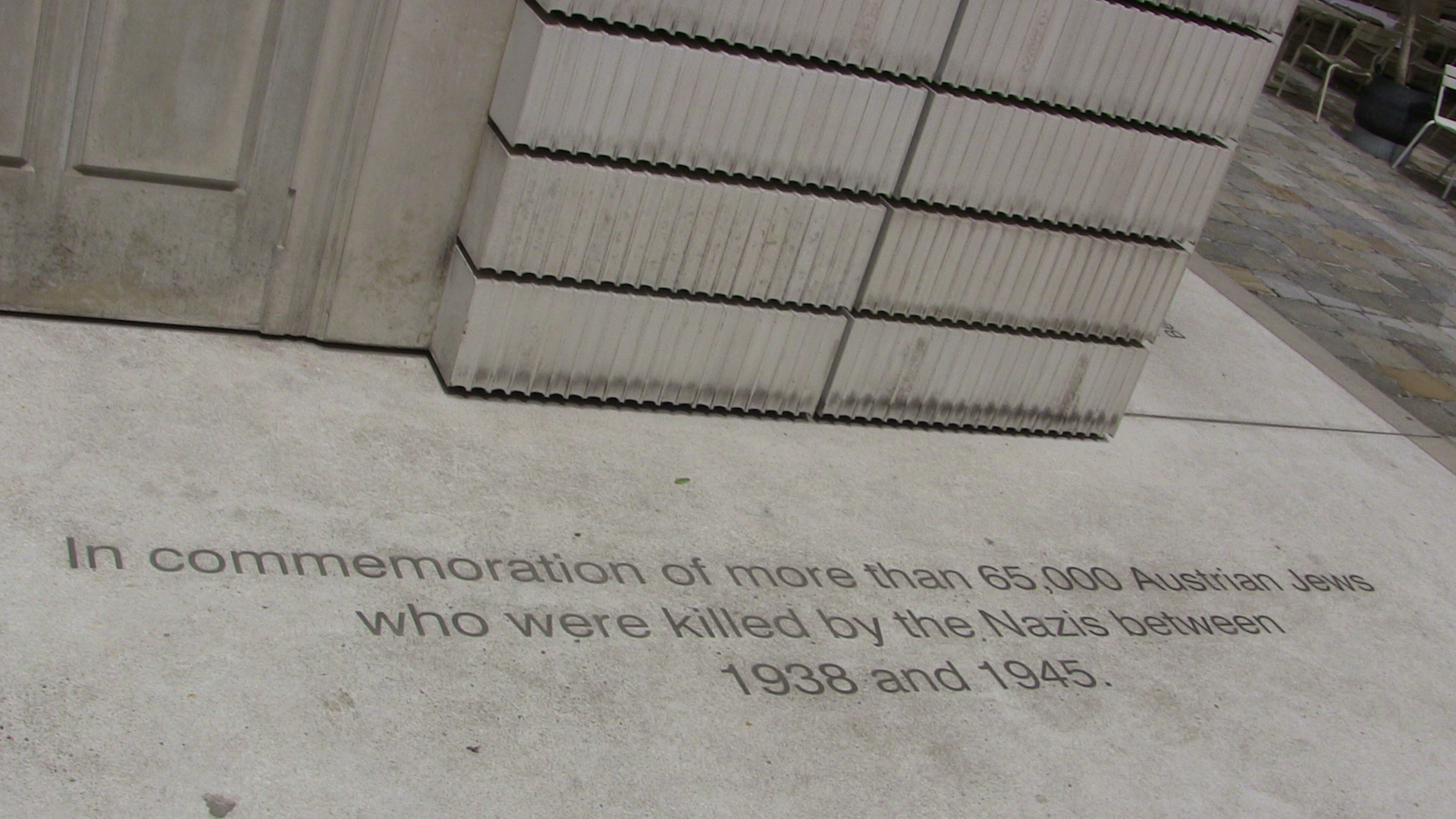
Thus, I strolled into so-called Jewish Plaza in downtown Vienna. The place has a monument that commemorates the memory of 65,000 Austrian Jews murdered by Hitler’s regime during World War II. In fact, I briefly visited this place earlier during one of my previous trips to Vienna. Yet, now looking at three identical inscriptions in three languages at the foundation of the monument I noticed something that earlier had not caught my attention. The inscription on the left is in German, the one on the right is in English, and the one in the middle is in Hebrew. The German one says, “In commemoration of more than 65,000 Austrian Jews who were killed by the National Socialists between 1938 and 1945.” So does the Hebrew one in the middle. Yet, the English version reads: “In commemoration of more than 65,000 Austrian Jews who were killed by the Nazis between 1938 and 1945.”

IMG_0687

IMG_0694

IMG_0698

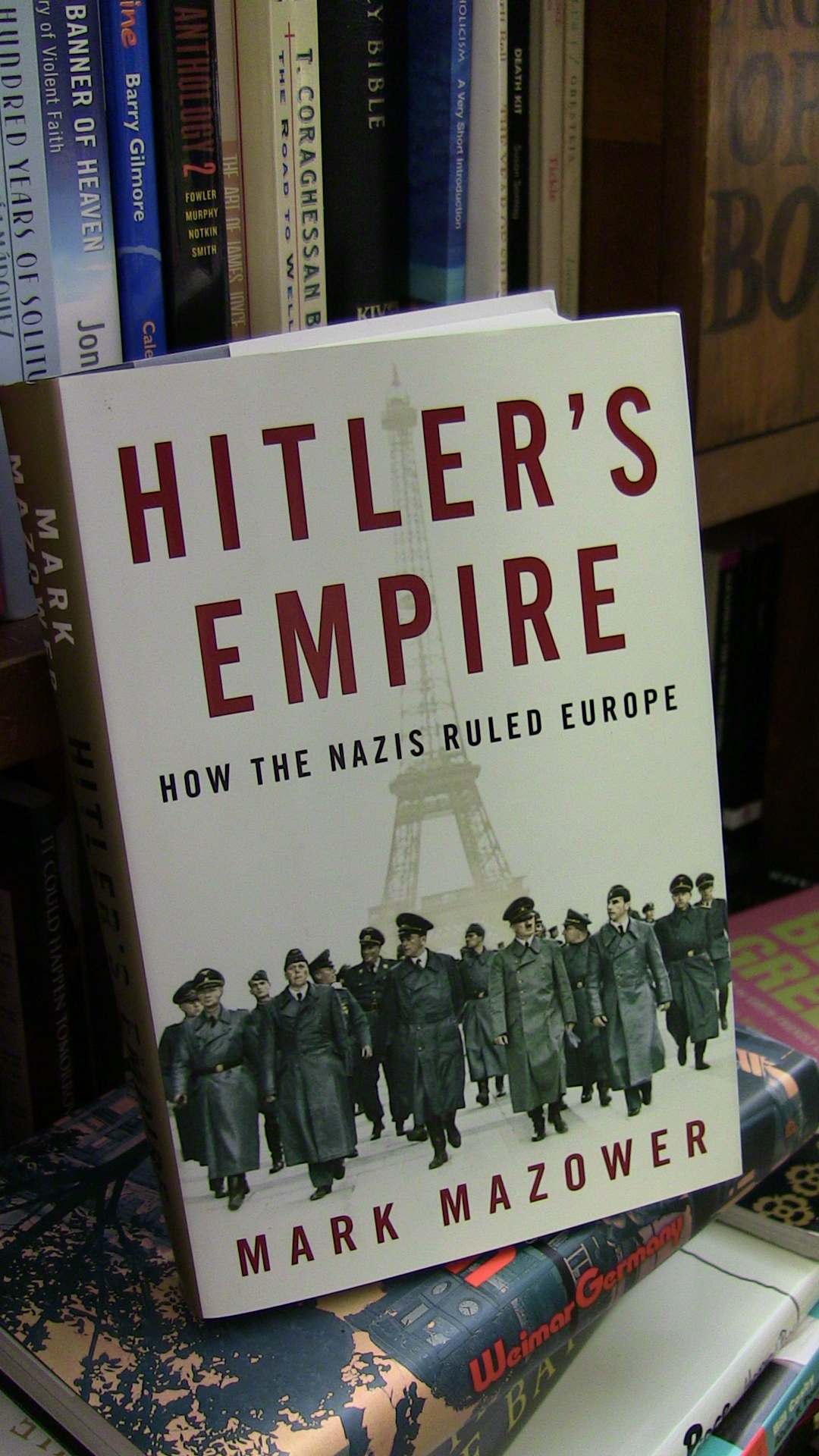
The same day I happened to go to Thalia, the biggest bookstore in Vienna. There, browsing shelves with social science and humanities literature that I stumbled upon a German translation of Hitler’s Empire: How the Nazis Ruled Europe, a 2009 book by the noted American historian Mark Mazower. The German edition of that book, which has the same cover picture, reads Hitlers Imperium: Europa unter der Herrschaft des Nationalsozialismus [Hitler’s Empire: Europe under the National Socialism Rule.]

IMG_0951IMG_0855

So I became curious about this linguistic discrepancy. Eventually, my curiosity took me further and further. The first thing one notices is that when English-speaking people write and talk about the 1930s-1940s’ Germany, more often than not they routinely use the word “Nazi.” Thus, in English we have books and articles about Nazi economy, Nazi labor policy, Nazi geopolitics, Nazi genetics, and so forth. In contrast, when Germans refer to the same turbulent years, they usually say “National Socialism” (Nazionalsozialismus).

So here is the result of my quest – an attempt to answer why in English we use “Nazi” and also who and why introduced this expression in English. The article has not been published yet. At first, I decided to prepare a brief digest of that paper and post it on this forum. Then I changed my mind. To make things more interesting, I decided to prepare a small multimedia audio presentation about why, how, and when the expression “Nazi” emerged in the first place and how it was introduced in English language and post it as a 20-minute video clip on my YouTube channel maguswest. Here it is:

National Socialists into Nazi: Politics and the English Language

A good friend of mine, who is an excellent narrator, assisted me in this. Click this link to see/listen to this talk and, if you wish, give me your critical feedback: Do not skip the ending of the clip, for it features a music tune (so-called Aviation march) that was shared by both Soviet Stalinist and National Socialist marching bands in the 1930s (words are different but music is the same).

Another Liberty Canon: Arendt

Hannah Arendt (1906-1975) was one of the more influential writers on political thought during the twentieth century. Born in Germany, her political views and Jewish origins (she was also Jewish in identity though not in religion) meant not only that she had to leave Germany after the Nazi takeover, but that she had to escape from Gestapo interrogation. A period in Paris was ended by the 1940 German invasion, which led to another escape from detention, and her final destination of the United States. She was able draw on this direct experience of totalitarianism and antisemitism to write The Origins of Totalitarianism, one of the classic works on this topic, which also considers the role of political anti-Semitism, as distinct from older religious prejudice, in the formation of the modern phenomenon of totalitarianism.

Arendt reached beyond an academic and scholarly audience in her most widely ready book, Eichmann in Jerusalem: A Report on the Banality of Evil, based on her journalistic reporting on the trial of one of the major administrators of the Holocaust, Adolf Eichmann. Though the book did much to draw attention to the extreme horror of  Holocaust, and and its history, which strange as it might seem now was not the object of a great deal of public or scholarly discussion in the immediate postwar period, also led Arendt into a morass of angry criticism and even hatred, in part for supposedly trivialising Eichmann’s criminality. However, the point of referring to the ‘banality of evil’ was not to say that the Holocaust was trivial, or to deny Eichmann’s criminality, but to suggest that as a person he was more of a small minded conformist than a grandiose anti-hero of apocalyptic evil.

From the point of view of Arendt’s work in political theory, her writing on the Holocaust and totalitarianism, contributed to her understanding of modern politics in its darkest possibilities, which were distinct from older forms of tyranny. That understanding itself drew on the breadth of her historical approach, including literary and cultural interest, which went back to the Ancient Greek beginnings of western political thought. Her understanding also included the ethical and religious thought of late antiquity, as can be seen in her doctoral dissertation, Love and Saint Augustine. She had a general appreciation of the whole of human life, with regard to consciousness and action, which is behind The Life of the Mind and can be found in some of her political theory, most obviously The Human Condition.

Arendt’s interest and appreciation of ancient politics, particularly the democracy of city state Athens,  sometimes leads to her being labelled a nostalgic and a believer in anti-individiualistic integrated communities. This can only be a parody though, Arendt thought that there might be some things to learn about modern politics through comparison with antiquity, but she did not advocate a return, and her interest in antiquity was in those communities like Athens and the Roman Republic, where we can see individualism growing and a decline in community based on adherence to tradition and to communal assumptions.

Arendt thought that the Athenians had achieved liberty of a significant kind for the aristocracy, and to some degree for the lower classes, on a real but limited basis in which some had the leisure to think and argue about the rules and laws of the city state. That form of library rested on ‘heroic’ and patriarchal values according to which the home and family are the place of economic production and therefore the place of necessity.

Liberty was understood with reference to the tradition of  heroes going to war or to a more recently evolved habit of widespread public free speech about public affairs. Arendt did not argue for this as the all time ideal, but as a moment with some ideal aspects, which was bound to fail. Partly it failed because law was understood as custom and communal obligation, rather than as concerned with contracts between free individuals.  In her historical analysis, the Romans made progress on the legal front, because they saw  that law can and should evolve with regard to the best ways of grounding freely chosen contracts,  while also failing to maintain political liberty as the republic gave way to Imperial autocracy

Arendt emphasised that the Roman model inspired modern movements for liberty, particularly the French and American Revolutions (the comparison is made in On Revolution). Though she wrote about the motives and early actions of French revolutionaries with great sympathy, she pointed out that it had all ended in revolutionary terror and then country-revolutionary autocracy, so that the American Revolution had created a better model, as shown in the long lasting nature of the Constitution. She both respected that achievement and pointed out that it rested on assumptions about the dominance of a land owning class, so that it could not in itself provide all the answers for modern liberty, even it established an enduring framework, which survived major shifts in the location of economic wealth and the sources of political power.

For Arendt, the modern capitalist world undermined the idea of a strict separation between a private realm of economic production, based on family ownership and use of land, as economic activity became what happened in factories and other enterprises, with regard to national and world markets. The social-cultural result was an undermining of the antique assumption that intellectual life is superior to, and dominant over, physical activity and economic life. It also  resulted in states that seemed more remote from traditional forms of allegiance and everyday customs, because the state became increasingly something concerned with legislative and administrative activity that aimed to enable production and trade, so for the first time establishing the state as something that aims to constantly elevate material wealth and ‘national welfare’. Arendt, in this way, argues that commercial society tends to create its own statist reaction.

Arendt equivocated to some degree about whether capitalism was to be preferred to socialism, but in political writing emphasised enhancing individuality and a spirit of competition and that can only be seen as directed against the expanding administrative state, particularly as she argued for more separation between political questions and social welfare questions. She looked for ways in which modern political participation could focus on the best parts of the antique legacy: public speech focused on the conditions of liberty rather than on expanding state activity, contests for esteem in the public sphere rather than levelling down egalitarianism.  Perhaps her equivocation about socialism can be seen as leaving the way open for ‘socialism’ as defined by left libertarians, markets without a state that promotes politically inspired concentrations of wealth and power. She was certainly a prominent critic of Soviet style state socialism.

Arendt had a grasp based in rather classically oriented political theory, of how capitalism tends to produce statist reactions to itself, which parallels the more political economy and economics oriented work of Austrian economics and Virginia Public Choice theory on  the rise of the administrative state and rent seeking.  Together with her interests in how to avoid antique tyranny and modern totalitarianism, this makes her a great twentieth century pro-liberty voice, particularly for those interested in the historical, psychological, moral, and literary aspects of political thinking.

All of Arendt’s major contributions to political thought are mentioned above. A good starting point for those new to Arendt might be the essays collected in Between Past and Future or The Promise of Politics

Entendiendo la inmigración a los Estados Unidos

El día de hoy murieron una o dos personas intentando cruzar la frontera entre México y Estados Unidos. El número de fallecidos es, sin embargo, ignorado pues la mayoría de la información existente sobre la situación migratoria en el sur de Estados Unidos se encuentra oculta por un manto de ignorancia y desinterés político crónico que ha desgastado los incentivos para discutir y explorar el tema migratorio.

Los datos provistos por el gobierno de los Estados Unidos de América son, sin embargo, alarmantes. Desde octubre, 2013 hasta junio de este año más de 52,000 niños sin acompañantes alcanzaron la fronteras superando en un 200% la cantidad reportada por el gobierno el año anterior.  Se espera que en el año 2014 más de 70,000 niños intentaran cruzar la frontera.

Tres niñas en vestido de quinceañeras juegan en Tijuana al lado del muro de la frontera México-USA. Fotografía: Romel Jacinto. Flickr. CC.
Tres niñas en vestido de quinceañeras juegan en Tijuana al lado del muro de la frontera México-USA.
Fotografía: Romel Jacinto. Flickr. CC.

La crisis aumentó cuando las imágenes de niños en campos de deportación empezaron a ser compartidas en las redes noticiosas y redes sociales. El gobierno de Barack Obama (quien ganó el premio Nobel de la Paz en el año 2009) reaccionó solicitando al Congreso de los Estados Unidos la cantidad de US$3,700 millones para empezar a responder a la emergencia humanitaria. El plan, en general, es una campaña cortoplacista que busca apaciguar las aguas en espera de que los medios de comunicación se interesen por otros temas.

En los países centroamericanos (la región de donde provienen la mayoría de estos niños) los gobiernos también reaccionaron rápidamente solicitando recursos económicos para financiar campañas de ‘educación’ y ‘concientización’ sobre las amenazas que representa realizar el viaje de alrededor de 2,000 millas. Estos gobiernos también reaccionan en espera de que la atención de este urgente problema se desvíe hacia los otros problemas cotidianos de seguridad, hambre, corrupción, insalubridad y pobreza que afectan la región.

La única solución para frenar esta crisis humanitaria, sin embargo, está muy lejos o es prácticamente imposible de conseguir si las condiciones globales actuales no cambian. Además, la solución a la situación migratoria requerirá que acciones legales, económicas y sociales sean tomadas en los países de Estados Unidos, México y Centro América para encontrar respuestas a largo plazo en estos países. De no hacerse nada, la actual situación migratoria continuará sin solucionarse de la misma manera en que la Guerra contra las Drogas continúa año con año aumentando.

Actualmente, la reforma migratoria no será discutida en el Congreso de los Estados Unidos de América y las acciones necesarias para atacar el flujo originario de inmigrantes indocumentados en los países de origen implican un reto dantesco. Los migrantes centroamericanos viajan al norte en busca de empleos y escapando de la violencia en la que fue inmersa el Istmo Centroamericano desde finales del siglo XX por el crecimiento del crimen organizado, las mafias del narcotráfico y la incapacidad de los gobiernos por afrontar los cambios globales fomentando un desarrollo económico sostenible para responder a las demandas de la economía mundial.

A pesar de la firma de un tratado de comercio regulado entre Estados Unidos y Centroamérica en el año 2005 conocido como DR-CAFTA, los países centroamericanos han sido incapaces de aprovechar las ventajas competitivas del tratado y los beneficios han sido para tan solo algunos sectores económicos.

Inmigrantes hondureños y salvadoreños que cruzaron la frontera entre Mexico-USA detenidos en Tejas.  Fotografía: Eric Gay/AP
Inmigrantes hondureños y salvadoreños que cruzaron la frontera entre Mexico-USA detenidos en Tejas.
Fotografía: Eric Gay/AP

Pero no crea estimado lector que la batalla está totalmente perdida para las miles de personas que buscan mejorar sus condiciones de vida mediante la migración forzosa de la que son víctimas. A continuación les comparto algunos estudios y ensayos que analizan el tema y profundizan en la compleja situación migratoria que enfrenta el continente americano. Al final del día, es solo educándonos y compartiendo el conocimiento adquirido que podremos contribuir a la búsqueda de soluciones a este tema migratorio que hasta el día de hoy ha sido detenido por una filosofía política inmoral y inhumana.

Ensayos:

Libros:

Deviant Tendency: An inside look at the politics of Iran

[Editor’s note: the following is a short essay by Payam Ghorbanian. Payam was born in Tehran, Iran. He got his bachelor of science in Engineering from Zanjan University in Zanjan, Iran. He has been participating in liberal political activities and he was involved with some think tanks in Iran. He is doing research in the field of international relations and Iran’s foreign policy as an independent activist. He is now living in San Jose, California.

I am excited to post his thoughts because of their potential as a conduit for intercultural dialogue and exchange. I have left his essay largely intact, but did break up some of his longer paragraphs for clarity’s sake. Thanks to Payam for taking the time to write this, and you can find his other essay at Notes On Liberty here, here, and here]

Last month was kind of exciting for me. Mahmoud Ahmadinejad’s brother said “… my brother has gotten rid of his deviant friends…”. The term “Deviant Tendency” has been using in Iran for calling Mr. Esfandiar Rahim Mashaei and his followers. Mr. Mashaei had been represented by Ahmadinejad for being the next president of Iran but the Guardian Council of the Constitution turned that willing down. Therefore Ahmadinejad left his office while he was so disappointed and at that time he said that the council has just deprived Iran of having a distinguished president. Although with “Approbation Supervision”, which implies the right for acceptance or rejection of elections legality and candidate’s competency, probably just the supreme leader and his followers can be qualified through the barrier of the Guardian Council.

I do not really care about this rumor whether or not Ahmadinejad and Mashaei are separated, the issue would be what Mr Mashaei’s political and social views are and what it is wrong with that. Also why the supreme leader and his followers do not like him? Why they tried to make him isolated even though he has no official title? As you might know during the second term of Ahmadinejad’s presidency, Mashaei was the chief of staff of the president of Iran. But why are they still scared of him? I should mention this that from my point of view, I am 100 percent sure that they (Ahmadinejad and Mashaei) just made this ending relations story up to have this chance for getting qualified for the next presidency election. But why are the supreme leader’s followers so excited of hearing that rumor? Apparently they still like Ahmadinejad but just him and as they said there would not be another chance for the combination of Ahmadinejad plus Mashaei to survive.

Now pay attention to these quotes:

“The area of Islamism has come to end, we had an Islamic revolution in 1979 but the area of Islamism is finished”

or

“Today, Iran is friend with American and Israeli people, No nation in the world is our enemy.”

These sentences and quotes have been told by the nearest person to Mahmoud Ahmadinejad, who is Mr. Rahim Mashaei. Obviously one could talk about these ideas in the free world and no one is going to be prosecuted because of that. However, talking about ending of Islamism inside a revolutionary country like Iran would be insane. I believe these types of moderation comments about Islam and also talking about people of Israel and United States not to be enemy of the Iranian people were all about politics, and Mr. Mashaei did not believe in what he said. But what were his points at that time?

It was the time that Green Movement and protestors confronted against rigged election. I would say Mashaei did all these things to reduce pressures over Ahmadinejad and in order to deceiving and poisoning the people’s mind, those people of the middle class who desperately believe in the new relations between Iran and the free world. Also I believe Mashaei did all these things to be a target instead of AhmadiNejad, which is literally about what old friends do for each other.

In Iran and especially in Shia beliefs of Islam, an ultimate savior of humankind and the final Imam of the twelve Imams will emerge with Jesus Christ and will set the kingdom of heaven on the earth to bring peace and justice to the world. It is the belief that the twelfth Imam disappeared hundreds of years ago and went into occultation state, but he will definitely re-appear around the end of the world, before the Day of Judgment. Before the Islamic revolution in Iran and probably before uprising of Ayatollah Khomein, there was a common trend that Shia would wait up until its survivor comes back. However, Khomeini argued that government should be run with traditional Islamic rules and for this to happen a leading Islamic jurist must provide “Guardianship” and as he said “Wilayat” over the people. This guardianship would be remained till the Twelfth Imam returns.

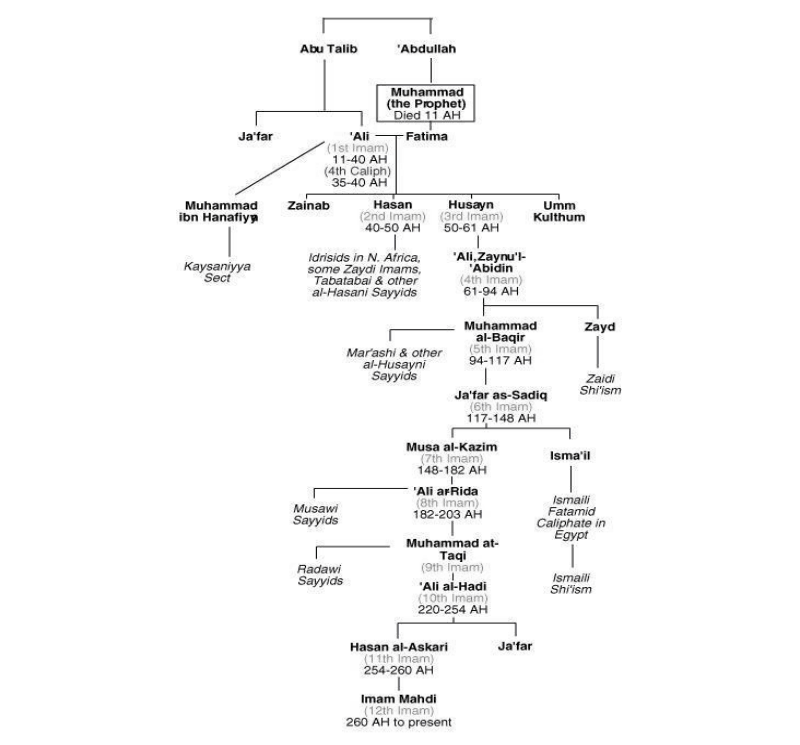
At that time this theory was accepted by the revolutionists and as the result of that, the last king of Iran felt down and “Wilayat AL Faqih” (guardianship of the Islamic Jurists) popped up. The terms of your majesty were destroyed and the Imam and the Wilayat was established and then the supreme leader was considered as the twelfth Imam’s deputy, which means that his orders are the lord’s orders and any questions or criticizes would be called as hostility against the twelfth Imam. This chart will help you out to understand more clearly about the hierarchy of Imams in Shia.

When I was living in Iran I always heard some rumors about the distinguished people who they or their followers believe that they are in connection with the twelfth Imam. They claim they can talk to him in person and get orders from him without any problem. Probably in the past they could take advantage of people’s stupidities. However, they had never been accepted by the politicians inside Iran before Ahmadinejad’s presidency started. Now you can tell why they have been called as Deviant Tendency. Mashaei claimed that he could talk to the twelfth Imam in person and he believed that when we can have access to the real source, why we should follow his deputy, who does not have any confirmation from the real lord.

chart of persian imams

Before Mashaei tried to extend his theory, the revolutionary guard crippled all of his ambitions subsequently. His followers were arrested and he was about to get caught too but it seemed that Ahmadinejad was completely in agreement with what he was saying. Ahmadinejad tried to protect Mashaei but as you know he lost the protection of the supreme leader. As a result, his authority dropped considerably. He got teased and he lost his connections and finally he got kicked out of the power circle and all of these were about his friendship with Mashaei, which he truly believed in him.

And now the new game has just started. First it was announced by Ahmadinejad’s brother that there would not be any connection between his brother and the deviant tendency. Then Ahmadinejad had a speech in Mashahd, one of the most religious cities in Iran where the 8th Imam of Shia has been buried, and he said:

“… the only way to overcome the enemies of the nation is standing on the value of our goals in the same way that Khomeini has showed us. I would totally remain on that way to serve the nation and revolution and its values and principles.”

He also tried to imply on revolution principles, the principles that revolutionists believe has been neglected after Rohani became a president.

Ed Lazear’s WSJ op-ed on California’s water problems

Ed Lazear had an outstanding op-ed, “Government Dries Up California’s Water Supply,” in the June 26 Wall Street Journal

It brings me back to 1982, when I first moved to California from Texas. Less Antman had the California Libertarian Party hire me as research director, and one of the biggest political issues at the time was water. The fight was over a ballot initiative authorizing construction of a Peripheral Canal around the San Joaquin-Sacramento River delta to divert more water to Central Valley farmers and southern California. It would have been an enormous, expensive boondoggle that united environmentalist and libertarians in opposition. I ended up not only writing but speaking before all sorts of audiences about the issue. My studies made me quite familiar with the socialist bureaucracy, much of unelected with taxing power, which manages California’s feudalistic water system, severely mispricing and misallocating water.

Fortunately, the Peripheral Canal went down to defeat. But little was done to reform California’s water system, and Lazear provides an excellent survey of the myriad drawbacks still plaguing it today. His solution: “Rather than praying for rain, we should get government out of the water-allocation business.” One noteworthy detail he doesn’t mention is that even in non-drought years, because the system encourages overuse of water, the Central Valley’s ground water continues to get depleted. This ensures that each subsequent drought will generate ever more serious problems. Worst of all, one solution being pushed during the current drought is a jazzed up version of the Peripheral Canal.

HT: Corrie Foos

Request for Technical Opinions

Readers of Notes On Liberty must include a fair number of information technology-savvy people. I am not one. I wish to gather opinions on the following question:

Is it possible, over a period of two years, to lose completely two years worth of email emanating from a high-ranking government bureaucrat as well as the emails of six other people?

I ask because I was under impression that you have to try hard to lose any computer information for good. I am also under under the impression that what emails are physically on my computer is irrelevant in the middle-run because everything is stored on a server even if it’s not deliberately backed up. (I back up everything although I am not obligated to do it by law, the way federal agencies are obligated.)

Thank you in advance.

Identity Crisis: An anecdote.

Today is liberalism day. A day where “classical liberals” seek to take back the moniker that was lost to them over the 20th century in an attempt to avoid confusion and to help drive home the ideological difference between modern liberals (who support a strong central government for the purposes of wealth redistribution and social control) and classical liberals such as Bastiat, Locke, and Ludwig von Mises (who advocated for little to no government tyranny and emphasized the rights of the individual over that of “society”).

In my personal experience however there is a far more dangerous muddling of ideology at the core of the libertarian movement. That is to say “when should libertarians betray their own values?” Since I was exposed to the ideas of Mises, Rothbard, Hayek and their intellectual proteges Hoppe, Block, Woods, DiLorenzo, Kinsella, Murphy, Ron and Rand Paul, and so many others I have found that there is a disconnect between the values advocated by these authors and the actions taken by them and their followers. This has often resulted in so called libertarians using remarkably non-libertarian tactics to pursue libertarian goals. First let me describe one of these events from my own personal experience and then I will discuss what I think can be done to help the libertarian movement as a whole.

I was introduced to libertarianism by a friend sometime in late 2008 but it wasn’t until the 2010 Conservative Political Action Committee (CPAC) that I met other libertarians “out in the wild”. I was still ideologically agnostic at the time but leaned towards a more leftist (not liberal) philosophy. I had voted for Obama in 2008 in my naïve belief that “anybody but Bush” was a valid political stance and I had supported the move towards National Healthcare; but over the next few months I was argued into holding a grudging respect for libertarian beliefs and by the time we boarded the train for D.C. I had read most of Milton Friedman’s Capitalism and Freedom and listened to a single Thomas DiLorenzo lecture through one half of a pair of headphones but was paying more attention to the other end of those headphones than the lecture droning into my ear.

So as I was walking into the Marriott or Hilton or whatnot I felt less like a fish out of water and more like a lobster in a pot and hearing a page over the loudspeaker for Dick Cheney raised the temperature ever closer to boiling. My compatriot barked a laugh at me when I turned and asked if she realized how dirty I felt being the same building as a war criminal. I was assured that I didn’t need to worry since we wouldn’t be anywhere near the neo-conservatives and would instead be linking up with some friends of hers at the Campaign for Liberty booth. A few awkward greetings later we were directed to a table, given badges with names of people neither of us had ever met, and told to vote in the Straw Poll for Ron Paul and to “do everything we could to not let the badges get punched” which signified that I.D. had been used and was ineligible for further voting. I, always good at following directions, managed with some small sleight of hand to vote and preserve the integrity of the badge, my friend was less subtle and some libertarian woman who was late to the party arrived later that day to find her I.D. already punched and her Straw Poll vote already cast. This small act of fraud was our payment for access to the speeches and Question and Answer later that day.

The speeches were interesting but uneventful. Thomas DiLorenzo on Abraham Lincoln (who else), Thomas Woods plugging one of his books. Rollback, I think, but at this point I own them all and can’t quite distinguish in my memory which one he released that year. The “Southern Avenger” Jack Hunter talked about something that completely escapes my memory though we were seated directly behind him before he went up and my friend’s cellphone going off directly in his ear is one of my fondest memories.

Then we were off to the Q&A featuring Ron Paul, Judge Napolitano with Tom Woods as moderator. At this point I feel the need to point out that throughout the day my friend and I were drinking out of 1 Liter Pepsi bottles that were approximately half Pepsi and half vodka. So at this point her cheeks were more red than Limbaugh’s cheeks and all fear I had of being outed as a “liberal pinko” was removed. In fact I was feeling bold. So as the Q&A reached its midpoint and my friend asked the air “I wonder if Tom Woods is an Anarcho-Capitalist?” I found myself stand up in this room of “right wing nutters” and insert myself into the line of people queued up waiting to ask questions.

Now anyone who enjoys the occasional overindulgence of hops and gets themselves into precarious situations knows the feeling I had at that moment. “Now what am I going to do?” I was in a hall with probably three to four hundred people, a television personality and a United States Congressman on stage in front of me while on camera and I was going to ask the MODERATOR if he had fringe political beliefs that I didn’t really know anything about.

The line in front of me grew shorter and shorter and I swear my blood pressure had to have rose a dozen digits and as I reached the front of the line I stuttered through some thanks to both Ron Paul and Napolitano before turning my gaze onto Woods and requesting his permission to ask him a question instead. At this point I knew I had broken about a dozen rules of etiquette as he mentioned that he would be available after the Q&A and noticeably stepped away from Ron Paul before agreeing to my request. I was in too deep at this point. “Mr. Woods.” I paused still figuring out my phrasing. “Do you think that a Minarchist society could lead to an Anarcho-Capitalist one?” His answer was everything I could have hoped for: “Of course, or else I wouldn’t be pursuing it.” Elated, I returned to my seat and gloated to my friend.

When we returned home I immediately looked for the video on the Campaign for Liberty website. Finding the video was easy enough but for whatever reason my question, and my question alone, was edited out. My only assumption was that it didn’t convey the “party line” that Campaign for Liberty wanted to convey. To me it felt as if I, a pseudo-democrat, was too radical for this so called party of change.

Now I didn’t think about this trip for several years but as I refined my beliefs and found the Rothbardian ideology that I now how hold dear I realized what a betrayal of libertarian beliefs my experience represented. The folks running the Campaign for Liberty booth openly and actively committed fraud in exchange for both personal and political favors while the Campaign for Liberty site runners were actively suppressing the logical conclusion of their belief system in an attempt to pander to the average voter. This was the beginning of my distrust of utilitarianism and of the political wing of the libertarian movement and that distrust has not subsided in the intervening years.

But if not politics then what can we do? I favor a two-pronged approach. The first is obvious: Education. We need to talk about libertarianism as much as possible and that is why I love this blog despite not being able to muster the time to post very often. I personally cannot stand to debate on the internet but some of the comments here and many of the posters make amazing headway into what it means to be a libertarian.

The second is more complex and much more personal. I call it practical (or passive) libertarianism. It is essentially finding it in yourself to embody the ideals of libertarian thought each and every day. Terry Amburgey says that I like to “Quote Scripture” and while he means it in a mocking way it is true that I do look to the writings of Mises and Rothbard for moral guidance. I believe that libertarianism has concrete ethics that help describe what is “right” and what is “wrong” in the world of morality and I make every attempt to live strictly by them.

What does this mean? Well for me it means following the Non-Aggression principle on a daily basis. In other words not committing aggression on persons or property. It means taking personal responsibility for my actions and not attributing blame to society or other abstract groups. It means not doing the obvious things such as stealing or littering but it also means making every attempt to keep money out of the government’s hands and in the hands of individuals by abstaining from buying superfluous goods whose proceeds go directly into the state coffers. This entails not playing the lottery (a bad idea anyway), and by trying to avoid purchasing things with heavy excise taxes.

Does this mean I live like a hermit? Of course not. I have to drive so I am forced into paying the heavy New York State gas tax. I purchase consumer goods as I see fit since sales tax is unavoidable. I am gainfully employed so the Income Tax is removed for me. But I do what I can. I try to minimize the government’s impact on my life. To quote pseudo-libertarian science fiction author Robert Heinlein”

I am free, no matter what rules surround me. If I find them tolerable, I tolerate them; if I find them too obnoxious, I break them. I am free because I know that I alone am morally responsible for everything I do.”

I suggest you do the same.

A Liberal: To Be or Not To Be (Happy #LiberalismDay!)

What’s in a name?

Dan Klein and Kevin Frei recently decided to launch a campaign dedicated to spreading awareness about the original meaning of the word ‘liberal’. At first I was a bit ambivalent about the project because a) I don’t mind using the term ‘libertarian’ to describe myself or the policies I favor, and b) I am normally very careful about classifying Leftists as such, rather than referring to them as ‘liberals’. In my mind, I’m doing everything right so why on earth should I spend time on really driving home a semantic point?

As I was thinking about this issue, Dr Gibson sent me an email of an interview Dan Klein gave with the London-based Adam Smith Institute. Here is how Dr Klein debunked my thoughts on semantics:

The word liberal is powerful. It relates to liberty and toleration, reflected in to liberalize. Words have histories that a generation or two cannot undo. A word has cognates and connotations that make our language cohere, more than we know, more than dictionary definitions can tell.

We need a wider understanding of the semantic changes of the 1880-1940 period. In a way, semantic issues are the momentous issues of our times; semantics tell who and what we are, our selfhood; they condition how we justify our everyday activities.

I can’t argue with this, so instead I have been asking myself how I can go about identifying myself as a liberal rather than a libertarian, and what exactly is the difference between a liberal and a libertarian if the semantics fight is one that should occur between individualists and collectivists (Jesper answers this second question quite well, by the way).

In a way, #LiberalismDay makes Will Wilkinson’s old essay on “bleeding-heart libertarianism” much more pertinent than ever before. Maybe I’m just a plain ole’ liberal, especially if the definition of libertarian being put forth by some individuals in our quadrant continues to gain traction. Maybe most of us are just plain ole’ liberals.

At the end of the day, and after thinking about this for quite some time, I think I’ll try to refer to myself as a liberal for the next little while. After all, as Klein and Frei point out, the term ‘liberal’ has increasingly come to mean the continued “governmentalization”of society so referring to myself as a ‘liberal’ while advocating policies that don’t conform to American conceptions of the term is basically an affront to the theft of the word in the first place.

Calling myself a ‘liberal’ while advocating for more restriction upon the state sounds better and better as I talk myself into it.

I know, I know, I didn’t explain how or why the term ‘liberal’ morphed into what it has here in the States. I outsource to F.A. Hayek on this matter (pdf).

Here are some more thoughts on #LiberalismDay (many of them do a great job of explaining the ‘how’ and the ‘why’ as well):

Liberalism Unrelinquished: Some Tactical Thoughts

Today is #LiberalismDay. My friend Dan Klein of George Mason University along with his colleague Kevin Frei have launched a project called “Liberalism Unrelinquished.” An impressive list of economists and others have signed their petition which declares that they “affirm the original arc of liberalism, and the intention not to relinquish the term liberal to the trends, semantic and institutional, toward the governmentalization of social affairs.”

Other bloggers will presumably rehearse the tale of how that storied term lost its original meaning, at least in the U.S., as it has been appropriated, since at least the 1930’s, by statists.  (Example: George Leef’s fine piece). I just offer a few thoughts on some tactics that may be appropriate to this battle.

  • We must stop using the word liberal to denote present-day statists. This should be easy since they themselves have largely abandoned the term in favor of “progressives.” (Note that modern progressives hate progress of the material sort more than anything. That’s an issue for another time.) I have nothing better than “progressives” to denote these folks except perhaps a qualified “so-called progressives.” I hope “governmentalists” doesn’t get started. That would be too big a mouthful.
  • Speaking of which, there must be a better term than “governmentalization,” another mouthful. Perhaps just “government takeover” which is more forceful and easier to say.
  • “Liberalism unrelinquished” doesn’t exactly roll off the tongue either. How about “liberalism restored?”
  • Our task will often be easier if we say “classical liberal” rather than just liberal.
  • The term libertarian has entered the mainstream of U.S. politics. We should take advantage of this progress. We can use phrases like “the libertarian position, or as I like to call it, the classical liberal position …”
  • We must understand the price we pay when we call ourselves or our positions “liberal” or “classical liberal.” The price consists in the time and energy required to make clear to our audience what we mean when we use the term. Whether the price is worth paying depends on circumstances.
  • In academic writing, speaking, or debating there is usually sufficient time to preface our arguments by explanations. Attention spans are long enough that the price paid for explaining why we say “liberal” will not be significant.
  • The last place to take this fight would be political campaigns or debates. Attention spans are minute, audiences are unsophisticated, and we will just confuse people by using the term in its classical meaning prematurely. We can, however, try to disavow the tired old “liberal-conservative” spectrum that is currently entrenched in the media. “I’m aTime permitting, we could say classical liberal, and that means I agree with conservatives on some issues and with progressives on others. All my positions are grounded in the notion of liberty.”
  • In letters to the editor where every word counts we can say “libertarian (or classical liberal)” or the other way around.

I congratulate Dan and Kevin on the response they’ve gotten so far and I hope the momentum continues.

Democrat Incompetence and Mendacity, in Nine Points

President Obama, during his first campaign, declared forcefully and clearly that he would close Guantanamo Bay prison within a year. There was no qualifications, no “ifs” and “buts;” it was a simple straightforward and forceful declaration of intention. It’s been more six years and the prison is still operative. It holds un-indicted prisoners, several captured under such dubious circumstances that it’s possible that some are shepherds or traveling salesmen caught in the wrong place at the wrong time.

Over the Memorial Day weekend, I had leisurely talks with five people in their late twenties about the topic of Guantanamo Bay Prison. Here are my accounts of these conversations.

One had never heard of Guantanamo Bay. She had voted for Mr Obama twice.

One had heard of Guantanamo Bay prison but he did not know whether it had been closed or not. He had voted for Mr Obama the first time and abstained the second time out of disinterest.

One knew Guantanamo Bay prison and he knew that it was still open. He had voted for Mr Obama once and deliberately abstained the second time. He now sports a bumper sticker proclaiming Obama to be a “dick.”

One had never voted for Mr Obama and she knew that the Guantanamo Bay prison was still open in spite of the president’s campaign promise.

The last person, an academically and professionally successful young woman, knew well about Guantanamo Bay prison and she knew it had not been closed. She is a forceful Obama supporter who was not able to vote for technical reasons. She argued that the president was unable to close the prison because of “Republican opposition.” She said that Republicans always stop him from doing anything good.

Now, her political position is interesting because the young woman was in good faith herself but her assertions were false. Guantanamo Bay case is an excellent test of the president’s own good faith and credibility. The President of the United States is the undisputed Commander in Chief of the armed forces, “undisputed.” A single one sentence order from him would start the process of closing the prison. Any opposition from any part of the political spectrum would be impotent to stop it. The president would have to take the political fallout of his order, of course, but that’s exactly why a politician should not make irresponsible promises.

There is a Chapter Two to the analysis of this clearly failed promise of the president. Even if he absolutely wanted political cover, he could have done it during the two years when his party had an absolute majority in Congress. And, by the more way, the president would have received considerable support from all sides had he had the courage to take the step explicitly contained in his campaign promise. There are plenty of conservatives like me who hate the idea of people detained indefinitely without charge. The legal technicality employed by Pres. Bush to put detainees in Guantanamo out of reach of American constitutional guarantees on the grounds that it’s not American soil was not his finest moment.

President Obama either lied or he spoke irresponsibly. It does not hurt him much with his followers. It seems, they like a good speech expressing generous sentiments above all. My side is not responding in a politically effective way to the reality of his appeal.

The Republican Party’s own political discourse is all over the place. It sounds like a cacophony where the only word emerging are: “Obama bad.” This lacks seriousness. Republican politicians have forgotten basic rules of good communication, rules about attention span, about clarity and about the value of repetition.

If it were my call, I would do the following:

Name three things that the president clearly promised to do and that were doable and that he did not do. (Stopping global warming isn’t tone.) That the president did not do them has to be easily verifiable. Closing Guantanamo Bay prison is a good example. Keep repeating slowly the three unkept promises.

Name three things that the president did that were done badly. The deployment of the health insurance exchange is a good example. Keep repeating them. Keep repeating that they were doable, that others would have done them well.

Name three things that he should have done and that he failed to do or did badly, irrespective of promises he might have made or not. The three things have to be actions that are within the bailiwick of every American president; they have to be part of the job. Reforming the Veterans’ Administration before he had to fire his own appointee to head it would be a good example.

Here, that’s nine things, not many but as many as my young interviewees of Memorial Day are able to understand, digest or retain durably. Maybe that’s even too many.

My communication plan deliberately stays away from foreign policy where Americans disagree strongly, especially when it comes to military intervention. It refrains deliberately from the common couplets presenting Mr Obama as the Devil himself, or even as “socialist” (a word devoid of meaning.) The plan highlights the fact that President Obama has been a very bad manager of American interests, that he did not take care of business anywhere near the level of competence and attention Americans ordinarily expect. Many independents and some liberals should come to the conclusion that Obama would be fired for simple non-performance if he were not protected by his office.

The objective is to make very difficult or impossible for a future candidate to anything to ride on the Obama wave. After a few months, there should be no Obama wave left at all. If Mrs Clinton should be the Democratic candidate for the presidency, for example, she should not be tempted and not be able to borrow Barack Obama’s likability without also putting on his cloth of gross incompetence. She should thus be forced to ride on her own likability which is very low, as everyone knows.

This is a plan to establish the fact , without unnecessary acrimony, without hysteria, that Democrats produce so-called  “leaders” who don’t do the job even minimally. It’s a constructive step toward making it difficult for the Democratic Party to saddle us with yet another non-doer, Hillary Clinton, for example. (She is a woman who has also done absolutely nothing except be loyal to a husband who deserved no loyalty.)

I am quite pessimistic. I think we are already in an advanced stage of fascism with a one-party system not far int the future. The ray of hope comes from today’s Peggy Noonan column , as it often does. She argues (WSJ 05/31/14 ) that Mr Obama inaction and bad actions are giving government a bad name. I hope she is right; I hope I am dead wrong.

Piketty’s numbers on inequality don’t add up

The Financial Times, a center-Left British publication, has the story here.

Piketty, an economist at France’s most prestigious business school, recently wrote an almost 600-page treatise on the growth of economic inequality in the West. The book has earned him lots of fame and has been discussed ad nauseum for about a month now.

Here is what I have found most interesting up to this point on the debate about inequality: The factions and their strategies regarding data and how it is interpreted. I think Dr Delacroix’s approach to the way data is interpreted is best, namely that the study design itself should be analyzed first and foremost.

Regarding factions, remember when that graduate student from the heavily neo-Keynesian UMass-Amherst found discrepancies in the work of Kenneth Rogoff and Carmen Reinhart on austerity in the West? The Left attacked savagely. The Right came up with excuses that would have earned an ‘F’ on most undergraduate tests.

Now that the Left’s own preferred conclusions have been borne out by bad data, what do you think is going to happen? Who wants to bet that the roles of Left and Right will be reversed? When Rogoff’s and Reinhart’s mistakes went public, the graduate student was invited to speak on televised talk and radio shows around the world. His work was (justifiably) hailed in the national and international press, and also (much less justifiably) as an answer to the deplorable state of the discipline of economics. What do you think the odds will be that the researchers responsible for finding flaws in Piketty’s data will get the same reception?

My money is on the answer “not good.”

All of this discussion about austerity and inequality is great, of course. The fact that researchers are expanding their findings to include more than just the data within their own countries is perhaps the most satisfying development in regards to epistemological human progress. I will await further developments to lay down my own verdict on the matter of inequality in the West. With the mistake of Rogoff and Reinhart, I decided, after carefully reading the merits and weaknesses of both sides of the debate, that their mistake was small enough to overlook and that austerity generally leads to better economic outcomes in the near- and long-term and that public debt is a drag on economic growth.

Depending on how the Left responds to its critics, I will see if economic inequality is indeed growing in the West.