George Keenan’s racism *AND* affinity for the Democratic Party confuses Left-wing journalist

From the New Republic‘s David Greenberg:

Normally a supporter of Democrats—in the diaries, he voices support for the presidential bids of Adlai Stevenson, John F. Kennedy, Eugene McCarthy, Frank Church (“promptly regretted it deeply”), and Bill Clinton (“without enthusiasm”)—Kennan was nonetheless profoundly conservative in his worldview.

How on earth could a Democrat be a conservative? The logic of Progressives continues to astound me. Kennan, in addition to being an ardent supporter of Democratic Party candidates, also expresses adulation for ugly racist stuff like eugenics and even goes so far as to express sympathy for Apartheid in South Africa.

Libertarians and honest conservatives have long known about the intricate links between institutional and scientific racism and Left-wing political causes. The logical outgrowth of this subtle racism can be found in many of the Left’s pet political causes, such as Affirmative Action or government housing projects. These are inherently racist policies and if you read the justifications for such policies you can see why they are a natural  outgrowth of Progressivism.

The New Republic‘s David Greenberg is unable to put two and two together, however. To him, the fact that Kennan was a racist and an imperialist and a Democrat does nothing to show him why the Democratic Party is the party of reaction, of conservatism writ large in the United States.

By the way: Just because I think Affirmative Action and government housing projects are racist does not mean I do not support reparations for the US government’s theft of labor from slaves and theft of land from Native Americans. I just think there are better ways of atoning for our government’s sins than engaging in even more fruitless, racist policies.

Short blurb on Murray Rothbard

Murray Rothbard (1926-1995) was an economist at UNLV and is considered to be one of the most important figures of the post-war libertarian movement. Rothbard earned his BA and PhD from Columbia (his dissertation on the banking panic of 1819 is still cited by economic historians), so it’s not like he was some hack with an unwarranted vendetta against the government. His contributions to a more libertarian world can be felt in numerous ways, from think tanks to economics graduate programs to the presidential campaigns of Ron Paul in 2008 and 2012. His daring foray into anarchy is, of course, his most important contribution to the scholarly world. However, I don’t see why this man has such a cult classic following within the libertarian movement. Could somebody explain this to me?

My best guess is that Rothbard’s strategy of appealing to the intelligent layman with well-disguised fallacies instead of discussing his research with the scholarly community has something to do with it, but this is only a guess.

His work just has “Cold War” written all over it. For instance, the first book of Rothbard’s that I cracked open, Conceived in Liberty Volume 1, read like a 1970s Marxist diatribe on economic development (by the way: see Dr Delacroix’s “The Export of Raw Materials and Economic Growth: A Cross-National Study” in the American Sociological Review for an excellent rebuttal of Marxist development theory). Again, I think part of this can be blamed on the time period he was writing in (mid-1970s), but even though it must have really sucked to be a scholar during the Cold War era there is really no good excuse for Rothbard’s present-day status as a saint within libertarian circles.

Not only has his scholarship become a stepping stone rather than a shrine (as all scholarship inevitably becomes), but the cult-like attitudes of some of his fans makes me cringe as a libertarian. At any rate, I’d really like to know why he has such a devoted following, and why his followers seem to think that their devotion to him is a good thing for the movement.

Is the Political Left Today’s Conservative Faction?

I tend to think so. I come across more and more anecdotal evidence to support my thesis with each passing day. For example, in my current research on Dutch colonial responses to Javanese political strategies, I came across the following passage by Dutch historian Eduard JM Schmutzer in his 1977 monograph Dutch Colonial Policy and the Search for Identity in Indonesia 1920-1931:

The abuses in government exploitation under the so-called “Cultuurstelsel” (Cultivation System) and the subsequent criticism by humanitarians […] made the liberals aware that new methods for the exploitation of the East Indies and for the development of its inhabitants were to be found. In contrast to the conservatives who maintained that the central role of government in economic life was necessary to protect the natives against the overpowering influence of private capital, the liberals argued that the doctrine of free enterprise and its beneficial laws of unrestrained capital and labor market, promised in Indonesia an increase in the sagging production and an improvement in the welfare of the natives. Both conditions [free capital and labor markets – bc], the liberals maintained, would be to the advantage of the population at home and abroad.

However, the channeling of capital into the structure of government monopolies by private investors did not result in the expected increase per capita productivity [Ya don’t say? – bc]. (1)

The emphasis is mine. Can anybody name any factions in today’s world that advocate restraining private capital in the name of (condescendingly) protecting those who are too stupid to know what to do with their own money?

Anybody at all?

Needless to say, the liberals lost those important colonial policy battles of the late nineteenth century (probably because they were outnumbered by both the theocrats and socialists who believed private capital was bad for the natives and that therefore authoritarian paternalism was in order).

I can’t help but wonder: Does the anti-globalization Left realize just how conservative its position is?

May I Present

…the estimable Kyle Dix:

Kyle Dix (personal homepage) was born in Miami and raised in the mountains of North Georgia.  He graduated from the University of Georgia in 2010 with dual degrees in Spanish and Management.  Kyle currently resides in Philadelphia, PA where he works and attends class at University of Pennsylvania, studying history with an eye on entering academia.  Between UGA and Penn he worked in a welfare-to-work NPO in North Philly, teaching job skills, career planning, and basic English.

The historical questions Kyle asks are largely rooted in his experiences: What is the nature of the discourse between individuals and government?  How do ideologies guide institutions as they grow and change?  How do globalization and modernization act as drivers for this discourse?  Kyle seeks to offer answers to these questions from the historical context of US-Latin American relations and via over-eager observations of current events.

Check out his introductory post at Notes On Liberty here. Welcome him accordingly!

A Reverse Crimea in the West: Kaliningrad

Look at the Kaliningrad Oblast. It used to be Prussian Koenisberg, an important detail: Many Germans still feel for it, like Russians for Crimea. This is one part of Europe toward which the Germans might loose a little of their current prudent cool and cooperate.

Find Kaliningrad on the map.

Source: BBC
Source: InKaliningrad.com

It’s a small Russian exclave on the Baltic. It’s entirely sandwiched between two NATO members that are also members of the European Union, Lithuania and Poland. It must have some military value because it’s the headquarter of the Russian Baltic Fleet.

Kaliningrad has no direct land links to the rest of Russia. Sea links are along the shores of unfriendly to very unfriendly countries. I don’t see why it would be difficult to apply an on-and-off siege to that territory. I don’t mean that the West or the US should actually attempt to starve its about one million people. I am thinking cutting off the water intermittently, for example. Perhaps a few US warships could cruise off Kaliningrad with all guns carefully covered. We should be able to cause enough unpleasantness there to stampede part of the civilian population. We might just let Russian sailors there lead lonely and even more drunken lives than they do now.

After the gobbling up of Crimea, making it difficult for Russia to staff its isolated western outpost would be a worthwhile goal. Even giving high Kremlin officials a few bad nights of sleep would be better than nothing. Letting bullies get away with anything is always a bad idea. It’s like asking for more bullying in the future.

I don’t know why no one is talking about it, not the Obama administration, not the Republican opposition, not the supine press.

Are we that pathetic or merely ignorant?

El legado de Hugo Chávez

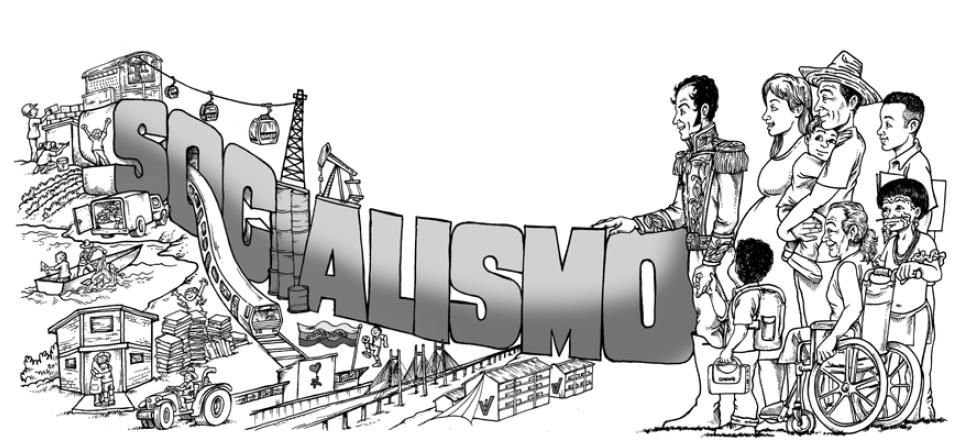
Propuesta del Candidato de la Patria Comandante Hugo Chávez Para la gestión Bolivariana socialista 2013-2019. Via: http://forajidosdelanetwar.blogspot.com/2012/11/caricaturas-e-imaginarios-en-la.html

Hace un año el actual presidente de Venezuela, Nicolás Maduro, anunció la muerte de Hugo Chávez.  Chávez fue el líder de la Revolución  Bolivariana en Venezuela y gobernó el país durante 14 años.  Maduro fue juramentado luego Presidente y recientemente ganó la reelección popular con una campaña que prometía continuar  con el legado de su mentor.

En el 2013, los datos del legado que dejaban los 14 años del gobierno socialista presentados por el Centre for Research on Globalization y por la Embajada Venezolana en los Estados Unidos son reveladores:

  • Venezuela cuenta con servicios de salud y educación universales gratuitos. Antes, 70% de los venezolanos no tenía acceso a servicios de salud.
  • Se eliminó el analfabetismo en el país.  Antes, 40% de los venezolanos eran analfabetos.
  • En los últimos 10 años, el PIB venezolano ha crecido al ubicarse en un nivel alrededor de los 300 mil millones de dólares. Esto representa un crecimiento sustancial frente a la década de los noventa cuando el PIB del país no llegaba a los 100 mil millones de dólares.
  • Se redujo en un 40% el costo de los productos de la canasta básica.
  • Aumentó el salario mínimo en más del 600%
  • Redujo el desempleo del 20% al 6%
  • El Índice de Desarrollo Humano (IDH) en Venezuela aumentó de 0,69 en  1998 a 0,84 en  2008, lo cual eleva a Venezuela a ser un país con rango de desarrollo humano medio a uno con rango alto.
  • De 2008 a 2012, el IDH descendió a 0,748 y alcanza el puesto 71 de 187 naciones y territorios que participaron de la medición.
  • Venezuela ocupa el puesto 71 entre los 179 países que figuran, según el informe anual del Programa de Naciones Unidas para el Desarrollo (PNUD). El coeficiente de Gini, que mide la desigualdad de ingresos, alcanzaron en 0.390 en 2012, el nivel más bajo en la historia de Venezuela y el más bajo en el Continente latinoamericano. En 1998, era de 0,4865.
  • Desde 1999, Venezuela incrementó sus relaciones comerciales con otros países en el hemisferio, así como con otras regiones del mundo. La mayor parte del comercio de Venezuela continúa siendo llevado a cabo en la región, con alrededor del 70% de las exportaciones de petróleo con destino a los países de las Américas, y los mercados de América del Sur, América Central y el Caribe están ganando importancia.
  • En 2012, un año antes de la muerte de Chávez, Venezuela era el tercer socio comercial más grande de Estados Unidos en América Latina y el número 14 más grande en el mundo, además de ser el cuarto proveedor de petróleo a EE UU.

Pero no todo ha sido fácil de conseguir en esta bonanza de estadísticas sociales y los drásticos cambios en el nivel de vida del pueblo venezolano han sido el resultado de muchos sacrificios impuestos en la población venezolana.

Con el ascenso de Chávez y el éxito inmediato de los cambios socioeconómicos en la población, la élite política chavista se aseguró el poder absoluto al conseguir el voto mayoritario en elecciones democráticas gracias a millones de venezolanos beneficiados por las reformas socialistas.  Este poder absoluto (democrático) permitió al gobierno socialista continuar con su plan e imponer restricciones a la libertad de expresión de la oposición, expropió sin muchos problemas industrias, eliminó fácilmente y sin mucha oposición el derecho a la propiedad privada y capturó los ahorros de millones de venezolanos.

Para Maduro, Chávez y muchos otros ideólogos socialistas antes de ellos, cualquier medio era justificable para la consecución del ideal revolucionario socialista.  Latino América, que durante décadas sirvió de laboratorio para experimentos económicos y políticos de líderes del mundo desarrollado fue la arena idónea para regresar a la dulce tentación socialista que había sido lograda con relativo éxito en otros continentes.

La fórmula del legado de Chávez es simple y poderoso:

Populismo anti-imperialista

+

petróleo nacionalizado

=

Socialismo clientelista 

Titulo: Sembrar petróleo. Por Emiliano Teran Mantovani. via: http://forajidosdelanetwar.blogspot.com/2012/11/caricaturas-e-imaginarios-en-la.html

La movilización y apoyo de los votantes en una nación democrática es fácil de conseguir cuando se posee el capital económico, político y/o militar para ofrecer al pueblo una salida de los sistemas de economía mixta extractivos que durante el siglo XX fueron implementados por las naciones desarrolladas del Norte Global y que fueron apoyadas por elites patrimonialistas en los territorios del Sur. El éxito de la revolución Bolivariana aseguró para otros países interesados en este experimento una segura y jugosa fuente de donativos para facilitar el efecto domino socialista que tanto temieron los ideólogos realistas gringos durante la Guerra Fría.  Sin duda, el legado de Chávez sigue vivo un año después de su muerte.

En los últimos dos meses la movilización de un importante grupo de la población venezolana causó manifestaciones en las ciudades más importantes del país.  Los manifestantes tenían muchas peticiones que iban desde reclamos por la corrupción del partido gobernante, reclamos por los altos índices de inflación que afronta el país y solicitudes de renuncia de los líderes de la revolución bolivariana.

Independientemente de cuántos  años más dure el partido revolucionario en el poder es seguro que su legado fue la implementación de una exitosa revolución socialista clientelista sostenida en la venta de petróleo a las economías mixtas del resto del mundo que mejoro los índices de desarrollo humano como nunca antes habíamos visto.  Así es que mientras el mundo siga dependiendo del oro negro, el mundo seguirá escuchando del legado de Chávez.

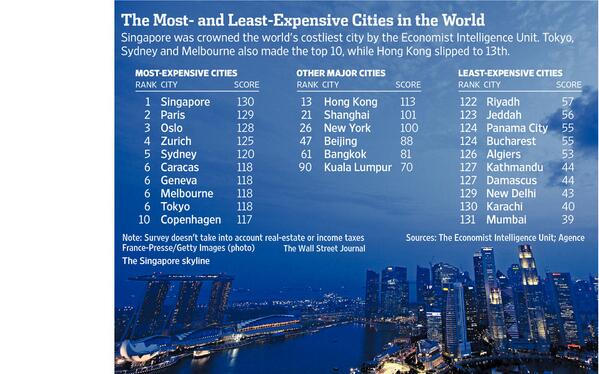
Este caro legado ha costado la libertad y los derechos de propiedad de miles de individuos. Venezuela sigue y continuará enfrentando desafíos en materia de seguridad, pues la tasa de homicidios de la región es la más alta del mundo. El regimen chavista es diariamente acusado de corrupción, incompetencia y la probabilidad de que esto cambie no es del interés de nadie. El año pasado la inflación fue del 56% y la escasez de productos básicos continuó agudizándose hasta este año.  Caracas se ha convertido en una de las ciudades más caras del mundo ocupando el puesto #6 según datos del WSJ.

Embedded image permalink

Are small businesses entrepreneurial?

Between 1958 and 1980 the number of businesses in the U.S. economy increased from 10.7 million to 16.8 million. But the relative economic importance of small business in the overall economy declined over this period. Between 1958 and 1977 the share of employment accounted for by firms with fewer than 500 employees decreased from 55.5 percent to 52.5 percent. Between 1958 and 1979 the share of business receipts obtained by companies with less than $5 million in receipts declined from 51.5 percent to 28.7 percent. Between 158 and 1977 the share of value added contributed by firms with 500 or fewer employees decreased from 57 percent to 52 percent. (Zoltán J. Ács, Bo Carlsson, and Charlie Karlsson 1999, 7)

That’s an enormous relative increase in the importance of big businesses. Consider that change in light of macroeconomic conditions and political thought at the time. It seems almost like the dark ages. I think it also shows an apparent correlation between business, government, and ideology. Since the mid ’70s, small businesses have gained importance in the U.S. economy while also leaving the dark ages of mid-20th century illiberalism.

Le nouveau racisme américain et l’impérialisme français

La tache est infinie d’eduquer les Francais pour leur faire jeter aux orties les cliches anti-Americains plus ou moins malveillants qu’ils trainent depuis soixante ans. Comme personne d’autre ne le fait, je me porte volontaire, de temps en temps, pour les aider a les remplacer par des cliches plus frais sur les Etats-Unis.

La Cour d’Appel qui correspond a la region de San Francisco vient de donner raison au directeur d’une ecole secondaire qui avait interdit a ses eleves le port ou l’affichage du drapeau …americain. Le tribunal a donne pour raison que ce drapeau risquait d’offenser les “Mexicains” de l’ecole.

Le debut de l’histoire remonte a Cinco de Mayo (en Espagnol dans le texte) de l’annee derniere. Il s’agit d’un fete officielle de l’Etat de Californie qui commemore une victoire militaire Mexicaine de 1862. C’est une fete qui passe inapercue presque partout au Mexique.

L’Etat de Californie l’a adoptee on ne sait plus trop pourquoi. Peut-etre que c’etait sous l’impulsion propre de la gauche cul-cul bien pensante locale aussi ignorante qu’avide demontrer sa sensibilite vis-a-vis des “minorites.” Peut-etre que cela a ete impose par un groupe de pression de Mexicano-Americains, raciste et fascisant qui se nomme lui-meme: “La Raza, ” “la Race.” (Ai-je meme l’imagination d’inventer de telles insanites?) En tous cas, selon mes sondages, forcement peu scientifiques mais tres frequents, le pourcentage d’Anglos capable de d’identifier les evenements ainsi commemores tourne autour de 0. Le pourcentage des jeunes d’origine hispanique monte jusqu’a 5. Il me faut ajouter pour etre honnete, qu’un 5% additionnel de ces derniers est en mesure d’affirmer: “Je ne sais pas ce que c’est mais je sais que ce n’est pas l’anniversaire de l’independance mexicaine.” En tous cas, cette commemoration a des effets positifs sur la consommation californienne de bieres mexicaines (d’ailleurs tres bonnes).

Et l’imperialisme francais alors, vous dites-vous? Et bien voila, en 1861, l’armee francaise du soi-disant Empereur Napoleon II (socialiste pour une bonne partie de sa carriere ploitique) a recu l’ordre d’aller attaquer la Prusse. Manque de chance, elle a tourne a doite au lieu d’a gauche. Elle s’est donc retrouvee au Mexique. De fil en aiguille, ell a fini par conquerir brievement tout le pays et a y installer un empereur fantome, un Autrichien obscur et palot. Ell profitait alors bien sur du fait que les Etat-Unis etaient eux-memes preocupes par le projet de s’entretuer pendant leur propre guerre civile. En attendant, au debut, les Mexicains de presidet Benito Juarez avaient bel et bien gagne contre le corps expeditionaire francais.

Pour en revenir a la Californie, le 5 Mai de l’annee derniere, dans une ecole sans importance d’une ville sans importance situee au sud de San Jose (Silicon Valley), des eleves d’origine mexicaine s’etaient presentes en class a portant des t-shirt figurant le drapeau mexicain. Des eleves Anglos avaient replique en enfilant des t-shirts a l ‘image du drapeau americain. Il y avait eu des bousculades entres eleves des deux groupes sans nulle doute echauffes par la presence de filles, aussi des deux groupes, en t-shirts sans dessins particuliers mais bien moulants.

La Cour d’Appel, en interdisant de fait de montrer le drapeau americain en Amerique a elle-meme fait la preuve d’une sorte de racisme, anti-blanc, cette fois-ci. En plus, elle a bien demontre son prejuge racial inconscient en identifiant comme “Mexicains” la categorie sociale que sa decision est censee proteger des bobos spirituels. Il est certain qu’elle voulait dire: “Americains d’origine mexicaine” car il n’y probablement pas ou que tres peu de “Mexicains” dans cette ecole. (N.B.: Toute personne nee aux Etats-Unis est citoyenne americaine, un point, c’est tout.)

PS Moi-meme, je suis tres satisfait de l’existence en Californie d’une forte emigration d’origine mexicaine (30% ou plus de la population de ‘Etat.) , y compris les sans-papiers. D’une part, se sont de gens faciles a aimer. D’autre part, ils apportent beacoup. Je crois meme bien que les enfants qu’ils font aujourd’hui supporteront la majeure partie du poids financier de la retraite Securite Social de mes propres enfants, vers 2045.

The socialist roots of Nazism (and the Left’s typical response)

One of my constituents once complained to the Beeb [BBC] about a report on the repression of Mexico’s indigenous peoples, in which the government was labelled Right-wing. The governing party, he pointed out, was a member of the Socialist International and, again, the give-away was in its name: Institutional Revolutionary Party. The BBC’s response was priceless. Yes, it accepted that the party was socialist, “but what our correspondent was trying to get across was that it is authoritarian”.

Amazing! This is from Daniel Hannan writing in the Telegraph.

A brief (but very good) history of West Africa

Just in time for the weekend:

What took the place of the colonial trading economy was an over-centralized political system, with the state adding the roles of banker, industrialist and landlord to that of merchant monopolist and bureaucratic provider. A dispersed population of small farmers constituted its material base and, with the state apparatus weighing down so heavily on a captive peasantry, something had to give.

There is much, much more here. From the economic anthropologist Keith Hart. Happy Friday to all.

Obama: “I can do what I want”

Obama: “I can do what I want”

Let us contrast this to the president that the founding fathers of America intended.   As Alexis de Tocqueville put it in the early 19th century, the president “has but little power, little wealth, and little glory to share among his friends; and his influence in the state is too small for the success or ruin of a faction to depend upon his elevation to power.”

How far we have come…

Risks Of Regulation

A bit dated but still very relevant.

Regulation; the four letter word of the business world.  Many people see regulation as a protective shield from the ‘dangers’ of the businessman; a way to protect people, property and the environment.  The oil industry is one of the most heavily regulated enterprises in the United States.  Despite being intended to protect us; these regulations failed catastrophically on April 20th, 2010 when the Deep Water Horizon oil rig suffered a mechanical failure resulting in an explosion which sank the rig two days later(1).  Yet, when the disaster happened, we were met with pleas for more government oversight and more red tape.  The regulations on that industry, both in the Gulf Mexico and throughout the country, helped cause the Deepwater Horizon disaster and removing them would help prevent similar disasters in the future.

Regulations in the Gulf of Mexico begin with the Minerals Management Service (MMS).  Created in 1982 due to the Federal Oil and Gas Royalty Management Act the MMS “both regulates the [gulf oil drilling] industry and collects billions[of dollars] in royalties from it”(2, 3).  The MMS’s responsibility to regulate includes monthly inspections, issuing safety documentation, and issuing safety citations(3).  Royalty collection is based on number of barrels of oil removed and varies from well to well.  The MMA also provides  “royalty relief“ to a number of rigs based on previous legislation. Until November of 2000 the royalty relief was issued based on the Outer Continental Shelf Deep Water Royalty Relief Act of 1995, better known as DWRRA.  This act “relieves eligible leases from paying royalties on defined amount of deep-water production”.  At depths over 2,526 feet oil companies did not have to pay the United States royalties on 87.5 million barrels of oil, between 1,312 and 2,625 feet the relief was 52.5 million barrels and between 656 and 1,312 feet the relief was only 17.5 million barrels.  While this act expired in the year 2000 it was replaced by an incentive program that allowed royalty relief to be “specified at the discretion of the MMS”(4).  This incentive program provides more relief if a drilling site is “more expensive to access” even if it is at the same water depth as another rig receiving less relief (2).  The royalty relief system provides incentives for Oil Rigs to operate in deep waters, especially those classified as “Ultra-Deepwater” by reducing the royalties paid on those sites(5).

While not specific to the gulf, there are a variety of moratoria on drilling throughout the country.  These moratoria take two forms.  The first set, known as “leasing moratoria” are general bans on drilling in select areas , the second set are temporary bans due to specific incidents.  Since   the fiscal year 1982 congress has denied funds to the MMS to “conduct leasing for the specified Outer Continental Shelf areas”.  Currently there is a “blanket moritorium” on leasing in effect “through 2012” that covers a large portion of both the East and West coasts( 2).  One of the largest bans on drilling however exists in the Arctic National Wildlife Refuge(ANWR).  Located in the “northeast corner” of Alaska over ten million acres of land are off limits to drilling.  In this wildnerness it is estimated that there exists “between ten billion and sixteen trillion barrels of oil” that could supply twenty percent of U.S. demand for nearly thirty years(6).  The most recent temporary bans have been a result of the Deepwater Horizon disaster.  A “30-day pause in offshore drilling” followed the sinking of the Horizon rig(11).  This did not only cover BP’s rigs but all offshore drilling “based on water depth”(7).  That ban was removed by a federal court, but was replaced with a revised ban that will be in effect until November, 2010(7).

Beyond physical limitations on drilling there are also economic regulations.  There are a number of federal subsidies and tax breaks for the drilling industry.  David Kocieniewski says that “examination of the American tax code indicates that oil production is among the most heavily subsidized businesses”.  These tax breaks occur for a number of reasons.  Many are simply to lure oil companies to American shores, others were “born of international politics” or “date back nearly a century”(8).  Beyond that the United States government has put “Liability Limits” on drilling operations.  The Oil Pollution Act of 1990 limits an oil companies liability for damages to only $75 million dollars.  Any remaining damages, up to $1 billion, are payed through the Oil Spill Liability Trust Fund.  This fund is “financed primarily through a fee on imported oil”(1).  Senator Robert Menendez from New Jersey recently introduced bill, S. 3305 which would raise that cap to $10 billion(9).

All of these laws and regulations have one thing in common.  They increased the probability of a catastrophic oil spill in the Gulf of Mexico.  Each regulation increased the risk of such a spill in some way and when combined they resulted in the disaster that is causing massive destruction in the Gulf today.  The Minerals Management service was organized to be the overarching regulatory body for the Oil Industry.  Why did it fail in its duty?  Why did “spills from offshore oil rigs…in U.S. waters more than quadrupled this decade” despite the MMS’s oversight(10)?  This question was answered by economist Walter Block in his book The Privatization of Roads & Highways (12).  Quoting Cecil Mackey, former Assistant secretary of transportation, he says:

“As the more obvious regulatory actions are taken; as the process becomes more institutionalized; as new leaders on both sides  replace ones who were so personally involved as adversaries in  the initial phases, those who regulate will gradually come to reflect,     in large measure, points of view similar to those whom they regulate.”

Quite simply, the MMS adopted the views of the Oil Industry completely negating their ability to regulate it.  Congressman Nick J. Rahall confirms this saying “MMS has been asleep at the switch in terms of policing offshore rigs”.  Using numbers supplied by the MMS in the prior 64 months before the incident “25 percent of monthly inspections were not performed”(3).  Are we to believe another agency would be any more efficient?  Bureaucracy and corruption are not the only things to blame however; legislation played a vital role in this disaster as well.  DWRRA, for example, incentivized the risk to drill in deep waters.  Under DWRRA the greater the depth being drilled the greater the royalty relief amount.  These waters are inherently less safe to drill in.   It is easy to compare the difficulties in dealing with a site 5000 feet below the ocean against one 500 feet below the surface.  These incentives were made worse when DWRRA expired.  Under the new program “the most economically risky projects would receive the most relief”, safer projects on the other hand would receive “little or no relief”(4).

While acts like DWRRA incentivize the risk of deepwater drilling the greater incentive to drill in the Gulf of Mexico is simply that there are so few places to drill in the continental United States.  The United States Exclusive Economic Zone extends “200 nautical miles” from all of it’s shores(2).  Yet, much of this area is off limits to drilling.  The “blanket moratorium” issued by former President George H.W. Bush in 1990  restricts drilling in “all unleased areas offshore Northern and Central California, Southern California except for 87 tracts, Washington, Oregon, the North Atlantic coast, and the Eastern Gulf of Mexico coast”.  The Gulf of Mexico is the only economically viable offshore area left for them to drill.  This of course pales in comparison to the Arctic National Wildlife Refuge.  Most of the 10-million-acre area is not even adjacent to the ocean, surely drilling on land or in shallow water is much safer than drilling 5000 feet under the ocean(6).  Beyond helping to cause the spill in the first place the government is increasing the risk of future disasters.  The temporary ban issued in response to the Horizon spill “neither improves safety nor mitigates risk”(11).  By forcing drilling to stop you immediately cause a number of problems.  Reentering a location is as dangerous, if not more so, than the original drilling operation.  Experienced workers have been fired, laid off, or relocated and will need to be replaced with less experienced ones.  Equipment in worse quality will be all that remains when the moratorium ends(11).

The economic regulations were the proverbial straw that broke the camel’s back.  A single tax break for the Deepwater Horizon oil rig covered “70 percent of the rent” or “$225,000 a day”.  Or, as policy analyst Sima J Gandhi describes it “We’re giving tax breaks to highly profitable companies to do what they would be doing anyway”(8).  These breaks are not only an unfair advantage, they incite these companies to make riskier choices.  If the potential cost of the Deepwater Horizon rig wasn’t offset by these breaks it may not have been economically viable to drill in such a dangerous location.  On top of the lower cost of the initial operation; the Liability Caps ensured that any potential risk was marginalized by the government.  The $75 million limit that has been in effect since 1990 was a message to the industry to attempt increasingly risky drills(1).

The oil companies should be liable for the full cost of any damages done by their rigs.  The worry that “operators and nonoperators in the U.S. Gulf of Mexico will be unable to obtain adequate protection from insurance” is totally unjustified (1).  If the site is not economically viable then there is no reason to drill there.  If BP and Transocean knew they would have been liable for all damages they would not have received a citation for “not conducting well control drills as required and not performing ‘all operations in a safe and workmanlike manner'”(3).  There would have been an incentive to spend money on safety, training and equipment instead of the incentive to take risks knowing they would be protected.  Or as one lawyer explained the situation “arbitrary liability caps are just not reasonable.  You cannot decide the expense of a disaster before it happens.  Liability caps allow companies like BP to avoid bearing the responsibility for the full cost of the damage they inflict”(9).

The oil has stopped flowing from the bottom of the Gulf; for now.  The question remains: How can we prevent this from happening again?  There, of course, is no easy answer.  Accidents, mistakes, and disasters can never be guarded against completely.  We can however mitigate the risk involved in those dangerous operations that are needed for the sake of humanity.  The best way to increase the safety of the oil industry is to remove the regulations that incentivize the risks involved in their industry.  Preventing drilling in safer areas, tax breaks, royalty reductions, liability limits; all these things make an already dangerous prospect that much more perilous.  We need to neither help nor hinder these companies, they must succeed or fail on their own merits.

Sources available upon request.

“Cybernetics in the Service of Communism”

In October, 1961, just in time for the opening of the XXII Party Congress, a group of Soviet mathematicians, computer specialists, economists, linguists, and other scientists interested in mathematical model and computer simulation published a collection of papers called “Cybernetics in the Service of Communism”. In that collection they offered a wide variety of applications of computers to various problems in science and in the national economy.

From this video interview of MIT Lecturer (and historian) Vyacheslav Gerovitch conducted by the website Serious Science. The interview is only 15 minutes long.

The Power of Propaganda and the Japanese Empire

Economist Kurt Schuler has a fascinating post on the various currencies that were used in mainland East Asia during World War II over at the Free Banking group blog.

Unfortunately, there are three paragraphs in the post that attempt to take libertarians to task for daring to challenge both the narrative of the state and the narrative of the nation regarding that horrific reminder of humanity’s shortcomings. He is writing of the certainty of the US’s moral clarity when it came to fighting Japan (the post was published around Pearl Harbor remembrance day):

The 1940 U.S embargo of certain materials frequently used for military purposes was intended to pressure Japan to stop its campaign of invasion and murder in China. The embargo was a peaceful response to violent actions. Japan could have stopped; it would have been the libertarian thing to do. For libertarians to claim that the embargo was a provocation is like saying that it is a provocation to refuse to sell bullets to a killer.

Then, in December 1941, came not just the Japanese bombing of Pearl Harbor, but an attack on the whole of Southeast Asia: Hong Kong, Singapore, what is now Malaysia (British colonies), Indonesia (a Dutch colony), the Philippines (scheduled under American law to become independent in 1945), Thailand (independent). In 1942 there followed the invasion of Burma, a bit of India, and a few of the Aleutian Islands, plus the bombing of Darwin, Australia.

With that history in mind, how can anybody think that the United States could have made a durable peace with Japan? It would have lasted as long as would have been to Japan’s military advantage, no longer. Japan was hell-bent on conquest. Nothing since its emergence as a major international power suggested a limit to its ambitions. It only ceded in the face of superior force. Even as Allied forces retook territory, Japanese fanaticism was such that the government did not surrender until after the U.S. military dropped two atomic bombs. To ignore the long pattern of Japanese aggression as quite a few libertarians are wont to do is not just historically ignorant but dangerous, because it closes its eyes to the hard truth that some enemies are so implacable that the only choice is between fighting them and being subjugated by them. It took a prolonged U.S. military occupation to turn Japan from the aggressor it was to the peaceful country it has become. (source)

This is an unfortunate mischaracterization of what went on in World War 2, but it also does a fairly good job of demolishing some of the arguments that libertarians have come up with in regards to this debate. You see, the issue of World War 2 is one that is usually foisted upon libertarians as an example of the benevolence of the State: Washington crushed two powerful, evil war machines in one fell swoop and then stood up to a third evil empire for forty years.

Libertarians often get confronted with this interpretation of history and they get bothered by it. This argument gets under their skin. They often make up excuses for Japan’s actions, or they avoid dealing with what actually happened in the time period. This response is also unfortunate because the general principles of libertarianism – individual freedom, strong property rights, internationalism – explain the events of World War 2 well, but only once the facts are looked at clearly and thoroughly. The power of propaganda is immense. The fact that so many people believe that the United States was the good guy in the war against Japan is astounding, and I think the heavy weight that is placed upon the shoulders of those who dare to defy the standard account of the US’s war with Japan flusters the seeker of truth.

Even though libertarians get hot-headed on this issue and stumble, thus making Schuler right in a sense, his argument is absolutely wrong. What follows is an attempt to calm things down, and to explain why Schuler is wrong and what libertarians need to get right.

Tokyo did not want to expand beyond a certain point, due to the ideological consensus of the governing party at the time. The narrative of the governing party was that great civilizations had natural territories over which they naturally lorded. For the Japanese, this natural territory (which was, of course, entirely arbitrary and ahistorical) was called, amongst other things, the East Asia Co-Prosperity Sphere. It included the Korean peninsula, Manchuria, Southeast Asia, Indonesia, the Philippines, coastal China, Mongolia, Malaysia (including Singapore and Brunei), and a separatist region in India known as Azad Hind. Any territory beyond these lands were inhabited by – again according to the ideology of the dominant political party at the time – peoples who did not conform to the standards set by the Japanese people (and those ranked directly beneath them; the ones I just mentioned). These foreign peoples were treated accordingly, especially in Melanesia.

What this suggests is that, contra Schuler, the Japanese were not “hell-bent on conquest.” Rather they simply wanted to carve out a territorial space that has obvious parallels with the German conception of Lebensraum. This is not a coincidence, by the way, for the ideologies of the dominant parties in Germany and Japan were cut from the same racist cloth.

Hawaii might have been a target for the Japanese military eventually, due to the large number of people living there with Japanese ancestry, but even this is stretching the limits of generosity. Hawaiians of Japanese ancestry considered themselves to be Hawaiians, or Americans, before Japanese (this probably due to the fact that the Japanese government sent some of its citizens over to Hawaii by force, but that is another story for another day; hopefully you can see why loyalty to Hawaii and the US was a given to people of Japanese ancestry on the islands). A Japanese invasion of the US mainland is simply an incredibly silly notion, which is why I think Dr Schuler relies upon the irrefutable fact of Japanese lust for conquest. Can you not see where propaganda is at work here?

Now, obviously the Japanese were warmongering at the time. There is no doubt about this. However, it hardly follows that the Japanese were a threat to the American republic.

For instance, look at what the Japanese military ended up attacking:

  • European and American colonies (which were burdens rather than boons for both the colonized and the colonizing)
  • Thailand, a kingdom with a long history of playing foreign powers off on each other
  • and parts of China (which could hardly lay claim to much of its territory anyway)

If I’m not mistaken, Europe and the United States are thousands of miles away from Japan, and yet they had militaries occupying foreign lands in East Asia. Again, Japan was certainly an aggressive state in the early 20th century, but it seems extremely unfair to ignore the military occupation – by Western states – of Asian lands and the Jim Crow-esque political regimes that they enacted and enforced. Notice, too, that the military incursions of the Japanese Empire do not stray too far from the official ideology of the governing political party. This is also true of Nazi Germany and Fascist Italy. It was also true of Soviet Russia, but for different reasons. The Soviets engaged in worldwide imperial ambitions (“spreading the revolution”) after solidifying their rule at home, and this imperialism was part and parcel of the dominant ideology of Leninism. I am digressing.

Japan did declare war on the US, so I think Washington’s war was just, but it hardly follows that Japan was “hell-bent on conquest,” or that its military would have invaded the United States, or that Tokyo’s decision not to curl up in the fetus position and simply accept US economic warfare was “unlibertarian.” Suppose Japan had conquered the US. What would its armies have uncovered?

Think of it this way: What incentive would Japan have to conquer the United States? Where were the plans to do so? Doesn’t it make more sense to look at Japan’s war on the US as part of its broader effort at creating and maintaining its hold over the territory it deemed to be the natural lord over? Why waste so many resources invading and occupying a territory dominated by people who were part of another race (as per the prevailing ideology of Tokyo at the time)? Oh, that’s right: Because Japan was “hell-bent on conquest.”

Propaganda is very powerful, but it’s also important not to label everything you disagree with as propaganda. That makes you sound like a crackpot. For instance, I don’t think anything Dr Schuler argues is driven by pure propaganda. Such an insinuation on my part would simply be garbage, and (rightly) treated as such in the public sphere. However, the notion that the US military stopped a war machine “hell-bent on conquest” is a product of propaganda. This notion is strengthened by personal and cultural narratives, and in time it takes on a life form of its own.

One last thing: Dr Schuler argues that the embargo Washington placed on Tokyo “was a peaceful response to violent actions,” but surely you can see how that policy was actually a violent response to violent actions. Whether that violence to counter other violence was a good thing or not is a question that cannot be answered in this already-too-long post.

(One more last thing: Here is an excellent essay on ideology in developing states that might be worth checking out; it doesn’t deal directly with the Japanese Empire but does deal with some of the concepts [especially nationalisms] that confront us when thinking about the rise of the Japanese Empire.)

Why Young Women Are Stupid (If They Are): A Scientific Inquiry

The Victoria’s Secret catalog mailing list is several tens of thousand times longer than the mailing list of the National Organization For Women. The feminist wheel has turned enough for brave male social scientists like me finally to consider from a scientific viewpoint an issue that has been with us forever.

Here is the issue: Anyone who has ever tried to win an argument with a reasonably well-informed eleven-year old girl and lost knows that something pretty bad must happen – on the mental front – to the females of our species shortly after they reach that age. (A lexicographic irony is that “front” is the French word for “forehead.” )

I won’t affirm that young women tend to be stupid, for two reasons. First, it would offend my young Indian niece, back in Calcutta. (The parenthetical part of the title is in deference to her feelings.) Second, as my super-intelligent wife often states in a an accusatory tone of voice, I am still a kind of closet liberal. This is the same wife who suspects Attila the Hun was kind of a big softie with his silly cut-off heads of his enemies hanging from his saddle. Incidentally, I owe my wife many of my late-life insights about womanhood.

As so often happens in a the Verstehen school of sociological philosophy, my first grasp of the problem came to me during a moment of idleness. I was contemplating my twelve-year old son watching television with his index finger in his nose up to the elbow. The incongruous thought hit me: “In two or three years at most, some pretty young woman is going to think him irresistible!” I started chuckling when the double thought crossed my mind that I was facing a veritable scientific quandary and possibly the seeds of its solution.

Now, to get a handle on the problem, we need to go back a few thousand years, a few hundreds of thousands of years actually. Let’s remember that we, humans, have only known agriculture and animal husbandry for about 10,000 years. Both were discovered or invented in the Middle-East, widely defined, or in India. (An Indian friend of mine keeps telling me that India already had advanced agriculture when my European ancestors were still trying to figure out how to come down from the trees. That is pure slander; my ancestors walked from East Africa; they did not brachiate.) Before that, for as long as there have been humans, and proto-humans, they led a precarious existence.

At the center of this precariousness lied the cave bear. Imagine a carnivorous creature with ten inch-canines standing ten feet tall when irritated and weighing in at one thousands pounds. (That would be the smaller ones.) Our ancestors hanged out near cave bears much of the time for two reasons. First, they used the same caves as the bears to protect themselves from the elements. Second, they soon discovered in themselves a predilection for the carrion cave bears left lying around, like all predators.

With this propinquity, meals where our ancestors were themselves the main course, and close-calls, unavoidably occurred frequently. That we survived as a species nevertheless calls for an explanation. Here it is below. Although it’s somewhat speculative, it’s in full accordance with what we know of the more general forms of human behavior and with evolutionary theory both.

Grandpa and Grandma Caveperson most likely lived in small extended family groups of fifteen and to fifty people. There are good technical reasons for this explanation centered around what semi-nomadic humans can carry and, especially, the number of babies and small children. In close encounters with cave bears, you can be sure there were young males, teen-age boys, who stayed behind to throw stones at the monsters. Probably no one could lob rocks heavy enough, or with enough force, to do serious damage to any bear. Yet, an avalanche of rocks could delay the bear long enough to allow many, or some, women with small children, and pregnant women to scamper away.

This survival strategy poses one problem though: The young rock throwers must have suffered a high rate of mortality. Thus, the very traits of brashness, courage, and accuracy that saved the group at Time 1 were in constant danger of disappearing with those who bore those traits and thus to be unavailable at Time 2.

Something had to compensate for the high mortality among the young rock throwers. That something is obvious: They had to be able to reproduce disproportionately. Do the arithmetic: If one in ten of the wimpy youths dies before siring offspring but one in two of the tough ones, after a short while, the propensity to stay behind and taunt the bears will disappear in the population. That is, unless the surviving rock artists manage somehow to have more than twice more children that their timid brothers and cousins. It turns out that the best solution to this quandary, widely observed in many species, including humans, is female mating choice.

If young human females actively wanted to mate with rock throwers, the right traits could be transmitted down the generations forever. But of course, intelligent young women wanted to have nothing to do with the morons. Accordingly, they reproduced, and their children survived, at an inferior rate. Thus, the traits supporting simple good judgment had a tendency to thin out in the relevant populations.

Female air-heads, who were hot for the delinquents, passed on their genes in large numbers to both their female and their male children. And so on, to this day where we encounter few cave bears. These things are hard-wired. It takes a while for a trait that was useful previously to vanish from a population because it has lost its usefulness. The trait may never disappears if it does not become dysfunctional in the current situation. And this, my friends is why young women would be stupid (if they were stupid).

Scientific note: One condition that would hasten the demise of female stupidity would be if intelligent women had more children surviving to reproductive age than stupid women. There is no reason to believe that they do, overall. By the way, that’s what the phrase “survival of the fittest” means: Having children who themselves have children.

If you are of the female persuasion, Dear Reader, and if my sage observations make you livid, or red with anger, as the case may be, stop and ask yourselves: How many of your girlfriends actively demonstrate their erotic attraction to bad boys?