How the Rentenbank Stopped Inflation

After World War I, Germany had to pay reparations to the United Kingdom and France. Having sold off its gold, the German government had no specie with which to back its currency, the mark. Therefore Germany issued fiat money, not backed by anything. It was called the Papiermark, the paper mark.

With its economy in ruins, the German government printed more and more currency with which to pay its bills, and the German expansion of money became the world’s most famous example of hyperinflation.

The inflation induced alternative currencies in Germany. In 1922, the Roggenrentebank was established, issuing notes backed by rye grain. In 1923 several local governments issued small-denomination loan notes denominated in commodities such as rye, coal, and gold. The commodity front served as a price index relative to marks for the notes.

The inflation came to a halt with the replacement of the Papiermark with a new currency, the Rentenmark on October 15, 1923*. One Rentenmark could be exchanged for a trillion Papiermarks.

The Rentenmark was fronted by bonds indexed to amounts of gold. Since the US dollar was backed by gold then, the Rentenmark was thus also pegged to the US dollar at 4.2 RM to $1. To “back” a currency means to exchange it for a commodity at a fixed rate. It was not enough to merely index the units of the Rentenmark to gold. To become stabilized, the new currency needed to be fronted by a commodity that was actually used. That commodity was real estate.

The Deutschen Rentenbank, the central bank of Germany, established reserves that included industrial bonds as well as mortagages on Germany’s real estate. A currency is fronted when the issuer has collateral that it can deliver in exchange for indexed units of the money. Real estate rentals payable in Rentenmarks were fronts for the new German currency. “Rente,” derived from French, means income in German, such as a pension.

After having stabilized the money, the Rentenmark was replaced by the legal-tender Reichsmark in 1924 one-to-one, although Rentenmark notes continued to serve as money until 1948.

Previous attempts to front a currency with land value failed, because such frontage is insufficient. In France during the early 1700s, John Law’s bank issued money on the collateral of land in Louisiana, but that hypothetical land value did not constrain the over issue of the banks’ notes. Then during the French Revolution, the government issued “assignats” on the collateral of confiscated church land, but that too did not prevent the inflation of the money.

Land rent cannot “back” a currency, since there are no uniform units of land that can be exchanged for units of money. But land rent can be a “front” for money when taxes are payable in that currency, which helps give that money its value. But that alone does not prevent an excessive expansion of the money. To stabilize the currency, it also needs to be backed by or indexed to some commodity. And gold has been a common and suitable backing for paper and bank-account currency.

The German experience also shows that the gold backing does not require large amounts of gold. It is sufficient for stabilization that there is some credible limit to the expansion of the money. The Germans were lucky in 1923 in having monetary chiefs such as Hans Luther of the Finance Ministry, and Hjalmar Schacht, Commissioner for National Currency, who maintained the gold index by limiting the expansion of the new currency.

But as the experience of France, shows, it is risky to depend on the integrity of monetary chiefs. Permanent monetary stability requires a structure of money and banking that is self-correcting. That structure is best provided by free-market banking, in which the real money (outside money) is some commodity beyond the control of the banks, and the banks issue “inside money” or money substitutes backed by the real money. Competition and convertibility prevent inflation.

Any kind of tax can serve to help endow money with value, but a land-value tax offers the greatest frontage for currency, because in effect, LVT acts as a mortgage on land value, and the government can take over land when the tax is not paid. Unlike with taxes on income, nobody goes to prison for not paying a real estate tax, because the rent serves as a reliable collateral. Land rent can serve as collateral not just for real estate loans, but also for taxation, and for currencies. All countries can have “renten money” when they covert from market-hampering taxes on production to market-enhancing taxes on the economic surplus that is land rent.

* This was corrected from an earlier typo listing the year as 2013 instead of 1923.

Tabarrok on “Bernanke vs. Friedman”

Alex Tabarrok has a very flattering post at Marginal Revolution about my 2011 article,  “Ben Bernanke versus Milton Friedman: The Federal Reserve’s Emergence as the U.S. Economy’s Central Planner.” It seems that the President of the Richmond Fed has independently just made a similar argument.

Into the ear of every anarchist that sleeps but doesn’t dream…

We must sing, We must sing,We must sing…


There is no libertarian art.

Well, that is a slight exaggeration, but not much of one. Art is a vital part to any social movement and it is one area where libertarians suffer immensely. Sure there are libertarian leaning authors such as Robert Heinlein and modern Austrian economic art like the guys over at www.econstories.tv but for the most part there are few non-academic ways to inspire potential libertarians.

This is a problem I lament when I am feeling negative about the prospects for a free society which, to be fair, is usually the case. Sometimes reading an article about Intellectual Property just isn’t enough to get the passion flowing.

“But Wait!” You say, “you failed to mention the author who brought tens of thousands of people into the libertarian fold. The late, the great, the Ayn Rand!”


….yea about that.


I don’t like Ayn Rand. There, I said it. Bring out the pitchforks and tie me to a Rearden Steel railroad track if you must but I stand by my statement. Now I know what you are all thinking: “But her works exemplify the individual freedoms that a libertarian society should strive for!” or “Dagny is a strong independent woman who don’t need no government!”

Yes, I am aware, but it isn’t Ayn Rand the author I dislike. Actually it isn’t even Ayn Rand the person that I dislike. I don’t like the idea of Ayn Rand. The metaphysical zeitgeist that surrounds and worships her throughout every circle of the libertarian movement from Walter Block to Milton Friedman to every other subscriber on www.reddit.com/r/libertarian.

All too often I have had to argue about libertarianism through the lens of someone whose only exposure to the philosophy is Ayn Rand and the objectivist selfishness that nearly everyone associates with capitalism. In short, I think she is bad for libertarianism and provides no end of ammunition that can be used against those of us with a more nuanced moral/ethical position.

Here is the kicker though. I have not read a single Ayn Rand novel. Not Anthem, not the Fountainhead, and especially not her magnum opus Atlas Shrugged. My knowledge of her works (outside of objectivist philosophy) comes mostly through a bit of osmosis during many diatribes in my conversion to libertarian thought and the first few chapters of Anthem I read in high school before being bored to tears.

I feel that my lack of personal experience with the work of Ayn Rand is a great injustice to someone so influential to many (but certainly not all) of the ideals that I hold so dear and maybe, just maybe, I can siphon off some of the passion that so many others feel when reading her novels.

So it is my objective to spend the next several weeks (months perhaps) reading Atlas Shrugged along with you, the faithful readers here at www.notesonliberty.com, and recording chapter based summaries of my thoughts, opinions, and analysis from a literary, ethical, and philosophical standpoint. These will be full of personal anecdotes and armchair analysis so be prepared for a tumultuous ride through one of the “great?” works of the 20th century.

Part one of many comes tomorrow morning.

1953

In 1953 I was just old enough to have some sense of what was going on in the world.  Have things gotten better since then or worse?  On the whole, better, I’d say.  Herewith, two lists to which many more items could be added.

Ten things that were better then:

  1. Clean entertainment, tuneful music
  2. Safe streets
  3. Good schools
  4. Low rate of illegitimate birth
  5. Predominance of two-parent families, most mothers staying at home
  6. Stable neighborhoods
  7. High standards of dress and deportment
  8. Less intrusive government
  9. Lower tax burden
  10. Korean war ending, cold war not yet ramped up

Amplifications:

  • That great scourge of western civilization, rock-and-roll “music,” was still over the horizon.
  • The best schools were not as good as today’s best schools: no AP programs, limited facilities.  The worst schools were far better than today’s worst schools.  On average, I would say schools were better.
  • The top marginal income tax rate was very high but hardly anyone paid that rate.  In Ohio, there was no state income tax and the state sales tax was 3%.

Ten things that weren’t so good

  1. Polio
  2. Crummy cars
  3. Three TV channels, primitive receivers
  4. Expensive monopoly telephone service
  5. De facto segregation, marginalization of women
  6. Air and water pollution
  7. Primitive medicine and dentistry
  8. The military draft
  9. Atmospheric nuclear weapons tests
  10. CIA overthrow of elected leaders in Guatemala and Iran

Amplifications:

  • Polio was a crippling and and contagious disease.  Our municipal swimming pool was closed during the summer of 1953 because of fears of polio.  The Salk vaccine was just over the horizon.
  • Car fenders would begin to rust through after a couple of years because of road salt.  It was common to have to grind the valves at 35,000 miles or so.  A 60,000-mile car was ready for the junk pile.
  • Air quality had improved somewhat due to the post-war switch from coal-fired furnaces to natural gas.  But if you painted your house white it would gradually take on a reddish tinge due to emissions from factories and foundries.  Lake Erie was unsafe for swimming within 50 miles either side of Cleveland.
  • If you were black, you couldn’t buy a house or rent an apartment in suburbs like Cleveland Heights where I lived.  There were no legal barriers, just an understanding among sellers and landlords.
  • The detrimental effects of ionizing radiation were not well recognized, not just with regard to weapons tests.  Dental X-rays inflicted 50 times as much radiation as they do now.  When my mother took me shopping for shoes, I stuck my feet into slots at the bottom of a machine called a fluoroscope with three viewing ports on top that showed X-ray images of my feet, to show whether a candidate pair of shoes fit well.  One such exposure probably didn’t hurt me, but the cumulative effect of many such exposures might have.
  • Opportunities for women were beginning to spread beyond the traditional fields of nursing, teaching, clerking and a few others.  Professions weren’t closed to women, but there were hurdles.

The Origin of Expression “Nazi” and How it was Introduced into English Usage

My hearty greetings to the Notes on Liberty “tribe” and special thanks to Brandon for inviting me to become part of this forum. I would like to share with you my side project that recently mutated into an article submitted to Independent Review. Last June, I was doing research in Vienna, Austria, working on a totally different topic (Mongol-Tibetan religious prophecies (Shambhala and the like) and their perceptions by Westerners). Taking advantage of my stay in that gorgeous city, in my spare time, I visited local museums and various prominent landmarks.

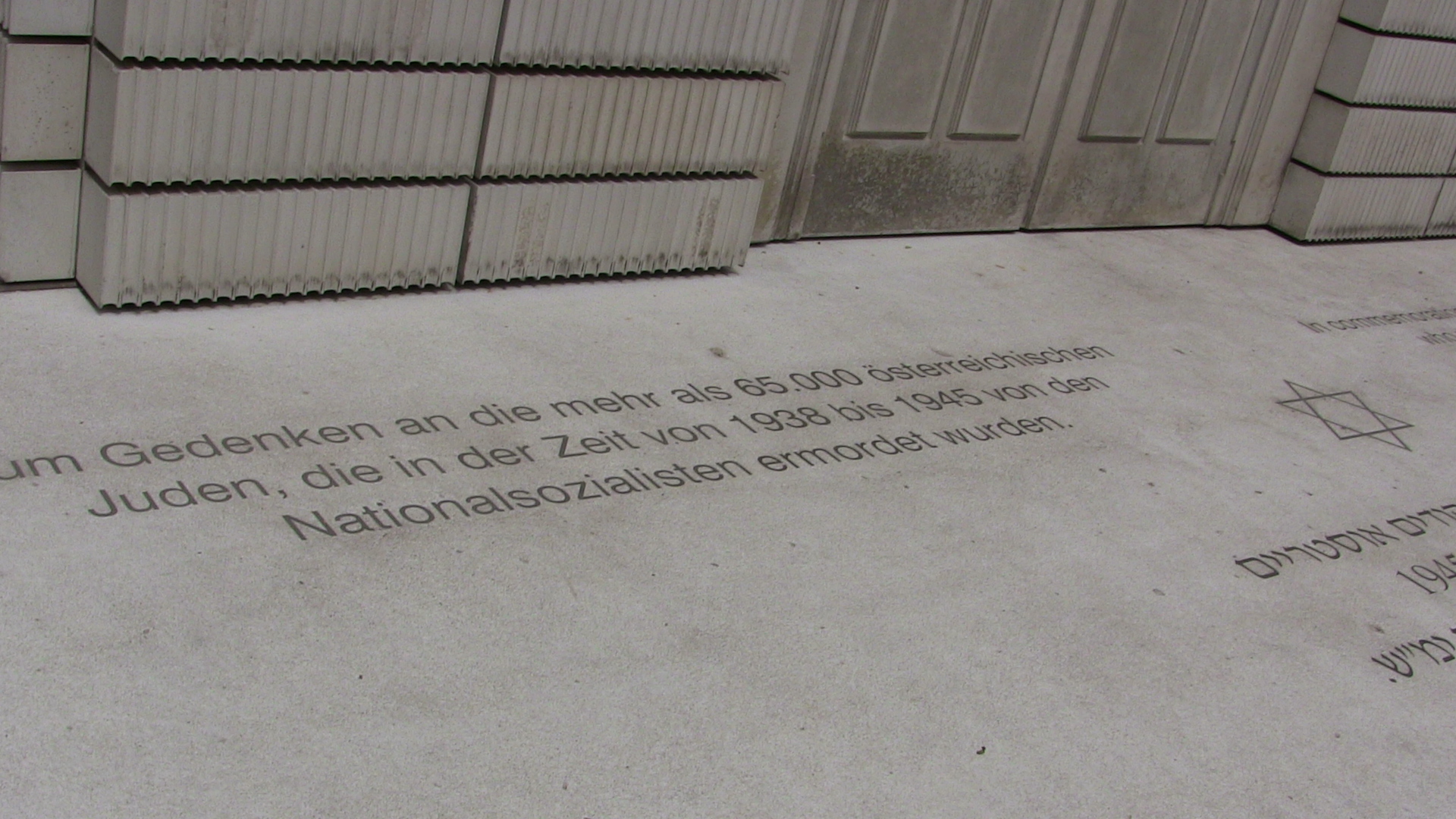
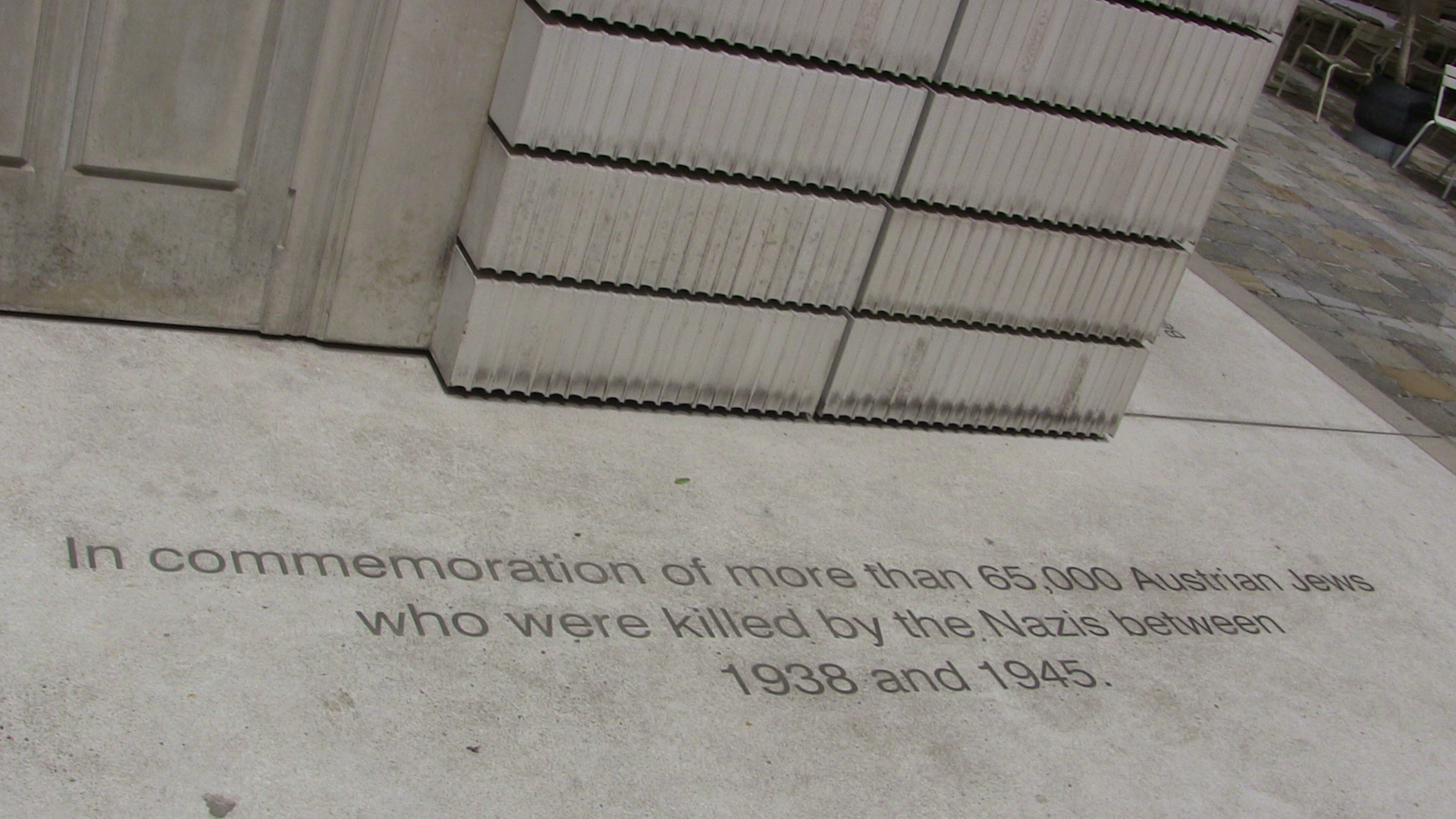
Thus, I strolled into so-called Jewish Plaza in downtown Vienna. The place has a monument that commemorates the memory of 65,000 Austrian Jews murdered by Hitler’s regime during World War II. In fact, I briefly visited this place earlier during one of my previous trips to Vienna. Yet, now looking at three identical inscriptions in three languages at the foundation of the monument I noticed something that earlier had not caught my attention. The inscription on the left is in German, the one on the right is in English, and the one in the middle is in Hebrew. The German one says, “In commemoration of more than 65,000 Austrian Jews who were killed by the National Socialists between 1938 and 1945.” So does the Hebrew one in the middle. Yet, the English version reads: “In commemoration of more than 65,000 Austrian Jews who were killed by the Nazis between 1938 and 1945.”

IMG_0687

IMG_0694

IMG_0698

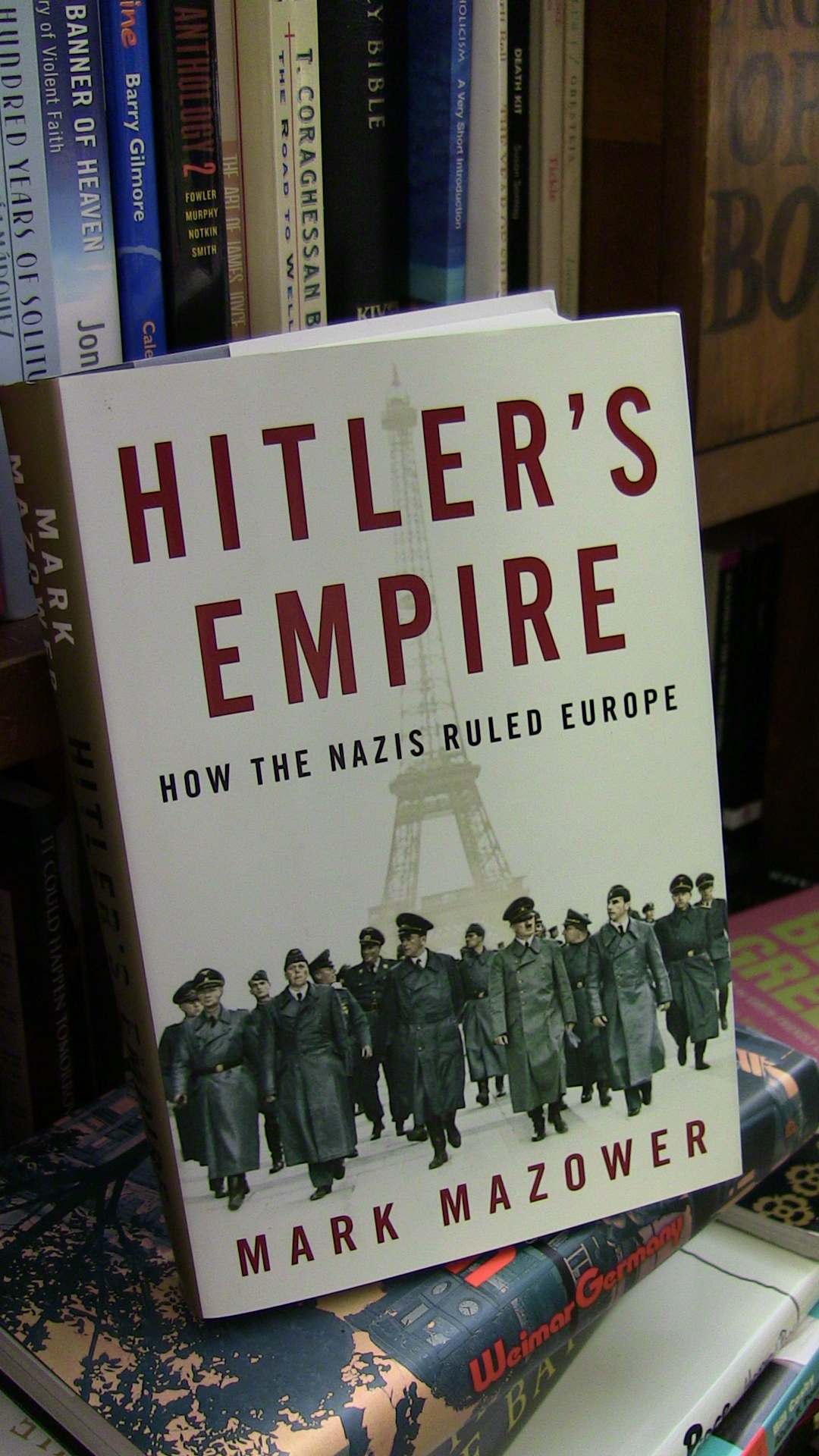
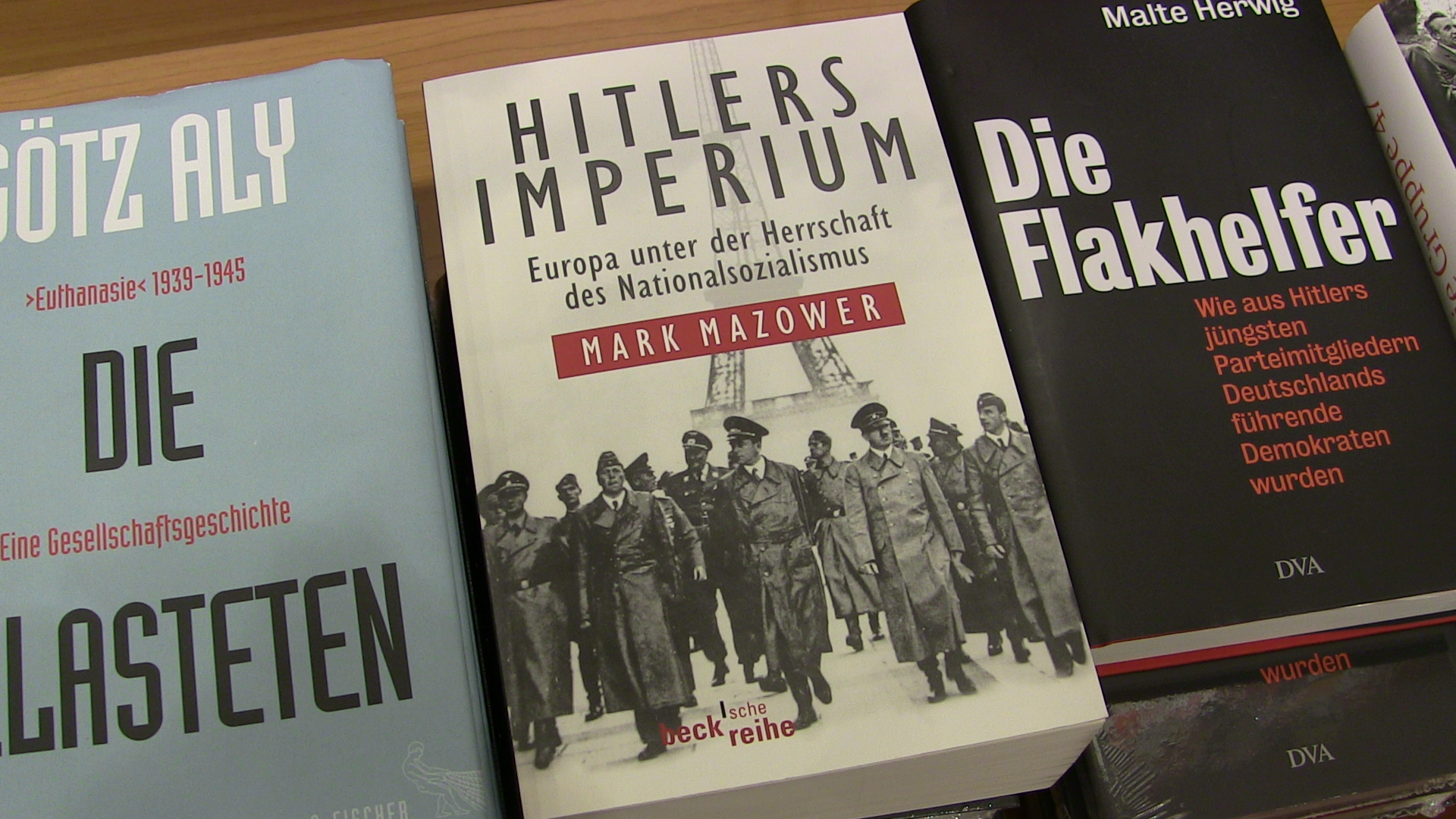
The same day I happened to go to Thalia, the biggest bookstore in Vienna. There, browsing shelves with social science and humanities literature that I stumbled upon a German translation of Hitler’s Empire: How the Nazis Ruled Europe, a 2009 book by the noted American historian Mark Mazower. The German edition of that book, which has the same cover picture, reads Hitlers Imperium: Europa unter der Herrschaft des Nationalsozialismus [Hitler’s Empire: Europe under the National Socialism Rule.]

IMG_0951IMG_0855

So I became curious about this linguistic discrepancy. Eventually, my curiosity took me further and further. The first thing one notices is that when English-speaking people write and talk about the 1930s-1940s’ Germany, more often than not they routinely use the word “Nazi.” Thus, in English we have books and articles about Nazi economy, Nazi labor policy, Nazi geopolitics, Nazi genetics, and so forth. In contrast, when Germans refer to the same turbulent years, they usually say “National Socialism” (Nazionalsozialismus).

So here is the result of my quest – an attempt to answer why in English we use “Nazi” and also who and why introduced this expression in English. The article has not been published yet. At first, I decided to prepare a brief digest of that paper and post it on this forum. Then I changed my mind. To make things more interesting, I decided to prepare a small multimedia audio presentation about why, how, and when the expression “Nazi” emerged in the first place and how it was introduced in English language and post it as a 20-minute video clip on my YouTube channel maguswest. Here it is:

National Socialists into Nazi: Politics and the English Language

A good friend of mine, who is an excellent narrator, assisted me in this. Click this link to see/listen to this talk and, if you wish, give me your critical feedback: Do not skip the ending of the clip, for it features a music tune (so-called Aviation march) that was shared by both Soviet Stalinist and National Socialist marching bands in the 1930s (words are different but music is the same).

Another Liberty Canon: Arendt

Hannah Arendt (1906-1975) was one of the more influential writers on political thought during the twentieth century. Born in Germany, her political views and Jewish origins (she was also Jewish in identity though not in religion) meant not only that she had to leave Germany after the Nazi takeover, but that she had to escape from Gestapo interrogation. A period in Paris was ended by the 1940 German invasion, which led to another escape from detention, and her final destination of the United States. She was able draw on this direct experience of totalitarianism and antisemitism to write The Origins of Totalitarianism, one of the classic works on this topic, which also considers the role of political anti-Semitism, as distinct from older religious prejudice, in the formation of the modern phenomenon of totalitarianism.

Arendt reached beyond an academic and scholarly audience in her most widely ready book, Eichmann in Jerusalem: A Report on the Banality of Evil, based on her journalistic reporting on the trial of one of the major administrators of the Holocaust, Adolf Eichmann. Though the book did much to draw attention to the extreme horror of  Holocaust, and and its history, which strange as it might seem now was not the object of a great deal of public or scholarly discussion in the immediate postwar period, also led Arendt into a morass of angry criticism and even hatred, in part for supposedly trivialising Eichmann’s criminality. However, the point of referring to the ‘banality of evil’ was not to say that the Holocaust was trivial, or to deny Eichmann’s criminality, but to suggest that as a person he was more of a small minded conformist than a grandiose anti-hero of apocalyptic evil.

From the point of view of Arendt’s work in political theory, her writing on the Holocaust and totalitarianism, contributed to her understanding of modern politics in its darkest possibilities, which were distinct from older forms of tyranny. That understanding itself drew on the breadth of her historical approach, including literary and cultural interest, which went back to the Ancient Greek beginnings of western political thought. Her understanding also included the ethical and religious thought of late antiquity, as can be seen in her doctoral dissertation, Love and Saint Augustine. She had a general appreciation of the whole of human life, with regard to consciousness and action, which is behind The Life of the Mind and can be found in some of her political theory, most obviously The Human Condition.

Arendt’s interest and appreciation of ancient politics, particularly the democracy of city state Athens,  sometimes leads to her being labelled a nostalgic and a believer in anti-individiualistic integrated communities. This can only be a parody though, Arendt thought that there might be some things to learn about modern politics through comparison with antiquity, but she did not advocate a return, and her interest in antiquity was in those communities like Athens and the Roman Republic, where we can see individualism growing and a decline in community based on adherence to tradition and to communal assumptions.

Arendt thought that the Athenians had achieved liberty of a significant kind for the aristocracy, and to some degree for the lower classes, on a real but limited basis in which some had the leisure to think and argue about the rules and laws of the city state. That form of library rested on ‘heroic’ and patriarchal values according to which the home and family are the place of economic production and therefore the place of necessity.

Liberty was understood with reference to the tradition of  heroes going to war or to a more recently evolved habit of widespread public free speech about public affairs. Arendt did not argue for this as the all time ideal, but as a moment with some ideal aspects, which was bound to fail. Partly it failed because law was understood as custom and communal obligation, rather than as concerned with contracts between free individuals.  In her historical analysis, the Romans made progress on the legal front, because they saw  that law can and should evolve with regard to the best ways of grounding freely chosen contracts,  while also failing to maintain political liberty as the republic gave way to Imperial autocracy

Arendt emphasised that the Roman model inspired modern movements for liberty, particularly the French and American Revolutions (the comparison is made in On Revolution). Though she wrote about the motives and early actions of French revolutionaries with great sympathy, she pointed out that it had all ended in revolutionary terror and then country-revolutionary autocracy, so that the American Revolution had created a better model, as shown in the long lasting nature of the Constitution. She both respected that achievement and pointed out that it rested on assumptions about the dominance of a land owning class, so that it could not in itself provide all the answers for modern liberty, even it established an enduring framework, which survived major shifts in the location of economic wealth and the sources of political power.

For Arendt, the modern capitalist world undermined the idea of a strict separation between a private realm of economic production, based on family ownership and use of land, as economic activity became what happened in factories and other enterprises, with regard to national and world markets. The social-cultural result was an undermining of the antique assumption that intellectual life is superior to, and dominant over, physical activity and economic life. It also  resulted in states that seemed more remote from traditional forms of allegiance and everyday customs, because the state became increasingly something concerned with legislative and administrative activity that aimed to enable production and trade, so for the first time establishing the state as something that aims to constantly elevate material wealth and ‘national welfare’. Arendt, in this way, argues that commercial society tends to create its own statist reaction.

Arendt equivocated to some degree about whether capitalism was to be preferred to socialism, but in political writing emphasised enhancing individuality and a spirit of competition and that can only be seen as directed against the expanding administrative state, particularly as she argued for more separation between political questions and social welfare questions. She looked for ways in which modern political participation could focus on the best parts of the antique legacy: public speech focused on the conditions of liberty rather than on expanding state activity, contests for esteem in the public sphere rather than levelling down egalitarianism.  Perhaps her equivocation about socialism can be seen as leaving the way open for ‘socialism’ as defined by left libertarians, markets without a state that promotes politically inspired concentrations of wealth and power. She was certainly a prominent critic of Soviet style state socialism.

Arendt had a grasp based in rather classically oriented political theory, of how capitalism tends to produce statist reactions to itself, which parallels the more political economy and economics oriented work of Austrian economics and Virginia Public Choice theory on  the rise of the administrative state and rent seeking.  Together with her interests in how to avoid antique tyranny and modern totalitarianism, this makes her a great twentieth century pro-liberty voice, particularly for those interested in the historical, psychological, moral, and literary aspects of political thinking.

All of Arendt’s major contributions to political thought are mentioned above. A good starting point for those new to Arendt might be the essays collected in Between Past and Future or The Promise of Politics

The European Union Needs More States, Not More Territory

The recent uproar over the upcoming vote on the potential secession of Scotland from Great Britain illustrates well the European Union’s foreign policy weaknesses. The EU’s potential to increase the number of states within its borders without having to expand its geographic space is an overlooked avenue to reaching a bolder, more sophisticated foreign policy.

Regional aspirations for more political autonomy have been voiced since the time of the creation of Germany and Italy in the late 19th century, but wars, nationalism, economic concerns, and fear of wars (along with the presence of the American military, of course) have largely kept these aspirations on the fringe of domestic political debates in Europe.

Steven Erlanger’s 2012 piece in the New York Times explains well why this is changing and what is currently happening in the European Union:

The great paradox of the European Union, which is built on the concept of shared sovereignty, is that it lowers the stakes for regions to push for independence.

Erlanger also goes on to quote a scholar at the European Council on Foreign Relations:

‘The whole development of European integration has lowered the stakes for separation, because the entities that emerge know they don’t have to be fully autonomous and free-standing,’ said Mark Leonard, the director of the European Council on Foreign Relations. ‘They know they’ll have access to a market of 500 million people and some of the protections of the E.U.’

The European Union has essentially taken the place of the nation-state as the chief entity in charge of standardizing trading policies in Europe. This political setup is a great opportunity for regions that have been absorbed into larger nation-states to assert more fiscal and political independence because of these regions’ new interdependence with a larger part of the European economy. The confederation has provided an opportunity for smaller states to emerge while at the same time providing these small state polities with a range of options and allies that are often missing from small states’ repertoires. The best of both worlds has a chance to flower: local governance and total participation in world trade.

This is better understood with a quick historical sketch of 19th and 20th century Europe in mind.

In the last decades of the 19th century the large nation-states of central Europe – Germany and Italy – had just been formed after centuries of being composed of hundreds of small polities. These small polities were parochial, and many of these polities’ elite factions had erected protectionist barriers around their small territories. These newly established nation-states were flanked on their eastern borders by cosmopolitan-but-despotic empires operating from Vienna, Moscow and Istanbul, and to the south were small Muslim polities haphazardly connected to the Ottoman Empire and economically dependent on Mediterranean piracy and Saharan trade routes. To the north and west: oceans and the seafaring, imperial regimes of Great Britain, the Netherlands, and France.

A map of Europe in 1800 AD. Look at how many polities are in what is now Germany and Italy. Thanks goes to euratlas.com

The formation of these larger nation-states were undertaken, generally speaking, in order to unify territories considered to be connected under various broad cultural domains into a cohesive political units and mercantile trading blocs.

After Germany and Italy achieved political unification, programs geared towards creating economic spheres of influence within the territory of the new nation-states began to be implemented. The creation of nation-states in central Europe had the contradictory result of opening up free trade zones within the territories of nation-states while simultaneously erecting new trading barriers that targeted individuals and factions not connected with the new nation-states. Free trade won in the domestic arena of these new states, but it also lost out internationally.

The political unification of these nation-states did not go down well with a myriad of factions. The reasons for resistance were varied, but suffice it to say that there was an intense backlash against the centralization of power and the nationalization of everyday life in the new nation-states of central Europe.

To counter regional resistance, proponents of political centralization argued that political union halted the wars that had wracked Europe for centuries (the economic benefits of freer trade were touted as well, but this argument did not have the same clout as it does today). However, this intellectual argument was framed in nationalistic terms, so when it trickled down into the public sphere of European life what emerged was a solid case against regional fracture that involved one part peace and one part national chauvinism.

The end result of this was the destruction of Europe through two large-scale, horrific wars.

The European Union has succeeded where the nation-states of Germany and Italy failed: by creating a massive free trade zone that eliminates protectionism (as the German and Italian nation-states did), and the necessity of cultural chauvinism (“nationalism”)  to maintain legitimacy (which the German and Italian nation-states could not do), the European Union has provided Europe with an incredible opportunity to build a lasting peace.

Adopting a requirement for member states  to incorporate a constitutional option that allows for referendums on secession would be a bold move that would not only bring a higher level of sophistication to EU foreign policy, but also fluster Moscow without edging closer to its borders (think about the example this would set in Russia’s own self-styled federation).

Deviant Tendency: An inside look at the politics of Iran

[Editor’s note: the following is a short essay by Payam Ghorbanian. Payam was born in Tehran, Iran. He got his bachelor of science in Engineering from Zanjan University in Zanjan, Iran. He has been participating in liberal political activities and he was involved with some think tanks in Iran. He is doing research in the field of international relations and Iran’s foreign policy as an independent activist. He is now living in San Jose, California.

I am excited to post his thoughts because of their potential as a conduit for intercultural dialogue and exchange. I have left his essay largely intact, but did break up some of his longer paragraphs for clarity’s sake. Thanks to Payam for taking the time to write this, and you can find his other essay at Notes On Liberty here, here, and here]

Last month was kind of exciting for me. Mahmoud Ahmadinejad’s brother said “… my brother has gotten rid of his deviant friends…”. The term “Deviant Tendency” has been using in Iran for calling Mr. Esfandiar Rahim Mashaei and his followers. Mr. Mashaei had been represented by Ahmadinejad for being the next president of Iran but the Guardian Council of the Constitution turned that willing down. Therefore Ahmadinejad left his office while he was so disappointed and at that time he said that the council has just deprived Iran of having a distinguished president. Although with “Approbation Supervision”, which implies the right for acceptance or rejection of elections legality and candidate’s competency, probably just the supreme leader and his followers can be qualified through the barrier of the Guardian Council.

I do not really care about this rumor whether or not Ahmadinejad and Mashaei are separated, the issue would be what Mr Mashaei’s political and social views are and what it is wrong with that. Also why the supreme leader and his followers do not like him? Why they tried to make him isolated even though he has no official title? As you might know during the second term of Ahmadinejad’s presidency, Mashaei was the chief of staff of the president of Iran. But why are they still scared of him? I should mention this that from my point of view, I am 100 percent sure that they (Ahmadinejad and Mashaei) just made this ending relations story up to have this chance for getting qualified for the next presidency election. But why are the supreme leader’s followers so excited of hearing that rumor? Apparently they still like Ahmadinejad but just him and as they said there would not be another chance for the combination of Ahmadinejad plus Mashaei to survive.

Now pay attention to these quotes:

“The area of Islamism has come to end, we had an Islamic revolution in 1979 but the area of Islamism is finished”

or

“Today, Iran is friend with American and Israeli people, No nation in the world is our enemy.”

These sentences and quotes have been told by the nearest person to Mahmoud Ahmadinejad, who is Mr. Rahim Mashaei. Obviously one could talk about these ideas in the free world and no one is going to be prosecuted because of that. However, talking about ending of Islamism inside a revolutionary country like Iran would be insane. I believe these types of moderation comments about Islam and also talking about people of Israel and United States not to be enemy of the Iranian people were all about politics, and Mr. Mashaei did not believe in what he said. But what were his points at that time?

It was the time that Green Movement and protestors confronted against rigged election. I would say Mashaei did all these things to reduce pressures over Ahmadinejad and in order to deceiving and poisoning the people’s mind, those people of the middle class who desperately believe in the new relations between Iran and the free world. Also I believe Mashaei did all these things to be a target instead of AhmadiNejad, which is literally about what old friends do for each other.

In Iran and especially in Shia beliefs of Islam, an ultimate savior of humankind and the final Imam of the twelve Imams will emerge with Jesus Christ and will set the kingdom of heaven on the earth to bring peace and justice to the world. It is the belief that the twelfth Imam disappeared hundreds of years ago and went into occultation state, but he will definitely re-appear around the end of the world, before the Day of Judgment. Before the Islamic revolution in Iran and probably before uprising of Ayatollah Khomein, there was a common trend that Shia would wait up until its survivor comes back. However, Khomeini argued that government should be run with traditional Islamic rules and for this to happen a leading Islamic jurist must provide “Guardianship” and as he said “Wilayat” over the people. This guardianship would be remained till the Twelfth Imam returns.

At that time this theory was accepted by the revolutionists and as the result of that, the last king of Iran felt down and “Wilayat AL Faqih” (guardianship of the Islamic Jurists) popped up. The terms of your majesty were destroyed and the Imam and the Wilayat was established and then the supreme leader was considered as the twelfth Imam’s deputy, which means that his orders are the lord’s orders and any questions or criticizes would be called as hostility against the twelfth Imam. This chart will help you out to understand more clearly about the hierarchy of Imams in Shia.

When I was living in Iran I always heard some rumors about the distinguished people who they or their followers believe that they are in connection with the twelfth Imam. They claim they can talk to him in person and get orders from him without any problem. Probably in the past they could take advantage of people’s stupidities. However, they had never been accepted by the politicians inside Iran before Ahmadinejad’s presidency started. Now you can tell why they have been called as Deviant Tendency. Mashaei claimed that he could talk to the twelfth Imam in person and he believed that when we can have access to the real source, why we should follow his deputy, who does not have any confirmation from the real lord.

chart of persian imams

Before Mashaei tried to extend his theory, the revolutionary guard crippled all of his ambitions subsequently. His followers were arrested and he was about to get caught too but it seemed that Ahmadinejad was completely in agreement with what he was saying. Ahmadinejad tried to protect Mashaei but as you know he lost the protection of the supreme leader. As a result, his authority dropped considerably. He got teased and he lost his connections and finally he got kicked out of the power circle and all of these were about his friendship with Mashaei, which he truly believed in him.

And now the new game has just started. First it was announced by Ahmadinejad’s brother that there would not be any connection between his brother and the deviant tendency. Then Ahmadinejad had a speech in Mashahd, one of the most religious cities in Iran where the 8th Imam of Shia has been buried, and he said:

“… the only way to overcome the enemies of the nation is standing on the value of our goals in the same way that Khomeini has showed us. I would totally remain on that way to serve the nation and revolution and its values and principles.”

He also tried to imply on revolution principles, the principles that revolutionists believe has been neglected after Rohani became a president.

Another Liberty Canon: Nietzsche

The political interpretation of Friedrich Nietzsche (1844-1900) is a constantly fraught issue. Amongst other things he has been taken as an anti- or non-political thinker and as responsible for the worst aspects of German politics in the twentieth century. However, that latter view is not supported by any Nietzsche scholars.

The reasons for that include his opposition to the anti-Semites of his time (after a youthful leaning in that direction with regard to culture rather than race) and his opposition to the militarist-statist-nationalist aspects of Prussian and German politics in his time, again after early leanings towards culturally oriented nationalism. The tendency to put culture above the state and take it as something of a replacement for politics was constant.

The anti-politics is itself not incompatible with some kinds of libertarian and classical liberal thinking, though in Nietzsche’s case it goes along with a constant inclination to talk about power, the state, and other politically charged issues. He was stateless for most of adult life, as he had to renounce Prussian citizenship to take up a Professorship in Basel, Switzerland in 1869, not long before the King of Prussia became the Emperor of a newly unified Germany, dominated by Prussia. Nietzsche himself was in any case from a part of Saxony, annexed by Prussia early in the nineteenth century.

In any case, Nietzsche did not present himself as a Saxon or a Prussian after leaving Germany and only lived in Germany after 1889, when he was incapacitated by paralysis, now generally believed to the the result of a brain tumour, and was looked after by his mother and sister.  Nietzsche did not have any citizenship after moving to Basel and though it was easier to travel round Europe in those days  without a state issued passport, it is still a remarkable position.

Nietzsche was not completely free of racist assumptions, but hardly to a degree at all unusual for his time, and he did not see race as a suitable basis for analysing the Europe of his time, since he thought races had become completely mingled in antiquity. He was inclined towards various forms of elitism, sometimes in a quite extreme way as when he claimed admiration for the Indian caste system, though in a very brief provocative way.

On the whole his elitism was devoted towards the self-creation of an individuality of great strength, great plural possibilities and the capacity to unify those possibilities in creation and in a creatively lived life. He had anxieties about mass culture and the rise of democracy, but there is not much to separate his substantive concerns from the general concerns of liberals of the nineteenth century, as in Alexis de Tocqueville’s analysis of the ‘tyranny of the majority’ and democratic mediocrity in culture in Democracy in America.

Nietzsche is sometimes referred to as the definitive anti-liberal, but a lot of this rests on associating liberalism with egalitarian (i.e. left, progressivist) liberalism. If we look at the classical liberals from Locke to Mill (who is a bit transitional between the two broad liberal approaches), we of course see that egalitarianism at least with regard to distribution of income and property, is not a central goal. There is growing interest in expanding legal and political equality beyond an aristocratic elite to the population as a whole, and criticism of aristocratic, monarchical, guild, and merchant-financial wealth where linked to political-monopolistic-protectionist privileges.

Nietzsche regards threats to personal, intellectual and cultural excellence as a possible outcome of democracy, but is also critical of the traditional state, referring to it sometimes as monstrous, and allows for the possibility of it becoming much reduced through transferring functions to the private economy. He was concerned that liberalism might betray liberty by building institutions which constrain the original liberal ideas. So he was not a complete critic of liberalism, but rather sets out ideals of self-development and individual flouring which are likely to be constrained by the state.

Though he mentions the possibility of replacing state functions with private economic activity, he was critical of commercial spirit. He feared that commercial orientation tends to reduce individual capacities, because of the ways in which it leads to individuals concerning themselves with the wants of other individuals. For most pro-liberty people, this is Nietzsche accurately identifying something good about capitalism and then rejecting it, which does at least leave Nietzsche as a good analyst.

Beyond this though, Nietzsche who never advocates a socialist economy or a return to pre-capitalist economics, is doing something similar to his criticism of liberal political institutions. He is showing that liberal commercial society both sets up an ideal of strong individuality, which it needs and then undermines it through the constraints of economic life. So the reason for a critical attitude towards capitalism is recognition of the tension between the kind of individuality produced by earlier societies which revolves around struggling with nature for survival and often wars with other states, and the kind of individuality produced by working to provide more than the mere means of survival for others in societies based round rising economic prosperity.

This tension was recognised by classical liberal thinkers like Adam Smith and Wilhelm von Humboldt.  Nietzsche takes further the concern that individualism requires an individual self-directed struggle for increased physical and psychological capacities, and that the culture of commercial society produces an economic elite that seems hardly distinguished from the mass in its personal style and culture, so fails to provide any example of greatness and excellence in these respects.

A classical style liberal of the twentieth century, Joseph Schumpeter (most famous as author of Capitalism, Socialism and Democracy, 1942), argued that individualistic capitalism tends to undermine itself through the creation of corporate bureaucracies, where commercial constraints may become separate from much decision making, and where individual creativity is stifled. Many liberty oriented thinkers have noted the tendency of capitalists to undermine capitalism by seeking a privileged relation with the state, so accepting the mediocrity of state imposed uniformity.

Nietzsche was hyperbolic and expressive and little informed about economics, but the hyperbole has a precise aim in drawing our attention to problems, and Nietzsche’s cultural capacities (including a strong interest in natural sciences) made him sensitive to some features of capitalist and democratic societies, which need to be counteracted if excellence is to flourish.

If one thinks that liberty merely, only, and purely means lack of state constraint, Nietzsche’s thoughts may not seem so meaningful. However, if we see liberty as including not only restraints on state power, but the value of individual pursuit of excellence for its own sake and to produce individuals who are not conformist and state-centered, then Nietzsche must be one of the great thinkers about liberty.

As with Kierkegaard, it is difficult to recommend a single major Nietzsche text on political thought. On the Genealogy of Morality tends to be the starting point for discussion of his political ideas, but covers many other topics, and Human, All Too Human contains his thoughts on the possibility of a reduced state in a commercial society. Untimely MeditationsDawnThus Spoke Zarathustra, Beyond Good and Evil, Twilight of the IdolsThe Anti-Christ, Birth of Tragedy, Ecce Homo, and The Gay Science are the other books of Nietzsche, and all contain passages discussed by commentators on Nietzsche and politics.

Surowiecki on Intellectual Piracy

James Surowiecki had an excellent article in the June 9 issue of the New Yorker about countries committing intellectual piracy. It includes a nice summary of how “stealing” patented ideas played a major role in the early economic development of the United States. In the process, it surveys some of the considerable historical evidence debunking the widespread myth that intellectual property is necessary for, or even makes a contribution to, economic growth.

Another Liberty Canon: Kierkegaard

Søren Kierkegaard (1813-1855) is well known for his contributions to philosophical and religious thought, and for the literary qualities of his work in these areas. He has not been so well known as a contributor to political thought, though there is now a growing amount of scholarly commentary in this area.

Generally his politics has been seen as directed by an extreme kind of conservative reaction against changes, and particularity movements of  democratic and constitutional change in Denmark in his own time. The sense that he was conformable with the most absolute and conservative kind of monarchism possible has been accompanied by the sense that he was anti-political, that he just did not like politics, which connected with the supposed conservatism, because if there is no need for change in political structures, there is no need for political discussion and thought.

These positions might have some appeal to some libertarian-conservative fusionists, and do have some basis in some aspects of Kierkegaard’s thought. However, his thought cannot be properly characterised overall in this way, which would connect Kierkegaard at a relatively popular level with the political thinking of J.R.R. Tolkein, or at the more historical scholarly level with Robert Filmer, the English ultra-monarchist criticised at length by John Locke, or the Savoyard (French-Italian) ultra-monarchist critic of the French Revolution, Joseph de Maistre.

More justified connections can be made with David Hume, for example. Hume was cautious about both political change and claims that the authority of existing political institutions rests on either reverence for the past, or very deliberate conscious popular consent. Hume thought that though societies with political and legal institutions probably did originate with a contract of sorts between government and governed, such contracts cannot bind future generations, and the ‘contract’, or set of relations, between individuals and the state, are open to reform and renegotiation.

Kierkegaard’s comments on the politic currents of his time, suggest that he had a strong understanding both of the belief in the absolute authority of existing institutions, and of the wish to create a new absolute, in a spirit of revolution. His own view is that negotiation and renewal are desirable, and are certainly inevitable, which he saw as the need to revise historical contractual agreements.

Kierkegaard certainly did not wish for individuals to make politics the highest aspect of their lives, as this would detract from the individual relation with God, which was the central interest of this passionately religious man. However, that is not to say that Kierkegaard thought Christianity gives the answer to everything in worldly life, or that Kierkegaard had nothing else driving him. A passion for writing, which has a strong element of self-exploration even if though the medium of fiction and the pseudonyms, which are used in his books, or as fictional authors for many of his widely read books.

The writing and self-exploration converge, for Kierkegaard, in the understanding and communication of the deepest relation of the self with itself as necessarily a relation with God. The recognition of something more than momentary about the existence of the self, leads to a recognition of an absolute aspect of the self, and a struggle with any dissolution of the self into a series of moments. This was Kierkegaard’s way of exploring the value of the individual, and the word ‘individual’ is frequently and frequently orientates his writing. In this, he provided a great way of thinking about the value of the individual for any political thought concerned about the liberty of the individual, and why that should be at the centre of politics.

Kierkegaard saw in the more absolute kinds of political thought a desire for a version of God, and in doing so provided the basis for distinguishing between a politics that recognises limits to what it hopes for from the state and collective action, and a politics that tries to impose itself on society by turning the state into a substitute for God.

Kierkegaard was very critical of the state church, even though his brother had made a career in it, and suggest that dependent on the state weakened religion, as other forms of dependence create other forms of weakness. He did not argue for a pure nightwatchman state, or individualist-anarchism, but he did argue for caution about how much the state does, and for taking individual responsibility for assisting those who have met with misfortune.

In his emphasis on the individual in his understanding of Christianity, Kierkegaard also understood that Christianity places an enormous burden on the individual compared with earlier forms of thinking, in which the individual is primarily thought of as part of a family or state. Kierkegaard was particularly concerned with the ancient Greek and Roman city states in this context, including the literature they produced. He placed value on his own small city of Copenhagen for preserving some of the value of ancient city-state, where the individual can draw strength from connection with others in a very concrete community, without wanting to see the individual subsumed into any kind of communal or collective identity.

For Kierkegaard, the more worldly part of our lives rests on more than living under a state defined  by law or a society defined  by universal rights, necessary though these are. We need engagement with our social world, including its political debates. Though Kierkegaard was a great loner in some respects, he did walk regularly though crowded parts of the city, live near the centre, accept that he would be recognised,  contributed to magazines, and existed as a public figure, which was sometimes uncomfortable for him, but was never a role he excluded.  He was attacked as an eccentric in the press and condemned as a diabolical figure by some of the church establishment, but like his hero Socrates reacted with humour, intelligence and the assumption that the independent, even self-contained, individual deals with difficult public controversies. In his ways of bringing together an antique commitment to public life and a more modern sense of strong individuality, Kierkegaard made a remarkable contribution to themes which preoccupied the major classical liberal thinkers, like David, Hume, Benjamin Constant, John Stuart Mill, and many others.

It is not possible to recommend specific political theory texts by Kierkegaard, and just about everything he wrote can be read with great reward in association with the issues discussed above. A good starting point for a focus on the more political Kierkegaard though is the literary reflections in Two Agesfollowed up by the three masterpieces of 1843 that established his importance. The most immediately readable is RepetitionFear and Trembling is also relatively short. Either/Or is long and complex, but very rewarding and can itself be followed up by reading its sequel Stages on Life’s Way.

My REASON review on the Panic of 1837

My review of Jessica Lepler’s The Many Panics of 1837: People, Politics, and the Creation of a Transatlantic Financial Crisis appears in the July issue of Reason. It has now been posted online.

Only after agreeing to review the book and receiving my copy, did I realize that Lepler’s study was far too academic and specialized for the typical Reason reader. But previously, when they had asked me to review Thomas Fleming’s Civil War book (A Disease of the Public Mind) and I had agreed, it turned out to be an awful example of cliche-ridden, superficial pop history at its worst. So I told them it wasn’t worth reviewing, and I didn’t consider it wise to do that again with the Lepler book, even though it would have been for the exact opposite reason.

A much better, recent book on the panic of 1837, despite my disagreeing with most of its interpretations, is Alasdair Roberts’s America’s First Great Depression: Economic Crisis and Political Disorder after the Panic of 1837 (2013). I mentioned it in the first draft of my Lepler review, but it was in a section that Reason edited out.

New Issue of Econ Journal Watch: Does Economics Need an Infusion of Religious or Quasi-Religious Formulations?

The new issue of Econ Journal Watch is out and EJW has teamed up with the Acton Institute to feature ‘religion and economics’ as the topic for a symposium.

As some of you may know, my fellow Editor-in-Chief Fred Foldvary is an editor for the journal, and Warren is the math reader, so this project holds a special place here at NOL. I just wish they’d be a little less humble about their endeavors elsewhere and share this type of stuff themselves (this humility is a recurring problem in the libertarian quadrant of the blogopshere)!

At any rate, here is the lineup:

The Prologue to the symposium suggests that mainstream economics has unduly flattened economic issues down to certain modes of thought (such as ‘Max U’); it suggests that economics needs enrichment by formulations that have religious or quasi-religious overtones.

Robin Klay helps to set the stage with her exploration“Where Do Economists of Faith Hang Out? Their Journals and Associations, plus Luminaries Among Them.”

Seventeen response essays are contributed by authors representing a broad range of religious traditions and ideological outlooks:

Pavel Chalupníček:
From an Individual to a Person: What Economics Can Learn from Theology About Human Beings

Victor V. Claar:
Joyful Economics

Charles M. A. Clark:
Where There Is No Vision, Economists Will Perish

Ross B. Emmett:
Economics Is Not All of Life

Daniel K. Finn:
Philosophy, Not Theology, Is the Key for Economics: A Catholic Perspective

David George:
Moving from the Empirically Testable to the Merely Plausible: How Religion and Moral Philosophy Can Broaden Economics

Jayati Ghosh:
Notes of an Atheist on Economics and Religion

M. Kabir Hassan and William J. Hippler, III:
Entrepreneurship and Islam: An Overview

Mary Hirschfeld:
On the Relationship Between Finite and Infinite Goods, Or: How to Avoid Flattening

Abbas Mirakhor:
The Starry Heavens Above and the Moral Law Within: On the Flatness of Economics

Andrew P. Morriss:
On the Usefulness of a Flat Economics to the World of Faith

Edd Noell:
What Has Jerusalem to Do with Chicago (or Cambridge)? Why Economics Needs an Infusion of Religious Formulations

Eric B. Rasmusen:
Maximization Is Fine—But Based on What Assumptions?

Rupert Read and Nassim Nicholas Taleb:
Religion, Heuristics, and Intergenerational Risk Management

Russell Roberts:
Sympathy for Homo Religiosus

A. M. C. Waterman:
Can ‘Religion’ Enrich ‘Economics’?

Andrew M. Yuengert:
Sin, and the Economics of ‘Sin’

Not too shabby, eh? I’ll admit upfront I haven’t been able to read any of the articles yet, but once I find some work out here in Austin I’ll be able to patch together a schedule that’ll allow for a little leisure. You can always download the entire issue, too (pdf). Econ Journal Watch is an important project that is dedicated to exploring and criticizing the underlying assumptions of the discipline of economics, but it is done in a way that is classy, professional, and informative.

Another Liberty Canon: Montaigne

Michel de Montaigne (1533-1592) might be the least controversial of the list of thinkers who have inspired me on liberty, but are not part of the standard list of thinkers on liberty. He even appears in the extensive collection of the Online Library of LibertyNevertheless there is a need to develop more the nature of his thoughts on liberty, and related subjects, and not just leave his ideas in the hands of commentators who are not liberty oriented, who may be over optimistic about collectivist and state schemes to rectify various forms of dissatisfaction.

Amongst other things, Montaigne offers an ethic of individuality, which is not too tied to some very specific moral theory, and which is neither narrowly egotistical nor a demand for self-denial. He explores his own strengths and weaknesses with sometimes unsettling frankness to establish a form of individuality that is both affirmative and self-questioning.

Montaigne’s life work was his Essays, which are in large part concerned with a life lived through writing and through the reading of books, which inspire Montaigne’s own writing. This came fairly late in life though, after a career as a local judge, and a period of melancholy which may have been connected with the death of his friend Etienne de La Boétie, himself the author of a classic of liberty minded political thought, ‘Discourse on Voluntary Servitude’.

Montaigne spent much of  his time in a tower on the family estate, writing in a book lined study. He did not write a big continuous integrated book, rather he wrote a series of essays of very variable length, which became the large cumulative classic, Essays. The individual essays range in length from about a page to more than two hundred pages in the case of ‘Apology for Raymond Sebond’.

The title and themes of the essay just mentioned can be taken as an illustration of Montaigne’s way of writing. Sebond was minor Medieval philosopher, who seems to have been a follower of Thomas Aquinas, translated by Montaigne’s father, and accordingly the essay has an element of filial piety in its origin. However, the essay has little to say about Sebond’s philosophy as it ranges through the link with his father, the context of writing, numerous philosophical themes largely established in discussion of ancient thinkers, including animal nature, knowledge, doubt, and being.

Montaigne’s explorations in his essays, longer and shorter, are on his own account rambling and contradictory, though they are also written with great literary style and at a high level of reasoning with regard to the difficulties of arriving at consistent positions. Part of this is that his writing is about himself, what is going in his mind at the time of writing, and therefore what reflects his passing moods and ideas.

The result is not a mess of unconnected thoughts, but a simultaneous exploration of how the mind works and the workings of the world in which the mind exists. The emphasis on the self is a confirmation of the moral importance of the individual and Montaigne is one of the major contributors to the idea that every individual perspective and every inner world matters.

The importance of every unique consciousness is expressed in a revulsion at cruelty, in the use of state power, or in any other kind of context, which is both horror cruelty at others and despair at futile forms of self-sacrifice. Our regard for the world created by someone else exists together with our own determination to prudently preserve  our own world of experience.

There is self-criticism in Montaigne’s account since he had been a judge and was very aware that a perfectly just judgement was not always possible. The judge has duties to follow the letter of the law and the history of interpretations of that law, which do not always harmonise, so undermining the idea of perfect justice. Furthermore, both these requirements may often prevent a judge from acting according to inner conviction about the relevant facts of a case and the moral evaluation of them.

He was painfully aware that the poor tended to come off worse from such constraints. In general he took some pride in an understanding of the condition of the lower classes that his father had encouraged. Though he made no claims to great generosity towards the poor, he does provide an example of thought about how state acts, and other actions, change the lives of weakest and most marginal in unintended ways.

Montaigne does not have a clear suggestion to offer on how to avoid such problems. He does entertain some utopian scenarios in which humans live spontaneously,  according to perfect justice in small self-sufficient communities without a state, and without judges, or ‘expert professionals’  of any kind. Montaigne was sceptical about medicine as well as lawyers, and was an early critic of the idea of imposing ‘rational knowledge’ on communities.

We must also be aware that Montaigne offers a utopia here, and one in which property accumulation  and communication, commercial or otherwise, between communities does not exist. He did not think that would be desirable, so does not offer a consistent non-state vision or vision of pure custom replacing law and imposed expertise. He does offer a powerful sense of how these things can go wrong and the need to temper and contain them, in a way of thinking in which every individual counts, just as nature can create anything, and even the most ‘monstrous’ creations are to be valued as part of the abundant possibilities of nature. 

In some respects, Montaigne is an enigma, and not just because of the shifting point of view he offers. He is evasive on the difficult questions of the time: Was he a republican  or a monarchist? Was he a Christian? Was he a Catholic? He adopts the pose of a moderate monarchist and moderate Catholic Christian, but there are plenty of hints of doubts and leanings towards other perspectives.

I am inclined to think he was a religious sceptic, with strong materialist leanings, and a republican at heart, but there is no certainty about this. Though his prudence on these issues partly reflects the dangers appearing to oppose the state authority and state church of monarchist Catholic France , his capacity for such elaborate and complex prudence shows a capacity for tolerance, understanding, and inclusion, that is its own message.

Ultra-libéralisme – A French Tale

I am in frequent correspondence with a French retired businessman in his sixties. He is a thoughtful man with minimum formal education but who reads two newspapers a day and watches French news on television several times a day. My informal judgment (as a retired teacher) is that he possesses intelligence well above average. His interest in political matters is through the roof. My French friend is also strictly monolingual. That is, he gets all his information in French.

My friend sent me recently the following email I had trouble understanding, at first. (My own careful translation. My first language is French. I have published in that language.)

“The European Financial Markets Authority (EFMA) has downgraded the three main international credit agencies that, themselves, upgrade or downgrade European and other countries. It’s a just reward*… and a good defense against these agencies which possess no legitimacy at all except from the fact of their existence; agencies that seek to estimate the worth of those countries (and, perhaps, to play the stock market [on the basis of their own assessment]). No an easy issue. Perhaps this is going to calm down the yo-yo effect financial speculators have on the stock exchange…..I even thought a few years ago of sending a personal note to those credit agencies.”
(Bolding mine)

Two salient points in this communication: First, the EFMA is a European Union “authority,” a government agency emanating from the individual EU countries’ national authorities. It’s a complete government body.

The second comment is related to the first, I believe. My friend states categorically that US-based credit agencies (Moody’s, S&P and Fitch Ratings ) have “no legitimacy” because they are not government agencies, precisely. This expresses a mental world whereas all legitimacy flows, can only flow, however indirectly, in however contorted a fashion, from the electoral process. He really thinks that the IFMA’s puerile tantrum is going to change the credit game decisively.

Within an American intellectual context, this sounds almost like the thinking of a madman. Yet, my friend is not mad. I have known him for dozens of year. He acts rationally in every aspect of his life. He is also decisively and loudly critical of French political life in general. The problem is simply that he is French, that he receives all his information from French sources, that his mind has been shaped by French economic thought (or un-thought).

His rage against the credit agencies is not based on a factual analysis of their performance either, which would certainly be a useful exercise after the 2008 world-wide financial crisis. His rage is based entirely on the violation of sovereignty by these non-legitimate bodies.

I often ask myself the rhetorical question, ” How much would I have to be paid to….?” In this case, I can’t come to a figure. I don’t know how I would begin to explain to my French friend the idea that credit agencies get most or all of their legitimacy the from the fact that they are precisely not government agencies. I could not tell him the obvious without being interrupted, I am sure: When economic actors begin doubting the credit ratings these agencies assign to organizations emitting bonds and to governments, they will swiftly collapse on their own. That is, this abstraction, the market grants them all of their legitimacy.**

The concept of markets, counter-intuitive in the best of times, has almost completely disappeared from the French consciousness. In 2012 I watched on French language television in horrified fascination the lively debates preceding the presidential election. That was after an ambitious New York District Attorney had disqualified the most likely winner who was both a qualified economist and a sex maniac. (I mean Strauss Khan, the then-current head of the International Monetary Fund and a very moderate nominal “Socialist.”)

French pre-election debates are both more lively and better staged than their US equivalents. In the first round of a two-round system, the candidates are grilled longer, more directly, more pitilessly than anything I have seen on American television. In this case, these animated and sometimes vicious discussions went on for weeks without the most serious economic questions obviously (to me) facing the country being addressed at all. I mean, of course, a large and fast-rising debt burden and the failure to grow the economy. The attendant permanent high unemployment often came up but I think that no candidate bothered to mention that strong economic growth melts unemployment .

There were ten candidates in the first rounds, including one each from: the New Anticapitalist Party and Workers’ Struggle (Wikipedia’s translation). There was not a single seat at the feast occupied by a conventional conservative party, a Tory party. There was no “liberal” chair at the dinner in the English sense of the word that would prevail in France if the term were used at all. (See below.). If the role of the market in both producing innovation and correcting wrong turns was ever mentioned during the whole campaign (first and second round,) it left no impression on anyone. There were plenty of arguments and proposals concerning taxes. They were all couched in terms of “fairness.” None was about the fundamental fact that taxes, even low taxes limit the virtuous work of the market and therefore shackle economic growth (which has practically ceased to exist in France).

The French candidates also kept their eyes averted from, or dismissed summarily the example of Germany next door which successfully reformed its welfare state in a more market direction ten years earlier.

It’s not that there are no “conservatives ” in France. So-called “cultural conservatives” abound. Large segments of the population become exercised about the right of homosexual couples to adopt and even about host womb fertilization. The puerile excesses of the post-1968 strange, make-believe revolution alone would ensure the existence of such conservatism if it did not have deep roots in the country (see below). Sex hounds like Strauss-Khan have always existed in France but 1968 gave them permission to act openly and more or less brazenly, thereby exciting the Catholic minority’s ire and disgust.

The absence of liberal economic thought in France is the result of a historical accident, a major one to be sure. At the end of World War II, the segments of French political society who had taken an active part in the resistance again the Nazi occupation took over. Soon, they constituted nearly the whole of the political class. The two main segments were the Communist Party and a shifting alliance of “Gaullist” parties, with the Socialist Party playing the role of permanent opposition until 1981. The Communists – nominally Marxist though few of their leaders had read any Marx – were obviously not believers either in the efficacy or in the morality of market mechanisms. The fairly large Socialist Party was kept in a permanent state of primitive vulgar Marxism by the necessity in which it found itself to compete with the Communists for its electorate.

The political right was occupied by Gaullists with serious ties to the progressive wing of the Catholic Church. General De Gaulle himself – a venerated figure and a mediocre politician – was thoroughly influenced by the social doctrine of the Church. To summarize it – but not abusively, I believe – the social doctrine views the state in the guise of absolute Ancien Regime kings. Good kings are both fair and powerful. They use the state apparatus unhesitatingly to distribute both justice and charity as needed.

In the post-World War II re-distribution of power, there was thus no room left for non-statist, or for “little- statist” organized opinion. The socialist victory of Mitterand in 1981, followed by a Socialist majority in parliament swept away any remaining free-market voices. It was not done through persecution in violation of democratic rule but largely through a natural swamping motion. Soon, the effect of this Socialist victory were seen in both the major mass media and, especially in French schools at all levels. All arguments about the economy heard were statist arguments: How much government action, where, for how long, whom and what to tax more, by how much, how can the government create more jobs? (The latter is taken literally: The government actually “creates ” jobs, within itself, inside the government bureaucracy.)

After thirty years, statist schooling has done the expectable: There is almost never any mention in public discourse or in private conversation of this simple idea:

Things that need to get done get done mostly well, mostly efficiently if government does not interfere.

This basic idea was never debated and beaten back; it was simply buried. It does not exist in the French consciousness. The fact that the French public is rather inferior in its ability to read other languages – notably English – helps maintain its insularity in this respect as it does in others. (Incidentally, the insularity runs so deep that the French political elite is incapable of seeing the success of the relatively liberal policies of the UK next door even as educated French youth flocks there by its tens of thousands in search of employment.)

If the French had any notion of the sentence above, they would use the word “liberal” in its English meaning. In fact, the word is practically never used in public discourse or in private discourse. When it is, it’s always accompanied by the qualifier “ultra.” The French live in a strange mental world where there are some “ultra-liberals” but no liberals. “Ultra liberal” is clearly an insulting term. It means “heartless, selfish and extremist.” No decent person is an ” ultra-liberal.” I don’t believe I know three French people who would not interrupt me in the middle of the sentence above in casual conversation. “But you are not an ultra-liberal,” they would break in with worry written all over their faces. If I retorted, “Yes, I am” not one of them would believe me.

Failing to possess conceptual language has concrete consequences. Two stand out.

In the absence of adequate terms, it is difficult to legislate regulations for normal economic activities. Many are swept under the rug. The result is that legitimate economic activities may no be performed above board, lobbying, for one. Les lobbys (in French) are illegitimate by definition. Much of what they do is borderline illegal because there is no relevant legislation or because the relevant legislation prevents them from doing their work. Since economic interests have to manifest themselves in connection with the state anyway, there follows a systematic criminalization of political life. With many of their ranking politicians pronounced criminals, ordinary French people have become deeply disaffected with normal politics. The recent (exaggerated) success of the rightist Front National in European elections is one manifestation of this distaste.

More seriously, it’s difficult to reform a polity if there is no word to designate the new direction it should take. (You need a North to navigate.) There is widespread informal agreement in France that the French welfare state is not sustainable: In 2013, half of French households received government cash for a mean of $600 plus/ month. Thus, in a country with a GDP per capita of $37,000 maximum (World Bank, for 2013), half the households receive $7,200 to $7500 annually in the form of government re-distribution (Le Figaro on-line 6/6/14) . In a society where the sentence above may not be used, or used intelligibly, it’s very difficult to state the obvious:

“We need to allow the market to spawn economic growth. We need to do it, if for no other reason, to continue to afford our munificent social (welfare) coverage.”

Instead, the political class disparages itself and destroys its own legitimacy in futile proposals and counter-proposals to cut this rather than that social program, to raise or lower such and such least favorite tax.

In my opinion, the French welfare state will not slowly grind to a halt or fall slowly apart. Rather, I think, it will come to a sudden full-stop, sink into bankruptcy because no one who counts in France is able to mouth the liberal alternative.

*This is a weak translation. The French phrase: “juste retour des choses” implies a morally valid return to some sort of previous equilibrium.

** None of this means that I think credit rating agencies perfect. I am sorry there are only three big ones of them. I regret that they exercise what I call the “tyranny of the written and of the counted.” I mean that their summary judgments tends – in the nature of things – to become substitutes for more sophisticated evaluations. They encourage laziness on the part of bond buyers, including me. Also, they have not lost enough credibility from their bad judgments on the eve of the 2008 crisis.

My book, I Used to Be French: an Immature Autobiographyis live in the Kindle Store.