Military Dictatorship in Brazil: Was it worth it?

The title of this text can already cause controversy since many understand that there was no dictatorship in Brazil, but a series of military governments that could not be classified as dictatorial. But the fact is that, in 1964, Castelo Branco became president in place of João Goulart, being succeeded by Costa e Silva, Medici, Geisel and João Figueiredo. Calling this dictatorship or not, the fact is that João Goulart was deposed and Castelo Branco occupied the presidency to avoid that the country was taken by groups sympathetic to the communism, making Brazil a “Big Cuba”. And it is against this fact that I ask if it was worth it: was it worth having 21 years of military governments to prevent a socialist government from being implanted in Brazil?

A socialist government was implemented in Brazil in 2003 by popular vote. Although political propaganda in 2002 had proclaimed an inclination towards the center of the political spectrum, the fact is that the PT never completely abandoned its socialist inclinations. It could even be said that FHC is worthy of the same comment: although less inclined to the left, the PSDB does not carry “democratic socialism” in the name for nothing. In light of this, I ask if it was worth having 21 years of military governments in Brazil. In 1988, just three years after João Figueiredo left the presidency of the country, a Constitution was promulgated with a strong Progressive character. In 1994, less than 10 years after the last military president stepped down, Brazil elected a “Third Way” president. In 2002 a president with a past of explicit connections with socialism came to power, and in 2011 the country happened to be governed by a former guerrilla warrior. If the objective of placing the military in power has been to avoid the implantation of socialist governments in Brazil, it can be said that this goal was not achieved. It was only postponed for just over 21 years.

What is socialism? Why is it so bad? Even without any empirical research, I am quite sure that most of the Brazilian population would not know how to answer these questions. In a similar vein, I am quite convinced that most of the country’s “literate class” (artists, academics, and intellectuals of all kinds) is sympathetic to socialism. Many of the political parties in Brazil carry “socialism” or “communism” in the name.

What did the military governments offer in exchange for socialism? Although they had varied characteristics, most of the governments between 1964 and 1985 tended to be a modernized version of Positivism. Positivism states that all knowledge (tradition, common sense, religion) will be superseded by positive scientific knowledge. Another way of defining it is to say that only what is empirically proven is true. Positivism, however, presents some problems. First, it is self-defeating, that is, it does not stand up to its own validation criteria: “Only what is empirically proven is true.” Is this empirically proven? Is it empirically proven that “only that which is empirically proven is true”? No. And it could not even be. Another difficulty is to carry out the empirical tests. It is possible, even with constraints, to conduct empirical tests in a controlled environment (in laboratories) to test theories and hypotheses. But it is not possible to declare the universality of the results, even if the tests are performed a very large number of times.

This “problem of induction” (to draw universal conclusions from particular, albeit many, observations) was famously answered by Karl Popper: in Popper’s definition, the aim of science is not to prove universal truths, but to affirm with confidence a set of information. In other words, nothing is “scientifically proven,” but many things are scientifically falsified by the lack of favorable evidence. Ludwig von Mises answered the problem of induction in another way: not everything has to be empirically tested to be considered true. There are truths that are self-evident, even without any empirical test. Despite the differences, both Popper and Mises offered possibilities of non-positivistic sciences (in the sense of systematic knowledge), especially valid for the study of human beings living in society.

Positivism and Marxism are sister doctrines. Both emerged in the 19th century in response to liberalism. The origin of liberalism lies in Christianity, if not in the affirmation of the existence of the Christian God in all the details presented by the Bible, at least in elements such as Natural Law and an anthropology similar to that of Christian teaching. Positivism and Marxism have moved away from Christianity by adopting a materialist view of reality (it only exists, or at least it only matters what we can experience empirically) and by denying the natural limitations of the human being.

Following von Mises, the Austrian School rejects the positivist methodology, and therefore is classified as heterodox. Although we should avoid anachronisms, the tendency of classical economists was the same: from introspection and axioms, rather than from empirical tests. It is not a matter of despising the scientific method altogether, quite the opposite! The scientific method is excellent for taking the man to the moon and discovering the cure of diseases. It just is not fit for a human “science.” To believe so is to fall into a “fatal conceit”. The military that governed Brazil between 1964 and 1985 can be accused of this fatal conceit. They generally believed that they could rule the country as if it were a barracks.

In conclusion: was it worth it? Certainly avoiding Socialism is a great and necessary goal. But combating it with Positivism is not the right path. Two mistakes do not make a hit. Was there the possibility of combating socialism with liberalism? I think not. Brazil didn’t have the liberal tradition necessary to confront socialism and other forms of authoritarianism or totalitarianism (and maybe it still hasn’t). Looking back, we can only regret that the options were so bad. Looking forward, we can try to improve our options by building a true liberalism in Brazil.


The End of the Past


On Branko Milanovic’s recommendation, I read Aldo Schiavone’s The End of the Past. Scholarly and elegantly written, it provides one of the best imaginative reconstructions of the ancient Roman economy.

Previous posts have touched on the economies of late antiquity, the modernist primitivist debate, and diagnosed problems in many recent assessments of the ancient economy (here, here, here, and here). I want to use Schiavone’s book to revisit a question raised by Peter Temin in The Roman Market Economy. How advanced was the Roman economy? Specifically, how did it compare to the economy of Europe in late medieval or early modern times? Was the Roman economy only as developed as that of Europe circa 1300 or was it as advanced as that of western Europe on the eve of the Industrial Revolution in say 1700.

This question is not mere idle speculation. It matters for our understanding of the causes of long-run economic growth whether an industrial revolution could have happened in Song China or ancient Rome. This type of counterfactual history is crucial for pinning down the casual mechanisms responsible for sustained growth, especially as historians like Bas van Bavel are now proposing explicitly cyclical accounts of growth in societies as varied as early medieval Iraq and the Dutch Republic (see The Invisible Hand? (OUP, 2016))

Temin’s GDP estimates suggest that Roman Italy had comparable per capita income to the Dutch Republic in 1600. The Empire as a whole, he suggests, may have been comparable to Europe in 1700 (Temin 2013, 261). My gut reaction is that this is plausible as an upper-bound. Schiavone (who was writing several years before Temin), however, raises important points that I had fully not considered previously.

Schiavone opens with an account of a speech given by Aelius Aristides celebrating the wealth of the Roman empire in the mid-2nd century AD.

“Whatever each culture grows and manufactures cannot fail to be here at all times and in great profusion. Here merchant vessels arrive carrying these many commodities from every region in every season and even at every equinox, so that the city takes on the appearance of a sort of common market for the world. One can see cargoes from India and even from southern Arabia in such numbers that one must conclude that the trees in those lands have been stripped bare, and if the inhabitants of those lands need anything, they must come here to beg for a share of what they have produced….

Your farmlands are Egypt, Sicily, and all of cultivated Africa. Seaborne arrivals and departures are ceaseless, to the point that the wonder is, not so much that the harbor has insufficient space for all these merchant vessels, but that the sea has enough space (if it really does). Just as there is a common channel where all waters of the Ocean have a single source and destination, so that there is a common channel to Rome and all meet here: trade, shipping, agriculture, metallurgy— all the arts and crafts that are or ever were and all things that are produced or spring from the earth. What one does not see here does not exist” (Aristides, The Roman Oration).

This is a panegyric addressed to flatter the emperor but its emphasis on long-distance trade, commerce, manufacturing is highly suggestive. Such a speech is all but impossible to imagine in an predominantly rural and autarkic society. Aristides is painting a picture of a highly developed commercialized economy that linked together the entire Mediterranean and beyond. Even if he is grossly exaggerates, the imagine he depicts must have been plausible to his audience. In evaluating the Roman economy in the age of Aristides, Schaivone notes that:

“Until at least mid-seventeenth century Amsterdam, so expertly described by Simon Schama — the city of Rembrandt, Spinoza, and the great sea-trade companies, the product of the Dutch miracle and the first real “globalization of the economy — or at least, until the Spanish empire of Philip II, the total wealth accumulated and produced in the various regions of Europe reached levels that were not too far from those of the ancient world” (Schiavone, 2000, 94).

This is the point Temin makes. Whether measured in terms of the size of its largest cities — Rome in 100 AD was larger than any European city in 1700 — or in the volume of grain, wine, and olive oil imported into Italy, the scale of the Roman economy was vast by any premodern standard. Quantitatively, then, the Roman economy looks as large and prosperous as that the early modern European economy.

Qualitatively, however, there are important differences that Schiavone draws out and which have been obscured in recent quantitative debates about GDP estimates.

Observe that Roman history leaves no traces of great mercantile companies like the Bardi, the Peruzzi or the Medici. There are no records of commercial manuals of the sort that are abundant from Renaissance Italy; no evidence of “class-struggle” as we have from late medieval Europe; and no political economy or “economics”, that is, no attempts to systematize one’s thoughts and insights concerning the commercial world. The ancient world, in this view, only superficially resembled that of early modern Europe. Seen from this perspective, the latter contained the potential for sustained growth; the former did not. Why is this?


The most obvious institutional difference between the ancient world and the modern was slavery. Recently historians have tried to elevate slavery and labor coercion as crucial causal mechanism in explaining the industrial revolution. These attempts are unconvincing (see this post) but slavery certainly did dominate the ancient economy.

In its attempt to draw together the various strands through which slavery permeated the ancient economy, Schiavone’s chapter “Slaves, Nature, Machines” is a tour de force. At once he captures the ubiquity of slavery in the ancient economy, its unremitting brutality—for instance, private firms that specialized in branding, retrieving, and punishing runaway slaves — and, at the same time, touches the central economic questions raised by ancient slavery: to what extent was slavery crucial to the economic expansion of period between 200 BCE and 150 AD? And did the prevalence of slavery impede innovation?

It is impossible to do justice to the argument in a single post. Suffice to say that after much discussion, and many fascinating interludes, Schiavone suggests that ultimately the economic stagnation of the ancient world was due to a peculiar equilibrium that centered around slavery.

One can think of this equilibrium as resting on a two legs. The first is the observation that the apparent modernity of the ancient economy — its manufacturing, trade, and commerce rested largely on slave labor. The expansion of trade and commerce in the Mediterranean after 200 BC both rested on, and drove, the expansion of slavery. Here Schiavone note that the ancient reliance on slaves as human automatons — machines with souls — removed or at least weakened, the incentive to develop machines for productive purposes.

The existence of slavery, however, was not the only reason for the neglect of productive innovation. There was also a specific cultural attitude that formed the second leg of the equilibrium:

“None of the great engineers and architects, none of the incomparable builders of bridges, roads, and aqueducts, none of the experts in the employment of the apparatus of war, and none of their customers, either in the public administration or in the large landowning families, understood that the most advantageous arena for the use and improvement of machines — devices that were either already in use or easily created by association, or that could be designed to meet existing needs — would have been farms and workshops”

The relevance of slavery colored ancient attitudes towards almost all forms of manual work or craftsmanship. The dominant cultural meme was as follows: since such work was usually done by the unfree, it must be lowly, dirty and demeaning:

“technology, cooperative production, the various kinds of manual labor that were different from the solitary exertion of the peasants on his land — could not but end up socially and intellectually abandoned to the lowliest members of the community, in direct contact with the exploitation of the slaves, for whom the necessity and demand increased out of all proportion . . . the labor of slaves was in symmetry with and concealed behind (so to speak) the freedom of the aristocratic thought, while this in turn was in symmetry with the flight from a mechanical and quantitative vision of nature”

Thus this attitude also manifest itself in the disdain the ancients had for practical mechanics:

Similar condescension was shown to small businessmen and to most trade (only truly largely-scale trade was free from this taint). The ancient world does not seem to have produced self-reproducing mercantile elites. Plausible this was in part because of the cultural dominance of the landowning aristocracy.

The phenomenon coined by Fernand Braudel, the “Betrayal of the Bourgeois,” was particularly powerful in ancient Rome. Great merchants flourished, but “in order to be truly valued, they eventually had to become rentiers, as Cicero affirmed without hesitation: ‘Nay, it even seems to deserve the highest respect, if those who are engaged in it [trade], satiated, or rather , I should say, satisfied with the fortunes they have made, make their way from port to a country estate, as they have often made it from the sea into port. But of all the occupations by which gain is secured, none is better than agriculture, none more delightful, none more becoming to a freeman’” (Schiavone, 2000, 103).

Such a cultural argument fits perfectly with Deirdre McCloskey’s claim in her recent trilogy that it was the adoption of bourgeois cultural norms and specifically bourgeois rhetoric that distinguished and caused the rise of north-western Europe after 1650 (here, here, and here).


Having taken note of the existence of such a powerful equilibrium — one resting on both material and cultural foundations, we can now return to Schiavone’s argument for why a modern capitalist economy did not develop in antiquity. He argues that given the prominence of slavery and the prestige of the landowning elite, economic expansion and growth of the kind that took place between c. 200 BCE to 150 CE was not self-reinforcing. It generated a growth efflorescence that lasted several centuries, but it ultimately undermined itself because it was based on an intensification of the slave economy that, in turn, reinforced the cultural supremacy of the landowning aristocracy and this cultural supremacy in turn eroded the incentives responsible for driving growth.

Compare and contrast with early modern Europe. The most advanced economies of early modern Europe, say England in 1700, were on the surface not too dissimilar to that of ancient Rome. But beneath the surface they contained the “coiled spring”, or at least the possibility, of sustained economic growth — growth driven by the emergence of innovation (a culture of improvement) and a commercial or even capitalist culture. According to Schiavone’s assessment, the Roman economy at least by 100 CE contained no such coiled spring.

We are not yet at the point when we can decisively assess this argument. But the importance of culture and the manner in which cultural and material factors interacted is clearly crucial. The argument that the slave economy and the easy assumptions of aristocratic superiority reinforced one another is a powerful one. For whatever historical reasons these cultural elements in the Roman economy were relatively undisturbed by the rise of merchants, traders and money grubbing equites. Likewise slavery did not undermine itself and give rise to wage labor.

Why this was the case can be left to future analysis. The full answer to the question why this was the case and a more careful consideration of the counterfactual “could it have been otherwise” are topics deserving their own blog post.

Did Inequality Fall During the Great Depression ?

Inequality

The graph above is taken from Piketty and Saez in their seminal 2003 article in the Quarterly Journal of Economics. It shows that inequality fell during the Great Depression. This is a contention that I have always been very skeptical of for many reasons and which has been – since 2012 – the reason why I view the IRS-data derived measure of inequality through a very skeptical lens (disclaimer: I think that it gives us an idea of inequality but I am not sure how accurate it is).

Here is why.

During the Great Depression, unemployment was never below 15% (see Romer here for a comparison prior to 1930 and this image derived from Timothy Hatton’s work). In some years, it was close to 25%. When such a large share of the population is earning near zero in terms of income, it is hard to imagine that inequality did not increase. Secondly, real wages were up during the Depression. Workers who still had a job were not worse off, they were better off. This means that you had a large share of the population who saw income reductions close to 100% and the remaining share saw actual increases in real wages. This would push up inequality no questions asked. This could be offset by a fall in the incomes from profits of the top income shares, but you would need a pretty big drop (which is what Piketty and Saez argue for).

There is some research that have tried to focus only on the Great Depression. The first was one rarely cited NBER paper by Horst Mendershausen from 1946 who found modest increases in inequality from 1929 to 1933. The data was largely centered on urban data, but this flaw works in favor of my skepticism as farm incomes (i.e. rural incomes) fell more during the depression than average incomes. There is also evidence, more recent, regarding other countries during the Great Depression. For example, Hungary saw an increase in inequality during the era from 1928 to 1941 with most of the increase in the early 1930s. A similar development was observed in Canada as well (slight increase based on the Veall dataset).

Had Piketty and Saez showed an increase in inequality during the Depression, I would have been more willing to accept their series with fewer questions and doubts. However, they do not discuss these points in great details and as such, we should be skeptical.

The Antebellum Puzzle, Anthropometric History and Quebec

I recently gave an interview on Economics Detective Radio with Garrett Petersen to talk about my forthcoming article in Economics & Human Biology (with Vadim Kufenko and Alex Arsenault Morin). In the interview, I explain why anthropometric history is important to our understanding of living standards, their evolution and short-term trade-offs in economic history. The interview is below, but you should subscribe to Garrett’s podcast as he is well on his way to becoming a serious competitor to EconTalk with the bonus that he does lots of economic history.

Podcast link (download).

Star Trek Did More For the Cultural Advancement of Women Than Government Policies

The fondest memories of my childhood center on the time I spent with my father watching Star Trek. At the time, I simply enjoyed science fiction. However, as an adult I have often revisited Star Trek (on multiple occasions) and I realized that I had incorporated subconsciously many elements of the show into my own political reasoning.

Not to give too much away about my age, my passion with Star Trek started largely with the Voyager installments. As a result, I ended up seeing Kate Mulgrew as Captain Janeway. And that’s what she was: the captain. I never saw the relevance that she was a woman. A few years ago, I saw her speak at the Montreal Comic-Con (yes, I am that kind of Trekkie) and she mentioned how crucial she thought her role to be for the advancement of women. By that time, I had already started to consider Star Trek as one of the most libertarian-friendly shows ever to have existed. While its economics were strange, its emphasis on tolerance, non-intervention and equality of rights make it hard to argue that it is not favorable to broadly-defined liberal mindset. However, I had not realized how much so until I heard Mulgrew speak about her vision of the role. After all, I had somehow forgotten that Mulgrew was a woman and how novel her role was.

One person who understands how important was this point is Shannon Mizzi who wrote a piece for Wilson Quarterly which I ended up reading while I was still a PhD student. Her core point was that in Star Trek, women were simply professionals. They were rarely seen doing other things than their work. While she argues that this meant that Star Trek played an underappreciated role in the history of women’s advancement, I am willing to go a step further. That step is to assert that the cause of the cultural advancement of women has been better served by Star Trek than by governments. (Please note that I am only considering cultural advancement)

The pre-1900 economic and social history of women would be sufficient in itself to make this point of mine. After all, women were given a lesser legal status by governments. This is both a necessary and sufficient element to assert that, overall, governments have been noxious to women’s advancement over many centuries. One century of legal emancipation would still leave Star Trek as a net positive force. But that would be a lazy argument on my part and I should simply focus on the present day. In fact, thanks to a wealth of data on wage gaps, gender norms and measures of legal institutions, I can more easily back up the claim.

My friend Rosemarie Fike of Texas Christian University is the first person that comes to mind in that regard. Her own doctoral dissertation, Economic Freedom and the Lives of Womenintroduced me to a wide literature on the role of economic freedom in the advancement of women. To be sure, Rosemarie was not the first to try to measure the role of economic freedom (which we should understand as how small and non-interventionist a government is). There had already been some research showing that higher levels of economic freedom were associated with smaller hourly wage gaps between genders and how liberalizing reforms were associated with wage convergence between genders. However, some economists have been arguing that there are other “soft sides” to economic freedom – like in the promotion of cultural equality and norms that promote certain types of attitudes. This is where Rosemarie’s work is most crucial. In a section of her dissertation, she essentially builds up on the work of (my favorite Nobel laureate) Gary Becker regarding preferences and discrimination. Basically, the idea is that free markets will penalize people who willingly discriminate. After all, if an employer refuses to hire redheads for some strange reason, I can compete by hiring the shunned redheads at a lower wage rate and out-compete him. In order to stay in business, the ginger-hating fool has to change his behavior and hire redheads which will push wages up. Its hard to be a racist or misogynist when it costs you a lot of money.

However, if you prevent this mechanism from operating (by intervening in markets), you are making it easier to be bigoted-chauvinistic-male-pigs. As a result, laws that prevent market operations (like the Jim Crow laws did for blacks) enshrine discriminatory practices. Individuals growing up in such environment may accept this as normal and acceptable behavior and strange beliefs about gender equality may cement themselves in the popular imagination. When markets are allowed to operate, beliefs will morph to reflect the actions taken by individuals (see Jennifer Roback’s great story of tramways in the US South as an example of how strong markets can be in changing behavior and see her article on how racism is basically rent-seeking). As a result, Rosemarie’s point is that societies with high levels of economic freedom will be associated with beliefs favorable to gender equality.

But the mirror of that argument is that government policies, even if their spirits have no relation to gender issues, may protect illiberal beliefs. Case in point, women are more responsive to tax rates than men – much more. In short, if you reduce taxes, women will adjust their labor supply more importantly at the extensive and intensive margin than men will. This little, commonly accepted, fact in labor economics is pregnant with implications. Basically, it means that women will work less in high tax environments and will acquire less experience than men will. Since it is also known that differences in the unmeasured effects of experience weigh heavily in explaining the remaining portion of the gender pay gap, this means that high tax rates contribute indirectly to maintaining the small gender pay gap that remains. Now, imagine what would be the beliefs of employers towards women if they did not believe that women are more likely to work fewer hours or drop out of the workforce for some time? Would you honestly believe that they would be the same? When Claudia Goldin argues that changes in labor market structures could help close the gap, can you honestly say that the uneven effect of high tax rates on the labor supply decisions of the different genders are not having an effect in delaying experimentation with new structures? This only one example meant to show that governments may, even when it is not their intent, delay changes that would be favorable to gender equality. There are mountains of other examples going the larger effects of the minimum wage on female employment to the effects of occupational licencing falling heavily on professions where women are predominant.

With such a viewpoint in mind, it is hard to say how much governments helped the cultural advancement of women (on net) over the 20th and 21st centuries . However, Star Trek clearly had a positive net effect on that cultural advancement.  That is why I am willing to say it here: Star Trek did more for the cultural advancement of women than governments did.

Famine and Finance: Credit and the Great Famine of Ireland

41YjUSWp3JL._SX351_BO1,204,203,200_I have recently finished reading Famine and Finance by Tyler Beck Goodspeed. While short, it should have a prominent place on the shelves of economic historians interested (obviously) in Irish history and (less obviously) in Malthusian theory.
Famine and Finance is a study of the response of Irish farmers to the potato blight. As it is known to many, many individuals simply left Ireland. However, where micro-credit was available, Goodspeed finds that farmers adapted by shifting to different types of activities – notably livestock. These areas experienced a smaller decline in population. Basically, where the institution of micro-credit was present, the demographic shock was much less severe. If only for this nuance, the book makes a sizeable contribution to the historiography of Ireland. The methods used are also elegantly simple and provide an interesting road map for anyone interested in studying the responses of local population to environmental shocks.

However, the deeper point comes from it tells us about institutions. In Goodspeed’s story, the amplitude of the collapse of the Irish population in the 19th century depends on the presence of the institution of micro-credit. Basically, the institution determined the amplitude of the shock. Since Ireland’s potato blight is often presented as the textbook case of Malthusian pressures, Goodspeed’s results are particularly interesting. In his chatper titled”Was Malthus Right?”, he shows that when controls for the institution of micro-credit is present, the typical Malthusian variables fail to explain population changes. In other words (i.e.  my words) , Malthusian pressures (the change in population) are in fact institutional failures.

This is a point I have often made elsewhere (see here, here and here and a blog post here). And because Goodspeed backs this point of mine, he has earned himself a place on my shelf of “go-to” books.

The Latin American tropism

Below is an excerpt from my book I Used to Be French: an Immature Autobiography. You can buy it on amazon here.


The Paris in which I grew up (outside of the long summer vacations), was a gray, dank and dark place. It was an easy locale from which to fantasize about the sun-drenched tropics. Palm-trees were our favorite trees because we never saw any except at the movies. Of all the tropics, the Latin American tropics took pride of place. Perhaps that was because France had negligible colonial entanglement there and therefore, no colonial retirees to mug our fantasy with their recollections of reality. Or perhaps, it was because, well after the emergence of rock-and-roll in France, close dancing was still taking place to the sound of Latin music: Rumba, Samba, Tango. One sensuous experience easily becomes grafted onto another; the clinging softness of girls’ flesh became associated in our minds with that particular kind of music and thence, with a whole unknown continent. This cocktail of sensations biased me until now in favor of that continent.

At one of the stops where several foreign student buses met, I became smitten with a Bolivian girl and she with me. We were to each other the most exotic thing ever touched. She had luscious brown skin, thick, black, lustrous Indian hair, swinging hips, and a lovely round chest. Our buses met again several times and the passion was renewed each time. Although those encounters involved little more than many sloppy deep kisses and some furious mutual groping, indirectly, they were to shape an important part of my mental life, a favorable disposition toward the otherness of others, “xenophilia,” if you will.

The Heights of French-Canadian Convicts, 1780 to 1830

A few days ago, it was confirmed that my article with Vadim Kufenko and Alex Arsenault Morin on the heights of French-Canadians between 1780 and 1830 was accepted for publication in Economics and Human Biology. In that paper, we try to introduce French-Canadians before 1850 to the anthropometric history literature by using the records of the prison of Quebec City. Stature is an important measure of living standards. As it is heavily related to other aspects of health outcomes, it is a strong measure of biological living standards. More importantly, there are moments in history when material living standards and biological living standards move in opposite directions (in the long-run, this is not the case).

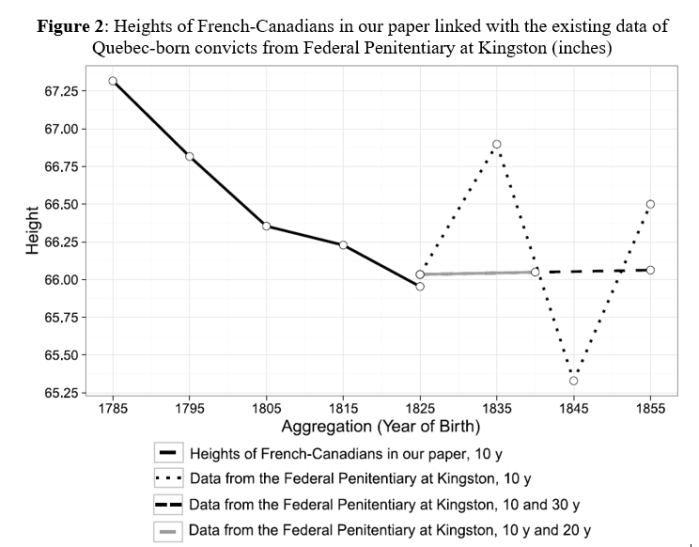
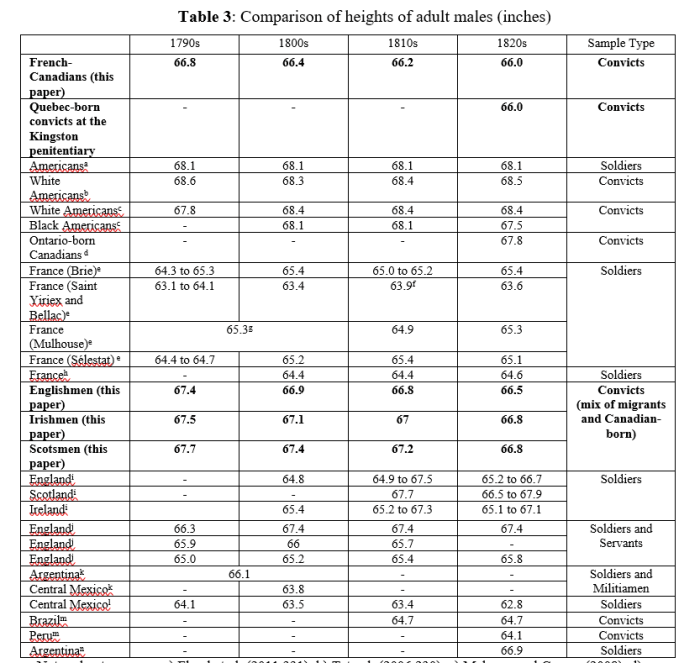
We find three key results. The first is that the French-Canadians grew shorter throughout the era when living standards did not increase importantly (and were very volatile). This puts them at odds from other places in North America where increases in stature were experienced up until the 1820s. Furthermore, stature stops falling around 1820 when economic growth picked up. This places the French-Canadians in a unique category in North America since it seems unlikely that they experienced a strong version of the antebellum puzzle (decline in stature with increases in material living standards which is what the US experienced). The second key result is that the French-Canadians are the shortest in North America, shorter even than Black Americans in slavery. However, they are considerably taller than most (save Argentinians) Latin Americans. More importantly, they are considerably taller than their counterparts in France. The third key result is related to the second key result. Today, French-Canadians are noticeably shorter than other Canadians. However, the gap was more important in the late 19th century and early 20th century. Pegged as a “striking exception” within Canada, we do not know when it actually started. Thanks to our work, we know that this was true as far back at the early 19th century.

The working paper (dramatically different than the accepted version) is here and I am posting key results in tables and figures below.  Moreover, I will be talking about anthropometric history and economic history with Garrett Petersen of Economics Detective Radio this Tuesday (I do not know when the podcast will be made available, but you should subscribe to that show anyways).

Heights.png

Table3.png

On power-display bias and the historians

This is an excerpt from my upcoming book at Palgrave McMillan which discusses Canadian economic history. This excerpt relates to a point that I have made numerous times on this blog regarding the bias for power held by historians and how it often leads them to inaccurate conclusions (here and here):

When the great historian Lord Acton warned that, “absolute power corrupts absolutely,” he was not only referring to imbuing certain fallible humans with excessive powers, but also as a caution to historians for their assessment of politicians. Too often, politicians become known for “greatness” because of their actions, regardless of how much they impoverished society or put in place measures that would ultimately erode their citizens’ quality of life. By the same token, some eminent figures remain unknown, relegated to a footnote in the history books, even though they have contributed in a more significant way to economic enrichment, cultural development, and social cohesion. Grand gestures and large-scale social projects inspired by good intentions do not always yield great results – or desirable ones.

If we truly want to assess the Quiet Revolution and the “Great Darkness” with any clarity, we must consider politicians’ actions in a more realistic scope, and sift through the quantitative and qualitative data that show how people thought and acted in the everyday. Through the use of rigorous tools, statistical methods and economic theories, we ought to consider how things might reasonably have developed otherwise without the Quiet Revolution. This is what I have tried to do in this book. (…)

The discourse on Quebec modernity that emerged along with the Quiet Revolution coincided with the emergence of a strong interventionist State. When we compare Quebec to other Western countries, however, our analysis reveals that the State did not play a major role in modernization here. After all, it was in a period when Quebec’s State apparatus was less active compared to the rest of Canada that it was able to progress in leaps and bounds. Of course, the State must have had some effect in certain areas, but the Quiet Revolution was not responsible for the bulk of positive outcomes that came to term during this period. Analyzing trends, causes, explanations and secondary forces at play in Quebec society’s metamorphosis definitely requires a degree of patience and effort. It would be much less onerous to take the easier path of only looking at the State’s activities as worthy of attention in this regard. If we fail to make these efforts, we risk succumbing to the “Nirvana Fallacy.” In order words, we tend to put the State on a pedestal: it becomes a kind of disembodied entity in a virtual reality where it plays the VIP or starring role. Comparing reality with a utopia necessary leads us to conclude that utopia is better, but this approach is utterly fruitless.


Brazil six months after Dilma Rousseff

Six months after President Dilma Rousseff’s impeachment, Brazil remains plunged into one of the biggest crises in its history. Economically the outlook is worrisome, with little chance that the country will grow again anytime soon. Politically the government of President Michel Temer has little credibility. Although brought to power by a process whose legitimacy cannot be questioned (even if groups linked to the former president still insist on the narrative of the coup – although without the same energy as before), Temer has no expressive popular support and is attached to oligarchic interests difficult to circumvent. In other areas, the crisis is also present: urban violence is increasing, unemployment, especially among the young, remains high, and education is among the worst in the world, among other examples. It is surprising that Brazil, considering its GDP, is one of the largest economies on the planet.

As I predicted in a previous article, Dilma Rousseff’s departure from power, however just and necessary, would not be the solution to all Brazil’s problems. Rousseff, although president of the country, was far from having a leading role in the Brazilian reality. As local press often put it, she was just a pole put in place by former President Luis Inacio Lula da Silva hoping to one day return to power (which he never completely left). Today, however, Lula is the target of several corruption investigations and is expected to go to jail before he can contest new elections. Meanwhile, the government of Michel Temer offers little news compared to the previous.

Michel Temer is a lifelong member of PMDB. PMDB was formed during the Military Government that lasted from the early 1960s to the early 1980s. It was the consented opposition to the military, and eventually added a wide variety of political leadership. Leaving the military leadership period, some tried to keep the PMDB united as a great democratic front, but this was neither doable nor desirable. Keeping the PMDB together was not feasible because what united its main leaders was only opposition to the military government. In addition, the party added an irreconcilable variety of political ideas and projects, and it was not desirable to keep them together because it would be important for Brazilian political leaders to show their true colors at a moment when internationally the decline of socialism was being discussed. After a stampede of many of its most active leadership to other parties (mainly to the PSDB), the PMDB became a pragmatic, often oligarchic, legend and without clear ideological orientation, very similar to the Mexican PRI.

Being a party of national expression, the PMDB had oscillating relations with all Brazilian governments since the 1980s, but with one certainty: the PMDB is a party that does not play to lose. Eventually a part of the party leadership understood that the arrival of the PT to the presidency of the country was inevitable and proposed an alliance. This explains the presence of Temer as Rousseff’s vice president. But it would be wrong to say that the PMDB simply joined the winning team: the PT was immeasurably benefited by the alliance, and probably would not have reached or remained in power without the new ally. The alliance with the PT also showed that, despite the ideological discourse, the PT had little novelty to offer to Brazilian politics.

Although he has waved with reforms in favor of economic freedom, Temer has done little that can considered new so far. The freezing of government spending, well received by many right-wing groups, does not really touch the foundations of Brazilian statism: the government remains almost omnipresent, only without the same money to play its part. The proposed pension reform, similarly, does not alter the fundamentals of the state’s relationship with society. Finally, Temer put the economic policy in the hands of Henrique Meirelles, who had already been President of the Central Bank of Lula. Meirelles is one of the main responsible for the crisis that the country faces today, and its revenue to get around the problems remains the same: stimulus spending. In other words, do more of what brought us to the current situation in the first place.

A positive aspect of the current Brazilian crisis is the emergence or strengthening of right-wing political groups. Although the Brazilian right still is quite authoritarian, there are inclinations in favor of the free market being strengthened. Of course, strengthening a pro-market right annoys the left, and this is perhaps the best sign that this is a political trend gaining real space. While it is still difficult to see a light at the end of the tunnel, the 2018 presidential election may be the most relevant to the country since 1989.

Communist Yugoslavia

Below is an excerpt from my book I Used to Be French: an Immature Autobiography. You can buy it on amazon here.


I was led into a large cell with an arching stone ceiling I would have called a dungeon except that it was harshly lit. There were about twenty-five men in the room, mostly in their late twenties. They greeted me loudly in their language. An older man who looked vaguely middle class because he wore a suit (without a tie) asked me in Italian where I was from. There were five or six blankets altogether. A tall, bony guy with the ravaged face of an operetta brigand requisitioned two and handed them to me. Then, we all lined up for whole-grain bread and soup. (Yes, whole-grain used to be the cheapest before it became fashionable, in the seventies.) The brigand pushed me to the head of the line. Then he showed me that you had to dunk the hard bread into the soup to soften it. After dinner, I had a long, civilized conversation with the old man, he speaking Italian and I, French. He told me that most of my cellmates were returning from Germany where they had gone to work without a proper Yugoslav exit visa, and that they were awaiting trial for that low-grade offense. “Why don’t they look more worried?”- I asked. (The mood was, in fact, downright merry.) He told me each would get a few months in the poker but that the cars they had bought in Germany with their earnings would be awaiting them when they got out. In fact, he said, the jail had a parking lot reserved for that usage. Real communism, communism as it existed, communism with a small “c,” was not simple!

As evening came, the inmates prepared for bed in their own rudimentary ways. There was tenseness when the brigand signaled for me to set down my two blankets next to him, on a raised wooden platform. I was old enough to doubt a free lunch existed. I perceived that I was the cutest thing in the joint, and the youngest! With no gracious way to escape, I did as he suggested. Tension turned into panic when he took my head into the crook of his arm. I withdrew brusquely. He delivered himself of a vociferous and loud speech that I guessed was at once re-assuring and reproachful. There was probably no ambiguity in his gesture. Yugoslavia was the beginning of the mysterious Orient, deep into Western Europe, with different customs. Later, I saw soldiers, and once, a pair of policemen, walking peaceably hand in hand. The brigand had just adopted me as a brother. He was no jail predator. For all I know, he had protected me from the real thing.

Rules of Warfare in Pre-Modern Societies

As my first foray into NOL blogging, I figured I would bring up a recent debate I had liberty, war, and peace that lingered in my mind: how have rules of war been maintained throughout history without a central enforcing agency? This question is fundamental to the understanding of the nation-state in IR theory, and is also an astonishing example of spontaneous order in an anarchic and chaotic scenario.

The quandary exists because even the laudable negative rights of life, liberty, and property ownership, as Eric Mack discusses in his essay on Just War Theory, require a positive enforcement by others. Similarly, “rules of war”–such as refraining from attacking non-regulars, not attacking neutral parties, abiding by the terms of treaties, treating prisoners of war with respect, etc.–are, theoretically, difficult to establish and dependent on positive enforcement. This is because if Party A respects these rules, they provide a perverse incentive to Party B to take advantage of Party A’s restraint, and if doing so gives Party B the upper hand, they can enjoy the benefits of betraying the rules of war with impunity. This is a classic Prisoner’s Dilemma, and if it generalized across many nations, the theory of rational choice would lead us to expect a coordination problem, in which those using the strategy of Party B would dominate the Party A’s.

I am certainly not the first to identify this, and the literature on overcoming coordination problems through iteration of the Prisoner’s Dilemma, regime collaboration, and international organizations and treaties is incredibly thorough (just for a taste, you can see James Morrow’s book, F.V. Kratochwil’s book, and articles by Duncan Snidal, Arthur A. Stein, and even James Buchanan and Victor Vanberg). However, I thought it would be interesting to examine the historical evidence of effective rules of war, particularly from the premodern period. Because global communication technology and networks, international courts, treaties, and organizations, and deterrence based on the terrifying weapons of modern war were lacking in antiquity and on through roughly the 18th century (open to argument on that one), premodern societies seem to be the best test of the effectiveness of rules of war and their mechanisms. I won’t discuss any in detail, and I am skipping many rules of war for which their effectiveness is not discernable (such as the Mahabarata, Deuteronomy, and the Quran), but here is a list of interesting examples for discussion:

  • The archaic Greek poleis:
    • As Victor Davis Hanson argues in his influential book, the Western Way of War, the incentive to focus on agricultural production and the fact that citizen-warriors were personally responsible for military service made the costs of long-term campaigns, especially given the lack of siege technologies and the difficulty in laying waste to wheat fields and olive trees, higher than the potential benefits. However, there were still disputes to be resolved, and raiding was still harmful to the agriculture of polis that was raided. In order to limit costs to both invader and defender, the poleis developed the hoplite warfare strategy, in which citizen-soldiers met for decisive conflicts in traditional, if not previously agreed, locations, in which limited territorial gains were afforded to the victor. While this does not describe every aspect of 7th-5th century warfare in Greece, this strategy pervaded the Greek mainland and allowed disputes to be resolved with minimal collateral damage and investment.
  • Thucydides’ Athens:
    • Though Thucydides’ History of the Peloponnesian War is seen as the invention of realism based on its “the strong did what they could, and the weak suffered what they must” representation of self-interest in foreign policy, his narrative as a whole shows an important constraint in war: if a military power makes war with the expressed intent of empire-building without casus belli, they will entrench their enemies, alienate neutral states, and cause divisiveness on the home front because they have lost the moral high ground. Thucydides notes that the majority of Greeks opposed Athens on the grounds of their selfish empire-building, and because of their inability to convince Sparta of their just motives, brutality to neutral states, internal dissension during the Sicilian expedition, and many other misfortunes of war (plague, death of Pericles, Persian intervention), Athenian power was broken. The lesson: Party B (from above) must consider the international reaction to abusing Party A, and at least make a public showing that the war is just. Also, if Hitler had only read his Thucydides, he might have known that marching through Belgium may be tactically sound, but he was risking the same reaction that the Athenians risked in the Melian massacre.
  • POW’s and ransoming in antiquity
    • Several rules of warfare were maintained through the mutual benefits to combatants, the most notable being the conventions concerning ransoming. From at least 5th century Greece (in the Sphacteria incident) to Caesar, citizens could be ransomed following a battle—and there were even conventional levels of payment for these POW’s. This was a benefit specifically afforded to “civilized” foes, and Roman practice increasingly became enslavement rather than ransom, but this convention was widespread for centuries, possibly showing that ransoming enemies is an Iterated Prisoner’s Dilemma.
  • Ancus Marcius and Just War Theory:
    • Along the same lines as the Thucydides example, the Romans engaged in the ritual of the fetiales, including the enumeration of the just cases for war, before invading an enemy. This limited war to official disagreements with neighboring states, and other religious conventions were maintained that limited certain tactics in war (a noteworthy passage of the Aeneid shows that putting on the armor of your enemies for stealth purposes would be doubly punished by the gods). These conventions included looking down on poison as woman’s weapon and on taking some religious statuary as booty, and though Roman generals still poisoned wells or robbed cities of their gods, they received negative reactions by their contemporaries.
  • Hostage policies throughout antiquity:
    • Another problem with the rules of war is the enforcement of treaties, which have credible commitment problems. Both Greeks and Romans made imperial gains by breaking treaties, but it was common practice to overcome the credible commitment problems of both alliances and treaties to end wars that hostages, usually the children of influential citizens or nobles, were exchanged. Whether they were exchanged both ways (more common in alliances) or passed only one way (usually from the defeated to the victorious), hostages were used at least 250 times by Rome and countless times by other ancient civilizations to ensure the enforcement of treaties.
  • Carthage’s “Truceless War”:
    • While we often think of ancient war as anarchic and based on the whims of generals, wars that completely lacked conventions or limitations were rare. In fact, following truces that allowed for collection of the dead, ransoming of both the living and the dead, and supplication for one’s own life go back at least as far as the Iliad, and wars that lacked such conventions were shocking to ancient historians. Such wars occurred when one side broke a general convention, usually the convention of allowing enemies to surrender alive and be ransomed. Because of this betrayal, their opponents would also stop following any rules of war, and such wars became not about achieving strategic goals but annihilating the opponent entirely. Carthage, following their loss in the First Punic War, fought a truceless war with their former mercenaries due to lack of payment that featured escalations in mutilation and crucifixion until the mercenaries were wiped out, at great cost in men and money to Carthage.
  • Roman 3rd party arbitration or intervention:
    • The Romans, after they gained international prominence but before they ruled the whole Mediterranean, took an interest in wars between their neighbors. While this sometimes included imperialism, in several instances they served as a 3rd party arbitrator of peace, and even as an enforcer of peace in Antiochus IV’s invasion of Egypt.
  • Blood feuds:
    • While mentioning blood feuds brings up images of Hatfields, McCoys, and senseless brutality over generations, blood feuds were actually a mechanism for limiting violence through threat of reprisal. While the effectiveness of this mechanism may be debatable, its intention as a limitation of violence is notable in several pre-modern societies, especially the Scots and Slavs.
  • Chivalric codes:
    • We should be careful of romanticizing this example, but from the 12th to 14th centuries, chivalry established rules of conduct for how knights should treat knights on and off the battlefield. Much of the conception of chivalry comes from poetic fictions about historical figures that were vicious or corrupt in many ways. However, it was actually the battlefield codes, such as ransoming rather than killing noble foes, that were actually practiced the most often, a trend that saw a brutal reversal in the War of the Roses. One might point out that neither the chivalric codes nor the earlier Roman codes of war included avoidance of harming civilians. This shows that, while rules of war were effective in practice at many points in history, they did not always have the same conceptions of what these rules were made to protect.
  • The Roman Catholic Church:
    • Catholicism influenced the rules of war in two ways: like the fetiales of the Romans, it established the grounds on which war was justifiable (and was influential on the ideals of chivalry), and the pope himself, through the power of excommunication, could limit the warring impulses of kings and lords. While many popes used their power to cause conflict, the church still had both moral influence and bargaining power, and was a powerful international institution for centuries that forced treaties on Christian rulers, provided a court of arbitration, and, several times, that tried to unite these leaders in war against non-Christians. The influence of Catholic peacekeeping measures waxed and waned from Charlemagne onward, but the Peace and Truce of God was one of the earliest attempts to protect non-combatants in wartime

This very incomplete list represents a lot of the more conventional examples of this phenomenon (sorry, but I am very conventionally educated). I would love if those who have other examples, especially from outside of Greece, Rome, and the Western World, would bring them up in the comments so I can expand my knowledge of the history of the rules of war!

The many iterations of rules of war in pre-modern societies shows the effectiveness of spontaneous order in creating systems that promote liberty and peace. These rules did not eliminate violence, cruelty, or imperialism, but they forced self-interested parties to check their selfish impulses. This is not an argument that international organizations with the goal of limiting war are unnecessary (and the Geneva Conventions are a laudable example of voluntary self-enforcement), but rather a demonstration of the wide reach of both Smith’s invisible hand and Hayek’s spontaneous order: even in the most anarchic of trades, long-term individual self-interest can support general interest, and a certain level of order is imposed on the chaos of war through the unplanned conventions of societies.


ἐν μὲν γὰρ τῇ οἱ παῖδες τοὺς πατέρας θάπτουσι, ἐν δὲ τῷ οἱ πατέρες τοὺς παῖδας

In [peace], sons bury their fathers, but in [war], fathers bury their sons.

–Herodotus, The Histories, 1.87.4.

Where the state came from

One of the questions that led me to libertarianism was “what is the state?” More than that: Where did it come from? How it works? What’s the use? Analogous questions would be “what is politics?” and “what is economics?” If my classroom experience serves as a yardstick for anything, the overwhelming majority of people never ask these questions and never run after answers. I do not blame them. Most of us are very busy trying to make ends meet to worry about this kind of stuff. I even sought an academic training in politics just to seek answers to these questions. For me it’s nothing to have answers, after all, I’m paid (albeit very poorly paid) to know these matters. Still, I wish more people were asking these types of question. I suspect that it would be part of the process to review the political and economic situation in which we find ourselves.

Many times when I ask in the classroom “what is the state?” I receive in response that Brazil is a state. In general I correct the student explaining that this is an example, not a definition. The modern state, as we have it today, is mainly the combination of three factors: government, population, and territory. The modern state, as we have it today, can be defined as a population inhabiting a specific territory, organized by a centralized government that recognizes no instance of power superior to itself. Often, in the academic and popular vocabulary, state and government are confused, and there is no specific problem in this. In fact, the two words may appear as synonyms, although this is not a necessity. It is possible to distinguish between state and government thinking that the state remains and governments go through.

The state as we know it today is a product of the transition from the Middle Ages to the Modern Age. I believe that this information alone should draw our attention enough: people have lived in modern states only in the last 500 years or so. Throughout the rest of human history other forms of political organization have been used. I am not saying (not here) that these other forms of organization were better than the modern state. I am simply saying that the modern state is far from being natural, spontaneous, or necessary. Even after 1500 the modern state took time to be universally accepted. First, this model of organization spread throughout Europe at the beginning of the Modern Era. It was only in the late 18th century and early 19th century that this model came to be used in the American continent. The modern state spread globally only after the decolonization movement that followed World War II. That is: the vast majority of modern states are not even 70 years old!

What is the purpose of the state? At least in my experience, many people respond by “providing rights” or “securing rights.” People think about health, education, sanitation, culture, security, etc. as duties of the state towards society. It is clear that many people think about health, education, housing, etc. as rights, which in itself is already questionable, but I will leave this discussion for another time. The point I want to put here is that empirically states have only cared about issues like health and public education very recently. In the classic definition of Max Weber (late 19th century), the state has a monopoly on the legitimate use of violence. In other words, virtually anyone can use violence, but only the state can do it legally. That is: the primordial function of the state is to use violence within a legal order. Other functions, such as providing health and education, came very late and only became commonplace with the welfare state that strengthened after World War II.

I find it always interesting to see how we live in a young world. Basically the entire world population today lives in some state and expects from this state a minimum level of well-being. However, this reality is only about 70 years old. The idea that we need to live in states that provide us with a minimum of well being is not natural and far from obvious. To understand that the modern state is a historical institution, which has not always existed, it is fundamental to question its validity. Moreover, to note that the functions of the state that seem obvious to us today did not exist 70 years ago leads us to question whether it is valid to expect things such as health and education from the state.

My personal perception is that the modern state (defined by territory, population, and government) is better than any alternative that has already been proposed. However, the state of social well-being is only a sugar-watered socialism. Socialism, by definition, does not work, as Ludwig von Mises very well shows. Partial socialism is as likely to function as full socialism. Expecting the state to use violence within legal parameters is valid and even fundamental. But to expect that this same state may successfully diversify its activities entering the branches of health, education, culture, etc. is a fatal conceit.

Once, Cubans were (maybe) richer than Americans

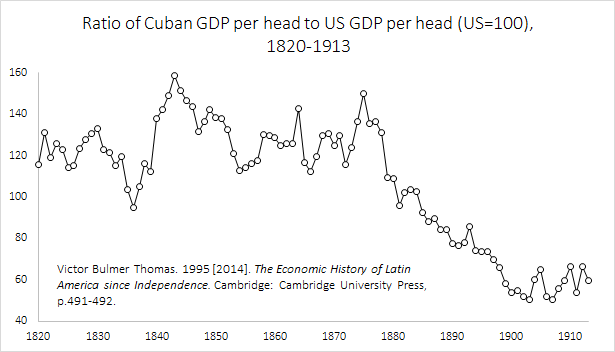
In light of what we see today, this is hard to believe. However, as a result of Castro’s death, I accidentally became interested in the history of this fascinating island and the more I discover, the more shocked I am at “the path” that Cuba has taken. One of these reasons is provided below by Victor Bulmer Thomas in his Economic History of Latin America since Independence. Now, Thomas uses a different approach than the commonly used Maddison data (he believes the assumptions are too heroic). He uses indicators correlated with GDP per capita to fill in the gaps and he finds that Cuba was generally richer than the United States for most of the 19th century (see below):

cubaus

Now, I am not convinced by the figure Thomas presents. However, I am also skeptical of the levels presented by Maddison (where Cuba is roughly 60% as rich as the US in 1820). In between are some more reasonable estimate (see this great discussion in this book as well as this discussion by Coatsworth).  Moreover, there is the  issue of slavery which distorts the value of using GDP per capita because of high levels of inequality (however, it distorts both ways since the US was also a slave economy up to the Civil War).

Nonetheless, this tells you about the “path not taken” by Cuba.

A very short response to Bruno Gonçalves Rosi’s reflection on Latin American Conservatism

With his “The Problem with Conservatism in Latin America, Bruno Gonçalves Rosi brings to NOL a very interesting debate on politics and history. In the case of Hispanic America the controversy is quite severe: during the 17th-century Spain and its colonies were undergoing an incremental process of liberalization and modernization known as “Bourbon Reforms.” These reforms implied a language unification (adopting Castilian – later named “Spanish” – as the national language), an increasing centralization of political administration, and free trade between Spain and its colonies, among other aspects.

In the case of the Spanish colonies in America, the Bourbon Reforms implied that Spanish-born subjects were preferred over American-born ones to take up public duties, and also that American products could not compete with Spanish ones. Up until then, commerce among Spain and its American colonies was restrained to gold and a narrow scope of goods. Free commerce had been allowed only in cases of extreme scarcity (for example, between Buenos Aires and South Africa) and for a very short lapse of time. The Bourbon Reforms put a severe strain on the incipient local production of the Hispanic American colonies that had flourished as consequence of closed markets. Sometimes inefficient local processes of production were outperformed by more competitive Spanish goods. But in other cases, efficient local industries were banned because they were regarded as a menace to Spanish ones.

Thus, the reactions to the Bourbon Reforms were of two opposite kinds: the Liberals rejected them because they limited the free trade only to Spain and its colonies and the modernization process was too slow. Liberals demanded free trade with all countries. On the other side, the Conservatives sought to go back to the Habsburg era: they rejected Modernity and free trade and demanded protectionism. The Emancipatory process of Spanish America was carried out by the conjunction of the Liberal and the Conservative reaction against the Bourbon Reforms. Once independence was fulfilled, the two parties became acutely antagonist to each other…perhaps up until today.

The history of Latin American Conservatism and Liberalism is worth our attention not only because of political history itself, but because it gives us a model to ponder the processes of departure from political and economic commonwealths that have been seen in the recent years -and perhaps are not closed yet.