2017: Year in Review

Well folks, another year has come and gone. 2017 was Notes On Liberty‘s busiest year yet. Traffic came from all over the place, with the most visits coming from the US, the UK, Canada, Australia, and India. (In the past, India and Germany have vied for that coveted 5th place spot, but this year India blew Germany out of the water.)

NOL is a voluntary cooperative, and as such this year saw the introduction of 6 new Notewriters: Kevin Kallmes, Nicolás Cachanosky, Ash Navabi, Tridivesh Maini, Matthew Bonick and Trent MacDonald.

Michelangelo invited Kevin to join, Nicolás is an old grad school buddy of Rick‘s, I reached out to Tridivesh, and Ash and Matthew were invited on Vincent‘s initiative.

Speaking of Vincent, 2017 was his year. He had Tyler Cowen (MarginalRevolution), Mark Thoma (Economist’s View), Anthony Mills (RealClearPolicy), Barry Ritholtz (Bloomberg), Don Boudreaux (Cafe Hayek), John Tamny (RealClearMarkets) and Pseudoerasmus (a well-regarded economic historian) all link to his thoughts multiple times over the course of the year. His Top 10 list for best papers/books in recent economic history (Part 1 and Part 2) were legitimate viral sensations, dominating the top 2 spots on NOL‘s most-read list. Other huge posts included “Did the 30 Glorious Years Actually Exist? (#5),” “The Pox of Liberty – dixit the Political Economy of Public Health (#9),” “James Buchanan on racism,” “The GDP, real wages and working hours of France since the 13th century,” “Did 89% of American Millionaires Disappear During the Great Depression?,” and “A hidden cost of the war on drugs.” My personal favorite was his “Star Trek Did More For the Cultural Advancement of Women Than Government Policies.” Dr Geloso’s thoughts made up 40% of NOL‘s 10 most-read 2017 posts.

My favorite posts from Edwin this year were his analyses of Dutch politics – “Dutch politics, after the elections” and “North Korea at the North Sea?” – but the reading public seemed to enjoy his posts on Ayn Rand, especially her thought on international relations, and his summary of Mont Pelerin Europe more than anything else. Van de Haar’s day job is in the private sector, so his blogging is understandably light (especially given his incredible publishing output in academic journals). I look forward to what looms ahead in 2018.

Federico’s most recent post on artificial intelligence and the law got love from some major outlets, including FT‘s Alphaville blog and 3 Quarks Daily. His question “Does business success make a good statesmen?” and his report on a Latin American Liberty summit are worth reading again, but my personal favorites were his comments on other Notewriters’ thoughts: first jumping in to add some historical clarity to Bruno’s post on Latin American conservatism and then to add layers onto the debate between Mark and Bruno on the Protestant Reformation. Federico has been invaluable to NOL‘s welcoming, skeptical culture and I cannot wait to see what he comes up with in 2018.

Barry was generous enough recount the situation in Turkey after the coup earlier in the year, and fruits of this endeavor – Coup and Counter Coup in Turkey – can be found in six parts:

  1. First of a series of posts on Turkey since 15th July 2016 and background topics
  2. Immediately after the coup and party politics
  3. Gülenists and Kemalists
  4. The Kurdish issue in Turkey
  5. Jacobins and Grey Wolves in Turkey
  6. Presidential Authoritarianism in Turkey

Dr Stocker also began writing an appendix to his six-part series, which resulted in a first post on authoritarianism and electoral fixes. Barry is hard at work on a new book, and of course the situation in Turkey is less than ideal, so I can only hope he has a bit more time in 2018 for NOL.

Michelangelo had a banner year at NOL. His #microblogging has been fun, as were his post analyzing relevant data from his surveys: What libertarians think of climate change, for example, or urban planning in Oregon. Michelangelo also utilized NOL to play around with concepts like race, marriage markets, data, Spanish language services, affirmative action, and freeware, to name a few. My absolute favorite Michelangelo post this year was his excellent “Should we tax churches? A Georgist proposal.” Michelangelo is a PhD candidate right now, too, so if he ever gets some time to himself, watch out world!

Rick also had a banner year at NOL. His post arguing against Net Neutrality was one of the most-read articles of the year here (#4), and many of his wonkier thoughts have been picked up by the sharp eye of Anthony Mills (RealClearPolicy) and the excellent Chris Dillow (Stumbling and Mumbling). Rick is my favorite blogger. Posts on cycling in Amsterdam, subsidies, management and measurement, linguisticsmore subsidies, and my personal favorite of his for the year, “Why do we teach girls that it’s cute to be scared,” always make me think and, more importantly, smile.

Bruno’s blogging was also amply rewarded this year. His thoughts on some of the problems with postmodernism brought in the most eyeballs, but thankfully he didn’t stop there: Articles introducing postmodernism and highlighting the origins of postmodernism also generated much interest. RealClearWorld picked up his post analyzing Brazil post-Rousseff (he had more analysis of Brazilian politics here and here), and his post delving into whether Nazism is of the left or the right provoked quite the dialogue. Dr Rosi was at his best, though, when prompted by Mark to further advance his argument that the Protestant Revolution played an integral role in the rise of the freedom of conscience. Times are tough in Brazil right now, so I can only hope that Bruno continues to play a vital role as a Notewriter in 2018.

Chhay Lin, now in the private sector, had his post about Bruce Lee’s application of Taoist philosophy head to the top of reddit’s philosophy sub, and his post on Catalonia and secession got love from RealClearWorld and Lew Rockwell (Political Theater). I hate to be *that* guy distracting a man from making his money, but I hope to see Chhay Lin pop in at NOL much more often in 2018!

Zak has been busy with a number of different projects, as well as attending Michigan-Ann Arbor full-time. He still managed to have one of his posts, on “libertarian” activist hypocrisy (#10), highlighted in the Guardian, the UK’s premier left-wing mouthpiece. His post on The Nancy MacLean Disgrace earned him plaudits from the online libertarian community and Don Boudreaux (Cafe Hayek), and his posts on open borders and income inequality show just how much of a bad ass he has become. I had a tough time trying to pick out my favorite Zak article of 2017, so I’m just gonna highlight all three of them:

  1. Immigration, Cultural Change, and Diversity as a Cultural Discovery Process
  2. Why I’m No Longer A Christian…
  3. Against Libertarian Populism

They’ve all got great self-explanatory titles, so do yourself a favor and read ’em again! Hopefully Zak can continue to work NOL in to his many successful ventures in 2018.

Jacques continues to amaze me. He’s been retired from academia for – as far as I can tell – at least a decade and he’s still producing great material that’s able to reach all sorts of people and places. His post on the Ottoman Empire and libertarianism (#6), which was featured at RealClearWorld and much-shared in Ottomanist corners of Twitter – took aim at popular American libertarian understandings of decentralization and seems to have landed pretty squarely on target. My favorite post of Dr Delacroix’ this year was about French Africa (also featured at RealClearWorld), but his late-year book review on Christopher De Bellaigue’s 2017 book about Islam might end up being a classic.

Bill’s 2017 here at NOL was productive and he continues to impress. His “Speech in academic philosophy: Rebecca Tuvel on Rachel Dolezal” brought in thousands of readers, but it was not his ability to draw crowds that I found impressive. His ability to tackle tough concepts and tough issues came to the forefront this year: drug use, “vulvæ,” more drug use, party culture (my personal fave), schooling (another personal fave), more schooling, and music (personal fave). Bill’s ability to weave these trends together through the lens of individual freedom is so much fun to read and important for fostering a culture of tolerance and respect in today’s world. I can’t wait to see what 2018 has in store for him!

Nicolás came out firing on all cylinders this year. With excellent dialogues between himself and Vincent, as well as between himself and guest blogger Derrill Watson (who I hope will be back for more in 2018), Dr Cachanosky’s passion for teaching has shown through clearly and brightly. I hope 2018 – his first full year with NOL – is filled with much more hard-hitting but insightful blogging from Nicolás.

Ash brought the heat, too. Check out the subject matter of his first few posts here at NOL: “A Right is Not an Obligation,” “Physical Goods, Immaterial Goods, and Public Goods,” “The Economics of Hard Choices,” “Markets for Secrets?,” “A Tax is Not a Price,” and “A Radical Take on Science and Religion.” Like Nicolás, Ash’s first full year at NOL is coming up, and if 2017 is any indication, readers can look forward to an interesting and engaging 2018.

Mark’s first full year here at NOL was a definite barnburner. His debate with Bruno on the Protestant Reformation (#8) brought in a bunch of eyeballs, including from RealClearHistory, while his “The Return of Cyclical Theories of History” also brought in thousands of readers, thanks in large part to Robert Cottrell’s excellent website, the Browser. Dr Koyama’s review of Aldo Schiavone’s The End of the Past also caught Mr Cottrell’s eye and the attention of his readers. Mark’s post on geopolitics and Asia’s “little divergence” is well worth reading again, too. Like Zak and Bill’s posts, I couldn’t choose just one favorite, so I give you two:

  1. Political Decentralization and Innovation in early modern Europe
  2. Some Thoughts on State Capacity” (an especially good criticism of American libertarian understandings of the “state capacity” literature)

We’re lucky to have Mark here at NOL.

Kevin, like Ash and Nicolás, brought the ruckus for his first few posts here at NOL. Kevin’s very first post at Notes On Liberty – “Rules of Warfare in Pre-Modern Societies” (#3) – ended up on the front page of RealClearHistory while his “Paradoxical geniuses…” earned a spot on the Browser‘s prestigious reading list. Not a bad start. Kevin will be finishing up the second half of his first year of law school (at Duke), so I doubt we’ll see much of him until June or July of 2018. My personal favorite, by the way, was Kevin’s “Auftragstaktik: Decentralization in military command.” His posts on taking over Syria – Roman style, the median voter theorem, and inventions that didn’t change the world also got lots of love from around the web.

Nick’s post on public choice and Nancy MacLean (#7) earned a nod from Arnold Kling (askblog), Don Boudreaux (Cafe Hayek), Chris Dillow (Stumbling and Mumbling), Mark Thoma (Economist’s View), and pretty much the entire online libertarian community, while his post analyzing the UK’s snap election earned a spot at RealClearWorld. Dr Cowen’s thoughts on school choice and robust political economy, as well as a sociological analysis of Trump/Brexit prompted by Vincent, all garnered love from libertarians and scholars around the world. My favorite Cowen post was his question “Is persecution the purpose?

Overall, it was a hell of a year here at Notes On Liberty. I’m really looking forward to 2018. Here’s to a happy, healthy you. Oh, and my proudest piece this year was “North Korea, the status quo, and a more liberal world.” HAPPY NEW YEAR!

BC’s weekend reads

  1. Holy shit! (great news)
  2. Hayek’s rapid rise to stardom | misunderstanding Hayek
  3. great write-up on Catalonia | a philosophical case for secession
  4. if colonialism was the apocalypse, what comes next? | should UNM replace its seal?
  5. do trees fall in cyberspace? | how to use Facebook better
  6. a pretty shallow deep throat | vulvæ in pornography and culture

Lunchtime Links

  1. Delacroix in Morocco | Delacroix in Mexico
  2. The Jews in Europe | The Jews in Europe
  3. Barbarianism ain’t that bad | Barbarian liberty
  4. Why did we start farming? |  Why farms die (and should die)
  5. Daily hell of life in the Soviet bloc | reading Bertrand Russell

North Korea, the status quo, and a more liberal world

The tension on the Korean Peninsula can be felt throughout the entire Pacific Rim right now. North Korea, a dictatorship with a shaky grasp on its populace, has nuclear weapons and is launching non-nuclear missiles over Japan and threatening South Korea and the United States. To make matters worse, the only state in the region that Pyongyang deems worthy of dialogue, China, refuses to engage in much multilateral work to defuse the situation.

If I were South Korea and China I would have an advanced missile shield system right on the border of North Korea, and if I were Japan I would have an advanced missile shield system spread all along my massive coastline. However, China is engaging in trade sanctions against South Korea for trying to build a missile shield along it’s border with North Korea, ostensibly because such a missile shield would threaten Beijing’s territorial integrity. This is a huge strategic mistake on China’s part. North Korea is ruled by the son of a brutal dictator who is in the midst of remaking the People’s Republic in his image. Pyongyang is launching missiles over wealthy democracies and threatening perceived enemies with nuclear annihilation. China is ignoring all of this, and undertaking policies designed to underwhelm multilateral efforts at containing North Korea because Beijing wants North Korea to serve 3 purposes: 1) a useful buffer state (but read this), 2) a hostile reminder that it considers Taiwan as part of China, and 3) as a good bargaining chip when dealing with the United States in the region.

Given that the United States is not geographically a part of East Asia, and given that Washington figures prominently in not one, not two, but all three major reasons why China refuses to engage robustly in more multilateral actions against such a destructive neighbor, we must ask ourselves: Why is the United States still in South Korea? The answer is that Koreans want them there.

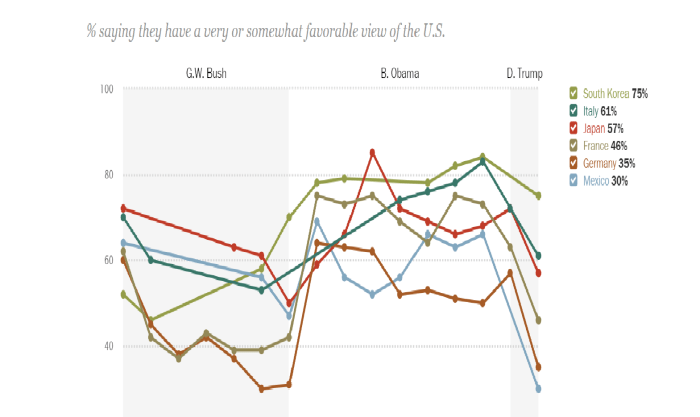
Check out the latest results of a Pew Survey asking people what they think about the United States:

blog Pew American 2
(source)

75% of South Koreans have a favorable or somewhat favorable view of the US even after the election of Donald Trump. That’s higher than the other baseball-friendly countries like Italy (61%) and Japan (57%), and much higher than next-door neighbor Mexico (30%) and longtime NATO partner Germany (35%).

China is wrong to believe that an American withdrawal would suddenly make North Korea a breezy member of the international community of states. Kim Jong Un’s regime depends on foreign enemies to survive. James Madison put it best:

The means of defense against foreign danger have been always the instruments of tyranny at home. Among the Romans it was a standing maxim to excite a war whenever a revolt was apprehended. Throughout all Europe, the armies kept up under the pretext of defending have enslaved the people.

North Korea would bully Seoul and Tokyo and cajole Beijing even moreso because Washington would not be there to bear the burden of Liberal Hegemonic Boogieman.

But I’m not a Chinese citizen and this is a post about a more liberal world, so I’d like to switch gears and focus on something that all libertarians are secretly obsessed with: money.

What kind of deal is the US getting by having troops stationed along the 38th parallel? I know the US is a target of a dictator’s nuclear arsenal because of troops along the 38th, and I know the US has to expend considerable resources on the Korean Peninsula to protect Seoul, so costs are understood, but what about benefits? What about payment? What does US get in return for protecting South Korea?

Trade – a big aspect of libertarian foreign policy – is not that big of a deal for either country: the United States makes up about 14% of South Korea’s exports, and South Korea makes up nearly 3% of the United States’ exports. This means that China, for example, is a larger, more important trading partner to both countries than either is to each other.

One of the benefits I’ve found is South Korea’s participation in multilateral military actions undertaken under the umbrella of US military leadership. South Korea has provided troops for dozens of current UN missions in sub-Saharan Africa and post-British Asia, and also participated in the US-led invasions and occupations of Afghanistan and Iraq (Seoul’s troops left Iraq in 2008 and Afghanistan in 2014). I also learned that South Korea deployed 325,000 soldiers to South Vietnam from 1964-1973, losing roughly 5,100 soldiers and welcoming home another 11,000 wounded soldiers.

Seoul’s participation in Vietnam was a shocking discovery for me. It forced me to reassess America’s relationship with South Korea. The status quo is actually a decent trade-off. The status quo is cooperative, not coercive. The status quo isn’t so bad from a libertarian standpoint: There is a trade-off with mutually beneficial exchange involved, there is a cooperative rather than coercive relationship between both sides, and tens of millions of people are freer than they otherwise would be because of it.

We can still make the alliance marginally better, though. We can still take small steps to a much better world. Consider federation between the two countries.

On the face of it, such an event is ludicrously radical and completely anathema to liberty and cooperation. I would have had the same reaction just a couple of years ago, but two books have fundamentally changed my mind about this: Daniel Deudney’s Bounding Power: Republican Security Theory from the Polis to the Global Village and David Hendrickson’s Peace Pact: The Lost World of the American Founding. Both scholars are American political scientists and, as far as I can tell, card-carrying Democrats.

Deudney’s book uses theory and history to show that, among other things, republican security theory is, and always has been, from antiquity to the present day, the most important question that scholars of international relations have had to grapple with. For centuries, republics started out with the best of intentions, the best of circumstances, and always managed to decay into despotism or succumb to conquest by neighboring despots. The United States, Deudney goes on,  managed to get out of this trap through federal union and, because of its peculiar geographic situation, a full-fledged republican security bargain was able to come to full fruition.

Deudney bases this part of his argument on Hendrickson’s little-known but immensely persuasive book. Hendrickson argues that the newly independent 13 states and their eventual federal union should best be viewed in an international relations framework. In order to protect themselves not only from powerful empires but more importantly from each other, the 13 states entered into a federal union that held them responsible for a limited number of shared responsibilities (such as international security and ensuring republican government in their domestic realms) and left plenty of space for each of them to exercise policymaking as they saw fit. In order to avoid a race to the bottom – where the 13 states formed security blocs between themselves and used Spain, France, and the UK to undermine their rivals – the 13 states built, piece-by-piece, a cooperative international system and called it a federation.

With America’s domestic liberties under increasing assault, largely because the current situation places so much emphasis on certain checks and balances over others, adding additional “states” in the form of South Korea’s provinces would breathe new life into all of the institutions necessary for both security and republican domestic governance.

The inevitable Korean bloc

The biggest fear that such a federation would bring about is the fear of a Korean bloc, or the disintegration of the precarious balance of power between the two parties in the US. Although partisans on both sides no doubt loathe that their side is even with the other in terms of influence and numbers, most Americans are very happy with the two party status quo (if they weren’t happy there would no longer be a two party status quo).

Admitting 5 to 7 new “states,” former Korean provinces, makes it seem like this delicate two party balance would be quickly destroyed with the advent of a Korean bloc which has no interest in traditional American politics. I assure you there would be no Korean bloc. Look at the most recent Korean elections:

blog korea elections map
You’ll notice there’s 5 parties instead of 2 like in the States. That’s because South Korea uses proportional representation whereas the United States uses the FPTP system. The end result of both systems is the same: a center-right bloc and a center-left bloc. In South Korea’s case, the red and the grey districts are right-wing, and the other three colors are left-wing. (source)

There is a Left-Right divide focused on policy and to a lesser extent ideology rather than an ethnic one, just like here in the States.

The Korean Left would line up nicely with Democrats (it even has an anti-American streak that isn’t anti-American at all, only anti-GOP, just like the Democrats!). The conservative wing of South Korea might form a Korean bloc but it would be ineffective in the House and Senate because of its small number.

Libertarians are often dissatisfied with the status quo, even though they’re often the first to point out that life in Western states continues to get better and better. The status quo relationship between South Korea and the United States is great. But it could always be a little bit better.

Worth a gander

  1. the Reformation’s controversies are as relevant as ever
  2. who stole Burma’s royal rubies?
  3. the Madras Observatory: from Jesuit cooperation to British rule
  4. There are few better illustrations of how a whole host of people can manage to understand absolutely nothing, act in an impulsive and idiotic way, and still drastically change the course of history.
  5. MacLean’s new book is bad news for the political Left
  6. fascism explained via 90-year-old sci-fi film (are you using hyphens correctly?)
  7. bawdry in the bloodstream (Bohemian nonsense)

Libertarian sighted at the Daily Beast

Ooops, I mean cited, not sighted:

Nor was it the case that there was a direct correlation between Protestant countries and prosperity. In a paper published in the journal Social Forces Jacques Delacroix and Francois Nielsen conclude that “there is little empirical support” for the common interpretation of Weber’s Protestant Work Ethic. This idea probably comes “from selected anecdotal evidence fortified… by the perceived well-being of contemporary Protestant countries.” In other words, Protestantism does not make people rich even if, in some cases, Protestants think that it does.

Rest the rest. h/t Uncle Terry

Oh, and Mark has an essay up on institutions over at Aeon that ties in well with the Daily Beast piece.

Don’t forget about the back-and-forth between Mark and Bruno on the Protestant Reformation here at NOL: Part one (Bruno), part two (Mark), and part three (Bruno).

Lunchtime Links

  1. oil and Kurdistan
  2. after Raqqa, Iraq’s army turns on Kurdistan
  3. “There has been a common and unfortunate tendency among many analysts and policy makers to underestimate the strength of Iraqi nationalism”
  4. separatist movements in Europe don’t actually want independence
  5. GREAT topic, but poor methodology, poor theory, poor use of data, and bad faith
  6. meh (try this book review instead)
  7. Law without the State [pdf]

Lunchtime Links

  1. Interview with a secessionist
  2. Ducking questions about capitalism
  3. The perverse seductiveness of Fernando Pessoa
  4. Yet in this simple task, a doffer in the USA doffed 6 times as much per hour as an adult Indian doffer.”
  5. Conflicted thoughts on women in medicine
  6. The Devil You Know vs The Market For Lemons (car problems)

A short note on the Holy Roman Empire, “democracy,” and institutions

At the heart of Europe […] lay a hugely complex and fragmented political entity which resisted the ‘modernizing’ trend of national state formation, and preserved medieval arrangements conceived as rooted in antiquity: the Holy Roman Empire. After three decades of bloodshed retrospectively known as the Thirty Year War (1618-1648), the Empire had achieved a somewhat precarious equilibrium in which hundreds of semi-autonomous imperial estates co-existed under the loose authority of an emperor and a college of princes. Disparaged as a multi-headed monster by many […,] for Leibniz the Holy Roman Empire remained a preferable alternative to national and absolutist states. In his mind, the Empire offered an ideal of shared sovereignty in which limited territorial autonomy could be combined with a central imperial authority, and the main Christian confessions could cohabit peacefully in a balanced, representative Reichstag. Alongside his more famous works on logic, metaphysics, and mathematics, Leibniz wrote innumerable memos and proposals advising rulers on how to strengthen and re-order the Empire into a stable, supra-national political structure which could protect and promote common interests while maintaining local self-determination in territories and imperial free cities. In short, Leibniz regarded political unity in diversity under a supra-national authority as a better path to peace, prosperity, and stability in Europe than the ascendancy of competing national states.

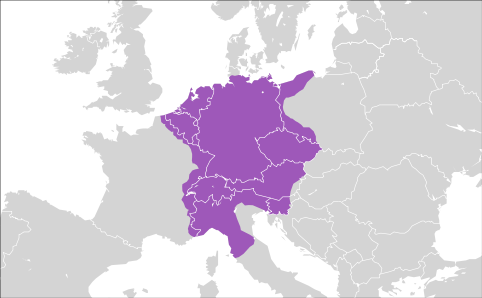
This is from Maria Rosa Antognazza, a philosopher at King’s College London, writing for Oxford University Press’s blog.  (h/t Barry) Check out this map of the outline of the Holy Roman Empire in 1600 AD (it is superimposed onto the outlines of today’s European states):

blog-holy-roman-empire-1600
(source)

It reminded me of this map I produced a couple of years ago showing the GDP (PPP) per capita of administrative units in Europe. What the map illustrates, generally, is a Europe where present-day Austria, western Germany, northern Italy, Switzerland, and Benelux are much wealthier than the rest of Europe (sans Scandinavia).

And here is a map, thanks to Vincent, of GDP per capita in European regions. What his map illustrates, generally, is a Europe where present-day Austria, western Germany, northern Italy, Switzerland, and Benelux are much wealthier than the rest of Europe (sans Scandinavia).

Wow, right? Eastern Germany, Poland, and Czech Republic are poor today, but the rest of what was once the Holy Roman Empire is very prosperous. So, two lines of thought here. One, socialism is really bad for people. It not only destroys economies and political and civil liberties, it also destroys institutions.

The second line of thought is to wonder aloud a bit more about institutions and their long-term viability. The first question that needs to addressed is “what are institutions?” Today, many scholars use “democracy” and “property rights” as generic answers when explaining to the general public what good institutions are, and they are not wrong, but they don’t do justice to the concept of democracy (or property rights, for that matter). I think a better term might be “representativeness,” or “constitutionalism,” or “republicanism.” Anything but “democracy.” Democracy implies rule of the people, but this doesn’t describe what has happened in the West, in regards to political equality and economic growth (both are uneven, but undeniably real).

“Democracy” sounds better than “political institutions favoring separation of powers and coalition-building in parliamentary settings, as well as the inclusion of people who don’t pull the levers of statecraft (through the voting mechanism),” but this shorthand has obvious negative unintended consequences: many a demagogue will use the term democracy to mean something quite different from what actual self-governance requires institutionally.

There is more to the Holy Roman Empire than just path dependency (albeit stretched to its limits). For instance, you’d have to explore why representative institutions in the HRE eventually failed. My quick guess would be that HRE’s neighbors (Russian Empire, French Empire, Ottoman Empire, Scandinavian kingdoms) were pretty ruthless and thus made it impossible for more formal constitutional institutions to take deep root and flourish in the heart of Europe. Instead, because of HRE’s unruly neighbors, the Empire was forever in flux between a loose alliance of petty states and a confederation.

Worth a gander

  1. good piece of American sociology by Jeffrey Friedman (h/t Alberto Mingardi)
  2. Daniel Larison on the devastation in Puerto Rico
  3. Don Boudreaux has the best take I’ve read or heard on the Trump-pro athlete fiasco, and remember when conservatives blasted Obama for sticking his nose where it didn’t belong when cops killed a black kid in Baltimore?
  4. Chris Dillow explains Leftist confusion about Brexit
  5. smart Leftists talking about smart things (penguins, of course!)

A short note on ideological neutrality

William‘s excellent post on dishonesty reminded me of an equally excellent post by John McGinnis over at Liberty Law Blog on the ACLU and free speech. The post ended, though, with the following sentence:

It would be a tragedy for our nation if the ACLU’s decision begins to dissolve the strong social fabric supporting the ideologically neutral First Amendment.

Ach. There is nothing neutral about the First Amendment. It’s a law based on liberal ideology. The idea of free speech is based on liberal ideology. The other ideologies out there pay great lip service to free speech, but there’s no First Amendment in the post-colonial states of Africa and Asia. Free speech is trumped by an ambiguous form of censorship called “hate speech” in other OECD countries (Western Europe, Australia-New Zealand, Japan). There is no First Amendment in Russia or China or Venezuela.

Liberalism is the only ideology out there that actually encourages rival ideologies to attack it, not with provocative laws but with one specific law that allows all factions the same space for their platform. The First Amendment is not neutral at all; it is instead an aggressive flaunting of liberalism’s staying power and ability to deliver freedom.

When libertarians start thinking of their preferred values as “neutral” or “centrist” they begin to echo the Left, which has been dishonest with itself for the past 45-50 years. That’s a road I’d hate to the movement plod through.

BC’s weekend reads

  1. Barry has a book review of Nietzsche’s political thought in the Los Angeles Review of Books!
  2. (check out Barry’s 2014 NOL post on Nietzsche’s contributions to the liberty canon)
  3. a good analysis on the Arab cold war between 2 sets of American allies
  4. a great analysis on the Kurds, the Yazidis, and Turkey
  5. the Zanzibar-North Sea swap
  6. walruses, the Arctic, and science

Lunchtime Links

  1. Trophy-taking and dismemberment as warfare strategies [pdf]
  2. optimally vague contracts and the law [pdf]
  3. Germanic and Carthaginian republicanism
  4. traditional resurgence in tropical Africa [pdf]
  5. crisis bureaucracy: homeland security and the political design of legal mandates [pdf]

Worth a gander

  1. good update on the mayhem in the Middle East
  2. as good as that update is, though: Iraq, Saudi Arabia to reopen border crossings after 27 years
  3. great read on Russia’s Far East and Russia’s travel writing genre
  4. in Russia, Lutheranism (Protestantism) is considered a “traditional” religion (h/t NEO)
  5. how social is reason?

Lunchtime Links

  1. violence among foragers [pdf]
  2. building legal order in ancient Athens [pdf]
  3. why Congo persists [pdf]
  4. toward an old new paradigm in American international relations [pdf]