What is a nation?

This is a reply to Brandon’s latest post. I offer similar thoughts to the below post in my post about ethnicity.

I agree with Brandon that in discussing things we should not limit ourselves to thinking in terms of states. We must consider, as Brandon puts it, both supra and sub states. We must also recall that states are much more fluid than we usually consider them.

When discussing international relations I attempt to get my conversation partners to agree that:

(1) National borders are not stable and,

(2) National identity is more fiction than reality.

The first is easily confirmed by looking at historical maps. Here is a map of the Levant/Greater Middle East in 14th century BC, in 830 BC, in 634 AD, in 1135 AD, and in 1900 AD.

Egypt and Persia are the only two entities that are present in some form or another throughout this time span, and even then their respective borders have fluctuated with only a few core regions being stable. I have yet to find someone who disagrees with the first point.

The second point is harder to get people to concede. We often think of ourselves as a given national identity and find it difficult to imagine that our nation did not exist since the beginning, or at least as far back as imaginable. Most nations have a foundation epic that makes little sense when seriously scrutinized.

Take for example American national identity. Three hundred million plus souls imagine themselves as ‘American’, but what exactly does that mean?

American identity cannot be equated with a specific phenotype; i.e. Americans are not all blue eyed blond people of English descent. In colonial days blacks outnumbered whites in several regions. Today whites in the Mid-Atlantic states are bronze skinned due to the dominance of Mediterranean descent there. The southwest is filled with “Hispanics” who overwhelming self-identify as white but are not considered really white, hence the curious demographic term “non-Hispanic white.” Even in the cradle of the American revolution, Massachusetts, the largest ancestry group is the Irish not English. The only state that is predominantly of English descent is Utah.

Among whites there is constant tension over who was really white and who is a “white negro.” Germans, who are today the largest ancestry group in the US, were the first ‘white’ subgroup to have to fight to prove that they were really white. The Irish, Italians, and others of European descent all had to fight for inclusion into the ‘white’ group. Today Hispanics and Asians are both vying for inclusion.

The revolutionary war serves as the US’ de facto national epic and the leaders of the rebellion are treated (and on occasion sculpted) as demi-gods. Yet the popular image of the revolution is more fiction than reality. Americans paid very little in tax relative to residents of the British isles. George Washington was a horrible military strategist. The founding fathers were not fighting to ensure liberty for the common man – they were fighting to shift control of government from elites in London to elites in Philadelphia. To be sure there were a few true revolutionaries, such as Thomas Paine, who were involved in the hope of genuinely reforming government. For every Paine, though, there were a dozen Hamiltons who wanted to preserve the British Empire, just without the British.

‘American’, in so far as it is an ethnic label, is non-stationary and continually evolving. I would not be amazed if the American label went extinct and was replaced with other labels in the future. Perhaps the Pacific Northwest will become inhabited by Cascadians in the future?

None of this is unique to the American moniker. It is easy to pick on the United States since it is a young nation, but most nations are just as fluid and nonsensical.

What does it mean to be British? Turkish? Austrian? Spanish?

Were the inhabitants of the British isles prior to the Norman invasion British?

The Byzantine Empire was only recently destroyed and many of its inhabitants inter married with Turkic migrants. The Ottomans gave themselves the title of Roman Emperor, “Kayser-i Rum.” A friend of mine jokingly calls Turks “Anatolian Greeks.”

‘Austrian’ as a national identity is arguably younger than the American moniker. Prior to the disestablishment of the Hapsburg Empire in WW1 there was no independent Austrian geopolitical entity. Austria was a constituent member of the Holy Roman Empire, the Hapsburg crown lands, the Austrian Empire, and Austria-Hungary before finally becoming simply Austria following WW1. Austrians are as culturally distinct from other Germans as Bavarians or Swabians are. Why then are Austrians a national group, but the latter two aren’t?

The Iberian peninsula has been under Muslim control (700s~1600s) longer than it has been under a united Spain. Spaniards continue to have significant traces of Arab/Berber genetic material. Despite the actions of Franco, Spanish (or “Castilian”) is not the sole language used in the country. Several million in the country’s northeast wish to cease being Spanish altogether in order to form an independent Catalan.

What is a nation? I argue that it is a group label that is invented and sustained in so far as it serves to further the goals of elites. Within an individual’s lifetime they appear unchanging, but from a historical perspective they are fluid and are frequently created, killed, or reborn as needed. When conversing about geopolitics we cannot ignore national identity, but we must keep in mind that in the long run nationality can be, and is, molded to suit political goals.
Barbarian Liberty and Civilisation in Homer

Following from my last two posts, this will explore the sort of ‘barbarian’ liberty that Tacitus recognised in his time, that is of the early Roman empire, and was further explored by Montesquieu and Humboldt in the eighteenth century in relation to the poetry of Homer. ‘Homer’ here refers to two Greek epic poems attributed to him, The Iliad and The Odyssey, which had a very large presence not only in Greek culture, but in Roman culture which produced a kind of sequel in Latin, The Aeneid of Virgil, a very major work in its own right deserving of separate consideration.

As already indicated Homer shows us warriors of extreme destructive ferocity, who consider it normal and admirable to destroy enemy cities, taking slaves, and collecting loot as well as killing without mercy. A reasonable immediate reaction to that from a liberty supporting point of view is that this is the opposite of what liberty is about, that liberty oriented thought treats  unprovoked violence as the prime evil. Without denying any of that, the kind of violence that the Homeric Heroes engage in is part of a social bond within which voluntary co-operation of some sorts. Here I am referring to heroes not just in the sense of the main protagonists of a story, but the semi-divine status they are accorded in Homer, and by implication which is accorded to them in Mycenaean (late Bronze Age) Greece, where these stories originate.

The Homeric world is one in which there is trade and commerce, but it is regarded as less ‘honourable’ than Heroic violence, including piracy and physical destruction of cites. What this refers to, in fictionalised and poetic ways, is a world of weak enforcement of rules about property and individual security from violence outside small compact communities. Trade is clearly hazardous, running risks of the piracy referred to and maybe trading valuables of a kind acquired by violence, including slaves. Wealth is to a very large degree understood to consist of what can be seized or occupied through violence, including land, livestock and metal objects, rather than the less tangible and physically identifiable wealth of commercial life.

The value of ‘Heroic’ violence is then understandable in a world where there is very limited understanding of forms of wealth and security arising from relations of mutual advantage and respect for rules that apply to more than a small community and maybe its intimate contacts in other communities. Individual achievement and excellence is then understood in very large part as striving for excellence in war, and maybe in associated activities such as competitive sports which may suit strong aggressive warriors, and in which valuables looted in war or even originating with the gods (presumably a metaphoric poetic way of referring to the skilled workers in metal, leather, and precious stones that only the ‘Hero’ class could employ) may be awarded as prizes.

What this picture is building up is the importance of excellence and competition in the Homeric warrior society, and which continues into later stages of ancient Greek society, certainly up to the great cultural achievements and experiments with political liberty and democracy in Athens of the fifth century BCE. Of course the Homeric poetry maybe to a large degree reflects the growth of that culture of individual excellence and competition between whatever tales of Bronze Age wars are the starting point of the oral poetic tradition that leads to Homer and the writing down of the poems as we know them.

The Iliad begins with a story of extreme personal anger at an insult to honour in which the greatest Greek hero, Achilles, withdraws from the war. This is one aspect of the individualistic competitive nature of the warrior culture in Homer and while it is a classic case of uncontrolled temper which threatens social bonds, it is  also a classic case of the growth of individuality. Achilles’ rage is the product of self-awareness of individuality and demands for respect of that individuality, which Achilles directs at someone with some claim to authority over him, Agamemnon the most powerful of the many kings ruling different parts of Greece, and the leader of the Greek league against Troy.

Achilles’ rage does not easily decline and is even increased when the Trojan hero Hector kills his best friend Patroclus. Achilles shows ‘barbaric’ cruelty in not only killing Hector himself, an inevitable response in this world, but in denying Hector’s body a funeral, even throwing it in the dust to decay and be eaten by wild animals. The greatest horror of the Homeric Heroes is to suffer such indignities in death, which are also an attack on the honour and welfare of family and of the community of that dead Hero. In the end, however, Hector’s father, King Priam of Troy, is able to persuade Achilles to return Hectors body and reflect on their shared experience of mourning for loved ones.

What we have in The Iliad is a kind of brutal but real individuality, which at least elevates warriors as individuals above a mass of identical individuals in a collective killing machine. The fierce kind of individuality which leads Achilles to rage at insults to his honour and the death of his friend also shows a capacity to judge wisely in disputes as in Achilles’ way of handling the games which are part of the funeral of Patroclus, and a capacity for empathy with the extreme emotions of others. That is Achilles shows a barbaric strength of warrior individualism and a growth of understanding of impartially administered justice and empathy with the sufferings of others, including his enemies. So we see that ‘barbarian liberty’ encompasses justice within the community and respect of some kind for the individual suffering of others, basic prerequisites for the development of a society in which individual liberty can flourish.

Next week the development of heroic individualism in the character of Odysseus and in The Odyssey.

Gracias, Carlitos

Me refiero a Carlos Bianchi, y el agradecimiento es por habernos enseñado cómo jugar la Libertadores; a los otros dos Carlos que lo merecen ya les corresponderá su post de agradecimiento.

Desde 2000, el record de Boca en la Copa es asombroso. Boca participó en 11 de 15 ediciones, llegando a la final en 6 ocasiones (55%); siempre pasó la primera fase, y sólo una vez se quedó en octavos de final (en 2009, contra Defensor Sporting). En otras palabras, Boca jugó los cuartos de final de dos de cada tres copas disputadas entre 2000 y 2014, y pasó en 6 de 7 semifinales (86%). Para poner esos números en contexto, de los otros 10 equipos que participaron en 9 o más ediciones,* únicamente Peñarol llegó a la final, en 2011 (perdió con Santos). Además de Boca, sólo Inter de Porto Alegre (ganó 2 de 2), Sao Paulo, Santos y Olimpia (1 de 2) llegaron a la final más de una vez.

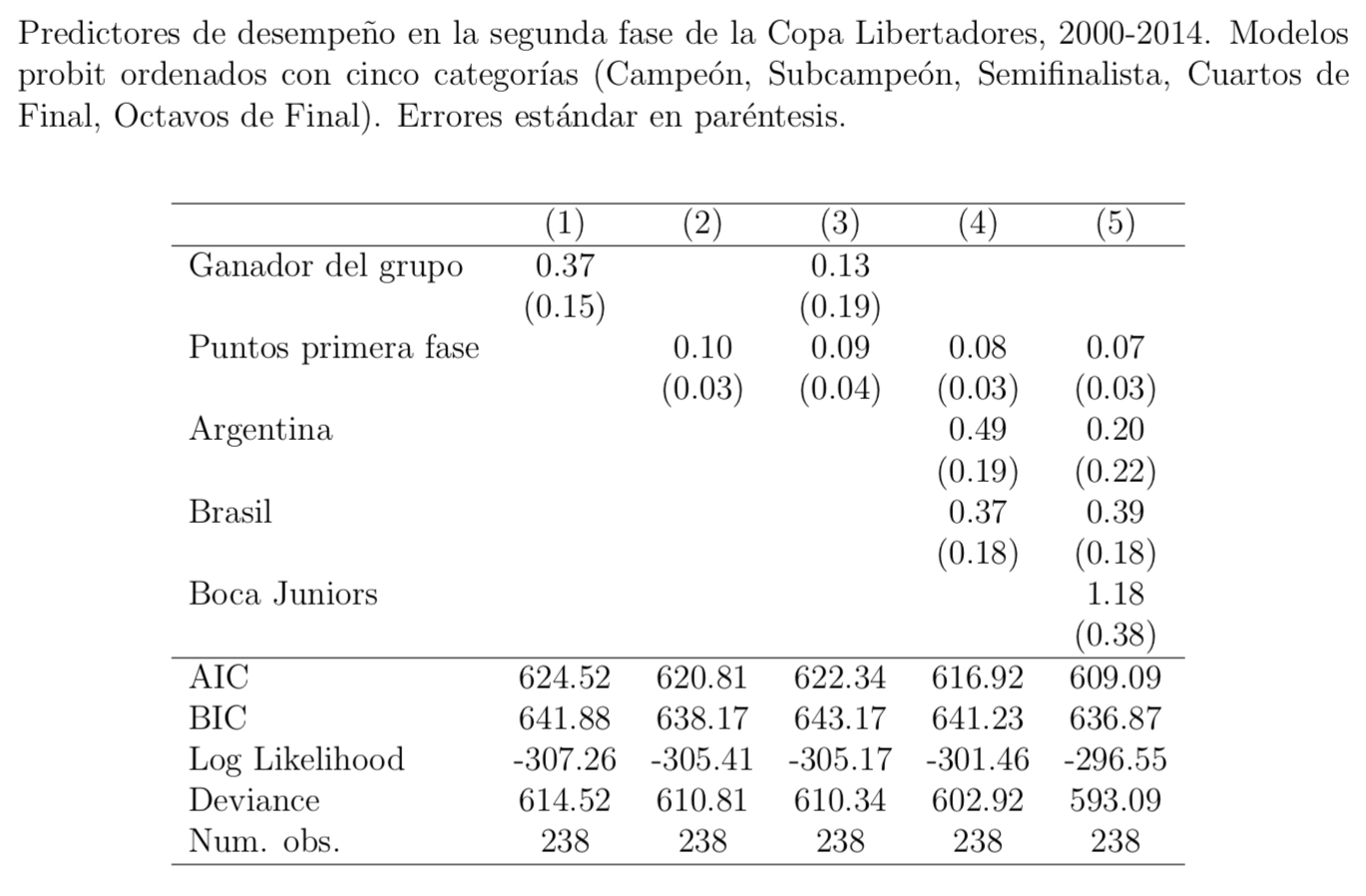
Una forma de examinar esos números con un poco más de rigor es estimar la probabilidad de que un equipo llegue a una determinada instancia (Final, Semi, Cuartos, etc) dadas ciertas variables, como su desempeño en la primera fase o su país de origen. Para ver si ése es el caso, estimé una serie de modelos probit ordenados donde la variable dependiente es la posición en que cada equipo terminó en cada Copa (Campeón, Subcampeón, Semifinal, Cuartos u Octavos). La muestra comprende todos aquellos equipos que llegaron a octavos de final.

Los modelos 1-3 muestran que los equipos a los que les va bien en la primera fase generalmente llegan más lejos, y que el total de puntos obtenidos es más importante que ganar el grupo. Por supuesto, ambas variables están correlacionadas–en promedio, el primero del grupo le saca tres puntos al segundo–, pero a los mejores primeros (y, presumiblemente, a los mejores segundos) les suele ir mejor. El modelo 4 muestra que incluso controlando por la cantidad de puntos obtenidos en la primera fase, los equipos argentinos y brasileños son más fuertes que el resto–lo que es de esperar si consideramos que casi 3 de cada 4 finalistas (22 de 30, ó 73%) vienen de Argentina o Brasil. Sin embargo, el último modelo revela que más que un “efecto Argentina”, lo que hay es un “efecto Boca”: cuando incluimos un dummy para Boca, los equipos argentinos ya no son tan buenos en comparación al resto, pero Boca sí lo es.

TablaGraciasCarlitos

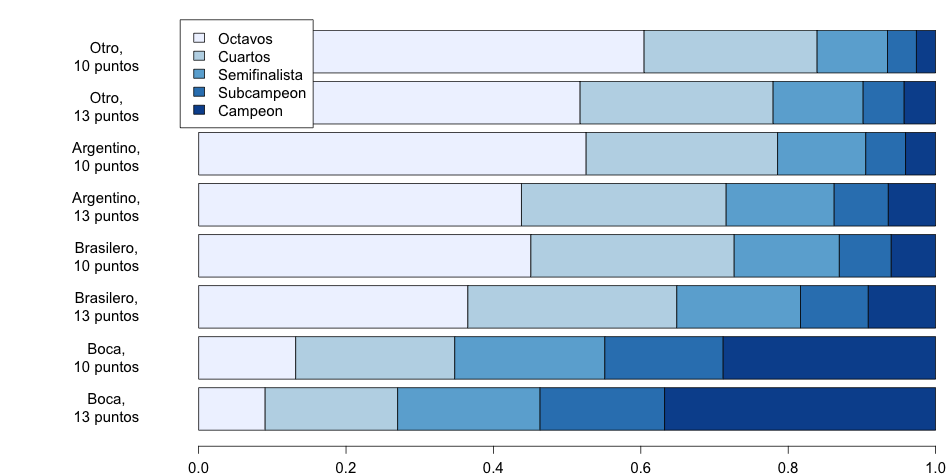
El gráfico de abajo ilustra la magnitude de ese efecto. Las barras indican la probabilidad de que distintos equipos lleguen a una determinada instancia de la Libertadores, dependiendo de su país de origen y el número de puntos obtenidos en la primera fase. Podemos apreciar cómo los equipos que no son argentinos ni brasileños (y los argentinos que pasan con sólo 10 puntos) tienen muchas probabilidades de quedarse afuera en Octavos; asimismo, la diferencia entre un equipo brasileño y uno argentino que no sea Boca es de alrededor de 3 puntos. Pero nada se compara con el Boca post-Bianchi, cuya probabilidad de ganar la final es la misma que la de un equipo brasileño de llegar a semifinales–y ni hablemos de pasar las primeras dos fases.

BocaLibertadores

(*) Los otros equipos que participaron en 9 ó más ediciones son Nacional de Montevideo (15), Cerro Porteño y Libertad de Paraguay (11), Bolívar, Emelec, River, Vélez (10), Caracas, Peñarol y The Strongest (9).

(Publicado originalmente en https://elpaisgeneroso.wordpress.com/)

From the Comments: The Suprastate and the Substate

My post on American Senator Rand Paul’s recent remarks on Kurdistan elicited the following response from fellow Notewriter Michelangelo:

If a neo-Ottoman federation arises I suspect it will begin as a political alliance between Turkey and Israel. Perhaps such a federation will arise from the Mediterranean Union, who can know really. The two countries are already relatively close in interests and are, alongside a few of the Gulf States, the closest things the region has to secular liberal powers. The Turks at this time would not favor an independent Kurdistan though and I fear they might withdraw support for a federation if that was part of the package.

I think it would be easier to first form an Ottoman federation and afterward grant Kurds their independence within the federation.

It is hard for me to imagine the Arabs joining said federation either way. The Egyptian-Syrian Arab republic went nowhere. Part of me (an infinitely small part!) kind of hopes ISIS manages to defeat the Iraqi and Syrian forces and creates the core of a Pan-Arab nation.

I’ll let him have the last word here (be sure to scroll though the entire dialogue), but I just want to take this opportunity to stress the importance of thinking about the world in terms we might not be used to. The standard unit of measurement – for lack of a better term – for thinking about international affairs is the nation-state, but this way of thinking about the world has, like all devices humans use to make sense of their world, weaknesses as well as strengths. To my mind, as the world becomes increasingly interconnected thanks to liberalization, the nation-state becomes less and less useful as a tool for understanding human action.

What Michelangelo is doing here is thinking ahead of the curve; he is applying the notions of suprastate and substate to international affairs. A suprastate is an organization or union that is composed of various nation-states, such as the ones Michelangelo uses in his argument (i.e. “Mediterranean Union”). A substate is a region within a nation-state, such as Kurdistan or Scotland or Somaliland.

Often, especially in debates here at NOL, the notions of suprastate and substate are used in conjunction with the developing, or post-colonial, regions of the world. This doesn’t mean these notions can’t be applied to places like the United States or Argentina. Indeed, the US itself was created as a supranational union in order to combat the strategies of the British, French, Spanish, and various Native nations. If you can entertain the notions of suprastate and substate when you think about human action, you will be that much closer to advocating clearly for the free and open society (see this piece on the informal economy by Dr Gibson, for example).

A proposal to help curb grade inflation.

I have a stack of midterms I’m procrastinating grading, but I’m not simply going to babble on about some minor nuisance in my own life, I’m going to expound on a modest, but promising intervention into the problem of grade inflation which, I believe, costs us millions of dollars every year.

Here’s the basic problem: schools serve a mix of roles, including signaling, human capital formation, and pure consumption. Unfortunately, universities face a problem of grade inflation. I have encountered many students who were very angry that I should even dare to suggest that a C is an acceptable grade. This, despite the fact that C has never been sold as anything but “average- simple, common, adequate but ordinary”.

And why is grade inflation a problem? It makes the signal of a college degree less meaningful. And the result is that students have to pile on ever more credentials at ever more selective institutions to prove themselves. It also leads to students turning school into a GPA maximization game rather than an intellectual pursuit. For top students this isn’t a real problem, but for the rest it may be costly. So here’s my proposal…

Maybe we should be describing the grade distribution as being like the Fahrenheit scale… 73 is just about right; sure it’s a few degrees off, but it’s close enough for government work. 93 Is about as hot as you’d ever really want it to be. Any hotter is superfluous, and besides, this school doesn’t give A+’s. The 90’s are hot; exceptionally so, but the 80’s are pretty warm. Once in a while an 85 degree day can be quite nice, But you don’t really even want too many 80+ grades on your transcript. This is related to a fact that always amazes my students: in econ grad school an A means you over-invested in a class and wasted energy that could have been spent on advancing your dissertation. Too many B’s for a typical undergrad means that they aren’t doing enough intellectual, spiritual, social, and personal exploration outside of class. So what about F’s and D’s? Well, the analogy might fall apart here, but I don’t think we need to sell students on going for F’s, although I think one or two would probably build character.

I think that if this description spread through high schools and colleges then we might just calm the students and parents down a bit. Doing that might just allow us all to slow down enough that the students might actually learn something and retain it.

We Must Have Order!

I sometimes think that the small daily vexations of government do more to wake up regular people than the really big abuses of government. Below is a relevant anecdote.

Seven or eight years ago, the City of Santa Cruz forbade me from cutting the tree figuring in the picture below. It’s a redwood tree. It’s in my tiny front yard. Its invasion of a sewer line cost me $10,000 before I asked humbly for permission to remove the tree. Now, the tree roots are destroying the foundations of my house as well as the sidewalk in front of it. The city says that I am responsible for fixing the sidewalk, indefinitely, apparently because redwood tress grow at least for several hundred years.

redwood in santa cruz

Now, to be fair, the City arborist told me a few months ago privately that if I asked for permission to cut the tree again now, it would probably be approved. It does not do me much good now. She said no when I could afford to cut it now, I can’t afford it. Besides, the city insists that I have to pay for a permit to remove the tree I did not want in the first place. This is more offensive than the much higher cost of taking the tree down which involves real work, at least. (It’s true that I bought the property with the tree on it. I had no idea then that I could even be denied the permission to cut a forest tree.) I am quite insensitive to the need of my city to have redwood trees, specifically, within its boundaries.

First, everyone knows that redwoods are destructive. Moreover, they sterilize the area where they grow. Second, it’s not as if our citizens were deprived of trees, as people might be, say, in Arizona. In fact, there is a large forest a four minute drive from my house, seven minutes by bicycle, tops. It’s a 90% redwood forest. It’s not clear to me that I must recognize a duty to subsidize the redwood viewing of residents and visitors who are too lazy to drive or bike there.

Note my delicateness of mind: I admit that many of my fellow Santa Cruzans would be morally torn between the desire to commune with redwood trees, on the one hand and their fervent wish to not contribute to global warming by driving four minutes, on the other hand. But I think they can just bike there, or walk. I also admit that there are people in Santa Cruz who don’t own a car and who are physically unable to bike or walk to the forest. I would be in favor of a city-sponsored collection to bus them to the redwood forest four times each year. I would gladly contribute, voluntarily, that is.

Two deeply different views of the world are at odds here. Now, let me assure you that although I am a conservative, I like trees. I like cherry trees and apple trees mostly, for obvious reasons, but redwoods are OK because they give high grade lumber. And, yes, they look wonderful. That is, they look wonderful where they belong, in a forest, with their brothers and sisters and all the cousins around. My own redwood tree (the tree that my family and the City apparently jointly own) is a object of shame. It’s so bad, that I never use it to give directions to my house although it stands right out. It’s an object of shame because PG&E, the publicly regulated monopoly, has the right to shape it in any way it chooses. I am sure there are technicalities that escape me here but the shape it prefers makes my redwood tree look like an old, overused toilet brush. Sorry for the vision, I call them as I see them!

Well, I planted a yellow rose bush nearby and the bush found the spot attractive. It grew and grew under my firm benign neglect. Eventually, it had to discover that the nearby redwood tree makes a good ladder to the sun. The result is in the photo above. Well, I think you are not going to believe this but a member of the leftist and left-liberal city council complained about the rose bush on the tree. She says it looks unkempt. Here you have it – not left-wing thought, there is no thinking involved here – but the leftist temperament in a nutshell: Things have to be neat; personal preferences do not matter; bureaucracies give you predictability even if at stupendous cost, the market is inherently messy. We must have order even if it impoverishes our lives.

Robert Tracinski on the Left’s Anger Issues

Ooo-weee. I apologize for not being around very much this week. I’ve been bumming around and just got back into civilization in order to enjoy the second weekend of March Madness.

I have viewed Leftists as cowards for a long time now. Now, whether or not being a coward is a good thing is another question, but I nevertheless view them as cowards. Angry cowards are the worst kind of cowards, of course. Here’s Tracinski trying to figure out why Leftists are so angry:

There’s the fact that those of us on the right are accustomed to encountering a lot of ideological opposition. For most of our lives, the left has controlled the high ground of the culture, such as it is: the mainstream media, Hollywood, the universities, the arts. So we’re not used to crawling into a “safe space” and hiding from ideas we disagree with, which makes it easier for us to regard ideological opposition with a degree of equanimity.

The rest of the essay is pretty good, too. What’s that old school term for a coward? The dog who is all bark and no bite? I remember these type of people well, from when I marched in San Francisco against the Iraq War. If tomorrow’s best and brightest Leftists are refusing to even consider the opposition’s arguments, what does that say for the future of the West?

But really, though: How on earth did the government come to be in charge of the roads?

More on Liberty and Homer: Tacitus, Montesquieu, and Humboldt

As I have discussed before here, there is a way of writing about liberty in a conscious focus on political thought, which finds liberty to be emulated in some respect, going back at least to the first century Roman historian Tacitus. He was referring to the condition of the ancient Britons, within the Roman Empire, but rebelling against it, and the ancient Germans who could not be incorporated into the Empire.

The latter situation may have been at least as much for economic reasons as for the German fighting spirit, but they were certainly difficult to overcome and inflicted one of the great defeats on the Roman legions, at the height of Roman power in the Battle of the Teutoburg Forest in 25CE.

The image of barbarian liberty in Tacitus was certainly in some part shaped by Homer given the deep impact of Greek culture on the Romans, and most relevantly in this instance through the continuation of Homer in the greatest latin epic, Aeneid, which links Rome with the Trojan prince Aeneas. As I pointed out before here, Tacitus’ idea of barbarian liberty strongly influenced Montesquieu’s The Spirit of the Laws (1748, a work I will be posting on in future), whose view of liberty in modern Europe, in brutal but meaningful summary, was of a combination of Roman law and Germanic individualism.

Montesquieu was of course a great part of Classical Liberalism and we can follow up his interest in barbaric liberty with reference to other classical liberals. David Hume and Adam Smith, who were writing after Montesquieu, tended to write on ‘barbarism’ and a related idea of ‘savagery’ with some anxiety regarding the possibility that such societies, or societies closer to that stage than those European nations where civil society had advanced the most, might overwhelm commercial legalistic nations with their unrestrained force.

However, some element of respect for liberty in the most simple societies does manifest itself at times, but mostly through an interest in the earliest stages of the Roman and Greek republics of antiquity, which in Montesquieu’s thinking come between the Germanic individualism and the late Roman legalism. Tacitus was thinking of the ‘virtue’ (in the sense of patriotic courage and love of law) of the early Romans when addressing the courage, rough individuality, and fierce independence of the Britons and Germans.

The most interesting way of linking back from Enlightenment liberalism of the Eighteenth century, for me at least, is via Wilhelm von Humboldt, a thinker I will address in at least one dedicated post in future. Humboldt’s major contribution to political thought, The Limits of State Action, was written in the 1790s, so another generation on from Montesquieu, just after Smith and Hume.

At this point, we might think of a movement from Enlightenment to Romanticism in European thought. While we should be very careful about such general distinctions, and amongst other things not engage in simplistic oppositions, it is appropriate to think of Humboldt as belonging to a phase of interest in the history and current meaning of aesthetics, literature, culture, and language as part of the study of political ideas.

He was in fact a major thinker about language and the infinite capacities inherent in the combinatory nature of language, which was part of his thinking about individual human capacity and the power of voluntary co-operation.

It is the interest in aesthetics, language, culture, historical existence, and the capacity of the inner human which makes him ‘Romantic’ rather than ‘Enlightened’, though again we should avoid stereotype and simple opposition here. Humboldt was very much not against Enlightenment respect for reasons, and some of these ‘Romantic’ themes are in ‘Enlightenment’ texts.

One of the earlier big classics of Enlightenment, The New Science (1725, 1744) by Giambattista Vico, is a good example and that is a book giving great importance to Homer. Vico is someone else who merits at least one dedicated post, so there will be more about him at some point. I am not aware of any evidence that Humboldt read Vico, but he certainly made an impression on German thinkers of the time.

Anyway, Humboldt was a learned classicist from a philological and literary way, which has an impact on his idea of how liberty was strengthened in antiquity, which compensated for the tendency of the ancient state to interfere in the soul, as Humboldt thinks of antique laws and institutions to promote moral and religious traditions.

What compensates for this pressure on liberty is the struggle in the lives of ancient humans, which has two main aspects. First the struggle with nature to have enough food and shelter to preserve life. Second the military struggle with rival states and communities, which was a very frequent experience in antiquity, and was an aspect of the history of the early Greek and Roman republics.

The best place to look for that in antique sources is Homer, because of the breadth of the Homeric world, as well as its poetic qualities, as well as its enormous influence on Greek and Roman culture. I had meant to address how the kind of struggle which can promote some kinds of liberty does appear in Homer, but this post is already long enough, and the best thing is to address Homer directly in the next post.

In the meantime, careful reading of any of the translations in books and post on websites, of The Iliad and The Odyssey (or indeed the original Greek for those fortunate enough to have that linguistic capacity), should I hope provide material to confirm what I’m suggesting.

Review of “The Age of Abundance: How Prosperity Transformed America’s Politics and Culture”

I just finished one of the best books I’ve read in a long time, so even though it’s been out since 2007 I’m going to review it: “The Age of Abundance: How Prosperity Transformed America’s Politics and Culture” by Brink Lindsey.  A second subtitle reads, “Why the Culture Wars Made Us More Libertarian.” It would be a shame if that subtitle put off some potential readers because the book isn’t a libertarian tract, not by a long shot. It’s a fine piece of sociological analysis, rigorous yet readable.

I lived through the post-war transformation of America but that doesn’t mean I really understood what was going on. I understand a whole lot better now thanks to Lindsey’s book. My mother struggled through the Great Depression, by necessity developing a scarcity mentality, some of which rubbed off on me. But as postwar abundance spread, overcoming scarcity was the driving motivation for fewer and fewer people. Instead, mass affluence became the norm. My cousin in Ohio, for example, spent his entire working life as a diesel mechanic for Ford Motor Co. Over the years he and his wife acquired a nice house, a boat, three cars, and took cruises abroad. He worked very hard, but so did his forebears, and they never had what he had.

Mass affluence gave people free time and energy to explore the meaning of life. The New Age, or the Aquarian movement as Lindsey calls it, burst forth in the 1970’s. Having participated peripherally in some of the “personal growth” movements of the time, I can attest to two things. First, most of it was nonsense. I’m chagrined to look back on some of the groups I got into, and glad that I never went overboard with any of them. Second, I’m grateful for some of the genuine growth I experienced during those times. Crucially, I never questioned the work ethic that I inherited from my mother. I grew a beard, but otherwise dressed conventionally and held a steady job.

Almost nobody in the personal growth movements of the time understood that they owed their newfound freedom to mass affluence and that that affluence resulted from the capitalist system which many of them liked to deride. (An exception would be the tiny libertarian movement of the time which for some people was allied with the personal growth movement.) Most participants looked down their noses at hard workers like my cousin.

As it happens, the capitalist system not only survived the Aquarian onslaught but found ways to make a buck from it, adapting and softening its revolutionary fashions, music, and entertainment for a mass market. Capitalism, far from keeling over, co-opted the movement and moved on.

Then came the evangelical backlash, a movement I never had any truck with. The system survived the evangelicals’ attacks on personal liberties.  The upshot, says Lindsey, is that while these two forces pulled at the capitalist center (or the free-market center as I prefer to call it), the system survived and has actually thrived. Out of it all, we are learning to balance liberation and responsibility. Here’s how he puts it on p. 316 of the hardcover edition:

Out of the antitheses of the Aquarian awakening and the evangelical revival came the synthesis that is emerging today. At the heart of that synthesis is a new version of the middle-class morality—more sober, to be sure, than the wild and crazy days of “if it feels good, do it,” but far removed from old-style bourgeois starchiness or even the genial conformism of the early postwar years. Core commitments to family, work, and country remain strong, but the are tempered by broad-minded tolerance of the country’s diversity and a deep humility about telling others how they should live.

As you can tell, Lindsey is a masterful story teller. He adds statistics occasionally; more would have been welcome. I doubt that he will ever get his material published in a sociology journal. Not only is he “politically incorrect” but his writing is too clear and too compelling. By the way, do you see the dialectics in this passage? Lindsey never uses the word, but there it is: Aquarian thesis, evangelical antithesis, libertarian synthesis. Fascinating.

A History of Regional Governments (Part 1)

Cities have historically been compact hyper-dense communities. This is because cities have been constrained in size by the average resident’s capacity to reasonably travel throughout the city within a day. Cities built before the dawn of the automobile are often noted for being walkable. It is doubtful that the walkability of these cities is due to any planned attempt to make them so as the urban planning profession is a relatively new discipline. Rather older cities are walkable because they had to be. For most of history the average man could only travel as far as his own legs could take him. Horses and other beasts of burden substantially increased one’s travel range, but even up to the 19th century ownership of such beasts was beyond the reach of the every man. Any real estate developer who attempted to build outside a city’s natural growth boundary would as such find it difficult to attract the necessary foot traffic to make his endeavor economically feasible.

This constraint in outward growth also led to older cities being easily dominated by a single local authority. This changed with the creation of the automobile. As noted above, a beast of burden was already capable of extending the effective range of their owner. The automobile similarly would have done little to influence the growth of cities if it were inaccessible to the average man. What made the automobile such a game changer to the future of cities was that it was within the reach of the average man’s finances.  In their early days, as in our own, automobiles presented a serious financial investment but were nonetheless cheap enough to afford.

With the advent of the economic automobile the general public was no longer constrained to the urban core. Attracted by cheap land prices in the periphery an increasing portion of the city settled in the periphery region – the so called suburbs. The development of suburbs had several immediate effects, but of interest to us is its effect on local government. At first cities attempted to annex the suburb regions but it was not before long that some suburbs rejected annexation. One of the first such cases was in when Brookline, a wealthy suburb of Boston, rejected annexation in the late 19th century. Even some suburbs which originally agreed to annexation changed their minds and fought to regain their independence.

Suburb residents had been driven to migrate from the cities in search for cheap housing, but they also valued their new found independence from urban politics.  Many suburbs elected to instead incorporate as cities by their own right. Despite their political independence the suburbs remained economically tied to the mother cities. It did not take long for the limits of this style of organization to be realized. In the greater New York metropolitan area New York and New Jersey local governments found themselves unable to settle basic questions regarding their common port. Meanwhile in Los Angeles the various local governments were unable to efficiently synchronize their electric current systems. Los Angeles proper synchronized its electrical system with the rest of the nation in 1936 but the rest of the metro didn’t make the switch for another twelve years. In greater Boston the suburbs found themselves unable to provide for quality running water and other basic utilities. These problems only increased as population growth increasingly favored suburbs and urban sprawl intensified.

Early reformers suggested the creation of a new layer of government, between state and local government, which would preserve the independence of the suburbs whilst creating a central authority capable of providing for regional needs.  Attempts to create regional governments were retarded by the actions of local governments who jealously guarded their own powers. It is unclear what would have happened if things would have been allowed to play out without federal intervention.

It was at the height of the New Deal era that the modern regional government was born. The Roosevelt administration began to encourage regions to form councils of government and other regional government associations if they wished preferential federal aid. The Truman and Eisenhower administrations codified this policy with the Housing Act of 1949 and 1954 respectively. Section 701 of the 1954 Housing Act in particular would serve as the benchmark for years to come in promoting the creation of regional governments. As a result of these actions almost one hundred regional governments were formed. The regional governments formed tended to be in name only. Local governments agreed to their formation in order to secure federal funding but granted their regional counterparts little actual control in day to day affairs. Regional governments were relegated to providing technical advice to local government and to aiding state government with paperwork, but were unable to pursue their own objectives. Meanwhile the growth of the suburbs continued strong, aided in part due to the return of WW2 veterans and the preferential mortgage packages offered to them.

The federal government attempted to bolster the strength of regional governments with the passage of the Highway Act of 1962. Thus far federal legislation had merely given preferential treatment in aid allocations towards regional governments. The Highway Act of 1962 made federal aid contingent on having areas with a population greater than 50,000 create a regional development plan. In practice the act gave regional governments little power as the language was broad enough to allow state and local governments to circumvent them. Once more regional governments found themselves with little teeth and better termed advisory bodies.

Epstein on Rand Paul’s foreign policy views

Published a while ago, still a good read: “Rand Paul’s Fatal Pacifism.”

Around the Web

  1. Contrary to popular myth, Democrats are just as ideological as Republicans, and Republicans are just as group-centric Democrats
  2. The Rule of Karlowitz: Fiscal Change and Institutional Persistence (pdf)
  3. The Privilege of Checking White Privilege
  4. The Wealth of Subnations: Geography, Institutions, and Within-Country Development (pdf) (h/t Adrián)
  5. Shakespeare in Tehran “I also noticed among the men a few who stood apart and did not seem to be either students or faculty. It was not difficult to imagine who these might be.”
  6. The new economic history of Africa (pdf)

Which MPOs are most efficient?

I have been working on a project to measure the efficiency of Metropolitan Planning Organizations (MPOs). MPOs are one of the levels of government often forgotten. When we think of government we usually think of federal, state and local government. MPOs lay between local and state government. My local MPO for example, the Southern California Association of Governments (SCAG) for example covers all of the southern Californian counties except for San Diego. Other MPOs, such as the Delaware Valley Region Planning Commission, cross over several states. Nominally MPOs are concerned with setting transportation policy, but in effect they have broad powers over many areas of regional economic development.

Most MPOs have no elected leadership and instead either appoint their own heads or draw from their constituent members. By no means am I a little ‘d’ democrat; I do not see much value in democracy to decide public policy. It is however concerning that these form of government have little oversight over them of any sort. My hope is that my work will provide much needed information on how well (or badly) these MPOs are doing their jobs.

I am attempt to rank MPOs on two basis: transportation services and air quality. Below is a ranking of the top 77 largest metro regions by their adjusted cost efficiency for providing transit services. I used metropolitan level data from 1991 to 2011 to construct these figures. By adjusted I mean that I attempted to take into account for factors that affect their cost efficiency, namely level of federal funding which is negatively associated with cost efficiency. I hope to be able to better calculate these figures in the future taking into account spatial factors that affect efficiency, but I have to start somewhere right?

1. Raleigh
2. Virginia Beach
3. Honolulu
4. El Paso
5. Orlando
6. Wichita
7. Memphis
8. Baton Rogue
9. Cincinnati
10. Indianapolis

….

70. Bridgeport
71. Akron
72. Seattle
73. Albuquerque
74. Knoxville
75. Worcester
75. Dallas
76. San Jose
77. McAllen

The full ranking can be found here: Efficiency Residual.

Thoughts?

Liberty and Homer

The ‘Expanding the Liberty Canon’ label is not adequate for some texts that ought to be discussed with regard to liberty, since they have something important to say about liberty, but even on an expanded inclusive definition cannot be said to put forward a case for liberty, certainly  not from the perspectives of classical liberalism, libertarianism, the liberty movement, or any other label for thinking which favours liberty understood as individual rights, markets, voluntary association, and rule of law over communalism, collectively directed distribution, state domination of society, and administrative rules.

I have plenty of further texts to discuss under the ‘Expanding the Liberty Canon’ heading, but here is a beginning to the ‘Liberty and…’ sequence. It is an appropriate starting point in that the epic poems associated with the name of Homer, The Iliad and The Odyssey are at the very beginning of European literature, culture, and knowledge. This is not say that there is pure beginning to Europe’s cultural and intellectual heritage with no precursors and no outside influence. It is to say that these are the first big texts in the history of anything that can be labelled European history. The name ‘Homer’ conceals considerable uncertainty about whether these poems have a single author and if so who.  What can be safely said is that these are long poems written down in approximately 800 BCE, drawing on a long oral tradition of sung poetry, referring to a world of Mycenaean late Bronze Age Greeks, who traded with and fought with the peoples of Anatolia, in a civilisation that disappears from the archaeological record in about 1 100 BCE.

On the side of Homer not being a hero of liberty is the apparent endorsement of a world where war and piracy have greater respect than trade and manufacture, the greatest role for a man is to defeat enemy armies and sack their cities, women’s role is to stay at home, do a lot of weaving, and obey their husband. Political authority is patriarchal-monarchical, based on the claim that kings are warrior-hero aristocrats are close to the gods. Ordinary people are deprived of choices and influence, subordinated to the hero-aristocrat class and may even be slaves. In The Iliad, a league of Greek kings lays siege to Troy for ten years, purely for reasons of honour connected with a Trojan Prince taking a Greek queen from her husband back to Troy. The violent destruction on enemy cities, the enslavement and murder of civilians, the organised theft of property are all part of the value system of Greeks and Trojans. In The Odyssey after various adventures on the way back from Troy, Odysseus massacres a group of aristocrats who have been trying to marry his wife during the twenty years of his absence, living in his palace using up the wealth, and follows this up with a massacre of those servant women who were too friendly with the massacred men.

So where does liberty come into this world of violence and traditionalist authority? One part of the answer to this question is that maybe the Homeric epics are critical of this world, at least in some part. The exploration of where there might be a critical distance in the Homeric poetry from the most disturbing aspects of the world it depicts gets into much detailed and questions of ambiguity to pursue here, but is something to bear in mind when reading Homer. Leaving that aside, there is the underlying issue of the formation of a world of poetic creation, which in some degree must be distant from and reflect on a world, so raising the possibility of individual critical perspectives.

Anyway, even staying at the level of the more direct and literal meaning, it portrays different possibilities of individual character and ways of being. In The Iliad we are see Achilles the proud angry warrior who lives to become the hero of song, even if that means dying young. His devotion to violence co-exists with a belief that he has rights as an individual against his overlord, a passionate devotion to his best friend, a capacity to overcome his angry nature when he allows the father of the Trojan hero, Hector, who killed his friend to take the body for honourable burial.

Hector himself has a near Achilles level of ‘heroic’ violence combined with a deep and self-effacing attachment to his wife and child. Many other possibilities of human individuality are explored including that of the most intelligent and cunning of the Greek leaders, Odysseus, who understands that war is won by stratagems as well as devotion to violence. This man of reflection, forethought and an early form of the life of the mind, becomes the centre of the second Homeric epic, The Odyssey, which recounts the ten years of his journey back from Troy to his homeland of Ithaca.

Odysseus starts back with his own fleet of ships carrying an army of Ithaca, by the time he gets back to Ithaca all of this is lost, and he is alone, in disguise playing the part of a vagabond when he arrives on his home island. Early in his adventures he described himself as No-man to trick his way out of danger from the giant Polyphemus and then proudly shouts his real name at the giant on his escape. This is at the base of his ten year journey since the god Poseidon is the father of  Polyphemus and takes revenge on Odysseus when Polyphemus can tell his father how Odysseus harmed him. Again and again Odysseus has to struggle with his own impulses and with the need to play a part, stretching his identity, in order to return to his island kingdom. So he is growing as an individual, exploring all the possibilities of individuality, including self-concealment, self-invention, and self-transformation.

The extreme violence of the return of Odysseus is followed by the brief description of a new beginning in Ithaca, an order of social peace in which a possible cycle of revenge is pre-empted through oaths and the prospect of justice settling differences rather than violence. This reconciling ending of The Odyssey itself builds on the sombre peace at the end of The Iliad, when a truce is agreed so that the city of Troy can bury and mourn its hero Hector, so that the values of peace and acknowledgement of individual suffering can stand up against the cycle of destructive violence.

In these and many other ways, Homeric epic offers much to stimulate thought about the nature of individuality and the kinds of social form which might allow individuals to flourish together, even in its depiction of the most destructive outcomes of human passions.

Mexican immigration and the Open Border: Mexicans Go Home and Mexican Kindness

I just returned from a two-plus weeks stay in Mexico for the second time in less than five months. A couple of comments to add to my previous essay on Mexican underdevelopment. Plus, some unrelated political sociology comments.

In 2009, my friend and I published a long piece on Mexican emigration to the US in the libertarian periodical The Independent Review. (Nikiforov and I are both immigrants to the United States.) The article is entitled, “If Mexicans and Americans Could Cross the Border Freely (pdf),” and the full text is available through a link on this blog. In that article, we argued that we would all be better off if the southern American border were open to crossing by citizens of both countries with no expectation of a change in citizenship for either.

Well, the politicians did not listen to us then and their inattention led to the recent Republican fiasco whereas, President Obama used an executive order to more or less legalize five million illegal aliens, most of them Mexicans whereas, the Republican Senate called him out and ended up caving piteously. (Do you remember or have you already forgotten? Stupidly, Republicans tried to use the threat to de-fund Homeland Security at a time when aggravated terrorism news fill the airwaves.) As often happens, the Republican leadership confused the issue of constitutional principle with the substantive issue of limiting immigration. Myself, I would chose total firmness on the first and flexibility on the second, for fear of ending up the A.H., no matter what the outcome. The Republican leadership lost the constitutional arm wrestling and still ended up the A. H. Congratulations, guys!

Our article was long and intricate as is normal for a scholarly piece. Here are two highlights from that piece on which I wish to comment after my two recent stays in Mexico:

A We argued that Mexicans – who constitute the largest immigrant group to the US – should be given special treatment over other aliens. Several reasons for this: They are our close neighbors; they have been joined to us through NAFTA for now 23 years, insuring that our lives are tightly enmeshed economically. Then, because of a long series of past interactions some may find deplorable, Mexicans tend to make very good immigrants. Two reasons for this superiority, in turn. First, nearly everyone agree that Mexicans (in the US) tend to be very hard workers. Even their direct competitors in the work place tend to assent to this judgment. Second, sociologically, Mexicans make good immigrants because they are astonishingly familiar with our society, including with our institutions, before they set foot on American soil. In particular, Mexicans don’t find perplexing our fundamental constitutional principle of separation of religion and government. (That’s, as opposed to immigrants from other areas I could name.)

Nikiforov and I argued that Mexican citizens should enjoy unimpeded passage into the US, and the freedom to take any job for which they qualify, all without any path to American citizenship because, Mexicans already have a citizenship, that of Mexico. We point out that the European Union has used this model for more than twenty years and experienced few downsides. (The current ferment in Europe about and opposition to immigration does not involve neighbors from the EU, with one single exception I will discuss if someone asks me.)

B We proposed that many Americans would find it comfortable to spend their last years in Mexico because of a specific aspect of Mexican culture, to wit, contemporary Mexicans tend to be sweet in general and considerate to older people in particular.

This is what I found in twice two and half weeks in Puerto Vallarta in the pas five months that is relevant to these issues.

First, on the matter of Mexicans wanting to work in the US but not necessarily wishing to live there, we were much more right than we thought when we wrote about this. The anecdotal evidence is overwhelming that this would work. Everywhere I went in Puerto Vallarta , I bumped into people who knew some English that they had learned in the US, mostly as illegal immigrants here working at undesirable jobs. None of those people had been expelled, deported. All had returned to Mexico under their own power after saving some money. Thus, they had chosen to go home because it’s home, just as we predicted in the article.

One middle-aged man sticks to my mind, a taxi driver. He had stayed in the US (illegally) for several years. He had refrained from visiting with his family in Mexico for stretches of two or three years at a time to avoid being unable to return to the US. You might say that he was trapped in the US for longer periods than he wished because of our immigration laws. He finally decided to go back to Mexico and to his family for good after he had saved enough money to build a house for each of his three daughters. He specified that only one of the daughters was of marriageable age by the time he had the three houses standing. To my mind, this is an exemplary story of emigration/immigration. On my query, the man declared himself satisfied with his choice and with his life since his return from the US.

He was earning, driving a taxi, about 1/5 or less of what he earned in the US doing unpleasant work. He liked his job; he enjoyed returning to his family every evening; he liked the schools; paradoxically, he liked Mexican schools. (This is paradoxical because daily life in Puerto Vallarta, including in the schools is much more relaxed, much more genteel than what prevails in the US except in the most elite neighborhoods. In that part of Mexico, the bloody drug traffic-based blood-thirsty banditry is found strictly in the newspapers. It is not at all apparent in daily life. The quality of this daily life is at the antipodes of the impression of Mexico reaching us through the US media. Gangs are not in the school unlike in Salinas, California, for example.)

On point B, the attractiveness of Mexico to older Americans, I find that I tend to censor myself anytime I write about the topic because I fear appearing to be gushing like a teenage girl. During my last stay, of two and half weeks, I did not meet a single Mexican man, woman or child who was not completely pleasant except two. One was a taxi driver and he was morose but, that’s because he was drunk. (Nobody is perfect.) The second was a female merchant who acted displeased because I tried to bargain down an item in which I was interested. Another merchant – from whom I actually bought and whom I befriended – told me later that my bargaining had been reasonable and that the woman was undergoing a painful divorce. Mexico is not perfect and I may have looked like the woman’s soon-to-be ex-husband. You never know; these things happen.

Absolutely everywhere, my gray beard drew the kind of respectful behavior I don’t expect in the US. (And that I don’t deserve, to be honest!)

I can hear the snickering from here: “Of course, he stays in a tourist ghetto were everyone is occupationally obligated to appear nice.” No, I did not spend all my time there; I was forced to go out and I liked to go out. I found that everyone smiles a lot, including at each other, even among perfect strangers, that everybody ceded passage, that waiting lines are always orderly. Being a formerly great social scientist, I yielded, of course, to the temptation to conduct verbal experiment. Unfailingly, I made everyone I wanted to laugh at the drop of a hat. I mean small children, old ladies and adults of all sexes. (Yes, my Spanish is that good. Eat your heart out or learn to conjugate irregular verbs! Those are your choices. There are no others.)

Issue A and B are joined in the strangest way within my latest short stay in Mexico. Puerto Vallarta in the winter is swarming with Canadians. Their flight from the cold may have a great deal to do with this fact but it has a virtuous side-effect. I suspect many flew in to warm up and ended up warmly loving Mexicans for the reasons I depicted above. They beat Americans at it, in that city, at least. Oh, and the only sullen faces around Puerto Vallarta all belong to them. It became a game of pop-sociology for me: guessing from afar who was American and who was Canadian. It soon become embarrassingly easy: The Americans are the loud ones who say hello and who laugh easily. (Besides, I think the presence of Canadians explains much of the bad food there.)

After this last experience, I am very tempted to start a new racist fad: Speaking ill of and persecuting Canadians. It could be fun and they are not (yet) a federally protected minority.